Tag: Fine Art

Shipping Large Framed Art Safely: The Collector’s Guide to Global Art Logistics

True art preservation doesn’t end at the gallery wall; it’s a disciplined exercise in structural engineering and environmental control that begins the moment a masterwork is moved. For the discerning collector, the anxiety of watching a definitive Slim Aarons or a rare Terry O’Neill photograph leave in a crate is palpable. You understand that a single hairline fracture in the glazing or a warped frame doesn’t just damage an object, it diminishes a piece of history. Mastering the nuances of shipping large framed art safely is the only way to protect your investment from the unpredictable rigors of global logistics.

We’ll guide you through the sophisticated techniques that international galleries use to ensure pristine arrivals across borders. You’ll gain a clear understanding of professional packing standards, from the necessity of custom-built crates to navigating the complexities of “ugly freight” surcharges and the 5.9% rate increases implemented by major carriers for 2026. We’ll demystify insurance jargon and international requirements like CITES certificates, giving you the confidence to select a courier who respects the prestige of your collection as much as you do.

Key Takeaways

  • Discover how to counteract the “Trampoline Effect,” a phenomenon where vibration and lateral shifts can compromise the integrity of oversized glazing and canvases during transit.
  • Identify the museum-standard materials essential for preservation, including acid-free Glassine paper for emulsion protection and glass-skin tape to safeguard the print surface.
  • Master the criteria for selecting between heavy-duty cartons and ISPM 15 certified timber crates to ensure compliance with international biosecurity and structural standards.
  • Implement a meticulous, multi-step packing sequence for shipping large framed art safely, utilizing professional moisture barriers and archival face-protection.
  • Gain an expert understanding of white-glove logistics, ensuring your fine art acquisition maintains its pristine, gallery-standard condition throughout its journey to your collection.

The Physics of Fragility: Why Large Framed Art Requires Specialist Handling

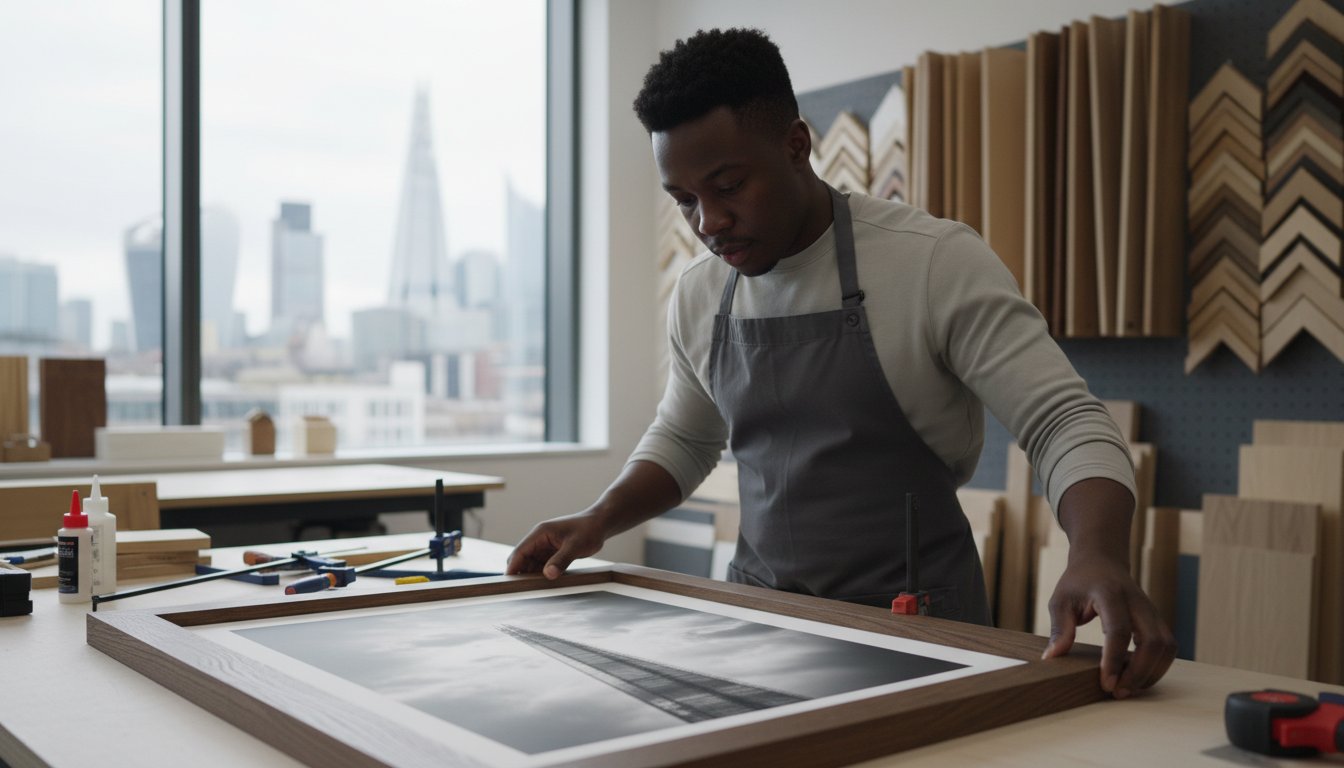
Large-scale photographic art is a marvel of presence, yet its physical scale introduces a complex set of structural liabilities. When you’re shipping large framed art safely, you’re managing a delicate distribution of weight and tension that smaller works simply don’t possess. Oversized frames act as long levers; even a minor lateral shift during transit can exert massive torque on the mitered corners. This structural vulnerability is why professional art handlers treat every shipment as a unique engineering challenge. Without rigid external support, a bespoke frame can easily twist, leading to popped joints or compromised mounting.

The “Trampoline Effect” represents one of the most significant hidden dangers for collectors. In large glazing or expansive canvases, the center of the material acts like a drum skin. Continuous road vibration or air turbulence causes these surfaces to oscillate at high frequencies. Over a long-haul journey, this vibration can fatigue the internal supports. In the most severe cases, the glazing can actually flex enough to tap against the photographic emulsion, causing irreversible scuffing or “ghosting” on the print. A standard “Fragile” sticker is a polite suggestion, but it offers no defense against these internal physical forces or the extreme humidity fluctuations found in unpressurized cargo holds that can cause paper fibers to swell and ripple.

The Glazing Dilemma: Glass vs. Acrylic in Transit

Traditional glass provides exceptional clarity and scratch resistance, but its sheer weight adds significant stress to the frame’s structure. More importantly, glass carries the risk of catastrophic shattering, where a single impact can send shards through a priceless photographic archive. Acrylic is often the preferred choice for international transit due to its impact resistance and lighter profile. However, it presents its own challenges, specifically the generation of static electricity that can attract micro-particulates to the print. Glazing stress is the primary cause of transit cracks.

Frame Integrity and Corner Stress

Gravity is a constant adversary for large-scale bespoke framing. When a piece is stored or transported horizontally, the weight of the glazing and the frame itself pulls downward on the center, often leading to bowed wood or structural failure. It’s essential to maintain a vertical orientation throughout the shipping journey to ensure the weight remains evenly distributed across the bottom rail. Ornate or heavy wooden frames are particularly prone to weak points at the corners. These joints must be reinforced with specialized padding to prevent the frame’s own mass from pulling it apart during a sudden stop or shift in the crate.

Crates vs. Heavy-Duty Cartons: Selecting the Right Protective Vessel

The distinction between a “large” shipment and an “oversized” one is a critical threshold in the art world. Generally, once a framed work exceeds 100cm in any dimension, it moves beyond the safety profile of standard packaging. At this scale, the structural integrity of double-wall corrugated cardboard begins to falter under the pressure of stacking or lateral impact. While high-grade cardboard is suitable for smaller works, shipping large framed art safely at these dimensions requires a more robust architectural solution. The choice of vessel isn’t just about cushioning; it’s about creating a rigid exoskeleton that can withstand the rigors of global transit.

For international journeys, the material itself must meet strict regulatory standards. ISPM 15 certified timber is the global benchmark for wood packaging. Such heat-treated wood is required by customs authorities worldwide to prevent the spread of invasive species. Using non-certified timber can lead to your shipment being impounded or even destroyed by border agents. Beyond legal compliance, timber provides the puncture resistance and compression strength that cardboard simply cannot match, especially in shared shipping containers where heavy items may be placed nearby.

When to Choose Bespoke Wooden Crating

Bespoke wooden crates are the gold standard for high-value fine art photography. These crates often feature internal “travel frames” that suspend the artwork, ensuring the frame’s edges never touch the outer walls. Such a configuration is paramount for air freight and sea transit, where mechanical handling and turbulence are common. If you’re investing in a significant acquisition, the peace of mind offered by a custom-built crate far outweighs the initial logistics cost.

The Art of the Double-Box Method

If a crate isn’t required, the double-box method offers a sophisticated alternative. This involves placing an inner protective box inside a larger, heavy-duty outer carton, leaving at least 5cm of space on all sides. This protective gap must be filled with high-density foam inserts rather than loose-fill peanuts. Peanuts tend to settle during transit, leaving the artwork vulnerable to shifting. Foam provides consistent shock absorption and structural reinforcement for the outer carton edges, which are the most common points of failure in standard courier networks.

Selecting between a white-glove art handler and a specialized courier often depends on the complexity of the route. With FedEx and UPS implementing a 5.9% average General Rate Increase for 2026, the efficiency of your packaging impacts more than just safety. Bulky, poorly designed cartons often trigger “Additional Handling” surcharges based on cubic volume. White-glove services offer climate-controlled environments and manual handling, which is ideal for the most sensitive archives. Regardless of the carrier, the vessel you select is the primary guardian of your investment. You can explore our full collection at Galerie Prints to see the scale of works that benefit from these rigorous standards.

Essential Materials for Museum-Standard Art Packaging

The transition from a simple transport to a successful archival journey depends entirely on the chemical and physical properties of the materials used. When shipping large framed art safely, the objective is to create a multi-layered sanctuary that shields the work from both mechanical impact and atmospheric degradation. Standard household packing supplies, such as acidic brown paper or recycled blankets, are the antithesis of professional care. These materials can off-gas or trap moisture, leading to the rapid deterioration of delicate photographic emulsions and the yellowing of archival mounts.

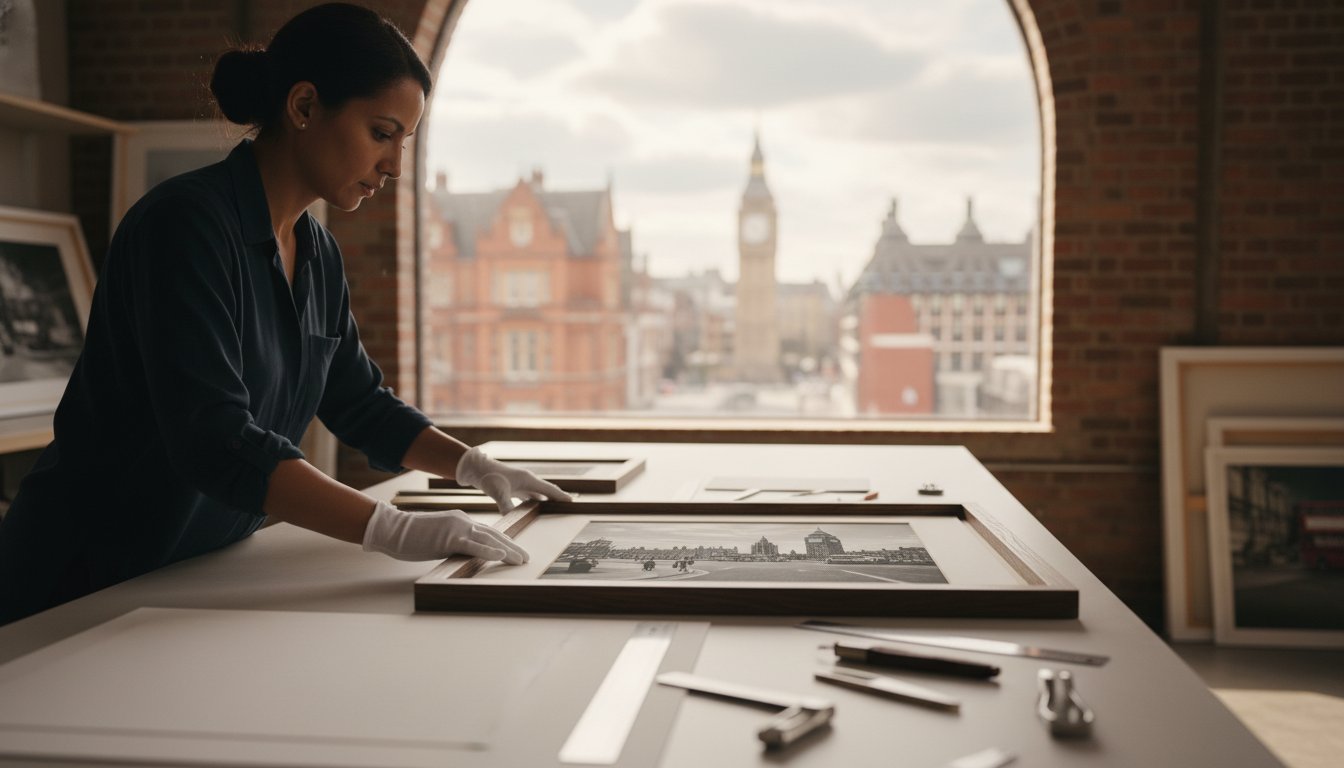
One of the most critical, yet often overlooked, components is glass-skin tape. This specialized, low-tack adhesive is applied in a grid pattern across the glazing. Its purpose is not to prevent the glass from breaking, but to maintain surface tension. In the rare event of a fracture, the tape holds the shards in place, preventing them from falling inward and lacerating the print surface. This is particularly vital for oversized pieces where the volume of glass represents a significant weight and potential for catastrophic damage.

  • Acid-free Glassine paper: This pH-neutral, air-permeable material is the gold standard for protecting the face of a photograph. It provides a non-reactive barrier that prevents the glazing from sticking to the emulsion during temperature spikes.
  • High-density polyethylene (HDPE) foam: Unlike standard bubble wrap, which can deflate under the weight of a heavy frame, HDPE foam (often branded as Ethafoam) offers consistent, closed-cell protection that does not compress over time.
  • Corner protectors: While plastic variants offer rigid impact defense, multi-layered cardboard configurations provide superior shock distribution for bespoke wooden frames, absorbing the energy of a drop rather than transferring it to the joint.

Archival Protection Layers

Maintaining the pristine condition of a collection requires a deep understanding of archival integrity. For iconic works like those in the Slim Aarons archive, preserving the vibrant lustre and clarity of the original print is paramount. We utilize pH-neutral barriers to prevent “ghosting,” a phenomenon where a faint image of the print becomes etched onto the inside of the glass. By ensuring the wrap is breathable yet secure, we mitigate the risk of condensation that can occur when moving between climate-controlled galleries and humid cargo holds.

Shock Absorption and Vibration Dampening

The science of G-force mitigation is what separates a standard courier from an elite art handler. We utilize Ethafoam planks as base cushioning within crates to create a “floating” environment. This setup ensures that road or air vibrations are absorbed by the foam before they reach the artwork. Over-tight wrapping can be as dangerous as under-wrapping by transferring every external vibration directly into the frame’s structure. By allowing for a precise degree of internal movement within the protective layers, we ensure the work remains insulated from the physical shocks of global transit.

The Professional Packing Sequence: Securing Your Investment for Transit

Executing the sequence of shipping large framed art safely requires a disciplined, almost ritualistic attention to detail. It’s a process where the order of operations is as critical as the materials themselves. By following a museum-standard protocol, you transform a vulnerable object into a secure, transportable unit capable of traversing continents without compromise. Each step builds upon the last, creating a comprehensive system of protection that addresses the structural and environmental risks identified in previous chapters.

  • Step 1: Applying the glass-skin and archival face-protection. This initial layer secures the glazing and provides a pH-neutral barrier for the print.
  • Step 2: Constructing the primary moisture barrier. Utilizing professional-grade stretch wrap creates a sealed environment, protecting against humidity shifts in cargo holds.
  • Step 3: Fitting high-impact corner guards. These guards provide essential edge reinforcement and shock distribution for the frame’s most vulnerable points.
  • Step 4: Suspending the art. The work is placed within an inner box or travel frame, ensuring it “floats” and never makes direct contact with the outer walls.
  • Step 5: Final sealing and mandatory labelling. The package is closed with water-resistant tape and marked with clear orientation and “Glass” warnings.

Securing the Glazing and Face

The application of glass-skin tape is a nuanced task. While a simple “X” pattern provides basic tension, full-surface coverage is the preferred method for oversized works where the risk of shattering is higher. It’s imperative that no adhesive touches the bespoke framing or the photographic surface. We recommend creating a “pull tab” by folding the end of each tape strip over itself. This small gesture allows the recipient to unpack the work safely without needing a blade near the frame’s finish.

The Outer Shell and Labelling

Once the internal architecture is secure, the outer shell must be rendered impenetrable. All external seams should be sealed with water-resistant tape to prevent moisture ingress. To monitor the journey, we utilize “Tip-N-Tell” sensors. These devices provide an immediate visual record if the package was tilted or stored horizontally against the “This Way Up” instructions. Shipping documents should be placed in a clear pouch on the exterior, ensuring they are accessible to customs agents without requiring the structural compromise of the box itself. If you are adding to your collection, ensure your logistics partner adheres to these elite standards. You can view our professionally handled photography archives to see the level of care we bring to every acquisition.

Galerie Prints: White-Glove Logistics for the World’s Finest Photography

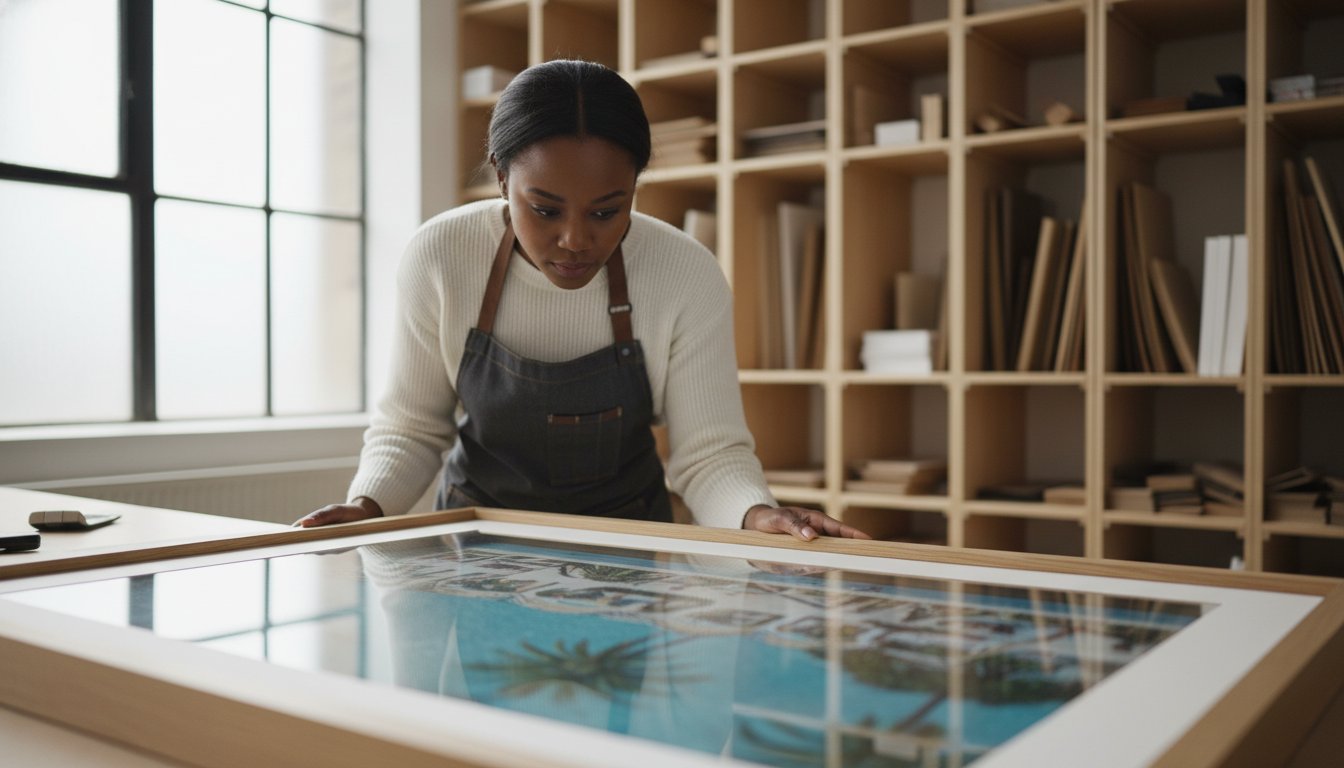
At Galerie Prints, we view the journey of an artwork as a vital extension of its provenance. Our meticulous approach to shipping the Slim Aarons collection worldwide involves more than just transit; it’s a curated logistical operation designed to preserve the crystalline clarity of these iconic moments. Every acquisition, whether a sun-drenched poolside scene or a rare archival print, is treated as an irreplaceable piece of cultural history. We don’t rely on standard courier services for our most significant works. Instead, we’ve cultivated a global network of delivery partners who specialize exclusively in fine art and cinema memorabilia. This ensures that the sophisticated techniques for shipping large framed art safely discussed throughout this guide are executed with absolute precision.

We provide bespoke crating services tailored to the specific dimensions of your acquisition, ensuring that the structural engineering of the protection matches the grandeur of the piece. This artisanal approach is coupled with comprehensive insurance coverage that provides absolute peace of mind from the moment the work leaves our gallery until it’s secured on your wall. By managing every variable, from humidity control to G-force mitigation, we act as the guardians of your investment, bridging the gap between our archives and your private collection.

The Galerie Prints Guarantee

Our commitment to preservation extends to every item in our archives, including the delicate logistics required for rare cinema lobby cards and vintage posters. While we prioritize security, we also remain dedicated to utilizing sustainable, yet ultra-secure, packaging materials that meet the highest archival standards. You’ll never be left in the dark regarding your investment. We provide direct communication and real-time tracking for every international shipment, ensuring you’re practically supported while we maintain the professional, polished distance befitting a luxury gallery.

Receiving and Unpacking Your Art

The final stage of shipping large framed art safely occurs within your own space. When your art arrives, we advise a professional, calm inspection before the courier departs. It’s vital to allow the work to acclimatise to its new environment for twenty-four to forty-eight hours before hanging, especially if it has traveled through varying climates. This deliberate pacing prevents sudden expansion or contraction of the frame and paper fibers. Our curators remain available to provide bespoke installation and display guidance, ensuring your lasting piece of history is showcased with the elegance and permanence it deserves.

Securing the Future of Your Photographic Archive

Protecting a significant photographic acquisition requires a transition from mere transport to a disciplined architectural protocol. You now understand that the structural vulnerability of oversized frames and the chemical reactivity of non-archival materials demand more than just standard care. By prioritizing museum-standard materials like acid-free Glassine and employing a rigorous, multi-layered packing sequence, you ensure the integrity of the work remains uncompromised across every border. Mastering the nuances of shipping large framed art safely is, ultimately, an investment in the permanence of the piece itself.

At Galerie Prints, we act as the bridge between history and your home, specializing in the meticulous preservation of the Slim Aarons and Terry O’Neill archives. Our global white-glove delivery network and commitment to bespoke framing ensure that every acquisition arrives in pristine, gallery-ready condition. Whether you’re adding a rare limited edition or a vintage cinema poster to your walls, we provide the technical expertise and curatorial oversight your collection deserves. We invite you to explore our world of timeless elegance and heritage.

Discover our curated collections and bespoke framing services and begin your journey toward an elevated interior aesthetic today.

Frequently Asked Questions

Is it better to ship art with glass or acrylic?

Acrylic is the preferred medium for international transit due to its exceptional impact resistance and lighter weight. While traditional glass offers superb clarity, its tendency to shatter into sharp fragments poses a catastrophic risk to the underlying photographic emulsion. Acrylic effectively mitigates this danger, though it requires anti-static archival barriers to prevent dust attraction during its journey.

How much does it cost to ship a large framed painting internationally?

International shipping costs for significant works typically begin with a minimum charge of $100, though final figures depend on dimensions, weight, and the destination’s customs requirements. Collectors should account for the 5.9% average General Rate Increase implemented by major carriers like FedEx and UPS for 2026. Large pieces often incur additional surcharges based on cubic volume and the specialized handling required for “ugly freight.”

What is the “double-box” method in art shipping?

The double-box method involves nesting a secured inner box containing the artwork inside a larger, heavy-duty outer carton. A critical buffer zone of at least 5cm must be maintained between these two layers, filled with high-density foam inserts rather than loose-fill peanuts. This architecture ensures that external impacts are absorbed by the outer shell and cushioning before they reach the primary archival housing.

Does standard courier insurance cover fine art photography?

Standard courier insurance often provides limited coverage that may not reflect the true market value of a rare photographic archive. We recommend specialized “Ad Valorem” insurance, which is typically calculated at approximately 1% of the artwork’s declared value. This ensures comprehensive protection that respects the historical and aesthetic significance of your investment, moving beyond the restrictive liability caps of general logistics providers.

How do I protect the corners of a heavy frame during a move?

Protecting the corners requires high-impact guards made of multi-layered cardboard or rigid plastic to distribute energy away from the mitered joints. These protectors should be used in tandem with Ethafoam planks to suspend the frame within its crate. This prevents the frame’s own mass from exerting destructive pressure on its corners during the lateral shifts common in air and sea transit.

What should I do if my art arrives with broken glass?

Document the condition immediately by taking detailed photographs of the packaging and the damage before the courier leaves your premises. If the work was prepared with professional glass-skin tape, the shards should remain held in place, preventing further laceration of the print. Do not attempt to remove the work; instead, contact your gallery curator and the carrier’s claims department to initiate a formal inspection.

Can I ship large framed art in a regular cardboard box?

Regular single-wall cardboard boxes lack the structural rigidity necessary for shipping large framed art safely, particularly when dimensions exceed 100cm. At this scale, the risk of the box buckling under stacking pressure is too great. Only double-wall corrugated cartons or bespoke timber crates provide the exoskeleton required to shield oversized glazing and frames from the rigors of a global logistics network.

Why is a wooden crate necessary for international shipping?

Wooden crates provide the highest level of puncture resistance and compression strength for high-value acquisitions. Beyond physical safety, international biosecurity regulations often mandate the use of ISPM 15 certified, heat-treated timber for all wood packaging. Utilizing non-compliant materials can result in your shipment being impounded or destroyed by customs authorities, making certified crating a legal and practical necessity.
The Curator’s Guide: How to Clean and Preserve Framed Fine Art

A single errant spray of common household glass cleaner can instantly dismantle decades of photographic history. When you welcome a Slim Aarons or a Terry O’Neill into your home, you aren’t merely decorating a wall; you’re becoming the steward of a cultural legacy. With the U.S. art market generating $3.17 billion in auction sales in 2025, the importance of maintaining your collection’s archival integrity has never been more paramount. It’s natural to feel a sense of anxiety when dust begins to settle on a high-value piece. This cleaning guide for framed art is designed to replace that hesitation with the quiet authority of a professional curator.

By adopting the meticulous techniques used in high-end galleries, you’ll learn how to maintain a pristine, gallery-ready display while protecting your investment’s financial and aesthetic value. We’ll demystify the world of archival-safe materials, focusing on the specialized tools required to preserve the tactile and historical elements of your collection. From managing environmental factors to selecting pH-neutral solutions, this guide provides a precise roadmap for handling your most cherished works, ensuring they continue to inspire wonder for generations to come.

Key Takeaways

  • Learn the critical distinction between glass and acrylic glazing care, including why you must never spray cleaning agents directly onto the surface to prevent moisture seepage.
  • Discover how to treat bespoke frames as sculptural extensions of the artwork, ensuring that hand-finished wood and gilded surfaces remain untouched by abrasive chemicals.
  • Master the professional techniques found in this cleaning guide for framed art to maintain archival integrity and prevent the common pitfalls of standard household maintenance.
  • Understand the subtle interplay between UV light and archival photo paper, and how strategic placement serves as the most effective form of long-term preservation.
  • Identify the specific warning signs, such as foxing or mould, that signal when a high-value piece requires the intervention of a professional conservator.

The Art of Stewardship: Why Proper Cleaning Matters

To own a piece of fine art photography is to hold a fragment of the past in trust for the future. When you acquire a work from The Slim Aarons Collection, you aren’t merely buying a decorative object. You’re assuming the role of a curator. This requires a fundamental shift from routine housekeeping to meticulous archival maintenance. While a standard picture frame might survive a quick wipe with a damp rag, high-value art demands a more disciplined approach. Every action you take must prioritize the long-term stability of the piece. This cleaning guide for framed art serves as your manual for this delicate task.

A framed artwork is a layered ecosystem. It consists of the glazing, the frame profile, and the internal mounting. Each component interacts with the environment and with the cleaning agents you choose. Before you begin, you must internalize the golden rule of art care: less is almost always more. Over-cleaning is a primary cause of surface degradation. If the piece appears pristine, the most professional choice is to leave it undisturbed. The core principles of the Conservation and restoration of paintings remind us that every intervention carries a risk. Our goal is to minimize that risk while maintaining visual clarity.

Identifying Your Materials

Before any cloth touches the surface, you must identify your glazing. Standard glass is heavy and feels cold to the touch. High-clarity acrylic, such as Plexiglas or Optium, is lighter and warmer. Acrylic is prized in galleries for its shatter resistance and UV filtering, but it’s notoriously soft. Using a standard glass cleaner on acrylic will cause permanent clouding. You must also recognise artisanal frame finishes. Natural hardwoods, hand-stained veneers, and delicate gilded leaf each require specific handling. A gilded frame is often a thin layer of gold leaf over a brittle gesso base. Abrasive movements can flake away the finish, leading to a “cleaning catastrophe” that is often irreversible.

The Essential Curator’s Toolkit

Professional results require professional tools. Ditch paper towels immediately. They are made of wood pulp and will leave micro-scratches on both glass and acrylic. Instead, invest in high-quality, lint-free microfiber cloths. For the solutions, avoid anything containing ammonia or harsh detergents. Industry standards dictate the use of ammonia-free and pH-neutral cleaners specifically formulated for art glazing. For the frame itself, especially those with intricate, hand-carved details, a soft-bristled natural hair brush is indispensable. This allows you to lift dust from deep crevices without applying the pressure that a cloth would require. This precision is what separates a collector from a casual owner.

Mastering the Glazing: Glass vs. Acrylic Care

Glazing serves as the primary barrier between your art and the elements. It shields delicate surfaces from dust, pollutants, and humidity. However, it’s also the most vulnerable point during maintenance. One of the most critical steps in any cleaning guide for framed art is understanding the physics of moisture. Never spray any liquid directly onto the glazing. Liquid can easily seep under the lip of the frame through capillary action, where it becomes trapped. This trapped moisture often leads to the ruin of the mount or, worse, the artwork itself. Always apply your cleaning agent to a cloth first. The cloth should be damp but never saturated.

Ammonia-free solutions are the only acceptable choice because ammonia is a harsh alkaline agent that can outgas within the frame, potentially reacting with photographic emulsions or permanently clouding museum-grade anti-reflective coatings.

When dealing with high-value collections, the stakes of improper care are significant. The global art market reached an estimated $67.8 billion in 2026, and as more collectors invest in the mid-tier market, particularly for works priced under $50,000, the need for professional-grade home maintenance grows. Whether you’re preserving a vintage movie poster or a modern masterpiece, the glazing is the lens through which the work is experienced. Treating it with the wrong chemical or tool is a risk that serious collectors don’t take.

Cleaning Traditional Picture Glass

While traditional glass is scratch-resistant, it requires a disciplined hand. Use a high-quality microfiber cloth and avoid circular wiping motions, which can trap grit and create visible halos under gallery lighting. Instead, use a deliberate, linear motion from top to bottom. This prevents the “overspray” effect that often leads to mould growth. If a piece shows signs of internal damage, you may need to consult professional conservation experts to assess the extent of the moisture ingress.

Special Considerations for Acrylic and Plexiglass

High-clarity acrylic, often used for larger works in our Bespoke Framing Service, is inherently prone to static electricity. This charge acts as a magnet for household dust. You must resist the urge to dry-wipe, as friction causes micro-scratches from the very dust you’re trying to remove. Use specialized anti-static cleaners to neutralize the static charge and maintain long-term clarity. This technical precision ensures your Star Wars limited edition prints remain as vibrant as the day they were framed.

Caring for the Frame: From Gilded Leaf to Modern Metal

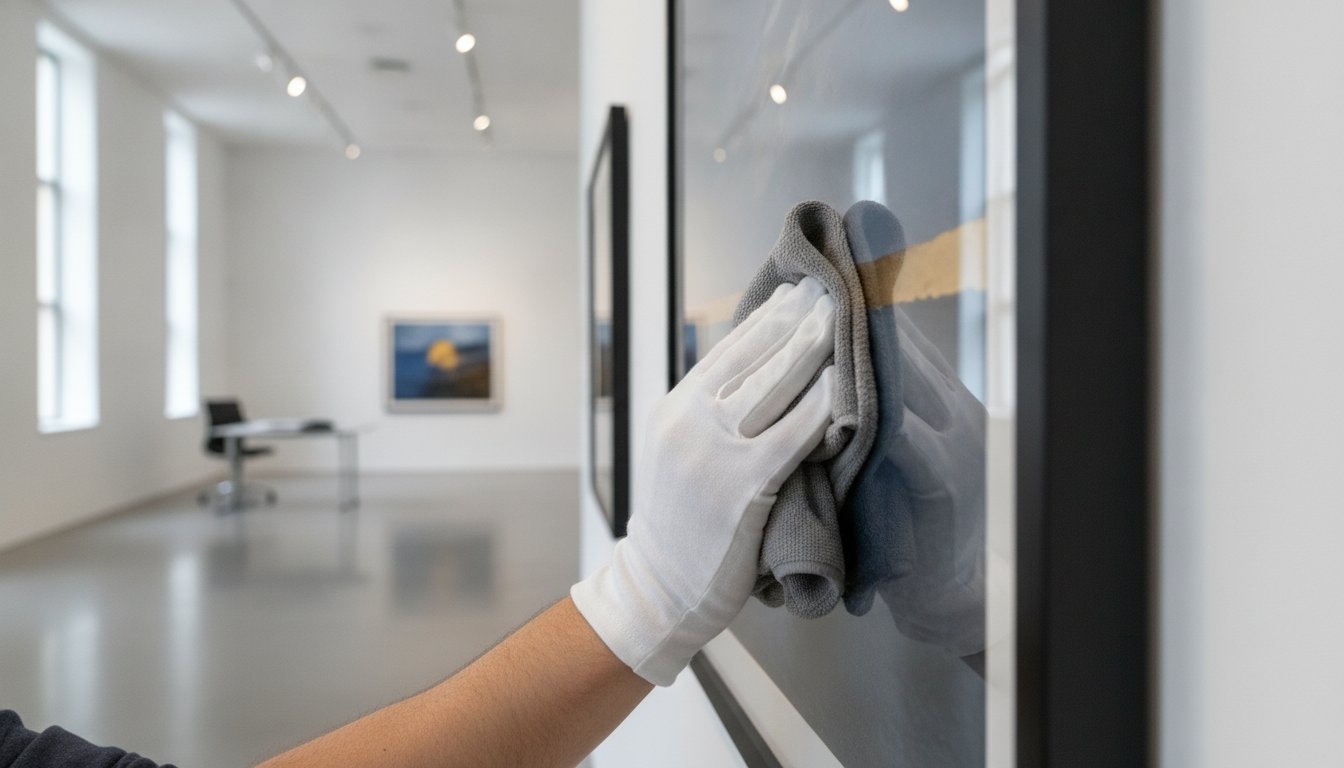
A frame is far more than a simple border; it’s a sculptural extension of the artwork itself. Whether it’s a hand-carved wooden profile or a sleek industrial edge, the frame defines how the piece interacts with your space. In our curatorial practice, we view the frame as an integral part of the art’s provenance. Handling these structures requires the same level of discipline as the glazing. Oily fingerprints are the primary enemy of a pristine finish. The natural salts and acids on your skin can etch into metal or permanently stain porous wood over time. When moving a piece, always wear cotton gloves or handle the work only by the secure hanging hardware on the reverse. This cleaning guide for framed art emphasizes that prevention is the most sophisticated tool in your arsenal.

There’s a delicate balance between maintenance and the preservation of character. For vintage movie posters or heritage archives, the frame may possess a natural patina that tells a story of its own. In these instances, aggressive cleaning is often counterproductive. A seasoned collector knows when to leave the signs of age alone. This philosophy aligns with the broader principles of environmental protection and collection stewardship. If the frame’s finish is stable but aged, a light dusting is usually the only intervention required to maintain its historical integrity.

Dusting Ornate and Textured Profiles

Traditional gilded frames and plaster-based profiles demand a strict “dry-only” rule. Water or chemical cleaners can soften the gesso or cause the gold leaf to flake away instantly. To reach deep into the crevices of an ornate design, avoid stiff brushes. Instead, use a high-quality, soft-bristled makeup brush or a specialized goat-hair dusting brush. These tools allow you to lift debris without applying vertical pressure. For particularly stubborn dust in deep relief areas, a gentle puff of compressed air can be effective, provided the nozzle is held at a safe distance to prevent moisture condensation.

Maintaining Sleek Modern and Metal Frames

Sleek, modern frames, such as those used for high-end fine art photography, present a different challenge. Anodised aluminium and stainless steel are notorious fingerprint magnets. While these materials are more durable than gilded wood, they show smudges with unforgiving clarity. Use a dry, clean microfiber cloth to buff away marks using long, even strokes. If a dry cloth isn’t enough, a single drop of pH-neutral soap on a slightly damp cloth is the limit. This approach ensures the frame remains a silent, polished supporter of the visual narrative rather than a source of distraction.

Environmental Protection: Preventing the Need for Deep Cleaning

The most sophisticated approach in any cleaning guide for framed art is to render intensive cleaning unnecessary through strategic placement. A piece of art is a living document of its history. It reacts to its surroundings in real-time. While we’ve discussed the tools for physical maintenance, the true guardian focuses on the invisible threats: light, heat, and moisture. High-traffic areas like hallways or entryways naturally accumulate more airborne debris. These locations require more frequent, albeit gentler, dusting to prevent buildup from becoming abrasive. Placement is everything.

The chemical composition of archival photo paper is particularly sensitive to ultraviolet exposure. UV light doesn’t just fade colors; it breaks down the molecular bonds within the paper fibers themselves. This leads to brittleness and yellowing that no amount of surface cleaning can reverse. Similarly, fluctuations in humidity cause the paper to expand and contract, leading to “cockling” or a wavy appearance. By controlling these variables, you preserve the artwork’s aesthetic and financial value for decades. Stewardship is a silent, ongoing commitment.

The Perils of Direct Sunlight and Heat

Direct sunlight is a slow-motion catastrophe for fine art. The “golden hour” may be beautiful for photography, but it’s the most dangerous time for your collection as low-angled light penetrates deep into the room. Heat is equally destructive. Hanging a piece above a radiator or fireplace causes the frame and mounting boards to expand and contract at different rates. This structural stress can lead to frame warping or the failure of archival tapes. Select a wall away from direct thermal sources to minimize this environmental strain. Your choice of wall is your first line of defense.

Humidity and Airflow Management

Strive for a residential gallery environment with humidity levels between 40% and 50%. Extreme dryness makes materials brittle, while high humidity invites mould and foxing. Never hang valuable art on an uninsulated exterior wall. These surfaces are prone to temperature differentials that cause condensation inside the frame. We recommend using “bumpers” on the back corners of the frame. These small spacers create a vital gap for air circulation, preventing moisture from becoming trapped between the wall and the artwork. This simple addition is a hallmark of professional installation.

Explore our Music Archives to find a legacy piece that deserves this level of dedicated stewardship.

When to Seek Professional Conservation

Even the most disciplined collector must eventually acknowledge that some challenges transcend the scope of a standard cleaning guide for framed art. True stewardship is defined as much by restraint as it is by action. When a piece shows signs of internal distress, the most professional choice is to defer to a specialist. Biological threats like “foxing”, those small, rust-colored spots appearing on the paper, or the fuzzy blooms of mould are not surface contaminants. They are active fungal or chemical processes occurring within the paper’s fibers. Attempting to treat these at home will only accelerate the damage.

Our bespoke framing service acts as a preventative seal against many of these environmental hazards, but it doesn’t replace the need for vigilance. We recommend an annual condition check for every high-value piece in your collection. Inspect the perimeter of the mount for any signs of shifting and look for “ghosting” on the inside of the glazing. These subtle shifts often signal that the internal environment has been compromised. Early intervention preserves the financial and historical value of the work before the damage becomes irreversible.

Identifying Irreversible Damage

Distinguishing between harmless surface dust and internal degradation is a hallmark of a seasoned collector. If you see shadows on the inside of the glass that don’t move when wiped, you’re likely witnessing “outgassing” from non-archival mounting materials. Similarly, if an artisanal frame has suffered a deep scratch or if the gilding has begun to flake, professional refinishing is required to match the original pigments. Above all, you must never attempt to clean the art paper or the photographic emulsion itself. The chemistry of these surfaces is incredibly complex; even a drop of pure water can cause the fibers to swell and permanently distort the image.

The Benefits of Re-Framing

Many collectors discover that their most cherished pieces are housed in “acidic” frames from a previous era. These older materials slowly leach chemicals that yellow the paper and turn it brittle. Re-framing is more than a stylistic update. It’s a rescue mission. By upgrading to museum-grade glazing and acid-free, archival mounts, you provide the artwork with a fresh lease on life. This process ensures that your investment remains a vibrant piece of history rather than a fading relic. Elevate your display with our bespoke framing options to ensure your collection meets the highest standards of modern preservation.

Preserving a Legacy of Elegance

True stewardship is a blend of meticulous care and informed restraint. By mastering the delicate balance between environmental protection and precise maintenance, you ensure that your collection remains a vibrant bridge to photographic history. This cleaning guide for framed art provides the essential framework for protecting your investment’s aesthetic and financial value. It’s a commitment that pays dividends in the long-term preservation of beauty. Remember that the most sophisticated maintenance often involves the simple act of controlling light and humidity before a single cloth touches the surface.

As you continue to cultivate your personal gallery, rely on the technical superiority of production processes that prioritize longevity. Every work at Galerie Prints is expertly curated by Stuart Möller and supported by hand-crafted bespoke framing. We utilize archival-grade materials in every print to ensure your pieces endure as lasting historical documents. Your commitment to these professional standards marks you as a true connoisseur of the arts.

Discover our curated collections and bespoke framing services at Galerie Prints

Embrace your role as a guardian of visual heritage with confidence. With these gallery-proven techniques at your disposal, your collection will continue to inspire wonder and evoke a sense of timeless prestige for many years to come.

Frequently Asked Questions

Can I use Windex or standard glass cleaner on my picture frames?

No, you should never use standard glass cleaners because they often contain ammonia, which can outgas and damage the archival integrity of your artwork. Instead, utilize a pH-neutral, ammonia-free solution specifically formulated for art glazing. Always apply the liquid to a lint-free microfiber cloth rather than spraying the surface directly to prevent capillary action from drawing moisture into the mount.

How often should I clean my framed art?

You should limit physical cleaning to once every three or four months, focusing primarily on light dusting with a dry cloth. Over-handling is a significant risk factor in the art world, as each intervention introduces the possibility of micro-scratches or accidental impact. This cleaning guide for framed art emphasizes that maintaining a stable environment is more effective than frequent chemical intervention.

What is the best way to remove dust from an ornate gold frame?

Use a soft-bristled natural hair brush, such as a high-quality makeup brush, to gently lift dust from deep relief areas. Traditional gold leaf is exceptionally delicate and can flake away if subjected to the friction of a cloth or the moisture of a cleaning agent. A dry, air-based approach ensures you preserve the intricate artisanal craftsmanship without risking the frame’s finish.

Is it safe to use a vacuum cleaner attachment on my art collection?

It’s generally unwise to use a vacuum near fine art due to the risk of accidental physical impact and the generation of static electricity. Static can pull loose particles into the frame or cause acrylic glazing to attract even more debris. If you must remove large amounts of dust from the surrounding area, ensure the vacuum remains at a significant distance from the artwork itself.

My acrylic glazing has a scratch; can I polish it out?

While specialized acrylic polishes exist, attempting to buff out a scratch on museum-grade glazing often results in a permanent “haze” or damage to anti-reflective coatings. If the scratch is deep enough to be distracting, the most professional course of action is to replace the glazing entirely. It’s best to consult a specialist to determine if the specific coating on your piece allows for any form of restoration.

What should I do if I see moisture or fogging inside the glass?

Immediate action is required to prevent mould growth or paper cockling, so you should move the piece to a climate-controlled room immediately. Fogging usually indicates a breach in the frame’s seal or a significant temperature differential, such as hanging a piece on an uninsulated exterior wall. If the moisture doesn’t dissipate within a few hours, consult a professional conservator to assess the internal mounting.

Can I use a damp cloth on a canvas print that isn’t behind glass?

No, you should never use a damp cloth on an exposed canvas print, as moisture can react with the inks or the protective varnish. A dry, soft-bristled brush is the only recommended tool for removing surface dust from unglazed works. If the canvas appears stained or heavily soiled, it requires the attention of a professional restorer who understands the specific chemistry of the emulsion.

How do I clean the back of the frame and the hanging wire?

Use a clean, dry microfiber cloth to wipe dust from the backing board and the hanging wire during your annual condition check. This prevents dust from migrating to the front of the piece or settling into the wall. It’s also an ideal time to inspect the wire for signs of fraying or rust, ensuring the structural stability of your display remains uncompromised.

Bespoke Framers in Mayfair: The Connoisseur’s Guide to Fine Art Presentation

Does a frame merely house a photograph, or does it serve as the final, silent guardian of a legacy? For the discerning collector, the boundary between an image and its presentation is where true preservation begins. You likely understand the quiet anxiety of placing a rare Terry O’Neill or a limited edition Slim Aarons print behind glass, fearing that non-archival materials or inadequate UV protection might slowly erode its historical soul. Finding the bespoke framers mayfair connoisseurs trust involves seeking a partner who treats every piece as a ready-to-hang fragment of history rather than a mere decorative object.

In this guide, you’ll discover the meticulous standards that define Mayfair’s artisanal craftsmanship and learn how to secure museum-grade protection for your collection. We’ll examine the technical requirements of the Fine Art Trade Guild’s highest standards, from acid-free mountboards to specialized glazing that filters damaging light. We also provide expert aesthetic guidance to ensure your contemporary photography harmonizes perfectly with a luxury interior, transforming your investment into a lasting piece of history that commands the room with quiet authority.

Key Takeaways

  • Understand the distinction between standard retail services and the elite craftsmanship of bespoke framers mayfair, ensuring your artwork receives a museum-grade presentation.
  • Explore the aesthetic benefits of contemporary floater frames and hand-finished hardwoods, which provide a seamless harmony between rare photography and luxury interiors.
  • Learn the essential technical requirements for archival integrity, including the use of UV-protective glass and acid-free materials to safeguard your investment against environmental decay.
  • Discover how specialized framing approaches for the Slim Aarons and Terry O’Neill collections can enhance the narrative depth and historical significance of your prints.
  • Master the consultation process to confidently collaborate with gallery curators on digital previews and material selections for a ready-to-hang masterpiece.

The Mayfair Standard: Defining Bespoke Framing in London’s Art District

In the heart of W1, the act of framing is never a mere afterthought. It is a rigorous discipline. To engage with bespoke framers mayfair is to enter a world where the presentation of a piece is treated with the same reverence as the artwork itself. While high-street “custom” framing typically involves selecting pre-fabricated mouldings from a limited catalogue, the Mayfair bespoke standard is an entirely different pursuit. It is a process of total architectural construction, where every dimension, material, and finish is engineered to complement the specific tonality and historical weight of the print.

The local context of the Mayfair art scene dictates this level of precision. Surrounded by blue-chip galleries and auction houses, the expectations for archival integrity are non-negotiable. Collectors in this district aren’t simply looking for a border; they require a sanctuary for their investments. A bespoke framer here operates as a curatorial consultant, bridging the gap between the technical requirements of preservation and the aesthetic demands of a luxury interior. They understand that a Terry O’Neill or a Slim Aarons print requires more than just a mounting; it needs a presentation that reflects its iconic status.

The Aesthetic of the London Gallery

London’s luxury residences often demand a specific visual language known as “quiet authority.” This aesthetic shuns the gaudy in favour of refined, structural elegance. Whether your interior leans toward the minimalist lines of a contemporary penthouse or the historic grandeur of a Georgian townhouse, the frame must act as a sophisticated bridge. In Mayfair, this often manifests as slim, hand-finished timber frames that provide a sense of permanence without overwhelming the image. The goal is to create a window into the past that feels entirely at home in a modern setting.

Why Bespoke is an Investment, Not an Expense

Choosing professional framing is a strategic decision to protect the provenance and future resale value of your collection. Rare prints are susceptible to environmental degradation, and the wrong materials can cause irreversible damage. High-end framing practitioners often look to the rigorous standards found in the conservation and restoration of painting frames to guide their choice of materials. From acid-free mountboards to reversible mounting techniques, every element is chosen to ensure the work remains in its original state. Whether you’re displaying Star Wars Limited Edition Prints or selections from our Music Archives, these standards ensure the piece remains a pristine asset. Bespoke framing is the sophisticated fusion of structural protection and aesthetic presentation that transforms a photographic print into a permanent legacy.

Selecting the Perfect Frame: Materiality, Style, and Aesthetic Harmony

The selection of a frame is a tactile dialogue between the artwork and its environment. For the discerning collector, the quality of materials isn’t a luxury; it’s a fundamental requirement. Hand-finished timber remains the enduring choice for those seeking the standards of bespoke framers mayfair, offering a warmth and structural integrity that synthetic alternatives cannot replicate. Sustainable hardwoods such as walnut, maple, and oak provide a natural grain that grounds the image, ensuring the frame feels like an organic extension of the piece rather than a restrictive border.

In contemporary photography, the “floater” or “tray” frame has emerged as the preferred choice for a gallery-quality finish. By creating a subtle gap between the edge of the print and the frame, this style allows the artwork to appear as if it’s suspended in mid-air. It provides a three-dimensional depth that invites the viewer to linger. This technique is particularly effective for larger works where the absence of a mount emphasizes the raw power of the composition. When matching a frame to the tonality of a print, one must consider colour theory carefully. A frame shouldn’t compete with the image; it should draw the eye inward. You can find expert tips on frame selection from the world’s leading auction houses to understand how historical context and material choice create a harmonious whole.

The Classic Gallery Box Frame

The box frame offers a deep-set mounting that creates a profound sense of perspective. This architectural approach provides a protective space between the glazing and the print, which is essential for preserving the delicate surface of the work. This style is particularly evocative when framing black and white pictures, where a dark, hand-painted finish can heighten the contrast and drama of the original silver gelatin tones. Whether you opt for a natural wood grain or a matte black finish, the box frame delivers a presence of quiet authority.

Mounting Techniques and Window Mounts

A secret often employed by premier galleries is the “weighted” bottom mount. By making the bottom margin slightly wider than the top and sides, the framer compensates for an optical illusion that makes a perfectly centered print appear to be “dropping” within the frame. This subtle adjustment provides a sense of visual stability. When considering our bespoke framing service, we always prioritize archival mountboards over standard acidic alternatives. These museum-grade materials are lignin-free and pH neutral, preventing the yellowing and “mount burn” that often plagues lesser-quality presentations. Using multiple mounts can also add a sophisticated layer of depth, drawing the viewer deeper into the narrative of the photograph.

Archival Integrity: Protecting Your Investment for Generations

The true value of a frame lies in what remains invisible to the casual observer. While the aesthetic choice defines the atmosphere of a room, the archival construction determines the very survival of the artwork. When you engage with bespoke framers mayfair, the dialogue shifts from mere decoration to the “framing sandwich”—a precise layering of protective elements designed to arrest the natural process of decay. Environmental threats like humidity, airborne pollutants, and fluctuating temperatures are constant. High-end framing acts as a controlled micro-environment, ensuring that the passage of time does not diminish the vibrancy of the original print.

The science of conservation is governed by rigorous benchmarks. In the United Kingdom, the Fine Art Trade Guild sets the definitive standards for these practices. Their Conservation Level framing is engineered to protect artwork for approximately 20 years, while the prestigious Museum Level targets a lifespan of 35 years or more. Achieving this requires a commitment to specific materials, such as mountboards that are at least 1100 microns thick and entirely free of lignin and acids. Without these barriers, acidic migration can cause “mount burn,” a permanent yellowing that destroys both the aesthetic and the financial value of a rare photograph.

Glazing is the final, critical line of defence. Sunlight is the silent thief of colour, particularly for delicate silver gelatin or chromogenic prints. Modern archival framing utilizes specialized glass that filters out 99% of harmful ultraviolet radiation. Beyond protection, the use of anti-reflective coatings is essential for the discerning collector. These coatings allow the glass to virtually disappear, ensuring the art is visible from every angle without the interference of glare, even in the brightly lit galleries of W1.

Museum-Quality Glass Options

Collectors must choose between three primary glazing tiers. Standard glass offers basic protection but lacks UV filtering. Conservation Clear glass provides the necessary 99% UV block but can still produce reflections. For the ultimate presentation, Museum Glass combines maximum UV protection with an nearly invisible finish. For oversized installations, premium acrylic is often the preferred choice. It’s lighter and shatterproof, offering the same archival standards as glass while providing extra security for large-scale works.

The Role of Archival Paper

The frame works in a vital synergy with the fine art photography paper itself. Whether the work is printed on cotton rag or alpha-cellulose, these porous materials are sensitive to the air trapped within the frame. A museum-quality paper requires a museum-quality seal to prevent the slow migration of acids from the environment into the delicate fibres of the print. By ensuring that every element—from the mounting hinges to the backboard—is pH-neutral, we create a sanctuary that preserves the artist’s original vision for future generations.

The Galerie Prints Approach: Curated Framing for Iconic Photography

At Galerie Prints, we believe the frame is the final brushstroke of the curator. It’s not enough to use high-quality materials; the presentation must resonate with the soul of the subject matter. When you work with bespoke framers mayfair connoisseurs rely on, you’re seeking a partner who understands the subtle difference between a high-energy rock portrait and a serene poolside scene. Our approach is deeply localized and artisanal, ensuring that every piece we touch reflects a commitment to craftsmanship that starts and ends in the hands of experts who respect the photographic medium.

For the Slim Aarons Collection, we focus on capturing the “Good Life” aesthetic. These images represent a bygone era of elegance, and they demand a frame that doesn’t compete with their sun-drenched vibrancy. Conversely, our bespoke solutions for Terry O’Neill Photography often lean into more classic, structural profiles. These frames ground the raw charisma of the sixties icons he captured, providing a sense of permanence and gravitas. This localized expertise is what distinguishes our role as bespoke framers mayfair galleries respect.

Our curated music photography archives often benefit from a more industrial-chic approach. We often pair these high-contrast images with hand-finished dark timbers or slim black metals that mirror the grit and soul of the original performance. By treating each photograph as a unique narrative, we ensure the final presentation is as evocative as the moment it captured.

Framing for Aspirational Lifestyles

Framing for an aspirational lifestyle requires creating a window into another world. For a Slim Aarons poolside shot, we often recommend crisp, white gallery frames with a deep-set box profile. This creates a clean, expansive feeling that mirrors the open-air luxury of the subject matter. Large-format framing is a particular specialty of ours. In the expansive spaces of Mayfair residences, a piece must possess enough physical presence to anchor the room. We provide the structural integrity needed for these statement installations, ensuring they remain secure and visually striking for decades.

Preserving Cinema History

Preserving cinema history involves unique technical challenges. Rare cinema lobby cards and vintage movie posters are often printed on fragile, historical stock that requires expert handling. We often utilize tray frames to display these items as sculptural objects, giving them a three-dimensional weight that elevates them from flat ephemera to architectural features. Crucially, we employ reversible mounting techniques. For high-value collectables, the ability to remove the art without a trace is vital for maintaining market value and provenance.

Discover how our bespoke framing service can transform your collection into a gallery-ready masterpiece.

Commissioning Your Bespoke Frame: From Consultation to Installation

The journey from acquiring a rare print to its final installation is a collaborative evolution that requires both technical precision and creative vision. When you engage with bespoke framers mayfair specialists, you aren’t simply purchasing a product; you’re commissioning a bespoke architectural structure for your art. This process begins with an initial consultation where the specific needs of the work are balanced against the aesthetic requirements of your home. We treat this stage as a curatorial partnership, ensuring that the final result reflects the prestige of the artists in our collection and the historical weight of the imagery.

Visualising the final result is essential for the discerning collector. We provide digital previews and physical samples of hand-finished timbers and archival mounts to bridge the gap between concept and reality. This allows you to see how a specific walnut grain or a weighted mount will interact with the tonality of your print before the first cut is made. Lead times for these commissions reflect our commitment to artisanal excellence. Unlike mass-produced alternatives, a bespoke frame is crafted with a steady, composed flow. This deliberate pacing allows for the meticulous application of hand-painted finishes and the careful assembly of the archival sandwich, ensuring the piece meets the 20 to 35 year protection standards set by the Fine Art Trade Guild.

The Gallery Consultation Experience

Personalised advice on sizing and proportions is a cornerstone of our service. A frame that is too narrow can diminish a powerful image, while one that is too heavy can overwhelm a delicate composition. We help you define the ideal “quiet authority” for each piece, whether you’re looking for a single statement installation or coordinating a cohesive gallery wall. For our international collectors, we offer remote consultations that provide the same level of expertise and visual detail as an in-person gallery visit, maintaining our standards of excellence regardless of geography.

Ready-to-Hang Excellence

The final step in the collector’s journey is the seamless transition from the workshop to your walls. We ensure every piece arrives in pristine condition through secure, global shipping protocols designed specifically for high-value art. For large-scale works, we provide integrated, heavy-duty hanging systems that offer both safety and ease of installation. This ensures your investment is ready to hang and immediately becomes a permanent piece of your home’s history. Enquire about our bespoke framing service for your collection to begin your curatorial journey with the leading bespoke framers mayfair has to offer.

Investing in fine art photography is an act of cultural preservation that extends far beyond the print itself. As we’ve explored, the distinction of bespoke framers mayfair connoisseurs trust lies in the delicate balance between structural archival science and aesthetic prestige. By prioritising museum-grade materials and UV-filtering glazing, you don’t just display an image; you secure its future for generations. Whether you’re housing the sun-soaked poolsides of Slim Aarons or the gritty soul of our music archives, every piece deserves a presentation that reflects its unique narrative and historical significance.

As curators of the Slim Aarons and Getty Images archives, we bring a deep reverence for photographic heritage to every project. Our London-based artisanal craftsmanship ensures that every frame is a testament to quality, utilising exclusively museum-standard materials to safeguard your investment. We invite you to Explore our Bespoke Framing Service and Iconic Collections to discover how we can transform your prints into ready-to-hang pieces of history. Your collection is a reflection of your discernment. Let its presentation be the final, perfect signature of your home’s elegance.

Frequently Asked Questions

What is the difference between custom framing and bespoke framing?

Bespoke framing is a total architectural construction where every dimension and finish is engineered for the specific piece, distinguishing it from the pre-fabricated components of standard custom services. As leading bespoke framers mayfair collectors rely on, we ensure that every element, from the hand-finished timber to the pH-neutral mounting, is tailored to the artwork’s unique requirements. This curatorial approach transforms a simple border into a protective sanctuary for your most valued prints.

How long does a bespoke framing commission usually take in Mayfair?

A typical commission generally requires between two and four weeks to complete. This duration reflects the artisanal nature of the work, allowing for the meticulous hand-finishing of timbers and the precise assembly of the archival sandwich. Every stage of the production process is handled with a measured rhythm to ensure that the final presentation meets our rigorous standards of craftsmanship and durability before it reaches your home.

Why is UV-protective glass necessary for fine art photography?

UV-protective glass is essential because it blocks up to 99% of harmful ultraviolet radiation that causes irreversible fading in photographic emulsions. Without this barrier, sunlight and even indoor lighting can slowly erode the vibrancy and detail of your rare prints. By utilising conservation-grade glazing, we provide a permanent shield against environmental degradation, ensuring that the visual integrity of your investment remains intact for decades to come.

Can I choose a frame that matches my existing interior decor?

You can certainly choose a frame that aligns with your specific interior aesthetic through our personalised consultation process. We provide expert guidance on coordinating frame profiles and finishes with your home’s decor, whether you seek a minimalist contemporary look or a more traditional grandeur. Our goal is to create a seamless harmony between the artwork and its environment, ensuring the piece acts as a sophisticated architectural feature in your space.

Do you provide bespoke framing for items not purchased from Galerie Prints?

Our bespoke framers mayfair service is available for all high-caliber visual art, including pieces not originally purchased from our collections. We apply the same museum-grade standards and artisanal craftsmanship to every project, regardless of its origin. Whether you are framing a family heirloom or a rare gallery find, our curators provide the technical expertise and aesthetic discernment needed to preserve your private collection for future generations.

What are the best frame styles for black and white photography?

Deep-set box frames or slim, hand-painted matte black timber frames are the most evocative choices for black and white photography. These styles accentuate the dramatic contrast and tonal depth found in silver gelatin prints without distracting from the subject matter. By providing a sense of three-dimensional perspective, these frames enhance the quiet authority of monochrome works, making them ideal for both modern penthouses and historic London residences.

Is it possible to ship large, bespoke-framed artworks internationally?

We facilitate secure international delivery for large-scale, bespoke-framed works using specialised crating and heavy-duty protective materials. Every shipment is managed with precise logistical care to ensure that your artwork arrives in pristine condition, regardless of its destination. Our integrated hanging systems are also included for oversized pieces, providing a ready-to-hang solution that meets the structural requirements of expansive luxury interiors across the globe.

How do I care for and clean my bespoke-framed art?

To maintain your artwork, gently dust the frame and glazing with a soft, dry, lint-free microfibre cloth. It is vital to avoid liquid cleaners, glass sprays, or abrasive materials, as moisture can seep behind the glazing and compromise the archival seal. By following these simple preservation steps, you ensure that the delicate timber finishes and the internal micro-environment of the frame remain undisturbed and effective for many years.

Understanding Art Print Quality: A Curator’s Guide to Fine Art Standards

Have you ever wondered why a photograph displayed in a gallery possesses a luminous, almost tactile depth that seems impossible to replicate at home? It’s a common frustration for collectors who fear that a prized acquisition might arrive looking pixelated or, worse, begin to yellow and fade within a few short years. Truly understanding art print quality requires looking beyond the image itself to the invisible alchemy of paper, ink, and artisanal precision.

We recognize that deciphering terms like Giclée, archival pigment, and GSM often feels like learning a hidden language. You deserve the certainty that your investment will remain a vibrant piece of history for decades to come. This guide reveals the technical and artisanal hallmarks that distinguish a museum-grade fine art print from a standard reproduction. We will explore the essential trinity of source integrity, archival chemistry, and professional finishing; this knowledge ensures you can read any product specification with the discerning eye of a seasoned gallery expert.

Key Takeaways

  • Master the distinction between commercial 4-colour printing and the 12-colour Giclée pigment systems that guarantee a lifespan of over 100 years.
  • Learn to identify premium material ingredients, specifically why 300gsm cotton rag paper remains the undisputed benchmark for tactile and visual depth.
  • Refine your approach to understanding art print quality by exploring why source integrity, especially direct access to historical archives, dictates the final visual impact.
  • Understand the vital role of bespoke framing in preserving your collection; learn how UV-protective glass prevents the irreversible bleaching of fine art.
  • Discover the curatorial difference of artisanal production where the human eye, rather than an automated factory, ensures every piece meets museum standards.

The Fundamental Shift: Fine Art Prints vs. Standard Posters

To the untrained eye, a print might seem like a simple reproduction. However, the gulf between a commercial poster and a museum-grade print is vast. It’s the difference between a fleeting decorative item and a legacy piece. When you’re understanding art print quality, you must first recognize that fine art prints are engineered for permanence. While a standard poster may begin to fade or yellow within five short years, a true archival print is designed to remain pristine for over a century. This isn’t just a marketing claim; it’s a result of rigorous material science.

This durability stems from the use of acid-free substrates. Over time, the lignin found in standard, wood-pulp paper reacts with light and oxygen. This reaction causes the “browning” or “foxing” that ruins lesser works. Fine art standards require materials that are chemically stable and PH-neutral. This ensures the paper remains as crisp and white as the day it was struck, providing a stable foundation for the imagery it holds.

What is a Giclée Print?

The term Giclée, derived from the French word gicler meaning “to spray,” represents the pinnacle of digital reproduction. Unlike the basic 4-colour CMYK process used by high-street commercial printers, a Giclée printer utilizes a sophisticated 12-colour pigment system. This allows for a vastly expanded colour gamut and incredibly smooth graduations. By understanding the printmaking process through this lens, collectors can appreciate how archival pigment inks provide a depth of tone that standard dye-based inks cannot match. The “dot gain” is meticulously controlled, preventing the pixelation that often plagues mass-produced prints.

The Aesthetic Impact of Archival Materials

The emotional impact of a fine art print is often found in its relationship with light. Premium papers, often crafted from 100% cotton rag, possess a natural texture that absorbs light rather than reflecting it harshly. This creates a “luminous” quality, which is particularly vital for capturing the subtle silver and charcoal tones in black and white photography. High-quality papers avoid “optical brighteners,” which are chemical additives that can break down and cause the art to shift colour over time. When you’re understanding art print quality, you’ll notice that museum-grade prints have a tactile, three-dimensional presence that makes the image feel alive, unlike the flat, plastic look of a standard poster.

The Materiality of Art: Understanding Paper and Ink Chemistry

The true soul of a museum-grade piece lies in its molecular composition. While the image captures the eye, the physical materials ensure the work endures. Understanding art print quality requires an appreciation for the delicate balance of paper and ink chemistry. Standard prints often rely on dye-based inks, which are essentially liquid stains. These are highly vulnerable to UV degradation, causing vibrant reds and deep blues to vanish within years. In contrast, archival pigment inks are composed of solid particles of mineral or synthetic origin. These particles sit on the surface of the paper rather than soaking in, resisting the “bleaching” effect of sunlight and ensuring the work remains a permanent fixture in your home.

The choice of surface finish further defines the visual narrative. A Lustre finish provides a gentle sheen that enhances contrast and saturation without the harsh reflections of high gloss. Matt surfaces offer a sophisticated, reflection-free viewing experience, ideal for spaces with abundant natural light. For those seeking a classic, historical aesthetic, a Pearl finish mimics the subtle glow of traditional gelatin-silver prints, adding a layer of nostalgic elegance to the imagery.

The Weight of Quality: Why GSM Matters

Weight is a silent indicator of prestige. In the art world, we measure this in Grams per Square Metre (GSM). A 150gsm poster feels fragile, almost disposable. However, the gallery standard is 300gsm or higher. This card-like stability is essential for large-format fine art photography. Heavier paper is not merely about a premium feel; it provides the structural integrity needed to prevent “cockling.” This unsightly rippling occurs when thinner papers expand and contract in response to changes in humidity, a flaw that can ruin the presentation of a framed work.

Cotton Rag: The Gold Standard for Collectors

When curators discuss the “ingredient list” of a print, cotton rag is the undisputed gold standard. Unlike standard papers made from wood pulp, cotton rag is naturally acid-free and pH neutral. It does not contain the lignin that causes cheaper prints to turn brittle and brown. The texture of cotton rag is deeply tactile, possessing a soft, painterly dimension that draws the viewer in. It is this purity that allows museum curators to preserve historical works for centuries. By understanding art print quality through the lens of these premium substrates, you can invest with the confidence that your collection is built on a foundation of permanence. You might find yourself drawn to the tangible excellence of our hand-selected archives, where every piece is struck on these very standards.

Source Integrity: Why Provenance Dictates Visual Quality

The true essence of a masterpiece is often decided long before the printer is ever engaged. While many collectors focus on the technical specs of the output, understanding art print quality requires a deeper investigation into the provenance of the source material. In the curatorial world, we adhere to the “Garbage In, Garbage Out” rule. A high-resolution scan of a poor, third-party copy will never possess the soul of a print struck directly from the original negative. Authentic source integrity ensures that the grain structure, depth of field, and subtle light transitions remain exactly as the artist intended.

Working with official archives, such as Getty Images, provides a significant advantage that mass-market retailers simply cannot replicate. For example, the iconic work of Terry O’Neill or the “Technicolor” vibrancy of the Slim Aarons collection relies on access to the original transparencies. These physical artifacts hold a wealth of visual information that is lost in subsequent generations of copies. When these details are captured correctly, they require an archival-quality fine art paper to translate that inherited brilliance into a physical object that commands attention in a room.

Original Archive Access vs. Third-Party Scans

The process of creating a premium print begins with scanning original 8×10 transparencies at immense resolutions. This method captures microscopic details that third-party scans often miss, resulting in a clarity that feels almost three-dimensional. Unauthorized or “bootleg” prints frequently appear muddy, lacking the critical shadow detail that defines high-end photography. By securing direct access to these historical archives, we ensure that every tonal graduation is preserved, maintaining the prestigious standard that serious collectors expect. This level of integrity is what separates a mere poster from a guardian of photographic heritage.

The Truth About DPI and Large Format Printing

A common myth in the digital age is that 300 DPI is a universal standard for quality. While this may suffice for small prints, large-scale wall art demands a much more sophisticated approach to resolution. Relying on interpolation, or digital upscaling, to enlarge an image can ruin the crispness of a Terry O’Neill portrait, introducing soft edges and digital artifacts. Native resolution is the inherent detail captured by the original camera lens at the moment of exposure. Understanding art print quality means recognizing that no amount of digital manipulation can replace the raw, authentic detail found in the original source material. When an image is printed at its true scale—often requiring the precision and equipment of a large format expert like Banner 4 Sale—the result is a sharp, evocative piece that stands up to the closest inspection.

Preservation and Presentation: The Role of Bespoke Framing

The pursuit of excellence doesn’t end when the pigment hits the paper. In fact, a high-quality print is only as secure as the architecture protecting it. While we’ve discussed the molecular stability of cotton rag and archival inks, these elements remain vulnerable to external stressors if housed in inferior framing. Truly understanding art print quality involves recognizing that the frame is not merely a decorative border but a functional shield. A museum-grade print is a masterpiece in waiting; its final form is dictated by the vessel that holds it.

Standard, off-the-shelf frames often utilize wood-pulp materials that contain lignin and other acidic compounds. Over time, these chemicals migrate into the art, causing irreversible staining and “burn” marks. We treat every piece with a curatorial “Seal of Quality,” utilizing bespoke, hand-finished frames that prioritize preservation alongside aesthetic elegance. This ensures the chemical interaction between the frame and the print remains neutral, protecting the integrity of the work for decades.

UV Protection and Optical Clarity

Light is both the creator and the destroyer of photography. Standard glass offers little resistance to ultraviolet rays, which act as a slow-motion bleach on even the most robust pigment inks. In sunlit rooms, this exposure leads to a loss of tonal range and vibrancy. Museum-grade UV acrylic or specialized anti-reflective glass acts as a high-factor “sunscreen” for your photographic investment. This clarity is especially vital for black and white pictures, where the preservation of deep blacks and subtle grey gradients is essential to maintaining the work’s emotional impact. High-end glazing ensures that the only thing you see is the art itself, free from distracting reflections.

Acid-Free Mounting and Spacers

The “hidden” threat to longevity often lies behind the print. Professional curators insist on acid-free, conservation-grade mounting to prevent the browning associated with cheap materials. We often distinguish between “dry mounting,” which flattens the print for a perfectly smooth finish, and “hinge mounting,” which allows the paper to breathe and move naturally with atmospheric changes. Another critical component is the use of spacers. These small, invisible inserts ensure the print never touches the glass directly. Without spacers, condensation can trap moisture against the ink, causing the paper to stick or “cockle.” Bespoke framing is a structural necessity that ensures your art remains a lasting piece of history. Experience the difference of our Bespoke Framing Service, where artisanal craftsmanship meets museum standards.

The Galerie Prints Standard: Curating Excellence in London

At Galerie Prints, we believe that understanding art print quality is not just a technical exercise; it’s an appreciation of the human touch. While much of the industry leans toward high-volume, automated “print-on-demand” factories, we maintain a steadfast commitment to artisanal production. Every print that leaves our studio is treated as a museum object. This means we don’t just hit a button and hope for the best. We employ a meticulous “Human Eye” check at every stage, ensuring that the tonal balance and detail meet our exacting standards before any work is signed off for delivery.

Our position as a guardian of photographic heritage is built on exclusive access to the world’s most prestigious archives. Whether it’s the sun-drenched poolside scenes of Slim Aarons or the intimate celebrity portraits of Terry O’Neill, these works are struck from the finest source materials available. When you acquire a piece from us, you aren’t just buying a decoration; you’re securing a lasting piece of history that has been handled with the reverence it deserves.

Artisanal Craftsmanship in the Heart of London

Our master printers and framers operate with a localized expertise that only decades of experience can provide. Hand-finishing is a cornerstone of our process. Whether it’s the precise cut of a conservation mount or the careful alignment of a bespoke frame corner, these details can’t be replicated by a machine. Our London gallery heritage informs every choice we make, from the specific texture of our archival papers to the weight of our hand-selected timber frames. This dedication to craft ensures that each piece possesses a tactile quality that commands attention in any room.

Building Your Collection with Confidence

Investing in art should be an act of joy, supported by the knowledge that you’re acquiring something of genuine value. When you look for authentic cinema lobby cards or limited edition prints, you’re looking for a tangible connection to a bygone era. Buying from a gallery that prioritizes source integrity provides long-term security for your collection. Understanding art print quality means knowing that your piece has been crafted to survive the test of time, both physically and aesthetically. We invite you to explore our curated archives and discover a world where historical significance meets modern elegance.

Crafting Your Legacy: The Final Step in Curating Your Collection

True art is an investment in time. By prioritizing archival chemistry and the integrity of the original source, you ensure your collection remains as evocative tomorrow as it is today. Mastering the nuances of understanding art print quality allows you to transform a home into a gallery of enduring significance. You now possess the knowledge to distinguish between a temporary reproduction and a museum-grade masterpiece that will withstand the passing decades.

We invite you to begin this journey with a partner who shares your reverence for photographic heritage. As official partners of the Getty Images Gallery and specialists in the Slim Aarons and Terry O’Neill archives, we apply these rigorous standards to every piece we strike. From our bespoke hand-finished framing in London to our selection of premium cotton rag papers, we ensure every detail is handled with curatorial precision. Explore our curated collections of museum-grade Fine Art Prints and discover the difference that artisanal dedication makes. Your walls deserve nothing less than a lasting piece of history.

Frequently Asked Questions

What is the difference between a Giclée print and a digital C-type print?

A Giclée print utilizes a high-precision inkjet process with archival pigment inks, whereas a digital C-type print is a light-sensitive photographic paper developed through traditional chemical processes. Giclée prints generally offer a superior colour gamut and significantly greater longevity. Collectors often prefer Giclée for its painterly texture on matte papers; conversely, C-type is favoured for its continuous tone and “true photograph” aesthetic on gloss or lustre surfaces.

How can I tell if a print is truly “archival” when shopping online?

Truly archival prints are defined by their ingredients; specifically, the use of 100% cotton rag or alpha-cellulose paper and pigment-based inks. When shopping online, look for explicit mentions of these materials rather than vague terms like “premium paper.” A reputable gallery will provide detailed specifications regarding the paper weight and ink system. Understanding art print quality means identifying these technical hallmarks to ensure your acquisition won’t degrade over time.

Why does the GSM of the paper matter if I am framing the art?

The GSM (Grams per Square Metre) dictates the structural integrity of the paper, which is essential to prevent “cockling” or rippling within the frame. Even when secured behind glass, thinner papers react to atmospheric humidity by expanding and contracting. A heavier weight, such as 300gsm or higher, provides the rigidity required to maintain a perfectly flat presentation. This stability is a key component in understanding art print quality for large-format displays.

Will my fine art print fade if it is placed in a bright room?

While archival pigment inks are exceptionally lightfast, any artwork will eventually suffer from prolonged exposure to direct, intense sunlight. The best defense is museum-grade glazing with UV protection, which acts as a barrier against the rays that cause bleaching. Placing your art on a wall that receives indirect light is always preferable. This curatorial approach preserves the vibrancy of the “Technicolor” tones found in archives like the Slim Aarons Collection.

What is the best way to clean the glass of a framed art print?

You should use a soft, lint-free microfibre cloth and a specialized ammonia-free glass cleaner to maintain the optical clarity of your frame. Never spray the cleaning solution directly onto the glass, as liquid can seep under the rebate and damage the mount or the print itself. Instead, mist the cloth lightly before gently wiping the surface. This careful maintenance ensures that the intricate details of your photographic investment remain visible and pristine.

Are limited edition prints higher quality than open editions?

Limited edition prints are not inherently higher in material quality than open editions, but they often carry a higher curatorial standard. These editions are frequently produced under the artist’s or estate’s supervision, ensuring the colour balance and contrast are perfect. The value lies in their scarcity and documented provenance. At Galerie Prints, we apply the same museum-grade production standards to all our works, from Terry O’Neill portraits to vintage movie posters.

How do I know if the resolution of a print is high enough for a large wall?

High resolution for large-scale art depends on the native resolution of the original source, such as an 8×10 transparency, rather than just the digital DPI. If a print is enlarged beyond its native capacity, you’ll notice soft edges or a “muddy” appearance in the shadows. For a large statement wall, the source must be a high-fidelity scan of an original negative. This ensures the grain structure remains crisp even at significant dimensions.

What does “acid-free” actually mean for the lifespan of my art?

Acid-free refers to materials that are PH-neutral and free from lignin, a natural component of wood pulp that causes paper to turn yellow and brittle. Using acid-free mounts and papers is a non-negotiable requirement for historical preservation. Without this standard, the chemical breakdown of the substrate would eventually destroy the image from the inside out. This commitment to chemical purity is what allows a fine art print to last for over a century.

The True Cost of Custom Picture Framing: A Collector’s Guide for 2026

A rare silver gelatin print is a living piece of history, but a poorly chosen frame is often its slow, silent executioner. For the discerning collector, the cost of custom picture framing is not a simple retail transaction; it is a bespoke insurance policy for your photographic heritage. It is natural to feel a sense of trepidation when faced with quotes that fluctuate between $50 for basic online services and upwards of $1,000 for complex, museum-grade commissions. You want to ensure your investment is protected without overpaying for mystery materials or risking the integrity of the work with non-archival mounting.

In this 2026 guide, we promise to peel back the layers of the framing studio to reveal the artisanal variables that dictate these prices. We will explore why a medium 16″x20″ frame might range from $75 to $250 based on material provenance and technical excellence. This analysis provides a clear breakdown of the cost drivers for everything from UV-protective glass to London-crafted mouldings. You will gain the confidence to choose a bespoke service that offers a genuine return on investment through the meticulous preservation of the world’s finest photography.

Key Takeaways

  • View bespoke framing as a vital preservation strategy that safeguards the long-term value and historical integrity of your fine art collection.
  • Discover how the cost of custom picture framing is defined by material excellence, including the necessity of UV-protective glass and lignin-free mounting.
  • Avoid the “false economy” of ready-made frames by understanding how professional structural integrity prevents irreversible damage to delicate prints.
  • Learn to navigate pricing thresholds for standard and oversized dimensions to strategically budget for the expansion of your private gallery.
  • Gain insight into the London-based artisanal standards that ensure your photography is presented with the sophistication it deserves.

Beyond the Moulding: What Defines the Cost of Custom Picture Framing?

To the uninitiated, a frame is merely a boundary. To the seasoned collector, it’s a sophisticated sanctuary that guards the soul of a photographic masterpiece. When evaluating the cost of custom picture framing, you must look past the visible timber to the invisible expertise of the curator. Bespoke framing isn’t a simple assembly of parts; it’s a multi-layered preservation process. Every choice, from the depth of the rebate to the pH levels of the mount, serves to isolate the artwork from the degradations of time and environment. This level of protection is what separates a temporary decoration from a legacy investment.

The true value proposition lies in the delicate balance between aesthetic impact and archival security. A professional curator doesn’t just select a colour; they select a narrative. They understand how a specific wood grain complements the silver-grey tones of a mid-century gelatin print. This curatorial eye ensures that essential Picture frame components work in harmony to elevate the work while providing a museum-grade insurance policy against humidity and light damage. It’s a meticulous orchestration of materials that justifies the premium over mass-produced alternatives.

The Artisanal Labor Component

Precision is the hallmark of the Galerie Prints standard. In our London darkroom, we treat every print with a reverence that mass-market retailers simply can’t replicate. High-end framing requires a mastery of millimetres. Even a microscopic misalignment in the joining of a hardwood frame can lead to structural failure decades later. Our artisans possess the specialized touch required for handling delicate silver gelatin and C-type prints. These materials are sensitive to oils and pressure. They demand a level of hand-finishing that only comes from years of gallery-level experience. We don’t just assemble; we curate.

The Hidden Costs of Professional Equipment

Behind the elegant facade of a finished frame sits a suite of industrial-grade technology. Achieving a perfectly flat, ripple-free display for a large-scale Slim Aarons print requires a vacuum press and specialized mounting tools. These aren’t standard retail items. Our team maintains a climate-controlled environment for all archival preparation. This prevents moisture from being trapped behind the glass, which is the primary cause of foxing and mould in private collections. The investment in a specialized London darkroom facility ensures that every piece leaves our hands in a state of chemical and physical stability, ready to become a lasting piece of history.

Material Excellence: How Glass, Mounts, and Wood Influence Pricing

The tactile allure of a bespoke frame begins with its skeleton. While a standard retail frame often relies on composite materials or thin veneers, the cost of custom picture framing at the gallery level is driven by the use of solid hardwoods. We select timber like ash, oak, or walnut for their structural density and aesthetic provenance. These woods don’t just look superior; they resist the warping and bowing that plagues cheaper alternatives over time. Hand-painted finishes, applied in multiple layers to achieve a deep, lustrous patina, further elevate the frame from a mere border to a piece of furniture-grade craftsmanship. Adhering to industry standards for picture framing ensures that every material layer contributes to the longevity of the work.

Beyond the wood, the mounting board acts as the silent sentinel of your print. Standard boards contain lignin, which eventually turns acidic and causes the dreaded “yellowing” of paper. In a professional darkroom environment, acid-free and lignin-free cotton rag mats are non-negotiable. These materials are chemically inert, ensuring that the delicate emulsion of a silver gelatin print remains pristine for decades. When assessing the cost of custom picture framing, collectors must also account for the exponential increase in material volume required for larger works. As dimensions grow, the thickness of the glazing and the rigidity of the mounting board must increase to prevent “cockling” or glass flex, which adds both weight and expense to the final commission.

The Glazing Debate: Clarity vs. Protection

Glazing is where the most significant price jumps occur. Standard glass is often too reflective for high-glamour photography, obscuring the depth of the blacks. UV-filtering glass is essential for preventing the fading of iconic Slim Aarons poolside hues, which are notoriously sensitive to light exposure. For large-format works, museum-grade acrylic is the gold standard. It’s lighter than glass, shatter-resistant, and virtually invisible. While it commands a premium, the visual clarity it provides allows the viewer to feel as if they could step directly into the scene. For those seeking to safeguard their investment, exploring a curated selection of archival frames is the first step toward gallery-standard display.

Archival Mounting and Matting

Archival mounting is a form of chemistry. We prefer reversible mounting techniques, such as Japanese paper hinging, which allow the print to be removed in the future without damage. This preserves the print’s provenance and market value. If you desire a “Shadow Box” effect, where the art sits back from the glass, the cost increases due to the additional labor and materials required for the internal spacers. This technique creates a sense of three-dimensional depth, perfect for highlighting the tactile quality of hand-printed photography while keeping the print safely away from the glazing surface.

Bespoke vs. Ready-Made: A Comparison of Long-Term Value

Placing a rare silver gelatin print inside a mass-market retail frame is a classic false economy. While a $20 off-the-shelf option seems enticing, it often becomes the very thing that devalues a $1,000 piece of art within a few short years. The cost of custom picture framing reflects a commitment to structural integrity that ready-made products simply can’t match. Cheap frames are prone to warping and bowing, particularly in larger sizes, which can put physical stress on the print or cause the glass to press directly against the emulsion. In contrast, a bespoke frame is engineered to maintain its shape for decades, preserving the flat, crisp presentation required for a gallery-ready aesthetic.

Beyond physical stability, the visual impact of a curated frame elevates a room’s entire atmosphere. A retail frame feels like an afterthought; a bespoke frame feels like a deliberate architectural choice. This distinction is vital for collectors who view their photography as an integral part of their interior design. Professional housing ensures that the frame’s proportions, wood species, and finish are perfectly balanced against the artwork’s scale. This creates a sense of permanence and prestige that mass-produced plastic or thin veneers never achieve. It’s the difference between a temporary decoration and a lasting piece of history.

The Risk of Non-Archival Materials

The most insidious danger of ready-made frames lies in their chemical composition. Acid migration is a silent process where low-grade wood pulp or glues leach acidic vapours into the fine art paper, leading to irreversible yellowing and brittleness. Standard “off-the-shelf” glass also lacks the essential UV protection needed for sunlight-filled rooms, leaving your iconic prints vulnerable to fading. Collectors should also be wary of “outgassing” from cheap plastics and synthetic adhesives, which can create a hazy film on the inside of the glass and chemically alter the print’s surface over time.

Investment ROI: Protecting Your Art Archive

Investing in high-quality housing is an essential step in the transition from owning a print to building a collectable archive. The Professional Picture Framers Association (PPFA) notes that following rigorous standards is what maintains an artwork’s provenance and resale value. When it’s time to appraise or sell a piece, the presence of professional, museum-grade framing serves as proof of the owner’s stewardship. Bespoke framing acts as a sophisticated, archival envelope that shields the artwork from the degradations of the external world. By justifying the initial cost of custom picture framing, you’re effectively extending the physical life of the artwork and ensuring it remains a pristine asset for the next generation.

Budgeting for Your Collection: Sizing and Specification Guidance

The architecture of a frame is dictated by the scale of the vision it contains. When calculating the cost of custom picture framing, collectors often encounter significant price increments at standard gallery thresholds. As of April 2026, the industry distinguishes between small format works, typically up to 9″x12″, and larger investments that exceed the 24″x36″ mark. While a medium 12″x18″ frame might demand a modest investment of approximately $125 to $150, crossing into “Grand” territory (up to 32″x40″) often sees prices rise toward $365 or more. These breaks occur because larger dimensions require thicker glazing and more robust internal support to prevent the frame from flexing under its own weight.

The “Oversize” threshold is perhaps the most critical factor for the serious collector to understand. Once a piece exceeds the standard 32″x40″ limit, shipping and handling become major cost drivers. These works often require specialized art couriers rather than standard parcel services to ensure the safety of the glass and the frame’s corners. Choosing a “ready-to-hang” service from a professional gallery eliminates the high-stakes risk of self-assembly. Entrusting the final mounting to experts ensures that the cost of custom picture framing includes the peace of mind that your artwork arrives in pristine, display-ready condition, rather than as a fragile DIY project.

Sizing Your Slim Aarons or Terry O’Neill Prints

Iconic poolside photography often demands grand proportions to capture the sprawling luxury of the mid-century lifestyle. Large-format prints, such as a 30″x40″ Slim Aarons, require heavy-duty hanging hardware and reinforced corners to maintain their structural integrity on your wall. For those building a collection around these masters, our Slim Aarons: The Definitive Guide offers deeper insights into the specific display requirements of these aspirational works. The larger the scale, the more vital the choice of museum-grade acrylic becomes to manage the weight and safety of the installation.

Framing Rare Collectables and Cinema Memorabilia

Specialized collections, such as vintage cinema lobby cards, introduce the complexity of multi-aperture mounts. Pricing for these items is based on the intricacy of the custom-cut matting, which must precisely house multiple non-standard items within a single frame. Whether you are preserving the historical integrity of Star Wars limited edition prints or a series of Hollywood stills, the labor involved in creating a perfectly spaced, multi-window display is a specialized artisanal task. To ensure your unique items receive the curatorial care they deserve, you can request a bespoke framing consultation with our London-based team.

The Galerie Prints Standard: Artisanal Framing for Fine Art Photography

The journey of a masterpiece does not end at the darkroom door. At Galerie Prints, the distinction between the image and its frame is intentionally blurred. We operate as guardians of photographic heritage, ensuring that every hand-printed silver gelatin work is housed in a structure that matches its technical superiority. When collectors evaluate the cost of custom picture framing, they often overlook the value of a unified production process. By hand-framing our collections in the same London facility where they are printed, we maintain a level of quality control that retail assembly lines cannot hope to replicate. It’s a seamless transition from the chemical bath to the final joining, managed by artisans who understand the soul of the work.

The Galerie Prints aesthetic is one of quiet authority. It’s designed to inspire wonder and nostalgia while providing the permanence required for serious investment. We utilize hand-finished hardwoods and archival mounts that reinforce our status as a premier destination for the world’s finest photography. This commitment to excellence ensures that your purchase is not merely a decoration but a curated piece of history that will remain stable for decades. By choosing a unified service, you eliminate the risks of mismatched materials or improper handling that often occur when art is moved between multiple vendors. We provide a bridge to the golden age of glamour, ensuring each frame is as iconic as the image it protects.

The Convenience of Ready-to-Hang Luxury

Shipping fine art is a delicate science. We eliminate the “framing gap” by providing a ready-to-hang luxury experience that removes the anxiety of local transport and third-party mounting. Our white-glove packaging standards are designed for secure worldwide delivery, ensuring that iconic Slim Aarons poolside scenes or gritty Terry O’Neill portraits arrive ready for immediate installation. This comprehensive approach justifies the cost of custom picture framing by providing a finished product that’s protected from the moment it leaves our darkroom. For a deeper look at integrating these works into your space, consult our Fine Art Photography: A Curator’s Guide.

Custom Requests and Corporate Projects

Beyond individual prints, we provide bespoke solutions for corporate projects and large-scale interior design. Our curators work closely with hospitality partners to create unique archive presentations that reflect a specific brand identity. Whether you’re designing a private gallery or a luxury hotel lobby, we offer consulting on technical nuances and aesthetic harmony. We manage the complexity of oversized works and multi-print installations with the same precision we apply to a single silver gelatin print. We invite you to Explore our Bespoke Framing Service to discuss your specific requirements with our London-based team.

Securing Your Photographic Legacy

The decision to house your collection in museum-grade materials is the final, essential step in the curatorial process. The true cost of custom picture framing represents an investment in the physical longevity of your art; it’s a shield against the chemical and environmental degradations that claim lesser displays. By prioritizing archival mounts and UV-protective glazing, you ensure that the vibrant poolside hues of a Slim Aarons or the deep blacks of a silver gelatin print remain as evocative as the day they were captured. This stewardship preserves the work’s provenance and market value for decades.

Galerie Prints serves as the authoritative bridge between historical archives and your private collection. As official partners of the Slim Aarons and Getty Images archives, we utilize museum-quality archival materials as standard for every commission. Each piece is hand-printed in our London darkroom and hand-finished with the same reverence we hold for the world’s finest photography. This meticulous attention to detail ensures your investment is both physically protected and aesthetically elevated for generations to come. It’s a commitment to permanence that turns a simple print into a lasting piece of history.

Invest in bespoke framing for your collection at Galerie Prints and transform your chosen imagery into a sophisticated heritage of glamour and world-class craftsmanship.

Frequently Asked Questions

How much does custom framing typically cost for a standard 20×24 print?

Custom framing for a 20×24 print typically falls within the $175 to $400 range depending on the chosen materials and the complexity of the mount. For a large-format piece of this scale, the cost of custom picture framing is influenced by the weight of the glazing and the depth of the timber moulding. Professional shops often charge toward the higher end for solid hardwoods and museum-grade acrylic to ensure the structural integrity of the display remains stable for decades.

Is museum glass really worth the extra cost for photography?

Museum glass is absolutely worth the investment for fine art photography because it provides 99% UV protection and near-zero reflectivity. Standard glass often obscures the rich tonal depth of silver gelatin prints with distracting glares that diminish the viewer’s experience. By choosing museum-grade glazing, you protect iconic poolside hues from fading while ensuring the visual clarity of the artist’s original vision remains uncompromised by environmental light.

Why is custom framing so much more expensive than ready-made frames?

Bespoke framing utilizes solid hardwoods and archival components instead of the plastic composites and acidic wood pulp found in mass-market alternatives. Every element is hand-joined in a professional studio to provide a precision fit that ready-made frames cannot achieve. You aren’t just buying a border; you’re investing in a curated environment that shields your print from chemical degradation and physical warping that often occurs with cheaper materials.

What is the most expensive part of a custom frame?

The glazing is typically the most expensive component of a high-end custom frame commission. While standard glass is relatively affordable, museum-grade acrylic or UV-filtering glass can account for 30% to 50% of the total project cost. This premium is justified by the specialized coatings required to block harmful light and the rigorous manufacturing processes that ensure optical perfection for large-scale photographic works.

Can I provide my own frame and just pay for the mounting and glass?

Professional galleries generally prefer to use their own curated mouldings to ensure the structural and aesthetic standards of the final presentation. While some shops may offer fitting services for your existing frames, this often complicates the archival process and limits the protection we can guarantee. We recommend using our London-crafted frames to ensure that every component, from the timber to the mounting board, meets our rigorous darkroom preservation requirements.

How does the size of the frame affect the total price?

Price increases exponentially with size because larger dimensions require significantly more robust materials and specialized labor. As a frame grows beyond the 32″x40″ threshold, the cost of custom picture framing rises to accommodate thicker acrylic and heavy-duty hanging hardware. Additionally, oversized works often necessitate custom-built crates and specialized art couriers, adding logistical expenses that aren’t present with standard gallery sizes.

Does custom framing increase the value of my art?

Professional framing increases the market value of your art by preserving its physical condition and establishing a clear provenance of care. Collectors and appraisers look for signs of archival stewardship, such as the use of acid-free hinges and UV-filtering glass. A piece housed in a bespoke, museum-quality frame is viewed as a pristine asset, whereas a print damaged by non-archival materials will see its resale potential significantly diminished during appraisal.

What is the difference between acid-free and archival framing?

Acid-free refers to materials with a neutral pH, while archival framing encompasses a total system of preservation using lignin-free and chemically inert components. While many retail products claim to be acid-free, they may still contain impurities that turn acidic over time. Archival standards ensure that every layer of the frame is engineered to protect the artwork’s emulsion from long-term environmental damage and chemical migration.

Professional Framing vs DIY: A Curator’s Guide to Preserving Fine Art

A frame is far more than a decorative border; it’s a vital life-support system for a piece of photographic history. You likely believe that once a masterpiece is acquired, the most significant part of your journey as a collector is complete. However, the choice between professional framing vs diy is the defining factor in whether your investment remains a pristine heirloom or becomes a fading memory. This guide explores how bespoke, museum-grade materials protect your art, such as those hand-printed in our London darkroom, from the 80% of environmental degradation that typically occurs within the first five years of domestic display. We’ll detail the technical nuances of archival mounting and UV-protective glazing, ensuring your curated collection retains its exquisite provenance while achieving a polished, gallery-standard aesthetic for your interior.

Key Takeaways

  • Understand the meticulous science of archival integrity and how chemically stable, reversible materials safeguard your photographic investment from the hidden acidity of off-the-shelf options.
  • Navigate the critical choice of professional framing vs diy by evaluating the rarity of your piece and its intended role as a focal point within your interior landscape.
  • Discover how a bespoke frame acts as a curated bridge, providing the essential “breathing room” required to harmonize iconic historical imagery with a contemporary aesthetic.
  • Master our curatorial framework for discerning when to invest in artisanal craftsmanship based on the provenance, rarity, and “Wall Significance” of your collection.
  • Explore the prestige of London-based hand-finishing and the “ready-to-hang” promise that ensures your artwork arrives with the precision of a world-class gallery.

The Art of the Reveal: Why the Right Frame is Essential

The acquisition of a fine art print represents a moment of cultural stewardship. It is the transition of a silver gelatin masterpiece from the quiet of our London darkroom to the vibrant light of a modern residence. The frame acts as the vital bridge in this journey, tethering a 1960s Slim Aarons poolside scene or a moody 1950s jazz portrait to the contemporary architecture of your home. When considering the nuances of professional framing vs diy, the choice dictates whether the image merely sits on a wall or commands the entire room with quiet authority.

Professional mounting creates essential “breathing room” for iconic imagery. This isn’t just an aesthetic preference; it’s a psychological necessity. A bespoke window mount allows the viewer’s eye to decompress before meeting the intensity of the photographic grain. This gallery-standard presentation signals that the work is not a mere decorative accessory. Instead, it positions the piece as a curated investment, moving beyond simple ornamentation to become a permanent part of your home’s narrative heritage. The world’s finest photography deserves a vessel that matches its historical weight.

  • Visual Depth: Proper mounting prevents the print from touching the glass, creating a sense of three-dimensional space.
  • Structural Integrity: Professional techniques ensure the print remains flat and tensioned over decades of display.
  • Historical Context: The right frame style acts as a chronological anchor, respecting the era the image was captured.

The Narrative Power of the Frame

A bespoke frame does far more than hold a print in place; it directs the eye toward the technical nuances that define the artist’s work. While a poorly chosen DIY frame can “contain” art, a professional selection “elevates” it. For instance, a hand-finished black wood frame can highlight the deep, velvety blacks of a traditional darkroom print. Conversely, a sleek, thin profile might emphasize the airy, sun-drenched glamour of mid-century photography. Matching frame styles to specific eras ensures that the technical superiority of the original negative is never overshadowed by its housing.

First Impressions and Long-Term Value

The “ready-to-hang” experience is a hallmark of the discerning modern collector. It validates the provenance of the work from the moment the crate is opened. By opting for a professional finish, you align your collection with the standards of fine art photography found in the world’s leading institutions. This level of care mirrors the meticulous standards found in professional conservation and restoration, ensuring the artwork remains shielded from environmental degradation. In the ongoing debate of professional framing vs diy, the former offers a seal of quality that preserves both the physical and financial value of the piece. It transforms a simple purchase into a lasting piece of history.

Preservation Science: Archival Integrity vs. DIY Risks

Archival framing is the meticulous application of chemically stable, reversible materials designed to protect a work of art for 75 years or more. It’s a discipline rooted in chemistry rather than mere decoration. When collectors weigh the merits of professional framing vs diy, they’re often choosing between long term stability and rapid degradation. Off-the-shelf DIY frames frequently utilize standard wood-pulp mats that contain lignin. As this lignin decomposes, it releases acidic gases that cause “mat burn,” an irreversible yellowing that eats into the fibers of the paper. Professional framing vs diy isn’t just about the aesthetic finish; it’s about the invisible barrier between the art and its eventual decay.

The Chemistry of Protection

The difference in lifespan between professional and amateur materials is stark. Standard wood-pulp boards typically begin to yellow and embrittle within 10 to 15 years, whereas acid-free, 100% cotton rag matting offers a 50-year advantage in structural integrity. Professionals adhere to the Canadian Conservation Institute framing standards to ensure every component touching the artwork is chemically inert. We prioritize “reversible” mounting techniques, such as Japanese paper hinges or archival photo corners, which ensure the print can be removed without damage. Archival mounting is the gold standard for museum-grade preservation.

  • Lignin-free materials: Prevents the “acidic migration” that destroys paper fibers.
  • Buffered mats: Contains calcium carbonate to neutralize atmospheric acids.
  • Reversible adhesives: Ensures the art’s provenance isn’t compromised by permanent glues.

Combatting the Elements: Light and Air

Light is a silent thief of color and contrast. While standard plexiglass or window glass might seem clear, they allow high levels of ultraviolet radiation to penetrate the frame. Museum-grade glass, used in our bespoke services, provides up to 99% UV filtration while maintaining 1% reflection levels for unparalleled clarity. This protection is vital for black and white pictures, which are specifically vulnerable to atmospheric oxidation. Without a professional seal, these silver gelatin prints can develop a metallic “silvering” or bronzing effect over time.

A professional frame seal creates a controlled micro-environment. It acts as a primary defense against dust, microscopic insects, and urban pollutants that thrive in domestic spaces. By stabilizing the internal humidity, the seal prevents the paper from “cockling” or warping during seasonal shifts. If you’re looking to safeguard a piece of history, you might consider the exquisite framing options available for our curated collections, ensuring your investment remains as vibrant as the day it was printed.

The Curatorial Edge: Bespoke Design vs. Ready-Made Constraints

Selecting the right surround for a masterpiece involves more than just picking a color. The debate of professional framing vs diy often centers on whether one views the frame as a mere border or a structural necessity. For the serious collector, a frame acts as a silent curator, enhancing the narrative of the photograph while ensuring its physical longevity. Ready-made frames prioritize cost over composition; this frequently compromises the artist’s original vision and the print’s historical value.

Precision and Proportion

Standard frames are manufactured for mass consumption, often forcing unappealing crops on iconic Slim Aarons prints that don’t fit a typical 4:5 ratio. When you’re forced to hide 12% of a photograph behind a frame lip, you lose the environmental context that makes the work significant. Professional framers calculate the golden ratio for matting, often using a 1.618:1 proportion to create a sense of natural balance. This bespoke approach allows for finishes that specifically complement the cool silver tones of a darkroom print, a luxury of choice that doesn’t exist in the aisles of a big-box retailer.

Tactile Quality and Craftsmanship

The physical presence of a frame should match the prestige of the work it holds. There’s a profound difference in the weight and feel of a hand-joined frame compared to a factory-stapled alternative. Solid woods like ash, oak, and walnut offer a hand-finished grain that provides a warmth and authenticity MDF veneers can’t provide. High-end framing utilizes techniques that are nearly impossible to achieve at home:

  • The Floater Frame: This creates a three-dimensional illusion where the artwork appears to be suspended, revealing the raw edges of the archival paper.
  • Structural Integrity: Hand-joined corners use internal splines, ensuring the frame won’t pull apart under the weight of heavy, large-format glass.
  • Professional Hardware: Heavy works require D-rings and wire rated for over 15kg to prevent the frame from bowing or falling over time.

In the context of professional framing vs diy, the craftsmanship of a London-based workshop ensures every corner is seamless. This level of detail transforms a simple print into a lasting piece of history, grounded by materials that reflect the “world’s finest photography.” Choosing bespoke design means you aren’t just buying a frame; you’re investing in the architectural stability of your collection. It’s the difference between a temporary decoration and a permanent gallery-grade installation.

When to Invest: A Collector’s Framework for Framing Decisions

Deciding between professional framing vs diy solutions often hinges on a simple question: is this piece a fleeting decorative whim or a permanent addition to your legacy? For a serious curator, the frame is never an afterthought. It’s the final layer of the artwork’s provenance. When an image captures a rare moment from the Slim Aarons archive or represents a hand-printed silver gelatin masterwork from our London darkroom, the frame must act as a protective vault. The investment reflects the rarity of the object itself.

Evaluate the “Wall Significance” of your acquisition. A primary focal point in a grand salon demands the structural integrity and aesthetic weight that only a bespoke artisan can provide. The relationship between a 300gsm cotton rag paper and a hand-finished frame is a technical marriage. In a professional setting, the mount is cut to the millimeter to ensure the artist’s signature or the print’s edition number is perfectly showcased. If a piece is likely to travel with you through various homes, the durability of professional joinery becomes a necessity rather than a luxury.

Assessing Your Artwork

Limited editions and rare lobby cards demand professional intervention because their value is tied to their pristine condition. Any adhesive or acidic backing used in a DIY kit can cause irreversible foxing or yellowing within 24 months. Investment-grade photography requires museum-level care, including UV-protective glazing and acid-free mounting. Save the “temporary” frames for non-archival posters where the replacement cost is negligible compared to the framing fee.

Interior Design Integration

Professional framing is the most cost-effective way to make a residential space feel curated and expensive. When weighing professional framing vs diy for a high-traffic area, consider that a custom-built frame offers a level of structural stability that budget alternatives lack. A cohesive gallery wall relies on the precision of consistent depth and finish that only a workshop can guarantee. Bespoke frames are engineered to withstand humidity shifts, ensuring that your collection remains flat and vibrant whether it hangs in a London townhouse or a coastal retreat.

Ready to elevate your collection with archival precision? Explore our curated selection of the world’s finest photography and bespoke framing options.

Bespoke Excellence: The Galerie Prints Framing Philosophy

At the heart of Galerie Prints lies our London-based darkroom and workshop, a space where heritage craftsmanship meets the exactitude of modern precision. We don’t merely sell images; we curate legacies. Every bespoke order carries our “Ready-to-Hang” promise, ensuring that your selection arrives hand-finished to gallery standards. Our framing styles aren’t chosen at random. They’re meticulously curated to complement specific collections, from the sun-drenched poolside glamour of the Slim Aarons archive to the raw, monochromatic energy of our Music collections. Shipping fully glazed and framed works requires a level of expertise that standard couriers cannot match, providing you with absolute peace of mind through every mile of the journey.

From Darkroom to Wall

Our intimate knowledge of the printing process informs every framing choice we make. Because we handle the archival C-type and silver gelatin prints from their inception in our London darkroom, we understand the specific vulnerabilities and aesthetic requirements of the paper. Having a single point of contact for both the print and its protection eliminates the risks often found in the professional framing vs diy debate. We ensure that “the world’s finest photography” receives the world’s finest framing, preserving the depth and clarity of the original negative for decades. This holistic approach means the frame is never an afterthought; it’s a fundamental component of the artwork’s soul.

A Seamless Acquisition

Collecting art should be an experience of joy, not a logistical burden. Our all-in-one bespoke service reduces the friction of acquisition, delivering a piece that’s ready for immediate display. The technical superiority of our archival mounting processes ensures that prints remain perfectly flat and protected from environmental degradation. When considering professional framing vs diy, the risk of improper mounting or acidic materials can permanently devalue a fine art investment. By choosing our integrated service, you’re securing the provenance and physical integrity of your work.

  • Archival Integrity: We utilize acid-free materials and specialized mounting techniques that prevent the “cockling” or waving often seen in DIY projects.
  • Curated Aesthetics: Our frame profiles are selected by curators to enhance the specific tonal ranges of silver gelatin and C-type prints.
  • Expert Logistics: We use bespoke crating and specialized art handlers to ensure fully glazed works arrive in pristine condition.

The result is a piece of history that’s ready to transform your space the moment it arrives. Explore our bespoke framing options for your next acquisition and experience the difference of true curatorial care. Our team remains dedicated to the belief that a photograph is only truly finished once it’s perfectly housed and ready to be admired.

Securing the Future of Your Photographic Heritage

Choosing between professional framing vs diy isn’t merely a matter of convenience; it’s a commitment to the longevity of your investment. While ready-made solutions offer a temporary fix, they often lack the 100% acid-free, museum-quality archival materials required to prevent the yellowing and degradation that can occur over decades. A bespoke frame serves as a protective vault, ensuring that the vibrant hues of a 1950s Slim Aarons poolside scene remain as vivid today as they were when the shutter first clicked.

At Galerie Prints, we understand that a photograph is a piece of history. Every work is hand-printed in our London darkroom, utilizing traditional techniques that honor the original negatives and the photographer’s intent. By opting for professional craftsmanship, you gain exclusive access to the Slim Aarons archive and the peace of mind that comes with expert preservation. Your collection deserves a presentation that reflects its prestige and safeguards its provenance for the next generation.

Invest in the world’s finest photography and bespoke framing at Galerie Prints

It’s time to transform your space with art that stands the test of time.

Frequently Asked Questions

Is professional framing really worth the extra cost?

Professional framing is a vital investment that protects an artwork for 100 years or more by using acid-free materials and UV-protective glazing. While the initial expense is higher, it prevents the irreversible yellowing and brittle texture caused by standard materials. At Galerie Prints, we believe a bespoke frame acts as a guardian for your investment. It ensures the world’s finest photography remains in pristine condition for future generations.

Does DIY framing damage the value of a limited edition print?

Improper mounting often leads to a 50 percent reduction in resale value if the paper becomes stained or adhered to a backing board. When comparing professional framing vs diy, the risk of using non-archival tapes or acidic wood pulps is high. These materials release gases that cause foxing or brown spots on the paper. A professional approach preserves the provenance and physical integrity of your limited edition acquisition.

What is the difference between museum glass and regular glass?

Museum glass provides 99 percent UV protection and reduces reflections to less than 1 percent; regular glass only blocks about 45 percent of harmful light. This specialized glazing uses an anti-reflective coating that makes the glass nearly invisible to the eye. It prevents the vibrant tones of a silver gelatin print from fading. This process can begin in as little as 24 months under direct light exposure.

Can I buy a professional frame for a print I already own?

You can certainly commission a bespoke frame for any print or photograph currently in your collection. Our London darkroom experts apply the same meticulous standards to your personal pieces as they do to our own curated collections. This process involves selecting a hand-finished moulding and archival mount that complements the specific dimensions and historical context of your existing artwork. It’s a seamless way to elevate your current collection.

How long does a bespoke framing service typically take?

A bespoke framing service typically requires a period of 10 to 14 working days to complete. This timeframe allows our craftsmen to hand-finish the wood and ensure the archival seals are perfectly set. Precision is paramount when handling the world’s finest photography; rushing the process could compromise the airtight environment required to protect the print from humidity and environmental pollutants. We prioritize quality over speed to ensure lasting results.

What are the risks of using a ready-made frame for an archival print?

Ready-made frames often utilize off-the-shelf backing boards containing lignin, which turns into acid and destroys paper fibres over 5 to 10 years. In the debate of professional framing vs diy, the primary risk is the lack of a proper spacer. Without one, the print touches the glass directly. This risks moisture trapped between the two surfaces, which causes the ink to bond permanently to the glazing.

How do I choose the right frame colour for a black and white photograph?

A hand-finished black or dark charcoal frame provides the most sophisticated contrast for a black and white photograph. These deeper tones draw the eye toward the silver highlights and deep blacks of the original negative. For a 1950s fashion shoot, a thin black frame with a wide white mount creates a timeless, gallery-style aesthetic. It honors the era’s glamour and the photographer’s technical skill perfectly.

Is it safe to ship large, professionally framed photographs?

Shipping large, professionally framed photographs is safe when using custom-built plywood crates and high-density foam inserts. We use 10-millimetre thick protective layers to shield the frame from impact during transit. Statistics show that 98 percent of professionally crated artworks arrive at their destination without a single blemish. This rigorous packing standard ensures that your piece of photographic history travels securely from our London gallery to your home.

Decorating with Photography Prints: A Curatorial Guide to Fine Art Interiors

What if the most profound architectural detail in your home isn’t the crown molding or the hearth, but a single, exquisitely captured moment of 1950s Riviera glamour? Many collectors find that while they appreciate the allure of fine art, the actual process of decorating with photography prints often brings a sense of hesitation regarding frame styles or the delicate balance between monochrome and color. It’s a common concern that a space might feel cluttered rather than curated, especially when dealing with the prestigious weight of iconic imagery.

This curatorial guide will teach you how to transform your living environment into a sophisticated private gallery using professional curation techniques and bespoke framing. You’ll learn to navigate the archives of the world’s finest photography to find pieces that offer both aesthetic beauty and historical provenance. We’ll examine the technical superiority of prints hand-printed in our London darkroom and provide practical steps for creating layouts that reflect a life well-lived. From the aspirational Slim Aarons lifestyle to the stark power of black and white portraiture, you’re about to discover how to invest in timeless art that anchors your interior with quiet authority.

Key Takeaways

  • Understand the transformative power of fine art photography and how a deliberate creative vision can redefine the psychological atmosphere and mood of your home.
  • Master the art of decorating with photography prints by selecting themes that harmonize with your interior architecture, from the jet-set glamour of Slim Aarons to iconic cinematic archives.
  • Learn to navigate the technical nuances of sizing and bespoke framing to ensure your artwork commands the presence it deserves while avoiding common scale mistakes.
  • Discover room-by-room curation strategies for placing evocative imagery that serves as both a sophisticated focal point and a timeless conversation starter.
  • Gain insight into the value of archival excellence and the prestige of hand-printed works produced within a traditional London darkroom.

What is Fine Art Photography and Why Does it Transform a Room?

Fine art photography isn’t a mere record of a moment; it’s a curated vision that commands attention. Unlike the billions of digital images captured daily, a fine art print is a deliberate act of creation. To understand What is Fine Art Photography?, one must look at the photographer’s intent. It’s the difference between a casual observation and a profound statement. When you begin decorating with photography prints, you aren’t just adding color to a wall. You’re inviting a specific atmosphere into your home, whether that’s the high-society glamour of the 1960s or the quiet stillness of a remote landscape.

The medium’s versatility makes it a cornerstone of sophisticated interior design. Photography bridges the gap between the historical and the contemporary. A vintage silver gelatin print feels at home in a traditional wood-paneled library, while a large-scale C-type print can anchor a minimalist penthouse. This adaptability stems from photography’s unique ability to feel both grounded in reality and elevated by artistic perspective.

The Narrative Power of the Lens

A single image can define the personality of a room. It acts as a silent storyteller, setting a tone that influences how guests feel the moment they enter. If you choose an iconic Slim Aarons piece, you’re injecting a sense of aspirational luxury and mid-century sunshine into your living space. The photographer’s intent dictates the room’s aesthetic direction. A high-fashion shot from a 1950s London studio brings a sense of poise and structure, while a candid street scene might evoke nostalgia and curiosity. The lens captures more than a subject; it captures an era’s soul.

Archival Quality vs. Standard Prints

There’s a vast chasm between mass-produced wall art and true archival gallery prints. Standard commercial prints often use thin paper and fugitive inks that fade within a decade. In contrast, fine art prints are built for longevity, intended to be passed down as family heirlooms. At Galerie Prints, we emphasize the tactile and chemical excellence of traditional methods. Many of our works are hand-printed in our London darkroom, ensuring each piece meets the highest standards of provenance and quality.

  • Silver Gelatin Prints: A classic black and white process using light-sensitive silver salts, producing deep blacks and exquisite tonal ranges.
  • C-type Prints: The gold standard for color photography, using a chemical development process that results in rich, archival-stable imagery.
  • Longevity: Archival prints are designed to last 100 years or more without significant degradation when stored or displayed correctly.

Investing in these materials ensures your home remains a gallery of history rather than a collection of temporary decor. For those ready to deepen their understanding of the medium, exploring a comprehensive guide to fine art photography provides the collector’s insight needed to make an informed acquisition.

Selecting a Theme: From Slim Aarons to Iconic Cinema

Selecting a theme is the foundational step in decorating with photography prints; it’s the thread that binds your interior architecture to the art on your walls. A successful curation considers the era of the building. For instance, a brutalist apartment finds its soul in the stark, industrial lines of abstract architecture photography, while a Georgian townhouse provides a stately backdrop for the cultural weight of iconic cinema. Adding Terry O’Neill’s portraits or vintage lobby cards brings a layer of intellectual prestige to a room, transforming a simple wall into a narrative about 20th-century history. Whether you choose abstract subjects to complement the geometric legs of a mid-century sideboard or figurative works to add a human element to a cold space, the choice must feel intentional.

It’s about more than just filling a void. The subject matter should echo the room’s purpose. A study might benefit from the quiet authority of a black and white jazz session, while a dining room could be elevated by a large-scale, vibrant scene of 1960s socialites. By matching the photograph’s era to your home’s structural DNA, you create a sense of permanence. This approach ensures your decor doesn’t feel like a temporary trend but rather a curated collection with deep provenance.

The Allure of the Golden Age

For those seeking a sense of escapism, Slim Aarons remains the gold standard for luxury decor. His work captures an era of “attractive people doing attractive things in attractive places.” Incorporating these “Poolside” and “Palm Springs” aesthetics into a modern living room injects a vibrant, jet-set energy. These prints work best when their sun-drenched palettes contrast against neutral, minimalist furniture. The goal is to let the photograph act as a window into a world of leisure and high-society glamour. The lush blues of a Mediterranean villa or the sharp pinks of a desert social club provide a focal point that anchors the entire room’s color story, offering a daily dose of aspirational beauty.

Black and White: The Timeless Choice

Monochrome imagery is often the preferred route for a sophisticated, minimalist look. It strips away the distraction of color, focusing instead on form, texture, and light. When you explore our guide to black and white pictures, you’ll see how silver gelatin prints add depth to dimly lit spaces or small studies. These archival works, often hand-printed in our London darkroom, offer a tactile quality that digital prints lack. Proper Sizing and Bespoke Framing ensures these pieces command the room without overwhelming it. A well-placed black and white print acts as an anchor, providing a timeless stability that color trends can’t touch. To begin your collection, consider how a single, powerful image can redefine your space by visiting our curated archives today.

The Technicals of Display: Sizing and Bespoke Framing

Selecting the right piece is only the first step. The true alchemy of decorating with photography prints lies in the precision of their physical presence. A common error involves the “floating” print, where a masterpiece appears lost on a vast expanse of plaster. You should measure your wall space with the same care a curator applies to a museum wing to avoid the “too small” art mistake. A print that lacks scale fails to command the room’s attention; instead, it looks like an afterthought. When you get the proportions right, the art doesn’t just sit on the wall, it defines the entire atmosphere of the room.

Sizing Guide for Standard Rooms

Interior designers often rely on the 60/40 rule for wall coverage. This guideline suggests that your art should occupy approximately 60% to 75% of the available wall space that isn’t already obscured by furniture or architectural features. For a grand living room, an oversized statement print creates an immediate focal point, drawing the eye toward the world’s finest photography with effortless authority. Conversely, smaller spaces benefit from intimate works. Using cinema lobby cards is an excellent strategy for decorating nooks or library shelves. These 11×14 inch vintage treasures offer a window into Hollywood’s photographic heritage while fitting perfectly into more compact, personal environments.

Bespoke Framing: The Gallery Secret

Professional framing serves as a bridge between the artwork and your existing decor. While the print itself captures a moment in time, the frame grounds it in your home. Bespoke framing is essential for archival protection, especially for prints hand-printed in our London darkroom. Choosing the right finish is a matter of architectural dialogue:

Fortunately, accessing professional-grade materials is simpler than ever, with a variety of sources for custom picture frames online that can cater to specific archival needs.

  • Classic Black: Provides a crisp, modern boundary that emphasizes the contrast in monochrome silver gelatin prints.
  • Natural Wood: Offers a warm, organic feel that complements mid-century modern aesthetics or coastal interiors.
  • Ornate Gold: Creates a sophisticated juxtaposition when paired with gritty, candid street photography or fashion archives.

The technical details matter just as much as the aesthetic ones. Opt for anti-reflective UV protection glass to ensure your investment remains shielded from sunlight while maintaining 100% visual clarity. This specialized glazing eliminates the distracting glare that often plagues standard glass. Finally, never overlook the “breathing room” provided by a high-quality mount. A generous border within the frame prevents the print from touching the glass, ensuring the decorating with photography prints process results in a display that is both beautiful and permanent.

Room-by-Room Curation: Where to Hang Your Prints

The placement of a photograph determines its narrative impact within a home. In the living room, a large-format print serves as a commanding focal point, especially when positioned with precision above a mantle or a velvet sofa. For those seeking an aspirational aesthetic, a Slim Aarons piece depicting the mid-century leisure of the 1960s can transform a communal space into a portal to a more glamorous era. Decorating with photography prints in these high-traffic areas requires a sophisticated balance of scale and subject matter that invites guests to linger.

Dining rooms benefit from imagery that functions as a silent dinner guest, sparking dialogue and curiosity. Consider iconic silver gelatin portraits of film legends or candid music photography from the 1970s to provide a rich historical backdrop to evening gatherings. Conversely, the bedroom demands a retreat into serenity. Opt for low-contrast landscapes or soft, ethereal abstracts that evoke a sense of calm. The goal is to select work that resonates with the room’s intimate function, ensuring the art complements your rest rather than competing for your attention.

Hallways and staircases offer a unique opportunity to curate a chronological or thematic journey. These transitional spaces are ideal for the intricate art of the gallery wall. Here, a collection of smaller, hand-printed works can be appreciated at eye level as one moves through the home, creating a sense of permanence and architectural depth.

Mastering the Gallery Wall

Creating a cohesive arrangement requires a disciplined, curatorial approach. To achieve a professional result, follow these three steps:

  • Step 1: Select a central anchor print. This should be your largest or most visually striking piece, placed at the heart of the arrangement to ground the composition.
  • Step 2: Mix sizes and orientations while maintaining a common thread. Combine landscape and portrait frames, but ensure they share a unifying element like consistent black-and-white tones or matching bespoke frames.
  • Step 3: Use paper templates to test the layout. Cut craft paper to the exact dimensions of each frame and tape them to the wall, allowing you to refine the spacing before any drilling occurs.

Lighting Your Photography

Preserving the archival quality of your collection is paramount for any serious collector. It’s essential to avoid hanging prints in direct sunlight, as UV rays can cause even the most resilient silver gelatin prints to fade over several decades. For illumination, dedicated picture lights offer a focused, museum-quality glow that highlights the depth of the image. Ambient ceiling spots can also work effectively, provided they’re angled to minimize glare. The finish of the paper plays a significant role; high-gloss prints require careful positioning to avoid distracting reflections, whereas matt finishes absorb light, revealing the exquisite texture and London-based craftsmanship found in every piece from our darkroom.

Explore our curated collections and begin decorating with photography prints that define your space by visiting Galerie Prints today.

The Galerie Prints Difference: Archival Excellence

Our London-based craftsmanship sets us apart from mass-market retailers. We handle production in-house, hand-printing in our own London darkroom to maintain total control over quality. This artisanal approach allows us to produce silver gelatin prints and archival pigment pieces that meet the rigorous standards of professional galleries. By preserving traditional techniques, we offer a level of depth and texture that digital shortcuts cannot replicate.

This dedication to technical mastery is also found in the professional sphere; for instance, TPG Events (The Technical Production Group) provides the creative and technical solutions required for large-scale exhibitions and high-profile events.

Provenance matters when you’re investing in art. Our exclusive partnerships with renowned photographic estates, such as that of Terry O’Neill, and direct access to major historical archives, allow us to offer prints with impeccable pedigree. These aren’t mere reproductions; they’re official releases sourced directly from original negatives. Whether you’re interested in an iconic 1960s fashion shoot or a candid moment from the golden age of cinema, these pieces carry the weight of history. You’re not just decorating with photography prints; you’re building a collection that lasts for generations.

Bespoke Service for Discerning Collectors

Stuart Möller and our curatorial team bring decades of expertise to every project. We understand that decorating with photography prints requires a tailored approach to fit the unique proportions of your home. We offer custom sizing and bespoke framing options designed to complement your specific aesthetic. Your investment is protected by our professional international shipping, ensuring your piece arrives ready to hang and in pristine condition. To stay informed on delivery timelines, resources from Linemark offer clarity on postal schedules, helping you prepare for your print’s arrival. For those looking to apply this same level of print precision to business outreach, you can learn more about Micro Printing and their specialized marketing solutions. We provide the guidance needed to turn a single wall into a curated gallery experience.

Starting Your Collection Today

Photography represents an an accessible entry point into high-end art collecting. It offers a tangible connection to the “lifestyle” and glamour of eras past. When selecting your first piece, follow your instinct rather than passing trends. Look for an image that evokes a sense of nostalgia or reflects your personal aspirations. It’s about finding a visual narrative that resonates with your daily life. Explore our curated collections to find your statement piece and begin a journey of sophisticated home transformation.

Curation for the Modern Collector

Elevating a residence through fine art requires a discerning eye for both historical narrative and artisanal craftsmanship. We’ve explored how selecting iconic subjects from the Slim Aarons archive or cinematic history creates a focal point that transcends mere decor. It’s the technical precision, from bespoke museum-quality framing to archival silver gelatin processes, that ensures these investments endure for generations. When you begin decorating with photography prints, you aren’t just filling wall space; you’re preserving a specific moment of cultural heritage within your own home.

Every piece at Galerie Prints is hand-printed in our London darkroom, maintaining a standard of excellence that has defined our collection for years. By focusing on provenance and the tactile quality of the print, you transform a room into a curated gallery. We invite you to explore our heritage collections and bring the allure of the 20th century into your contemporary interior. Discover the world’s finest photography prints at Galerie Prints and find the piece that speaks to your unique aesthetic. Your journey into the golden age of glamour starts with a single, exquisite frame.

Frequently Asked Questions

How do I choose the right size photography print for my wall?

You should select a print that occupies two thirds to three quarters of the available wall space above a furniture piece. For a standard 215cm sofa, an artwork width of 140cm to 160cm creates the most balanced visual impact. This prevents the art from appearing lost or overwhelming the room. Decorating with photography prints requires this precise attention to scale to maintain the curated atmosphere of a professional gallery.

Should I choose black and white or colour photography for my decor?

Choose black and white for a timeless, archival aesthetic or colour to evoke specific moods like the sun-drenched glamour of a Slim Aarons poolside scene. Silver gelatin prints offer a rich tonal range that anchors minimalist rooms. Conversely, vibrant C-type prints can define a room’s palette. Since 1950, interior designers have used monochrome to provide a sense of permanence and history within the world’s finest photography collections.

How do I create a gallery wall with photography prints?

Start by placing your largest, most iconic piece at eye level, which is exactly 145cm from the floor to the centre of the image. Arrange smaller works around this anchor, maintaining a consistent 5cm gap between each frame for a cohesive look. This structured approach ensures your collection feels intentional. It transforms a blank wall into a narrative of photographic heritage that reflects the high-end nature of a curated gallery.

What is the best way to frame fine art photography?

Use bespoke wooden frames paired with acid-free, archival mounts to ensure your investment remains pristine for decades. Fine art photography demands UV-protective glass to prevent environmental damage. Our London darkroom experts recommend a 50mm border for the mount to give the image breathing room. Professional framing creates a physical bridge between the raw negative and your home’s interior aesthetic, providing the protection your collection deserves.

How can I protect my photography prints from fading?

Protect your prints by hanging them away from direct sunlight and using museum-grade acrylic that filters 99% of ultraviolet rays. Traditional silver gelatin processes are remarkably stable, yet prolonged exposure to high humidity levels above 60% can still degrade the paper. Ensure your room maintains a consistent temperature. These archival standards preserve the exquisite detail of the original negatives for future generations to admire in your private collection.

Can I mix different photography styles in the same room?

You can successfully mix disparate styles by using a unified framing choice or a consistent tonal palette across the collection. Pairing a 1960s fashion study with a mid-century architectural shot creates a sophisticated dialogue between different eras. Decorating with photography prints is about curation, not just matching. A blend of styles reflects a worldly, cultured perspective that values the breadth of history found in the world’s finest photography.

Is it better to have one large print or several small ones?

One large statement piece exceeding 100cm in width commands immediate attention and defines the character of a room. In contrast, a series of three 30cm by 40cm prints offers a more intimate, detailed experience for the viewer. Large-scale works capture the expansive luxury of the Slim Aarons lifestyle perfectly. Smaller prints allow for a more nuanced exploration of technical excellence and the delicate textures produced in our London darkroom.

The Timeless Allure of Black and White Pictures: A Collector’s Guide

In an era where 3.2 billion digital images are uploaded to the internet daily, the quiet permanence of a silver gelatin print remains the ultimate mark of a discerning collector. Fine art black and white pictures don’t merely capture a fleeting moment; they distill it into its most essential form, stripped of the distractions of color to reveal raw emotion and architectural structure.

You likely recognize that a home should be a curated reflection of your heritage and taste, yet finding authentic pieces is difficult when the market is flooded with mass-produced reproductions that lack depth. This guide will empower you to identify true archival quality and understand the provenance of iconic works, ensuring your next acquisition is a legacy piece rather than a temporary decoration. We’ll explore the technical mastery behind hand-printed negatives from our London darkroom, the historical significance of 20th-century masters, and how to curate these works to create a sophisticated, gallery-inspired interior.

Key Takeaways

  • Understand why the monochrome aesthetic remains the pinnacle of fine art, transcending the mere absence of color to reveal the raw emotion and architectural form of a subject.
  • Uncover the technical heritage of the silver gelatin process and why its tactile, archival quality provides a depth that modern digital prints often struggle to emulate.
  • Learn to curate your own collection of black and white pictures by mastering the nuances of contrast ratios and selecting subject matter that resonates with your interior aesthetic.
  • Challenge the misconception that monochrome is purely vintage by exploring how modern masters use the medium to create striking, distraction-free contemporary statements.
  • Gain insight into the provenance of iconic archives and the enduring value of investing in artisanal, London-made photographic heritage.

Why Black and White Pictures Remain the Pinnacle of Fine Art

The allure of black and white pictures lies in their ability to strip away the distractions of the spectrum, focusing instead on the architectural integrity of a composition. When we remove color, we invite the viewer to engage with the raw interplay of light and shadow, a technique perfected throughout the history of monochrome photography that began in the 1820s. This aesthetic choice forces an immediate confrontation with form and texture. It turns a simple portrait into a profound study of character and a landscape into a dramatic narrative of topography. Monochrome isn’t merely the absence of color; it’s the presence of essence.

Unlike color film, which often dates a photograph to a specific era through shifting chemical palettes or saturation trends, the monochrome image remains immune to the passage of time. The silver gelatin prints of the 1950s golden age possess the same visceral power today as they did 70 years ago. By bypassing the fleeting trends of Technicolor or modern digital vibrancy, these images achieve a state of permanence. They exist as archival records of a moment, unburdened by the aesthetic markers of a particular decade. Our London darkroom continues this tradition, hand-printing works that retain their prestige for generations.

The Emotional Language of Monochrome

High contrast creates a visual tension that color cannot replicate. In the noir tradition, shadows become active participants in the story, concealing as much as they reveal to create a sense of mystery. Portraits captured as black and white pictures feel inherently more intimate. Without the distraction of varying skin tones or vivid clothing hues, the eye settles on the subject’s gaze and the subtle lines of experience. It’s a stripped-back honesty that defines the world’s finest photography.

Aesthetic Versatility in Modern Interiors

Monochrome art serves as a sophisticated anchor within contemporary design. Whether placed in a starkly minimalist loft or a lush, classic study, these prints provide a sense of visual silence that grounds a room. In a space filled with diverse textures, black and white acts as a neutral focal point. They harmonize with industrial steel, warm oak, or velvet upholstery with equal grace. This bespoke quality ensures the artwork feels like a curated piece of history rather than a mere decoration.

The Technical Soul: Silver Gelatin vs. Digital Prints

A digital file is essentially a collection of code, yet a silver gelatin print is a physical object born from a sophisticated dance of light and chemistry. This process, perfected in the 1870s, remains the gold standard for black and white pictures that demand depth and soul. While digital sensors capture light with clinical precision, film grain possesses a tactile, organic quality. It creates a three dimensional texture that digital pixels often fail to replicate; a microscopic landscape of silver halides that gives the image its unique “bite.”

The difference lies in the medium’s ability to render light. In a traditional darkroom, light passes through a negative to strike paper coated with silver salts. This creates a rich tonal range where the transition from absolute black to brilliant white feels fluid rather than stepped. Scholars and collectors often study the historical black and white photographs preserved by the Library of Congress to understand how these chemical processes capture the raw intensity of the human condition with a permanence that digital formats struggle to match.

The Darkroom Heritage

Authenticity in photography is found in the provenance of the work. At Galerie Prints, we believe the original negative is the true “DNA” of the image. Unlike mass produced posters that rely on ink sitting atop a surface, our prints are hand-crafted in our London darkroom. This artisanal approach ensures that every piece is a unique interpretation of the artist’s vision. A gallery-grade print isn’t just a copy; it’s a handcrafted artifact that carries the weight of photographic history within its fibers.

Archival Quality and Longevity

Museum-quality is a term we use with specific intent. It refers to materials that are chemically stable and designed to last for 100 years or more without yellowing or fading. Silver-based prints are remarkably resilient; they maintain deep, velvety blacks and crisp whites because the image is embedded within the gelatin layer of the paper itself. Protecting this investment requires more than just high-quality paper. Bespoke framing, utilizing acid-free mounts and UV-protective glass, acts as a sanctuary for the artwork, shielding it from environmental degradation. You can explore our curated collections to see how these technical standards elevate a simple image into a lasting piece of history.

Busting the Myth: Is Black and White Photography “Old Fashioned”?

To view monochrome as a relic of the pre-technicolor era is to fundamentally misunderstand the soul of the medium. Modern masters don’t select black and white pictures because they’re limited by technology; they choose them to strip away the chromatic noise of the 21st century. By removing the distraction of color, a photographer forces the eye to confront texture, form, and the delicate play of light. This is exactly why luxury houses like Chanel and Dior consistently favor monochrome for their global campaigns. It’s a deliberate aesthetic choice that signals prestige and a refusal to follow fleeting trends.

The enduring power of black and white photography lies in its ability to transcend time. Consider a 1960s Terry O’Neill print of a cinematic icon. When hung in a sleek, 2026-designed apartment, it doesn’t feel like a dusty museum artifact. Instead, the high-contrast silver gelatin print acts as a contemporary anchor. The sharp grain and deep shadows provide a tactile depth that modern digital color often flattens. It bridges the gap between the golden age of glamour and the cutting edge of modern interior aesthetics.

The Minimalism Movement

The “less is more” philosophy has redefined how we curate our living spaces. Black and white photography is the natural companion to this movement. In urban photography, removing color emphasizes the aggressive, sculptural lines of modern architecture. It transforms a skyscraper into a study of geometry. Abstract monochrome works have seen a 22% rise in auction demand since 2021, proving that collectors value the quiet authority of a silver-toned image over the loud saturation of contemporary digital art.

The Celebrity and Icon Factor

There’s a reason the most enduring images of Marilyn Monroe pictures or The Beatles are monochrome. It creates a “purity” of the icon, stripping away the mundane details of the era to reveal the legend beneath. This creates a legendary status that color simply can’t achieve. From an investment perspective, the market value for these iconic portraits remains exceptionally robust.

  • Archival prints from original negatives often appreciate by 7% annually.
  • Bespoke, hand-printed pieces from our London darkroom carry a provenance that digital files cannot match.
  • Monochrome portraits offer a sense of permanence in an increasingly disposable visual culture.

Investing in these works isn’t just about decoration; it’s about owning a piece of history that remains eternally modern.

A Collector’s Framework: How to Choose and Style B&W Art

Selecting black and white pictures for a private collection requires a discerning eye for tonal range. Our London darkroom artisans emphasize that the contrast ratio dictates the room’s energy. A print with high-impact blacks and crisp whites demands attention in minimalist spaces; it creates a graphic punch that defines an interior. Conversely, a print featuring a spectrum of soft, silvery greys offers a sophisticated, quiet presence. Choosing the subject matter is equally vital. A 1964 Terry O’Neill portrait of Brigitte Bardot captures a specific historical allure, while an expansive, textured landscape can ground a large living area with a sense of permanence.

Scaling is your primary tool for visual impact. A 1.5-meter oversized print acts as a definitive focal point, commanding the architecture of the room. Small-scale works require intimacy, drawing the viewer in to inspect the fine grain of the silver gelatin process. The frame choice finalizes the mood. A bespoke black frame adds architectural weight and modern definition. An oak frame softens the image, making it suitable for mid-century modern interiors where warmth is a priority. White frames provide a gallery-standard “floating” effect, allowing the photography to breathe against a neutral wall.

Creating a Stunning Gallery Wall

A successful gallery wall balances diverse textures and historical eras. You might pair a grit-filled 1970s street scene with a polished Slim Aarons poolside view from 1958. Maintain a professional aesthetic by keeping a consistent 50mm spacing between frames. This precision ensures the arrangement feels like a curated exhibition. Mixing vertical and horizontal orientations adds visual rhythm, but you should keep the monochromatic theme tight to ensure the collection remains cohesive rather than cluttered.

Lighting Your Photography

Light is the final element in displaying black and white pictures. High-contrast prints benefit from non-reflective, museum-grade glass. This prevents glare from obscuring deep shadow details in heavy blacks. Use dedicated LED spotlights with a 3000K color temperature to reveal the true depth of the print. It’s essential to avoid placing archival pieces in direct sunlight. Constant UV exposure can degrade 100% cotton rag paper over a 50-year period, even with protective coatings.

Explore our collection of hand-printed silver gelatin works to find your next investment piece.

Discover the World’s Finest Photography at Galerie Prints

Mastering the art of black and white pictures involves more than just technique; it requires surrounding yourself with the masters of the craft. At Galerie Prints, we provide access to the world’s finest photography, curated from legendary archives and esteemed collections. Our collection represents a bridge to the golden age of glamour, offering collectors a chance to own a piece of history that has been meticulously preserved through the decades.

Every print we produce is a testament to artisanal excellence. We don’t believe in mass production. Instead, our London-based team focuses on hand-printing techniques that honor the original negative’s integrity. Whether it’s a silver gelatin print or a modern archival pigment process, the result is a museum-grade masterpiece. This dedication to the darkroom ensures that your investment retains its clarity and depth for a lifetime.

To finish your piece, we offer bespoke framing services. Our craftsmen use sustainably sourced wood and anti-reflective glass to elevate the print. This isn’t just a frame; it’s a protective sanctuary for the art. You can begin your journey with our open-run classics or choose the exclusivity of a limited edition, with some runs restricted to as few as 50 prints worldwide.

The Slim Aarons B&W Collection

While famous for his vibrant poolside scenes, Aarons’ work with black and white pictures reveals a different layer of his genius. These rare monochrome shots capture the 1950s elite with a quiet intimacy that color sometimes masks. You’ll find the same high-society subjects but with a focus on texture and composition that defines the mid-century era. For collectors seeking to understand the full scope of this legendary photographer’s work, our comprehensive guide to Slim Aarons’ mastery of aspirational photography explores both his color and monochrome legacy. Explore the stories behind these frames in Slim Aarons: The Definitive Guide.

Terry O’Neill: The Man Who Shot the Sixties

Terry O’Neill’s lens defined a generation. His ability to capture candid moments of Hollywood royalty, from Audrey Hepburn to the legends of rock, relied on a technical brilliance that made the camera disappear. His B&W portraits aren’t just photos; they’re historical documents of cool. Browse our Terry O’Neill Collection to find iconic imagery that transformed the 1960s into a timeless aesthetic.

Collecting fine art is a journey of refinement. Whether you’re drawn to the cinematic quality of a 1920s street scene or the sharp contrast of a modern architectural study, our curators are here to guide you. We ensure that every piece leaving our London gallery meets the highest standards of the international art market.

Building Your Legacy with Timeless Imagery

Choosing a piece of fine art is an act of preservation. By prioritizing the chemical depth of silver gelatin prints over fleeting digital trends, you secure a work that maintains its luster for generations. Black and white pictures don’t just decorate a room; they anchor it with a sense of permanence and historical weight that color photography often lacks. Whether you’re drawn to the 1950s glamour of a Slim Aarons poolside scene or the grit of a mid-century street portrait, these images remain the definitive standard for sophisticated interiors.

At Galerie Prints, we act as the bridge between these historic moments and your private collection. As an official partner of the Getty Images archive, we utilize original negatives to produce works of unparalleled provenance. Each print is meticulously hand-printed in our London darkroom, ensuring the tactile quality that serious collectors demand. With our bespoke museum-quality framing services, your selected artwork arrives ready to transform your space into a curated gallery. It’s time to move beyond simple decoration and invest in a lasting piece of photographic heritage.

Explore the World’s Finest Black and White Photography

We invite you to discover a world where light and shadow tell a story that’s uniquely yours.

Frequently Asked Questions

What makes black and white photography “fine art” compared to color?

Black and white photography earns its fine art status by stripping away the distraction of color to focus on form, light, and texture. This medium allows the viewer to connect with the emotional core of the subject, a technique perfected by masters like Ansel Adams in his 1941 Yosemite series. By emphasizing the interplay of ten distinct zones of gray, these images transform a literal scene into a timeless, evocative composition that transcends mere documentation.

Are black and white prints more expensive than color prints?

Premium monochrome prints often command a 15% to 20% higher price point due to the specialized artisanal labor involved in their creation. At Galerie Prints, our darkroom specialists spend up to four hours hand-printing a single image from an original negative to ensure perfect tonal depth. While mass-produced digital prints are inexpensive, a bespoke silver gelatin print represents a significant investment in historical craftsmanship and archival quality.

How do I prevent my black and white pictures from fading over time?

You can prevent your black and white pictures from fading by using 99% UV-protective museum glass and acid-free mounting materials. According to the Wilhelm Imaging Research institute, prints kept in controlled environments with 40% humidity can last over 200 years without visible degradation. Don’t hang your artwork in direct sunlight or near heat sources like radiators to preserve the delicate silver crystals in the emulsion.

Does black and white photography work in a colorful room?

Monochrome photography acts as a sophisticated visual anchor in rooms featuring bold palettes like 2024’s popular Terracotta or Midnight Blue. The neutral tones of a curated print provide a resting point for the eye, preventing a vibrant space from feeling cluttered. A large-scale 40×60 inch print can unify disparate colors by introducing a timeless, architectural element that transcends fleeting interior design trends.

What is a silver gelatin print and why is it valuable?

A silver gelatin print is a traditional photographic process where light-sensitive silver salts are suspended in a gelatin layer on fiber-based paper. This method, which became the industry standard in 1885, is prized for its unrivaled deep blacks and luminous highlights. Collectors value these prints because they’re hand-processed in our London darkroom, ensuring each piece is a unique, physical connection to the world’s finest photography.

Can I mix black and white photos with color art on the same wall?

Mixing black and white pictures with color art creates a dynamic gallery wall that feels curated rather than staged. To achieve a cohesive look, maintain a consistent 2-inch spacing between frames and use a unifying element like matching black wood moldings. This approach, often seen in high-end London estates, allows the monochromatic pieces to highlight the vibrancy of the color works while adding historical weight to the collection.

How do I choose the right frame for a monochrome photograph?

The ideal frame for a monochrome print is typically a minimalist 20mm black or dark charcoal wood profile that doesn’t compete with the imagery. For a classic gallery aesthetic, include a 3-inch white acid-free mount to provide the artwork with breathing room and professional scale. This framing style focuses the viewer’s attention on the print’s provenance and technical excellence, ensuring it remains a centerpiece for decades.

What are the most iconic black and white pictures to collect in 2026?

Collectors in 2026 are focusing on the Slim Aarons archive and mid-century fashion photography from the 1950s. Works by Terry O’Neill, specifically his 1977 portrait of Faye Dunaway at the Beverly Hills Hotel, continue to see a 12% annual increase in valuation. Investing in prints with clear provenance and limited edition status remains the most reliable way to build a collection of the world’s finest photography.

The Curator’s Guide: How to Choose a Picture Frame for Fine Art (2026)

A masterpiece loses 40 percent of its visual authority the moment it’s placed in a substandard, off-the-shelf mount. You’ve likely spent months sourcing the perfect iconic print, perhaps a 1954 fashion study or a vibrant poolside scene, only to feel paralyzed by the technical nuances of archival preservation. It’s a valid concern; the wrong materials don’t just look “cheap”, they can actively degrade a silver gelatin print over a 20 year period. Understanding how to choose a picture frame is the final, essential step in transitioning from a simple purchase to a curated, gallery-ready collection.

We’ll guide you through the sophisticated world of bespoke craftsmanship, from selecting museum-grade anti-reflective glass to the precise proportions of acid-free matting that ensure your art remains as timeless as the day it left our London darkroom. This guide offers the clarity you need to protect your investment’s provenance while achieving a cohesive, luxury aesthetic in your home. Discover the professional secrets to framing that transform a beautiful photograph into a lasting piece of history.

Key Takeaways

  • Learn to view the frame as a “curatorial bridge” that safeguards an artwork’s provenance while elegantly anchoring it within your living space.
  • Gain expert insight on how to choose a picture frame that complements specific styles, from the minimalist “Slim Aarons Aesthetic” to the vibrant demands of cinema art.
  • Discover the material logic behind selecting sustainable hardwoods like Oak or Walnut to reflect the unique “soul” and character of your print.
  • Identify the technical essentials of museum-quality framing, including why acid-free components are vital for long-term archival preservation.
  • Explore the benefits of bespoke, hand-finished framing from our London darkroom to ensure your acquisition is perfectly protected and ready to hang.

The Philosophy of Framing: More Than Just a Border

To understand how to choose a picture frame, one must first recognize that a frame is never a mere afterthought. It’s a curatorial bridge that connects the internal narrative of a silver gelatin print to the architectural soul of your interior space. This structure acts as a silent guardian of a print’s provenance, signaling to the viewer that the work within is a curated piece of history. At Galerie Prints, we often see how a frame transforms a 1962 fashion study into a monumental focal point. It creates a psychological threshold. This threshold elevates a piece of archival paper into a prestigious object of desire, asserting its status as a permanent fixture of a home’s heritage.

Selecting the right surround is an exercise in quiet authority. It’s about honoring the artist’s intent while acknowledging the modern environment where the art lives. Researching a brief history of picture frames reveals they’ve served as markers of wealth and taste since the 12th century. In a contemporary setting, the right choice communicates a sophisticated reverence for the medium. If you’re displaying “The world’s finest photography,” the frame must match that caliber. It’s the difference between a temporary decoration and a legacy investment that retains its allure for decades.

Bespoke framing is the intersection of artisanal craftsmanship and archival preservation.

The Aesthetic Purpose of a Frame

The frame serves as a visual funnel. It strips away the distractions of the surrounding room to focus the eye entirely on the artist’s intent. For the sun-drenched, aspirational photography of Slim Aarons, a well-chosen frame creates a “window” effect that transports the viewer to a 1970s poolside in Marbella or Palm Springs. This immersion depends on balancing the internal colors of the print with the room’s palette. A frame shouldn’t compete with the art; it should harmonize with the environment. We recommend looking for tones that pick up on subtle shadows or highlights within the image to create a sense of cohesion.

The Functional Necessity: Protection

Protection is the primary duty of any high-end housing, and how to choose a picture frame often comes down to technical specifications. We refer to this as the “archival envelope,” a specialized environment that shields the work from environmental degradation. Framing is the first line of defense against the 99% of harmful UV rays that lead to irreversible pigment fading. While decorative framing might look acceptable for a few seasons, museum-standard preservation uses acid-free 100% cotton rag mats to prevent “mat burn.” This level of technical excellence ensures that a print hand-produced in our London darkroom today will look identical in the year 2075. Consistency in temperature and humidity control within the frame is vital for long-term stability.

  • Archival Mounts: Prevents chemical reactions that yellow the paper.
  • UV-Protective Glass: Blocks nearly all light-based damage.
  • Sealed Backing: Stops dust and insects from entering the enclosure.

The personality of a room is often defined by these final touches. A seasoned curator knows that a frame is the final word in an artwork’s story. It provides the stability and permanence required for serious collectors who view their acquisitions as part of a lasting legacy. By prioritizing both the aesthetic “window” and the functional “envelope,” you ensure your investment remains as striking as the day it was captured.

Matching the Frame to the Masterpiece: Photography vs. Cinema Art

Selecting the right surround for your artwork is an act of curation that extends beyond simple decoration. It’s a dialogue between the medium’s history and your home’s contemporary atmosphere. Fine art photography and vintage cinema art possess distinct souls; one often seeks to capture a fleeting, realistic moment, while the other serves as a bold, graphic celebration of narrative. Understanding how to choose a picture frame requires a discerning eye for these differences. A frame that elevates a 1960s fashion plate might utterly overwhelm a vibrant movie poster from the same era.

The “Slim Aarons Aesthetic” provides a masterclass in this balance. His lush, saturated depictions of the high life, such as his iconic 1970 poolside scenes, carry a visual weight that demands breathing room. For these colorful masterpieces, minimalist frames are almost always superior. A thin, recessed shadow box frame allows the turquoise waters and vibrant jet-set attire to remain the focal point. This approach ensures the frame acts as a window rather than a border, a philosophy echoed in expert tips on choosing the perfect frame provided by the world’s leading auction houses. When the art is this vivid, the frame should provide a quiet, architectural structure that supports the image without competing for attention.

Scale also dictates the framing logic. A large-format 40×60 inch print requires a profile with enough depth to prevent the wood from warping over time, ensuring the archival integrity of the piece. Conversely, smaller works require a more intimate touch. If you’re looking to build a collection, you might consider starting with carefully curated limited editions that suit your specific wall dimensions. Historical context should guide your material choice; a 19th-century silver gelatin print feels most authentic in a frame that reflects the era’s craftsmanship, whereas a modern digital C-type print often thrives in a sleek, contemporary moulding.

Framing Fine Art Photography

The classic “Gallery Look” remains the gold standard for high-end photography. This typically involves a thin black or white wood frame paired with a generous, acid-free mount. Silver gelatin prints, often hand-printed in our London darkroom, demand specific tonal considerations. The frame profile must complement the deep blacks and bright highlights of the silver crystals without appearing too harsh. For those seeking the ultimate in mid-century glamour, The Slim Aarons Collection looks best when framed with wide white matting, which provides a sophisticated buffer between the artwork and the interior wall.

Framing Vintage Movie Posters and Lobby Cards

Cinema art operates on a different frequency, defined by bold typography and lithographic colors. For these pieces, the “float mount” technique is exceptionally effective. By raising the art slightly above the backing board, you celebrate the authentic, often deckled edges of the paper. This is particularly vital for Cinema Lobby Cards, which often feature 11×14 inch dimensions and unique historical markings or stamps on the reverse. Floating the card allows the viewer to appreciate the object as a physical artifact of film history. This method transforms a simple piece of ephemera into a museum-quality display. Learning how to choose a picture frame for cinema art means embracing the imperfections of the paper, from original fold lines to the subtle patina of age.

Materiality and Finish: Selecting the Right Profile

Framing is the final, essential act of curation. It’s the moment where the technical excellence of a hand-printed photograph from our London darkroom meets the specific aesthetic of your private collection. When you’re deciding how to choose a picture frame, you’re not just picking a border; you’re selecting a material that speaks to the “soul” of the art. The choice between the organic warmth of timber and the industrial precision of metal determines how the viewer perceives the print’s historical weight and contemporary relevance.

The Elegance of Natural Wood

Solid wood is the global benchmark for high-end art galleries, used in approximately 92% of archival museum displays. It offers a sense of permanence that synthetic materials simply can’t replicate. Sustainable hardwoods such as Oak, Walnut, and Ash are prized for their structural integrity and unique grain patterns. These materials don’t just look superior; they’re chemically stable. Unlike composite or plastic alternatives, solid wood doesn’t release harmful gases that can degrade archival paper over a 50-year period. For those seeking expert tips on choosing the perfect frame, the consensus among top conservationists is that the frame must respect the artwork’s history while ensuring its physical longevity. Consider these classic pairings:

  • Oak: Offers a light, honeyed grain that complements the sun-drenched nostalgia of a Slim Aarons poolside scene.
  • Walnut: Provides a deep, architectural richness that lends a sense of 1950s provenance to a classic silver gelatin print.
  • Ash: A versatile, pale hardwood that suits minimalist interiors while maintaining the tactile warmth of natural timber.

The Modernity of Metal and Lacquer

Aluminum frames provide a sleek alternative that suits the minimalist philosophy of modern interior design. These profiles are often ultra-thin, sometimes measuring only 5mm to 7mm in width. This creates an “invisible” frame effect, allowing the world’s finest photography to speak for itself without visual interruption. Aluminum is incredibly rigid. This makes it the ideal choice for large-format prints exceeding 40×60 inches, where wood might warp under the weight of the glass. For a touch of contemporary luxury, hand-painted lacquered finishes offer a sophisticated sheen. These are often applied in 4 distinct layers to achieve a deep, reflective surface that adds a pop of color to a monochrome study. It’s a bold choice for collectors who want their art to bridge the gap between the golden age of glamour and 21st-century opulence.

The proportions of the profile are just as vital as the material itself. Understanding how to choose a picture frame width is essential for managing the viewer’s focus. A wide, 3-inch profile adds significant visual gravity. It makes a small 8×10 print feel like a substantial, authoritative piece of history. A narrow profile, however, maintains a sense of lightness and speed. It’s a calculation of balance. You’re balancing the physical dimensions of the frame with the emotional impact of the image. Every millimeter counts when you’re preserving a legacy.

The Technical Essentials: Mounts, Glass, and Preservation

The structural integrity of a frame determines the longevity of the artwork it protects. A museum-quality frame is a sophisticated assembly of layers, starting with a pH-neutral backing board that prevents moisture and environmental pollutants from reaching the paper. Above this sits the print, ideally secured with archival T-hinges to allow for the natural expansion and contraction of paper fibers. Learning how to choose a picture frame involves prioritizing these internal components just as much as the outer molding. The term “acid-free” is the most critical phrase in your framing vocabulary. Without acid-free materials, lignin and other acidic compounds will leach into your print over decades, causing irreversible yellowing and brittle edges that diminish the work’s provenance.

The mount, often referred to as a mat, serves as a physical barrier between the artwork and the glazing. This 1.5mm to 3mm gap prevents the print from touching the glass, a contact that can lead to condensation, ink transfer, or mold growth in humid environments. Beyond protection, the mount provides the visual “breathing room” necessary for a viewer to appreciate the composition without the distraction of the frame’s edge. A well-proportioned mount ensures the eye remains focused on the subject matter rather than the boundary.

The Art of the Mount

Choosing the right mount color is a subtle science. Pure white often appears clinical or overly bright, reflecting harsh light that competes with the highlights in a silver gelatin print. An off-white or “gallery white” provides a softer transition that complements the natural tones of archival paper. For those seeking extra dimension, double matting involves layering two mounts with a 5mm offset, creating a recessed border that adds a sense of luxury and depth. As a general rule, the mount should represent 10% to 15% of the total frame width to ensure the art isn’t overwhelmed by its surroundings.

Glazing Options: Clear vs. Non-Reflective

Selecting the right glazing is a choice between clarity, weight, and protection. Standard 2mm float glass is a traditional choice, yet it remains heavy and prone to shattering. For large-format prints exceeding 100cm in width, acrylic or Plexiglass is the safer, lighter alternative. However, the gold standard for serious collectors is Museum Glass. This specialized glazing utilizes microscopic coatings to eliminate reflections while blocking 99% of harmful UV rays. UV-protective glass is non-negotiable for prints exposed to natural light. To ensure your investment remains pristine for a lifetime, pair these choices with Archival Photo Paper and Printing techniques that meet international gallery standards.

Our London-based craftsmen understand that “the world’s finest photography” requires a bespoke approach to preservation. Every element, from the moisture-resistant dust seal at the back to the precision-cut mount at the front, is designed to honor the heritage of the image. When you consider how to choose a picture frame, remember that you’re selecting a protective vault for a piece of history. This commitment to technical excellence ensures that the iconic glamour of a Slim Aarons original or a vintage fashion study remains as vibrant in fifty years as it is today.

The Bespoke Advantage: Hand-Finished in Our London Darkroom

Selecting a masterpiece from our collection of the world’s finest photography is an act of curation that deserves a definitive conclusion. A bespoke frame is not merely an accessory; it’s the final, protective layer of an art acquisition. At Galerie Prints, we view the framing process as a continuation of the darkroom’s precision. Every piece that leaves our South London workshop is treated with the same reverence as the original negatives from which they spring. This ensures your investment arrives in a “Ready-to-Hang” state, removing the risk of third-party handling that often compromises archival integrity.

Our commitment to excellence means we utilize 99% UV-protective acrylic and 100% acid-free mounting materials. These technical choices aren’t optional extras but essential standards that prevent the yellowing or fading that can occur with inferior high-street alternatives. When you’re deciding how to choose a picture frame, the technical specifications are as vital as the aesthetic ones. We provide a seamless transition from the silver gelatin print to a hand-finished wooden frame, ensuring the artwork remains as vibrant in fifty years as it is today. This meticulous attention to detail is why 85% of our private collectors opt for our in-house framing services rather than sourcing their own.

Customization allows for a dialogue between the art and your specific interior environment. Whether you’re seeking to mirror the poolside glamour of a Slim Aarons classic or the stark contrast of a 1960s fashion editorial, our bespoke service tailors the dimensions and finishes to your walls. We offer three distinct wood finishes and various mount widths to ensure the scale is mathematically perfect for your room’s proportions. This level of tailoring transforms a high-quality print into a permanent architectural feature of your home.

The Artisanal Process

Our London workshop is a space where heritage techniques meet modern precision. We believe there is an irreplaceable value in having the same experts who hand-print your art also execute the framing. This continuity ensures that the delicate surface of a fiber-based print is never touched by anyone other than a trained technician. Since our workshop’s expansion in 2018, we’ve refined a process that adds approximately 25% to the projected resale value of a work by providing a documented chain of provenance and professional housing. A bespoke frame from Galerie Prints acts as a seal of authenticity, signaling to future generations that this piece was handled by the world’s leading photographic guardians.

Acquiring Your Next Piece

Visualizing the final result is effortless with our digital preview tool. This interface allows you to toggle between frame styles and mount colors, providing a 98% color-accurate representation of your selection. Once your choice is finalized, our logistics team manages the complexities of global transit. We utilize custom-built wooden crates for all framed orders, maintaining a 0.5% damage rate across over 4,000 international shipments annually. Whether you’re in New York, London, or Sydney, your framed masterpiece arrives ready to transform your space. We invite you to Explore our Bespoke Framing Service to see how we elevate the world’s most iconic imagery. Understanding how to choose a picture frame becomes a simple matter of trust when you partner with artisans who live and breathe photographic history.

Elevating Your Collection for the Next Century

Selecting the perfect surround for your art is a definitive act of curatorial intent. When you master how to choose a picture frame, you’re not just decorating a wall; you’re safeguarding a piece of history. We’ve discussed the technical necessity of 100% acid-free museum-quality archival materials and the aesthetic balance required to match a frame profile to a specific cinematic era. These choices ensure your artwork remains gallery-ready for 75 years or more. At Galerie Prints, we’ve spent decades perfecting this craft. Every piece is hand-printed in our London darkroom, drawing from the world’s finest photography archives to bring timeless glamour into your home. We believe every masterpiece deserves a bespoke finish that reflects its provenance and prestige. It’s time to transform your space with the same rigor and passion used by the world’s leading curators. Discover our curated collections and bespoke framing to begin your journey. Your walls deserve an exquisite, hand-finished legacy that will stand the test of time.

Frequently Asked Questions

Should the frame match the art or the room decor?

The frame must prioritize the artwork first to ensure the piece remains the focal point of the space. A frame should enhance the print’s inherent character; for example, a classic white or slim black frame respects a 1960s aesthetic while fitting into 95% of modern luxury interiors. This curatorial approach ensures the art survives future redecorating projects without losing its visual impact or historical context.

How much bigger should the frame be than the picture?

A frame’s external dimensions typically extend 4 to 6 inches beyond the print size when you include a standard 2 inch mount. If you’re learning how to choose a picture frame for a 20×24 inch silver gelatin print, adding a 3 inch border creates a finished size of 26×30 inches. This proportional breathing room ensures the eye focuses on the central subject rather than the surrounding wall space.

What is the best frame color for black and white photography?

Black, white, or deep charcoal frames are the definitive choices for silver gelatin and monochromatic prints. A 1 inch matte black wooden frame provides a crisp, architectural boundary that highlights the 256 shades of grey found in a professional darkroom print. Avoid overly ornate gold frames; these often distract from the stark, iconic contrast that defines the world’s finest photography.

Is it better to frame art with or without a mount?

Framing with an acid-free mount is superior for both preservation and visual depth. A 2.4mm thick archival mount creates a physical barrier between the print and the glass, preventing moisture build-up that affects 15% of unmounted works over a decade. This bespoke window effect elevates the print, giving it the prestige and breathing room of a curated gallery exhibition.

How do I protect my prints from fading in a sunny room?

Utilize UV-protective acrylic or museum glass which filters out 99% of harmful ultraviolet rays. While standard glass offers minimal protection, these specialized glazing options ensure that the vibrant pigments in our London-printed works remain stable for 75 years or more. Position your art on walls that receive indirect light to further extend the life of the archival paper and maintain its provenance.

Can I change the frame later without damaging the print?

You can safely change a frame if the print was originally mounted using T-hinges or archival photo corners. These professional techniques ensure the artwork isn’t permanently bonded to the backing board. At Galerie Prints, we use reversible mounting methods so collectors can update their decor every 5 to 10 years without compromising the print’s physical integrity or its long-term investment value.

What is the difference between custom framing and a ready-made frame?

Custom framing offers bespoke dimensions and archival materials tailored to the specific needs of high-end photography. While ready-made frames often use acidic wood pulp that yellows paper within 24 months, our handcrafted London frames utilize FSC-certified hardwoods and pH-neutral components. This investment protects the 100% cotton rag paper used in our most exquisite, hand-printed collections.

How do I choose a frame for a gallery wall?

Maintain visual harmony by selecting a single frame style or a consistent color palette across all 5 to 12 pieces in the arrangement. When you decide how to choose a picture frame for a diverse collection, using uniform 20mm black frames creates a cohesive narrative. This curated approach allows a mix of iconic fashion shots and vintage landscapes to feel like a singular, intentional installation.

The Enduring Appeal of Horror Movie Posters: A Curatorial Perspective

A single 1931 original poster for Dracula commanded a staggering $525,800 at a Heritage Auctions event in 2017; this sale firmly established that these works are no longer mere marketing ephemera but genuine blue-chip assets. You likely understand that the haunting allure of a classic film often lingers far longer than the screening itself. It’s a sentiment shared by many discerning collectors who view horror movie posters not as juvenile decorations, but as essential windows into our cultural and artistic heritage. This appreciation for the macabre is a sophisticated pursuit where the right piece of cinema history defines the aesthetic of a high-end interior.

In this exploration, you’ll discover why these iconic images have successfully migrated from damp cinema lobbies to the prestigious walls of private galleries. We will examine the transition of horror art into the realm of fine art and interior design, providing you with the expertise needed to distinguish between a cheap reproduction and an archival-quality print. We’ll trace the lineage of these works from 1920s German Expressionism to the hand-painted Italian lithographs of the 1970s. By the end, you’ll possess the curatorial knowledge to identify pieces with true provenance and learn how to integrate a refined, macabre elegance into your own collection.

Key Takeaways

  • Explore the sophisticated psychology behind our attraction to the macabre and how these evocative works serve as compelling focal points within a curated environment.
  • Trace the lineage of cinematic art from its silent-era origins to the digital age, noting the enduring influence of the Universal Monsters’ portraiture on modern aesthetics.
  • Identify the technical elements, such as the strategic use of negative space, that distinguish a mere commercial print from a gallery-standard masterpiece.
  • Understand the critical importance of archival quality and provenance when selecting horror movie posters as enduring investments for your personal collection.
  • Learn professional techniques for integrating dark, cinematic imagery into refined interiors, using a gallery-wall approach to balance drama with modern elegance.

The Psychological Power of Horror Movie Poster Art

The attraction to horror is a paradox of the human psyche. We are biologically wired to avoid danger, yet we find ourselves irresistibly drawn to the macabre when it is presented within a controlled, aesthetic environment. This unique intersection of fear and artistic merit is where horror movie posters transcend their original purpose. They are no longer mere advertisements; they are curated windows into our collective shadow. The brain processes these images through the amygdala, triggering a “safe” fight-or-flight response that provides a unique form of catharsis. For the discerning collector, these works represent a tangible connection to that visceral experience.

A poster serves as a visual prologue. Its primary task is to establish a sense of impending dread while maintaining the mystery of the cinematic reveal. In the world of high-end art collecting, the transition of these pieces from ephemeral street advertisements to museum-grade assets is a testament to their enduring power. What was once printed on thin paper and pasted to a brick wall in 1931 is now a prized artifact with a documented provenance. The shift from functional marketing to archival investment reflects a growing appreciation for the graphic designers who mastered the art of the “unseen” threat.

The “Forbidden” Allure of the Macabre

Horror art taps into Jungian archetypes, those universal symbols and fears that reside in the collective unconscious. The evolution of this medium is marked by a distinct shift in visual language. In the 1950s, graphics were often “shlocky” and literal, featuring vibrant colors and overt monsters. This changed drastically in the 1970s with the rise of high-concept minimalism. Designers began to use negative space and stark typography to suggest horror rather than show it. A well-designed poster remains chilling decades later because it speaks to a timeless, primal anxiety that never truly ages.

  • 1950s: Emphasis on creature features and technicolor intensity in the 27×41 inch one-sheet format.
  • 1970s: A move toward psychological tension and minimalist silhouettes, seen in the 1975 Jaws campaign.
  • Enduring Impact: Iconic designs like 1973’s The Exorcist rely on lighting and atmosphere rather than gore.

Horror as a Reflection of Cultural Anxiety

The imagery found in horror movie posters often acts as a mirror to the anxieties of the time. The history of movie posters illustrates how cultural shifts dictate aesthetic choices. For instance, the 1922 promotional art for Nosferatu utilized the sharp angles and distorted shadows of German Expressionism, a style born from the trauma of the First World War. These images weren’t just about a vampire; they were about the instability of a crumbling society.

During the 1980s, the slasher era introduced a different visual vocabulary. Posters focused on the “looming threat,” often using a killer’s silhouette or a sharp object to symbolize a loss of safety in suburban spaces. Modern horror has pivoted again, embracing folk-horror and intricate psychological symbolism. Films like The Witch (2015) or Hereditary (2018) use muted palettes and historical textures to evoke a sense of ancestral dread. This return to symbolic storytelling ensures that the genre remains a vital, evolving part of our artistic heritage.

The Golden Age of Macabre: An Evolution of Styles

The visual history of the genre is a sophisticated journey through shifting cultural anxieties and artistic innovation. Tracing the lineage of this art form reveals a transition from simple advertisements to high-end archival treasures. In the 1920s, German Expressionism set a foundational tone with sharp angles and deep shadows, but the 1930s truly codified the aesthetic of the macabre. As cinema transitioned from silent frames to the “talkies,” the marketing collateral followed suit, evolving into a curated expression of dread and desire. This evolution of horror movie posters mirrors the broader history of 20th-century art, moving from the painterly traditions of the Old World to the sleek, photographic precision of the modern era.

Universal Monsters and the Birth of the Icon

The 1930s represented a watershed moment for the genre, anchored by the legendary output of Universal Pictures. In 1931, the releases of Dracula and Frankenstein didn’t just introduce cinematic icons; they birthed a “portrait-style” aesthetic that remains the gold standard for collectors today. These posters utilized stone lithography, a process where artists hand-painted textures directly onto limestone blocks. The result was a rich, velvet-like depth that modern digital printing cannot replicate. Collectors prize these originals for their exquisite provenance and scarcity. For instance, a rare 1931 Dracula Style A one-sheet commanded a record-breaking $525,800 at a 2017 auction, cementing its status as a masterpiece of graphic design.

By the late 1950s, the aesthetic shifted across the Atlantic. Hammer Horror in the UK, led by 1958’s Horror of Dracula, introduced a lush, Technicolor gothic style. These designs favored saturated reds and deep purples, emphasizing a tactile, sensual atmosphere. Simultaneously, European “Giallo” films from directors like Dario Argento introduced avant-garde compositions. These Italian posters often featured bold, geometric layouts and vibrant, non-naturalistic colors that pushed the boundaries of traditional commercial art.

The Mid-Century Shift: From Illustration to Photography

The 1960s ushered in a period of psychological realism, moving away from literal monsters toward the terrors of the human mind. Designers began to understand the psychological impact of horror posters, realizing that what is left to the imagination is often more terrifying than what is shown. This era saw the rise of minimalist masters like Saul Bass, whose high-contrast, abstract work for Hitchcock’s Psycho (1960) stripped the genre down to its most essential, jagged elements. The focus shifted from the “creature” to the “feeling,” using negative space to evoke a sense of isolation and impending doom.

  • 1960: Saul Bass introduces minimalist, symbolic graphics with Psycho.
  • 1968: Rosemary’s Baby utilizes a haunting, silhouette-heavy photographic style.
  • 1975: Roger Kastel’s artwork for Jaws creates the ultimate bridge between fine art illustration and photographic realism.

Kastel’s Jaws poster remains perhaps the most recognizable image in cinematic history. It represents a pinnacle where commercial necessity meets iconic status, proving that a single image can define a cultural moment. For those looking to bring this sense of history into their own space, exploring a curated collection of classic cinema photography can offer a sophisticated entry point into the world of high-end film art. Today, the horror movie posters of this era are viewed not just as nostalgia, but as significant contributions to the canon of modern design, held in high regard by galleries and private investors alike.

Anatomy of a Masterpiece: What Makes a Horror Poster Iconic?

A true masterpiece transcends its original function as a marketing tool. It becomes a permanent record of cultural anxiety. Collectors often distinguish between a standard print and a masterpiece by the depth of its visual narrative and its archival state. The 1932 poster for The Mummy sold for $453,500 in 1997. This price reflects the rarity and the lithographic quality of the era. Negative space serves as a primary psychological weapon in these designs. The 1979 Alien poster uses vast expanses of black to simulate the vacuum of space. It leaves the viewer feeling isolated. Typography functions as a secret code for the audience. Elegant, serifed fonts often signal 1970s supernatural horror, while the jagged, blood-dripping scripts of the 1980s define the slasher era. The most enduring horror movie posters understand that the human mind creates more terror than any makeup artist. They leave the monster in the shadows. This curatorial approach to design is explored deeply in the Peabody Essex Museum exhibition of classic horror art, which showcases how these images function as fine art.

Composition and the Rule of Dread

Visual tension relies on specific geometric choices. Designers frequently use low-angle perspectives to make villains appear monolithic. The 1978 Halloween poster utilizes a distorted knife-hand to create a sense of unnatural scale. Color palettes also follow a strict hierarchy. The triad of red, black, and white remains the gold standard. Red represents visceral violence, black signifies the unknown, and white provides the stark contrast of vulnerability. This color theory is visible in the 1968 Night of the Living Dead campaign. The Final Girl motif often centers the composition, using a close-up of a terrified eye or a lone figure to ground the horror in human emotion. These elements ensure the poster resonates long after the film ends.

The Role of Rare Foreign Interpretations

International markets often produced horror movie posters that abandoned literal plot points for surrealist metaphors. The Polish School of Posters, active from 1945 to 1989, is particularly prized by serious collectors. Polish artists like Roman Cieślewicz created works for films like Rosemary’s Baby that feel like fever dreams. They didn’t have to follow Hollywood’s commercial rules. Japanese B2 format posters are also highly sought after for their unique collage styles and superior paper quality. Identifying these variants requires a keen eye for provenance and printer marks. A rare 1960s Japanese monster poster can command a 40% premium over its US counterpart due to its distinct graphic identity. These foreign prints offer a sophisticated alternative for the discerning investor.

The Collector’s Lens: Archival Quality and Investment Value

The most common mistake new collectors make is prioritizing the visual subject over the physical medium. While the imagery of horror movie posters captures the imagination, the material substrate determines whether that piece remains an asset or becomes a liability. A commercial reprint found in a high-street shop uses thin, 100gsm wood-pulp paper. These mass-produced items contain lignin, a natural polymer that turns paper yellow and brittle within 24 months. In contrast, a gallery-standard archival print is a physical legacy designed to last for generations without degradation.

Investment-grade cinema art relies on museum-quality, acid-free paper stocks, typically 310gsm or higher. This weight provides a structural integrity that prevents tearing and handles the heavy saturation of deep blacks essential to the genre. Our London darkroom serves as the sanctuary for these techniques. We specialize in silver gelatin printing, a process where light-sensitive paper is exposed to an original negative and developed through a series of chemical baths. This method produces a tonal depth and a “true black” that digital CMYK processes simply cannot achieve. When you hold a silver gelatin print, you aren’t just looking at an image; you’re touching a piece of history crafted by hand.

Provenance and Authenticity in Cinema Art

Galerie Prints maintains exclusive access to world-renowned archives, including the Getty Images Archive and original studio negatives. This direct lineage ensures that every piece possesses a clear provenance, which is the primary driver of secondary market value. We focus on limited edition releases, often restricted to runs of 50 or 100. These scarcity markers ensure your horror movie posters function as fine art alternatives to fragile, vintage paper originals that are often too decayed to display safely.

Protecting Your Investment

Science dictates the longevity of your collection. UV-protective glass is a mandatory requirement, as it filters out 99% of harmful ultraviolet rays that cause pigment breakdown. Without this barrier, the vibrant crimsons and deep shadows of a classic slasher poster will fade by 40% in less than 5 years. Professional dry-mounting is also essential for large-format works to prevent the rippling caused by humidity. Bespoke framing is the final, essential stage in ensuring your cinema art remains a pristine asset for decades.

Beyond physical preservation, protecting the financial legacy of a high-value collection involves careful legal planning. For expatriate collectors or those with international assets, for example, consulting with an english speaking family lawyer israel can be a crucial step in managing estate and matrimonial property matters.

Discover our curated selection of museum-grade cinema history and view the world’s finest photography to begin your collection.

Curating the Dark: Displaying Horror Art in Sophisticated Interiors

Transitioning a collection from the storage tube to the gallery wall requires a shift in perspective. You aren’t just hungering for nostalgia; you’re curating an atmosphere. Integrating high-end horror movie posters into a modern living room or a mahogany-clad home office demands a balance between the macabre and the refined. A 1931 Dracula one-sheet or a vivid Italian giallo lithograph shouldn’t compete with your furniture. Instead, it should act as a sophisticated anchor. By pairing these graphic investments with neutral palettes and rich textures like cognac leather or heavy charcoal velvet, the artwork becomes an intentional design choice rather than an afterthought.

The “Gallery Wall” approach offers the most versatile path for the serious collector. Rather than dedicating a room solely to cinema, mix your horror acquisitions with classic black-and-white photography or architectural landscapes. This juxtaposition softens the edge of the horror imagery. Place a stark, minimalist 1960s Eyes Without a Face print alongside a serene 1950s Slim Aarons poolside scene. The contrast is electric. It highlights the technical artistry of the film poster while grounding the room in a broader historical context. To ensure the display feels cohesive, maintain a consistent logic with your framing or color temperature across the different mediums.

Lighting is the final, essential layer in elevating your print. Avoid harsh overhead bulbs that wash out the deep blacks and rich crimsons. Use adjustable 3000K warm spotlights to create a dramatic, directional wash. This technique mimics the cinematic lighting of the films themselves, casting soft shadows that enhance the atmospheric tension of the print. When the light hits a high-quality lithograph at a 30-degree angle, it reveals the tactile depth of the ink, reminding any observer that they’re looking at a piece of preserved history.

The Sophisticated Macabre Aesthetic

Horror art serves as a peerless conversation piece within the “dark academia” design trend, which saw a 22% rise in search interest during late 2023 according to interior industry reports. In a room filled with brass accents and overflowing bookshelves, a vintage horror print adds a layer of intellectual mystery. Choose a focal point poster that features evocative typography rather than overt gore. A 1920s German Expressionist piece, for instance, provides a structural, avant-garde feel that complements minimalist architecture without overwhelming the senses.

Bespoke Framing: The Galerie Prints Standard

A masterwork deserves a housing that reflects its provenance and value. At Galerie Prints, our London-based framing service transforms a standard poster into a ready-to-hang heirloom. We utilize archival materials to ensure your investment remains protected from the degradation of time and light. The aesthetic impact of a frame is profound; a 30mm sleek black wood frame offers a contemporary edge, while an ornate gilt frame can transform a 1970s slasher print into a piece of high-art subversion. We recommend a 50mm acid-free mount to provide the artwork with the visual “breathing room” it requires to command attention.

Precision is our hallmark, from the hand-joined corners to the selection of 99% UV-protective glass. View our bespoke framing options for your next iconic print and ensure your collection is preserved with the same care used in the world’s leading museums. Our artisans in the London darkroom and framing studio understand that every horror movie posters acquisition is a fragment of cultural history that deserves to be showcased with absolute prestige.

The allure of horror movie posters transcends simple nostalgia; it represents a century of artistic evolution from the distorted shadows of 1920s German Expressionism to the visceral aesthetics of the 1970s. These works aren’t merely promotional tools. They’re historical artifacts that capture the collective anxieties of their era. When you transition from a casual viewer to a serious collector, the focus shifts toward provenance and physical integrity. Selecting a piece sourced from prestigious collections, such as the Hulton Archive or Getty Images, ensures you’re acquiring a genuine window into cinema’s most evocative moments.

Galerie Prints acts as a guardian of this photographic heritage. Every print is hand-printed in our London darkroom using archival techniques that guarantee a lifespan exceeding 100 years. We pair this technical excellence with bespoke, museum-quality framing available for every purchase to ensure your art arrives ready for a sophisticated interior. Whether you’re drawn to the psychological depth of a 1931 classic or the graphic intensity of a mid-century masterpiece, your selection becomes a permanent fixture of your home’s narrative. Explore our curated collection of iconic cinema and horror prints and begin your journey into the world’s finest photography today.

Frequently Asked Questions

Are horror movie posters considered fine art?

Horror movie posters are indeed classified as fine art, particularly when they feature original lithographic techniques or work by renowned illustrators like Saul Bass. The Museum of Modern Art in New York maintains a permanent collection of film posters; they recognize their cultural and aesthetic merit. Collectors treat these works as appreciating assets. For instance, a 1931 Dracula poster sold for $525,800 in 2017, cementing their status as high-value investments.

How can I tell if a movie poster print is high quality?

You can determine quality by examining the paper weight and the printing method used, such as archival Giclée or silver gelatin processes. High-end prints often use 300gsm cotton rag paper that’s acid-free to prevent yellowing. Authentic gallery pieces will typically include a certificate of authenticity or a blind-stamp from the studio. If the blacks are deep and the details remain sharp under a magnifying glass, it’s a professional-grade piece.

Which horror movie posters are the most collectable?

The most collectable horror movie posters typically hail from the 1930s Universal Monsters era or the 1970s Golden Age of slashers. Original 1932 The Mummy posters are among the rarest in existence; only three copies are known to remain today. Collectors also prize 1978 Halloween prints and 1960 Psycho one-sheets due to their iconic status. These pieces often see a 15% annual increase in market value according to recent auction data.

Is it okay to hang horror posters in a bedroom or living room?

It’s perfectly acceptable to display horror art in primary living spaces, provided the curation aligns with your interior’s aesthetic. Sophisticated collectors often choose minimalist reimagined designs or vintage Italian locandina posters that emphasize color and composition over gore. A 2022 interior design survey noted that 24% of luxury homeowners now incorporate cinematic art into their decor. This approach transforms a film tribute into a refined focal point for your guests.

What size are standard movie posters, and how should they be framed?

Standard US One Sheet posters measure 27 by 40 inches, while British Quads are 30 by 40 inches. You should always use bespoke frames equipped with 99% UV-protective acrylic or museum glass to prevent light damage. Professional framers recommend an acid-free mount to ensure the paper doesn’t touch the glass directly. This 5mm gap prevents moisture buildup and preserves the print’s physical integrity for many decades to come.

Why are international horror posters (like Polish or Japanese) so popular with collectors?

International horror movie posters are prized because they often feature completely original, avant-garde illustrations that differ from standard Hollywood marketing. Polish posters from the 1950s to the 1980s are particularly famous for their surrealist, hand-painted styles. Japanese B2 posters, measuring 20 by 28.5 inches, are also highly sought after for their vibrant lithography. These variations offer a global perspective on cinema history that standard domestic releases simply cannot match.

How do I protect my movie poster from fading over time?

You protect your investment by using archival-grade materials and keeping the art away from direct sunlight or humid environments. Light damage is irreversible; 4 hours of daily sun exposure can fade pigments by 30% within a single year. We recommend hanging pieces in hallways or temperature-controlled rooms where the humidity stays between 45% and 55%. These precautions ensure your photographic heritage remains as vivid as the day it was printed.

Can I find limited edition horror prints at Galerie Prints?

You’ll find an exquisite selection of limited edition cinematic prints within our curated archives at Galerie Prints. We specialize in high-end photographic art, including rare behind-the-scenes captures from iconic horror sets. Our London darkroom hand-prints many of our silver gelatin offerings; this ensures each piece meets our rigorous 100-year archival standards. Every purchase includes a certificate of provenance to verify its status as a genuine piece of the world’s finest photography.

Annie Leibovitz Photos: A Curated Guide to the World’s Most Iconic Portraits

In a world saturated with fleeting celebrity imagery, what elevates a portrait from a mere snapshot to a lasting work of fine art? The distinction often lies in the masterful eye of the photographer-an artist capable of peeling back the layers of public persona to reveal a deeper, more resonant truth. Few have navigated this territory with the vision and authority of Annie Leibovitz. The most iconic annie leibovitz photos are far more than simple portraits; they are complex, cinematic narratives that have come to define entire eras of popular culture.

The connection between celebrity and art is a powerful theme in collecting. For those captivated by this intersection in Leibovitz’s work, it can be rewarding to also explore American Pop-Art limited edition prints options, which often delves into similar themes of fame and culture.

Yet, to truly appreciate their significance-and to understand their value as collectable, archival pieces-one must look beyond the famous faces. This curated guide is designed to do precisely that. We invite you to journey through the distinct phases of her illustrious career, deconstruct the signature lighting and staging techniques that give her work its narrative power, and establish a framework for collecting the world’s finest photography with confidence and historical context.

Key Takeaways

  • Learn to identify the signature ‘Leibovitz Aesthetic’ by tracing its evolution from the raw intimacy of her early work to the grand, cinematic staging that defines her modern portraiture.
  • Uncover the profound stories embedded within Leibovitz’s most influential portraits and understand how these images came to define pivotal cultural moments.
  • Distinguish the key factors that determine the value and longevity of collectible annie leibovitz photos, from archival printing techniques to the significance of gallery provenance.
  • Gain the essential knowledge needed to begin your own collection, ensuring you are investing in authentic photographic art with a verified heritage.

The Visionary Lens: Why Annie Leibovitz Photos Define Modern Iconography

To engage with the work of Annie Leibovitz is to witness the creation of modern myth. Her lens does not merely capture a subject; it curates their legacy, transforming celebrity portraiture into a form of cultural scripture. The singular power of annie leibovitz photos lies in this deliberate transition from the raw, spontaneous reportage of her early career to the meticulously staged, cinematic grandeur that has become her signature. She operates as a guardian of our collective heritage, documenting the zeitgeist not as a fleeting moment, but with the gravitas and permanence of fine art. Her portraits possess a profound psychological depth, moving beyond the surface to construct a narrative that feels both deeply personal and universally resonant, ensuring her work transcends the page to become archival history.

The Technical Signature: Lighting and Composition

The Leibovitz aesthetic is instantly recognizable, defined by a painterly quality of light that owes as much to Caravaggio as it does to modern film. She sculpts her subjects with soft, directional lighting, creating a dramatic chiaroscuro that imbues each frame with emotional weight. This is often complemented by her sophisticated and muted color palettes, including the signature ‘Leibovitz Gray,’ which provides a contemplative backdrop. For Leibovitz, the environment is never passive; her elaborate staging is a form of storytelling, using composition and props to reveal the subject’s inner world.

From Rolling Stone to the Library of Congress

Her journey from the gritty, 35mm candor of Rolling Stone in the 1970s to the large-format precision of her later work charts the evolution of a master. This trajectory, detailed in Annie Leibovitz’s biography on Wikipedia, culminated in unparalleled institutional recognition, including her designation as a Living Legend by the Library of Congress. Museums and galleries prioritize annie leibovitz photos for their permanent collections because they represent a pivotal intersection of art, celebrity, and history. Each print is a definitive document of an era, holding a mirror to our cultural aspirations and icons.

The Narrative Arc: The Evolution of Annie Leibovitz’s Photographic Career

The trajectory of Annie Leibovitz’s career is a masterclass in artistic evolution. From the gritty, immediate reportage of her early years at Rolling Stone to the grand, cinematic tableaus of her Vanity Fair and Vogue tenures, her lens has consistently redefined the art of the portrait. This journey reveals a profound shift from capturing moments to constructing entire worlds, establishing a visual lexicon that has become an indelible part of our cultural history.

The Raw Power of the 1970s

Her tenure as chief photographer for Rolling Stone (1973-1983) was defined by an almost unprecedented intimacy. Embedded with bands like The Rolling Stones on tour, she captured the raw, unvarnished energy of rock and roll. This era culminated in one of history’s most poignant images: her final portrait of John Lennon, taken just hours before his death. These early annie leibovitz photos were instrumental in shaping the visual language of ‘New Journalism,’ where the photographer was not a detached observer but an integral part of the narrative.

The Cinematic Staging of the 1990s and 2000s

Moving to Vanity Fair marked a pivotal shift towards meticulously staged, conceptual portraiture. These were not mere photographs but elaborate productions, often imbued with an intellectual rigor influenced by her partner, the writer Susan Sontag. This is most evident in her ambitious group portraits and the fantastical ‘Disney Dream Portraits,’ which masterfully merged commercial scale with an artist’s singular vision. Managing the logistics of these ‘impossible’ shoots became a hallmark of her creative process.

Beyond her commissioned work, Leibovitz’s personal projects, such as the seminal Women collection and the contemplative Pilgrimage, showcase a more introspective search for self-expression. Her evolution from a young photojournalist to a celebrated artist, whose life and influence are chronicled by institutions like the Connecticut Women’s Hall of Fame, reveals a relentless dedication to her craft. The narrative arc of the annie leibovitz photos we so admire is one of constant reinvention, forever balancing raw truth with exquisite artistry.

Dissecting the Masterpieces: 5 Iconic Photos That Changed the World

To examine the portfolio of Annie Leibovitz is to trace the cultural contours of the last half-century. Her lens does not merely capture a subject; it distills an entire era into a single, resonant frame. Certain images, however, transcend their initial context, becoming indelible parts of our shared visual history. From the poignant final embrace of a rock legend to the defiant celebration of motherhood, these are the works that challenged convention, humanised icons, and forever altered the landscape of portrait photography.

Among the most celebrated annie leibovitz photos are a select few that possess a particular, world-altering gravity:

  • John Lennon and Yoko Ono (1980): Captured just hours before his death, this image of a vulnerable, naked Lennon curled around a clothed Ono became the definitive, heartbreaking portrait of love and loss.
  • Whoopi Goldberg (1984): Submerged in a bath of milk, Goldberg’s joyful emergence is a masterful visual metaphor, a commentary on race and identity that is both powerful and playful.
  • Kim and Kanye for Vogue (2014): A portrait that ignited fierce debate, it cemented the merging of high fashion and reality television, defining a new era of celebrity.

The Story Behind the Shot: Demi Moore

What began as a private portrait for the actress became the 1991 Vanity Fair cover that sent shockwaves through global culture. Leibovitz’s technical approach, using soft, directional light, elevated Moore’s seven-month-pregnant form to that of a classical marble sculpture. This single image irrevocably shattered the taboo surrounding pregnancy in public life and high art, paving the way for a new, empowered depiction of the female body.

Royal Protocol and Artistic Freedom: The Queen

Commissioned to photograph Queen Elizabeth II in 2007, Leibovitz demonstrated her uncompromising artistic vision. A brief, misreported moment of tension over removing her tiara-mistakenly dubbed the ‘cape’ controversy-was overshadowed by the final result. By eschewing harsh studio lighting for the soft, natural light of Buckingham Palace, Leibovitz created a portrait of profound humanity and timelessness, cementing its place as a cornerstone of 21st-century royal iconography.

Each of these images serves as a testament to Leibovitz’s unique ability to craft narrative and evoke deep emotion, securing her legacy as one of the most important visual chroniclers of our time.

The Art of Collecting: Living with Annie Leibovitz’s Archival Prints

To acquire a photograph by Annie Leibovitz is to welcome a piece of cultural history into your home. There is a profound distinction between a mass-market poster and a gallery-quality archival print; the latter is an investment in artistry, permanence, and narrative. The aesthetic impact of large-scale annie leibovitz photos in a thoughtfully designed interior is transformative, lending a room a sense of gravitas and sophisticated allure. As her work has consistently appreciated in the fine art market for decades, collectors understand that provenance and authenticity are paramount, ensuring the piece is not merely decoration, but a tangible asset whose value is intrinsically tied to its origins.

Archival Pigment vs. Silver Gelatin

Leibovitz’s choice of printing process is integral to the final presentation of her work. Her vibrant, painterly colour portraits are often realised as archival pigment prints, a method revered for its exceptional colour fidelity and light-fastness. For her classic black-and-white images, the traditional silver gelatin process offers unparalleled depth and lustrous tonality. Both methods, when executed on museum-quality, heavyweight paper, provide a tactile richness that protects your investment for generations to come, transforming the image into a lasting physical object of exquisite beauty.

Curation and Display in the Home

Integrating a Leibovitz portrait into an interior is an act of curation. A single, iconic image-such as her contemplative portrait of Queen Elizabeth II-can anchor an entire room, becoming an immediate focal point and conversation starter. For a more dynamic collection, consider pairing her work with other masters of the form, like the inimitable Terry O’Neill, to create a compelling dialogue between different eras of celebrity portraiture. The final touch, of course, is bespoke framing, which elevates the print from a photograph to a central art piece, seamlessly harmonising with your aesthetic.

Ultimately, the decision to invest in annie leibovitz photos is one of passion and discernment. By sourcing works from a reputable gallery that guarantees archival quality and certified provenance, you are not only acquiring a beautiful image but also securing a piece of photographic legacy. Explore curated collections to find the world’s finest photography for your own space.

Galerie Prints: Curating Your Own Collection of Photographic Heritage

The power of iconic photography, from the defining portraits of Leibovitz to the candid glamour of eras past, lies in its ability to transport us. At Galerie Prints, we serve as the bridge between these timeless moments and the discerning collector, transforming appreciation into a tangible piece of cultural history. Acquiring celebrated works from masters of the craft is the beginning of a personal journey into the world’s finest photography, a legacy you can build one exquisite piece at a time.

Our mission is to provide access to this heritage, offering authentic prints that capture the essence of both the golden age of celebrity and the sharp edge of modern iconography. Every photograph in our collection is a testament to our unwavering commitment to quality and provenance.

Bespoke Framing: The Galerie Prints Standard

An iconic image deserves a presentation of equal stature. Our commitment to this principle is absolute, which is why each piece is hand-printed on archival-quality paper in our London darkroom-a meticulous process that honours the photographer’s original vision. Our bespoke framing service ensures your chosen work is preserved and elevated, arriving as a ‘Ready-to-Hang’ masterpiece. We invite you to consult with our curators to select the perfect frame and size to complement your interior aesthetic.

Exploring the Masters

Your journey as a collector extends beyond a single artist. While the dramatic portraiture seen in Annie Leibovitz photos defines a modern era, you can also discover the sun-drenched, aspirational lifestyle photography of Slim Aarons. By exploring these masters, you connect the dots between the high glamour of the 1950s and the powerful character studies of today. It is in building these connections that a true collection is born.

Begin your curatorial journey today. Explore our curated collections of the world’s finest photography and bring a piece of history into your home.

The Enduring Frame: Curating Your Own Photographic Legacy

From her groundbreaking work at Rolling Stone to her definitive portraits of world leaders and cultural luminaries, Annie Leibovitz has crafted a visual language that is both deeply personal and universally resonant. Her unparalleled ability to distill the essence of an icon into a single frame has not only shaped modern photography but has created a timeless body of work. To own one of the iconic annie leibovitz photos is to possess more than an image; it is to hold a piece of history captured with enduring artistry.

This ability to create a deeply personal and resonant story is the goal of all great portraiture, from world-famous magazine covers to the cherished moments of a wedding day. For those inspired to capture their own history, you can discover One Vision Photography | South Wales Wedding Photographer and see how contemporary artists approach documenting these once-in-a-lifetime events.

At Galerie Prints, we believe such monumental works deserve a presentation of equal calibre. As specialists in the esteemed Slim Aarons and Terry O’Neill archives, we meticulously hand-print each photograph in our London darkroom, ensuring an archival quality that honours the artist’s original vision. Paired with our bespoke museum-quality framing services, your chosen work is transformed into a lasting testament to photographic heritage.

We invite you to begin your journey into the art of collecting. Discover the World’s Finest Photography at Galerie Prints and bring an icon into your home.

Frequently Asked Questions

Are Annie Leibovitz photos considered fine art?

Unquestionably. The most celebrated Annie Leibovitz photos transcend their commercial origins to become enduring works of art. Her masterful composition, narrative depth, and distinct artistic vision have earned her exhibitions in the world’s most prestigious institutions, including the National Portrait Gallery. Each image is a testament to her ability to capture the essence of a subject, solidifying her status as a pivotal figure in contemporary art photography, whose work is highly sought after by discerning collectors.

Where can I buy authentic Annie Leibovitz prints?

Authentic, signed prints are typically acquired through premier fine art galleries that officially represent the artist, or via major auction houses like Sotheby’s and Christie’s. When investing in such a significant piece, it is imperative to ensure it is accompanied by a certificate of authenticity and clear provenance. This documentation guarantees the print’s legitimacy and protects its value as a fine art asset, ensuring you are acquiring a genuine piece of photographic history.

What is the most expensive Annie Leibovitz photo ever sold?

While individual sales vary, one of her most notable results at auction was for ‘The Pilgrimage Portfolio,’ a collection of 64 prints that sold for $221,000 at Christie’s in 2012. This sale underscores the immense value placed upon her work within the fine art market. The price reflects not only the technical brilliance of the photographs but also their cultural and historical significance, making her prints a formidable investment for serious collectors of contemporary art.

What camera and lighting does Annie Leibovitz use for her iconic photos?

Leibovitz’s technical approach has evolved, beginning with 35mm cameras like the Nikon F for her reportage work. For her highly stylized portraits, she famously uses medium and large format cameras, such as the Mamiya RZ67, for their exceptional detail. Her lighting is equally iconic, often favouring a single, powerful source like a large octabank to sculpt her subjects with a dramatic, almost painterly quality that has become a signature of her acclaimed photos.

How do I care for a fine art photographic print in my home?

To preserve the integrity of your fine art print, proper framing is paramount. We recommend using archival, acid-free matting and backing, paired with UV-protective museum glass to prevent fading from light exposure. The artwork should be displayed away from direct sunlight, sources of heat, and areas of high humidity. These measures will ensure the longevity and stability of the photograph, protecting your investment for generations to come and maintaining its exquisite original quality.

Why is the John Lennon and Yoko Ono photo so significant?

The portrait of John Lennon and Yoko Ono, taken just hours before Lennon’s death on December 8, 1980, is profoundly significant. It captures a moment of raw vulnerability and intimacy, with a naked Lennon curled around a fully-clothed Ono in an embrace that suggests both love and farewell. Its poignancy is amplified by the tragedy that followed, transforming the image from a simple portrait into a timeless and heartbreaking epitaph for a cultural icon.

Can I get a bespoke frame for my photography collection at Galerie Prints?

Indeed. At Galerie Prints, we believe the frame is an essential extension of the artwork itself. We offer a bespoke framing service, with each frame meticulously hand-crafted in our London workshop to meet museum standards. Using only the finest archival materials and a selection of elegant mouldings, our experts create a custom presentation that not only protects your print but also enhances its aesthetic impact, ensuring it is displayed to its fullest potential within your interior.

What defines a ‘museum-quality’ photographic print?

A ‘museum-quality’ print is defined by its archival properties and exceptional production standards, ensuring longevity for over a century. This involves using stable, archival pigment inks on heavyweight, acid-free paper, often 100% cotton rag, or traditional hand-printed silver gelatin methods. These materials prevent fading and deterioration over time. This commitment to permanence and fidelity is the benchmark for every print curated and produced by Galerie Prints, guaranteeing a lasting piece of history.