
A photograph by Terry O’Neill or Slim Aarons isn’t finished when the shutter clicks; it’s only truly complete when it’s properly shielded from the world. You’ve likely felt that familiar hesitation while looking at a new acquisition, asking yourself: is professional framing worth it when a mass-produced alternative costs so much less? It’s a valid concern for any collector who values both their aesthetic and their investment. You want your home to mirror the prestige of a curated gallery, yet the technical jargon of acid-free mounts and lignin-free backing can feel intentionally opaque.
We believe your art is a piece of heritage. This article will show you why bespoke craftsmanship is the essential final act of curation for the world’s finest photography. With 18% of framing customers now requesting museum-grade UV protection and specialty archival packages for medium prints reaching $290, the shift toward longevity is clear. We’ll demystify the standards used by the Library of Congress, from 100% cotton rag matboards to glass that blocks 99% of harmful rays. You’ll discover how these meticulous details ensure your print remains as vibrant as the day it left our London darkroom.
Key Takeaways
- Decide if is professional framing worth it by understanding how a bespoke frame acts as a protective micro-environment for your investment.
- Learn to identify the “invisible enemies” of fine art photography, such as atmospheric pollutants and UV rays, that only archival-grade materials can neutralise.
- Discover how professional matting and mounting serve as architectural elements that anchor your room’s design and guide the viewer’s eye.
- Avoid the false economy of mass-produced frames by recognizing the common DIY pitfalls that lead to permanent artwork degradation.
- Explore the unique synergy between traditional London darkroom printing and master framing that transforms a print into a lasting family legacy.
Beyond the Border: What Does Professional Framing Actually Provide?
To the untrained eye, a frame is merely a boundary. To the seasoned collector, it’s a sophisticated marriage of structural engineering and aesthetic curation. When you ask yourself is professional framing worth it, you’re really questioning whether your artwork deserves a stable, long-term future. Unlike a generic picture frame found in a retail catalogue, a bespoke creation acts as a protective micro-environment. It shields the delicate chemistry of a silver gelatin print from the volatile shifts in household humidity and atmospheric pollutants that can degrade an image over time.
Fine art photography demands a level of technical precision that differs significantly from other mediums. While an oil painting might possess a rugged durability, a Terry O’Neill or music archive print is highly sensitive to the chemicals found in standard adhesives and wood pulps. Because our prints are often hand-printed in our London darkroom, they possess a tactile quality and historical value that must be preserved with reverence. Professional framing creates a physical barrier, ensuring that only lignin-free, pH-neutral materials touch the print. This prevents the yellowing and “acid burn” that historically devalues a significant portion of poorly stored photographic collections. This investment creates a psychological shift; it signals that the work is a curated piece of heritage rather than a temporary decoration.
The Distinction Between Retail Frames and Bespoke Craftsmanship
Retail frames rely on rigid, standard dimensions that often force a masterpiece into a cramped or poorly proportioned space. In contrast, bespoke craftsmanship offers millimetre-perfect dimensions tailored to the specific negative or print size. We prioritise solid hardwoods and refined metals over the plastic composites found in 85% of mass-market options. These high-end structures also include heavy-duty hanging systems, providing the structural integrity required to keep large-scale works perfectly level and secure for decades.
The Curator’s Perspective: Framing as Narrative
A frame provides the essential “breathing room” necessary for a complex composition to shine. The depth of the profile and the texture of the mount guide the viewer’s engagement, allowing the narrative of a Slim Aarons social study to unfold without visual noise. By selecting a frame that mirrors the architectural lines of your room, you create a bridge between the art’s historical provenance and your home’s contemporary decor. It’s the difference between hanging a picture and curating a legacy that anchors an entire interior design.
Archival Integrity: Protecting Your Photographic Investment
The true value of a frame lies in what it prevents. When collectors ask is professional framing worth it, they’re often considering the immediate visual impact, yet the most critical benefits are invisible. Large-format photographic prints are essentially complex chemical arrangements. They remain reactive to their environment long after they leave the darkroom. Unlike a standard retail frame, which often uses acidic MDF backings, a bespoke archival solution creates a sealed sanctuary. This prevents the phenomenon of outgassing, where cheap glues and plastics release volatile organic compounds that can cause silver mirroring or permanent staining on your print.
A professional curator views the frame as a micro-environment. Adhering to strict conservation framing practices ensures that every element is chemically inert. This is especially vital because investing in archival photo paper is only the first step in a print’s journey. Reversibility is the hallmark of this process. Every mount and hinge must be entirely removable without damaging the original paper. If a frame is damaged or a collector decides to redecorate, the artwork should emerge in its original state, preserving its provenance and future market value. It’s a level of security that mass-produced alternatives simply can’t provide.
UV Protection and the Science of Light Damage
Light is a constant threat to photographic heritage. While standard glass provides a basic barrier, it allows harmful rays to penetrate and break down chemical dyes. Museum-grade glass, which blocks 99% of UV rays, is now a priority for serious investors. Data from May 2026 shows that 18% of framing customers now request this high-level protection. UV damage is cumulative and irreversible; once the vibrant tones of a Slim Aarons pool scene begin to fade, they cannot be restored. Choosing the right glazing is the only way to lock in the artist’s original vision.
Acid-Free Materials: Preventing the Slow Decay of Paper
Standard cardboard mounts contain lignin, a natural component of wood that turns acidic over time. This acidity migrates into the artwork, causing the dreaded brown “mat burn” seen on many vintage pieces. We use only alpha-cellulose or 100% cotton rag matboards that have passed the Photographic Activity Test (PAT). These materials maintain a neutral or slightly alkaline pH, ensuring the paper doesn’t become brittle. When you consider the longevity of your collection, the choice of archival hinges and tapes becomes paramount; they won’t yellow or fail even after decades of display. You can explore our curated collections to see how these standards elevate the world’s finest photography into lasting heirlooms.
The Aesthetic Impact: How Bespoke Framing Elevates Your Interior
Beyond the chemical sanctuary discussed previously, the visual transformation of a print is where the question of is professional framing worth it finds its most immediate answer. A bespoke frame acts as an architectural element, anchoring a piece of art within the specific geography of a room. It provides the essential “breathing room” that prevents a vibrant pool scene or a stark monochrome portrait from being swallowed by the surrounding decor. By achieving the “Gallery Look,” you elevate a simple wall into a curated exhibition space, signaling a level of discernment that mass-produced retail options cannot replicate.
Professional mounting is the silent guide for the viewer’s eye. It isn’t merely about creating a border; it’s about managing the transition between the three-dimensional world of your interior and the two-dimensional narrative of the photograph. Wide, generous mounts can make even a small music archive print feel monumental, granting it the gravitas usually reserved for large-format works. This intentional use of space creates a clean, authoritative aesthetic that mirrors the world’s most prestigious galleries, proving that is professional framing worth it for the visual impact alone.
Proportions, Spacing, and the Art of the Mount
The “Golden Ratio” remains a cornerstone of professional framing, often manifesting in the technique of bottom-weighting. By making the bottom margin of a mount slightly deeper than the top and sides, the framer compensates for an optical illusion that would otherwise make the art appear to be “sinking” within the frame. This subtle adjustment, combined with deep-bevel mounts that create three-dimensional shadows, adds a layer of sophistication. Choosing mount colours that complement the subtle highlights of a photograph, rather than just matching the wall, ensures the art remains the focal point of the room.
Matching the Frame to the Era
A frame should act as a bridge between history and the present. When framing Slim Aarons, collectors often choose between mid-century modernism and contemporary minimalism to reflect the aspirational luxury of the 1950s and 60s. For monochrome music photography archives, a classic black wood frame provides a timeless, high-contrast finish that suits the grit and glamour of the subject matter. For prints with deckled edges or historical borders, “floating” the print above the mount board allows the tactile nature of the paper to take center stage, celebrating the artisanal craftsmanship of the London darkroom where the print was born.
The True Cost of DIY: Risk vs. Reward
Choosing a retail frame often feels like a pragmatic shortcut, yet this “false economy” frequently results in paying twice. While a DIY custom framing kit might start at approximately $35, the professional labor for a bespoke service, typically adding between $40 and $100 to the total, guarantees a level of protection a kit cannot match. When you consider whether is professional framing worth it, you must account for the potential loss of a limited edition’s resale value. A Star Wars limited edition or a vintage movie poster loses its provenance the moment an amateur adhesive or a non-archival backing board causes permanent staining. It’s a gamble that few serious collectors are willing to take with their heritage.
Handling large-scale prints without the industrial vacuum-press equipment found in a professional studio often leads to trapped dust or uneven mounting. These small imperfections become permanent distractions once the glass is sealed. Beyond the visual flaws, the risk of glass breakage during assembly or the lack of proper hanging hardware can lead to catastrophic falls. Professional framers provide the structural security that ensures a Terry O’Neill or music archive print remains safely on the wall for decades rather than ending up as a casualty of poor hardware.
The Hidden Risks of Off-the-Shelf Solutions
Off-the-shelf solutions rely on generic pressure clips that can create permanent indentations on the delicate edges of a print. Without a millimetre-perfect fit, the artwork lacks the space required for thermal expansion; this leads to “wavy” or buckled paper as the room’s temperature fluctuations cause the paper to expand and contract. Cheap frames often omit the necessary matting that prevents the print’s emulsion from touching the glass. In humid environments, this leads to the artwork permanently sticking to the glazing, a disaster that usually ends in the total loss of the piece.
Longevity as a Factor of ROI
We define the ROI in art as the cost of the frame divided by decades of enjoyment. For fine art photography intended to serve as a family heirloom, the initial investment in archival materials is negligible compared to the alternative of slow, visible decay. Professional work ensures that your acquisition remains in gallery condition for the next generation. Beyond the chemistry, there’s the simple luxury of peace of mind. Our “Ready-to-Hang” delivery means you avoid the anxiety of assembly errors, allowing you to explore our bespoke framing service with absolute confidence in the final result.
Bespoke Framing at Galerie Prints: Hand-Crafted in London
The final consideration when deciding is professional framing worth it involves the provenance of the craftsmanship itself. At Galerie Prints, we provide a rare synergy between our London-based darkroom and our master framing studio. This proximity ensures that the transition from a hand-printed negative to a finished, bespoke piece is seamless. Our master framers don’t just work with wood and glass; they work in direct consultation with the printers who understand the specific tonal nuances of each image. This artisanal continuity is what distinguishes a piece of home decor from a genuine work of photographic heritage. It’s a standard of excellence that mass-market retailers simply can’t mirror because they lack the direct connection to the darkroom process.
Our curated frame selections are specifically chosen to respect the history of our archives. Whether you’re acquiring a Slim Aarons poolside scene or a Terry O’Neill portrait, the frame is designed to complement the era’s aesthetic. We offer a level of worldwide, ready-to-hang delivery that removes the logistical burden from the collector. This ensures that the world’s finest photography arrives at your door precisely as the artist intended, protected by a structure built to last a lifetime. By managing the entire production chain in-house, we guarantee that every component meets our rigorous archival standards before it’s shipped to your location.
Our London Darkroom and Framing Studio
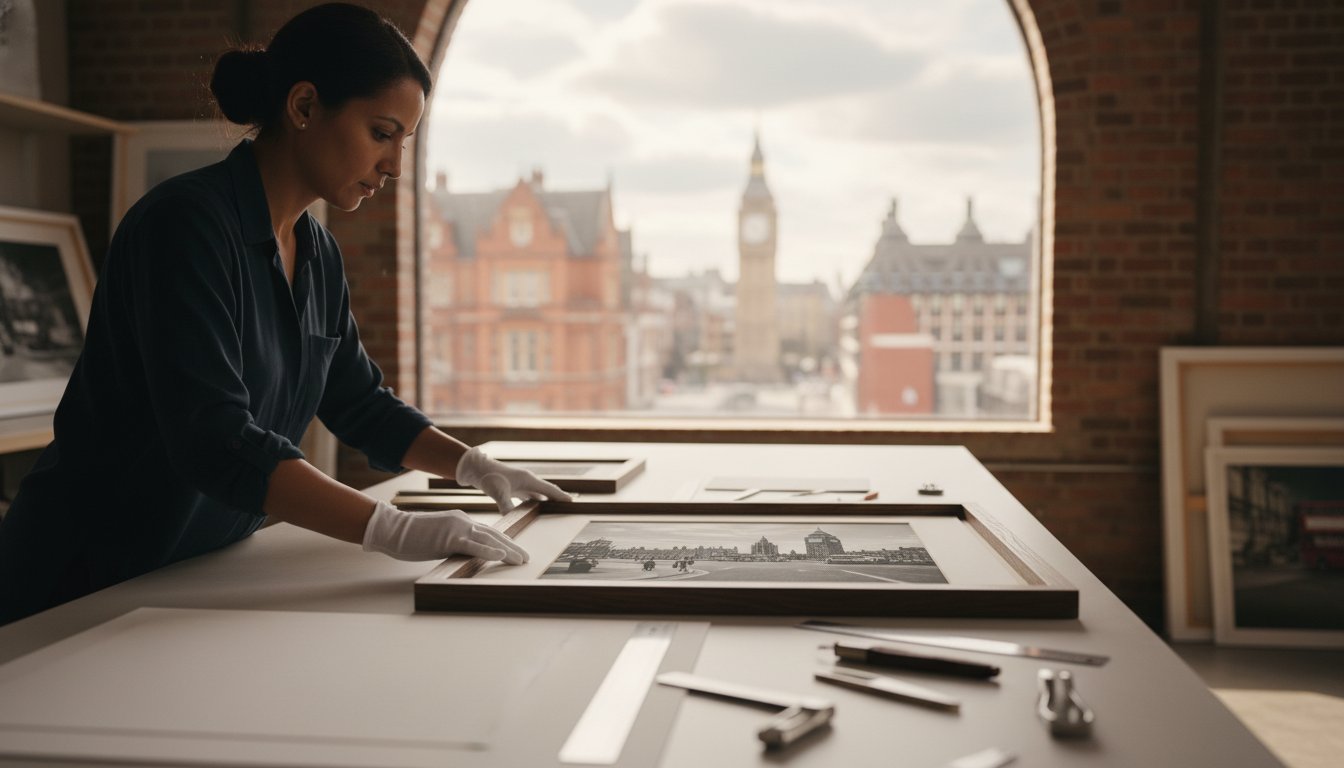
Maintaining quality control requires a hands-on approach that only local craftsmanship can provide. We handle delicate black and white pictures with white-glove precision, ensuring that the silver gelatin emulsion remains pristine throughout the mounting process. Our bespoke options allow for a high degree of personalisation. You can choose from classic hand-stained woods that highlight natural grain or sleek museum acrylics for a more contemporary, minimalist finish. These acrylic options are particularly valued for large-format works because they offer superior clarity and reduced weight without compromising on UV protection. Every choice reinforces the question: is professional framing worth it? The answer is found in the meticulous attention to detail that only a specialist studio can offer.
The Seamless Collector Experience
Many collectors suffer from a “framing backlog,” where exquisite prints remain rolled in tubes for months or even years. By opting for a framed acquisition, you eliminate this delay and begin enjoying your investment immediately. Our team provides expert advice on building a cohesive gallery wall, helping you select framing styles that unite disparate archives into a single, sophisticated narrative. This curatorial support ensures that your home reflects the polished atmosphere of a private exhibition. We invite you to explore our bespoke framing options and curated collections to find the perfect final act for your next acquisition.
Preserving Your Photographic Legacy for the Next Generation
Your collection deserves a future as vibrant as its past. When you weigh the risks of environmental decay against the precision of museum-grade standards, the answer to is professional framing worth it becomes a matter of preserving heritage. A bespoke frame isn’t just an accessory; it’s a structural guarantee that your investment remains shielded from UV rays and atmospheric pollutants for decades. By choosing artisanal craftsmanship over mass-produced alternatives, you ensure that the narrative of your home remains as curated and iconic as the art itself.
Whether you are curating a collection of iconic archive prints or commissioning a specialist like Mandy Martin Photography to document your own family milestones, the same rigorous standards of archival protection should apply to ensure these memories endure for generations.
We operate as guardians of photographic history. As specialists in the Slim Aarons and Getty Images archives, we combine museum-quality archival materials with the unique expertise of our London-based darkroom. Every piece is hand-printed and framed with a level of precision that honours the original artist’s vision. Now is the time to transition from being a buyer to becoming a true collector. Invest in the world’s finest photography, expertly framed by our London craftsmen. Your walls are the canvas for your history; let us help you protect it with the reverence it deserves.
Frequently Asked Questions
Is professional framing worth it for inexpensive prints?
Bespoke framing is an excellent investment for inexpensive prints if you value their aesthetic impact within your home. A professional mount and a solid wood profile lend an air of authority to any image, transforming a simple poster into a gallery-worthy focal point. Beyond the visual elevation, professional handling prevents the low-grade paper often used for such prints from yellowing or becoming brittle within a few short years.
How much does professional custom framing usually cost?
As of May 2026, the cost of custom work is determined by dimensions and material quality. Small items up to 9″ x 12″ typically range from $90 to $115. Medium-sized works around 16″ x 20″ generally fall between $75 and $250, while large-scale statement pieces up to 24″ x 36″ can reach between $200 and $600. The choice of premium glazing and archival matting are the primary factors in these variations.
What is the difference between museum glass and regular glass?
Museum glass is a specialized product that blocks 99% of harmful UV rays while featuring an anti-reflective coating that makes the glazing nearly invisible. Regular glass offers basic protection from dust but lacks significant UV filtering and creates distracting reflections. Because light damage is cumulative and irreversible, the decision regarding is professional framing worth it often centers on whether you choose this superior protection for your collection.
Can a bad frame actually damage my artwork or photography?
A poorly constructed frame can cause irreversible chemical damage through acid migration and moisture trapping. Standard retail frames often use MDF or cardboard backings that release acidic gases, leading to permanent staining or “mat burn.” If the photograph’s emulsion touches the glass directly without a mount, it can bond to the surface in humid conditions, making it impossible to remove the print without destroying it.
How long does a professional framing project typically take?
A bespoke project usually requires between 14 and 28 days to complete, as it involves hand-selecting hardwoods and meticulous artisanal assembly. This timeline allows for the precision required in a professional studio, such as hand-staining wood or ensuring a perfectly dust-free environment during the final seal. While retail options are instant, the measured pace of a bespoke finish ensures the structural integrity of your investment.
Does professional framing increase the resale value of art?
Professional framing preserves the condition that dictates the market value of a limited edition. A print with a documented history of archival storage and museum-grade protection is far more attractive to serious collectors and auction houses. By preventing fading and paper degradation, you ensure that the artwork retains its provenance and original vibrancy, which are the cornerstones of any future valuation.
What is acid-free mounting and why is it necessary for photography?
Acid-free mounting utilizes materials with a neutral or slightly alkaline pH, such as 100% cotton rag matboard. This is vital for photography because the chemical dyes in the image are highly reactive to the lignin found in cheaper wood-pulp products. Without this chemical neutrality, the print will eventually develop brown spots or “foxing,” a form of decay that significantly devalues the work over time.
Can I frame a large print myself without it buckling?
Framing a large-scale print at home is exceptionally difficult because paper naturally expands and contracts with temperature changes. Without professional mounting techniques or the use of a vacuum press, large prints often develop “waves” or buckles within the frame. A master framer provides the necessary expansion room and structural support to keep the image perfectly flat and secure for decades of display.