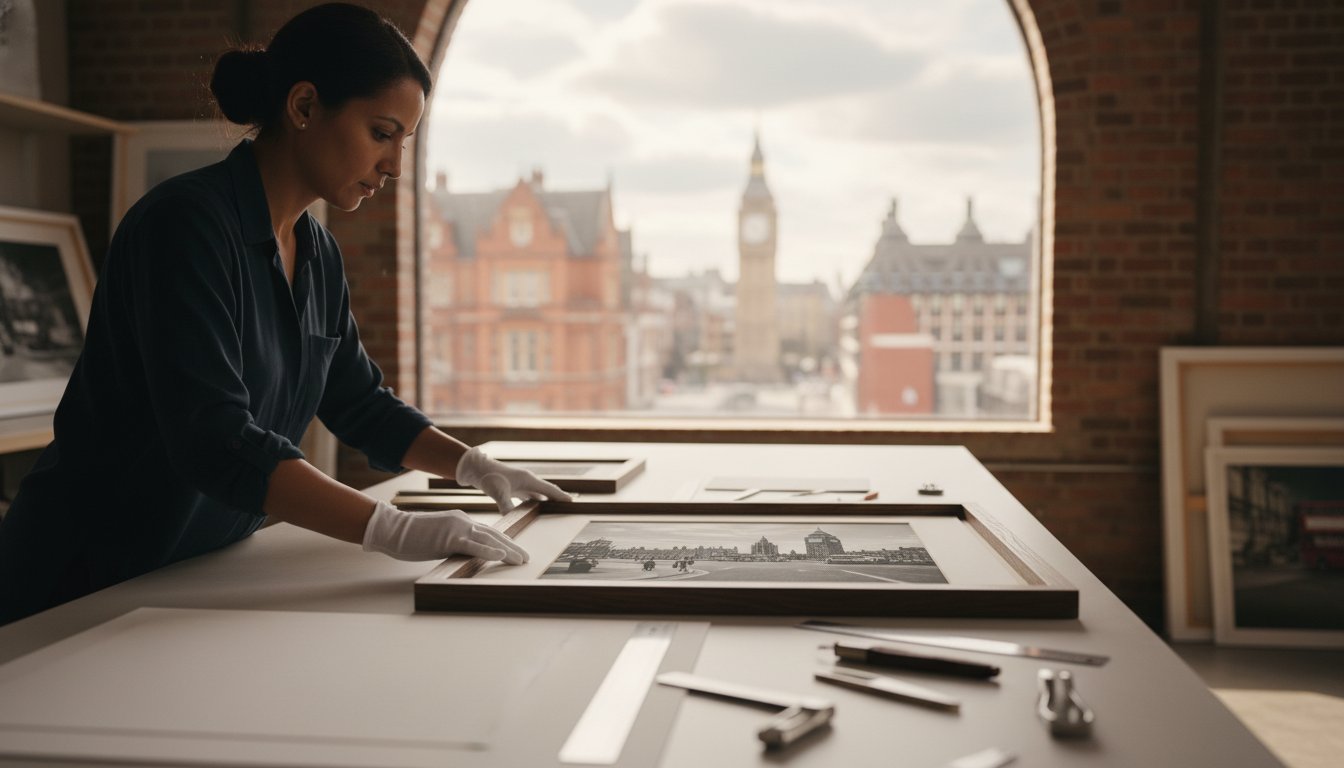

A frame is far more than a decorative border; it’s the final curatorial act that defines whether a masterpiece survives the decades or slowly fades into obscurity. The standards of archival picture framing london represent more than a simple service; they are a commitment to the longevity of your visual heritage. It’s natural to feel trepidation regarding the technicalities of preservation. The fear that acidic mounts might yellow a rare print or that light will steal the vibrancy of a Slim Aarons original is a concern shared by every serious collector. In a UK art market valued at $10.5 billion in 2025, the stakes for protecting your investment have never been higher.
This guide shows you how to bridge the gap between historical reverence and modern interior design. You’ll learn to navigate the technicalities of 99% UV-protective glazing and museum-grade cotton rag mounts without compromising on aesthetic impact. We’ll preview the artisanal traditions of London’s master framers, ensuring your journey from purchase to hanging is effortless and sophisticated. Discover how the right conservation standards don’t just protect a print; they elevate its presence as a lasting piece of history.
Key Takeaways
- Distinguish between conservation and museum-grade standards to ensure your rare prints are shielded from the irreversible effects of foxing and chemical degradation.
- Master the art of aesthetic curation by selecting timber and finishes that complement iconic eras, such as the vibrant Mid-Century Modern aesthetic of the Slim Aarons Collection.
- Learn why investing in archival picture framing london provides the necessary UV-protective glazing and pH-neutral environments required to preserve a photograph’s long-term market value.
- Gain insight into the London artisan tradition, where hand-finished hardwoods and local expertise meet the rigorous display demands of world-class art institutions.
- Discover the effortless elegance of a ready-to-hang service that bridges the gap between a curated gallery acquisition and a perfectly installed home display.
Defining the London Standard: Conservation vs. Museum Fine Art Framing
In the quiet workshops of London’s premier art districts, a frame is viewed as a guardian rather than a mere ornament. High-street framing often relies on wood pulps and adhesives that release harmful acidic gases over time. These volatile compounds lead to foxing, those unsightly brown spots that mar the surface of a pristine photograph, and permanent chemical degradation. Professional archival picture framing london eliminates these risks by creating a strictly pH-neutral environment. By choosing materials that don’t off-gas or migrate acids, collectors ensure their investment remains as vibrant as the day it was captured.
Preservation is a financial strategy as much as an aesthetic choice. A damaged print can lose a significant portion of its market value if the paper becomes brittle or discoloured. In a market where UK art sales reached approximately $10.5 billion in 2025, maintaining the physical integrity of a piece is paramount. Leading galleries treat the frame as the final curatorial act, a protective seal that signals to future buyers that the work has been handled with the utmost reverence. Understanding The Anatomy of a Bespoke Frame is the first step in appreciating how these technical layers contribute to long-term stability and prestige.
What is Conservation Level Framing?
Conservation framing is built upon the foundational principle of reversibility. Every element touching the artwork must be removable without leaving a trace. This level utilizes acid-free barrier boards and cotton-rag hinges, which are far superior to standard adhesive tapes. It’s the essential benchmark for private collectors in 2026 who want to enjoy their art while keeping their options open for future conservation. It creates a sanctuary for the paper, shielding it from the atmospheric fluctuations common in historical London homes.
The Museum Standard: When Only the Best Suffices
The museum standard represents the pinnacle of the craft, adhering to the rigorous guidelines that define the highest tier of the Fine Art Trade Guild. This level is non-negotiable for rare archives, such as those found in the Slim Aarons collection, where the preservation of specific colour dyes is critical. For light-sensitive historical prints and rare silver gelatin works, museum-grade framing employs 99% UV-protective glazing and the highest purity of cotton-rag mounts. It’s an uncompromising approach designed to ensure that even the most delicate photographic heritage remains unchanged for over a century.
The Anatomy of a Bespoke Frame: Premium Materials for 2026
The foundation of a superior frame lies in the timber. While mass-produced alternatives often rely on composite materials that degrade, the connoisseur’s choice remains sustainable hardwoods like ash, oak, and walnut. These woods provide a structural permanence that resists warping, ensuring the artwork remains perfectly flat and secure over decades. In the pursuit of archival picture framing london, the discernment of the collector often begins with the tactile quality of hand-finished veneers. These finishes are applied with a reverence for the wood’s natural grain, creating a housing that is as much a piece of furniture as it is a protective vessel.
An archival mount is a chemically inert, acid-free barrier board with a minimum thickness of 1.4mm, typically crafted from cotton linters or purified alpha-cellulose to ensure it remains pH-neutral for the life of the print. This component is the silent guardian of the photograph. It prevents the migration of acids from the frame’s backboard or the external environment, which would otherwise lead to the brittle yellowing of the paper. Choosing the right mounting materials is a technical necessity that underpins the longevity of any serious collection.
Glazing Options: Anti-Reflective and UV Protection
Glazing is the primary defense against the invisible threat of light. Adhering to the Fine Art Trade Guild framing standards ensures that glazing provides more than just a physical barrier. Standard glass often acts as a mirror, obscuring the delicate grain of a silver gelatin print; however, specialist Artglass or Museum Acrylic provides a clarity that makes the glazing virtually invisible. More importantly, these materials filter out 99% of UV rays. This protection is non-negotiable for colour photography, where light exposure causes irreversible fading and shifts in tonal balance. For those seeking a seamless transition from selection to display, exploring a bespoke framing service ensures every material choice is guided by archival expertise.
Mounting Techniques for Photographic Depth
The way a print is positioned within the frame dictates its visual impact and physical safety. A deep-bevel window mount creates a dramatic gallery-style focus, drawing the eye into the image while providing a necessary air gap between the print and the glass. This gap is vital; it prevents moisture from becoming trapped against the emulsion, which can cause the print to stick to the glazing. For works on deckled-edge papers, float mounting allows the artisanal quality of the paper to remain visible, making the artwork appear as if it’s suspended within the frame. Spacers are used in these instances to maintain that crucial protective distance, blending technical safety with a sophisticated, three-dimensional aesthetic.
Aesthetic Curation: Matching Frames to Iconic Photographic Eras
Selecting a frame is a deliberate act of translation. It requires an intimate understanding of the artist’s intent and the historical context of the work. Some collectors hesitate, viewing the frame as a secondary concern to the print itself. However, a bespoke frame is an essential extension of the art; it provides the structural and visual context that allows an image to breathe. In the sophisticated world of archival picture framing london, this curation ensures that the aesthetic of a mid-century poolside, a gritty rock-and-roll portrait, or even the vibrant contemporary African artworks found at Artgal.Online is both preserved and properly articulated within a modern home.
For those focused on black and white pictures, the goal is often monochrome mastery. Enhancing the deep blacks of a silver gelatin print requires a frame that doesn’t compete for attention. Conversely, contemporary minimalism demands sleek, thin profiles. Large-scale modern photography and digital prints often benefit from these narrow, unadorned frames, which allow the sheer scale of the work to dominate the space. This approach prioritizes the image, using the frame as a subtle, protective boundary that disappears into the architecture of the room.
Framing the Jet-Set Era
The vibrant, aspirational world of Slim Aarons demands a specific palette to maintain its sun-drenched allure. To anchor these 1960s scenes in a contemporary London interior, curators often look to natural wood or pristine white frames. These lighter tones complement the turquoise waters and citrus hues characteristic of the era without overwhelming them. The “gallery white” standard remains a favourite for high-end residential displays in Chelsea and Mayfair, providing a clean, crisp finish that feels both historical and refreshingly modern. It creates a seamless transition between the leisure of a bygone era and the refined aesthetics of today.
The Terry O’Neill Aesthetic: Rock and Roll Sophistication
Iconic celebrity portraiture and music photography often require a more substantial presence. To capture the raw energy of a Terry O’Neill archive, black stained ash or oak provides a dramatic weight that mirrors the intensity of the subject. The width of the frame moulding significantly influences the mood; a wider, hand-finished black frame can turn a single portrait into a powerful focal point. For collectors building an extensive gallery wall, using uniform archival framing creates a cohesive narrative across diverse images. This consistency allows the individual stories of the artists to shine while maintaining a disciplined, curatorial rhythm throughout the collection.
The London Artisan Tradition: Why Local Bespoke Craftsmanship Wins
London has long been a sanctuary for master craftsmen; workshops stretch from the historic ateliers of Chelsea to the vibrant, industrial studios of Shoreditch. This geographical concentration of talent ensures that archival picture framing london remains at the forefront of global conservation standards. Local artisans possess an intimate understanding of the security and display demands required by major art institutions, providing a level of oversight that distant factories simply cannot replicate. Every frame produced in these workshops is a testament to a lineage of skill, where the focus remains on the preservation of history through meticulous manual labour.
The distinction between a factory-joined frame and a hand-finished piece is immediately apparent to the discerning eye. Factory frames are often joined from pre-finished lengths of moulding, leaving visible seams at the corners. In contrast, a bespoke London frame is joined in its raw state before being sanded, stained, and finished as a single unit. This process creates the “closed-corner” look, a hallmark of luxury that ensures the frame appears as a seamless, solid object. In 2026, this tradition is bolstered by a commitment to sustainability, with workshops sourcing FSC-certified timbers to ensure that every commission respects both the artwork and the environment.
Hand-Finished Excellence
Artisanal excellence is defined by the subtle nuances of hand-staining and waxing. Unlike the flat, uniform colours of mass-produced frames, hand-finishing allows for a unique patina that develops depth and character over time. This level of customization is essential for high-end interior design projects, where custom colour matching ensures total harmony between the artwork and its architectural surroundings. Whether it’s a soft, muted grey to match a specific silk wallpaper or a rich, dark oak to ground a library, the artisan’s touch provides a bespoke finish that anchors the piece in its environment.
The Logistics of London Art Handling
The journey from the workshop to the gallery wall requires more than just a delivery van. Specialist art handlers manage the safe transport of large-format works across the city, utilizing climate-controlled vehicles to protect sensitive paper archives from London’s unpredictable humidity. For those looking to move collections abroad, professional crating is a necessity. These custom-built wooden cases provide a protective micro-environment, ensuring that even the most delicate prints survive international shipping without incident. To ensure your collection receives this level of dedicated care, explore our bespoke framing service for a truly comprehensive preservation solution.
Galerie Prints: A Seamless Integration of Fine Art and Framing
The journey from a legendary negative to a finished masterpiece requires a steady hand and a curator’s eye. At Galerie Prints, we don’t just sell imagery; we act as a bridge to a bygone era of elegance. By operating as a premier fine art photography gallery London, we offer an integrated service that removes the friction between acquisition and installation. This seamless approach ensures that the technical rigour of archival picture framing london is applied at the very moment the print is born. It’s a commitment to the integrity of the work, ensuring every piece leaves our care with the protection it deserves.
Our consultations are designed to bridge the gap between art selection and the nuances of luxury home display. We understand that a large-format print, whether it is a unique gallery acquisition or a professional digital production from Colour Graphics, requires more than just wall space; it needs a frame that respects the architecture of the room. Our experts provide guidance on profile selection and material finishes, ensuring that the final presentation is both historically accurate and aesthetically resonant. This level of personalized service is what distinguishes a true gallery experience from a standard retail transaction, positioning us as guardians of your collection’s provenance.
The Galerie Prints Bespoke Experience
The lifecycle of a print in our London workshop is a meticulous process. Whether you’re selecting a piece from the Slim Aarons Collection or the Terry O’Neill Photography archives, the customization options are exhaustive. We help you navigate the delicate balance between frame depth and mount width, ensuring the dimensions are tailored to your specific interior. This bespoke attention ensures that the finished work isn’t just a decoration but a permanent fixture of your home’s heritage, supported by the highest standards of archival picture framing london.
Ready-to-Hang Luxury
There’s a profound reassurance in knowing your artwork has been professionally mounted and sealed before it ever reaches your door. This ready-to-hang philosophy extends to our more specialized offerings, such as cinema lobby cards and rare memorabilia. These items often require unique archival displays that highlight their vintage charm while providing a museum-grade seal against the elements. Every frame undergoes a final, rigorous quality check, receiving the Galerie Prints seal of excellence as a guarantee of its artisanal origin and archival stability.
Securing Your Photographic Legacy for the Next Century
The decision to invest in archival picture framing london is a commitment to the permanence of your collection. By choosing museum-grade materials and pH-neutral environments, you don’t just display a print; you preserve a piece of history against the inevitable passage of time. We’ve explored how the synergy between hand-finished hardwoods and UV-protective glazing creates a sanctuary for your art, ensuring that the vibrant hues of the jet-set era or the deep contrasts of monochrome portraiture remain untarnished for future generations. A frame isn’t merely an accessory. It’s the final, essential chapter in the story of the image.
As an official partner of the Slim Aarons archives and other esteemed photographic collections, Galerie Prints operates with a deep reverence for the works we house. Our handcrafted bespoke framing is trusted by international collectors and London’s leading interior designers to deliver a finish that’s as technically superior as it is aesthetically profound. Whether you’re anchoring a single iconic image or curating an expansive gallery wall, we invite you to explore our curated collections and bespoke framing options. Begin the journey of elevating your home with world-class photographic heritage; your collection deserves a guardian that understands its true value.
Frequently Asked Questions
What is the difference between conservation and museum-quality framing?
Conservation framing is the standard for high-value collections, while museum-quality framing represents the absolute pinnacle of preservation. Conservation level uses acid-free materials and reversible techniques to protect against environmental damage. Museum framing elevates this by employing the highest-grade UV glazing and cotton rag mounts. It’s the definitive choice for those seeking the most rigorous archival picture framing london standards for their sensitive historical archives.
How much does bespoke fine art framing cost in London?
The cost of bespoke fine art framing in London depends on the dimensions of the work and the technical complexity of the materials selected. Factors such as the choice between sustainable hardwoods and hand-finished veneers, as well as the level of UV protection in the glazing, will influence the final investment. Collectors typically find that the cost reflects the artisanal labour and the long-term protection provided to the artwork.
Why is UV-protective glass essential for fine art photography?
UV-protective glass is essential because it filters out up to 99% of harmful ultraviolet rays that cause irreversible fading and tonal shifts. Fine art photography, particularly colour work from the mid-century, is highly susceptible to light damage. Without this barrier, exposure to natural or artificial light will eventually degrade the emulsion, permanently diminishing both the visual impact and the market value of the piece.
Can you frame rare items like cinema lobby cards or vintage posters?
Yes, rare items like cinema lobby cards and vintage movie posters require specialized archival picture framing london to prevent the delicate paper from becoming brittle. These historical artifacts often feature unstable inks or acidic paper stocks that need pH-neutral environments to survive. Our workshop utilizes custom mounting techniques that secure these items without the use of permanent adhesives, ensuring their cinematic heritage is preserved.
How long does a bespoke framing project typically take in London?
A bespoke framing project typically requires between two to four weeks from the initial consultation to final completion. This timeline allows for the meticulous hand-finishing of timber and the precision cutting of museum-grade mounts. While standard options may be faster, the artisanal process of crafting a custom housing for fine art photography cannot be rushed if one wishes to meet the highest curatorial standards.
What is the best frame style for a Slim Aarons poolside print?
The most effective frame style for a Slim Aarons poolside print is a slim, hand-finished white or natural wood profile. These lighter tones complement the vibrant turquoise and citrus palettes of the jet-set era without distracting from the aspirational narrative. A deep-bevel window mount is often recommended to add a sense of gallery-style depth, perfectly anchoring the sun-drenched scene within a sophisticated modern interior.
Do you offer delivery and installation for large framed artworks in London?
We facilitate the safe transport and professional installation of large-format framed works through a network of specialist art handlers in London. Managing the logistics of substantial pieces requires climate-controlled vehicles and expert knowledge of secure hanging systems. This ensures that your investment is moved with the utmost care and installed with the precision required for high-end residential or gallery displays.
Is it better to buy a print pre-framed or frame it myself later?
Buying a print pre-framed from a reputable gallery is generally superior as it ensures the artwork is never exposed to improper handling or acidic environments. Professional mounting and sealing occur in a controlled workshop, providing an immediate archival seal. Framing it yourself later carries the risk of accidental damage or the use of sub-standard materials that could compromise the print’s integrity and long-term value.