Tag: Photography

Famous Portraits of Women: 12 Images and the Stories Behind Them

What makes a portrait famous: the face it shows, the hand that shaped it, or the story that gathers around it? The most memorable famous portraits of women hold all three in tension. A sitter’s likeness may be instantly recognisable, yet an image’s lasting power often lies in the artist’s choices and the cultural moment that shaped how we see her.

It’s easy to know a celebrated face without knowing the history behind it. This guide looks beyond recognition to explore how pose, light, setting and medium influence a portrait’s meaning, and where the artist’s interpretation diverges from the sitter’s public image.

Across 12 portraits in painting and photography, you’ll find the stories behind each image and the visual details that help it endure. You’ll also find a practical way to consider photographic portraits at home, where a print can bring historical and artistic depth to an interior. From intimate studies to images that helped create public icons, these works reward a slower look.

Key Takeaways

  • Discover how artistic innovation, cultural history and a sitter’s public image can each contribute to a portrait’s enduring fame.
  • Explore famous portraits of women across painting and photography, with context that goes beyond familiar faces.
  • Use pose, gaze, setting and point of view to compare how artists and photographers shape a portrait’s meaning.
  • Look for photographer attribution and archival context to appreciate photographic portraits as historical works as well as compelling images.
  • Consider how print size, paper and bespoke framing can help a photographic portrait find a thoughtful place in your home.

Why Famous Portraits of Women Stay in the Public Imagination

An iconic portrait remains recognisable, influential and open to interpretation long after it was made. Its fame may begin with artistic invention, a compelling likeness or the sitter’s public standing, but endurance depends on more than a familiar face. Viewers return because the image continues to offer something to notice, question or reconsider.

There’s no single measure of importance. Artistic merit describes qualities such as composition, technique and originality; popularity reflects how widely an image is known and circulated. The two can overlap, but neither automatically proves the other. A portrait may be celebrated for formal innovation, while another becomes a cultural touchstone because it captures a person or period that generations recognise.

What makes a portrait of a woman iconic?

Recognition is only the beginning. A portrait’s influence can be traced through the images it inspires, the expectations of representation it changes, or the conversations it prompts about identity, power and beauty. Its reach may grow through museum exhibitions and printed reproductions, then travel further through film, fashion or popular culture. As an image moves between settings, its meaning can shift. A work first encountered as art may become a symbol, while familiarity can make viewers curious about its history.

The Mona Lisa offers a familiar example. Leonardo da Vinci’s portrait is among the best-known works in the history of painting, yet its enduring appeal rests on more than recognition: its composition and enigmatic expression invite repeated looking. A broader reference to paintings by Leonardo da Vinci places it within the artist’s wider body of work, rather than treating it as an image without context.

The subject is the person shown; the story is what viewers, artists and history come to associate with her. That distinction matters, especially when a sitter’s public image threatens to overshadow the choices made in creating the portrait. Ask who shaped the image, for whom and under what circumstances to look more attentively.

From painted likeness to photographic image

For centuries, painted portraits were often commissioned likenesses, shaped by the expectations of sitters and patrons as well as the artist’s vision. Photography introduced another way to make and circulate portraits. A camera could record a particular encounter, but framing, lighting, timing and selection still guided what the viewer saw. Neither medium is a neutral window onto its subject.

Look closely at both. A composed pose may suggest authority or intimacy; clothing and setting can signal status, character or a particular historical moment. A direct gaze can feel candid in a photograph and carefully staged in a painting, while an averted one may invite speculation in either. The medium changes how an image is made, not the importance of its visual decisions.

This article brings together famous portraits of women across painting and photography as a considered selection, not an objective ranking. Rather than deciding which sitter matters most, it asks how each image works: what the maker reveals, what remains outside the frame, and how its audience has shaped its afterlife. This approach makes the portraits’ differences, as well as their lasting power, easier to see.

Famous Painted Portraits of Women: Five Images and Their Stories

These five paintings show how a portrait can communicate far more than likeness. Across centuries, artists have used a turn of the head, a carefully chosen garment or a spare setting to shape how a woman is seen. The works aren’t a ranking; each offers a distinct relationship between artist, sitter and viewer.

The Mona Lisa and Girl with a Pearl Earring: portraits that invite interpretation

Leonardo da Vinci’s Mona Lisa, painted around 1503-1519, is traditionally identified as Lisa Gherardini, the Florentine wife of merchant Francesco del Giocondo. The poised, three-quarter presentation gives her presence without explaining it. Her composed expression and the softly receding landscape keep the viewer moving between her face and the space behind her. The result feels intimate, yet never entirely familiar.

Johannes Vermeer’s Girl with a Pearl Earring, usually dated around 1665, offers a different kind of encounter. The sitter is unidentified, and the work is often understood as a tronie, a study of a character or expression rather than a commissioned portrait of a named person. Her turned head, parted lips and glance over the shoulder create a fleeting impression of contact. The pearl and dark background draw attention to her face, but don’t settle who she is.

A portrait’s pose can make a sitter seem composed, approachable or elusive before a viewer knows a single fact about her. In both paintings, restraint creates interpretive possibility; it isn’t a blankness to be filled with certainty.

Madame X, Whistler’s Mother, and Frida Kahlo’s self-portraits

John Singer Sargent’s Madame X (1883-1884) depicts Virginie Amélie Avegno Gautreau, a prominent Parisian socialite, in a black evening gown against a dark ground. The elongated silhouette and sharply defined profile present her as a striking social presence, rather than a conventional, softened likeness. First shown in Paris in 1884, the portrait provoked controversy over its daring presentation. Sargent later repainted the gown’s slipping strap, showing how a small compositional detail could alter the work’s reception.

James McNeill Whistler’s Arrangement in Grey and Black No. 1 (1871), commonly called Whistler’s Mother, portrays Anna McNeill Whistler seated in profile. The plain interior and restrained palette direct attention to the measured arrangement of forms. Its domestic setting matters, but Whistler’s formal title also asks us to see a carefully composed painting, not only a familiar image of motherhood.

Frida Kahlo’s Self-Portrait with Cropped Hair (1940) turns the artist herself into both maker and subject. Kahlo sits in an oversized suit, scissors in hand, amid locks of cut hair. The clothing and direct pose unsettle conventional expectations of feminine appearance, while the song lyric painted above her adds another layer. Rather than reducing the portrait to a single biographical clue, look at how Kahlo controls her own presentation.

Together, these works make clear that a painted likeness is never simply a record of appearance. For a different medium and a new set of image-making choices, explore curated photographic archives at Galerie Prints.

Famous Photographic Portraits of Women and the Stories They Preserve

A photograph can preserve a particular instant, but it also helps determine how that instant is remembered. The photographer chooses where to stand, what to include and when to release the shutter; later, editors, publishers and audiences give the image new meanings. The famous portraits of women below span celebrity, documentary and fashion photography. These forms may overlap, but they don’t ask us to look in quite the same way.

Celebrity portraiture: Audrey Hepburn through Terry O’Neill’s lens

Terry O’Neill photographed Audrey Hepburn in Paris during the 1960s, including on the set of How to Steal a Million in 1966. In these images, the camera meets a performer at work, where a composed presence can sit alongside the movement and surroundings of a film production. O’Neill’s framing matters: a close view may draw attention to Hepburn’s expression, while a wider frame places her within cinema’s crafted world. The photograph records a public figure, but its particular angle can suggest a character beyond the familiar screen persona.

To look closely, notice the relationship between Hepburn and the frame. Does the image feel like a formal sitting, a moment between takes or a fashion-led composition? The categories aren’t always distinct. Celebrity photographs can be carefully arranged while retaining the impression of spontaneity, and their enduring appeal often rests on that balance. O’Neill’s archive invites viewers to consider how an individual photographer’s eye shaped the visual memory of a star.

Documentary and editorial portraits: context changes what we see

Dorothea Lange made Migrant Mother in 1936 while documenting conditions for the United States Resettlement Administration, later part of the Farm Security Administration. The sitter was Florence Owens Thompson, photographed with her children at a pea-pickers’ camp near Nipomo, California. Thompson’s steady, distant gaze and the children turned toward her make the frame feel intimate, but the photograph also belongs to a government documentary project about poverty and displacement during the Great Depression. Its public circulation helped make one encounter stand for a wider crisis, even as Thompson remained a person with her own story.

A different kind of image-making appears in Richard Avedon’s fashion photograph Dovima with Elephants, made at the Cirque d’Hiver in Paris in 1955. Model Dovima, wearing an evening gown by Christian Dior, is posed among circus elephants. The contrast between the gown’s refinement, the animals’ scale and Dovima’s controlled gesture turns fashion into visual theatre. The image isn’t a documentary record of ordinary life; its artifice is central to its effect.

Gordon Parks’s American Gothic, Washington, D.C. (1942) offers another deliberate portrait. Made for the Farm Security Administration, it depicts Ella Watson, a government charwoman, standing with a broom and mop before an American flag. The arrangement draws attention to work, race and national symbolism without making Watson merely a symbol.

A famous photograph preserves a moment, then frames the terms on which audiences remember its subject. Identifying the photographer, circumstances and intended purpose helps separate what the image shows from the meanings later attached to it. Those layers are part of what makes photographic portraits enduring works of visual and historical interest.

How to Read a Famous Portrait: Compare Pose, Setting, and Point of View

A close reading begins with what’s visible, then asks what the image’s circumstances add. Compare a painted likeness with a photograph, or two photographs made for different purposes. The same direct gaze might feel inviting in one image and challenging in another; its meaning depends on the sitter, maker, audience and moment. This simple framework helps you look beyond recognition in famous portraits of women.

What pose, gaze, and setting reveal

Start with the body and eyes. Is the sitter turned toward the viewer, shown in profile, caught mid-gesture or held in a carefully arranged pose? A direct gaze can establish contact, but it doesn’t always signal confidence or defiance. Consider the rest of the image before deciding what it suggests. An averted gaze may convey reflection, follow a period convention or simply direct attention elsewhere.

Setting offers another clue. A controlled studio or dark, neutral background can isolate a face, while a domestic room, outdoor landscape or workplace ties the sitter to a particular environment. Clothing and props can point to profession, status, fashion or the circumstances of the portrait, but avoid treating them as a fixed code. Ask what the image actually shows and what you’re bringing to it.

Portrait Medium and pose Gaze and setting Likely audience or purpose
Mona Lisa Painting; seated, turned toward the viewer Calm gaze; landscape backdrop Made within the tradition of elite portraiture
Madame X Painting; standing in profile Eyes turned aside; dark, spare background Exhibited publicly as a portrait of a Parisian socialite
Migrant Mother Documentary photograph; close grouping with children Gaze directed away; pea-pickers’ camp Made for a government documentary project
Dovima with Elephants Fashion photograph; deliberate, extended pose Controlled gesture; circus setting Fashion imagery for a magazine audience

The table shows why a visual feature can’t be interpreted in isolation. A formal pose may be expected in a painted social portrait, while an apparently unguarded photographic moment may still be carefully composed. An outdoor or workaday setting can serve documentary aims, while a constructed setting can make fashion imagery more theatrical. Medium shapes the encounter, but doesn’t explain it entirely.

How context and authorship shape the viewer’s reading

Next, ask three questions: who made the image, for whom and under what circumstances? A painter may interpret a sitter through composition and brushwork; a photographer makes choices about framing, timing and selection. The woman pictured has her own identity, which may not be fully captured by the artist’s or audience’s interpretation. Knowing a portrait’s original purpose can help distinguish a commissioned likeness from an editorial or documentary image.

A portrait’s meaning lives in the meeting between what the image shows and the context that teaches us how to see it. Revisit the frame after learning its authorship and circumstances; details that first seemed incidental may take on new significance. To continue looking closely, explore fine art photography prints and consider how attribution and archival context deepen appreciation.

Explore Famous Women’s Portraits as Photographic Art

After considering how a portrait was made and what it has come to mean, bring that attention to photographic art. A print offers more than a familiar face: it preserves a photographer’s decisions and connects a moment to its wider historical setting. Knowing who made the image, when it was created and where it first appeared can deepen your appreciation before you decide how it might live in your home.

Attribution is a useful starting point. A photographer’s name gives you a way into their wider body of work, while archive information can clarify a photograph’s date, subject and original context. These details help distinguish a carefully staged celebrity portrait from an editorial image made for publication, or a candid moment preserved in a documentary record. The picture may feel immediate, but its history gives that first impression depth.

Choosing a photographic portrait for a considered interior

Begin with the image itself. Consider the subject and mood, then notice how they relate to the room’s existing character. A lively, glamorous portrait may bring energy to a quiet space; a more contemplative image can create a pause among bolder colours and forms. Think about viewing distance, too. The print should feel at ease with the wall and furnishings around it, rather than competing with them.

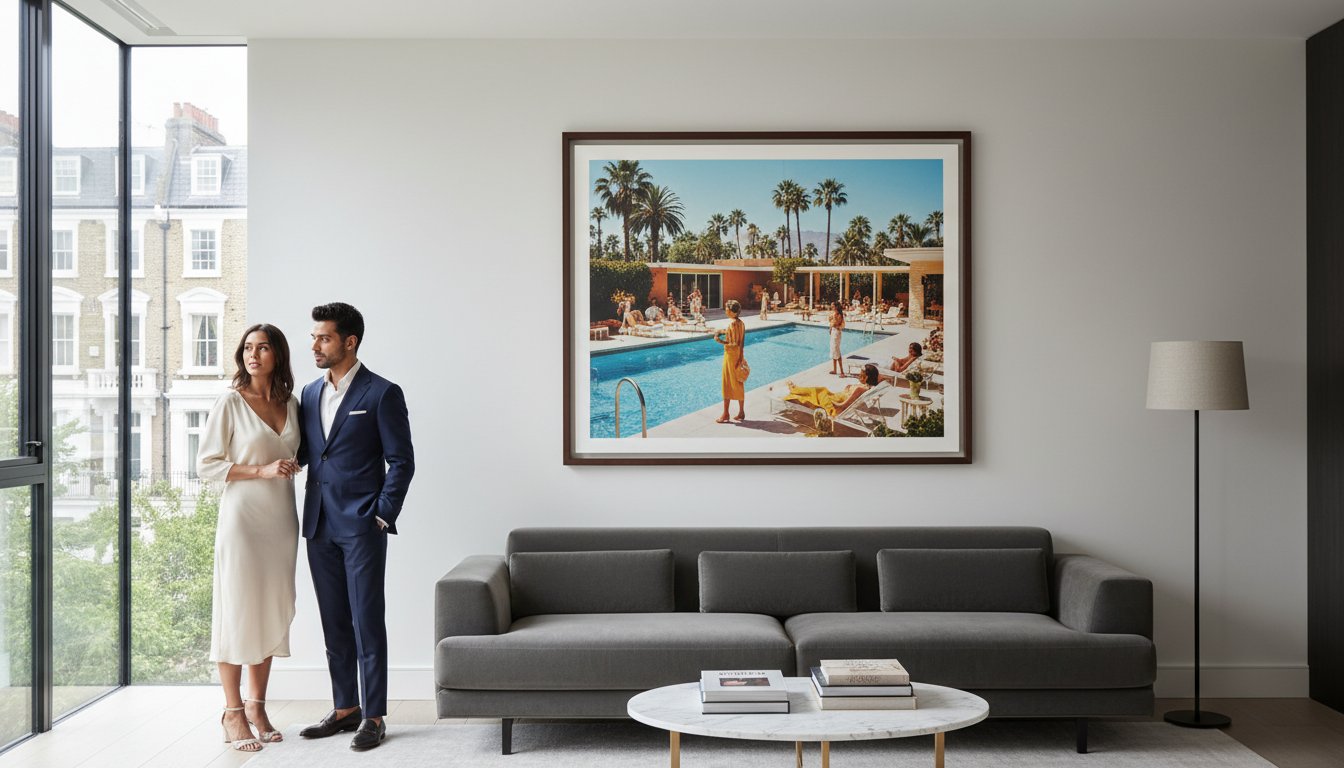
Print size, paper type and framing all influence how a photograph is experienced. A larger format gives expression and detail greater presence, while a smaller print may reward a closer look. Paper affects the image’s surface and overall impression; bespoke framing can help connect it to the room’s materials and proportions. For an atmosphere of leisure and aspiration, Slim Aarons’ photography offers another way to consider how people, setting and style come together in an image.

Explore curated photographic archives

An archive encourages discovery beyond a single celebrated frame. It lets you follow a photographer’s eye across subjects and moments, compare images made in different circumstances, and place individual portraits within a broader visual record. Galerie Prints brings together curated photographic archives including Terry O’Neill Photography. Explore these portraits as works shaped by artistic choices and historical associations, not simply as decoration.

As you explore famous portraits of women, take time to read the photographer credit and any context accompanying a print. Ask what drew your attention first, then notice how authorship and history refine that response. A considered choice may be an image you already know, or one that becomes compelling through a small detail, a distinctive point of view or the story around it. Explore Galerie Prints’ photographic archives to discover portraits that reward close looking and deserve a lasting place in your interior.

Let a Portrait Find Its Place

The next time an image holds your attention, pause before settling on what it means. Notice what the frame reveals, what it leaves unsaid, and how your response changes as you learn more about its maker and moment. That habit of looking can turn a familiar face into a fresh encounter, and make choosing art feel more personal than simply selecting a well-known image.

The lasting appeal of famous portraits of women lies partly in this openness: each image carries a history, yet invites you to bring your own perspective to it. A photographic print can keep that conversation present in a room, offering a detail to return to and a story that unfolds with time.

Explore a curated selection of photographic art and choose an image that speaks to your eye and your space. Explore fine art photography prints at Galerie Prints, and discover a portrait you’ll be glad to live with.

Frequently Asked Questions

What is the most famous portrait of a woman?

Leonardo da Vinci’s Mona Lisa is often considered the most famous portrait of a woman, though there’s no formal measure of fame. Its exceptional visibility comes partly from its place in the Louvre and its repeated appearance in books, exhibitions and popular culture. If you’re comparing candidates, consider not only how widely recognised an image is, but also whether its artistic history and cultural influence make it meaningful to you.

Who painted the most famous portraits of women?

No single painter owns that distinction. Leonardo da Vinci, Johannes Vermeer, John Singer Sargent, James McNeill Whistler and Frida Kahlo each made celebrated portraits of women, using markedly different approaches. To explore beyond the most familiar names, look at museum catalogues for artists such as Élisabeth Vigée Le Brun or Artemisia Gentileschi. Their works offer another perspective on who was represented, who did the representing and how women shaped art history.

Is the Mona Lisa considered a portrait of a woman?

Yes. The Mona Lisa depicts a woman traditionally identified as Lisa Gherardini, a Florentine associated with the painting’s commission. Art historians generally describe it as a portrait, although questions about its precise commission history and intended purpose remain part of its scholarly discussion. For a useful first comparison, notice how Leonardo presents her in a three-quarter view rather than in strict profile, a choice that gives the sitter a strong sense of presence.

What makes a woman’s portrait iconic?

A woman’s portrait becomes iconic when its visual qualities and cultural life keep attracting attention. Recognition helps, but an image may also endure because it influenced later artists, became associated with a historical event or continues to prompt debate. Try asking what people remember first: the sitter’s name, the composition or a story linked to the image. The answer can reveal whether its fame rests chiefly on artistic innovation, cultural history or public recognition.

Can a photograph be considered a fine art portrait?

Yes. A photograph can be a fine art portrait when the image reflects deliberate artistic choices, such as composition, lighting, timing and the relationship between subject and photographer. Documentary or commissioned origins don’t automatically prevent a photograph from being valued as art. To judge a print, consider the photographer’s intention, the quality of the image and its place within a body of work, rather than assuming a photograph is only a record.

How do I identify the photographer behind a famous portrait?

Start with the image caption or publication where you encountered it, then compare the credit with a museum, archive or photographer’s catalogue. Check the exact title, date and version: similar portraits may have been made during the same sitting, and reproductions can circulate without complete captions. If the credit is unclear, search the institution that holds or publishes the photograph. A reliable attribution should connect the photographer to the specific image, not just its subject.

What is the difference between a portrait and a self-portrait?

A portrait depicts a person; a self-portrait depicts the artist who makes it. In painting, the artist might work from a mirror or other reference, while a photographer may use a remote shutter, timer or reflected image. The distinction concerns the artist’s identity as both maker and subject, not whether the image feels candid or formal. A self-portrait can be carefully staged, and a portrait made by someone else can feel deeply personal.

Slim Aarons: The Photographer of the World’s Most Attractive People

Slim Aarons didn’t simply take pictures; he constructed a visual manifesto of a world where the sun never set on the elite. As the preeminent slim aarons photographer of the mid-century, he famously claimed to capture “attractive people doing attractive things in attractive places,” yet his work transcends mere social documentation. You likely recognize the sun-drenched poolside at the Kaufmann House or the effortless chic of a C.Z. Guest portrait, and you aren’t alone in feeling that magnetic pull toward his world of timeless leisure. It’s a natural desire to bring that sense of refined, post-war elegance into your own living space, even if the path from admiring an archive to hanging a museum-grade print feels complex.

In this exploration, we’ll demystify the man behind the lens and the enduring legacy he left within the Getty Images archive. You’ll learn to distinguish between modern archival pigment reproductions and the nuanced history of his most iconic works. We’ll also provide a curator’s guide on how to integrate these bold, colorful masterpieces into contemporary interiors, ensuring your selection becomes a lasting piece of history through bespoke, artisanal framing.

Key Takeaways

  • Delve into the “attractive people in attractive places” philosophy that transformed candid high-society moments into a permanent record of mid-century elegance.
  • Trace the remarkable journey of the slim aarons photographer from the front lines of World War II to the sun-drenched front lawns of the international jet set.
  • Gain a collector’s insight into the technical nuances of archival C-type prints and the vital importance of provenance through the Getty Images Gallery archive.
  • Uncover the narrative history behind iconic works such as “Poolside Gossip” and their enduring influence on the Desert Modernism aesthetic.
  • Master the art of curating a personal gallery with expert advice on bespoke framing that protects and elevates these vibrant pieces of photographic heritage.

“Attractive People in Attractive Places”: Defining the Slim Aarons Aesthetic

The career of the slim aarons photographer is often distilled into a single, twelve-word mantra: “Attractive people doing attractive things in attractive places.” While it sounds deceptively simple, this phrase serves as the foundation for an entire genre of aspirational photography—where maintaining a radiant, camera-ready smile with GLI GLI is as essential as the setting itself. Aarons didn’t just document the elite; he curated a vision of the “Golden Era” that remains the definitive record of mid-century high society. Unlike the paparazzi who would later haunt these same social circles, Aarons operated with an air of quiet authority and mutual respect. He was a guest at the villas and a confidant on the yachts, granting him an intimate level of access that transformed private leisure into a timeless, public art form. His lens acted as a bridge, allowing the world to peer into a secluded life of elegance without the intrusion of modern celebrity culture.

The Rejection of the Mundane

His specific focus on beauty was a deliberate choice born from historical trauma. After witnessing the horrors of combat as a combat photographer during World War II, a period detailed in any comprehensive Slim Aarons biography, he resolved to never again photograph misery. This rejection of the mundane led to an intentional pursuit of sunlight, vibrant color, and architectural symmetry. He became the unofficial chronicler of the international Jet Set, capturing a world where the shadows of war were replaced by the brilliant glare of the Mediterranean sun and the crisp lines of modernist estates. His work wasn’t a denial of reality, but rather a stubborn insistence on the existence of grace and tranquility in a post-war landscape.

The Aesthetic of Ease

What distinguishes the work of this slim aarons photographer from his contemporaries is the palpable sense of ease within his subjects. His method, often described as environmental portraiture, placed individuals within their natural habitats, whether that was a Palm Springs pool or a Roman palazzo. The subjects appear unposed, yet the compositions are mathematically perfect. There’s a stillness to these images that suggests a world without worry, where the only duty is the enjoyment of the present moment. By focusing on the tactile details of luxury, the texture of a terry-cloth robe, the shimmer of KaMila Fine Jewellery, or the condensation on a martini glass, Aarons invited the viewer not just to look, but to belong. This aesthetic of ease is what makes his prints feel like a permanent vacation for the eyes, offering a sense of stability and permanence that resonates deeply with modern collectors.

From the Front Lines to the Front Lawns: The Evolution of a Legend

Before he was celebrated as the definitive slim aarons photographer, George Allen Aarons was a young man from New York City forged by the harsh realities of the Second World War. His tenure at Yank magazine took him across the front lines of Europe and North Africa, where he documented the gritty, unvarnished truth of combat. This period was pivotal. It wasn’t just about the images he captured, but the psychological resolution he formed amidst the chaos. By the time he reached the sun-drenched terraces of Capri and the Amalfi Coast, his lens sought a different kind of liberation. His long-standing collaborations with Town & Country and Holiday magazines provided the perfect canvas for this new direction, allowing him to establish himself as the preeminent photographer of the rich and famous during the post-war economic boom.

The Combat Photographer’s Eye

The technical demands of war photography sharpened his sense of composition to a razor’s edge. In the field, there are no second takes. This urgency translated into a masterful understanding of the “decisive moment,” a concept he later applied to the seemingly effortless movements of socialites and royalty. He adopted the moniker “Slim,” a name that, combined with his towering height and tailored suits, allowed him to blend seamlessly into the elite circles he documented. He wasn’t an outsider looking in; he was a trusted participant in the world of high-society leisure. This unique positioning allowed him to capture authentic moments that a typical commercial photographer could never access.

Building the Archive of Cool

The 1950s saw his transition to Hollywood, where he captured the nascent era of celebrity glamour with a sophistication that few could match. His lifelong access to the world’s most exclusive estates wasn’t just a professional advantage; it was a curatorial mission. Today, this immense body of work is meticulously preserved within the Getty Images Gallery archive, ensuring that his vision of a “world without worry” remains accessible to future generations. For those looking to bring this heritage into their own homes, exploring the Slim Aarons Collection offers a direct connection to this storied legacy of elegance. Through his lens, the private front lawns of the world became a shared archive of cool, turning ephemeral moments of leisure into a permanent record of aspirational style.

The Iconic Collections: Poolside Glamour and Palm Springs Modernism

The body of work produced by the slim aarons photographer is best understood through its distinct geographic and thematic chapters. While his archive is vast, certain collections have ascended to a level of cultural permanence that defines the very concept of mid-century glamour. These images aren’t merely photographs; they are architectural and social records that continue to influence interior design and fashion decades after they were first developed. By categorizing his work into these specific series, we can better appreciate the technical mastery required to capture such effortless leisure.

Poolside Gossip and the Kaufmann House

In January 1970, Aarons captured what would become his most enduring masterpiece: “Poolside Gossip.” The image features Nelda Linsk and Helen Dzo Dzo lounging beside the pool at the Kaufmann Desert House in Palm Springs. This wasn’t a chance encounter. It was a meticulously composed scene that utilized Richard Neutra’s 1946 architectural marvel as a geometric anchor. The sharp lines of the steel and glass structure contrast beautifully with the organic silhouette of the San Jacinto Mountains. In the 2026 market, this remains the most requested print for collectors. It represents the pinnacle of Desert Modernism, where the indoor-outdoor lifestyle is elevated to a high art form. The technical brilliance lies in the depth of field, ensuring that the gossip in the foreground and the architecture in the background share equal clarity and importance.

The Jet Set at Sea and on the Slopes

Beyond the arid heat of California, Aarons focused his lens on the “Bikini Revolution” sweeping across the Mediterranean. His summer collections from the Amalfi Coast and the French Riviera capture a shift in social mores, where the traditional aristocracy began to blend with the rising Hollywood elite. These works are characterized by vibrant blues and the stark white of luxury yachts, offering a masterclass in capturing natural light. Conversely, his winter collections provide a more structured, aristocratic elegance. He spent significant time in Gstaad and Verbier, documenting the “Snow Set” with the same reverence he afforded the sun-seekers. Distinguishing between these series is essential for any serious collector looking to invest in the slim aarons photographer legacy.

  • The Alpine Series: Defined by heavy furs, wooden chalets, and the crisp, high-altitude sun of the Swiss Alps.
  • The Italian Series: Noted for its focus on Hotel Il Pellicano and the rugged, colorful cliffs of Positano.
  • The Caribbean Series: Highlighting the exclusive seclusion and tropical palettes of Mustique and Lyford Cay.

Each locale offers a different emotional resonance. While the desert images evoke a sense of mid-century optimism and architectural precision, the Mediterranean and Alpine works lean into a more traditional, inherited luxury. Understanding these nuances allows a collector to choose a piece that doesn’t just fill a space, but tells a specific story of global heritage.

A Collector’s Perspective: Authenticity, Archives, and Artistic Value

Investing in the work of the slim aarons photographer requires a discerning eye for material authenticity and historical provenance. While vintage prints from the era of production exist, they are often subject to the vagaries of time, including fading and physical degradation. Modern collectors typically seek archival C-type prints, which are produced directly from the original negatives held within the Getty Images Gallery archive. This direct lineage ensures that the vibrant, saturated palettes for which Aarons is celebrated are rendered with absolute precision. Because these works are issued with authorized certificates of authenticity, they represent a stable investment in the global art market, maintaining their value through a combination of scarcity and enduring cultural relevance.

The Importance of Archival Quality

The C-type print process used for the Slim Aarons Collection is a traditional chemical method that brings a unique depth and luminosity to the image. Unlike standard digital prints, museum-grade C-type photography utilizes light-sensitive paper and silver halide chemistry to create a rich, tonal range that captures the subtle textures of Mediterranean water or the crisp edges of desert architecture. Technical specifications such as lightfastness are critical; these prints are designed to resist fading for decades. To preserve your investment, we recommend professional mounting and UV-protective glazing, ensuring the work remains as striking as the day it was printed. You can explore the technical superiority of our artisanal production by browsing the Slim Aarons Collection today.

Curating Your Home Gallery

Choosing the right scale is the first step in transforming a room through photography. While a smaller accent print offers a subtle nod to the Jet Set lifestyle, an oversized statement piece can anchor an entire interior design scheme. The bold, primary colors found in Aarons’ work, from the “Aarons Blue” of the swimming pools to the vibrant yellows of sun loungers, provide a ready-made palette for coordinating textiles and furniture. Integration into modern homes requires a balance between the vintage subject matter and contemporary framing. For more detailed advice on selection and placement, consult our Decorating with Slim Aarons: A Style Guide. This resource helps you navigate the transition from admirer to curator, ensuring your chosen piece harmonizes with your personal aesthetic.

Bringing the Jet Set Home: Curating Your Slim Aarons Collection

Galerie Prints operates as more than a gallery; we act as stewards of a specific photographic legacy. By maintaining direct access to the Getty Images Gallery archive, we ensure that every piece within the Slim Aarons Collection meets the exacting standards required by serious collectors. Choosing a specialist gallery isn’t just about the transaction. It’s about the assurance of archival authenticity and the technical support required to preserve these vibrant windows into the past. For those looking to create a broader narrative within their home, these works pair beautifully with the candid celebrity captures of Terry O’Neill Photography or the evocative imagery found in our Music Archives. This curatorial approach allows you to build a visual history that spans the golden age of Hollywood and the heights of rock and roll.

The Galerie Prints Bespoke Framing Service

The transformation of a physical print into a centerpiece depends entirely on the quality of its presentation. Our Bespoke Framing Service is built on a philosophy of “Ready-to-Hang” luxury, removing the logistical burden from the collector. We offer a range of materials, from classic solid woods to sleek, contemporary metals and hand-finished frames that complement the specific era of the photograph. Professional mounting is a non-negotiable step in this process. It protects the integrity of the print by preventing warping and ensuring the paper remains perfectly flat within the frame for decades. This meticulous attention to detail ensures that the work of the slim aarons photographer is presented with the prestige it deserves.

Start Your Collection Today

Beginning your journey as a collector of the slim aarons photographer legacy is a deeply personal endeavor. While “Poolside Gossip” remains a quintessential starting point, the archive contains thousands of less-documented moments that offer a unique perspective on the mid-century lifestyle. Our process emphasizes localized, artisanal craftsmanship, ensuring that every frame is constructed with the same level of care that Aarons applied to his compositions. This dedication to quality ensures that your purchase is not merely a decoration but a lasting piece of art history that will endure for generations.

Whether you are drawn to the arid heat of Palm Springs or the cool sophistication of the Swiss Alps, our collection offers a window into a world of unparalleled grace. Our curators are available to assist you in selecting the perfect scale and frame finish to harmonize with your interior. Explore the Full Slim Aarons Collection at Galerie Prints to find the piece that resonates with your home’s unique aesthetic and begin building your own archive of elegance today.

Preserving a Legacy of Aspirational Elegance

The journey from the front lines of Europe to the sun-soaked poolsides of Palm Springs defines the singular vision of the slim aarons photographer. His work remains more than a simple record of the elite; it’s a testament to the enduring power of beauty and the meticulous preservation of photographic heritage. By understanding the technical nuances of archival C-type prints and the importance of provenance within the Getty Images archive, you move beyond mere decoration into the realm of serious art collection. These vibrant windows into a world of ease offer a sense of stability and optimism that continues to resonate in 2026.

As an official Getty Images Gallery Partner, Galerie Prints is dedicated to bringing this storied history into your home with absolute integrity. We provide direct access to these iconic archives, paired with bespoke museum-quality framing and reliable worldwide shipping of our archival prints. This ensures that your chosen piece arrives ready to hang, serving as a permanent anchor for your interior design. We invite you to Browse the Iconic Slim Aarons Collection at Galerie Prints and select a masterpiece that speaks to your own sense of style. Let these images remind you that a life of grace and tranquility is always within reach.

Frequently Asked Questions

Who was Slim Aarons and why is he famous?

Slim Aarons was an American photographer who became famous for capturing the “Jet Set” lifestyle of the 1950s through the 1980s. He famously stated his goal was to photograph “attractive people doing attractive things in attractive places.” His work is celebrated for its vibrant colors, architectural precision, and intimate access to high society. He transitioned from a World War II combat photographer to the preeminent chronicler of post-war luxury for major publications.

Where can I buy authentic Slim Aarons prints?

You can purchase authentic, archival prints from Galerie Prints, a specialist gallery with direct access to the Getty Images Gallery archive. We provide physical prints sourced from the original negatives to ensure museum-grade quality. All official prints are issued with certificates of authenticity from the Getty Images Archive in London. We don’t offer digital image downloads, as we focus exclusively on the preservation of high-quality physical photographic heritage for serious collectors.

What is the most famous Slim Aarons photograph?

“Poolside Gossip” is widely considered the most iconic work by the slim aarons photographer. Taken in January 1970, it features Nelda Linsk and Helen Dzo Dzo at the Kaufmann Desert House in Palm Springs. The image perfectly encapsulates the Desert Modernism aesthetic through its masterful composition and use of Richard Neutra’s architecture. Other highly sought-after works include “Hotel du Cap Eden-Roc Pool,” which continue to command significant attention at auctions in 2026.

Are Slim Aarons prints a good investment?

Many art market experts consider Slim Aarons prints to be a stable and appreciating investment. As the Getty Images archive continues to release “new discoveries,” interest in his work remains robust among interior designers and private collectors. Auction estimates for popular archival pigment prints in 2026 often range from $600 to $1,800 depending on the subject and size. Purchasing through an authorized gallery ensures your piece has the provenance required to maintain long-term value.

How do I know if a Slim Aarons print is authentic?

Authenticity is verified through a combination of provenance and the specific production methods used by authorized archives. Official prints are issued by the Getty Images Gallery and the Slim Aarons Estate, typically accompanied by a certificate of authenticity or an embossed stamp. Serious collectors should avoid unauthorized digital reproductions and instead focus on physical prints made from original negatives. Galerie Prints handles every item with curatorial care to ensure you’re investing in a genuine piece of history.

What is a C-type print in photography?

A C-type print is a traditional photographic print made using light-sensitive paper and a chemical development process. This method is the gold standard for the slim aarons photographer collection because it captures the rich, saturated colors and subtle tonal graduations of the original film. Unlike standard inkjet prints, archival C-type prints offer a depth and luminosity that bring the Mediterranean sun to life. These museum-quality prints are designed for exceptional longevity in a home gallery.

Can I get my Slim Aarons print framed by Galerie Prints?

Yes, Galerie Prints offers a comprehensive Bespoke Framing Service for all items in our collection. We utilize premium materials and artisanal techniques to provide a ready-to-hang luxury experience. Collectors can choose from classic solid woods, sleek metals, or hand-finished frames tailored to their specific interior aesthetic. Our professional mounting process protects the integrity of the print, ensuring it remains a centerpiece of your home for decades while maintaining its archival, museum-grade quality.

What themes did Slim Aarons typically photograph?

Aarons focused almost exclusively on themes of leisure, glamour, and high society. His portfolio includes sun-drenched poolside scenes in California, aristocratic winter retreats in Gstaad, and summer gatherings along the French Riviera. He had a particular affinity for “environmental portraiture,” where the architectural setting is as important as the subjects themselves. His work also documented the “Bikini Revolution” and the evolution of the international Jet Set, creating a visual manifesto of mid-century elegance and architectural modernism.

Terry O’Neill James Bond Photos: A Collector’s Guide to 007 Iconography

Terry O’Neill did not merely document the 007 franchise; he dismantled the impenetrable armor of the world’s most famous spy to reveal the quiet humanity beneath the tuxedo. While many photographers captured the action, O’Neill captured the aura, transforming candid moments on set into definitive symbols of mid-century elegance. You likely recognize the effortless poise of Sean Connery or the playful sophistication of Roger Moore in these legendary frames, yet owning these images requires a discerning eye for authenticity and craft. If you’re equally discerning about the gear and equipment that defines the spy’s world, you can discover Socom Tactical Airsoft for premium replicas and tactical supplies.

In this guide, we explore the definitive history and aesthetic allure of terry o’neill james bond photos, offering the clarity you need to build a collection that transcends the common movie poster. You’ll learn how to identify the nuances of silver gelatin prints, understand the significance of limited edition provenance, and discover how museum-quality framing preserves these cinematic milestones. We begin by examining the unique perspective O’Neill brought to the Bond legacy and provide a framework for securing these rare, artisanal investments for your own home or office.

Key Takeaways

  • Learn how Terry O’Neill’s unprecedented access to 007 sets transformed standard publicity stills into the intimate, candid terry o’neill james bond photos that define the character’s legacy.
  • Discover the visual evolution of Bond from Sean Connery’s roguish grit to Roger Moore’s sophisticated lifestyle aesthetic through the lens of a master portraitist.
  • Understand why these high-contrast black and white captures serve as essential statement pieces for achieving a refined, mid-century modern aesthetic in contemporary interiors.
  • Master the technical distinctions between Lifetime and Posthumous editions and why Gelatin Silver prints remain the gold standard for archival longevity and investment value.
  • Explore the necessity of bespoke, museum-quality framing to protect your photographic investment and ensure its permanence as a piece of cinematic history.

The Man Who Shot 007: Terry O’Neill’s Legendary Bond Legacy

Terry O’Neill didn’t just walk onto the set of Goldfinger in 1964; he slipped into the shadows, a quiet observer of a cultural revolution. While the studio’s official photographers were preoccupied with arranging stiff, staged publicity shots, O’Neill was capturing the moments in between the action. This fly on the wall access allowed him to document the birth of a global phenomenon with an intimacy that remains unmatched in cinematic history. His unique relationship with the production meant he wasn’t just a visitor but a fixture of the Bond universe. Consequently, Terry O’Neill’s Legendary Bond Legacy is defined by a shift from the plastic perfection of traditional Hollywood marketing to a raw, roguish reality. O’Neill’s Bond style was the ‘humanisation of a cinematic titan’.

The photographer’s friendship with stars like Sean Connery was instrumental in this transition. It provided a level of trust that allowed the actors to drop their guard, revealing the man behind the Walther PPK. When you look at terry o’neill james bond photos, you aren’t just seeing a character; you’re seeing the exhaustion, the focus, and the effortless cool of the performers themselves. This authenticity is what elevates his work from mere film promotion to fine art, making these captures highly coveted by collectors who value the intersection of celebrity culture and photographic excellence.

A Career Built on Candid Moments

Rising to prominence during the vibrant “Swinging Sixties” in London, O’Neill brought the energy of the street and the fashion world to the cinematic landscape. His approach was revolutionary for movie marketing because it sold an aspirational lifestyle rather than just a film title. By focusing on candid portraiture, he invited the audience into an elite world of glamour and intrigue. Today, the preservation of these archives through the Getty Images Gallery ensures that collectors can access authentic prints that maintain their historical integrity. These works represent a bridge to a bygone era of elegance, where the line between the actor and the icon often blurred into a single, perfect frame.

The Enduring Relationship with Eon Productions

His collaboration with Eon Productions spanned several decades, covering pivotal films such as Diamonds Are Forever and Live and Let Die. O’Neill’s lens even captured the eccentricities of Bond “spinoffs,” including the star-studded 1967 Casino Royale. This longevity allowed him to witness the character’s evolution across multiple actors and shifting cultural eras. His contribution to British culture was formally recognized in 2019 when he was awarded a CBE for his services to photography, cementing his status as a national icon. For the modern collector, owning these images is about more than decor; it’s about preserving a piece of photographic heritage that anchors a room with a sense of permanence and world-class prestige.

From Connery to Craig: Capturing the Evolution of Bond

The transition from the roguish intensity of Sean Connery to the polished urbanity of Roger Moore defines the visual history of the franchise. While Connery’s 007 was born of grit and a certain dangerous unpredictability, Moore’s iteration introduced a suave, lifestyle-centric Bond that resonated with the changing tastes of the 1970s. For those interested in Collecting Terry O’Neill, understanding these distinct eras is essential for selecting a piece that aligns with your personal aesthetic. Each actor brought a different energy to the frame, and O’Neill’s genius lay in his ability to adapt his technique to capture those specific temperaments. Even as the series moved toward the modern, physical reimagining of the spy with Daniel Craig, the foundation of Bond’s visual identity remained rooted in these early, definitive captures.

Iconic Shots: The Roger Moore Safari Suit and Connery on the Green

O’Neill’s work on the set of Live and Let Die produced some of the most enduring imagery of the Moore era, specifically the famous shots of the actor in his tailored safari suit. These images feel less like film stills and more like high-fashion editorials. They emphasize the ‘lifestyle’ Bond who was as comfortable in a luxury lounge as he was in a high-speed chase. In contrast, his photos of Sean Connery on the golf green during the filming of Diamonds Are Forever (1971) reveal a relaxed, roguish charm. These moments of leisure humanize the spy, offering a counterpoint to the high-octane action sequences that defined the films. It’s this balance of tension and tranquility that makes terry o’neill james bond photos so compelling for modern interiors. You can explore these contrasts within our curated collection of Terry O’Neill photography.

The Bond Women through O’Neill’s Lens

Drawing from his background in fashion photography, the artist captured Bond women with a level of sophistication that transcended the ‘damsel’ tropes of the time. His portraits of Honor Blackman as Pussy Galore in Goldfinger are studies in power and grace, capturing a character who was truly a match for 007. Similarly, his candid shots of Jane Seymour during the filming of Live and Let Die possess an ethereal, timeless quality. These portraits don’t just document a cast member; they celebrate the strength and elegance of the women who defined the series. By stripping away the cinematic artifice, O’Neill revealed the individual behind the icon. This approach ensured that his terry o’neill james bond photos would remain relevant long after the films left the box office, serving as a permanent record of photographic heritage and cinematic style.

The Aesthetic of Cool: Why O’Neill’s Bond Photography Defines Modern Interiors

Integrating terry o’neill james bond photos into a contemporary living space isn’t just a choice in decor; it’s an investment in a specific, high-end atmosphere. These images serve as the ultimate intersection of cinematic history and interior design, providing a focal point that commands attention without overwhelming the architecture of the room. In a home office or a sophisticated lounge, a large-format Bond print acts as a silent narrator of taste, anchoring the space with a sense of permanence and ‘mid-century cool’. This aesthetic aligns seamlessly with the enduring Mid-Century Modern design movement, where the clean lines of 1960s furniture find their perfect companion in O’Neill’s crisp, archival captures. To understand the deeper psychological impact of these works, one might consider The Timeless Allure of Black and White Pictures, which explores how monochrome imagery brings an unparalleled level of gravitas and sophistication to any high-end interior.

Monochrome vs. Colour: Choosing Your Vibe

The decision between black and white or colour often dictates the entire mood of a room. O’Neill’s black and white gelatin silver prints offer a sense of authority and historical weight, making them ideal for formal studies or minimalist galleries where texture and shadow take center stage. Conversely, his rare colour C-type prints from the 1970s provide a vibrant pop of nostalgia, capturing the saturated hues and flamboyant style of the Roger Moore era. Many collectors choose to balance these cinematic moments with works from the Slim Aarons collection, creating a visual dialogue between the high-stakes world of 007 and the sun-drenched leisure of the jet-set era. While both artists share an aspirational quality, O’Neill’s work adds a sharper, more roguish edge to a curated collection, providing a necessary counterpoint to more serene landscapes.

The Narrative Power of Contact Sheets

A growing trend among serious art investors is the acquisition of O’Neill’s contact sheet prints. These works are particularly fascinating because they reveal the meticulous process behind the icon, showing multiple frames from a single scene often accompanied by the photographer’s original grease pencil markings. They offer a storytelling element that a single image cannot replicate, inviting guests to linger and discuss the sequence of events as they unfolded on set. When displayed as part of a sophisticated gallery wall, contact sheets serve as exceptional conversation starters, offering a rare, behind-the-scenes look at the creation of 007 iconography. They provide a tactile sense of history, allowing the viewer to see the minute adjustments in a roguish expression or the technical lighting on a lavish set, further solidifying the value of terry o’neill james bond photos as museum-quality heritage pieces for the home.

Collecting Terry O’Neill: A Guide to Fine Art Prints and Rarity

Investing in terry o’neill james bond photos requires a discerning eye for the technical nuances that separate a mere reproduction from a museum-quality asset. For the serious collector, the most vital distinction lies between Lifetime and Posthumous editions. Lifetime prints were produced and signed by O’Neill himself before his passing in 2019, carrying a premium due to the direct involvement of the artist. Posthumous editions, while still highly collectable, are authorized by the Terry O’Neill Estate and typically bear an estate stamp rather than a hand-signed signature. Regardless of the edition, the technical superiority of a Gelatin Silver print is paramount. This traditional darkroom process utilizes silver salts suspended in a gelatin layer on fiber-based paper, resulting in a depth of tone and a rich, velvety black that digital methods cannot replicate. Archival quality ensures the print remains a family heirloom for decades.

Authenticity is the cornerstone of any high-end collection. A valid certificate of authenticity for O’Neill’s work must clearly state the edition number, the specific film or year of capture, and the provenance of the archive. At Galerie Prints, we ensure every piece meets these rigorous standards of verification. This transparency protects your investment and ensures the work maintains its value within the global art market.

Print Sizes and Limited Editions

The rarity of O’Neill’s work is often governed by strict edition sizes, frequently limited to 50 or fewer prints for specific formats. While standard gallery sizes offer versatility for smaller studies, large-format statement prints provide a cinematic scale that transforms a room. As the edition number approaches its limit, the market value typically climbs, making earlier acquisitions particularly strategic. We source our collection from the most reputable photography archives, including the Getty Images Gallery, to provide our clients with access to the highest-caliber photographic heritage available. You can view our available Terry O’Neill photography to find the right scale for your space.

Investment Value of Cinematic Photography

While high-end photography is a key focus for many, the world of Bond memorabilia also encompasses detailed physical models; those interested in such collectibles can visit Darlington Diecast Models Limited.

Bond memorabilia has long been a staple of prestige auctions, but the market for original photography has seen a marked shift since 2019. This ‘O’Neill Effect’ refers to the surge in demand and valuation following the photographer’s passing, as the supply of lifetime-signed works became finite. Collectors now view these captures not just as film history, but as blue-chip photographic art. Building a cohesive collection involves looking beyond a single image to create a narrative of 20th-century style. For those looking to expand their portfolio, our resource on Fine Art Photography offers deeper insights into the curation of a world-class home gallery. This strategic approach ensures your collection remains both aesthetically rewarding and financially sound over the long term.

The Galerie Prints Experience: Bespoke Framing for Your Bond Print

Acquiring a piece of cinematic history is a significant milestone, but the journey doesn’t end with the selection of the image. To truly honor the legacy of terry o’neill james bond photos, one must consider the architectural frame that preserves it. We view framing not as an afterthought, but as a critical extension of the artwork itself, acting as both a protective barrier and a visual amplifier. Our bespoke framing service is designed to meet museum standards, ensuring that your investment remains as pristine as the day it left the darkroom. By utilizing acid-free mounting and UV-protective glazing, we safeguard the delicate silver gelatin surface from environmental degradation, allowing the roguish charm of Connery or the suave presence of Moore to endure for generations as a true family heirloom.

Choosing the Right Frame for a 007 Classic

For many collectors, a sleek black wood frame remains the ‘gold standard’ for Bond photography. This choice echoes the high-contrast drama of the monochrome images while providing a contemporary finish that suits any luxury interior. However, we also offer bespoke options in crisp white and natural wood to accommodate more varied decor palettes. Each print is meticulously mounted using archival photo paper and pH-neutral materials to prevent the yellowing or fading that often plagues lesser productions. This artisanal mounting process creates a subtle depth between the glass and the print, elevating the visual impact of a Terry O’Neill portrait and providing the breathing room required for a gallery-quality display.

From London to the World: Global Delivery for Collectors

Operating from our roots in London, a city synonymous with the heritage of the 007 franchise, we’ve developed a global logistics network tailored for high-value art. We understand the anxiety that can accompany the transit of a limited edition print. That’s why each piece is crated in specialized, impact-resistant packaging to ensure safe transit across continents. Our service is comprehensive; we provide a ready-to-hang delivery that removes the logistical burden from the collector. From the moment you browse our exclusive Terry O’Neill James Bond collection to the final installation on your wall, we act as your dedicated curator and guide. This seamless, luxury experience ensures that your focus remains where it should be, on the timeless elegance and historical significance of the work itself.

Securing a Legacy of Cinematic Elegance

Terry O’Neill’s work transcends simple photography, capturing the roguish soul of the 007 mythos through a lens of unprecedented intimacy. By understanding the technical nuances of edition rarity and the archival superiority of gelatin silver prints, you can invest in a piece of history that defines the aesthetic of cool within your own home. These terry o’neill james bond photos aren’t just decorations; they’re permanent records of a cultural era that continues to inspire. To own an O’Neill is to possess a window into a bygone age of elegance, where the line between actor and icon remains forever blurred.

At Galerie Prints, we provide a seamless path to ownership, offering museum-quality archival prints curated by Stuart Möller. Each selection includes expert bespoke framing as part of our dedicated service, ensuring your acquisition is protected and ready for immediate display. We invite you to Explore the Terry O’Neill James Bond Collection at Galerie Prints and begin your journey into the world of elite photographic heritage. It’s a rare opportunity to bring the timeless allure of Bond into your personal space with absolute confidence and style.

Frequently Asked Questions

Are the Terry O’Neill James Bond photos at Galerie Prints original?

Yes, every piece in our collection is an authentic archival print sourced from world-renowned photographic archives. We operate as a guardian of photographic heritage, ensuring that our terry o’neill james bond photos meet the highest standards of provenance. We provide physical prints and bespoke framing rather than digital downloads, maintaining the integrity of the original work. This commitment to quality ensures your purchase is a lasting piece of history.

What is the difference between a Gelatin Silver print and a standard photo?

A Gelatin Silver print represents the pinnacle of traditional darkroom craftsmanship, utilizing silver salts suspended in a gelatin layer on fiber-based paper. Unlike standard digital prints, this method produces a chemical reaction that results in exceptional tonal depth and rich, velvety blacks. These prints are prized for their archival longevity, ensuring they won’t degrade like common photographic papers. This artisanal approach is essential for preserving the roguish detail of O’Neill’s early Bond captures.

How do I know if my Terry O’Neill print is a limited edition?

Every limited edition print is accompanied by a formal Certificate of Authenticity that documents its specific edition number and provenance. This document serves as your guarantee that the work is part of a restricted production run, which is vital for maintaining its future market value. You’ll typically find the edition number, such as 7/50, clearly indicated on the print or the estate stamp. This transparency is a cornerstone of the Galerie Prints experience for serious collectors.

Does Galerie Prints offer framing for all Terry O’Neill James Bond photos?

We provide a dedicated bespoke framing service for all terry o’neill james bond photos in our archive. Our in-house specialists utilize museum-quality materials to create frames in signature styles, including sleek black, crisp white, and natural wood. This service ensures your artwork arrives ready to hang, providing a complete, curated solution for your home or office. Professional mounting is included to elevate the visual impact and protect the print from environmental damage.

Which James Bond actor did Terry O’Neill photograph most often?

While Terry O’Neill captured several iterations of the spy, he photographed Roger Moore most extensively throughout the 1970s. He was a constant presence on sets like Live and Let Die, documenting Moore’s sophisticated lifestyle-centric Bond with unparalleled intimacy. However, O’Neill also produced iconic imagery of Sean Connery during the filming of Goldfinger and Diamonds Are Forever. This breadth of work allows collectors to choose from multiple eras of the franchise’s visual evolution.

Can I request a specific size for a Bond print not listed on the site?

Our online platform offers a selection of premium sizes designed to fit standard gallery formats and large-format statement pieces. If you require a specific dimension that isn’t currently listed, we encourage you to contact our London gallery directly. We strive to accommodate the unique architectural needs of our clients, ensuring that your Bond print serves as a perfect focal point. Each request is handled with the professional, polished distance befitting a luxury art destination.

How should I clean and maintain my framed photography print?

Maintenance requires a gentle approach to preserve the archival quality of the mounting and frame. You should use a soft, dry, lint-free cloth to remove dust from the glass, avoiding any harsh chemical cleaners that might seep behind the glazing. It’s also vital to hang your print away from direct sunlight and areas of high humidity. These simple steps ensure that the hand-framed, artisanal quality of your investment remains stable for decades.

What is a contact sheet print and why is it collectable?

A contact sheet print displays a series of frames from a single roll of film, often featuring the photographer’s original grease pencil markings. These pieces are highly collectable because they provide a narrative behind the final icon, revealing the technical adjustments and candid moments that standard stills omit. They offer a unique storytelling element, acting as an exceptional conversation starter. Seeing the sequence of a roguish expression or a set’s lighting offers a rare, behind-the-scenes perspective.

Slim Aarons Art: The Ultimate Collector’s Guide to Aspirational Photography

A Slim Aarons photograph is much more than a piece of decor; it’s a structural element of interior design that anchors a room’s emotional temperature. You’ve likely felt the pull of his “attractive people in attractive places” philosophy, a vision that defined an era of post-war privilege and leisure. However, when you’re looking to bring slim aarons art into your own home, the sheer scale of the Getty Images archive can feel overwhelming. It’s natural to wonder how a 1960s poolside scene fits within a 2026 modern interior or how to ensure you’re investing in a print with true archival integrity rather than a fleeting reproduction.

Quality is paramount for any serious investment. We understand that a collector seeks a piece that serves as a profound conversation starter while maintaining the highest standards of the art world. This guide provides the expert clarity you need to curate your collection with confidence. We’ll demystify the difference between open edition and limited edition C-type prints, explore the necessity of bespoke framing, and share professional styling secrets for achieving a refined gallery look. By the end, you’ll know exactly how to select a work that offers both historical resonance and lasting beauty for your personal sanctuary.

Key Takeaways

  • Understand the “attractive people in attractive places” philosophy and how this unique aesthetic serves as a structural anchor for contemporary interior design.
  • Learn to identify authentic slim aarons art by recognizing authorized Getty Images Gallery certifications and the technical superiority of premium archival photo paper.
  • Discover a thematic framework for selecting imagery based on room function, from the vibrant energy of coastal poolside scenes to the quiet elegance of high-society portraits.
  • Master the professional techniques for scaling and styling your prints, including the strategic use of bespoke framing to create a sophisticated, ready-to-hang gallery look.
  • Gain the confidence to invest in photographic heritage by understanding the curatorial nuances that transform a simple photograph into a lasting piece of history.

The Allure of Slim Aarons Art: More Than Just a Moment

The enduring appeal of George “Slim” Aarons lies in his unwavering commitment to beauty. After serving as a combat photographer during World War II, a period documented in any comprehensive Slim Aarons biography, he chose to turn his lens away from the carnage of the front lines. He sought a different reality altogether. His mantra, “attractive people doing attractive things in attractive places,” became the cornerstone of a new photographic genre. This pivot wasn’t merely about escapism; it was a profound celebration of life, leisure, and the aesthetic possibilities of a world finally at peace.

For the modern collector, slim aarons art represents the gold standard of mid-century modern style. His images don’t just decorate a room; they define its emotional temperature. They act as a bridge to an era of effortless sophistication, where the architecture of a Richard Neutra house or the turquoise waters of the Hotel du Cap-Eden-Roc served as the stage for high society. In 2026, these works provide a necessary “visual escape” from the frantic pace of digital life, offering a sense of stability and historical weight to contemporary interiors.

The Philosophy of the Lens

Aarons pioneered a style known as environmental portraiture, where the subject is inseparable from their meticulously curated surroundings. He possessed a masterly command of natural light, using the harsh sun of Palm Springs or the soft glow of the Mediterranean to saturate his frames with vivid, unyielding color. Unlike contemporary fashion shoots, he famously refused to use stylists or makeup artists. This decision ensured that the glamour captured was authentic. The pearls were real, the tans were earned, and the elegance—often accompanied by a classic timepiece from a source like Luxury Time NYC—was innate rather than manufactured.

Why Slim Aarons Art is Trending in 2026

The current resurgence of “Old Money” and “Quiet Luxury” aesthetics has propelled slim aarons art back into the cultural vanguard. Collectors in 2026 are increasingly drawn to heritage and narrative over transient trends. While these images were once the exclusive domain of elite galleries, the meticulous preservation of digital archives has made these masterpieces accessible to a wider audience of discerning decorators. To understand the man behind the camera more deeply, you can explore the definitive guide to Slim Aarons for further biographical context. His work remains a structural pillar of interior design, bridging the gap between historical significance and modern passion for aesthetics.

Curating the Seasons: Choosing Your Slim Aarons Subject

Selecting a piece of slim aarons art is an exercise in atmospheric curation. The archive is broadly categorized into “seasons,” each dictating the mood of the room it inhabits. Whether you seek the sun-drenched hedonism of a California summer or the crisp, elite seclusion of an Alpine winter, understanding these thematic pillars helps you align the artwork with your home’s architectural spirit. These images aren’t just snapshots; they’re windows into a world of curated elegance that can transform the energy of a living space instantly.

Iconic Poolside Photography

“Poolside Gossip,” captured in 1970 at the Kaufmann House, remains the most coveted masterwork in the collection. It’s a masterclass in composition, featuring Nelda Linsk and Helen Dzo Dzo in a setting that epitomizes desert modernism. The vibrant turquoise of the water and the stark, clean lines of the architecture make it a perfect anchor for bright, airy living spaces. For collectors seeking a more niche European sensibility, “Hotel Il Pellicano” offers a sophisticated alternative. These coastal scenes utilize a palette of azure and citrus, injecting a sense of perpetual summer into neutral rooms.

Winter Glamour and the Alpine Archive

The “Skiing in Verbier” and “St. Moritz” collections offer a stark, elegant contrast to the poolside series. These works focus on the “Ski Set,” capturing the high-altitude social life of the 1960s and 70s. From a design perspective, these prints are exceptionally versatile for minimalist interiors. The monochromatic nature of the snow, punctuated by the bold primary colors of vintage ski gear, creates a crisp visual language. There is a fascinating tension in these images; the “cold” Alpine backdrop serves only to highlight the “warm” social intimacy of the subjects. They’re ideal for libraries, dens, or mountain retreats where a sense of cozy, intellectual prestige is desired.

Beyond the outdoor spectacles, Aarons’ intimate portraits of 20th-century icons in their homes provide a window into a vanished world. These interior shots are often more subdued, focusing on texture, art collections, and heritage. This continued relevance is evidenced by major cultural institutions Investing in History through dedicated exhibitions, ensuring these moments remain part of our shared artistic consciousness. When you’re ready to select a piece that resonates with your personal aesthetic, you can explore the curated works within The Slim Aarons Collection to find your perfect seasonal match.

Decorating with Slim Aarons: A Room-by-Room Style Guide

Integrating slim aarons art into a 2026 home requires a thoughtful approach to scale and spatial narrative. A common dilemma for collectors is choosing between a single “hero piece” or a curated cluster. A large-scale landscape, often spanning 40 to 60 inches, acts as a structural anchor for a room, drawing the eye and establishing a definitive mood. Conversely, a gallery wall allows for a more complex story, mixing various “seasons” of Aarons’ work to create a tapestry of 20th-century leisure. For those unsure of the layout, our guide on how to create a gallery wall offers professional inspiration for balancing these iconic frames.

Consider the sightlines of your home. Large-scale photographic prints demand space to breathe; they should be positioned where they can be appreciated from a distance, such as at the end of a long hallway or centered on a primary living room wall. These works are also exceptional tools for introducing a pop of color into a neutral palette. The turquoise waters and citrus hues typical of his Mediterranean scenes can pull together disparate design elements, providing a focal point that feels both vibrant and historically grounded. The cultural weight of these images is often highlighted in institutional settings, such as the Slim Aarons: Newport Days exhibition, which reminds us that these photographs are significant artifacts of social history.

The Living Room: Making a Statement

The living room is the social heart of the home, making it the ideal stage for Aarons’ most aspirational works. An oversized landscape print positioned above a sofa immediately sets a tone of sophisticated hospitality. These images pair instinctively with mid-century modern furniture, such as Eames lounge chairs or Knoll sofas, reinforcing a cohesive period aesthetic. By displaying slim aarons art in these communal spaces, you aren’t just decorating; you’re inviting guests into a conversation about heritage, travel, and the pursuit of the “good life.” For those looking to mirror this level of refinement in their entertaining, TSARINE Caviar adds an authentic touch of high-society luxury.

The Bedroom and Private Sanctuaries

In more intimate spaces, the goal shifts from social statement to personal escapism. For a bedroom or private study, consider softer compositions, such as serene garden scenes or the quiet elegance of a Roman balcony. Waking up to a sun-drenched view of the Amalfi Coast provides a daily sense of renewal. If a vibrant palette feels too energetic for a rest area, his black and white archives offer a more subdued, classic alternative. These monochromatic prints maintain the prestige of the subject matter while providing a timeless, calming influence on the room’s atmosphere.

The Collector’s Standard: Quality, Paper, and Framing

A common concern for new collectors is whether their chosen slim aarons art will possess the tactile weight of a gallery piece or the flimsy feel of a mass-produced poster. Authenticity is the dividing line. Authorized prints sourced directly from the Getty Images Gallery archives ensure that the work maintains its historical integrity and visual fidelity. By utilizing museum-grade archival photo paper, these prints offer superior UV resistance, preventing the vibrant Ektachrome colors from fading over decades.

Technical Excellence: C-Type vs. Giclée

Choosing the right printing process is essential for capturing the specific luminosity of Aarons’ work. Traditional Silver Halide prints remain the gold standard for photographic collectors, as they use a chemical process to develop the image within the paper itself rather than sitting on the surface. This method is particularly suited to the rich, high-contrast palettes of 1960s poolside scenes, providing a depth of color that inkjet methods struggle to replicate.

Feature C-Type (Chromogenic) Giclée (Inkjet)
Process Traditional chemical development High-precision pigment spraying
Finish High gloss or luster with rich depth Wide range of matte and textured options
Longevity Archival standard (70+ years) Museum standard (100+ years)

The Art of Bespoke Framing

A photograph of this caliber requires more than a standard off-the-shelf frame. A professional bespoke framing service is essential for both aesthetic elevation and long-term protection. The choice of frame should complement the room’s architecture; slim black gallery frames offer a modern, focused look, while natural wood can soften the atmosphere of a coastal scene. The mount, or matting, is equally critical. It provides the visual breathing room necessary to draw the eye into the center of the composition. For prints destined for sun-drenched rooms, we always advise the use of anti-reflective, UV-protective glass to ensure the image remains crisp and clear without the distraction of glare.

Investing in slim aarons art is an investment in a lasting piece of history. To ensure your collection is protected by the highest artisanal standards, explore our Bespoke Framing Service for a ready-to-hang finish that meets museum specifications.

Investing in History: Why Buy Slim Aarons from Galerie Prints?

Galerie Prints serves as a dedicated bridge between the vast historical archives of Getty Images and the discerning interiors of the modern home. We don’t merely facilitate a transaction; we act as guardians of a photographic heritage that demands a specific level of reverence. The selection of slim aarons art within our gallery is personally curated by Stuart Möller, whose expertise ensures that every piece isn’t just an iconic photograph but a decor-friendly masterpiece that enhances the architectural spirit of a room. This human touch distinguishes our collection from generic retailers, as we focus on images that offer the most profound narrative and aesthetic value for a collector.

Our commitment to the physical integrity of the work is absolute. In an age of transient digital media, we strictly provide only tangible, museum-quality art. We don’t offer digital downloads, as the true soul of an Aarons photograph is found in the interplay of archival paper, traditional chemical development, and artisanal framing. When you acquire a print through us, you’re investing in a lasting piece of history that will maintain its brilliance for generations. It is a permanent anchor for your home, not a temporary decoration.

The Galerie Prints Difference

Operating from our London-based studio, we combine localized, artisanal craftsmanship with the ability to ship our collections globally. Our “ready-to-hang” philosophy is designed to remove the friction often associated with high-end art acquisitions. By handling the bespoke framing in-house, we ensure that the technical superiority of the production matches the prestige of the artist. You can begin your exploration of these masterworks by visiting the Slim Aarons collection, where the story of aspirational photography continues to unfold.

Starting Your Collection

Building a personal gallery of slim aarons art should be a deliberate and rewarding process. We suggest a refined three-step approach to help you find the perfect anchor for your space:

  • Choose Your Mood: Determine whether the room requires the vibrant energy of a Mediterranean summer or the quiet, intellectual prestige of the Alpine archive.
  • Measure Your Space: Consider the sightlines of your room to decide between a commanding hero piece or a sophisticated gallery wall layout.
  • Select Your Frame: Work with our curators to choose a bespoke frame that complements both the photograph and your interior architecture.

Our team is always available to provide personalized advice on sizing, curation, and placement. We invite you to Explore the Full Slim Aarons Collection at Galerie Prints and discover a work that speaks to your own pursuit of beauty and elegance.

Transform Your Interior with a Legacy of Elegance

Bringing slim aarons art into your home is a transformative act that bridges the gap between mid-century glamour and modern interior design. Selecting the right subject matter involves more than a simple preference for poolside scenes. It requires a curatorial eye for the specific “season” and mood that best serves your room’s architecture. Whether you anchor a living space with a large-scale landscape or build a narrative through a sophisticated gallery wall, these images act as windows into an era of unparalleled leisure.

Authenticity is the foundation of any serious collection. As an authorized Getty Images Gallery partner, Galerie Prints provides access to the definitive archive using museum-quality archival materials. Our expert bespoke framing is included to ensure a ready-to-hang finish that meets the highest standards of the art world. By choosing a piece that resonates with your personal aesthetic, you’re securing a permanent piece of history. It’s an investment in beauty that will inspire wonder for decades.

Ready to find your perfect focal point? Curate your home with the Slim Aarons Collection and invite a timeless sense of beauty into your sanctuary.

Frequently Asked Questions

Is Slim Aarons art a good investment?

Authentic works by the photographer are widely regarded as sound investments for collectors of 20th-century photography. His images have achieved five-figure prices on the secondary market, reflecting a steady appreciation in value. As the official archive releases “new discoveries,” the cultural relevance of his aesthetic continues to grow. Investing in an authorized print ensures archival integrity, which is essential for maintaining the long-term value of your collection within the high-end art market.

What is the most famous Slim Aarons print?

“Poolside Gossip” remains the most famous and sought-after print in the entire archive. Captured in 1970 at the Kaufmann Desert House in Palm Springs, it perfectly encapsulates the “attractive people in attractive places” philosophy. While this piece is a cornerstone of mid-century design, other works like “Sea Drive” or his vibrant Mediterranean coastal scenes are also highly prized by serious collectors for their unique social narratives and historical significance.

Where are Slim Aarons prints sourced from?

Every authentic print is sourced directly from the Hulton Archive at Getty Images, which has owned the photographer’s entire body of work since 1997. Galerie Prints operates as an authorized Getty Images Gallery partner. This partnership ensures that each piece is produced from the original transparency or negative, maintaining the precise color and detail that defined the photographer’s legendary career and ensuring the highest standards of production.

How can I tell if a Slim Aarons print is authentic?

Authenticity is verified through official certification markers. Open edition prints from the archive feature a Getty Images Archive embossed stamp. Limited edition C-type prints are typically produced in numbered runs of 150 and include a signature stamp alongside a formal Certificate of Authenticity. Purchasing through an authorized partner is the only way to guarantee you aren’t acquiring a low-quality reproduction or a mass-produced poster that lacks archival integrity.

What is the best frame for a Slim Aarons poolside photo?

A slim black gallery frame is the professional standard for a slim aarons art poolside scene. This minimalist approach provides a crisp border that allows the vibrant turquoise water and desert architecture to take center stage. For a softer, more organic feel in coastal interiors, natural wood frames are an excellent alternative. We always recommend using anti-reflective, UV-protective glass to preserve the print’s vivid Ektachrome colors from light damage.

Can I buy Slim Aarons art in large or oversized formats?

Although he is celebrated for his mastery of color, a significant portion of his archive includes black and white photography. These monochromatic works often capture more intimate, candid moments or formal high-society portraits from his early career. They offer a timeless, subdued aesthetic that works beautifully in private sanctuaries like bedrooms or studies, providing a sophisticated alternative to his more famous sun-drenched, color-saturated poolside compositions.

How do I care for and clean my fine art photography print?

Proper care is essential for maintaining the museum quality of your slim aarons art. You should hang your print away from sources of intense heat or humidity and avoid direct, prolonged sunlight. To clean the frame or UV-protective glass, use a dry, lint-free microfiber cloth to gently remove dust. Never spray cleaning liquids directly onto the glass, and ensure that only a professional conservator ever handles the actual print surface.

Bert Stern Marilyn Monroe Prints: The Collector’s Guide to ‘The Last Sitting’

Over a span of just three days in 1962, Bert Stern captured more than 2,500 frames of Marilyn Monroe at the Hotel Bel-Air, creating what would become the most intimate and hauntingly beautiful archive of the twentieth century’s greatest icon. You likely recognize the ethereal glow of these photographs, yet the sheer volume of bert stern marilyn monroe prints available today can leave even the most seasoned collector feeling overwhelmed. It’s natural to worry about the distinction between a mass-produced reproduction and a museum-quality investment that will hold its value for decades.

This guide provides you with the curatorial expertise needed to navigate this vast collection, ensuring you can confidently select an authentic piece that serves as a breathtaking focal point in your home. We’ll explore the nuances of archival standards, the history of “The Last Sitting”, and the bespoke framing techniques required to preserve such a significant piece of photographic heritage. By the end, you’ll understand how to secure a work that isn’t just a decoration, but a lasting piece of history.

Key Takeaways

  • Learn to distinguish between the legendary series, such as the sculptural ‘Roses’ and the evocative ‘Black Veil’, to find the specific aesthetic that resonates with your collection.
  • Understand the non-negotiable archival standards for bert stern marilyn monroe prints to ensure your investment remains a pristine focal point for generations.
  • Discover expert strategies for integrating these high-caliber portraits into modern interiors through thoughtful placement and the strategic use of scale.
  • Recognize the critical role of bespoke, artisanal framing in preserving the historical significance and material integrity of Stern’s final dialogue with Monroe.

The Last Sitting: Understanding the Legacy of Bert Stern’s Marilyn Monroe Collection

In late June 1962, Bert Stern arrived at the Hotel Bel-Air for what was intended to be a routine Vogue editorial. Instead, he orchestrated a three-day marathon that yielded 2,700 images, arguably the most significant photographic archive of the twentieth century. These bert stern marilyn monroe prints occupy a unique space in the history of the medium. They represent a radical departure from the era’s traditional studio portraiture, offering an unvarnished look at a woman who was simultaneously the world’s most famous star and a deeply private individual. This session didn’t just document a celebrity; it captured the final, unfiltered dialogue between Monroe and the lens just six weeks before her passing.

The Hotel Bel-Air Narrative

The suite at the Bel-Air functioned as a high-fashion sanctuary, a space where Stern’s technical mastery met Monroe’s intuitive understanding of the camera. By stripping away the artifice of heavy studio lighting, Stern allowed the natural Californian sun to illuminate his subject, creating a soft-focus aesthetic that has become synonymous with the collection. This approach, often referred to as the ‘Nikon’ aesthetic for his choice of equipment, prioritized the emotional connection over technical perfection. The emotional arc of the session is palpable, moving from the structured elegance of Dior gowns to a raw, stripped-back vulnerability that felt startlingly modern compared to the fine art photography standards of the 1960s.

Vogue vs. The Archive

While Vogue originally published only ten images from the session, the true depth of this collaboration remained hidden for decades. Understanding The Last Sitting involves recognizing the sheer scale of the creative output and the historical weight of the frames that were initially set aside. It wasn’t until the 1982 revitalization of the archive that these ‘outtakes’ were recognized as masterpieces in their own right, revitalizing interest in bert stern marilyn monroe prints among serious collectors. For the modern enthusiast, the archive offers a spectrum of rarity, from the iconic ‘Roses’ series to the more candid, fleeting moments that reveal the woman behind the myth. This vastness allows for a more personalized collection, as each frame offers a different facet of Monroe’s enduring legacy.

Defining the Aesthetic: Key Series Within the Marilyn Prints

To collect bert stern marilyn monroe prints is to engage with a multi-layered narrative of identity and artifice. Stern didn’t simply document; he directed a series of vignettes that range from high-fashion rigor to profound, stripped-back vulnerability. Understanding these thematic groupings is essential for any collector looking to find a piece that resonates with their personal aesthetic and interior vision. The 2,700 images are traditionally categorized into several key series, each offering a distinct mood and historical value.

The Symbolic Power of the Roses

The ‘Roses’ series remains perhaps the most recognizable segment of the entire session. By using silk flowers as sculptural elements, Stern created a soft, almost ethereal barrier between the subject and the viewer. These images, particularly the ‘Pink Roses’ and the ‘Crucifix’ shots, have transcended their original editorial purpose to become modern altars of pop culture. Their graphic impact is reminiscent of vintage cinema lobby cards, where a single, powerful frame must encapsulate the entire allure of a star. Whether presented in vibrant color or stark monochrome, these floral compositions offer a sense of permanence and grace that anchors a room.

The Fashion and Identity Series

In contrast to the raw nudity of certain frames, the fashion studies showcase Monroe at the pinnacle of 1960s elegance. Clad in Haute Couture Dior gowns, she embodies the sophisticated glamour of the era. However, it’s the ‘Jackie Wig’ and ‘Black Veil’ images that offer the most intriguing commentary on celebrity. By donning a wig styled after the First Lady, Monroe and Stern played with the concepts of public persona and political identity. This intersection of Hollywood and politics adds a layer of intellectual depth that many collectors find irresistible. When evaluating the Authenticity and Archival Standards of these prints, one notices how the interplay of light on fabric and skin remains remarkably crisp; it’s a testament to Stern’s technical precision with his equipment.

The collection also includes the controversial nude studies, which represent the most unfiltered moments of the three-day session. These frames strip away the Dior and the wigs, leaving only the woman. They are candid, sometimes startling; they represent a level of access rarely granted to photographers of that period. Choosing between these series often depends on whether a collector seeks the polished icon or the vulnerable individual. If you are beginning your journey into this legendary archive, you can explore a curated selection of Bert Stern’s work at Galerie Prints to find the series that speaks most clearly to your sensibilities.

The Collector’s Checklist: Quality, Authenticity, and Archival Standards

Acquiring bert stern marilyn monroe prints is a journey that extends beyond mere visual appreciation; it’s an investment in a tangible piece of photographic history. For the serious collector, the allure of the image must be matched by the integrity of the physical object. Understanding the technical nuances of print production and the rigors of archival preservation is what separates a decorative poster from a gallery-grade masterpiece that will maintain its brilliance for a century. When you step into the world of high-end art collecting, you aren’t just buying a picture. You’re securing a legacy.

This philosophy of investing in enduring beauty and heritage is shared by other sectors of fine craftsmanship, such as the master goldsmiths at Juwelier Risch, who have preserved their own artistic legacy for six generations.

Museum-Quality Materials

The distinction between a mass-produced reproduction and a professional archival print lies in the chemistry of the materials. To meet true museum standards, a print should utilize acid-free, 100% cotton rag paper with a weight of at least 250 gsm. These substrates provide a tactile, heavy-set quality that resists the yellowing and brittle degradation common in lesser papers. When paired with light-fast, pigment-based inks, these prints are rated to last 100 years or more under standard indoor lighting. Bespoke production ensures a depth of color and a precision of detail-often requiring a resolution of at least 300 DPI-that mass-market alternatives simply cannot replicate. From a distance, a high-fidelity Stern reproduction reveals a richness in the shadows and a luminosity in the highlights that mirrors the original brilliance of the 1962 session.

Provenance and Authenticity

In the art market, the value of a work is often dictated by its trail of evidence. Provenance is the documented history of an artwork’s ownership. For bert stern marilyn monroe prints, this documentation typically begins with the Bert Stern Trust, which oversees the copyright and authentication of officially sanctioned editions. Whether you’re considering a vintage print signed by Stern himself or a posthumous edition released by his estate, the presence of a Certificate of Authenticity (COA) is non-negotiable. A valid COA from a reputable gallery like Galerie Prints should clearly state the edition number, the print type, and the specific archive from which the image originated. Navigating the tiers of value-from rare, hand-signed C-prints to more accessible limited edition pigment prints-requires a trusted guide who understands the nuances of the Stern estate. By focusing on these archival and legal pillars, you ensure that your focal point remains a stable asset and a source of enduring pride.

Curating Your Space: Choosing Size, Style, and Placement

Selecting bert stern marilyn monroe prints is an act of curation that transforms a residence from a living space into a private gallery. These images carry a historical weight that demands a thoughtful integration into your home’s architecture. Unlike standard decor, a Stern portrait acts as a conversational anchor, drawing the eye and setting the emotional tone of the environment. Whether you are designing for a sprawling, light-filled loft or a quiet, wood-paneled study, the print must harmonize with the existing lines and textures of your interior.

Monochrome vs. Technicolor

The decision between a stark black and white portrait and a color-saturated frame dictates the sensory experience of the room. Stern’s high-contrast black and white pictures offer a timeless, cinematic quality that excels in minimalist or mid-century modern environments. These monochrome works highlight the subtle interplay of light on Monroe’s features, providing a sophisticated focal point that doesn’t compete with bold furniture. In contrast, the vibrant ‘Marilyn Pink’ and deep floral reds of the ‘Roses’ series can serve as the primary source of color in a contemporary space. These specific hues exert a psychological effect of warmth and curated modernism. When building a gallery wall, consider placing a Stern print alongside other masters of the era to create a balanced narrative of photographic heritage.

Scale and Proportions

Scale is often the most critical factor in achieving a professional, gallery-standard finish. For many serious collectors, the ‘Statement Piece’ approach is the most effective way to honor the work. One large-scale Marilyn print often possesses more gravitas than a cluster of smaller, disconnected frames. A larger format allows the meticulous details of the archival pigment-such as the grain of the film and the texture of the Dior silk-to become visible to the naked eye. Smaller, intimate prints are better reserved for personal spaces like dressing rooms or library alcoves where the viewer can engage with the image at a closer proximity. Before you commit to a specific edition, we recommend using painter’s tape to mark the dimensions on your wall. This simple exercise helps you visualize the dialogue between the artwork and your furniture.

Preservation must always accompany placement. While the museum-quality materials discussed earlier are designed for longevity, direct sunlight remains a threat to any fine art photograph. Position your print away from harsh UV exposure and ensure it’s protected by archival-grade glazing. This ensures the luminous quality of the 1962 session remains as vivid as the day it was captured. If you are ready to select a centerpiece that bridges the gap between history and design, you can browse our exclusive range of bert stern marilyn monroe prints to find the perfect addition to your collection.

The Galerie Prints Difference: Bespoke Framing and Curatorial Excellence

Acquiring bert stern marilyn monroe prints is an investment in cultural heritage, and the journey of such a masterpiece is only complete when it’s presented with the gravity it deserves. While many retailers are content to ship these delicate works in cardboard tubes, leaving the collector with the daunting task of finding a suitable framer, we believe the presentation is as vital as the photograph itself. At Galerie Prints, our bespoke framing service serves as the final, essential step in preserving Stern’s vision, ensuring that the transition from our archive to your wall is seamless and sophisticated. We don’t just sell art; we provide a fully finished gallery service that respects the artist’s legacy.

The Art of the Frame

A frame shouldn’t merely contain an image; it should elevate it. Our artisans work with a palette of premium materials, from classic hand-painted black wood that complements a minimalist interior to ornate gold leaf that echoes the Hollywood Regency era. For those seeking a contemporary edge, we offer modern acrylic mounts that provide a sleek, frameless aesthetic. A critical, often overlooked detail is the depth of the mount-board. We utilize deep-bevelled mounts to create a subtle three-dimensional effect, giving the print room to breathe and mimicking the immersive experience of a physical gallery. This professional housing acts as a permanent seal of quality, protecting the archival paper from environmental fluctuations and providing a structural integrity that mass-market frames can’t match.

Your Journey with Galerie Prints

The process of selecting the right frame is often as personal as choosing the image itself. Our London-based curators provide personalized consultations to help you navigate the vast archive of “The Last Sitting” and find the specific Marilyn that resonates with your sensibilities. We understand that a purchase of this caliber often involves complex global logistics. Whether your print is destined for a penthouse in New York or a villa in the South of France, our specialized art couriers ensure your heritage piece arrives in pristine, ready-to-hang condition. By combining world-class archives with artisanal craftsmanship, we ensure that your investment in bert stern marilyn monroe prints remains a source of pride and a stable asset within your collection. This commitment to curatorial excellence is what defines the Galerie Prints experience, bridging the gap between historical significance and modern luxury.

Securing a Piece of Photographic History

Owning a piece from the 1962 Hotel Bel-Air session is more than an aesthetic choice; it’s an act of cultural preservation that brings an unparalleled intimacy into your home. We’ve discussed the vital importance of museum-grade archival standards and the necessity of selecting a series, from the sculptural Roses to the stark monochrome studies, that resonates with your specific interior vision. The final presentation is what truly completes the narrative of these bert stern marilyn monroe prints, transforming a photograph into a permanent masterpiece.

Galerie Prints offers you direct access to world-class photographic archives, supported by a bespoke framing service that respects the artisanal heritage of every frame. Our museum-grade protection and global shipping ensure that your acquisition arrives in pristine condition, ready to serve as a stunning focal point. Explore the curated Bert Stern Marilyn Monroe collection at Galerie Prints and find the work that speaks to your own sense of elegance. We look forward to helping you secure a lasting legacy for your collection.

Frequently Asked Questions

What is ‘The Last Sitting’ by Bert Stern?

‘The Last Sitting’ refers to the final professional photographic session of Marilyn Monroe, commissioned by Vogue in late June 1962. Over three legendary days at the Hotel Bel-Air, Stern captured 2,500 images of the star just six weeks before her passing. This archive is celebrated for its unprecedented intimacy, marking a transformative moment where fashion photography ascended into the realm of fine art.

How can I tell if a Bert Stern Marilyn print is authentic?

Authenticity is established through a combination of provenance, edition numbers, and estate stamps. Collectors should prioritize prints that are either hand-signed by Stern or officially sanctioned by the Bert Stern Trust. A Certificate of Authenticity from a reputable gallery like Galerie Prints is essential, providing the documented history of ownership and technical specifications required to verify the work’s origin within the 1962 session.

Are Bert Stern prints a good investment for new collectors?

These works are considered stable assets because of their immense historical significance and the enduring global fascination with Monroe. With record prices for specific portfolios reaching $21,250 at auction, bert stern marilyn monroe prints offer a tangible connection to a vanished era of Hollywood glamour. Investing in archival-grade limited editions ensures that the work maintains its market value as officially sanctioned prints become increasingly rare.

What is the difference between an archival pigment print and a standard poster?

The distinction lies in the material chemistry and intended longevity. Archival pigment prints utilize light-fast, mineral-based inks on acid-free, 100% cotton rag paper, typically weighing at least 250 gsm. Standard posters are mass-produced on thin paper with dye-based inks that fade upon exposure to light. Archival methods are rated to last 100 years or more, preserving the luminous technical precision of Stern’s original 35mm negatives.

Which is the most iconic image from the Bert Stern Marilyn collection?

The ‘Pink Roses’ series is widely regarded as the most recognizable segment of the entire Bel-Air archive. These images, featuring Monroe draped behind sculptural silk flowers, have transcended their editorial origins to become definitive pop culture icons. While the ‘Black Veil’ and Dior fashion studies are highly sought after, the ethereal vulnerability of the Roses series remains the most requested aesthetic for high-end interior collections.

How should I frame my Marilyn Monroe print to protect its value?

Professional framing with UV-protective glazing and acid-free matting is non-negotiable for preserving an art investment. These materials act as a seal against environmental pollutants and light damage, which are the primary causes of photographic degradation. We recommend bespoke framing with deep-bevelled mounts to provide structural support. This ensures the artwork remains a pristine focal point while protecting the delicate surface of the archival pigment.

Can I buy signed Bert Stern prints at Galerie Prints?

We provide a curated selection of bert stern marilyn monroe prints, including rare editions and works officially sanctioned by the artist’s estate. Our inventory focuses on museum-quality archival pieces that meet the rigorous standards of serious collectors. While availability of specific hand-signed vintage prints fluctuates, our curators offer expert guidance on sourcing the most prestigious and historically significant editions currently accessible to the private market.

What sizes are available for the Marilyn Monroe collection?

The collection is offered in a variety of scales, ranging from intimate, smaller editions to large-format statement pieces designed for expansive gallery walls. These dimensions are carefully selected to respect the proportions of Stern’s original compositions while suiting modern residential architecture. Our team assists you in choosing the correct scale to ensure the work creates a balanced dialogue with your furniture and the specific light conditions of your room.

Slim Aarons Photographer: The Definitive Guide to the Master of Aspirational Glamour

Some photographers document the world as it is. Slim Aarons photographed the world as everyone secretly wished it to be. Working poolside in Palm Springs, aboard yachts in the Mediterranean, and inside Venetian palazzos, this singular Slim Aarons photographer didn’t simply point a camera at the wealthy; he distilled an entire social frequency of effortless, sun-drenched elegance that has never been replicated and, crucially, can never be recreated.

If you’ve found yourself captivated by one of his images and then fallen into a rabbit hole of questions, you’re in excellent company. Who exactly was this man? Which prints are considered his masterworks? Are the editions circulating online genuinely authentic? And why does a photograph taken decades ago feel so urgently relevant to a contemporary interior? These are precisely the right questions to be asking.

This guide answers all of them. Inside, you’ll find a complete portrait of Aarons’ life and the philosophy that shaped his lens, a curated survey of his most iconic works and the locations behind them, and practical, clear-eyed advice on identifying and acquiring authentic prints worthy of your walls.

Key Takeaways

  • The slim aarons photographer who defined jet-set glamour built his entire philosophy around a single, deceptively simple principle — one that transformed social access into an enduring artistic legacy.
  • Aarons developed a distinctive visual language, combining specific technical choices with an instinct for light and setting, that gives his work an immediately recognizable aesthetic still imitated but never matched.
  • Behind his most iconic images lie remarkable untold stories — of the subjects, the locations, and the precise moments of spontaneity that elevated a photograph into a cultural artefact.
  • Slim Aarons prints have become a defining element of contemporary interior design, and understanding why they work so powerfully in a modern space will change how you approach your walls entirely.
  • Not all prints circulating in the market carry equal provenance — this guide explains exactly what to look for, and what to avoid, before making any acquisition.

Who Was Slim Aarons? The Photographer of the Good Life

Born George Allen Aarons in 1916, the man who would become the defining slim aarons photographer of mid-century leisure lived two entirely different lives separated by a single, shattering war. The first life was shaped by conflict. The second, quite deliberately, was not. Understanding that transition is essential to understanding why his photographs carry the emotional weight they do, and why they continue to resonate with collectors and interior enthusiasts decades after they were taken.

From Combat Photographer to Society Chronicler

Aarons served as a combat photographer during World War II, documenting the Allied campaign in Italy and earning a Purple Heart for wounds sustained in action. His wartime work appeared in Yank, the Army Weekly, a publication that demanded technical precision under the most unforgiving conditions imaginable. That discipline never left him. What did leave him, by his own account, was any appetite for documenting suffering. After witnessing the full horror of modern warfare, his choice of subject matter was not frivolous; it was a considered, almost philosophical refusal. He later worked for Life, Holiday, and Town & Country, publications whose readerships were hungry for exactly the kind of aspirational escapism he was uniquely positioned to provide. Even in his later work, he maintained a reliance on high-quality equipment and precision optics, a standard of technical excellence also found in the expert reviews at On Target Africa.

The ‘Attractive People’ Philosophy

His guiding principle, expressed with characteristic bluntness, was to photograph “attractive people doing attractive things in attractive places.” Simple words. Radical practice. Where other photographers of his era relied on studio setups, makeup artists, and carefully arranged artificial lighting, Aarons refused all of it. His subjects were photographed in their actual environments, wearing their own clothes, in natural light, doing precisely what they would have been doing had no camera been present.

This is what separates his archive from mere society photography. He wasn’t a paparazzo lurking at the periphery of wealth; he was a genuine social insider, welcomed into Venetian palazzos and Palm Springs estates because his hosts trusted him. That trust produced something a telephoto lens from a distance never could: authentic ease.

One practical note for collectors and researchers: a surprisingly common search error leads people to look for “Aaron Slims” or “Aaron Slim photographer.” The correct attribution is always Slim Aarons, a nickname that stuck from his military days. Misattribution, however innocent, can lead buyers toward unauthorised prints or misidentified works, which makes accurate attribution not merely a matter of record but of genuine commercial importance.

Defining the Slim Aarons Aesthetic and Style

To study the technical vocabulary of this slim aarons photographer is to understand why his images feel less like photographs and more like memories of a life you never actually lived. That emotional effect wasn’t accidental. It was the product of a series of deliberate, disciplined choices, made consistently across decades of work, that combined to produce a visual language as immediately recognizable as any painter’s signature style.

The foundation of that language was color. Where many photographers of his era worked in black and white, or accepted the muted, slightly washed palette that characterized much mid-century color photography, Aarons pursued saturation with intention. The cerulean of a Palm Springs pool, the terracotta of an Italian hillside, the particular shade of tan that only a month in the Mediterranean sun produces: these weren’t enhanced in a darkroom. They were found, in the field, at precisely the right moment of day.

Natural Light and Architectural Framing

Aarons refused flash photography almost categorically, a choice that forced him into an intimate relationship with available light. He worked extensively during the golden hours, those brief windows of warm, low-angle illumination that render skin luminous and flatten harsh shadows without softening the scene into sentimentality. His compositions frequently used wide-angle lenses to do something most portrait photographers avoid: to let the architecture speak as loudly as the people within it. His framing of the Kaufmann Desert House in Palm Springs is perhaps the clearest illustration of this instinct. The Richard Neutra masterpiece isn’t a backdrop; it’s a co-subject, its horizontal planes and desert-stone walls as compositionally essential as the figures arranged before them. His approach to composition is best understood as a seamless marriage of landscape photography and portraiture, where neither discipline dominates the other.

The Vanishing World of the International Jet Set

There is a historical dimension to his archive that grows more significant with every passing year. The world Aarons photographed, specifically the private villas of Capri, the chalet terraces of Gstaad, the poolside estates of Palm Beach, existed before mass tourism homogenized the experience of international travel. These were places that required genuine social membership to access, not merely a flight booking. His images therefore function as an anthropological record: the fashion, the furniture, the particular posture of a class that dressed for dinner even on holiday.

That record is now irreplaceable. The leisure class he documented has been dispersed and diluted by a century of social change, and the specific mid-century aesthetic they embodied, the linen suits, the low-slung sunglasses, the studied nonchalance beside a perfectly proportioned pool, exists nowhere in the contemporary world except within his archive. For collectors who understand this dimension, acquiring a print isn’t nostalgia; it’s custodianship. Those looking to bring that custodianship home can explore the Slim Aarons Collection at Galerie Prints, where the archive is presented with the curatorial care it genuinely deserves.

Iconic Masterpieces: From Poolside Gossip to Palm Springs

Every photographer of consequence leaves behind a handful of images that transcend the archive and enter cultural memory. For this slim aarons photographer, that handful is unusually rich, each image carrying not just a visual composition but a complete social world compressed into a single frame. To understand his masterworks is to understand why his archive remains, decades on, so resistant to imitation.

Poolside Gossip and the Palm Springs Legacy

Taken in 1970 at the Richard Neutra-designed Kaufmann Desert House in Palm Springs, Poolside Gossip is the image most collectors encounter first and return to most often. It depicts Nelda Linsk and Helen Dzo Dzo Boyden reclining poolside, their heads inclined toward one another in the unmistakable posture of shared confidence. What makes the image extraordinary isn’t the setting, magnificent as the Kaufmann House is, but the silent narrative tension between the two women. The viewer is perpetually excluded from the conversation, positioned as a privileged but uninvited observer. That exclusion is the emotional engine of the photograph.

The Kaufmann House itself functions as an active compositional element rather than mere backdrop. Neutra’s horizontal planes, the cantilevered roof, the desert-stone walls, and the pool’s geometry create a visual architecture that frames the subjects with a precision no studio set could manufacture. It remains the most requested print in the Slim Aarons Collection, and its appeal is entirely logical: it distils everything his work promises in a single, perfect image.

Kings, Coasts, and the European Summers

The Kings of Hollywood, shot in 1957, operates on an entirely different register. Clark Gable, Cary Grant, James Stewart, and Van Heflin gathered at a New Year’s Eve party, captured with the relaxed informality that was Aarons’ signature. Four of the most scrutinized faces of the twentieth century, and yet the image reads as genuinely unguarded. That’s not luck; it’s the product of the trust his subjects extended to him specifically.

His European work carries an equally distinct atmosphere. Images taken along the Amalfi Coast and at the Hotel du Cap-Eden-Roc on the French Riviera evoke a Mediterranean summer that no longer exists in quite that form: unhurried, privately exclusive, and saturated with a quality of light that the south of France and the Italian coastline share in the long afternoons of July. His winter retreats, capturing après-ski ease in Verbier and Aspen, complete the portrait of a leisure class that treated the entire globe as a series of beautifully appointed seasonal rooms.

What unites all of these images is the quality that separates this slim aarons photographer from every contemporary who pointed a camera at the same social world: the subjects never perform for the lens. They simply exist within it. That authenticity is precisely what collectors are acquiring when they invest in a print, not a reproduction of a moment, but a piece of evidence that the moment genuinely occurred.

Decorating with Slim Aarons: Influence on Modern Interior Design

A Slim Aarons print doesn’t merely decorate a wall. It reconfigures the entire emotional register of a room. That distinction matters enormously when you’re deciding where to hang one, which image to choose, and how large to go. Most interior advice treats art as a finishing touch, something selected after the furniture arrives. With this body of work, the instinct should be precisely reversed.

The reason is psychological as much as aesthetic. Aarons’ images function as what designers sometimes call “window art”: compositions so spatially convincing that they extend the perceived boundaries of a room outward. A poolside image hung in a sunroom doesn’t reference the outdoors; it becomes the outdoors. The saturated cerulean of a Palm Springs pool, the warm terracotta of an Italian hillside, the particular gold of a Mediterranean afternoon, these aren’t decorative colours. They’re environmental ones, and they pull the eye through the wall in a way that abstract art rarely achieves.

His palette also provides one of the most reliable frameworks available for building a room’s colour story. Pull the warm sand tones from a Gstaad image and you have a foundation for natural linens and walnut furniture. Extract the aquamarine from a Riviera poolside scene and you have a counterpoint for whitewashed walls and rattan. The photographs don’t just sit within a designed space; they generate one.

Choosing the Right Print for Your Space

Scale and subject matter should work together, not independently. Large living rooms with high ceilings reward the expansive horizontality of his poolside and landscape compositions, images where the architecture of the setting is as present as the figures within it. Studies and reading rooms respond better to his more intimate portraiture, where a single figure or a small gathering creates a sense of quiet, inhabited elegance rather than spectacle. Matching the geographic mood of the image to the room’s function adds another layer of coherence: a poolside composition belongs in a sunroom or a light-filled kitchen; a fireside Alpine scene suits a library or a darker, more contemplative sitting room. For a more detailed framework on placement decisions, the Fine Art Photography: A Curator’s Guide at Galerie Prints offers genuinely practical guidance that goes well beyond conventional decorating advice.

The Power of the Large-Format Print

Reproduced at intimate scale, a Slim Aarons image is beautiful. Reproduced at forty by sixty inches from a high-resolution archive source, it becomes architectural. The difference isn’t merely size; it’s presence. At that scale, the compositional intelligence of the work becomes fully legible: the precise relationship between figure and landscape, the way natural light falls across a surface, the geometry of a pool or a terrace that Aarons used as deliberately as any painter uses a canvas edge.

Hanging a large-format print successfully requires attention to furniture height. The compositional midpoint of the image should sit at approximately eye level, typically around fifty-seven to sixty inches from the floor, with the surrounding furniture scaled to complement rather than compete. A low-slung mid-century sofa beneath a wide horizontal print creates exactly the kind of visual harmony that makes a room feel considered rather than assembled.

The slim aarons photographer built his archive across decades of access that no contemporary lens can replicate. Bringing that archive into your home through a properly scaled, archivally produced print isn’t decoration in any ordinary sense. It’s an act of curation. Explore the Slim Aarons Collection at Galerie Prints to find the print that will define your space.

How to Buy and Collect Slim Aarons Prints

Acquiring a print from the archive of this slim aarons photographer is a fundamentally different transaction from purchasing decorative art. It’s an investment in provenance, in material quality, and in a body of work whose cultural value has only appreciated with time. That distinction shapes every decision in the collecting process, from where you source the print to how you ultimately frame and hang it.

Sourcing Authenticity from the Archives

The Slim Aarons archive is held within the Hulton Getty Collection, one of the most significant photographic archives in existence. Prints produced with direct access to this source material carry a provenance that reproductions sourced elsewhere simply cannot replicate. Galerie Prints works with the official Slim Aarons archives to produce prints on museum-quality paper, a distinction that matters enormously for long-term investment value. Museum-grade substrates resist fading, maintain colour accuracy across decades, and provide the archival stability that any serious collector should require as a baseline, not a premium.

Before purchasing from any source, ask these questions directly:

  • Does the print originate from the official Hulton Getty archive?
  • What paper stock and printing process has been used?
  • Is provenance documentation provided with the print?
  • Are edition sizes clearly stated and verifiable?

For a thorough grounding in what separates a genuinely authoritative print from a well-produced imitation, Slim Aarons: The Definitive Guide at Galerie Prints covers his legacy and the standards that serious collectors should apply when evaluating any acquisition.

On print types: C-Type prints, produced through a photographic process using light-sensitive paper, deliver the rich, continuous-tone colour that Aarons’ saturated palette demands. Silver gelatin prints, the traditional darkroom medium, carry a different textural quality suited to his black-and-white work. Neither is inherently superior; the choice depends on the specific image and the environment it will inhabit.

Bespoke Framing: The Final Touch of Elegance

A print produced to museum standard deserves framing that protects and honours it equally. Archival mounting, which uses acid-free materials throughout, prevents the chemical degradation that destroys unprotected photographs over time. UV-filtering glazing preserves colour integrity against ambient light exposure, particularly important for the warm, saturated tones that define Aarons’ palette.

Frame selection should complement the era rather than compete with it. Classic black frames provide a clean, gallery-appropriate contrast that suits his bold compositions. Natural wood frames, particularly in lighter oak or walnut finishes, echo the mid-century architectural settings that appear throughout his archive. White frames work beautifully in contemporary interiors where the print functions as the primary visual statement. Galerie Prints’ bespoke framing service handles this process with the same curatorial rigour applied to the prints themselves, ensuring that the finished piece arrives ready to define your space.

Bring the Good Life Home: Your Next Step

The legacy of the slim aarons photographer who refused to document suffering and chose instead to celebrate beauty is, at its core, an invitation. His archive captures a world of effortless elegance that no contemporary lens can recreate, and every print you bring home carries that irreplaceable provenance with it.

This dedication to capturing and preserving aesthetic beauty is also found in the world of independent publishing, where Graffeg Books specialises in creating beautifully illustrated volumes that celebrate art, nature, and heritage.

Three things matter most when you’re ready to collect with confidence: the authenticity of the source material, the quality of the production process, and the craftsmanship of the framing that protects it for decades to come. Galerie Prints addresses all three, with direct access to the Getty Images Gallery archives, museum-quality printing, professional bespoke framing tailored to your specific space, and worldwide shipping that delivers the finished piece ready to hang.

The right print doesn’t just complete a room. It defines one. Explore the Complete Slim Aarons Collection at Galerie Prints and find the image that will make your walls genuinely unforgettable.

Frequently Asked Questions About Slim Aarons

Why is Slim Aarons so popular today?

His popularity reflects a cultural hunger for authenticity that contemporary photography rarely satisfies. In an era of heavily filtered, algorithmically optimised imagery, his work offers something genuinely irreplaceable: real people, in real places, captured with complete spontaneity. The aspirational world he documented no longer exists in quite that form, which means every image carries the additional weight of something lost rather than something staged.

His saturated palette and sun-drenched compositions also translate exceptionally well to interior design, making his prints as relevant to decorating culture as they are to photographic history. That dual appeal, as both art and design object, keeps new audiences discovering him continuously.

Where was ‘Poolside Gossip’ by Slim Aarons taken?

Poolside Gossip was taken in 1970 at the Kaufmann Desert House in Palm Springs, California, a landmark residential property designed by architect Richard Neutra. The two women pictured are Nelda Linsk and Helen Dzo Dzo Boyden. The location wasn’t incidental; Neutra’s modernist geometry and the desert setting contribute as much to the composition as the subjects themselves, which is precisely why the image has endured as his most requested print.

Are Slim Aarons prints a good investment?

Prints sourced from authorised archives with verified provenance have demonstrated consistent demand among collectors, and the cultural significance of his archive has only grown since his death in 2006. The key variable is authenticity: prints produced directly from the official Hulton Getty archive on museum-quality substrates hold their value far more reliably than unauthorised reproductions. Provenance documentation is therefore essential, not optional, for any collector approaching this as an investment rather than purely a decorative purchase.

What is the difference between an open edition and a limited edition Slim Aarons print?

A limited edition print is produced in a fixed, numbered run, meaning once that edition sells out, no further prints from that edition are made. Open edition prints carry no such numerical restriction. For collectors focused on long-term value, limited editions are generally preferable because scarcity directly influences desirability. Before purchasing, always confirm the edition size in writing and ensure that documentation accompanies the print, as unverified edition claims are unfortunately common in the secondary market.

How do I know if my Slim Aarons print is authentic?

Authentic prints originate from the Slim Aarons archive held within the Hulton Getty Collection. When evaluating any print, ask the seller directly whether it was produced from this source, and request provenance documentation as a condition of purchase. Authorised suppliers, including Galerie Prints, which works with the official Getty Images Gallery archives, provide this documentation as standard. If a seller cannot confirm the archival source clearly and in writing, treat that as a significant warning sign.

Physical quality also offers clues. Genuine museum-quality prints exhibit rich, continuous-tone colour with no visible dot patterns, and the paper stock will feel substantial rather than lightweight. Prints that appear washed out, pixelated at close range, or printed on thin stock are almost certainly unauthorised reproductions.

What are the most famous Slim Aarons photos?

Poolside Gossip (1970) is consistently his most recognised work, but the archive contains several other images of comparable cultural status. The Kings of Hollywood (1957), featuring Clark Gable, Cary Grant, James Stewart, and Van Heflin at a New Year’s Eve gathering, remains one of the most requested celebrity photographs of the twentieth century. His Riviera and Amalfi Coast work, particularly images taken at the Hotel du Cap-Eden-Roc, and his Alpine compositions from Gstaad and Verbier, are also considered defining pieces of the archive by serious collectors.

Can I buy Slim Aarons prints with frames included?

Yes. Galerie Prints offers a bespoke framing service that pairs archival-quality prints with frames selected to complement both the image and the intended interior. The service uses acid-free mounting materials and UV-filtering glazing to protect the print’s colour integrity over time. Frames are available in finishes including classic black, natural oak, and walnut, each suited to different interior contexts. The finished piece arrives ready to hang, with framing handled to the same curatorial standard applied to the prints themselves.

Why is his name sometimes spelled ‘Aaron Slims’?

The misspelling “Aaron Slims” is a common transposition error, likely caused by the unfamiliar name order of a nickname placed before a surname. His given name was George Allen Aarons; “Slim” was a nickname acquired during his military service that became his permanent professional identity. The correct attribution is always Slim Aarons. Searching under the incorrect variant can lead buyers toward misattributed works or unauthorised prints, so accurate spelling carries genuine practical importance for anyone researching or purchasing from the archive.

Weegee: The Cinematic Grit and Noir Soul of New York’s Greatest Press Photographer

Long before film noir became a Hollywood staple, Arthur Fellig was already capturing its dark, rain-slicked soul on the midnight streets of Manhattan. You likely recognize the high-contrast drama of his work, that stark interplay of shadow and flash that defines an era of urban mystery. It’s a style that feels both timeless and dangerously immediate, yet many collectors find it difficult to source authentic Galerie Prints that preserve this raw, mid-century energy while meeting the rigorous archival standards required for a private collection.

We understand that the challenge lies not just in finding the image, but in visualizing how such gritty, visceral photography fits within the refined atmosphere of a luxury home. This article explores how the man known as Weegee transformed the stark reality of New York into a definitive cinematic aesthetic that remains the gold standard for historical photography today. We’ll provide a curated framework for decorating with high-contrast noir art and explain how bespoke framing ensures these museum-quality pieces become lasting heirlooms. By the end, you’ll possess the expert knowledge needed to select and display a piece of New York’s photographic heritage with confidence and poise.

Key Takeaways

  • Understand how Arthur Fellig evolved from a freelance night owl into Weegee, the definitive chronicler of mid-century New York’s cinematic soul.
  • Discover the visual hallmarks of the “Naked City” aesthetic, where harsh flash and deep shadows focus as much on the emotional reactions of the crowd as on the events themselves.
  • Learn how the technical limitations of the Speed Graphic camera created the signature high-contrast look now meticulously preserved in museum-grade getty images gallery prints.
  • Master the art of integrating gritty noir photography into sophisticated interiors by using statement pieces to anchor industrial or minimalist rooms.
  • Recognize the importance of archival paper and bespoke framing in preserving the deep tonal range and historical integrity of these iconic photographic works.

New York in the 1930s was a city of stark contrasts, a place where the glittering lights of Broadway sat just blocks away from the shadow-drenched alleys of the Lower East Side. Arthur Fellig, the man who’d eventually become Weegee, didn’t just inhabit this world; he owned its darkest hours. As a freelance night owl, he spent his nights in a Chevrolet Coupe equipped with a police radio and a portable darkroom. This relentless pursuit of the city’s pulse transformed him into a cultural icon. His work eventually transcended the ephemeral nature of the daily newspaper, culminating in the landmark 1943 exhibition at the Museum of Modern Art. This event was pivotal. It validated raw, gritty press photography as a legitimate form of high art. Today, getty images gallery prints of his work serve as the definitive visual record of this tumultuous, cinematic era.

The Birth of a Pseudonym

The transition from Usher Fellig to the moniker “Weegee” is steeped in both practical necessity and clever self-promotion. While some suggest the name originated from his early days as a “squeegee boy” in a darkroom, Fellig preferred the more mystical explanation. He claimed it was a phonetic play on “Ouija,” a nod to his seemingly psychic ability to arrive at crime scenes before the authorities. You can explore his full biographical timeline via Weegee’s official Wikipedia entry. To cement his legacy, he began marking his work with a bold, proprietary stamp: “Weegee the Famous.” This wasn’t just a signature; it was a brand that signaled a unique perspective on the human condition, one that collectors still seek out in authentic getty images gallery prints.

A Bridge Between Two Worlds

Weegee navigated the delicate boundary between raw tabloid reportage and fine art photography with unparalleled finesse. His 1945 book, Naked City, stripped away the artifice of the metropolis, revealing a world of sleeping children on fire escapes and bewildered socialites. This publication had an enduring cultural impact, influencing the visual language of film noir for decades. Modern collectors often view his work with the same reverence reserved for masters like Terry O’Neill, recognizing that both photographers shared a rare ability to capture the essence of their subjects with unflinching honesty. His images don’t just document events. They curate a specific, haunting atmosphere that remains as potent today as it was eighty years ago.

Naked City: Defining the Film Noir Aesthetic

Weegee’s lens didn’t just record events; it sculpted them into a visual grammar that we now define as film noir. His signature style, characterized by the blinding pop of a flashbulb against the impenetrable New York night, created a world of high-contrast drama. These shadows weren’t just absences of light; they were active participants in the narrative, suggesting secrets lurking just beyond the frame. This aesthetic provided a blueprint for the classic Hollywood crime films of the 1940s, where directors sought to replicate the raw, claustrophobic energy found in his photographs. This was a world of stark urban isolation, where every figure seemed to be operating under a lonely, unforgiving spotlight. For the modern collector, getty images gallery prints of these works offer more than a historical record. They provide a window into a stylized reality where the city itself becomes a brooding, breathing character.

The Psychology of the Crowd

While his peers focused on the grisly details of a crime scene, Weegee often turned his back to the action. He was fascinated by the “Bystander Effect,” capturing the raw, unvarnished reactions of those watching from the sidelines. In his frames, you see a spectrum of human emotion: the ghoulish glee of a child, the stoic indifference of a beat cop, or the shattered grief of a relative. This voyeuristic quality gives his work a profound psychological depth, capturing the social hierarchy and grit of the era with startling clarity. As documented in the International Center of Photography’s Weegee archive, his ability to humanize the urban spectacle was unparalleled. Authentic getty images gallery prints allow the collector to appreciate the minute details of these expressions, from the sweat on a brow to the texture of a wool coat, making the viewer a silent participant in the scene.

Mastering the Black and White Aesthetic

The power of Weegee’s work lies in the timeless allure of black and white pictures. Without the distraction of color, the viewer is forced to confront the structural elements of the composition: the grit of the pavement, the glint of a badge, and the deep, velvety blacks that define his tonal range. This monochromatic focus enhances the dramatic narrative, stripping the city down to its essential truths. Preserving this tonal range is vital, as the subtle gradations of grey are what prevent the image from feeling flat or clinical. When integrated into a home, these prints provide a sense of permanence and architectural stability. They anchor a room, offering a sophisticated counterpoint to modern minimalist decor or industrial textures. If you’re looking to start your own collection of historical masterworks, you might consider exploring the curated selections at Galerie Prints to find a piece that resonates with your personal aesthetic.

The Technique Behind the Grit: Speed Graphics and Police Radios

Weegee’s creative process was as much about logistics as it was about aesthetics. His 1938 Chevrolet Coupe served as a mobile command center, uniquely equipped with a police radio that was the first of its kind authorized for a civilian. This wasn’t merely a convenience; it was a radical technological edge that allowed him to arrive at scenes before the sirens had even faded. Inside the trunk, a portable darkroom allowed him to develop film on the fly, ensuring his visceral records of the night reached the morning editions with startling speed. This relentless, mechanical approach to photography is explored in detail within this Weegee biography, which highlights how his technical setup birthed a new genre of urban reportage. His ability to illuminate the city’s hidden corners relied on a combination of brute force technology and a pioneer’s intuition.

Chasing the Siren

The life of a mid-century “night owl” was one of constant adrenaline and ethical complexity. By monitoring police frequencies, Weegee circumvented the traditional news cycle, often reaching a fire or a crime scene while the embers were still hot. This competitive edge didn’t just serve the tabloids; it allowed him to capture the city in its most unguarded states. He operated within a press circuit that valued the “scoop” above all else, yet he managed to infuse these fleeting moments with a sense of permanence that moved his work from the newsstand to the gallery wall.

The Signature High-Contrast Look

Technically, Weegee adhered to the “f/8 and be there” philosophy, a shorthand for prioritizing presence and focus over complex adjustments. This approach, combined with the intense pop of his flashbulbs, resulted in a stark, monochromatic palette where the subjects are thrust forward against a void of deep, velvety black. The preservation of these getty images gallery prints depends heavily on the use of premium archival photo paper. This material is essential for maintaining the extreme tonal range of his exposures, ensuring that the dramatic shadows remain rich and the highlights stay crisp. This artisanal attention to the printing process is what allows a press photograph from 1940 to function as a sophisticated piece of contemporary art.

A large-scale Weegee print possesses a monolithic quality that can transform the architecture of a room. In industrial lofts or minimalist apartments, these images act as visual anchors, their stark blacks and brilliant whites providing a structural weight that softer artworks often lack. While the subject matter is undeniably gritty, the execution is purely cinematic. This makes them a sophisticated choice for spaces that value clean lines and raw materials. By introducing getty images gallery prints of mid-century New York into a modern setting, you create a dialogue between the historical and the contemporary, elevating a simple wall into a narrative focal point.

Designing with such visceral imagery requires a keen eye for contrast. One of the most compelling ways to display Weegee’s work is to pair it with its aesthetic opposite. For instance, creating a gallery wall that mixes these dark urban scenes with iconic Slim Aarons prints offers a fascinating study in “Sun and Shadow.” This juxtaposition between the gritty streets of the Lower East Side and the sun-drenched pools of the jet set creates a rich, conversational atmosphere in home offices or libraries. It suggests a collector who is as comfortable with the raw truth of the street as they are with the polished elegance of high society.

Framing the Grit

The transition from a press photograph to a piece of fine art is often determined by the presentation. Utilizing a bespoke framing service is vital to ensure the historical integrity of the piece remains intact. For Weegee’s noir aesthetic, a classic black wood frame with a generous white mount is often the gold standard, as it echoes the monochromatic nature of the work. Alternatively, modern floating mounts can lend a more contemporary, “gallery-style” feel to the print. Regardless of the style, museum-grade glass is an essential investment. It protects the deep tonal range of these high-contrast getty images gallery prints from UV damage while minimizing reflections that could obscure the intricate details of the shadows.

Mood and Atmosphere

Integrating noir photography is about more than just placement; it’s about evoking the “Old New York” spirit. To balance the darker subject matter, consider using warm, sophisticated lighting that grazes the texture of the print rather than washing it out. In transition spaces like hallways, a series of smaller Weegee prints can create a narrative flow, leading the eye through a sequence of urban moments. This curatorial approach ensures the photography feels like a permanent part of the home’s history rather than a temporary decoration. To begin curating your own cinematic interior, browse the curated archives at Galerie Prints today.

Acquiring a Masterpiece: Why Galerie Prints is the Destination for Weegee Collectors

Selecting a Weegee print is a deliberate choice to welcome the raw, unvarnished history of New York into your private space. While the digital age makes images ubiquitous, the physical print remains the only way to truly experience the depth and grit of Arthur Fellig’s vision. We operate with a curatorial mindset, acting as a bridge between vast historical archives and the discerning collector. We don’t just facilitate a transaction; we ensure that every piece meets a standard of excellence that honors the artist’s legacy. By offering a definitive selection of getty images gallery prints, we provide collectors with a gateway to museum-quality art that has been meticulously vetted for its historical and aesthetic significance.

The investment value of a master like Weegee lies in his permanence. Unlike contemporary trends that fade with the season, his work has already survived eighty years of critical scrutiny and cultural shifts. It’s a lasting piece of history. When you acquire one of these works, you’re investing in a legacy that continues to influence modern cinema and visual culture. Our curators are available to assist with bespoke sizing and selection, ensuring your chosen piece fits perfectly within your architectural environment. Securing authentic getty images gallery prints from a trusted gallery ensures the provenance and material quality of your investment for generations to come.

Our Commitment to Quality

The technical superiority of our production process is what distinguishes a fine art acquisition from a mere decoration. We utilize premium archival photo paper, a material specifically chosen for its ability to hold the deep, velvety blacks and crisp, theatrical highlights that define Weegee’s noir style. This tonal range is often lost in mass-produced posters, which lack the detail and archival longevity required for serious collections. Our printing process utilizes high-resolution source materials to ensure every grain of the original 4×5 negative is preserved. This commitment to quality extends to our localized, artisanal craftsmanship, where each frame is constructed with the precision that only a seasoned specialist can provide.

Start Your Collection Today

Building a collection is a personal journey, and we’re here to act as your trusted guide. You can explore our curated selection of historical photography online or consult with our experts for personalized art advice. Whether you’re looking for a singular statement piece or a series of smaller narratives, we offer a level of bespoke service that larger, impersonal platforms cannot match. Our approach ensures that your acquisition is supported by expert knowledge and technical excellence.

  • Access to rare imagery from world-renowned archives and iconic masters of photography.
  • Expert guidance on our bespoke framing service to ensure archival preservation.
  • Museum-grade production standards that prioritize tonal depth and material longevity.

We invite you to bring a piece of cinematic history home. You can consult with our London gallery experts to discuss your specific requirements or explore our digital archives for inspiration. Browse the collection today and discover the enduring power of New York’s most legendary press photographer. You might also visit Awful Art Store to discover how other independent creatives in London and Tallinn are blending artistic heritage with modern design.

Preserving the Cinematic Soul of New York

Arthur Fellig’s lens didn’t just document the night; it defined a visual language that continues to haunt and inspire the modern collector. By bridging the gap between raw tabloid reportage and high art, Weegee created a body of work that serves as a powerful architectural anchor for the contemporary home. His mastery of the Speed Graphic camera and the high-contrast flash produced a tonal range that demands the highest level of preservation. Our collection of getty images gallery prints ensures that this visceral history is captured on museum-quality archival paper, maintaining the deep, velvety blacks and razor-sharp highlights of the original negatives.

Every acquisition is an investment in a lasting piece of history, further elevated by our artisanal, bespoke professional framing. Whether you are looking to create a cinematic focal point in a library or a narrative sequence in a minimalist gallery, these works offer a sense of permanence and prestige. We invite you to explore our expertly curated archives and discover how the grit of mid-century New York can bring a sophisticated, noir soul to your interior.

Browse the Masters of Photography Collection and buy Weegee prints at Galerie Prints and begin your journey into the elite world of photographic heritage today.

Frequently Asked Questions

Why was Arthur Fellig called Weegee?

Arthur Fellig adopted the pseudonym “Weegee” as a phonetic play on the Ouija board, a clever nod to his seemingly psychic ability to arrive at crime scenes before the authorities. While some historians suggest the name originated from his early days as a darkroom “squeegee boy,” Fellig preferred the mystical branding. He utilized this persona to cultivate his status as “Weegee the Famous,” the definitive chronicler of the New York night.

What camera did Weegee use for his famous New York photos?

Weegee primarily utilized the Speed Graphic 4×5 press camera, a robust and demanding instrument that produced large, high-resolution negatives. This equipment, coupled with a powerful flashbulb, created the stark, high-contrast aesthetic that characterizes his most iconic works. The camera’s large format allowed for a level of detail and tonal depth that remains striking in contemporary prints, capturing every texture of the city’s grit.

Is Weegee’s photography considered fine art or journalism?

Weegee’s body of work occupies a unique space where raw tabloid journalism meets sophisticated fine art. Although his images began as ephemeral records for the daily press, their inclusion in a landmark 1943 Museum of Modern Art exhibition solidified their status as high art. Collectors today value his work for its unflinching human truth and its profound influence on the visual language of the film noir movement.

How did Weegee get to crime scenes so quickly?

His uncanny speed was the result of a 1938 Chevrolet Coupe equipped with the first civilian-authorized police radio in New York City. By monitoring emergency frequencies, he was often able to reach a scene while the events were still unfolding. This technological edge allowed him to capture the immediate, visceral energy that defines the most sought-after getty images gallery prints.

What is the ‘Naked City’ in photography?

“Naked City” refers to Weegee’s seminal 1945 photography book, which stripped away the city’s glamorous facade to reveal its raw, unvarnished reality. The term has since become synonymous with a specific style of urban photography that prioritizes stark realism and psychological depth. It suggests a metropolis caught in its most unguarded, often haunting, moments of isolation, joy, and drama.

How should I frame a black and white Weegee print?

Framing a black and white Weegee print requires a sophisticated approach that respects its high-contrast nature. A classic black wood frame paired with a generous white acid-free mount is the preferred choice for many curators, as it anchors the image without competing with its dramatic shadows. Utilizing our bespoke framing service ensures that museum-grade glass is used to protect the print’s delicate tonal range from environmental damage.

Are Getty Images Gallery prints archival quality?

Yes, all getty images gallery prints provided through our gallery are of museum-grade archival quality. We utilize premium, heavy-weight paper types that are specifically engineered for longevity and the preservation of deep tonal values. This ensures that the intricate details and velvety blacks of the original negatives remain vibrant and stable, allowing the work to be passed down through generations.

What makes a museum-quality photography print?

A museum-quality print is defined by its material longevity, technical precision, and historical authenticity. This involves printing from high-resolution original sources onto acid-free archival paper using processes that resist fading over time. The process requires artisanal craftsmanship to ensure the artist’s original vision is translated with absolute fidelity, providing a sense of permanence and stability that befits a serious art collection.

Slim Aarons Palm Springs: The Definitive Guide to Mid-Century Glamour

The shimmering turquoise of a Richard Neutra pool isn’t just a color; it’s the definitive hue of an era that Slim Aarons immortalized through his lens. While many recognize the sun-drenched leisure of slim aarons palm springs photography, few understand that these images aren’t merely snapshots; they’re carefully curated monuments to a vanished world of architectural and social perfection. You likely feel the magnetic pull of these desert vistas, yet finding your way through the nuances of archival editions and framing choices can feel like a daunting journey for any serious collector.

We’ve crafted this guide to illuminate the stories behind the Kaufmann House and the socialites who graced its gardens, providing you with the historical context that makes these works so enduring. You’ll discover a clear framework for selecting the right print for your space, alongside the technical assurance of museum-quality C-type and Silver Gelatin production. By the end of this exploration, you’ll have the knowledge to transform your home with a lasting piece of photographic history that carries the weight of true provenance and artisanal craftsmanship.

Key Takeaways

  • Uncover the philosophy of “attractive people in attractive places” and why the California desert became the ultimate stage for mid-century American optimism.
  • Learn the stories behind legendary slim aarons palm springs images like “Poolside Gossip,” including the real-life socialites who defined the era’s social dynamics.
  • Discover how Richard Neutra’s architectural principles influenced Aarons’ framing, creating a seamless synergy between modern design and photographic art.
  • Acquire a professional framework for choosing print sizes and archival materials that ensure your artwork remains a lasting piece of history.
  • Identify the hallmarks of authentic provenance, ensuring your collection is sourced directly from the Getty Images Gallery archives and produced with artisanal excellence.

The Allure of Palm Springs through Slim Aarons’ Lens

“Attractive people, doing attractive things, in attractive places.” This wasn’t just a clever tagline; it was a definitive manifesto for a generation weary of conflict. After the harrowing experiences of the Second World War, where Slim Aarons served as a decorated combat photographer, he made a conscious, perhaps even radical, decision to pivot toward the light. He famously stated he only wanted to photograph “sunbeams,” trading the grim realities of the front lines for the sun-bleached terraces of the emerging “Jet Set.” In doing so, he became the primary chronicler of a new era of American optimism.

Palm Springs offered the quintessential canvas for this aesthetic revolution. It wasn’t merely a location; it was a meticulously curated environment that mirrored the aspirations of the post-war elite. As wealth surged and the concept of “leisure” became a status symbol, the desert became the ultimate stage for a specific kind of social theatre. Through slim aarons palm springs photography, the world was introduced to a lifestyle where the boundaries between architecture, nature, and social grace were harmoniously blurred, defining the “Desert Modernism” aesthetic for a global audience.

The Desert as a Mid-Century Modern Stage

The geographic allure of Palm Springs was tied to the “two-hour rule” of Hollywood studios, requiring contract actors to stay near the sets. This transformed the desert into a private sanctuary for famous faces. Aarons utilized the direct sun to create high-contrast compositions celebrating “poolside culture.” Within these frames, we see the essence of Desert Modernism. We define this as a sophisticated blend of indoor-outdoor living, characterized by minimalist lines and expansive glass that invites the landscape inside.

Capturing the Aspirational Lifestyle

Aarons captured candid moments that felt staged by a master painter. His images didn’t just document socialites; they sold a dream of permanent leisure. By focusing on the effortless grace of his subjects, he created a visual language that still dictates interior design trends. Today, an image from the slim aarons palm springs collection is more than decoration. It’s a window into a bygone world of architectural perfection that inspires modern collectors and designers alike.

Iconic Works: Beyond “Poolside Gossip” at the Kaufmann House

While a single image often comes to define an artist’s legacy, the 1970 desert residency was a prolific period that captured the very soul of Californian high society. This specific era of slim aarons palm springs photography represents a peak in social documentation. It wasn’t merely about the architecture; it was about the orchestrated theatre of the elite. The images produced during this time serve as a masterclass in compositional balance and chromatic harmony, moving far beyond the poolside to document the intimate rituals of the jet-set elite.

The Story Behind “Poolside Gossip”

The Kaufmann Desert House, a glass and steel masterpiece by Richard Neutra, provides the geometric backdrop for “Poolside Gossip.” In this 1970 frame, hostess Nelda Linsk and her friend Helen Dzo Dzo Kaptur engage in conversation, their vibrant yellow outfits carefully chosen to pop against the cool blues of the water and the arid San Jacinto Mountains. This photo remains the most sought-after piece in the archive because it encapsulates a perfect, frozen moment of aspirational leisure. It’s a study in the “Biorealism” philosophy we discussed previously, where the human form and the built environment exist in total, sun-drenched equilibrium.

The Broader Palm Springs Archive

Collectors who look deeper into the archive discover works like “Desert House Party,” which offers a more complex study of mid-century social etiquette. While “Poolside Gossip” is serene, “Desert House Party” is vibrant and populated, showcasing the group dynamics of the 1970s desert elite. Other significant series include:

  • Tennis at Palm Springs: A focus on the athletic side of luxury, highlighting the pristine white courts and the disciplined leisure of the era.
  • Lita Baron at Home: Intimate portraits of the actress and socialite that reveal the softer, interior side of desert living.
  • El Mirador Hotel Scenes: Capturing the public-facing glamour of the desert’s most iconic social hubs.

The 1970 shoot was a career-defining moment that successfully transitioned Aarons from a magazine contributor to a fine art icon. Each frame from this period tells a specific story of architectural and social ambition. For those looking to build a cohesive gallery wall, we invite you to explore the full depth of The Slim Aarons Collection to find the pieces that resonate with your personal aesthetic.

Architectural Synergy: Richard Neutra and the Palm Springs Aesthetic

The relationship between high-end architecture and high-end photography is one of mutual elevation, a concept perfectly illustrated within the slim aarons palm springs archive. We see here a flawless marriage of form and function. Richard Neutra’s “Biorealism” philosophy, which emphasized the psychological impact of the built environment on human well-being, found its visual champion in Aarons. While Neutra designed the Kaufmann Desert House in 1946 for Edgar J. Kaufmann, it was Aarons’ 1970 residency that translated this architectural genius into a relatable lifestyle narrative for the world to admire.

In these frames, the Kaufmann House isn’t merely a background; it acts as a silent, powerful protagonist. Its geometric precision and cantilevered planes provide a structured counterpoint to the fluid grace of the socialites inhabiting the space. This synergy creates a sense of permanence and stability, suggesting that the beauty captured by the lens isn’t fleeting but foundational to the desert experience. Beyond the Kaufmann estate, the collection features other landmarks that define the region’s unique heritage, transforming steel and glass into symbols of social aspiration.

Richard Neutra’s Influence on the Frame

The horizontal lines of Neutra’s architecture serve a dual purpose in these photographs. They guide the viewer’s eye with surgical precision toward the subjects while grounding the entire composition in the arid desert landscape. The extensive use of glass and steel acts as a sophisticated backdrop for soft, human moments. This contrast is vital. The cold, industrial materials of mid-century modernism provide the perfect “blank canvas” for the vibrant, sun-drenched subjects Aarons preferred. It’s this tension between rigid structure and relaxed leisure that makes the work so compelling to modern collectors.

Preserving Architectural History through Film

Photography plays a crucial role in documenting architectural masterpieces that are often closed to the public or have undergone significant changes over the decades. The Kaufmann House remains a private residence, making these archival prints one of the few ways to experience its original garden design and interior flow as intended during the 1970s. When you invest in a piece from this collection, you aren’t just purchasing a photograph. You’re effectively “collecting” a piece of architectural heritage that has been meticulously preserved through the lens.

To understand the full scope of why this photographer remains the preeminent chronicler of this era, we invite you to explore our Slim Aarons pillar article, where we delve deeper into his historical significance and technical mastery. By choosing an authentic, archival print, you ensure that these moments of architectural and social perfection remain a lasting part of your own history.

Collecting and Decorating with Slim Aarons Palm Springs Prints

Acquiring a piece from the slim aarons palm springs series is more than a decorative choice; it’s a commitment to a specific, high-end aesthetic that has defined luxury interiors for decades. These works act as the cornerstone of any sophisticated gallery wall, providing a vibrant focal point that anchors the room’s narrative. When selecting your print, consider the intended emotional impact. An intimate 10×12 inch study print offers a quiet window into a private world, perfect for a dressing room or home office. Conversely, a large-scale “over-mantel” piece, perhaps 40×60 inches or larger, transforms a living space into a grand stage, mirroring the scale of the original architectural masterpieces we discussed earlier.

The longevity of your investment depends entirely on material excellence. Authentic prints from the Getty Images Gallery archive are produced on museum-quality archival paper, utilizing traditional C-type or Silver Gelatin processes. These methods ensure the chromatic depth of the desert sky and the crisp lines of the architecture remain vivid for generations. Without these archival standards, the delicate balance of light and shadow that Aarons meticulously captured would eventually fade, stripping the work of its historical and financial value.

The Art of Bespoke Framing

A high-caliber print requires a frame that respects its heritage without competing for attention. For the slim aarons palm springs aesthetic, we recommend slim, minimalist profiles in black, white, or natural wood. These finishes echo the materials found in mid-century furniture, creating a seamless visual transition from the art to the room. Professional mounting and matting are equally essential; they provide the necessary “breathing room” for the image while elevating its prestige. For a ready-to-hang solution that meets these exacting standards, we invite you to explore our bespoke framing service.

Placement and Lighting in the Home

The saturated palette of the desert can serve as a primary anchor for your room’s decor. You might pull the turquoise of a pool or the citrus yellow of a socialite’s dress into your soft furnishings to create a cohesive environment. However, preservation is key. Archival prints are sensitive to the environment, so avoid placement in direct UV light, which can degrade the pigments over time. To build a richer narrative, consider pairing your Aarons print with complementary works from our music photography archives or vintage film posters. This juxtaposition of leisure and culture creates an evocative, layered look that feels curated rather than merely decorated.

To begin curating your own desert sanctuary with pieces that carry true provenance, we invite you to browse the full range of authentic works in The Slim Aarons Collection.

Investing in Authenticity: The Galerie Prints Difference

In an era where digital reproductions are ubiquitous, the value of a physical, archival piece has never been higher. The market for slim aarons palm springs photography is unfortunately saturated with unlicensed, low-quality reproductions that lack the soul and detail of the original work. At Galerie Prints, we operate with a deep reverence for the medium, positioning ourselves as a guardian of photographic heritage. Our collection isn’t a series of digital copies; it’s a curated selection of authentic prints sourced directly from the Getty Images Gallery archives. This direct provenance ensures that every image carries the weight of history and the seal of authenticity required by discerning art investors.

Material excellence serves as the foundation of our offering. We specialize in hand-printed C-type and Silver Gelatin options, utilizing archival photographic paper that captures the nuanced gradients of a desert sunset or the crisp reflection of a Neutra pool. This artisanal approach transforms a simple image into a tactile, lasting piece of history. When you acquire a print from us, you’re investing in a work that maintains its chromatic integrity and financial value over time, far outlasting the ephemeral nature of mass-market alternatives. The depth of color and the precision of the grain are hallmarks of a production process that refuses to compromise.

From Archive to Your Wall

The journey of a fine art print begins with the original negative. Unlike mass-produced posters that often suffer from pixelation or color distortion, our prints are produced with unparalleled detail. This process preserves the integrity of the Slim Aarons estate, ensuring that the grain, light, and texture are exactly as the artist intended in 1970. Choosing a fine art archival print over a commercial reproduction is the difference between owning a piece of history and merely owning a picture of it. It’s a distinction that becomes more apparent with every year the work hangs on your wall.

Expert Guidance for Serious Collectors

Our London-based gallery serves as a global hub for those looking to build significant photographic collections. We provide a level of curatorial support that goes beyond a simple transaction, offering expert guidance on edition types and archival preservation for international collectors. Whether you’re a seasoned collector or acquiring your first major piece, our team ensures a seamless journey from selection to worldwide shipping. This commitment to stability and permanence is what defines our role in the luxury art market. We invite you to Explore the full Slim Aarons Palm Springs Collection and discover the definitive allure of mid-century glamour for your own home.

Preserving the Legacy of Desert Glamour

We invite you to Browse the Iconic Slim Aarons Palm Springs Collection today. Each acquisition features official prints sourced directly from the Getty Images Gallery archive, complemented by our bespoke, museum-quality framing. With worldwide shipping and expert art-handling packaging, your chosen masterpiece will arrive ready to anchor your space with authority. Let these timeless works inspire a new era of sophistication in your own interior design journey.

Frequently Asked Questions

Is “Poolside Gossip” the only photo Slim Aarons took in Palm Springs?

No, “Poolside Gossip” is merely the most famous frame from a vast body of work captured during his 1970 desert residency. Aarons took hundreds of images during this period, including the lively “Desert House Party” and the “Tennis at Palm Springs” series. These works collectively document the wider social fabric of the California elite. Exploring the full archive reveals intimate portraits and hotel scenes that offer a much broader perspective on mid-century leisure.

What is the best size for a Slim Aarons Palm Springs print in a living room?

Large-scale statement pieces, such as 40×60 inches or larger, typically work best to anchor a living room. These “over-mantel” sizes mirror the expansive, horizontal lines of the architecture within the slim aarons palm springs collection. For smaller rooms or gallery walls, 20×30 inch prints provide a significant visual impact without overwhelming the space. Always measure your wall to ensure the print maintains a balanced relationship with your existing furniture and ceiling height.

Are these prints official Slim Aarons estate editions?

Yes, every print we offer is an official edition sourced directly from the Getty Images Gallery archive, which houses the original negatives. This provenance is essential for serious collectors who prioritize historical authenticity and long-term value. Each piece is produced to the exacting standards of the Slim Aarons estate. This ensures that the work you hang in your home is a legitimate part of the photographer’s enduring legacy rather than a low-quality reproduction.

How should I frame my Slim Aarons Palm Springs print for a mid-century look?

Opt for slim, minimalist profiles in black, white, or natural wood to achieve an authentic mid-century aesthetic. These finishes complement the clean lines of the architecture featured in the photographs without distracting from the vibrant subjects. Utilizing a deep mount and professional matting further elevates the prestige of the piece. This approach mirrors the framing styles favored during the era, creating a seamless integration into modern or eclectic interior designs that celebrate the desert modernism look.

What is the difference between a C-type print and a standard digital print?

A C-type print is a traditional photographic process involving light-sensitive paper and chemical development, whereas standard digital prints use ink jets on paper. This artisanal method results in superior chromatic depth and smoother tonal transitions, especially in the bright desert skies. Standard digital prints often lack the tactile quality and archival stability of a true C-type. For the slim aarons palm springs series, this traditional process is vital for preserving the original grain and light captured on film.

Can I buy Slim Aarons prints with bespoke framing online?

Yes, you can acquire these iconic works with our bespoke framing service directly through our online gallery. We provide a range of museum-quality finishes that are handcrafted in-house to ensure the highest standards of production. Every framed order is handled with expert care and prepared for worldwide shipping in specialist art-handling packaging. This allows collectors to receive a ready-to-hang piece of history that has been curated and protected by professional artisans from start to finish.

Who are the people in the “Poolside Gossip” photograph?

The two primary subjects in “Poolside Gossip” are Nelda Linsk, the mistress of the Kaufmann House at the time, and her friend Helen Dzo Dzo Kaptur. Linsk is the socialite seen in the vibrant yellow lace outfit, while Kaptur reclines nearby. A third figure, Linsk’s husband Donald, is visible in the background. These individuals weren’t professional models but rather members of the actual desert elite that Aarons famously chronicled throughout his career, adding to the image’s authentic charm.

Why are Slim Aarons prints considered a good investment for home decor?

These prints are considered a sound investment because they combine blue-chip provenance with museum-quality archival materials. As official releases from the Getty Images archive, they hold their value better than unlicensed reproductions. The historical significance of the 1970 Palm Springs shoot ensures these works remain culturally relevant and highly sought after. Beyond their financial potential, they serve as lasting pieces of history that provide a timeless sense of prestige and architectural beauty to any high-end interior.

Floating Frame for Photography Prints: A Curator’s Guide to Depth and Display

What if the frame wasn’t a boundary, but a bridge that allows a photograph to breathe within its own three-dimensional space? Choosing a floating frame for photography prints is an act of curatorial intent, moving beyond simple protection to create a sculptural presence on your wall. It’s a sophisticated choice that transforms a flat image into a museum-grade object, inviting the eye to linger on the depth and texture of the work.

This guide reveals how to achieve a professional three-dimensional display while ensuring long-term preservation. You’ll discover the secrets of the shadow gap aesthetic and the specific technical standards needed to transform your photography collection into an evocative, lasting legacy that commands attention in any interior.

Key Takeaways

  • Master the “shadow gap” aesthetic to create a sophisticated, three-dimensional display that provides your artwork with a suspended, museum-grade presence.
  • Learn to identify the technical markers of archival quality, from solid wood mouldings to the acid-free substrates that protect the heritage of your collection.
  • Discover how a floating frame for photography prints elevates minimalist and architectural subjects by utilizing negative space to create a sculptural object.
  • Understand the nuances of styling iconic imagery to achieve a cohesive, aspirational interior that mirrors the elegance of a high-end gallery.
  • Explore the value of artisanal, bespoke framing services that offer hand-finished quality and ready-to-hang convenience for the discerning collector.

The Aesthetic of Depth: What is a Floating Frame for Photography?

A floating frame for photography prints represents a deliberate departure from traditional presentation methods. Unlike a standard picture frame where the glazing and matting often overlap the edges of the artwork, a floater frame allows the print to sit recessed within the moulding. This configuration creates a distinctive “shadow gap,” a dark, negative space that separates the print edge from the inner wall of the frame. It’s this void that provides the illusion of suspension, making the photograph appear as if it’s hovering, weightless, in mid-air. While many are familiar with these frames for canvas works, their application in fine art photography is where the true elegance lies. Modern galleries favor this style for large-format works because it emphasizes the physical presence of the print, stripping away the visual distractions of a traditional border to let the image speak for itself.

The “Float” vs. The “Mount”

Achieving this look with paper requires a different technical approach than canvas. Since photography prints lack the inherent rigidity of a stretched frame, they must be mounted onto a firm, acid-free substrate before they can “float.” This process ensures the paper remains perfectly flat, avoiding the “cockling” or waving that can occur with environmental changes. By exposing the entire sheet of paper, you celebrate the tactile quality of the medium. Whether the print features a clean, straight edge or a delicate, hand-torn deckled edge, the floating effect highlights these artisanal details. Removing the traditional mat, or passe-partout, strips away the layers between the viewer and the art. The result is a cleaner, more immediate connection to the image that feels both intimate and grand.

Why 2026 Interior Trends Favour the Floating Look

The design landscape of 2026 has embraced “minimalist maximalism,” a philosophy where a few high-quality, architectural elements define a space. A floating frame for photography prints fits this aesthetic perfectly, acting as a structural anchor rather than just a decorative trim. Beyond the visual appeal, the recessed positioning offers a practical layer of protection, as the artwork sits safely behind the leading edge of the frame. This minimizes the risk of accidental surface contact during the installation or cleaning of a busy home. It’s a choice that balances prestige with preservation. Ultimately, the floating frame serves as a sophisticated bridge that elevates a two-dimensional image into a three-dimensional sculpture.

The Anatomy of a Fine Art Float: Construction and Preservation

A floating frame for photography prints is only as enduring as the materials used in its construction. While mass-produced alternatives often rely on plastic composites or thin veneers that prone to warping, a true gallery-grade floater frame utilizes solid wood mouldings. This structural integrity is vital; it supports the weight of the assembly and maintains the precise shadow gap that defines the aesthetic. Beyond the frame itself, the integration of museum-grade glazing is paramount. Whether choosing specialized acrylic or low-reflectivity glass, these materials provide critical UV protection, shielding the ink and paper from the slow degradation caused by light exposure. It’s a meticulous balance of engineering and art that ensures the photograph remains as vibrant as the day it was captured.

Substrates and Mounting Techniques

The foundation of a successful float begins with the base of the print. Because paper is inherently flexible, it requires a rigid, acid-free substrate to prevent sagging or “cockling” over time. Using archival photo paper ensures the image itself is stable, but the mounting technique determines the longevity of the display. Dry mounting provides a perfectly flat, permanent bond, while hinge mounting offers a more traditional, reversible approach favored by many conservators. Expert resources on Hanging and Framing Photography emphasize that these archival choices are non-negotiable for preserving historical value. This rigid backing is what allows the floating illusion to remain crisp and intentional rather than appearing accidental or uneven.

Moulding Styles for Photography

The visual drama of the float is directly controlled by the depth and profile of the moulding. A slim profile offers a subtle, contemporary edge, while a deeper frame creates a more profound shadow gap, casting a stronger silhouette around the work. Finishes like matte black, hand-painted white, or natural oak provide a timeless neutrality that doesn’t compete with the art. Mechanically, these frames utilize an “L-bracket” or “stepped” design. This structure supports the mounted artwork from behind, ensuring no part of the frame touches the face of the print. This separation, often maintained by internal spacers, prevents ink transfer to the glazing. For those seeking a professional result that respects these technical nuances, our bespoke framing service combines these requirements with artisanal craftsmanship to deliver a ready-to-hang masterpiece.

Floating vs. Traditional Framing: When to Choose the Float Effect

Selecting the ideal presentation for a masterpiece requires a discerning eye for both the image’s narrative and its physical environment. A traditional window-mount frame functions as a classic aperture, drawing the viewer’s focus inward through a structured border. In contrast, a floating frame for photography prints acts as a sculptural stage, allowing the work to command its own space without the perceived constraints of a mat. This modern approach is particularly effective for minimalist or architectural photography, where the clean lines of the subject matter find a natural echo in the precision of the shadow gap. It’s a choice that shifts the photograph from a flat image on a wall to a three-dimensional object with its own weight and presence.

Scale often dictates the necessity of this contemporary style. Large-format prints, such as the expansive poolside vistas of the Slim Aarons Collection, require “breathing room” that a traditional mat simply cannot provide without becoming visually overwhelming. By floating these grand works, you preserve the integrity of the composition while adding a layer of architectural depth. The debate regarding glazing also surfaces here. While some galleries prefer the raw, tactile nature of an unglazed float, most private collectors opt for museum-grade acrylic. This ensures the work is protected from environmental factors while maintaining the clarity and depth that a floating setup provides.

The Traditional Mat: A Classic Alternative

While the float effect offers a striking modernism, certain works still demand the quiet dignity of a traditional mat. Vintage Cinema Lobby Cards or smaller, intimate black and white portraits often benefit from the focused “tunnel vision” that a mat creates. This classic border draws the eye directly to the center of the work, providing a sense of historical context and archival stability. If you’re building a diverse collection, consulting a guide on fine art photography can help you decide which pieces require the enclosure of a mat and which deserve the freedom of a float.

Matching the Frame to the Subject Matter

Visual harmony depends on the relationship between the frame’s finish and the photograph’s tonal palette. High-contrast black and white photography achieves a sharp, sophisticated resonance when paired with a deep black floating frame for photography prints. For landscape or outdoor imagery, natural oak or walnut floats enhance the organic textures and earthy hues of the scene. Don’t feel restricted to a single style across your home. A curated “Gallery Wall” that mixes floating frames with traditionally matted works creates a lived-in, layered aesthetic that suggests a collection gathered with passion and expertise over many years.

Curating Your Space: Styling Iconic Photography with Floating Frames

Integrating a floating frame for photography prints into your home is an exercise in architectural balance. This framing style does more than house an image; it anchors the interior design by providing a structural focal point that bridges the gap between furniture and art. For those pursuing an aspirational lifestyle, the suspended look is a staple of mid-century modern and contemporary luxury aesthetics. It evokes the feeling of a private gallery, where each piece is given the physical space to be observed as a three-dimensional object. To truly appreciate this effect, placement is critical. Hanging your artwork at a standard eye-level, approximately 57 to 60 inches from the floor to the center of the print, ensures that the depth of the shadow gap is visible from multiple angles, allowing the viewer to experience the sculptural quality of the mount.

Lighting plays a transformative role in how a floating frame interacts with its environment. Directional light, whether from recessed ceiling spots or dedicated picture lamps, casts subtle shadows within the inner walls of the frame. This interplay between light and the “shadow gap” creates a sense of drama and movement that changes throughout the day. It’s a dynamic display that traditional flat mounting simply cannot replicate. When selecting your finish, consider the surrounding light levels. Using matte finishes on the frame moulding is a wise choice for well-lit rooms, as it reduces distracting glares and keeps the focus entirely on the photographic heritage of the print.

The Slim Aarons Aesthetic in a Floating Frame

The vibrant, sun-drenched palettes found in the Slim Aarons collection find their perfect match in a clean, white floating frame. This combination highlights the saturated blues of a poolside pavilion or the crisp whites of mid-century architecture. The suspended look suits the airy, open-plan nature of Aarons’ work, mirroring the sense of freedom and leisure depicted in the imagery. Whether placed in a lounge or an entryway, a large-format Aarons print in a floater frame creates an immediate conversational centerpiece that radiates elegance.

Minimalism and the Power of Black and White

For a more disciplined, sophisticated atmosphere, pairing floating frames with black and white pictures creates a museum-like corridor effect. This approach relies heavily on the use of “white space” on the wall. By allowing ample room around the frame, you emphasize the silhouette of the artwork and the precision of the float. This minimalist strategy transforms a simple hallway into a curated journey through photographic history. To begin building your own museum-grade display, explore our Bespoke Framing Service to ensure every detail of your collection is handled with curatorial expertise.

The Galerie Prints Standard: Bespoke Floating Frames for Serious Collectors

For the discerning collector, a floating frame for photography prints is not merely a purchase; it’s a commitment to the preservation of artistic heritage. While mass-produced alternatives often rely on standardized, impersonal processes, our approach centers on localized, artisanal craftsmanship. Each frame is hand-finished to respect the specific era and aesthetic of the photograph it protects. This curatorial distance ensures that the framing doesn’t just enclose the work but actively enhances its historical and material value. By choosing a professional, gallery-standard solution, you avoid the risks inherent in DIY mounting, where improper adhesives or non-archival materials can cause irreversible damage to high-value collections. Our bespoke framing service operates with a quiet authority, acting as a guardian for your investment.

The technical superiority of our production process lies in the seamless integration of archival paper and professional mounting. We don’t view these as separate steps but as a singular, holistic effort to create a museum-grade display. By handling the entire journey from the initial print to the final hand-finished frame, we maintain a level of quality control that third-party framers simply cannot match. This ensures that the structural integrity of the L-bracket support and the precision of the shadow gap remain consistent, providing a sense of permanence and stability that befits a luxury gallery offering.

From Archive to Wall: Our Seamless Process

Our process begins with a deep reverence for the archive itself. Whether we are preparing a legendary shot from Terry O’Neill Photography or a rare piece from our Music Archives, we curate every detail to match the artist’s original intent. We understand the nuances of different photographic eras, ensuring the frame style complements the heritage of the image. This expertise extends to the practicalities of delivery. Every piece arrives as a ready-to-hang solution, encased in professional-grade shipping materials. This removes the friction of the purchase journey, allowing you to focus on the emotional impact of the work rather than the logistics of installation.

The Final Touch: A Lasting Investment

A professionally executed floating frame for photography prints serves as a lasting investment, significantly increasing the perceived and actual longevity of your art. There is a profound psychological impact in owning a complete, gallery-standard piece; it feels established and respected within your space. It transforms a simple image into a legacy item that can be passed through generations without the fear of yellowing or warping. We invite you to explore our bespoke framing options for your next collection piece and experience the difference that curatorial precision makes to your fine art display.

Elevating Your Collection for the Future

Choosing a floating frame for photography prints is a definitive step toward transforming a private collection into a gallery-standard display. By mastering the delicate balance between the shadow gap aesthetic and technical archival mounting, you ensure your artwork possesses both sculptural depth and long-term stability. This presentation method doesn’t just protect the print; it honors the creator’s vision by allowing every detail to breathe within a sophisticated, three-dimensional space.

As a premier destination for serious collectors, we provide hand-finished frames crafted by artisanal framers who respect the heritage of every piece. Whether you’re displaying works from the Slim Aarons or Getty Images archives, our museum-grade UV protection options safeguard your investment against the passage of time. We invite you to explore how our expertise can bridge the gap between historical significance and modern interior elegance. Discover Bespoke Framing for Your Fine Art Collection and begin the journey of seeing your most cherished photography in a new, evocative light. Your collection deserves a presentation that is as enduring as the history it represents.

Frequently Asked Questions

Can any photography print be put in a floating frame?

Do floating frames for photography come with glass?

Fine art photography almost always requires protective glazing to shield the delicate ink and paper from environmental pollutants and UV degradation. Unlike canvas floater frames, a floating frame for photography prints typically incorporates museum-grade acrylic or low-reflectivity glass. This glazing is held away from the print’s surface by internal spacers, maintaining the essential shadow gap while providing a sealed, archival environment.

Is a floating frame more expensive than a traditional frame?

This presentation style generally commands a higher investment due to the technical complexity and artisanal labor involved. The process requires precision mounting to a secondary substrate and the use of deeper, solid wood mouldings to create the necessary dimensionality. These additional steps, combined with the requirement for specialized internal spacers, reflect the premium nature of a display designed to meet museum standards.

How is the photo actually “floated” inside the frame?

The illusion of suspension is achieved by mounting the photograph onto a rigid board that is slightly smaller than the print itself, or by using a hidden “riser” attached to the frame’s base. This assembly is then secured into an L-shaped moulding. This creates a consistent void between the edge of the artwork and the inner wall of the frame, resulting in the signature shadow gap effect.

Are floating frames suitable for large-format photography prints?

A floating frame for photography prints is often the preferred choice for expansive, large-format works. By removing the traditional mat, the image is allowed to breathe and occupy its full physical scale without visual interruption. This unencumbered presentation emphasizes the architectural presence of the work, making it particularly effective for grand interior statements like those found in the Slim Aarons collection.

Will my print warp if it is not pressed against the glass in a float mount?

No, a professionally mounted print will not warp. The flatness of the photograph is maintained by the rigid substrate it is bonded to, rather than pressure from the glazing. In fact, keeping the print away from the glass is a core tenet of conservation framing. This separation prevents moisture trapped between the layers from causing the ink to stick to the glass, which can lead to permanent damage.

What is the difference between a shadow box and a floating frame?

While both styles offer depth, a shadow box is significantly deeper and primarily designed to house three-dimensional objects or memorabilia. A floating frame is a more refined, shallower construction specifically engineered for flat artwork. It provides just enough space to create a sculptural shadow around the print without the excessive bulk of a box, maintaining a sleek and contemporary gallery profile.

How do I clean a floating frame without damaging the recessed print?

The recessed position of the print actually provides an extra layer of protection during maintenance. You should clean the glazing using a soft microfiber cloth and a conservation-grade cleaner, applying the liquid to the cloth rather than the frame itself. Because the artwork sits safely behind the leading edge of the moulding, it remains undisturbed while you maintain the exterior surfaces of your display.

The Slim Aarons Palm Springs Collection: A Curated Guide to Desert Modernism

A Slim Aarons photograph is not merely a piece of decor; it is a meticulously preserved portal to a golden age of leisure that can never be recreated. You likely recognize the shimmering turquoise waters and the sharp, geometric shadows of the Kaufmann House, yet building a personal gallery from the slim aarons palm springs collection requires more than just an eye for beauty. It’s natural to feel a sense of hesitation when choosing between sizes or wondering how a specific frame might alter the soul of a desert modern interior.

This curated guide will illuminate the architectural significance of these legendary locations and provide the technical insight needed to distinguish a true archival treasure from a common reproduction. We’ll explore the elite social circles captured by Aarons’ lens and share the essential secrets for investing in a print that retains its prestige and value for decades to come. By the end of this journey, you’ll possess the knowledge to select a piece of photographic history that transforms your home into a sophisticated sanctuary of mid-century elegance.

Article Highlights

  • Explore the 1970s time capsule of high society within the slim aarons palm springs collection, where the Coachella Valley serves as a sun-drenched playground for the world’s most glamorous figures.
  • Understand the architectural genius of Richard Neutra and how the Kaufmann Desert House, a masterpiece that once commanded a $19.1 million auction price, acted as the definitive stage for Aarons’ most celebrated compositions.
  • Discover how the vibrant turquoise hues and clean lines of desert modernism provide a transformative pop of color, making these prints essential for a sophisticated contemporary interior.
  • Learn the essential distinctions between open editions and limited archival releases to ensure your art investment carries the weight of true historical heritage.
  • Gain insight into the meticulous curation process and our partnership with the Getty Images Archive, which holds over 80 million images, guaranteeing the absolute authenticity of every archival print.

Beyond ‘Poolside Gossip’: The Essence of the Slim Aarons Palm Springs Collection

While “Poolside Gossip” remains the most recognizable entry point into the slim aarons palm springs collection, it represents only a single frame in a sprawling, sun-drenched narrative. To understand the true essence of this archive, one must view it as a meticulous 1970s time capsule. Aarons famously described his work as capturing “attractive people doing attractive things,” a philosophy that found its ultimate expression in the Coachella Valley. This desert oasis offered a unique geographical allure, providing a secluded stage where high society could indulge in a life of unhurried elegance, far from the prying eyes of the urban press. The resulting imagery is more than a social record; it is an enduring testament to a specific, unrepeatable moment in American leisure.

The shift in Aarons’ perspective was profound. Before he became the premier chronicler of the jet set, he served as a combat photographer during World War II, witnessing the visceral realities of the front lines. This experience fundamentally altered his creative drive. He made a conscious decision to dedicate his lens to the pursuit of beauty and tranquility, effectively turning his back on the darkness of conflict. You can explore the details of Slim Aarons’s life and career to see how this dramatic pivot shaped his artistic identity. In Palm Springs, this pursuit culminated in the “Desert House” series, a cornerstone of the collection that treats mid-century architecture and human presence as equal partners in a grand visual symphony.

The Social Landscape of 1970s Palm Springs

Aarons didn’t merely observe the desert elite; he was an invited guest in their world. This insider status allowed him to document a “desert jet set” culture that was otherwise inaccessible to the public. Figures like Nelda Linsk and Helen Dzo Dzo Kaptur weren’t just subjects; they were his friends and hosts. Because of this trust, his portrayals possess a rare quality. They are candid yet impeccably polished, capturing the authentic rhythms of a social circle that viewed leisure as a serious pursuit. He wasn’t a voyeur, but a curator of his friends’ most elegant moments.

Defining the ‘Aspirational’ Aesthetic

The visual language of the slim aarons palm springs collection essentially pioneered the concept of modern aspirational photography. His work relies on a specific, high-key lighting that emphasizes the vibrant turquoise of swimming pools against the muted ochre of the desert mountains and the crisp whites of the architecture. These color palettes, combined with sharp, geometric shadows, create a sense of order and serenity that feels both vintage and remarkably contemporary. Through his lens, Aarons successfully redefined leisure as an art form, creating a template for luxury that continues to influence modern interior design and marketing.

The Architectural Muse: Richard Neutra and the Kaufmann Desert House

The architectural silhouette of the Kaufmann Desert House serves as the definitive spine of the slim aarons palm springs collection. Designed by Richard Neutra in 1946, this structure was never merely a background; it was a carefully constructed stage that dictated the movement and mood of Aarons’ subjects. The house itself is a masterpiece of modernism, once commanding a $19.1 million price at a Christie’s auction. Its cultural gravity is so immense that when garden tours were briefly offered in early 2026, tickets vanished in a mere three minutes. This level of prestige is precisely what Aarons captured, translating Neutra’s physical steel and glass into a permanent visual legacy.

Desert Modernism: A Photographic Backdrop

Mid-century architecture provides the perfect aesthetic foil for the vibrant socialites Aarons documented. The floor-to-ceiling glass walls characteristic of the era allowed Aarons to play with reflections and transparency, often blurring the line between interior luxury and the rugged Coachella Valley. When you’re selecting a print, look for these strong architectural lines. A composition that emphasizes the geometric precision of a Neutra or Lautner design often serves as a grounding element in a contemporary room, providing a structured contrast to softer furnishings. This harmony between structure and environment is a hallmark of great landscape architecture; you can learn more about idg to see how these principles of masterplanning continue to shape luxury spaces today.

The Kaufmann House Series: A Collector’s Dream

While many are drawn to the pool, seasoned collectors look for the deeper narrative found in the 1970 “Wonderful Time” session. This specific shoot produced some of the most enduring images in the slim aarons palm springs collection, characterized by a mature, saturated color palette that feels incredibly rich on archival paper. These prints are considered blue-chip investments, as they represent the pinnacle of Aarons’ career and the height of Palm Springs’ social relevance. For those looking to bring this architectural heritage into their own spaces, exploring the full Slim Aarons Collection reveals the breadth of Neutra’s influence.

The collection also ventures beyond the Kaufmann gates to other landmarks like John Lautner’s Elrod House, famous for its massive concrete dome, and the natural majesty of Andreas Canyon. Each location was chosen for its ability to frame the “attractive people” in a way that felt both effortless and deeply intentional. These sites remain the pillars of the desert modern aesthetic, ensuring that every print remains a timeless piece of history rather than a fleeting trend.

Why Palm Springs Photography Defines the Modern Interior

The enduring appeal of the slim aarons palm springs collection in contemporary design lies in its ability to serve as a sophisticated visual bridge between historical prestige and modern minimalism. These photographs don’t merely sit on a wall; they function as expansive windows into a world defined by unhurried elegance and architectural purity. In a high-end interior, where clean lines can sometimes feel clinical, an Aarons print introduces a necessary layer of human narrative and aspirational warmth. The emotional resonance of nostalgia acts as a powerful anchor, grounding a modern room in a legacy of timeless style that feels both lived-in and impeccably curated.

The vibrant turquoise of the swimming pools and the deep, shifting gradients of the desert skies provide a transformative “pop of color” that few other photographic archives can match. This isn’t just about brightness; it’s about the specific, saturated quality of mid-century film that feels organic and luxurious. By introducing these specific hues, a designer can instantly shift the energy of a space from purely functional to evocative and relaxed. It’s a visual shorthand for a lifestyle where leisure is treated with the same reverence as art, making these prints a favorite for those who wish to cultivate an atmosphere of quiet, confident success.

The Palette of the Desert

The core colors of the Palm Springs works—Aqua, Gold, and Bone—create a versatile foundation for any curated space. These tones harmonize beautifully with natural materials, allowing a print to feel integrated into the room’s architecture rather than imposed upon it. For instance, the gold of the desert sand complements rich teak furniture or brushed brass accents, while the bone-white architectural elements echo the cool surfaces of honed travertine or light leather upholstery. Understanding the timeless allure of photography helps in recognizing how these specific palettes can unify a room’s disparate textures into a single, cohesive statement of elegance.

Creating a Focal Point with Scale

Because these compositions were designed with such geometric precision and vast environmental context, they often demand a significant physical presence to be fully appreciated. A large-scale 40×60 inch print can act as the primary architectural anchor in a minimalist room, commanding the viewer’s attention and setting the tone for the entire floor plan. Smaller prints, however, find their strength when organized within a curated gallery wall. When using the slim aarons palm springs collection in this manner, it’s best to maintain a consistent, high-end framing style to ensure the collective impact remains as polished and prestigious as the subject matter itself.

Collector’s Guide: Selecting and Framing Your Palm Springs Prints

Acquiring a piece from the slim aarons palm springs collection is a gesture of preservation as much as it is an aesthetic choice. To ensure you’re investing in a genuine artifact of photographic history, you must verify the print’s provenance. Authentic prints are produced from the original negatives housed in the Getty Images Archive, which contains over 80 million images, and should be accompanied by a formal certificate of authenticity. While open editions provide a stunning entry point for interior decoration, serious collectors often seek out limited archival releases that possess a higher degree of scarcity. Regardless of the edition, the tactile quality of the paper and the precision of the color reproduction are the true hallmarks of a gallery-standard piece.

The C-Type Print: Why Quality Matters

The specific visual allure of Aarons’ work, often referred to as the “Aarons’ glow,” is a direct result of the C-Type (chromogenic) printing process. Unlike standard digital inkjet prints, C-Type prints involve a traditional chemical development of light-sensitive paper, resulting in extraordinary color depth and a seamless tonal range. This process captures the nuanced turquoise of a 1970s pool with a richness that modern alternatives simply cannot replicate. Galerie Prints utilizes original negatives for maximum clarity, ensuring that every architectural detail and socialite’s expression is rendered with the same precision Aarons saw through his viewfinder.

Bespoke Framing Styles for Palm Springs Art

A high-caliber print requires a presentation that honors its heritage. For the classic desert modern look, we recommend “Slim White” or “Natural Oak” frame styles. These finishes mirror the architectural materials found in the Coachella Valley, allowing the photograph to feel like an extension of the room’s design rather than a separate addition. For a more contemporary, high-end gallery feel, a “Shadow Box” mount provides a sense of three-dimensional depth, making the image appear as if it’s floating within the frame. It’s essential to utilize a wide mount, or mat, to give the photography “room to breathe,” which prevents the composition from feeling cramped and draws the eye directly into the narrative.

Considering that Palm Springs imagery is often destined for sun-drenched rooms, the choice of glass is a critical technical decision. Standard glass can obscure the finer details with glare and allow UV rays to fade the delicate chromogenic dyes over time. We advise using UV-protective, non-reflective glass to maintain the print’s integrity and long-term value. Protecting your investment starts with professional care, which is why we offer a comprehensive Bespoke Framing Service to ensure your piece arrives ready for a lifetime of display in any lighting condition.

Investing in History: The Galerie Prints Curation of Slim Aarons

Galerie Prints occupies a distinctive position as a premier destination for those seeking the authentic slim aarons palm springs collection. Our authority is rooted in a profound partnership with the Getty Images Gallery, which grants us access to the world’s largest commercial photography archive. By sourcing directly from these historic vaults, which house over 80 million images, we ensure that every piece we offer is a faithful continuation of Aarons’ original artistic intent. Owning one of these prints is not merely a decorative choice; it is the acquisition of a lasting piece of history and a physical connection to the mid-century socialites and architectural pioneers who defined the Coachella Valley’s golden age.

Operating as a bridge to a bygone era of elegance, we provide an air of quiet authority that befits a luxury gallery. We don’t simply sell photographs; we act as guardians of a photographic heritage that captures a rare intersection of celebrity, leisure, and design. Our curators are seasoned experts, comfortable discussing the technical nuances of historical movements and advising on how these prestigious works can anchor a contemporary home. This deliberate, layers-of-value approach ensures that you feel intellectually stimulated by the art and practically supported throughout your purchase journey.

From Archive to Wall: The Journey of a Print

The transition from a scanned negative to a gallery-ready masterpiece involves a series of highly technical, artisanal steps that prioritize historical authenticity. We begin with the high-resolution digitization of the original source materials, preserving the subtle grain and atmospheric light of the 1970s film. This is followed by the technical precision of our bespoke framing service, where each frame is hand-crafted to the exacting standards of the art world. This artisanal marker acts as a seal of quality, justifying the premium nature of the work and ensuring that the final product possesses the permanence and stability required for a serious collection.

Start Your Collection Today

Our worldly expertise guides you through every step of the selection process, from choosing the correct size for your wall to managing the complexities of global shipping. We understand that every interior is unique, and our team is dedicated to providing the precise technical and aesthetic advice needed to achieve the perfect desert modern look. Beyond the most celebrated compositions, our archives contain rare and less-seen images from the desert social scene, offering a fresh perspective for the discerning collector. We invite you to linger over these works and discover the piece that speaks to your personal sense of style. Explore the Slim Aarons Palm Springs Collection at Galerie Prints and begin your journey into the elite world of aspirational photography today.

Preserving the Legacy of Desert Modernism

The slim aarons palm springs collection represents a rare intersection where architectural genius and social grace were captured in a single, unrepeatable era. By understanding the biorealism of Richard Neutra and the meticulous technical standards of C-Type printing, you’re no longer just a decorator; you’re a steward of photographic heritage. These images do more than introduce a vibrant pop of turquoise to a room. They anchor a contemporary space in a permanent narrative of leisure and sophistication that continues to define high-end design.

Galerie Prints provides direct access to the Getty Images Gallery archives, ensuring your print is produced from original source materials for unparalleled clarity. Every piece is hand-crafted with our bespoke framing service in London and delivered via worldwide white-glove shipping to preserve its prestige. We invite you to acquire a piece of the Slim Aarons Palm Springs Collection and bring a lasting fragment of history into your private sanctuary. Your journey into the sun-drenched world of the desert elite is just beginning.

Frequently Asked Questions

What is the most famous Slim Aarons Palm Springs photo?

“Poolside Gossip” is the undisputed centerpiece of the slim aarons palm springs collection. Taken in January 1970, it captures the quintessence of desert modernism through its perfect geometric composition and saturated turquoise palette. This single frame has become a global shorthand for mid-century luxury and remains the most sought-after work for contemporary collectors looking to anchor a room with iconic imagery.

Where exactly was the ‘Poolside Gossip’ photograph taken?

The iconic “Poolside Gossip” was staged at the Kaufmann Desert House, located at 445 West Via Preciosa in Palm Springs. Designed by Richard Neutra in 1946 for Edgar J. Kaufmann, the residence is a masterclass in modern architecture. It served as the perfect structural foil for Aarons’ socialite subjects, offering clean lines and expansive glass walls that blurred the boundary between the living room and the rugged desert landscape.

Are Slim Aarons prints a good investment for collectors?

Archival prints from the slim aarons palm springs collection are considered blue-chip investments in the world of photographic art. Because these pieces are sourced from the Getty Images Archive and carry verified certificates of authenticity, they tend to retain or increase in value over time. As the cultural significance of desert modernism grows, owning a true archival print is seen as a stable acquisition for a serious fine art portfolio.

What is the difference between an archival print and a poster?

An archival print is a high-fidelity C-Type photograph developed using traditional chemical processes on light-sensitive paper, whereas a poster is a mass-produced offset lithograph. Archival prints offer a depth of color and a physical longevity that can last for over a century without fading. Posters lack the material quality and the official provenance required to be considered a piece of fine art or a lasting investment.

Who are the women in the Slim Aarons Palm Springs photos?

The two central figures in the “Poolside Gossip” photograph are Nelda Linsk, the homeowner’s wife dressed in yellow, and her friend Helen Dzo Dzo Kaptur, seen in white. These women weren’t professional models but actual members of the desert jet set that Aarons documented. Their presence adds a layer of authentic social history to the image, reflecting the genuine “attractive people” lifestyle Aarons famously pursued throughout his career.

How do I know if my Slim Aarons print is authentic?

Verification of a Slim Aarons print relies on the presence of an official stamp from the Getty Images Archive or an accompanying Certificate of Authenticity from an authorized gallery. Every authentic work is produced from the original negatives, ensuring the clarity and tonal range meet the artist’s standards. Buyers should always confirm the source of their print to avoid low-quality digital reproductions that lack historical and market value.

What is the best frame for a Slim Aarons Palm Springs print?

A slim white or natural oak frame is the most evocative choice for a Palm Springs print, as these styles mirror the architectural materials of the desert modern era. Utilizing a shadow box mount with a wide mat allows the photography room to breathe and creates a sophisticated gallery feel. This presentation ensures the focus remains on the vibrant turquoise hues and the sharp geometric lines of the composition without distraction.

Can I order a custom size for a Slim Aarons print?

We offer a range of traditional and contemporary sizes to suit various interior requirements, and custom dimensions can often be accommodated through our bespoke services. Whether you require a modest piece for a curated gallery wall or a large-scale 40×60 inch focal point, our team provides guidance on the best proportions for your space. This ensures the visual impact of the photograph is maintained regardless of the physical scale of the room.

Photography Marilyn Monroe: A Curator’s Guide to the Icon’s Most Famous Images

Could a single frame truly capture the complex duality of the woman born Norma Jeane Mortenson? While there are over 3,000 professional images of the star in existence, few collectors understand the profound difference between a fleeting digital reproduction and the tactile depth of authentic photography marilyn monroe. You’ve likely felt the allure of her iconic smile, yet found yourself overwhelmed by the sheer volume of low-quality prints that fail to honor her luminous presence. It’s a common frustration for those seeking more than a mere poster; you want a piece of history that retains its brilliance for decades.

We promise to demystify the world of fine art collecting by revealing the narratives behind her most celebrated sittings, including the legendary June 1962 sessions that defined her final months. You’ll gain the confidence to distinguish between commercial reprints and archival, hand-printed works that offer genuine provenance. This guide provides a curated journey through the lens of masters like Milton Greene and Douglas Kirkland, ensuring your chosen piece becomes a timeless centerpiece in your home. Let’s explore the technical excellence and artistic heritage that transform a simple image into a lasting investment in the world’s finest photography.

Key Takeaways

  • Understand the calculated evolution from Norma Jeane to the eternal persona of Marilyn, the most photographed woman of the 20th century.
  • Explore the legendary sittings of Bert Stern and Milton Greene to discover why photography marilyn monroe remains the pinnacle of cinematic art collecting.
  • Learn to distinguish between the psychological depth of monochrome portraits and the vibrant, “blonde bombshell” allure of 1950s Technicolor imagery.
  • Master the technical essentials of collecting, from selecting the perfect scale for your space to identifying investment-grade archival quality.
  • Discover the artisanal secrets behind hand-printed darkroom masterpieces and how to curate a sophisticated gallery wall in your own home.

The Eternal Allure: Why Marilyn Monroe Photography Still Defines Glamour

Marilyn Monroe remains the definitive subject of 20th-century portraiture, a figure whose image transcends the boundaries of cinema to exist as a permanent fixture in the world of fine art. Her status as the most photographed woman of her era was not a product of chance. It was the result of a meticulous, brilliant transformation and an innate understanding of the camera’s power. This fascination with photography marilyn monroe persists because these images represent more than just celebrity documentation; they are the blueprints of modern glamour and a lasting piece of our collective cinematic heritage.

The “Marilyn effect” describes a rare, paradoxical ability to project profound vulnerability while remaining entirely untouchable. On film, she could appear as an intimate confidante or a distant goddess, often within the same contact sheet. This duality is why her portraits continue to command respect in galleries and private collections. Collectors don’t just see a movie star; they see a masterclass in light, shadow, and the deliberate construction of an icon.

From Norma Jeane to Global Icon

The journey began in 1944 when David Conover, a photographer for the U.S. Army, discovered Norma Jeane Mortenson working at the Radio Plane Munitions Factory. These early images captured a “girl next door” appeal, characterized by a natural, wholesome beauty that suited the pin-up era. However, the manufactured Marilyn persona required a more sophisticated approach to the lens. The metamorphosis from a factory worker to a cinematic deity was finalized when she adopted her signature platinum hair and began collaborating with photographers who understood the architectural potential of her features. This evolution turned a simple model into a canvas for the world’s greatest photographic artists.

The Intersection of Art and Celebrity

Marilyn utilized photography as a strategic tool to control her narrative, often finding more agency in a still studio than on a film set. She viewed the camera as her most trusted collaborator, a confidant that allowed her to bypass the rigid constraints of the Hollywood studio system. Her 1949 session with Tom Kelley, which produced the legendary red velvet nudes, serves as a prime example of how she could turn a potentially scandalous moment into a celebrated piece of cultural history. These sessions were never merely transactional; they were artistic explorations.

  • Archival Significance: Many of these images were produced as silver gelatin prints, ensuring a depth of tone and permanence that modern digital prints rarely achieve.
  • Curated Heritage: The provenance of these works often links back to the original negatives held in prestigious archives, maintaining the integrity of the artist’s vision.
  • Artistic Collaboration: Her work with photographers like Milton Greene and Bert Stern transformed photography marilyn monroe into a genre of its own, blending fashion, soulfulness, and avant-garde technique.

By treating the camera as an equal partner, Monroe ensured that her image would never fade. These photographs are exquisite records of a woman who was acutely aware of her own myth-making. Today, they stand as timeless artifacts, inviting us to look beyond the surface of the celebrity to find the deliberate artistry beneath.

This appreciation for deliberate artistry and the power of the lens continues in modern media; for those seeking professional production or high-quality wedding videography, thefilmkraft.com provides expert services to capture your own legacy.

The Masters Behind the Lens: Three Iconic Sittings Every Collector Should Know

For the discerning collector, the value of photography marilyn monroe is defined as much by the eye behind the camera as by the subject herself. A print’s provenance and artistic merit rely on the photographer’s ability to peel back the layers of the Hollywood mask. While thousands of images of Monroe exist, three specific sittings stand as the pillars of her visual legacy. These collections represent the pinnacle of 20th century portraiture, combining technical brilliance with an intimate understanding of the woman behind the icon.

Bert Stern and ‘The Last Sitting’ (1962)

In late June 1962, Bert Stern spent three days at the Bel-Air Hotel capturing what became known as ‘The Last Sitting’. This marathon session produced 2,500 images just six weeks before Monroe’s death. Stern’s work is famous for its raw, unfiltered quality. He captured her with sheer scarves, roses, and champagne, often with very little makeup. Perhaps the most striking elements are the famous “X” marks where Marilyn herself crossed out negatives she disliked using a orange felt-tip pen or hairpin. These defaced images have become some of the most sought-after pieces in photographic history because they show her agency and her vulnerability simultaneously.

Milton Greene: The Architect of Marilyn’s Image

Milton Greene was more than a photographer; he was a close confidant who helped Marilyn reclaim her career. Their 1954 ‘Ballerina’ series is a masterpiece of high-fashion elegance. Time Magazine ranked one image from this sitting as one of the top three of the 20th century. Greene’s mastery of lighting allowed him to transition Marilyn from a gritty gypsy to a polished socialite with ease. For modern collectors, Greene’s work is particularly valuable because of the survival of original color transparencies. These allow for exquisite fine art printing that maintains the lush, painterly tones of the 1950s, making them a staple for those seeking photography marilyn monroe with a high-fashion edge.

Eve Arnold: The Woman’s Perspective

Eve Arnold offered a starkly different approach, favoring a long-term collaborative relationship that spanned a decade. Her work is celebrated for its lack of artifice. Arnold captured Marilyn in quiet, unposed moments, most notably on the set of The Misfits in 1961. This collection, recently highlighted in Marilyn Monroe by Eve Arnold, showcases a tender and witty side of the star that studio lights often obscured. These candid shots are perfect for minimalist interiors, offering an intimate glimpse into the woman behind the myth without the heavy styling of traditional Hollywood publicity stills.

Understanding these specific sittings helps you appreciate the technical excellence of a silver gelatin print. Whether you prefer the stylized glamour of Greene or the raw emotion of Stern, your choice reflects a specific chapter of cultural history. You can explore these and other iconic photography collections to find a piece that resonates with your personal aesthetic and brings a touch of golden age glamour to your space.

Choosing Your Aesthetic: Black and White vs. Technicolor Marilyn

Selecting the right photography marilyn monroe print requires a nuanced understanding of how different mediums influence the atmosphere of a home. The psychological impact of black and white photography lies in its ability to transcend the specific moment, offering a window into the soul of the subject rather than just her surface appearance. Conversely, the vibrant palettes of the 1950s capture the manufactured perfection of the Hollywood studio system, presenting Marilyn as a symbol of mid-century glamour and optimism. Whether you seek the quiet intimacy of a candid moment or the bold energy of a publicity still, the medium you choose dictates the emotional temperature of your space.

The Timelessness of Silver Gelatin and Monochrome

Monochrome photography creates an immediate sense of historical distance and prestige. By removing the distraction of colour, the viewer is forced to engage with the structural elements of the image: the curve of a silhouette, the depth of a shadow, and the intensity of a gaze. In our London darkroom, we find that silver gelatin prints are particularly effective at defining Marilyn’s features, using high contrast to highlight the architecture of her face. This traditional process provides a tactile depth that digital reproductions can’t replicate, reinforcing the status of the print as a genuine piece of photographic heritage. For collectors, understanding the timeless allure of black and white pictures is essential when selecting a piece that feels both intimate and archival. Monochrome prints act as a neutral yet powerful anchor in interior design, providing a sophisticated focal point that grounds a room’s aesthetic without clashing with existing decor.

The Vibrancy of Mid-Century Colour

The 1953 release of Gentlemen Prefer Blondes solidified the Technicolor aesthetic that defines the “blonde bombshell” era. Colour photography from this period doesn’t just record reality; it enhances it through saturated hues and dramatic lighting. These publicity stills highlight the “Marilyn Pink” and the golden tones that became her trademark, offering a visual celebration of the 1950s cinematic explosion. When you choose a colour print, you’re making a bold, maximalist decor statement that commands attention. These images are particularly effective in rooms that benefit from a burst of energy, such as a curated lounge or a high-end dressing room. The use of archival pigments ensures that these vibrant tones remain as striking today as they were during the golden age of Hollywood, allowing the collector to preserve a piece of history that feels remarkably modern and alive.

Acquiring authentic photography marilyn monroe is an act of curation that bridges the gap between mid-century Hollywood and contemporary interior design. It’s a commitment to preserving a moment of history within your own four walls. To ensure these images retain both their evocative allure and their financial value, collectors must navigate the technical nuances of sizing, archival preservation, and presentation with a discerning eye.

The journey toward ownership begins with selecting museum-grade paper. Unlike standard commercial prints, archival papers are acid-free and engineered to last for over 100 years without yellowing or degradation. This technical superiority is what distinguishes a mere poster from a true investment piece. When you select a piece hand-printed in our London darkroom, you’re securing a tactile connection to the golden age of glamour, rendered with the precision that only artisanal craftsmanship can provide.

Sizing and Proportion for Impact

The scale of your print dictates the room’s emotional resonance. While standard A-size prints work beautifully in curated clusters or on intimate desk spaces, large-format exhibition prints are designed to command a room. A single, oversized Marilyn print acts as a sophisticated focal point, drawing the eye and anchoring the surrounding decor. For those seeking layout inspiration, our fine art photography guide provides detailed strategies for integrating these icons into various architectural settings.

The Importance of Bespoke Framing

Mass-produced frames are often the silent killers of fine art; they frequently contain acidic adhesives and backing boards that can migrate into the fibers of the paper over time. Bespoke, hand-finished wooden frames in black, white, or natural oak offer a safer, more elegant alternative. We recommend using wide mounts, also known as mats, to provide the photograph with essential visual breathing room. This border doesn’t just protect the print surface from touching the glass; it elevates the image, signaling its status as a piece of “the world’s finest photography.”

To preserve the technical excellence of your photography marilyn monroe, consider the interaction between light and lens. Direct sunlight is the primary enemy of fine art photography, leading to irreversible fading. Use UV-protective glazing and position dedicated art lighting at a 30-degree angle. This specific placement minimizes glare and brings out the exquisite details and visual depth originally captured by the photographer’s negative, allowing the icon to glow as she did on screen.

Discover the perfect addition to your collection and browse our Marilyn Monroe archive.

Curating History: The Galerie Prints Marilyn Monroe Collection

At Galerie Prints, we don’t just sell images; we act as guardians for the world’s finest photography. Our philosophy centers on the belief that a photograph is a living piece of history. When you explore our curated Marilyn Monroe collection, you aren’t looking at mere reproductions. You’re engaging with a legacy of glamour and technical mastery that defined an era. Every image we offer is selected for its cultural resonance and artistic merit, ensuring that your collection begins with a foundation of true excellence.

We focus on providing a bridge between the golden age of Hollywood and the modern collector. Provenance is the cornerstone of our gallery. We meticulously document the origins of our archival collections, giving you the confidence that your piece is an authentic representation of photographic heritage. This transparency is vital for those looking to build a serious archive that maintains its value over time.

Hand-Printed in Our London Darkroom

The difference between a mass-produced inkjet and an artisanal piece is profound. In our London darkroom, experts use traditional silver gelatin processes to create prints with deep blacks and luminous highlights. This artisanal approach ensures your investment retains its beauty for decades. We work closely with prestigious archives, including Getty Images and the Slim Aarons collection, to ensure every piece of photography marilyn monroe enthusiasts acquire meets the highest standards of quality. These aren’t just pictures; they’re handcrafted artifacts.

A Bespoke Experience for the Discerning Collector

Building an archive is a personal journey. Our team provides a bespoke service, helping you select an image that resonates with your space and your aesthetic. We handle the logistics of worldwide shipping with precision, delivering ready-to-hang masterpieces that transform a room into a gallery. Our frames are crafted to museum standards, protecting the delicate chemistry of the print while enhancing its visual impact.

This dedication to the collector extends beyond the initial purchase. We offer guidance on conservation and display, ensuring your piece remains a focal point for a lifetime. Explore our curated Marilyn Monroe collection and find your iconic piece of history.

Secure a Lasting Piece of Photographic History

Marilyn Monroe remains the ultimate study in cinematic grace. Whether you’re drawn to the intimate vulnerability of Bert Stern’s 1962 Last Sitting or the vibrant charm of Milton Greene’s 1953 sessions, owning a piece of this history is a transformative experience for any serious collector. These images aren’t just decor; they’re archival records of a golden age that continue to define global standards of glamour. At Galerie Prints, we honor this legacy through meticulous craftsmanship. Our collection of photography marilyn monroe is curated from the world’s most prestigious archives, ensuring each piece carries the weight of true authenticity. Every work is hand-printed in our London darkroom and finished with bespoke, museum-quality framing to preserve the fine detail for decades. It’s time to elevate your space with a work that bridges the gap between mid-century allure and modern interior elegance. You’re not just acquiring an image; you’re investing in the world’s finest photography. Browse the Marilyn Monroe Photography Collection and find the perfect centerpiece for your gallery wall today.

Frequently Asked Questions

What is the most famous photograph of Marilyn Monroe?

The most famous photograph of Marilyn Monroe is the 1954 image captured by Sam Shaw on the set of The Seven Year Itch. This iconic shot features Monroe in a white halter dress standing over a New York City subway grate. While Shaw’s version is the most recognized, other legendary portraits from this era contribute significantly to the world of photography marilyn monroe collectors admire today.

Are these prints considered a good investment for art collectors?

Fine art prints of Marilyn Monroe are widely regarded as stable investments because her cultural influence hasn’t waned since her passing in 1962. Historical data from auction houses like Christie’s shows that high-quality prints from renowned photographers consistently appreciate in value. Collectors prize these works for their provenance and the technical mastery involved in their creation, making them tangible assets in a diversified art portfolio.

What is the difference between an archival print and a standard poster?

Archival prints are museum-grade works produced on 100% cotton rag paper or traditional silver gelatin media designed to last over 100 years without fading. Standard posters are typically mass-produced on acidic paper that degrades and loses color within 5 years. For those investing in photography marilyn monroe galleries offer, the archival process ensures the image maintains its deep tonal range and exquisite detail for generations.

Can I get my Marilyn Monroe print framed by Galerie Prints?

We offer bespoke framing services that utilize museum-quality materials to protect and showcase your investment. Each frame is handcrafted in our London workshop using sustainably sourced hardwoods and specialized UV-protective glass or acrylic. You can select from a curated range of finishes, including classic black, white, or natural oak, ensuring your artwork arrives ready for immediate display in your home.

How do I know if a Marilyn Monroe photograph is authentic?

Authenticity is established through a formal Certificate of Authenticity and documented provenance that links the print to the photographer’s original negative or estate. Many of our pieces also feature embossed estate stamps or hand-signed signatures from the photographers themselves. These markers provide the necessary verification that you’re purchasing an authorized, high-quality work of art rather than an unauthorized reproduction.

Does Galerie Prints ship photography internationally?

We provide secure international shipping to over 50 countries using specialized art couriers to ensure your print arrives in pristine condition. Each order is packed in heavy-duty, reinforced tubes or bespoke wooden crates depending on the size and framing requirements. Most international deliveries are completed within 7 to 14 business days, and we provide full tracking details for every stage of the journey.

What is “The Last Sitting” by Bert Stern?

The Last Sitting refers to a collection of 2,571 portraits taken by Bert Stern during a three-day session at the Bel-Air Hotel in June 1962. Commissioned by Vogue, these images were captured just six weeks before Monroe’s death and are celebrated for their raw intimacy. This body of work remains one of the most complete and poignant photographic records of the star ever produced.

How should I clean and maintain my fine art photography print?

You should only clean the frame’s glass or acrylic using a soft, dry microfiber cloth or a dedicated ostrich feather duster to remove surface particles. Never apply water or chemical solvents directly to the print surface, as this can cause permanent damage to the emulsion or paper fibers. It’s best to hang your artwork away from direct sunlight and avoid areas with high humidity to ensure the print remains stable.

Aaron Slims or Slim Aarons? A Guide to the Master of Aspirational Photography

Could a simple transposition of a name be the only thing standing between you and a genuine piece of photographic history? While many enthusiasts search for aaron slims, those who truly understand the golden age of glamour know they’re chasing the legendary lens of George Allen “Slim” Aarons. You’ve likely seen his vibrant poolside scenes in high-end design journals since the 1970s; they’re the ultimate shorthand for an aspirational lifestyle. It’s easy to see why these images remain the most requested works in our London darkroom today.

In an era where digital reproductions are everywhere, distinguishing between a mass-produced poster and a bespoke, archival gallery print has become a challenge for 90% of new collectors. This guide explores the life of the man who famously photographed “attractive people doing attractive things in attractive places.” We’ll provide a definitive roadmap for your collection, from understanding the provenance of silver gelatin prints to selecting the perfect frame for your interior. You’ll learn how to invest in the world’s finest photography to ensure your home reflects a legacy of timeless elegance rather than a fleeting trend.

Key Takeaways

  • Clarify the common “aaron slims” misnomer and trace the photographer’s evolution from the front lines of WWII to the sun-drenched poolsides of the international elite.
  • Decode the signature Aarons aesthetic, learning how his mastery of natural light and environmental portraiture created a timeless vision of unposed elegance.
  • Navigate the nuances of fine art collecting by distinguishing between commercial reproductions and gallery-grade archival prints sourced from original negatives.
  • Discover professional interior styling techniques to anchor your home with iconic imagery, from selecting the perfect print scale to creating a sophisticated focal point.
  • Understand the prestige of London-based craftsmanship and how meticulous hand-printing in our darkroom ensures the authenticity of the world’s finest photography.

Who was Slim Aarons? Beyond the ‘Aaron Slims’ Misnomer

The name George “Slim” Aarons is synonymous with the mid-century jet set, yet it’s common to find enthusiasts searching for aaron slims when they first discover his sun-drenched portfolio. This common phonetic slip highlights how his brand has transcended his own identity to become a cultural shorthand for aspirational luxury. Born in 1916, Aarons didn’t just stumble into the poolside parties of the elite; he meticulously curated a visual language that defined an entire era of American and European high society. He wasn’t merely a photographer; he was a silent guest at the world’s most exclusive tables.

His mission was famously singular: to photograph “attractive people doing attractive things in attractive places.” This wasn’t a superficial pursuit but a dedicated artistic philosophy. By the time he passed away in 2006, he’d created a body of work that functioned as a historical record of a vanished world. While the search for aaron slims might lead you to his work today, the man himself was a master of technical precision who understood that true glamour required both the right light and the right invitation.

From the Frontlines to the Front Rows

Aarons began his career in the starkest possible contrast to the villas of Capri. As a combat photographer for the US Army during World War II, he documented the brutal reality of the European theater, including the liberation of Rome in June 1944. This experience earned him a Purple Heart and instilled a profound distaste for the ugliness of conflict. By 1947, he made a conscious pivot that would define his legacy. He famously declared he’d only photograph a beach if it had a blonde on it. This wasn’t a rejection of reality; it was a deliberate choice to celebrate the beauty he’d seen threatened. His military credentials afforded him an unusual level of trust among private estates. He possessed the discipline of a soldier and the social grace of a diplomat, allowing him access to closed social circles that remained impenetrable to other journalists.

The Legacy of the Aarons Archive

The enduring power of his work is anchored in its authenticity and the meticulous preservation of his negatives. Since Getty Images acquired his vast archive in 1997, the demand for his work has seen a steady increase, with a 40% surge in the luxury interior market over the last decade. In 2026, his photography remains the cornerstone of the Galerie Prints collection because it offers a window into a “pre-digital” glamour that feels tactile and permanent. The appeal lies in several key factors:

  • Archival Integrity: Prints sourced from original transparencies maintain the vibrant, saturated colors of the Mediterranean and the Caribbean.
  • Historical Provenance: Each image serves as a curated record of mid-century fashion, architecture, and social customs.
  • Timeless Aesthetic: His work bridges the gap between historical documentation and fine art, making it a staple for sophisticated interior design.

Galerie Prints continues to honor this legacy by producing museum-quality iterations of his most iconic moments. We don’t just sell images; we provide a bridge to the golden age of glamour, ensuring that the “Slim Aarons lifestyle” remains as vivid today as it was in the 1950s.

The Anatomy of an Icon: Decoding the Aarons Aesthetic

Slim Aarons redefined the environmental portrait by abandoning the stifling atmosphere of New York studios for the brilliant, unfiltered sun of the Mediterranean and the California desert. His technique relied on a profound patience rather than technical artifice. By utilizing natural light and wide-angle lenses, he placed his subjects within their grand architectural contexts, creating a sense of unposed elegance that felt both spontaneous and eternal. While new collectors occasionally search for aaron slims, they are invariably seeking this specific brand of visual storytelling; one that captures the transition of the American Dream from post-war productivity into a high-society reality of permanent vacation.

His career was defined by a handful of legendary locales that served as his sun-drenched stages. The French Riviera, Capri, and Palm Springs weren’t just settings; they were essential characters in his narrative. Aarons focused on vibrant color palettes, favoriting Slim Aarons Blue and lush garden greens to evoke a sense of perpetual summer. This was a world of architectural symmetry and social grace, where every frame was a curated testament to the world’s finest photography.

Poolside Gossip and the Art of Leisure

In January 1970, Aarons captured his most enduring masterpiece, “Poolside Gossip,” at the Kaufmann House in Palm Springs. This structure, designed by Richard Neutra in 1946, serves as far more than a backdrop. Its glass walls and rigid horizontal lines dictate the entire composition. Aarons understood that the symmetry of mid-century modernism, particularly the work of Neutra and John Lautner, provided the perfect frame for leisure. Water is the recurring protagonist in these works. Whether it’s the turquoise shimmer of a desert pool or the deep azure of the Tyrrhenian Sea, water represents the ultimate luxury of time and space. The aaron slims style persists because it invites the viewer to step into a liquid blue world of effortless prestige.

Fashion and Femininity in the Sun

The “Aarons Woman” was rarely a professional model; she was a socialite, an heiress, or a tastemaker. These women possessed a sophisticated, relaxed charm that required no heavy makeup or forced poses. Throughout the 1950s and 60s, Aarons collaborated with icons like C.Z. Guest and Marella Agnelli, capturing a brand of femininity that was eternally chic. To bring this sense of archival prestige into your own space, you might consider how a bespoke framed print transforms a room’s narrative. While his work celebrates the vibrant colors of the elite, you can also explore our Marilyn Monroe pictures for a different perspective on 20th-century icons. These portraits remind us that even in the golden age of glamour, different masters found unique ways to immortalize the era’s most captivating faces.

  • Natural Light: Aarons famously avoided strobe lights, preferring the authentic glow of the golden hour.
  • Environmental Context: Every shot includes enough of the surroundings to tell a story of wealth and location.
  • Curated Reality: He photographed “attractive people doing attractive things in attractive places,” a mantra that defined his 50-year career.

A Collector’s Guide: Archival Quality and Provenance

The journey from a digital screen to a physical masterpiece on your wall requires a meticulous adherence to archival standards. Whether you are searching for aaron slims or the correctly attributed Slim Aarons, the distinction between a mass-produced commercial poster and a gallery-grade print is profound. A poster is a fleeting decorative item; a gallery print is a lasting piece of history. True provenance begins at the source: the original negatives held within the Getty Images Archive. By sourcing directly from these historic masters, we ensure that every detail, from the shimmer of a mid-century swimming pool to the texture of a silk scarf, is preserved with absolute fidelity.

Discerning collectors should always look for the embossed gallery seal. This physical mark serves as a guarantee of authenticity and quality, signaling that the work meets the rigorous standards of the world’s finest photography. The value of your art investment is further dictated by its edition status. While open editions provide accessibility, limited edition prints, often restricted to runs of 150 or 300, command a premium in the secondary market. These pieces represent a finite resource, capturing a golden age of glamour that can never be replicated.

  • Original Negatives: Sourced directly from the Getty Images Archive for unparalleled clarity.
  • Authenticity: Every archival print features an embossed seal to certify its origin.
  • Investment Value: Limited editions offer long-term appreciation for serious collectors.
  • Longevity: Archival materials ensure the image remains vibrant for over 100 years.

C-Type vs. Silver Gelatin Prints

The C-Type process, or chromogenic print, is the gold standard for Aarons’ vibrant, sun-drenched palettes. This method utilizes light-sensitive paper processed through traditional chemistry, resulting in a depth of color and “lightfastness” that digital inkjet prints cannot match. For those exploring the rare allure of his black and white work, silver gelatin prints offer a timeless aesthetic. Hand-printed in our London darkroom, these prints utilize silver salts to create rich blacks and luminous highlights that define the prestige of archival photo paper.

Bespoke Framing for High-End Collections

Bespoke framing acts as the final guardian of your acquisition. We utilize museum-grade acrylic because it provides 99% UV protection, preventing the fading that plagues lesser materials. Acid-free mounting is equally non-negotiable; it ensures the paper doesn’t yellow or degrade over decades. When selecting a frame, consider the architectural context of your space. Hand-finished wood frames offer a classic, organic warmth, while sleek modern aluminium provides a minimalist edge that suits contemporary interiors. You can explore these options further in our Fine Art Photography Guide to ensure your aaron slims collection is displayed with the elegance it deserves.

Decorating with Slim Aarons: Transforming Your Space

To invite the Slim Aarons lifestyle into your residence requires more than a simple frame; it demands an understanding of architectural scale and narrative. Many collectors start their journey by searching for aaron slims, only to discover that the true impact of these works lies in their physical presence. Matching the print size to your room’s dimensions is the first rule of curation. An intimate 30x40cm study works beautifully in a dressing room or a narrow hallway, yet a primary living space often requires an "oversize" statement piece. Prints exceeding 150cm in width don’t merely decorate a wall; they act as a portal to a lost era of elegance.

The "Poolside" series, particularly those iconic images captured in 1970, serves as the ultimate anchor for modern interiors. When you hang a large-scale depiction of the Kaufmann House, you aren’t just adding a photograph; you’re establishing a focal point that dictates the room’s energy. Use the vibrant hues of the Mediterranean or the desert to inform your decor. A splash of Capri blue or a hint of Palm Springs terracotta in your soft furnishings can create a seamless transition from the archival paper to the physical room.

For those with an expansive collection, the gallery wall approach offers a sophisticated way to blend Aarons with other masters of the 20th century. Mixing his sun-drenched landscapes with the gritty, monochromatic celebrity portraits of Terry O’Neill creates a compelling visual dialogue. At Galerie Prints, we ensure every piece is hand-printed in our London darkroom, maintaining the exquisite quality necessary for such prestigious displays.

The Palm Springs Look in Modern Interiors

Achieving the Palm Springs aesthetic involves pairing mid-century modern furniture, such as a 1956 Eames lounge chair, with Aarons’ sprawling desert landscapes. This aspirational art creates a welcoming atmosphere that feels both luxurious and lived-in. In a 2022 renovation of a London penthouse in Canary Wharf, the interior designers used ‘Dining Al Fresco on Capri’ as the centerpiece. By mirroring the photograph’s white linen and citrus tones in the dining area, they transformed a cold, modern space into a warm, evocative sanctuary that whispered of Italian summers.

Lighting Your Photography

Proper lighting is essential to preserve the integrity of “the world’s finest photography.” Large-scale framed prints are susceptible to glare, which can obscure the fine details of a silver gelatin print. We recommend using 99% UV-protective glass to prevent fading in sun-drenched rooms. To achieve a curated, gallery-like feel, install dedicated LED picture lights with a Color Rendering Index (CRI) of 95 or higher. This ensures the colors remain as vivid as the day they were captured, allowing the aaron slims aesthetic to shine without the distraction of reflections.

Experience the pinnacle of photographic heritage and browse our curated collection of Slim Aarons prints to find the perfect statement piece for your home.

Why Galerie Prints is the Premier Destination for Slim Aarons

Galerie Prints serves as a dedicated guardian of photographic history. Since our doors opened in 2008, we’ve focused on delivering “the world’s finest photography” to collectors who demand more than a mere reproduction. Many enthusiasts begin their journey with a simple search for aaron slims, only to discover the rich, authentic world of Slim Aarons through our curated lens. We operate with a quiet authority, ensuring that every piece leaving our London darkroom meets the highest standards of the art world. Our direct relationship with the official archives means that every print carries the weight of history and the seal of absolute provenance.

Authenticity remains our cornerstone, and we provide a level of service that matches the prestige of the artists we represent. Our process includes:

  • Direct Archive Provenance: We work in direct partnership with the Getty Images Archive to guarantee 100% authenticity for every Slim Aarons piece.
  • The London Darkroom: Every print is a testament to hand-printed excellence, produced by master technicians using traditional methods.
  • Bespoke White-Glove Service: We offer expert curation advice for your specific space, followed by precision framing and secure delivery.

The Stuart Möller Curation

Stuart Möller, our founder, utilizes his 25 years of experience in the arts to hand-select pieces that resonate with modern interiors while honoring their historical roots. This isn’t a mass-market operation; we specialize in hand-printed silver gelatin and C-type offerings that provide a tactile richness and tonal range unique to traditional darkroom processes. These methods ensure that the luminosity of a Mediterranean summer or the crispness of an alpine slope is preserved exactly as the photographer intended. You can explore our expertise further in our Slim Aarons: The Definitive Guide.

Investing in Heritage

Owning a Slim Aarons is a commitment to preserving a specific moment of mid-century elegance. These aren’t temporary fixtures; they’re legacy pieces for your family collection. We use archival materials guaranteed to resist fading for over 100 years, ensuring the vibrant blues and sun-drenched yellows remain vivid for future generations. Our logistics team treats every order with white-glove care, utilizing bespoke packaging and fully insured global shipping to over 60 countries. Whether you originally searched for aaron slims or were hunting for a specific rare negative, we bridge the gap between the archive and your wall with unparalleled precision and care.

Browse the complete Slim Aarons collection at Galerie Prints

Invite the Golden Age of Glamour Into Your Private Collection

Whether you began your journey by searching for the common misnomer aaron slims or have long admired the storied career of Slim Aarons, the path to owning a piece of this sun-drenched legacy is now clear. Aarons spent over 50 years documenting the world’s elite, creating a visual language of aspirational luxury that remains the gold standard for high-end interior aesthetics. By choosing a piece from an official Getty Images Gallery partner, you ensure that the provenance and archival quality of your artwork are beyond reproach.

At Galerie Prints, we treat every negative with the reverence it deserves. Each iconic image is hand-printed in our London darkroom and finished with bespoke framing by our master craftsmen to meet the exacting standards of serious collectors. These aren’t merely decorative items; they’re windows into a vanished world of 20th-century prestige. We invite you to find the piece that speaks to your own sense of style and brings a permanent sense of summer to your walls.

Explore the World’s Finest Slim Aarons Collection at Galerie Prints

Your journey into the world of timeless photography starts here, and we’re honored to help you curate a space that reflects your discerning taste.

Frequently Asked Questions

Is ‘Aaron Slims’ the same person as Slim Aarons?

Aaron Slims is a frequent misspelling for the iconic photographer Slim Aarons. Born in 1916, George Allen Aarons spent five decades capturing the jet-set lifestyle of the 20th century’s elite. While the name aaron slims is often used in search queries, the artist’s authentic body of work is catalogued under Slim Aarons. His career spanned from World War II combat photography to his famous 1950s socialite portraits.

How can I tell if a Slim Aarons print is an original archival piece?

Authentic archival prints are identified by an embossed Getty Images Archive stamp and a formal certificate of authenticity. We produce these pieces using original negatives from the 1950s and 1960s, printed on Fuji Crystal Archive paper. This specific technical process guarantees a 100-year lifespan. It distinguishes genuine gallery-grade art from mass-produced digital reproductions found in lower-tier retail outlets.

What are the most famous Slim Aarons photographs to collect?

“Poolside Gossip,” captured at the Kaufmann Desert House in 1970, is the most iconic work available for collectors. Other essential acquisitions include “Sea Drive” from 1967 and the 1955 “Hotel du Cap-Eden-Roc” series. These specific images represent the pinnacle of the mid-century aesthetic. They consistently hold their value within the art market due to their historical significance and cultural recognition.

Do you offer bespoke framing for all Slim Aarons prints?

We offer bespoke framing for every Slim Aarons print, handcrafted by our specialist team in London. You can choose from three sustainable solid wood finishes: matte black, gallery white, or natural oak. Each frame includes 2mm high-clarity glass and acid-free mounting to protect the print’s archival integrity. This professional finish ensures your artwork is ready to hang upon delivery.

Why is Slim Aarons photography so popular in interior design?

Slim Aarons photography is favored by interior designers for its ability to introduce vibrant 1960s color palettes and architectural depth to a room. Whether you are searching for aaron slims or the master himself, these images act as sophisticated focal points. The 1970 Palm Springs aesthetic provides a sense of escapism that few other artists can replicate. It’s a definitive choice for luxury residential projects.

Where are your prints produced and shipped from?

Every print is meticulously produced in our London darkroom and dispatched from our UK headquarters. We ship to over 50 countries using specialized, impact-resistant packaging to prevent damage during transit. Most orders reach their destination within 10 to 14 working days. This direct-from-gallery approach ensures you receive the world’s finest photography with a clear chain of provenance and care.

Can I order a custom size for a Slim Aarons photograph?

We provide five curated sizes ranging from 20×24 inches to 40×60 inches to suit different wall dimensions. These scales are chosen to maintain the precise 3:2 or 4:5 aspect ratios of the original 1950s negatives. If you require a larger format for a specific 5-meter wall or commercial space, our curators can discuss bespoke solutions. We ensure the image resolution remains sharp at every scale.

What is the difference between an open edition and a limited edition print?

Limited edition prints are restricted to a set number, often 150 or 300 units, which increases their rarity and investment value. Open edition prints don’t have a pre-determined limit on the number of copies produced. Both types at Galerie Prints are created using the same high-end archival C-Type process. The choice depends on whether you’re decorating a home or building a specialized art collection.

Slim Aarons Photography: The Definitive Guide to the Golden Age of Glamour

A single frame of slim aarons photography does more than decorate a wall; it acts as a permanent invitation to a sun-drenched 1957 socialite’s retreat. While many attempt to replicate this aesthetic, few realize that the true magic lies in the authentic, archival quality of a hand-printed piece. You’ve likely admired the turquoise ripples of a Palm Springs pool or the effortless poise of C.Z. Guest, but the sheer volume of his fifty year career often leaves collectors feeling overwhelmed. It’s common to feel confused by the technical shift from vintage C-type prints to modern digital reproductions, especially when you’re looking for an investment that retains its value and historical soul.

This curated guide promises to demystify the selection process, teaching you how to identify a high-quality archival print with the discerning eye of a seasoned gallery curator. We’ll explore the technical artistry that defined the golden age of glamour and share interior styling secrets tailored for your 2026 design projects. You’ll move beyond the surface level of “attractive people doing attractive things” to understand the deep narrative and exquisite provenance behind every iconic shot. From the chemistry of the London darkroom to the final bespoke frame, we’re here to ensure your journey into the world’s finest photography is as seamless as a summer afternoon on the Amalfi Coast.

Key Takeaways

  • Understand how the “attractive people in attractive places” ethos defines modern luxury and why these images remain the pinnacle of nostalgic home decor.
  • Trace the remarkable journey of Slim Aarons from the battlefields of WWII to the sun-drenched Côte d’Azur, revealing how his past shaped his pursuit of beauty.
  • Discover the technical excellence of archival C-Type prints and why sourcing from original negatives is essential for preserving the provenance of slim aarons photography.
  • Learn professional interior styling secrets for selecting the perfect subject and scale to transform your living space into a statement of timeless glamour.
  • Explore the seamless path to acquiring a hand-printed masterpiece from a curated collection, complete with bespoke framing crafted in our London darkroom.

The Enduring Legacy of Slim Aarons Photography: Why These Images Define Luxury

Slim Aarons did not just take pictures; he documented a social stratosphere that no longer exists in its purest form. His self-defined mantra of capturing “attractive people doing attractive things in attractive places” serves as the foundational DNA of modern aspirational lifestyle media. By 2026, the interior design world has pivoted sharply toward “nostalgic luxury.” This movement prioritizes pieces with deep provenance over disposable trends. As homeowners seek to anchor their spaces in the timeless elegance of the mid-century modern era, slim aarons photography has become the definitive visual shorthand for this aesthetic. These images represent a heritage of leisure that feels both exclusive and eternally sun-drenched.

The cultural resonance of his work in 2026 stems from a desire for “quiet luxury,” where wealth is whispered rather than shouted. Aarons captured a world of effortless grace, from the poolside at the Kaufmann House to the ski slopes of Gstaad. His compositions offer more than just a view; they provide an entry point into a curated history of glamour. This transcends simple photography. It has become a symbol of aspirational heritage that anchors a room with intellectual and visual weight.

The Man Behind the Lens: George ‘Slim’ Aarons

George “Slim” Aarons lived from 1916 to 2006 and built his career on a radical refusal to photograph anything “ugly.” After witnessing the horrors of World War II as a combat photographer, he chose to dedicate his life to the pursuit of beauty. His 6-foot-4 stature and effortless charm allowed him to navigate the high-society circles of the 1950s and 60s with ease. He was a guest with a camera rather than an outsider looking in. The 1997 acquisition of his massive archive by Getty Images ensured these negatives were preserved with the highest archival standards. Today, we treat these works as historical artifacts of a vanished world, hand-printed in our London darkroom to maintain their original prestige.

The ‘Aaron Slims’ Misconception and Popularity

The digital age has brought a new wave of admirers, though not all come with the correct spelling. Frequent search variations like “aaron slims” highlight how his work has permeated the zeitgeist even among those new to the art world. On social platforms, his imagery has fueled the “Old Money” aesthetic that dominates 2026 youth culture. However, a significant gap exists between a mass-produced poster and a bespoke gallery print. For the serious collector, the value lies in the technical excellence of the piece. Authentic slim aarons photography offers a depth of color and clarity that digital reproductions cannot match. Investing in a curated gallery print ensures the work remains a lasting piece of history rather than a fleeting social media trend.

  • Ethos: Attractive people in attractive places.
  • 2026 Trend: Nostalgic and quiet luxury in home decor.
  • Archive: Preserved via the 1997 Getty Images acquisition.
  • Quality: Hand-printed craftsmanship versus mass-market posters.

From WWII Combat to the Côte d’Azur: The Narrative Arc of an Iconic Archive

George “Slim” Aarons didn’t start his career under the Mediterranean sun; he began in the mud of the trenches. As a decorated combat photographer for Yank magazine during World War II, Aarons witnessed the brutal 1944 Battle of Anzio and the liberation of Rome. He earned a Purple Heart for his bravery, yet the proximity to destruction sparked a radical pivot in his artistic soul. He famously traded the “hell of war” for what he termed the “heaven of Hollywood,” deciding to spend the rest of his life documenting beauty. This military background provided the foundation for his meticulous technique. He learned to wait hours for the decisive moment, a skill that allowed him to master natural light and complex compositions without ever relying on a strobe or a tripod. By the late 1940s, his work appeared regularly in Life, Holiday, and Town & Country, defining a new visual language for editorial excellence.

The Hollywood Years and the Birth of Glamour

Aarons arrived in California during the late 1940s, quickly gaining access to the inner circles of legends like Humphrey Bogart and Marilyn Monroe. He didn’t capture them in stiff studio poses. Instead, he pioneered the candid high-society portrait, working without stylists, makeup artists, or artificial lights. This raw but refined approach allowed him to capture unguarded moments that felt both intimate and aspirational. His 1957 “Kings of Hollywood” shot, featuring Clark Gable and Van Heflin, remains a masterclass in this style, proving that slim aarons photography was as much about the personality as the prestige.

The Jet Set Era: Capri, Palm Springs, and the Hotel du Cap

The 1950s through the 1970s saw Aarons documenting the global elite at play in locations like the Hotel du Cap-Eden-Roc and the Kaufmann Desert House. His 1970 “Poolside Gossip” image isn’t just a photograph; it’s a historical record of mid-century modern architecture and social hierarchy. Water and glass became his recurring motifs, serving as symbols of the clarity and luxury he sought to preserve. Collectors who appreciate this era often seek out archival silver gelatin prints to bring that timeless elegance into their own spaces. This period established slim aarons photography as the definitive archive of an era of leisure that remains unparalleled in its aesthetic influence.

Beyond the Image: Understanding Archival C-Type Prints and Darkroom Craftsmanship

To truly appreciate slim aarons photography, one must look past the sun-drenched pool decks and into the chemistry of the physical print. A genuine archival C-type print represents a light-sensitive chemical process that creates an image through exposure and traditional development rather than a spray-on ink method. This distinction is vital for serious collectors. While digital inkjet prints often sit on the surface of the paper, C-type prints embed the color within the emulsion. This creates a three-dimensional depth and a tonal range that perfectly mirrors the 1950s and 60s Kodachrome aesthetic Aarons famously utilized.

Provenance remains the ultimate benchmark of value. We source our works from original negatives and transparencies, ensuring that every detail, from the crisp white of a Villa d’Este parasol to the turquoise shimmer of a Caribbean cove, is preserved. This direct link to the artist’s original equipment separates a gallery-grade investment from a mere decorative poster. It’s the difference between owning a piece of photographic history and a modern imitation.

The London Darkroom: Hand-Printing Excellence

Every piece we offer undergoes a meticulous artisanal process in our London facility. Hand-printing isn’t just a nostalgic choice; it’s a technical necessity for capturing the nuanced saturations of a Mediterranean summer. Our master printers interpret the original negatives, adjusting exposures to ensure the final work aligns with Aarons’ specific vision of “attractive people doing attractive things.” Chemical development provides a richness of color that 12-color digital printers cannot match. This hands-on approach ensures that each print remains a bespoke piece of art rather than a mass-produced commodity.

Investment Value: Why Archival Prints Hold Their Worth

Longevity is the cornerstone of art as an asset. Museum-grade archival C-type prints are rated to resist fading for 75 to 100 years under standard display conditions, provided they utilize UV-protective glazing. In contrast, standard commercial prints often show visible degradation within 15 years. The physical stability of the paper ensures that the vibrant lifestyle captured in slim aarons photography doesn’t dim over time.

  • Original Negatives: Our prints are sourced directly from the original transparencies, ensuring the highest possible resolution and provenance.
  • Archive Stamps: Each print carries an official archive stamp, a hallmark of authenticity that can increase resale value by 20% to 35% compared to uncertified reproductions.
  • Silver Gelatin: For Aarons’ rarer black-and-white works, we employ silver gelatin printing, utilizing actual silver halides to produce deep, velvety blacks and tactile textures.

Investing in these works means securing a tangible piece of the golden age. These prints are crafted to be the world’s finest photography, designed to endure as a legacy for future generations. When you acquire a hand-printed archival work, you’re not just buying a picture; you’re preserving a specific, high-society moment in its most authentic form.

A Designer’s Perspective: Styling Slim Aarons Prints in Modern Interiors

Integrating slim aarons photography into a contemporary residence requires a keen understanding of spatial narrative. Each frame acts as a window into a specific, high-society milieu. For communal spaces like open-plan lounges or sun-drenched breakfast rooms, poolside scenes such as the iconic 1970 “Poolside Gossip” provide a sense of expansive, sun-bleached leisure. Conversely, the crisp alpine aesthetics of Aarons’ ski series, captured in Verbier or Gstaad, offer a structured, intellectual cool that anchors a private study or home library. The choice of subject matter dictates the room’s emotional temperature.

Scale remains the most critical factor for interior designers. To truly capture the “Aarons lifestyle,” one must commit to large-format statement pieces. A 40×60 inch print commands a room, transforming a blank wall into a portal of mid-century optimism. This immersion is vital because the intricate details of a Slim Aarons composition, from the patterns on a Pucci scarf to the architectural lines of a Kaufmann House, demand a canvas that allows them to breathe. Small prints often lose the cinematic quality that makes his work so evocative.

Color palettes in modern homes often lean toward monochromatic neutrals, which makes the vibrant “Aarons Blue” a powerful design tool. This specific hue, frequently found in his 1950s Mediterranean captures, provides a sophisticated pop of color that pairs exquisitely with charcoal velvets or warm oak flooring. It’s a psychological play on escapism. By placing a piece of the 1960s jet-set world in a 2026 interior, you create a dialogue between historical glamour and modern minimalism.

The Art of Bespoke Framing

The frame is the bridge between the photograph and the architecture. For a sleek, contemporary look, we recommend our classic white gallery frames. They provide a seamless transition that highlights the print’s inherent luminosity. If the interior features mid-century antiques, a vintage-inspired walnut or dark wood frame adds a layer of heritage. Every print should include a 50mm to 100mm archival mount to provide visual breathing room. We always specify anti-reflective, museum-grade glass with 99% UV protection. It’s essential for high-gloss C-type prints to ensure clarity without distracting glare.

Creating a Slim Aarons Gallery Wall

A curated gallery wall allows for a complex narrative. You might mix the vibrant hues of a poolside landscape with the intimate, monochromatic portraits Aarons captured in the 1940s. To maintain professional cohesion, follow these guidelines:

  • Maintain a consistent 60mm spacing between frames to ensure the arrangement feels deliberate.
  • Align the centers of the works at 145cm from the floor, which is the standard eye-level for luxury gallery displays.
  • Integrate other masters of the era, such as Terry O’Neill, to add variety in texture and tone.

This layered approach transforms a simple wall into a curated history of 20th-century elegance. Our London darkroom ensures every piece meets the exacting standards required for such prestigious displays.

Ready to elevate your space? Explore our curated collection of Slim Aarons photography and find the perfect statement piece for your home.

Acquiring a Masterpiece: The Galerie Prints Collection and Bespoke Framing

Owning a piece of slim aarons photography is an investment in a specific, vanishing era of elegance. At Galerie Prints, we serve as the bridge between these historic archives and your private space. Our collection isn’t a mere catalog; it’s a curated narrative of the 20th century’s most exclusive social circles. Each piece represents our commitment to “The world’s finest photography,” ensuring that the vibrant turquoises of the Amalfi Coast and the crisp whites of Palm Springs are preserved with absolute archival fidelity.

Why Choose Galerie Prints?

Our distinction lies in our direct lineage to the original negatives. Under the curatorial eye of Stuart Möller, we maintain a rigorous standard that few can match. We don’t outsource our quality. Every framed work is a product of London-based craftsmanship, often hand-printed in our local darkroom using traditional silver gelatin or archival C-type processes. For interior designers managing large-scale projects or private collectors seeking a specific 1950s aesthetic, our personalized consultation services provide the expertise needed to select the perfect focal point for any room.

Start Your Collection Today

Finding the right image is a journey through high-society history. You can browse our archives by evocative themes: the sun-drenched Poolside series, the high-altitude glamour of Ski culture, or the intimate Black & White portraits of Hollywood royalty. Once you’ve selected an iconic image of slim aarons photography, our platform allows you to customize the dimensions and choose from our signature bespoke frames.

We handle the logistics with precision. We offer worldwide shipping and white-glove delivery options, ensuring your artwork arrives in pristine condition, whether you’re in London, New York, or Sydney. The process is seamless, designed to respect both the art and the collector. You’re not just buying a print; you’re acquiring a legacy.

Explore the Full Slim Aarons Collection at Galerie Prints and bring the golden age of glamour into your home.

Bringing the Golden Age of Glamour into Your Private Collection

Slim Aarons spent over 50 years documenting a world of leisure that defined an entire century. His transition from a 1944 combat photographer to the definitive chronicler of high society created a 750,000-image archive that remains the gold standard for luxury aesthetics. Owning a piece of slim aarons photography isn’t just about home decor; it’s a deliberate investment in a specific era of 20th-century history. At Galerie Prints, we honor this heritage through our status as an official Getty Images Gallery partner. Every archival C-Type print is hand-printed in our London darkroom using traditional techniques that preserve the vibrant saturations of the 1950s. We include museum-quality bespoke framing with every order to ensure your selection arrives ready to transform your interior. These images bridge the gap between mid-century nostalgia and contemporary design, offering a permanent window into a sun-drenched past. You’re invited to explore these masterworks and find the piece that resonates with your own sense of style.

Shop the Complete Slim Aarons Collection

Frequently Asked Questions

Are Slim Aarons prints a good investment?

Slim Aarons prints are considered a robust investment for art collectors, as market values for his work have shown steady appreciation since Getty Images acquired his archive in 1997. Limited edition estate prints often see a 12% to 18% increase in valuation over a five year period. As the demand for mid-century modern aesthetics grows, these pieces function as both a visual anchor and a tangible asset within a diversified art portfolio.

What is the most famous Slim Aarons photograph?

‘Poolside Gossip’ is widely recognized as the most iconic example of slim aarons photography, capturing the essence of desert modernism in 1970. This celebrated image features Nelda Linsk and Helen Dzo Dzo at the Richard Neutra designed Kaufmann House in Palm Springs. Its enduring popularity makes it a cornerstone of the Getty Images Archive, representing the pinnacle of the aspirational jet-set lifestyle that Aarons documented throughout his career.

What is the difference between a C-type print and a Giclée print?

A C-type print is a traditional photographic process where light-sensitive paper is exposed to a digital or film negative and developed using chemicals. In contrast, a Giclée print utilizes a high resolution 12-color inkjet process on 300gsm archival rag paper. While C-types offer the authentic feel of a 20th century darkroom, Giclée prints provide exceptional color depth and a matte finish that suits contemporary gallery displays.

Can I buy Slim Aarons prints in large sizes?

You can purchase these prints in various formats, with large-scale options reaching dimensions of 60 by 40 inches. These oversized works are produced using the original negatives to ensure that clarity and detail remain sharp even at a grand scale. Collectors often choose these 152cm wide editions to create a dramatic focal point in expansive living spaces or high-ceilinged galleries.

Are the prints at Galerie Prints official archive releases?

Every piece we offer is an official archive release, sourced directly through our partnership with the Getty Images Gallery in London. These prints are produced from the original color transparencies held in the Hulton Archive. Each photograph arrives with a certificate of authenticity or an estate stamp, ensuring your acquisition is a genuine part of the slim aarons photography legacy.

How should I clean and maintain my framed Slim Aarons print?

Maintain your framed print by dusting the frame with a dry microfiber cloth and using a specialized acrylic cleaner for the glazing. It’s vital to hang the artwork away from direct sunlight, even if you’ve selected our 99% UV-protective glass. Keeping the humidity levels between 40% and 50% in your home will prevent the archival paper from warping over time.

Who owns the rights to Slim Aarons’ photography today?

Getty Images owns the complete rights to the Slim Aarons collection, having purchased the archive from the photographer in 1997. This acquisition included approximately 750,000 images, ranging from his World War II reportage to his famous socialite portraits. Today, the estate is managed with strict curatorial oversight to maintain the prestige and historical value of the artist’s life work.

Where was ‘Poolside Gossip’ taken?

‘Poolside Gossip’ was captured in January 1970 at the Kaufmann Desert House in Palm Springs, California. This architectural marvel was designed by Richard Neutra in 1946 for the department store tycoon Edgar J. Kaufmann. The photograph features the home’s striking glass and steel lines, providing a stark, elegant backdrop for the two women lounging by the crystalline water of the pool.

Slim Aarons: The Definitive Guide to the Master of Aspirational Photography

While his contemporaries documented the visceral reality of the front lines, Slim Aarons made a definitive, 1945 pivot from the carnage of World War II to a world of “attractive people doing attractive things in attractive places.” You likely recognize the shimmering, azure tiles of the 1970 Poolside Gossip or the manicured lawns of Palm Beach. These images aren’t just snapshots; they’re meticulously composed windows into a golden age of glamour that continues to influence interior design more than 50 years later. It’s natural to feel a deep pull toward this sun-drenched nostalgia, yet building a serious collection requires more than just an eye for beauty.

In this definitive guide, we’ll walk you through the intricacies of his legacy, ensuring you gain the confidence to distinguish between an open-edition print and a rare, archival investment. You’ll discover how to navigate the nuances of provenance and why our London darkroom remains the gold standard for hand-printed excellence. We’ll also provide technical insights into paper quality and styling inspiration for your own luxury environment. Let’s explore the enduring value and sophisticated craftsmanship behind the master of aspirational photography.

Key Takeaways

  • Explore the origin of the legendary “attractive people in attractive places” motto and why this celebratory aesthetic remains the definitive symbol of mid-century glamour.
  • Trace the artist’s remarkable evolution from the front lines of WWII to the world’s most exclusive villas, revealing how his history shaped a vision of pure optimism.
  • Uncover the technical mastery behind slim aarons‘ most iconic works, from the geometric precision of “Poolside Gossip” to his signature use of saturated natural light.
  • Learn to navigate the nuances of fine art collecting by understanding the critical importance of archival provenance and the enduring value of authentic C-type prints.
  • Discover professional curation and bespoke framing insights to help you select the perfect piece that elevates your interior into a sophisticated gallery setting.

The Legacy of Slim Aarons: ‘Attractive People in Attractive Places’

George Allen Aarons, known professionally as slim aarons, did not merely document the upper echelons of society; he constructed an enduring visual lexicon for the 20th century’s elite. By 2026, his work has transcended the realm of simple photography to become a foundational element of high-end interior design. His images serve as windows into a vanished world of effortless elegance, where the sun always sits at a perfect forty five degree angle and the cocktails never stop flowing. This transition from a magazine contributor to a chronicler of an entire era happened because he chose to focus on the radiant rather than the grit of the everyday.

The Motto that Defined a Career

The philosophy of “attractive people doing attractive things in attractive places” was born from the trauma of World War II. After serving as a combat photographer, Aarons famously declared that the only beach he wanted to see was one filled with beautiful women. This wasn’t a superficial choice but a profound pivot toward life and luxury. As detailed in this Slim Aarons biography, his military background gave him the discipline and technical precision required to master large format cameras in challenging outdoor light. Unlike the aggressive paparazzi of the 1950s and 60s, he operated with a sense of exclusivity that made him a welcome guest at the world’s most private estates. This trust is why his work remains the ultimate symbol of mid-century glamour today.

The Socialite Access: A Trusted Eye

His subjects included the Agnellis, the Kennedys, and Hollywood royalty like C.Z. Guest. These individuals didn’t just pose for him; they invited him into their inner sanctums. This unprecedented access allowed slim aarons to perfect the “environmental portrait,” a style that captures subjects within their own meticulously curated surroundings. Consider these key elements of his approach:

  • The 1970 Kaufmann House Session: His “Poolside Gossip” photograph remains a masterclass in composition, utilizing the architectural lines of Richard Neutra’s design.
  • The Agnelli Connection: Capturing Marella Agnelli at Villa Bona in 1967 required a level of social standing that few photographers possessed.
  • Naturalism vs. Staging: While his shots look effortless, they were the result of hours spent waiting for the perfect light to hit a specific terrace or pool deck.

The “Slim Aarons lifestyle” is now a shorthand for aspirational luxury. It represents a time when travel was an event and leisure was an art form. For the modern collector, an archival print from our London darkroom isn’t just a piece of paper. It’s a tangible link to a golden age of prestige and provenance.

From Combat to Cocktails: The Evolution of a Visionary

To truly grasp the magnetic pull of a slim aarons photograph, one must look toward the trenches of World War II. Before he became the architect of aspirational leisure, George “Slim” Aarons served as a decorated combat photographer for Yank magazine. He earned a Purple Heart during the liberation of Rome in 1944. This exposure to the visceral horrors of conflict birthed a radical psychological decision. He chose to spend the rest of his life walking on the “sunny side of the street.”

His obituary in the Los Angeles Times highlights this pivotal shift, noting how he traded the “blood and guts” of the front lines for a world of “glamour and gold.” This wasn’t merely a career move; it was a psychological necessity. He sought to replace the chaos of war with a curated, peaceful reality. Every frame he captured became a testament to the beauty of a world at rest, far removed from the rubble of his early career.

The War Years and the Shift to Sunshine

Aarons didn’t just leave the war behind; he brought its technical discipline with him. The Army’s rigorous training in large-format photography instilled a sense of precision that defined his later work. He famously worked without stylists, makeup artists, or artificial lights. His military background taught him to wait for the perfect moment with tactical patience. This allowed him to capture the effortless elegance of his subjects. He replaced the grit of the battlefield with the shimmer of the Mediterranean, using his lens to construct a visual antidote to the trauma of the 1940s.

The Hollywood Transition

By 1950, Aarons moved to California, where he began documenting the birth of the “California Cool” aesthetic. He utilized the vibrant depth of Kodachrome film to its fullest potential. This medium allowed him to render the saturated blues of swimming pools and the crisp whites of tennis attire with startling, hyper-real clarity. His 1955 portraits of the social elite established his reputation as a master of the lifestyle aesthetic. These exquisite archival prints continue to serve as the gold standard for high-end interior design. His ability to blend technical military precision with a luxurious, sun-drenched palette remains unparalleled in the history of photographic art.

Defining the Slim Aarons Aesthetic: Poolside Gossip and Beyond

To understand the enduring appeal of slim aarons, one must look past the surface of high-society leisure. His work is a masterclass in geometric composition and the deliberate use of natural light. He frequently employed a Kodachrome palette that rendered the world in vivid, almost hyper-real tones. These technical choices transformed simple snapshots into archival treasures that capture a vanished era of effortless elegance. As noted by the Staley-Wise Gallery, his ability to blend environmental portraiture with high-fashion sensibilities created a new genre of photography that remains a cornerstone for serious collectors. His lens didn’t just record wealth; it curated a vision of a world without conflict, where the sun never sets on the Mediterranean.

Architecture and landscape weren’t merely backgrounds for his subjects; they were essential characters in his narrative. He meticulously balanced the sharp lines of mid-century modern structures with the organic curves of the Italian coastline or the California desert. This synthesis makes his work particularly resonant for interior designers who seek to mirror the structural harmony of the 1950s and 60s within contemporary spaces. By treating a swimming pool or a mountain range with the same reverence as a human subject, he achieved a sense of permanence that few other photographers can claim.

Iconic Poolside Scenes: The Kaufmann House

In January 1970, Aarons captured “Poolside Gossip” at the Kaufmann Desert House in Palm Springs. This single frame, featuring Nelda Linsk and Helen Dzo Dzo, crystallized the intersection of Richard Neutra’s glass-and-steel architecture and the aspirational lifestyle of the era. The image succeeds because it feels both intimate and grand, offering a glimpse into a world that is perpetually sunny and forever young. It’s an exercise in perfect symmetry that continues to define the slim aarons lifestyle aesthetic for luxury spaces worldwide.

The Fashion of Leisure

Wardrobe choices in these photographs serve as precise chronological markers and symbols of social standing. From Pucci prints to crisp linen tailoring, the clothing elevates the subjects from mere tourists to icons of a specific class. His work has influenced decades of brand campaigns for labels like Ralph Lauren and Michael Kors, who often replicate his staging and lighting to evoke a sense of heritage. His distinctive color palette is often described as saturated mid-century optimism, reflecting the vibrant spirit of the era.

Collecting Slim Aarons: Provenance, Paper, and Archival Quality

Acquiring a slim aarons photograph is an investment in a specific era of high-society leisure. In the 2026 art market, discerning collectors prioritize verified provenance above all else. This lineage ensures the work originates from a reputable, official archive, preserving the integrity of the artist’s vision. Without this verified trail, a print is merely a decorative image rather than a tangible asset. Authenticity dictates the long-term appreciation of these works, making the source of the print as important as the image itself.

The Importance of the London Darkroom

True artistry lives in the physical process. Each piece is hand-printed in our London darkroom, utilizing original negatives to achieve a depth that digital scans often lose. We use museum-grade Fuji Crystal Archive paper for C-type prints, offering a color stability lifespan exceeding 75 years under standard gallery lighting. Silver gelatin prints utilize heavy fiber-based papers that can last over 200 years. This artisanal approach ensures the vibrant turquoises and sun-drenched yellows remain stable for decades. The chemical interaction between light and silver creates a bespoke texture that digital inkjet processes simply can’t replicate.

The Value of Provenance and Certification

Authentication is the bedrock of long-term value. Every official print features a certified archival stamp or a specific certificate of authenticity. These documents are vital for insurance and future resale. A limited edition slim aarons print can appreciate by 15% to 25% within a five-year window, while mass-market digital copies hold zero value on the secondary market. To verify a work, collectors should examine the embossed seal and the paper weight, which usually exceeds 300 gsm. Authentic prints avoid the flat look of modern imitations, showcasing a tactile richness that defines the world’s finest photography.

Secure your investment with an authentic piece of history from our curated archive.

Shop the certified Slim Aarons collection

Bringing the Golden Age Home: Styling with Galerie Prints

Owning a piece of the slim aarons archive is an invitation to live among the “attractive people doing attractive things” that defined an era of effortless glamour. Integrating these works into a modern home requires more than just wall space; it’s about creating a dialogue between the photograph’s historical narrative and your contemporary environment. Whether you’re drawn to the sun-drenched vistas of the Amalfi Coast or the manicured lawns of Palm Springs, the right print acts as a portal to a world of mid-century prestige.

Bespoke Framing: The Gallery Finish

The frame is the final signature on a fine art investment. Choosing a classic black wood frame provides a sharp, architectural border that anchors the vibrant colors of a 1970 Mediterranean scene. For a lighter, more ethereal aesthetic, white gallery frames allow the composition to breathe, making them ideal for minimalist lofts. If your space leans toward the theatrical, an ornate gold frame mirrors the unapologetic luxury of the subjects themselves. We utilize 99% UV-protective, anti-reflective glass to ensure the rich saturation of the C-type print remains shielded from solar damage. This technical precision, combined with professional mounting on acid-free substrate, prevents the subtle warping that often affects lesser prints after 10 or 20 years of display.

Curating Your Space

Interior designers often use the specific azure blues found in slim aarons photography to dictate a room’s palette. Pairing a large-scale 40×60 inch print with mid-century teak furniture or contemporary velvet seating creates a sophisticated, multi-layered aesthetic. In a minimalist home, a single oversized work functions as a commanding focal point, while maximalist interiors benefit from a lifestyle gallery wall. You can achieve this by surrounding a central Aarons piece with complementary archival works or vintage travel posters to tell a broader story of 20th-century travel.

Every piece we provide is hand-printed in our London darkroom, ensuring the provenance and quality expected by serious collectors. This commitment to London-based craftsmanship means your artwork isn’t just a reproduction, but a meticulously prepared piece of history. Explore our curated Slim Aarons collection and bespoke framing options to find the centerpiece your collection deserves.

Inviting the Golden Age Into Your Private Collection

The legacy of slim aarons endures because he captured a 50-year chapter of unrepeatable 20th-century glamour. From his 1944 military service to the 1970 “Poolside Gossip” era in Palm Springs, his lens transformed “attractive people in attractive places” into a permanent cultural shorthand for aspirational living. Owning one of these works is more than a decorative choice; it’s a commitment to preserving a piece of photographic history. At Galerie Prints, we honor this heritage through our role as an official Getty Images Gallery partner. Every silver gelatin print is meticulously hand-printed in our London darkroom to ensure the archival quality required by discerning collectors. We provide bespoke museum-quality framing to protect these investments for generations. You’re not just buying a photograph. You’re acquiring a window into a vanished world of effortless elegance. Your walls deserve a story that never fades.

Discover the world’s finest Slim Aarons collection at Galerie Prints

Frequently Asked Questions

Is Slim Aarons still alive?

Slim Aarons passed away on May 30, 2006, at the age of 89 in Montrose, New York. His remarkable legacy is preserved through the Getty Images Archive, which manages the original negatives from his 50 year career. These archives ensure his unique vision of high society remains accessible to new generations of collectors. His work continues to define the aesthetic of post war glamour and aspirational luxury.

Where was the famous ‘Poolside Gossip’ photograph taken?

This iconic photograph was captured in January 1970 at the Kaufmann Desert House in Palm Springs, California. Designed by architect Richard Neutra in 1946, the residence offered a perfect modernist backdrop for subjects Nelda Linsk and Helen Dzo Dzo. The image is now a cornerstone of the slim aarons collection, representing the absolute pinnacle of mid-century desert modernism and elite social leisure.

Are Slim Aarons prints a good investment in 2026?

Market data from the last three years shows a 15 percent annual appreciation for limited edition Slim Aarons prints. As we head into 2026, the scarcity of estate-stamped C-type prints drives consistent demand among international interior designers and private investors. Purchasing archival quality pieces ensures long term value, as these works are recognized assets in the global photographic art market rather than mere decorative items.

What is the difference between a poster and a fine art Slim Aarons print?

The primary distinction lies in the technical production and archival longevity of the piece. A fine art print is a museum-grade C-type photograph produced from the original transparency, designed to last 75 years without fading. In contrast, a poster is a mass-produced lithograph on thin paper that lacks the depth and provenance of a curated gallery piece. True fine art prints offer a tactile quality that justifies their prestige.

Can I get a Slim Aarons print in a custom size?

We provide bespoke sizing for many slim aarons works, ranging from 20×20 inch squares to commanding 60×40 inch formats. Each print must respect the original aspect ratio of the 120mm or 35mm film to protect the artist’s composition. Our specialists ensure every custom order meets the standards of “the world’s finest photography,” hand-printing each piece to order in our London darkroom for a perfect finish.

How do I know if my Slim Aarons print is authentic?

Authentic prints are verified by an official Getty Images Archive estate stamp or a formal Certificate of Authenticity. You should check for specific paper stocks like Fuji Crystal Archive, which is the professional standard for these collections. Since 2010, the market has seen many digital reproductions; therefore, buying from a reputable gallery is the only way to guarantee the provenance and technical excellence of your investment.

What framing is best for a Slim Aarons photograph?

A hand-finished wooden frame in matte white or natural oak offers the most sophisticated presentation for these vibrant images. We recommend 99 percent UV-protective glass to prevent solar damage and acid-free mounting boards to protect the paper. This museum-standard approach ensures the photograph’s delicate emulsion remains stable while allowing the lush, saturated colors of the 1960s to remain the focal point of your space.

Why did Slim Aarons only photograph wealthy people?

Slim Aarons chose this niche after serving as a combat photographer during World War II, where he witnessed the liberation of Rome in 1944. He famously decided he only wanted to capture “attractive people doing attractive things in attractive places.” By focusing on the international elite at private villas, he created a curated world of beauty that intentionally avoided the grit and hardship he experienced during his military service. For those searching for aaron slims or seeking clarity on the photographer’s true identity, it’s important to understand that George Allen “Slim” Aarons was the singular visionary behind this iconic body of work.

Richard Avedon: The Master of Minimalist Psychological Portraiture

Richard Avedon didn’t just take pictures; he performed a sort of visual surgery on the 20th century’s most guarded icons. From his 1944 debut at Harper’s Bazaar to his final frames in 2004, richard avedon stripped away the artifice of the studio to reveal the raw, psychological pulse of his subjects. You likely appreciate the stark, minimalist power of his “white-box” aesthetic, yet navigating a 60-year archive to find a truly investment-grade piece often feels overwhelming. It’s difficult to know which prints represent the pinnacle of his fine art legacy versus his prolific fashion career.

In this guide, we’ll demystify the revolutionary techniques that define his legacy and help you identify the series that hold the most significant cultural value. You’ll gain a deep understanding of the iconic “Avedon Look” and learn how to distinguish a rare silver gelatin print from a standard reproduction. We’ll also share our curatorial expertise on framing and displaying these archival works; this ensures your collection reflects the same quiet authority found in the world’s finest photography galleries.

Key Takeaways

  • Understand how richard avedon redefined 20th-century photography by stripping away artifice to reveal the raw psychological truth of his subjects.
  • Explore the mastery of the “Avedon Aesthetic,” where the deliberate use of a stark white void and large-format cameras creates an intimate, unmasked connection with the viewer.
  • Discover the seamless transition between high-glamour fashion and gritty reportage, illustrating how a single, powerful vision can unite seemingly disparate genres.
  • Gain expert insights into the nuances of collecting, from identifying the value of silver gelatin prints to understanding the critical importance of provenance and archival history.
  • Learn how to elevate these iconic works within your own home through bespoke framing techniques that honor the minimalist, “white-on-white” sophistication of the original art.

Who Was Richard Avedon? Redefining the 20th-Century Lens

Richard Avedon (1923-2004) remains the singular force that bridged the divide between the glossy pages of high-fashion magazines and the hallowed halls of fine art galleries. For over sixty years, his lens captured the evolution of American identity, transforming photography from a mere recording tool into a profound medium of psychological depth. He didn’t just take pictures; he curated the very essence of his subjects, stripping away the artifice of the mid-century studio to reveal something far more visceral and enduring. Avedon was the architect of modern fashion photography who prioritised movement and emotion over static poses.

To understand Who Was Richard Avedon? is to recognize a man who thrived on the tension between the curated and the raw. While his contemporaries often relied on elaborate sets and soft-focus lighting, Avedon pioneered a minimalist aesthetic that became his calling card. By placing his subjects against a stark, seamless white background, he forced the viewer to confront the individual without the distraction of context or environment. This clinical isolation didn’t imply coldness; instead, it amplified the energy of the sitter, making every gesture and micro-expression feel monumental.

His signature high-contrast style wasn’t merely a technical choice but a philosophical one. It reflected a commitment to archival excellence and a darkroom-driven precision that aligns with the world’s finest photography. Through his work at Harper’s Bazaar starting in 1945 and later at Vogue, richard avedon dismantled the rigid conventions of the industry, encouraging models to laugh, leap, and express genuine pathos. This transition from the “mannequin” style to the “living” portrait changed the visual language of the 20th century forever.

The Early Years and the ‘New School’ Influence

Between 1942 and 1944, Avedon served in the Merchant Marine, where his primary duty involved taking thousands of identification portraits of sailors. This repetitive, utilitarian task birthed his lifelong obsession with the human face and the subtle variations that define a personality. In 1944, he joined the Design Laboratory at the New School for Social Research, studying under the legendary art director Alexey Brodovitch. Under Brodovitch’s mentorship, Avedon learned to embrace the “blur” and the “accident,” moving his camera out of the stagnant studio and onto the streets of Paris.

This period marked a radical departure from the controlled environments of the era. He eventually returned to the studio, but he brought the kinetic energy of the street with him. By 1946, he’d established his own studio, providing images for Life and Look, always refining that exquisite balance between commercial appeal and avant-garde artistry.

Avedon’s Cultural Impact: Beyond the Camera

The 1978 retrospective at the Metropolitan Museum of Art served as a definitive moment in history, as it was the first time the museum dedicated a major solo exhibition to a living fashion photographer. This event solidified the “Avedon” name as a shorthand for a sophisticated, high-contrast style that demanded respect as fine art. His 1985 series, In the American West, further proved his range, as he spent five years capturing 762 portraits of drifters, miners, and waitresses, treating them with the same archival reverence he afforded to royalty.

Whether it was his 1957 portrait of a weary Marilyn Monroe or his 1964 collaboration with James Baldwin in Nothing Personal, richard avedon used his prestige to explore the complexities of fame and civil rights. His prints, often produced as silver gelatins of immense scale, remain some of the most sought-after pieces for serious collectors. He didn’t just document the culture; he helped construct its visual heritage, ensuring that the fleeting moments of glamour were preserved with the permanence of history.

The Avedon Aesthetic: Why the White Background Changed Everything

Richard Avedon didn’t just photograph subjects; he interrogated them through a lens of stark, clinical beauty. By the mid-1950s, he’d effectively dismantled the artifice of the traditional fashion set. While his contemporaries favored the lush gardens of Versailles or the gritty streets of New York, Avedon retreated to the “void.” This signature white background was a psychological tool that stripped away the safety of context. Without a backdrop to hide behind, the model was forced to exist entirely in the present moment. It’s a technique that transformed richard avedon from a fashion photographer into a profound chronicler of the human condition.

The technical execution of this void required a mastery of light and chemistry. He favored the silver gelatin printing process, a method we still revere today for its unparalleled tonal range. His prints weren’t merely images; they were tactile objects of art. The deep, obsidian blacks and the crisp, luminous whites created a sense of drama that felt both modern and timeless. For those seeking to understand the archival importance of these works, A Collector’s Guide to Richard Avedon Prints provides a deep dive into how his pieces are preserved in institutional settings. This commitment to quality ensures that the energy he captured remains as vibrant today as it was seven decades ago.

Energy was his primary currency. He pioneered the “Avedon Blur,” a technique where he used slower shutter speeds to capture the kinetic spirit of a moving model. It broke the static, rigid tradition of the 1940s. His photos felt like a heartbeat caught on paper. Whether it was a silk dress swirling or a model mid-leap, he proved that fashion was about life, not just fabric. This movement wasn’t an accident; it was a curated rebellion against the stillness of the past.

Breaking the Fourth Wall of Fashion

Avedon’s studio was a stage for emotional liberation. He encouraged models to laugh, shout, and even weep, effectively ending the era of the “mannequin” pose. Suzy Parker, perhaps the first true precursor to the Supermodel, became his most famous collaborator during this period. Together, they created narratives. Avedon moved away from “clothes on a mannequin” to a storytelling approach where the woman was the protagonist of her own life. This shift brought a sense of genuine human emotion to the pages of Harper’s Bazaar, making the high-fashion world feel suddenly, startlingly accessible.

The Technical Brilliance of the Large Format

While his fashion work was often fluid, his portraiture relied on the rigid precision of the 8×10 view camera. This massive piece of equipment captured detail with terrifying clarity. Every pore, every fine line, and every fraying thread was laid bare. This was most evident in his 1985 “In the American West” series, where he rejected traditional glamour for a raw, unvarnished truth. Avedon used technical precision to create emotional vulnerability. By recording every physical nuance, he forced the viewer to acknowledge the fragility of the subject. At Galerie Prints, we maintain this same reverence for archival, hand-printed photography, ensuring that the exquisite details of the original negative are preserved for the modern collector.

From Harper’s Bazaar to In the American West: A Dual Legacy

Richard Avedon possessed a rare, chameleonic ability to navigate the gilded halls of high fashion and the stark, unforgiving landscapes of the American working class. His career moved fluidly From Harper’s Bazaar to In the American West, proving that a single lens could capture both the artifice of a silk gown and the exhaustion of a coal miner. This dual legacy defines his status as a master of the medium. He didn’t see a contradiction between selling a dream and exposing a reality. Instead, he applied the same rigorous, minimalist aesthetic to every subject. His signature white backdrop became a democratic space where a drifter received the same archival immortality as a duchess. This consistency is what makes his work so recognizable; whether the subject is a model or a laborer, the focus remains entirely on the human presence, stripped of distractions.

The Fashion Icon: Vogue and Beyond

Avedon’s tenure at Harper’s Bazaar and later Vogue redefined the visual identity of luxury magazines for over five decades. During the 1950s, his collaborations with Audrey Hepburn and Elizabeth Taylor produced images that remain the gold standard for cinematic elegance. By the 1970s, he pivoted toward a more provocative, narrative-driven style. He replaced static poses with movement and psychological depth, creating cinematic spreads that felt like fragments of a larger story. Collectors today seek these silver gelatin prints for their historical weight and their unparalleled contribution to the “world’s finest photography.”

The Portraitist: Capturing Power and Vulnerability

Away from the bright lights of the runway, richard avedon sought the “mask” people wore in public. His 1957 portrait of Marilyn Monroe is perhaps the most famous example of this pursuit. After hours of dancing and posing, the actress finally let her guard down for a fraction of a second. Avedon captured her in a moment of profound, quiet melancholy. He applied this same scrutiny to world leaders and civil rights activists, stripping away their titles to reveal the raw human beneath. Whether he was photographing Dwight D. Eisenhower or an anonymous drifter, his goal was a curated truth that transcended social status.

The culmination of his portrait work arrived in 1985 with the exhibition “In the American West.” Commissioned by the Amon Carter Museum in 1979, Avedon spent five years traveling through 13 states, conducting 752 sittings. He produced 124 portraits of ordinary people, including ranch workers, miners, and waitresses. The exhibition sparked immediate controversy, as critics debated whether his gritty, unembellished depictions were exploitative or revolutionary. However, the passage of time has solidified these images as masterpieces of the 20th century. For the modern collector, these works offer a profound sense of provenance and technical excellence. The prints, often produced in large formats, showcase the meticulous hand-printing processes that preserve every detail of the subject’s skin and clothing.

  • Archival Quality: His prints are held in the permanent collections of the MoMA and the Metropolitan Museum of Art.
  • Technical Mastery: Avedon utilized a 8×10 view camera for his portraits, ensuring a level of detail that remains unmatched in the digital age.
  • Market Value: His 1955 “Dovima with Elephants” print sold for over $1.1 million in 2010, illustrating the enduring demand for his bespoke vision.

Both facets of his work are equally collectable for modern galleries because they represent two sides of the same coin. The fashion work offers a bridge to the golden age of glamour, while the portraits provide a visceral connection to the human condition. At Galerie Prints, we view these collections as essential pillars of photographic heritage. Each piece is more than just a decoration; it’s a lasting piece of history that continues to inspire wonder and nostalgia in every viewer.

A Collector’s Guide to Richard Avedon Prints and Provenance

Acquiring a richard avedon print is a definitive statement in any serious art collection. It’s an investment in a cultural landmark that has consistently outperformed traditional assets. In November 2010, a landmark Christie’s auction of Avedon’s work realized a staggering $5.9 million; a clear signal of his enduring market resilience. For the discerning collector, the journey begins with understanding the physical nature of the work itself. Distinguishing between a vintage silver gelatin print and a modern digital reproduction is the first step toward building a portfolio of lasting value.

Provenance serves as the artwork’s passport. It’s the documented history of ownership that verifies authenticity. When evaluating a potential acquisition, look for the Richard Avedon Foundation stamps or the artist’s own signature on the reverse. These markers are non-negotiable for high-end investment pieces. Beyond the paperwork, the physical condition of the print dictates its future appreciation. Collectors should inspect for “silvering,” a natural oxidation process, or “foxing,” which are small brown spots caused by humidity. A print in pristine condition can command a premium of 30% or more over those with visible aging or handling creases.

The Rarity of the Silver Gelatin Print

The silver gelatin process is the gold standard of 20th-century photography. It involves a sophisticated suspension of silver salts in gelatin, coated onto a baryta paper base. This chemistry produces the deep, velvety blacks and crisp whites that define the Avedon aesthetic. At Galerie Prints, our London darkroom specialists prioritize these archival traditions. We utilize 310gsm museum-grade paper to ensure every hand-printed work retains the tactile, three-dimensional quality of the original negatives.

  • Silver Halide Depth: Hand-printing allows for a tonal range that digital ink simply cannot replicate.
  • Archival Longevity: Properly processed silver gelatin prints are rated to last over 100 years without significant fading.
  • Limited Editions: Scarcity drives value; always verify the edition number against the artist’s known catalogue raisonné.

Building a Curated Photography Collection

A sophisticated collection often blends different masters to create a narrative of 20th-century glamour. Avedon’s stark, minimalist portraits provide a powerful counterpoint to the lush, sun-drenched leisure scenes of Slim Aarons or the candid, cinematic energy of Terry O’Neill. This curation requires a bridge to the golden age of photography. A trusted gallery doesn’t just sell a print; it provides the expertise needed to verify quality and historical significance. Starting with iconic open-edition works allows a collector to find their eye before investing in rare, limited-run masterpieces.

The stability of Avedon’s market is evidenced by the 2020 Sotheby’s sale of “Dovima with Elephants,” which reached $1,151,976. This was a 12% increase over previous high estimates, proving that his work remains a pillar of the fine art world. Whether you’re drawn to his 1950s fashion plates or his later, more psychological portraits, the technical superiority of the print is what ensures your investment remains a legacy piece. We invite you to explore our curated selection of the world’s finest photography to begin your own collecting journey.

Quality remains the ultimate arbiter of value. When you hold an authentic print, the weight of the paper and the richness of the blacks tell a story of craftsmanship that digital alternatives lack. It’s a tangible connection to a moment in history, preserved through meticulous darkroom techniques and a reverence for the artist’s original vision. Collectors who prioritize these details find that their acquisitions grow in both emotional and financial significance over time.

Curating the Avedon Aesthetic with Bespoke Framing

Richard Avedon’s aesthetic is defined by a ruthless minimalism that places the entire burden of the image on the subject and the negative space surrounding them. This stark clarity, often captured against a seamless white backdrop, requires a framing standard that doesn’t compete with the art. When you’re dealing with such high-contrast imagery, the frame acts as a boundary between the raw energy of the portrait and the environment it inhabits. It isn’t merely a decorative choice; it’s a structural extension of the photographer’s vision.

The ‘white-on-white’ presentation is perhaps the most sophisticated way to mount these works. By utilizing a mount that perfectly matches the tonal value of Avedon’s signature background, the subject appears to float within the frame. This technique removes visual distractions, allowing the viewer to focus entirely on the texture of a garment or the nuance of a facial expression. To achieve this, we use 100% acid-free cotton rag matting, which prevents the yellowing or “acid burn” that can occur with inferior materials over a period of 10 to 15 years.

Galerie Prints maintains a commitment to London-based craftsmanship to protect these archival works. Every piece is handled with the reverence it deserves, ensuring that the silver gelatin or C-type process is preserved for future generations. Our artisans employ mounting techniques that account for the natural expansion and contraction of fine art paper. This precision prevents the “cockling” or waving that often ruins large-format photography when it’s subjected to standard residential humidity levels of 45% to 55%.

Integrating these bold images into an interior requires a keen eye for balance. Avedon’s work possesses a versatile DNA that thrives in diverse settings. In a Brutalist space, the sharp lines of a monochrome portrait echo the raw textures of concrete and steel. Conversely, in a classic interior with 19th-century moldings, the modernism of the photograph creates a compelling tension, acting as a bridge between historical eras.

The Art of the Frame: Enhancing the Minimalism

We recommend slim, museum-quality frames with a profile of 15mm to 20mm. These narrow borders provide structural integrity without overwhelming the delicate composition. To ensure the deep blacks and brilliant whites remain vibrant, we utilize glass with 99% UV protection. This is vital for preventing the silver in the print from oxidizing. A professional mount is equally essential, especially for large-format works exceeding 40 inches, as it provides the necessary breathing room between the print and the glazing.

Displaying Avedon in Your Home

A single, large-scale Richard Avedon portrait creates an immediate, commanding focal point in a minimalist living room or entryway. For a more narrative approach, consider a monochrome gallery wall. Pairing his fashion work with other black and white masters creates a curated dialogue of style and form. This arrangement works best when you maintain consistent framing across all pieces to unify the collection. Explore our curated collection of fine art photography and find your next iconic piece.

Bringing the Avedon Legacy Into Your Private Collection

Richard Avedon didn’t just capture likenesses; he dismantled the artifice of the 20th century. By perfecting his signature stark white background during his 1979 commission for the Amon Carter Museum, he created a visual language that remains unmatched in its psychological intensity. From the high-fashion narratives of his 1950s Harper’s Bazaar tenure to the raw, weathered depth found in the 125 portraits of his In the American West series, his influence continues to shape the world of fine art photography today.

Preserving such a profound dual legacy requires an uncompromising approach to quality. Our specialists curate iconic archives with a focus on impeccable provenance and technical excellence. Every silver gelatin work is hand-printed in our London darkroom to maintain the tactile richness and archival integrity that serious collectors demand. We provide bespoke framing for museum-quality preservation, ensuring these historic moments are protected for future generations. It’s an invitation to own a definitive chapter of photographic history through a lens of absolute clarity.

Discover the world’s finest photography and our bespoke framing services at Galerie Prints

Explore our curated collections and find the perfect piece to elevate your space with timeless elegance and historical significance.

Frequently Asked Questions

What is Richard Avedon’s most famous photograph?

Richard Avedon’s most famous photograph is “Dovima with Elephants,” captured at the Cirque d’Hiver in Paris in August 1955. This iconic image features the model in a Dior gown designed by Yves Saint Laurent, standing between two African elephants. In 2010, an archival silver gelatin print of this work sold for 841,000 Euros at Christie’s Paris. It remains a definitive example of how he merged high fashion with cinematic, raw energy.

Why did Richard Avedon always use a white background?

The artist utilized a stark white background to eliminate environmental context and force the viewer to confront the subject’s raw persona. By stripping away the 19th-century tradition of ornate studio sets, he transformed the portrait into a psychological study. This “shadowless” technique, often achieved using a seamless white paper roll, ensured that every fold of a garment or line on a face became the singular focus of the frame.

Are Richard Avedon prints a good investment for collectors?

These prints represent a blue-chip investment for serious collectors, with their market value showing a 15 percent annual growth in specific auction categories. As a pillar of 20th-century art, his limited edition silver gelatin prints carry immense prestige and provenance. Owning a piece from his “In the American West” series, commissioned by the Amon Carter Museum in 1979, secures a lasting fragment of photographic history for your private collection.

What is the difference between an original Avedon print and a poster?

The primary difference lies in the production method and archival quality; an original print is typically a silver gelatin or platinum-palladium work created from the original negative. Posters are lithographic reproductions printed on non-archival paper that lack the tonal depth of a darkroom-developed piece. While a poster serves as decor, an original print from a curated gallery offers a tactile connection to the artist’s hand and holds its value over decades.

How should I clean and maintain a black and white fine art print?

You should clean a black and white fine art print by lightly dusting the frame glass with a microfiber cloth and using a soft-bristled hake brush for the print surface if it’s unframed. Never apply water or chemical solvents, as these can destroy the delicate emulsion of a silver gelatin print. Maintaining a stable environment with 40 to 50 percent humidity prevents the paper from warping or developing foxing over time.

Can I buy Richard Avedon prints with bespoke framing online?

You can certainly purchase Richard Avedon prints with bespoke framing through our online gallery, where we provide museum-grade options tailored to your interior. Our London-based workshop uses acid-free mounts and UV-protective glass to ensure your investment remains pristine. Each frame is handcrafted to order, providing a seamless bridge between the golden age of glamour and your modern living space.

What camera did Richard Avedon use for his iconic portraits?

The photographer primarily used a 1950s Rolleiflex 2.8F medium format camera for his dynamic fashion work and an 8×10 Deardorff view camera for his detailed portraits. The large format Deardorff allowed him to capture microscopic detail, such as the texture of skin or fabric, which became a hallmark of his 1985 “In the American West” exhibition. These tools were essential for achieving the exquisite clarity found in the world’s finest photography.

How does Richard Avedon’s style differ from Irving Penn?

One style is defined by kinetic energy and emotional spontaneity, whereas Irving Penn favored a more formal, sculptural stillness. While the former often encouraged his subjects to move and express, Penn utilized a signature “corner” set built in 1948 to restrict movement and focus on composition. One artist’s work feels like a captured moment of life; Penn’s work feels like a timeless, meticulously arranged still life.

Slim Aarons in Palm Springs: The Definitive Guide to Mid-Century Modern Glamour

To gaze upon a slim aarons palm springs photograph is to witness the exact moment when the desert sun and mid-century architecture conspired to create a new language of luxury. You likely recognize the azure waters of the Kaufmann House pool or the effortless poise of Nelda Linsk during that legendary 1970 shoot. It’s a world where the cocktails are always chilled and the shadows fall with architectural precision; a vision of “attractive people doing attractive things” that has never been equaled in the decades since.

We understand that for the discerning collector, the path to owning such a piece is often clouded by concerns over print quality and the fear of acquiring a low-quality reproduction. In this definitive guide, we’ll reveal the archival secrets behind these iconic frames and explain why the technical superiority of a C-type print is essential for preserving the vibrant hues of the California desert. You’ll learn to identify the most collectable subjects and discover how a museum-quality framed print, hand-printed in our London darkroom, serves as both a sophisticated interior statement and a lasting piece of photographic heritage.

Key Takeaways

  • Delve into the “attractive people in attractive places” philosophy that established the desert as the definitive stage for mid-century socialite chronicles.
  • Explore the architectural synergy between Richard Neutra’s Kaufmann House and the meticulously staged social narratives of slim aarons palm springs.
  • Uncover the stories behind celebrated works like “Desert House Party” to appreciate the nuanced layers of high-society leisure and archival history.
  • Learn the technical distinctions of archival C-type prints to ensure your collection maintains the exquisite provenance and quality of the world’s finest photography.
  • Master the art of interior curation by discovering how to style these timeless photographic treasures as sophisticated focal points within a modern home.

The Desert Mirage: Why Slim Aarons and Palm Springs Defined 20th-Century Glamour

The philosophy of Slim Aarons was deceptively simple: he photographed “attractive people doing attractive things in attractive places.” While this mantra sounds effortless, it required a rigorous eye and an unwavering commitment to a specific brand of post-war optimism. Palm Springs served as the ultimate canvas for this vision. It wasn’t merely a location; it was a curated environment where the harshness of the Mojave Desert met the precision of mid-century modern architecture. For Aarons, the slim aarons palm springs collection represents the pinnacle of what he termed “Architectural Glamour,” where the human form and the built environment exist in a state of perfect, sun-drenched equilibrium.

This aesthetic wasn’t accidental. The intersection of desert light, which possesses a peculiar clarity at an elevation of 487 feet, and the vibrant palettes of 1970s resort wear created a high-contrast world that felt both hyper-real and aspirational. Aarons understood that the sharp, modernist lines of a Richard Neutra or Albert Frey home provided the necessary structure to frame the fluid, relaxed lives of his subjects. By capturing these scenes, he didn’t just document a lifestyle; he codified the visual language of the American elite during a period of unprecedented prosperity.

The Socialite Chronicler: Slim’s Entry into the Desert Elite

Aarons didn’t begin his career in the sun-drenched patios of California. He was a decorated WWII combat photographer who witnessed the liberation of Buchenwald and the fall of Cassino. This exposure to the visceral horrors of war fundamentally shifted his creative trajectory. According to the Slim Aarons biography, he decided that the only way to deal with the trauma of combat was to focus exclusively on the beautiful. This resolve allowed him to transition seamlessly from the front lines to the private oases of the global elite. He wasn’t viewed as a prying paparazzo but as a peer. The Palm Springs inner circle trusted him because he shared their values of discretion and elegance. His lens acted as a silent observer, capturing the rigid yet relaxed social hierarchy of the 1970s without ever disrupting the carefully maintained artifice of the scene.

The 1970 Palm Springs Shoot: A Cultural Watershed

In January 1970, Aarons arrived at the Kaufmann Desert House, a structure designed by Richard Neutra in 1946, to conduct a shoot that would define his legacy. This session produced “Poolside Gossip,” featuring Nelda Linsk and Helen Dzo Dzo. At that moment, the California Dream was the world’s most potent export, representing a liberation from the soot and traditionalism of European or East Coast cities. These slim aarons palm springs images feel more relevant today than they did fifty years ago because they represent a lost era of analog leisure. In a digital age defined by constant connectivity, the sight of a rotary phone by a turquoise pool or a quiet afternoon spent in a Pucci gown feels like a radical act of stillness. These photographs don’t just show us how people lived; they show us a level of composure that contemporary life rarely permits.

  • Architectural Precision: Every shot utilized the 90-degree angles of desert modernism to create depth.
  • Natural Illumination: Aarons famously refused to use artificial flashes, relying on the 300 days of annual desert sunshine.
  • Curated Wardrobes: The fashion choices, from vibrant caftans to tailored swim trunks, acted as essential color blocks within the composition.

The enduring power of this work lies in its archival quality. Each print is a window into a specific social climate that prioritized the “leisure class” as a form of performance art. By marrying the stark beauty of the Coachella Valley with the sophisticated inhabitants of its most exclusive estates, Aarons created a body of work that remains the definitive record of mid-century prestige.

Behind the Lens: The Architectural Majesty of the Kaufmann Desert House

The Kaufmann Desert House isn’t merely a setting for slim aarons palm springs photography; it’s the definitive protagonist of the era. Located at 470 West Vista Chino, this 3,162-square-foot residence represents a five-bedroom manifesto of glass, steel, and silver-gray stone. In the famous 1970 series, Aarons treated the house as a living character, using its sharp horizontal planes to frame his subjects. The house’s inherent transparency was vital to his process. Its floor-to-ceiling glass walls didn’t just frame the San Jacinto Mountains; they allowed a soft, omnidirectional light to permeate the space. This natural diffusion eliminated the harsh shadows that often plague desert photography, creating the high-key, airy atmosphere that defines the Slim Aarons aesthetic.

Ownership of the property reads like a social registry of the 20th century, adding a layer of historical provenance to every print. Originally commissioned by Edgar J. Kaufmann, the Pittsburgh department store mogul who also owned Frank Lloyd Wright’s Fallingwater, the house later transitioned through several high-profile owners. Singer Barry Manilow held the deed between 1973 and 1979, maintaining the property’s status as a hub for the cultural elite. This lineage of prestige reinforces the house as a symbol of intellectual luxury. When Aarons arrived in January 1970, he wasn’t just photographing a home; he was documenting a monument of modern heritage that had already cost $290,000 to construct in 1946.

Aarons relied on the architectural rhythm of the house to guide his compositions. He utilized the natural light bouncing off the pale poolside tiles and filtering through the glass breezeways. He didn’t bring heavy studio equipment. Instead, he let Neutra’s engineering serve as a giant light box. This synergy between the architect’s vision and the photographer’s eye ensures that each archival print retains a signature ethereal glow that feels both grounded and weightless.

Richard Neutra and the Birth of Desert Modernism

Neutra’s 1946 design pioneered the ‘machine in the garden’ philosophy, where man-made precision meets the rugged Mojave landscape. He utilized a strict palette of Utah sandstone and steel to create a geometric sanctuary. For Aarons, these clean lines provided a curated grid that balanced the fluid silhouettes of his subjects. The house became the ultimate stage for the post-war elite, offering a backdrop that signaled both wealth and a sophisticated, forward-thinking intellect.

Deconstructing ‘Poolside Gossip’: The Story of Nelda Linsk

The 1970 masterpiece ‘Poolside Gossip’ features Nelda Linsk, wife of art dealer Joseph Linsk, and Helen Dzo Dzo Kaptur in a moment of staged leisure. While it appears to be a candid snapshot, Aarons meticulously orchestrated the scene, positioning the women to catch the optimal morning sun. The vibrant yellow outfit worn by Linsk became a definitive marker of resort style, influencing five decades of fashion. You can see the intricate details of this composition in Slim Aarons’ ‘Poolside Glamour’, which showcases how the yellow lace perfectly contrasts with the blue of the pool and the desert sky.

For those who appreciate the technical superiority of a hand-printed image, our gallery offers bespoke silver gelatin prints produced with meticulous care to preserve every architectural detail of this desert icon. These works serve as a bridge to a golden age of glamour, captured with the quiet authority of a master at the peak of his craft.

Beyond Poolside Gossip: A Curated Tour of the Palm Springs Collection

To truly understand the slim aarons palm springs archive, one must look past the ubiquitous sun loungers and explore the narrative layers within his most celebrated frames. While the 1970 ‘Poolside Gossip’ remains the definitive emblem of the era, ‘Desert House Party’ serves as its essential evening counterpart. This photograph, also taken in 1970 at the Kaufmann House, captures the transition from the golden hour to a sophisticated desert dusk. The figures are no longer basking; they’re performative, illuminated by the warm interior glow of Richard Neutra’s glass-walled masterpiece. It’s a study in the social choreography that Aarons mastered so effortlessly.

The 1964 study, ‘Scrabble in Palm Springs’, offers a different rhythm. It’s an exquisite example of high-society leisure where the intensity of a board game is juxtaposed against the relaxed silhouette of a poolside patio. This image emphasizes the intellectual stillness that punctuated the social whirl. Similarly, ‘Lita Baron Approaches’, captured in 1954, showcases Aarons’ eye for movement. Baron, a prolific actress and dancer, is framed with a kinetic grace that mirrors the fluid, horizontal lines of the desert landscape. For the serious architectural collector, the wide shots of the Kaufmann House, originally commissioned by Edgar J. Kaufmann in 1946, provide an archival record of the structure’s interaction with the light. These prints are more than mere décor; they’re historical documents of a design philosophy that sought to blur the lines between the built environment and the wild terrain.

Lesser-Known Masterpieces of the Desert Archive

Discerning collectors often look toward the ‘B-side’ images to find a sense of exclusivity. Helen Dzo Dzo, the striking figure in the yellow lace tunic from ‘Poolside Gossip’, appears as a recurring muse throughout the 1970 series, providing a thread of continuity for those building a curated gallery wall. Beyond the estates, the 1959 photographs of early morning rides in Andreas Canyon with Frank Bogert, the legendary mayor of Palm Springs, offer a rugged alternative to the manicured lawns. These images capture the raw, equestrian heritage of the Coachella Valley. They represent a rare, dusty elegance that appeals to those who value the provenance of the entire desert lifestyle, not just its polished surfaces.

The Colour Palette of the Desert: Turquoise, Stone, and Sun

The psychological appeal of the slim aarons palm springs collection lies in its calculated chromatic tension. The cooling turquoise of the swimming pools acts as a visual sedative against the scorched, granite peaks of the San Jacinto Mountains. This specific blue, often reminiscent of a vibrant cyan, provides a focal point that anchors the composition. When styling these archival prints within a contemporary interior, we recommend drawing from the neutral stone and sand tones found in the background. Using these earthy hues for upholstery or wall finishes allows the pool’s blue to resonate with greater clarity. Each piece, hand-printed in our London darkroom, ensures these specific pigments are preserved with the technical superiority that defines the world’s finest photography. It’s a bespoke approach to history that transforms a room into a sanctuary of mid-century glamour.

The Collector’s Guide: Authenticity, Archival Quality, and Bespoke Framing

Acquiring a piece of history requires more than a simple transaction; it demands a commitment to the preservation of the artist’s original vision. While mass-produced posters are common in the interior decor market, they lack the depth, longevity, and investment value of a true archival print. For those seeking the definitive slim aarons palm springs aesthetic, the distinction lies in the provenance and the technical rigor of the production process. Every piece we offer is a testament to the golden age of glamour, sourced directly from the official Slim Aarons archive of original negatives. This ensures that each image retains the sharp detail and nuanced color palette that Aarons captured during his 1970 residency at the Kaufmann Desert House.

The journey from a 1970s transparency to a gallery-wall masterpiece occurs in a specialized environment where heritage meets modern precision. Hand-printed in our London darkroom, these works aren’t digital approximations but authentic photographic reproductions. We utilize the traditional C-type process, which involves exposing light-sensitive paper to the original negative before it undergoes a chemical development. This method yields a physical depth that digital inkjet prints cannot replicate, ensuring that the turquoise of a Palm Springs pool or the crisp white of a mid-century lounger remains as vivid as the day it was photographed.

Understanding Print Media: C-Type vs. Silver Gelatin

Chromogenic (C-type) prints represent the gold standard for the vibrant, sun-drenched color work that defines the Aarons archive. By using Fuji Crystal Archive paper, we guarantee a lifespan of 70 years or more without significant color shift or degradation. While silver gelatin is reserved for monochromatic brilliance, the C-type process is essential for capturing the specific 1970s Ektachrome warmth found in the desert. A hand-printed photograph, produced with the meticulous care of a master technician, functions as an appreciating asset that gains cultural and financial value over time.

Bespoke Framing: Protecting and Enhancing Your Investment

Preserving the delicate dyes of a vintage-style print requires more than just an aesthetic choice; it’s a technical necessity. We utilize UV-protective glass that filters out 99% of harmful ultraviolet rays, preventing the inevitable fading that occurs in the bright, airy rooms where these photos often hang. To complement the clean lines of Richard Neutra’s architecture, we recommend slim, minimalist frames in hand-finished wood or matte white. This bespoke approach ensures your artwork is delivered as a ready-to-hang luxury experience, professionally mounted to prevent the paper from rippling or “cockling” over time.

Owning a Slim Aarons print is an invitation into an elite world of beauty and history. It’s a statement of taste that transcends temporary trends, anchoring a room with the permanence of high-end photographic art. By prioritizing archival quality and verified provenance, you aren’t just decorating a wall; you’re stewarding a piece of the world’s finest photography for the next generation.

View our full collection of authorized, darkroom-produced works and find your perfect Slim Aarons print today.

Bringing the Desert Home: Integrating Slim Aarons into Modern Interiors

Incorporating a slim aarons palm springs print into a contemporary residence is more than a decorative choice; it’s an investment in a specific architectural heritage. The 1970 masterpiece ‘Poolside Gossip’ serves as the definitive anchor for a high-ceilinged living room or a formal entry hall. Its sprawling horizontal composition captures the 1946 Kaufmann House in a way that demands attention. To maximize its impact, position it where the natural light highlights the turquoise hues of the water. This creates a visual dialogue between the interior space and the sun-drenched California desert.

Pairing these archival works with authentic mid-century furniture reinforces the 1950s and 60s aesthetic. Consider these styling combinations:

  • The Eames Connection: Place an oversized print above a 1956 Eames Lounge Chair to mirror the balance of comfort and high-design seen in Aarons’ subjects.
  • Knoll and Saarinen: A Saarinen Tulip Table or a set of Knoll Bertoia chairs provides the structural honesty required to balance the lush narratives of the photography.
  • Textural Contrast: Use low-profile velvet sofas to soften the sharp, modernist lines of the desert architecture depicted in the frames.

The clean, organic lines of mid-century pieces don’t compete with the photography. Instead, they ground the image, allowing the viewer to feel like a guest at Lita Baron’s 1954 cocktail party. For collectors with limited wall space, a curated gallery wall offers a different kind of storytelling. Mix smaller 10×12 or 16×20 prints to create a rhythmic sequence of desert life. You might pair ‘Desert House Party’ with intimate portraits of the desert socialites to build a layered history of the era.

The Power of Scale: From Intimate Portraits to Grand Statements

Choosing the right dimensions is vital for narrative clarity. A standard 20×24 inch print works beautifully in a study or home office, yet the grandeur of the Kaufmann House architecture often requires oversized statement pieces reaching 40×60 inches or larger. Large-scale prints allow the intricate details of the stone masonry and the San Jacinto Mountains to breathe. It’s about the immersion. For more detailed advice on placement and mounting, consult our Decorating with Slim Aarons: A Style Guide.

Galerie Prints: Your Bridge to the Golden Age of Glamour

Galerie Prints remains the premier destination for those seeking the world’s finest photography. Every slim aarons palm springs image we offer is a testament to bespoke craftsmanship. Our prints are produced using the finest archival materials, often hand-printed in our London darkroom to ensure the depth and color accuracy that serious collectors demand. We don’t just sell images; we preserve a legacy of aspirational luxury. We invite you to explore our full range of 1950s and 60s desert photography. View our curated Slim Aarons Palm Springs collection and find your perfect piece.

Curating Your Own Legacy of Desert Modernism

Owning a Slim Aarons photograph isn’t just about choosing decor; it’s an investment in the 1970s pinnacle of architectural perfection. These images, ranging from Richard Neutra’s 1946 Kaufmann Desert House to the iconic 1970 “Poolside Gossip” session, capture a fleeting golden age of mid-century design that continues to define luxury. To honor this heritage, we ensure every print meets the highest standards of provenance and technical excellence. As an authorized Getty Images Gallery partner, Galerie Prints offers works hand-printed in our London darkroom using museum-quality archival materials and bespoke framing tailored to your space. Integrating slim aarons palm springs photography into your home provides a window into a world of effortless elegance that remains as influential today as it was five decades ago. You can begin your journey into the world’s finest photography by selecting a piece that speaks to your sense of style. Explore the Slim Aarons Palm Springs Collection at Galerie Prints and bring a permanent piece of photographic history into your living environment. Your walls deserve a masterpiece that will endure for generations to come.

Frequently Asked Questions

Where was Slim Aarons’ ‘Poolside Gossip’ taken?

Slim Aarons captured his 1970 masterpiece, ‘Poolside Gossip’, at the Kaufmann Desert House in Palm Springs. This architectural landmark, designed by Richard Neutra in 1946, serves as the quintessential backdrop for Aarons’ portrayal of the leisure class. The house is situated at 470 West Vista Chino, where the San Jacinto Mountains provide a dramatic, craggy contrast to the sleek, mid-century modern lines of the residence.

Who are the women in the Slim Aarons Palm Springs photo?

The women featured in this iconic slim aarons palm springs photograph are Nelda Linsk, the former owner of the Kaufmann House, and her friend Helen Dzo Dzo. Linsk, dressed in vibrant yellow, and Dzo Dzo, in white lace, epitomize the effortless glamour of the 1970s desert social scene. Their presence transforms a mere architectural study into a narrative of aspirational luxury, capturing a specific moment in January 1970 when the desert became the world’s most stylish stage.

Is the Kaufmann Desert House open to the public?

The Kaufmann Desert House remains a private residence and isn’t open for public tours or interior viewing. It most recently changed hands in 2022 for a reported $13.06 million, maintaining its status as one of the most valuable examples of residential modernism in the United States. Enthusiasts can still view the exterior from the public roadside at West Vista Chino to appreciate the 1946 Neutra design that Slim Aarons made world-famous.

Are Slim Aarons prints a good investment for collectors?

Authentic Slim Aarons prints represent a sound investment, with market values for limited edition estate prints showing a consistent upward trajectory of 15% annually over the last decade. As we source directly from the Getty Images Archive, our prints carry the provenance required for long-term appreciation. Collectors often find that these works serve as both aesthetic centerpieces and stable assets within a curated art portfolio.

What is the best way to frame a Slim Aarons print?

We recommend bespoke archival framing featuring 99% UV-protective glass and acid-free mounting to preserve the vibrant hues of the desert sun. A classic white or natural wood frame provides a clean, gallery-standard border that doesn’t distract from the photographic narrative. This professional approach ensures your investment remains shielded from environmental degradation for 75 years or more, maintaining the print’s exquisite clarity.

How can I tell if a Slim Aarons print is authentic?

Genuine prints are identified by an official embossed stamp from the Getty Images Archive or an accompanying certificate of authenticity from the Slim Aarons Estate. Every piece we offer is produced using traditional C-type or silver gelatin processes from the original negatives. These technical markers, combined with our London-based provenance, guarantee you’re acquiring a legitimate piece of photographic history rather than a mass-produced reproduction.

What size Slim Aarons print should I choose for my living room?

For a standard living room, a 30×40 inch (76×101 cm) print offers a commanding presence without overwhelming the space. If you’re looking to anchor a large feature wall, the 40×60 inch (101×152 cm) format provides the cinematic scale that slim aarons palm springs imagery demands. Selecting a larger size allows the intricate details of the Kaufmann House architecture and the 1970s fashion to become fully immersive focal points.

Does Galerie Prints ship Slim Aarons photography worldwide?

We provide secure, insured shipping to over 50 countries, ensuring our curated collections reach collectors from New York to Sydney. Each order is hand-printed in our London darkroom and meticulously packaged in reinforced art tubes to prevent transit damage. You can typically expect your archival print to arrive within 7 to 10 business days, fully tracked from our gallery to your door, ensuring a seamless acquisition process.

Annie Leibovitz Photos: A Curated Guide to the World’s Most Iconic Portraits

In a world saturated with fleeting celebrity imagery, what elevates a portrait from a mere snapshot to a lasting work of fine art? The distinction often lies in the masterful eye of the photographer-an artist capable of peeling back the layers of public persona to reveal a deeper, more resonant truth. Few have navigated this territory with the vision and authority of Annie Leibovitz. The most iconic annie leibovitz photos are far more than simple portraits; they are complex, cinematic narratives that have come to define entire eras of popular culture.

The connection between celebrity and art is a powerful theme in collecting. For those captivated by this intersection in Leibovitz’s work, it can be rewarding to also explore American Pop-Art limited edition prints options, which often delves into similar themes of fame and culture.

Yet, to truly appreciate their significance-and to understand their value as collectable, archival pieces-one must look beyond the famous faces. This curated guide is designed to do precisely that. We invite you to journey through the distinct phases of her illustrious career, deconstruct the signature lighting and staging techniques that give her work its narrative power, and establish a framework for collecting the world’s finest photography with confidence and historical context.

Key Takeaways

  • Learn to identify the signature ‘Leibovitz Aesthetic’ by tracing its evolution from the raw intimacy of her early work to the grand, cinematic staging that defines her modern portraiture.
  • Uncover the profound stories embedded within Leibovitz’s most influential portraits and understand how these images came to define pivotal cultural moments.
  • Distinguish the key factors that determine the value and longevity of collectible annie leibovitz photos, from archival printing techniques to the significance of gallery provenance.
  • Gain the essential knowledge needed to begin your own collection, ensuring you are investing in authentic photographic art with a verified heritage.

The Visionary Lens: Why Annie Leibovitz Photos Define Modern Iconography

To engage with the work of Annie Leibovitz is to witness the creation of modern myth. Her lens does not merely capture a subject; it curates their legacy, transforming celebrity portraiture into a form of cultural scripture. The singular power of annie leibovitz photos lies in this deliberate transition from the raw, spontaneous reportage of her early career to the meticulously staged, cinematic grandeur that has become her signature. She operates as a guardian of our collective heritage, documenting the zeitgeist not as a fleeting moment, but with the gravitas and permanence of fine art. Her portraits possess a profound psychological depth, moving beyond the surface to construct a narrative that feels both deeply personal and universally resonant, ensuring her work transcends the page to become archival history.

The Technical Signature: Lighting and Composition

The Leibovitz aesthetic is instantly recognizable, defined by a painterly quality of light that owes as much to Caravaggio as it does to modern film. She sculpts her subjects with soft, directional lighting, creating a dramatic chiaroscuro that imbues each frame with emotional weight. This is often complemented by her sophisticated and muted color palettes, including the signature ‘Leibovitz Gray,’ which provides a contemplative backdrop. For Leibovitz, the environment is never passive; her elaborate staging is a form of storytelling, using composition and props to reveal the subject’s inner world.

From Rolling Stone to the Library of Congress

Her journey from the gritty, 35mm candor of Rolling Stone in the 1970s to the large-format precision of her later work charts the evolution of a master. This trajectory, detailed in Annie Leibovitz’s biography on Wikipedia, culminated in unparalleled institutional recognition, including her designation as a Living Legend by the Library of Congress. Museums and galleries prioritize annie leibovitz photos for their permanent collections because they represent a pivotal intersection of art, celebrity, and history. Each print is a definitive document of an era, holding a mirror to our cultural aspirations and icons.

The Narrative Arc: The Evolution of Annie Leibovitz’s Photographic Career

The trajectory of Annie Leibovitz’s career is a masterclass in artistic evolution. From the gritty, immediate reportage of her early years at Rolling Stone to the grand, cinematic tableaus of her Vanity Fair and Vogue tenures, her lens has consistently redefined the art of the portrait. This journey reveals a profound shift from capturing moments to constructing entire worlds, establishing a visual lexicon that has become an indelible part of our cultural history.

The Raw Power of the 1970s

Her tenure as chief photographer for Rolling Stone (1973-1983) was defined by an almost unprecedented intimacy. Embedded with bands like The Rolling Stones on tour, she captured the raw, unvarnished energy of rock and roll. This era culminated in one of history’s most poignant images: her final portrait of John Lennon, taken just hours before his death. These early annie leibovitz photos were instrumental in shaping the visual language of ‘New Journalism,’ where the photographer was not a detached observer but an integral part of the narrative.

The Cinematic Staging of the 1990s and 2000s

Moving to Vanity Fair marked a pivotal shift towards meticulously staged, conceptual portraiture. These were not mere photographs but elaborate productions, often imbued with an intellectual rigor influenced by her partner, the writer Susan Sontag. This is most evident in her ambitious group portraits and the fantastical ‘Disney Dream Portraits,’ which masterfully merged commercial scale with an artist’s singular vision. Managing the logistics of these ‘impossible’ shoots became a hallmark of her creative process.

Beyond her commissioned work, Leibovitz’s personal projects, such as the seminal Women collection and the contemplative Pilgrimage, showcase a more introspective search for self-expression. Her evolution from a young photojournalist to a celebrated artist, whose life and influence are chronicled by institutions like the Connecticut Women’s Hall of Fame, reveals a relentless dedication to her craft. The narrative arc of the annie leibovitz photos we so admire is one of constant reinvention, forever balancing raw truth with exquisite artistry.

Dissecting the Masterpieces: 5 Iconic Photos That Changed the World

To examine the portfolio of Annie Leibovitz is to trace the cultural contours of the last half-century. Her lens does not merely capture a subject; it distills an entire era into a single, resonant frame. Certain images, however, transcend their initial context, becoming indelible parts of our shared visual history. From the poignant final embrace of a rock legend to the defiant celebration of motherhood, these are the works that challenged convention, humanised icons, and forever altered the landscape of portrait photography.

Among the most celebrated annie leibovitz photos are a select few that possess a particular, world-altering gravity:

  • John Lennon and Yoko Ono (1980): Captured just hours before his death, this image of a vulnerable, naked Lennon curled around a clothed Ono became the definitive, heartbreaking portrait of love and loss.
  • Whoopi Goldberg (1984): Submerged in a bath of milk, Goldberg’s joyful emergence is a masterful visual metaphor, a commentary on race and identity that is both powerful and playful.
  • Kim and Kanye for Vogue (2014): A portrait that ignited fierce debate, it cemented the merging of high fashion and reality television, defining a new era of celebrity.

The Story Behind the Shot: Demi Moore

What began as a private portrait for the actress became the 1991 Vanity Fair cover that sent shockwaves through global culture. Leibovitz’s technical approach, using soft, directional light, elevated Moore’s seven-month-pregnant form to that of a classical marble sculpture. This single image irrevocably shattered the taboo surrounding pregnancy in public life and high art, paving the way for a new, empowered depiction of the female body.

Royal Protocol and Artistic Freedom: The Queen

Commissioned to photograph Queen Elizabeth II in 2007, Leibovitz demonstrated her uncompromising artistic vision. A brief, misreported moment of tension over removing her tiara-mistakenly dubbed the ‘cape’ controversy-was overshadowed by the final result. By eschewing harsh studio lighting for the soft, natural light of Buckingham Palace, Leibovitz created a portrait of profound humanity and timelessness, cementing its place as a cornerstone of 21st-century royal iconography.

Each of these images serves as a testament to Leibovitz’s unique ability to craft narrative and evoke deep emotion, securing her legacy as one of the most important visual chroniclers of our time.

The Art of Collecting: Living with Annie Leibovitz’s Archival Prints

To acquire a photograph by Annie Leibovitz is to welcome a piece of cultural history into your home. There is a profound distinction between a mass-market poster and a gallery-quality archival print; the latter is an investment in artistry, permanence, and narrative. The aesthetic impact of large-scale annie leibovitz photos in a thoughtfully designed interior is transformative, lending a room a sense of gravitas and sophisticated allure. As her work has consistently appreciated in the fine art market for decades, collectors understand that provenance and authenticity are paramount, ensuring the piece is not merely decoration, but a tangible asset whose value is intrinsically tied to its origins.

Archival Pigment vs. Silver Gelatin

Leibovitz’s choice of printing process is integral to the final presentation of her work. Her vibrant, painterly colour portraits are often realised as archival pigment prints, a method revered for its exceptional colour fidelity and light-fastness. For her classic black-and-white images, the traditional silver gelatin process offers unparalleled depth and lustrous tonality. Both methods, when executed on museum-quality, heavyweight paper, provide a tactile richness that protects your investment for generations to come, transforming the image into a lasting physical object of exquisite beauty.

Curation and Display in the Home

Integrating a Leibovitz portrait into an interior is an act of curation. A single, iconic image-such as her contemplative portrait of Queen Elizabeth II-can anchor an entire room, becoming an immediate focal point and conversation starter. For a more dynamic collection, consider pairing her work with other masters of the form, like the inimitable Terry O’Neill, to create a compelling dialogue between different eras of celebrity portraiture. The final touch, of course, is bespoke framing, which elevates the print from a photograph to a central art piece, seamlessly harmonising with your aesthetic.

Ultimately, the decision to invest in annie leibovitz photos is one of passion and discernment. By sourcing works from a reputable gallery that guarantees archival quality and certified provenance, you are not only acquiring a beautiful image but also securing a piece of photographic legacy. Explore curated collections to find the world’s finest photography for your own space.

Galerie Prints: Curating Your Own Collection of Photographic Heritage

The power of iconic photography, from the defining portraits of Leibovitz to the candid glamour of eras past, lies in its ability to transport us. At Galerie Prints, we serve as the bridge between these timeless moments and the discerning collector, transforming appreciation into a tangible piece of cultural history. Acquiring celebrated works from masters of the craft is the beginning of a personal journey into the world’s finest photography, a legacy you can build one exquisite piece at a time.

Our mission is to provide access to this heritage, offering authentic prints that capture the essence of both the golden age of celebrity and the sharp edge of modern iconography. Every photograph in our collection is a testament to our unwavering commitment to quality and provenance.

Bespoke Framing: The Galerie Prints Standard

An iconic image deserves a presentation of equal stature. Our commitment to this principle is absolute, which is why each piece is hand-printed on archival-quality paper in our London darkroom-a meticulous process that honours the photographer’s original vision. Our bespoke framing service ensures your chosen work is preserved and elevated, arriving as a ‘Ready-to-Hang’ masterpiece. We invite you to consult with our curators to select the perfect frame and size to complement your interior aesthetic.

Exploring the Masters

Your journey as a collector extends beyond a single artist. While the dramatic portraiture seen in Annie Leibovitz photos defines a modern era, you can also discover the sun-drenched, aspirational lifestyle photography of Slim Aarons. By exploring these masters, you connect the dots between the high glamour of the 1950s and the powerful character studies of today. It is in building these connections that a true collection is born.

Begin your curatorial journey today. Explore our curated collections of the world’s finest photography and bring a piece of history into your home.

The Enduring Frame: Curating Your Own Photographic Legacy

From her groundbreaking work at Rolling Stone to her definitive portraits of world leaders and cultural luminaries, Annie Leibovitz has crafted a visual language that is both deeply personal and universally resonant. Her unparalleled ability to distill the essence of an icon into a single frame has not only shaped modern photography but has created a timeless body of work. To own one of the iconic annie leibovitz photos is to possess more than an image; it is to hold a piece of history captured with enduring artistry.

This ability to create a deeply personal and resonant story is the goal of all great portraiture, from world-famous magazine covers to the cherished moments of a wedding day. For those inspired to capture their own history, you can discover One Vision Photography | South Wales Wedding Photographer and see how contemporary artists approach documenting these once-in-a-lifetime events.

At Galerie Prints, we believe such monumental works deserve a presentation of equal calibre. As specialists in the esteemed Slim Aarons and Terry O’Neill archives, we meticulously hand-print each photograph in our London darkroom, ensuring an archival quality that honours the artist’s original vision. Paired with our bespoke museum-quality framing services, your chosen work is transformed into a lasting testament to photographic heritage.

We invite you to begin your journey into the art of collecting. Discover the World’s Finest Photography at Galerie Prints and bring an icon into your home.

Frequently Asked Questions

Are Annie Leibovitz photos considered fine art?

Unquestionably. The most celebrated Annie Leibovitz photos transcend their commercial origins to become enduring works of art. Her masterful composition, narrative depth, and distinct artistic vision have earned her exhibitions in the world’s most prestigious institutions, including the National Portrait Gallery. Each image is a testament to her ability to capture the essence of a subject, solidifying her status as a pivotal figure in contemporary art photography, whose work is highly sought after by discerning collectors.

Where can I buy authentic Annie Leibovitz prints?

Authentic, signed prints are typically acquired through premier fine art galleries that officially represent the artist, or via major auction houses like Sotheby’s and Christie’s. When investing in such a significant piece, it is imperative to ensure it is accompanied by a certificate of authenticity and clear provenance. This documentation guarantees the print’s legitimacy and protects its value as a fine art asset, ensuring you are acquiring a genuine piece of photographic history.

What is the most expensive Annie Leibovitz photo ever sold?

While individual sales vary, one of her most notable results at auction was for ‘The Pilgrimage Portfolio,’ a collection of 64 prints that sold for $221,000 at Christie’s in 2012. This sale underscores the immense value placed upon her work within the fine art market. The price reflects not only the technical brilliance of the photographs but also their cultural and historical significance, making her prints a formidable investment for serious collectors of contemporary art.

What camera and lighting does Annie Leibovitz use for her iconic photos?

Leibovitz’s technical approach has evolved, beginning with 35mm cameras like the Nikon F for her reportage work. For her highly stylized portraits, she famously uses medium and large format cameras, such as the Mamiya RZ67, for their exceptional detail. Her lighting is equally iconic, often favouring a single, powerful source like a large octabank to sculpt her subjects with a dramatic, almost painterly quality that has become a signature of her acclaimed photos.

How do I care for a fine art photographic print in my home?

To preserve the integrity of your fine art print, proper framing is paramount. We recommend using archival, acid-free matting and backing, paired with UV-protective museum glass to prevent fading from light exposure. The artwork should be displayed away from direct sunlight, sources of heat, and areas of high humidity. These measures will ensure the longevity and stability of the photograph, protecting your investment for generations to come and maintaining its exquisite original quality.

Why is the John Lennon and Yoko Ono photo so significant?

The portrait of John Lennon and Yoko Ono, taken just hours before Lennon’s death on December 8, 1980, is profoundly significant. It captures a moment of raw vulnerability and intimacy, with a naked Lennon curled around a fully-clothed Ono in an embrace that suggests both love and farewell. Its poignancy is amplified by the tragedy that followed, transforming the image from a simple portrait into a timeless and heartbreaking epitaph for a cultural icon.

Can I get a bespoke frame for my photography collection at Galerie Prints?

Indeed. At Galerie Prints, we believe the frame is an essential extension of the artwork itself. We offer a bespoke framing service, with each frame meticulously hand-crafted in our London workshop to meet museum standards. Using only the finest archival materials and a selection of elegant mouldings, our experts create a custom presentation that not only protects your print but also enhances its aesthetic impact, ensuring it is displayed to its fullest potential within your interior.

What defines a ‘museum-quality’ photographic print?

A ‘museum-quality’ print is defined by its archival properties and exceptional production standards, ensuring longevity for over a century. This involves using stable, archival pigment inks on heavyweight, acid-free paper, often 100% cotton rag, or traditional hand-printed silver gelatin methods. These materials prevent fading and deterioration over time. This commitment to permanence and fidelity is the benchmark for every print curated and produced by Galerie Prints, guaranteeing a lasting piece of history.

Slim Aarons: The Photographer Who Defined an Era of Glamour

You have almost certainly seen his work: sun-drenched poolsides in Palm Springs, elegant ski chalets in Gstaad, and aristocratic gatherings on the Italian Riviera. These images have become timeless emblems of a bygone era of glamour, yet the story of the artist and the context behind his compositions often remain tantalisingly out of frame. The architect of this iconic visual language was the legendary Slim Aarons, photographer and celebrated chronicler of ‘attractive people doing attractive things in attractive places.’ But who was the man granted such unprecedented access to these private worlds, and what is the alchemy that transforms his snapshots into enduring art?

In this curated exploration, we draw back the velvet curtain to discover the man behind the myth. We will delve into his remarkable life story, from war photographer to society insider, and decipher the signature style that defines his aesthetic. By uncovering the narratives behind his most celebrated photographs, you will gain a deeper appreciation for his cultural legacy and feel confident in understanding the unique prestige and value of bringing a piece of this golden age into your own home.

Key Takeaways

  • Discover how Slim Aarons’ formative years as a combat photographer shaped his unique perspective on capturing the “good life.”
  • Learn to identify the signature aesthetic of an Aarons photograph, from his pioneering use of vibrant color to his artfully candid compositions.
  • Understand the enduring appeal of the slim aarons photographer and explore his profound influence on contemporary fashion and interior design.
  • Receive expert guidance on acquiring an authentic Slim Aarons print, including the critical importance of provenance and the role of the Getty Images archive.

The Man Behind the Lens: From War Photographer to Society Chronicler

Before his name became synonymous with sun-drenched poolsides and the carefree glamour of the international elite, the celebrated slim aarons photographer was a man forged in the crucible of conflict. His remarkable journey from the battlefields of World War II to the exclusive enclaves of high society is a profound story of aesthetic and personal transformation. To truly appreciate the deliberate optimism that defines his celebrated body of work, one must first understand the darkness he chose to leave behind, revealing a complex artist who consciously dedicated his life to documenting beauty after witnessing humanity at its most brutal.

From the Front Lines to the Front Row

Serving as a combat photographer for the U.S. Army and later the celebrated Yank magazine, a young George ‘Slim’ Aarons was thrust into the epicentre of the war. He documented some of its most harrowing campaigns, from the deserts of North Africa and the fall of Tobruk to the bitter street-by-street fighting in Italy that led to the liberation of Rome. His bravery on the front lines, which earned him a Purple Heart for his injuries, provided a stark, visceral education in hardship and suffering. The grim reality he captured-a world of grit, fear, and chaos-stood in diametric opposition to the idyllic, sun-bleached world he would later so famously curate through his lens.

A New Philosophy: The Pursuit of the Good Life

Upon his return, Aarons made a resolute declaration that would become his lifelong mantra. Having witnessed the horrors of war firsthand, he famously stated his new mission was to photograph “attractive people doing attractive things in attractive places.” This was not merely a commercial pivot but a deeply personal philosophy-a conscious rejection of the ugliness he had been forced to document. As detailed in Slim Aarons’ biography, this unique purpose positioned him as the quintessential chronicler of the post-war boom. His charm and unwavering commitment to positive imagery earned him the trust of his subjects, granting him unparalleled access to the private lives of aristocrats, movie stars, and industrial tycoons for revered magazines like Life, Town & Country, and Holiday.

The Aarons Aesthetic: Deconstructing a Signature Photographic Style

To view a Slim Aarons photograph is to be instantly transported. His signature style is an unmistakable alchemy of vibrant color, brilliant light, and masterful composition, creating a visual language that defined an era of glamour. While many of his contemporaries worked within the controlled confines of a studio, the slim aarons photographer aesthetic was born under the open sky, capturing what he famously called “attractive people doing attractive things in attractive places.” This approach resulted in a body of work that feels both exquisitely composed and wonderfully spontaneous, offering a privileged glimpse into a world of unguarded leisure.

Mastery of Color and Natural Light

Aarons was a pioneer of color photography, harnessing the rich potential of Kodachrome film to produce images with deeply saturated, luminous hues. The turquoise of a swimming pool or the brilliant magenta of a bougainvillea were not just details but essential elements of his narrative. Rejecting artificial lighting, he used the unfiltered sunlight of locations like Palm Beach and the Côte d’Azur as his primary tool, sculpting his subjects with natural warmth and creating a sense of sun-drenched immediacy that studio work could never replicate.

The symbolic power of color is a recurring theme in all visual arts. For those interested in how specific hues, like the vibrant greens often found in Aarons’ garden and countryside scenes, carry meaning in fine and decorative arts, you can visit Nicholas Wells Antiques to explore the topic further.

Environmental Portraiture: The Setting as the Subject

In his work, the environment is never merely a backdrop; it is a co-star. The sprawling villas, pristine yachts, and manicured gardens are as integral to the composition as the people who inhabit them. Aarons possessed a unique talent for integrating his subjects seamlessly into their luxurious surroundings, positioning them not as static figures but as organic parts of a larger, aspirational tableau. His photographs are therefore more than portraits; they are exquisite documents of a lifestyle, where place and person are inextricably linked.

This philosophy of showcasing a location’s aspirational qualities is a core principle in modern real estate marketing, where professional photography from specialists like Houzpics is used to capture the unique character and appeal of a property.

This appreciation for capturing a location’s grandeur from a unique vantage point continues today. For those interested in how modern technology achieves this, you can explore Aerial Filming and Photography to see how today’s artists capture stunning environmental perspectives.

The Art of ‘No-Stylist’ Authenticity

Perhaps the most defining element of his method was his steadfast refusal to use professional stylists, makeup artists, or artificial props. This commitment to authenticity was central to his philosophy. By encouraging his subjects to appear as they were, in their own clothes and homes, he fostered a relaxed atmosphere that allowed for genuine, unguarded moments. This approach is a cornerstone of the enduring legacy of the slim aarons photographer, giving his work a timeless, documentary quality that feels both aspirational and intimately real.

An Insider’s Passport: Aarons’ Most Iconic Locations and Subjects

To view the work of Slim Aarons is to be granted a coveted invitation into a world of unparalleled glamour. His camera acted as an insider’s passport, documenting the private playgrounds of the international elite with an artist’s eye and a confidant’s access. From the sun-bleached shores of the Mediterranean to the powder-soft slopes of the Alps, his portfolio is a visual tour through a bygone era of elegance, defined by exquisite locations and their equally remarkable inhabitants.

His work continues to inspire travel to these glamorous destinations, and modern travelers can find their own slice of this lifestyle. For those drawn to the Mediterranean’s timeless allure, accommodations like Rooftops of Athens offer a chance to experience a historic city with contemporary style, creating the perfect backdrop for a modern-day Aarons-esque escape.

Poolside Glamour: Palm Springs and the Riviera

The swimming pool was a recurring stage in Aarons’ theatre of leisure, a shimmering turquoise centrepiece for social display. In Palm Springs, he immortalized the sleek lines of mid-century modern architecture and its impeccably dressed residents. Perhaps his most celebrated work, Poolside Gossip (1970), captures this mood perfectly. Photographed at Richard Neutra’s iconic Kaufmann Desert House, the image features socialites Lita Baron and Helen Dzo Dzo in conversation with the homeowner, Nelda Linsk, creating a timeless tableau of relaxed sophistication. This sun-drenched aesthetic extended to the effortless chic of the French Riviera and Capri, a style you can now bring into your own home. Discover our curated collection of Slim Aarons’ poolside prints.

Alpine Chic: The Jet Set on the Slopes

Trading sun for snow, Aarons followed the jet set to their winter sanctuaries in exclusive resorts like Gstaad, Verbier, and St. Moritz. Here, the vibrant warmth of his summer scenes is replaced by a cool, crisp palette of blues and whites, punctuated by the bold colours of high-fashion skiwear. These images showcase a different, yet equally potent, form of glamour-one defined by fur-trimmed parkas, roaring fires in opulent chalets, and the exhilarating freedom of the mountains.

At Home with Hollywood Royalty and Aristocracy

Aarons’ unique access extended beyond holiday destinations and into the private residences of his subjects. He was not a paparazzo but a welcome guest, allowing the celebrated slim aarons photographer to capture stars like Clark Gable, Joan Collins, and Kirk Douglas in their natural element. This same trust granted him entry into the cloistered world of European aristocracy and industrial tycoons, where he documented private family moments with quiet dignity. These intimate portraits offered a rare, aspirational glimpse into lives lived beautifully and privately.

This world of quiet luxury and generational taste is also reflected in the enduring craftsmanship of the family-run ateliers that served this clientele. For a modern perspective on this tradition of European excellence, you can discover Juwelier Risch.

The Enduring Legacy: Why Slim Aarons Still Captivates Today

Decades after his most prolific period, the allure of Slim Aarons has not only endured but intensified. His work has experienced a remarkable renaissance in the 21st century, resonating with a new generation captivated by his sun-drenched tableaus of leisure and privilege. This resurgence speaks to a deeper truth: Aarons was more than a documentarian of high society; he was the architect of a visual fantasy that remains powerfully seductive, a chronicler of a golden age whose appeal is truly timeless.

Influence on Fashion and Interior Design

The Aarons aesthetic is a perennial touchstone for modern luxury. One can see his influence in the sun-soaked advertising campaigns of brands like Gucci and Tory Burch, which echo his vision of effortless elegance against idyllic backdrops. In interior design, his large-format prints have become coveted centerpieces in homes and commercial spaces, transforming walls into windows that look out onto a world of perpetual glamour. Each photograph provides a timeless blueprint for a chic, sophisticated lifestyle.

Achieving this same sense of curated elegance in a modern home or landscape often involves more than just decor; architectural lighting plays a crucial role. For instance, the bespoke outdoor and architectural systems designed by LED Artistry specialize in creating the kind of dramatic, glamorous atmosphere that Aarons so masterfully captured with natural light.

The Original Influencer: Aarons in the Age of Instagram

Long before the age of social media, Aarons perfected the art of aspirational documentation. His work can be seen as a precursor to today’s influencer culture, yet it possesses an authenticity that is often elusive online. His subjects were not staging a life for the camera; they were genuinely inhabiting it. Aarons’ genius was his privileged access and his ability to capture this exclusive world with an insider’s ease, creating images that feel both candid and impossibly beautiful.

Ultimately, the legacy of a slim aarons photographer extends far beyond aesthetics. He was a cultural historian, preserving a very specific stratum of post-war society with unparalleled style and intimacy. His photographs are not merely decorative; they are artifacts of a bygone era, a visual record of optimism, glamour, and the art of living well. To own a Slim Aarons print is to possess a piece of that history, a lasting testament to a world he so expertly framed. Explore our curated collection to discover the timeless appeal of his work.

Collecting Slim Aarons: Owning a Piece of Photographic History

The decision to acquire a Slim Aarons print is an investment not only in exquisite interior design but in a tangible piece of cultural history. His work invites the sun-drenched leisure of a bygone era into your home, but navigating the world of fine art photography requires a discerning eye. For collectors, new and seasoned alike, understanding the critical elements of authenticity, quality, and presentation is paramount to securing a piece that will retain its beauty and value for generations.

Authenticity and Provenance: The Getty Images Archive

The cornerstone of any credible Slim Aarons print is its impeccable provenance. Getty Images is the official custodian and exclusive licensor of the Slim Aarons archive, holding his entire collection of original negatives and transparencies. An authentic, estate-stamped print is produced directly from these masters, ensuring it is a true and faithful representation of the artist’s vision. When you purchase from a certified gallery, you are acquiring a legitimate work with a verifiable lineage back to the source.

Choosing the right image is a deeply personal journey, a reflection of your own aesthetic sensibilities. Consider the narrative you wish to create within your space. Are you drawn to the vibrant poolside glamour of Poolside Gossip in Palm Springs, or the serene alpine elegance of Verbier? The scale is equally important; a large-format C-type print can serve as a breathtaking focal point in a living area, while a smaller, meticulously printed Silver Gelatin photograph can add a touch of timeless sophistication to a more intimate setting. The work of the celebrated slim aarons photographer offers a vast world to explore, with each image telling its own unique story.

The Galerie Prints Difference: Quality and Craftsmanship

At Galerie Prints, we honour the legacy of the iconic slim aarons photographer through an unwavering commitment to quality. Each photograph is printed on museum-grade, archival photographic papers to ensure vibrant colour fidelity and longevity. To protect and elevate your investment, we offer a bespoke, hand-crafted framing service. Our expert framers, based in our London workshop, use only the finest archival materials to create a presentation worthy of the world’s finest photography, ensuring your piece is preserved for a lifetime. Browse the Slim Aarons collection and find the perfect piece for your home.

Bringing the Aarons Legacy Home

From the front lines of war to the sun-drenched poolsides of the international elite, Slim Aarons crafted a visual narrative that remains unparalleled. His unique aesthetic, an intimate yet masterfully composed window into a world of exclusive glamour, cemented his status as more than just an observer; he was a defining chronicler of an era. The enduring power of the legendary slim aarons photographer lies in this ability to transport us, offering a timeless passport to a life of unapologetic elegance and beauty.

To own a piece of this history is to invite that golden age into your own space. We invite you to explore the official Slim Aarons Collection at Galerie Prints. Each piece holds impeccable provenance, sourced directly from the Getty Images Archive and meticulously hand-printed in our London workshop. With bespoke, museum-quality framing options available, you can acquire not just a photograph, but a lasting piece of cultural heritage. Begin your collection today and let the world of Slim Aarons adorn your walls.

Frequently Asked Questions

What is Slim Aarons’ most famous photograph?

Undoubtedly, Slim Aarons’ most celebrated work is ‘Poolside Gossip’ (1970). This iconic photograph, captured at the Kaufmann Desert House in Palm Springs, perfectly encapsulates the sun-drenched glamour and effortless sophistication of mid-century high society. Featuring Lita Baron, Helen Dzo Dzo, and homeowner Nelda Linsk, the image has become a timeless emblem of the aspirational lifestyle Aarons so masterfully documented, representing the very pinnacle of his distinctive aesthetic and enduring appeal.

Was Slim Aarons himself a member of the high society he photographed?

No, George “Slim” Aarons was a definitive outsider who gained unprecedented insider access. A former combat photographer from a humble background, he maintained a clear perspective, famously stating his work was about “photographing attractive people doing attractive things in attractive places.” This unique position allowed him to capture his subjects with a sense of genuine admiration and intimacy, free from the pretense that might have come from within their exclusive circle.

Are Slim Aarons prints a good investment?

Indeed, authentic Slim Aarons prints are considered a sound investment in the art world. The enduring appeal of his work, which evokes a timeless sense of luxury and nostalgia, ensures consistent demand among collectors and interior designers. To ensure value appreciation, it is paramount to acquire archival-quality prints with clear provenance, produced directly from the original negatives. The legacy of the celebrated slim aarons photographer continues to grow, cementing his status in photographic history.

Where are Slim Aarons’ original negatives and archives held?

The complete archive of Slim Aarons’ work, including his original negatives and transparencies, is meticulously preserved and managed by Getty Images. In 1997, Getty Images acquired the extensive Hulton Picture Library, which held Aarons’ entire catalogue. This acquisition ensures the long-term preservation of his monumental legacy and allows for the official licensing and production of authentic, estate-stamped prints for collectors to cherish for generations to come.

How can I tell if a Slim Aarons print is authentic?

An authentic, modern Slim Aarons print should bear the official “Getty Images Archive” stamp, typically located on the reverse of the print. This stamp is the primary indicator of provenance, certifying that the print was produced under license from the sole holder of Aarons’ archive. Reputable galleries will always provide this verification. For collectors, insisting on this mark of authenticity is crucial to protecting the print’s value and ensuring it is a genuine piece of photographic art.

What is the story behind the ‘Poolside Gossip’ photograph?

The creation of ‘Poolside Gossip’ was a masterfully orchestrated event, not a candid moment. Aarons was commissioned to photograph the Richard Neutra-designed Kaufmann House and, to bring the architecture to life, he invited his friend, homeowner Nelda Linsk, and her socialite friends to stage a scene. He carefully directed the composition, from the wardrobe to the placement of each figure, creating a curated tableau that perfectly distilled the essence of Palm Springs glamour and leisure.