Tag: Home Gallery

The Art of Curating a Photography Collection at Home: A Collector’s Guide

A truly sophisticated home is not merely a residence; it’s a living dialogue between the inhabitant and the history they choose to preserve. While many approach the task of curating a photography collection at home as a simple exercise in interior design, the most discerning collectors understand that it’s an act of guardianship and storytelling. You want your living space to reflect a refined, personal narrative, but the uncertainty of mixing different eras or the fear of a cluttered, unpolished aesthetic can be paralyzing. It’s a common hesitation for those who value the quiet authority of a well-composed room.

We believe that your walls should serve as a private gallery that honors the heritage of the lens. This guide provides the practical knowledge you need to invest in premium prints with confidence, focusing on the technical superiority of archival standards and the art of narrative display. You’ll discover how to blend the timeless elegance of a Slim Aarons poolside scene with the raw energy of Terry O’Neill’s portraits, ensuring every piece meets the 600 DPI resolution and 100-year archival guarantees that define museum-grade quality. We’ll show you how to move beyond mere decoration to build a lasting visual legacy.

Key Takeaways

  • Learn to distinguish between mere decoration and the intentional act of curation to create a home that speaks with quiet authority.
  • Discover how curating a photography collection at home allows you to weave a cohesive narrative through the lens of historical prestige and thematic selection.
  • Understand the technical standards of museum-quality prints, including the importance of Giclée processes and archival materials for long-term preservation.
  • Master spatial arrangement techniques that transform your living area into a private gallery by using focal points and careful layout planning.
  • Gain access to the world’s most iconic archives, from the sun-drenched elegance of Slim Aarons to the legendary portraiture of Terry O’Neill.

What Does It Mean to Curate a Photography Collection at Home?

To curate is to choose with profound purpose. It’s the essential difference between a house that’s merely furnished and a home that’s thoughtfully composed. When you begin curating a photography collection at home, you step away from the transient nature of modern “decor” and move toward the creation of a personal legacy. Decoration often seeks only to fill a void on a wall or match a specific textile pattern. Curation, however, is the intentional assembly of images that speak to one another, creating a silent but powerful dialogue within your living space. It’s an intellectual and aesthetic pursuit that transforms a room into a narrative experience.

By assembling a private collection, you act as a guardian of photographic history. You aren’t just buying a print; you’re preserving a specific cultural heartbeat. Living with iconic imagery from world-renowned archives offers an emotional resonance that mass-produced art cannot replicate. This role requires a discerning eye and a respect for the technical craftsmanship involved in the original capture. Whether you’re drawn to the cinematic depth of Star Wars Limited Edition Prints or the rhythmic energy of Music Archives, you’re celebrating the artistry of the archive. The collector becomes a bridge between a bygone era and the modern interior.

The Shift from Personal Snapshots to Fine Art

We live in an age of digital surplus where most images are ephemeral, trapped behind glass screens and lost to endless scrolling. Fine art photography offers a deliberate return to a bygone era of elegance. Investing in prints from established archives like Getty Images ensures that the work possesses a pedigree of authenticity. These aren’t just pictures; they’re historical documents captured by masters of the craft. A curated collection acts as a physical anchor in a modern home, offering a sense of permanence. It’s a lasting piece of history that gains character and significance as the years pass.

Defining Your Personal Curatorial Vision

Every great collection starts with an emotional anchor. You must identify the mood you wish to evoke, whether it’s the sun-drenched nostalgia of the Mediterranean or the gritty, high-contrast energy of 1970s London. Your vision doesn’t require every photo to feature the same subject. Instead, look for consistency in tone and spirit. A Slim Aarons poolside scene can live beautifully alongside a minimalist architectural study if they share a certain aspirational rhythm. Start with a single “hero” piece. This large-scale, evocative work sets the tempo for the entire room, serving as the standard for all future acquisitions. Mastering this vision is the first step in successfully curating a photography collection at home that feels both professional and deeply personal.

Developing a Thematic Strategy for Your Collection

A collection without a theme is merely a gallery of isolated moments. When you begin curating a photography collection at home, your strategy should transcend literal subject matter. Instead of grouping images by category, consider the emotional temperature they radiate. Aspirational photography serves as a powerful tool for setting a room’s atmosphere. It invites the viewer into a world of leisure and sophistication, acting as a window to a more refined reality. By selecting prints that share a common spirit, you create a cohesive environment where different artists and eras can coexist in harmony.

Mixing black and white photography with vibrant color prints adds layers of visual depth to your walls. Monochromatic works provide a sense of timelessness and structural clarity, while color photography can inject warmth and modern vitality. This interplay prevents the collection from feeling static or one-dimensional. Historical context also plays a vital role. A piece that captures a pivotal cultural moment becomes an immediate conversation starter. As noted in this guide to Art Collecting 101, understanding the narrative behind a print is as important as its visual appeal. It allows you to speak with authority about the provenance and significance of each acquisition.

The Slim Aarons Aesthetic: A Case Study in Glamour

Few photographers have captured the essence of high society as effectively as Slim Aarons. This Slim Aarons photography guide illustrates how his work defines the “Poolside Gossip” and “Palm Springs” lifestyles. His mantra of “attractive people doing attractive things in attractive places” provides a perfect thematic anchor for luxury interiors. Curating around this theme allows you to bring a sense of effortless glamour into mid-century modern or contemporary spaces. His saturated blues and crisp whites create a rhythmic vitality that feels both vintage and eternally fresh.

Iconic Portraits and Music Archives

For a collection with a more rebellious or soulful edge, building around cultural icons is an evocative choice. Works by Terry O’Neill, featuring legends like David Bowie or Brigitte Bardot, offer a proximity to fame that feels intimate and rare. Similarly, exploring music photography adds a layer of “soul and sound” to your home. These archives capture the raw energy of performance and the quiet moments of the creative process. You might also consider the unique charm of Cinema Lobby Cards, which offer a nostalgic, niche entry point for film enthusiasts. If you’re ready to find your next anchor piece, you can explore our curated archives to see these stories come to life.

Ensuring Technical Excellence: Prints, Paper, and Framing

The transition from digital appreciation to physical ownership is marked by a commitment to material excellence. When curating a photography collection at home, the quality of the print serves as the ultimate seal of authenticity. It’s the difference between a temporary decoration and a gallery-grade investment. Professional collectors prioritize the physical medium because the tactile nature of a print conveys the soul of the original work. High-end curation requires a shift in perspective, moving away from the “disposable” culture of standard commercial prints toward the permanence of artisanal craftsmanship.

Museum-quality reproduction relies heavily on the Giclée printing process. Unlike standard inkjets, Giclée utilizes specialized pigment-based inks that offer a depth and tonal range unattainable by common commercial methods. Modern professional standards have shifted to a 600 DPI resolution, which is a significant leap from the previous 300 DPI benchmark. This technical superiority ensures that every nuance of the original negative, from the grain of a vintage film to the sharpest edge of a modern digital capture, is preserved. The choice of paper is equally vital. Archival fiber-based papers possess a weight and texture that standard photo paper lacks, providing a matte finish that absorbs light and invites the viewer to linger on the details.

The Importance of Archival Standards

Longevity is the cornerstone of any serious collection. The term “archival” represents a technical promise that the work will endure without fading or yellowing. Many professional labs now offer 100-year archival guarantees on their prints, a standard that protects the historical integrity of your investment. This preservation is achieved through a combination of acid-free mounting and UV-protective glass. These elements act as a shield against environmental degradation, ensuring that the vibrant blues of a Slim Aarons scene or the deep blacks of a Terry O’Neill portrait remain unchanged for decades. Traditional production methods are essential for maintaining this photographic heritage.

Bespoke Framing as a Curatorial Tool

A frame is much more than a protective border; it’s a curatorial statement that completes the narrative of the work. Utilizing a bespoke framing service ensures that the presentation respects the specific era and style of the photograph. A Star Wars Limited Edition Print might demand a sleek, contemporary profile, while a vintage movie poster feels most at home in a more classic arrangement. Professional framing provides the “ready-to-hang” precision required for a sophisticated gallery look. Subtle choices, such as the width of the mount or the specific hue of the matboard, can dramatically alter how a viewer perceives the focal point of the image.

Designing the Display: Layout and Spatial Narrative

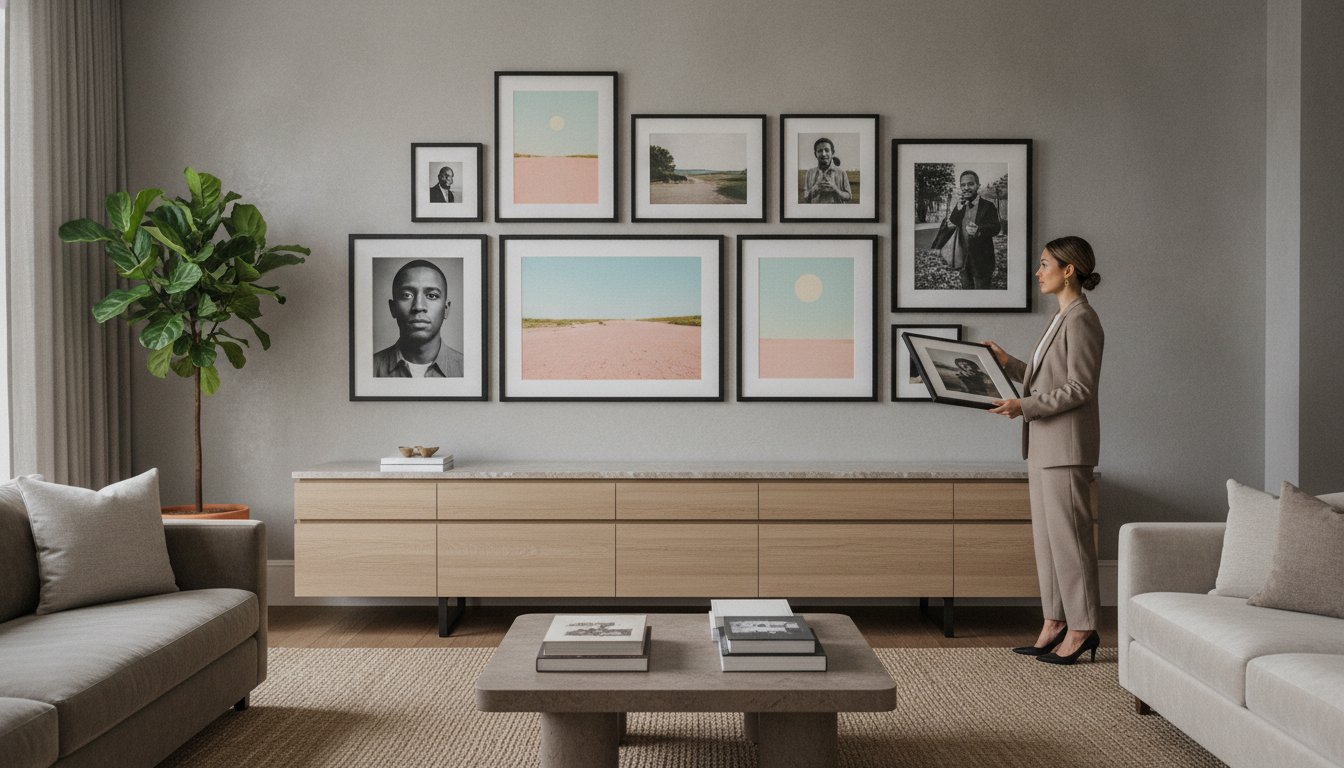
Designing the spatial narrative of your home requires more than a hammer and a steady hand. When curating a photography collection at home, you must treat your walls as a dynamic stage where each print plays a specific role. The process begins with meticulous planning. Before a single nail touches the plaster, map your wall space using paper templates. This allows you to visualize the cadence of the collection without the risk of unnecessary damage. Once the boundaries are defined, establish a focal point. This should be your most evocative or largest piece, positioned to anchor the room’s energy and dictate the placement of surrounding works.

Visual weight is the secret to a professional display. Balance is achieved by mixing different print sizes and frame thicknesses. A heavy, dark frame can be offset by a cluster of smaller, lighter pieces, creating a sense of equilibrium that feels organic rather than rigid. Lighting is your final curatorial tool. As we noted regarding archival standards, direct sunlight is the enemy of preservation. Instead, utilize dedicated picture lights to create a warm, focused glow that highlights the texture of the fiber-based paper. Always leave sufficient breathing room between frames. This negative space is essential; it allows the viewer’s eye to rest and ensures each piece can speak with its own voice.

Creating a Dynamic Gallery Wall

A gallery wall offers two distinct paths: the formal precision of a grid or the eclectic charm of a salon hang. A grid layout suggests order and quiet authority, ideal for a series of related architectural studies or portraits. Conversely, a salon hang allows for a more personal, evolving narrative. The secret to a cohesive salon wall lies in its anchors. Using black and white pictures provides a neutral structural foundation that allows more vibrant color works to shine without creating visual chaos. This approach maintains a sophisticated rhythm across disparate subjects.

The Power of the Solo Statement

Sometimes, silence is the most powerful statement. A single, large-format print can dominate a room with unparalleled grace. This approach is most effective when the piece is placed for maximum reveal impact, such as the wall directly opposite a room’s entrance. Dedicated lighting transforms a solo piece from a static image into a living presence, pulling the viewer into the historical narrative of the creator. If you’re ready to begin your spatial transformation, you can view our exclusive collections to find your next statement piece and elevate your home’s aesthetic.

Building Your Legacy with Galerie Prints

The journey of curating a photography collection at home reaches its most rewarding phase when you select a partner capable of translating your vision into a physical reality. At Galerie Prints, we don’t merely provide images; we offer a gateway to the world’s most prestigious archives. Our deep relationships with the Slim Aarons Collection, the Terry O’Neill Photography archive, and the Getty Images Gallery allow us to bring museum-grade masterworks directly to your walls. Each piece is treated with a sense of measured luxury, ensuring that the transition from the archive to your home preserves the historical integrity of the original capture.

Our commitment to artisanal craftsmanship is reflected in every stage of the production process. We understand that a collector’s needs are as unique as their narrative, which is why we provide bespoke options that go beyond the standard. Whether you require custom dimensions to fit a specific spatial requirement or professional framing tailored to a particular interior aesthetic, our team operates with the precision of a seasoned curator. We position ourselves as your trusted partner, offering the expert guidance necessary to navigate the nuances of high-caliber art with confidence and discernment.

A Bridge to a Bygone Era

Our curated collections invite you into an elite world of beauty and history, offering a tangible connection to moments that shaped our cultural consciousness. While digital trends are often fleeting and ephemeral, the stability of a physical print provides a lasting anchor. We believe that a purchase should be more than a decoration; it’s a lasting piece of history. By investing in archival-quality works from our Music Archives or Cinema Lobby Cards, you’re ensuring that your collection remains a source of wonder and nostalgia for generations to come.

Starting Your Collection Today

Building a legacy begins with a single, decisive choice. We encourage you to browse our most iconic collections to find the anchor piece that will set the rhythm for your entire home. Our team is available to consult on everything from spatial planning to the technical specifications of our Bespoke Framing Service, ensuring your journey is as seamless as it is intellectually stimulating. The art of curation is a lifelong pursuit, and there’s no better moment to begin than now. Explore the Slim Aarons Collection and begin your curatorial journey today.

The journey from a blank wall to a professional collection is defined by a commitment to both thematic vision and technical excellence. We’ve explored how intentional selection creates a dialogue between eras and why museum-grade archival standards are non-negotiable for the serious collector. By focusing on the spatial narrative of your home, you ensure that every piece, whether it’s a vibrant Slim Aarons poolside scene or a soulful Music Archive print, commands the attention it deserves. Mastering the nuances of curating a photography collection at home is not just an aesthetic choice; it’s a way to preserve a cultural heartbeat within your own four walls.

As an official Getty Images Gallery partner, we offer exclusive access to the legendary archives of Slim Aarons and Terry O’Neill. Every acquisition is supported by our Red Dot-level artisanal framing, ensuring your investment is protected by the highest standards of the art world. You’re now equipped with the knowledge to build a legacy that reflects your personal journey and refined taste. It’s time to transform your environment into a sanctuary of historical prestige and timeless elegance.

Discover our curated collections and begin your private gallery today

Frequently Asked Questions

How do I start a photography collection on a budget?

You can begin your journey by focusing on smaller, high-quality entries such as Cinema Lobby Cards or vintage movie posters. While high-end masterworks are a significant investment, the growing market for authentic art priced under $2,000 makes it possible to begin curating a photography collection at home with focused, smaller acquisitions. This approach allows you to build narrative depth and value without the immediate pressure of acquiring large-format pieces.

What is the best way to arrange a gallery wall without it looking cluttered?

The secret to a sophisticated gallery wall lies in the disciplined use of “breathing room” and a singular central anchor piece. By maintaining a consistent distance of approximately two to three inches between frames and using paper templates to plan the layout, you avoid the trap of visual chaos. A structured grid offers a sense of formal authority, while a more eclectic salon hang requires a shared tonal element to ensure the arrangement feels intentional rather than random.

Does the frame matter as much as the photograph itself?

A frame is much more than a protective border; it’s a curatorial tool that bridges the gap between the artwork and your home’s architecture. Utilizing a bespoke framing service provides the professional precision required to elevate a print from a simple image to a gallery-grade investment. It ensures the materials used, including acid-free matting and specialized glass, protect the work while the aesthetic choice of the frame respects the historical era of the image.

How can I tell if a photography print is “archival quality”?

True archival quality is defined by the use of pigment-based inks and acid-free, fiber-based papers that offer 100-year fade resistance. You should look for Giclée prints produced at a 600 DPI resolution, which is the current professional standard for museum-quality reproduction. These technical specifications ensure that the tactile and visual integrity of the work remains unchanged by environmental factors, providing the permanence that defines a serious collection.

Can I mix black and white photography with colour prints in the same room?

Mixing monochromatic and color works is an excellent way to add visual depth and prevents your collection from feeling static. When curating a photography collection at home, use black and white pieces as structural anchors to provide a timeless, graphic clarity. This foundation allows vibrant color prints, such as a sun-drenched Slim Aarons scene, to shine with modern vitality without overwhelming the room’s sophisticated rhythm.

What are the most collectable photography archives to invest in for 2026?

The archives of Slim Aarons and Terry O’Neill remain the premier choices for collectors seeking historical prestige and a connection to a bygone era of elegance. Additionally, the Music Archives and Star Wars Limited Edition Prints are seeing increased demand as high-net-worth collectors seek authentic, human-made works as an alternative to AI-generated imagery. These collections offer a sense of permanence and cultural significance that outlasts fleeting digital trends.

How do I protect my photography collection from fading over time?

Protection begins with the use of UV-protective glass and careful spatial placement to avoid the reach of direct sunlight. High-quality framing must utilize acid-free mounting and matboard to prevent chemical degradation of the paper over decades. By insisting on museum-standard materials and avoiding harsh environmental exposure, you act as a guardian of the work, ensuring the vibrant soul of the photograph remains preserved for future generations.
The Curator’s Guide: How to Clean and Preserve Framed Fine Art

A single errant spray of common household glass cleaner can instantly dismantle decades of photographic history. When you welcome a Slim Aarons or a Terry O’Neill into your home, you aren’t merely decorating a wall; you’re becoming the steward of a cultural legacy. With the U.S. art market generating $3.17 billion in auction sales in 2025, the importance of maintaining your collection’s archival integrity has never been more paramount. It’s natural to feel a sense of anxiety when dust begins to settle on a high-value piece. This cleaning guide for framed art is designed to replace that hesitation with the quiet authority of a professional curator.

By adopting the meticulous techniques used in high-end galleries, you’ll learn how to maintain a pristine, gallery-ready display while protecting your investment’s financial and aesthetic value. We’ll demystify the world of archival-safe materials, focusing on the specialized tools required to preserve the tactile and historical elements of your collection. From managing environmental factors to selecting pH-neutral solutions, this guide provides a precise roadmap for handling your most cherished works, ensuring they continue to inspire wonder for generations to come.

Key Takeaways

  • Learn the critical distinction between glass and acrylic glazing care, including why you must never spray cleaning agents directly onto the surface to prevent moisture seepage.
  • Discover how to treat bespoke frames as sculptural extensions of the artwork, ensuring that hand-finished wood and gilded surfaces remain untouched by abrasive chemicals.
  • Master the professional techniques found in this cleaning guide for framed art to maintain archival integrity and prevent the common pitfalls of standard household maintenance.
  • Understand the subtle interplay between UV light and archival photo paper, and how strategic placement serves as the most effective form of long-term preservation.
  • Identify the specific warning signs, such as foxing or mould, that signal when a high-value piece requires the intervention of a professional conservator.

The Art of Stewardship: Why Proper Cleaning Matters

To own a piece of fine art photography is to hold a fragment of the past in trust for the future. When you acquire a work from The Slim Aarons Collection, you aren’t merely buying a decorative object. You’re assuming the role of a curator. This requires a fundamental shift from routine housekeeping to meticulous archival maintenance. While a standard picture frame might survive a quick wipe with a damp rag, high-value art demands a more disciplined approach. Every action you take must prioritize the long-term stability of the piece. This cleaning guide for framed art serves as your manual for this delicate task.

A framed artwork is a layered ecosystem. It consists of the glazing, the frame profile, and the internal mounting. Each component interacts with the environment and with the cleaning agents you choose. Before you begin, you must internalize the golden rule of art care: less is almost always more. Over-cleaning is a primary cause of surface degradation. If the piece appears pristine, the most professional choice is to leave it undisturbed. The core principles of the Conservation and restoration of paintings remind us that every intervention carries a risk. Our goal is to minimize that risk while maintaining visual clarity.

Identifying Your Materials

Before any cloth touches the surface, you must identify your glazing. Standard glass is heavy and feels cold to the touch. High-clarity acrylic, such as Plexiglas or Optium, is lighter and warmer. Acrylic is prized in galleries for its shatter resistance and UV filtering, but it’s notoriously soft. Using a standard glass cleaner on acrylic will cause permanent clouding. You must also recognise artisanal frame finishes. Natural hardwoods, hand-stained veneers, and delicate gilded leaf each require specific handling. A gilded frame is often a thin layer of gold leaf over a brittle gesso base. Abrasive movements can flake away the finish, leading to a “cleaning catastrophe” that is often irreversible.

The Essential Curator’s Toolkit

Professional results require professional tools. Ditch paper towels immediately. They are made of wood pulp and will leave micro-scratches on both glass and acrylic. Instead, invest in high-quality, lint-free microfiber cloths. For the solutions, avoid anything containing ammonia or harsh detergents. Industry standards dictate the use of ammonia-free and pH-neutral cleaners specifically formulated for art glazing. For the frame itself, especially those with intricate, hand-carved details, a soft-bristled natural hair brush is indispensable. This allows you to lift dust from deep crevices without applying the pressure that a cloth would require. This precision is what separates a collector from a casual owner.

Mastering the Glazing: Glass vs. Acrylic Care

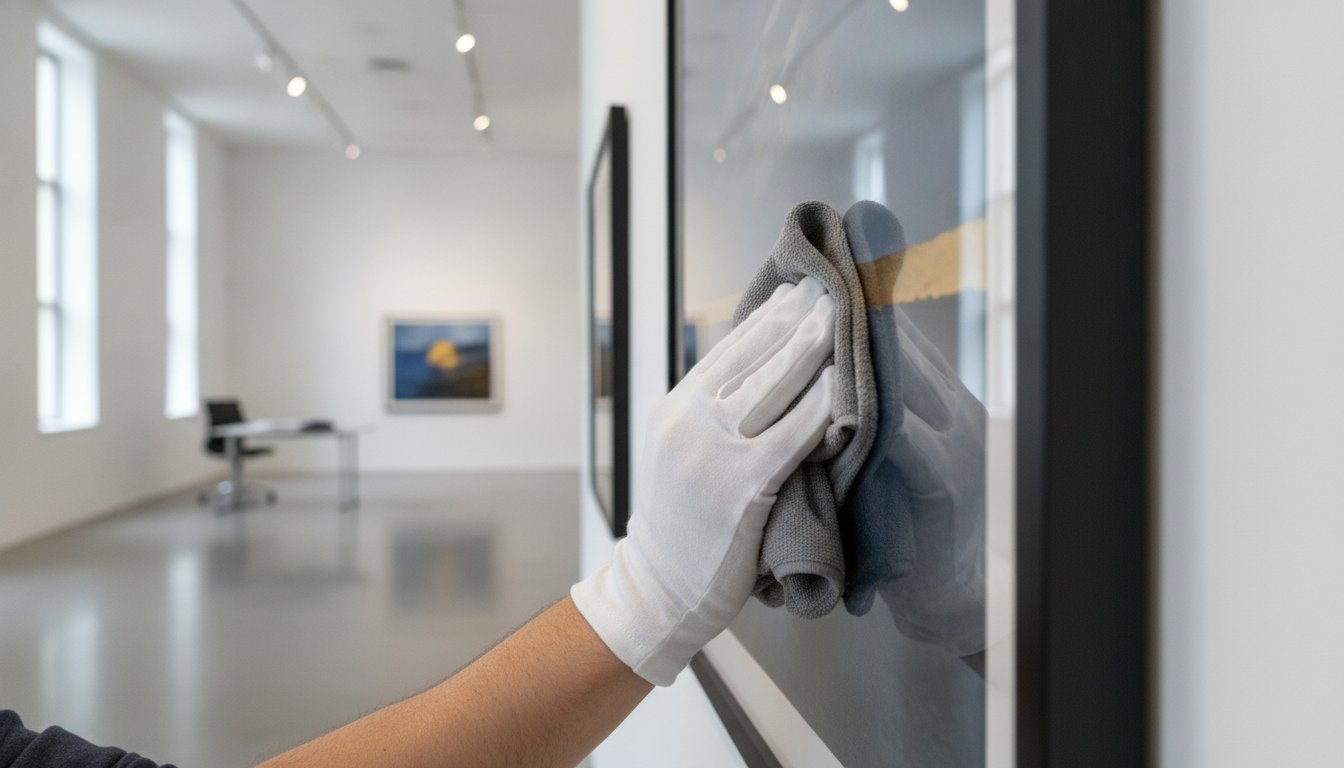
Glazing serves as the primary barrier between your art and the elements. It shields delicate surfaces from dust, pollutants, and humidity. However, it’s also the most vulnerable point during maintenance. One of the most critical steps in any cleaning guide for framed art is understanding the physics of moisture. Never spray any liquid directly onto the glazing. Liquid can easily seep under the lip of the frame through capillary action, where it becomes trapped. This trapped moisture often leads to the ruin of the mount or, worse, the artwork itself. Always apply your cleaning agent to a cloth first. The cloth should be damp but never saturated.

Ammonia-free solutions are the only acceptable choice because ammonia is a harsh alkaline agent that can outgas within the frame, potentially reacting with photographic emulsions or permanently clouding museum-grade anti-reflective coatings.

When dealing with high-value collections, the stakes of improper care are significant. The global art market reached an estimated $67.8 billion in 2026, and as more collectors invest in the mid-tier market, particularly for works priced under $50,000, the need for professional-grade home maintenance grows. Whether you’re preserving a vintage movie poster or a modern masterpiece, the glazing is the lens through which the work is experienced. Treating it with the wrong chemical or tool is a risk that serious collectors don’t take.

Cleaning Traditional Picture Glass

While traditional glass is scratch-resistant, it requires a disciplined hand. Use a high-quality microfiber cloth and avoid circular wiping motions, which can trap grit and create visible halos under gallery lighting. Instead, use a deliberate, linear motion from top to bottom. This prevents the “overspray” effect that often leads to mould growth. If a piece shows signs of internal damage, you may need to consult professional conservation experts to assess the extent of the moisture ingress.

Special Considerations for Acrylic and Plexiglass

High-clarity acrylic, often used for larger works in our Bespoke Framing Service, is inherently prone to static electricity. This charge acts as a magnet for household dust. You must resist the urge to dry-wipe, as friction causes micro-scratches from the very dust you’re trying to remove. Use specialized anti-static cleaners to neutralize the static charge and maintain long-term clarity. This technical precision ensures your Star Wars limited edition prints remain as vibrant as the day they were framed.

Caring for the Frame: From Gilded Leaf to Modern Metal

A frame is far more than a simple border; it’s a sculptural extension of the artwork itself. Whether it’s a hand-carved wooden profile or a sleek industrial edge, the frame defines how the piece interacts with your space. In our curatorial practice, we view the frame as an integral part of the art’s provenance. Handling these structures requires the same level of discipline as the glazing. Oily fingerprints are the primary enemy of a pristine finish. The natural salts and acids on your skin can etch into metal or permanently stain porous wood over time. When moving a piece, always wear cotton gloves or handle the work only by the secure hanging hardware on the reverse. This cleaning guide for framed art emphasizes that prevention is the most sophisticated tool in your arsenal.

There’s a delicate balance between maintenance and the preservation of character. For vintage movie posters or heritage archives, the frame may possess a natural patina that tells a story of its own. In these instances, aggressive cleaning is often counterproductive. A seasoned collector knows when to leave the signs of age alone. This philosophy aligns with the broader principles of environmental protection and collection stewardship. If the frame’s finish is stable but aged, a light dusting is usually the only intervention required to maintain its historical integrity.

Dusting Ornate and Textured Profiles

Traditional gilded frames and plaster-based profiles demand a strict “dry-only” rule. Water or chemical cleaners can soften the gesso or cause the gold leaf to flake away instantly. To reach deep into the crevices of an ornate design, avoid stiff brushes. Instead, use a high-quality, soft-bristled makeup brush or a specialized goat-hair dusting brush. These tools allow you to lift debris without applying vertical pressure. For particularly stubborn dust in deep relief areas, a gentle puff of compressed air can be effective, provided the nozzle is held at a safe distance to prevent moisture condensation.

Maintaining Sleek Modern and Metal Frames

Sleek, modern frames, such as those used for high-end fine art photography, present a different challenge. Anodised aluminium and stainless steel are notorious fingerprint magnets. While these materials are more durable than gilded wood, they show smudges with unforgiving clarity. Use a dry, clean microfiber cloth to buff away marks using long, even strokes. If a dry cloth isn’t enough, a single drop of pH-neutral soap on a slightly damp cloth is the limit. This approach ensures the frame remains a silent, polished supporter of the visual narrative rather than a source of distraction.

Environmental Protection: Preventing the Need for Deep Cleaning

The most sophisticated approach in any cleaning guide for framed art is to render intensive cleaning unnecessary through strategic placement. A piece of art is a living document of its history. It reacts to its surroundings in real-time. While we’ve discussed the tools for physical maintenance, the true guardian focuses on the invisible threats: light, heat, and moisture. High-traffic areas like hallways or entryways naturally accumulate more airborne debris. These locations require more frequent, albeit gentler, dusting to prevent buildup from becoming abrasive. Placement is everything.

The chemical composition of archival photo paper is particularly sensitive to ultraviolet exposure. UV light doesn’t just fade colors; it breaks down the molecular bonds within the paper fibers themselves. This leads to brittleness and yellowing that no amount of surface cleaning can reverse. Similarly, fluctuations in humidity cause the paper to expand and contract, leading to “cockling” or a wavy appearance. By controlling these variables, you preserve the artwork’s aesthetic and financial value for decades. Stewardship is a silent, ongoing commitment.

The Perils of Direct Sunlight and Heat

Direct sunlight is a slow-motion catastrophe for fine art. The “golden hour” may be beautiful for photography, but it’s the most dangerous time for your collection as low-angled light penetrates deep into the room. Heat is equally destructive. Hanging a piece above a radiator or fireplace causes the frame and mounting boards to expand and contract at different rates. This structural stress can lead to frame warping or the failure of archival tapes. Select a wall away from direct thermal sources to minimize this environmental strain. Your choice of wall is your first line of defense.

Humidity and Airflow Management

Strive for a residential gallery environment with humidity levels between 40% and 50%. Extreme dryness makes materials brittle, while high humidity invites mould and foxing. Never hang valuable art on an uninsulated exterior wall. These surfaces are prone to temperature differentials that cause condensation inside the frame. We recommend using “bumpers” on the back corners of the frame. These small spacers create a vital gap for air circulation, preventing moisture from becoming trapped between the wall and the artwork. This simple addition is a hallmark of professional installation.

Explore our Music Archives to find a legacy piece that deserves this level of dedicated stewardship.

When to Seek Professional Conservation

Even the most disciplined collector must eventually acknowledge that some challenges transcend the scope of a standard cleaning guide for framed art. True stewardship is defined as much by restraint as it is by action. When a piece shows signs of internal distress, the most professional choice is to defer to a specialist. Biological threats like “foxing”, those small, rust-colored spots appearing on the paper, or the fuzzy blooms of mould are not surface contaminants. They are active fungal or chemical processes occurring within the paper’s fibers. Attempting to treat these at home will only accelerate the damage.

Our bespoke framing service acts as a preventative seal against many of these environmental hazards, but it doesn’t replace the need for vigilance. We recommend an annual condition check for every high-value piece in your collection. Inspect the perimeter of the mount for any signs of shifting and look for “ghosting” on the inside of the glazing. These subtle shifts often signal that the internal environment has been compromised. Early intervention preserves the financial and historical value of the work before the damage becomes irreversible.

Identifying Irreversible Damage

Distinguishing between harmless surface dust and internal degradation is a hallmark of a seasoned collector. If you see shadows on the inside of the glass that don’t move when wiped, you’re likely witnessing “outgassing” from non-archival mounting materials. Similarly, if an artisanal frame has suffered a deep scratch or if the gilding has begun to flake, professional refinishing is required to match the original pigments. Above all, you must never attempt to clean the art paper or the photographic emulsion itself. The chemistry of these surfaces is incredibly complex; even a drop of pure water can cause the fibers to swell and permanently distort the image.

The Benefits of Re-Framing

Many collectors discover that their most cherished pieces are housed in “acidic” frames from a previous era. These older materials slowly leach chemicals that yellow the paper and turn it brittle. Re-framing is more than a stylistic update. It’s a rescue mission. By upgrading to museum-grade glazing and acid-free, archival mounts, you provide the artwork with a fresh lease on life. This process ensures that your investment remains a vibrant piece of history rather than a fading relic. Elevate your display with our bespoke framing options to ensure your collection meets the highest standards of modern preservation.

Preserving a Legacy of Elegance

As you continue to cultivate your personal gallery, rely on the technical superiority of production processes that prioritize longevity. Every work at Galerie Prints is expertly curated by Stuart Möller and supported by hand-crafted bespoke framing. We utilize archival-grade materials in every print to ensure your pieces endure as lasting historical documents. Your commitment to these professional standards marks you as a true connoisseur of the arts.

Discover our curated collections and bespoke framing services at Galerie Prints

Embrace your role as a guardian of visual heritage with confidence. With these gallery-proven techniques at your disposal, your collection will continue to inspire wonder and evoke a sense of timeless prestige for many years to come.

Frequently Asked Questions

Can I use Windex or standard glass cleaner on my picture frames?

No, you should never use standard glass cleaners because they often contain ammonia, which can outgas and damage the archival integrity of your artwork. Instead, utilize a pH-neutral, ammonia-free solution specifically formulated for art glazing. Always apply the liquid to a lint-free microfiber cloth rather than spraying the surface directly to prevent capillary action from drawing moisture into the mount.

How often should I clean my framed art?

You should limit physical cleaning to once every three or four months, focusing primarily on light dusting with a dry cloth. Over-handling is a significant risk factor in the art world, as each intervention introduces the possibility of micro-scratches or accidental impact. This cleaning guide for framed art emphasizes that maintaining a stable environment is more effective than frequent chemical intervention.

What is the best way to remove dust from an ornate gold frame?

Use a soft-bristled natural hair brush, such as a high-quality makeup brush, to gently lift dust from deep relief areas. Traditional gold leaf is exceptionally delicate and can flake away if subjected to the friction of a cloth or the moisture of a cleaning agent. A dry, air-based approach ensures you preserve the intricate artisanal craftsmanship without risking the frame’s finish.

Is it safe to use a vacuum cleaner attachment on my art collection?

It’s generally unwise to use a vacuum near fine art due to the risk of accidental physical impact and the generation of static electricity. Static can pull loose particles into the frame or cause acrylic glazing to attract even more debris. If you must remove large amounts of dust from the surrounding area, ensure the vacuum remains at a significant distance from the artwork itself.

My acrylic glazing has a scratch; can I polish it out?

While specialized acrylic polishes exist, attempting to buff out a scratch on museum-grade glazing often results in a permanent “haze” or damage to anti-reflective coatings. If the scratch is deep enough to be distracting, the most professional course of action is to replace the glazing entirely. It’s best to consult a specialist to determine if the specific coating on your piece allows for any form of restoration.

What should I do if I see moisture or fogging inside the glass?

Immediate action is required to prevent mould growth or paper cockling, so you should move the piece to a climate-controlled room immediately. Fogging usually indicates a breach in the frame’s seal or a significant temperature differential, such as hanging a piece on an uninsulated exterior wall. If the moisture doesn’t dissipate within a few hours, consult a professional conservator to assess the internal mounting.

Can I use a damp cloth on a canvas print that isn’t behind glass?

No, you should never use a damp cloth on an exposed canvas print, as moisture can react with the inks or the protective varnish. A dry, soft-bristled brush is the only recommended tool for removing surface dust from unglazed works. If the canvas appears stained or heavily soiled, it requires the attention of a professional restorer who understands the specific chemistry of the emulsion.

How do I clean the back of the frame and the hanging wire?

Use a clean, dry microfiber cloth to wipe dust from the backing board and the hanging wire during your annual condition check. This prevents dust from migrating to the front of the piece or settling into the wall. It’s also an ideal time to inspect the wire for signs of fraying or rust, ensuring the structural stability of your display remains uncompromised.

How to Mix Different Art Styles: A Curator’s Guide to Cohesive Interior Decor

The most captivating rooms don’t rely on matching sets; they thrive on the deliberate collision of history and aesthetic. While you might worry that a 1960s Slim Aarons poolside scene would clash with a Star Wars limited edition print or a vintage movie poster, the reality is that contrast creates depth. Learning how to mix different art styles is less about finding identical colors and more about mastering the art of the visual narrative. It’s a skill that transforms a mere wall of pictures into a sophisticated, multi-layered home gallery that whispers of worldly travels and refined tastes.

You’ve likely felt that familiar uncertainty when standing before a blank wall, wondering if your Terry O’Neill music archives can truly coexist with traditional cinema lobby cards without looking chaotic. This guide provides the professional curatorial strategies you need to blend diverse movements and photography archives into a cohesive masterpiece. We’ll examine how a shared palette, thematic anchors, and the quiet authority of bespoke framing can unify even the most eclectic collection. You’ll gain the confidence to invest in the pieces you love, knowing exactly how to bridge the gap between different eras and mediums.

Key Takeaways

  • Shift your mindset from mere decoration to intentional curation by distinguishing between a random assortment and a purposeful selection of historical works.
  • Master how to mix different art styles by identifying a common thread, such as a recurring color palette or a shared narrative theme, to anchor your diverse collection.
  • Explore how bespoke framing acts as a visual bridge, using consistent materials or profiles to unify disparate mediums like vintage movie posters and contemporary photography.
  • Learn to select the ideal arrangement for your space, whether it’s the disciplined symmetry of a grid or the evocative, storied depth of a salon hang.
  • Discover how to pair the high-society elegance of the Slim Aarons Collection with the raw energy of music archives for a truly sophisticated home gallery.

The Curatorial Philosophy of Mixing Art Styles

True curation is a deliberate act of selection; it is not merely the gathering of objects. It requires a discerning eye that appreciates the friction between a sun-drenched Slim Aarons poolside scene and the raw, monochromatic intensity of a Terry O’Neill portrait. This friction creates a narrative depth that a single-style room simply cannot replicate. By adhering to fundamental design principles like scale and visual weight, you ensure that this mix feels prestigious rather than accidental. A curator looks for the quiet harmony that exists between disparate pieces, finding beauty in the tension of competing eras.

Understanding how to mix different art styles involves recognizing the difference between an accidental hoard and a purposeful selection. A selection is curated with a specific intent; it is a conversation held across decades. When you place a vibrant Star Wars limited edition print near a classic cinema lobby card, you aren’t just filling wall space. You are building a bridge between pop culture milestones and traditional cinematic history. This multi-layered approach suggests a worldly perspective, signaling that the collector values the heritage of the image as much as its aesthetic impact.

Intentionality vs. Clutter

A gallery feels cluttered when the eye has nowhere to rest. To avoid this, utilize white space as a silent partner in your design. An “earned” mix is one where the quality of the production and the authenticity of the source material remain consistent, even if the subjects differ wildly. This shared excellence provides the necessary cohesion to prevent visual chaos. Ultimately, eclectic curation is the balance of historical narrative and visual rhythm. It demands that every piece, whether it is a vintage movie poster or a music archive print, earns its place through its contribution to the room’s overarching story.

The Value of the Multi-Layered Collection

A room styled in only one era often feels like a sterile showroom; it lacks the soul and character of a lived-in space. A home should feel layered, reflecting a lifetime of discerning tastes and cultural appreciation. Integrating fine art photography as a foundational layer allows you to build a collection that feels permanent and stable. Mixing photography archives with cinema memorabilia invites guests to linger. These diverse pieces spark a silent dialogue about culture and artistry, ensuring your home remains a sanctuary of elegance rather than a fleeting trend. Mastering how to mix different art styles is the final step in evolving from a decorator to a true guardian of visual history.

Finding the Visual Anchor: Establishing a Common Thread

To achieve a balanced gallery, you must establish a visual tether that binds diverse pieces together. While some suggest designer-curated art sets as a starting point, a truly bespoke collection relies on more nuanced anchors. Color is the most immediate tool at your disposal. A single recurring hue, perhaps the deep azure of a Mediterranean sea or the softened charcoal of a studio backdrop, can bridge the gap between a Terry O’Neill portrait and a contemporary abstract print. This color repetition provides a rhythmic continuity that guides the eye across the wall, ensuring the transition between eras feels intentional.

Subject matter offers another sophisticated anchoring technique. Grouping by theme allows you to explore how to mix different art styles without sacrificing clarity. A collection centered on “The Aspirational Life” might elegantly sit a vibrant Slim Aarons poolside scene alongside minimalist sketches of mid-century architecture. You should also consider visual weight; a bold, saturated photograph requires a strategic counterweight. Pairing it with a minimalist black and white piece ensures neither work overwhelms the other. Contrast in medium, such as the matte texture of a vintage lobby card against the high-gloss finish of a modern archival print, adds a tactile dimension that enriches the viewer’s experience.

Pairing Photography with Illustrative Art

Integrating different mediums requires precision. When hanging a Slim Aarons work alongside oil paintings or sketches, maintain a consistent horizon line or eye level. This geometric alignment creates a sense of order that permits stylistic diversity. Using tonal values is equally effective; a sepia-toned photograph can effortlessly share space with a graphic poster if they share the same warmth. If you’re looking to expand your collection, you might browse our music archives for pieces that share these subtle tonal qualities.

The Narrative Anchor: Storytelling Through Art

A collection should tell a story that spans generations. Using a lobby card adds a layer of historical grit and cinematic nostalgia to an otherwise polished gallery. This creates a “time-travel” wall where the grit of 1940s Hollywood meets the sleekness of modern limited edition prints. To preserve this narrative for decades, emphasize archival quality. High-caliber visual art is an investment in history, and maintaining its condition ensures the story remains vivid. Mastering how to mix different art styles through storytelling transforms a room from a decorative space into a curated archive of human experience.

The Bridge of Bespoke Framing and Materiality

Framing is often the unsung hero of a successful gallery. It serves as the physical bridge between the art and the room’s architecture. When considering how to mix different art styles, the frame acts as a “uniform” that can reconcile a 19th-century sketch with a 21st-century limited edition print. By applying a consistent bespoke framing treatment across your collection, you create a visual language that speaks of intentionality. This approach is supported by a curator’s guide to mixing art styles, which emphasizes that strategic framing is vital for preventing visual chaos in eclectic spaces.

A “complimentary mix” is an alternative for those who find identical frames too rigid. You might select different profiles that share a common material, such as hand-finished dark wood or blackened aluminum. This shared materiality provides enough cohesion to allow for diversity in the art itself. Mount sizing, or matting, also plays a critical role in establishing a gallery rhythm. Generous, consistent matting provides a “breathing space” for the eyes, allowing a gritty Terry O’Neill music archive print to sit comfortably beside a vibrant Star Wars limited edition piece. Investing in museum-quality paper and archival mounting isn’t just about aesthetics; it’s about the permanence of your history.

Unifying Disparate Eras with Frame Choice

Selecting a frame involves honoring the artwork’s heritage while acknowledging the room’s contemporary aesthetic. A “modern classic” look is achieved by pairing a vintage archive print with a sleek, minimalist frame. This juxtaposition highlights the timelessness of the image while ensuring it feels relevant in a modern interior. A bespoke frame acts as a visual translator between the art and the architecture. It allows a vintage movie poster to speak the same language as a piece of contemporary furniture.

Materiality and Texture

The viewing experience is profoundly affected by technical specifications like premium glazing. Anti-reflective museum glass ensures that the intricate details of a photograph are visible from every angle without the distraction of glare. The tactile nature of black and white pictures is enhanced by professional mounting techniques that prevent warping over time. In a luxury context, “ready-to-hang” must always signify hand-crafted excellence, utilizing acid-free materials that justify the investment by preserving the work for future generations.

The physical arrangement of your collection is the final act of curation, dictating how the viewer moves through the space and interacts with the history on your walls. While a Grid Layout offers a disciplined, rhythmic approach ideal for serial works like Star Wars Limited Edition Prints, a Salon Hang embraces the evocative complexity of a diverse archive. Understanding how to mix different art styles through spatial placement requires a delicate balance of geometry and narrative flow. By establishing an “Anchor Piece,” perhaps a large-scale Slim Aarons photograph, you create a gravitational focal point that allows smaller, more varied works to orbit around it without feeling untethered or accidental.

Mastering the Salon Hang

A successful salon hang begins at the center. Place your most challenging or unique piece first, then build outward to maintain a sense of organic growth. To prevent visual noise, adhere to the 2-3 inch rule, keeping spacing consistent even when the mediums differ. This discipline allows you to mix small-scale cinema lobby cards with large-format music photography without losing the intricate details of the smaller works. It’s a sophisticated way to explore how to mix different art styles, creating a wall that feels like a lived-in archive rather than a static display.

The “One Per Sightline” Evolution

In luxury homes with open-plan layouts, the traditional “one statement per sightline” rule often feels too restrictive. Instead, use your collection to zone the room, creating distinct atmospheres within a single space. You might dedicate one corner to the raw energy of music archives while allowing a cinematic hallway to lead guests through a history of film. Always perform a “scale test” to ensure your mix doesn’t feel dwarfed by the volume of the room. If you’re ready to elevate your home’s narrative, you can explore our curated collections to find your next anchor piece.

Curating Your Collection with Galerie Prints

Galerie Prints operates as more than a premier destination for fine art; it serves as a guardian of photographic heritage and a bridge to a bygone era of elegance. By offering a seamless bridge between the raw, monochromatic grit of Terry O’Neill’s music archives and the sun-drenched, aspirational luxury found within the Slim Aarons collection, Galerie Prints provides the essential building blocks for a truly worldly home gallery. When you are discovering how to mix different art styles, the provenance of the work is just as vital as its visual impact. Our archives are meticulously selected to ensure that every piece, whether a cinematic lobby card or a limited edition Star Wars print, carries an inherent prestige that elevates the surrounding decor.

The defining advantage of a Galerie Prints acquisition lies in our bespoke framing service, where each frame is hand-crafted in our London workshop by skilled artisans. This localized craftsmanship acts as a seal of quality, ensuring that the “visual translator” discussed in previous sections is of the highest technical caliber. Starting your collection begins with the selection of an anchor piece, a significant work that establishes the tonal and narrative direction of your space. Our seasoned experts are available to guide you through this selection, ensuring your first investment provides a stable foundation for the eclectic layers to follow.

A Legacy of Quality

Every print within our collection is produced with a reverence for historical significance, utilizing original source materials to maintain absolute authenticity. Under the curatorial direction of Stuart Möller, Galerie Prints has established itself as an authority in the art world, ensuring that every acquisition is a lasting piece of history. We prioritize the tactile elements of production, from the choice of museum-grade papers to the precision of archival mounting. This commitment to technical superiority ensures that your journey in learning how to mix different art styles is supported by works that will retain their vibrancy and value for generations.

Begin Your Curatorial Journey

We invite you to linger within our digital gallery and explore the vast narratives contained within our music, film, and fashion archives. Our professional “Ready-to-Hang” service removes the logistical complexities of installation, allowing you to focus entirely on the creative joy of curation. Whether you are drawn to the timeless allure of black and white portraiture or the bold graphic impact of vintage movie posters, our collections offer the diversity required for a sophisticated, multi-layered home. Explore our curated collections and find your next statement piece.

Mastering how to mix different art styles transforms your home from a simple collection of objects into a cohesive narrative of cultural heritage. By establishing a clear visual anchor and utilizing the unifying power of bespoke framing, you bridge the gap between disparate eras and artistic mediums. Whether you are pairing the raw grit of a Terry O’Neill portrait with the sun-drenched elegance of Slim Aarons, the secret lies in the quality of the source material and the precision of the final presentation. These strategies ensure your gallery feels earned and intentional rather than accidental.

We invite you to begin this curatorial journey by exploring our official archives, featuring prestigious works from Getty Images and historic music archives. Every selection is hand-crafted with artisanal bespoke framing in our London workshop and protected by worldwide shipping in museum-grade packaging to ensure its lasting stability. Curate your space with our hand-picked Fine Art Photography collections. Your walls are the ultimate canvas for your personal history; let them speak with the quiet authority and timeless beauty they deserve.

Frequently Asked Questions

Can I mix black and white photography with colorful paintings?

You can certainly mix monochromatic photography with vibrant paintings to create a sophisticated visual contrast. Black and white images, such as those found in our Terry O’Neill archives, act as a neutral grounding element that allows the saturation of colorful works to flourish without competition. This juxtaposition highlights the technical nuances of both mediums, creating a curated depth that feels intentional rather than accidental.

How many different art styles should I limit myself to in one room?

Aim to focus on two or three dominant artistic movements to ensure your space remains balanced and refined. While there are no rigid rules on how to mix different art styles, over-extending your selection can dilute the narrative impact of individual pieces. By selecting a few core styles, such as mid-century photography and cinematic history, you allow each work to contribute to a clear, authoritative story.

Should all my frames match if the art styles are different?

Matching frames aren’t a requirement, but utilizing a shared material or profile provides a necessary uniform for a diverse collection. You might choose different frame widths while sticking to a single finish, such as hand-finished black wood or blackened aluminum. Our bespoke framing service in London specializes in creating these subtle visual bridges, ensuring that disparate works like Star Wars prints and vintage movie posters share a common architectural language.

Is it okay to hang a modern photograph next to a vintage movie poster?

Pairing modern photography with vintage cinematic memorabilia is an excellent way to add historical grit to a polished interior. This contrast creates a time-travel effect that rewards the viewer with layers of cultural significance and nostalgia. The key is to ensure both pieces share a similar level of production quality, which prevents the vintage item from looking out of place next to a contemporary archival print.

How do I choose the right size when mixing different art mediums?

Choose one large-scale statement work to act as your primary focal point and arrange smaller pieces around it to create a balanced hierarchy. This anchor piece strategy provides a sense of stability, especially when mixing varied mediums like cinema lobby cards and music archives. Maintaining consistent spacing between these different sizes helps the eye navigate the collection without feeling overwhelmed by the change in scale.

What is the best way to arrange a gallery wall with different styles?

The salon hang is the most evocative arrangement for a collection that spans multiple eras and mediums. Start by placing your most significant or visually complex piece at eye level and build the layout organically outward. This approach is a masterclass in how to mix different art styles, as it celebrates the tension between pieces while maintaining a rhythmic, intentional flow across the wall.

Can I mix landscape and portrait orientations in the same display?

Mixing landscape and portrait orientations adds a dynamic, sculptural quality to your display that prevents the arrangement from feeling static. To keep the look sophisticated, align the center points or the top edges of the frames to create a sense of underlying order. This geometric discipline allows you to combine horizontal Slim Aarons poolside scenes with vertical Terry O’Neill portraits in a way that feels curated and professional.

How do I ensure my eclectic art collection doesn’t look like a mess?

Ensure your collection maintains a high standard of material quality and authenticity to prevent an eclectic mix from appearing cluttered. Utilizing generous white space and professional matting provides each piece with the breathing room it requires to be appreciated as a standalone work. When every item is produced using archival methods and museum-grade materials, the shared excellence of the collection acts as its own unifying force.

Minimalist Black and White Art Prints: A Curator’s Guide to Monochrome Elegance

What if the most profound statement your home could make was whispered in shades of charcoal and bone, rather than shouted in color? You likely understand that a room’s atmosphere hinges on the quiet strength of its walls, yet finding high-caliber minimalist black and white art prints often feels like an exercise in avoiding the mediocre. It’s frustrating to sift through endless digital posters that lack the textural soul of a true gallery piece. You want your space to reflect a discerning eye, not a mass-produced catalog.

This guide promises to help you transcend the common pitfalls of online art shopping by mastering the nuances of monochrome curation. We’ll explore the critical distinction between standard paper and archival fine art prints, ensuring your investment possesses the permanence of a historical artifact. From selecting iconic Terry O’Neill photography to utilizing bespoke framing services that elevate the work, you’ll gain the confidence to transform your residence into a private gallery of timeless elegance. Discover how to curate a home that feels both modern and steeped in photographic heritage.

Key Takeaways

  • Understand how high-contrast monochrome imagery creates a psychological focal point, providing a sense of refined calm and visual clarity to modern interiors.
  • Learn to select minimalist black and white art prints that utilize architectural lines and precise composition to command attention while harmonizing with your existing furniture.
  • Discover the transformative power of scale and why a singular, oversized fine art photograph often provides a more sophisticated statement than a collection of smaller pieces.
  • Master the art of the gallery look by choosing bespoke framing and oversized mounts that protect archival integrity while significantly elevating the print’s visual impact.
  • Explore how to bridge historical significance with contemporary aesthetics through exclusive access to prestigious archives like the Slim Aarons Collection and Terry O’Neill photography.

The Essence of Minimalist Black and White Art Prints

True minimalism in fine art is rarely about the absence of subject matter. Instead, it represents the absolute precision of what remains. When we discuss minimalist black and white art prints, we’re describing a philosophy where every grain of silver halide and every subtle gradation of grey serves a specific purpose. While mass-market decor often treats minimalism as a “blank” aesthetic, high-end curation views it as a rigorous discipline. This shift from the dated “less is more” mantra to a modern “every detail matters” approach defines the current landscape of sophisticated interior design.

As we move through 2026, the design world is embracing a concept known as “warm minimalism.” This trend rejects the clinical, cold environments of previous decades in favor of spaces that feel tactile, historical, and deeply personal. Monochrome photography provides the perfect conduit for this transition. By utilizing negative space, a curator creates “breathing room” within a home, allowing the architecture and the art to exist in a silent, luxurious dialogue. This space isn’t empty; it’s a structural element that directs the eye and commands a sense of stillness.

The Heritage of Monochrome Minimalism

The roots of this aesthetic stretch back to the functional elegance of Bauhaus architecture and the mid-century modern obsession with clean, geometric forms. The movement toward Monochrome painting in the mid-20th century paved the way for photographers to experiment with radical simplicity. Masters like Richard Avedon famously utilized stark white backgrounds to strip away the environmental “noise,” forcing the viewer to confront the raw essence of his subjects. This is the primary difference between generic minimalism and curated art. One is a placeholder; the other is a deliberate piece of photographic heritage designed to endure for generations.

Why Black and White is the Ultimate Minimalist Medium

Color can be a profound distraction. It carries emotional baggage and seasonal trends that can quickly date a room. By removing it, you focus entirely on the foundational elements of visual art: form, texture, and the play of light. The black and white pictures found in prestigious archives offer a sense of permanence that color photography rarely achieves. Whether you’re decorating a sleek contemporary penthouse or a traditional estate, these prints act as a sophisticated anchor. They bridge the gap between disparate styles, ensuring that your minimalist black and white art prints remain relevant even as your furniture or wall colors evolve. The result is a home that feels like a curated gallery, grounded in technical excellence and historical weight.

The Psychology of Contrast: Why Minimalist Art Works

The human brain thrives on order. In an era defined by digital saturation and visual clutter, the stark clarity of a monochrome palette offers an immediate neurological reprieve. This phenomenon, often described as “visual silence,” isn’t merely the absence of noise; it’s the presence of intentionality. When you introduce minimalist black and white art prints into a living space, you aren’t just decorating a wall. You’re creating a psychological anchor that allows the mind to rest. By stripping away the emotional complexity of color, these works focus the viewer’s attention on the fundamental relationship between light and dark, fostering a sense of serene permanence that vibrant trends cannot replicate.

High-contrast prints, characterized by deep, velvety blacks and crisp, luminous whites, establish a clear visual hierarchy. This contrast creates a powerful focal point that commands the room without overwhelming it. While colorful art often competes with furniture and textiles, monochrome works exist in a state of quiet authority. They feel “collected” rather than “purchased,” suggesting a homeowner who values historical depth and artistic integrity over fleeting aesthetic fads. To understand the intellectual foundations of this approach, one can look to the Minimalism movement, which sought to reduce art to its essential elements to reveal a more profound truth.

Creating Atmosphere with Light and Shadow

The most compelling minimalist black and white art prints utilize the technique of Chiaroscuro, a classical method of managing extreme light and shadow to create three-dimensional depth on a flat surface. This interplay is essential for setting a room’s mood. A print with heavy, dramatic shadows can transform a study into a place of mystery and intellectual rigor, while a high-key image with abundant white space can make a bedroom feel airy and ethereal. It’s also vital to consider your home’s lighting; natural morning light will soften a print’s edges, while directed evening spotlights will emphasize its textural grain and archival quality.

Minimalism as a Statement of Quality

In the world of high-end design, “Quiet Luxury” is the prevailing standard. This philosophy suggests that prestige is found in material excellence and understated elegance rather than overt branding. A single, large-scale minimalist photograph often possesses more gravity than a cluttered gallery wall, as it demonstrates a confident willingness to let a singular piece of history speak for itself. To begin your journey into high-contrast curation, you might explore the legendary Slim Aarons collection, where monochrome works reveal a different side of mid-century glamour. Ultimately, a minimalist aesthetic serves as a sophisticated and neutral foundation that allows the evolving story of your own personal heritage to take center stage.

Curating Your Collection: Subjects and Composition

Selecting minimalist black and white art prints requires an eye for structural integrity rather than just decorative appeal. While many retailers suggest that minimalism is limited to abstract brushstrokes, a true curator looks for the inherent geometry in the world. Whether it’s the repetitive rhythm of a spiral staircase or the stark silhouette of a lone figure, the subject must possess a clarity that survives the removal of color. This section of your collection should be a deliberate choice, reflecting a philosophy where the lens acts as a filter for the essential.

Scale plays a pivotal role in this curation process. To make a definitive statement, you shouldn’t be afraid to go oversized. A single, large-format print creates a vacuum of attention, drawing the viewer into its specific world and reinforcing the minimalist philosophy through sheer physical presence. This approach ensures the work feels like a permanent architectural feature rather than a transient piece of decor. When you match the subject matter to your home’s architectural style, you create a seamless transition between the art and the environment. A mid-century modern residence, for instance, finds its perfect match in the geometric precision of 1950s urban photography.

Identifying “archival-worthy” compositions involves looking for pieces with visual gravity. You’re looking for images that won’t feel dated in a year because they don’t rely on fleeting visual gimmicks. Instead, they lean on universal truths of light, shadow, and form. These are the works that maintain their prestige over decades, becoming part of your personal heritage rather than just another item on the wall.

Architectural and Geometric Precision

The allure of brutalist shapes and urban symmetry lies in their honesty. Architectural photography, with its focus on clean lines and perspective, serves as an ideal anchor for hallways and home offices where professional focus is paramount. By finding beauty in the mundane, a style heavily influenced by the “New Topographics” movement, these prints transform everyday structures into timeless studies of form. They provide a sense of order and stability, acting as a sophisticated backdrop for a modern, high-end lifestyle.

Minimalist Portraiture and the Human Form

Portraits can be profoundly minimalist when the photographer strips away the artifice of the studio. Iconic masters like Terry O’Neill excelled at capturing legends through candid, stripped-back compositions that emphasize the human silhouette. Curating from a “Music Archive” or cinematic collection allows you to bring a sense of evocative history into your home without the visual noise of traditional memorabilia. These candid monochrome shots capture the essence of a subject with minimal distraction, offering a narrative that remains elegant, understated, and deeply evocative of a bygone era of glamour.

The Art of Display: Framing and Placement for Impact

The physical presentation of minimalist black and white art prints is what distinguishes a serious collector’s piece from a temporary decoration. A frame is not merely a container; it constitutes roughly 50% of the visual impact and serves as a structural extension of the artwork itself. Choosing the correct profile ensures the work harmonizes with your interior’s scale and architectural rhythm. Without the right housing, even the most prestigious photograph loses its authority and risks looking like a standard poster.

To achieve the coveted “Gallery Look,” you should utilize oversized mounts, often referred to as mats. A wide, acid-free mount creates a deliberate buffer of negative space, forcing the eye to focus on the print’s subject while adding a layer of sophisticated breathing room. This technique is particularly effective for smaller, intimate works that need to command a larger wall. For placement, the Rule of Thirds offers a reliable framework for hanging art in minimalist environments. Instead of centering everything predictably, try positioning your print off-center to create a dynamic tension with the surrounding furniture. This approach respects the “visual silence” of the room, ensuring the wall feels curated rather than crowded.

Protecting your investment is a practical necessity that requires museum-grade materials. High-end prints require UV-protective glass to prevent the degradation of deep blacks and the yellowing of white spaces over time. When you invest in archival quality, you ensure the work remains a lasting piece of history rather than a fading memory. To ensure your collection receives this level of care, consider utilizing our bespoke framing service to match your art with the perfect museum-standard finish.

Bespoke Framing vs. Ready-Made

Bespoke framing offers a level of precision that ready-made plastic or mass-produced wood frames cannot replicate. A professional framer uses acid-free mounting to prevent “cockling,” the unsightly rippling that occurs when paper reacts to humidity. When choosing colors, a slim black frame provides a classic, authoritative border, while white frames offer a seamless, modern integration into light walls. Natural wood frames are increasingly popular in “warm minimalism,” adding a tactile, organic element to the monochrome palette.

Paper Quality: Archival Pigment vs. Standard Prints

The gold standard for collectors is the Archival Pigment Print, often called a Giclée. Unlike standard digital prints, these use lightfast, pigment-based inks that offer incredible longevity. For minimalist black and white art prints, the choice between a Lustre and Matte finish is crucial. Lustre provides a subtle sheen that enhances contrast and depth, while Matte offers a soft, non-reflective surface that feels deeply artisanal. 300gsm cotton rag paper is essential for monochrome depth because its heavy weight and texture allow for the richest possible absorption of dark pigments.

Investing in Heritage: The Galerie Prints Collection

Acquiring minimalist black and white art prints from Galerie Prints is a commitment to preserving the soul of the photographic medium. We don’t merely print images; we act as guardians of a visual legacy, bridging the gap between prestigious historical archives and the refined requirements of modern decor. Our London-based workshop operates with a reverence for artisanal craftsmanship, ensuring that every piece leaving our hands meets the exacting standards of serious collectors. By prioritizing traditional production methods over mass-market speed, we ensure that your chosen artwork is a lasting piece of history rather than a transient decoration.

The prestige of our collection is anchored in our exclusive access to the Getty Images Gallery and the world-renowned Slim Aarons Collection. These archives contain some of the most significant monochrome works of the twentieth century, offering a level of exclusivity that elevates a home from a living space to a curated gallery. When you invest in these works, you’re securing a tangible connection to a bygone era of elegance, rendered with a technical precision that honors the original artist’s vision.

From the Archives to Your Wall

Our curatorial process begins with the meticulous sourcing of original negatives and high-resolution digital files. We understand that authenticity is the cornerstone of value, which is why our prints carry the weight and prestige of the original photographer’s intent. Whether you’re drawn to the stark, geometric lines of mid-century architecture or the quiet intensity of our Music Archives, each print is produced to reveal the deepest blacks and the most nuanced textures. This technical superiority ensures that our most sought-after minimalist photography collections remain as striking in fifty years as they are today.

The Collector’s Journey

We believe the experience of acquiring fine art should be as refined as the work itself. Our curators are available to provide personalized advice, helping you select the perfect minimalist piece that harmonizes with your architectural environment and personal aesthetic. Once your selection is made, we manage the entire process, from professional mounting to secure global delivery, with the precision you’d expect from a luxury gallery. This seamless journey ensures that your investment is protected and presented with the dignity it deserves. Explore our curated collection of minimalist black and white art prints today.

Curate Your Legacy in Monochrome

Embracing the quiet power of monochrome is a deliberate step toward a more intentional home. You now understand that the most impactful minimalist black and white art prints are those that balance structural precision with museum-grade archival integrity. By prioritizing the relationship between negative space and high-contrast form, you’ve moved beyond mere decoration. You’re now equipped to choose works that offer both psychological calm and enduring visual gravitas, ensuring your walls reflect a sophisticated, discerning eye.

As an official Getty Images Gallery Partner, we take pride in offering access to the world’s most prestigious photographic archives. Every piece we produce undergoes a meticulous journey, from the selection of heavy-weight cotton rag paper to our bespoke London-based framing service. These aren’t just images; they’re historical artifacts designed to withstand the passage of time and the shifting tides of interior trends. We invite you to Browse the Curated Minimalist Collection at Galerie Prints and find the cornerstone of your own private gallery. Your space deserves the permanence and prestige of true fine art.

Frequently Asked Questions

What makes an art print “minimalist”?

An art print is considered minimalist when it prioritizes the economy of form and the deliberate use of negative space to convey its subject. It’s not merely about simplicity; it’s about the precision of what remains after all distractions are removed. In high-end photography, this often manifests as stark architectural lines or isolated silhouettes that allow the viewer’s eye to rest on a singular, powerful focal point without visual clutter.

How do I choose the right size for a minimalist black and white print?

Choosing the right size depends on whether you want the piece to act as a subtle accent or a definitive architectural statement. For a truly sophisticated look, we recommend going larger than you initially expect; an oversized print creates a vacuum of attention that reinforces the minimalist philosophy. Ensure the print covers approximately two-thirds to three-quarters of the available wall space above a piece of furniture to maintain a balanced, gallery-standard proportion.

Is black and white art better in a matte or lustre finish?

The choice between finishes depends on the intended atmosphere of the room and the specific lighting environment. A lustre finish is often preferred for minimalist black and white art prints because it enhances the depth of the blacks and the brilliance of the whites, providing a classic photographic feel. Conversely, a matte finish offers a soft, non-reflective surface that feels deeply artisanal and works beautifully in spaces with significant natural light or directed spotlights.

How can I make a minimalist print look more expensive?

You can elevate a minimalist print by investing in museum-grade presentation and our bespoke framing service rather than ready-made options. Utilizing an oversized, acid-free mount creates a luxurious buffer of space that directs the eye and signals that the work is a curated piece of history. When the print is housed in a high-quality frame with UV-protective glass, it gains a sense of permanence and prestige that mass-produced items simply cannot replicate.

What is the best room for minimalist monochrome art?

Minimalist monochrome art is exceptionally versatile, but it’s particularly effective in spaces where you wish to foster a sense of serene order or intellectual focus. In a master bedroom, the simplified palette provides a calming sanctuary, while in a hallway or study, architectural prints create a sophisticated rhythm. Because these works act as neutral anchors, they integrate seamlessly into any room without competing with existing textures or seasonal color palettes.

Do black and white prints fade faster than colour prints?

On the contrary, high-quality monochrome prints produced with archival pigment inks are significantly more stable and resistant to fading than traditional color photographs. When printed on 300gsm cotton rag paper, these works are designed to last for generations without losing their tonal depth. It’s still essential to use UV-protective glass to shield the paper from direct sunlight, which can cause the whites to yellow or the paper fibers to degrade over time.

Should I use a mount (mat) for my minimalist art?

Using a mount is highly recommended for minimalist black and white art prints to provide both aesthetic breathing room and physical protection. A wide, off-white or crisp white mount creates a professional gallery look that emphasizes the intentionality of the composition. Practically, the mount also creates a necessary air gap between the print and the glass, preventing the artwork from sticking or being damaged by trapped moisture or temperature fluctuations.

How do I style a minimalist print without making the room look “empty”?

Styling a minimalist piece effectively involves playing with textures and lighting rather than adding more objects. Pair your print with rich, tactile materials like velvet, natural wood, or stone to create a warm minimalism that feels intentional rather than sparse. Use directed spotlights to emphasize the print’s contrast; this creates a dynamic focal point that commands the room’s energy. By following the Rule of Thirds for placement, you ensure the art feels like a deliberate part of the room’s architecture.

Conversation Starter Art Pieces: A Curator’s Guide to Narrative Decor

A room filled with exquisite furniture remains silent until a single, storied image gives it a voice. When a guest pauses to admire an authentic silver gelatin print, they aren’t just looking at a decoration; they are witnessing a preserved moment of photographic heritage. Many collectors worry their homes might feel like a sterile, mass-produced catalogue, yet they often struggle to find conversation starter art pieces that carry a genuine, verifiable backstory. You likely believe that your walls should reflect a discerning eye for the world’s finest photography, serving as a bridge to the golden age of glamour rather than a mere placeholder for empty space.

We understand that a premium art investment requires more than just aesthetic appeal; it demands provenance and technical mastery. This curator’s guide will show you how to transform your living space into a private gallery by selecting iconic photography that commands attention and rewards curiosity. You’ll learn how to justify the value of an archival print, from the meticulous hand-printing processes used in our London darkroom to the timeless allure of the 1970s Slim Aarons lifestyle. We’ll explore the specific elements that turn a rare print into a lasting legacy, ensuring you can discuss the history of your collection with absolute confidence and pride.

Key Takeaways

  • Learn why the most compelling interiors of 2026 prioritize narrative-driven decor over mere aesthetics, focusing on works with profound historical weight and technical rarity.
  • Discover how to leverage the “Slim Aarons” effect to introduce an air of aspirational luxury and social intrigue into your private living spaces.
  • Master the art of selecting conversation starter art pieces that utilize cinematic icons and music legends to forge deep, nostalgic connections with your guests.
  • Identify the curatorial secrets to positioning your collection, from matching a print’s visual “volume” to the room’s purpose to the transformative power of bespoke framing.
  • Understand the technical superiority of hand-printed silver gelatin prints and why archival excellence is the cornerstone of a lasting photographic legacy.

What Defines Conversation Starter Art Pieces in 2026?

By 2026, the philosophy of high-end home curation has evolved beyond simple coordination. We’ve moved past the era of sterile minimalism where art was merely a color-coded afterthought to the furniture. Today, sophisticated collectors seek narrative-driven interior design that reflects a personal history or a specific cultural moment. The most effective conversation starter art pieces are those that bridge the gap between aesthetic beauty and intellectual curiosity. This evolution reflects a broader movement in design where the story behind the frame is as vital as the image within it.

A true conversation piece must possess more than just visual appeal; it requires historical weight, a rare perspective, or a technical marvel that defies easy explanation. While the term historical conversation piece originally referred to 18th-century informal group portraits, the modern interpretation focuses on the dialogue between the viewer and the work. This psychological impact is profound. It forces a shift from passive viewing to active inquiry, prompting guests to pause and engage rather than simply passing by. Distinguishing these curated works from mass-produced novelty is essential. While a trendy print might catch the eye for a week, an archival silver gelatin print from a master’s original negative retains its power for decades.

The Anatomy of a Statement Piece

The first glance is critical. A statement piece often uses scale or an unexpected color palette to disrupt the visual flow of a room. This disruption creates the narrative hook, leading guests to wonder about the context of the shot or the identity of the subject. A conversation piece is a visual anchor that demands a verbal response. Whether it is the sun-drenched glamour of a Slim Aarons poolside scene or the gritty elegance of a 1960s London streetscape, the visual impact must be undeniable. It’s the difference between decor that whispers and art that speaks.

Provenance vs. Presence

Exclusivity drives intrigue in any high-end collection. The story of the photographer, their journey to capture a fleeting moment, and the rarity of the edition add layers of value that go beyond the physical paper. This is why fine art photography remains the ultimate medium for modern storytellers. Limited editions create a sense of urgency and prestige, ensuring that the piece remains a unique focal point. When a print is hand-printed in a London darkroom from an original negative, it carries a sense of permanence and stability that digital reproductions simply cannot replicate. Collectors in 2026 value this authenticity, viewing their acquisition as a lasting piece of history rather than a temporary trend.

The Slim Aarons Effect: Aspirational Luxury as a Social Catalyst

Slim Aarons didn’t just photograph subjects; he documented an aspirational ideal. His work remains the gold standard for conversation starter art pieces because it transcends simple decoration to become a narrative experience. By adhering to his famous mantra of capturing “attractive people doing attractive things in attractive places,” Aarons created a visual language of leisure that continues to resonate with modern collectors. These images serve as more than just aesthetic additions to a room. They act as social catalysts, drawing guests in with the promise of a story hidden behind every sun-drenched frame.

The enduring appeal of these photographs lies in their ability to evoke a specific sense of nostalgia for a lost world. When a guest encounters a work like the 1970 masterpiece ‘Poolside Gossip’ at the Kaufman House in Palm Springs, they aren’t just looking at a pool. They’re engaging with a sophisticated social tableau. This aligns perfectly with Tate’s definition of a conversation piece, which describes art intended to portray a group of people in a domestic or social setting. Aarons’ work elevates this concept, offering a window into the 1950s and 60s glamour that feels both exclusive and welcoming.

Bringing the Jet-Set Lifestyle Home

Whether you’re decorating a sleek penthouse or a mid-century modern residence, these prints offer incredible versatility. Large-scale photography possesses the unique power to anchor a room’s social energy, providing a focal point that dictates the atmosphere of the entire space. It’s why many designers consider Slim Aarons to be more of a lifestyle curator than a mere photographer. His ability to frame the jet-set lifestyle allows homeowners to inject a sense of permanent vacation into their daily lives. For those looking to build a collection, exploring our curated archive of the world’s finest photography is an excellent starting point.

The Story Behind the Lens

The authenticity of these moments is what truly sparks dialogue. Unlike modern editorial shoots, Aarons worked without a fleet of stylists or make-up artists. He relied on natural light and the genuine charisma of his high-society subjects. This raw yet refined approach stems from his background as a WWII combat photographer for Yank magazine. After witnessing the horrors of war, he dedicated his career to capturing beauty. New collectors often mistakenly search for ‘Aaron Slims’ when they first enter the market, but they quickly learn the name represents the pinnacle of archival prestige. Each piece tells a story of a man who traded the front lines for the front rows of the world’s most exclusive resorts, ensuring his work remains a permanent fixture in the history of luxury.

Cinematic Icons and Music Legends: Cultural Touchpoints

Art that taps into our collective memory holds a unique gravity within a home. When you hang a portrait of a music legend or a cinematic star, you aren’t just decorating a wall; you’re inviting the spirit of a definitive era into your living space. These works act as conversation starter art pieces because they bridge the gap between personal aesthetics and shared cultural history. Whether it’s the rebellious energy of the 1970s rock scene or the structured glamour of Mid-Century Hollywood, these images resonate because they represent moments that shaped the modern world.

Terry O’Neill: Capturing the Soul of the Sixties

Terry O’Neill’s lens offered a rare, unvarnished look at the 1960s and 70s, moving beyond the artifice of traditional celebrity photography. His portraits of The Beatles or Brigitte Bardot feel like private moments shared between confidants rather than staged publicity shots. This intimacy is heightened when you choose black and white pictures, as the absence of color focuses the eye on the texture, grain, and raw emotion of the subject. O’Neill’s work serves as a vital historical document of pop culture, immortalizing the fleeting energy of London’s youth revolution with an artist’s precision. These prints bring a sense of quiet authority to a room, suggesting a collector who values both historical depth and the craft of silver gelatin printing.

Rare Cinema Memorabilia as Art

There is a significant distinction between a mass-produced movie poster and a rare, archival photographic print. While a poster is a promotional tool, an archival print from an original negative carries the weight of provenance and technical excellence. For those working with smaller, more intimate spaces, cinema lobby cards offer a tactile, vintage charm that larger formats cannot replicate. These pieces were originally used by theaters to entice audiences, and their smaller scale makes them perfect for grouping together to create a curated corner or a mini-gallery.

  • Investment Value: Rare memorabilia from franchises like Star Wars or original 1950s film noir posters have shown consistent growth in the secondary market over the last 20 years.
  • Curation: Grouping themed prints by director or era creates a narrative thread that guides a guest’s eye through the room.
  • Authenticity: Archival prints preserve the fine details of the film’s production, from the costume textures to the specific lighting setups used on set.

Icons like Marilyn Monroe or David Bowie never fail to spark dialogue because they are more than just faces; they are symbols of social evolution. A high-quality print captures the nuance of their expression, demanding a closer look and a longer pause. By selecting conversation starter art pieces with such rich heritage, you transform your walls into a gallery of human achievement and style.

The Curator’s Eye: Selecting and Positioning Your Piece

Selecting a photograph involves more than mere aesthetic preference; it requires an understanding of spatial volume. A piece must resonate with the room’s energy. In a quiet study, a smaller, intimate silver gelatin print invites a guest to step closer and discover the texture of the grain. In a grand living area, the Rule of One often prevails. A single, large-scale work creates a definitive focal point that anchors the entire interior narrative. Lighting acts as the silent partner in this curation. Professionals recommend using LEDs with a Color Rendering Index (CRI) of 95 or higher to ensure colors remain true to the original negative. Aim for a color temperature of 3000K to provide a warm, gallery-like glow that highlights exquisite details without washing out the shadows.

Bespoke Framing: The Final Touch

Museum-quality mounting and framing are non-negotiable for serious collectors. A bespoke frame serves as a bridge between the historical significance of the photograph and the contemporary lines of your home’s architecture. At Galerie Prints, we emphasize archival standards to protect your investment for decades. This includes the use of acid-free matting and 99% UV-protective glass. This specialized glazing prevents the fading of delicate pigments and maintains the deep blacks of a hand-printed silver gelatin photograph. The frame’s profile should complement the era of the shot; a sleek, dark wood often suits a 1950s fashion plate, while a minimalist white frame allows a vibrant Slim Aarons poolside scene to radiate modern luxury.

Placement Strategies for Maximum Engagement

The placement of conversation starter art pieces dictates how guests interact with your collection. The entry hall is your first opportunity to set a narrative tone. A striking, high-contrast image here acts as a bold introduction to your personal style. In the dining room, art serves as a catalyst for dinner party conversation. Position these pieces so they’re visible from a seated position, fostering a shared experience during the meal. For the best viewing angle, follow the gallery standard of hanging art at eye level. This typically means the center of the print sits 145 cm (approximately 57 inches) from the floor. This height ensures that the viewer’s gaze meets the subject naturally, whether they’re admiring a candid moment from a 1960s film set or a serene landscape.

  • Entry Hall: Use bold, iconic imagery to establish an immediate sense of prestige.
  • Dining Room: Hang pieces at a slightly lower “seated” eye level to maintain engagement during long evenings.
  • Large Walls: Don’t fear empty space. A single oversized print often carries more weight than a cluttered gallery wall.
Explore our curated selection of conversation starter art pieces to find a work that speaks to your unique aesthetic.

Investing in Legacy: The Galerie Prints Difference

Acquiring conversation starter art pieces is an investment in a narrative that transcends temporary trends. At Galerie Prints, we operate as guardians of a photographic heritage, offering what we confidently term the world’s finest photography. Our collection isn’t a mere catalog of images; it’s a curated gateway to the golden age of glamour, sourced through exclusive access to the Getty Images Gallery and iconic archives containing over 80 million historical negatives. Every piece we provide carries a weight of authenticity that digital reproductions lack, turning your walls into a gallery of historical significance.

Hand-Printed in Our London Darkroom

The distinction between a mass-produced digital print and a hand-printed silver gelatin photograph is profound. In our dedicated London darkroom, master printers utilize a traditional chemical process that remains the gold standard for fine art photography. This method involves exposing light-sensitive paper to an original negative, then developing it through a series of meticulous chemical baths. The result is a piece with a three-dimensional depth and a range of rich, tonal blacks that digital ink simply cannot replicate. It’s a tactile experience as much as a visual one.

  • Archival Excellence: We use heavy-weight, fiber-based archival paper, ensuring your investment remains vibrant and stable for over 100 years.
  • Tactile Authenticity: Every print bears the unique characteristics of a handcrafted object, making it a true bespoke addition to your collection.
  • Provenance: By working directly from original negatives, we maintain a direct physical link to the photographer’s initial vision.

A Trusted Guide for Global Collectors

Our role extends far beyond the darkroom. We act as a bridge for collectors, providing professional consultancy led by Stuart Möller and our team of seasoned experts. Whether you’re seeking a rare Slim Aarons poolside scene to evoke aspirational luxury or a gritty 1960s street portrait to anchor a room, we help you identify the specific conversation starter art pieces that resonate with your personal aesthetic. We manage the entire lifecycle of your acquisition, from the initial discovery to bespoke professional framing that protects and enhances the work for decades to come.

Logistics shouldn’t be a barrier to luxury. We’ve refined our worldwide shipping processes to ensure that framed art arrives at your door in pristine condition, regardless of whether you’re in London, New York, or Sydney. Every shipment is handled with the precision and care that a piece of history deserves. If you’re ready to transform your living space into a gallery of stories, explore our curated collections at Galerie Prints and find the work that speaks to you.

Curate Your Living Narrative

Transforming a room into a private gallery requires a discerning eye for authenticity and cultural resonance. As we approach 2026, the most compelling interiors move beyond simple decoration to embrace conversation starter art pieces that tell a profound story. Whether it’s the aspirational luxury found in the Slim Aarons archive or the raw energy of a cinematic icon, these works act as social catalysts. They don’t just sit on a wall; they invite engagement and reflect a sophisticated worldview.

Investing in such a legacy requires a commitment to archival excellence. Every order we fulfill is hand-printed in our London darkroom, ensuring that the silver gelatin or c-type print you receive meets the highest standards of the art world. We provide exclusive access to historic negatives and offer bespoke museum-quality framing on all orders to preserve the provenance of your selection. It’s time to elevate your environment with a piece that transcends time and trends.

Discover the World’s Finest Photography at Galerie Prints

Your walls are the canvas for your personal history; choose images that speak with authority and grace.

Frequently Asked Questions

What makes a piece of art a ‘conversation starter’?

A piece of art becomes a conversation starter when it possesses a compelling narrative or a historical provenance that invites immediate inquiry from guests. These conversation starter art pieces often feature iconic subjects, such as those found in the Slim Aarons archive, which represent a specific era of mid-century glamour. Whether it’s the technical mastery of a 1954 fashion shoot or a rare candid of a Hollywood star, the work must offer more than just aesthetic appeal. It acts as a bridge to a story that the homeowner is eager to share.

Are Slim Aarons prints a good investment for home decor?

Slim Aarons prints have demonstrated consistent desirability, with his most famous work, “Poolside Gossip,” remaining a definitive symbol of aspirational luxury since 1970. Collectors value these pieces because they capture an era of “attractive people doing attractive things in attractive places” that no longer exists. Since the Getty Images Gallery acquisition of the archive in 1997, the global recognition of these works has solidified their status as blue-chip photographic investments. They bring both historical weight and timeless style to any curated interior.

What is the difference between a standard print and a silver gelatin print?

The primary difference lies in the artisanal chemistry of the darkroom versus modern digital inkjet methods. A silver gelatin print is created through a light-sensitive process where silver salts suspended in gelatin are exposed to an original negative. This method, which has been the gold standard of fine art photography since the 1870s, produces a rich tonal range and deep blacks that digital prints cannot replicate. We continue this heritage by offering works hand-printed in our London darkroom to ensure every piece meets the highest curatorial standards.

How do I choose the right size art for a large living room wall?

You should aim for the artwork to occupy approximately 60 percent to 75 percent of the available wall space not covered by furniture. For a standard 96-inch sofa, a single large-scale piece or a curated triptych should span at least 58 inches to maintain visual balance. Positioning the center of the image at the 57-inch “eye level” standard used by major international galleries ensures the work feels integrated into the room’s architecture. Choosing the wrong scale is the most common mistake in interior curation.

Can I buy framed conversation starter art pieces online safely?

You can safely acquire conversation starter art pieces online when the gallery utilizes specialized fine art couriers and museum-grade packaging. At Galerie Prints, we protect our world’s finest photography using reinforced crates and shatter-resistant acrylic, which is 17 times stronger than standard glass. We provide full tracking and insurance for every shipment leaving our London studio. This professional approach ensures that bespoke frames and delicate silver gelatin prints arrive in pristine, gallery-ready condition regardless of their destination.

Why is bespoke framing important for fine art photography?

Bespoke framing is essential because it provides a pH-neutral environment that prevents the degradation of the photographic paper over time. Unlike mass-produced frames, custom solutions use acid-free mounting boards and UV-protective glazing to block 99 percent of harmful rays. This meticulous attention to detail preserves the provenance of the work while ensuring the frame complements the specific aesthetic of the photograph. It’s a critical step in transforming a simple print into a lasting piece of history for your home.

What are cinema lobby cards and why are they collectable?

Cinema lobby cards are 11 by 14-inch promotional photographs that movie studios distributed to theaters to entice audiences during a film’s original release. These cards were typically produced in sets of 8 and were never intended for public sale, making surviving examples from the 1940s and 1950s highly sought-after rarities. Collectors prize them for their vibrant lithographic colors and their ability to capture a film’s most iconic moments in a compact, displayable format. They represent a tangible connection to the golden age of cinema.

How can I tell if a print is of archival quality?

A print is considered archival if it’s produced on acid-free, 100 percent cotton rag or fiber-based paper designed to last for over 100 years without yellowing. You should look for certifications such as the ISO 9706 standard, which dictates the permanence requirements for fine art materials. Our darkroom processes use traditional chemistry and premium papers to ensure that every image remains as vivid as the day it was captured. Verifying the printing method and paper weight is the best way to confirm a piece’s longevity.

How to Preserve Art Prints: The Collector’s Guide to Archival Longevity

Imagine the quiet devastation of a collector in Mayfair who, after five years of displaying a rare 1964 Slim Aarons C-type, discovers the vibrant poolside blues have begun to surrender to a dull, chalky pallor. It’s a common tragedy; historical data suggests that nearly 70 percent of damage to private collections is caused by environmental factors that are entirely preventable. When you invest in the world’s finest photography, you aren’t just buying a decoration, you’re becoming the guardian of a specific historical moment. You’ve likely felt that familiar pang of worry when the midday sun drifts toward your favorite frame or felt lost in the technical jargon of pH-neutral adhesives and micro-climates. Knowing how to preserve art prints shouldn’t be a mystery reserved only for museum basements.

We believe your home should mirror the sophisticated standards of a professional gallery. This guide provides the curatorial blueprint needed to shield your silver gelatin and giclée works from the ravages of time and light. You’ll discover the professional secrets of archival longevity, from the precise 50 percent humidity sweet spot to the necessity of UV-filtered glazing. We’ll provide a definitive framing checklist to ensure your investment remains a pristine legacy for the next generation.

Key Takeaways

  • Distinguish between costly restoration and preventative care by mastering professional curatorial standards on how to preserve art prints for archival longevity.
  • Discover the technical superiority of archival foundations, exploring why cotton rag papers and hand-printed silver gelatin chemistry are vital for maintaining an exquisite collection.
  • Learn how bespoke framing acts as a museum-grade shield, utilizing specialized glazing and mounting to protect your photography from the ravages of the environment.
  • Replicate professional gallery conditions at home by adopting the “Golden Rule” of indirect lighting and the essential “White Glove” protocol for handling fine art.

The Philosophy of Preservation: Why Art Protection Matters

Owning a piece of the world’s finest photography is a privilege that carries a silent, significant responsibility. Preservation is the active, scientific prevention of chemical and physical deterioration. It’s the quiet work of guarding a legacy. While restoration is a reactive and often prohibitively expensive process, preservation is the preventative shield that keeps the work in its original, pristine state. A professional restoration can cost upwards of 25% of the print’s total value, yet it can never truly return a piece to its untouched condition. Collectors must view themselves as stewards of photographic history. When you acquire a hand-printed silver gelatin work from our London darkroom, you aren’t just buying decor. You’re protecting a moment of cultural heritage for the next century.

Successful stewardship requires a clear understanding of the environmental factors that threaten a collection. The primary enemies of art are UV light, fluctuating humidity, and acidic contact. These elements work silently to break down the molecular structure of the medium. Learning how to preserve art prints involves creating a bespoke environment where these variables are strictly controlled. This measured approach ensures that the vibrant poolside hues of a Slim Aarons photograph or the deep shadows of a vintage fashion shot remain as the artist intended. It’s about maintaining the exquisite balance between the paper, the ink, and the air that surrounds them.

The Inevitability of Decay Without Intervention

Air pollutants like ozone and sulfur dioxide cause micro-damage to paper fibers at a molecular level, leading to brittleness over time. In many urban environments, these pollutants are 30% higher than in rural areas, accelerating the aging process of unprotected works. Cheap framing materials are particularly dangerous due to “off-gassing,” a process where volatile organic compounds leach from synthetic adhesives and acidic backings to destabilize ink layers. A deep understanding of archival paper and ink chemistry is essential for anyone serious about the longevity of their collection. Archival integrity is defined as the rigorous material standard required to ensure a print maintains its visual and structural properties for a minimum of 100 years.

Preservation as Value Protection

Condition is the cornerstone of provenance and directly dictates the resale or appraisal value of any fine art investment. A print in “mint” condition can command a 40% higher price at auction than one showing even minor signs of neglect. Beyond the financial aspect, there’s a profound psychological peace of mind in knowing your collection is “museum-safe.” You don’t want to discover damage when it’s too late to intervene. Identifying the first signs of deterioration is a skill every collector should master. Look for these specific markers:

  • Yellowing: A sign of acid migration or excessive UV exposure.
  • Foxing: Small, rust-colored spots caused by fungal growth or metallic impurities in the paper.
  • Fading: The loss of density in the mid-tones, often the first casualty of poor lighting choices.

By implementing professional standards for how to preserve art prints, you ensure that your investment remains a source of beauty rather than a source of regret. Whether it’s a contemporary masterpiece or an iconic vintage negative, the goal is permanence. Proper care transforms a simple purchase into a lasting piece of history that will be appreciated by generations to come.

The Archival Foundation: Paper, Ink, and Chemistry

Every masterpiece begins with its substrate. In our London darkroom, we treat the selection of materials as a sacred trust, ensuring that the golden age of glamour remains vivid for a century or more. Most commercial printers rely on wood-pulp papers that contain lignin. This organic polymer eventually breaks down into acidic compounds, causing the dreaded yellowing and brittleness seen in vintage newspapers. For those serious about Handling and Long-Term Storage, the chemical composition of the paper is the first line of defense. Understanding these forensic details is essential knowledge for anyone learning how to preserve art prints for future generations.

Understanding Archival Photo Paper

The distinction between standard paper and true archival photo paper lies in the source of the fibers. We utilize 100% cotton rag or high-alpha cellulose stocks. Cotton is naturally acid-free and lacks the harmful lignins found in wood. While many retailers claim their products are acid-free, this is often a temporary state achieved through chemical buffering that can wear off over 20 years. Our museum-grade papers maintain a neutral pH of 7.0 or higher indefinitely. The physical weight is equally critical. We prefer a substantial 310 GSM (grams per square meter) weight. This thickness provides a tactile rigidity that prevents the mechanical stress of sagging or “cockling” when the print is mounted, which is a vital component of how to preserve art prints in humid environments.

The Role of Ink and Development Processes

The transition from the image to the physical page involves complex chemistry. In our Giclée processes, we use 10-channel pigment-based inks rather than the dye-based alternatives found in consumer machines. Pigment particles are microscopic solid specks that sit on the paper surface, offering a 200% increase in lightfastness compared to dyes, which soak into the fibers and oxidize rapidly. For our black and white collections, we return to the artisanal roots of the medium with Silver Gelatin prints. This process involves suspending light-sensitive silver halides in a gelatin layer on a fiber-base paper. Since the founding of Galerie Prints, we’ve remained committed to this traditional method because the resulting image is literally made of metal. Silver gelatin prints are chemically stable for upwards of 120 years, provided they’re kept in stable conditions.

  • Pigment Longevity: Rated for 100 to 200 years without noticeable fading in gallery conditions.
  • Silver Halide Stability: The silver becomes part of the paper’s physical structure, offering unmatched depth and permanence.
  • Fiber Base vs. Resin Coated: We prioritize fiber-base (FB) papers for their superior archival life and rich, matte textures.

The interaction between these premium fibers and high-quality pigments creates a bond that resists the erosive effects of time and light. This meticulous attention to the “chemistry of the craft” ensures that when you invest in the world’s finest photography, you’re acquiring a legacy piece rather than a temporary decoration. It’s this commitment to excellence that defines our curation. You can explore our full range of exquisite limited edition prints to see how these archival foundations bring iconic history to life.

Bespoke Framing: The Primary Shield for Your Art

While a frame undoubtedly serves as the final flourish for an iconic Slim Aarons poolside scene, its role is far more foundational than mere decoration. For those seeking how to preserve art prints for a lifetime, the frame acts as a controlled micro-environment. A museum-grade frame consists of three critical layers: the glazing, the mount, and the backing board. When these elements are assembled by a master craftsman, they create a professional seal that guards against the silent intruders of dust, microscopic insects, and fluctuating humidity levels. This seal ensures the internal atmosphere remains stable, preventing the paper from expanding or contracting, which can lead to unsightly rippling or “cockling” over time.

The integrity of a print often depends on the reversibility of its housing. Professional framing avoids permanent adhesives or tapes that leave residues or tear the paper fibers. Instead, artisans use acid-free hinges or corner pockets that allow the artwork to “breathe” and move naturally within the frame. Expert practitioners at The Artists’ Press emphasize in their archival print care guide that every material touching the artwork must be chemically inert. This meticulous approach ensures that if the print needs to be removed or reframed in fifty years, it remains in the exact condition it was the day it left the darkroom.

Glazing Options: Glass vs. Acrylic

The choice of glazing is your print’s first line of defense against environmental degradation. Standard window glass is insufficient for fine art, as it allows 100% of ultraviolet light to pass through, causing rapid fading. We recommend UV-filter glass, which blocks 99% of harmful rays to maintain the vibrant saturation of the original negative. For the ultimate viewing experience, “museum glass” is the gold standard. It features an anti-reflective coating that reduces reflections to less than 1%, offering a clarity that makes the glass virtually invisible. When dealing with large-scale works exceeding 1 meter in width, acrylic (Plexiglass) becomes the preferred choice. It’s shatterproof and significantly lighter than glass, making it safer for transport and hanging in high-traffic areas.

Mounting and Matting Standards

Archival matting is not just a visual border; it provides a vital air gap between the art surface and the glazing. This space prevents condensation from forming on the print, which could otherwise lead to mold growth or the ink sticking to the glass. You must ensure your mats are “lignin-free.” Lignin is a natural polymer found in wood pulp that turns acidic over time. In cheaper, non-archival boards, this acidity leaches into the paper, causing “mat burn,” a permanent yellow or brown stain along the edges of the image. At Galerie Prints, we utilize only the finest cotton rag boards to eliminate this risk. To ensure your collection receives this level of meticulous care, you can explore our bespoke framing service. Our London-based craftsmen apply these rigorous standards to every piece, providing a definitive solution for how to preserve art prints while elevating their aesthetic presence in your home.

Owning a piece of photographic history requires a commitment to its longevity that transcends simple aesthetics. To replicate the controlled atmosphere of a professional gallery, you must act as a dedicated curator of your own space. The primary objective is environmental stability. Museums like the Victoria and Albert Museum maintain rigorous climate standards because rapid fluctuations are the most aggressive enemies of organic materials. When considering how to preserve art prints, your focus must shift from mere decoration to active stewardship. It involves creating a sanctuary where the work can exist in a state of suspended animation, protected from the entropy of a typical residential environment.

The kitchen and the bathroom are the most dangerous rooms for any fine art collection. These spaces are defined by volatility. Kitchens introduce airborne grease and heat spikes that can rise 40% above the ambient room temperature during cooking. Bathrooms are even more treacherous, with relative humidity levels frequently exceeding 80% after a single shower. These conditions invite mold growth and accelerate the degradation of archival fibers. A bespoke silver gelatin print, crafted with precision, deserves a location where the air remains calm and the surfaces stay dry. Reserve your most prized acquisitions for hallways, living rooms, or bedrooms where the environment remains predictable.

Light Management and UV Exposure

Light damage is both cumulative and irreversible. Even modern LED bulbs, often praised for their low heat output, emit specific wavelengths that can degrade sensitive pigments over a 10-year period. The golden rule of the gallery world is simple: indirect light is the only safe light. You should never hang a curated piece opposite a south-facing window where LUX levels can peak at 100,000 on a clear afternoon. Instead, choose a wall that receives soft, reflected light. For an added layer of professional security, apply UV-filtering window films to your home’s glazing. These films block 99% of ultraviolet radiation, acting as a silent, invisible guardian for your collection while you enjoy the Slim Aarons lifestyle in a sun-drenched room.

Temperature and Humidity Control

The ideal sweet spot for photographic paper is a consistent temperature between 18 and 21°C, paired with a relative humidity of 40% to 50%. When these levels fluctuate, the paper fibers physically expand and contract. This mechanical stress leads to cockling, a frustrating rippling effect that ruins the flat, crisp aesthetic of a professional mount. Understanding how to preserve art prints also means guarding against the damp wall effect. Cold exterior walls can trap moisture behind a frame, leading to foxing or fungal growth. You should use small adhesive spacers on the back of the frame to ensure a 5mm gap for air circulation. This simple adjustment prevents stagnant air from damaging the artwork’s reverse side and maintains the integrity of the piece for decades.

Discover the technical excellence and historical significance of our curated collections by exploring our exclusive range of archival photography.

Handling and Long-Term Storage for Serious Collectors

For the dedicated collector, stewardship is a lifelong commitment to the world’s finest photography. Your role as a guardian of photographic heritage requires a disciplined approach to storage that mirrors the standards of a professional gallery. Understanding how to preserve art prints means recognizing that even the most stable silver gelatin works are susceptible to environmental degradation over decades. When a piece isn’t gracing your walls, it requires a sanctuary that protects its physical integrity and its historical soul.

The “White Glove” rule isn’t a mere formality; it’s a chemical necessity. Human skin produces natural oils and salts known as sebum. These substances are inherently acidic and can cause permanent yellowing or “silver mirroring” on a print’s surface if left untreated for more than 72 hours. Always handle prints by the edges with lint-free cotton gloves. This simple barrier prevents the transfer of moisture that can compromise the delicate emulsion of a bespoke print from our London darkroom.

Professional Storage Solutions

Serious archives rely on Solander boxes, which have been the gold standard for museum curators since the late 18th century. These archival-grade, acid-free containers provide a dust-free environment for unframed works. Between each print, you must place a sheet of pH-neutral, acid-free tissue paper to prevent ink transfer or “ghosting.” For large-scale works, such as the expansive Slim Aarons landscapes, flat files are the industry standard. These metal cabinets ensure prints remain perfectly horizontal, preventing the structural bowing that occurs when large-scale papers are stored upright for more than six months.

Handling and Unrolling Protocol

Shipping tubes are essential for secure transit, but they aren’t a permanent home. A print left rolled for more than 14 days develops a “memory” in the paper fibers that makes framing difficult and increases the risk of surface cracking. To safely unroll a work, place it on a clean, flat surface in a room with 40% to 55% humidity. Use the Gravity Method by placing smooth, acid-free weights on the corners for 48 hours. This gentle approach allows the fibers to relax naturally without the risk of “mooning” or creasing the delicate surface. Always handle prints by the edges with lint-free cotton gloves.

Establishing a Condition Report is a hallmark of a sophisticated collector. Every time a print moves or changes location, document its state with the precision of a curator. Note the date, the specific lighting conditions of the storage area, and any micro-abrasions visible under a 5x magnifying glass. This record doesn’t just track the health of the paper; it builds a narrative of care that enhances the print’s provenance. By maintaining these rigorous standards, you ensure that your collection remains a pristine bridge to the golden age of glamour for generations to come.

Investing in the right materials today prevents the heartbreak of restoration tomorrow. Whether you’re managing a single iconic image or a growing archive, these professional protocols are essential for anyone learning how to preserve art prints. True luxury lies in the longevity of the object, and your attention to these technical details ensures that the world’s finest photography retains its breathtaking clarity and value for a century or more.

Securing Your Photographic Legacy

Building a collection is an act of cultural stewardship. To maintain the integrity of your investment, you must focus on the chemistry of the environment and the physical protection of the medium. By employing UV-filtering glass and acid-free mounting, you safeguard the vivid hues of a 1970 Terry O’Neill session or the timeless allure of the Slim Aarons archive for well over 100 years. Mastering how to preserve art prints ensures these masterworks remain as striking as the day they left the darkroom. Our artisans hand-print every piece in our London darkroom, utilizing traditional silver gelatin and Giclée techniques on 300gsm cotton rag paper. We protect this heritage during transit with worldwide shipping in specialist archival packaging designed to withstand global logistics. Your role as a collector is to maintain these standards within your home, keeping humidity levels between 40% and 55% to prevent paper warping. Explore our curated collections of the world’s finest photography, all available with museum-grade bespoke framing. Your walls deserve a piece of history that’s built to endure.

Frequently Asked Questions

Can I use hairspray to protect my art prints from fading?

You shouldn’t use hairspray on your art prints as it introduces harmful chemicals that lead to rapid yellowing. Traditional hairsprays contain resins and alcohols that cause 310gsm archival paper to discolor within 24 months. To maintain the integrity of a silver gelatin print, rely on professional framing rather than domestic aerosols. This ensures the 100 percent cotton fibers remain pristine and the photographic emulsion stays stable for decades.

How long do art prints last before they start to fade?

Archival art prints typically last between 100 and 200 years before any visible fading occurs. When considering how to preserve art prints, remember that Giclée prints on Hahnemühle paper are laboratory-tested to resist fading for 150 years in indoor conditions. Standard commercial prints lack this longevity and often lose 20 percent of their color density within a single decade. Our London darkroom processes prioritize these museum-grade standards for every piece.

Is it better to frame art with glass or acrylic for preservation?

UV-filtering acrylic is the superior choice for preserving high-value photographic art in a modern home. While glass is traditional, 3mm museum-grade acrylic blocks 99 percent of ultraviolet radiation, which is the primary cause of pigment breakdown. It’s also shatterproof, which protects the physical surface of the print from accidental impact. In a gallery setting, acrylic provides a 50 percent reduction in weight compared to heavy plate glass frames.

What happens if I leave my print in the shipping tube for too long?

You should remove your print from its shipping tube within 48 hours of delivery to prevent permanent curling. Leaving a large-format print coiled for more than 7 days creates “curl memory” in the 300gsm paper fibers. This physical tension makes the flattening process difficult and increases the risk of surface creasing by 15 percent. Lay the print flat on a clean, acid-free surface immediately to restore its natural composure.

Can sunlight damage art even if it’s not in direct contact with the sun?

Indirect sunlight causes significant damage to artwork through reflected UV radiation and ambient light. Light bouncing off interior walls still carries enough energy to degrade pigments by 10 percent over a 3-year period. Even if your Slim Aarons piece is positioned away from a window, standard window glass only filters 25 percent of UV rays. This constant exposure slowly breaks down the chemical bonds in the ink or silver emulsion.

What is the best way to clean the glass on a framed art print?

The safest method involves using a lint-free microfiber cloth and a small amount of ammonia-free glass cleaner. Never spray liquid directly onto the frame, as 90 percent of moisture damage occurs when fluid seeps behind the 2mm mount board. Instead, dampen the cloth first and wipe in circular motions. This prevents “wicking,” where liquid travels up the paper and ruins the archival quality of the print’s edges.

Does ‘acid-free’ mean the art will last forever?

Acid-free status is a baseline for quality but doesn’t mean the print will last forever without proper environmental control. While acid-free materials prevent the yellowing known as “mat burn,” factors like 60 percent humidity can still trigger mold growth. Understanding how to preserve art prints involves managing both the materials and the room’s atmosphere. Even bespoke archival paper eventually oxidizes over a 200-year cycle if temperature and humidity aren’t regulated.

Should I use tape to secure my print to the backing board?

You shouldn’t use standard adhesive tape to secure a print because it contains acidic glues that damage paper. Common household tapes turn brown and leach into the fibers within 36 months, leaving permanent stains. Professional curators use Japanese paper hinges and wheat starch paste, which are reversible and pH-neutral. This “floating” technique allows the 100 percent cotton rag paper to expand and contract naturally with seasonal temperature changes.

The Timeless Allure of Black and White Photography: A Collector’s Guide for 2026

In an era defined by 48-megapixel sensors and a billion digital hues, the most profound statement a discerning collector can make is to strip every color away. You likely recognize that while digital trends flicker and fade, the quiet authority of black and white photography remains the undisputed pinnacle of fine art. Yet, as we look toward 2026, the challenge isn’t just finding an image you love; it’s distinguishing a fleeting decor piece from a true archival investment. Recent 2024 auction data from Sotheby’s showed a 15% increase in demand for certified silver gelatin prints, confirming that serious collectors are moving away from the ephemeral and toward the eternal.

At Galerie Prints, we believe your home should reflect a curated legacy rather than a seasonal catalog. This guide will help you master the nuances of provenance and technical excellence, ensuring you never settle for a low-quality digital substitute. We’ll explore how to identify the works of iconic masters like Terry O’Neill and provide a blueprint for creating a luxury gallery atmosphere in your own space. From the meticulous craftsmanship of our London darkroom to the aspirational world of a Slim Aarons original, you’re about to discover how to build a collection that transcends time.

Key Takeaways

  • Understand why black and white photography remains the ultimate medium for capturing texture and light, transcending the temporary nature of modern design trends.
  • Explore the provenance and enduring appeal of iconic archives, from the aspirational lifestyle of Slim Aarons to the candid Hollywood portraits of Terry O’Neill.
  • Learn to distinguish between mass-produced prints and the superior archival quality of the silver gelatin process, the definitive standard for serious collectors.
  • Discover how to professionally curate your space by balancing oversized statement pieces with intimate gallery walls to anchor a room’s aesthetic.
  • Gain insight into the value of hand-printed craftsmanship and how investing in historical negatives ensures your collection becomes a lasting legacy.

The Aesthetic Philosophy: Why Black and White Photography Remains Timeless

Choosing black and white photography isn’t a retreat into the past; it’s a sophisticated embrace of visual essentialism. When an artist strips away the vibrant distractions of the color spectrum, they reveal the skeletal structure of an image. This process highlights texture, form, and the nuanced behavior of light in a way that color often obscures. In our London darkroom, we see how the absence of hue allows the silver gelatin process to emphasize the tactile quality of a subject, from the weathered grain of a stone wall to the soft luminescence of skin. It’s a deliberate subtraction that adds intellectual weight to a frame.

Monochrome serves as a powerful nostalgia bridge, connecting contemporary interiors to the 20th-century golden age of cinema and fashion. This medium carries an inherent authority. It feels permanent and archival, whereas color can sometimes feel anchored to the fleeting trends of a specific decade. There’s a psychological reason why collectors view monochromatic works as “fine art” more readily than color prints. Black and white represents an abstraction of reality. Since we don’t see the world in grayscale, a monochromatic print signals that the image is a curated interpretation of a moment rather than a mere literal record of it.

Distinguishing between a modern “desaturated” digital image and true monochromatic vision is vital for any serious collector. A digital filter applied in 2024 often lacks the tonal depth found in traditional methods. True black and white photography requires the artist to pre-visualize the world in terms of luminosity and contrast. It’s about the relationship between the deepest blacks and the crispest whites, a technical discipline that has defined the world’s finest photography for over a century.

The Emotional Weight of Monochrome

The absence of color forces an intimate encounter with the subject. Without the noise of competing palettes, a viewer’s gaze travels directly to the eyes and the subtle muscular shifts of an expression. This creates a narrative depth that color struggles to replicate. Iconic 1954 portraits of Marilyn Monroe or the delicate captures of Audrey Hepburn remain etched in the collective memory specifically because their monochromatic nature strips away the “celebrity” to reveal the human. Contrast becomes the primary storyteller, using deep shadows to create drama and bright highlights to evoke hope or purity.

A Legacy of the Masters

The enduring prestige of this medium is rooted in the work of early pioneers. Ansel Adams revolutionized the craft in the 1930s with his Zone System, a technical framework that ensured every print achieved a full range of tones. Henri Cartier-Bresson later mastered “The Decisive Moment” in 1952, proving that black and white could capture the frantic energy of street life with poetic stillness. Understanding the history of monochrome photography reveals how these masters transitioned the medium from a historical necessity into a deliberate artistic choice. Their influence persists today, as contemporary artists return to the darkroom to create bespoke prints that carry the same tactile soul and provenance as the classics. This legacy ensures that every silver gelatin print isn’t just a decoration, but a lasting piece of photographic heritage.

  • Texture: Enhanced through the interplay of micro-contrast.
  • Form: Defined by the graduation of shadows rather than color boundaries.
  • Timelessness: Immune to the shifting color grading trends of digital software.

The Masters of the Lens: Iconic Collections and Their Provenance

To understand why a piece of chromatic diversity in early photography resonates across decades, one must look toward the provenance of the negative itself. An iconic image transcends the simple capture of light; it represents a curated moment of cultural significance. At Galerie Prints, we recognize that the value of black and white photography lies in its connection to the original artist and the meticulous nature of the archival process. Authentic prints from established archives ensure that the collector isn’t just buying a reproduction, but a piece of history. This distinction separates the true masterpiece from the common snapshot, providing a sense of permanence in an increasingly digital world.

The Slim Aarons Monochrome Rarities

Slim Aarons is synonymous with the vibrant blues of the 1970s jet-set lifestyle, yet his monochrome work reveals a deeper, more architectural sophistication. Before he documented “attractive people doing attractive things” in places like Palm Springs or the Amalfi Coast, Aarons served as a combat photographer during World War II. His work for Stars and Stripes between 1941 and 1945 taught him the precision of composition under pressure. This background informed his later social studies, where he utilized high-contrast film to strip away the distractions of color. These prints are particularly suited for mid-century modern interiors, where the clean lines of 1950s design mirror the sharp focus of his lens. By removing the lush palettes of his poolside scenes, the viewer is forced to focus on the geometry and the social dynamics of the subjects.

Terry O’Neill and the Spirit of the Sixties

Terry O’Neill redefined the celebrity portrait by removing the barrier between the subject and the viewer. His 1963 shots of The Beatles at Abbey Road or his legendary 1977 portrait of Faye Dunaway by the pool at the Beverly Hills Hotel capture an intimacy that color often obscures. O’Neill’s mastery of the 35mm camera allowed him to move with the “Cool Britannia” crowd, turning candid snapshots into enduring art. You can explore these moments further in our dedicated collection, Terry O’Neill: The Man Who Shot the Sixties. His ability to find the human element within the high-stakes world of Hollywood royalty remains unparalleled. The stark whites and deep blacks of his film choice emphasize the raw charisma of his subjects, creating a timeless aesthetic that refuses to date.

True value in art collecting is found in the physical heritage of the print. A genuine silver gelatin print, hand-processed in our London darkroom, offers a depth of tone that digital reproductions can’t replicate. We maintain official partnerships with the world’s most prestigious archives to guarantee that every piece meets the highest standards of the art world. This commitment to quality ensures that the black and white photography you choose today will remain a centerpiece for generations. Collectors looking to begin their journey can browse our curated selection of silver gelatin prints to find a piece that speaks to their unique aesthetic. Every print we produce is a testament to the enduring power of the original negative and the skill of the darkroom technician.

  • Official archive partnerships provide 100% authenticity for serious collectors.
  • Silver gelatin prints offer a tactile quality and tonal range unique to traditional darkroom methods.
  • Iconic status is achieved through a combination of historical timing, technical mastery, and cultural relevance.

Technical Excellence: Silver Gelatin vs. Giclée Archival Prints

Distinguishing a mass-produced poster from a gallery-grade masterpiece requires an eye for the physical medium. A standard commercial print often relies on thin, 150gsm wood-pulp paper and dye-based inks that begin to shift in color within five years. In contrast, true fine art prints are built to endure for centuries. Our London darkroom serves as a sanctuary for these traditional techniques, ensuring that the artisanal knowledge of the 20th century isn’t lost to modern automation. Every print we produce is treated as a singular artifact, crafted with a level of precision that mirrors the prestige of the photographers we represent.

The Silver Gelatin Process Explained

The silver gelatin process, perfected in 1871, remains the gold standard for monochrome art. It’s a chemical journey rather than a mechanical one. The process involves suspending light-sensitive silver halide crystals in a gelatin layer atop a heavy, fiber-based baryta paper. When light from an enlarger hits these salts, it creates a latent image that only reveals itself during chemical development. This isn’t just a reproduction of a digital file; it’s a physical reaction that yields a depth of field and a tonal range that digital sensors struggle to replicate. The blacks aren’t just dark; they’re “wells” of silver that draw the eye into the frame.

There’s a tactile “soul” in a silver gelatin print that digital alternatives lack. The fiber-based paper has a slight, organic texture and a semi-gloss finish that breathes with the light in a room. Collectors who regularly consult Black & White Magazine for collectors understand that this medium carries a sense of permanence and history. It’s the difference between a fleeting image and a tangible piece of the past. The way the silver sits within the gelatin creates a three-dimensional quality, making the highlights shimmer with a purity that feels almost luminous.

Silver Gelatin is the definitive medium for ensuring the multi-generational longevity of fine art black and white photography.

Modern Archival Giclée Printing

While the darkroom is our heart, modern Giclée printing offers incredible flexibility for large-scale installations. When a collector requires a piece that exceeds 40×60 inches, traditional darkroom papers can be restrictive. Our Giclée process utilizes 12-color Lucia PRO pigment inks, which provide a D-max-or maximum black density-that rivals chemical prints. This technology allows for a breathtaking level of detail that remains sharp even when viewed from inches away, making it ideal for the sweeping, iconic landscapes and high-fashion portraits that define our collection.

The substrate is just as vital as the ink. We insist on 100% cotton rag paper, which is naturally acid-free and lignin-free. This prevents the unsightly yellowing and brittleness that plague inferior materials. By choosing a pH-neutral base, we guarantee that the black and white photography stays crisp and vibrant for over 150 years under normal gallery conditions. If you’re curious about why these technical specifications matter for your investment, explore our guide on Museum-Quality Paper: What Does It Mean? to understand the science of preservation. This commitment to archival standards ensures that your purchase isn’t just a decoration, but a lasting piece of history that maintains its provenance and value.

Curating Your Space: Styling Black and White Prints in Modern Interiors

Integrating black and white photography into a modern living space requires more than just hanging a frame; it’s a deliberate exercise in visual weight and architectural harmony. Monochrome prints act as a permanent, sophisticated anchor within a room. While bold interior colors might shift with seasonal trends, a silver gelatin print remains a constant. It provides a place for the eye to rest, especially in rooms featuring vibrant furniture or complex wallpaper. If you’re working with a 2024 palette of deep terracottas or forest greens, a monochrome piece provides a crisp counterpoint that prevents the space from feeling cluttered or overwhelming.

The impact of your art often depends on scale. A single, oversized 150cm statement print creates an immediate, commanding focal point in a minimalist loft or a grand entryway. It’s a bold declaration of taste that mimics the atmosphere of a high-end gallery. Conversely, smaller prints allow for a more intimate, intellectual exploration of the subject matter. Lighting these pieces is the final, crucial step in the curatorial process. To truly appreciate the exquisite tonal range of a professional print, you should avoid direct overhead spotlights that cause harsh reflections. Instead, position your light source at a 30-degree angle to the wall. Using bulbs with a Color Rendering Index (CRI) of 95 or higher ensures the deep blacks retain their depth and the highlights stay crisp without appearing yellowed.

The Art of the Gallery Wall

A successful gallery wall feels like a private museum collection gathered over a lifetime. The beauty of a monochrome theme is the ability to mix disparate styles without creating visual chaos. You might pair a 1953 fashion study with a 1970s architectural abstract; the shared tonal palette binds them together. Symmetry offers a formal, classical feel perfect for dining rooms, while an asymmetrical layout provides a dynamic, contemporary energy suited for living areas. To master the placement, many curators follow the 145cm rule, where the center of the collection sits at eye level. For a detailed breakdown of layout techniques, explore our guide on Creating a Stunning Gallery Wall: Step-by-Step.

Choosing the Perfect Frame

The frame is the essential bridge between the photograph and the room’s architecture. A slim 20mm black wooden frame is the quintessential choice for a modern, clean aesthetic, whereas a vintage ornate frame can add a layer of historical prestige to a contemporary setting. The mount, or matting, is just as vital as the frame itself. A 50mm to 70mm border of museum-grade, acid-free card provides the visual “breathing room” the image needs to stand out. At Galerie Prints, our London-based craftsmanship ensures that every piece is handled with archival care. We use 99% UV-protective glass and bespoke mounting techniques to guarantee your investment is protected from fading for decades. This meticulous attention to detail ensures that the world’s finest photography remains a lasting piece of history in your home.

Ready to transform your interior with a curated masterpiece? Browse our exclusive collection of bespoke framed prints today.

Investing in History: Why Galerie Prints is the Collector’s Choice

Choosing a piece of art is a deeply personal investment. At Galerie Prints, we serve as the bridge between the golden age of glamour and your private collection. We maintain a steadfast commitment to “the world’s finest photography” by securing rare, exclusive access to the most prestigious photographic archives and historic collections on the planet. This isn’t just retail; it’s a guardianship of history. When you choose a piece of black and white photography from our curated selection, you’re acquiring a masterwork that has been preserved for decades. Your purchase supports the vital work of physical archive maintenance, ensuring that original negatives from the 1940s and 50s don’t fade into obscurity.

The digital age produces over 3.2 billion images every single day, most of which are ephemeral and forgotten within seconds. We stand in direct opposition to this digital ubiquity. Every print we offer is a testament to the tactile, enduring nature of the silver gelatin process. Our personalised service reflects this high-touch philosophy. From the moment you seek curatorial advice to the final stage of global white-glove delivery, our team manages every detail with precise, professional care. We understand that a luxury purchase requires a seamless experience, which prevents why we’ve perfected our international shipping logistics to serve collectors in over 50 countries.

Hand-Printed in London

Our gallery on Arthur Road in Wimbledon is more than a showroom; it’s a center of artisanal excellence. The darkroom expertise we employ is a vanishing art form that Stuart Möller has championed for over 25 years. Stuart’s curatorial eye ensures that every print meets a standard far beyond “decor.” These are collectable assets. We focus on the nuances of tone and contrast that only hand-printing can achieve, giving our prints a depth that digital alternatives simply cannot replicate. By maintaining our production in London, we ensure that every piece leaving our gallery carries a seal of authentic British craftsmanship.

Start Your Collection Today

Beginning an art collection can feel daunting, but we simplify the journey by focusing on long-term value. We guide first-time buyers toward limited edition prints and works bearing official archival stamps. These markers of provenance are essential, as they often correlate with the appreciation of the piece over time. Since our founding in 2012, we’ve helped thousands of collectors find their first iconic image. Whether you’re captivated by the mid-century elegance of a Slim Aarons poolside scene or the raw emotion of 20th-century reportage, a well-chosen black and white photography print is a milestone. Explore our curated Black and White collection to find the piece that speaks to your personal narrative and secure your own fragment of photographic history.

Investing in a Legacy of Monochromatic Excellence

Securing a premier art collection for 2026 demands a focus on both historical provenance and technical longevity. The enduring market for black and white photography proves that true value resides in the tangible connection to the past. By choosing an Official Getty Images Gallery Partner, you gain access to a curated archive that spans over 100 years of visual history. Every piece we offer is hand-printed in our London darkroom, utilizing traditional silver gelatin processes or archival Giclée methods to ensure museum-standard quality. These aren’t mass-produced items; they’re bespoke treasures finished with museum-quality framing designed to protect your investment for decades. Whether you’re drawn to the 1950s glamour of a Slim Aarons scene or the raw power of a mid-century photojournalistic masterpiece, your choice reflects a commitment to authentic craftsmanship. It’s time to transform your interior space into a gallery that speaks of timeless sophistication and quiet authority.

Browse the World’s Finest Black and White Photography

Your journey into the golden age of photography starts with a single, exquisite frame.

Frequently Asked Questions

Is black and white photography more expensive than colour?

Authentic black and white photography often commands a premium price, particularly when produced as silver gelatin prints. These artisan works frequently cost 30% more than digital C-type color prints because they require manual hand-processing in a darkroom. At Galerie Prints, our London darkroom technicians spend up to 4 hours perfecting a single master print from an original negative, reflecting the intense labor involved in traditional monochrome artistry.

What is the difference between a silver gelatin print and a standard digital print?

A silver gelatin print is a chemical photograph created by exposing light-sensitive silver salts onto fiber-based paper, a process perfected in 1871. Standard digital prints, or Giclées, use inkjet nozzles to spray pigment onto the surface. Silver gelatin prints offer a 100 year lifespan and deep, three-dimensional blacks that digital methods struggle to replicate. We maintain this heritage by hand-printing from original glass plates to ensure unparalleled depth.

How do I know if a black and white print is “archival”?

You can identify an archival print by checking if it meets ISO 18902 standards for stability and uses acid-free, 100% cotton rag or fiber-based paper with a pH between 7 and 9. Archival black and white photography avoids the yellowing seen in non-treated papers over 20 years. Every piece in our collection is produced using museum-grade materials designed to resist degradation for 150 years when kept in controlled environments.

Can I mix black and white photos with colour art on the same wall?

Mixing mediums creates a sophisticated gallery aesthetic, though designers often suggest a 70/30 ratio to maintain visual harmony. A monochrome image provides a structural anchor for vibrant color pieces, acting as a visual cleanser for the eye. Use consistent framing, such as our bespoke black wood frames, to unify a 5 piece collection. This approach allows a 1960s monochrome fashion shot to sit elegantly alongside contemporary color abstracts.

Why are Slim Aarons black and white prints so collectable?

Slim Aarons black and white prints are highly collectable because they capture the raw, unvarnished beginnings of his career during the 1940s and 1950s. While his 1970 “Poolside Gossip” is famous for color, his earlier monochrome work offers a rare, intimate look at Hollywood royalty. Collectors value these prints for their 99% accuracy to the original negatives held in the Getty Images Archive, representing a finite piece of mid-century history.

Does black and white photography fade over time?

Traditional black and white photography is significantly more resistant to fading than color photography, which relies on volatile dyes that can shift in 40 years. Silver gelatin prints use metallic silver, which remains stable for 100 to 200 years if kept away from direct UV light. We use UV-protective glazing on all framed works to ensure your investment retains its tonal range and deep contrast for multiple generations.

What is the best frame colour for a black and white photograph?

A matte black or dark charcoal frame is the gold standard, chosen by 80% of gallery curators to emphasize the print’s tonal contrast. This choice draws the viewer’s eye into the image without the distraction of ornate colors. Our London workshop recommends a 20mm wide black wood frame with a 50mm acid-free mount. This specific combination provides a window-like depth that enhances the classic prestige of the world’s finest photography.

How do I clean and maintain my fine art photography prints?

Clean your framed prints using a 100% microfiber cloth and a small amount of ammonia-free glass cleaner applied directly to the cloth, never the frame. Maintain a consistent humidity level between 30% and 50% to prevent the paper from rippling or cockling. If you own an unframed silver gelatin print, only handle it with white cotton gloves to avoid transferring skin oils that can cause oxidation within 5 years.