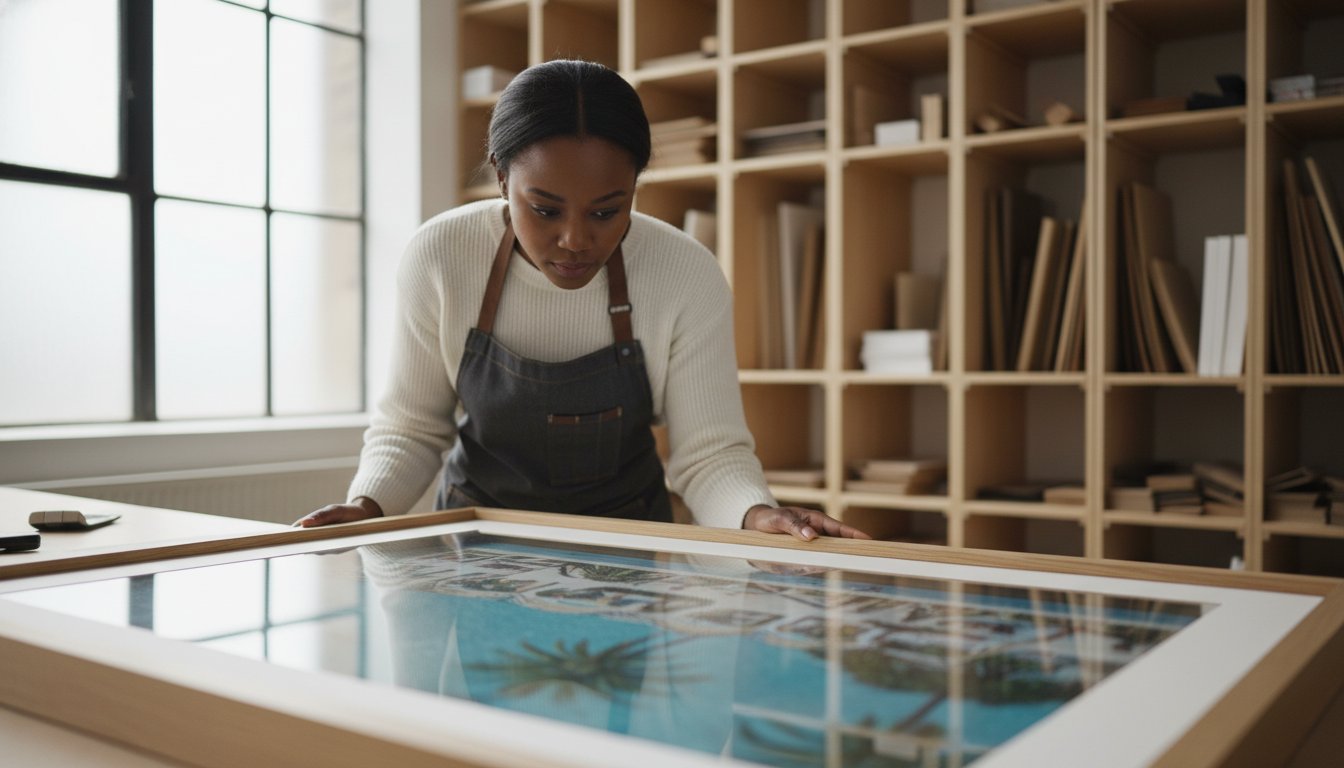
Tag: Custom Framing

The Hidden Costs of DIY Framing: What to Consider Before You Begin

What if the frame that looks cheapest at first becomes more costly after you add an extra tool, wasted material or an afternoon of rework? The hidden costs of diy framing go beyond the items on your shopping list. A frame needs to fit the print, assemble securely and suit the way you want to display it. The wrong mount or glazing choice can also affect how the artwork looks and is cared for. DIY can seem like a way to save money, especially when the frame itself appears straightforward.

A fair comparison includes the time needed to measure, source materials and assemble the finished piece, as well as the chance of wasted supplies or damage that cannot easily be undone. This guide will help you estimate the full scope of a DIY project and weigh framing choices against the needs of your print. We’ll cover tools, materials, common points of uncertainty and the value of a finished, ready-to-hang presentation, so you can decide whether to frame the print yourself or consider professional framing instead.

Key Takeaways

  • Count overlooked expenses alongside the frame, including tools, replacement materials, sourcing time and assembly effort.
  • The hidden costs of diy framing can include more than extra spending. Material and mounting decisions can also affect a print’s appearance and care.
  • Compare DIY and professional framing for control, finish, time and convenience to see which approach fits your priorities.
  • Use a project worksheet to list components, tools you already own, shopping time and assembly time before you commit.
  • Galerie Prints offers bespoke framing for prints purchased through the gallery, an option if you prefer a finished presentation.

What are the hidden costs of DIY framing beyond the frame?

A frame is only one part of a DIY framing project. The hidden costs of diy framing include overlooked spending, time, effort and risks that arise while measuring, sourcing materials and fitting the print. A project that looks simple on paper can involve several components, specialised tools and careful handling, particularly when the artwork has personal or historical significance.

The frame price is only the visible part of the cost. A fuller estimate includes tools you need, planning and assembly time, wasted materials, possible rework and the care required to protect the finished piece. Before starting, make a list of the frame, mount board, glazing, backing, hanging components and tools. Add the work involved in measuring, cutting and assembling, plus a realistic allowance for mistakes.

Which framing supplies and tools can add to the bill?

List the components separately instead of treating “the frame” as a single purchase:

  • Frame: Check the internal dimensions and whether they accommodate the print and any mount.
  • Mount board: Decide whether you want a visible border, then check both the mount’s overall size and the opening for the print.
  • Glazing: Choose a material and finish that suit the artwork and display setting. Appearance and preservation are separate considerations.
  • Backing: Include a suitable board or other backing to complete the assembly.
  • Hanging components: Account for the fittings needed to display the finished frame securely.

The tools depend on the project. You may need measuring equipment, a cutting tool or assembly supplies, but check what you already own before buying anything. Confirm what the frame and materials require. Standard sizes may not match the print or the proportions you want, so the artwork’s dimensions affect the frame, mount and glazing choices.

How can time and mistakes become hidden costs?

DIY takes time at every stage: measuring the print and frame, sourcing components, cutting materials, assembling the frame and fitting the artwork. Record each task, even if you do not assign a monetary value to your time. This gives you a more useful comparison with a finished framing option.

Small errors can mean rework. An incorrect measurement can leave the print poorly positioned or the components unable to fit together. Rushed alignment can make the final presentation look uneven, while dust or careless handling can affect the result. If the print is valuable to you, consider the risk of experimenting in relation to your confidence and experience. The Professional Picture Framers Association offers context on the specialist knowledge involved in picture framing.

How do materials and preservation choices change DIY framing costs?

Once you know the print’s dimensions, your next decisions shape both its appearance and how it is housed. Glazing, mount board, backing and fit each have a different role. Choosing only by the lowest upfront cost may not suit the print or its display conditions. Choose materials for the artwork’s format and significance, the presentation you want and the conditions where it will be displayed, rather than treating the components as interchangeable.

What should you know about glazing, mounts and backing?

Glazing sits in front of the artwork and affects how the image is viewed, including reflections and the overall look of the framed piece. A mount creates a border around the print and establishes visual spacing. Its opening and fit need to suit the artwork. Backing supports the assembly from behind. Each component involves a choice and may add to the cost, but no single material is right for every photograph or poster.

Options can differ in appearance, handling and intended use. Terms such as “archival,” “conservation-grade” or “UV-protective” describe particular material qualities, but their meaning and performance depend on the specific product. Check the manufacturer’s information or seek specialist guidance before relying on these claims. A label alone does not guarantee a particular level of protection for every artwork or display setting.

When does preservation matter more than the lowest material spend?

Start with the print’s significance to you. A poster chosen for a room refresh may call for different priorities than a sentimental photograph, a collectible or a limited-edition print. For an artwork you value, consider how it will sit against the mount or backing, whether it fits securely and how you will handle it during assembly. A poor fit can create pressure or leave the work misaligned, and repeated handling creates more opportunities for accidental marks or damage.

Consider the display conditions too, including light, humidity and how often you may move the piece. These factors can help you identify which material details to investigate, but they do not make a generic framing choice suitable by default. For a delicate, rare or unusually sized work, consult a qualified framing or conservation specialist before cutting, mounting or placing it behind glazing. Check product specifications rather than relying on broad preservation claims.

If you are weighing those material decisions against a finished presentation, Galerie Prints offers bespoke framing for prints purchased through the gallery. It is an alternative if you would prefer framing choices to be part of acquiring the print.

DIY framing vs professional framing: how do the real trade-offs compare?

Neither approach is right for every print. DIY gives you direct control over the materials and appearance, while professional framing can reduce the work of sourcing and assembling each component yourself. Compare more than the price: consider time, tools, finish and how involved you want to be, along with the value of the artwork.

Consideration DIY framing Professional framing
Materials You select and source the frame, mount, glazing and backing. Material choices can be discussed as part of the framing service; confirm current specifications.
Tools You’ll need suitable tools, or must acquire access to them, depending on the project. You don’t need to assemble a personal toolkit for the job.
Time Allow for planning, sourcing, measuring, fitting and any rework. Less hands-on assembly for you; check the provider’s current process and timing.
Control You manage the choices and carry out the work yourself. You explain your preferences and confirm the available options with the framer.
Finish The result depends on your measuring, alignment and assembly. A finished presentation is the aim, but confirm what the specific service includes.
Convenience Requires planning and careful execution. May reduce independent sourcing and assembly, depending on the service.

When can DIY framing be a sensible choice?

DIY is more manageable when the print has standard dimensions, you already have suitable tools and you are confident measuring accurately. It may also appeal if you enjoy hands-on work and want close control over each design choice. Before deciding, list the materials and tools you need, then record sourcing and assembly time. This fuller estimate helps you see whether the project still fits your budget and schedule.

When is professional framing worth considering?

Complex dimensions, valuable artwork, limited time or a preference for a polished, ready-to-hang presentation may make professional framing worth exploring. A service can reduce the need to find compatible components and assemble them yourself, but the result depends on the options and work agreed with the provider. Before ordering, confirm the frame, glazing, mount and paper specifications, as well as delivery, assembly and hanging details.

Galerie Prints offers bespoke framing for prints purchased through the gallery, with framed purchases described as ready to hang. If convenience is a priority, explore bespoke framing for purchased prints and check the details for the specific order. The hidden costs of diy framing are best weighed against the time and involvement you are willing to take on, not an assumption that one approach always produces a better result.

How can you calculate the full cost of a DIY framing project?

Start your estimate with the print, not a shopping list copied from another project. The hidden costs of diy framing depend on the artwork’s dimensions, the presentation you want and what you already have. Use this worksheet to capture your own requirements before buying anything.

What should your DIY framing checklist include?

  1. Describe the artwork. Record its dimensions, format and condition, then note where you plan to display it. This helps you choose the frame size and identify any special handling or material considerations.
  2. List the components. Write down the frame, mount, glazing, backing and hanging components you need. Check that their sizes and intended uses suit the print and your preferred presentation.
  3. Account for tools. Separate tools you already own from those you need to buy or borrow. Include any specialist equipment needed to cut materials accurately.
  4. Record effort and logistics. Estimate the time for measuring, sourcing, transport, cutting, assembly and fitting. Include the effort of making separate trips or finding components that work together.
  5. Allow for possible rework. Add a contingency line for replacement materials or mistakes, such as an inaccurate cut or a component that does not fit. Choose an allowance that makes sense for your project rather than relying on a generic figure.

In short, your total includes materials, tools, time and potential rework. If you want to account for your time financially, choose a method and apply it consistently. Otherwise, record the hours separately so you can compare the effort involved.

How do you compare your DIY estimate with a framed print option?

Compare like with like. Use the same print dimensions and consider the framing scope, desired finish and whether the result is ready to hang. A DIY materials list may not include assembly, while a framed option may bundle choices differently. Before treating the options as equivalent, verify the current frame, mount, glazing and paper specifications, along with delivery and hanging details.

Galerie Prints offers print-size, paper-type and professional framing choices, with bespoke framing available for prints purchased through the gallery. Framed purchases are described as ready to hang, but confirm the current details for the specific order. Then weigh your budget, available time and preferred level of involvement.

Explore professional framing options for prints purchased through Galerie Prints.

How can Galerie Prints make framing your art simpler?

After weighing the materials, tools and time involved in framing a print yourself, convenience may be part of the decision. Galerie Prints offers bespoke framing for prints purchased through the gallery, bringing the print and framing choice together rather than leaving you to source every component independently. Framed purchases are described as ready to hang. Check the details for a particular order before buying.

What should you check before choosing a framed print?

Start with the artwork and the room where you plan to display it. Review the print sizes, paper choices and framing options shown with the current product listing. Consider how the selected dimensions and presentation will work in the space. A print intended as a focal point may need a different visual balance from one displayed among other works.

Before deciding, confirm the current details for the frame finish, glazing and mount, if specified, along with delivery and any hanging requirements. These details can vary by order, so do not assume every framed print includes the same components or arrangements. Checking first lets you compare the finished option fairly with your DIY worksheet.

How do you take the next step with confidence?

Decide what matters most for this piece: the control and hands-on involvement of framing it yourself, or the convenience of choosing a print with framing. Compare your complete DIY tally, including tools, sourcing effort, assembly time and possible rework, with the current bespoke framing offer. This grounds the decision in your project rather than a general assumption about which route is better.

The hidden costs of diy framing may be acceptable for a straightforward project you are keen to handle. A framed option may better suit a valued print or a busy schedule. Either way, check the available choices and order details, especially if a particular finish or hanging arrangement matters to you.

If you would like to consider the alternative, explore bespoke framing options for prints purchased through Galerie Prints. Review the current choices and decide whether a framed presentation suits the artwork and your plans for displaying it.

Choose the framing approach that suits your print

The hidden costs of diy framing extend beyond materials. Tools, planning time, careful assembly and possible rework all belong in a fair estimate. Your choices of glazing, mount and backing also shape the print’s presentation, so consider appearance and preservation needs alongside the project’s total effort.

DIY may suit a straightforward piece and someone who enjoys hands-on control. If the print is especially meaningful, has complex dimensions or you would rather avoid sourcing and assembling components, professional framing is another option.

Galerie Prints offers bespoke framing for prints purchased through the gallery, and framed purchases are described as ready to hang. Check the current specifications and order details, including what is included, before deciding. Compare the available choices with your DIY checklist, then choose the route that suits the artwork and the space where you plan to display it.

Explore bespoke framing options at Galerie Prints, and find a presentation that lets your chosen print feel at home on your wall.

Frequently Asked Questions

Is DIY framing cheaper than professional framing?

Not necessarily. DIY may cost less if you already have suitable tools and can use readily available components, but the frame price alone does not show the full picture. Add materials, tools you need, sourcing and assembly time, and possible replacement materials. For a fair comparison, match the print dimensions, mount and glazing choices, finish, and whether the professional option is assembled and ready to hang.

What are the hidden costs of DIY framing?

The hidden costs of DIY framing can include more than supplies. Consider tools you need to buy or borrow, time spent measuring and sourcing components, transport, cutting and fitting, and materials wasted through mistakes. Rework may be needed if parts do not fit or the print is misaligned. Record each input, including your time, before comparing DIY with a finished framing option.

Can DIY framing damage a photograph or print?

Yes. Careless handling or a poor fit can mark, crease or misalign a photograph or print. Dust trapped during assembly may also affect its appearance, while unsuitable materials or display conditions may create preservation concerns. Handle the artwork carefully and check component specifications rather than assuming a label guarantees protection. For a rare, delicate or especially meaningful piece, seek specialist framing or conservation guidance before proceeding.

What materials do I need to frame a print myself?

A typical project may require a frame, glazing, mount board if you want a border, backing and hanging components. The print’s dimensions and your preferred presentation determine which sizes will fit. You may also need measuring and cutting tools or assembly supplies, depending on the frame and materials. Check each component’s intended use and specifications, particularly if the print has collectible or sentimental value.

How do I compare DIY framing with a bespoke framing service?

Compare equivalent options: the same print dimensions, framing scope, finish and preservation considerations. For DIY, include materials, tools, sourcing, assembly time and possible rework. For a service, check what the current offer includes, such as frame, mount, glazing, assembly, delivery and hanging details. Galerie Prints offers bespoke framing for prints purchased through the gallery. Framed purchases are described as ready to hang, but confirm the details for your order.

Is professional framing better for valuable or limited-edition prints?

Professional framing may be worth considering for valuable or limited-edition prints, but it is not automatically right for every piece. A specialist can help you assess suitable materials, fit and handling, while DIY requires you to make those decisions and carry them out carefully. Consider the artwork’s significance and your experience. For a rare, delicate or unusually sized print, seek qualified framing or conservation advice before assembly.

What should I measure before framing a print?

Measure the print itself, not just the area you want visible, and note its width and height accurately. If using a mount, consider both the opening around the artwork and the mount’s overall dimensions, then check that the frame accommodates the complete assembly. Also measure the wall space where you plan to display it. Confirm all measurements against the product specifications before cutting or ordering components.
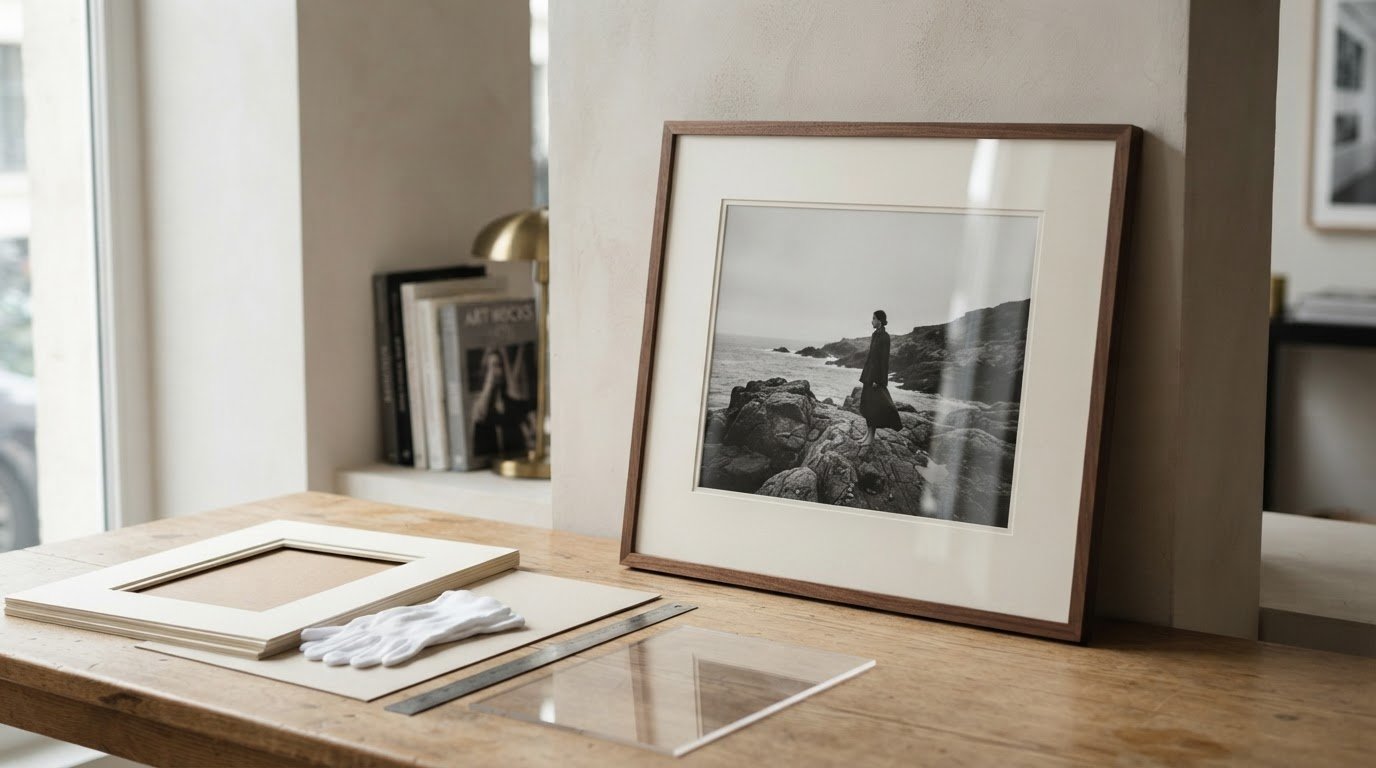
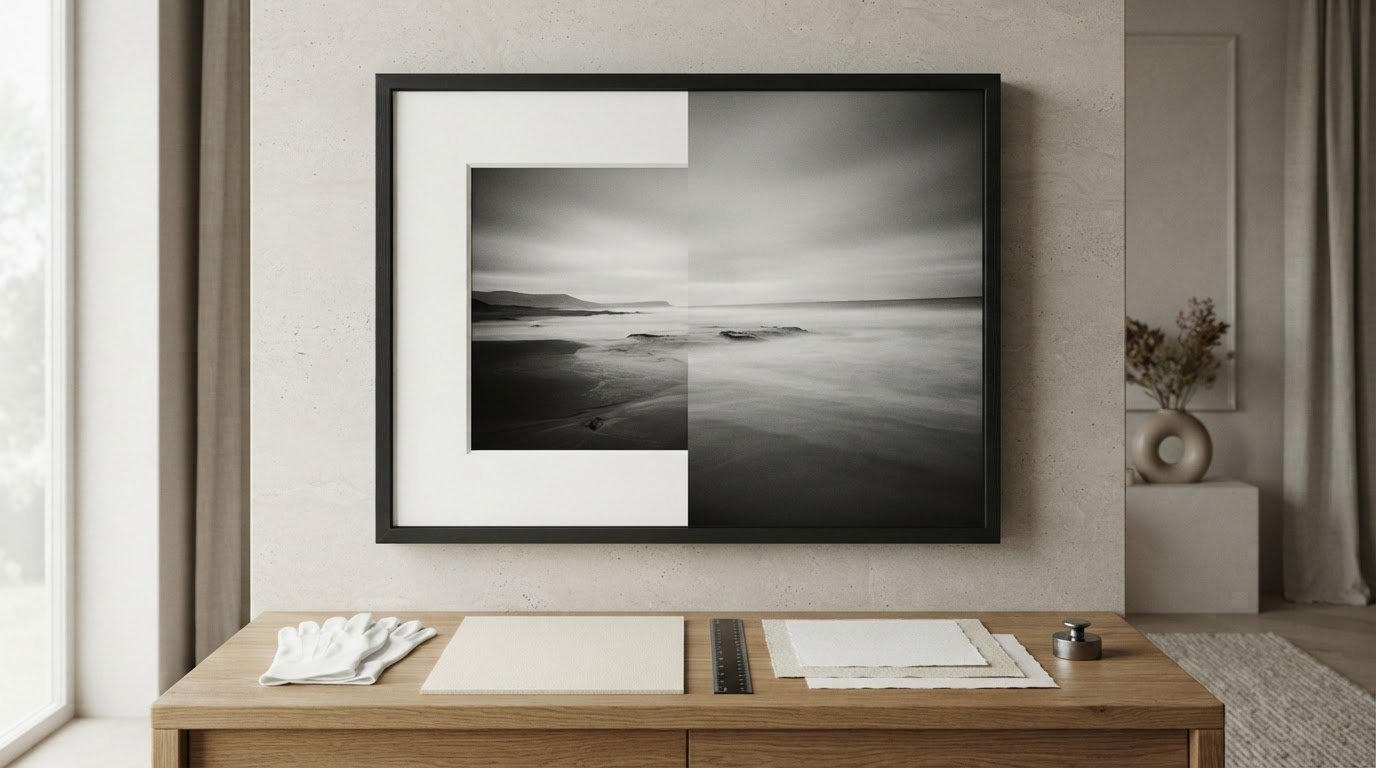
The Curator’s Guide to Framing Fine Art Photography

An exquisite photograph is a captured moment of history, yet without the right protection, that history begins to fade the second it meets the air. Choosing the correct approach to framing fine art photography is the definitive line between a simple wall decoration and a lasting investment that commands a room. You’ve likely spent hours selecting a Slim Aarons poolside scene or a Terry O’Neill portrait, only to feel a sudden hesitation when faced with the technicalities of archival mounting. It’s a common anxiety for collectors who fear that acidic backings or harsh glares might obscure the very soul of the work they admire.

We understand that your home is your personal gallery, and every piece should reflect that prestige. This guide, a definitive resource for the discerning collector, will show you how professional framing preserves photographic heritage while transforming a standard print into a museum-quality masterpiece. We’ll explore the science of UV-filtering glass, the necessity of pH-neutral materials, and the art of matching frame profiles to the specific era of your collection. From the sleek minimalism of modern archives to the warm wood tones favored in mid-century aesthetics, you’ll gain the confidence to curate a space that feels both timeless and protected for decades to come.

Key Takeaways

  • Identify the essential archival materials required to safeguard your investment against acidity and environmental aging over the coming decades.
  • Learn how to harmonize frame styles with the soul of the photograph, ensuring the aesthetic mirrors the specific historical era of the work.
  • Master the precision of the golden ratio to calculate mount proportions that lend a prestigious, gallery-standard presence to any sized print.
  • Understand how professional framing fine art photography acts as a final curatorial act, elevating a simple image into a definitive piece of heritage.
  • Discover the long-term value of bespoke, hand-finished framing compared to mass-produced options for maintaining the integrity of limited edition prints.

The Curatorial Role of Framing Fine Art Photography

For the serious collector, the acquisition of a physical print is only the beginning of the narrative journey. The process of framing fine art photography represents the final curatorial act, a deliberate choice that bridges the gap between a captured moment of history and the contemporary environment it will inhabit. While casual decorating often treats a frame as a mere accessory to match a sofa or a wall color, true collecting views the frame as a protective sanctuary and a psychological boundary. It signals to the viewer that the work inside is not a disposable image, but a piece of heritage deserving of genuine reverence. It’s the difference between merely filling a space and building a legacy.

This presentation style dictates how we perceive photographic history. A well-chosen frame creates a sense of permanence; it isolates the artist’s vision from the distractions of the room, allowing the viewer to step into the world of the image. As you explore the evolution of photography framing, you’ll see that iconic works, from the sun-drenched Slim Aarons scenes to the intimate Terry O’Neill portraits, rely on this boundary to maintain their narrative power. The frame acts as a portal, inviting a sense of wonder while maintaining a professional, polished distance that befits a luxury gallery.

Preservation as a Primary Objective

Beyond the visual impact, the frame serves a vital functional role as a guardian. Fine art photography demands significantly higher standards than standard commercial posters because the materials are inherently more sensitive to environmental shifts. Without professional intervention, prints are susceptible to irreversible damage. Foxing, the unsightly brown spots caused by fungal growth or metallic impurities, and waving, caused by humidity fluctuations, can ruin a masterpiece in just a few years. A Bespoke Framing Service ensures that every component, from the backing to the glazing, creates a stable micro-environment that protects the print’s physical integrity for decades.

Enhancing the Visual Narrative

A frame should never compete with the art; instead, it should focus the eye and provide a sense of depth that draws the viewer into the scene. Mastering the nuances of framing fine art photography allows you to achieve the coveted ‘Gallery Look’, which requires a balance of quiet authority and technical precision. By choosing a profile that complements the subject matter, you provide the work with a stage. This is particularly important for high-caliber archives where the goal is to mirror the prestige of a luxury gallery. Whether it’s a minimalist black wood or a warm, hand-finished oak, the right choice ensures the photograph remains the protagonist of the story.

Archival Excellence: Materials That Protect Your Investment

Archival framing is the science of preservation. It involves using chemically stable, inert materials that prevent the slow, silent deterioration of a print over time. When we discuss framing fine art photography, we’re referring to a system where every component, from the backing to the hinges, is designed to be reversible and non-reactive. For collectors of rare archives, museum-quality standards aren’t a luxury; they’re the only way to ensure the longevity of the work. Standard framing materials often contain lignin, a natural substance in wood pulp that turns acidic as it ages, causing the “burning” or yellowing of the paper. By contrast, professional-grade materials act as a barrier, maintaining the print’s original brilliance for generations.

Museum-Quality Mounting and Matting

The mount, or mat, serves a dual purpose: aesthetic elevation and physical protection. Its primary function is to create a necessary air gap between the photograph and the glazing, preventing the print from adhering to the glass due to condensation. Industry standards dictate the use of 100% cotton rag or high-grade alpha-cellulose boards, which are naturally pH neutral. To achieve that definitive gallery feel, many curators utilize a weighted bottom mount, where the lower border is slightly wider than the top and sides, providing a visual anchor for the piece. Implementing these conservation framing techniques ensures that the artwork remains suspended in a safe, acid-free environment.

Understanding UV-Protective and Anti-Reflective Glass

Environmental light is a constant threat to photographic pigments. Research indicates that UV radiation is responsible for approximately 40% of the fading seen in art prints. To combat this, collectors must choose glazing that offers significant UV protection. While standard glass provides a basic barrier, museum-grade glazing blocks up to 99% of harmful rays while virtually eliminating reflections. This balance of protection and clarity is essential; you want to see the texture of the paper and the depth of the shadows without the distraction of a mirror-like glare. For larger pieces, high-quality acrylic is often preferred for its shatter resistance and lighter weight, provided it maintains those critical archival standards. If you’re looking to elevate a recent acquisition, exploring a bespoke framing service is the most reliable way to secure these premium materials.

Aesthetic Styles: Matching the Frame to the Photographic Era

The frame is far more than a simple border; it’s a stylistic extension of the image’s era and intent. A photograph captured in the 1960s carries a distinct energy that differs vastly from a contemporary Star Wars Limited Edition Print or a monochrome scene from our Music Archives. To master the art of framing fine art photography, one must align their choices with the principles outlined in our Fine Art Photography: A Curator’s Guide. This alignment ensures the frame honors the soul of the work rather than merely serving as a decorative afterthought. The choice of color is the first step in this curatorial journey. Stark black frames provide a definitive, modern edge that anchors an image, while gallery white offers a seamless, airy transition that suits minimalist interiors. Warm wood tones, such as hand-finished oak or walnut, evoke a sense of heritage and artisanal craftsmanship that complements historical subjects.

Materiality plays a significant role in the tactile experience of the art. While mass-produced composite frames often feel hollow and fragile, solid timber mouldings offer a weight and texture that signals prestige. This physical presence is essential for serious collectors who view their acquisitions as permanent fixtures. Selecting high-quality, sustainable wood ensures that the frame ages as gracefully as the photograph it protects. By employing sophisticated archival framing techniques, you ensure that these aesthetic choices are supported by the structural integrity required to preserve the work for decades.

The Slim Aarons Aesthetic: Mid-Century Elegance

For the vibrant, sun-drenched works found in the Slim Aarons collection, the framing must mirror the “aspirational” mood of the subject matter. Clean, minimalist frames in white or light, natural woods work best to preserve the sense of leisure and light. A wide, bright white mount is often the secret to success here; it acts as a visual buffer that allows the saturated turquoises of a poolside scene to pop. The goal is to make the piece feel as effortless and elegant as the high-society lifestyle Aarons famously documented.

Classic vs. Contemporary Framing Approaches

Monochrome archives, such as the iconic Terry O’Neill Photography, often demand the timeless ‘Black Box’ frame. This deep-profile style adds a three-dimensional quality, creating a shadowbox effect that draws the viewer into the celebrity’s gaze. Conversely, for vintage movie posters or Cinema Lobby Cards, a slightly more traditional moulding can echo the golden age of the silver screen. Modern collectors may also consider float-framing, a technique where the print appears to hover within the frame. This method is particularly effective for prints with deckled edges, as it highlights the physical nature of the paper itself, creating a sophisticated, gallery-standard display.

Proportions and Precision: The Art of Mounting and Sizing

Precision in measurement is the silent language of the gallery. When framing fine art photography, the relationship between the image and its border determines the piece’s perceived value. Many collectors make the mistake of choosing a frame that matches the print size too closely; this creates a claustrophobic effect that stifles the artwork’s narrative. Instead, professional curators often employ the golden ratio to calculate mount widths that provide perfect visual balance. By intentionally oversizing a mount, even a modest print gains a sense of immense prestige. It signals that the work is significant enough to command its own dedicated territory on the wall.

Large-format pieces present a different set of technical challenges. As the scale increases, the structural integrity of the frame becomes paramount. The weight of museum-grade glazing requires robust joinery to prevent bowing, which could otherwise cause the glass to touch the print. Achieving this level of precision requires artisanal expertise that mass-produced options simply can’t provide. When framing fine art photography at a significant scale, the frame must act as a rigid exoskeleton, protecting the print from the physical stresses of its own size.

The Impact of Border Width and Window Mounts

Wide borders are essential for creating ‘breathing room,’ allowing the viewer’s eye to settle on the subject without distraction. The ‘Museum Mount’, characterized by a significantly larger frame for a smaller print, remains a hallmark of luxury in the art world. It suggests a level of care and expense that elevates the entire room. A window mount is a protective and aesthetic buffer cut from archival board that sits over the print to provide depth and prevent glass contact. This technique ensures the print remains flat and secure, avoiding the unsightly waving that occurs when paper is pressed directly against a hard surface.

Achieving the Gallery Look in Residential Spaces

Scaling art to the dimensions of your room is vital for a harmonious interior. A large Star Wars Limited Edition Print might dominate a small study, while a series of smaller Cinema Lobby Cards requires consistent spacing to feel like a cohesive collection. Always aim for eye-level hanging, typically centering the work roughly 145cm from the floor to mirror professional standards. Lighting is the final touch; use directional LEDs to avoid hotspots on the glass that can obscure fine details. To ensure your collection is presented with this level of curatorial precision, you can select a bespoke framing option that is tailored to your specific space.

Bespoke Framing: The Galerie Prints Signature Approach

The final stage of acquisition shouldn’t be a logistical burden. While many collectors find the process of sourcing a frame after the print arrives to be a point of friction, our signature approach to framing fine art photography integrates the curatorial and technical processes into one seamless experience. We don’t view the frame as an add-on; it’s the final layer of the artist’s presentation. By utilizing a Bespoke Framing Service that operates in direct concert with our archives, we ensure that every physical print is delivered as a completed masterpiece. This artisanal, localized production stands in stark contrast to mass-produced mail-in services that often prioritize volume over the delicate technical needs of high-caliber art.

Hand-finished frames offer a level of durability that composite materials can’t match. Every corner is joined with precision, and every finish is applied by hand to ensure a depth of color and texture that complements the specific photographic era. This commitment to craftsmanship ensures that your investment is ready to hang the moment it arrives at your door, regardless of whether you’re in London, New York, or Sydney. Large-scale framed works require specialized handling during global transit, and our logistics team ensures that even the most substantial pieces are crated and shipped with the same level of care used by international galleries. It’s about providing peace of mind alongside prestigious art.

From Archive to Wall: A Seamless Journey

There’s a distinct advantage in having a curator oversee the final presentation of your collection. When you select a piece from our Star Wars Limited Edition Prints or our extensive Music Archives, our team understands the historical context and visual requirements of that specific work. We maintain a rigorous consistency across large-scale collections, ensuring that if you hang multiple works in a single space, the profiles and mounts match perfectly. This eliminates the guesswork for the collector and guarantees a professional result every time. We invite you to explore our bespoke framing service for your next acquisition to experience this integrated excellence firsthand.

Investment Value and Heritage

A professionally framed print is more than a decoration; it’s a legacy. While the initial print holds significant value, the meticulous process of framing fine art photography ensures the work retains its market appeal and physical integrity far better over time. The frame acts as a primary line of defense, protecting the photographic heritage for future generations. Our commitment to localized production and premium materials ensures that every piece we deliver is a lasting piece of history. By choosing artisanal craftsmanship over mass-market convenience, you’re investing in a heritage that will remain as evocative and prestigious decades from now as it is today.

Elevating Your Collection for the Next Generation

The final act of curation is a commitment to the future. By prioritizing archival materials and precise proportions, you ensure that your investment remains a vibrant window into the past rather than a fading memory. We’ve discussed how the right glazing and acid-free mounting create a sanctuary for your prints, while thoughtful aesthetic choices bridge the gap between historical heritage and modern design. Mastering the nuances of framing fine art photography is what transforms a personal residence into a private gallery of enduring significance.

Our Bespoke Framing Service removes the logistical friction from this journey, offering pieces that are hand-crafted by specialist artisans and delivered ready to hang. With professional mounting included with all bespoke frames and global secure shipping for framed artwork, your collection is protected from the moment it leaves our archive until it reaches your wall. It’s an invitation to give your acquisitions the prestigious stage they deserve. Discover our Bespoke Framing Service and complete your collection to begin building a legacy of beauty that will inspire for decades to come.

Frequently Asked Questions

What is the difference between standard and archival framing for photography?

Archival framing focuses on long-term preservation by utilizing chemically inert materials like 100% cotton rag matboard and pH-neutral adhesives. Standard options often contain lignin, which turns acidic and causes yellowing or “burning” of the paper over time. By contrast, museum-quality framing fine art photography creates a stable micro-environment. This ensures the physical integrity of the print remains untouched, protecting your investment from environmental degradation for many decades to come.

Does framing a photograph increase its value as a collectable?

A professionally framed piece often holds its value better because the frame acts as a primary guardian of the print’s condition. Collectors prioritize works that haven’t suffered from light damage or moisture. When you choose a bespoke service, you’re signaling that the work is a significant piece of heritage. This curatorial care transforms a simple print into a prestigious, gallery-standard asset that commands respect in the secondary art market.

What kind of glass is best for displaying fine art photography in a bright room?

For spaces with high natural light, museum-grade glass is the gold standard. It features an anti-reflective coating that virtually eliminates glare, allowing you to see the deep shadows and fine details without a mirror-like reflection. Crucially, it blocks up to 99% of UV radiation. Research shows UV rays cause 40% of fading in art prints, so this specialized glazing is essential for maintaining the vibrant colors of poolside scenes or historical portraits.

Why is a mount (mat) necessary for framed photography?

The mount, or mat, provides a vital physical barrier by creating a necessary air gap between the photograph and the glass. Without this space, condensation can cause the print to adhere to the glazing, leading to irreversible surface damage. Aesthetically, it offers “breathing room” that draws the eye toward the subject. Using wide, weighted mounts is a hallmark of luxury, giving even smaller prints a sense of immense prestige and quiet authority.

How do I choose the right frame color for a black and white photograph?

Monochrome archives, such as Terry O’Neill Photography, typically look best in a classic ‘Black Box’ frame. This deep-profile style adds a three-dimensional quality that anchors the image. If you prefer a more contemporary aesthetic, a crisp white frame offers a seamless transition to the wall. For historical pieces like Cinema Lobby Cards, warm, hand-finished wood tones like walnut can echo the era of the production, providing a sense of nostalgic elegance and artisanal craftsmanship.

Can I buy a frame separately for a print I already own?

Galerie Prints offers a Bespoke Framing Service as a dedicated add-on for our curated collections, including the Slim Aarons Collection. While we specialize in providing ready-to-hang physical prints from our own archives, serious collectors should always seek artisanal, localized production for any work they own. It’s vital to ensure that any separate frame you acquire meets museum-quality standards, as mass-produced options often lack the technical precision required for high-caliber visual art.

What are the risks of using a cheap, non-archival frame for high-end prints?

Cheap frames often use wood-pulp backing boards that release harmful gases as they age, leading to unsightly brown spots known as foxing. Non-archival adhesives can also cause permanent staining or waving of the paper. When framing fine art photography, cutting corners on materials invites environmental light and humidity to destroy the work’s soul. These risks aren’t just aesthetic; they can lead to restoration costs that far exceed the initial price of a professional frame.

How does Galerie Prints ensure the safety of framed art during shipping?

We treat every framed work as a piece of history. Our team uses specialized crating and secure global shipping to protect against the physical stresses of transit. Large-format framed works are packed with museum-quality materials to prevent glass breakage or frame bowing. This ensures that your acquisition arrives in perfect condition, ready for immediate display. We handle the technical logistics so you can focus on the wonder of your new gallery-standard masterpiece.

Should I Frame a Print With or Without a Mat? The Curator’s Guide

The cleanest, most minimalist framing choice in contemporary design can quietly become the most destructive decision for an art collection. When standing before a prized piece and asking, should I frame a print with or without a mat, the dilemma reaches far beyond simple styling; it is fundamentally archival. Resting bare photographic paper directly against glazing risks trapped humidity, which can fuse delicate emulsions to glass and cause irreversible damage.

It is natural to feel caught between the crisp immediacy of full-bleed presentation and the quiet reverence of a traditional mount. You want your living space to feel refined rather than dated, yet uncertainty around margin ratios, tonal balance, and print protection can stall any installation. You will discover whether matting or full-bleed framing best elevates and preserves your fine art photography. Ahead, we share a definitive curatorial framework to safeguard your valued prints, balance negative space, and achieve a timeless presentation that enriches your interior architecture.

Key Takeaways

  • Master the curatorial criteria for deciding whether you should frame a print with or without a mat based on artwork rarity, scale, and paper surface.
  • Understand how archival cotton rag matting physically separates print emulsions from glass, eliminating condensation risks and long-term degradation.
  • Discover when full-bleed presentation creates dramatic visual impact, particularly for expansive landscape photography and bold mid-century compositions.
  • Learn why standard wood pulp mats inflict irreversible mat burn and how conservation-grade mounting preserves collector value across decades.
  • Identify the spatial proportions and frame depths needed to achieve architectural harmony within sophisticated residential interiors.

Framing With or Without a Mat: The Essential Curatorial Difference

Every framing decision is fundamentally a dialogue between preservation and spatial perception. When resolving whether you should frame a print with or without a mat, you are choosing how the eye transitions from the active architecture of a room into the frozen narrative of a photograph. Historically, fine art institutions positioned mat boards as essential isolation chambers, focusing contemplation squarely upon delicate tonal gradations. Modern residential design, by contrast, frequently embraces the immediate clarity of full-bleed presentation. Both approaches carry distinct physical consequences for fine art paper and create entirely different sensory experiences within an interior.

The Anatomy and Purpose of a Picture Mat

A window mount is far more than a decorative paper border. In traditional gallery presentation, a conservation-grade 4-ply or substantial 8-ply beveled mount acts as an architectural relief. The precision 45-degree bevel cut produces a crisp, recessed shadow line, gently drawing the eye inward toward the print while visually isolating the subject from patterned wall coverings or competing decor. More crucially, as detailed in the archival overview of Mat (picture framing), the board establishes an indispensable physical barrier. This spatial depth prevents the photographic emulsion from resting directly against the framing glass, eliminating the micro-climate where condensation gathers and permanently destroys gelatin or pigment surfaces.

The Aesthetic Intent of Matless Full-Bleed Framing

Borderless presentation strips away ornamental ceremony to celebrate raw graphic impact. By running a photograph directly to the inner rebate of the moulding, full-bleed framing creates an uninterrupted window into the image:

  • Visual immediacy: The frame functions as an architectural portal, pulling the viewer directly into the composition without decorative buffering.
  • Modern spatial balance: Expansive horizontal vistas and bold mid-century works gain dramatic presence, complementing the clean lines of contemporary residential joinery.
  • Maximized scale: Artworks command wall space through imagery alone, an ideal treatment when oversized dimensions leave little room for perimeter margins.

Deciding if you should frame a print with or without a mat ultimately hinges on whether your space calls for the contemplative reverence of a layered reveal or the kinetic, contemporary drama of an unbordered horizon.

When You Should Frame a Print With a Mat: Protection and Prestige

Preservation is an invisible art. While aesthetic preferences shift across eras, the physical vulnerabilities of fine art paper remain constant. When asking yourself if you should frame a print with or without a mat, remember that rare photographic editions demand physical separation from ambient room environments. Incorporating an archival window mount provides an essential buffer against degradation, ensuring collector-grade imagery maintains its pristine physical state across generations.

Preventing Glazing Damage and Moisture Traps

Every home experiences diurnal temperature fluctuations. As warm air cools against framing glass or acrylic, microscopic condensation forms along the interior glazing surface. Without a separating window border, the delicate emulsion of a photographic print touches that glass directly. Over months or years, the gelatin or pigment layer rehydrates, softens, and permanently adheres to the glass face. Lifting the glass tears the artwork away, resulting in catastrophic loss. Adhering to professional conservation framing practices ensures paper fibers have adequate clearance to expand and contract naturally as seasonal relative humidity shifts.

Elevating Historic and Fine Art Photographic Archives

Archival collections possess a visual gravity that responds exquisitely to intentional border treatments. Intimate mid-century portraits and classic black and white pictures require quiet visual isolation so the eye can savor subtle silver tonal transitions. A pristine white, warm white, or soft neutral museum mount establishes a zone of visual silence. This perimeter blocks competing wall tones, allowing deep velvety blacks and crisp architectural highlights to resonate with authentic gallery prestige.

Balancing Print Scale on Expansive Wall Spaces

Interior architecture frequently demands substantial visual weight. An intimate 8×10 or 11×14 inch archival print can easily feel lost upon a double-height wall or above a substantial credenza. A generous mat solves this spatial tension through proportion:

  • Substantial margins: Applying a four- to five-inch border expands the overall frame footprint, allowing smaller historical pieces to hold significant architectural space.
  • Curatorial focus: Wide margins create dramatic negative space, drawing the viewer closer to study fine grain, facial expressions, and nuanced period details.
  • Collector presence: The deliberate use of negative space signals that the image inside is an authentic artifact deserving focused contemplation.

If you are considering whether you should frame a print with or without a mat to safeguard rare family heirlooms or archive acquisitions, partnering with an artisanal studio for a bespoke framing service guarantees your pieces receive tailored, conservation-grade protection that honors their historical weight.

When to Frame Without a Mat: Modern Scale and Immersive Art

Borderless framing strips away visual boundary lines to pull the observer directly into the frame. While intimate, historical works often benefit from the formal reverence of a window border, contemporary residences frequently call for an immediate, architectural punch. When asking whether you should frame a print with or without a mat, scale and pictorial composition serve as your clearest aesthetic guides. Removing the perimeter creates an immersive threshold, allowing sweeping horizons and saturated palettes to interact seamlessly with clean interior millwork.

Maximizing the Visual Impact of Large-Format Works

Large-format lifestyle works thrive on uninhibited space. Iconic resort scenes, such as those captured by slim aarons, celebrate sunlight, saturated azure pools, and sprawling mid-century villas. Encasing a substantial 30×40 inch or 40×60 inch photograph within an additional four-inch mat border can easily produce an overwhelming, cumbersome profile that swallows residential wall space. Extending the photograph straight to a slender walnut, natural oak, or satin black moulding produces modern immediacy. The image reads as a panoramic architectural window rather than a framed paper artifact.

Protecting Art Without a Mat: The Role of Framers Spacers

Dispensing with a mat must never mean sacrificing conservation standards. Contrary to common belief, custom framing without a mat does not require pressing fine art paper flat against glazing. Seasoned framing studios deploy framers spacers to achieve safety:

  • Concealed depth: Framers secure inert acrylic or wood fillet spacers inside the frame rebate, hidden entirely behind the lip of the moulding.
  • Air circulation: These slender profiles lift the glass a crucial 1/8 to 1/4 inch away from the print, establishing identical environmental airflow to a traditional 8-ply mat.
  • Structural flat support: Archival backing boards and reversible hinge mounts ensure broad sheets remain perfectly flat without bowing or touching the glazing across seasonal temperature shifts.

Highlighting Deckled Edges and Exposed Paper Character

Certain fine art papers possess rich, tactile personalities that should be celebrated rather than tucked behind a beveled mat opening. Heavyweight cotton rag papers featuring hand-torn or deckled edges gain captivating presence through shadowbox float mounting. In this treatment, the print is gently anchored atop an archival 8-ply conservation board with a generous margin surrounding it, leaving the irregular, feathered paper edges entirely exposed. Adding internal frame spacers sets the glazing forward, casting natural, atmospheric drop shadows around the paper edges and accentuating the physical craftsmanship of the print itself.

Deciding if you should frame a print with or without a mat comes down to artistic intent: choose a mat for quiet focus, or embrace spacer-based full-bleed methods when your artwork demands architectural scale and visceral immersion.

Curator Decision Framework: Choosing the Right Framing Approach

Every considered acquisition requires a deliberate framing strategy that synthesizes physical preservation with spatial harmony. Determining whether you should frame a print with or without a mat ceases to be guesswork when evaluating two core pillars: the material nature of the photographic medium and the architectural atmosphere of the installation space. A curated interior relies on this balance to ensure artwork looks intentional rather than accidentally assembled.

Print Characteristics: Medium, Rarity, and Paper Finish

The substrate of your artwork dictates the minimum level of physical isolation required inside the frame moulding:

  • Chromogenic and gelatin silver prints: Glossy, resin-coated, or darkroom C-type papers possess delicate chemical layers that permanently fuse to acrylic or glass if subjected to direct contact; they demand the physical offset of a 4-ply mat or concealed archival spacers.
  • Heavy cotton rag fine art papers: Textured, ultra-matte baryta surfaces absorb ambient light with minimal surface glare. While they offer greater aesthetic flexibility for edge-to-edge presentation, their thick fibrous edges still require non-invasive corner hinges rather than destructive adhesive mounts.
  • Limited-edition archival rarity: High-value historical acquisitions necessitate museum-standard reversible mounting techniques, ensuring the print remains entirely untouched by permanent adhesives, masking tapes, or non-archival backing boards.

Interior Architecture, Room Mood, and Display Density

The proportions and lighting of your domestic environment fundamentally shape how a framed composition behaves on the wall. A generous, off-white window border introduces a pocket of calm, making it ideal for period architecture with detailed plasterwork, patterned wallpapers, or rooms with active joinery. In contrast, modern spaces characterized by polished concrete floors, steel-framed glass doors, and restrained furnishings often benefit from full-bleed framing within slender metal or dark hardwood mouldings, allowing the photograph to function as an uncluttered graphic anchor.

Arrangement density matters just as profoundly. For a tight, grid-aligned salon wall featuring multiple images, unifying pieces with identical three-inch archival mats produces rhythmic order and prevents visual exhaustion. For a solitary statement piece over a wide low sideboard, full-bleed presentation can create an immediate, arresting presence that grounds the room.

Whether you need custom cotton window borders for rare archival portraits or precision spacer installations for expansive statement works, explore our artisanal bespoke framing service to pair your collection with flawless, hand-finished museum standards.

Resolving whether you should frame a print with or without a mat comes down to aligning the tactile vulnerabilities of your photographic print with the volume, light, and architectural voice of your living space.

Executing the Presentation: Archival Materials and Custom Framing

Execution transforms an aesthetic concept into an enduring legacy. Even after deciding whether you should frame a print with or without a mat, the longevity of your investment relies entirely on the chemical integrity of the materials resting inside the moulding. Substandard mounts inflict slow, irreversible damage on fine art paper, while true conservation components guarantee your collection remains as luminous decades from now as the day it was printed.

Selecting True Archival Mat Boards: Avoiding Mat Burn

Standard decorative mat boards are manufactured from unrefined wood pulp laden with lignin. Over time, environmental heat and light break down this compound, off-gassing hydrochloric and sulfuric acids that leach directly into fine art paper fibers. The consequence is unsightly “mat burn,” a permanent sepia discoloration etched along the beveled border of the print. Authentic preservation demands 100% cotton rag museum boards or virgin alpha-cellulose boards that are completely acid-free and lignin-free. Hand-applied Japanese mulberry paper hinges and water-reversible wheat starch paste ensure the print hangs naturally without chemical degradation.

Determining Proportions and Harmonious Tones

Precision proportions prevent a finished frame from appearing visually unstable. Curators rely on proven visual rules to establish balance:

  • The scale differential: Mat borders should measure at least double the face width of your frame moulding, preventing the frame and mount from competing for optical dominance.
  • The curatorial bottom weight: Adding a subtle quarter- to half-inch of additional width to the lower mat margin compensates for an optical drop illusion, keeping the artwork grounded squarely in the center of the aperture.
  • Tonal matching: Stark, bleached optical whites clash harshly with traditional silver gelatin tones; select warm ivory, natural linen, or soft charcoal boards that pull their hue from the palest highlights within the image itself.

The Galerie Prints Approach to Bespoke Presentation

Acquiring curated fine art photography is an investment in cultural heritage. Our master craftsmen hand-finish every piece through a dedicated bespoke framing service, ensuring each print is cradled within genuine museum-grade conservation materials. From hand-cut 8-ply cotton boards to precision hidden-spacer installations for full-bleed works, each finished frame arrives ready to hang, elevating your residence with timeless gallery authority.

When asking whether you should frame a print with or without a mat, remember that material execution matters as much as border styling. Choosing artisanal craftsmanship safeguards photographic history while creating an exquisite visual presence in your home.

Elevating Your Art Collection for Generations to Come

Selecting the ideal presentation for fine artwork isn’t merely an interior styling choice; it’s an enduring act of stewardship. When asking yourself, should I frame a print with or without a mat, your decision ultimately harmonizes room architecture with conservation physics. A generous cotton rag mount introduces contemplative negative space while isolating delicate photographic surfaces from glazing. Conversely, an expertly spaced full-bleed presentation delivers immediate, cinematic immersion across modern interiors.

As a trusted worldwide specialist in iconic 20th-century photography archives, Galerie Prints honors the balance between historical resonance and contemporary design. Our curator-selected archives are printed on premium archival photographic papers and paired with bespoke hand-crafted framing providing museum-standard protection against environmental shifts. Explore Bespoke Framing for Your Fine Art Prints to present your photography with the quiet authority, elegance, and protection your living space deserves.

Frequently Asked Questions

Does framing a print without a mat damage the artwork over time?

Framing without a mat can cause irreversible damage if the print rests directly against the glazing. Daily interior temperature shifts cause microscopic condensation to form on the inside of framing glass. When photographic emulsions touch this moisture, they soften and permanently fuse to the glass. To frame safely without a window border, always ensure your framer installs concealed archival spacers beneath the frame rebate to maintain an air gap.

Can I frame an oversized art print with a mat without it looking too bulky?

You can mat an oversized piece successfully by using a narrow, tailored border paired with a slender moulding profile. For expansive works spanning 30×40 inches or larger, standard wide mats often create excessive visual bulk that overwhelms domestic wall space. Limiting the mount to two or two and a half inches provides the necessary air buffer without dominating the room. Alternatively, full-bleed presentation offers a sleek architectural look.

What is the standard mat board width for fine art photography?

Fine art photography typically looks best with a mat width between two and a half and four inches, depending on the print dimensions. A reliable curatorial guideline requires the mat to measure at least twice the width of the frame moulding. This proportional difference ensures the frame and mount don’t compete for optical dominance while drawing the viewer’s gaze into the delicate mid-tones of the photograph.

What is mat burn and how do I prevent it on valuable prints?

Mat burn is a permanent, yellowish-brown line of chemical discoloration that appears along the inner beveled edge of an artwork. It occurs when low-grade, wood-pulp boards break down and release acidic lignin directly into the print paper. You can prevent this damage entirely by using only 100% cotton rag museum boards or alpha-cellulose conservation boards that are certified acid-free and lignin-free.

Is it better to match the mat color to the print or to the wall color?

Curators always match the mat color to the highlights within the artwork rather than the wall paint. Selecting a stark white board can make vintage black-and-white prints appear dingy or yellowed by comparison. Instead, choose warm ivory, soft cream, or natural off-white tones that pull directly from the lightest values in the photographic paper, creating a seamless tonal transition that enriches the imagery.

How do framers protect full-bleed prints if no mat is used?

Professional framers install inert acrylic or wood fillet spacers inside the frame rebate, concealed completely beneath the moulding lip. These slim spacers elevate the glazing roughly 1/8 to 1/4 inch away from the artwork surface. This structure provides the same continuous airflow and moisture protection as a traditional window mount, allowing you to showcase full-bleed photography without risking glaze contact.

Are movie posters and lobby cards better displayed with or without a mat?

When deciding if you should frame a print with or without a mat for cinema archives, piece size dictates the best approach. Small, rare artifacts like vintage cinema lobby cards benefit immensely from wide archival mats, which elevate their modest footprint to command attention on the wall. Conversely, large vintage movie posters possess bold graphic lettering and vibrant borders designed to extend edge-to-edge within a spacer-fitted frame.

Curating Art for a Minimalist Home: Intentional Walls

True minimalism is never achieved by leaving your walls entirely barren, as a sterile white expanse often reflects hesitation rather than quiet sophistication. When curating art for a minimalist home, the objective isn’t to fill negative space out of obligation; it’s to anchor an interior with a singular, evocative visual voice that honors the room’s architectural calm.

You’ve likely felt the delicate tension between protecting a serene sanctuary and dreading the soulless, impersonal nature of mass-produced wall art. Balancing a warm cultural narrative with crisp spatial discipline isn’t simple, particularly when an improper print proportion or chaotic arrangement risks cluttering the very peace you worked to design.

In this guide, you’ll discover how to select, scale, and frame archival photography to build striking, intentional minimalist interiors. We’ll explore exact architectural hanging ratios, the power of generous matting, and the bespoke framing standards needed to turn legendary photographic archives into lasting, heirloom anchors for your home.

Key Takeaways

  • Master the philosophy of visual restraint by treating negative space as an active architectural element rather than empty wall area.
  • Discover the definitive spatial proportions and golden ratio formulas that prevent undersized prints from cluttering clean interior lines.
  • Learn how curating art for a minimalist home relies on selecting singular, storied archives rather than impersonal, mass-market decor.
  • Explore how bespoke framing materials, from natural hardwood profiles to museum-grade glazing, bridge the artwork with your living environment.
  • Build an enduring, iterative art collection guided by authentic provenance and certified archival darkroom print quality.

The Philosophy of Minimalist Art: Choosing Impact Over Abundance

Minimalism is frequently misunderstood as an exercise in sheer erasure. In interior architecture, stripped-back rooms often fall into sterile emptiness when bare walls are treated as an aesthetic virtue rather than a missed opportunity. True intentionality operates on restraint, not deprivation. In the practice of curating art for a minimalist home, the objective isn’t to cover every surface, nor is it to leave walls hollow; it’s about choosing singular, narrative-rich works that command attention through quiet authority.

A solitary, museum-grade photographic print introduces emotional tranquility that scattered decor cannot replicate. By presenting an authentic narrative, whether captured in the sun-drenched leisure of Slim Aarons or the candid intimacy of legendary music archives, the wall transforms from an unoccupied barrier into an intentional architectural anchor.

Rethinking Negative Space on Modern Walls

Negative space isn’t blank void; it’s an active structural design element. Much like the pauses between musical notes, unadorned expanses of vertical plaster give an artwork room to breathe, elevating the piece from casual decoration to an intentional installation. In movements such as minimalist photography, sparse composition and expansive margins direct visual energy toward subtle variations in light and form.

To successfully integrate negative space into your environment, consider how surrounding physical elements interact:

  • Clear visual boundaries: Ensure at least two to three feet of uninterrupted wall surface surrounds the frame to prevent sightline friction.
  • Architectural alignment: Balance low-slung credenzas or linen sofas against open vertical planes to emphasize ceiling height.
  • Breathing room: Avoid competing sconces or adjacent shelving that dilute the impact of the primary print.

The Power of the Singular Focal Point

Eclectic gallery clusters often fracture a room’s composure. When you distribute attention across a dozen mismatched frames, visual clutter naturally follows. Curating art for a minimalist home requires replacing that chaotic visual noise with one decisive, large-format statement work that anchors the entire room’s layout.

A monumental, darkroom-grade print immediately establishes spatial hierarchy. Rather than allowing eyes to dart aimlessly across disparate frames, an oversized archival work pulls the gaze inward, setting the emotional temperature of the living space. By investing in museum-quality fine art photography, you introduce genuine cultural provenance and technical mastery, grounding modern architectural discipline with profound human history.

How to Select the Perfect Photographic Art for Minimalist Spaces

Minimalist interior design relies on raw, honest surfaces. Poured concrete, lime-washed plaster, honed limestone, and white oak create an architectural canvas that rejects decorative superficiality. When curating art for a minimalist home, the artwork shouldn’t sit as an alien layer atop these materials; it must harmonize with their inherent weight and grain. Medium-format and large-format photographic prints achieve this seamlessly because their physical medium possesses depth, texture, and technical provenance.

Silver halide prints on fiber-based archival paper respond dynamically to daylight, shifting their tonal presence as shadows cross the room. To ensure these tactile heirlooms endure, collectors adhere to strict preservation matting and framing standards, utilizing acid-free cotton rag boards that protect delicate emulsions while providing essential visual containment.

Tonal Restraint: The Case for Monochromatic Imagery

Monochrome imagery provides immediate architectural grounding. A deep black-and-white print establishes a strong graphic contrast against pale, neutral wall finishes, anchoring an open floor plan without introducing chromatic discord. The quiet depth found in historical black and white pictures, whether documenting brutalist facades or intimate portraits by masters like Terry O’Neill, brings human narrative into stark living spaces without competing against organic interior finishes.

Consider these key pairings when integrating black-and-white prints:

  • Charcoal and warm taupe: Softens the stark contrast against unsealed concrete and pale linen upholstery.
  • Deep pitch black: Aligns with blackened steel fixtures, minimal joinery, and architectural window mullions.
  • High-key silvers: Harmonizes with pale ash, light travertine, and brushed aluminum accents.

Aspirational Color: Curating Saturated Heritage Photography

Color in a minimalist residence must feel deliberate, never accidental. Instead of scattering decorative accents across cushions and accessories, introduce focused, saturated heritage works. The mid-century archives of Slim Aarons serve as an extraordinary tool for this approach. His depictions of poolside leisure and modernist architecture juxtapose azure waters and terracotta roofs directly against neutral interior textiles.

A single, expansive Aarons print breathes warm, golden-era vitality into disciplined rooms, delivering an effortless narrative bridge between modern restraint and storied European or desert modernism. To discover pieces that elevate your space through verifiable historical significance, explore the curated editions available at galerieprints.com.

Proportion, Scale, and Placement: The Architectural Formula

Minimalist architecture exposes spatial errors without mercy. While traditional interiors can disguise improper sizing amid layered furnishings, an uncluttered room highlights every proportional mismatch. An undersized frame adrift on a wide expanse of drywall doesn’t read as delicate; it appears hesitant, fracturing the room’s sightlines and generating visual clutter through awkward emptiness. Successful wall curation requires mathematical discipline to ensure the artwork functions as a natural structural extension of the space.

Mastering this balance is essential when curating art for a minimalist home. When an archival print commands the correct physical volume, the surrounding wall transitions from blank drywall into intentional, calming negative space.

Calculating the Two-Thirds Furniture Proportion Rule

Placing art above primary furniture anchors, such as low-profile credenzas, linen sofas, or platform headboards, requires strict adherence to spatial ratios. The total width of the framed artwork should span approximately 60% to 75% (roughly two-thirds to three-quarters) of the furniture piece beneath it. For an 84-inch sofa, the ideal frame width falls between 56 and 63 inches.

To preserve structural balance between the artwork and the furniture foundation, apply these clear guidelines:

  • The vertical gap: Hang the bottom edge of the frame 6 to 8 inches above the back of a sofa or the surface of a console to maintain a unified visual unit.
  • The Mantel clearance: Position the frame 4 to 8 inches above a fireplace mantel to prevent the art from floating away from the hearth.
  • Prevent visual tipping: Avoid frames narrower than 50% of the furniture width, which look stranded and disrupt horizontal balance.

Gallery Sightlines and Spatial Breathing Room

Residential art placement frequently suffers from being mounted too high. Gallery and museum standards dictate that the vertical center of an artwork should sit at eye level, precisely 57 to 60 inches from the finished floor. In rooms with standard eight-foot ceilings or seated gathering areas, 57 inches provides an intimate resting point. In hallways or open spaces featuring nine- to ten-foot ceilings, lifting the center line to 60 inches preserves vertical harmony.

When curating art for a minimalist home, calculate fastener placement using this museum formula: add half the total frame height to 57 inches, then subtract the distance from the top edge of the frame to the hanging hardware. This prevents measuring to the top rim and guarantees exact eye-level centering. Finally, preserve at least 12 to 18 inches of clearance between the outer frame and adjacent door casings, architectural corners, or light sconces, ensuring natural light washes across the glazing without visual interruption.

The Art of Bespoke Framing: Enhancing Without Overwhelming

A frame should never compete with the artwork it encloses, nor should it feel like an afterthought. In modern interiors, bespoke framing acts as a structural bridge, linking the artwork to the room’s materials, millwork, and light quality. When curating art for a minimalist home, the moulding profile, mat margin, and glazing specifications define the piece’s physical presence on the wall. Mass-market frames flex, cast distracting reflections, and rely on acidic backing boards that degrade paper over time. Artisanal framing, by contrast, transforms an archival print into an enduring architectural fixture.

Selecting Frame Profiles for Minimalist Architecture

Disciplined spaces demand restrained frame profiles that emphasize geometric precision. Deep-set box mouldings with ultra-narrow faces, measuring between one-quarter and one-half inch, create subtle shadow lines without cluttering clean wall planes.

  • Raw White Oak and Maple: Introduces organic grain and warmth, softening austere concrete, limestone, or Scandinavian palettes.
  • Satin Black and Powder-Coated Aluminium: Provides a razor-sharp graphic perimeter, perfect for delineating high-contrast black-and-white photography.
  • Deep-Set Spacers: Suspends the print away from the glazing, letting the paper’s natural texture and darkroom luster sit undisturbed.

Matting Margins and Glazing Precision

Matting establishes vital breathing room between the subject and its perimeter. Standard narrow mats often look cramped in minimalist rooms. Specifying generous mat borders, where the mat width is at least twice the moulding face (typically 3 to 4.5 inches of unblemished white space), amplifies negative space and intensifies visual focus. For full-bleed images, float mounting with internal spacers allows the entire physical sheet to sit celebrated as an authentic artifact.

Archival preservation is equally paramount. To safeguard rare photographic emulsions from irreversible light degradation, specify museum-grade glazing that blocks 99% of UV rays while suppressing surface reflection to under 1%. Combined with acid-free, 100% cotton rag mat boards that pass ISO 18916 Photographic Activity tests, your collection retains its darkroom clarity across generations. To ensure your artwork is tailored to your exact architectural dimensions, specify museum-grade finishes through the artisanal bespoke framing service at Galerie Prints.

Building a Cohesive Art Collection Over Time

Minimalist curation rejects the impulse to fill every room immediately. The most striking architectural homes embrace the slow art philosophy, where an intentional wall remains unadorned until an authentic, resonant work is acquired. When curating art for a minimalist home, acquiring pieces iteratively ensures your collection reflects genuine cultural stewardship rather than hasty interior decorating. A disciplined collection develops through patience, guided by a clear aesthetic thesis rather than fleeting design trends.

Developing a Personal Curatorial Narrative

A cohesive home doesn’t demand identical themes in every room. Instead, visual continuity emerges from subtle connective threads across adjacent living areas. You might link spaces through shared historical eras, photographic printing techniques, or disciplined tonal palettes. For instance, pairing high-contrast silver halide music archives in an entryway with dramatic Terry O’Neill portraits in a formal study establishes a sophisticated rhythm across rooms.

To build an enduring narrative across your interior, prioritize works with distinct historical authenticity:

  • Thematic resonance: Unify separate rooms through consistent subject matter, such as mid-century architecture, classic cinema, or candid performance imagery.
  • Documented provenance: Select prints sourced directly from authorized negative archives, accompanied by gallery certification.
  • Tonal continuity: Match black-and-white tonal depth across hallways to maintain unbroken sightlines between doorways.

Acquiring Masterworks for Your Home

Living with intention means allowing your collection to evolve without accumulating visual clutter. Rotating signature prints seasonally between rooms refreshes your living environment while honoring your home’s spatial restraint. A large-format Slim Aarons print that enlivens a bright summer living room can easily make way for a moody, contemplative darkroom study during winter months, altering the space’s energy without adding a single extra frame.

Mastering this approach is the cornerstone of curating art for a minimalist home. When every acquisition represents museum-grade darkroom craftsmanship and historic provenance, each piece commands permanent respect within your private sanctuary. To begin building an intentional collection of heirloom photography, explore ready-to-hang collections at Galerie Prints.

Transforming Minimalist Walls into Architectural Statements

Intentional interiors require a confident dialogue between architectural space and cultural narrative. When curating art for a minimalist home, true sophistication isn’t found in sterile emptiness or rushed decoration. It reveals itself when you honor negative space, observe precise spatial proportions, and anchor your environment with an authentic masterwork that speaks with quiet authority.

Selecting the right photographic print gives your walls permanent gravity. Whether you are drawn to the sun-soaked elegance of the Slim Aarons archive or dramatic monochrome portraiture from storied music archives, your private collection deserves museum-level preservation. Handcrafted bespoke framing, museum-grade glazing, and darkroom-grade silver halide papers ensure each ready-to-hang piece endures across generations without losing its visual luster.

Take your time building an intentional environment that allows your living space to breathe. Explore the curated archives at Galerie Prints to discover fine art photography that brings timeless elegance and cultural resonance to your home.

Frequently Asked Questions

Can you have vibrant, colorful art in a minimalist home?

Yes, vibrant artwork functions beautifully in minimalist spaces when it serves as the singular chromatic anchor. Rather than scattering competing accent colors across pillows and accessories, concentrate color within one commanding archival print. Works from the Slim Aarons Collection, with their vivid pool blues and sun-drenched architectural settings, inject warmth and narrative energy while preserving clean spatial serenity.

What size print should I choose for an expansive living room wall?

Choose a print that commands significant physical volume rather than defaulting to smaller, standard sizes. An ideal statement frame spans 60% to 75% of the width of adjacent furniture, such as a credenza or sofa. In large rooms without anchoring furniture, an oversized print measuring at least 40 by 60 inches preserves scale and prevents blank walls from feeling cavernous or abandoned.

Is black and white photography better suited for minimalism than color?

Monochrome photography isn’t inherently better, but it offers immediate architectural discipline. Black-and-white silver gelatin prints emphasize contrast, graphic structure, and texture without introducing chromatic tension. When curating art for a minimalist home, high-contrast monochrome portraits by photographers like Terry O’Neill provide dramatic human depth while seamlessly honoring neutral palettes of raw timber, stone, and plaster.

Should minimalist art always be framed with a wide white mat board?

Wide matting isn’t mandatory, but it significantly elevates focus and provides breathing room. A generous mat border, typically measuring three to four inches, creates intentional negative space within the frame itself. Alternatively, full-bleed float mounting inside a deep spacer box offers an equally refined look, letting the physical edges and natural paper texture of an archival print take center stage.

How do I choose art if my furniture features diverse natural materials?

Select art that complements the underlying tonal undertones and grain of your materials rather than trying to match them identically. If your interior combines travertine, blackened steel, and white oak, archival photography works exceptionally well because darkroom prints offer organic paper luster. A bespoke natural oak or slender black frame effortlessly ties these contrasting interior textures into a unified visual statement.

Can I curate a gallery wall while maintaining a minimalist aesthetic?

You can curate multi-print displays while preserving minimalism by replacing chaotic salon arrangements with strict geometric symmetry. Instead of varied frame profiles and eclectic layouts, choose a disciplined diptych or triptych of matching dimensions. Curating art for a minimalist home requires consistent spacing, identical bespoke mouldings, and a cohesive subject theme to maintain a calm architectural rhythm.

What makes archival fine art prints superior to standard poster prints?

Archival fine art prints are exposed onto darkroom-grade silver halide or cotton rag papers rather than mass-produced ink-jet paper. These museum-quality substrates resist yellowing and fading across decades, preserving deep tonal graduations and rich shadow details. When paired with conservation glazing and acid-free mounting, archival prints retain genuine physical value and historical authenticity that disposable commercial posters lack.

Professional vs DIY Picture Framing: The Collector’s Guide to Preservation

A frame is far more than a decorative border; it is a structural sanctuary that determines whether a masterpiece survives the century or succumbs to the slow decay of acidic materials and sunlight. When you hold a rare Slim Aarons print or a limited edition Terry O’Neill, the impulse to protect it is instinctual. You’ve likely felt that sharp pang of hesitation when considering a standard, store-bought frame, fearing that “cheap” look or, worse, the permanent yellowing caused by inferior backing. It’s a valid concern for any collector who views art as a lasting piece of history rather than a fleeting decoration.

This guide explores the critical nuances of professional vs diy picture framing to ensure your fine art and collectibles are preserved for a lifetime. You’ll discover why the choice between bespoke craftsmanship and a home kit is actually a choice between long-term investment and eventual loss. We will examine the technical superiority of archival glazing, the tactile elegance of natural wood finishes, and the peace of mind that comes from knowing your collection is guarded by museum-grade standards. By the end, you’ll have the confidence to choose a display that truly honors the prestige of your photographic heritage.

Key Takeaways

  • Understand the critical distinction between professional vs diy picture framing and how archival materials act as a sanctuary against the irreversible effects of “acid burn” and UV degradation.
  • Learn to apply the “investment rule” to your collection, identifying when the monetary or sentimental value of a piece necessitates the intervention of a master conservator.
  • Discover the aesthetic secrets of gallery-ready displays, including the use of multi-layered mats and “weighted” bottoms to provide a sophisticated visual balance.
  • Identify why standard store-bought frames often fail to protect high-end photography, leading to the yellowing and decay of original source materials over time.
  • Explore the Galerie Prints artisanal philosophy, where bespoke framing is treated as a final act of curation that transforms a print into a lasting piece of history.

Understanding the Craft: Professional vs DIY Framing Fundamentals

The act of framing a rare print is a delicate dialogue between preservation and presentation. It’s the profound difference between merely placing an image in a container and creating a sealed sanctuary that honors the artist’s original vision. When considering professional vs diy picture framing, one must look beyond the immediate visual impact and consider the chemical stability of the materials involved. A professional framer acts as a seasoned curator, advising on how a specific molding might echo the mid-century elegance of the Slim Aarons Collection or the stark, monochromatic power of a Terry O’Neill archive. This consultation ensures the frame isn’t just an accessory but a bridge to the interior’s aesthetic narrative.

Unlike the modern “upload and print” models that prioritize speed and digital convenience, handling original physical archives requires a reverence for the physical medium. Professional-grade wood and metal moldings offer a tactile weight and grain depth that plastic or composite alternatives simply cannot replicate. This artisanal approach is essential for those looking to invest in bespoke framing that respects the provenance of the work.

The Anatomy of a Professional Frame

A professional picture frame is a complex assembly of specialized layers designed to combat environmental decay. The assembly includes museum-grade glazing to filter light, acid-free mounts to prevent yellowing, and internal spacers that ensure the art never touches the glass. This air gap is critical; it prevents moisture ingress and the risk of the print adhering to the glazing over time. Professional assembly also utilizes reversible mounting techniques, ensuring that the artwork can be removed in its original state decades from now without residue or damage.

The DIY Allure: Convenience vs Quality

DIY kits and ready-made frames offer a certain allure for temporary displays or inexpensive posters where longevity isn’t a priority. They provide a quick solution for standard sizes, yet they often fail to do justice to the unique proportions of fine art photography. The hidden costs of these “cheap” frames are often found in the long-term damage they inflict. Non-archival materials can cause “acid burn” on delicate paper, while standard glass offers no protection against UV degradation. For a Star Wars Limited Edition or a vintage cinema lobby card, the risk of permanent damage far outweighs the initial convenience of a store-bought alternative.

The Hidden Dangers of DIY: Why Your Art Might Be at Risk

The allure of a weekend framing project often masks the silent, chemical clock that begins ticking the moment a print is sealed behind non-archival materials. While the initial visual result might satisfy a casual observer, the debate over professional vs diy picture framing is truly settled by the science of aging. Fine art photography is a living medium, susceptible to the atmosphere it inhabits. When a collector chooses a standard, store-bought frame, they often inadvertently introduce a cocktail of acidic elements that begin to erode the very heritage they intended to preserve.

One of the most frequent casualties of DIY attempts is the “acid burn” effect, where lignins in wood-pulp mats migrate into the paper of the print. This doesn’t just cause aesthetic yellowing; it structurally weakens the fibers, making the art brittle and prone to cracking. Similarly, the use of standard household tapes or permanent adhesives is a cardinal sin in the art world. These substances eventually fail, leaving behind greasy, translucent stains that no restorer can fully erase. Even the environment within the frame poses a risk; thermal expansion and contraction can cause a print to buckle or “wave” if it isn’t mounted with the precision that bespoke framing provides.

The Chemistry of Preservation: Acid-Free vs Archival

True preservation requires a deep understanding of pH neutrality. Lignin-free materials are essential because they don’t break down into acidic byproducts over time, ensuring the mount remains a neutral sanctuary for the artwork. Outgassing is the process where chemical vapors from acidic components are trapped within the frame’s micro-environment, leading to the gradual deterioration of the print’s emulsion. By selecting museum-grade cotton rag mats, professionals eliminate these volatile organic compounds entirely.

Glazing: More Than Just a Clear Cover

Glazing is the primary defense against the invisible enemy of the Slim Aarons aesthetic: ultraviolet light. Standard glass allows UV rays to penetrate, which leaches the vibrant, sun-drenched colors from high-gloss photography and causes irreversible fading. Professional UV-filtering acrylic or museum glass blocks up to 99% of these harmful rays. This protection is vital for maintaining the saturated hues of vintage cinema lobby cards, ensuring that the visual impact remains as potent as the day it was first displayed. Investing in superior glazing is a hallmark of the curatorial approach, transforming a simple cover into a protective shield.

The Professional Advantage: Preservation and Bespoke Aesthetics

Professional framing is the final act of curation. It bridges the gap between a piece of history and a modern interior. When evaluating professional vs diy picture framing, the aesthetic possibilities of bespoke services often outweigh the mere cost savings of a home kit. A master framer doesn’t just select a border; they tailor the entire presentation to the specific era of the artwork. For instance, a Slim Aarons print from the 1960s demands a different profile than a contemporary black-and-white Terry O’Neill archive. This historical sensitivity ensures the frame enhances the art’s narrative rather than competing with it.

The art of the mount is where professional skill becomes most visible. Experts often employ “weighted” bottoms, where the lower margin of the mat is slightly wider than the top and sides. This technique compensates for an optical illusion that makes centered art appear to be sinking. Multi-layered mats add a sense of architectural depth, drawing the eye into the frame. For oversized works, such as large-scale Slim Aarons prints, structural integrity is paramount. Professional frames are engineered with reinforced corners and heavy-duty strainers to prevent the molding from bowing under the weight of the glass. This is paired with professional hanging hardware, such as Z-bars or heavy-duty D-rings, ensuring these gallery pieces remain secure on your walls. While a DIY kit might suffice for a child’s drawing, the choice between professional vs diy picture framing becomes a question of legacy when dealing with high-caliber visual art.

How to Frame a Vintage Silk Scarf: A High-Stakes Example

Textiles present unique challenges that DIY methods cannot safely address. Unlike paper, a vintage silk scarf should never encounter adhesives. Galerie Prints utilizes specialized “pinning” or “stitching” techniques to secure the fabric to an archival board without causing tension or tears. Spacers are strictly necessary here; they create a crucial air gap that prevents the silk from touching the glass, which could otherwise lead to moisture trapping and permanent staining. Our bespoke service respects the unique dimensions of luxury scarves, providing a display that highlights the drape and luster of the material while ensuring it remains a lasting piece of history.

Preserving Cinema History: Framing Lobby Cards and Posters

Vintage cinema lobby cards and posters are often printed on fragile, historical paper stocks that have already survived decades of handling. Professional framing focuses on protecting these delicate edges while creating visual depth. Shadow-box techniques are particularly effective for collectibles, offering a three-dimensional perspective that celebrates the item as an artifact. We also emphasize the importance of archival backing. Many rare posters contain historical markings or studio stamps on the reverse; our preservation methods ensure these details are protected from environmental decay while the front remains a gallery-ready focal point.

Decision Framework: When to Choose Professional Bespoke Framing

The choice of professional vs diy picture framing often hinges on a single, sobering question: is this piece replaceable? A discerning collector views their acquisitions through the lens of longevity. The “investment rule” serves as an essential guide; if the monetary or sentimental value of the artwork exceeds the cost of its housing, professional intervention is the only logical path. While a digital reprint can be replaced with a few clicks, an original physical archive is a finite resource. Its provenance is tied to its condition, and once environmental damage occurs, the loss is often absolute.

Assessing the fragility of the medium is equally vital. Original paper stocks from the mid-century or vintage cinema lobby cards possess a chemical volatility that modern digital papers lack. These artifacts require a controlled micro-environment to prevent decay. Furthermore, you must evaluate the intended display environment. If your gallery wall resides in a room flooded with natural light or subject to humidity fluctuations, the structural and protective limitations of a DIY frame will be exposed within months. Professional framing creates a sealed sanctuary, shielding the work from the invisible forces of atmospheric change.

The DIY Checklist: When It’s Safe to Self-Frame

DIY framing is a perfectly appropriate solution for projects where the goal is temporary decoration rather than historical preservation. If you are displaying family snapshots, replaceable digital prints, or posters for a seasonal refresh, a self-framed approach offers flexibility. To succeed, you must seek out ready-made frames with solid wood moldings and real glass rather than plastic composites. Essential tools for a respectable DIY attempt include:

  • A point driver to secure the backing without damaging the frame.
  • Acid-free mounting corners to avoid using tape on the image.
  • Microfiber cloths and specialized glass cleaner to ensure a lint-free seal.

The Professional Checklist: When to Consult a Curator

Certain items are non-negotiable candidates for bespoke care. This includes Slim Aarons prints, limited edition Star Wars releases, and any vintage memorabilia with historical markings. These pieces demand a level of precision that home kits cannot provide. You should seek professional counsel when dealing with:

  • Large-scale pieces that require reinforced strainers to prevent bowing.
  • Three-dimensional objects or textiles that need shadow-box depth.
  • Environments where museum-grade UV protection, such as Tru Vue glass, is essential to prevent color leaching.

For those looking to elevate their collection into a gallery-ready display, our bespoke framing service ensures every piece is treated with the reverence it deserves, arriving ready to hang and preserved for the next generation.

Elevating Your Collection with Galerie Prints Bespoke Services

At Galerie Prints, we believe that the journey of a photograph doesn’t end at the shutter’s click; it concludes only when the work is safely enshrined within a frame that reflects its prestige. The debate of professional vs diy picture framing is often viewed through a lens of utility, yet for the serious collector, it’s a matter of curatorial integrity. Our philosophy treats each frame as a bridge to historical elegance, ensuring that a Slim Aarons poolside scene or a Terry O’Neill portrait is presented with the quiet authority it deserves. This isn’t merely about aesthetics. It’s about providing a structural sanctuary that honors the artist’s legacy while elevating your interior narrative.

Our artisanal approach to bespoke framing relies on localized craftsmanship and premium materials that far exceed the capabilities of any home kit. By selecting moldings that echo the specific era of the work, we create a curated look for your fine art photography that feels both timeless and sophisticated. This attention to detail extends to the functional aspects of ownership. We handle the complex logistics of global art delivery, providing a ready-to-hang luxury experience that ensures your investment arrives in pristine condition, regardless of its destination.

A Seamless Experience from Archive to Wall

Choosing a pre-framed print directly from our archives is the safest option for maintaining the work’s provenance. When you acquire a piece that’s been professionally mounted and sealed at the source, you eliminate the risks of handling and environmental exposure discussed in previous sections. Our selection of gallery-approved moldings and mount styles is curated to complement our specific collections, from the vibrant saturation of Star Wars Limited Editions to the delicate tones of vintage movie posters. This provides the peace of mind that comes with knowing every component, from the archival backing to the UV-filtering glazing, meets museum standards.

Your Invitation to Historical Ownership

A well-framed piece does more than sit on a wall; it becomes the focal point of the home, inviting conversation and inspiring wonder. The longevity of our materials ensures that your collection isn’t just a contemporary decoration but a legacy for the next generation. By investing in professional craftsmanship, you’re securing a piece of history in a format that will remain stable and evocative for decades. We invite you to explore our bespoke framing options today and discover how our curatorial expertise can transform your space into a private gallery.

Securing the Future of Your Photographic Heritage

The choice between professional vs diy picture framing is ultimately a decision about the legacy you wish to leave. By prioritizing archival materials, you move beyond mere decoration and embrace true custodianship. You ensure that your prints are shielded from the chemical decay of acid migration and the fading touch of ultraviolet light. A professional frame isn’t just a border; it’s a structural sanctuary that honors the provenance of the work, tailoring every mount and molding to the specific historical narrative of the artist.

Galerie Prints specializes in providing the expertise required to protect high-caliber visual art. Our use of bespoke archival materials and our commitment to worldwide secure shipping mean your investment is protected from the moment it leaves our archive to the moment it arrives on your wall. We invite you to browse the Slim Aarons Collection and choose your bespoke frame today. Transform your space into a gallery and enjoy the peace of mind that comes with knowing your collection is preserved for the next generation.

Frequently Asked Questions

Is professional framing really better than store-bought frames?

Professional framing offers significantly better protection than store-bought frames through the use of archival-grade materials that prevent chemical decay. While store-bought options are convenient for temporary displays, they often lack the airtight seals and acid-free components necessary for long-term preservation. A professional approach ensures the structural integrity of the piece, utilizing specialized mounting techniques that prevent the art from touching the glass, thereby avoiding moisture damage and permanent adhesion over time.

What is the most archival way to frame a vintage silk scarf?

The most archival way to frame a vintage silk scarf is through a non-invasive mounting method known as hand-stitching to an archival-grade board. This technique avoids the use of permanent adhesives which would irreversibly stain the delicate silk fibers. Additionally, the inclusion of internal spacers is essential to create a protective air gap between the fabric and the glazing. This prevents humidity trapping and ensures the luster of the silk is maintained without the risk of mold.

How can I tell if a frame uses acid-free materials?

Identifying archival materials often requires looking at the core of the mat board; a standard board will reveal a brown or yellow edge over time, indicating high lignin content. Professional-grade, acid-free mats typically feature a white or colored core that remains bright despite aging. When evaluating professional vs diy picture framing options, look for specific labels such as “100% cotton rag” or “alpha-cellulose,” which signify that the materials are chemically stable and pH-neutral.

Does UV-protective glass actually prevent art from fading?

UV-protective glass effectively blocks up to 99% of harmful ultraviolet rays, providing a critical defense for your collection. This significantly slows the photochemical reaction that causes colors to leach and paper to become brittle. While no glazing can stop fading entirely if a piece is placed in direct, constant sunlight, the protection offered by professional-grade glass is the most reliable method for maintaining the vibrant saturation of high-gloss photography and rare cinema archives for decades.

Why is custom framing so much more expensive than DIY?

Custom framing cost reflects the intersection of artisanal labor and high-performance materials. Unlike mass-produced DIY kits, bespoke framing involves hand-joined moldings, precision-cut archival mats, and specialized glazing sourced from conservation suppliers. The process requires a master framer’s expertise to ensure every component is chemically compatible with the artwork. This attention to detail ensures a perfect fit for unique dimensions, providing a level of security and aesthetic refinement that standard off-the-shelf solutions simply cannot replicate.

Can I frame a Slim Aarons print myself without ruining it?

While it is possible to frame a print yourself, the risk of causing permanent damage to a Slim Aarons print is substantial without specialized equipment. These works are often large-scale and require precise mounting to prevent buckling or “acid burn” from inferior backing. Given that these prints represent a finite photographic heritage, the professional vs diy picture framing debate suggests that the potential loss of value from a DIY error far outweighs the cost of expert assembly.

What is museum-quality framing and do I need it?

Museum-quality framing is the highest standard of preservation, utilizing only chemically inert materials and completely reversible mounting techniques. You need this level of care for rare collectibles, limited editions, or any piece with significant historical value. It ensures the artwork can be removed from the frame decades later in its original condition. This approach is essential for serious collectors who view their acquisitions as lasting pieces of history rather than fleeting contemporary decorations.

Professional Art Print Framing: A Curatorial Guide to Preservation and Presentation

A fine art print is a silent witness to history, yet without the correct sanctuary, its voice begins to fade the moment it meets the light. Many collectors understandably hesitate to display their most prized acquisitions, fearing that acidic mounts or inferior glazing will slowly erode the vibrant hues of a Slim Aarons poolside or the sharp contrast of a Terry O’Neill original. Choosing professional art print framing is not merely a decorative decision; it’s an act of stewardship. You want to ensure that the elegance of a bygone era survives for future generations while instantly elevating the atmosphere of your home.

Key Takeaways

  • Learn why archival-grade materials, such as acid-free mounting and UV-protective glazing, are essential to prevent the yellowing and fading of valuable photographic works.
  • Discover how professional art print framing bridges the gap between historical significance and modern interior design, specifically tailored to iconic collections like Slim Aarons and Terry O’Neill.
  • Understand the artisanal process of handcrafted bespoke framing, where each piece is treated with the meticulous care and technical precision of a museum artifact.
  • Gain insights into selecting frame profiles that complement specific artistic eras, ensuring your presentation honors the original spirit and prestige of the photography.
  • Explore the seamless transition from gallery to home with ready-to-hang solutions that guarantee safe global transit and immediate aesthetic impact in luxury spaces.

Why Professional Art Print Framing is an Essential Investment for Collectors

For a discerning collector, the acquisition of a work from the Slim Aarons Collection or a Terry O’Neill archive is merely the beginning of a journey. The true fulfillment of that investment lies in its presentation. While a standard retail frame might provide a temporary border, professional art print framing serves as a permanent archival sanctuary. It transitions the piece from a transient image to a legacy asset. Beyond mere decoration, it acts as a guardian of photographic heritage, ensuring that the chemical stability and visual clarity of the work remain uncompromised by the passage of time.

This approach establishes a sense of quiet authority within a room. A bespoke frame doesn’t shout for attention; instead, it commands respect through its precision and material quality. When understanding the basics of picture frames, one realizes that the structural choices made during the assembly process dictate whether a piece will retain its value or slowly deteriorate. For high-value archives, a ready-made solution is often a liability, as it lacks the specialized barriers required to block atmospheric pollutants and acidity.

The Protective Function of Professional Framing

The Aesthetic Value of a Curated Presentation

Archival Excellence: The Technical Anatomy of Museum-Quality Framing

The true longevity of a photographic masterpiece depends on the invisible chemistry occurring behind the glass. Professional art print framing is, at its core, a science of molecular stability. It creates a controlled micro-environment where the artwork is shielded from the volatile organic compounds found in standard, wood-pulp based materials. By utilizing museum-grade components, collectors ensure that the deep blacks and nuanced shadows of a Terry O’Neill portrait or the saturated blues of a Slim Aarons poolside scene remain as vibrant as the day they were captured. This technical precision transforms a simple display into a lasting piece of history, capable of surviving for future generations without the threat of yellowing or chemical degradation.

Glazing and Light Protection

Standard glass acts as a window, while museum-quality glazing functions as a sophisticated filter. Standard glass and basic acrylic often allow harmful ultraviolet rays to penetrate the frame, causing pigments to break down and paper to become brittle. In contrast, premium options like Museum Glass offer 99% UV protection, effectively neutralizing the most destructive spectrums of light. For high-gloss photographic prints, anti-reflective coatings are equally vital, as they remove distracting glints and allow the viewer to appreciate the tactile depth of the archival photo paper. UV-glazing serves as the primary defense against pigment fading and the irreversible loss of detail.

Mounting and Matting Standards

The choice of matting is often where the battle for preservation is won or lost. Standard boards contain lignin, a natural component of wood that turns acidic over time, resulting in the dreaded “mat burn” or yellowing at the edges of the print. Professional standards dictate the use of 100% cotton rag matboards, which are naturally acid-free and lignin-free. These materials provide a stable, alkaline environment that actively protects the paper fibers.

Equally important is the method of attachment. A core principle of conservation is reversibility. All mounting techniques must be completely removable without causing any damage or alteration to the original artwork. This is typically achieved through archival hinges or corners rather than permanent bonding. Beyond protection, the matting serves an aesthetic purpose. Utilizing weighted bottoms, where the lower margin is slightly wider than the top and sides, creates a balanced, gallery-style proportion that grounds the artwork. This level of detail is a hallmark of our bespoke framing service, where every material is selected to honor the integrity of the print.

Aesthetic Harmony: Matching Frame Styles to Iconic Photographic Collections

Framing is the final act of curatorial intent, serving as an aesthetic bridge between the artwork’s origin and the modern interior. When considering the works of Slim Aarons, the choice often leans toward mid-century modern aesthetics. These photographs, capturing a world of aspirational leisure, harmonize beautifully with warm, natural wood tones or slim, understated profiles. Such choices evoke the sun-drenched environments of the 1950s and 60s without distracting from the vibrant, often saturated, color palettes that define his career.

The approach for Terry O’Neill photography often demands a sharper, more contemporary impact. His iconic 1960s celebrity portraits, frequently captured in striking black and white, benefit from a sleek professional art print framing solution. Utilizing the “white cube” gallery aesthetic, such as a minimalist black or white frame, emphasizes the graphic quality of the image. This allows the subject’s personality to dominate the space, ensuring the piece feels as relevant today as it did during the height of the Swinging Sixties.

Material selection also influences the “temperature” of the piece. Natural oak or walnut finishes add a layer of historical authenticity and organic warmth, which is ideal for softening a minimalist room. Conversely, metal or high-gloss finishes cool the presentation, lending a sense of clinical precision to fine art photography in luxury interiors. This choice dictates how the art interacts with existing furniture and architectural details.

Wood vs. Metal: Material Narratives

Executing professional art print framing at this level requires a marriage of traditional production methods and modern interior aesthetics. Our craftsmen operate with a seal of quality that automated labs simply cannot replicate. They understand how light interacts with paper grain and how a frame’s profile influences the viewer’s perception of depth. By positioning ourselves as guardians of photographic heritage, we ensure that the artisanal marker of our work acts as a permanent seal of quality for your collection.

Step-by-Step Artisanal Workflow

The process begins with the selection of museum-quality archival paper, specifically chosen to honor the photographer’s original intent. For a Terry O’Neill portrait, this might mean a paper that preserves the stark, high-contrast grain of the 1960s. Next, expert craftsmen undertake the precision cutting of bespoke frames and acid-free mounts. Every corner is joined with millimetre-perfect accuracy. The final assembly takes place in a controlled environment to ensure a dust-free, perfectly aligned presentation that mirrors the atmosphere of a physical gallery.

Customization Without Compromise

Collectors often require bespoke solutions to fit specific architectural niches or to complement a particular luxury interior. We tailor frame depths and mat colors to these unique requirements without ever compromising archival integrity. Our curators act as trusted guides, helping you navigate the delicate balance between aesthetic impact and preservation. A hand-finished frame possesses a quiet authority that anchors the artwork in its physical space. This bespoke approach ensures that your investment is protected by the highest standards of professional art print framing.

Experience the difference of a museum-grade presentation by exploring our Bespoke Framing Service.

Securing Your Legacy: The Value of Bespoke Framing and Ready-to-Hang Luxury

Ready-to-Hang Convenience

The transition from a shipping crate to a gallery wall should be effortless. We provide professional-grade hanging hardware as standard, ensuring precise alignment and long-term safety. These components are specifically chosen to support the weight of solid wood frames and museum-grade glazing, preventing the structural failures common with generic retail kits. This ready-to-hang approach also significantly mitigates the risk of post-purchase damage. Entrusting a raw print to a local, third-party framer introduces unnecessary variables, such as environmental contaminants or physical mishandling. By receiving a finished work, the unboxing experience becomes a refined extension of the gallery visit. You can enjoy the piece immediately, free from the friction of additional logistics.

International Shipping Excellence

For the global collector, the primary concern is often the safe passage of fragile, glazed works across international borders. We address this through specialized crating and multi-layered protective packaging designed specifically for framed photography. Each shipment is treated with the same meticulous care as the framing process itself. Our commitment to secure delivery ensures that even the most delicate Star Wars Limited Edition Prints or oversized Slim Aarons works arrive in pristine condition. This logistical precision provides peace of mind. It reassures the collector that their piece of history is protected from the moment it leaves our London gallery until it reaches its final destination.

Elevating Your Collection for Generations

Professional art print framing is the final, essential step in a collector’s journey, transforming a vulnerable print into a permanent piece of history. By prioritizing archival-grade materials and artisanal craftsmanship, you don’t just decorate a room; you safeguard the legacy of masters like Slim Aarons and Terry O’Neill. Every selection, from UV-protective glazing to the specific frame profile, ensures your investment remains as vibrant and stable as the day it was captured.

As an Authorized Getty Images Gallery Partner, we understand the technical and aesthetic nuances required to honor these iconic archives. Our commitment to excellence extends from our workshop to your wall through global white-glove delivery, ensuring your ready-to-hang artwork arrives in pristine condition. Whether you’re anchoring a luxury interior or beginning a new archive, our artisanal hand-finished frames provide the quiet authority your collection deserves.

Discover the Bespoke Framing Service at Galerie Prints and elevate your artwork to its full museum-quality potential. Your collection is a window into a bygone era of elegance; let’s help you preserve that view forever.

Frequently Asked Questions

What is the difference between archival framing and standard framing?

Archival framing focuses on long-term preservation using pH-neutral materials and UV-protective glazing to create a stable micro-environment. In contrast, standard framing is purely decorative and often utilizes wood-pulp boards that release harmful gases. Choosing professional art print framing ensures that your artwork is shielded from environmental pollutants. It prevents the irreversible yellowing and fading that typically occurs when using non-archival, retail-grade components that prioritize low costs over historical longevity.

Does professional framing increase the value of my art prints?

While framing itself is a separate asset, its primary contribution to value lies in condition preservation. A print that has been expertly shielded from acid burn and light damage will always command a higher premium on the secondary market. Poorly framed art often suffers from “mat burn” or pigment loss, which significantly reduces its collectability. By investing in high-quality presentation, you signal to future collectors that the work has been treated with professional curatorial care.

What type of glass is best for protecting photography from sunlight?

Museum-quality glazing with 99% UV protection is the most effective choice for protecting photography from solar damage. Standard glass allows a significant portion of the ultraviolet spectrum to pass through, which leads to the rapid degradation of photographic pigments. Additionally, premium glazing often features anti-reflective coatings. These technical layers eliminate distracting glints and shadows, allowing you to appreciate the depth and detail of your archive even in rooms with abundant natural light.

Can I order a framed print for international delivery?

Galerie Prints specializes in the global transit of fragile, handcrafted artworks. We utilize specialized crating and multi-layered protective packaging to ensure that every framed work arrives in pristine condition. Our white-glove delivery service removes the logistical friction for international collectors, providing a seamless journey from our London gallery to your wall. This commitment to secure logistics ensures that your investment is protected during every mile of its journey to its new home.

How do I choose the right frame color for a black and white photograph?

Selecting a frame color for monochrome photography depends on the desired atmosphere of your interior. A sleek black frame provides a strong graphic border that emphasizes the contrast within the image, while a white frame offers a minimalist, gallery-style aesthetic. For those seeking a sense of organic warmth, natural wood finishes like oak or walnut provide an elegant counterpoint to the cool tones of a silver gelatin print. The goal is always to complement rather than compete.

What are acid-free materials and why are they necessary for photography?

Acid-free materials are components, such as 100% cotton rag matboards, that have a neutral or slightly alkaline pH level. Traditional wood-pulp products contain lignin, which breaks down over time and releases acids that cause paper to become brittle and yellowed. For fine art photography, these materials are non-negotiable. They provide a chemically stable environment that prevents the deterioration of the paper fibers, ensuring the artwork remains a lasting piece of history for decades.

How long does the bespoke framing process typically take?

The timeline for our bespoke framing service reflects the artisanal nature of the work. Every frame is precision-cut and hand-finished by expert craftsmen in our London workshop to meet museum-grade standards. Because we treat each print as a unique curatorial project, we prioritize technical excellence over high-speed production. This measured pace allows for a final inspection that ensures a dust-free, perfectly aligned assembly. Choosing professional art print framing is an investment in quality that rewards the collector’s patience.

Is it better to frame a print with or without a mat (mount)?

Framing with a mat, or mount, is generally the superior choice for both aesthetic and archival reasons. A mat creates a vital air gap between the photographic surface and the glazing, which prevents the print from adhering to the glass due to changes in humidity. Visually, a mat provides “breathing space” that separates the art from the frame’s edge. This focus on proportion helps to ground the image and elevate its status within a luxury interior.

The Expert’s Guide to Framing Vintage Movie Posters: Preservation Meets Aesthetic

That weathered 1940s noir sheet or the vibrant 1970s sci-fi lithograph in your possession is far more than mere paper; it’s a living fragment of cinematic history that demands more than a generic store-bought frame. You understand that framing vintage movie posters isn’t just about decoration, it’s an act of preservation. It’s natural to feel a sense of trepidation when handling these rare items, especially with the global vintage poster market reaching an estimated 1.93 billion dollars in 2026. The fear of using acidic materials that cause yellowing or choosing the wrong glass that allows UV rays to bleach iconic colors is a valid concern for any serious collector.

We’re here to bridge the gap between museum-grade protection and sophisticated interior design. In this guide, you’ll discover how to safeguard your cinematic heritage while elevating your home’s aesthetic through professional archival techniques and curated design choices. We’ll walk you through the essential differences between UV-filtered plexiglass and traditional glazing, the importance of pH-neutral mounting, and how to select a bespoke frame style that perfectly complements the specific era of your film.

Key Takeaways

  • Understand the necessity of archival materials in neutralizing the inherent acidity of vintage paper and preventing environmental degradation.
  • Compare the technical advantages of UV-protective glazing and museum-grade acrylic to ensure the lasting vibrancy of rare cinematic pigments.
  • Discover how to harmonize your collection with your interior by framing vintage movie posters in styles that respect their specific historical origins.
  • Master the practical complexities of cinematic dimensions and weight management for large-scale formats like British Quads and US One-Sheets.
  • Learn how a bespoke framing approach elevates a historical artifact into a sophisticated, museum-quality centerpiece that’s ready to hang.

The Significance of Archival Framing for Vintage Cinema

A vintage movie poster is a survivor. Unlike modern giclée prints designed for longevity, these pieces were originally created as ephemeral tools of promotion, never intended to outlive their theatrical runs. When you approach framing vintage movie posters, you must view the frame as a sophisticated micro-climate rather than a simple border. It’s a protective environment designed to arrest the natural decay of historical paper. Most posters from the Golden Age of Hollywood were printed on high-acid, wood-pulp paper that was inherently unstable. Over decades, this acidity, combined with exposure to light and humidity, causes the paper to become brittle, yellowed, and prone to tearing. Professional archival framing acts as a necessary intervention, neutralizing these internal threats while shielding the work from external pollutants.

The impact of this curatorial care extends far beyond aesthetics; it’s a critical factor in long-term appraisal. For insurance purposes and serious collectors, the condition of a poster is the primary driver of its market value. A poster that’s been professionally stabilized and housed in a conservation-grade environment will always command a premium over one that has been subject to the rigors of atmospheric exposure. By investing in professional services, you’re effectively shifting the item’s status. It ceases to be mere “merchandise” or a nostalgic souvenir and becomes a definitive piece of fine art. This elevation is what allows a cinematic artifact to sit comfortably alongside prestigious photography or classical paintings in a curated interior.

Preserving the Narrative: Why History Matters

The History of film posters reveals a fascinating transition from utilitarian advertisements to highly sought-after cultural artifacts. Rare items, such as original cinema lobby cards, are particularly susceptible to damage due to their specific paper stock and historical handling. Without proper protection, these pieces often fall victim to “foxing,” the unsightly reddish-brown spots caused by fungal growth and metallic oxidation within the paper fibers. Archival framing is the use of chemically inert materials that do not react with or degrade the artwork over time. By utilizing these materials, we ensure the cinematic narrative remains as vivid as the day it first graced a theater lobby.

Framing as an Investment in Longevity

There’s a profound distinction between “decorative” framing, which focuses solely on visual appeal, and “conservation” framing, which prioritizes the physical integrity of the piece. While a standard frame might look acceptable for a short time, it often utilizes acidic backing boards and adhesives that will eventually destroy the poster’s value. For the discerning collector, the “ready-to-hang” model provided by a specialist gallery is the gold standard. It provides the assurance that every element, from the mounting hinges to the glazing, meets museum specifications. At Galerie Prints, our commitment to artisanal craftsmanship ensures that your collection is handled with the reverence it deserves. This bespoke approach provides a sanctuary for your posters, ensuring they remain a lasting piece of history for generations.

Archival Materials: The Anatomy of a Protected Poster

To master the art of framing vintage movie posters, one must look beyond the aesthetic facade and examine the chemical composition of the materials involved. A truly archival display acts as a sentinel, protecting the delicate lithographic inks and fragile paper fibers from the inevitable march of time. Every component, from the glazing to the backing board, must be selected with the rigor of a museum conservator. Standard materials often harbor hidden dangers, such as acidic adhesives or off-gassing wood pulps, which can cause irreversible damage within a few short years.

Central to this protective architecture is the choice of matboard. We exclusively utilize acid-free and lignin-free boards to eliminate the risk of “mat burn,” a dark, permanent staining that occurs when acidic components migrate into the poster. This focus on chemical purity aligns with the core principles of archival paper preservation, ensuring that the environment surrounding your artwork remains inert. The final layer of defense is the backing board. By using acid-free foam core, we create a rigid, moisture-resistant barrier that prevents environmental fluctuations from warping the paper or encouraging mold growth.

The UV Shield: Battling the Silent Killer

Light is the most persistent enemy of any historical print. UV rays act as a catalyst for a chemical reaction that breaks down the molecular bonds of ink pigments, leading to the heartbreaking “ghosting” often seen in poorly maintained collections. While standard float glass offers virtually zero protection, our bespoke framing utilizes glazing with 99% UV protection. For larger formats, museum-grade acrylic (Plexiglass) is often the superior choice. It provides the same spectral protection while being shatter-resistant and significantly lighter. Even with these advanced shields, we advise collectors to avoid hanging their most prized pieces in direct sunlight, as heat can still accelerate aging. If you’re looking to start your collection with a piece that deserves this level of care, explore our curated selection of vintage movie posters today.

Reversibility: The Golden Rule of Collecting

In the world of high-end art, reversibility is the standard by which all work is judged. Any process applied to a poster must be capable of being undone without leaving a trace. This is why dry-mounting is considered a cardinal sin in the community; it permanently fuses the poster to a board, effectively destroying its historical and financial value. Instead, we advocate for linen-backing as a superior, reversible alternative for stabilization. Within the frame itself, we use archival hinges or acid-free corners. These methods allow the paper to expand and contract naturally with temperature changes, ensuring the poster remains securely positioned without the use of invasive adhesives. This commitment to non-destructive techniques ensures your cinematic heritage remains pristine for future generations.

Curating the Look: Matching Frame Styles to Film Eras

Framing a cinematic artifact is an exercise in aesthetic harmony. It requires a discerning eye to ensure the frame respects the film’s visual language without overwhelming its historical character. When you approach framing vintage movie posters, you’re making a design choice that speaks to both the era of the film and the sophistication of your interior. A well-chosen frame acts as a bridge, grounding a piece of mid-century lithography or a bold 1980s blockbuster sheet within a modern living space. This process involves more than just selecting a color; it’s about matching textures and proportions to the specific narrative of the work.

For many collectors, the “Gallery Minimum” represents the pinnacle of timeless design. A simple, slender black wood frame provides a clean, authoritative border that allows the artwork to remain the focal point. This approach is particularly effective when you’re integrating cinema archives with fine art photography, as it creates a cohesive visual thread across diverse collections. To truly elevate the display, we utilize matting to create essential “breathing room.” This prevents the often dense, vibrant colors of movie art from feeling cramped. Following the standards of Preservation matting and framing, a generous mat also ensures the paper never touches the glazing, protecting it from moisture and adhesion.

Classic Noir and Mid-Century Elegance

Posters from the 1940s and 50s, particularly those belonging to the Film Noir genre, benefit from frames that echo their moody, atmospheric origins. Dark, rich woods with subtle graining provide a sense of permanence and weight. When dealing with the iconic, minimalist typography of Saul Bass-era posters, clean lines and deep matting are essential to preserve the graphic impact of the design. For thicker memorabilia, such as original lobby cards, a “shadow box” frame can add a sense of three-dimensional depth, turning a flat image into a sculptural object. This specialized framing approach is equally valuable for sports collectors; for instance, those displaying authentic signed pieces from footballmemorabiliauk.com often rely on deep-set frames to safely showcase shirts and footballs within their home gallery.

The Modern Blockbuster: Bold and Minimalist

The high-octane energy of 1970s and 80s icons like Star Wars or Jaws demands a different curatorial strategy. These posters often feature intense color palettes that are best served by sleek, minimalist frames in matte black or brushed metal. We often recommend a “float mount” for these pieces. This technique allows the raw, sometimes deckled edges of the vintage sheet to be visible, highlighting its tactile history. It’s best to avoid high-gloss finishes on the frame itself, as they can distract from the delicate matte texture of older, linen-backed paper. Instead, choose finishes that highlight the secondary colors within the poster’s artwork to create a balanced, professional look.

Practical Considerations: Sizes, Mounting, and Placement

Successfully framing vintage movie posters requires an intimate understanding of the physical diversity found within cinematic history. Unlike modern standardized prints, vintage materials possess a variety of formats that reflect their geographical and historical origins. A seasoned collector knows that these dimensions aren’t merely measurements; they’re markers of authenticity that dictate the very structure of the frame. When you transition from the archival science of preservation to the practicalities of display, the weight, orientation, and mounting of the piece become paramount to its long-term safety and visual impact.

Weight management is a critical safety consideration for any serious installation. For large-format pieces, we often recommend museum-grade acrylic over traditional heavy glass. This choice reduces the strain on the frame’s joins and minimizes the risk of catastrophic damage should the piece be bumped in a high-traffic area. When hanging these substantial works, avoid the traditional picture wire, which can stretch or snap under tension. Instead, utilize heavy-duty D-rings and wall hooks to ensure the piece remains perfectly level and secure. To ensure your collection is housed with this level of technical precision, we invite you to explore our Bespoke Framing Service.

Understanding Cinema Dimensions

The landscape of film promotion has shifted significantly over the decades. Before the 1980s, the standard US One-Sheet typically measured 27″ x 41″, whereas modern versions have transitioned to a slightly shorter 27″ x 40″ format. These nuances require a custom approach to avoid cropping essential artwork. British Quads, measuring 30″ x 40″, present a unique challenge due to their landscape orientation, often serving as the bold centerpiece of a room. For those who appreciate the charm of smaller formats, Cinema Lobby Cards offer a delightful opportunity for triptych displays or curated sets that tell a film’s story in chapters.

The Art of Hanging and Display

Placement is the final act of curatorship. Large-format movie posters should generally be hung so their center point sits at eye level, approximately 57 to 60 inches from the floor. This creates a natural engagement with the viewer, similar to a gallery experience. Lighting also plays a vital role; always opt for LED fixtures over Halogen bulbs. LEDs emit negligible heat and no UV radiation, which prevents the “silent” degradation of the paper fibers. If you’re creating a “Cinema Gallery Wall,” don’t be afraid to mix genres. Pairing iconic Star Wars Limited Edition Prints with gritty 1940s noir creates a sophisticated narrative that celebrates the breadth of your cinematic passion.

The Galerie Prints Approach to Bespoke Framing

At Galerie Prints, we view the act of framing vintage movie posters as a solemn commitment to custodianship. We don’t see these items as mere decorative accents; they’re historical documents that capture the cultural zeitgeist of their era. This philosophy informs every decision we make in our London workshop. Unlike mass-market retailers that offer a dizzying array of low-quality, automated options, our selection is strictly curated. We only provide frame profiles and finishes that harmonize with the specific paper stocks and ink densities found in our extensive archives. This ensures that the frame never competes with the artwork but instead provides a quiet, authoritative border that enhances its presence.

Our frames are hand-finished by expert technicians who understand the nuances of fine art presentation. This artisanal approach ensures that every join is seamless and every finish is consistent, reflecting the prestige of the collections they house. By maintaining this level of localized craftsmanship, we provide a “Gallery Ready” experience that is entirely seamless. Just as we pride ourselves on these traditional methods, we appreciate artisans in other fields who value quality; for a taste of that same hand-crafted dedication, you can check out Pop’s Pizzeria. When a poster leaves our studio, it’s ready to hang as a permanent piece of history, bridging the gap between a collector’s passion and a museum-quality display. This dedication to quality is why serious collectors consider us a trusted bridge to a bygone era of elegance.

Crafting Your Custom Display

Our bespoke framing service is designed to be a natural extension of the artwork itself. We utilize museum-grade materials, including acid-free mounting and archival photo paper, to ensure that the transition from our archives to your home is flawless. This integration is particularly vital for our rare film collections, where the paper’s fragility requires a gentle, expert touch to prevent any environmental degradation. We invite you to consult with our curators for custom projects to ensure your specific vision is realized with absolute technical precision.

A Legacy of Elegance

The prestige we bring to cinematic art is rooted in our deep experience with world-class photographic archives. By connecting the high-end, aspirational aesthetic found in the work of Slim Aarons to the world of vintage posters, we offer a level of sophistication that is rare in the industry. Serious collectors trust us with their most prized acquisitions because they know we treat every item with the same reverence as a masterwork of photography. This dedication to quality ensures that framing vintage movie posters becomes a lasting investment in both beauty and provenance. Explore our Bespoke Framing Service today to begin your journey of preservation.

Securing Your Piece of Cinematic History

The journey from a rare theatrical find to a museum-quality centerpiece requires a delicate balance of archival science and aesthetic intuition. By prioritizing UV-protective glazing and acid-free materials, you ensure that the vibrant lithography of the past remains shielded from the environmental threats of the present. Beyond protection, the art of framing vintage movie posters is about creating a visual narrative that respects the film’s origins while seamlessly integrating with your modern interior. Whether you’re managing the substantial weight of a British Quad or the intimate detail of a lobby card, every choice is an investment in the artwork’s enduring value and your home’s character.

As specialists in rare cinema and photography archives, we provide the expertise needed to transform these ephemeral survivors into lasting legacies. Our museum-quality archival materials and hand-finished artisanal frames offer the quiet authority your collection deserves. We invite you to elevate your space with the same curatorial care found in the world’s leading galleries, ensuring your investment is protected for generations to come.

Explore our Bespoke Framing Service and Curated Cinema Collection

Your collection is not just a display of the past; it’s a testament to the timeless power of film. We look forward to helping you preserve that heritage with the elegance it warrants.

Frequently Asked Questions

Should I trim the white borders of my vintage movie poster to fit a frame?

Trimming the borders of a vintage movie poster is never recommended, as it fundamentally compromises the item’s historical integrity and market value. These margins often contain essential printer marks, date codes, and copyright information that establish provenance. A bespoke frame should always be crafted to accommodate the full, original dimensions of the sheet. Altering the paper in any way is an irreversible act that serious collectors and archives strictly avoid.

What is the difference between dry-mounting and linen-backing?

The primary difference lies in reversibility; linen-backing is a conservation-grade process that can be undone, whereas dry-mounting is a permanent bond that destroys a poster’s provenance. Linen-backing utilizes acid-free paper and wheat paste to stabilize the poster on a canvas support, making it safe for display. Dry-mounting uses heat and permanent adhesives to fuse the poster to a board. This permanent alteration is considered a cardinal sin in the world of high-end art collecting.

Is acrylic (Plexiglass) better than traditional glass for large posters?

Museum-grade acrylic is frequently the superior choice for large-format cinema art due to its shatter-resistance and significantly lighter weight compared to traditional glass. Large glass panes are inherently heavy and can fracture, posing a risk of slicing the delicate paper beneath. High-quality acrylic provides the same 99% UV protection as glass while ensuring the frame remains secure on the wall and safe to handle during transport or installation.

How much does it typically cost to frame an original movie one-sheet?

The cost of professional framing is determined by the specific dimensions of the sheet and the technical complexity of the archival materials chosen. Factors such as the selection of UV-filtered glazing, the use of acid-free spacers, and the choice of a hand-finished wood profile all influence the final investment. While entry-level options exist, museum-quality preservation requires a higher commitment to ensure the frame acts as a protective sanctuary for the artwork’s longevity.

What is acid-free matting and why is it essential for vintage paper?

Acid-free matting is a chemically inert border that prevents the migration of harmful acids into the delicate paper fibers of your poster. Traditional wood-pulp mats contain lignin, which produces acidic byproducts that cause “mat burn” or permanent brown staining over time. Utilizing pH-neutral materials is a cornerstone of framing vintage movie posters, ensuring that the environment surrounding your cinematic heritage remains stable and non-reactive for decades to come.

Can I frame a folded movie poster, or should it be flattened first?

While you can frame a folded poster, professional stabilization through linen-backing is the gold standard for achieving a flat, museum-quality display. Framing a folded sheet without proper support can lead to the paper sagging over time, and the creases may become brittle and split under the pressure of the glazing. Flattening and backing the poster ensures it presents a smooth, sculptural appearance that highlights the artwork rather than the historical fold lines.

How do I protect my posters from fading if my room has lots of windows?

Protecting your collection from fading requires a combination of 99% UV-protective glazing and strategic placement away from direct light sources. Even with archival glass, the heat from sunlight can accelerate the aging process of vintage pigments. We recommend hanging your most prized pieces on walls that receive indirect light. Utilizing LED fixtures for room lighting is another essential step, as LEDs emit negligible UV radiation compared to traditional halogen bulbs.

What is the best frame color for a classic black and white movie poster?

A slender matte black wood frame is the definitive choice for black and white cinema art, offering a sophisticated border that highlights the work’s tonal range. This “gallery look” provides an authoritative contrast that draws the eye toward the dramatic shadows and highlights of the original photography. For a more nuanced aesthetic, a deep charcoal or a dark walnut finish can offer a refined, period-appropriate alternative that complements the moody atmosphere of classic film noir.

Bespoke Picture Framing for Fine Art Prints Online: The Collector’s Guide 2026

The true value of a fine art print isn’t just found in the ink and paper, but in the permanence of how it’s presented to the world. You understand that a rare Slim Aarons or a vintage cinema lobby card is a piece of cultural heritage that requires more than a simple border. It’s common to feel a sense of hesitation when considering bespoke picture framing for fine art prints online, especially when the safety of your investment is at stake. You want the assurance that your artwork won’t just be mounted, but truly preserved for the next generation.

This guide bridges the gap between traditional artisanal craftsmanship and modern digital convenience. You’ll discover how to select museum-grade materials, such as UV-filtering glass and acid-free mats, that align with the rigorous standards set by the Professional Picture Framers Association. We’ll walk through the process of choosing styles that enhance your interior design while providing the structural integrity needed for high-value shipping. This journey transforms your loose prints into ready-to-hang masterpieces that define your space and protect your legacy.

Key Takeaways

  • Distinguish between standard custom options and genuine gallery-grade services to ensure your fine art investment retains its long-term value.
  • Identify the critical materials required for archival preservation, such as solid hardwood mouldings and acid-free mounting boards that prevent degradation.
  • Gain curatorial insights into selecting frames that enhance specific aesthetics, whether you’re highlighting the vibrant lifestyle of Slim Aarons or the sharp contrast of Terry O’Neill photography.
  • Learn the precise steps to secure bespoke picture framing for fine art prints online while ensuring the artisanal quality of a premier luxury gallery.
  • Understand the logistical essentials of shipping high-value framed art to guarantee your ready-to-hang piece arrives in pristine condition.

Defining Bespoke Picture Framing for Fine Art Prints Online

To own a piece of photographic history is to hold a fragment of time. Whether it’s the sun-drenched poolside of a Slim Aarons or the gritty elegance of a Terry O’Neill archive, these works are investments in culture. Choosing bespoke picture framing for fine art prints online allows a collector to honor that heritage without leaving their study. Unlike mass-market alternatives that prioritize speed over stability, a true bespoke service operates with the precision of a museum conservator. The picture frame serves as the primary defense against the elements, shielding delicate emulsions from the ravages of time and light.

The psychological impact of a well-framed piece on interior aesthetics is profound. A frame creates a sanctuary for the image, a dedicated space where the viewer’s attention is captured and held. It isn’t merely about matching the palette of a room. It’s about providing the artwork with the gravitas it deserves. When a frame is chosen with curatorial intent, it bridges the gap between the era of the image and the modern home, creating a sense of permanence and prestige that mass-produced frames simply cannot replicate.

The Evolution of the Digital Gallery

The digital landscape has matured into a sophisticated extension of the traditional physical gallery. Collectors no longer need to transport fragile works across cities to receive expert advice. Today, the process of securing bespoke picture framing for fine art prints online offers the same level of curatorial oversight one would expect in a high-end London studio. Bespoke framing is a tailored marriage of protection and presentation. This evolution provides a seamless path to ready-to-hang luxury, where technical specifications are handled with quiet authority, allowing the collector to focus on the aesthetic narrative of their collection.

Preservation vs. Decoration

Fine art prints are living documents. They react to light, humidity, and acidity in ways a standard decorative poster does not. When dealing with iconic archives like Star Wars limited editions or vintage cinema lobby cards, a purely decorative approach is insufficient. You need a curatorial one. This means selecting materials that respect the historical context of the work. A monochrome masterclass in photography requires a specific tonal balance in its mount to preserve the artist’s original intent. True bespoke framing ensures that the materials touching the art are as noble as the art itself, prioritizing archival integrity over temporary trends.

A gallery-grade frame is a sophisticated micro-environment designed to halt the progression of time. When you invest in bespoke picture framing for fine art prints online, you aren’t just buying a wooden border; you’re securing a complex assembly of archival components. Every element, from the backing board to the glazing, must work in harmony to protect the integrity of the work. This level of protection requires adherence to strict principles of conservation matting and framing, ensuring that no harmful chemicals interact with the delicate surface of the print. The difference between a standard frame and a bespoke one is found in these invisible details.

The tactile finish of a bespoke piece is where the artisan’s hand becomes most apparent. Smooth mitred corners and perfectly joined edges are the hallmarks of a master framer. These details provide a sense of permanence and stability, suggesting that the work is not just a temporary decoration but a lasting piece of history. If you’re looking to elevate your collection with this level of detail, exploring a dedicated bespoke framing service is the definitive next step for any serious collector.

Archival Materials and Longevity

The science of preservation begins with the materials that actually touch the artwork. Utilizing acid-free and lignin-free components is essential for maintaining the structural health of archival photo paper over many decades. Without these pH-neutral layers, prints are susceptible to acid burn, a process that causes irreversible yellowing and brittleness. Beyond the mounting, the choice of glazing is critical for light-sensitive works. High-performance UV-filtration glass preserves the vibrant hues and saturated blues of Slim Aarons photography by blocking harmful rays. This invisible shield ensures that the investment remains as striking as the day it was captured.

Moulding Styles for the Discerning Eye

The exterior of the frame should mirror the prestige of the artist. For many collectors, the classic black gallery frame remains the gold standard, providing a neutral yet authoritative border that allows the imagery to speak. However, a more evocative aesthetic can be achieved through hand-stained hardwoods that recall a bygone era of craftsmanship. These frames are often finished with wax or oils to highlight the natural grain of the timber, adding a tactile dimension that mass-produced plastic or composite frames lack. It’s vital to match the physical weight and profile of the moulding to the scale of the print. A large-format Terry O’Neill requires a robust profile to provide both visual balance and physical support.

Online Bespoke Framing vs. Mass-Market Services

The distinction between high-volume retail and specialized curation is not merely a matter of price; it’s a matter of philosophy. Choosing bespoke picture framing for fine art prints online provides access to a level of discernment that a standard high-street discount cannot buy. While automated production lines focus on the “one-size-fits-all” approach common in budget outlets, a bespoke service treats every piece as a unique preservation project. This curatorial guidance is essential when handling high-value collections, ensuring the aesthetic and physical integrity of the work remains uncompromised by the shortcuts of mass production.

High-end galleries manage the anxiety of international transit through meticulous, engineered logistics. Every framed piece is secured in specialized packaging designed to withstand the rigors of global shipping, ensuring the glass and moulding remain pristine. This “Ready-to-Hang” promise eliminates the logistical burden of finding a local specialist after your print arrives, allowing you to move directly from the moment of delivery to the act of curation on your own walls. It’s a seamless bridge between a digital archive and a physical home, handled with the quiet authority of a seasoned expert.

The Pitfalls of “Budget” Framing

In the pursuit of a lower price point, many mass-market services utilize composite woods, plastic veneers, and synthetic adhesives. These materials can permanently devalue an investment-grade slim aarons print. Lower-tier frames often trap volatile organic compounds that “gas out” over time, causing the paper to become brittle or discolored. A premium frame is an investment in the art itself, ensuring the work’s longevity and market value. When a frame fails to meet archival standards, it isn’t just a poor decoration; it’s a risk to the photographic heritage you’ve chosen to protect.

The Artisanal Advantage

True quality is found in localized, hand-finished production rather than outsourced overseas assembly lines. By adhering to Fine Art Trade Guild framing standards, a master framer provides the technical superiority needed for serious collections. This artisanal approach allows for deep customization that goes far beyond standard retail sizes, accommodating the unique dimensions of vintage movie posters or music archives. The reassurance of expert craftsmanship in bespoke picture framing for fine art prints online means your piece is handled by individuals who understand the technical nuances of historical artistic movements. Whether you’re framing a rare Star Wars limited edition or a delicate cinema lobby card, the bespoke process adapts to the specific requirements of the medium, offering a sense of stability and permanence.

How to Choose Frames for Iconic Photographic Collections

Framing is the final act of creation, a decisive choice that bridges the gap between the artist’s original intent and the architecture of your home. For collectors securing bespoke picture framing for fine art prints online, the challenge lies in selecting a profile that respects the historical weight of the work while ensuring it feels relevant in a contemporary setting. A frame should never compete with the image; instead, it should act as a quiet guardian that directs the eye inward. Whether you’re housing a mid-century poolside scene or a gritty rock-and-roll portrait, the frame’s material and depth are your primary curatorial tools.

Choosing the right border requires an understanding of the era and the medium. Cinema lobby cards and vintage movie posters often possess unique saturations and non-standard dimensions that demand a tailored approach. For these rare pieces, the frame must provide a sense of stability and permanence without overwhelming the graphic nature of the lithography. By matching the frame’s weight to the scale of the print, you create a balanced aesthetic that honors the piece as a ready-to-hang slice of history. To see how these principles apply to your own acquisition, browse our curated bespoke framing service options.

Framing the Slim Aarons Aesthetic

The sun-drenched, high-key palette of the aaron slims guide suggests a specific visual language of luxury and light. To complement the aspirational poolside scenes of the Amalfi Coast or Palm Springs, many collectors opt for wide, crisp white matting paired with light wood frames. Ash, maple, or hand-finished white timber profiles mirror the airy quality of mid-century modernism. This combination creates a sense of nostalgia and elegance, allowing the vibrant blues and lush greens of the photography to radiate from the wall without the heavy visual anchor of darker woods.

The Timeless Appeal of Black and White

Monochrome photography, particularly the iconic portraits found in the Terry O’Neill archives, requires a masterclass in contrast. You can achieve a sophisticated, gallery-grade look by utilizing deep-set frames that provide a “shadow box” effect. This technique is especially powerful for black and white pictures, as the physical depth of the frame creates a natural shadow that enhances the tonal range of the print. Modern minimalist frames in matte black or charcoal provide a sharp, clean edge that grounds vintage subject matter in the present day, ensuring that even a decades-old image feels vital and contemporary. Choosing bespoke picture framing for fine art prints online allows you to specify these depths with precision, ensuring the final presentation mirrors the authority of a professional gallery exhibition.

Galerie Prints: Where Artisanal Craftsmanship Meets Fine Art Curation

Galerie Prints doesn’t merely provide a service; we act as guardians of photographic heritage. Our philosophy is deeply rooted in a bygone era of elegance, a time when the objects within a home were chosen for their permanence and their story. When you choose bespoke picture framing for fine art prints online through our gallery, you’re entering a partnership dedicated to the preservation of culture. Every frame we produce is a bridge between the historical significance of the archive and the modern sophistication of your interior design.

The journey from the archive to your wall is guided by the Stuart Möller touch. This artist-led curation ensures that every frame profile and matting choice respects the technical nuances of the original work. We don’t believe in the transactional nature of modern e-commerce. Instead, we offer a measured, luxurious experience that honors the creator’s vision. Our commitment to safe, premium transit means that this piece of history arrives at your door ready to hang, secured by packaging engineered for the rigors of global travel.

A Trusted Guide for Serious Collectors

Serious collectors of the world’s most renowned archives understand that the frame is the final word on the art’s value. Trusting a single, expert source for both the acquisition and the protection of your print ensures a level of consistency that fragmented services cannot match. We maintain total control over the production process to guarantee that every component meets our rigorous curatorial standards. You’ll find our localized, artisanal craftsmanship is centered in our London studio, where master framers treat every project with the reverence it deserves.

Begin Your Collection Today

Building a world-class collection should be an inspiring journey, not a logistical challenge. Our online interface provides the clarity and precision needed to make informed decisions from the comfort of your study. Whether you’re drawn to the cinematic depth of our Star Wars limited edition prints or the timeless style of our music archives, the path to a sophisticated home starts with a discerning choice. We invite you to bespoke picture framing for fine art prints online by visiting our gallery. Explore our Bespoke Framing Service and curated archives to discover the perfect union of history and hand-finished excellence.

Securing Your Photographic Legacy for the Future

Investing in fine art is an act of stewardship. You’ve learned that the longevity of a print depends on the invisible science of museum-grade archival materials and the visible elegance of hand-finished mouldings. By choosing bespoke picture framing for fine art prints online, you ensure that your investment is shielded from the environment while being elevated by professional curation. It’s the difference between a simple decoration and a permanent piece of history that commands attention in any room.

As a guardian of the Slim Aarons and Getty Images archives, Galerie Prints brings a unique level of authority to every project. Every frame benefits from the artist-led curation of Stuart Möller, ensuring that the historical context of your photography is respected and enhanced. This meticulous approach guarantees that your artwork arrives not just as a print, but as a gallery-ready masterpiece designed to endure for generations.

Elevate your collection with our bespoke framing service and transform your space with the timeless prestige your art deserves.

Collector Insights: Frequently Asked Questions

What is the difference between custom framing and bespoke framing for fine art?

Bespoke framing is a curatorial partnership that prioritizes the historical and material needs of a specific artwork. While custom framing often focuses on basic dimensions and standard retail materials, bespoke picture framing for fine art prints online through a luxury gallery ensures every choice, from the moulding grain to the mounting technique, is guided by an expert’s eye. It’s an artisanal approach that treats the frame as a permanent extension of the art itself.

Does Galerie Prints use archival, acid-free materials for all bespoke framing?

We exclusively utilize museum-grade, acid-free matting and pH-neutral mounting boards to ensure the longevity of your collection. These materials create a stable environment that prevents “acid burn” and the irreversible yellowing that often plagues mass-market framing. By adhering to these strict archival standards, we act as guardians for your prints, protecting the paper’s structural integrity for decades to come.

How do I choose the right frame size for a Slim Aarons or Terry O’Neill print?

Selecting the correct size involves balancing the physical dimensions of the print with the visual weight of the room. Large-scale Slim Aarons poolside scenes often require broader mouldings to provide structural support and aesthetic balance. For Terry O’Neill’s intimate portraits, a deeper profile can create a sophisticated shadow-box effect. We recommend matching the frame’s scale to the print’s impact to ensure a harmonious presentation.

Is it safe to ship large, framed fine art prints internationally?

International transit is handled through meticulously engineered logistics and specialized, reinforced packaging. Every framed piece is secured within multi-layered protection designed to withstand the rigors of global shipping. This process ensures that the glazing and hand-finished mouldings arrive in the same pristine condition as they left our London studio. We provide the reassurance of safe, premium delivery for collectors worldwide.

What type of glass or glazing is best for protecting photography from sunlight?

Museum-grade acrylic or UV-filtering glass provides the highest level of protection against light-induced degradation. These specialized glazes block up to 99% of harmful ultraviolet rays, which are the primary cause of fading in vibrant photography. For pieces displayed in bright, sunlit interiors, this invisible shield is essential for preserving the original color saturation and tonal depth of your fine art investment.

Can I get bespoke framing for a print I already own, or just for items bought from Galerie Prints?

Our bespoke picture framing for fine art prints online is designed to complement the exclusive collections we represent, including our music archives and vintage movie posters. While we specialize in the curation and framing of our own limited edition prints, our service is built on the principle of providing a complete, ready-to-hang solution. This ensures that the artisanal quality of the frame perfectly matches the prestige of the artwork.

How does bespoke framing affect the resale value of a limited edition print?

Archival framing significantly enhances the long-term resale value of a limited edition print by maintaining its “as-new” condition. Collectors and auction houses prioritize works that have been stored in pH-neutral environments with UV protection. A bespoke frame from a reputable gallery acts as a seal of quality, proving that the piece has been professionally preserved and handled with the care required for high-value art.

What is the typical lead time for a bespoke framed order from Galerie Prints?

The lead time for a bespoke order reflects the meticulous, hand-finished nature of our artisanal process. Because every frame is constructed to order using traditional production methods, we prioritize precision over speed. This deliberate pacing ensures that every mitred corner and mounting detail meets our curatorial standards. Collectors can expect a steady and composed flow from the initial selection to the final delivery of their ready-to-hang history.

Is Professional Framing Worth It? An Investment in Art and Heritage

A photograph by Terry O’Neill or Slim Aarons isn’t finished when the shutter clicks; it’s only truly complete when it’s properly shielded from the world. You’ve likely felt that familiar hesitation while looking at a new acquisition, asking yourself: is professional framing worth it when a mass-produced alternative costs so much less? It’s a valid concern for any collector who values both their aesthetic and their investment. You want your home to mirror the prestige of a curated gallery, yet the technical jargon of acid-free mounts and lignin-free backing can feel intentionally opaque.

We believe your art is a piece of heritage. This article will show you why bespoke craftsmanship is the essential final act of curation for the world’s finest photography. With 18% of framing customers now requesting museum-grade UV protection and specialty archival packages for medium prints reaching $290, the shift toward longevity is clear. We’ll demystify the standards used by the Library of Congress, from 100% cotton rag matboards to glass that blocks 99% of harmful rays. You’ll discover how these meticulous details ensure your print remains as vibrant as the day it left our London darkroom.

Key Takeaways

  • Decide if is professional framing worth it by understanding how a bespoke frame acts as a protective micro-environment for your investment.
  • Learn to identify the “invisible enemies” of fine art photography, such as atmospheric pollutants and UV rays, that only archival-grade materials can neutralise.
  • Discover how professional matting and mounting serve as architectural elements that anchor your room’s design and guide the viewer’s eye.
  • Avoid the false economy of mass-produced frames by recognizing the common DIY pitfalls that lead to permanent artwork degradation.
  • Explore the unique synergy between traditional London darkroom printing and master framing that transforms a print into a lasting family legacy.

Beyond the Border: What Does Professional Framing Actually Provide?

To the untrained eye, a frame is merely a boundary. To the seasoned collector, it’s a sophisticated marriage of structural engineering and aesthetic curation. When you ask yourself is professional framing worth it, you’re really questioning whether your artwork deserves a stable, long-term future. Unlike a generic picture frame found in a retail catalogue, a bespoke creation acts as a protective micro-environment. It shields the delicate chemistry of a silver gelatin print from the volatile shifts in household humidity and atmospheric pollutants that can degrade an image over time.

Fine art photography demands a level of technical precision that differs significantly from other mediums. While an oil painting might possess a rugged durability, a Terry O’Neill or music archive print is highly sensitive to the chemicals found in standard adhesives and wood pulps. Because our prints are often hand-printed in our London darkroom, they possess a tactile quality and historical value that must be preserved with reverence. Professional framing creates a physical barrier, ensuring that only lignin-free, pH-neutral materials touch the print. This prevents the yellowing and “acid burn” that historically devalues a significant portion of poorly stored photographic collections. This investment creates a psychological shift; it signals that the work is a curated piece of heritage rather than a temporary decoration.

The Distinction Between Retail Frames and Bespoke Craftsmanship

Retail frames rely on rigid, standard dimensions that often force a masterpiece into a cramped or poorly proportioned space. In contrast, bespoke craftsmanship offers millimetre-perfect dimensions tailored to the specific negative or print size. We prioritise solid hardwoods and refined metals over the plastic composites found in 85% of mass-market options. These high-end structures also include heavy-duty hanging systems, providing the structural integrity required to keep large-scale works perfectly level and secure for decades.

The Curator’s Perspective: Framing as Narrative

A frame provides the essential “breathing room” necessary for a complex composition to shine. The depth of the profile and the texture of the mount guide the viewer’s engagement, allowing the narrative of a Slim Aarons social study to unfold without visual noise. By selecting a frame that mirrors the architectural lines of your room, you create a bridge between the art’s historical provenance and your home’s contemporary decor. It’s the difference between hanging a picture and curating a legacy that anchors an entire interior design.

Archival Integrity: Protecting Your Photographic Investment

The true value of a frame lies in what it prevents. When collectors ask is professional framing worth it, they’re often considering the immediate visual impact, yet the most critical benefits are invisible. Large-format photographic prints are essentially complex chemical arrangements. They remain reactive to their environment long after they leave the darkroom. Unlike a standard retail frame, which often uses acidic MDF backings, a bespoke archival solution creates a sealed sanctuary. This prevents the phenomenon of outgassing, where cheap glues and plastics release volatile organic compounds that can cause silver mirroring or permanent staining on your print.

A professional curator views the frame as a micro-environment. Adhering to strict conservation framing practices ensures that every element is chemically inert. This is especially vital because investing in archival photo paper is only the first step in a print’s journey. Reversibility is the hallmark of this process. Every mount and hinge must be entirely removable without damaging the original paper. If a frame is damaged or a collector decides to redecorate, the artwork should emerge in its original state, preserving its provenance and future market value. It’s a level of security that mass-produced alternatives simply can’t provide.

UV Protection and the Science of Light Damage

Light is a constant threat to photographic heritage. While standard glass provides a basic barrier, it allows harmful rays to penetrate and break down chemical dyes. Museum-grade glass, which blocks 99% of UV rays, is now a priority for serious investors. Data from May 2026 shows that 18% of framing customers now request this high-level protection. UV damage is cumulative and irreversible; once the vibrant tones of a Slim Aarons pool scene begin to fade, they cannot be restored. Choosing the right glazing is the only way to lock in the artist’s original vision.

Acid-Free Materials: Preventing the Slow Decay of Paper

Standard cardboard mounts contain lignin, a natural component of wood that turns acidic over time. This acidity migrates into the artwork, causing the dreaded brown “mat burn” seen on many vintage pieces. We use only alpha-cellulose or 100% cotton rag matboards that have passed the Photographic Activity Test (PAT). These materials maintain a neutral or slightly alkaline pH, ensuring the paper doesn’t become brittle. When you consider the longevity of your collection, the choice of archival hinges and tapes becomes paramount; they won’t yellow or fail even after decades of display. You can explore our curated collections to see how these standards elevate the world’s finest photography into lasting heirlooms.

The Aesthetic Impact: How Bespoke Framing Elevates Your Interior

Beyond the chemical sanctuary discussed previously, the visual transformation of a print is where the question of is professional framing worth it finds its most immediate answer. A bespoke frame acts as an architectural element, anchoring a piece of art within the specific geography of a room. It provides the essential “breathing room” that prevents a vibrant pool scene or a stark monochrome portrait from being swallowed by the surrounding decor. By achieving the “Gallery Look,” you elevate a simple wall into a curated exhibition space, signaling a level of discernment that mass-produced retail options cannot replicate.

Professional mounting is the silent guide for the viewer’s eye. It isn’t merely about creating a border; it’s about managing the transition between the three-dimensional world of your interior and the two-dimensional narrative of the photograph. Wide, generous mounts can make even a small music archive print feel monumental, granting it the gravitas usually reserved for large-format works. This intentional use of space creates a clean, authoritative aesthetic that mirrors the world’s most prestigious galleries, proving that is professional framing worth it for the visual impact alone.

Proportions, Spacing, and the Art of the Mount

The “Golden Ratio” remains a cornerstone of professional framing, often manifesting in the technique of bottom-weighting. By making the bottom margin of a mount slightly deeper than the top and sides, the framer compensates for an optical illusion that would otherwise make the art appear to be “sinking” within the frame. This subtle adjustment, combined with deep-bevel mounts that create three-dimensional shadows, adds a layer of sophistication. Choosing mount colours that complement the subtle highlights of a photograph, rather than just matching the wall, ensures the art remains the focal point of the room.

Matching the Frame to the Era

A frame should act as a bridge between history and the present. When framing Slim Aarons, collectors often choose between mid-century modernism and contemporary minimalism to reflect the aspirational luxury of the 1950s and 60s. For monochrome music photography archives, a classic black wood frame provides a timeless, high-contrast finish that suits the grit and glamour of the subject matter. For prints with deckled edges or historical borders, “floating” the print above the mount board allows the tactile nature of the paper to take center stage, celebrating the artisanal craftsmanship of the London darkroom where the print was born.

The True Cost of DIY: Risk vs. Reward

Choosing a retail frame often feels like a pragmatic shortcut, yet this “false economy” frequently results in paying twice. While a DIY custom framing kit might start at approximately $35, the professional labor for a bespoke service, typically adding between $40 and $100 to the total, guarantees a level of protection a kit cannot match. When you consider whether is professional framing worth it, you must account for the potential loss of a limited edition’s resale value. A Star Wars limited edition or a vintage movie poster loses its provenance the moment an amateur adhesive or a non-archival backing board causes permanent staining. It’s a gamble that few serious collectors are willing to take with their heritage.

Handling large-scale prints without the industrial vacuum-press equipment found in a professional studio often leads to trapped dust or uneven mounting. These small imperfections become permanent distractions once the glass is sealed. Beyond the visual flaws, the risk of glass breakage during assembly or the lack of proper hanging hardware can lead to catastrophic falls. Professional framers provide the structural security that ensures a Terry O’Neill or music archive print remains safely on the wall for decades rather than ending up as a casualty of poor hardware.

The Hidden Risks of Off-the-Shelf Solutions

Off-the-shelf solutions rely on generic pressure clips that can create permanent indentations on the delicate edges of a print. Without a millimetre-perfect fit, the artwork lacks the space required for thermal expansion; this leads to “wavy” or buckled paper as the room’s temperature fluctuations cause the paper to expand and contract. Cheap frames often omit the necessary matting that prevents the print’s emulsion from touching the glass. In humid environments, this leads to the artwork permanently sticking to the glazing, a disaster that usually ends in the total loss of the piece.

Longevity as a Factor of ROI

We define the ROI in art as the cost of the frame divided by decades of enjoyment. For fine art photography intended to serve as a family heirloom, the initial investment in archival materials is negligible compared to the alternative of slow, visible decay. Professional work ensures that your acquisition remains in gallery condition for the next generation. Beyond the chemistry, there’s the simple luxury of peace of mind. Our “Ready-to-Hang” delivery means you avoid the anxiety of assembly errors, allowing you to explore our bespoke framing service with absolute confidence in the final result.

Bespoke Framing at Galerie Prints: Hand-Crafted in London

The final consideration when deciding is professional framing worth it involves the provenance of the craftsmanship itself. At Galerie Prints, we provide a rare synergy between our London-based darkroom and our master framing studio. This proximity ensures that the transition from a hand-printed negative to a finished, bespoke piece is seamless. Our master framers don’t just work with wood and glass; they work in direct consultation with the printers who understand the specific tonal nuances of each image. This artisanal continuity is what distinguishes a piece of home decor from a genuine work of photographic heritage. It’s a standard of excellence that mass-market retailers simply can’t mirror because they lack the direct connection to the darkroom process.

Our curated frame selections are specifically chosen to respect the history of our archives. Whether you’re acquiring a Slim Aarons poolside scene or a Terry O’Neill portrait, the frame is designed to complement the era’s aesthetic. We offer a level of worldwide, ready-to-hang delivery that removes the logistical burden from the collector. This ensures that the world’s finest photography arrives at your door precisely as the artist intended, protected by a structure built to last a lifetime. By managing the entire production chain in-house, we guarantee that every component meets our rigorous archival standards before it’s shipped to your location.

Our London Darkroom and Framing Studio

Maintaining quality control requires a hands-on approach that only local craftsmanship can provide. We handle delicate black and white pictures with white-glove precision, ensuring that the silver gelatin emulsion remains pristine throughout the mounting process. Our bespoke options allow for a high degree of personalisation. You can choose from classic hand-stained woods that highlight natural grain or sleek museum acrylics for a more contemporary, minimalist finish. These acrylic options are particularly valued for large-format works because they offer superior clarity and reduced weight without compromising on UV protection. Every choice reinforces the question: is professional framing worth it? The answer is found in the meticulous attention to detail that only a specialist studio can offer.

The Seamless Collector Experience

Many collectors suffer from a “framing backlog,” where exquisite prints remain rolled in tubes for months or even years. By opting for a framed acquisition, you eliminate this delay and begin enjoying your investment immediately. Our team provides expert advice on building a cohesive gallery wall, helping you select framing styles that unite disparate archives into a single, sophisticated narrative. This curatorial support ensures that your home reflects the polished atmosphere of a private exhibition. We invite you to explore our bespoke framing options and curated collections to find the perfect final act for your next acquisition.

Preserving Your Photographic Legacy for the Next Generation

Your collection deserves a future as vibrant as its past. When you weigh the risks of environmental decay against the precision of museum-grade standards, the answer to is professional framing worth it becomes a matter of preserving heritage. A bespoke frame isn’t just an accessory; it’s a structural guarantee that your investment remains shielded from UV rays and atmospheric pollutants for decades. By choosing artisanal craftsmanship over mass-produced alternatives, you ensure that the narrative of your home remains as curated and iconic as the art itself.

Whether you are curating a collection of iconic archive prints or commissioning a specialist like Mandy Martin Photography to document your own family milestones, the same rigorous standards of archival protection should apply to ensure these memories endure for generations.

We operate as guardians of photographic history. As specialists in the Slim Aarons and Getty Images archives, we combine museum-quality archival materials with the unique expertise of our London-based darkroom. Every piece is hand-printed and framed with a level of precision that honours the original artist’s vision. Now is the time to transition from being a buyer to becoming a true collector. Invest in the world’s finest photography, expertly framed by our London craftsmen. Your walls are the canvas for your history; let us help you protect it with the reverence it deserves.

Frequently Asked Questions

Is professional framing worth it for inexpensive prints?

Bespoke framing is an excellent investment for inexpensive prints if you value their aesthetic impact within your home. A professional mount and a solid wood profile lend an air of authority to any image, transforming a simple poster into a gallery-worthy focal point. Beyond the visual elevation, professional handling prevents the low-grade paper often used for such prints from yellowing or becoming brittle within a few short years.

How much does professional custom framing usually cost?

As of May 2026, the cost of custom work is determined by dimensions and material quality. Small items up to 9″ x 12″ typically range from $90 to $115. Medium-sized works around 16″ x 20″ generally fall between $75 and $250, while large-scale statement pieces up to 24″ x 36″ can reach between $200 and $600. The choice of premium glazing and archival matting are the primary factors in these variations.

What is the difference between museum glass and regular glass?

Museum glass is a specialized product that blocks 99% of harmful UV rays while featuring an anti-reflective coating that makes the glazing nearly invisible. Regular glass offers basic protection from dust but lacks significant UV filtering and creates distracting reflections. Because light damage is cumulative and irreversible, the decision regarding is professional framing worth it often centers on whether you choose this superior protection for your collection.

Can a bad frame actually damage my artwork or photography?

A poorly constructed frame can cause irreversible chemical damage through acid migration and moisture trapping. Standard retail frames often use MDF or cardboard backings that release acidic gases, leading to permanent staining or “mat burn.” If the photograph’s emulsion touches the glass directly without a mount, it can bond to the surface in humid conditions, making it impossible to remove the print without destroying it.

How long does a professional framing project typically take?

A bespoke project usually requires between 14 and 28 days to complete, as it involves hand-selecting hardwoods and meticulous artisanal assembly. This timeline allows for the precision required in a professional studio, such as hand-staining wood or ensuring a perfectly dust-free environment during the final seal. While retail options are instant, the measured pace of a bespoke finish ensures the structural integrity of your investment.

Does professional framing increase the resale value of art?

Professional framing preserves the condition that dictates the market value of a limited edition. A print with a documented history of archival storage and museum-grade protection is far more attractive to serious collectors and auction houses. By preventing fading and paper degradation, you ensure that the artwork retains its provenance and original vibrancy, which are the cornerstones of any future valuation.

What is acid-free mounting and why is it necessary for photography?

Acid-free mounting utilizes materials with a neutral or slightly alkaline pH, such as 100% cotton rag matboard. This is vital for photography because the chemical dyes in the image are highly reactive to the lignin found in cheaper wood-pulp products. Without this chemical neutrality, the print will eventually develop brown spots or “foxing,” a form of decay that significantly devalues the work over time.

Can I frame a large print myself without it buckling?

Framing a large-scale print at home is exceptionally difficult because paper naturally expands and contracts with temperature changes. Without professional mounting techniques or the use of a vacuum press, large prints often develop “waves” or buckles within the frame. A master framer provides the necessary expansion room and structural support to keep the image perfectly flat and secure for decades of display.

The True Cost of Custom Picture Framing: A Collector’s Guide for 2026

A rare silver gelatin print is a living piece of history, but a poorly chosen frame is often its slow, silent executioner. For the discerning collector, the cost of custom picture framing is not a simple retail transaction; it is a bespoke insurance policy for your photographic heritage. It is natural to feel a sense of trepidation when faced with quotes that fluctuate between $50 for basic online services and upwards of $1,000 for complex, museum-grade commissions. You want to ensure your investment is protected without overpaying for mystery materials or risking the integrity of the work with non-archival mounting.

In this 2026 guide, we promise to peel back the layers of the framing studio to reveal the artisanal variables that dictate these prices. We will explore why a medium 16″x20″ frame might range from $75 to $250 based on material provenance and technical excellence. This analysis provides a clear breakdown of the cost drivers for everything from UV-protective glass to London-crafted mouldings. You will gain the confidence to choose a bespoke service that offers a genuine return on investment through the meticulous preservation of the world’s finest photography.

Key Takeaways

  • View bespoke framing as a vital preservation strategy that safeguards the long-term value and historical integrity of your fine art collection.
  • Discover how the cost of custom picture framing is defined by material excellence, including the necessity of UV-protective glass and lignin-free mounting.
  • Avoid the “false economy” of ready-made frames by understanding how professional structural integrity prevents irreversible damage to delicate prints.
  • Learn to navigate pricing thresholds for standard and oversized dimensions to strategically budget for the expansion of your private gallery.
  • Gain insight into the London-based artisanal standards that ensure your photography is presented with the sophistication it deserves.

Beyond the Moulding: What Defines the Cost of Custom Picture Framing?

To the uninitiated, a frame is merely a boundary. To the seasoned collector, it’s a sophisticated sanctuary that guards the soul of a photographic masterpiece. When evaluating the cost of custom picture framing, you must look past the visible timber to the invisible expertise of the curator. Bespoke framing isn’t a simple assembly of parts; it’s a multi-layered preservation process. Every choice, from the depth of the rebate to the pH levels of the mount, serves to isolate the artwork from the degradations of time and environment. This level of protection is what separates a temporary decoration from a legacy investment.

The true value proposition lies in the delicate balance between aesthetic impact and archival security. A professional curator doesn’t just select a colour; they select a narrative. They understand how a specific wood grain complements the silver-grey tones of a mid-century gelatin print. This curatorial eye ensures that essential Picture frame components work in harmony to elevate the work while providing a museum-grade insurance policy against humidity and light damage. It’s a meticulous orchestration of materials that justifies the premium over mass-produced alternatives.

The Artisanal Labor Component

Precision is the hallmark of the Galerie Prints standard. In our London darkroom, we treat every print with a reverence that mass-market retailers simply can’t replicate. High-end framing requires a mastery of millimetres. Even a microscopic misalignment in the joining of a hardwood frame can lead to structural failure decades later. Our artisans possess the specialized touch required for handling delicate silver gelatin and C-type prints. These materials are sensitive to oils and pressure. They demand a level of hand-finishing that only comes from years of gallery-level experience. We don’t just assemble; we curate.

The Hidden Costs of Professional Equipment

Behind the elegant facade of a finished frame sits a suite of industrial-grade technology. Achieving a perfectly flat, ripple-free display for a large-scale Slim Aarons print requires a vacuum press and specialized mounting tools. These aren’t standard retail items. Our team maintains a climate-controlled environment for all archival preparation. This prevents moisture from being trapped behind the glass, which is the primary cause of foxing and mould in private collections. The investment in a specialized London darkroom facility ensures that every piece leaves our hands in a state of chemical and physical stability, ready to become a lasting piece of history.

Material Excellence: How Glass, Mounts, and Wood Influence Pricing

The tactile allure of a bespoke frame begins with its skeleton. While a standard retail frame often relies on composite materials or thin veneers, the cost of custom picture framing at the gallery level is driven by the use of solid hardwoods. We select timber like ash, oak, or walnut for their structural density and aesthetic provenance. These woods don’t just look superior; they resist the warping and bowing that plagues cheaper alternatives over time. Hand-painted finishes, applied in multiple layers to achieve a deep, lustrous patina, further elevate the frame from a mere border to a piece of furniture-grade craftsmanship. Adhering to industry standards for picture framing ensures that every material layer contributes to the longevity of the work.

Beyond the wood, the mounting board acts as the silent sentinel of your print. Standard boards contain lignin, which eventually turns acidic and causes the dreaded “yellowing” of paper. In a professional darkroom environment, acid-free and lignin-free cotton rag mats are non-negotiable. These materials are chemically inert, ensuring that the delicate emulsion of a silver gelatin print remains pristine for decades. When assessing the cost of custom picture framing, collectors must also account for the exponential increase in material volume required for larger works. As dimensions grow, the thickness of the glazing and the rigidity of the mounting board must increase to prevent “cockling” or glass flex, which adds both weight and expense to the final commission.

The Glazing Debate: Clarity vs. Protection

Glazing is where the most significant price jumps occur. Standard glass is often too reflective for high-glamour photography, obscuring the depth of the blacks. UV-filtering glass is essential for preventing the fading of iconic Slim Aarons poolside hues, which are notoriously sensitive to light exposure. For large-format works, museum-grade acrylic is the gold standard. It’s lighter than glass, shatter-resistant, and virtually invisible. While it commands a premium, the visual clarity it provides allows the viewer to feel as if they could step directly into the scene. For those seeking to safeguard their investment, exploring a curated selection of archival frames is the first step toward gallery-standard display.

Archival Mounting and Matting

Archival mounting is a form of chemistry. We prefer reversible mounting techniques, such as Japanese paper hinging, which allow the print to be removed in the future without damage. This preserves the print’s provenance and market value. If you desire a “Shadow Box” effect, where the art sits back from the glass, the cost increases due to the additional labor and materials required for the internal spacers. This technique creates a sense of three-dimensional depth, perfect for highlighting the tactile quality of hand-printed photography while keeping the print safely away from the glazing surface.

Bespoke vs. Ready-Made: A Comparison of Long-Term Value

Placing a rare silver gelatin print inside a mass-market retail frame is a classic false economy. While a $20 off-the-shelf option seems enticing, it often becomes the very thing that devalues a $1,000 piece of art within a few short years. The cost of custom picture framing reflects a commitment to structural integrity that ready-made products simply can’t match. Cheap frames are prone to warping and bowing, particularly in larger sizes, which can put physical stress on the print or cause the glass to press directly against the emulsion. In contrast, a bespoke frame is engineered to maintain its shape for decades, preserving the flat, crisp presentation required for a gallery-ready aesthetic.

Beyond physical stability, the visual impact of a curated frame elevates a room’s entire atmosphere. A retail frame feels like an afterthought; a bespoke frame feels like a deliberate architectural choice. This distinction is vital for collectors who view their photography as an integral part of their interior design. Professional housing ensures that the frame’s proportions, wood species, and finish are perfectly balanced against the artwork’s scale. This creates a sense of permanence and prestige that mass-produced plastic or thin veneers never achieve. It’s the difference between a temporary decoration and a lasting piece of history.

The Risk of Non-Archival Materials

The most insidious danger of ready-made frames lies in their chemical composition. Acid migration is a silent process where low-grade wood pulp or glues leach acidic vapours into the fine art paper, leading to irreversible yellowing and brittleness. Standard “off-the-shelf” glass also lacks the essential UV protection needed for sunlight-filled rooms, leaving your iconic prints vulnerable to fading. Collectors should also be wary of “outgassing” from cheap plastics and synthetic adhesives, which can create a hazy film on the inside of the glass and chemically alter the print’s surface over time.

Investment ROI: Protecting Your Art Archive

Investing in high-quality housing is an essential step in the transition from owning a print to building a collectable archive. The Professional Picture Framers Association (PPFA) notes that following rigorous standards is what maintains an artwork’s provenance and resale value. When it’s time to appraise or sell a piece, the presence of professional, museum-grade framing serves as proof of the owner’s stewardship. Bespoke framing acts as a sophisticated, archival envelope that shields the artwork from the degradations of the external world. By justifying the initial cost of custom picture framing, you’re effectively extending the physical life of the artwork and ensuring it remains a pristine asset for the next generation.

Budgeting for Your Collection: Sizing and Specification Guidance

The architecture of a frame is dictated by the scale of the vision it contains. When calculating the cost of custom picture framing, collectors often encounter significant price increments at standard gallery thresholds. As of April 2026, the industry distinguishes between small format works, typically up to 9″x12″, and larger investments that exceed the 24″x36″ mark. While a medium 12″x18″ frame might demand a modest investment of approximately $125 to $150, crossing into “Grand” territory (up to 32″x40″) often sees prices rise toward $365 or more. These breaks occur because larger dimensions require thicker glazing and more robust internal support to prevent the frame from flexing under its own weight.

The “Oversize” threshold is perhaps the most critical factor for the serious collector to understand. Once a piece exceeds the standard 32″x40″ limit, shipping and handling become major cost drivers. These works often require specialized art couriers rather than standard parcel services to ensure the safety of the glass and the frame’s corners. Choosing a “ready-to-hang” service from a professional gallery eliminates the high-stakes risk of self-assembly. Entrusting the final mounting to experts ensures that the cost of custom picture framing includes the peace of mind that your artwork arrives in pristine, display-ready condition, rather than as a fragile DIY project.

Sizing Your Slim Aarons or Terry O’Neill Prints

Iconic poolside photography often demands grand proportions to capture the sprawling luxury of the mid-century lifestyle. Large-format prints, such as a 30″x40″ Slim Aarons, require heavy-duty hanging hardware and reinforced corners to maintain their structural integrity on your wall. For those building a collection around these masters, our Slim Aarons: The Definitive Guide offers deeper insights into the specific display requirements of these aspirational works. The larger the scale, the more vital the choice of museum-grade acrylic becomes to manage the weight and safety of the installation.

Framing Rare Collectables and Cinema Memorabilia

Specialized collections, such as vintage cinema lobby cards, introduce the complexity of multi-aperture mounts. Pricing for these items is based on the intricacy of the custom-cut matting, which must precisely house multiple non-standard items within a single frame. Whether you are preserving the historical integrity of Star Wars limited edition prints or a series of Hollywood stills, the labor involved in creating a perfectly spaced, multi-window display is a specialized artisanal task. To ensure your unique items receive the curatorial care they deserve, you can request a bespoke framing consultation with our London-based team.

The Galerie Prints Standard: Artisanal Framing for Fine Art Photography

The journey of a masterpiece does not end at the darkroom door. At Galerie Prints, the distinction between the image and its frame is intentionally blurred. We operate as guardians of photographic heritage, ensuring that every hand-printed silver gelatin work is housed in a structure that matches its technical superiority. When collectors evaluate the cost of custom picture framing, they often overlook the value of a unified production process. By hand-framing our collections in the same London facility where they are printed, we maintain a level of quality control that retail assembly lines cannot hope to replicate. It’s a seamless transition from the chemical bath to the final joining, managed by artisans who understand the soul of the work.

The Galerie Prints aesthetic is one of quiet authority. It’s designed to inspire wonder and nostalgia while providing the permanence required for serious investment. We utilize hand-finished hardwoods and archival mounts that reinforce our status as a premier destination for the world’s finest photography. This commitment to excellence ensures that your purchase is not merely a decoration but a curated piece of history that will remain stable for decades. By choosing a unified service, you eliminate the risks of mismatched materials or improper handling that often occur when art is moved between multiple vendors. We provide a bridge to the golden age of glamour, ensuring each frame is as iconic as the image it protects.

The Convenience of Ready-to-Hang Luxury

Shipping fine art is a delicate science. We eliminate the “framing gap” by providing a ready-to-hang luxury experience that removes the anxiety of local transport and third-party mounting. Our white-glove packaging standards are designed for secure worldwide delivery, ensuring that iconic Slim Aarons poolside scenes or gritty Terry O’Neill portraits arrive ready for immediate installation. This comprehensive approach justifies the cost of custom picture framing by providing a finished product that’s protected from the moment it leaves our darkroom. For a deeper look at integrating these works into your space, consult our Fine Art Photography: A Curator’s Guide.

Custom Requests and Corporate Projects

Beyond individual prints, we provide bespoke solutions for corporate projects and large-scale interior design. Our curators work closely with hospitality partners to create unique archive presentations that reflect a specific brand identity. Whether you’re designing a private gallery or a luxury hotel lobby, we offer consulting on technical nuances and aesthetic harmony. We manage the complexity of oversized works and multi-print installations with the same precision we apply to a single silver gelatin print. We invite you to Explore our Bespoke Framing Service to discuss your specific requirements with our London-based team.

Securing Your Photographic Legacy

The decision to house your collection in museum-grade materials is the final, essential step in the curatorial process. The true cost of custom picture framing represents an investment in the physical longevity of your art; it’s a shield against the chemical and environmental degradations that claim lesser displays. By prioritizing archival mounts and UV-protective glazing, you ensure that the vibrant poolside hues of a Slim Aarons or the deep blacks of a silver gelatin print remain as evocative as the day they were captured. This stewardship preserves the work’s provenance and market value for decades.

Galerie Prints serves as the authoritative bridge between historical archives and your private collection. As official partners of the Slim Aarons and Getty Images archives, we utilize museum-quality archival materials as standard for every commission. Each piece is hand-printed in our London darkroom and hand-finished with the same reverence we hold for the world’s finest photography. This meticulous attention to detail ensures your investment is both physically protected and aesthetically elevated for generations to come. It’s a commitment to permanence that turns a simple print into a lasting piece of history.

Invest in bespoke framing for your collection at Galerie Prints and transform your chosen imagery into a sophisticated heritage of glamour and world-class craftsmanship.

Frequently Asked Questions

How much does custom framing typically cost for a standard 20×24 print?

Custom framing for a 20×24 print typically falls within the $175 to $400 range depending on the chosen materials and the complexity of the mount. For a large-format piece of this scale, the cost of custom picture framing is influenced by the weight of the glazing and the depth of the timber moulding. Professional shops often charge toward the higher end for solid hardwoods and museum-grade acrylic to ensure the structural integrity of the display remains stable for decades.

Is museum glass really worth the extra cost for photography?

Museum glass is absolutely worth the investment for fine art photography because it provides 99% UV protection and near-zero reflectivity. Standard glass often obscures the rich tonal depth of silver gelatin prints with distracting glares that diminish the viewer’s experience. By choosing museum-grade glazing, you protect iconic poolside hues from fading while ensuring the visual clarity of the artist’s original vision remains uncompromised by environmental light.

Why is custom framing so much more expensive than ready-made frames?

Bespoke framing utilizes solid hardwoods and archival components instead of the plastic composites and acidic wood pulp found in mass-market alternatives. Every element is hand-joined in a professional studio to provide a precision fit that ready-made frames cannot achieve. You aren’t just buying a border; you’re investing in a curated environment that shields your print from chemical degradation and physical warping that often occurs with cheaper materials.

What is the most expensive part of a custom frame?

The glazing is typically the most expensive component of a high-end custom frame commission. While standard glass is relatively affordable, museum-grade acrylic or UV-filtering glass can account for 30% to 50% of the total project cost. This premium is justified by the specialized coatings required to block harmful light and the rigorous manufacturing processes that ensure optical perfection for large-scale photographic works.

Can I provide my own frame and just pay for the mounting and glass?

Professional galleries generally prefer to use their own curated mouldings to ensure the structural and aesthetic standards of the final presentation. While some shops may offer fitting services for your existing frames, this often complicates the archival process and limits the protection we can guarantee. We recommend using our London-crafted frames to ensure that every component, from the timber to the mounting board, meets our rigorous darkroom preservation requirements.

How does the size of the frame affect the total price?

Price increases exponentially with size because larger dimensions require significantly more robust materials and specialized labor. As a frame grows beyond the 32″x40″ threshold, the cost of custom picture framing rises to accommodate thicker acrylic and heavy-duty hanging hardware. Additionally, oversized works often necessitate custom-built crates and specialized art couriers, adding logistical expenses that aren’t present with standard gallery sizes.

Does custom framing increase the value of my art?

Professional framing increases the market value of your art by preserving its physical condition and establishing a clear provenance of care. Collectors and appraisers look for signs of archival stewardship, such as the use of acid-free hinges and UV-filtering glass. A piece housed in a bespoke, museum-quality frame is viewed as a pristine asset, whereas a print damaged by non-archival materials will see its resale potential significantly diminished during appraisal.

What is the difference between acid-free and archival framing?

Acid-free refers to materials with a neutral pH, while archival framing encompasses a total system of preservation using lignin-free and chemically inert components. While many retail products claim to be acid-free, they may still contain impurities that turn acidic over time. Archival standards ensure that every layer of the frame is engineered to protect the artwork’s emulsion from long-term environmental damage and chemical migration.

Museum Quality Art Framing: The Collector’s Guide to Archival Preservation

A silver gelatin print can endure for over 100 years in a darkroom, yet it can lose its depth and clarity in less than 24 months if trapped behind inferior materials. It’s a sobering reality for any serious collector that the wrong choice in materials can turn a masterpiece into a fading relic. You likely feel a deep responsibility to protect your investment, yet the technical jargon surrounding museum quality art framing often creates more confusion than clarity. It’s frustrating to seek a guardian for your heritage only to find standard solutions that ignore the delicate chemistry of fine art photography.

We believe that your collection deserves the same curatorial rigor found in the world’s leading galleries. This guide explores the essential standards of archival preservation, from the 99 percent UV protection of specialized glazing to the pH-neutral chemistry of cotton rag matboards. You’ll discover how to select bespoke finishes that enhance the prestige of your interior while ensuring your Slim Aarons or Terry O’Neill prints remain timeless. We’ll detail the specific components of a museum-grade assembly, providing you with the confidence to display your art as a lasting piece of history.

Key Takeaways

  • Distinguish between mere decorative borders and the rigorous conservation standards required to safeguard photographic heritage for future generations.
  • Master the technical nuances of museum quality art framing by understanding how specialized glazing and archival components shield your investment from environmental degradation.
  • Evaluate the long-term appreciation of your collection by comparing the enduring stability of bespoke archival materials against the hidden restoration costs of standard framing.
  • Learn to select bespoke frame styles that honor the historical era and mood of your photography, ensuring the aesthetic complements rather than competes with the artwork.
  • Gain an insider’s perspective on the artisanal techniques used in our London darkroom to integrate museum-grade protection into every hand-crafted frame.

Defining Museum Quality Art Framing: Preservation as an Art Form

A photograph from a hand-printed London darkroom represents more than a captured moment; it’s a piece of history that requires a dedicated guardian. While decorative framing focuses on the immediate aesthetic of a room, museum quality art framing serves a significantly higher purpose. It acts as a sophisticated barrier against the inevitable decay of time. Many casual collectors settle for ‘acid-free’ materials, yet this is merely the baseline for any serious investment. True archival preservation involves a meticulous selection of materials that exceed basic industry standards to ensure the longevity of a silver gelatin or C-type print.

Museum quality framing is defined as the meticulous integration of chemical neutrality and robust physical protection to ensure an artwork remains unchanged for centuries. This standard aligns with the rigorous principles found in the Conservation and restoration of painting frames, where every component must contribute to the artwork’s survival. At Galerie Prints, we view the frame as a bespoke extension of the darkroom process, protecting the provenance of the world’s finest photography for future generations.

The Three Pillars of Conservation Framing

  • Chemical Stability: Every layer, from the mount board to the hinges, must be chemically inert. This prevents the “acidic burn” that often plagues lower-quality frames, ensuring no harmful molecules migrate into the paper fibers.
  • Environmental Shielding: High-end glazing must block 99% of ultraviolet light. This shield prevents the fading of delicate pigments and protects the print from atmospheric pollutants and humidity fluctuations.
  • Reversibility: This is the golden rule of the curator. Any mounting technique or adhesive used must be entirely undoable without leaving a trace or damaging the original work, allowing future generations to re-house the art as needed.

Why Fine Art Photography Demands Higher Standards

Photographic emulsions, particularly silver gelatin prints, are exceptionally sensitive to their surroundings. Exposure to improper backing materials can trigger ‘foxing,’ which appears as reddish-brown spots caused by fungal growth or metallic impurities. If a rare Slim Aarons print is subjected to heat damage from poor mounting, the physical layers can delaminate, causing irreversible warping. The financial stakes are high. A print that retains its pristine, archival state can see its value appreciate by 25% or more over a decade, while a damaged piece often loses 50% of its market value instantly. Protecting these assets requires more than a simple glass box; it requires an uncompromising commitment to technical excellence and museum quality art framing standards.

The Anatomy of Archival Excellence: Materials That Preserve History

Every Galerie Prints bespoke frame is a scientific endeavor designed to halt the passage of time. It’s not merely an aesthetic choice but a protective vessel that creates a controlled micro-environment for the world’s finest photography. We treat museum quality art framing as a discipline of preservation, where every component is selected for its chemical stability and longevity. This technical rigor ensures that a silver gelatin print, hand-printed in our London darkroom, remains as vivid in fifty years as it was the day it left the chemist’s wash. The frame functions as a sealed ecosystem, regulating internal humidity and shielding delicate paper fibers from modern atmospheric pollutants.

Glazing Options: From UV-Filter to Museum Glass

Light is the primary catalyst for irreversible photochemical degradation. While standard window glass blocks only about 25% of UV rays, museum-grade glazing offers a shield that filters out 99% of harmful radiation. For collectors shipping internationally, high-grade acrylic provides a shatter-resistant alternative that is 50% lighter than glass while maintaining 92% light transmission. However, for the ultimate gallery experience, we utilize anti-reflective coatings that reduce reflections to less than 1%, creating an “invisible glass” effect. This clarity allows the deep blacks and nuanced grays of iconic photography to emerge without the distraction of glare. In a sun-drenched interior, 99% UV-filtering glass acts as a non-negotiable insurance policy for your investment, preventing the silent erasure of history by the morning tide of light.

Matting and Backing: The Invisible Protectors

What touches the print matters most to its long-term survival. We exclusively use 100% cotton rag matboards because they are naturally acid-free and lignin-free. Wood pulp alternatives, frequently found in mass-market frames, contain acidic compounds that eventually migrate into the artwork. This leads to “mat burn,” a permanent brown staining that appears around the print edges and devalues the piece. By maintaining a pH-neutral environment, our archival backing boards provide a rigid, breathable support structure that prevents warping.

Our mounting techniques respect the integrity of the paper above all else. We avoid all pressure-sensitive tapes or glues that can yellow or become brittle. Instead, we use reversible methods such as:

  • Japanese Paper Hinges: Applied with wheat starch paste, these allow the art to hang naturally.
  • Archival Corners: Clear, acid-free pockets that hold the print without any adhesive touching the paper.
  • T-Hinges: Providing the necessary “give” for the paper to expand and contract with temperature shifts.

This level of bespoke craftsmanship ensures your collection retains its provenance and physical integrity, allowing the legacy of the artist to endure. When utilizing museum quality art framing, you aren’t just decorating a room; you’re acting as a temporary steward for a lasting piece of history.

Museum Quality vs. Standard Framing: A Long-Term Value Assessment

Choosing between bespoke museum quality art framing and a standard retail option isn’t just a matter of taste; it’s a financial decision that spans decades. Over a 25-year period, the differences become stark. A standard frame typically uses wood-pulp matboards that contain lignin. As this lignin breaks down, it releases acidic gases, leading to the irreversible ‘mat burn’ often seen on older, poorly kept prints. In contrast, museum framing utilizes 100% cotton rag mats and 99% UV-protective glazing, ensuring the artwork remains in its original state well into the next generation.

Think of museum-grade materials as a physical insurance policy for your collection. While a standard frame might save costs today, the hidden expenses of restoration or re-printing can be staggering. Professional conservation of a single water-damaged or acid-burned print often starts at hundreds of pounds, frequently exceeding the original cost of the framing itself. Beyond protection, a bespoke frame adds ‘wall power.’ It transforms a photograph into a definitive statement piece, elevating the perceived value through meticulous proportion and material choice.

Identifying the Warning Signs of Inferior Framing

The degradation of a print is often a slow, silent process. You can identify the failure of standard materials through three primary indicators:

  • Yellowing mat edges: This is the first sign of acid migration. If the bevelled edge of the mat board looks brown or yellow, it’s actively damaging the paper it touches.
  • Wavy paper (cockling): This occurs when a print is restricted by improper mounting or exposed to humidity shifts. It suggests the frame isn’t providing a stable micro-environment.
  • Fading colours: If the vibrancy of the blacks or the depth of the hues has diminished, your glass has failed its UV duties. Standard glass allows up to 50% of harmful rays to penetrate.

Investment ROI: Does Better Framing Increase Resale Value?

In the secondary art market, the condition of a piece is paramount. Auction houses like Sotheby’s or Christie’s rely on condition reports that scrutinize the archival integrity of the work. A print with a documented history of museum quality art framing commands a higher premium because the buyer is assured of its longevity. Collectors of Slim Aarons photography, for instance, prioritise archival integrity to preserve the iconic, sun-drenched hues of the 1950s and 60s. When provenance meets pristine condition, the ROI is reflected in a significantly higher hammer price, often outperforming the initial investment in the framing itself.

Curating Your Collection: Choosing the Right Bespoke Frame Style

The final stage of acquisition is the most transformative. At Galerie Prints, the philosophy remains steadfast: a frame should serve as a silent guardian, providing a window into the artist’s world without ever overshadowing the work itself. Achieving museum quality art framing requires a deep understanding of the piece’s provenance and the atmosphere it seeks to create within a room. Whether you’re housing a 1950s fashion plate or a candid moment from the Slim Aarons archive, the frame acts as the bridge between the historical negative and your modern interior.

A minimalist white frame provides a crisp, architectural boundary that allows the deep tonality and silver-rich highlights of iconic black and white pictures to command the viewer’s full attention. For large-format statement pieces, the structural integrity of the frame becomes a technical necessity as much as a stylistic one. These substantial works, often exceeding 100 centimetres in width, require reinforced profiles to prevent bowing over time, ensuring the print remains perfectly flat and protected against environmental shifts.

Style Profiles: From Classic Wood to Modern Metal

Collectors must consider the final destination of their art. For coastal properties in regions like the Hamptons or the Côte d’Azur, humidity and salt air present unique challenges. In these environments, we utilize specific archival sealing techniques to prevent moisture ingress. High-traffic areas, such as entryways or corporate lobbies, benefit from more robust profiles, while a private study allows for more delicate selections. The luxury of our ‘Ready-to-Hang’ service means each piece arrives as a complete object of art, assembled with the same precision used by major galleries to ensure longevity and aesthetic perfection.

Explore our curated selections and discover how we preserve the world’s finest photography for your collection.

The Galerie Prints Standard: Hand-Crafted Excellence in London

Every piece of history we curate deserves a sanctuary that preserves its soul. At Galerie Prints, we provide a single-source journey that begins with the original negative and ends with a hand-finished masterpiece ready for your wall. By managing the entire process within our London darkroom and framing studio, we ensure that the technical superiority of our silver gelatin prints is never compromised by inferior housing. This holistic approach is why discerning collectors trust us for museum quality art framing that stands the test of time. It’s a seamless transition from the chemical magic of the darkroom to the physical permanence of a bespoke frame.

Our Commitment to Craftsmanship

Our master framers don’t rely on the automated, high-volume methods found in mass-market retail. Instead, they employ hand-finishing techniques that respect the delicate nature of fine art photography. While our craft is manual, other high-precision customization fields like garment printing often rely on advanced industrial machinery from Apparel Tech to maintain quality standards. At Galerie Prints, every custom order undergoes a rigorous quality control protocol. We inspect the first cut of the acid-free mat and verify the final moisture-resistant seal with equal intensity. Our London-based curators oversee this process, ensuring that the bespoke frame complements the provenance and aesthetic of the work. Whether it’s a vibrant Slim Aarons poolside scene or a gritty 1960s street portrait, the frame is built to enhance, not just house, the image.

Seamless Experience for Serious Collectors

Investing in the world’s finest photography requires a logistics partner that understands the stakes. We cater to unique architectural spaces by offering custom sizing and bespoke framing requests tailored to your specific interior design needs. Whether you require an oversized statement piece for a grand hallway or a delicate arrangement for a private study, our team provides precise solutions. We’ve perfected our secure, worldwide shipping methods to ensure your framed art arrives in pristine condition, regardless of its destination. To better understand how to integrate these pieces into your home, you can explore our Fine Art Photography: A Curator’s Guide for professional advice on building a lasting collection.

The beauty of a curated collection lies in the details of its preservation. We invite you to explore our extensive archives, where every iconic image is available with our signature museum quality art framing options included. Discover the perfect fusion of history and hand-crafted excellence for your home today.

Securing the Future of Your Photographic Heritage

True collection management begins the moment a print leaves the darkroom. By prioritizing museum quality art framing, you’re investing in a sophisticated shield against the environmental factors that threaten paper and pigment for 75 years or more. Our London darkroom remains one of the last artisanal facilities where silver gelatin prints are still hand-crafted, ensuring a level of quality trusted by world-renowned archives and private collectors worldwide. This dedication to excellence extends to our bespoke framing service, where we employ 100% acid-free cotton rag mounts and 99% UV-protective glazing to lock in the provenance of every piece.

Whether you’re acquiring a 1950s Slim Aarons poolside scene or a rare vintage fashion study, the right archival housing transforms a simple photograph into a permanent historical artifact. Your collection is a reflection of your discernment; protect its integrity with the same passion used to create it. The right frame doesn’t just display your art; it honors the history within the frame for generations to come.

Explore our curated collections and choose your bespoke museum-quality frame today.

Frequently Asked Questions

What is the difference between museum quality and conservation framing?

Museum quality art framing represents the highest echelon of archival preservation, strictly adhering to the 100% reversible standards established by the Fine Art Trade Guild. While conservation framing protects against approximately 90% of environmental hazards, museum standards require 99% UV-filtering glazing and 100% cotton rag matting. This ensures every element, from the hinges to the backing, remains chemically inert for over 100 years.

Is UV-filtering glass really necessary for art not in direct sunlight?

Yes, UV-filtering glass is essential because indirect ambient light and standard indoor bulbs still emit harmful radiation. According to the International Institute for Conservation, even indirect daylight contains enough UV energy to cause irreversible pigment degradation over a 5-year period. By blocking 99% of these rays, you protect delicate silver gelatin or chromogenic dyes from the cumulative damage that causes “ghosting” and color shifts.

Can I change the frame later without damaging the print?

You can change the frame without any risk to the print, provided the original work utilized reversible archival hinging. We employ Japanese mulberry paper and wheat starch paste, a method that allows the artwork to be detached without leaving any residue or tearing the fibers. This preservation technique ensures your investment remains as pristine as the day it left our London darkroom, regardless of future aesthetic shifts.

What does ‘acid-free’ actually mean in the context of art mounting?

In the context of museum quality art framing, “acid-free” refers to materials with a pH level of 7.0 or higher. True archival quality utilizes alpha-cellulose or 100% cotton rag boards that are naturally lignin-free. These materials won’t undergo the chemical “browning” or “foxing” that occurs with standard wood-pulp paper. This prevents the acidic migration that destroys 40% of paper-based art kept in non-archival conditions.

How much should I expect to spend on museum-quality framing?

Collectors typically allocate between 15% and 25% of the artwork’s value toward professional framing to ensure long-term preservation. While we don’t provide fixed quotes, industry data from the Professional Picture Framers Association indicates that archival materials and specialized labor account for the majority of these costs. Investing in bespoke craftsmanship ensures the physical integrity and provenance of your piece remain intact for decades.

Why is acrylic often preferred over glass for large-format framed prints?

Acrylic is often preferred for large-format works because it weighs 50% less than traditional glass and is virtually shatterproof. For prints exceeding 40 inches in width, the structural integrity of the frame is better maintained with lightweight glazing. High-end acrylic options, such as Optium Museum Acrylic, provide the same 99% UV protection as glass while eliminating the risk of shards damaging the print during transit.

Does museum quality framing prevent all fading?

No framing method can stop fading entirely, but archival standards can slow the process by up to 90%. Light damage is cumulative; even the most sophisticated glazing can’t negate the effects of 24-hour exposure. To maintain the exquisite depth of a silver gelatin print, we recommend keeping light levels below 50 lux, as suggested by the Getty Conservation Institute, to ensure the image remains vibrant.

How do I clean a museum-quality frame without damaging the glass?

To clean your frame safely, use a clean, lint-free microfiber cloth and a dedicated acrylic or glass cleaner. Never spray liquids directly onto the glazing, as moisture can seep under the rebate and damage the matting. Instead, apply a small amount of cleaner to the cloth first. This careful approach preserves the anti-reflective coatings that make our curated collections appear so lifelike and immersive within your home.

The Curator’s Guide: How to Choose a Picture Frame for Fine Art (2026)

A masterpiece loses 40 percent of its visual authority the moment it’s placed in a substandard, off-the-shelf mount. You’ve likely spent months sourcing the perfect iconic print, perhaps a 1954 fashion study or a vibrant poolside scene, only to feel paralyzed by the technical nuances of archival preservation. It’s a valid concern; the wrong materials don’t just look “cheap”, they can actively degrade a silver gelatin print over a 20 year period. Understanding how to choose a picture frame is the final, essential step in transitioning from a simple purchase to a curated, gallery-ready collection.

We’ll guide you through the sophisticated world of bespoke craftsmanship, from selecting museum-grade anti-reflective glass to the precise proportions of acid-free matting that ensure your art remains as timeless as the day it left our London darkroom. This guide offers the clarity you need to protect your investment’s provenance while achieving a cohesive, luxury aesthetic in your home. Discover the professional secrets to framing that transform a beautiful photograph into a lasting piece of history.

Key Takeaways

  • Learn to view the frame as a “curatorial bridge” that safeguards an artwork’s provenance while elegantly anchoring it within your living space.
  • Gain expert insight on how to choose a picture frame that complements specific styles, from the minimalist “Slim Aarons Aesthetic” to the vibrant demands of cinema art.
  • Discover the material logic behind selecting sustainable hardwoods like Oak or Walnut to reflect the unique “soul” and character of your print.
  • Identify the technical essentials of museum-quality framing, including why acid-free components are vital for long-term archival preservation.
  • Explore the benefits of bespoke, hand-finished framing from our London darkroom to ensure your acquisition is perfectly protected and ready to hang.

The Philosophy of Framing: More Than Just a Border

To understand how to choose a picture frame, one must first recognize that a frame is never a mere afterthought. It’s a curatorial bridge that connects the internal narrative of a silver gelatin print to the architectural soul of your interior space. This structure acts as a silent guardian of a print’s provenance, signaling to the viewer that the work within is a curated piece of history. At Galerie Prints, we often see how a frame transforms a 1962 fashion study into a monumental focal point. It creates a psychological threshold. This threshold elevates a piece of archival paper into a prestigious object of desire, asserting its status as a permanent fixture of a home’s heritage.

Selecting the right surround is an exercise in quiet authority. It’s about honoring the artist’s intent while acknowledging the modern environment where the art lives. Researching a brief history of picture frames reveals they’ve served as markers of wealth and taste since the 12th century. In a contemporary setting, the right choice communicates a sophisticated reverence for the medium. If you’re displaying “The world’s finest photography,” the frame must match that caliber. It’s the difference between a temporary decoration and a legacy investment that retains its allure for decades.

Bespoke framing is the intersection of artisanal craftsmanship and archival preservation.

The Aesthetic Purpose of a Frame

The frame serves as a visual funnel. It strips away the distractions of the surrounding room to focus the eye entirely on the artist’s intent. For the sun-drenched, aspirational photography of Slim Aarons, a well-chosen frame creates a “window” effect that transports the viewer to a 1970s poolside in Marbella or Palm Springs. This immersion depends on balancing the internal colors of the print with the room’s palette. A frame shouldn’t compete with the art; it should harmonize with the environment. We recommend looking for tones that pick up on subtle shadows or highlights within the image to create a sense of cohesion.

The Functional Necessity: Protection

Protection is the primary duty of any high-end housing, and how to choose a picture frame often comes down to technical specifications. We refer to this as the “archival envelope,” a specialized environment that shields the work from environmental degradation. Framing is the first line of defense against the 99% of harmful UV rays that lead to irreversible pigment fading. While decorative framing might look acceptable for a few seasons, museum-standard preservation uses acid-free 100% cotton rag mats to prevent “mat burn.” This level of technical excellence ensures that a print hand-produced in our London darkroom today will look identical in the year 2075. Consistency in temperature and humidity control within the frame is vital for long-term stability.

  • Archival Mounts: Prevents chemical reactions that yellow the paper.
  • UV-Protective Glass: Blocks nearly all light-based damage.
  • Sealed Backing: Stops dust and insects from entering the enclosure.

The personality of a room is often defined by these final touches. A seasoned curator knows that a frame is the final word in an artwork’s story. It provides the stability and permanence required for serious collectors who view their acquisitions as part of a lasting legacy. By prioritizing both the aesthetic “window” and the functional “envelope,” you ensure your investment remains as striking as the day it was captured.

Matching the Frame to the Masterpiece: Photography vs. Cinema Art

Selecting the right surround for your artwork is an act of curation that extends beyond simple decoration. It’s a dialogue between the medium’s history and your home’s contemporary atmosphere. Fine art photography and vintage cinema art possess distinct souls; one often seeks to capture a fleeting, realistic moment, while the other serves as a bold, graphic celebration of narrative. Understanding how to choose a picture frame requires a discerning eye for these differences. A frame that elevates a 1960s fashion plate might utterly overwhelm a vibrant movie poster from the same era.

The “Slim Aarons Aesthetic” provides a masterclass in this balance. His lush, saturated depictions of the high life, such as his iconic 1970 poolside scenes, carry a visual weight that demands breathing room. For these colorful masterpieces, minimalist frames are almost always superior. A thin, recessed shadow box frame allows the turquoise waters and vibrant jet-set attire to remain the focal point. This approach ensures the frame acts as a window rather than a border, a philosophy echoed in expert tips on choosing the perfect frame provided by the world’s leading auction houses. When the art is this vivid, the frame should provide a quiet, architectural structure that supports the image without competing for attention.

Scale also dictates the framing logic. A large-format 40×60 inch print requires a profile with enough depth to prevent the wood from warping over time, ensuring the archival integrity of the piece. Conversely, smaller works require a more intimate touch. If you’re looking to build a collection, you might consider starting with carefully curated limited editions that suit your specific wall dimensions. Historical context should guide your material choice; a 19th-century silver gelatin print feels most authentic in a frame that reflects the era’s craftsmanship, whereas a modern digital C-type print often thrives in a sleek, contemporary moulding.

Framing Fine Art Photography

The classic “Gallery Look” remains the gold standard for high-end photography. This typically involves a thin black or white wood frame paired with a generous, acid-free mount. Silver gelatin prints, often hand-printed in our London darkroom, demand specific tonal considerations. The frame profile must complement the deep blacks and bright highlights of the silver crystals without appearing too harsh. For those seeking the ultimate in mid-century glamour, The Slim Aarons Collection looks best when framed with wide white matting, which provides a sophisticated buffer between the artwork and the interior wall.

Framing Vintage Movie Posters and Lobby Cards

Cinema art operates on a different frequency, defined by bold typography and lithographic colors. For these pieces, the “float mount” technique is exceptionally effective. By raising the art slightly above the backing board, you celebrate the authentic, often deckled edges of the paper. This is particularly vital for Cinema Lobby Cards, which often feature 11×14 inch dimensions and unique historical markings or stamps on the reverse. Floating the card allows the viewer to appreciate the object as a physical artifact of film history. This method transforms a simple piece of ephemera into a museum-quality display. Learning how to choose a picture frame for cinema art means embracing the imperfections of the paper, from original fold lines to the subtle patina of age.

Materiality and Finish: Selecting the Right Profile

Framing is the final, essential act of curation. It’s the moment where the technical excellence of a hand-printed photograph from our London darkroom meets the specific aesthetic of your private collection. When you’re deciding how to choose a picture frame, you’re not just picking a border; you’re selecting a material that speaks to the “soul” of the art. The choice between the organic warmth of timber and the industrial precision of metal determines how the viewer perceives the print’s historical weight and contemporary relevance.

The Elegance of Natural Wood

Solid wood is the global benchmark for high-end art galleries, used in approximately 92% of archival museum displays. It offers a sense of permanence that synthetic materials simply can’t replicate. Sustainable hardwoods such as Oak, Walnut, and Ash are prized for their structural integrity and unique grain patterns. These materials don’t just look superior; they’re chemically stable. Unlike composite or plastic alternatives, solid wood doesn’t release harmful gases that can degrade archival paper over a 50-year period. For those seeking expert tips on choosing the perfect frame, the consensus among top conservationists is that the frame must respect the artwork’s history while ensuring its physical longevity. Consider these classic pairings:

  • Oak: Offers a light, honeyed grain that complements the sun-drenched nostalgia of a Slim Aarons poolside scene.
  • Walnut: Provides a deep, architectural richness that lends a sense of 1950s provenance to a classic silver gelatin print.
  • Ash: A versatile, pale hardwood that suits minimalist interiors while maintaining the tactile warmth of natural timber.

The Modernity of Metal and Lacquer

Aluminum frames provide a sleek alternative that suits the minimalist philosophy of modern interior design. These profiles are often ultra-thin, sometimes measuring only 5mm to 7mm in width. This creates an “invisible” frame effect, allowing the world’s finest photography to speak for itself without visual interruption. Aluminum is incredibly rigid. This makes it the ideal choice for large-format prints exceeding 40×60 inches, where wood might warp under the weight of the glass. For a touch of contemporary luxury, hand-painted lacquered finishes offer a sophisticated sheen. These are often applied in 4 distinct layers to achieve a deep, reflective surface that adds a pop of color to a monochrome study. It’s a bold choice for collectors who want their art to bridge the gap between the golden age of glamour and 21st-century opulence.

The proportions of the profile are just as vital as the material itself. Understanding how to choose a picture frame width is essential for managing the viewer’s focus. A wide, 3-inch profile adds significant visual gravity. It makes a small 8×10 print feel like a substantial, authoritative piece of history. A narrow profile, however, maintains a sense of lightness and speed. It’s a calculation of balance. You’re balancing the physical dimensions of the frame with the emotional impact of the image. Every millimeter counts when you’re preserving a legacy.

The Technical Essentials: Mounts, Glass, and Preservation

The structural integrity of a frame determines the longevity of the artwork it protects. A museum-quality frame is a sophisticated assembly of layers, starting with a pH-neutral backing board that prevents moisture and environmental pollutants from reaching the paper. Above this sits the print, ideally secured with archival T-hinges to allow for the natural expansion and contraction of paper fibers. Learning how to choose a picture frame involves prioritizing these internal components just as much as the outer molding. The term “acid-free” is the most critical phrase in your framing vocabulary. Without acid-free materials, lignin and other acidic compounds will leach into your print over decades, causing irreversible yellowing and brittle edges that diminish the work’s provenance.

The mount, often referred to as a mat, serves as a physical barrier between the artwork and the glazing. This 1.5mm to 3mm gap prevents the print from touching the glass, a contact that can lead to condensation, ink transfer, or mold growth in humid environments. Beyond protection, the mount provides the visual “breathing room” necessary for a viewer to appreciate the composition without the distraction of the frame’s edge. A well-proportioned mount ensures the eye remains focused on the subject matter rather than the boundary.

The Art of the Mount

Choosing the right mount color is a subtle science. Pure white often appears clinical or overly bright, reflecting harsh light that competes with the highlights in a silver gelatin print. An off-white or “gallery white” provides a softer transition that complements the natural tones of archival paper. For those seeking extra dimension, double matting involves layering two mounts with a 5mm offset, creating a recessed border that adds a sense of luxury and depth. As a general rule, the mount should represent 10% to 15% of the total frame width to ensure the art isn’t overwhelmed by its surroundings.

Glazing Options: Clear vs. Non-Reflective

Selecting the right glazing is a choice between clarity, weight, and protection. Standard 2mm float glass is a traditional choice, yet it remains heavy and prone to shattering. For large-format prints exceeding 100cm in width, acrylic or Plexiglass is the safer, lighter alternative. However, the gold standard for serious collectors is Museum Glass. This specialized glazing utilizes microscopic coatings to eliminate reflections while blocking 99% of harmful UV rays. UV-protective glass is non-negotiable for prints exposed to natural light. To ensure your investment remains pristine for a lifetime, pair these choices with Archival Photo Paper and Printing techniques that meet international gallery standards.

Our London-based craftsmen understand that “the world’s finest photography” requires a bespoke approach to preservation. Every element, from the moisture-resistant dust seal at the back to the precision-cut mount at the front, is designed to honor the heritage of the image. When you consider how to choose a picture frame, remember that you’re selecting a protective vault for a piece of history. This commitment to technical excellence ensures that the iconic glamour of a Slim Aarons original or a vintage fashion study remains as vibrant in fifty years as it is today.

The Bespoke Advantage: Hand-Finished in Our London Darkroom

Selecting a masterpiece from our collection of the world’s finest photography is an act of curation that deserves a definitive conclusion. A bespoke frame is not merely an accessory; it’s the final, protective layer of an art acquisition. At Galerie Prints, we view the framing process as a continuation of the darkroom’s precision. Every piece that leaves our South London workshop is treated with the same reverence as the original negatives from which they spring. This ensures your investment arrives in a “Ready-to-Hang” state, removing the risk of third-party handling that often compromises archival integrity.

Our commitment to excellence means we utilize 99% UV-protective acrylic and 100% acid-free mounting materials. These technical choices aren’t optional extras but essential standards that prevent the yellowing or fading that can occur with inferior high-street alternatives. When you’re deciding how to choose a picture frame, the technical specifications are as vital as the aesthetic ones. We provide a seamless transition from the silver gelatin print to a hand-finished wooden frame, ensuring the artwork remains as vibrant in fifty years as it is today. This meticulous attention to detail is why 85% of our private collectors opt for our in-house framing services rather than sourcing their own.

Customization allows for a dialogue between the art and your specific interior environment. Whether you’re seeking to mirror the poolside glamour of a Slim Aarons classic or the stark contrast of a 1960s fashion editorial, our bespoke service tailors the dimensions and finishes to your walls. We offer three distinct wood finishes and various mount widths to ensure the scale is mathematically perfect for your room’s proportions. This level of tailoring transforms a high-quality print into a permanent architectural feature of your home.

The Artisanal Process

Our London workshop is a space where heritage techniques meet modern precision. We believe there is an irreplaceable value in having the same experts who hand-print your art also execute the framing. This continuity ensures that the delicate surface of a fiber-based print is never touched by anyone other than a trained technician. Since our workshop’s expansion in 2018, we’ve refined a process that adds approximately 25% to the projected resale value of a work by providing a documented chain of provenance and professional housing. A bespoke frame from Galerie Prints acts as a seal of authenticity, signaling to future generations that this piece was handled by the world’s leading photographic guardians.

Acquiring Your Next Piece

Visualizing the final result is effortless with our digital preview tool. This interface allows you to toggle between frame styles and mount colors, providing a 98% color-accurate representation of your selection. Once your choice is finalized, our logistics team manages the complexities of global transit. We utilize custom-built wooden crates for all framed orders, maintaining a 0.5% damage rate across over 4,000 international shipments annually. Whether you’re in New York, London, or Sydney, your framed masterpiece arrives ready to transform your space. We invite you to Explore our Bespoke Framing Service to see how we elevate the world’s most iconic imagery. Understanding how to choose a picture frame becomes a simple matter of trust when you partner with artisans who live and breathe photographic history.

Elevating Your Collection for the Next Century

Selecting the perfect surround for your art is a definitive act of curatorial intent. When you master how to choose a picture frame, you’re not just decorating a wall; you’re safeguarding a piece of history. We’ve discussed the technical necessity of 100% acid-free museum-quality archival materials and the aesthetic balance required to match a frame profile to a specific cinematic era. These choices ensure your artwork remains gallery-ready for 75 years or more. At Galerie Prints, we’ve spent decades perfecting this craft. Every piece is hand-printed in our London darkroom, drawing from the world’s finest photography archives to bring timeless glamour into your home. We believe every masterpiece deserves a bespoke finish that reflects its provenance and prestige. It’s time to transform your space with the same rigor and passion used by the world’s leading curators. Discover our curated collections and bespoke framing to begin your journey. Your walls deserve an exquisite, hand-finished legacy that will stand the test of time.

Frequently Asked Questions

Should the frame match the art or the room decor?

The frame must prioritize the artwork first to ensure the piece remains the focal point of the space. A frame should enhance the print’s inherent character; for example, a classic white or slim black frame respects a 1960s aesthetic while fitting into 95% of modern luxury interiors. This curatorial approach ensures the art survives future redecorating projects without losing its visual impact or historical context.

How much bigger should the frame be than the picture?

A frame’s external dimensions typically extend 4 to 6 inches beyond the print size when you include a standard 2 inch mount. If you’re learning how to choose a picture frame for a 20×24 inch silver gelatin print, adding a 3 inch border creates a finished size of 26×30 inches. This proportional breathing room ensures the eye focuses on the central subject rather than the surrounding wall space.

What is the best frame color for black and white photography?

Black, white, or deep charcoal frames are the definitive choices for silver gelatin and monochromatic prints. A 1 inch matte black wooden frame provides a crisp, architectural boundary that highlights the 256 shades of grey found in a professional darkroom print. Avoid overly ornate gold frames; these often distract from the stark, iconic contrast that defines the world’s finest photography.

Is it better to frame art with or without a mount?

Framing with an acid-free mount is superior for both preservation and visual depth. A 2.4mm thick archival mount creates a physical barrier between the print and the glass, preventing moisture build-up that affects 15% of unmounted works over a decade. This bespoke window effect elevates the print, giving it the prestige and breathing room of a curated gallery exhibition.

How do I protect my prints from fading in a sunny room?

Utilize UV-protective acrylic or museum glass which filters out 99% of harmful ultraviolet rays. While standard glass offers minimal protection, these specialized glazing options ensure that the vibrant pigments in our London-printed works remain stable for 75 years or more. Position your art on walls that receive indirect light to further extend the life of the archival paper and maintain its provenance.

Can I change the frame later without damaging the print?

You can safely change a frame if the print was originally mounted using T-hinges or archival photo corners. These professional techniques ensure the artwork isn’t permanently bonded to the backing board. At Galerie Prints, we use reversible mounting methods so collectors can update their decor every 5 to 10 years without compromising the print’s physical integrity or its long-term investment value.

What is the difference between custom framing and a ready-made frame?

Custom framing offers bespoke dimensions and archival materials tailored to the specific needs of high-end photography. While ready-made frames often use acidic wood pulp that yellows paper within 24 months, our handcrafted London frames utilize FSC-certified hardwoods and pH-neutral components. This investment protects the 100% cotton rag paper used in our most exquisite, hand-printed collections.

How do I choose a frame for a gallery wall?

Maintain visual harmony by selecting a single frame style or a consistent color palette across all 5 to 12 pieces in the arrangement. When you decide how to choose a picture frame for a diverse collection, using uniform 20mm black frames creates a cohesive narrative. This curated approach allows a mix of iconic fashion shots and vintage landscapes to feel like a singular, intentional installation.

Custom Framing London: The Connoisseur’s Guide to Bespoke Protection & Display

An exquisite photograph, whether a hand-printed silver gelatin print or an iconic glimpse into the Slim Aarons lifestyle, is more than an image; it is a piece of history. Yet, the final step in its journey-the framing-can often feel like a perilous one. Faced with a sea of generic options, the connoisseur rightly fears that inferior materials could compromise the print’s archival integrity, while a poorly chosen profile might diminish its aesthetic power. This is the precise challenge where the art of custom framing London artisans excel, transforming a moment of hesitation into an act of preservation.

This guide is your invitation into that world of curatorial expertise. We will navigate the essential principles of museum-standard protection, ensuring your treasured artwork is shielded for generations to come. Furthermore, we will explore how a bespoke frame becomes an extension of the photograph itself-a final, deliberate brushstroke that harmonises the piece with your interior aesthetic. Consider this your definitive resource for elevating your collection from a simple print to a gallery-ready masterpiece, displayed with the prestige and care it truly deserves.

Key Takeaways

  • Distinguish between decorative framing and conservation-standard curation to ensure your artwork receives the protection it truly deserves.
  • Identify the key archival materials and museum-grade standards required to shield your fine art photography from environmental damage.
  • Learn the art of selecting a frame that enhances and respects the photograph’s unique historical era and aesthetic.
  • Navigate your custom framing London consultation with confidence by understanding what to prepare about your art and interior space beforehand.

Why Bespoke Framing in London is the Essential Final Act of Curation

The journey of a fine art photograph does not end when it leaves the darkroom; it culminates in its presentation. Bespoke framing is this final, critical act of curation-a process that extends far beyond a simple made-to-measure service. It is a thoughtful dialogue between the artwork, its materials, and the environment it will inhabit. Where a decorative frame merely borders an image, a bespoke frame serves as its guardian, enhancing its narrative while ensuring its longevity for generations to come.

This distinction lies in a commitment to conservation-standard materials and techniques. Every element, from the archival, acid-free mount boards to the UV-protective glazing, is selected to shield the print from environmental degradation. This meticulous approach, rooted in the complex principles of conservation and restoration of painting frames, ensures that the artwork is not only aesthetically elevated but also fundamentally preserved against the passage of time.

The Investment Value of Custom Framing

For collectors of limited edition prints, professional framing is a non-negotiable aspect of protecting an asset’s provenance and resale value. Off-the-shelf frames often contain acidic materials that can leach into delicate paper fibres, causing irreversible chemical damage known as ‘mat burn’. Conversely, presenting a piece with gallery-standard framing has a profound psychological impact, immediately signalling the artwork’s significance and transforming a simple wall into a curated exhibition space within the home.

The London Artisanal Heritage

For centuries, London has remained the global epicentre for this highly specialised craft. Within the city’s historic workshops, master framers continue to practise 18th-century techniques, such as hand-gilding and joinery, while integrating the latest advancements in archival material science. This deep-rooted expertise is why the world of high-end custom framing london is a testament to an enduring heritage. For high-value art, proximity to your framer is also paramount, minimising the risks associated with transit. At Galerie Prints, our commitment to this London-based craftsmanship is absolute, ensuring every piece we frame is handled with the local expertise and reverence it deserves.

The Anatomy of Museum-Quality Framing: Archival Materials and Standards

A bespoke frame does more than simply present a photograph; it serves as its primary guardian against the ravages of time. At Galerie Prints, our approach to custom framing london is rooted in the principles of conservation science, adhering to the stringent “Museum Standard” set forth by the Fine Art Trade Guild (FATG). This commitment ensures that the piece you invest in today-be it an evocative silver gelatin print or a vibrant C-type-is preserved for generations, its integrity and value wholly intact.

The foundation of this protection lies in chemistry. While many suppliers offer “acid-free” materials, true archival quality demands a higher specification: lignin-free. Lignin, a natural polymer in wood pulp, degrades over time, releasing acids that cause irreversible yellowing and deterioration. Every component we use, from the window mount to the backing board, is both pH neutral and entirely lignin-free, a standard rigorously defined by conservation authorities and detailed in expert resources like the AIC’s Preservation Housing Materials guide. The golden rule is reversibility; any process we undertake can be undone without altering the original artwork.

Glazing: Beyond Simple Glass

The glazing is your photograph’s first line of defence against environmental damage. We offer several options, each selected for its specific protective qualities:

  • Float Glass: A standard, high-clarity option suitable for general-purpose framing.
  • Acrylic (Perspex): Lighter and shatter-resistant, this is the ideal choice for large-scale installations or shipping.
  • Anti-Reflective Museum Glass: The ultimate choice for collectors. This advanced glazing offers up to 99% UV protection and minimises reflection, providing a crystal-clear view of the artwork. To preserve the vibrant, sun-drenched hues of an iconic Slim Aarons photograph, UV-filtering glass is an absolute necessity.

Archival Mounting Techniques

How a photograph is secured within its frame is paramount. We exclusively use conservation-grade techniques that prioritise the long-term health of the print. While dry mounting-a permanent heat-bonding process-is common elsewhere, we avoid it for fine art photography as it is irreversible. Instead, we employ methods like T-hinging, where the artwork is suspended from the backing board using delicate Japanese paper hinges and conservation tape. This allows the print to expand and contract naturally with changes in humidity. You can then choose between a classic window mount, which frames the image, or a contemporary float mount, which raises the print from the backing for a dramatic, three-dimensional effect.

Matching Frame to Era: From Slim Aarons Chic to Contemporary Minimalism

A photograph is a moment captured in time, and its frame should honour that provenance. A successful frame is not merely a border, but a thoughtful extension of the artwork’s historical and aesthetic narrative. Our approach to bespoke custom framing london is deeply rooted in this curatorial philosophy, ensuring every choice-from the profile of the moulding to the tone of the mount-respects the artist’s original vision and the era it represents.

Framing the Golden Age of Glamour

The sun-drenched poolside scenes of Slim Aarons or the candid elegance of the 1960s demand a frame that echoes mid-century sophistication. We often recommend clean-lined profiles in natural woods. The rich, warm grain of American Walnut or the understated texture of solid Oak beautifully complements the tactile quality of vintage film. To elevate the image further, we employ oversized, archival window mounts, creating a “gallery window” effect that draws the eye inward and gives these iconic moments the space and reverence they command.

Black and White Masterpieces

For the stark, dramatic power of a Terry O’Neill portrait or a classic David Bowie print, the frame must provide contrast without competing. The quintessential black gallery frame is a timeless choice, but its success lies in the details. The depth of the profile adds gravitas, while its width defines the artwork’s presence on the wall. We meticulously pair these prints with “off-white” or conservation-toned mounts-a subtle but critical decision that avoids a harsh, clinical feel and honours the nuanced tonal range of a true silver gelatin print, adhering to the highest archival Fine Art Trade Guild standards.

Beyond historical homage, the frame can serve as a contemporary bridge. For minimalist interiors, a sleek shadow box can give a vintage piece a fresh, floating effect, while for more vibrant, modern works, you can find inspiration from collections like those at the First4Frames Gallery. Our hand-painted finishes offer the ultimate level of customisation, allowing us to mix a precise colour that pulls a subtle tone from the photograph itself-the cerulean blue of a Mediterranean sky, for instance-unifying the art and its presentation into a single, cohesive statement.

The final act of curation for any artwork is its frame-a decision that should be as considered and personal as the acquisition of the piece itself. Our consultation process is a collaborative dialogue, designed to unite your aesthetic vision with our archival expertise. This step-by-step guide illuminates the meticulous journey we undertake for every custom framing London project, ensuring your artwork is not just displayed, but truly honoured.

Your in-person appointment is a tactile and immersive design experience. Guided by a specialist, you will explore our extensive library of hand-finished mouldings, from classic hardwoods to contemporary profiles. We will consider the subtle interplay between the artwork and its mount, selecting from a curated range of archival-quality boards. The process extends to choosing the appropriate glazing, with options like anti-reflective Artglass and UV-filtering museum glass to ensure pristine viewing and long-term preservation. During this stage, our experts also conduct a technical assessment, carefully examining your artwork for any pre-existing conditions and ensuring its stability for framing.

What to Bring to Your Consultation

To ensure a seamless and productive design session, we recommend preparing a few key items. This information allows our framers to provide tailored recommendations that consider both the art and its final destination.

  • Accurate measurements of the wall space and photographs of the room, paying special attention to the quality and direction of natural and artificial light.
  • Any provenance papers, edition details, or certificates of authenticity that accompany the artwork.
  • Visual references of existing frames or interior styles you admire, which can serve as an excellent starting point for the design conversation.

Questions to Ask Your London Framer

A discerning collector should always feel empowered. We encourage an open dialogue and believe asking the right questions is essential to entrusting your art to a framer. Key inquiries include:

  • “Are your materials 100% acid-free?” All our mounts, tapes, and backing boards are of archival, museum-grade quality to prevent discolouration and protect your art for generations.
  • “Do you provide a delivery and hanging service in London?” We offer a white-glove delivery and professional installation service across the city to ensure your framed piece is securely and perfectly placed.
  • “What is the turnaround time for hand-finished frames?” While timelines vary based on complexity, we provide a clear and reliable schedule for our artisanal, hand-finished framing projects.

Once the design is finalised, your artwork is entrusted to our London workshop, where our master framers begin their meticulous work. From precision-cutting the moulding to hand-finishing the surface, every step is performed with exacting care. To begin this bespoke journey and schedule your personal consultation, please contact our gallery team.

Galerie Prints: Expert Bespoke Framing in the Heart of London

The journey of a fine art photograph does not end when it leaves the darkroom; it is only complete when it is perfectly presented. At Galerie Prints, our heritage is rooted in the entire lifecycle of an image, from developing the original negative to applying the final, protective backing. This unique, holistic perspective is our curatorial advantage. Unlike general framers, we possess an intrinsic understanding of photographic prints-their delicate nature, their historical context, and the precise archival methods required to preserve their integrity and value for generations to come. Our service is a testament to this deep expertise in custom framing in London.

We extend this specialist knowledge to our most celebrated collections, offering bespoke framing that honours the provenance of every piece. For collectors of Slim Aarons or other renowned photographic archives, our service goes beyond aesthetics to provide a historically sympathetic and archivally sound presentation, ensuring the spirit of the original photograph is immaculately preserved.

The Galerie Prints Craftsmanship

Our commitment to excellence is evident in every frame that leaves our London studio. We unite traditional techniques with contemporary conservation standards to offer a service defined by precision and artistry.

  • Integrated Expertise: All our archival prints are hand-printed and framed under one roof, ensuring a seamless chain of custody and uncompromising quality control from start to finish.
  • Curated Styles for Iconic Archives: We have developed a range of signature frame styles, from classic gallery profiles to ornate finishes, specifically designed to complement the timeless glamour of our exclusive collections.
  • Bespoke Solutions: For oversized prints, rare collectables, or unique interior design schemes, our artisans can create entirely custom frames tailored to your precise specifications.

Start Your Framing Journey Today

Whether you are a seasoned collector or acquiring your first piece of fine art photography, we invite you to collaborate with our experts. For a truly personal approach to custom framing in London, you can book a private consultation at our gallery on Arthur Road, Wimbledon. Here, you can view our finishes and discuss your vision with our team. For our international clients, our consultants are available to guide you through our bespoke options online, ensuring the Galerie Prints standard of quality reaches you anywhere in the world. To begin crafting the perfect presentation for your artwork, we invite you to Enquire about our Bespoke Framing Service.

Your Artwork’s Definitive Chapter: The Galerie Prints Promise

The act of framing is not merely a finishing touch; it is the final, essential stage of curation, a decisive gesture that protects and elevates your chosen artwork. As we have explored, the distinction lies in the details: the use of museum-standard archival materials ensures longevity, while a considered frame choice completes the narrative of the piece, honouring its unique aesthetic and historical context.

At Galerie Prints, we bring this philosophy to life. As the official curators of the Slim Aarons Archive, our expertise in custom framing london is built on a profound respect for photographic heritage. Every piece is treated with the reverence it deserves, encased in exquisite, hand-finished frames built in our own London workshop and protected by the finest archival materials available.

Allow us to guide you in preserving your investment and transforming it into a lasting piece of history. We invite you to Book a Framing Consultation at our London Gallery and begin the final, exquisite chapter of your artwork’s story.

Frequently Asked Questions

How much does custom framing cost in London?

The investment for a bespoke piece reflects the artisanal nature of our work. The cost for custom framing in London is determined by several key factors, including the dimensions of the artwork, the choice of moulding, the type of mount board selected, and the specific glazing required for preservation. Each project is quoted individually to ensure it perfectly meets the unique needs of your photograph. We invite you to contact our consultants for a precise, no-obligation quotation tailored to your piece.

How long does a bespoke framing project typically take?

Our commitment to meticulous craftsmanship means each bespoke frame is given the time and attention it deserves. A typical framing project is completed within 10 to 15 working days from the finalisation of your design. This allows our London-based artisans to source the finest materials and construct your frame to our exacting standards. For more complex or large-scale commissions, the timeline may be extended, and we will advise you accordingly during your consultation.

What is the best glass for protecting photography from sunlight?

To ensure the longevity and preservation of your fine art photography, we unequivocally recommend glazing with significant UV protection. Our premier choice is Museum Glass, which blocks up to 99% of harmful ultraviolet rays, preventing fading and discolouration. This superior option also features an anti-reflective coating for crystal-clear viewing, ensuring the integrity and vibrancy of the original print is maintained for generations to come, unhindered by sunlight or artificial light.

Is bespoke framing better than buying a ready-made frame?

While a ready-made frame offers convenience, a bespoke frame provides unparalleled protection and aesthetic integration for a cherished artwork. Unlike mass-produced alternatives, our custom frames utilise archival, acid-free materials that safeguard your photograph against deterioration. Furthermore, the bespoke process ensures the frame’s dimensions, finish, and style are perfectly curated to complement both the artwork and your interior, creating a truly harmonious and lasting presentation that a standard frame cannot achieve.

Can you frame a photograph that is already damaged or creased?

We can certainly assist with framing photographs that show signs of age or damage. While framing cannot reverse creasing or tears, our expert techniques can help stabilise the piece and minimise the appearance of imperfections. Using conservation mounting methods, we can carefully flatten the print and present it in a way that secures its condition and enhances its visual appeal. We recommend a consultation to assess the photograph and discuss the most appropriate conservation-framing approach.

Do you offer a collection and delivery service for large artworks in London?

To ensure the safety and integrity of your significant pieces, we provide a specialised collection and delivery service for large or delicate artworks across London. Our experienced art handlers manage the entire process with the utmost care, from secure collection at your location to the final delivery of the exquisitely framed piece. This white-glove service is designed to provide complete peace of mind, guaranteeing your artwork is transported and handled with professional precision at every stage.

What is the difference between archival and museum-quality framing?

These terms are often used interchangeably, but a subtle distinction exists. ‘Archival’ primarily refers to the use of materials, such as acid-free mount boards and tapes, that will not degrade or harm the artwork over time. ‘Museum-quality’ represents the highest tier of this standard, encompassing not only archival materials but also the most advanced conservation techniques, including the use of 99% UV-protective glazing and reversible mounting methods to ensure ultimate, long-term preservation.

The Art of Presentation: A Guide to Bespoke Framing

The final, crucial step in acquiring a piece of fine art photography is often the most daunting: selecting the perfect frame. Entrusting a valuable print to a bespoke framing service can feel like a significant decision, fraught with questions about archival materials, aesthetic harmony, and the long-term preservation of your investment. This moment, poised between the print and its final presentation, is where uncertainty about the complex process can overshadow the initial joy of ownership.

At our London-based workshop, we transform this apprehension into an act of refined curation. We believe the frame is not merely a border, but an integral part of the artwork’s narrative-a seamless extension that both elevates its aesthetic and ensures its archival integrity for generations to come. It is an art form in its own right, one that demands expertise, meticulous craftsmanship, and a deep respect for the iconic image within.

This guide will demystify the art of presentation, guiding you through the considerations of form, material, and finish. Discover how our master framers protect and enhance the world’s finest photography, ensuring your final result is a timeless, gallery-quality masterpiece that confidently completes your vision and preserves your collection for the future.

Key Takeaways

  • Understand why custom framing is an essential act of preservation that safeguards your artwork’s value and longevity.
  • Explore the essential components of a gallery-quality frame, from archival mounting to sustainably sourced hardwoods.
  • Develop a curatorial eye for pairing the perfect frame to your photograph, considering its unique colour palette, style, and era.
  • Discover how our integrated bespoke framing service provides a seamless journey from print selection to a ready-to-hang masterpiece.

Why Bespoke Framing is an Essential Investment for Fine Art

An exceptional photograph deserves more than a mere container; it requires a final, considered presentation that honours the artist’s vision. Framing transcends simple decoration, becoming an essential act of preservation and aesthetic completion. While standard, off-the-shelf frames can diminish an artwork’s presence, a bespoke frame elevates it, ensuring its legacy and visual integrity for generations. It is the final, curatorial touch that transforms a print into a lasting work of art, securing your investment and enhancing its profound impact within your space.

The Protective Power of Archival Quality

At the heart of any professional bespoke framing service lies a commitment to archival quality. This museum-grade standard employs materials chosen for their permanence and protective properties, including acid-free mounts and backing boards that prevent the yellowing and degradation known as ‘acid burn’. Paired with UV-filtering glazing, these components create a sealed, stable environment that shields your print from the irreversible damage caused by light exposure, humidity, and airborne pollutants, preserving the richness and tonality of the original for a lifetime.

The Unmatched Aesthetics of a Custom Fit

The limitations of standard sizing often force a compromise, either leaving awkward gaps around the artwork or cropping its intended composition. Bespoke framing ensures a perfect harmony of proportions, where the width of the mount and the profile of the frame are meticulously chosen to complement the piece. The frame becomes an extension of the image itself, a concept deeply rooted in the history of picture frames, where the enclosure was always integral to the art’s presentation. This meticulous approach creates a seamless visual dialogue between the art and its surround.

This principle of a flawless, custom fit extends beyond the art world into other areas of bespoke craftsmanship, such as personal tailoring. To see how this philosophy is applied to create perfectly proportioned garments, you can learn more about Your Tailor Robin.

Enhancing the Value of Your Collection

For the discerning collector, the quality of the frame is a direct reflection of the respect afforded to the artwork. A professionally framed piece not only commands greater aesthetic authority but also signals a profound commitment to the work’s long-term integrity and provenance. This attention to detail enhances its potential value and solidifies the collector’s reputation. Choosing a bespoke frame is an unmistakable statement that you recognise the significance of the art and are dedicated to its masterful preservation and presentation.

Deconstructing the Frame: A Guide to Our Materials & Craftsmanship

A truly exceptional frame is more than a border; it is a meticulously constructed guardian of the image within. At our London workshop, every component is chosen with purpose, from the sustainably sourced hardwood to the archival backing. This commitment to superior materials and time-honoured craftsmanship is the cornerstone of our bespoke framing service, ensuring each photograph is presented with the reverence it deserves.

This appreciation for time-honoured craftsmanship extends to other artisanal fields as well. For example, understanding the journey of a material from its raw state to a finished product, like the hand-weaving process explained at createdbytheridleys.co.uk, offers a deeper respect for the final piece.

Selecting the Perfect Moulding

The character of a frame begins with its foundation: the wood. We work exclusively with solid, sustainable hardwoods, each selected for its unique beauty and structural integrity. Choose from the clean, pale grain of Ash for a contemporary feel; the classic, robust texture of Oak for timeless appeal; or the deep, luxurious warmth of Walnut for a statement of refined elegance. Every moulding is then hand-finished-sanded, stained, or painted-to achieve an exquisite, seamless finish that perfectly complements your chosen artwork.

Glazing: Your Window to the Artwork

Glazing serves as the invisible protector, preserving your print while ensuring absolute clarity. We offer two gallery-quality options to create an uninterrupted dialogue between the viewer and the art:

  • Standard Acrylic: A lightweight, shatter-resistant option offering excellent clarity and inherent UV protection.
  • Anti-Reflective UV Acrylic: The ultimate choice for collectors, this museum-grade material features a specialised coating that diffuses light to eliminate reflections, alongside 99% UV filtering to prevent fading and preserve the print’s archival integrity for decades.

The Foundation: Mounts and Backing

Behind every great artwork lies an impeccable support system. Our acid-free, conservation-grade window mounts (also known as mat boards) not only provide aesthetic breathing space but also prevent the print from making direct contact with the glazing. This is complemented by an archival-quality backing board, which seals the artwork from atmospheric pollutants and humidity. Our adherence to proven conservation framing techniques guarantees that your investment is protected against yellowing and deterioration, a promise central to our bespoke framing service.

A Curated Approach: How to Match a Frame to Your Photograph

Selecting the perfect frame is an art form in itself, a final, curatorial decision that elevates a photograph from a simple print to a treasured object. It requires a delicate balance of intuition and expertise, where the artwork’s era, its distinct colour palette, and the nuances of your interior space must converge. Our experts guide you through this process, ensuring our bespoke framing service honours both the image and its environment for a truly cohesive result.

Framing for the Subject: From Slim Aarons to Classic Cinema

The artwork provides the primary inspiration. For the sun-drenched, vibrant scenes of Slim Aarons, a clean white or black gallery frame allows the spectacular colour to command attention. In contrast, the deep, tonal range of an archival black and white photograph is exquisitely enhanced by the rich grain of a dark wood frame, while vintage posters are best served by classic profiles that honour their original era and aesthetic intent.

Harmonising with Your Interior Style

A frame must not only complement the art but also harmonise with its surroundings. For minimalist interiors, we recommend slim, simple profiles in neutral tones that create a subtle, gallery-like feel. Traditional spaces are enriched by the warmth of classic wood finishes like Oak or Walnut, adding timeless character, while modern homes can embrace the graphic impact of a bold black or crisp white frame to create a striking focal point.

The Role of the Window Mount

The window mount, or mat, is a critical component in the presentation of fine art photography. Its purpose extends beyond mere decoration, serving several key functions:

  • Visual Space: A wider mount provides the image with essential ‘breathing room,’ drawing the viewer’s eye towards the centre of the composition and preventing it from feeling crowded.
  • Archival Separation: It creates a crucial air gap, separating the delicate surface of the print from the glazing and the frame moulding, which is vital for long-term preservation.
  • Contemporary Finish: For a modern, gallery-style aesthetic, we can ‘float’ the print. This technique raises the artwork from the backing board, creating a subtle shadow and a dramatic, three-dimensional effect.

Our bespoke framing service considers every one of these details to achieve the perfect presentation for your chosen piece. Explore our curated collections to see these principles brought to life across the world’s finest photography.

The Galerie Prints Process: Seamless, Secure, and Ready to Hang

At Galerie Prints, we believe the presentation of a photograph is as crucial as the print itself. To honour this, our fully integrated process ensures that the journey from our historic London darkroom to your wall is one of seamless quality and continuous care. This commitment to excellence is the foundation of our bespoke framing service, where every iconic image is handled with the reverence it deserves by a single, dedicated team of artisans under one roof.

Step 1: Selecting Your Frame Online

Our intuitive online tool empowers you to act as curator for your own space. As you select one of the world’s finest photographs, you can effortlessly preview it with our complete range of archival mounts and handcrafted frames. The interface provides a precise visual representation, with dimensions and pricing updating in real-time, ensuring absolute clarity and confidence in your final selection before you commit.

Step 2: Handcrafted in Our London Workshop

Once your archival silver gelatin or C-type print is produced, it is passed directly to our in-house framing workshop. Here, our master framers-artisans with years of specialised experience-hand-cut, join, and finish each frame to your exact specifications using sustainably sourced solid wood. Every mitred corner is perfected, and the glazing is meticulously cleaned before a multi-point quality inspection ensures the final assembly meets our exacting gallery standards.

Step 3: Secure Delivery to Your Door

The final step is ensuring your artwork arrives in pristine condition, anywhere in the world. Your framed piece is professionally sealed to protect against environmental factors and then encased in custom-built, reinforced packaging designed for safe transit. Each delivery arrives ready to hang, complete with all the necessary fittings, allowing you to display your new acquisition with ease and immediacy.

From the digital preview to the moment it graces your wall, our comprehensive bespoke framing service is designed to be as flawless as the photographs we represent. We manage every detail, allowing you to simply anticipate the arrival of a timeless piece of history, perfectly presented and ready to transform your interior.

An Enduring Legacy, Perfectly Presented

As we have explored, the art of presentation is not an afterthought but an essential final act in honouring fine art photography. A thoughtfully chosen frame, selected for its archival integrity and its aesthetic harmony with the image, does more than simply protect. It completes the narrative of the photograph, elevating the work from a simple print to a true centrepiece, ensuring its story resonates within your space for a lifetime.

At Galerie Prints, this philosophy is the very foundation of our bespoke framing service. Each frame is meticulously handcrafted in our London workshop by master artisans who employ only the finest archival, museum-quality materials. This curated approach ensures that the world’s finest photography is not only preserved against the passage of time but is presented with the reverence and sophistication it truly commands.

We invite you to continue your curatorial journey and find the perfect union of image and frame. Allow our expertise to guide you in creating a piece of lasting history for your home. Select a print and discover our bespoke framing options today. Your masterpiece awaits its final, perfect touch.

Frequently Asked Questions

What is the difference between bespoke framing and just buying a frame?

Bespoke framing is a meticulous, made-to-measure process, ensuring the frame is perfectly proportioned to the artwork. Unlike standard off-the-shelf frames, every element-from the wood profile to the mount and glazing-is selected for conservation and aesthetic harmony. This archival approach not only elevates the visual presentation but provides the highest level of protection for your investment, preserving its integrity and provenance for generations to come.

How do I know which frame style will best suit my photograph?

Our curators advise considering both the artwork and its intended environment. A timeless black or white gallery frame often complements the graphic power of black-and-white photography, such as an iconic Terry O’Neill portrait. For warmer, nostalgic images like those by Slim Aarons, a natural wood finish can enhance the ambience. Ultimately, the frame should serve the art, creating a subtle, elegant border that draws the eye inward without overpowering the photograph itself.

What is UV-protective glazing and is it worth the extra cost?

UV-protective glazing is an essential investment for any piece of fine art photography. This specialised acrylic or glass is treated to block over 99% of harmful ultraviolet rays, which are the primary cause of fading and paper discoloration over time. While it represents an additional cost, its role in preserving the vibrancy, tonality, and archival quality of your print is invaluable, making it a non-negotiable element for serious collectors seeking long-term conservation.

How long does the bespoke framing and delivery process take?

The timeline for our bespoke framing service reflects the meticulous, hand-crafted nature of our work. From consultation to completion, the framing process in our London workshop typically takes 7-10 working days. Once your piece is expertly framed and has passed our quality inspection, delivery times will vary based on your location. We believe this measured pace is essential to achieving the flawless, gallery-quality finish that your artwork deserves.

Can you frame a print or artwork that I already own?

Yes, we are pleased to extend our bespoke framing service to artworks and prints that you already own. Our specialists offer consultations to assess your piece and recommend the most suitable archival materials and frame profiles to enhance and protect it. We invite you to contact our gallery directly to discuss your specific requirements and arrange for a private consultation with our framing artisans, ensuring your treasured artwork receives the expert care it warrants.

How do you ensure my framed artwork arrives safely, especially for international shipping?

We take extraordinary measures to ensure your framed artwork arrives in pristine condition, regardless of its destination. Each piece is encased in archival-quality materials before being secured within a custom-built, reinforced art crate. We partner exclusively with specialist fine art couriers who are experienced in handling high-value items with the utmost care. For international shipments, all customs documentation is meticulously prepared to ensure a seamless and secure transit from our London workshop to your door.