Tag: Archival Preservation

Investing in Cinema History: The Ultimate Guide to the Original Pulp Fiction Movie Poster

An original pulp fiction movie poster is no longer mere promotional ephemera; it has ascended into the prestigious realm of a blue-chip cultural artifact. For the discerning collector, this iconic imagery represents a definitive shift in nineties independent cinema, yet the market is increasingly saturated with sophisticated reproductions that can deceive even a passionate eye. You likely recognize the magnetic pull of Quentin Tarantino’s 1994 masterpiece, but the fear of acquiring a high-priced counterfeit often stands in the way of securing a true piece of history. It’s a valid concern when digital reprints mimic the tactile soul of vintage paper with alarming accuracy.

This guide serves as your curatorial compass, providing the clarity needed to identify, authenticate, and preserve a genuine piece of cinematic heritage for your private gallery. We’ll explore the technical markers of studio authenticity, the subtle variations in print runs, and the archival methods required to protect the long-term investment value of your acquisition. You’ll gain the confidence to transition from a cautious enthusiast to a definitive guardian of photographic history, ensuring your collection features a verified, beautifully preserved centerpiece that resonates with timeless elegance.

Key Takeaways

  • Learn the precise physical dimensions and technical markers that distinguish a genuine original pulp fiction movie poster from common commercial reproductions.
  • Understand the historical significance of the “Lucky Strike” recall and why this specific trademark error makes early print runs highly coveted by elite collectors.
  • Discover how professional condition grading, ranging from Fine to Near Mint, dictates the blue-chip investment potential of your cinematic art.
  • Master the essentials of archival preservation, including why UV-protective glazing and bespoke mounting are critical to preventing ink degradation over time.
  • Explore the curatorial standards required to source rare cinema archives and the peace of mind offered by a professional authenticity guarantee.

Defining the Original Pulp Fiction Movie Poster

Quentin Tarantino’s Pulp Fiction (1994 film) arrived with a seismic force that shattered the conventions of nineties independent cinema. While the film’s narrative non-linearity and sharp dialogue are legendary, its visual identity was equally revolutionary. For the serious collector, an original pulp fiction movie poster is far more than a decorative item; it’s a physical fragment of that cultural explosion. To define an “original” in this context, we must look beyond the image itself to its intended purpose. These were functional artifacts, printed by the studio specifically for theatrical display within cinema lobbies. They were never intended for public sale at the time of the film’s release.

This distinction is vital because the market is saturated with commercial reprints. These retail versions are typically printed on thinner paper and often utilize a standard 24×36 inch format. In contrast, a genuine studio-issued one-sheet possesses a tactile weight and specific dimensions that signal its authenticity. What began as an ephemeral marketing tool has transitioned into a high-value collectible, prized for its rarity and its status as a cornerstone of modern film history. Owning one is an act of preservation, keeping the spirit of 1994 alive in a tangible form.

The 1994 US Theatrical One-Sheet

The standard for any prestigious collection is the US theatrical one-sheet. These posters measure approximately 27×40 inches and are famously double-sided. This printing technique, where the image is printed in reverse on the back, was designed to enhance color depth and saturation when placed inside a theater lightbox. The iconic imagery, featuring Uma Thurman as Mia Wallace reclining with a cigarette and a pulp novel, is rendered with a clarity that reproductions rarely match. Authentic examples must feature the Miramax logo and the 1994 copyright marks, serving as the primary signatures of their provenance. The paper should feel substantial, reflecting the high production standards of the era.

Advance vs. Final Release Versions

Collectors often distinguish between the “Advance” teaser and the “Final” release versions. The advance poster typically features a “Coming Soon” or “Coming This Fall” tagline, focusing on the film’s bold aesthetic before the full cast credits were finalized. These teaser versions often command a premium because they were produced in smaller quantities and frequently discarded once the film premiered. The final release version includes the full “billing block” at the bottom, listing the extensive cast and crew. Both versions represent different chapters of the film’s journey, but the advance poster remains a particularly sought-after artifact for those looking to capture the initial buzz of Tarantino’s masterpiece.

The Lucky Strike Controversy: Authenticating the Recalled Poster

The history of the original pulp fiction movie poster is inextricably linked to one of the most famous legal recalls in cinematic history. Shortly before the film’s wide release, Miramax issued a series of posters featuring Uma Thurman’s Mia Wallace with a pack of Lucky Strike cigarettes prominently displayed on the bed. Because the studio hadn’t secured the necessary trademark permissions from the American Tobacco Company, they were forced to recall the entire print run. Most were destroyed. A few escaped the shredder, instantly creating a “holy grail” for collectors. Finding a genuine original pulp fiction movie poster from this recalled batch is a rare triumph.

The scarcity of these items has driven their market value into the thousands, but it has also invited a flood of high-quality bootlegs. Distinguishing a true 1994 artifact from a modern imitation requires a curatorial eye for detail and a deep understanding of the era’s printing standards. It’s not just about the image; it’s about the soul of the paper and the precision of the lithography used by Miramax nearly three decades ago.

Identifying the Recalled Version

The primary marker of a recalled original is the presence of the Lucky Strike logo, which is clearly visible on the cigarette pack. Beyond the branding, you should inspect the “Smokin’ Fruit” snack box positioned near the bed; its colors should be vibrant and the text sharp, not blurry or pixelated as seen on digital scans. Authenticity is also found in the physical material. Genuine 1994 posters were printed on heavy, high-grade paper stock that feels substantial between the fingers. If the paper feels flimsy or overly glossy, it’s likely a modern reproduction rather than a studio-issued piece.

The Standard “Cigarette” Version

Following the recall, Miramax released an airbrushed version where the Lucky Strike logo was removed, leaving the cigarette pack generic. While more common than the recalled version, a 1994 original of this airbrushed poster remains a highly sought-after piece of history. To verify its provenance, look for the double-sided printing and the specific 1994 copyright dates. Collectors must be wary of “anniversary” reprints from the 2020s; these often lack the depth of color found in the original lithographic process. For those seeking to add such a significant piece to their collection, our vintage movie posters archive provides a curated selection of verified cinematic art. Each piece we handle is treated as a guardian of photographic heritage, ensuring your investment is both historically significant and aesthetically peerless.

Market Analysis: Why Pulp Fiction is a Blue-Chip Investment

The 1990s witnessed a transformative shift in cinema, led by a wave of independent voices that redefined the silver screen. At the heart of this movement stands Quentin Tarantino’s masterpiece, a film that didn’t just capture the zeitgeist but created it. Investing in an original pulp fiction movie poster is widely considered a blue-chip acquisition because it represents the pinnacle of this era. Unlike modern digital releases, these physical artifacts were printed in limited quantities for the 1994 theatrical run. Most were discarded after their functional life ended. This leaves only a small percentage for the private market. This inherent scarcity, combined with the film’s permanent seat in the cultural pantheon, makes it a quintessential gateway piece for those entering the world of serious cinema collecting.

Pulp Fiction remains a cornerstone of modern film history. Its visual identity is as recognizable as its dialogue, ensuring that demand for authentic materials stays high even as other trends fade. For the collector, this isn’t just about nostalgia; it’s about securing a tangible asset that bridges the gap between commercial advertising and fine art.

Condition Grading for Vintage Posters

The value of a vintage poster is inextricably linked to its physical state. Collectors utilize a standardized grading system, ranging from Good to Near Mint, to determine gallery worth. High-end investors prioritize pieces that have been handled with curatorial care.

  • Linen Backing: This archival process involves mounting the paper onto acid-free paper and linen to stabilize the fibers and smooth out creases. It’s a standard practice for preserving the integrity of vintage paper.
  • Fold Lines and Pinholes: While original posters from this era were often shipped folded to theaters, “unfolded” or rolled examples are the gold standard for investment. They command significantly higher prices due to their pristine display quality.
  • Edge Wear: Minor fraying can be mitigated through professional restoration, but pristine edges remain the most desirable trait for serious collectors.

The Tarantino Effect on Collectability

Tarantino’s early filmography enjoys a level of demand that few other directors can match. While icons like Reservoir Dogs or Trainspotting hold significant value, an original pulp fiction movie poster remains the most recognizable and coveted emblem of nineties cool. The market for these items has shown remarkable stability. The film’s influence only deepens with time. Provenance is the documented history of a poster’s ownership. This record adds a layer of security to the piece, ensuring its place as a lasting historical artifact in any sophisticated home gallery.

Preserving Cinema Art: Bespoke Framing and Archival Care

Acquiring an original pulp fiction movie poster is only the first step in a collector’s journey. The true challenge lies in its long-term preservation. Standard high-street framing often proves fatal for vintage paper, as acidic backings and non-protective glass can cause irreversible damage. To maintain the integrity of a 1994 artifact, one must adopt the mindset of a museum curator. This involves understanding the delicate chemistry of paper and ink, ensuring that your investment doesn’t just hang on a wall but thrives for decades. For deeper insights into display aesthetics, consult our Fine Art Photography: A Curator’s Guide.

Museum-Quality Glazing and Materials

UV-protective glazing is a non-negotiable requirement for any serious collection. Standard acrylic or glass allows ultraviolet rays to penetrate, leading to the rapid fading of the iconic red and yellow tones of the Pulp Fiction palette. Museum Glass, by contrast, offers nearly invisible clarity while blocking up to 99% of harmful UV light. Beyond the glass, the mounting process must utilize acid-free materials to prevent “foxing”, those unsightly brown spots caused by fungal growth and metallic impurities in the paper. A “breathable” frame environment, where the paper isn’t pressed directly against the glazing, allows for natural expansion and contraction. This level of artisanal craftsmanship doesn’t just protect the work; it significantly enhances the resale value, signaling to future buyers that the piece has been treated with absolute reverence.

Creating a Cinematic Gallery Wall

Integrating an original pulp fiction movie poster into your home requires a thoughtful approach to lighting and composition. Avoid direct sunlight at all costs. Dimmable LED spotlights with a high Color Rendering Index (CRI) are ideal for highlighting the poster’s depth without introducing heat. To create a layered, narrative display, consider pairing your one-sheet with complementary pieces like Cinema Lobby Cards, which offer a more intimate look at the film’s production. This creates a focal point that transforms a room into a private gallery. If you’re ready to elevate your collection, our Bespoke Framing Service ensures that your cinematic heritage is preserved with the technical superiority it deserves.

Sourcing Authenticity at Galerie Prints

Galerie Prints operates as more than a gallery; it’s a sanctuary for cinematic and photographic history. Our curatorial approach to sourcing ensures that every original pulp fiction movie poster in our archive is a verified artifact of the 1994 theatrical era. We recognize that for the serious collector, authenticity isn’t a luxury but a requirement. By maintaining rigorous standards of provenance, we bridge the gap between the chaotic secondary market and the refined world of high-end art collecting. Our quiet authority in this field stems from decades of immersion in world-renowned archives.

The Galerie Prints guarantee is anchored in a deep reverence for historical significance and material quality. We don’t merely facilitate a transaction; we act as guardians of photographic heritage. This expertise extends from the silver screen to the sun-drenched poolside of the Slim Aarons Collection and the candid intimacy of Terry O’Neill Photography. This cross-disciplinary knowledge allows us to evaluate film ephemera with the same critical eye used for museum-grade photography. We treat every piece as a lasting piece of history, ensuring it meets the technical superiority our clients expect.

The journey from our archive to your private collection is handled with meticulous care. We understand the anxieties involved in international shipping for high-value collectibles. Every original poster is packed using specialized archival-grade materials and dispatched through secure, tracked logistics. This white-glove approach ensures that your investment arrives in pristine condition, ready to be integrated into your home gallery with total confidence.

The Curated Vintage Collection

A commitment to preserving a bygone era of elegance defines our selection process. We verify the provenance of every item through physical inspection and historical documentation. By focusing on the material quality of the 1994 lithographic process, we ensure that every item meets our high-end standards. This dedication to quality mirrors our work with Star Wars Limited Edition Prints and other iconic archives. We invite you to explore a world where art and history converge, guided by seasoned curators who understand the nuances of the market.

Your Purchase Journey: Bespoke and Direct

Selecting a piece is the beginning of a transformative design process. Our London-based artisanal framing serves as a seal of quality, providing a bespoke finish that complements the bold, saturated aesthetic of the nineties. We offer a direct service where our curators advise on frame styles and archival mounting, turning your collectible into a finished interior piece. This artisanal marker acts as a guarantee of both beauty and permanence for global buyers. View our collection of rare movie posters and bespoke framing options.

Securing Your Piece of Cinematic Heritage

Owning an original pulp fiction movie poster is a profound way to anchor a home gallery in the cultural legacy of the 1990s. We’ve explored the technical markers of studio authenticity, the historical intrigue of the Lucky Strike recall, and the vital importance of museum-grade preservation. This isn’t just about collecting paper; it’s about acting as a guardian for a blue-chip artifact that redefined independent film. Every genuine one-sheet carries the soul of the era, demanding a level of care that matches its historical weight.

As a specialist in world-renowned photographic archives, Galerie Prints provides the curatorial expertise needed to source and protect these rare treasures. From our artisanal London-based framing studio to our secure global shipping for rare collectables, we ensure your acquisition remains a timeless centerpiece. Explore our curated archive of original movie posters and bespoke framing to begin your journey into the elite world of cinema history. Your collection deserves a foundation built on authenticity and elegance, ensuring these iconic images inspire wonder for generations to come.

Frequently Asked Questions

How can I tell if my Pulp Fiction poster is an original 1994 release?

Identifying an original pulp fiction movie poster requires a close inspection of its physical properties. A genuine studio-issued one-sheet is typically double-sided for use in theater lightboxes, meaning the image appears in reverse on the back. You should also verify the presence of the Miramax logo and the 1994 copyright information. Unlike commercial reprints, the print quality will be sharp and the paper stock substantial, reflecting the high production standards of nineties theatrical ephemera.

What is the “Lucky Strike” Pulp Fiction poster and why was it recalled?

The “Lucky Strike” version is the first print run that featured a pack of cigarettes with the brand’s logo clearly visible on the bed next to Mia Wallace. Miramax was forced to recall these posters due to a trademark dispute with the American Tobacco Company. Most copies were destroyed, which transformed the surviving examples into some of the most coveted artifacts in cinema history. Authenticating these requires verifying the specific logo details and the heavy paper weight unique to that 1994 run.

Are original movie posters a good financial investment?

Original posters from culturally significant films often function as blue-chip investments. Because these items were produced in limited quantities for theatrical display and never sold to the public, their scarcity drives long-term value. An original pulp fiction movie poster occupies a unique space in the market, representing a turning point in independent cinema. As long as the condition is maintained through archival care, such pieces tend to appreciate as they transition from marketing tools to historical artifacts.

What is the standard size of an original Pulp Fiction one-sheet?

The standard dimensions for a US theatrical one-sheet from 1994 are approximately 27×40 inches. This size is distinct from the 24×36 inch format commonly used for mass-produced commercial reprints sold in retail shops. Collectors should also be aware of international variations, such as the British Quad, which measures 30×40 inches. Verifying these exact measurements is a critical step in confirming that a piece was actually intended for cinema display rather than home decor.

Is it better to buy a linen-backed or unbacked movie poster?

The choice depends on the poster’s condition and your display goals. Linen-backing is a professional archival process that mounts the paper onto acid-free materials, stabilizing the fibers and smoothing out old fold lines. It’s often preferred for posters that require restoration. However, unbacked or rolled originals in Near Mint condition are highly prized by purists for their untouched state. Both options are valid for a sophisticated collection, provided the mounting is performed by an expert conservator.

How much does an original Pulp Fiction movie poster cost?

The market value for these posters fluctuates based on rarity, version, and physical condition. The recalled “Lucky Strike” version commands a significant premium due to its scarcity, while the standard airbrushed release is more accessible yet still highly valued. Factors such as professional grading and provenance also play a role in determining the final gallery price. Rather than seeking a fixed number, collectors should focus on the quality of the specific piece and its potential for long-term appreciation.

Can I get my vintage poster professionally framed by Galerie Prints?

Yes, Galerie Prints offers a comprehensive bespoke framing service designed specifically for high-value collectables. Our London-based artisanal workshop utilizes museum-quality materials, including UV-protective glazing and acid-free mounting, to ensure your poster is both beautifully displayed and preserved for the future. This end-to-end service transforms a rare archive piece into a finished centerpiece for your home gallery, providing the technical superiority required to protect the integrity of vintage paper and ink.

Why should I avoid buying movie posters from mass-market retailers?

Mass-market retailers typically sell modern reproductions that lack the historical soul and investment value of a studio-issued original. These reprints are often produced using digital scans on thin, low-grade paper that will degrade quickly without archival protection. They don’t possess the tactile quality or the double-sided printing of a genuine artifact. For a serious collector, these items are merely decorations rather than the verified pieces of cinematic heritage found in specialized photographic archives and galleries.
Collecting Original Film Posters: A Curator’s Guide to Cinematic Heritage

Could a single sheet of lithographic paper truly command a price exceeding $1.2 million? While the 1927 Metropolis poster represents the zenith of the market, the art of collecting original film posters is defined by more than just record breaking auctions. It’s a pursuit that bridges the gap between cinematic nostalgia and sophisticated interior design. You likely recognize the magnetic pull of a classic lobby card or a rare one sheet, yet the fear of inadvertently acquiring a high priced reproduction often keeps enthusiasts from making their first serious investment.

I understand that the world of archival art can feel impenetrable when you’re faced with specialized terminology like linen backing or country of origin. You deserve to feel confident that your collection serves as both a personal sanctuary and a stable asset that may see an annualized value increase of 10 to 15 percent. This guide provides the curatorial expertise needed to distinguish authentic, studio issued pieces from common reprints. We’ll explore the nuances of provenance and the technical excellence of archival preservation. You’ll learn how to transform these historical artifacts into gallery grade displays that preserve their heritage for generations.

Key Takeaways

  • Learn to distinguish studio-issued originals from commercial reprints to ensure every acquisition maintains its historical and financial pedigree.
  • Discover why first theatrical runs often command premiums and how specific country-of-origin variations can significantly impact the rarity of a piece.
  • Master the strategic nuances of collecting original film posters by understanding how release timing and artistic variations drive market appreciation.
  • Explore the essential science of archival preservation, from the delicate process of linen-backing to the necessity of UV-protective glazing.
  • Gain the confidence to curate a sophisticated home gallery using bespoke framing techniques that protect your investment while elevating your interior aesthetic.

The Allure of the Archive: Why Collect Original Film Posters?

The transformation of the movie poster from a transient promotional tool to a prestigious archival asset is a remarkable chapter in the history of visual culture. Initially printed on fragile paper and intended for a short, functional life outside a cinema, these pieces have evolved into “blue-chip” collectables that command the attention of serious art investors. For those dedicated to collecting original film posters, the appeal lies in the intersection of cultural significance and tactile artistry. Unlike modern digital prints, vintage posters from a bygone era possess a unique physical presence. The depth of color in traditional lithography and the specific texture of mid-century offset printing offer a sensory experience that digital reproductions simply cannot replicate. These artifacts, once destined for the bin after a film’s theatrical run, are now revered as guardians of cinematic heritage.

Posters as a Window to Cinematic History

A collection of vintage posters serves as a tangible timeline of the 20th century, capturing the visual zeitgeist of every decade. By examining the history of film posters, we see the evolution of marketing from the hand-drawn elegance of the Silent Era to the bold, graphic sensibilities of the 1960s. Certain artists have transcended the films they promoted; the minimalist precision of Saul Bass or the romantic, illustrative power of Drew Struzan has made their work as coveted as the celluloid itself. Rarity also plays a vital role in this pursuit. Limited print runs intended for specific international territories often result in high-value finds, where a Japanese B2 or an Italian Foglio might offer a completely different artistic interpretation than its domestic counterpart, creating a specialized niche for the discerning collector.

The Aesthetic Shift: From Cinema Lobby to Gallery Wall

Modern curation has elevated these works far beyond the casual “dorm room” aesthetic of the past. Today, a vintage one-sheet for Jaws or a limited edition Star Wars print is treated with the same reverence as a masterpiece of photography. Integrating these cinematic treasures alongside iconic works, such as the aspirational imagery of Slim Aarons, creates a layered and sophisticated interior narrative. This blend of media reflects a worldly perspective, where the high-octane drama of cinema meets the quiet elegance of fine art. For many, collecting original film posters acts as a gateway to a broader interest in fine art photography. Displaying a piece of our shared cultural history in a private living space doesn’t just decorate a wall. It invites a sense of wonder and nostalgia, anchoring a room with a permanent, physical connection to the stories that shaped our world.

Defining Authenticity: What Makes a Poster ‘Original’?

An original film poster is a piece of advertising material printed by or for a film studio for use in a cinema. This fundamental definition is the cornerstone of collecting original film posters, serving as the line of demarcation between a historical artifact and a mere decorative reprint. While a commercial reproduction might offer a clean image, it lacks the soul and the documented pedigree of a piece that was actually intended for a theater lobby. Authenticity is often verified through provenance, which is the traceable history of an item from its theatrical release to the present day. Major institutions, such as the Harry Ransom Center, maintain extensive archival collections of these materials, treating them as vital primary sources for cultural and cinematic history.

The Anatomy of an Original

To the untrained eye, a modern reprint might appear identical to a vintage piece, yet the physical anatomy of an original reveals its secrets. Most US posters printed between the 1940s and the mid-1980s feature National Screen Service (NSS) numbers, which were used by studios to track promotional stock. Sizes are also strictly standardized. The “One Sheet” is the most recognizable US format, typically measuring 27×41 inches, while the “British Quad” offers a 30×40 inch landscape alternative. Larger formats, such as the “Six Sheet,” were often printed in sections for outdoor display. Beyond dimensions, the tactile cues of aged paper and the subtle scent of vintage ink are nearly impossible to forge. It’s also important to remember that most posters from the pre-digital era were shipped to cinemas folded, meaning that authentic pieces from these decades should typically display historical fold lines.

The Role of Cinema Lobby Cards

For collectors who appreciate photographic detail or have limited wall space, cinema lobby cards provide a sophisticated alternative. These sets, usually consisting of eight 11×14 inch cards, were displayed in theater foyers to highlight specific scenes. The “Title Card” is the most coveted in any set, as it features the film’s main credits and primary artwork. Many enthusiasts find that pairing a full-size poster with its corresponding lobby cards creates a more comprehensive and visually rich archival display. This layered approach to collecting original film posters captures both the grand scale of cinematic marketing and the intimate artistry of the production itself. If you’re ready to begin your own journey into cinematic history, exploring our curated selection of vintage movie posters is an excellent place to start.

Strategic Curation: First Runs, Re-releases, and Country of Origin

Successful curation requires an eye for historical timing and geographic pedigree. When you’re collecting original film posters, the most significant factor in long term value is the release window. The “First Run” or First Release poster, printed for a film’s initial theatrical debut, is the gold standard for most investors. These pieces represent the very first time the public encountered the film’s visual identity. While subsequent re-releases often feature updated artwork or corrected credits, they rarely command the same premiums as a true first printing. However, exceptions exist. In certain cases, a re-release from a decade later might feature a more celebrated artist or a more iconic design, making it a desirable addition for those who prioritize aesthetic impact over chronological priority.

Evaluating the Factors of Value

Value is determined by a delicate balance of condition and cultural resonance. We utilize a strict grading spectrum, ranging from “Near Mint” to “Fair,” to assess the physical integrity of the paper. Beyond condition, the subject matter plays a decisive role in market appreciation. Genre films, particularly science fiction, horror, and cult classics, tend to appreciate faster than standard dramas. For instance, posters for the Star Wars franchise or early James Bond films consistently see high demand. Artistic rarity also drives value; posters with withdrawn designs, such as the famous “Lucky Strike” version of the Pulp Fiction advance one sheet, can fetch between $3,000 and $5,000 at auction due to their limited survival rate.

The “Style” Variation

Studios often produced multiple designs to test different marketing angles, resulting in “Style A” and “Style B” variations. These different artistic directions allow a collector to choose the imagery that best fits their personal gallery.

  • Teaser Posters: Often released months before the film, these utilize minimalist, iconic imagery and “Coming Soon” text. They are highly coveted for their clean design.
  • Advance Posters: These are the very first prints to leave the studio, intended to build early momentum.
  • Style Variations: Choosing between a photographic Style A and an illustrative Style B allows for a more personalized approach to collecting original film posters.

By understanding these nuances, you transition from a casual buyer to a discerning guardian of cinematic history.

The Science of Preservation: Archival Care and Bespoke Framing

Safeguarding a collection is a responsibility that begins the moment an acquisition is made. Vintage movie posters were never intended for longevity; they were printed on thin, often acidic paper designed for a few weeks of theatrical display. Over decades, this material becomes exceptionally vulnerable to environmental stressors. Ultraviolet light is perhaps the most silent thief, capable of bleaching fugitive inks and turning vibrant lithographs into pale shadows of their former selves. Humidity and fluctuating temperatures are equally destructive, leading to the development of “foxing,” those distinctive brown age spots caused by fungal growth and metallic oxidation within the paper fibers. For those dedicated to collecting original film posters, professional preservation is the only way to arrest this natural decay and stabilize the asset for the future.

Linen-backing has emerged as the gold standard for restoring and protecting large-format posters. This conservation process involves mounting the paper onto a layer of acid-free Japanese tissue, which is then adhered to a heavy-duty linen canvas. This method provides vital structural support, flattens historical fold lines, and allows for discrete restoration of any surface loss. While some purists prefer their posters in an “unrestored” state, linen-backing is widely accepted in the archival community as it is entirely reversible and significantly improves the physical handling of the piece. It transforms a fragile sheet of paper into a durable work of art that can be safely framed and displayed.

The Galerie Prints Approach to Bespoke Framing

Our curatorial philosophy extends to the final presentation of your collection. We utilize museum-grade UV-protective glass or acrylic, which filters out up to 99 percent of harmful rays, ensuring that the deep blacks and vivid reds of your vintage posters remain saturated. A critical detail often overlooked by amateur framers is the necessity of “breathing room.” We ensure that the poster never touches the glazing directly by using archival spacers. This prevents the ink from bonding to the glass over time, a common cause of irreparable damage. We also offer a bespoke framing service that carefully selects profiles to complement the film’s era, whether it’s a sleek, minimalist frame for a 1960s French New Wave piece or a more substantial, classic design for a Golden Age epic.

Displaying Large Format Art

Integrating large-scale cinematic art into a home requires both structural and aesthetic consideration. British Quads, with their unique landscape orientation, require specialized framing that prevents the paper from sagging under its own weight. When lighting your collection, we recommend indirect LED sources that highlight the texture of the paper without introducing heat. For a truly sophisticated interior, many collectors adopt the “Gallery Wall” concept, mixing their film archives with iconic black and white pictures. This juxtaposition of cinematic drama and photographic elegance creates a curated narrative that feels both historical and contemporary. By investing in these archival methods, you ensure that collecting original film posters remains a rewarding pursuit that preserves history for the next generation of enthusiasts.

Cultivating Your Collection with Galerie Prints

Galerie Prints operates as more than a gallery; it is a dedicated bridge between world-renowned archives and the private sanctuaries of discerning collectors. We understand that collecting original film posters is an act of cultural preservation. Every piece we offer is selected for its historical significance and its capacity to command a room with aesthetic prestige. Our commitment to artisanal craftsmanship ensures that the tactile quality of a mid-century lithograph is matched by the technical excellence of its presentation. Whether you engage with our collections through our tailored online platform or visit us in person, you’ll find an environment that respects the quiet authority of photographic and cinematic heritage.

Beyond the Poster: A Multi-Archive Collection

A truly sophisticated domestic gallery often extends its narrative beyond the silver screen. While a vintage one-sheet provides a bold focal point, the most compelling collections are those that weave together disparate threads of 20th-century history. You might choose to anchor a room with a rare cinematic find, then complement it with the candid, high-fashion elegance of Terry O’Neill Photography or the evocative energy found within our Music Archives. For those seeking a more focused archival experience, the exclusivity of our Star Wars Limited Edition Prints and rare cinema lobby cards offers a way to explore specific franchises with curatorial depth. Our experts are always available to advise on building a cohesive visual story that reflects your personal journey and the timeless allure of the arts.

Start Your Journey Today

Beginning a collection of this caliber requires more than just a transaction; it requires a partnership with a trusted guide. We offer personalized consultations for new collectors to help you navigate the nuances of the market and identify pieces that align with your long-term goals. Once you’ve made your selection, our professional, ready-to-hang delivery services ensure that your investment arrives in pristine condition, prepared to take its place on your wall immediately. This seamless transition from gallery to home is part of our commitment to your journey. We invite you to explore our curated collection of vintage movie posters and cinema memorabilia and discover the piece of history that speaks to you. At Galerie Prints, we don’t just sell art. We provide a bridge to a bygone era of elegance, ensuring that your collection remains a lasting testament to cinematic heritage.

Preserving the Legacy of the Silver Screen

The journey into collecting original film posters is an invitation to secure a tangible piece of our shared cultural memory. By mastering the nuances of studio authenticity and the rigorous standards of archival preservation, you transition from an enthusiast to a true guardian of cinematic heritage. You now understand that the lasting value of these artifacts lies not just in their rarity, but in the meticulous care used to display them as sophisticated, gallery-grade art.

As an official Getty Images Gallery partner, we operate with a steadfast commitment to Red Dot Design quality standards. Every acquisition from our archive arrives with the stability of bespoke, museum-grade framing already included, ensuring your investment is protected from the moment it reaches your wall. This professional foundation allows you to focus on the narrative depth of your home gallery while we handle the technical precision of its longevity. We invite you to explore our curated collection of cinema memorabilia and film posters to find the next cornerstone of your personal archive. Your bridge to a bygone era of elegance is only a selection away.

Frequently Asked Questions

What is the difference between an original movie poster and a reprint?

An original movie poster was printed by or for the film studio for promotional use in theaters, while a reprint is a commercial reproduction intended for retail sale. Originals carry the historical pedigree of the theatrical release and often feature specific printer marks or National Screen Service identifiers. Reprints lack these archival markers and are generally produced on modern paper stocks with digital techniques that fail to capture the tactile depth of vintage lithography.

How can I tell if a movie poster is an original from the studio?

Identifying a studio-issued original involves examining physical markers such as National Screen Service (NSS) numbers, studio copyright dates, and standardized dimensions. For posters printed before the mid-1980s, the presence of historical fold lines is often a primary indicator of authenticity, as these pieces were shipped to cinemas folded. You should also verify the paper texture and ink quality, as fakes often use glossy, modern paper that lacks the weight and scent of archival materials.

Does linen-backing a movie poster decrease its value?

Linen-backing generally maintains or increases the value of a poster by stabilizing the paper and arresting further decay. This archival process is widely accepted by serious collectors because it is entirely reversible and provides structural support for fragile or damaged pieces. While some purists prefer unrestored examples, most find that the aesthetic improvement and physical protection offered by professional linen-backing make the poster more desirable for long-term display and investment.

What is a “British Quad” movie poster?

A “British Quad” is the standard landscape-format poster used in United Kingdom cinemas, typically measuring 30 by 40 inches. Unlike the vertical US One Sheet, the Quad offers a wider canvas that often features unique, territory-specific artwork. This format is highly coveted by those collecting original film posters due to its distinctive proportions and the high-quality lithographic printing often found in mid-century British releases.

Why are posters from the “Country of Origin” more valuable?

“Country of Origin” posters are considered the primary version of a film’s promotional history because they were produced in the same nation as the film’s production. For a classic American film, the US One Sheet is the true original, representing the studio’s initial visual intent. These pieces often command higher premiums because they’re viewed as the most authentic link to the film’s creative roots, though artistic variations from other territories also hold significant appeal.

How should I store movie posters that are not yet framed?

Unframed posters should be stored flat in acid-free portfolios or archival sleeves to prevent yellowing and physical damage. It is vital to keep them in a climate-controlled environment with low humidity and no direct exposure to light. If flat storage isn’t possible, posters can be loosely rolled in large-diameter, acid-free tubes, though this is less ideal for long-term preservation as it can cause the paper to retain a curl or stress historical fold lines.

Are folded movie posters less valuable than rolled ones?

Folded posters aren’t inherently less valuable, as almost all original movie posters printed before the 1980s were shipped to theaters folded by the studio. In the world of collecting original film posters, these folds are actually considered a marker of authenticity. While a rolled example of a vintage poster is rare and may command a premium, the presence of factory folds is a standard and accepted condition for most investment-grade pieces from the mid-century era.

What makes Star Wars posters so highly collectable?

Star Wars posters are highly collectable due to the franchise’s immense cultural impact and the legendary artists who created the imagery. The market for these pieces is driven by the rarity of specific Style variations and advance teasers that were printed in limited quantities. Because the series redefined the modern blockbuster, its promotional materials have become blue-chip assets that consistently appreciate as foundational pieces of cinematic history.

How to Store Fine Art Prints: A Collector’s Guide to Archival Preservation

What if the most significant threat to your collection isn’t the passage of time, but the invisible chemistry of its immediate surroundings? A fine art print is a silent dialogue between the artist’s vision and the paper’s texture, yet this conversation is remarkably fragile. Without a disciplined approach to preservation, even the most prestigious Terry O’Neill or Slim Aarons photograph can fall victim to the invisible ravages of oxidation and environmental decay. If you’re uncertain about how to store fine art prints to maintain their archival integrity, you’re not alone. Many collectors harbor a quiet fear that a simple storage error might diminish the value of their vintage movie posters or rare Star Wars prints.

It’s natural to feel overwhelmed by the technical nuances of pH-neutral barriers and atmospheric stability. You seek the confidence that your collection will retain its vibrant depth and historical significance for decades. This guide demystifies the curatorial secrets used by the world’s leading galleries to protect museum-quality works. We’ll examine the specific environmental benchmarks while identifying the essential acid-free materials required to safeguard your photographic heritage against the elements, ensuring your investment remains a pristine heirloom for generations to come.

Key Takeaways

  • Learn to manage the environmental alchemy of your storage space to prevent the chemical degradation of historical pigment-based inks.
  • Identify the non-negotiable archival materials, including Solander boxes and lignin-free barriers, required for how to store fine art prints with professional precision.
  • Adopt the professional curator’s “White Glove” rule to safeguard the tactile integrity of your collection during inspection or relocation.
  • Understand the role of bespoke framing as a permanent preservation tool that acts as a protective micro-environment for your most valued acquisitions.

The Stewardship of Art: Why Proper Storage is a Collector’s Duty

Owning high-end imagery isn’t merely an act of decoration; it’s a commitment to historical preservation. Archival storage is defined as the active prevention of chemical and physical degradation over time, ensuring the material remains in its intended state. When you acquire fine art photography, you’re accepting a role as a steward of a cultural artifact. Unlike temporary decorative posters, which are often printed on acidic wood-pulp paper, museum-grade editions are designed for centuries of stability. However, this longevity isn’t a passive guarantee. You must defend the work against the “Three Enemies of Art”: light, humidity, and volatile organic compounds (VOCs). Understanding how to store fine art prints ensures these forces don’t erode the artist’s original intent or the print’s structural integrity.

The Investment Perspective: Protecting Market Value

In the world of high-caliber art, condition is the ultimate arbiter of market value. A minor crease, a hint of yellowing, or the presence of foxing can drastically reduce the resale price of a limited edition piece. Condition reports serve as a clinical biography of the print’s life, documenting every nuance of its physical state. While your Certificate of Authenticity proves the work’s origin, only “mint condition” status secures your long-term financial upside. Professional collectors don’t just buy art; they manage it with the same rigor as a gallery curator—much like how property professionals utilize properlens.app for media wellness checks—to ensure their investment remains untarnished.

A Legacy of Preservation: From Archives to Heirlooms

Meticulous preservation transforms a modern purchase into a cherished family heirloom. Professional galleries adhere to strict photograph preservation guidelines to protect fragile assets like vintage cinema lobby cards. These items weren’t always intended to survive the decades, yet they endure through disciplined care. When you master how to store fine art prints, you’re protecting a specific, tangible moment in cultural history. It’s a bridge between the past and the future, ensuring the emotional depth and tactile beauty of the work remains vibrant for your children and grandchildren.

Environmental Alchemy: Controlling Light, Humidity, and Temperature

The endurance of a masterpiece depends on a delicate chemical equilibrium. When considering how to store fine art prints, you must view your storage space as a controlled laboratory where atmospheric stability is the highest priority. Modern giclée prints utilize a sophisticated technical alchemy where microscopic pigment particles are suspended in a liquid carrier and bonded to archival paper. This process, pioneered in the early 1990s through the Graham Nash legacy, transformed digital scans into museum-quality works. Nash’s insistence on archival stability pushed the industry to move beyond fleeting dyes toward the lightfast pigments we rely on today. These pigments are remarkably resilient, but they aren’t invincible. They require an environment that adheres to the strict museum standard: a stable temperature between 18-20°C and a relative humidity of 40-50%.

Atmospheric stability is your primary defense against the invisible forces of decay. For works not currently showcased behind UV-protective glass, dark storage is a non-negotiable requirement. Light damage is cumulative; even low levels of ambient exposure can slowly break down the molecular bonds of the ink. By following professional conservation storage guidelines, you can ensure that the evocative depth of your collection remains unchanged for decades. If you’re ever in doubt about the safety of your current display, our bespoke framing service provides a sealed, UV-shielded environment that offers the ultimate peace of mind.

Pigment vs. Dye: The Chemistry of Fading

The distinction between pigment and dye is the difference between a legacy and a memory. Dye-based inks are molecularly dissolved in water, making them highly susceptible to rapid fading and “bleeding” when exposed to light or moisture. In contrast, archival pigment is composed of solid particles of color that sit on the surface of the paper; it’s officially rated for 100-year stability under proper conditions. While these pigment particles are far more stable, their lightfastness ratings still depend on your storage choices. Direct sunlight will eventually bleach even the most robust Star Wars limited edition prints, making the choice of a shaded, climate-controlled room essential for long-term preservation.

The Humidity Hazard: Preventing Foxing and Mould

Moisture is perhaps the most insidious threat to paper-based art. High humidity encourages the growth of mould and the development of “foxing,” those distinctive reddish-brown spots that frequently mar antique black and white pictures. These blemishes are often caused by the oxidation of iron or copper particles within the paper fibers when they encounter moisture. Beyond chemical staining, fluctuating humidity causes the paper to “cockle,” creating an unsightly warping or rippling effect as the fibers swell and shrink. To prevent this, never store your collection in basements, attics, or against external walls, as these areas are prone to dampness and rapid temperature shifts. Consistent airflow and a dehumidifier are often necessary tools for anyone serious about how to store fine art prints in a residential setting.

The Anatomy of Protection: Archival Materials and Solander Boxes

The physical preservation of a masterpiece requires more than just a stable room; it demands a physical sanctuary. If you are researching how to store fine art prints, the Solander Box represents the pinnacle of this protection. Invented in the 18th century by botanist Daniel Solander, this book-shaped case remains the gallery standard because it allows prints to lie perfectly flat while offering a rigid, dust-proof barrier. Within this sanctuary, every material that touches the print must meet the non-negotiable standards of being both acid-free and lignin-free. Lignin, a natural component of wood pulp, is the primary culprit behind the yellowing and eventual “burning” of paper fibers. By utilizing alpha-cellulose or cotton rag materials that have been chemically purified, you ensure that the substrate remains as pristine as the day it left the press.

Interleaving is the quiet hero of archival storage. Choosing between Mylar and Glassine depends on the specific needs of your collection. Mylar, a brand of polyester film, is valued for its absolute chemical neutrality and transparency, making it ideal for frequent viewing of Star Wars Limited Edition Prints. Glassine, a translucent and glazed paper, provides a smooth surface that prevents ink transfer or “ghosting” between stacked works. When managing the complexities of how to store fine art prints, these layers act as the final defense against the friction of time and the subtle transfer of pigments.

Why Shipping Tubes are Only for Shipping

Tubes are a logistical necessity, not a storage solution. Paper possesses a “memory” that becomes more stubborn the longer it remains coiled. Long-term storage in a tube leads to permanent curling, making the print nearly impossible to frame without risking structural damage. The act of extracting a large-format print from a narrow cylinder often leads to “mooning” or crushed edges, particularly with fragile cotton rag papers. Beyond the physical risks, standard cardboard tubes often off-gas acidic vapors that can yellow the edges of a Slim Aarons photograph or a vintage movie poster within a few short years.

Selecting Your Substrate Protectors

The choice between buffered and non-buffered materials is a subtle but critical distinction in the art world. Buffered materials contain calcium carbonate to neutralize acids, which is excellent for most giclée prints and modern photography. However, certain historical photographic processes require non-buffered tissue to maintain their specific chemical balance. You should always avoid using adhesive tapes, even those labeled “archival,” directly on the print surface. Instead, utilize polyester corner mounts within your storage folders to secure the work. This method allows the paper to breathe and expand naturally without the risk of adhesive delamination or permanent staining.

The Curator’s Touch: Handling and Maintenance Protocols

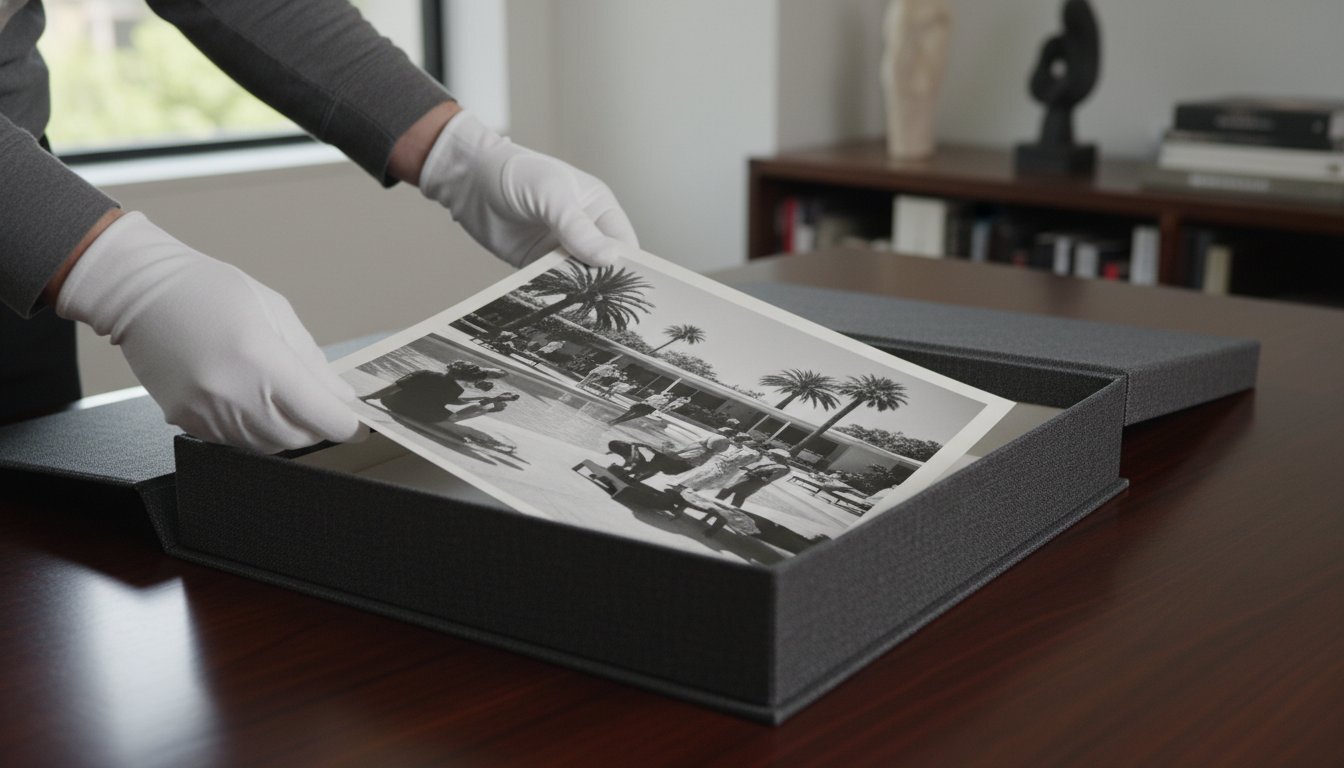
Mastering how to store fine art prints requires a transition from collector to curator, starting with the physical touch. The moment a print is handled is the moment of greatest risk. Even the most pristine storage environment cannot undo the damage caused by a single careless fingerprint. The “White Glove” rule isn’t merely gallery theater; it’s a chemical necessity. The oils naturally present on human skin contain fatty acids and salts that can permanently etch the delicate emulsion of a photographic print, leaving marks that may only become visible years later as they oxidize. When you prepare to inspect your collection, always utilize lint-free cotton or nylon gloves to maintain the tactile integrity of the work.

Before unboxing any acquisition, establish a “Clean Surface” protocol. Your workspace should be a flat, rigid surface, significantly larger than the print itself, and cleared of all potential contaminants. When handling a large-format slim aarons print, never lift it by a single corner. This creates a fulcrum point that leads to “half-moon” creases, which are permanent breaks in the paper fibers. Instead, use two hands to support the print from opposite sides, or better yet, slide a piece of archival board underneath to act as a support cradle. This meticulous approach ensures that the “as-new” condition of your investment remains uncompromised during every viewing.

Unboxing Your New Acquisition

Opening a new shipment is a moment of high anticipation, but haste is the enemy of preservation. Avoid the temptation to reach inside a shipping tube and pull the print out by its edge. This friction can cause “scuffing” on the ink surface. Instead, use a gravity-assisted removal: tilt the tube and let the print gently slide out onto your prepared surface. Once removed, the print will likely retain its curled “memory.” Use the “24-hour Flattening” technique by placing the print between two sheets of acid-free glassine and weighted with archival weights at the corners. During this time, perform a close-range inspection for “silvering” or ink flaking, particularly in high-density color areas where the ink load is heaviest.

The Dangers of DIY Cleaning

A collector’s instinct is to keep their work spotless, but traditional cleaning methods are often destructive. You should never use liquids, glass cleaners, or “canned air” on a giclée surface. The propellants in canned air can leave oily residues, while liquids can cause the pigment-based inks to swell or delaminate. If you notice surface dust, the only safe method is a light pass with a soft hake brush made of natural hair. If you encounter stubborn spots or foxing on vintage movie posters or music archives, stop immediately. These issues require a professional conservator who understands the specific chemistry of historical paper. For the ultimate protection that allows for safe display, consider our bespoke framing service to seal your art away from domestic hazards.

Finally, maintain a rigorous documentation log for your growing collection. Every time a print is moved, inspected, or rehoused, record the date and any subtle changes in its condition. This log, combined with your Certificate of Authenticity, creates a comprehensive provenance that proves your commitment to professional standards. Understanding how to store fine art prints is a journey of constant vigilance, ensuring that the visual impact of your collection never fades.

The Galerie Prints Standard: Bespoke Framing as Permanent Preservation

While a Solander box offers a sanctuary for works in repose, the true culmination of a collector’s journey is the transition from archive to display. Many enthusiasts struggle with the dilemma of how to store fine art prints without hiding them from the world. The solution lies in the sophisticated micro-environment of a gallery-grade frame. At Galerie Prints, our bespoke framing service isn’t merely an aesthetic choice; it’s a rigorous extension of archival science. We view the frame as a sealed vessel, a silent sentinel that guards a Terry O’Neill portrait or a rare Star Wars limited edition print from the subtle, daily threats of a lived-in interior. By utilizing museum-grade materials, we allow you to “store” your art in plain sight, maintaining its “as-new” condition while it graces your walls.

Our London-based artisanal craftsmanship is rooted in the tradition of the master framer, where every component is selected for its chemical neutrality. We utilize only acid-free mounting materials and pH-balanced adhesives to ensure that the paper fibers of your acquisition remain undisturbed. There is a profound synergy between a museum-quality giclée print and a hand-finished frame. This partnership creates a stable atmospheric pocket that buffers the work against the temperature shifts and humidity fluctuations discussed in earlier chapters. It’s a commitment to localized, artisanal quality that serves as a seal of excellence for any serious collection.

Sealing the Heritage: The Anatomy of a Gallery Frame

The structural integrity of a frame depends on what remains invisible to the casual observer. We employ archival spacers to create a vital gap between the print surface and the glass. This prevents the delicate pigment-based inks from bonding to the glazing, a common tragedy in non-professional framing caused by moisture condensation. Our frames utilize high-density, archival backing boards that act as a primary defense against moisture ingress from external walls. These frames are designed to be heirlooms themselves, constructed with the same reverence for permanence as the Star Wars Limited Edition Prints or Music Archives they protect.

Quiet Authority: Selecting Frames for Your Collection

Choosing the right profile is an exercise in quiet authority. A frame should complement the aspirational lifestyle captured in iconic Slim Aarons photography without competing for attention. By incorporating UV-protective museum glass, which blocks 99% of harmful rays, we significantly reduce the need to rotate works out of sunlight. This advanced glazing allows the deep blacks of a vintage movie poster or the vibrant hues of cinema lobby cards to remain vivid for decades. Our ready-to-hang luxury experience ensures that from the moment a work leaves our London workshop, it’s prepared to endure as a lasting piece of history in your home.

Securing Your Photographic Legacy for the Future

With a deep commitment to preserving photographic history, Galerie Prints stands as a dedicated guardian of photographic heritage. We specialize in the iconic Slim Aarons and Terry O’Neill archives, offering bespoke, hand-made framing in our London workshop to provide the ultimate protective micro-environment. Your collection is a window into a bygone era of elegance, and it deserves nothing less than professional-grade preservation. Explore our curated collection of museum-quality Giclée prints and begin building a legacy that will inspire wonder for generations to come.

Frequently Asked Questions

How long do fine art prints last if stored correctly?

High-quality giclée prints can endure for more than 100 years without visible fading. This impressive longevity depends on the use of pigment-based inks and 100% cotton rag paper. When you maintain museum-grade environmental controls, your collection becomes a lasting piece of history for future generations.

Is it safe to store my art prints in the original shipping tube?

Shipping tubes are designed for transport, not for permanent storage. The physical “memory” of the paper will cause stubborn, permanent curling if it’s left coiled for more than a few weeks. Additionally, standard cardboard often off-gasses acidic vapors that can yellow the edges of your photography.

Do I really need to wear gloves when handling my photography prints?

Wearing lint-free cotton or nylon gloves is a non-negotiable requirement for any serious collector. Fingerprints are more than just surface smudges; they’re deposits of fatty acids and salts. These chemicals can permanently etch the delicate emulsion of a print over time, leaving marks that are impossible to remove.

What is the best temperature and humidity for storing art at home?

You should aim to maintain a stable temperature of approximately 20°C and a relative humidity between 40% and 50%. When researching how to store fine art prints in a domestic setting, remember that stability is your primary goal. Rapid fluctuations in these levels are what cause paper fibers to swell, leading to unsightly warping or cockling.

What is a Solander box and do I need one for my collection?

A Solander box is a specialized, acid-free case with a book-shaped design that protects prints from light, dust, and physical pressure. It remains the gallery standard for archival storage across the globe. If you own rare photography or Star Wars limited edition prints, it’s a necessary investment to ensure their long-term preservation.

Can I store my prints in a plastic storage bin from a hardware store?

Most hardware store bins are made from plastics that off-gas volatile organic compounds, which can be highly destructive to art. These vapors often lead to yellowing or the chemical breakdown of the ink. If you must use plastic, ensure it’s chemically inert polypropylene; however, archival-grade Solander boxes are always the superior choice.

How do I tell if my print has been damaged by “foxing”?

Foxing manifests as distinctive reddish-brown or yellowish spots that appear scattered across the paper’s surface. It’s a chemical reaction typically caused by fungal growth or the oxidation of metallic impurities within the paper when exposed to high moisture. If you notice these blemishes, it’s a sign that your storage environment is too humid.

Why is archival-grade paper so important for long-term storage?

Archival paper is chemically purified to be entirely acid-free and lignin-free, preventing the internal structural decay that turns ordinary paper brittle. This purity provides a stable foundation that allows pigment-based inks to remain vibrant. Understanding these material differences is a foundational part of how to store fine art prints with professional-grade results.

Museum Quality Art Framing: The Collector’s Guide to Archival Preservation

A silver gelatin print can endure for over 100 years in a darkroom, yet it can lose its depth and clarity in less than 24 months if trapped behind inferior materials. It’s a sobering reality for any serious collector that the wrong choice in materials can turn a masterpiece into a fading relic. You likely feel a deep responsibility to protect your investment, yet the technical jargon surrounding museum quality art framing often creates more confusion than clarity. It’s frustrating to seek a guardian for your heritage only to find standard solutions that ignore the delicate chemistry of fine art photography.

We believe that your collection deserves the same curatorial rigor found in the world’s leading galleries. This guide explores the essential standards of archival preservation, from the 99 percent UV protection of specialized glazing to the pH-neutral chemistry of cotton rag matboards. You’ll discover how to select bespoke finishes that enhance the prestige of your interior while ensuring your Slim Aarons or Terry O’Neill prints remain timeless. We’ll detail the specific components of a museum-grade assembly, providing you with the confidence to display your art as a lasting piece of history.

Key Takeaways

  • Distinguish between mere decorative borders and the rigorous conservation standards required to safeguard photographic heritage for future generations.
  • Master the technical nuances of museum quality art framing by understanding how specialized glazing and archival components shield your investment from environmental degradation.
  • Evaluate the long-term appreciation of your collection by comparing the enduring stability of bespoke archival materials against the hidden restoration costs of standard framing.
  • Learn to select bespoke frame styles that honor the historical era and mood of your photography, ensuring the aesthetic complements rather than competes with the artwork.
  • Gain an insider’s perspective on the artisanal techniques used in our London darkroom to integrate museum-grade protection into every hand-crafted frame.

Defining Museum Quality Art Framing: Preservation as an Art Form

A photograph from a hand-printed London darkroom represents more than a captured moment; it’s a piece of history that requires a dedicated guardian. While decorative framing focuses on the immediate aesthetic of a room, museum quality art framing serves a significantly higher purpose. It acts as a sophisticated barrier against the inevitable decay of time. Many casual collectors settle for ‘acid-free’ materials, yet this is merely the baseline for any serious investment. True archival preservation involves a meticulous selection of materials that exceed basic industry standards to ensure the longevity of a silver gelatin or C-type print.

Museum quality framing is defined as the meticulous integration of chemical neutrality and robust physical protection to ensure an artwork remains unchanged for centuries. This standard aligns with the rigorous principles found in the Conservation and restoration of painting frames, where every component must contribute to the artwork’s survival. At Galerie Prints, we view the frame as a bespoke extension of the darkroom process, protecting the provenance of the world’s finest photography for future generations.

The Three Pillars of Conservation Framing

  • Chemical Stability: Every layer, from the mount board to the hinges, must be chemically inert. This prevents the “acidic burn” that often plagues lower-quality frames, ensuring no harmful molecules migrate into the paper fibers.
  • Environmental Shielding: High-end glazing must block 99% of ultraviolet light. This shield prevents the fading of delicate pigments and protects the print from atmospheric pollutants and humidity fluctuations.
  • Reversibility: This is the golden rule of the curator. Any mounting technique or adhesive used must be entirely undoable without leaving a trace or damaging the original work, allowing future generations to re-house the art as needed.

Why Fine Art Photography Demands Higher Standards

Photographic emulsions, particularly silver gelatin prints, are exceptionally sensitive to their surroundings. Exposure to improper backing materials can trigger ‘foxing,’ which appears as reddish-brown spots caused by fungal growth or metallic impurities. If a rare Slim Aarons print is subjected to heat damage from poor mounting, the physical layers can delaminate, causing irreversible warping. The financial stakes are high. A print that retains its pristine, archival state can see its value appreciate by 25% or more over a decade, while a damaged piece often loses 50% of its market value instantly. Protecting these assets requires more than a simple glass box; it requires an uncompromising commitment to technical excellence and museum quality art framing standards.

The Anatomy of Archival Excellence: Materials That Preserve History

Every Galerie Prints bespoke frame is a scientific endeavor designed to halt the passage of time. It’s not merely an aesthetic choice but a protective vessel that creates a controlled micro-environment for the world’s finest photography. We treat museum quality art framing as a discipline of preservation, where every component is selected for its chemical stability and longevity. This technical rigor ensures that a silver gelatin print, hand-printed in our London darkroom, remains as vivid in fifty years as it was the day it left the chemist’s wash. The frame functions as a sealed ecosystem, regulating internal humidity and shielding delicate paper fibers from modern atmospheric pollutants.

Glazing Options: From UV-Filter to Museum Glass

Light is the primary catalyst for irreversible photochemical degradation. While standard window glass blocks only about 25% of UV rays, museum-grade glazing offers a shield that filters out 99% of harmful radiation. For collectors shipping internationally, high-grade acrylic provides a shatter-resistant alternative that is 50% lighter than glass while maintaining 92% light transmission. However, for the ultimate gallery experience, we utilize anti-reflective coatings that reduce reflections to less than 1%, creating an “invisible glass” effect. This clarity allows the deep blacks and nuanced grays of iconic photography to emerge without the distraction of glare. In a sun-drenched interior, 99% UV-filtering glass acts as a non-negotiable insurance policy for your investment, preventing the silent erasure of history by the morning tide of light.

Matting and Backing: The Invisible Protectors

What touches the print matters most to its long-term survival. We exclusively use 100% cotton rag matboards because they are naturally acid-free and lignin-free. Wood pulp alternatives, frequently found in mass-market frames, contain acidic compounds that eventually migrate into the artwork. This leads to “mat burn,” a permanent brown staining that appears around the print edges and devalues the piece. By maintaining a pH-neutral environment, our archival backing boards provide a rigid, breathable support structure that prevents warping.

Our mounting techniques respect the integrity of the paper above all else. We avoid all pressure-sensitive tapes or glues that can yellow or become brittle. Instead, we use reversible methods such as:

  • Japanese Paper Hinges: Applied with wheat starch paste, these allow the art to hang naturally.
  • Archival Corners: Clear, acid-free pockets that hold the print without any adhesive touching the paper.
  • T-Hinges: Providing the necessary “give” for the paper to expand and contract with temperature shifts.

This level of bespoke craftsmanship ensures your collection retains its provenance and physical integrity, allowing the legacy of the artist to endure. When utilizing museum quality art framing, you aren’t just decorating a room; you’re acting as a temporary steward for a lasting piece of history.

Museum Quality vs. Standard Framing: A Long-Term Value Assessment

Choosing between bespoke museum quality art framing and a standard retail option isn’t just a matter of taste; it’s a financial decision that spans decades. Over a 25-year period, the differences become stark. A standard frame typically uses wood-pulp matboards that contain lignin. As this lignin breaks down, it releases acidic gases, leading to the irreversible ‘mat burn’ often seen on older, poorly kept prints. In contrast, museum framing utilizes 100% cotton rag mats and 99% UV-protective glazing, ensuring the artwork remains in its original state well into the next generation.

Think of museum-grade materials as a physical insurance policy for your collection. While a standard frame might save costs today, the hidden expenses of restoration or re-printing can be staggering. Professional conservation of a single water-damaged or acid-burned print often starts at hundreds of pounds, frequently exceeding the original cost of the framing itself. Beyond protection, a bespoke frame adds ‘wall power.’ It transforms a photograph into a definitive statement piece, elevating the perceived value through meticulous proportion and material choice.

Identifying the Warning Signs of Inferior Framing

The degradation of a print is often a slow, silent process. You can identify the failure of standard materials through three primary indicators:

  • Yellowing mat edges: This is the first sign of acid migration. If the bevelled edge of the mat board looks brown or yellow, it’s actively damaging the paper it touches.
  • Wavy paper (cockling): This occurs when a print is restricted by improper mounting or exposed to humidity shifts. It suggests the frame isn’t providing a stable micro-environment.
  • Fading colours: If the vibrancy of the blacks or the depth of the hues has diminished, your glass has failed its UV duties. Standard glass allows up to 50% of harmful rays to penetrate.

Investment ROI: Does Better Framing Increase Resale Value?

In the secondary art market, the condition of a piece is paramount. Auction houses like Sotheby’s or Christie’s rely on condition reports that scrutinize the archival integrity of the work. A print with a documented history of museum quality art framing commands a higher premium because the buyer is assured of its longevity. Collectors of Slim Aarons photography, for instance, prioritise archival integrity to preserve the iconic, sun-drenched hues of the 1950s and 60s. When provenance meets pristine condition, the ROI is reflected in a significantly higher hammer price, often outperforming the initial investment in the framing itself.

Curating Your Collection: Choosing the Right Bespoke Frame Style

The final stage of acquisition is the most transformative. At Galerie Prints, the philosophy remains steadfast: a frame should serve as a silent guardian, providing a window into the artist’s world without ever overshadowing the work itself. Achieving museum quality art framing requires a deep understanding of the piece’s provenance and the atmosphere it seeks to create within a room. Whether you’re housing a 1950s fashion plate or a candid moment from the Slim Aarons archive, the frame acts as the bridge between the historical negative and your modern interior.

A minimalist white frame provides a crisp, architectural boundary that allows the deep tonality and silver-rich highlights of iconic black and white pictures to command the viewer’s full attention. For large-format statement pieces, the structural integrity of the frame becomes a technical necessity as much as a stylistic one. These substantial works, often exceeding 100 centimetres in width, require reinforced profiles to prevent bowing over time, ensuring the print remains perfectly flat and protected against environmental shifts.

Style Profiles: From Classic Wood to Modern Metal

Collectors must consider the final destination of their art. For coastal properties in regions like the Hamptons or the Côte d’Azur, humidity and salt air present unique challenges. In these environments, we utilize specific archival sealing techniques to prevent moisture ingress. High-traffic areas, such as entryways or corporate lobbies, benefit from more robust profiles, while a private study allows for more delicate selections. The luxury of our ‘Ready-to-Hang’ service means each piece arrives as a complete object of art, assembled with the same precision used by major galleries to ensure longevity and aesthetic perfection.

Explore our curated selections and discover how we preserve the world’s finest photography for your collection.

The Galerie Prints Standard: Hand-Crafted Excellence in London

Every piece of history we curate deserves a sanctuary that preserves its soul. At Galerie Prints, we provide a single-source journey that begins with the original negative and ends with a hand-finished masterpiece ready for your wall. By managing the entire process within our London darkroom and framing studio, we ensure that the technical superiority of our silver gelatin prints is never compromised by inferior housing. This holistic approach is why discerning collectors trust us for museum quality art framing that stands the test of time. It’s a seamless transition from the chemical magic of the darkroom to the physical permanence of a bespoke frame.

Our Commitment to Craftsmanship

Our master framers don’t rely on the automated, high-volume methods found in mass-market retail. Instead, they employ hand-finishing techniques that respect the delicate nature of fine art photography. While our craft is manual, other high-precision customization fields like garment printing often rely on advanced industrial machinery from Apparel Tech to maintain quality standards. At Galerie Prints, every custom order undergoes a rigorous quality control protocol. We inspect the first cut of the acid-free mat and verify the final moisture-resistant seal with equal intensity. Our London-based curators oversee this process, ensuring that the bespoke frame complements the provenance and aesthetic of the work. Whether it’s a vibrant Slim Aarons poolside scene or a gritty 1960s street portrait, the frame is built to enhance, not just house, the image.

Seamless Experience for Serious Collectors

Investing in the world’s finest photography requires a logistics partner that understands the stakes. We cater to unique architectural spaces by offering custom sizing and bespoke framing requests tailored to your specific interior design needs. Whether you require an oversized statement piece for a grand hallway or a delicate arrangement for a private study, our team provides precise solutions. We’ve perfected our secure, worldwide shipping methods to ensure your framed art arrives in pristine condition, regardless of its destination. To better understand how to integrate these pieces into your home, you can explore our Fine Art Photography: A Curator’s Guide for professional advice on building a lasting collection.

The beauty of a curated collection lies in the details of its preservation. We invite you to explore our extensive archives, where every iconic image is available with our signature museum quality art framing options included. Discover the perfect fusion of history and hand-crafted excellence for your home today.

Securing the Future of Your Photographic Heritage

True collection management begins the moment a print leaves the darkroom. By prioritizing museum quality art framing, you’re investing in a sophisticated shield against the environmental factors that threaten paper and pigment for 75 years or more. Our London darkroom remains one of the last artisanal facilities where silver gelatin prints are still hand-crafted, ensuring a level of quality trusted by world-renowned archives and private collectors worldwide. This dedication to excellence extends to our bespoke framing service, where we employ 100% acid-free cotton rag mounts and 99% UV-protective glazing to lock in the provenance of every piece.

Whether you’re acquiring a 1950s Slim Aarons poolside scene or a rare vintage fashion study, the right archival housing transforms a simple photograph into a permanent historical artifact. Your collection is a reflection of your discernment; protect its integrity with the same passion used to create it. The right frame doesn’t just display your art; it honors the history within the frame for generations to come.

Explore our curated collections and choose your bespoke museum-quality frame today.

Frequently Asked Questions

What is the difference between museum quality and conservation framing?

Museum quality art framing represents the highest echelon of archival preservation, strictly adhering to the 100% reversible standards established by the Fine Art Trade Guild. While conservation framing protects against approximately 90% of environmental hazards, museum standards require 99% UV-filtering glazing and 100% cotton rag matting. This ensures every element, from the hinges to the backing, remains chemically inert for over 100 years.

Is UV-filtering glass really necessary for art not in direct sunlight?

Yes, UV-filtering glass is essential because indirect ambient light and standard indoor bulbs still emit harmful radiation. According to the International Institute for Conservation, even indirect daylight contains enough UV energy to cause irreversible pigment degradation over a 5-year period. By blocking 99% of these rays, you protect delicate silver gelatin or chromogenic dyes from the cumulative damage that causes “ghosting” and color shifts.

Can I change the frame later without damaging the print?

You can change the frame without any risk to the print, provided the original work utilized reversible archival hinging. We employ Japanese mulberry paper and wheat starch paste, a method that allows the artwork to be detached without leaving any residue or tearing the fibers. This preservation technique ensures your investment remains as pristine as the day it left our London darkroom, regardless of future aesthetic shifts.

What does ‘acid-free’ actually mean in the context of art mounting?

In the context of museum quality art framing, “acid-free” refers to materials with a pH level of 7.0 or higher. True archival quality utilizes alpha-cellulose or 100% cotton rag boards that are naturally lignin-free. These materials won’t undergo the chemical “browning” or “foxing” that occurs with standard wood-pulp paper. This prevents the acidic migration that destroys 40% of paper-based art kept in non-archival conditions.

How much should I expect to spend on museum-quality framing?

Collectors typically allocate between 15% and 25% of the artwork’s value toward professional framing to ensure long-term preservation. While we don’t provide fixed quotes, industry data from the Professional Picture Framers Association indicates that archival materials and specialized labor account for the majority of these costs. Investing in bespoke craftsmanship ensures the physical integrity and provenance of your piece remain intact for decades.

Why is acrylic often preferred over glass for large-format framed prints?

Acrylic is often preferred for large-format works because it weighs 50% less than traditional glass and is virtually shatterproof. For prints exceeding 40 inches in width, the structural integrity of the frame is better maintained with lightweight glazing. High-end acrylic options, such as Optium Museum Acrylic, provide the same 99% UV protection as glass while eliminating the risk of shards damaging the print during transit.

Does museum quality framing prevent all fading?

No framing method can stop fading entirely, but archival standards can slow the process by up to 90%. Light damage is cumulative; even the most sophisticated glazing can’t negate the effects of 24-hour exposure. To maintain the exquisite depth of a silver gelatin print, we recommend keeping light levels below 50 lux, as suggested by the Getty Conservation Institute, to ensure the image remains vibrant.

How do I clean a museum-quality frame without damaging the glass?

To clean your frame safely, use a clean, lint-free microfiber cloth and a dedicated acrylic or glass cleaner. Never spray liquids directly onto the glazing, as moisture can seep under the rebate and damage the matting. Instead, apply a small amount of cleaner to the cloth first. This careful approach preserves the anti-reflective coatings that make our curated collections appear so lifelike and immersive within your home.