Tag: Photography Prints

Calming Photography Prints for Home Décor

What if the most calming print isn’t the one with the softest colors, but the one that brings a room into balance? Choosing calming photography prints for the home starts with considering how a photograph’s palette, scale, and subject will sit alongside the furnishings already there. This gives you a practical way to picture the print in your space before deciding where it belongs.

It’s natural to want artwork that feels peaceful without making a room feel impersonal. This guide explores how color, décor, and landscape imagery can help you find that balance, from the quiet simplicity of water to the sheltering quality of a misty scene. You’ll learn what to consider when imagining a print in your space, how to coordinate it with textiles and furnishings, and how a larger photograph can create a focal point that draws the eye gently into the landscape.

Key Takeaways

  • Choose color or black-and-white photography according to the atmosphere and visual balance you want in the room.
  • Use colors in your textiles and furnishings to create a considered connection with the artwork.
  • Explore how water, trees, mist, and waterfalls each bring a distinct quality to a landscape photograph.
  • Consider the print’s scale and placement to shape a focal point that feels at ease within your décor.

Color and black-and-white photo art

Begin with the room’s existing palette, then decide whether the photograph should echo or soften it. Green and blue are often chosen for their calming associations, making a forest scene or quiet seascape a considered choice for a restful space. Muted green foliage can sit comfortably beside natural wood, while blue water may complement pale, cool-toned walls. Look at the photograph’s dominant colors, not just its overall impression. A small area of vivid color can draw more attention than a broad field of gentle tones.

Black-and-white photography offers a different kind of visual calm. Without color, the eye follows tonal contrast, texture, and composition. A misty landscape in gray may feel quieter than a high-contrast image with deep blacks and bright whites. In a room with patterned upholstery or colorful objects, monochrome photography can create a visual pause. In a restrained interior, a strongly contrasted image can instead become the room’s most commanding detail. Consider how the print’s darkest and lightest areas relate to nearby furnishings.

Compare the artwork with the colors already in the room. Picture its palette beside a blue cushion, a green throw, or a cream wall. Similar hues can create continuity; a restrained contrast can give the image definition without overwhelming the setting. A soft blue landscape, for example, may connect with a blue textile, while a black-and-white print can balance a room with several competing colors. Aim for one clear relationship between the photograph and its surroundings.

To narrow your choice, identify the room’s strongest color, such as sage upholstery or a charcoal sofa. Decide whether you want the print to repeat that color, introduce a related tone, or offer monochrome contrast. Then consider the image’s tonal range. A pale photograph may blend into a light wall, while darker details can give it presence. Finally, view the choice alongside the room’s textiles and furnishings. This sequence helps you select photographic art that feels composed rather than disconnected.

Matching artwork with décor

Start with the room’s materials, then consider how a photograph might relate to them. Nature imagery can feel more cohesive when nearby textiles echo its colors. A landscape with mossy greens, for example, may connect with a muted cushion or woven throw. The aim isn’t to match every shade exactly. A shared color note can link artwork and furnishings while allowing each to retain its character.

Look beyond color to the textures shaping the room. A photograph of smooth water may complement linen, glass, or polished wood, while a rugged mountain scene can sit naturally among woven fabrics and tactile ceramics. These pairings create visual relationships between image and setting. If the room already has strong patterns, choose a photograph with a simpler composition. In a quieter interior, a richly layered landscape can introduce detail without requiring more decorative objects.

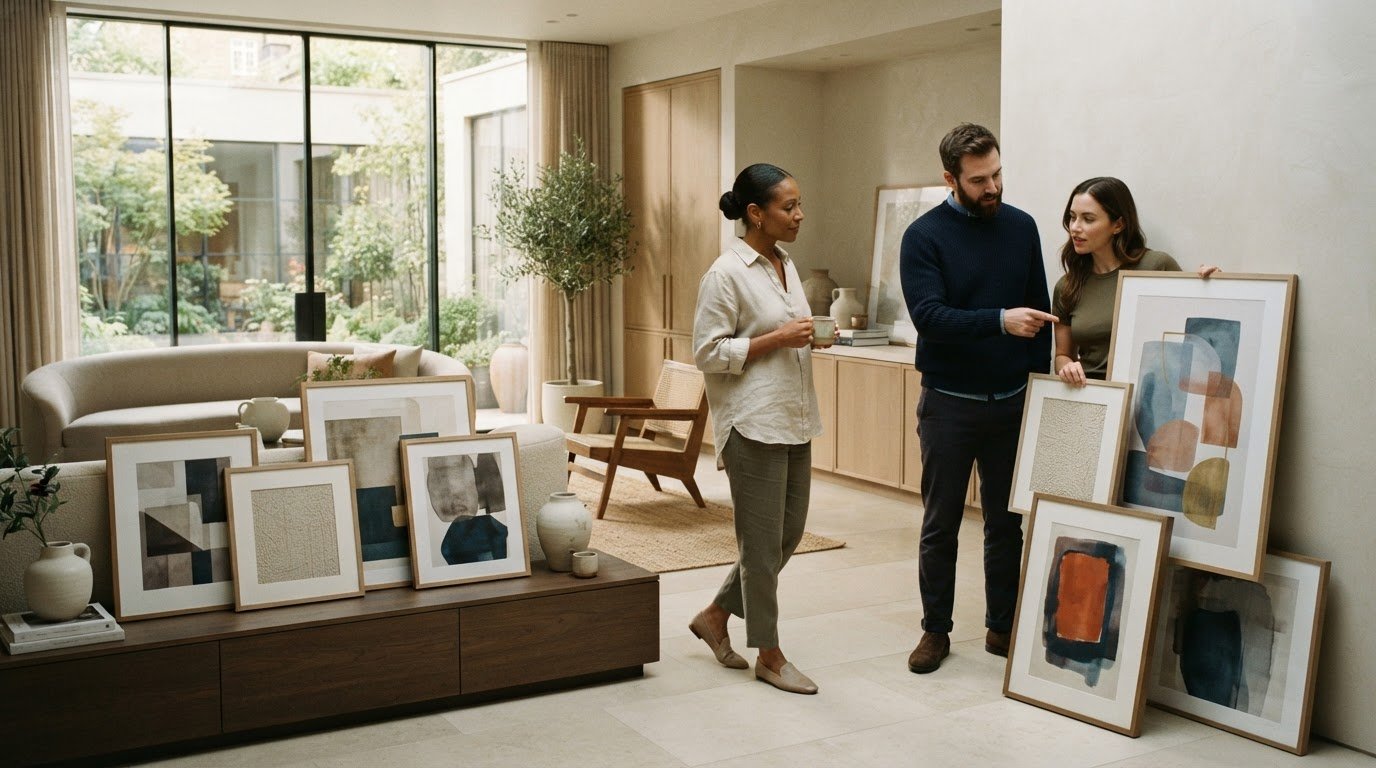
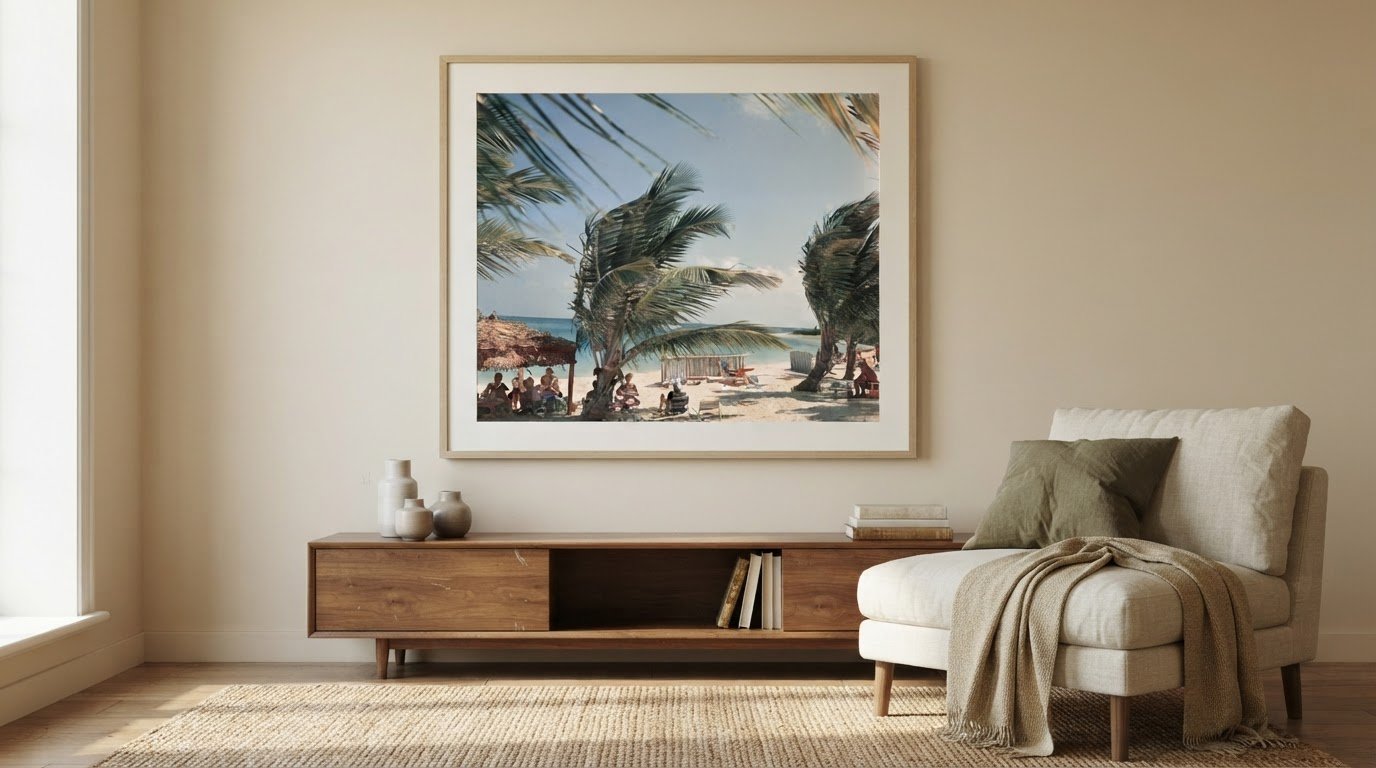
Placement also affects how artwork relates to furniture. Above a sofa, a horizontal photograph can echo the furniture’s long line; beside a reading chair, a vertical composition may follow the shape of a bookcase or window. Keep the arrangement deliberate. A crowded cluster of objects can compete with a peaceful image, while clear space lets its subject remain legible. In a small room, consider nearby shelves, lamps, and doorways before settling on a position.

To choose calming photography prints for home décor, identify a textile or finish the artwork can relate to, then look for a landscape with a compatible hue or texture. Consider the image’s orientation and nearby furniture. The best calming photography prints for home interiors support the room’s atmosphere without competing with its furnishings. Notice whether surrounding objects frame the photograph or distract from it. A nature image with soft greens, for instance, may feel at home beside woven upholstery and pale wood. Explore photographic prints for considered interiors as you refine the relationship between image, room, and furnishings.

Peaceful landscape imagery and emotional connection

Water offers a particularly quiet subject for photographic art. Wallace J. Nichols, PhD, notes that water simplifies the visual landscape, giving the eye fewer competing details to process. A broad lake, still shoreline, or gently receding tide can create that sense of visual spaciousness. Waves add movement, while their repeated forms can make a seascape feel measured rather than busy. Choose a photograph where the water’s pattern and surrounding detail suit the room’s intended mood.

Trees can suggest shelter, depth, and a connection to the natural world. Viewing tree photographs may reduce stress and support focus for people without easy access to forests. A close study of trunks and leaves offers intricate detail, while a woodland path gives the gaze a clear route through the composition. For a reading corner, consider which image would hold your attention without demanding it. Nature imagery can decrease stress and increase positivity, making the photograph’s particular subject worth considering—much like how creative studios such as Art Therapy explore how artistic engagement contributes to relaxation and everyday well-being.

Mist changes the emotional character of a landscape. Fog can make a scene feel intimate and protected, qualities that may evoke security and peace. A distant hill softened by mist often has less visual urgency than a sharply defined skyline. Waterfalls offer another kind of calm: their sights and sounds are soothing, and their motion is perceived by the brain as non-threatening. In a still photograph, flowing water preserves the impression of movement through cascading lines and pale highlights.

Use the image’s visual rhythm to guide your choice. For a quieter effect, look for a level horizon, gentle tonal shifts, or open space around the main subject. A close crop of rushing water creates more energy than a wide view of a calm bay. Waves produce negative ions that can improve mood, increase alertness, and boost mental energy. Consider whether that livelier association suits the room. Compare the emotional character of trees, fog, and water, then choose the landscape you’d most like to return to.

Photographic prints for home decor

Paper and finish affect how a print looks in a room. Matte surfaces reduce reflections, while glossy ones emphasize contrast and sheen. Fine-art prints can draw attention to tonal detail and the character of the paper. Consider the room’s lighting: a glossy surface near a bright window may catch reflections, while matte artwork can appear more subdued.

A print’s price depends on its dimensions, material, and presentation, including framing. Larger prints use more material, while framing affects the overall purchase. Compare the finished piece rather than size alone, since the frame and print surface influence its presence. Decide what matters most: scale, finish, or frame.

For bedrooms, still water, fog, or a softly lit woodland can suit a restful mood. In living rooms, a broad landscape may establish a focal point, while a close view of leaves can bring nature into a smaller arrangement. The best calming photography prints for home décor suit the room’s scale, light, and intended mood.

In the United States, explore photographic prints through an art gallery’s collection, where image and presentation can be considered together. To choose calming photography prints for home, compare the available artwork with the room’s purpose and the effect you want it to create. A clear visual intention can help narrow the selection.

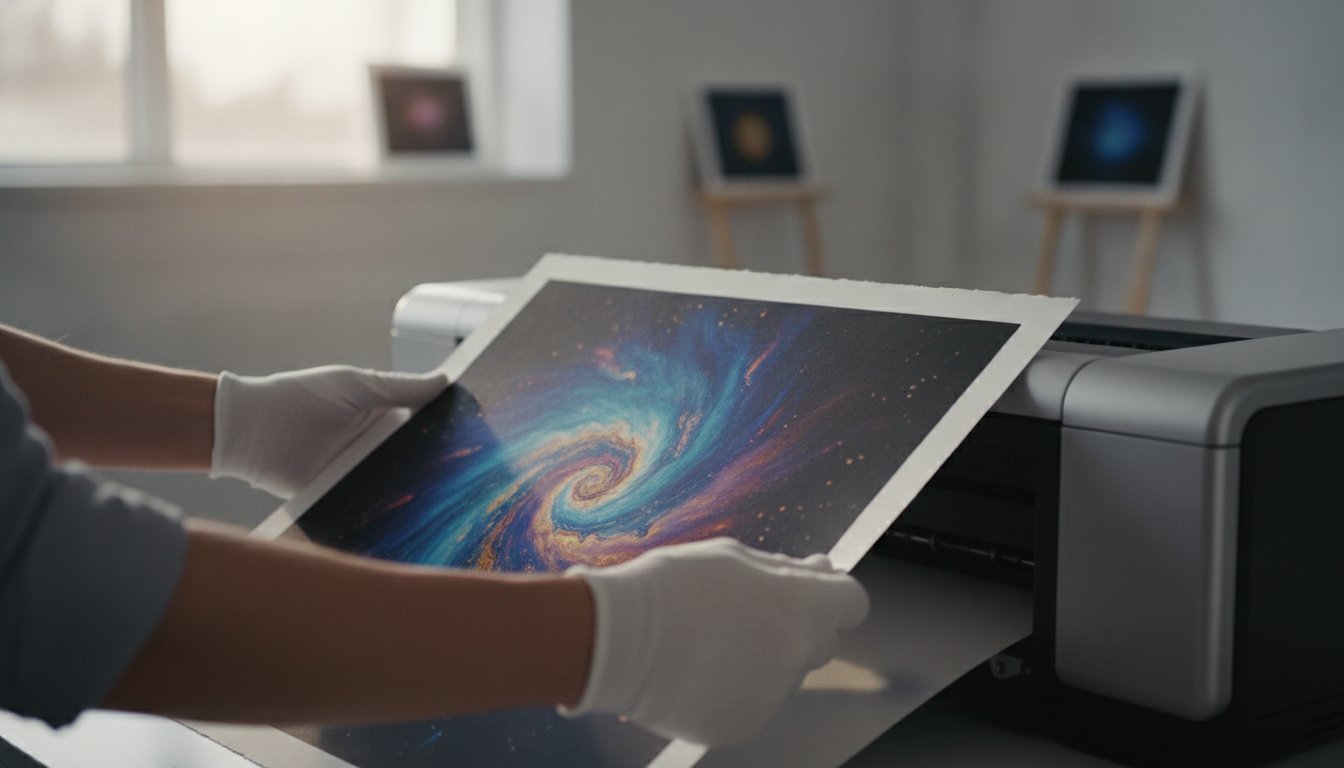
Preserve a print by keeping it away from direct sunlight, moisture, and abrupt environmental changes. Handle it by the edges with clean, dry hands, and avoid touching the image area. Dust a frame gently with a soft cloth rather than applying cleaner to the print. For example, position a framed landscape away from a sunny window and a damp bathroom wall.

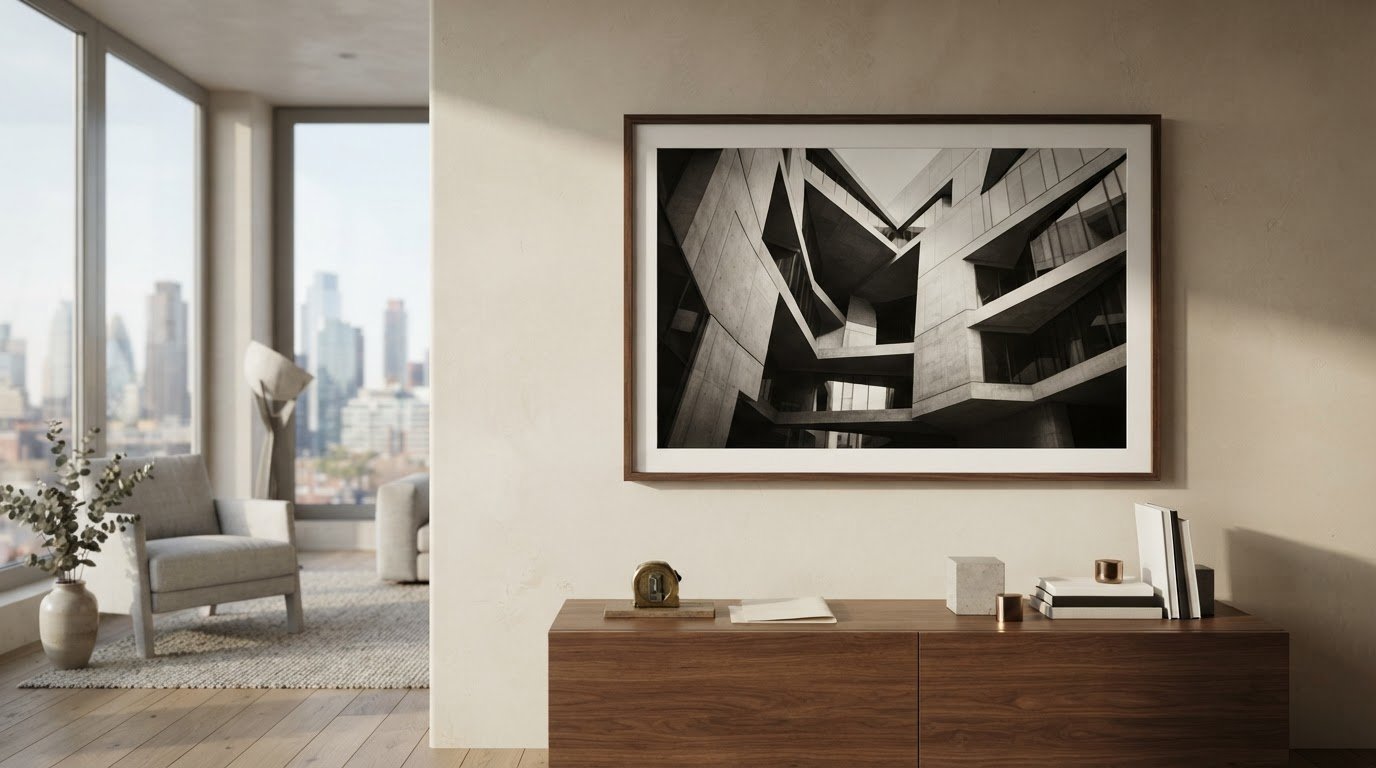
Before choosing, picture the finished work in its intended position. A large, immersive nature print can create a focal point and suggest a view into the landscape. Consider the wall’s available space, nearby furniture, and image orientation together. Browse photographic prints for your home to explore images that could bring this visual balance into your rooms.

Galerie Prints: Terry O’Neill Photography

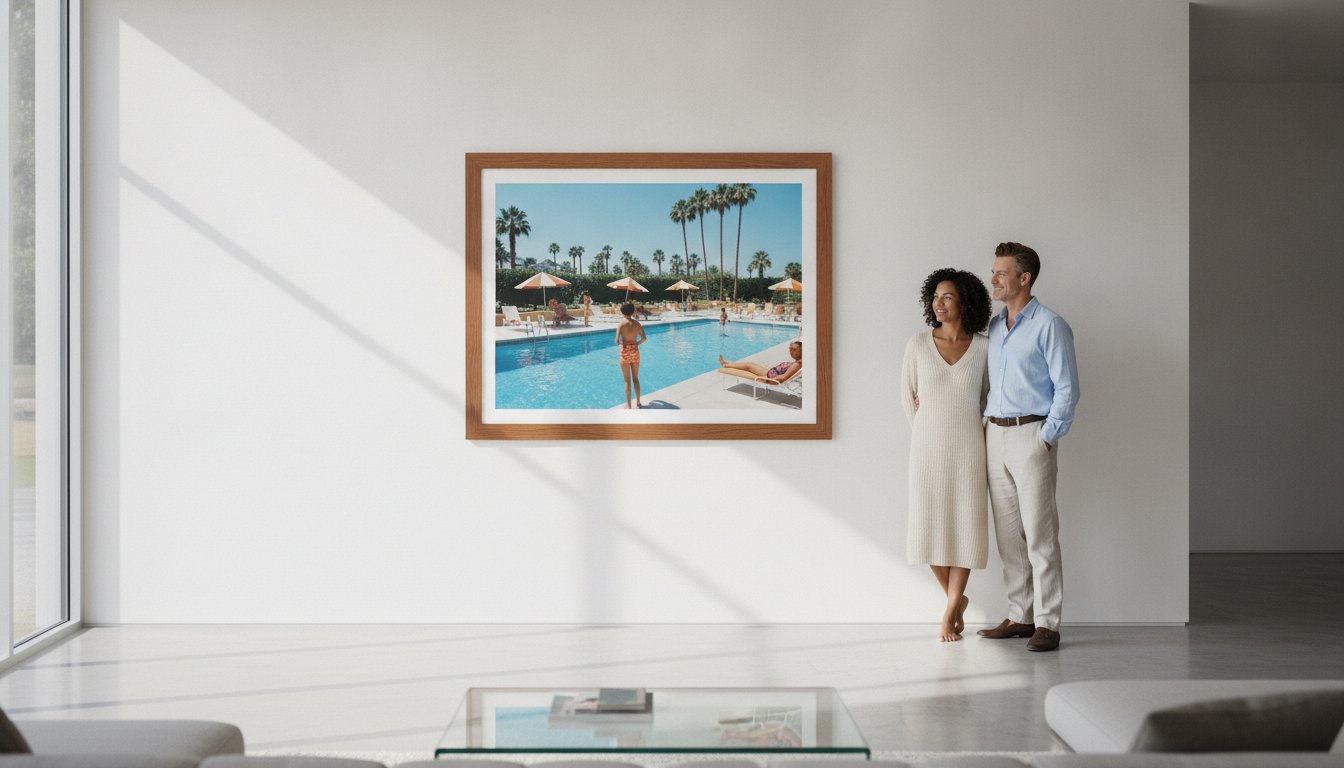
Galerie Prints offers Terry O’Neill Photography for readers drawn to photographic art with a distinctive cultural presence. Once you’ve considered color, subject, and placement, exploring a photographer’s work can help you find images that suit your room and personal taste. The Slim Aarons Collection, Cinema Lobby Cards, and Star Wars Limited Edition Prints offer other directions, from photographic collections to cinema imagery.

Choose according to the atmosphere you want the artwork to contribute. A print can complement a considered interior or provide a point of contrast within it. Galerie Prints also offers a Bespoke Framing Service, a useful consideration when you want the finished presentation to relate thoughtfully to your décor. For a closer look at the photographic choices, contact Galerie Prints.

Choose a Print That Feels at Home

Let your final choice reflect more than the room’s palette. The photograph you live with can carry a personal association, a remembered place, or a sense of escape that makes the space feel distinctly yours. Before deciding, picture the artwork in its intended setting and consider whether you’ll enjoy seeing it every day. That personal connection can turn a considered piece into part of your home’s story.

For a next step, explore the distinct photographic perspectives in Terry O’Neill Photography and The Slim Aarons Collection, alongside the cinematic character of Cinema Lobby Cards. Each offers a different visual mood to consider as you refine your selection. Galerie Prints brings these collections together to help you explore the atmosphere you want to create.

Contact Galerie Prints for help choosing, and take the next step toward finding a photograph that feels personal to your home.

Frequently Asked Questions

Can I See How a Print Will Look in My Room?

Yes, make a simple paper template to preview the print’s scale and placement. Cut kraft paper to match the intended dimensions, then tape it where you plan to hang the artwork. This helps you judge its relationship to a sofa, doorway, or nearby shelf before choosing. Include the frame’s outer dimensions too, so your preview reflects the finished piece.

How Should I Display The Print?

Place the print where its composition can be appreciated without competing with nearby objects. Above a console, align the artwork with the furniture’s center; in a gallery arrangement, keep spacing visually consistent. Consider the room’s sightlines from the main entrance and seating area. A photograph opposite a favorite chair, for instance, can become a quiet point of focus.

What Photography Print Subjects and Styles Create a Calming Atmosphere at Home?

Choose a subject whose mood suits the room’s purpose. An open shoreline can feel spacious, while a close botanical study offers a more intimate view of nature. In a bedroom, a restrained composition may feel restful; in a living room, a wider scene can invite longer attention. Personal meaning matters too: a landscape reminiscent of a cherished place can make the artwork especially resonant.

Which Colors in Wall Art Are Most Calming for Living Spaces?

Green and blue are often chosen for their calming associations, but the specific shade and balance matter. Muted blue can feel quieter than a highly saturated shade, while soft green may blend gently with natural materials. Consider the wall color and furnishings as well. A small accent of a stronger hue can add definition without making the entire artwork feel visually intense.

What Print Sizes Work Best for Different Rooms and Wall Dimensions?

The right size depends on the available wall area, nearby furniture, and the visual role you want the print to play. Measure the intended space, including room for the frame, then compare that footprint with the furniture below. A narrow wall may suit a vertical composition, while a broad sofa wall can accommodate a wider work. A paper template makes these proportions easier to judge.

How Do I Choose a Frame and Mat for Photography Prints?

Choose a frame that relates to the room’s finishes, such as pale wood near light timber furniture or a dark frame against deeper accents. A mat can create separation between the photograph and frame, especially when the image has delicate details. Keep the overall presentation in proportion to the print and wall. Galerie Prints offers bespoke framing for its prints.

Custom framing for photography prints in your home

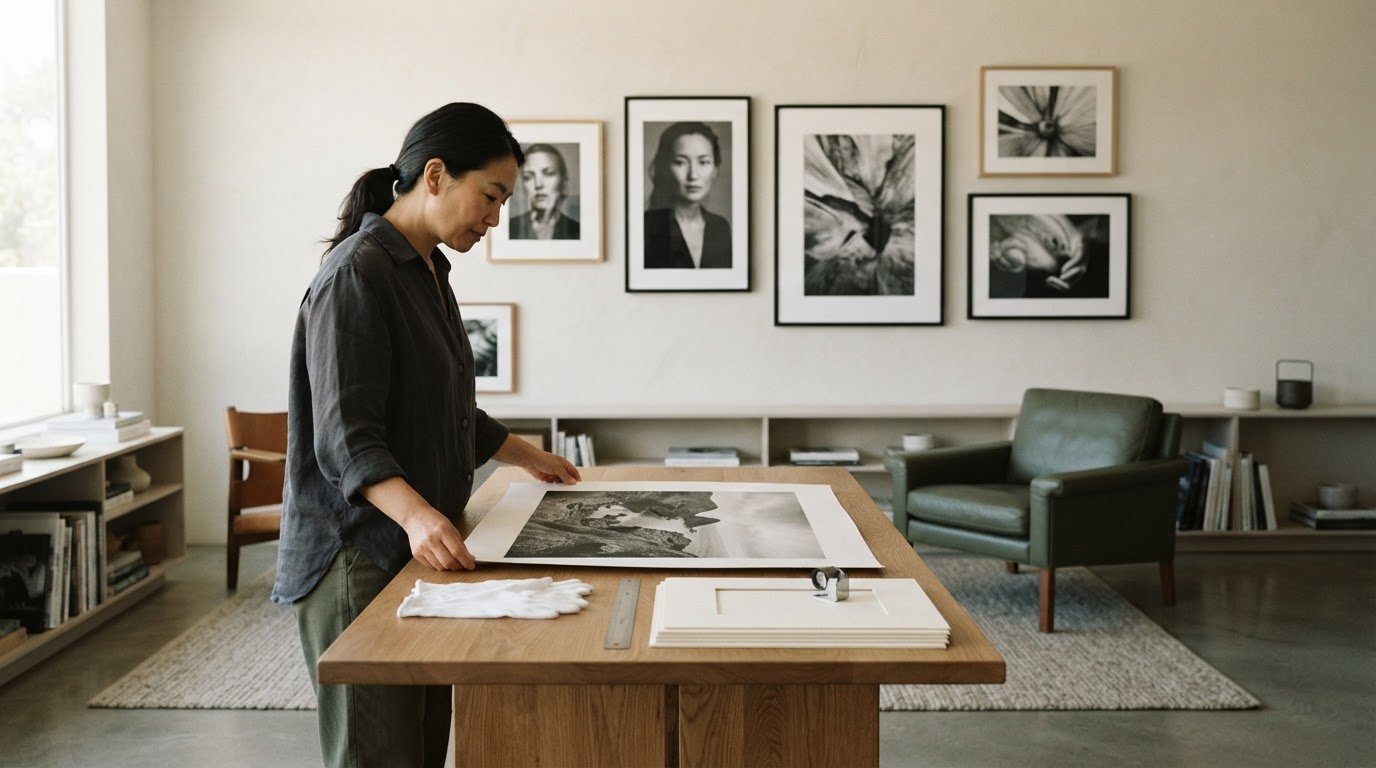
A photograph’s frame should serve the image, not compete with it. Custom framing for photography prints can be tailored to the print’s dimensions and visual character, whether you’re displaying a quiet portrait, a vivid landscape, or a richly detailed archival image. Art prints can be framed with the same care, with the choice of frame and mat shaping how each work sits within a room.

It’s natural to focus first on the image, but its presentation can change how it feels on the wall. A clean, minimal frame may bring focus to a contemporary photograph, while a more substantial profile can lend presence to a dramatic or historic image. This guide explains what can be framed, how online custom framing works and how to choose a frame for different photographs and interiors. It also covers the key decisions, from proportions and matting to the relationship between the artwork, wall and furnishings.

Key Takeaways

  • Choose a frame and mat that support the photograph’s mood, proportions, and visual weight rather than competing with the image.
  • Decide between framing at home and using an in-studio service by weighing your preferred level of control and hands-on involvement.
  • When ordering online, prepare the print’s measurements and consider how the finished frame will look in its intended space.
  • Photography and art prints can each be framed to suit their subject and setting; explore image collections that complement the atmosphere you want to create.

Frame selection for different images and interiors

Let the image guide the frame’s character: a quiet portrait and a vivid travel photograph create different effects. Consider the artwork, wall color, furnishings and viewing distance before choosing a frame.

Frame Styles and Colors

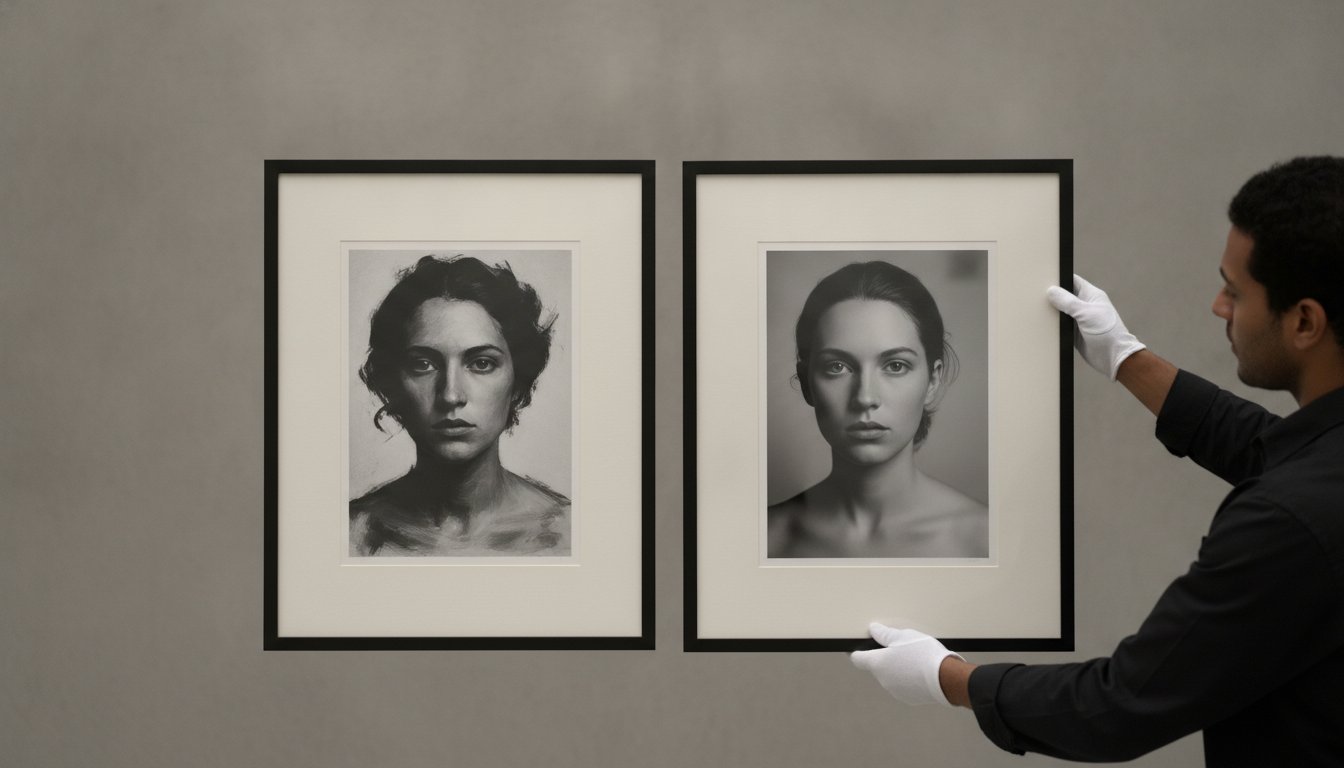
A slim black frame can define the edges of a monochrome portrait, while pale wood may echo the warmth in a sunlit landscape. In a room with patterned furnishings, a restrained profile helps the photograph remain the focal point. Against a plain wall, a more substantial frame can lend it gallery presence. Smooth finishes feel crisp, while visible grain adds warmth. Choose a color that connects with the image or interior rather than matching every nearby object.

Mats, Paper, and Glazing

A mat separates the image from the frame and gives the composition breathing space. A tested setup pairs a 1.5-inch white mat with an 8-by-10-inch photo print; treat it as a proportion to consider, not a fixed rule. Paper also affects the image’s appearance: a lustre surface can soften reflections, while matte paper gives a subdued finish. For glazing, regular glass provides a clear viewing surface; UV-protective glass helps limit ultraviolet exposure, and acrylic is lighter and less prone to shattering. Choose according to the print’s display conditions and handling needs.

Frame Sizing and Mounting

How do you choose the right frame size for a photo print? Measure the print, then decide whether a mat should add visual space around it. Check that the frame opening suits the image and compare the finished outer dimensions with the available wall space. A mat can make a small print feel more composed; a full-bleed presentation keeps attention on the image’s edges. Choose hanging hardware suited to the frame’s weight and position, then check that the mount will keep it level.

For custom framing prices, compare local-shop quotes using the same print dimensions, frame material, mat, glazing, and mounting needs; those choices shape the total. Artists arranging print-and-frame fulfillment can define a consistent set of frame and mat options, then use an example print to assess how each combination presents the work before offering it to customers.

How does online custom framing work?

Online framing starts with a choice: frame an existing print or order a print and frame together. You can select presentation details remotely, review your choices and submit the order.

For custom framing for photography prints, start by measuring the print and entering its dimensions. Some services also let you upload an image for printing. At-home framing gives you control over assembly and lets you inspect each component before mounting. An in-studio framer can handle the fitting and discuss presentation in person, while online ordering lets you consider materials from home.

Custom framing for photography prints provides a tailored fit and professional assembly, while DIY framing gives you hands-on control and the option to reuse materials. DIY requires careful measuring and mounting. A framing service can handle those steps, which may suit delicate artwork or an unusually sized print.

Framing Prices and Budget Options

Compare quotes by matching the same print dimensions, frame material, mat, glazing, and finish. A simple frame without a mat uses fewer components than a layered presentation with protective glazing, so like-for-like comparisons show what affects the total. To manage a budget, keep the frame profile simple, choose a standard size when it suits the image, and reserve more elaborate materials for a favorite photograph.

Framing Time and What to Bring

How long does custom framing take, and what should you bring to a framer? Timing depends on the selected materials, print requirements, and assembly schedule. Bring the artwork, its measurements, and a reference photo of the intended wall. For an online order, have the image file ready to upload or the physical print available, depending on the ordering process.

For prints where presentation is part of the experience, explore photographic prints and consider how each image might sit within your home.

Online custom framing for prints and photos

Online framing turns a series of choices into a finished display without an in-person visit. You provide the print or image, select presentation details, review the order, and receive a framed photo ready to hang or place.

Start by deciding whether you’re sending an existing print or uploading a digital image for printing. Enter the image’s dimensions, then choose the frame, mat, glazing, and finish offered in the ordering interface. Preview tools help you judge how the artwork may appear together, but compare the preview with the original image before submitting. Cropping, color, and borders deserve particular attention, since a beautiful image can feel unbalanced if its composition changes.

A review tested eight online framing services, illustrating how much the ordering experience can differ. Compare each service’s available materials, size options, preview controls, and instructions for supplying artwork. Read the order summary carefully: it should make clear whether you’re framing a print you already own or ordering printing and framing together. For example, an existing portrait may need a different crop from a new landscape print.

Online photo framing can suit a single family picture or a carefully planned gallery wall. For several images, make a list of each print’s orientation and dimensions before ordering. Keep the intended display in mind: a row of travel photographs may benefit from a consistent finish, while a collected arrangement can mix images with distinct visual character. Acrylic glazing is one option to consider for a lighter framed piece, especially when handling or placement matters.

Customer service can help clarify ordering steps, file submission, or how an image will be cropped. Keep your image file, print measurements, and preferred display arrangement at hand when seeking support. Treat the process as a sequence: prepare the artwork, select the presentation, review the order details, then submit. That method helps prevent avoidable mistakes before the finished print arrives.

Custom framing for photography and art prints

A photograph records a particular moment; an art print may foreground line, color, or pattern. Let that distinction guide the frame’s role. For a quiet portrait, a narrow profile can keep attention on expression. For a graphic poster, a broader border may balance strong shapes and create a deliberate pause before the image. The best personalized presentation begins with what the work asks you to notice.

Consider the print’s surface and visual weight before choosing a handcrafted-looking finish. A delicate image can feel overwhelmed by ornate moulding, while a richly layered composition may welcome more frame presence. For example, pair a restrained frame with a photograph whose subject already fills the composition. Choose a more textured finish when the artwork’s palette includes warm tones or tactile marks. These choices make framing part of interpretation, not simply an accessory.

For a gallery wall, plan the arrangement as a whole rather than treating each piece separately. Lay out paper templates matching the finished frame dimensions, then adjust spacing and alignment before hanging. A series of related travel photographs can share a frame color while varying in orientation. A mixed collection of photographs and art prints can use a consistent mat tone for visual continuity. Choose one image as the anchor, then arrange supporting works around its scale and color.

Before purchase, define the intended viewing distance, wall location, and hanging method. A large image above a sofa needs a different visual balance from a small print beside a desk. Check that frame depth and hardware suit the chosen position, and consider whether reflections could distract from the image. Premium presentation comes from coherence: the frame, print, room, and neighboring objects should feel considered together. Review a mock arrangement in the actual space before committing to the final composition.

Galerie Prints: The Slim Aarons Collection

Galerie Prints brings together photographic works and a Bespoke Framing Service for collectors shaping a considered display at home. The Slim Aarons Collection offers images with a distinctive sense of leisure and place, while Terry O’Neill Photography brings iconic portraiture to interiors. Cinema Lobby Cards and Star Wars Limited Edition Prints can lend a gallery wall a more cinematic character.

Turn to Galerie Prints when you’ve chosen the mood or subject you want to live with, and would like framing to form part of the presentation. Consider how the image’s palette, scale, and atmosphere will relate to your room, then explore the collections with that setting in mind. For a considered next step in choosing photographic art and framing, contact Galerie Prints.

Give Your Chosen Image a Place to Belong

Let a photograph or art print become part of how you experience a room, not simply something added to an empty wall. When considering custom framing for photography prints, choose an image that holds your attention, then imagine the atmosphere you want it to bring into your home. That intention can guide your selection more meaningfully than matching every detail of the decor.

Galerie Prints offers The Slim Aarons Collection, Terry O’Neill Photography and Cinema Lobby Cards, each opening a different path for shaping a room’s character. A scene of leisure, an iconic portrait or a cinematic image can each become the starting point for a personal display. Choose the work that connects with your space and the stories you want it to hold.

When you’re ready to explore a photographic print or discuss framing, contact Galerie Prints about framing. A considered image can give a familiar room a fresh point of view, and your next choice can begin with the picture you’re happiest to live with.

Frequently Asked Questions

What can you frame?

Photographs, fine art prints, posters and collectible paper pieces such as cinema lobby cards can all be framed. The right approach depends on the item’s dimensions, condition and display purpose. A concert photograph might suit a simple presentation, while a vintage lobby card may call for a frame that complements its archival character. Galerie Prints offers a Bespoke Framing Service for prints purchased through its gallery.

Can I feature multiple photos in one frame?

Yes. A multi-opening mat can bring related photographs together in one frame, such as portraits from the same occasion or images from a single journey. Plan the arrangement first: align the openings, leave space around each photograph and decide whether the pictures should share equal prominence. A consistent color palette can unify images with different lighting or subject matter.

Do Framed Prints include glass or acrylic?

The words “framed print” don’t specify whether glazing is included. A framed piece can use glass, acrylic or no glazing, depending on its presentation. Glass gives a traditional, clear finish, while acrylic is lighter and less prone to shattering. For a print in a busy hallway, consider weight and impact resistance alongside the image’s appearance.

How do I choose the right frame style for my artwork?

Start with the artwork’s visual character, then consider the room where it will hang. A restrained frame can let a detailed photograph command attention, while a bolder profile may complement a graphic poster. Look at the image’s dominant tones, contrast and subject, then compare frame options beside it. The right choice should feel intentional without pulling focus from the work.

Is online framing cheaper than a local frame shop?

Not automatically. Compare equivalent specifications, including frame material, matting, glazing, print size, and delivery, before judging the total. An online order can make it easier to review options remotely, while a local shop lets you discuss materials alongside the physical print. For a fair comparison, list the same requirements for each quote and note any differences in presentation or delivery.

What are the best frame styles for photography prints?

There’s no single best style for every photograph. Black or white frames can provide a clean edge for high-contrast images, while brown frames can bring warmth to portraits or landscapes. A slim profile suits photographs with strong compositions; a wider border can give a small print more visual presence. Match the frame to both the image’s mood and the room’s character.

Collecting Limited Edition Prints: A Guide for Beginners

What if the best first print isn’t the rarest, but the one you’re still glad to see each day? Collecting limited edition prints can feel like a pursuit of insider knowledge or investment potential, especially when edition numbers, signatures and printing details seem to demand expert interpretation. But a collection can begin with a simpler question: does this image hold your attention, and does it mean something to you?

Edition details matter, but they’re there to deepen your understanding of a work, not replace your own response to it. With a few clear pointers, you can learn what limited editions mean in practice, compare the details that matter, and choose work that reflects your interests rather than market speculation.

This guide explores the language of editions, the qualities to consider when selecting a photographic print, and how to care for it. From a striking image to exhibition-quality printing and considered framing, collecting can be a lasting pleasure: a way to live with the photographs and stories that speak to you.

Key Takeaways

  • Begin collecting limited edition prints with an image that continues to hold your attention, rather than choosing solely for perceived investment potential.
  • Read edition numbers, signatures and provenance as details that add context. Their format and presence can vary from print to print.
  • When comparing a print with an original, focus on what you’re choosing and what matters to you, not on which format seems more valuable.
  • Use a simple checklist to consider the image, edition information, condition and how you’ll enjoy the work at home.
  • Thoughtful display and general care can help you sustain a lasting relationship with a print.

Why Collecting Limited Edition Prints Begins with Personal Meaning

A photograph can become part of the rhythm of a home. You pass it in the morning, notice a detail in its composition at dusk, and find that its mood shifts with the light and your own changing perspective. That lasting pleasure is a compelling reason to begin collecting limited edition prints: the work isn’t simply something to acquire, but an image to return to.

A limited edition print belongs to a specified edition, meaning the edition has a stated limit rather than being offered as an unrestricted run. Practices can vary between artists and publishers, so the phrase alone doesn’t tell you every detail of how a print was made or presented. An open edition, by contrast, generally has no stated edition limit. For broader context on the term, see Understanding Limited Editions.

Personal resonance is a useful starting point because the image you connect with is the one you’ll want to keep looking at.

What does collecting limited edition prints mean?

In this guide, “prints” means physical photographic artworks, not original paintings or digital downloads. The edition describes the group to which a print belongs; the print itself is the object you choose to live with. Edition markings and related information offer context, but there isn’t one universal format that every edition follows.

That distinction makes the language easier to approach. You don’t need to begin with specialist terminology or a collecting strategy. Start by looking closely at the image, then use the edition details to understand more about the particular work.

Why a print can matter beyond its market value

An image may draw you in through its subject, its light, or a moment it preserves. A photograph of a familiar place might recall a journey; a portrait may hold your attention through gesture or expression; a cinematic scene may connect with a story you’ve loved for years. These associations are personal, and they can deepen as you encounter the work in everyday life.

That relationship is different from a prediction about resale demand or financial performance. The future market for a work is uncertain, so collecting is more rewarding when your decision doesn’t depend on a promised return. Treat market information as context, not as the measure of whether a print belongs in your home.

Think of the image as a conversation that can unfold over time. You may notice a new detail, remember why it first caught your eye, or find that it takes on a different meaning as your interests change. Choosing exhibition-quality photographic art for that continuing experience makes collecting less about tracking an asset and more about sustaining a connection with the work.

How Edition Numbers, Signatures, and Provenance Add Context

Once an image has caught your attention, its accompanying details can help you understand the particular print in front of you. An edition number, a signature, or a record of ownership each offers a different kind of context. None should be treated as a shortcut to judging the work’s artistic or financial worth.

Edition details help place a print in context; they don’t guarantee that scarcity will translate into value.

How to read an edition number and signature

A number such as 7/25 is commonly used to indicate a print’s position within an edition of 25. It’s an illustrative example, not a universal format: conventions and the information provided can differ between works. Read the marking alongside the print’s description, rather than assuming the same notation or practice applies to every edition.

A signature, when present, can add useful information about a print. Consider where it appears and how it relates to the description, but don’t treat a signature by itself as proof of authenticity. Some limited editions are signed; others aren’t. The absence of a signature doesn’t, on its own, explain the print’s status or quality.

What condition and provenance can tell a collector

Condition describes the print’s present state, while provenance refers to its documented history or chain of ownership, when that information exists. Both can help you build a clearer picture of a work, but they answer different questions: condition concerns what can be observed about the print, and provenance concerns its recorded history.

Keep documented facts separate from impressions. A print that looks old doesn’t necessarily have a known history, just as an attractive appearance doesn’t provide a complete account of its condition. Give greater weight to details explicitly stated in the work’s description, and avoid filling gaps with assumptions about age, handling, or ownership.

These details are most useful when read together. An edition marking can identify a print’s stated place in an edition; a signature may provide further information; and provenance, if documented, can add an account of its history. Each contributes context, but none alone tells the whole story. For a beginner, this is a measured way to approach collecting limited edition prints: notice what is stated, distinguish it from what you’re inferring, and let the image remain central.

Galerie Prints offers signed and limited editions across varied photographic movements and periods, with a focus on exhibition-quality prints. Explore signed and limited photographic prints to see how image, edition information, and presentation come together in individual works.

Limited Edition Prints and Originals: Compare the Work, Not Just the Format

A limited edition print and an original can offer different ways to encounter an image or artwork. The right choice depends less on a hierarchy of formats than on what you want to own, what draws you to the work, and how you hope to live with it. An editioned print is one of a specified group of prints; “original” can mean a unique work, though the term’s precise meaning depends on the medium and the description. Read the work’s details carefully.

What differs between a limited edition print and an original?

Both formats can carry artistic significance. With a limited edition print, you’re choosing a print and considering its place within the stated edition. With an original, you’re considering the work described as the original, which may be a singular object. Neither format is automatically more meaningful or more rewarding to collect.

Use this comparison to clarify what you’re choosing, rather than to rank the two:

Format What you’re choosing Questions to consider
Limited edition print A print belonging to a specified edition, with details described for that particular work. What does the description say about the edition? Does the image and format suit your interest and intended display?
Original A work identified as an original; its exact meaning depends on the medium and description. What does “original” mean for this work? What qualities of the object matter most to you?

For example, you might be drawn to a photograph’s composition and want a print to display, while another collector may be interested in a singular work and its particular physical presence. Those are different collecting aims, not evidence that one format is inherently better.

Does a limited edition print make a good investment?

Edition status alone doesn’t establish future performance or resale value. A stated limit describes the edition, but it doesn’t predict what a future buyer might want or what a work may be worth later. Treating “limited” as a promise of appreciation can turn a nuanced decision into a financial assumption.

Market considerations may be part of a collector’s research, but they’re uncertain. The more dependable outcome is the experience of owning a work you enjoy: its subject, composition, or connection to a photographic period may continue to reward your attention regardless of how the market changes.

Edition status alone cannot determine a work’s personal or financial significance. For anyone collecting limited edition prints, that distinction keeps the choice grounded: understand what the description says, then decide whether the work itself merits a place in your collection. An informed decision can consider format and edition details without mistaking either for a guarantee of value.

A Practical Checklist for Choosing a Limited Edition Print

A considered choice doesn’t require specialist knowledge. It does benefit from time with the image and a careful reading of the information provided. Use this four-step process to move from first impression to a print you can enjoy with confidence.

  1. Identify what draws you in. Look beyond the initial impact. Is it the subject, composition, atmosphere, or a detail you keep noticing? Write down what you respond to and why. That short note gives you a personal reference point if trends or other opinions begin to influence your decision.
  2. Review the edition details. Read the product description for information about the edition and note whether a signature is mentioned. Separate what’s explicitly stated from what you might assume. Let the description guide your understanding rather than relying on general expectations about how editions are marked.
  3. Assess the stated condition and history. Consider any condition information and provenance included in the description. These details can help you understand the print, but they aren’t interchangeable: condition concerns the work’s present state, while provenance concerns documented history. Don’t infer either from an image alone.
  4. Plan how you’ll enjoy it. Picture the work in the space where you’d like to live with it. Consider how its subject and scale might relate to the room, and whether you’d prefer to experience it as a focal point or as part of a wider arrangement. The aim is to imagine a genuine place for the image in your daily life.

Questions to ask before choosing a print

Pause before deciding and ask yourself: Does the image continue to interest me beyond a first glance? What edition, signature, condition, and provenance details are explicitly provided? Will the work suit the space and the way I want to experience it? These questions keep the decision personal and grounded in the information available.

Compare confirmed product descriptions when considering different prints. An image alone can’t reliably communicate every detail about an edition, its condition, or its history, so avoid filling in missing information by guesswork. A written description gives you a firmer basis for comparing works on like terms.

How to start a collection with intention

A collection can begin with a theme, subject, photographer, or visual quality that genuinely interests you. You might be drawn to portraits, a particular photographic period, or the way a certain kind of light shapes an image. There’s no fixed formula: a coherent collection can emerge gradually as you discover what consistently holds your attention.

For further inspiration on living with photographic art, explore fine art photography collecting and decorating. As you consider your next work, explore exhibition-quality photographic prints and let your own eye lead.

Enjoying and Caring for Your Limited Edition Print

A print’s place in a collection is shaped not only by the moment you choose it, but by the attention you give it afterwards. Display and care are part of sustaining a relationship with the image: making space for it in your home, returning to its details, and treating it thoughtfully as it becomes part of daily life.

Display a print so it remains part of everyday life

Choose a place where the work can be seen and appreciated, and where its subject and atmosphere feel at ease with the room. Think about the experience you want: a single image that draws the eye, or a work that sits in conversation with other objects and photographs. Give yourself time to live with the arrangement; a considered position can make the print feel naturally at home.

Professional framing is available with purchased prints to complete their presentation. Galerie Prints also offers bespoke services, including custom sizing, cropping, large-scale murals and wallpapers, and printing on any substrate, including aluminium, wood and glass. These options can help shape how a chosen work is presented while keeping the image itself at the centre. For broader ideas about integrating photographic art into a space, explore this guide to displaying and collecting fine art photography.

Care needn’t become complicated. Handle the print thoughtfully, keep track of any care guidance provided with it, and take care when moving or repositioning it. If you’re unsure how best to manage a particular work, seek advice suited to that print rather than relying on assumptions about every edition being alike.

Make the collecting experience personal and lasting

A simple record can preserve useful context. Note the artist and title, along with the edition information, signature, condition details, and provenance stated in the description. Keep your notes factual, separating what was provided from your own observations. This small habit makes it easier to revisit the story of the work as your collection grows.

Also record what first drew you to the image. Perhaps it was the stillness of a scene, a subject with personal meaning, or a detail in the composition. Looking back at that note later can reveal how your response has changed, or remind you of the original connection. That evolving attention is part of the pleasure of collecting limited edition prints, and it doesn’t depend on a prediction about future financial value.

Galerie Prints focuses on exhibition-quality photographic prints, including signed and limited editions from varied photographic movements and periods. If you’re ready to discover a work that speaks to your own interests, explore limited edition and signed photographic prints.

Let Your Collection Grow with Your Eye

Collecting limited edition prints can remain an open-ended pleasure, shaped by curiosity rather than a fixed plan. Give yourself permission to follow a subject, photographer, or visual quality that continues to hold your attention. As your collection develops, you may discover unexpected connections between works, or find that a single image becomes a touchstone for a particular time or place.

As you consider what to live with next, Galerie Prints describes its photographic works as exhibition-quality, with signed and limited editions spanning varied movements and periods. Bespoke framing and printing on any substrate offer ways to consider how a chosen print will be presented in your space. Let these possibilities serve the work and your experience of it, rather than dictate what belongs in your collection.

Take your time, trust the details that matter to you, and allow your collection to become a personal record of the images you value. Explore exhibition-quality photographic prints and discover a work that feels worth returning to. The most rewarding collection is one that continues to bring meaning and pleasure into everyday life.

Frequently Asked Questions

What is a limited edition print?

A limited edition print is one of a stated number of prints in an edition. The edition information helps describe the work’s place within that group, though formats and practices can vary. Read the specific description rather than assume every print follows the same conventions. The term refers to the print’s edition, not by itself to its subject, condition, or likely market performance.

Are limited edition prints signed?

Some limited edition prints are signed, but a signature isn’t a feature of every edition. Look for signature information in the work’s description and consider it alongside the other details provided. A signature can be useful context, but its presence alone doesn’t establish every fact about a print. When comparing two works, note whether each description mentions a signature rather than treating one format as the universal standard.

What does the number on a limited edition print mean?

An edition number commonly indicates a print’s position within its stated edition. For example, a notation such as 7/25 may signify the seventh print in an edition of 25. Numbering practices can differ, so use the accompanying description to interpret the marking for that particular work. Don’t assume the number indicates when the print was made, or that a lower number automatically means higher quality or value.

Are limited edition prints a good investment?

Not necessarily. A limited edition designation doesn’t establish what a print will be worth in the future or how easily it might resell. Market outcomes are uncertain, and edition status alone can’t predict them. If financial considerations matter to you, keep them separate from the reasons you enjoy the image. A print you value for its subject or artistic qualities can bring pleasure in your home without relying on a future return.

How should I choose a limited edition print?

Choose a work whose image interests you beyond its first impression, then read its description closely. Compare the stated edition information, signature details, condition, and any provenance provided, and consider how you’d like to display it. For collecting limited edition prints, keeping a brief note about what drew you to a particular image can help you make thoughtful choices and recognise when a passing trend, rather than your own taste, is leading the decision.

How can I care for a limited edition print?

Handle your print thoughtfully, keep any care information supplied with it, and take care when moving or repositioning it. Choose a display location where you can appreciate the work and where it suits its surroundings. Since individual works and presentation choices can differ, avoid assuming one specific care method applies to every print. A simple record of the work’s details can also help you keep track of it as your collection develops.

What is the difference between a limited edition print and an original?

A limited edition print belongs to a stated edition, while an original is described as the original work; the precise distinction depends on the medium and the work’s description. Collectors may be drawn to either for different reasons, including the object itself or the way they want to experience it. Read the wording for the individual work carefully, since neither label alone determines artistic importance, personal significance, or future value.

Overcoming the Fear of Choosing the Wrong Art: A Thoughtful Guide

What if choosing art well has less to do with finding a piece you’ll love forever, and more to do with finding one that feels right for your life and space now? When every image, style and format seems possible, it’s easy to imagine a future regret before you’ve made a choice. Overcoming fear of choosing the wrong art begins with letting go of the idea that a considered decision must come with perfect certainty.

It’s natural to wonder whether a work will suit the room or whether your taste might change. Art is personal, and choosing it isn’t a test with one correct answer. A thoughtful choice can reflect what draws you in today while leaving room for your home and perspective to evolve.

This guide offers a practical framework for deciding what you want art to bring to a space, then comparing pieces by mood, scale, visual character and presentation. You’ll learn how to narrow the possibilities without overthinking every detail, so you can choose with care and move forward without waiting for absolute certainty.

Key Takeaways

  • Separate choosing artwork to live with from the different fear of making art yourself.
  • Notice the mood, memory, subject or visual quality that draws you in before weighing trends or impressiveness.
  • Compare shortlisted pieces by emotional response, palette, intended space and format. Don’t make colour matching the only measure of fit.
  • Use a simple art brief to narrow your options, review your shortlist in context and make a considered decision without demanding certainty.
  • Overcoming fear of choosing the wrong art becomes easier when presentation is part of the decision. Framing and custom sizing can help tailor a photographic print to your space.

Why Choosing the Right Art Can Feel So Difficult

Pausing before choosing a work of art doesn’t mean you lack taste or judgement. The decision is personal: a photograph or print may become part of a room’s daily rhythm, and you want it to feel at home there. That care can be a strength. The difficulty begins when every option seems to demand a flawless answer.

There’s also a useful distinction between choosing art to own and being afraid to make art yourself. The first is about selecting a work that speaks to you and suits your space; the second is about creating something of your own. This guide addresses the first. It isn’t a test of artistic skill or expertise.

Too many possible subjects, styles and formats can make comparison feel endless. Add the idea that a purchase must remain right forever, and even a promising choice can start to feel risky. Room-fit concerns add another layer: will the work feel balanced above a sofa, hold its presence on a narrow wall, or sit comfortably alongside furnishings without simply matching them?

A considered art choice is grounded in personal meaning and the context of the space where you intend to live with it. This leaves room for both feeling and practical judgement. It shifts the question from “How can I know this is perfect?” to “What matters most to me about this work, and where will it live?”

What Are You Afraid of Getting Wrong?

Name the specific concern instead of treating the whole decision as one large risk. Is it your taste, the piece’s compatibility with the room, its scale, or the possibility that you’ll feel differently about it later? Each calls for a different kind of attention. A scale concern invites you to assess the wall; a taste concern asks what you genuinely respond to.

Write down the worry that’s delaying your decision. Making it specific can show whether you need more information, a clearer sense of your preferences, or permission to choose without a guarantee.

A Meaningful Choice Does Not Require Certainty

Confidence doesn’t mean predicting every future version of your taste. It can come from knowing what draws you to a work now: its subject, atmosphere, visual rhythm or the memory it brings to mind. Those preferences give you a sound basis for choosing, even as your home and interests change.

Think of the decision as a thoughtful choice, not a permanent examination of your expertise. Overcoming fear of choosing the wrong art means clarifying what matters, comparing options and deciding with care. It can’t promise you’ll never change your mind, but it can help you act without waiting for certainty that no choice can provide.

Start With the Feeling and Story You Want the Artwork to Bring

Before asking whether a piece is fashionable, impressive or easy to place, pause with your first response. What caught your eye? Perhaps it’s a quiet horizon, a lively gathering, a particular expression or the way light falls across a scene. That initial pull is useful information, even if you can’t yet explain it. A work doesn’t need to impress everyone to hold meaning for you.

Ask what you’d like to experience as you pass the artwork each day. You might want a room to feel serene, animated, intimate or full of possibility. A subject might also call up a place, period or memory you’re glad to revisit. A useful shortlist begins with your own response to the work. That gives you a personal point of reference before outside opinions enter the decision.

Consider whose preference is guiding you. A guest may admire a dramatic image while you’re drawn to a quieter composition; neither response is wrong. You’re choosing for the life the work will have in your space, not staging a test of what others might approve. Distinguishing your own attraction from an imagined audience’s verdict is a practical first step in overcoming fear of choosing the wrong art.

Build a Personal Art Brief Before Browsing

Write a few words about what you enjoy. Keep the brief concise rather than trying to classify your taste perfectly. Note a subject, a mood and one or two visual qualities, such as movement, contrast, intimacy or open space. Then think of images or objects you already love. They’re clues to what feels compelling, not rules every candidate must follow.

Explore Photographic Art Without Choosing by Trend

Photography encompasses a wide range of subjects, periods and visual approaches, from candid portraits to composed scenes of leisure. Exploring fine art photography and its place in a collection or interior can help you notice what distinguishes one image from another beyond whether it happens to be in fashion.

For example, Slim Aarons photography offers a distinct point of view, with images of leisure and social life that may appeal if you’re drawn to elegance, atmosphere and narrative. Treat it as one avenue to explore, not a prescription. As you browse Galerie Prints’ curated photographic art, return to your brief: does the image hold your attention, and would you welcome its mood and story in your space?

Compare Art Choices by Visual Fit, Format, and Commitment

Once you have a shortlist, compare the works against the same criteria rather than letting one striking detail decide everything. A simple grid can make differences visible: one image may have the subject you love, while another better suits the atmosphere you want in the room. The point isn’t to score art as though it were a test. It’s to see how each candidate answers your priorities.

Consideration Ask yourself
Subject Would I enjoy spending time with this scene, figure or setting?
Emotional response What feeling does the image invite, and do I want that in this space?
Palette Does its use of colour or tone relate comfortably to the room?
Intended space Where will I see it, and what role should it play there?
Format How might size, crop, paper and framing affect its presence?

Visual fit isn’t the same as matching a cushion or wall colour. A photograph with a distinct palette can bring welcome contrast to a restrained interior; a quieter tonal image may sit naturally among patterned furnishings. Consider the room as a whole, including its light, nearby objects and existing visual activity. The artwork can belong in the space without imitating everything around it.

Assess Whether the Artwork Suits Its Intended Space

Look at each candidate in the room where you imagine displaying it. Consider the viewing distance, the open wall around it and what sits nearby, such as furniture, shelving or another artwork. Decide whether it should be a focal point, a quieter note or part of a wider arrangement. Comparing candidates in context can reveal differences that are easy to miss when browsing images alone.

Scale is part of that judgement, but no single dimension suits every wall. A work’s visual weight, the room’s proportions and the distance from which you’ll see it all matter. If you’re unsure, note what feels unresolved: perhaps the composition seems crowded, or the image needs more presence. That gives you a practical question to revisit without dismissing a piece you otherwise value.

One simple way to assess scale is to mark out the proposed artwork’s dimensions on the wall with removable paper. Step back to the usual viewing point and notice whether the shape feels balanced in relation to the furniture and surrounding space. This won’t decide whether you like the image, but it can help separate a size concern from your response to the artwork.

Choose a Format That Supports the Decision

Format can shape how an image reads. A different print size changes its presence, while cropping affects which details lead the eye and how much of the original composition remains visible. Paper is the print surface; a frame influences how the work is presented alongside its surroundings. These choices affect presentation, but they don’t make one image inherently better than another.

Galerie Prints offers bespoke framing and custom sizing and cropping, so you can consider presentation alongside the artwork itself. Treat price as a practical boundary in your decision, not as a measure of emotional or aesthetic worth. Comparing an image and its format together helps turn a vague worry into concrete points you can weigh.

Use a Simple Decision Process to Narrow Your Art Shortlist

A written process can keep browsing from becoming an open-ended search for an impossible perfect answer. Set a clear purpose, compare a manageable group of works and return to your own preferences at each step. Overcoming fear of choosing the wrong art becomes less about predicting every future reaction and more about making a considered decision with the information you have now.

A Five-Step Shortlisting Method

  1. Define the purpose. Note the feeling, subject or visual quality you want the artwork to bring to its intended space. Keep this art brief nearby.
  2. Build a small shortlist. Select a handful of works that genuinely hold your attention. Set aside images you’re considering only because they seem fashionable or because you think someone else would approve.
  3. Compare each candidate. Use the same criteria for every work: subject, emotional response, visual fit and relationship to the room. Check each one against your brief instead of adding new requirements as you browse.
  4. Consider the format. Think about how size, crop and framing may affect the image’s presence and presentation. Separate these practical choices from whether the artwork itself speaks to you.
  5. Review, then decide. Look at your strongest candidates in the intended space. If you feel rushed or notice you’re choosing to meet imagined expectations, pause and return to the comparison when you can consider it calmly.

This process can’t select a work for you. Its value is that it makes your reasons visible, so you can see which choice best reflects your priorities instead of reopening the entire search whenever a new option appears.

When Two Artworks Both Feel Right

If two candidates remain compelling, step away from the browsing session and revisit them later. Notice whether one continues to draw your attention, then consider how each relates to the room and the preferences in your brief. One might suit the space better, while the other connects more strongly to a subject or memory. Neither distinction automatically decides the matter, but it clarifies what you value in each.

A tie is allowed to remain a tie. You don’t need a universal rule, such as choosing the more dramatic image or the one that matches more colours. If no meaningful difference emerges, give yourself space to reflect rather than forcing a decision for its own sake.

A checklist to save:

  • I can name what I want the artwork to bring to the space.
  • My shortlist reflects images I genuinely want to live with.
  • I’ve compared the works using the same personal criteria.
  • I’ve considered the room and the presentation separately from the artwork’s appeal.
  • I’m choosing thoughtfully, not expecting a promise against all future regret.

Ready to explore options with your art brief in mind? Browse Galerie Prints’ photographic art and consider which works align with the feeling and setting you’ve chosen.

Make a Confident Choice with Galerie Prints

With your shortlist and personal art brief in hand, you can explore Galerie Prints’ exhibition-quality photographic prints with clearer criteria. Instead of searching for a work that must suit every room or satisfy every taste, return to the questions you’ve already defined: What draws you to the image? What do you want it to bring to the intended space? Which candidate feels most compelling in that context?

Photographic art can shape a room through its subject, atmosphere and point of view. A portrait, a cinematic scene or a photograph of a particular moment may each offer a different kind of presence. If you’re drawn to film history and distinctive imagery, Cinema Lobby Cards offer a subject to explore—much like how collectors of cinema culture explore curated physical editions on avantgarde-cinema.com. Browse at your own pace, using your criteria to guide you rather than treating the breadth of choice as a demand to find a universal favourite.

What to Consider When Selecting a Galerie Prints Work

Bring the intended display space back into view. Consider where the work will be seen, the surrounding objects and the role you want it to play. Then look at the image alongside its presentation: size influences its presence, cropping changes the composition, and framing can create a visual boundary between the print and the room.

These are related but distinct choices. If a candidate appeals to you yet seems difficult to place, consider whether its size or crop is shaping that impression. Galerie Prints offers custom sizing and cropping, as well as bespoke framing, so presentation can be tailored to the chosen work and project. Bespoke Services are available on any substrate, including aluminium, wood and glass.

Revisit your shortlist before settling on practical details. A frame can complement a work, but it can’t tell you whether the image carries the subject or feeling you want to live with. Let your personal response lead, then consider how the presentation choices support it. That keeps the artwork itself at the centre of the decision.

Explore the Prints at Your Own Pace

There’s no need to rush from browsing to certainty. Take time to look closely, compare the images that continue to hold your attention and imagine each in its intended setting. Overcoming fear of choosing the wrong art doesn’t mean eliminating every possibility of changing your mind. It means having thoughtful reasons for the work you select and making the presentation suit its context.

Galerie Prints’ exhibition-quality photographic prints offer a range of images to consider against your own preferences. Explore them calmly, return to your shortlist as needed, and choose the work that feels right for your space and taste.

Let Your Choice Become Part of the Room

A work of art doesn’t need to settle every question about your taste. It can become a meaningful part of the room you’re shaping now, with its own story and presence. Overcoming fear of choosing the wrong art starts with allowing your choice to be thoughtful without asking it to predict every future change.

As you take your next step, stay curious. Return to the images that held your attention and notice which one still feels connected to the space and experience you want to create. Galerie Prints offers exhibition-quality photographic prints, with bespoke framing and customisation of size and cropping to shape their presentation.

Explore Galerie Prints’ exhibition-quality photographic prints and find a work that feels like yours. You don’t need perfect certainty to choose with care.

Art That Inspires Creativity in an Office: Ideas for a More Imaginative Workspace

What if the art on your office walls could do more than fill empty space? Art that inspires creativity in an office gives people something to pause over, notice and interpret in their own way. A well-chosen image can lend a workspace a distinct character without overwhelming it.

If your office feels generic, choosing artwork can seem surprisingly difficult. A striking image that suits a reception area may feel distracting beside a desk, while a thoughtful subject can lose its presence if the scale or placement is wrong. The answer isn’t simply to add more, but to choose with intention.

This guide explores how imagery, subject matter and position can shape different workspaces, from shared meeting rooms to quieter individual offices. You’ll find practical ways to compare art directions, assess scale and placement, and create visual interest without clutter. Photographic prints, vintage cinema imagery and considered framing can each bring a distinctive point of view, helping your office feel personal, composed and suited to the way people use it.

Key Takeaways

  • Choose imagery for its visual character, from fine-art photography and abstract compositions to nature-inspired scenes and cinematic subjects.
  • Match the artwork’s mood and format to the room, considering how people use the space and what they’ll see from their usual positions.
  • Use a simple selection process to define the room’s needs, shortlist images, assess scale and refine the presentation.
  • Thoughtfully selected art that inspires creativity in an office can invite fresh perspectives while giving the workspace a more personal feel.
  • Explore exhibition-quality photographic prints, with bespoke framing and options for custom sizing and cropping to suit your chosen image and wall.

Why Art That Inspires Creativity in an Office Is More Than Decoration

An office can be carefully equipped and still feel impersonal: desks, screens and blank walls arranged for function, with little to suggest the character of the people who work there. Art changes how a room feels by giving the eye something worth returning to. Art that inspires creativity in an office is chosen to invite attention, interpretation and fresh associations, rather than simply match a passing trend or complete a colour scheme.

Creativity is not one fixed quality or process. The broad discussion of the concept of creativity reflects how varied its meanings can be. In a workspace, that variety is a useful starting point: choose imagery that leaves room for curiosity, rather than expecting one picture to prompt the same thought in everyone.

What makes an image feel creatively engaging?

Subject and composition shape how an image holds attention. A photograph of a familiar city from an unusual vantage point might draw attention to its geometry; a cropped portrait might bring gesture, expression or negative space to the fore. An image with a clear subject can be compelling, while a more ambiguous composition may invite several readings.

Those responses are personal, not universal. One person may find a cinematic scene evocative because it recalls a favourite film; another may respond to its lighting or arrangement of figures. A photograph connected to a team’s interests, history or sense of place can carry more meaning than an image chosen only because it matches the current palette. Consider what the work might mean to the people who will encounter it, as well as how it looks on the wall.

That doesn’t mean every surface needs artwork. One striking piece in a meeting room or a small group of images united by subject, tone or framing can be enough. Leaving some walls clear gives the selected work space to be seen. Aim for visual interest with intention, not decoration for decoration’s sake.

Start with the character of the office

Before choosing an image, decide what atmosphere each room should communicate. A shared brainstorming area might suit imagery with movement, contrast or details that invite conversation. A quiet focus room may call for a more restrained composition that feels absorbing without dominating the space. In reception, artwork can offer a first impression of the organisation’s sensibility, whether contemporary, warm, playful or shaped by cultural references.

Think about the room’s purpose, sightlines and existing character. What will people see as they enter, sit down or move through the space? A large, vivid work might anchor a generous wall, while a more intimate image could reward closer viewing in a smaller room. Art should complement the way a space is used, not dictate it. Once you’ve settled on the atmosphere, it becomes easier to compare subjects and formats and choose work that feels at home.

Four Art Directions That Can Bring Fresh Perspectives to an Office

Different visual languages create different kinds of presence. Fine-art photography offers observed detail, abstract imagery foregrounds form and colour, nature-inspired scenes bring the natural world into view, and cinematic subjects suggest a story. None is inherently more creative than another; the right choice depends on the space and the people who encounter it.

These approaches can sit alongside each other, provided the selection feels deliberate. Decide whether you want an image to reward a close look, establish a particular mood or introduce a cultural reference. The arts’ relationship with fresh thinking is explored in the arts and innovation, a useful perspective when considering how visual culture can have a place in working life.

  • Fine-art photography: Photography can offer immediate impact as well as intricate detail. A landscape might draw attention to changing light across a ridge; an architectural image can turn a familiar façade into a study of line, pattern and perspective. Photographs of people may invite reflection on gesture or connection. Galerie Prints’ curated photographic collections offer a range of images to consider, including the Slim Aarons Collection and Terry O’Neill Photography.
  • Abstract imagery: Rather than depicting a recognisable subject, abstract work emphasises shapes, texture, colour and rhythm. A composition of overlapping forms might feel measured to one viewer and spontaneous to another. This openness leaves room for individual interpretation, making abstract imagery a way to introduce visual contrast without requiring a literal narrative.
  • Nature-inspired scenes: Images of forests, coastlines, gardens or open skies bring natural forms and environments into a room. A misty shoreline has a different quality from a densely detailed woodland or a crisp botanical study. Choose by considering the scene’s palette, sense of space and level of detail, rather than assuming every nature image creates the same atmosphere.
  • Cinematic subjects: Film-related imagery can introduce period detail, recognisable visual language and the feeling of a story about to unfold. A vintage lobby card or movie poster may evoke a particular era or style of filmmaking, while its composition can also stand on its own as an image. One thoughtfully placed piece can serve as a cultural reference within a broader office interior.

A useful question is what kind of visual encounter you want: close observation, open interpretation, connection to the natural world or a hint of narrative. The answer can help narrow the field without turning these directions into a ranking. For photographic imagery with lasting presence, explore Galerie Prints’ fine-art photography as you consider the visual language that best suits your workspace.

How to Compare Office Art Ideas by Mood, Format and Workspace

Compare an artwork by more than its subject. Consider the visual tone it brings to a room, the space it occupies and the distance from which people will view it. This makes it easier to choose art that inspires creativity in an office without treating one style as a universal solution. The table offers a starting point; the room’s purpose and existing character should guide the final choice.

Art direction Visual mood Suitable setting Selection consideration
Photographic Observant, detailed or atmospheric Meeting rooms, corridors or reception Choose a subject and composition that hold interest at the expected viewing distance.
Abstract Expressive, rhythmic or open-ended Shared spaces or contemporary interiors Consider how its shapes and colours relate to the room’s palette.
Nature-inspired Expansive, organic or contemplative Focus rooms, breakout areas or transitions Look at the scene’s detail, tonal range and sense of space.
Cinematic Narrative, nostalgic or culturally referential Reception areas or communal rooms Decide whether the image’s era and references suit the office’s character.

Match visual intensity to the room’s purpose

For a room intended for concentration, quieter imagery with restrained contrast may feel more in keeping than a highly saturated, densely composed work. A communal area can accommodate a bolder focal image or a more varied visual language, particularly where people gather and talk. These are design considerations, not guarantees about how anyone will think or behave. Look for harmony between the artwork’s tone, the room’s function and its furnishings, finishes and light.

Choose a format and scale that feel considered

Scale depends on both the wall and the viewer. A work that seems substantial up close may feel undersized across a long reception wall; intricate details may be better appreciated where people can approach them. Consider the furniture below the artwork, nearby doorways and the usual standing or seated viewpoint. A paper plan or removable wall templates can help you judge proportions before settling on a layout.

Galerie Prints’ Bespoke Services include custom sizing and cropping, which can help a chosen image suit a particular wall or format. Cropping can alter the balance of a composition, so consider which details should remain visible. For more ideas on presenting photographic art, explore the gallery’s guides to displaying photography and fine-art photography.

A Practical Method for Choosing Art That Inspires Creativity in Your Office

A thoughtful selection begins with the room, not the frame. This process turns a broad search for art that inspires creativity in an office into clear decisions about atmosphere, subject, scale and presentation, whether you’re furnishing one compact room or a larger shared workplace.

Build a short visual brief before choosing a print

Before browsing, write down the room’s purpose, the atmosphere you want it to have and the subjects that feel meaningful to its users. For a shared space, invite the people who use it to discuss visual preferences; a few reference images can make differing tastes easier to compare. Look for a coherent thread, such as tone or subject, while allowing each chosen image to keep its own character.

  1. Identify the room. Note who uses it, what happens there and where people spend time. A meeting room, quiet office and reception area each call for different considerations. Include the main wall and the direction from which it’s usually viewed.
  2. Choose a mood. Describe the atmosphere in a few words, such as calm, curious, sociable or reflective. Use these as a guide, not a rigid rule. In shared spaces, discuss the words as a group and agree on a tone that feels welcoming without needing to suit every individual taste.
  3. Shortlist imagery. Gather a focused range of possible works that fit the brief. Compare their composition, subject and visual intensity, then ask what draws your attention and whether that interest is likely to endure. A clear shortlist makes it easier to compare images on their merits.
  4. Assess the scale. Measure the available wall area and consider viewing distance, furniture and surrounding finishes. A work should feel in proportion from the places people will actually see it. For a group of images, sketch the arrangement to judge its overall footprint, spacing and balance.
  5. Refine the presentation. Consider how the format and framing relate to the artwork and the room. Check that the arrangement feels deliberate beside nearby furnishings and other visual elements. If several people use the space, share a layout or physical mock-up before settling on the placement.

Refine the image for the wall and viewing distance

Wall dimensions are only part of the calculation. A detailed photograph may reward closer viewing, while a composition with broad shapes can read clearly across a room. Think about whether people will pass the artwork, sit opposite it or encounter it as they enter. Galerie Prints’ Bespoke Services include custom sizing and cropping, which can help adapt a chosen image to the wall while keeping its composition in view. Cropping changes what the viewer sees, so consider which details should remain in frame.

Once the visual brief and layout feel resolved, explore photographic prints for your office and choose a work that suits the character of the space.

Bring Exhibition-Quality Photographic Art into Your Office with Galerie Prints

Once you’ve settled on the atmosphere, subject and placement that suit your workspace, look for an image whose visual character you’ll want to live with. Galerie Prints offers curated photographic prints across a range of subjects, including the Slim Aarons Collection, Terry O’Neill Photography, music archives and cinema imagery. A carefully chosen work can give a shared room a point of interest or bring a more personal note to an individual office, without needing to define the entire interior.

Galerie Prints describes its prints as exhibition quality and its printing and framing process as second to none. The gallery is passionate about art and offers bespoke framing for purchased prints. Whether you’re drawn to a richly detailed photograph, a distinctive portrait or an image with a sense of narrative, choose a work that feels connected to the room and the way your team wants to use it.

Select a photographic print that suits the space

Let the room’s purpose guide your selection. A reception area might suit an image that offers an immediate point of visual interest, while a meeting space could benefit from a composition that rewards a closer look. For an office used by a particular team, consider subjects that reflect shared interests or references without relying on an overly literal statement. Galerie Prints’ collections offer a range of visual directions to explore, from fine-art photography to cinematic and music-related imagery.

If you’d like to consider the medium in more depth, the guide to fine-art photography offers another perspective on how photographic images can be appreciated and selected. As you browse, return to the practical questions you’ve already considered: how the work will read from the doorway, what details will hold attention at closer range, and whether its tone sits comfortably with the room.

Make the finished presentation feel intentional

Scale, crop and framing all contribute to how an image meets the wall. Galerie Prints’ Bespoke Services include custom sizing and cropping, helping a chosen photograph suit its intended space while keeping its composition in view. Bespoke framing is also available for purchased prints. For a different presentation, Bespoke Services include printing on any substrate, including aluminium, wood and glass. The options also include large-scale murals and wallpapers.

These choices let the presentation respond to the office rather than forcing the room around the artwork. Consider how the frame relates to nearby materials and how the image’s proportions sit within the available wall area. A considered finish can help the work feel at home, whether it stands alone or forms part of a wider visual arrangement.

Explore Galerie Prints’ exhibition-quality photographic prints and find art that inspires creativity in an office while reflecting the character of your workspace.

Let the Workspace Reflect What Comes Next

A considered office can develop alongside the people who use it. As teams change, projects evolve and rooms take on new purposes, artwork can remain a steady point of reference or offer a fresh perspective. Choosing art that inspires creativity in an office is less about finding a single perfect image than making space for curiosity, personal connection and visual character.

Begin with one wall or one room. Notice what feels missing, what already belongs and which image you’d be glad to encounter each day. Let that response guide your choice, rather than trying to fill every blank surface at once. A thoughtful piece can make a room feel more distinctly yours while leaving room for new ideas.

Galerie Prints offers exhibition-quality prints, with Bespoke Services that include custom sizing, cropping and printing on any substrate. When you’re ready to choose a photographic work for your space, explore Galerie Prints’ exhibition-quality photographic prints.

Frequently Asked Questions

Can photographic prints inspire creativity in an office?

Yes, photographic prints can invite people to pause, notice details and interpret an image in their own way. Individual responses vary, so no photograph can guarantee a particular creative result. For art that inspires creativity in an office, consider whether the subject and visual mood feel right for the room and its users. A cityscape, for example, might appeal to a team interested in architecture, while a portrait may feel more personal.

What type of art is best for a creative office?

There’s no single best choice. Photography can draw attention to observed detail; abstract imagery offers shapes and colours open to interpretation; nature-inspired scenes depict organic forms and landscapes; cinematic imagery brings cultural references and a sense of narrative. Think about the room’s purpose, the people who use it and the atmosphere you’d like to create. A preference shared by the team may matter more than choosing a style simply because it’s fashionable.

How do I choose art for an office wall?

Start by identifying the room’s purpose, then decide on a mood that suits how people use it. Shortlist images that reflect that intention, and assess the wall area, viewing distance and nearby furnishings before settling on a composition. Consider how the work will appear from the entrance as well as from a desk or meeting table. Galerie Prints offers bespoke custom sizing and cropping to help adapt a chosen print’s presentation to the space.

Can office art be made to fit a particular wall?

Galerie Prints’ Bespoke Services include custom sizing and cropping, which can help tailor a selected image’s presentation to a particular wall. Consider the wall’s proportions and the distance from which the print will usually be viewed, then think about how cropping may affect the composition. The right presentation depends on the image and the space; custom sizing doesn’t mean every photograph will suit every wall or arrangement.

Does Galerie Prints offer framed photographic prints for an office?

Yes, Galerie Prints offers a bespoke framing service as an add-on for purchased prints. Framing can form part of the overall presentation, helping the selected work feel considered within an office interior. The gallery describes its printing and framing process as second to none. Consider how the frame will relate to the artwork, the available wall space and surrounding furnishings.

What materials can Galerie Prints print on for bespoke office art?

Galerie Prints’ Bespoke Services include printing on any substrate. Examples include aluminium, wood and glass. The choice of substrate can be considered alongside the image and the character of the office, as part of planning the artwork’s presentation. Think about how the chosen surface will sit visually with nearby materials and finishes, without assuming a particular technical property or result.

Architectural Photography: A Thoughtful Buyer’s Guide

What makes an architectural photograph feel like a work of art rather than familiar wall décor? Often, it’s the way light meets structure, the photographer’s point of view, and the care taken in the finished print. When you’re considering architectural photography for sale, a striking building is only the starting point.

A photograph also needs to hold your attention, suit your room, and feel right on the wall. Look beyond the subject to its composition, image source, print format, paper, and presentation. Edition information matters, too, as does knowing exactly what a listing includes.

This guide explains how to assess composition and image details, compare prints using consistent criteria, and choose a size and finish for your space. Galerie Prints brings together fine art photography from curated archives, with customizable print sizes, premium paper choices, and bespoke framing. Use the guidance below to make a considered choice you’ll be glad to live with.

Key Takeaways

  • Look beyond the building itself: geometry, light, perspective, and negative space shape how an architectural photograph holds your attention.
  • When comparing architectural photography for sale, assess the image source, edition information, dimensions, paper, and framing separately.
  • Measure your wall, consider orientation and palette, and judge whether the architectural details will read clearly from your usual viewing distance.
  • Notice how architecture, materials, and atmosphere can make a photograph an expression of place rather than simple décor.
  • Curated photographic archives, customizable print sizes, premium paper choices, and bespoke framing can help you create a finished artwork for your space.

Why Architectural Photography for Sale Belongs in a Considered Art Collection

Architectural photography makes buildings and designed spaces its central subjects, using viewpoint, light, framing, and atmosphere to shape how we see them. It may show a landmark, a quiet interior, or an everyday façade. What distinguishes an artistic interpretation from general building imagery is not simply the presence of a structure. The photograph invites you to look, feel, and consider, rather than only identify a property.

This distinction is useful when browsing architectural photography for sale. An image made primarily to document a property tends to communicate its features clearly. An artistic interpretation may instead draw attention to an unusual angle, a play of shadow, or the relationship between a building and its surroundings. Neither purpose is inherently superior. Knowing which approach appeals to you helps you choose a print with lasting visual interest.

What makes a building photograph feel like art?

Composition gives architecture its visual rhythm. A centred façade can feel formal and still, while repeated windows or columns draw the eye across the frame. Negative space, such as open sky, a bare wall, or a shadowed interior, gives those forms room to breathe. A low viewpoint can make a structure seem monumental; an oblique angle may reveal its layers and irregularities.

Light changes the character of a surface. Side light can bring out the texture of stone or carved details, while softer conditions may quiet a façade’s contrast and create a more contemplative mood. Notice what the photograph shows, but also how its tonal balance and viewpoint shape your response. For a broader account of the genre’s techniques and history, see Architectural Photography on Wikipedia.

Architecture, place, and the story behind the image

A building rarely exists in isolation. Its design may reflect a period, a local tradition, or a response to climate and landscape. You don’t need specialist knowledge to appreciate these connections. Ask what the image suggests about the place and the people who use it. A modernist structure framed against open sky can feel very different from a similar building surrounded by dense streets.

Look closely at the edges of the frame. A tree, shoreline, neighboring façade, or glimpse of daily life can establish scale and deepen the sense of place. These details may turn a study of form into a story about how people inhabit a landscape. Often, the most rewarding image works at first glance and continues to reveal details over time.

The balance between visual pleasure and context is useful well beyond architectural photography. The fine-art photography collecting guide offers broader perspective on living with photographic art. Next, consider how composition, light, and perspective work together in an individual image.

How to Assess Composition, Light, and Perspective in Architectural Photography

An architectural image can feel orderly, expansive, intimate, or unsettled. To understand why, look beyond the building’s name and read the photograph as a carefully constructed view. Use this checklist to compare images in architectural photography for sale without relying on subject matter alone:

  1. Geometry: Follow lines, repeated forms, symmetry, and open space. Notice where your eye enters the image and where it comes to rest.
  2. Viewpoint: Ask whether the photographer looks straight on, upward, downward, or across the structure, and how that angle changes its presence.
  3. Light: Observe which surfaces are illuminated, which fall into shadow, and whether the contrast feels gentle or dramatic.
  4. Context: See how the setting, nearby structures, or landscape affect the building’s meaning and scale.
  5. Emotional effect: Name the impression the image leaves: calm, monumental, austere, welcoming, or something less easily defined.

Read the building’s lines, forms, and point of view

A frontal view often emphasizes symmetry and gives a building a composed, ceremonial quality. An angled view can reveal depth, overlap, and movement, guiding the eye from a near edge into the structure. Neither approach is automatically stronger. Consider whether the perspective suits the subject’s character.

Viewpoint changes perceived scale: a low camera position can make a building feel monumental, while an elevated view may make it seem more contained within its setting. Lens choice and camera angle also influence how parallel lines appear. Converging verticals can create a sense of height or drama, while corrected verticals may give an image a more measured, architectural precision. Look for intention rather than treating either effect as a flaw.

Design vocabulary offers another way to read an image. In Brutalist architecture, mass, raw surfaces, and forceful geometry may dominate the composition. Bauhaus design often draws attention to functional forms, clean lines, and balanced relationships. Consider how the photographer translates these qualities into the frame, rather than stopping at identifying the style.

Notice how light and colour shape the photograph

Soft, diffused light can reveal detail across a façade with subtle transitions between tones. Harder light creates sharper shadows, making relief, edges, and sculptural form more pronounced. Colour temperature matters, too: warmer tones can lend a scene a welcoming or nostalgic quality, while cooler hues may suggest restraint. Strong tonal contrast can heighten drama; a quieter range may feel contemplative.

As you compare images, consider whether light clarifies the structure or becomes a subject in its own right. Monochrome can focus attention on line, texture, and tonal relationships, a quality explored in this black-and-white photography collector’s guide.

With these observations in mind, browse curated photographic prints. Look for an image that rewards close attention to its formal choices and creates the feeling you want in the room.

Compare Architectural Photography Prints by Provenance, Edition, and Quality

A compelling image is only one part of the decision. When comparing architectural photography for sale, examine what the listing says about the image’s source, edition, physical dimensions, paper, and presentation. Clear details help you compare the artwork as both an image and a finished print, rather than relying on appearance alone. Apply the same criteria to each work:

Detail What to look for Why it matters
Image source Photographer, archive attribution, or other source information Provides context for the image and its authorship.
Edition information Whether the work is open or limited edition, and any stated edition details Clarifies the status of the specific print without implying future value.
Dimensions Print measurements and orientation Helps you judge scale and plan how the image will sit on your wall.
Paper The named paper option and any description of its surface or finish Paper influences the print’s tactile and visual character.
Framing Whether framing is offered and what presentation is described Framing affects the artwork’s final appearance and how it relates to its surroundings.

What to look for in provenance and edition information

Provenance is the documented history and source of an artwork or photographic image. For a photograph, useful context may include the artist’s name and attribution to a photographic archive. Galerie Prints curates works from renowned photography archives, providing context as you discover photographic prints.

Read edition information as a description of the specific artwork. Edition status and accompanying documentation vary from one photograph to another, so don’t assume a print is limited, signed, or accompanied by a certificate unless its listing says so. A limited edition describes a defined edition; it does not, by itself, establish future market value or guarantee appreciation.

How print materials and specifications affect the result

Paper is part of the image’s presentation, not a minor technical detail. A smooth surface can look different from a textured one, and paper choice can influence how tonal transitions and fine details appear. Compare the paper options named for each print, considering the image’s contrast, detail, and intended viewing distance. Don’t assume performance or longevity from a broad label alone.

Check dimensions and orientation before choosing. A tall, narrow print and a wide horizontal one make different demands of a wall, even if their subjects are similar. Distinguish print dimensions from the space a frame may occupy, too. Galerie Prints offers customizable print sizes, premium paper choices, and professional bespoke framing, allowing you to consider each part of the finished artwork. Read the listing carefully: the source, edition, format, and presentation apply to the individual work, and those details make a sound comparison possible.

Choose an Architectural Photograph That Suits Your Wall and Interior

A photograph can look compelling on screen yet feel quite different once it occupies a wall. Before browsing architectural photography for sale, consider the room as well as the image: available space, viewing distance, surrounding colours, and the role you want the print to play. This four-step approach helps make the choice intentional without turning interior design into a set of rigid rules.

Match image scale, orientation, and viewing distance

Start with the wall. Measure the width and height of the space available for the artwork, allowing for nearby furniture, doorways, and other visual elements. Compare those measurements with the print dimensions in each listing. If you’re considering professional framing, account for the framed artwork’s overall footprint, not just the print itself.

Next, choose an orientation that suits the wall and the composition. A landscape image can echo a long sofa or wide wall, while a portrait format can emphasize height beside a doorway or in a narrower space. A panoramic composition may create a quieter horizontal sweep, but needs enough room to read comfortably. These are starting points, not rules; an unexpected orientation can bring welcome energy to a room.

Finally, consider how far away you’ll usually view the print. A photograph rich in window patterns, masonry, or fine façade details may need a larger presentation or a position where you can approach it easily. From across a room, small details can merge into texture, while broader shapes and tonal relationships remain legible. Decide whether you want an image that rewards close inspection, holds its presence from a distance, or does both.

Coordinate architectural imagery with the room

Assess the dominant palette after considering scale and orientation. Warm stone can sit naturally alongside wood, ochre, or cream, while cool glass may complement restrained blues, greys, and crisp neutrals. Concrete can harmonize with natural materials or provide a deliberate contrast against softer furnishings. Monochrome photographs draw attention to form and tone, but can feel subtle or striking depending on their contrast and the room around them.

Use these relationships as prompts, not prescriptions. A quiet composition with open space may give a layered room a moment of visual calm; a more graphic image can lend definition to a pared-back interior. Look at the colours already present, then decide whether the photograph should echo them or introduce a considered counterpoint. A strong choice feels connected to the space while still holding your attention in its own right.

Once you’ve measured the wall, settled on orientation, considered the palette, and judged the image at its likely viewing distance, explore photographic prints with your room in mind. Galerie Prints offers customizable print sizes, premium paper choices, and professional bespoke framing to help bring your selected image together as a finished artwork.

Buy Architectural Photography Prints Through Galerie Prints

Choosing a photograph is the beginning of collecting; its format and presentation shape how it will live in your home. Galerie Prints is a specialist fine art photography gallery offering physical prints from curated archives, including the Getty Images Gallery. Its collections provide a considered way to encounter photographs, with the image and its context at the heart of the selection.

As you browse architectural photography for sale, use each artwork’s listing as your guide. Edition information, available dimensions, paper choices, and framing options are specific to the individual photograph. Compare those details with what you’re looking for: a particular composition, a scale that suits your wall, or a surface that complements the image’s tones. This helps ensure your choice reflects both the photograph and how you intend to display it.

From curated photograph to considered print

An archive can place a photograph in a broader artistic or historical context, helping you look beyond a building’s appearance to the image’s authorship and story. Galerie Prints curates works from the Getty Images Gallery and other photography archives, offering a route from discovery to a physical artwork. Read the listing for details about that specific piece rather than assuming every photograph shares the same edition status or format.

Print size and paper contribute to an artwork’s presence. A larger format may give architectural lines room to unfold across the wall; another size may suit a more intimate setting. Paper choices affect the print’s surface and visual character, so consider them alongside the photograph’s tonal range and level of detail. Available sizes and premium paper types vary by artwork, and the listing sets out the relevant options.

Complete the artwork with a considered frame

Professional bespoke framing can bring a print together as a finished, ready-to-hang presentation. A frame profile establishes an edge around the image, while a mount can create visual breathing room between the photograph and its frame. A restrained choice may support a quiet composition; a more defined border can give a graphic image stronger presence. Aim for balance: the frame should complement the photograph, not compete with its architectural forms.

Consider the artwork and its setting as a whole. The print’s orientation, dimensions, paper, and framing all contribute to how it will appear on your wall, so review the options attached to the individual listing. Galerie Prints offers customizable print sizes, premium paper choices, and professional bespoke framing, allowing you to shape the presentation around your selected photograph.

With the image’s context and practical details in view, you can make a more informed choice. Explore Galerie Prints’ curated photographic archives and find a photograph that feels at home in your collection.

Choose a Photograph You’ll Keep Discovering

The most rewarding print isn’t always the one that makes the strongest first impression. It may be the photograph whose lines, shadows, or sense of place continue to draw your attention as the room changes around it. Let that response guide your final choice. A considered piece of architectural photography can become more than a portrait of a building; it can offer a daily invitation to pause and look again.

Revisit the images that stayed with you. Which one feels connected to your point of view, and which would you be glad to encounter every day? Choose the photograph that holds both visual interest and personal meaning. A collection can begin with one image selected with care.

Explore Galerie Prints’ photography collection and find a print that feels right for your space and your story.

Frequently Asked Questions

What is architectural photography?

Architectural photography makes buildings and designed spaces the subject of a photograph, whether the aim is documentary, commercial, or artistic. An image might record a building’s appearance, communicate a design, or invite a personal response to its structure and atmosphere. As a buyer, consider the purpose behind the image: does it simply show what a place looks like, or does the photographer offer an interpretation you want to live with?

Is architectural photography different from real estate photography?

Yes, although the categories can overlap. Real estate photography generally presents a property to prospective buyers or renters, often prioritizing a clear view of its rooms and features. An architectural photograph may instead focus on a design element, material, or particular mood. For example, a property image might show an entire room, while an art photograph isolates the geometry of a staircase. Consider the image’s intent and treatment, not just its subject.

Can architectural photography include interiors?

Why do buildings look distorted in some architectural photographs?

Building edges can appear to lean or converge when a camera points upward, especially from close to a tall structure. Lens characteristics can also affect how a scene’s proportions appear. Photographers may retain converging lines to heighten drama or use perspective-control techniques to keep verticals more parallel. Neither treatment is automatically an error. Consider whether the geometry feels expressive or distracting, and how it changes your impression of the building.

Do architectural photographers use special lenses?

Some photographers use wide-angle lenses to include more of a building or interior, while tilt-shift lenses can help manage framing and perspective. The choice depends on the subject and the desired effect. A wider view may make a compact interior feel more expansive, while other lens choices can preserve a more natural sense of proportion. For print buyers, the finished image matters most: judge how convincing and engaging the space feels, not the equipment used.

How much does an architectural photography print cost?

There isn’t one price for every print. The amount can vary with the individual artwork, selected dimensions, paper option, edition details, and framing. Compare listings for architectural photography for sale by their specific options, rather than by image alone. Before deciding, review the chosen format and presentation details so you understand what the displayed price applies to. A lower price does not, by itself, tell you whether an image is right for your collection.

Can architectural photography be black and white?

Yes. Monochrome can make a photograph’s tonal structure especially prominent, which can suit a façade with strong shadows or an interior defined by light and shade. Colour may be more expressive when the building’s materials or setting carry distinctive hues. To compare treatments, imagine each version in the room under its usual lighting and alongside nearby furnishings. Choose the interpretation that best sustains the mood you want, rather than assuming one approach is more sophisticated.

Gered Mankowitz Photography: The Architect of Rock and Roll’s Visual Soul

Gered Mankowitz didn’t just document the 1960s; he curated the very myth of the rock star through intimate, architectural portraiture. You likely recognize the brooding intensity of a young Keith Richards or the ethereal haze surrounding Jimi Hendrix, images that have become the visual shorthand for rock’s golden age. It’s natural to feel a deep reverence for gered mankowitz photography, yet finding authentic, high-quality prints from original archives often feels like a daunting pursuit for the discerning collector.

This guide invites you to delve into the storied career of Mankowitz, offering a bridge to a bygone era of elegance and raw talent. You’ll gain the knowledge needed to distinguish between print types and understand the artisanal craftsmanship that justifies a permanent place in a luxury home. We’ll trace his journey from a fifteen-year-old apprentice to a guardian of photographic heritage, while providing practical advice on selecting and framing these iconic works to create an evocative gallery wall with lasting presence. By understanding the technical soul of his archives, you can transform your living space into a sophisticated sanctuary of music history.

Key Takeaways

  • Understand how Mankowitz shaped the visual identity of the 1960s, transitioning from a teenage apprentice to the definitive chronicler of the British Invasion.
  • Explore the intimate sessions with The Rolling Stones and Jimi Hendrix that transformed raw musicianship into enduring cultural iconography.
  • Learn to identify the architectural depth and studio mastery that defines gered mankowitz photography as a cornerstone for any serious fine art collection.
  • Navigate the acquisition of physical prints as an appreciating asset class, focusing on the distinction between iconic hits and rare archival shots.
  • Discover how bespoke framing and archival preservation techniques ensure your photographic investment remains a lasting piece of history for the modern home.

The Evolution of Rock Imagery: The Mankowitz Legacy

Gered Mankowitz stands as the definitive visual chronicler of the British Invasion, a period where the sonic landscape of London was shifting as rapidly as its social fabric. His career began with a precocious apprenticeship, leaving school at just fifteen to immerse himself in the technical rigours of the medium. By the time he established his own studio in Mason’s Yard, he was perfectly positioned to capture the burgeoning energy of a generation. His work represents more than just a series of portraits; it’s the cornerstone of our Music Archives, serving as a meticulous preservation of the cultural soul that defined an era.

Before the rise of gered mankowitz photography, images of musicians were often relegated to the status of tabloid fodder, captured in fleeting, low-quality snapshots for daily newspapers. Mankowitz elevated the medium. He treated his subjects with the gravity of classical portraiture, utilizing studio lighting and deliberate composition to move rock imagery into the territory of fine art. This transition was essential in establishing the rock star as a modern icon, a figure of depth rather than a mere celebrity. As noted in the Gered Mankowitz Wikipedia biography, his early professional journey was shaped by a profound connection to the London art scene, which allowed him to bridge the gap between traditional photography and the raw vitality of rock and roll.

Beyond the Lens: A Bridge to a Bygone Era

The social climate of 1960s London provided a vibrant, chaotic canvas for Mankowitz. He didn’t just photograph the scene; he helped invent the “cool” aesthetic that still resonates in contemporary fashion and art. His lens captured the quiet arrogance and effortless style of artists who were reinventing the world. To understand how these moments fit into the wider tapestry of the medium, one can explore our broader Music Photography collection. This curated selection highlights the art of capturing sound and soul through a visual medium, where the photographer acts as a silent witness to the birth of legends.

The Curatorial Authority of Galerie Prints

Stuart Möller founded Galerie Prints with a vision to act as a guardian for these historical treasures. We don’t merely sell prints; we curate archives that represent the pinnacle of photographic heritage. Our commitment to artisanal quality ensures that every piece of gered mankowitz photography is produced using professional gallery-grade archival paper and traditional production methods. This focus on material excellence means that acquiring a Mankowitz print isn’t a temporary purchase. It’s an investment in a lasting piece of history, intended to be passed down through generations. By focusing on the tactile and historical elements of the work, we ensure that the prestige of the artist is matched by the technical superiority of the final print.

Defining the 1960s: The Rolling Stones and Jimi Hendrix Sessions

The period between 1965 and 1967 represents a seismic shift in the visual language of music, a time when gered mankowitz photography became the primary lens through which the world viewed the outlaws of rock. As the official photographer for The Rolling Stones, Mankowitz didn’t just document their rise; he shaped their public identity as dangerous, unpolished, and undeniably cool. His work from this era, extensively detailed in the monograph Gered Mankowitz: Photographs, captures a raw intimacy that was previously unseen in the industry. Beyond the Stones, his portfolio expanded to include the fragile elegance of Marianne Faithfull and the blues-rock intensity of the Yardbirds, solidifying his status as the era’s premier image-maker.

The Rolling Stones: Capturing the Outlaws of Rock

During his tenure with the band, Mankowitz moved beyond the standard promotional shot to capture moments of quiet notoriety. He toured with them during their 1965 American tour, gaining a level of access that allowed for unforced, candid portraits of a group increasingly at odds with the establishment. The “Between the Buttons” cover shoot at Primrose Hill remains a definitive moment in his career. To achieve the iconic, ethereal look of the album, he applied Vaseline to the lens and used a homemade filter to create a sense of drug-induced fatigue. The “Between the Buttons” shoot stands as a masterpiece of atmospheric distortion.

Jimi Hendrix at Mason’s Yard: The Definitive Portrait

In 1967, at his Mason’s Yard studio, Mankowitz produced what are arguably the most famous portraits of Jimi Hendrix. These sessions were characterized by a stark, controlled technical setup that allowed Hendrix’s natural charisma to command the frame. By stripping away color, Mankowitz emphasized the textures of the musician’s military jacket and the intensity of his gaze. For collectors, these images exemplify the timeless allure of black and white pictures, where the absence of hue invites a deeper focus on the subject’s soul. If you’re looking to anchor a room with a piece of true rock history, you might consider how a large-format Hendrix print serves as a powerful focal point.

While his 60s work is legendary, Mankowitz’s influence didn’t stop with the summer of love. He successfully bridged the gap into the 1980s, documenting the synth-pop elegance of the Eurythmics and the vibrant energy of Kate Bush. This versatility ensured that his archive remained a comprehensive map of musical evolution, moving from the gritty streets of London to the polished aesthetics of the MTV era. You’ll find that his discerning eye remained constant, whether he was photographing the raw rebellion of Mick Jagger or the avant-garde grace of Annie Lennox.

The Mankowitz Aesthetic: Intimacy vs. Iconography

The architecture of the human face serves as the primary subject in the work of Gered Mankowitz. While many of his contemporaries focused on the chaotic energy of the stage, Mankowitz preferred the controlled environment of the studio, where he could manipulate shadow to create a sense of “architectural” depth. He builds with light. This meticulous approach didn’t just illuminate his subjects; it sculpted them, adding a layer of permanence to figures who were often perceived as fleeting pop stars. This balance between the raw vulnerability of the individual and the polished iconography of their public persona is what defines gered mankowitz photography as a high-art form.

His lens acted as a bridge between two worlds. He possessed a rare ability to capture the quiet, contemplative moments of artists who were otherwise surrounded by noise. As noted in this Gered Mankowitz Biography, his work is characterized by a signature “hand” that remains visible even as his subjects and styles changed. This consistency is particularly evident in the tactile quality of his silver gelatin prints, which possess a richness and tonal range that digital formats struggle to replicate. These physical objects carry the weight of history, offering a sensory connection to the moment of capture that transcends the digital image.

Studio Mastery and Environmental Portraits

The Mason’s Yard studio functioned as a creative sanctuary during the height of the London music scene. Mankowitz often utilized remarkably simple backdrops, stripping away distractions to ensure the viewer’s gaze remained fixed on the subject’s essence. This minimalism allowed the artist’s personality to fill the void. While his original work was captured on film, the transition to modern archival pigment prints has allowed for a level of preservation and clarity that meets the highest gallery standards. It’s this fusion of traditional vision and modern production that ensures the longevity of his archive, making each piece a durable fragment of cultural heritage.

The 1980s Transition: Annie Lennox and the Eurythmics

The 1980s marked a significant stylistic departure for Mankowitz, moving from the gritty, atmospheric 60s into the high-gloss pop aesthetic of the MTV generation. His collaboration with the Eurythmics, particularly during the “Sweet Dreams” era, showcased his ability to reinvent himself alongside his subjects. He helped craft the androgynous, avant-garde image of Annie Lennox, using sharp lines and bold contrasts that reflected the synth-pop sound of the time. This era proved that gered mankowitz photography wasn’t a static relic of the past but a living, evolving narrative of musical identity. Whether working with the jagged edges of rock or the smooth surfaces of pop, his commitment to the structural soul of the portrait remained unwavering.

Investing in Music History: A Collector’s Guide

Fine art music photography has transcended its origins as promotional material to become a legitimate, appreciating asset class for the modern investor. For the discerning collector, acquiring gered mankowitz photography is not merely an act of decoration; it’s a strategic investment in a cultural legacy that continues to gain prestige in the global art market. When building a private gallery, you must decide between the iconic “hits”—such as the legendary Hendrix sessions—and the rarer, candid shots that offer a glimpse into the unscripted lives of rock royalty. While the former provides an immediate, recognizable focal point, the latter often adds a layer of exclusivity and narrative depth that seasoned collectors prize.

Scale plays a vital role in how these images transform a space. A large-format portrait commands a room with quiet authority, emphasizing the grain and texture of the original film, while smaller, intimate prints invite a closer, more personal inspection. This versatility allows music photography to fit into even the most sophisticated home environments, bridging the gap between historical significance and contemporary interior aesthetics.

Archival Standards: Protecting Your Investment

Longevity is the cornerstone of any serious art acquisition, particularly when dealing with the delicate chemistry of photographic prints. At Galerie Prints, we utilize professional gallery-grade archival paper, which is specifically engineered to resist the fading and chemical deterioration that plagues standard commercial prints. Unlike mass-produced posters, these fine art prints are created using traditional production methods that ensure the structural integrity of the image remains pristine for decades. Collectors should always verify the provenance of their photographic prints to ensure authenticity and long-term value. This commitment to artisanal craftsmanship ensures that your purchase is not a temporary fixture but a permanent piece of history.

Building a Cohesive Gallery Wall

Creating an evocative gallery wall requires a balance of visual weight and narrative flow. You might consider mixing the gritty, monochromatic intensity of gered mankowitz photography with the vibrant, sun-drenched lifestyle imagery found in the Slim Aarons collection. This juxtaposition creates a sophisticated dialogue between the rebellious energy of the 60s London scene and the aspirational elegance of mid-century high society. Themes like “The Evolution of the Frontman” or “The Architecture of Cool” allow for a curated journey through time. To begin your journey into the world of elite music photography, explore our curated Music Archives and discover the perfect cornerstone for your private gallery.

Bespoke Presentation: Framing Mankowitz for the Modern Home

To own a piece of gered mankowitz photography is to hold a fragment of rock history; however, the transition from an archival print to a centerpiece of interior design requires a curatorial eye. At Galerie Prints, we believe the frame is not merely a border but an extension of the artwork’s soul. Our Bespoke Framing Service is designed to elevate these iconic images, ensuring they harmonize with the sophisticated aesthetics of a modern home while preserving the raw energy of the 1960s.

Frame styles play a critical role in how a photograph interacts with its environment. For the brooding, monochromatic intensity of the Stones or the vibrant textures of Hendrix, we often recommend sleek black wood frames. This choice provides a sharp, gallery-standard contrast that anchors the image, allowing the architectural depth Mankowitz is known for to command the room. It transforms a simple photograph into a window to a bygone era of elegance and rebellion, bridging the gap between historical heritage and contemporary luxury.

The Galerie Prints Artisanal Seal

Craftsmanship is our cornerstone. Every frame we produce is a result of localized, artisanal craftsmanship, reflecting our status as guardians of photographic heritage. We utilize high-quality mounting materials specifically selected to prevent warping over time, a common issue with inferior commercial products. This technical precision ensures your investment remains as stable and evocative as the day it was captured. For those seeking further advice on curating their space with gered mankowitz photography, our Fine Art Photography guide offers professional insights into displaying and decorating with high-caliber prints.

Transforming Your Interior with Iconic Imagery

The emotional impact of a large-scale Hendrix or Stones print in a living space is profound. These images act as conversational anchors, inviting guests into a world of artistic excellence and historical significance. We provide ready-to-hang convenience for our international collectors, ensuring that the journey from our gallery to your wall is handled with the same precision as the printing process itself. This seamless service allows you to focus on the aesthetic joy of your collection rather than the logistics of installation. A purchase from our archive is more than a decoration; it’s a lasting piece of history that gains character as it ages within your home.

We invite you to browse the full archive and discover how these historical treasures can redefine your interior. Explore the Gered Mankowitz Collection and Bespoke Framing Options to begin your journey as a collector of rock and roll’s visual soul.

Preserving the Visual Soul of Music History

Acquiring a piece of gered mankowitz photography is more than a simple aesthetic choice; it’s an intentional act of cultural preservation. By bridging the raw rebellion of 1960s London with the architectural precision of high-end portraiture, Mankowitz provided the definitive visual map for rock’s golden age. These images represent a stable and appreciating asset class, offering a permanent connection to the moments that defined a generation. Whether you’re drawn to the atmospheric distortion of the Stones or the stark charisma of Hendrix, these works carry a prestige that transcends mere decoration.

The transition from a historical archive to a sophisticated modern interior requires the artisanal touch of bespoke museum-quality framing. Curated by our gallery director, Stuart Möller, our collection offers exclusive access to iconic music archives that are as technically superior as they are emotionally resonant. Each print serves as a bridge to a bygone era of elegance, meticulously produced to ensure it remains a lasting piece of history for your private gallery. We invite you to discover the evocative power of these legendary sessions and find the perfect cornerstone for your collection.

Browse the Gered Mankowitz Archive at Galerie Prints

Frequently Asked Questions

Who is Gered Mankowitz and why is he famous?

Gered Mankowitz is a legendary British photographer renowned for shaping the visual identity of the 1960s rock scene. He gained international fame as the official photographer for The Rolling Stones between 1965 and 1967, capturing the band’s rise to notoriety. His work is celebrated for its intimate, off-guard approach, moving music photography from promotional snapshots to fine art. Today, his pieces are held in prestigious permanent collections like the National Portrait Gallery.

Which famous bands did Gered Mankowitz photograph?

Mankowitz’s portfolio reads like a history of modern music, beginning with his era-defining work with The Rolling Stones and Jimi Hendrix. He also captured iconic portraits of Marianne Faithfull, The Yardbirds, and Small Faces during the British Invasion. As the decades progressed, he successfully transitioned his style to document 1980s legends such as the Eurythmics, Kate Bush, Elton John, and Duran Duran, demonstrating a rare versatility across various musical genres.

Are Gered Mankowitz prints a good investment for art collectors?

Yes, gered mankowitz photography is considered a legitimate and appreciating asset class within the fine art market. As physical prints from original archives become rarer, their value often increases, particularly for limited edition or signed pieces. These works represent a permanent piece of cultural heritage. Investing in high-quality physical prints ensures you own a tangible fragment of music history that maintains its prestige and historical significance over time.

What is the difference between an archival pigment print and a silver gelatin print?

A silver gelatin print is a traditional black and white process using light-sensitive silver salts, prized for its rich tonal range and tactile quality. In contrast, an archival pigment print uses advanced inkjet technology with mineral-based pigments on gallery-grade paper. Both methods meet high museum standards for longevity. At Galerie Prints, we prioritize these archival standards to prevent fading, ensuring your photographic investment remains pristine and vibrant for future generations.

How do I choose the right frame for a Gered Mankowitz music print?

Choosing a frame should enhance the photograph’s architectural depth without distracting from the subject. For the raw, monochromatic intensity of 1960s rock portraits, a sleek black wood frame is often the most sophisticated choice. This style provides a gallery-standard finish that complements the “cool” aesthetic of the era. Our bespoke framing service uses high-quality mounting materials to prevent warping, ensuring the final presentation matches the prestige of the artist.

Does Galerie Prints ship Gered Mankowitz photography internationally?

Galerie Prints provides worldwide shipping, ensuring that collectors across the globe can access our curated Music Archives. We handle every order with professional care, utilizing secure packaging designed to protect the integrity of the archival paper and frame. Whether you’re in London or New York, your chosen piece will arrive safely. Our global coverage reflects our commitment to acting as a bridge between historical photographic heritage and international art enthusiasts.

Can I buy a Gered Mankowitz print already framed?

Yes, we offer a professional bespoke framing service that allows you to receive your print in a ready-to-hang condition. You can select from various premium frame styles and mounting options directly through our online platform. This service is handled with localized, artisanal craftsmanship, ensuring that the final product meets the high-end requirements of a luxury gallery. It’s a convenient and secure way to ensure your new artwork is perfectly presented upon arrival.

What is the story behind the Rolling Stones “Between the Buttons” cover?

The “Between the Buttons” cover was shot by Mankowitz at Primrose Hill during a cold morning in 1966. To capture the band’s weary, drug-influenced energy, Mankowitz utilized a homemade filter and smeared Vaseline on the lens. This technique created the famous out-of-focus, atmospheric distortion that defined the album’s aesthetic. It remains one of the most celebrated examples of gered mankowitz photography, perfectly capturing the Stones as the unpolished and defiant outlaws of rock.

Iconic Fashion Photography: A Collector’s Guide

A truly iconic photograph isn’t just a captured moment; it’s a permanent piece of cultural heritage that defines the very walls it inhabits. You likely understand that a home should reflect a certain level of worldly sophistication, yet searching for authentic, investment-grade iconic fashion photography for sale often feels like a journey through a sea of mass-produced imitations. It’s a common frustration to seek the soul of a Terry O’Neill original while worrying about paper acidity or the lack of a true archival pedigree that ensures your investment lasts for generations.

This guide will demystify the transition from editorial page to fine art investment. You’ll learn how to identify museum-grade standards, the importance of documented provenance, and the specific artists whose work bridges the gap between historical significance and modern luxury. We’ll explore the prestige of the O’Neill and Aarons archives, the technical requirements for lifetime longevity, and the artisanal framing techniques that turn a physical print into a lasting legacy for your collection.

Key Takeaways

  • Identify the hallmarks of an investment-grade image by exploring the historical significance and cultural impact of masters like Terry O’Neill.
  • Differentiate between commercial posters and fine art by mastering the archival requirements for paper quality, ink stability, and museum-grade longevity.
  • Secure authentic iconic fashion photography for sale by understanding how to verify provenance and access authorized archives through reputable galleries.
  • Elevate your home interior with expert curation tips, focusing on large-format focal points and the transformative power of bespoke, artisanal framing.

Defining the Iconic: Why Fashion Photography Transcends the Magazine Page

For decades, the images found within the glossy pages of high-fashion periodicals were viewed as ephemeral; they were beautiful, certainly, but ultimately transient tools of commerce. However, as the decades have passed, these photographs have undergone a profound metamorphosis. What was once a fleeting editorial moment is now recognized as a vital artifact of cultural history. This transition from the newsstand to the gallery wall reflects a growing appreciation for the medium as a legitimate form of high art, where the garment is merely the starting point for a deeper exploration of human elegance and societal shifts. This appreciation for enduring beauty is also why many collectors seek out Brilliant Diamonds Fine Jewelers for custom-designed pieces that serve as personal artifacts of elegance.

The Shift from Editorial to Fine Art

The 20th century saw a radical redefinition of the lens as photographers began to treat their subjects with the same reverence a painter might afford a muse. Masters of the craft moved beyond the static poses of early studio work to capture something more visceral and narrative driven. This Fashion photography overview highlights how the genre evolved from simple cataloging to a complex interplay of light, shadow, and celebrity. By removing these images from their original commercial context, we can see them for what they truly are: masterful compositions that stand alone without the need for a masthead or a price tag. Iconic fashion photography is a cultural timestamp of elegance; it captures the very essence of an era’s aspirations and aesthetic soul.

The Value of Photographic Heritage

For the discerning collector, the search for iconic fashion photography for sale is often driven by a desire to preserve a specific mood or era within their own private space. Unlike mass-produced decor, these works carry the weight of photographic heritage. Their value lies in their scarcity and the technical mastery required to produce a print that meets museum standards. In the broader fine art photography landscape, fashion images hold a unique position because they are inextricably linked to the icons who defined the modern age.

The gallery acts as a vital guardian of these visual legacies. By securing authorized access to prestigious archives, such as those of Terry O’Neill or the Getty Images Gallery, a curator ensures that every print maintains its historical integrity. This commitment to provenance is what transforms a simple image into an investment-grade asset. Collectors aren’t just buying a picture; they’re acquiring a piece of history that has been meticulously preserved and presented through:

  • Authorized archival sourcing to ensure authenticity.
  • The use of light-fast pigments and acid-free materials.
  • A direct connection to the artist’s original vision and negatives.

This focus on permanence ensures that the sophisticated aesthetic brought into a home today will remain vibrant and valuable for generations.

The Masters of the Lens: From Terry O’Neill to the Golden Era

The “Golden Era” of fashion photography represents a pivotal moment when the medium shed its purely commercial skin to become a cornerstone of fine art. During the mid-20th century, a select group of visionaries stopped simply documenting garments and began capturing the zeitgeist. These masters understood that style was a language of power, rebellion, and aspiration. For the modern collector, acquiring iconic fashion photography for sale from this period is an opportunity to own a piece of that transformative energy, bringing a sense of historical weight and effortless cool to a contemporary interior.

Terry O’Neill: The Architect of Cool

Terry O’Neill remains a titan of the genre, legendary for his ability to dismantle the wall between the icon and the lens. His work during the Sixties and Seventies redefined celebrity portraiture by infusing it with a high-fashion sensibility. Whether it was Brigitte Bardot in 1971 with a cigar between her teeth or Faye Dunaway poolside in 1977 the morning after her Oscar win, O’Neill’s images possess an intimacy that feels both candid and meticulously styled. His subjects weren’t just stars; they were the architects of a new cultural aesthetic. This blend of narrative depth and visual polish is why his prints are considered essential for any serious collection. If you’re beginning your journey, these Tips for collecting fashion photography can help you navigate the nuances of selecting works that hold their value.

Aspirational Aesthetics and Slim Aarons

While O’Neill captured the grit and glamour of the London and Hollywood elite, Slim Aarons documented the sunshine-drenched world of the international “leisure class.” Aarons famously claimed he only photographed “attractive people doing attractive things in attractive places,” yet this simple philosophy birthed some of the most enduring fashion-adjacent imagery in history. His work creates a seamless synergy between high-end style and an enviable lifestyle, making it a perennial favorite for luxury home decor. To understand the full scope of his influence, you can explore our definitive guide to Slim Aarons, which details his mastery of color and composition.

The enduring appeal of these masters lies in their ability to evoke nostalgia while remaining aesthetically relevant. They created a visual heritage that continues to inspire designers and decorators today. Their photographs do more than fill a space; they set a tone of worldly sophistication. You can browse the Terry O’Neill archives to find a piece that resonates with your personal style and interior vision.

The Collector’s Criteria: Archival Quality and Provenance

For the discerning eye, the allure of a photograph begins with the subject but is solidified by the physical medium. When exploring iconic fashion photography for sale, it’s vital to distinguish between a simple decorative image and a true archival asset. A standard poster is a mass-produced commodity designed for the short term; a fine art print is a meticulously crafted artifact intended to endure. The transition from a commercial image to a piece of investment-grade art depends entirely on the technical standards of its production and the documented history of its origin.

Museum-Quality Standards

The technical nuances of archival pigment printing, often referred to as Giclée, are what separate gallery-grade works from high-street reproductions. This process utilizes light-fast, mineral-based pigments that bond deeply with the fibers of the paper rather than sitting on the surface. The choice of substrate is equally critical; museum-grade, acid-free and lignin-free papers, typically 100% cotton rag, prevent the yellowing and brittleness that compromise lesser materials over time. Archival quality ensures the print remains vibrant for decades, preserving the subtle textures of a silk gown or the sharp, analog grain of a film-era portrait. When these prints are paired with professional mounting and bespoke framing, they are shielded from environmental shifts, ensuring the visual impact remains as potent as the day the image was first captured.

The Role of the Curator

At Galerie Prints, the collection isn’t merely assembled; it’s curated with the precision and passion of a seasoned artist. Stuart Möller’s background as a photographer informs every selection, ensuring that each piece possesses the necessary visual gravity and technical excellence to anchor a sophisticated interior. Operating from our London-based gallery, we serve as a specialized bridge to world-renowned archives, providing collectors with authorized prints that carry undeniable provenance. This direct connection to the Terry O’Neill and Getty Images archives ensures that your acquisition is a legitimate part of a photographic legacy rather than a generic reproduction.

Provenance is the lifeblood of serious collecting, acting as a guarantee of authenticity and future value. By acquiring works through a gallery that maintains these rigorous standards, you’re investing in a piece of history that has been handled with the reverence it deserves. For those who find themselves particularly drawn to the high-contrast drama of the monochrome aesthetic, our black and white pictures guide offers deeper insights into the tonal mastery required for high-end collecting and interior styling.

Curation and Display: Styling Iconic Fashion Prints in Your Home

Integrating high-caliber art into a living space requires a shift in perspective from mere decorating to deliberate curation. While we’ve previously established the technical and historical value of these works, their true power is realized when they harmonize with your private environment. Finding iconic fashion photography for sale is only the beginning of the journey; the ultimate goal is ensuring the piece commands the respect it deserves within your home’s architecture. In some cases, collectors choose to complement these images with a custom piece from an architectural illustrator Cheltenham to highlight the unique character of the property itself. These images don’t just fill a void; they serve as sophisticated lifestyle anchors that reflect a deep appreciation for visual heritage.

Large-format prints, those commanding windows into another era, act as visual anchors that dictate the tonal palette and emotional temperature of a room. For displays positioned over a mantel or a primary sofa, scale is the most critical factor, as a piece that is too small feels like an afterthought, whereas one that is correctly proportioned creates an immersive atmosphere. Consider the specific mood you wish to evoke. The high-contrast, monochrome works of Terry O’Neill offer a sharp, graphic sophistication that pairs effortlessly with minimalist, modern furniture. In contrast, the saturated, aspirational hues of a Slim Aarons scene can inject a sense of mid-century optimism into a sun-drenched lounge. To protect the visual depth of the print, lighting should be indirect. Using anti-reflective glass or positioning spotlights to graze the frame ensures that deep blacks and subtle highlights remain visible without distracting glare.

The Art of the Gallery Wall

If you prefer a narrative-driven interior, a curated gallery wall provides a sophisticated window into photographic heritage. This approach allows you to weave together different cultural threads, perhaps mixing high-fashion portraiture with the nostalgic charm of cinema lobby cards. These smaller, vintage artifacts add a layer of tactile history that complements the grandeur of larger, archival prints. You can achieve visual cohesion by maintaining a consistent framing style or a unified color story across the collection. A well-executed gallery wall doesn’t just fill a void; it reflects a discerning, lived-in aesthetic that balances modern sensibilities with vintage icons.

Whether you want to define a room with a single statement or build a multi-layered collection, our curators are ready to assist you in selecting the finest iconic fashion photography for sale today. You can browse our curated archives to begin your next interior transformation.

Acquiring Excellence: The Galerie Prints Bespoke Experience

The journey of a collector culminates in the moment of acquisition, where the ethereal beauty of a captured moment meets the physical reality of museum-grade presentation. We believe that finding iconic fashion photography for sale is merely the beginning of a partnership between the curator and the collector. We don’t just facilitate a transaction; we ensure that the transition from our archives to your walls is handled with the reverence that these visual legacies demand. Our London-based expertise is rooted in a deep respect for the medium, ensuring that every piece remains a stable, lasting piece of history for your home.

Bespoke Framing and Mounting

The final presence of a photograph is defined by its presentation. A handcrafted frame acts as the essential finishing touch, bridging the gap between the artwork and the architecture of your interior. Unlike mass-produced alternatives, our bespoke framing service utilizes premium materials specifically chosen to complement the depth and tone of iconic imagery. Whether you choose a classic dark wood to anchor a high-contrast Terry O’Neill or a clean, modern profile for a vibrant Slim Aarons, the quality is palpable. The weight of the wood and the clarity of the glass are carefully balanced to enhance, rather than distract from, the artist’s vision.

We offer a seamless, ready-to-hang delivery service to simplify the collector’s journey. By handling the mounting and framing in-house, we control the environment and the materials, ensuring that no harmful adhesives or non-archival elements touch the print. This localized, artisanal craftsmanship serves as a seal of quality. It guarantees that your investment is protected from the moment it leaves our gallery, arriving at your door with the professional finish expected of a premier destination for serious collectors.

A Trusted Guide for Collectors

Acquiring fine art shouldn’t be a solitary endeavor. As a specialized gallery owned and curated by artist Stuart Möller, we provide a personalized service that larger, transactional platforms cannot match. We act as a bridge to a bygone era, offering authorized access to the world’s most prestigious archives while providing the practical support needed for global shipping. Our logistics are handled with the same precision as our printing, bringing London gallery quality to a worldwide audience with reassuringly direct and precise communication. This ensures you feel both intellectually stimulated by the art and practically supported in your purchase journey.

Investing in these works is a declaration of taste and a commitment to preserving cultural history. As you begin or expand your collection, you aren’t just purchasing decoration; you are securing a permanent piece of the 20th century’s visual soul. Our curated archives are a testament to human elegance and the enduring power of the lens. We invite you to explore our full collection of iconic fashion photography for sale and discover the piece that will define your space for generations to come.

Cultivating Your Visual Legacy

Building a collection of fine art photography is an act of cultural preservation that elevates the very atmosphere of your home. You’ve seen how the masters of the lens transformed fleeting editorial moments into permanent icons of elegance; a process that relies heavily on the technical integrity of museum-quality materials and documented provenance. By choosing works from authorized world-renowned archives, you’re securing a piece of history that has been meticulously maintained for future generations.

Finding the right iconic fashion photography for sale is a journey of discerning choice, where our London-based artisanal craftsmanship meets your personal aesthetic vision. From the initial curation to the final bespoke museum-quality framing, every detail is handled with the precision that a luxury interior demands. This commitment to excellence ensures that your chosen image doesn’t just hang on a wall; it commands the room with a quiet, authoritative presence. Your home deserves the sophistication of a gallery-grade legacy.

Acquire a piece of photographic history: Explore our Iconic Fashion Collection

Frequently Asked Questions

What defines a photograph as ‘iconic’ in the fashion world?

An iconic photograph is the intersection of a pivotal cultural moment, the subject’s enduring influence, and the photographer’s unique vision. These images transcend their original commercial purpose to become a visual shorthand for an era’s elegance or rebellion. Such works often feature legendary figures captured in a way that feels both intimate and monumental, securing their permanent place within the broader history of fine art and sophisticated interior design.

Are the prints at Galerie Prints authorized by the photographers’ estates?

Yes, all our archival prints are fully authorized and sourced directly from world-renowned archives. We maintain prestigious partnerships with the Getty Images Gallery and the Terry O’Neill archives, ensuring every piece of iconic fashion photography for sale is a legitimate part of the artist’s legacy. This authorization provides collectors with the necessary provenance and peace of mind regarding the authenticity and historical value of their acquisition.

What is the difference between an archival print and a standard poster?

The primary difference lies in the longevity and material quality of the final work. Standard posters are often printed on acidic paper with dye-based inks that fade quickly. In contrast, our archival prints utilize museum-grade, acid-free cotton rag paper and light-fast pigments. This meticulous production process ensures that the image remains vibrant and structurally sound for decades, resisting the yellowing and degradation common in mass-produced alternatives.

Do you offer bespoke framing for all fashion photography prints?

We provide a comprehensive bespoke framing service for every print in our collection. This artisanal process involves handcrafted frames and conservation-grade mounting materials designed to protect and enhance the artwork’s presence. By selecting this option, you ensure your photograph arrives ready to hang, having been professionally finished in our London-based studio using materials that meet the highest gallery standards for protection and aesthetic impact.

How do I choose the right size fashion print for my wall?

Choosing the correct scale depends on the architectural context of your room and the intended visual impact. A large-format print acts as a commanding focal point, ideal for over-mantel or sofa displays where it can dictate the room’s tone. For smaller spaces or corridors, a series of medium-sized prints can create a sophisticated narrative. We recommend measuring your wall space and considering the distance from which the work will be viewed.

Does Galerie Prints ship iconic fashion photography internationally?

We ship our entire collection of iconic fashion photography for sale to a global audience. Whether you’re acquiring a Slim Aarons piece or a Terry O’Neill portrait, our logistics team ensures the work is securely packaged and tracked from our London gallery to your door. We handle the complexities of international transit with professional precision, ensuring that even the most delicate framed prints arrive in pristine, museum-ready condition.

How should I care for and clean my fine art photography print?

Proper care involves protecting the print from direct sunlight and extreme humidity, which can compromise archival materials. To clean the frame or glass, use a soft, lint-free microfiber cloth to gently remove dust. Avoid using liquid cleaners directly on the surface, especially if the frame contains specialized anti-reflective glass. By maintaining a stable environment and avoiding harsh chemicals, you ensure the photograph remains a lasting piece of history for your home.

Can I get advice on creating a gallery wall with fashion imagery?

Our curators are delighted to offer guidance on assembling a cohesive and sophisticated gallery wall. This often involves balancing different scales and subjects, such as mixing large-format fashion portraits with smaller cinema lobby cards or music archives. We can advise on framing styles and thematic connections to ensure the final arrangement feels curated rather than cluttered. This personalized service helps you create a display that reflects a truly worldly aesthetic.

French Riviera Photography: 2026 Collector’s Buying Guide

Can a single image truly capture the scent of salt air and the effortless glamour of a mid-century summer? You likely understand that your home should be a reflection of your finest experiences, yet finding authentic french riviera photography prints that transcend the cliché of generic stock imagery can feel like an impossible task. It is often frustrating to seek the soul of the Mediterranean only to be met with mass-produced works that lack archival integrity or the historical weight of a true masterpiece. You deserve a piece of photographic history that acts as a permanent window into a bygone era of elegance.

This collector’s guide will show you how to navigate the world of high-end photography to select and curate a collection that brings the timeless sophistication of the Côte d’Azur into your living space. We will explore the enduring legacy of the Slim Aarons Collection, the technical nuances of museum-grade archival materials, and the transformative power of a bespoke framing service. By the end, you’ll have the knowledge to transform your walls into a sophisticated gallery that preserves the prestige of the French Riviera for generations to come.

Key Takeaways

  • Learn why the Slim Aarons Collection and Terry O’Neill archives represent the pinnacle of Mediterranean visual heritage, offering a bridge to an era of unparalleled elegance.
  • Discover how to select french riviera photography prints that align with your interior aesthetic by distinguishing between the vibrant energy of St. Tropez and the secluded luxury of Cap d’Antibes.
  • Understand the technical necessity of museum-grade archival papers and bespoke framing to ensure your artwork maintains its color depth and structural integrity for decades.
  • Master the professional techniques for displaying your collection, whether you’re creating a curated gallery wall or positioning an oversized statement piece as a room’s focal point.

Defining the Allure of French Riviera Fine Art Photography

The French Riviera has long occupied a singular space in the global imagination, serving as the definitive cultural symbol of post-war glamour and leisurely sophistication. It’s a landscape where the azure waters of the Mediterranean meet a rugged coastline, providing a backdrop for a lifestyle that prioritizes beauty, art, and the pursuit of pleasure. Riviera Style is best defined as the seamless intersection of raw natural beauty and high-society elegance. This unique aesthetic has transformed the region from a simple coastline into a legendary stage where every afternoon feels like a scene from a classic film.

While digital snapshots offer a fleeting record of a moment, authentic french riviera photography prints capture the soul of the region through a deliberate, artistic lens. Fine art photography is not merely about documentation; it’s about the evocative power of composition and light. There is a profound distinction between a mass-produced commercial poster and a gallery-grade photographic print. The former is a decorative placeholder often lacking in tonal range, while the latter is a meticulously crafted artifact. Gallery-grade works are produced using archival processes that ensure depth, texture, and a sense of permanence that a standard print simply cannot replicate.

The “Golden Era” Aesthetic

Photography as a Window to Heritage

When you acquire a fine art print, you’re investing in a piece of history rather than a simple decorative object. Archival imagery plays a vital role in preserving the architectural and social heritage of France, documenting the legendary villas and social rituals that defined an epoch. These works serve as a tangible link to a storied past, capturing the evolution of style and the enduring spirit of the Mediterranean. For those looking to build a meaningful collection, exploring a broader fine art photography guide can provide deeper insights into how these historical pieces function within contemporary spaces.

Selecting the Master: Slim Aarons vs. Terry O’Neill and Iconic Archives

The prestige of a private collection often rests on the provenance of the eye behind the lens. While many photographers have attempted to capture the Côte d’Azur, only a few have successfully defined its visual language for future generations. Choosing between these masters requires a deep understanding of their distinct narratives and the specific moods they evoke. The Getty Images Gallery serves as a vital repository for these rare, editorial moments, offering access to archives that were once the exclusive domain of high-end publications. This curated approach ensures that each print carries the weight of genuine history. Even the provocative nature of Helmut Newton’s Riviera photography highlights how the region has long been a playground for the world’s most significant visual artists, each finding a different truth beneath the Mediterranean sun.

The Slim Aarons Signature

Slim Aarons remains the definitive chronicler of mid-century leisure. His philosophy was famously simple: he sought to photograph “attractive people doing attractive things in attractive places.” For the collector seeking the ultimate poolside or yachting aesthetic, his work is entirely unparalleled. He didn’t just document the elite; he elevated their environment into a high-art form that feels both aspirational and timeless. Key works often feature the sun-drenched terraces of the Hotel du Cap or the vibrant, uninhibited social gatherings of St. Tropez. These french riviera photography prints function as portals into an era where glamour was a full-time occupation and style was effortless. You can explore his full legacy in our Slim Aarons definitive guide to understand why his work remains a cornerstone of luxury decor.

Terry O’Neill and the Celebrity Lens

If Aarons captured the environment, Terry O’Neill captured the raw charisma of the icons within it. His work frequently utilizes the stark, timeless allure of black and white photography to create a sense of profound intimacy. O’Neill possessed a unique ability to blend into the background, catching candid moments that felt entirely unscripted despite the high-profile subjects. His portraits of Brigitte Bardot in St. Tropez are legendary, blending the “cool” of the 1960s with the sophisticated backdrop of the South of France. These prints add a narrative depth to a home, suggesting a story that exists beyond the frame. They represent a more personal side of the Riviera, defined by individual spirit and the quiet moments between the flashbulbs.

Evaluating the rarity and collectability of these archives is essential for anyone looking to invest in photographic heritage. The value of a print is anchored in its authenticity and the technical excellence of the production process. We invite you to browse our curated archives to find a piece that resonates with your personal sense of style and history.

Choosing Your Vista: From St. Tropez to Cap d’Antibes

The topography of leisure along the Côte d’Azur is remarkably diverse, with each coastal enclave offering a distinct visual narrative for your collection. Selecting the right french riviera photography prints involves more than just picking a beautiful view; it requires an appreciation of the specific energy each location radiates. St. Tropez remains the epicenter of sun-drenched hedonism, where the vibrant energy of iconic beach clubs and golden sands creates a sense of perpetual summer. In contrast, Cap d’Antibes represents the pinnacle of old-world luxury. Its secluded villas and the legendary Hotel du Cap-Eden-Roc provide a more reserved, aristocratic backdrop that speaks to a heritage of quiet prestige.

Further east, Monte Carlo offers a landscape of high-octane glamour defined by architectural opulence and the sleek lines of world-class yachts. It’s a vista of precision and wealth that contrasts sharply with the cinematic heart of the region: Cannes. For the film enthusiast, Cannes is unparalleled, capturing the intersection of Mediterranean beauty and the magnetic pull of the silver screen. Each of these locations serves a different purpose within a home, allowing a collector to curate an environment that reflects their personal connection to the Mediterranean lifestyle.

Matching Location to Interior Mood

The “Riviera Blue” spectrum is perhaps the most famous element of this aesthetic, using varying sea and sky tones to bring a sense of airy expanse into an interior. However, one shouldn’t overlook the warmth of terracotta and ochre found in village-scene photography, which can add a necessary earthy balance to a minimalist room. While color captures the heat of the sun, there are times when a more formal, classic look is required. In these instances, choosing black and white pictures allows the focus to shift entirely to composition, light, and the timeless silhouettes of the Mediterranean coast.

Technical Excellence: Archival Papers and Bespoke Framing

While photography captures the heat and light of the Mediterranean, you can further enrich your space by incorporating other original art forms. For those looking to complement their collection with contemporary pieces, Wine Art Gallery offers unique paintings and artist-designed decor that bring a modern, sophisticated touch to any room.

Serious collectors understand that the value of french riviera photography prints is as much in the physical artifact as it is in the captured imagery. It’s a commitment to preserving history. Investing in high-caliber art requires an uncompromising focus on technical excellence to ensure the work remains a legacy piece for generations. Museum-quality archival photo paper serves as the foundation for this longevity. These acid-free, cotton-rag materials, such as the industry-standard Hahnemühle Photo Rag, are designed to hold pigment for over a century without yellowing or degradation. This ensures that the crystalline clarity of the Mediterranean coast doesn’t fade with time.

The scale of the print also dictates its psychological impact within a space. Intimate desk pieces offer a personal, tactile connection to a specific moment, while oversized statement works can anchor an entire room’s design. Regardless of the dimensions, professional mounting is essential to prevent warping and “rippling” as environmental humidity shifts. Proper mounting provides a rigid, stable support that keeps the paper perfectly flat, preserving the intended perspective of the master photographer. This technical precision is what separates a true gallery acquisition from a temporary decoration.

The Anatomy of a Premium Print

Giclée printing utilizes sophisticated inkjet technology with pigment-based inks to achieve a depth of color and detail that far surpasses the capabilities of standard digital reproduction. The tactile quality of high-weight art paper, often exceeding 300gsm, adds a physical presence to the work that mass-produced alternatives simply lack. To protect these delicate surfaces, UV-protective glazing is a non-negotiable requirement for serious collectors. It filters out harmful light rays that would otherwise bleach the vibrant blues and golden ochres of the Riviera, keeping the image as vivid as the day it was first developed.

Choosing the Perfect Frame

A frame should act as a sophisticated bridge between the artwork and your interior architecture. For a contemporary, minimalist gallery feel, classic black or white frames with clean, sharp lines allow the focus to remain entirely on the composition. Conversely, natural wood frames often complement the “vintage” Slim Aarons aesthetic, echoing the warmth of mid-century Mediterranean villas. The role of the mount, or mat, is equally critical; it provides essential breathing room for the image and prevents the artwork from feeling crowded by its borders. You can explore our artisanal bespoke framing service to ensure your selection receives the professional finish it requires.

Curating Your Sanctuary: How to Order and Display Your Art

Displaying french riviera photography prints is an exercise in visual storytelling. A “Riviera Gallery Wall” is a sophisticated method for those who wish to evoke the multifaceted spirit of the Mediterranean within a single space. By mixing landscape orientations with portrait studies and blending the vibrant colors of the Slim Aarons Collection with the monochrome depth of Terry O’Neill, you’ve created a narrative of leisure and heritage. This approach allows smaller, intimate works to coexist with medium-format pieces, creating a rhythmic flow that draws the eye across the room. It’s a curated look that suggests a lifetime of discerning travel and artistic appreciation.

Conversely, the “Statement Piece” approach relies on the power of scale. Selecting a single, oversized print to anchor a room transforms the space into a dedicated sanctuary of style. An expansive view of the Hotel du Cap or a sun-drenched St. Tropez beach club becomes a permanent window, dictating the room’s atmosphere through its sheer presence. Galerie Prints provides a comprehensive bespoke service to facilitate this, offering expert curation advice to ensure your chosen vista aligns perfectly with your architectural environment. Our global logistics team ensures that your piece of the Mediterranean arrives safely, utilizing specialized packaging designed to protect high-caliber art during transit to any corner of the globe.

The Collector’s Journey at Galerie Prints

Your journey begins with an exploration of our meticulously organized archives. You can browse by specific collection, whether your interest lies in the golden age of Film, the raw energy of the Music Archives, or the definitive Slim Aarons archive. Once a piece is selected, you’ve the freedom to customize your print size and choose from museum-quality framing options directly online. There’s a profound reassurance in acquiring art from a physical London gallery with a worldwide reputation for excellence. This connection to a physical space ensures that every print is handled with the care and expertise that a digital-only retailer simply cannot provide.

Final Considerations for the Discerning Buyer

Before finalizing a purchase, the discerning collector must verify the provenance of the archive. Authenticity is the cornerstone of value. Iconic french riviera photography prints aren’t merely decorative; they’re investments in cultural history that often maintain their significance as the archives become more exclusive. By choosing works with a documented heritage, you ensure that your gallery remains a source of pride and a lasting piece of history. We invite you to explore our curated French Riviera collection at Galerie Prints and begin the process of transforming your home into a Mediterranean sanctuary.

Securing Your Piece of the Golden Era

Collecting fine art is a journey of preservation. You’ve discovered how the masters of the lens captured the soul of the Côte d’Azur, from the vibrant social energy of St. Tropez to the aristocratic stillness of Cap d’Antibes. By prioritizing museum-grade archival materials and artisanal mounting, you ensure that your investment remains a vibrant window into history. Authentic french riviera photography prints don’t just decorate a room; they anchor it in a legacy of timeless elegance and mid-century glamour.

As an official Slim Aarons and Getty Images partner, Galerie Prints is dedicated to maintaining the highest standards of photographic heritage. Every selection is accompanied by our hand-finished bespoke framing in London, ensuring your artwork is gallery-ready upon arrival. We provide worldwide white-glove shipping to ensure your acquisition reaches you in pristine condition, regardless of your location. We invite you to Browse the Iconic French Riviera Collection at Galerie Prints and begin building a collection that will inspire wonder for years to come.

Frequently Asked Questions

What makes Slim Aarons photography so popular for French Riviera prints?

Slim Aarons is celebrated for his ability to document the mid-century social elite with an unrivaled eye for composition and natural light. His work defines the aspirational lifestyle of the 1950s and 60s, transforming private poolside moments into enduring art. Collectors choose his french riviera photography prints because they serve as a definitive visual record of a golden age, blending architectural precision with the effortless glamour of the Mediterranean coast.

How do I know if a French Riviera print is an authentic archival piece?

Authenticity is verified through a combination of provenance and material quality. A true archival piece will be produced on museum-grade, acid-free paper, such as Hahnemühle Photo Rag, which is designed for a lifespan exceeding one hundred years. Serious collectors should look for official estate stamps or certification from recognized partners like the Getty Images Gallery. These markers ensure the work is a faithful reproduction from the original negative, preserving the artist’s intended tonality.

What is the best size for a photography print in a living room?

The ideal size depends on the architectural scale of your space, but a statement piece typically begins at twenty-four by thirty-six inches. Oversized works act as a focal point, creating a virtual window that expands the perceived boundaries of a room. For more intimate arrangements, a series of smaller prints can be curated into a gallery wall. It’s essential to consider the “breathing room” provided by the mount to ensure the image doesn’t feel crowded.

Do you offer international shipping for framed photography prints?

We provide comprehensive worldwide white-glove shipping for all our framed collections. Our logistics team utilizes specialized, reinforced packaging to protect the delicate glazing and bespoke frames during transit. Whether you are located in North America or Asia, your acquisition is handled with the same curatorial care it received in our London gallery. This ensures that your piece of Mediterranean history arrives in pristine, ready-to-hang condition, regardless of the distance it travels.

What is the difference between a C-type print and a Giclée print?

A C-type print is a traditional photographic process where light-sensitive paper is exposed to a negative and developed using chemicals. This method is prized for its continuous tone and depth. In contrast, a Giclée print utilizes high-resolution inkjet technology with pigment-based inks on archival rag paper. While both offer exceptional quality, Giclée is often preferred for french riviera photography prints due to its superior color gamut and the rich, matte texture of the art paper.

Can I choose a custom frame for my French Riviera photography?

Our bespoke framing service allows you to select from a range of museum-quality finishes tailored to your interior aesthetic. You can choose classic black or white frames for a contemporary look, or opt for natural wood to complement a vintage archive. Every frame is hand-finished in our London workshop using archival-grade materials. This personalized approach ensures that the framing doesn’t just protect the print but elevates it to a gallery-standard centerpiece for your home.

How should I clean and maintain my framed photography prints?

Maintaining your print requires a gentle approach to preserve the archival integrity of the materials. You should use a clean, dry microfiber cloth to remove dust from the glazing and frame. Avoid using liquid cleaners or household sprays, as moisture can seep behind the glass and damage the paper. It’s also vital to hang your artwork away from direct sunlight and high-humidity areas to prevent the colors from fading or the paper from warping over time.

Why is the Hotel du Cap-Eden-Roc so prominent in Riviera photography?

The Hotel du Cap-Eden-Roc has served as the unofficial headquarters for high society since the nineteenth century. Its secluded location on the tip of Cap d’Antibes provided the perfect, private stage for photographers like Slim Aarons to capture the elite at play. The hotel’s iconic diving boards and saltwater pool are symbols of a specific, old-world luxury. Its prominence in photography reflects its status as a cultural landmark that remains the beating heart of Riviera glamour.

How to Buy Slim Aarons Prints Online in 2026: The Collector’s Guide

A Slim Aarons photograph is far more than a decorative asset; it’s a curated portal to a vanished world of effortless sophistication and mid-century leisure. You’ve likely felt the pull of those sun-drenched vistas and the quiet poise of his subjects, yet the path to acquiring such a piece can feel fraught with uncertainty. It’s natural to worry about the dilution of quality in a digital age or the complexity of selecting the right archival paper. When you look to buy slim aarons prints online, the distinction between a mass-produced copy and a museum-quality investment lies in the meticulous details of provenance and production.

We understand that a collector’s journey should be as refined as the art itself. This guide promises to demystify the process, offering you the expertise needed to navigate the official archive and verify the authenticity of every frame. You’ll learn how to select between hand-numbered limited editions and archival pigment prints, ensuring your choice reflects your personal aesthetic and the historical significance of the work. We’ll explore the essential criteria for bespoke framing and archival standards, providing a clear roadmap to securing a lasting piece of photographic heritage for your collection.

Key Takeaways

  • Verify provenance via official Getty Images Gallery partnerships to protect the long-term value and historical integrity of your investment.
  • Differentiate between C-Type and archival pigment processes to ensure your prints retain their iconic vibrancy and material quality for decades.
  • Apply a professional curatorial framework to select the ideal scale and anchor colors when you buy slim aarons prints online for your home.
  • Professionalize your collection with bespoke framing options hand-crafted in London to achieve a seamless, museum-quality aesthetic.
  • Navigate the expansive 2026 archive releases to discover rare, newly digitized scenes that offer a fresh perspective on mid-century glamour.

The Allure of Slim Aarons: Why Collect Mid-Century Glamour?

The Slim Aarons aesthetic is most famously distilled into his own mantra: “Attractive people, doing attractive things, in attractive places.” This wasn’t merely a tagline; it was a radical departure from the grit of photojournalism toward a celebratory, sun-drenched idealism. In 2026, as luxury interiors lean toward a “quiet luxury” that prizes heritage and narrative, these works have transitioned from simple decor to profound lifestyle investments. They offer a window into a specific, high-society leisure that feels both aspirational and deeply nostalgic. When you choose to buy slim aarons prints online, you aren’t just purchasing a photograph. You’re acquiring a piece of a meticulously preserved era where style and setting were inextricably linked.

The Historical Context of the Archive

The weight of the archive stems from the unique trajectory of the artist himself. A closer look at Slim Aarons’ life and career reveals a man who began as a combat photographer in World War II, an experience that fueled his desire to focus exclusively on the beautiful side of humanity. This earned him the trust of the era’s most elusive figures. His lens captured the private lives of the Kennedys, the Agnellis, and the Guinness family with an intimacy that remains unparalleled. Whether it’s the manicured lawns of Palm Springs or the rugged cliffs of the Amalfi Coast, his work documents the “Golden Age” of travel with a clarity that modern digital filters simply cannot replicate.

Why Aarons Prints Are Modern Design Staples

Aarons’ work possesses a rare versatility that allows it to anchor a room regardless of the surrounding decor. His palettes are legendary. The specific turquoise of a mid-century pool, the warm ochre of a Tuscan villa, and the crisp whites of a yacht deck provide a sophisticated color foundation for contemporary designers. In 2026, these prints are utilized as “anchor pieces” that can bridge the gap between minimalist, modern lines and more eclectic, maximalist textures. They satisfy a psychological craving for light and space. For those who seek to buy slim aarons prints online, the appeal lies in this ability to transform a modern wall into a timeless vista of elegance.

In the high-stakes world of fine art photography, provenance is the invisible thread that connects a physical print to the artist’s original vision. When you look to buy slim aarons prints online, you’re navigating a marketplace filled with varying degrees of quality and intent. True value lies in the official authorization of the Getty Images Gallery, the sole guardian of the Aarons archive. As an official partner, Galerie Prints acts as a bridge to this prestigious heritage, ensuring that every piece is produced from the master transparency held within the archive vaults. This direct lineage isn’t just a technicality; it’s the only way to guarantee the vibrant, sun-soaked clarity that defines his work.

The Hulton Archive Legacy

The journey of an authentic print begins deep within the Hulton Archive, where the original 8×10 color transparencies are meticulously preserved under archival conditions. These aren’t mere scans of old magazines or secondary sources. They’re the direct descendants of the film that passed through Slim’s camera. The technical team at the archive employs a high-resolution digitization process that captures every nuance of light, grain, and skin tone. This level of institutional care is why world-class institutions like the Redwood Library & Athenæum choose to feature these specific works in curated settings, such as the Slim Aarons: Newport Days exhibition. Without this heritage, a print loses its status as a piece of history and becomes a mere reproduction.

Identifying Genuine Limited Editions

Distinguishing between different tiers of collectibility is essential for any serious investor or interior designer. Open edition prints are authorized with a Getty Images Archive embossed stamp, providing a seal of archival quality for the discerning decorator. However, for those seeking true rarity, limited edition C-type prints are produced in strictly numbered runs, often capped at 150 pieces worldwide. These carry a distinct signature stamp and are accompanied by a formal Certificate of Authenticity. It’s also vital to ensure you’re searching for the correct artist; if you’ve ever found yourself confused between Aaron Slims or Slim Aarons, our guide clarifies the legacy of the master himself. Avoiding the “grey market” of low-resolution digital copies is paramount for those who value longevity. You can explore the full range of certified works within our curated Slim Aarons collection to find a piece that truly resonates with your space.

Technical Excellence: C-Type Prints vs. Archival Photo Paper

The brilliance of a poolside scene at the Kaufmann House isn’t merely a result of Aarons’ eye for composition. It’s a product of the specific chemistry used to render those iconic hues. To buy slim aarons prints online is to invest in a physical object that must withstand the test of time while maintaining the luminosity of the original transparency. While many retailers offer standard digital inkjet reproductions, the discerning collector looks for the depth and nuance only found in museum-grade production. The technical superiority of the medium is what separates a mere poster from a gallery-standard investment.

What is a C-Type Print?

A C-type print is a traditional photographic print made from a digital file using light-sensitive paper and chemical processing. Unlike inkjet prints that spray microscopic dots of ink onto a surface, a C-type print involves a chemical reaction within the paper’s emulsion. This process creates a continuous tone, meaning there are no visible dots, even under close inspection. For the Slim Aarons Collection, this translates into rich saturation and a breathtaking range of blues and greens. It’s the preferred medium for high-end galleries because it replicates the look and feel of a traditional darkroom photograph while utilizing the precision of modern digital files.

Selecting the right finish is a critical curatorial decision that affects how the work interacts with your environment. A gloss finish offers maximum color depth and vibrancy, making it ideal for spaces where you want the image to “pop” with cinematic intensity. Conversely, a matte finish provides a sophisticated, non-reflective surface that excels in rooms with high natural light or complex lighting schemes. Both options utilize the same high-caliber chemical processes, ensuring that skin tones remain warm and natural rather than appearing digitized or flat.

Archival Standards for 2026

Longevity is the cornerstone of any serious art collection. In 2026, the industry standard for preservation relies on museum-grade paper that’s strictly acid-free and lignin-free. These organic compounds are the primary culprits behind the yellowing and brittleness seen in lower-quality prints. By eliminating them, the paper remains stable for decades. When you buy slim aarons prints online through an authorized partner, you’re securing materials designed for permanence.

When these prints are paired with UV-protective glazing, your investment is shielded from the fading effects of sunlight. You can expect a print of this caliber to look as vivid in fifty years as it does the day it arrives at your door. This commitment to technical excellence ensures that your piece of history remains a legacy for the next generation. Our Bespoke Framing Service utilizes these premium materials to ensure that every work is protected and presented with the quiet authority it deserves.

How to Choose Your Print: A Curatorial Framework

Selecting a work from the archive is an exercise in aesthetic intent. It’s about more than filling a void on a wall. When you buy slim aarons prints online, identifying an “anchor colour” is your first strategic move. You might look for the specific turquoise of a mid-century pool or the warm ochre of a desert sandscape to harmonize with your room’s existing palette. Scale follows colour. Aarons often utilized wide-angle lenses to capture vast social landscapes, meaning his work thrives when given significant wall real estate. A cramped corner does a disservice to the expansive “vibe” of his Mediterranean or Palm Springs scenes. Finally, your choice of frame acts as the architectural bridge, connecting photographic history to your home’s modern structure.

Iconic Themes in the Slim Aarons Collection

Poolside scenes remain the quintessential choice for those seeking a bright, airy atmosphere. These works embody the “attractive people” ethos in its most recognizable and celebratory form. Conversely, the skiing and Verbier collections offer a different type of luxury, bringing a sense of “après-ski” warmth to winter retreats or mountain lodges. For a more formal setting, Aarons’ high-society portraits provide a window into the private worlds of the elite. These are ideal for sophisticated dining rooms or private studies where a sense of quiet authority is desired. You can delve deeper into these categories in our Slim Aarons: The Definitive Guide.

Sizing Guide for Fine Art Photography

Measuring your wall space requires a vision for the final impact. A single “statement piece,” such as a 40×60 inch print, can anchor a modern hallway with cinematic authority. Smaller prints are better suited for curated gallery walls where they can interact with other mid-century artifacts. We often recommend including generous white borders; they give the photography room to breathe and maintain the focus on the central narrative. This spacing creates a professional, gallery-style finish that elevates the entire room. Choosing the right size ensures the image’s perspective remains immersive rather than merely decorative.

Ready to find the perfect centerpiece for your interior? Explore the full Slim Aarons Collection at Galerie Prints to discover a work that speaks to your personal style.

The Galerie Prints Experience: Bespoke Framing and Global Delivery

The acquisition of a fine art photograph is only complete when the physical object achieves a state of museum-quality permanence. When you buy slim aarons prints online, the journey from the Hulton Archive to your residence is handled with a level of precision that mirrors the exclusivity of the subjects depicted. We don’t merely ship a product; we deliver a hand-finished heirloom. Our Bespoke Framing Service, located in the heart of London, ensures that each work is presented with the dignity it deserves, bridging the gap between historical photography and contemporary architecture.

Artisanal Craftsmanship in Every Frame

Every frame we produce is an exercise in artisanal dedication. We utilize only sustainably sourced wood and acid-free mounting materials to ensure that the chemical integrity of your C-type print remains uncompromised for generations. These frames aren’t mass-produced. They’re hand-finished to meet rigorous museum display standards, protecting the work from environmental degradation. Collectors can choose between classic black, crisp white, or natural wood finishes, each selected to complement the specific tonality of the Aarons palette. This bespoke approach doesn’t just decorate a room. It preserves the physical life of the artwork.

Global Logistics for the Serious Collector

Transporting high-value art across borders requires a specialized understanding of global logistics. We have an established track record of delivering to sophisticated collectors in international hubs such as New York, Dubai, and Sydney. Each framed work is secured within custom-built crates and museum-grade protection designed to withstand the rigors of international transit. We provide comprehensive insurance and real-time tracking for every shipment, offering total peace of mind for your investment. For further insights into building a lasting collection, you may find our Fine Art Photography: A Curator’s Guide particularly useful.

The hallmark of a truly luxury experience is the absence of effort for the client. Our prints arrive ready-to-hang, allowing you to transform your space immediately upon delivery. There’s no need to source external framers or worry about archival mounting. Every technical and aesthetic detail is resolved before the crate leaves our workshop. By the time you buy slim aarons prints online and the work reaches your door, it’s ready to become a permanent fixture of your home’s narrative. This seamless transition from gallery to wall is the final step in securing your own piece of mid-century glamour.

Curating Your Piece of Photographic History

Acquiring a Slim Aarons work isn’t merely a decorative choice; it’s a commitment to preserving a specific, sun-drenched moment of mid-century elegance. We’ve explored how authenticity is anchored in our official partnership with Getty Images Gallery and why the technical nuances of C-type prints on archival paper are essential for longevity. When you choose to buy slim aarons prints online, you’re securing a legacy that demands both expert curation and artisanal protection. Our bespoke London-based framing ensures that every photograph is presented with the quiet authority of a gallery-standard exhibit.

Galerie Prints serves as your dedicated guide, providing worldwide insured shipping to ensure your investment arrives in pristine condition. From the turquoise waters of the Amalfi Coast to the manicured lawns of Palm Springs, these images offer a permanent window into a world of sophisticated leisure. We invite you to begin your journey and elevate your interior with a piece of photographic heritage that will resonate for generations.

Browse The Full Slim Aarons Collection at Galerie Prints

Frequently Asked Questions

Is Galerie Prints an authorized seller of Slim Aarons prints?

Yes, Galerie Prints operates as an official partner of the Getty Images Gallery. This relationship grants us direct access to the Hulton Archive, where the original Slim Aarons negatives and transparencies are preserved. Every piece we produce is an authorized work that meets strict archival standards. When you buy slim aarons prints online through our gallery, you’re guaranteed a museum-quality piece with verified provenance and institutional backing.

What is the difference between a C-type print and a Giclée print?

A C-type print is a traditional photographic process where light-sensitive paper is exposed and then chemically processed to create a continuous tone image. This method is the gallery standard because it avoids the visible dot patterns found in inkjet processes. While a Giclée print uses high-quality inks sprayed onto paper, the C-type process captures the specific depth, saturation, and chemical vibrancy inherent in Slim Aarons’ original film work.

How long does it take to receive a framed Slim Aarons print internationally?

International delivery typically requires three to five weeks for completion. This timeframe accounts for the artisanal production in our London workshop, where our experts hand-finish each bespoke frame. Once your artwork is secured in a custom-built crate, we utilize professional art couriers for transit. We provide real-time tracking for all shipments to global destinations such as New York, Dubai, or Sydney, ensuring you can monitor your investment’s journey.

Can I customize the size of my Slim Aarons print?

We offer a diverse range of sizes that respect the original composition and aspect ratio of the photograph. While we prioritize the artist’s intended vision, we can often accommodate requests for oversized statement pieces or specific dimensions for unique architectural spaces. If you’re looking to buy slim aarons prints online for a particular project, our curatorial team can advise on the largest possible scale that maintains crisp, museum-standard resolution.

Do the prints come with a certificate of authenticity?

Every authentic print from our collection is accompanied by a formal Certificate of Authenticity or carries an embossed Getty Images Archive stamp. This documentation is a vital component of your collection; it serves as a permanent record of the work’s origin and technical specifications. For limited edition releases, the certificate also confirms the specific edition number, protecting the long-term value and historical significance of your photographic investment.

What happens if my art is damaged during shipping?

All our shipments are fully insured to provide total peace of mind for high-value investments. In the rare event that an item is damaged during transit, we coordinate a comprehensive replacement service at no additional cost to you. We simply require that you document the damage to the packaging and the print upon arrival. Our team will then prioritize the production of a new, pristine piece to be delivered to your residence.

Why are some Slim Aarons prints more expensive than others?

Pricing is primarily determined by the edition type and the physical scale of the work. Limited edition C-type prints are produced in restricted quantities, often limited to 150 pieces worldwide, which naturally increases their rarity. Open edition prints provide a more accessible entry point for collectors. The final cost also reflects the use of premium materials in our Bespoke Framing Service, including acid-free mounting and museum-grade UV-protective glazing.

How should I clean and maintain my framed photographic print?

To preserve the vibrancy of the pigments, you should display your print away from direct sunlight and high humidity. For regular maintenance, use a dry, soft microfiber cloth to gently remove dust from the frame and glazing. Avoid using household chemicals or liquid cleaners directly on the glass, as these can seep into the mount and damage the archival paper. Proper care ensures the photograph remains a lasting piece of history for decades.

Giclée vs. C-Type Prints: A Collector’s Guide to Fine Art Quality

A masterpiece loses its soul the moment its vibrancy begins to surrender to the passage of time. When you curate a collection featuring the likes of Slim Aarons or Terry O’Neill, you’re acting as a guardian of a specific historical moment; yet, many enthusiasts find themselves paralyzed by the technical divide of the giclee vs c-type print. It’s a common fear, the worry that a lack of technical knowledge might result in a purchase that fades or fails to capture the artist’s original vision. You want the assurance that your investment will remain as evocative decades from now as it is the day it arrives at your door.

In this collector’s guide, you’ll discover the definitive differences between the chemical alchemy of C-Type and the painterly, archival depth of Giclée. We’ll provide the clarity you need to choose a medium that honors both the subject matter and your home’s unique lighting. From understanding the longevity of modern pigment inks to the tactile allure of traditional silver halides, you’ll gain the confidence to build a gallery that stands as a lasting testament to fine art excellence.

Key Takeaways

  • Uncover the fundamental distinction in the giclee vs c-type print debate, moving beyond technical jargon to see how chemistry and pigment define the soul of an image.
  • Learn why C-Type printing remains the authentic choice for mid-century archives, offering a continuous tone and deep, liquid-like blacks without visible digital dots.
  • Discover how the multi-ink precision of Giclée creates a painterly depth on textured fine art papers, making it the preferred choice for moody monochrome works.
  • Identify which print method best suits your environment, ensuring your collection maintains its gallery-standard brilliance under specific room lighting.
  • Gain the curatorial confidence to match world-renowned archives with the specific production method that best preserves their historical authenticity.

The Art of the Print: Understanding Giclée and C-Type

Selecting the medium is the foundational decision for any serious collector. It’s the bridge between the artist’s original negative and the final presence on your wall. The debate of giclee vs c-type print isn’t merely about equipment; it’s about the fundamental difference between light-sensitive chemistry and precision-sprayed pigment. By 2026, museum standards have tightened. The ISO 18937-3:2026 regulation now ensures that high-end prints maintain their stability even under modern LED indoor lighting. This commitment to longevity transforms a simple purchase into a legacy piece that can be passed through generations.

What is a C-Type Print?

Chromogenic prints, or C-Types, represent the pinnacle of traditional photographic heritage. Unlike standard digital prints, these are created by exposing light-sensitive paper to lasers or LEDs using sophisticated Durst Lambda or Océ Lightjet technology. This process triggers a chemical reaction within the silver halide emulsion, resulting in a “true” photograph rather than a layered ink image. The result is a breathtaking continuous tone. Because there are no visible ink dots, the gradients in a summer sky or the subtle shadows of a silhouette appear perfectly smooth. This method offers a nostalgic, liquid-like clarity that digital-only processes often struggle to replicate, making it a favorite for those who value the analog soul of a digital file.

What is a Giclée Print?

The term Giclée, derived from the French “to spray,” denotes a standard of inkjet production far beyond the reach of consumer devices. It utilizes 10 to 12 individual pigment-based inks to achieve a color gamut of extraordinary depth. This technique allows for a painterly interaction with the substrate, where the ink sits within the fibers of 100% cotton rag or textured fine art paper. The result is a tactile, matte finish that absorbs light rather than reflecting it. For collectors, the giclee vs c-type print choice often comes down to this: do you want the crisp, polished sheen of a chemical photograph or the rich, velvety texture of a pigment-on-fiber masterwork? Modern giclée technology allows for an incredible level of detail that brings out every nuance of the artist’s intent.

Ultimately, the substrate acts as the stage. Whether it’s a high-gloss metallic finish that makes a vibrant poolside scene pop or a heavy, textured paper that gives a monochrome portrait its charcoal-like grit, paper selection is the final brushstroke in the production process. Understanding these photographic print processes ensures that your collection doesn’t just decorate a room, but commands it. By choosing the right method, you ensure the image’s history and your home’s aesthetic exist in perfect harmony.

C-Type Prints: The Timeless Alchemy of Light and Chemistry

The C-Type print remains a marvel of photographic evolution, acting as a sophisticated digital-to-analog bridge for the modern collector. High-end equipment like the Durst Lambda or Océ Lightjet 500XL, capable of resolutions up to 4000 dpi, uses RGB lasers to expose light-sensitive silver halide paper. This isn’t a surface-level application of ink; rather, the image is developed through a chemical reaction within the paper itself. Determining the victor in the giclee vs c-type print debate often depends on the specific archival needs of the collector, but the C-Type offers a structural integrity that feels inherently permanent and historically grounded.

Visual characteristics are what truly define this method in the ongoing giclee vs c-type print discussion. Because the image is created by light rather than droplets, there are no visible “dots” or halftone patterns to distract the eye. You are left with deep, soulful blacks and crisp, luminous whites that command attention. The durability of the gelatin emulsion layer also makes these prints remarkably resilient, resisting the minor abrasions of handling far better than the fragile surface of a pigment print. Collectors can choose from several finishes to suit their specific interior aesthetic:

  • Gloss: For maximum impact and vivid color saturation.
  • Matt: For a sophisticated, reflection-free viewing experience in bright rooms.
  • Metallic: A professional-favorite that offers a three-dimensional, pearlescent quality.

The Photographic ‘Feel’

There is a tangible nostalgia in the “feel” of a C-Type. It captures the essence of a bygone era, providing the smooth transitions between colors that are essential for realistic skin tones and expansive sky gradients. C-Type printing is the undisputed industry standard for traditional photographic exhibitions and prestigious gallery displays. When viewing a piece from The Slim Aarons Collection, the C-Type process preserves that mid-century poolside shimmer with unmatched authenticity.

Longevity and Preservation

Modern silver-halide papers have reached a state of chemical stability that would have astonished previous generations of curators. These prints react gracefully to UV exposure when protected by museum-grade glazing, and their emulsion is naturally less sensitive to humidity than many ink-based alternatives. However, the preservation of C-Type integrity depends heavily on the quality of the surrounding materials. A bespoke framing service ensures the print remains perfectly flat, preventing the “silvering” or waving that can occur over decades if a print is poorly housed. This archival approach ensures your investment remains a stable piece of history.

Giclée Prints: The Pinnacle of Modern Pigment and Precision

While the C-Type print captures the liquid soul of traditional photography, the Giclée method represents a triumph of modern precision. It utilizes an array of 10 to 12 individual pigment inks, a configuration that allows for a color depth previously unattainable in the darkroom. This technology ensures that even the most subtle chromatic shifts are rendered with surgical accuracy. In the ongoing dialogue of giclee vs c-type print, the Giclée’s strength lies in this sheer technical range, offering a versatility that spans from smooth luster finishes to heavy, textured watercolor papers. The process involves a sophisticated “spray” technique that delivers microscopic droplets of pigment with absolute consistency, creating a work that feels both technologically advanced and artisanally crafted.

Modern galleries often specify Giclée for its uncompromising archival standards. Pigment inks are inherently more stable than the dyes used in older inkjet methods, resisting the fading effects of time and light with remarkable tenacity. This durability is why curators frequently turn to this method for contemporary works that demand a life beyond the current decade. The giclee vs c-type print selection often hinges on this sense of permanence. The process creates a “painterly” effect, where the image doesn’t just sit on the surface but feels like an organic part of the substrate itself. This interaction provides a sense of materiality and weight that makes the artwork feel like a handcrafted object of value rather than a mere reproduction.

Unrivaled Color Gamut

The primary advantage of pigment technology is the breadth of its color spectrum. High-resolution files benefit from HDR printing techniques that capture the finest details in both deep shadows and brilliant highlights. For modern art that features high contrast or extreme saturation, Giclée is the superior choice. It reaches vibrant hues that chemical processes simply cannot replicate, providing a visual punch that defines the contemporary aesthetic. This method allows the artist’s original vision to be translated with a fidelity that respects every pixel of the digital master.

Texture and Materiality

The tactile nature of the print is where the Giclée truly diverges from its chemical counterpart. By using archival photo paper, such as 100% cotton rag, the collector can achieve a sophisticated, matte finish that completely eliminates glare. This lack of reflection allows the viewer to connect with the work without the distraction of room lighting. Giclée ink sits ‘in’ the paper rather than ‘on’ it, creating a seamless union between the pigment and the underlying fibers. This quality is particularly appreciated in 2026, as collectors increasingly favor textured, matte papers for their “human-made” feel and perceived artisanal value.

The Showdown: Giclée vs. C-Type Head-to-Head

Choosing between these two prestigious mediums isn’t about finding a superior technology, but rather identifying the right partner for your specific space. The giclee vs c-type print decision requires weighing the liquid punch of a chemical emulsion against the velvet richness of pigment. While both meet the rigorous ISO 18937-3:2026 standards for LED light stability, they interact with your room’s environment in vastly different ways. Environmental considerations also play a role; modern Giclée production is often cited for its ink efficiency, whereas C-Type remains a specialized chemical process that requires meticulous waste management to meet 2026 sustainability goals.

Visual Comparison Table

Feature C-Type (Chromogenic) Giclée (Pigment Inkjet)
Process Laser exposure + Chemical development Precision micro-spray technology
Color Depth Continuous tone gradients Ultra-wide color gamut (10-12 inks)
Paper Options Gloss, Matt, Metallic (Emulsion-based) Cotton Rag, Textured Fiber, Watercolor
Best Use Case Classic photography, vibrant poolside scenes Moody monochromes, textured fine art

Lighting is the silent curator of your collection. A glossy C-Type print thrives in controlled environments but can struggle with glare near large windows. Conversely, the matte surface of a Giclée absorbs light, making it the ideal choice for rooms with heavy natural exposure. There’s also the persistent “dot” debate. Many collectors fear visible pixels in Giclée work, yet modern professional printers utilize microscopic droplets that are invisible to the naked eye, rivaling the smooth transitions of chemical prints.

Archival Quality and Value

Both methods carry the “Museum Grade” label when produced by master printers, but their impact on resale value can differ. In the secondary market, the choice of print method signals the artist’s intent; a limited edition C-Type often carries the weight of photographic tradition, while Giclée is prized for its tactile, “object-like” presence. Regardless of the method, the lifespan of your investment depends on protection. The necessity of bespoke framing cannot be overstated, as it provides the airtight, UV-shielded environment required to preserve the vibrancy of the work for generations.

Whether you’re drawn to the nostalgic shimmer of a silver-halide finish or the deep, charcoal-like grit of a pigment-on-fiber piece, your choice should reflect a harmony between the image and its final home. Explore our world-renowned archives to find the perfect masterwork for your next acquisition.

The Collector’s Choice: Finding the Perfect Match for Your Home

The final decision in the giclee vs c-type print debate often transcends technical specifications, settling instead into the realm of curatorial intuition. It’s about how the image breathes within your specific architectural context. While the previous sections established the “how” of production, the final choice rests on the “where” and the “why” of your collection. A masterwork shouldn’t just exist on a wall; it should harmonize with the room’s soul, its lighting, and the historical era it represents.

Subject Matter Synergy

Certain images possess a natural affinity for specific mediums. The aspirational photography found in The Slim Aarons Collection, for instance, captured a world of poolside glamour and sun-drenched elegance that practically demands the high-gloss or metallic shimmer of a C-Type. The chemical emulsion preserves the liquid brilliance of the water and the radiant skin tones with a historical “truth” that feels authentic to the mid-century era. This process honors the original film’s intent, providing a polished finish that suits minimalist, modern interiors with clean lines and reflective surfaces.

Conversely, when curating black and white pictures, the Giclée method is often the superior choice. The way pigment settles into 100% cotton fibers creates a moody, charcoal-like depth that chemical processes can’t quite replicate. This velvety finish enhances the emotional weight of monochrome work, making it a perfect match for maximalist spaces or traditional rooms where a softer, light-absorbing texture is desired. A seasoned curator will also consider the paper’s “white point.” Matching the natural tone of the substrate to your wall color ensures the artwork feels like an integrated part of the home rather than an after-thought.

Ready to Hang: The Final Touch

Presentation is the final brushstroke of the production process. Giclée prints, with their delicate matte surfaces, are particularly susceptible to room glare, making anti-reflective museum glass a necessity to protect those deep, pigment-rich blacks. C-Type prints are more resilient but require precise mounting to prevent the subtle waving that can occur with silver-halide papers over time. Both formats reach their full potential only when supported by a professional, artisanal approach to finishing. Prioritize C-Type when seeking photographic authenticity and a polished sheen; choose Giclée when your vision calls for tactile depth and unparalleled color saturation.

Discover our curated collections and choose your perfect print format today.

Preserving Your Legacy in Print

The journey from admiring a photograph to owning a piece of history requires more than just an appreciation for the image; it demands a commitment to the technical excellence that ensures its longevity. Whether you choose the liquid, continuous tones of a chemical emulsion or the velvety, pigment-rich depth of a cotton rag substrate, the giclee vs c-type print decision defines how your collection interacts with light and time. Modern museum-grade standards ensure that both methods offer the permanence required for a serious investment. At Galerie Prints, we act as guardians of this heritage, blending historical significance with a modern passion for interior aesthetics.

Every piece we offer is curated by expert gallery directors and realized through artisanal craftsmanship, including our bespoke framing service that provides the final layer of protection. Your choice of medium is the first step in ensuring the artist’s original vision remains vibrant for generations. Explore the Slim Aarons Collection and choose your archival finish today. Your walls deserve a masterwork that stands as a lasting testament to beauty and history.

Frequently Asked Questions

Which print lasts longer, Giclée or C-Type?

Giclée prints generally offer superior longevity due to the chemical stability of modern pigment inks. While C-Type prints are highly durable, the pigment-on-fiber nature of a giclee vs c-type print often scores higher in accelerated aging tests. Under the 2026 ISO standards for LED light exposure, both methods provide a lifespan exceeding 100 years when housed in a museum-grade environment. The choice rests on your specific archival goals and the environmental conditions of your home.

Is Giclée printing the same as inkjet printing?

Giclée is a specialized, high-fidelity evolution of inkjet technology that utilizes archival pigment inks rather than standard dyes. While the mechanical process of spraying droplets is similar, the Giclée label implies a commitment to 10 to 12 individual ink channels and acid-free substrates. This distinction ensures the work meets the rigorous demands of fine art collectors. It transforms a digital file into a tactile object of permanence that standard commercial inkjet processes cannot replicate.

Why do photographers often prefer C-Type prints?

Photographers favor C-Type prints for their continuous tone and the absence of visible halftones or ink droplets. Because the image is created by light exposing silver halide crystals within the paper’s emulsion, the transitions in skin tones and skies are flawlessly smooth. This method provides a photographic truth that feels authentic to the analog heritage of the medium. It remains the professional standard for those wanting to preserve the liquid clarity of traditional darkroom aesthetics.

Can I get a Giclée print on glossy paper?

You can certainly obtain a Giclée print on glossy or luster paper, though the medium is more celebrated for its matte, textured finishes. High-gloss Giclée substrates are designed to mimic the reflective punch of a traditional photograph while maintaining the wide color gamut of pigment inks. However, many collectors find that a luster finish provides a more sophisticated balance. It offers the vibrancy of gloss without the aggressive reflections that can distract from the work’s finer details.

Which is more expensive, Giclée or C-Type?

The cost of production for Giclée and C-Type prints is comparable, though setup requirements often influence the final investment. C-Type printing involves complex chemical processing and specialized laser equipment, which may result in different initial costs for a single master print. Giclée pricing is typically dictated by the weight and rarity of the chosen fine art paper. Ultimately, the value resides in the artisanal craftsmanship and the archival integrity of the finished masterwork rather than the method alone.

What is the best way to clean a C-Type print vs a Giclée print?

Cleaning should be avoided; instead, utilize a soft, anti-static brush or a gentle puff of air to remove dust. The surface of a Giclée is particularly delicate, as the pigment sits within the paper fibers and can be easily abraded. While a C-Type’s gelatin emulsion is slightly more resilient, it’s still prone to scratching and fingerprints. The most effective preservation strategy is to house your print behind anti-reflective museum glass immediately to avoid any direct contact.

Does the choice of print method affect framing options?

The print method significantly dictates your framing and mounting strategy. C-Type prints are traditionally dry-mounted to ensure they remain perfectly flat, preventing the subtle waving that can occur with silver-halide papers. Giclée prints on heavy cotton rag often benefit from float mounting to showcase the paper’s deckled edges and tactile materiality. Additionally, the matte surface of a Giclée demands high-quality anti-reflective glass to maintain the clarity of deep blacks without the interference of room glare.

Which method is better for large-scale wall art?

Both methods excel at large scales, but the choice depends on the desired visual impact. C-Type is often preferred for oversized works requiring razor-sharp clarity and deep, glossy blacks that command a large room. Giclée is the superior choice for large-scale pieces where a painterly, non-reflective texture is needed to create a sense of intimacy. When deciding on a large-scale giclee vs c-type print, consider the viewing distance and the room’s lighting to ensure the work’s presence isn’t diminished.

Investing in Elegance: The Ultimate Guide to Buying Slim Aarons Prints (2026)

Can a single image truly transport you to the golden age of the jet set, where the sun never seemed to set on the Mediterranean? You’ve likely felt that magnetic pull toward the sun-drenched, mid-century glamour captured in slim aarons prints, yet the path to acquiring an authentic piece is often clouded by a sea of inferior reproductions and technical jargon. It’s frustrating to search for a legacy piece only to be met with pixelated posters or confusing options regarding paper types and archival mounting.

This 2026 guide will clarify the acquisition process; it’s designed to ensure you can confidently select, authenticate, and display museum-quality photography that honors the artist’s original vision. We’ll explore the nuances of the Getty Images Archive, the technical superiority of archival C-Type prints, and the art of bespoke framing. By the end, you’ll possess the knowledge to transform your home into a sanctuary of timeless elegance, backed by the certainty that your investment is a genuine piece of photographic history.

Key Takeaways

  • Identify the specific themes within the archive, such as poolside glamour or alpine chic, to select a piece that complements your interior color palette.
  • Understand the technical nuances of museum-quality production, including why C-type printing on archival paper is the preferred method for authentic slim aarons prints.
  • Learn how to utilize large-scale photography to create a focal point in contemporary spaces, effectively bridging the gap between mid-century nostalgia and modern design.
  • Verify the provenance of your artwork by ensuring it is issued and authorized by the Getty Images Archive, preserving its status as a piece of photographic heritage.
  • Discover the value of artisanal, bespoke framing services that offer a ready-to-hang finish, ensuring your artwork is preserved and displayed with gallery-level precision.

The Enduring Allure of The Slim Aarons Collection

The legacy of Slim Aarons is defined by a singular, unapologetic mantra: he captured “attractive people doing attractive things in attractive places.” While he began his career as a combat photographer, his post-war transition into the sun-drenched worlds of the Mediterranean and Palm Springs transformed him into the preeminent chronicler of the global elite. Today, slim aarons prints serve as more than just decor; they are windows into a vanished world of effortless elegance and social poise. His work has successfully transitioned from the glossy pages of Town & Country and Holiday magazine into the permanent collections of discerning art enthusiasts, representing a significant shift from ephemeral editorial photography to high-value fine art collectibles.

From the Getty Images Gallery to Your Home

Authenticity in this specialized market relies entirely on provenance. Every piece within the collection is sourced from the original transparencies and negatives housed within the Getty Images Archive, which acquired the photographer’s life work in 1997. Sourcing from a gallery with direct archive access is vital, as it ensures that each print is authorized by the Estate and produced to museum standards. Slim Aarons defined the aspirational photography genre by blending environmental portraiture with a candid, naturalistic approach that remains unmatched in its technical clarity. For a deeper look at his journey from the front lines of WWII to the poolside at the Kaufmann House, Slim Aarons’ biography provides essential context for collectors seeking to understand the cultural weight of his archive.

Why 2026 is the Year of Mid-Century Nostalgia

The current year has seen a profound resurgence of 1950s and 60s aesthetics, with contemporary architecture leaning heavily into the clean lines and indoor-outdoor fluidity of the mid-century era. As we move further into a digital-first age, the demand for “pre-digital” glamour has intensified, leading to a 40% surge in the luxury interior market for Aarons’ work over the last decade. His photography offers a tangible sense of escapism that modern imagery often lacks. With the spring 2026 release of newly discovered images from Marrakesh and Rio de Janeiro, the slim aarons prints collection continues to expand, offering fresh narratives for collectors who value historical heritage alongside modern aesthetic appeal. These works aren’t merely snapshots; they are meticulously preserved artifacts of a golden age, providing a sense of permanence and stability in an ever-changing visual landscape.

How to Choose the Perfect Slim Aarons Print for Your Space

Selecting a piece for your private collection is an exercise in interior storytelling. It’s about matching the visual narrative of the work to the physical and emotional requirements of your space. Whether you’re drawn to the sun-drenched poolside glamour of Palm Springs or the crisp, winter chic of the Swiss Alps, the theme you choose dictates the room’s energy. Vibrant blues and soft pastels require a sympathetic color palette; they work best when they either anchor a minimalist room or harmonize with mid-century furnishings. A large-scale print often serves as a definitive focal point, while smaller, more intimate works act as sophisticated conversational pieces in libraries or hallways.

Iconic Poolside vs. Rare Archive Finds

Iconic works like “Poolside Gossip” or “Kings of Hollywood” are excellent entry points for new collectors, offering immediate recognition and prestige. However, seasoned collectors often look toward rare archive finds, such as candid portraits that reveal a more nuanced side of the post-war elite. Aarons’ ability to blend into these elite circles was honed during his career as a society photographer, allowing him to capture moments that felt both grand and intimately candid. While the vibrant saturation of Technicolor remains his hallmark, the black and white pictures within the archive offer a different, more architectural perspective on mid-century life.

Sizing Your Print for Maximum Impact

Sizing is critical for ensuring slim aarons prints achieve their intended impact. In open-plan living areas, a large-format acquisition can command an entire wall, creating a “window” effect that expands the perceived space and invites the viewer into the scene. For intimate settings like a study or a transitional hallway, smaller prints allow for closer inspection of the intricate details and social nuances Aarons was known for. Utilizing the “rule of thirds” in your placement, such as positioning the horizon line of the photograph at eye level, ensures the work feels balanced and grounded within the room’s architecture.

Understanding the rarity of your selection is equally important for long-term value. While open editions provide access to the most beloved scenes, limited archive releases offer an added layer of exclusivity for the serious investor. These prints are often produced in smaller runs or from specific archival sets, making them prized additions to a growing art portfolio. When you’re ready to define your aesthetic, you might consider how a specific theme resonates with your existing decor by exploring the curated Slim Aarons collection.

Quality and Craftsmanship: Archival Paper and Bespoke Framing

The physical manifestation of a photograph is as vital as the composition itself. When you acquire slim aarons prints, you aren’t merely buying an image; you’re investing in a physical artifact of mid-century history. The technical distinction between printing methods is where the serious collector separates a museum-quality piece from a commercial reproduction. While Giclée printing has its place in modern art, the Slim Aarons Archive prioritizes the C-type process. This chromogenic method involves exposing light-sensitive silver halide paper to the original transparency, resulting in a continuous tonal range and a depth of color that mimics the original film’s luminescence.

The enduring influence and collectibility of these works are intrinsically tied to their physical integrity. Using museum-quality archival photo paper is non-negotiable for longevity. These papers are acid-free and designed to resist yellowing or degradation for over a century. To complement this, UV-protective glass is essential. It acts as a silent guardian, filtering out harmful rays that would otherwise bleed the vibrant turquoise from a poolside scene or the rich ochres of a Mediterranean villa. Our commitment to these artisanal production standards ensures that every piece maintains the visual impact intended by the artist.

The Galerie Prints Bespoke Framing Service

Our Bespoke Framing Service is an artisanal extension of the photographic archive. We utilize only premium wood frames, hand-selected to complement the specific aesthetic of the Aarons collection. The mounting process is equally critical; we employ specialist techniques to ensure the print remains perfectly flat. This prevents the subtle warping or “cockling” that can occur with changes in temperature, a common issue with large-scale photography. The result is a ready-to-hang piece that arrives with the quiet authority of a gallery-curated work, allowing you to focus entirely on the visual impact rather than the logistics of display.

Preserving Your Investment for Decades

Caring for fine art photography requires a measured approach to the environment. While UV-protective glass offers significant defense, it’s best to avoid hanging your print in direct, harsh sunlight. Stable humidity levels are also paramount, as excessive moisture can affect the paper’s fibers over decades. Lighting should be indirect and soft, perhaps utilizing dedicated picture lights that enhance the print’s natural brilliance without introducing heat. By treating the work with the reverence it deserves, you ensure its status as a lasting piece of history remains untarnished for future generations.

Styling Your Home with Slim Aarons Photography

Integrating slim aarons prints into a contemporary residence is an act of curating a specific, aspirational lifestyle. These images do more than occupy wall space; they dictate the room’s atmosphere. To achieve a “Palm Springs” aesthetic in a modern living area, consider the dialogue between the artwork and your furniture. Pairing a vibrant poolside scene with a low-slung velvet sofa or a classic Eames lounger creates a seamless bridge to the era of Desert Modernism. In minimalist interiors, where the palette is often restricted to neutral tones, an Aarons print serves as a vital source of saturated color, providing a sophisticated focal point without cluttering the visual field. For those looking to add even more depth to their space, pairing these prints with authentic European pieces from Antiques & Vintage Texas creates a rich, curated look that spans continents and eras.

The Gallery Wall: Mixing Slim Aarons with Other Masters

A well-curated gallery wall should feel like a cohesive narrative rather than a random collection. When you combine the work of Aarons with other masters of fine art photography, consider the visual weight of each piece. Balancing his vibrant Technicolor scenes with monochromatic music or film archives can prevent the display from becoming overwhelming. You might anchor the wall with a large-scale Aarons poolside scene and surround it with smaller, candid portraits in black and white to create a sophisticated, layered look that speaks to a deep appreciation for photographic heritage.

Case Study: The Iconic “Poolside Gossip” Placement

There is a reason “Poolside Gossip” remains the most sought-after acquisition for serious collectors. This iconic photograph, captured in 1970 at Richard Neutra’s Kaufmann Desert House in Palm Springs, perfectly encapsulates the “attractive people in attractive places” philosophy. Because of its wide, cinematic composition, it is ideally suited for placement above a long sofa or as the primary focal point in a dining room. It invites the viewer into the conversation, acting as a window that expands the perceived boundaries of your home. If you’re ready to transform your living space into a sanctuary of mid-century prestige, you can explore our full Slim Aarons collection to find the piece that resonates with your vision.

Why Collectors Choose Galerie Prints for Slim Aarons

Galerie Prints operates as a premier London-based fine art gallery, serving as a dedicated bridge between the historical archives and the modern collector. Our heritage is rooted in a deep reverence for the photographic medium, positioned far beyond the reach of standard retailers. Director Stuart Möller leads a curatorial team that views each acquisition as a stewardship of a legacy. This expertise ensures that every selection from the collection meets the exacting standards required for high-end interior design and serious art investment. We provide secure, global shipping for both framed and unframed works, ensuring the integrity of the piece is maintained from our gallery to your doorstep.

Our digital interface is designed for the discerning eye, offering an ease of customization that mirrors the bespoke nature of our physical gallery. We understand that acquiring fine art is a personal journey. By combining technical precision with a sophisticated online platform, we allow collectors to navigate the archive with confidence. Each interaction is handled with the quiet authority and professional distance befits a luxury institution.

Authenticity Guaranteed

Every acquisition of slim aarons prints through our gallery is underpinned by an unwavering commitment to provenance. We maintain direct access to the Getty Images Gallery archives in London, ensuring that every piece is an authorized release from the photographer’s estate. Each print carries the official archive stamp and certification. This provides the essential validation that serious art investors require. This transparency eliminates the fear of inferior reproductions. It secures the long-term value of your collection, providing total peace of mind in a market where quality varies wildly. We act as the guardian of these original source materials, preserving the technical superiority of the C-type process for future generations.

A Seamless Path from Selection to Installation

We’ve refined the acquisition process to be as effortless as the lifestyles Aarons once documented. Our online customization platform features a sophisticated preview tool, allowing you to visualize your chosen work with various bespoke framing finishes before making a final commitment. This digital gallery experience is matched by our white-glove approach to customer service. Whether you’re a seasoned collector or acquiring your first piece of fine art, our team provides precise, direct support throughout the journey. The result is a ready-to-hang masterpiece that arrives ready to transform your space with mid-century prestige. Explore the full Slim Aarons Collection at Galerie Prints.

Defining Your Legacy with Timeless Photography

Acquiring a masterpiece for your home is a journey of both aesthetic passion and technical discernment. By prioritizing archival integrity through C-type production and selecting themes that resonate with your architectural narrative, you ensure your acquisition transcends mere decoration. Owning authentic slim aarons prints is an investment in a specific era of poise and permanence that remains unmatched. It’s a commitment to preserving a golden age within your own four walls, creating a sanctuary of mid-century glamour that will endure for decades.

At Galerie Prints, we act as the bridge between the Getty Images Gallery and your private collection. We provide direct archive access and utilize only museum-quality materials to preserve the artist’s original vision. Our team offers expert curatorial support to help you navigate the archive’s depth, while our secure global shipping ensures your work arrives in pristine, gallery-ready condition. We handle the technical complexities so you can focus entirely on the visual and emotional impact of the work.

View the Slim Aarons Collection and Bespoke Framing Options

Embrace the opportunity to invite a piece of photographic history into your life. It’s a choice that reflects a deep appreciation for beauty, history, and the enduring allure of mid-century elegance.

Frequently Asked Questions

Are these Slim Aarons prints authentic?

Every piece in our collection is an authentic work issued and authorized by the Slim Aarons Archive and Estate in London. We maintain direct access to the Getty Images Gallery, ensuring each print is produced from the original transparencies held in their world-renowned archives. This provenance is verified by an official archive stamp and certification, providing the serious collector with total assurance regarding the artwork’s historical integrity and long-term value.

What is the difference between a C-type print and a standard poster?

A C-type print is a professional, light-sensitive photographic work that utilizes silver halide paper to achieve a continuous tonal range and deep color saturation. Unlike mass-produced posters, which use standard ink-jet methods on low-grade paper, our museum-quality slim aarons prints are produced to archival standards. This artisanal process ensures the luminescence of the original film is preserved, offering a level of tactile quality and historical authenticity that a commercial reproduction cannot replicate.

Do you offer international shipping for framed Slim Aarons prints?

We provide secure, global shipping for our entire collection, including both framed and unframed works. Our logistics team utilizes specialized, white-glove packaging techniques to ensure that even large-scale bespoke framed pieces arrive at your international destination in pristine condition. Whether you are located in New York, Paris, or Sydney, your acquisition is handled with the professional care and precision befits a luxury fine art gallery, ensuring a seamless delivery experience.

How should I choose the right size print for my wall?

Selecting the appropriate scale depends on the architectural requirements of your space and the intended emotional impact. Large-format prints serve as definitive focal points in open-plan living areas, effectively acting as “windows” into the mid-century world. For more intimate settings like a study or hallway, smaller scales allow for a closer inspection of Aarons’ intricate social details. We recommend using our online preview tool to visualize how different dimensions harmonize with your existing furniture and wall proportions.

Can I customize the framing for my Slim Aarons photography?

Our bespoke framing service allows for complete customization to ensure your artwork complements your interior aesthetic. You can select from a range of premium wood frames and finishes, all hand-selected to honor the heritage of the Slim Aarons Collection. Each piece is professionally mounted to prevent warping and protected by UV-filtering glass. This artisanal approach ensures your print arrives ready to hang, providing a polished, gallery-curated finish that is tailored to your specific design vision.

What is the most iconic Slim Aarons photo to start a collection?

“Poolside Gossip” remains the definitive entry point for many collectors due to its immediate recognition and status as a cornerstone of mid-century glamour. Captured in 1970 at the Kaufmann Desert House, it perfectly encapsulates the aspirational lifestyle that defines Aarons’ career. Other iconic choices include “Kings of Hollywood” or “Sea Drive,” both of which offer the saturated color and social poise that make slim aarons prints such a sought-after acquisition for contemporary luxury interiors.

How long does it take to receive a bespoke framed print?

Lead times for our bespoke framed works typically range from two to four weeks, depending on the complexity of the artisanal mounting and framing process. We prioritize technical precision over speed to ensure every piece meets our museum-quality standards. Once your print has been hand-crafted and inspected by our curatorial team, it is dispatched via our secure global shipping network. You will receive precise tracking information to monitor your acquisition’s journey from our London gallery to your home.

Does Galerie Prints sell limited edition Slim Aarons works?

We offer a curated selection that includes both open editions and rare limited archive releases for the discerning investor. While the most famous scenes are often available as open editions, we frequently secure access to lesser-known candid portraits and rare archive finds that carry a higher degree of exclusivity. These limited works are highly prized in the luxury art market, often seeing increased demand as the historical significance of the Getty Images Archive continues to grow in global prestige.

Beyond Aesthetics: Understanding the Deep Emotional Connection to Artwork

Have you ever stood before a photograph and felt a sudden, inexplicable rush of nostalgia for a place you have never even visited? Research in neuroaesthetics confirms this is not mere sentimentality; viewing art can increase blood flow to the brain by ten percent, mimicking the physiological response of looking at a loved one. It is a striking reality that ninety-four percent of art buyers cite these emotional benefits as their primary motivation, yet many collectors still find themselves in homes that feel sterile or soulless, unable to bridge the gap between a fleeting trend and a true investment.

We understand that a deep emotional connection to artwork is an embodied dialogue between your personal history and the curated narrative of the piece. You deserve a sanctuary that reflects this prestige rather than echoing the empty aesthetics of mass production. This article will guide you through the psychological, historical, and tactile factors that transform a fine art print into a profound emotional anchor for your home. We will explore how to discern lasting value from passing fads, ensuring your collection provides enduring joy while maintaining the archival integrity required to preserve these photographic legacies for generations.

Key Takeaways

  • Understand the science of “Emotional Salience” to identify why certain images trigger a profound physiological response and stay anchored in your memory.
  • Learn how a deep emotional connection to artwork is forged through the narrative power of photographic heritage and the evocative allure of nostalgic elegance.
  • Discover why the physical “objecthood” of an archival print creates a more meaningful bond than digital imagery through the tactile warmth of museum-quality materials.
  • Master the “Ten-Second Test” to bypass intellectual over-analysis and select pieces that resonate instinctively with your unique visual vocabulary.
  • Appreciate how artisanal craftsmanship and bespoke framing transform a photographic print into a permanent, soul-stirring anchor for a sophisticated home.

The Science of the Visual Spark: Why Art Moves Us

An emotional connection to artwork is far more than a simple visual preference; it is a profound, “embodied” response that resonates through the entire nervous system. When you encounter a piece that truly speaks to you, the experience transcends the boundaries of the frame. Your body reacts with a sudden stillness or a quickening pulse before your mind can even begin to articulate why the image matters. This physiological dialogue is what transforms a decorative print into a permanent psychological anchor within your home.

This reaction is driven by “Emotional Salience,” a cognitive process that prioritizes certain visual information in our memory based on its perceived significance. High-salience images are etched into our consciousness because they bypass our analytical filters, making them feel like personal landmarks rather than mere objects. Scientists exploring The Science of Art and Emotion have found that these connections are often as potent as our interactions with the physical world, explaining why we return to the same images year after year for comfort or inspiration.

This neurological bridge is particularly evident in how we process human subjects. The brain often treats a photograph of a person as a real social encounter, activating the same neural pathways used for empathy and recognition. This leads to the “Paradox of Fiction,” where we experience genuine joy or grief for subjects we know are geographically or historically distant. Whether it’s a candid moment in a Terry O’Neill archive or a cinematic still, the emotional weight is real, even if the subject exists in a world far removed from our own.

The Bodily Response to Visual Harmony

Research from the Turku PET Centre has mapped how art engages the physical body, showing that visual harmony triggers specific bodily signatures. Visual “tension,” created by a daring composition or sharp contrast, can measurably alter heart rate and skin conductance. This physical resonance is amplified by “mirror neurons,” which allow us to mentally inhabit the scenes we view. When you gaze at a Slim Aarons poolside scene, your brain doesn’t just see the water; it invites you to feel the Mediterranean sun and the relaxed atmosphere of a bygone era of elegance.

Cognitive Appraisal vs. Raw Feeling

There is a vital distinction between “liking” a photograph and establishing an emotional connection to artwork that lasts a lifetime. Liking is often a result of cognitive appraisal, influenced by contemporary trends or temporary decorative needs. A true connection, however, is filtered through your personal “schema,” the unique tapestry of life history and subconscious associations that define your world. While one person might see a vintage movie poster, another sees a symbol of their own aspirations or a nostalgic anchor to their youth. An Aesthetic Experience is the seamless blend of immediate sensory input and the resonant echoes of personal memory.

Narrative and Nostalgia: The Emotional Weight of Photographic Heritage

Photography possesses a singular ability to arrest the relentless march of time, acting as a curated capsule for human sentiment. Unlike other mediums, a photograph captures a precise, unrepeatable instance, preserving the light and the mood of an era long since passed. This inherent quality is what fosters such a deep emotional connection to artwork; we aren’t merely observers, but travelers invited into a historical narrative. Nostalgia functions here as a curative tool, allowing us to find solace in the refined elegance of the mid-twentieth century. By integrating these pieces into our homes, we anchor our modern lives to a heritage of sophistication and grace.

For many collectors, the work of Slim Aarons represents the pinnacle of this evocative power. His ability to document a world of leisure and beauty offers more than a visual treat; it provides a psychological sanctuary. To understand the breadth of this influence, one might explore Slim Aarons: The Definitive Guide to the Master of Aspirational Photography, which details how his lens captured a lifestyle that remains the gold standard for interior aesthetics. These images do not merely decorate a wall, they perform as windows into a world where beauty and composure were the primary objectives.

The Guardian of Memories: Terry O’Neill and Iconic Portraits

The portraits captured by Terry O’Neill, a master of the candid moment, do not merely depict celebrities; they archive the vulnerability of icons. This intimacy creates a sense of shared history, as if the viewer was present during those quiet, unscripted moments between the flashes. There is an emotional honesty found in black and white photography that color often obscures. By stripping away the distraction of hue, the viewer is forced to confront the raw expression and textural depth of the subject. This process of Creating Meaningful Connections Through Art is essential for those seeking pieces that resonate on a level far deeper than surface-level decor. O’Neill’s work invites a certain empathy, bridging the distance between the viewer and the legendary figure on the paper.

Aspirational Photography as Emotional Anchor

Surrounding oneself with imagery of leisure and grace serves as a vital psychological escape from the frantic pace of contemporary life. A Slim Aarons print functions as an emotional anchor, inviting the viewer into a sun-drenched world of “attractive people doing attractive things.” This aspirational pull is not about envy; it is about the joy of witnessing human harmony and architectural beauty in perfect alignment. For those navigating the nuances of his legacy, our guide on Aaron Slims or Slim Aarons? A Guide to the Master of Aspirational Photography clarifies why his work remains a cornerstone of high-end collections. If you find yourself drawn to the quiet authority of these historical moments, you might consider how the Terry O’Neill photography collection could transform your own space into a gallery of narrative depth.

The Tactile Bond: How Material Quality Deepens the Connection

The “objecthood” of a physical print creates a visceral resonance that digital images simply cannot replicate. In a world saturated with fleeting pixels, a tangible piece of art serves as a permanent anchor within a room. This physical presence is foundational to the emotional connection to artwork; it transforms a visual concept into a living, breathing part of your environment. When you can see the subtle grain of the paper and the rich depth of the ink, the image ceases to be a distant representation and becomes an intimate, tactile reality that you share space with every day.

Material quality acts as a subtle but powerful signal to the brain. Museum-quality archival paper doesn’t just preserve the image; its specific texture influences the perceived “warmth” or “distance” of the photograph. A heavy, fibrous paper can make a candid portrait feel approachable and human, while a sleek, high-gloss finish might reinforce the polished distance of a high-fashion archive. The sheer scale of a large-format print further deepens this bond. By enveloping your field of vision, a significant piece demands your full attention, creating an immersive experience that temporary, smaller decorations fail to provide. These technical choices signal to the subconscious that the image is valuable, intentional, and permanent.

The Psychology of the Frame

Bespoke framing acts as a crucial threshold between the chaotic real world and the curated art world. It’s the final, authoritative touch that signals the prestige of the work within. The choice of finish carries its own emotional weight; a minimalist black frame offers a modern, window-like clarity, whereas a classic wood finish provides a sense of organic history and warmth. Galerie Prints’ commitment to artisanal craftsmanship ensures that every frame isn’t just a border, but a guardian of the piece’s historical stability. This meticulous attention to detail reinforces the feeling that you’re not just hanging a picture, but installing a legacy.

Longevity and the Legacy Connection

There is a profound emotional comfort in knowing that a piece is built to last for generations. Archival standards are often discussed in technical terms of pH levels and UV protection, but they are ultimately a commitment to future memory. Investing in high-caliber materials ensures that the vibrancy and emotional clarity of the work won’t fade with time. For those looking to build a collection that stands the test of years, our Fine Art Photography: A Curator’s Guide to Collecting and Decorating offers deeper insights into selecting pieces that maintain their soul and value. This permanence is what allows a emotional connection to artwork to evolve from a personal joy into a cherished family heritage.

Curating for the Soul: How to Choose Art That Resonates

Identifying your visual vocabulary is the first step toward a true emotional connection to artwork. It involves looking beyond what is merely “pretty” to discover the recurring themes, eras, or landscapes that offer you genuine peace. Do you gravitate toward the sun-drenched architectural symmetry of the 1960s or the gritty, intimate energy of the 1970s London music scene? By recognizing these patterns, you stop purchasing isolated items and start building a narrative that reflects your inner world. This shift from consumer to curator ensures that every piece you acquire serves as a meaningful extension of your personality.

When evaluating a new piece, employ the “Ten-Second Test.” Trust your immediate bodily response before your intellectual critique has time to intervene. As we explored regarding the physiological dialogue between viewer and image, your heart rate and skin conductance react to visual harmony almost instantly. If a photograph makes you catch your breath or feel a sudden surge of nostalgia, it has already passed the most significant hurdle. Intellectualizing a purchase often leads to safe, sterile choices that lack the long-term resonance required to anchor a room.

Consider the emotional function of the specific space you are curating. A dining room might benefit from the vibrant, social energy of a Slim Aarons poolside gathering, while a private study requires the quiet, contemplative authority of a monochromatic portrait. Balance aesthetic beauty with the historical interest of the piece to ensure it remains intellectually stimulating over time. A great photograph should be a conversation starter, both for your guests and for your own daily reflection.

Building a Cohesive Personal Archive

Creating a cohesive personal archive doesn’t require sticking to a single artist or style. You can bridge the gap between the aspirational leisure of Slim Aarons and the raw celebrity of Terry O’Neill by finding a common emotional thread, such as a shared reverence for mid-century elegance. The use of black and white pictures is particularly effective here, as it grounds a colorful room and provides a sense of timelessness that ties disparate subjects together. For a deeper look at this technique, consult The Timeless Allure of Black and White Pictures: A Collector’s Guide. Additionally, incorporating Cinema Lobby Cards adds a layer of nostalgic storytelling, turning your walls into a curated history of cultural milestones.

Avoiding the “Trend Trap”

Avoid the trap of selecting art based on “current colors” or seasonal home decor fads. This is the fundamental difference between decorating and collecting. Decorating is transient and often shallow; collecting is an act of preservation and self-discovery. When you choose a piece solely because it matches a rug or a cushion, you weaken the potential emotional connection to artwork. Instead, buy the story, not the swatch. A piece with narrative depth and historical weight will survive every renovation and move, becoming a permanent fixture of your life’s journey. If you are ready to begin your journey with a piece of true historical significance, explore The Slim Aarons Collection to find a narrative that speaks to you.

The Galerie Prints Philosophy: Preserving the Emotional Heritage

At Galerie Prints, we operate with a deep reverence for the photographic legacies we represent. We aren’t merely retailers; we are guardians of a legacy, acting as a bridge to a bygone era of elegance. Our philosophy is rooted in the belief that a true emotional connection to artwork is only possible when the image is treated with the respect its historical significance demands. We don’t just sell prints. We offer a curated passage into 20th-century heritage, ensuring that each piece functions as a lasting piece of history within your home.

Our commitment to artisanal craftsmanship serves as a seal of quality that justifies our place in the world’s most discerning interiors. We understand that the transition from a historic archive to a physical object is a meticulous journey requiring technical superiority and localized expertise. By utilizing traditional production methods and the finest museum-quality materials, we preserve the original source material’s soul. As seasoned curators, we act as your trusted guide, helping you identify the specific narratives that resonate with your personal history and your unique, aspirational lifestyle.

Beyond the Print: The Full Curatorial Experience

The presence of a piece is defined as much by its presentation as its subject matter. Our bespoke framing and mounting services are not secondary additions; they are essential components that establish the art’s physical threshold. A museum-quality production ensures that the perceived warmth and depth of the photographic grain remain vibrant for decades. This enduring emotional connection to artwork is the cornerstone of a truly sophisticated collection. Ultimately, art is not just what you see on the wall. It is the profound sense of stability and wonder you feel when you are home, surrounded by images that reflect your highest values.

Start Your Collection Today

Transforming your living space into a gallery of personal resonance begins with a single, meaningful choice. Whether you find yourself drawn to the legendary energy of our music archives, the cinematic allure of vintage film, or the sun-drenched compositions of the Slim Aarons Collection, your journey toward a more soulful home is just beginning. We invite you to explore our world of beauty and history, where every acquisition is an investment in your own emotional heritage. Explore our curated collections at Galerie Prints and find the anchor your home has been waiting for.

Cultivating a Sanctuary of Visual Resonance

Choosing art is a refined journey that begins with a visceral spark and culminates in a lifelong dialogue with your personal sanctuary. We’ve explored how the physiological impact of an image is deepened by the historical weight of its narrative and the tactile excellence of its production. By prioritizing your unique visual vocabulary over transient trends, you’re ensuring that every acquisition fosters a profound emotional connection to artwork rather than serving as mere decorative filler. Your walls should tell a story that is authentically yours.

At Galerie Prints, we act as your trusted guide to the official archives of Slim Aarons and Terry O’Neill, ensuring every image carries the prestige of its historical origins. Each piece is meticulously rendered on museum-quality archival paper and completed with expert bespoke framing for a prestigious, ready-to-hang finish. This commitment to artisanal craftsmanship ensures your collection remains a source of enduring joy and stability for generations to come.

Discover the photographic masterpiece that resonates with your story at Galerie Prints. Your home is the ultimate gallery of your life’s journey; we invite you to begin your next chapter of collecting with us today.

Frequently Asked Questions

Why do I feel an emotional connection to art that I don’t fully understand?

Your reaction is an embodied response triggered by the brain’s neuroaesthetic pathways. Research indicates that viewing significant art increases blood flow to the brain by as much as ten percent, mimicking the physiological feeling of looking at a loved one. This subconscious emotional connection to artwork often precedes intellectual understanding, as your personal life history filters the visual information before you can even begin to articulate its meaning.

Can black and white photography evoke more emotion than color?

Black and white photography often carries a greater emotional weight by stripping away the distraction of color. By focusing exclusively on tonal contrast, light, and shadow, the viewer is forced to confront the raw expression and textural depth of the subject. This creates a sense of “honest” history, particularly in archival portraits, where the absence of hue allows the underlying narrative to speak with more clarity and authority.

How does the size of a print affect its emotional impact?

The size of a print fundamentally alters its psychological presence by either inviting intimacy or commanding awe. Large-format prints serve to envelop your entire field of vision, creating an immersive experience that signals the image is both valuable and permanent. This physical scale demands your full attention, transforming a simple decorative piece into a dominant emotional anchor that defines the atmosphere of a room.

What is the “Paradox of Fiction” in art appreciation?

The “Paradox of Fiction” describes the phenomenon where we experience genuine grief or joy for subjects we know are distant or fictional. In photography, the brain often processes an image of a person as a real social encounter. This neurological bridge allows you to feel a deep empathy for a figure in a vintage archive, bridging the gap between your reality and their captured moment.

Does the frame really change how I feel about a piece of art?

The frame acts as a vital threshold between the real world and the curated space of the art. It establishes the work’s presence and signals its prestige, providing a sense of historical stability. Whether you choose a minimalist black frame or a classic wood finish, the framing informs the viewer’s perception of the piece’s “warmth” or “distance,” making it an essential component of the overall experience.

Is it better to choose art that matches my decor or my personality?

It is always better to prioritize your personal narrative over current decor trends. Decor is transient and often shallow; choosing art based on your personality creates a lasting emotional connection to artwork that will survive every move or renovation. When you buy the story rather than matching a color swatch, the piece becomes a permanent reflection of your inner world rather than a temporary accessory.

How can I tell if an artwork is a good long-term emotional investment?

A good emotional investment passes the “Ten-Second Test,” where your immediate bodily response is one of sudden stillness or nostalgia. Beyond this raw feeling, look for archival quality and historical significance. A piece printed on museum-quality paper with archival ink ensures that the visual integrity of the work remains intact for generations, allowing your personal connection to evolve into a family legacy.

Why does nostalgia play such a big role in art collecting?

Nostalgia serves as a curative tool that anchors us to a bygone era of elegance and composure. In a fast-paced digital world, collecting images from 20th-century archives offers a psychological sanctuary. These pieces provide a window into a world of leisure and grace, allowing you to curate a home environment that feels more like a sophisticated heritage than a sterile, modern space.

How to Value Fine Art Photography Prints: A Collector’s Guide for 2026

Did you know that Gen Z and Millennial collectors are now allocating up to 26% of their entire portfolios to art, signaling a profound shift toward the tangible in our increasingly digital age? You likely feel the magnetic pull of a perfectly captured moment, yet you might worry about the risk of overpaying for what is essentially a glorified poster. It’s a natural hesitation for those who seek to bridge the gap between a beautiful interior and a meaningful investment. Learning how to value fine art photography prints requires you to look past the surface of the image to find the archival soul of the work itself.

This guide will help you master the nuances of photographic valuation, from the scarcity of limited editions to the tactile excellence of museum-grade materials. You’ll gain the confidence to acquire works from high-end galleries with a clear understanding of what creates lasting worth. We’ll explore the essential triad of artist legacy, provenance, and artisanal integrity, ensuring your next acquisition is a piece of history that resonates for generations.

Key Takeaways

  • Master how to value fine art photography prints by evaluating the critical triad of artist legacy, archival provenance, and the technical superiority of the physical object.
  • Learn to identify the hallmarks of material excellence, specifically the role of museum-grade papers and pigment-based inks in ensuring long-term value.
  • Navigate the distinct market tiers, from emerging talent to iconic heritage archives, and understand why cultural nostalgia drives demand in niches like music photography.
  • Recognize the necessity of bespoke framing as a protective architectural extension that uses museum-grade glass to preserve clarity and historical authenticity.
  • Develop a sophisticated strategy for building a thematic collection that prioritizes narrative depth and archival integrity over mere decoration.

The Fundamentals of Valuation: Provenance and Artist Reputation

To truly grasp how to value fine art photography prints, you must first appreciate the concept of provenance. This term refers to the documented lineage and origin of a specific physical work. It’s the pedigree that separates a collectible asset from a simple reproduction. While the modern world is flooded with ephemeral digital imagery, iconic film photography offers a permanent historical record. This focus on history aligns with fundamental art valuation principles, which dictate that a work’s journey from the artist to the current owner is a primary driver of its worth.

When a collection is affiliated with prestigious archives like the Getty Images Gallery, the market value naturally ascends. This is the “curator effect” in action. A gallery’s discerning selection acts as a powerful seal of quality, assuring the collector that the work holds both artistic and historical weight. The curation process filters out the temporary and highlights the timeless, providing a sense of security for those looking to invest in high-caliber visual art.

The Prestige of the Name: Slim Aarons and Terry O’Neill

Specific artists have become synonymous with value. Slim Aarons remains a cornerstone of any serious collection, representing the pinnacle of aspirational lifestyle photography. His ability to capture a world of leisure and high society makes his work a perennial favorite for luxury interiors. Meanwhile, Terry O’Neill photography is prized for its candid intimacy. His portraits of cultural icons are more than just pictures; they are historical records of 20th-century celebrity. Market demand for these masters is further solidified when their work is featured in museum retrospectives or definitive monographs, which signals to the secondary market that the artist’s legacy is secure.

Verifying Authenticity through Heritage Archives

The technical source of a print is a non-negotiable factor in its valuation. You should always look for prints sourced from original negatives or transparencies, as these retain the artist’s intended detail and tonal range. Official estate stamps and gallery certificates of authenticity are the keys to verifying this link. Heritage archives offer a stable valuation that is often missing with independent, unrepresented artists. It’s this archival connection that transforms a beautiful image into a lasting piece of history. By acquiring works that have been preserved through professional archives, you are investing in a piece that has been guarded with the same meticulous care you will provide in your own home.

Technical Integrity: How Material Excellence Dictates Price

The physical manifestation of a photograph is where the ethereal meets the tangible. When considering how to value fine art photography prints, the choice of substrate is paramount. Standard photographic papers, while suitable for family albums, lack the structural integrity required for a serious collection. Museum-grade archival papers, often crafted from 100% cotton rag or alpha-cellulose, offer a weight and texture that standard lustre or pearl finishes simply cannot match. This material excellence isn’t just about aesthetics; it’s about the permanence of the object as a historical artifact.

Understanding how to value fine art photography prints also involves recognizing that premium production is a science of preservation. Pigment-based inks represent the gold standard in contemporary photography. Unlike dye-based alternatives that may shift or fade within a short decade, archival pigments are designed to resist the ultraviolet assault of natural light. This technical superiority ensures that the deep charcoals and subtle highlights of a masterwork remain unchanged for generations. While the physical production costs represent a necessary investment in quality, they are only a fraction of the final valuation. The price reflects the artist’s vision, the archive’s prestige, and the rarity of the physical artifact.

Limited Editions vs. Open Editions

Scarcity is a potent driver of market value. A print numbered “1 of 50” commands a significant premium because its existence is strictly capped, creating a finite supply that can appreciate as the artist’s reputation grows. Artist Proofs, or APs, sit even higher in the collector’s hierarchy. Originally intended for the artist’s personal use to check color and detail, these rare specimens are often the most coveted by serious connoisseurs. For those beginning their journey, open editions from prestigious archives provide an accessible entry-point into fine art photography without sacrificing the technical integrity of the print itself.

The Science of Archival Longevity

Archival quality is a professional standard that guarantees a print will remain chemically stable and visually vibrant for over 100 years. This longevity depends on a holistic approach to production where every element is acid-free. From the mounting boards to the adhesives used in the framing process, the absence of acidic compounds prevents the “yellowing” or “brittleness” that plagues lesser works. This technical rigor acts as a protective shield for your investment. By prioritizing these artisanal standards, you ensure that environmental degradation doesn’t erode the beauty or the worth of your collection over time. You might explore our Music Archives to see how these archival standards preserve the raw energy of rock history in stunning detail.

The Market Context: Understanding Price Segments

The photographic art market operates within a sophisticated hierarchy that dictates the financial trajectory of a print. Understanding how to value fine art photography prints requires a clear view of these distinct tiers. At the foundation, we find emerging artists who offer a fresh perspective and high potential for future appreciation. Above them sit mid-career photographers, those with a consistent history of exhibitions and a growing collector base. Finally, the iconic heritage tier consists of the masters whose works have become part of the collective consciousness. Their prints aren’t just images; they are cultural assets with a proven track record of stability. To capitalize on the financial potential of such assets, Artsy Traders specializes in managing and disposing of direct investments in Blue-Chip art, offering a strategic approach to high-end collecting. The value here is anchored in historical significance, ensuring these works remain coveted regardless of shifting trends.

Cultural relevance often acts as a catalyst for sudden appreciation. A specific aesthetic might align with the current zeitgeist, driving demand for styles that were once overlooked. This is particularly evident in music photography, where cultural nostalgia elevates a candid backstage moment into a high-demand masterwork. These pieces capture the raw energy of a bygone era, appealing to both the heart and the investment portfolio. Benchmarks for these valuations are frequently set at international art fairs and prestigious auctions. Public sales data from these events provides a transparent baseline for gallery pricing, helping collectors understand where a specific print sits within the broader market landscape.

Primary vs. Secondary Art Markets

The journey of a print begins in the primary market. This is the first time a work is sold, typically through an authorized gallery like Galerie Prints. This initial transaction establishes the artist’s retail value and supports their ongoing career. Over time, the secondary market or resale market validates this price. When a print reappears at auction and sells for a higher amount, it confirms the initial investment’s worth. Buying from established galleries is essential because it ensures the provenance necessary for future liquidity. It’s the difference between owning a beautiful object and holding a verifiable piece of history that other collectors will recognize and value.

Why Niche Collections Carry Premium Value

Certain segments of the market carry a unique “collector’s premium” due to their historical crossover appeal. For instance, the specific allure of cinema lobby cards lies in their rarity and their role as physical artifacts of Hollywood’s golden age. Similarly, limited edition Star Wars prints or music archive collections bridge the gap between traditional memorabilia and fine art. These niche acquisitions often command higher prices because they tap into deeply held passions while maintaining the archival integrity of a gallery-grade print. They offer a rare opportunity to own a tangible fragment of a cultural phenomenon, combining cinematic history with the technical excellence of archival production.

Presentation as Valuation: The Role of Bespoke Framing

A masterwork’s journey does not end at the edge of the paper. When determining how to value fine art photography prints, the presentation is often the silent partner that dictates the final worth. A professional frame is far more than a decorative border; it is an architectural extension of the art itself. It provides the structural sanctuary required to preserve the print’s integrity while elevating its presence within a space. Without this protective layer, even the most prestigious archival print remains vulnerable to the elements. High-end collectors recognize that a “Ready-to-Hang” piece carries a luxury premium, offering the convenience of immediate installation without the risk of improper handling by a third party.

Technical superiority in framing involves the use of museum-grade glass, which serves two critical functions: clarity and protection. This specialized glazing is nearly invisible, reducing reflections to ensure the viewer connects directly with the image’s depth. More importantly, it provides a robust barrier against ultraviolet light, preventing the gradual solar degradation that can erode a print’s market value. Choosing an “off-the-shelf” frame is a gamble few serious collectors are willing to take. Inexpensive materials often lead to wood outgassing or acid migration, chemical processes that can permanently stain the substrate and destroy the very asset you seek to protect.

Archival Mounting and Protection

The internal mechanics of a frame are as vital as its exterior. Professional curators utilize “hinge mounting” with acid-free Japanese paper and wheat starch paste. This method is vastly superior to permanent adhesives because it allows the print to expand and contract with changes in humidity, preventing the “buckling” that devalues a work. Furthermore, the use of spacers and deep mounts ensures the delicate surface of the photograph never touches the glass. This physical gap prevents moisture traps and ensures the “Certificate of Authenticity” can be safely preserved within the framing package, keeping the print’s provenance physically bonded to the work.

Aesthetic Elevation for Interior Design

The right frame scale can transform a modest print into a significant focal point, creating a psychological sense of “finished” luxury. To maximize value, the frame style should reflect the era of the imagery. For example, a piece from the Slim Aarons collection finds its natural home in a sleek, mid-century modern frame that mirrors the glamour of the subject matter. This aesthetic alignment does more than please the eye; it reinforces the historical context of the photograph. When a piece is presented with such meticulous attention to detail, it instills a sense of pride in the collector and signals to any future buyer that the work has been treated with the reverence it deserves. To preserve the lasting worth of your collection, always entrust your acquisitions to a bespoke framing service that prioritizes archival integrity.

Building a Collection with Galerie Prints

Building a collection is an intimate act of storytelling. It’s a transition from simply decorating a room to curating a legacy. To begin this journey, many collectors find success by focusing on a specific theme that resonates with their personal history or aesthetic preferences. For instance, black and white pictures offer a monochromatic elegance that serves as a sophisticated anchor for any interior. By mastering how to value fine art photography prints, you move from being a passive observer to an active guardian of photographic heritage. Galerie Prints facilitates this transition by offering end-to-end curation, ensuring that the narrative of history and elegance is never interrupted by subpar production or mismatched presentation.

Our commitment to artisanal craftsmanship is more than a promise; it is a guarantee of archival integrity. Every print we produce is a tangible piece of history, handled with the reverence it deserves. We bridge the gap between the legendary archives of the past and the modern passion for interior aesthetics. This holistic approach means that the technical superiority we discuss is embedded in every fiber of the paper and every joint of the bespoke frame. When you acquire a piece through our gallery, you aren’t just buying an image. You are investing in a curated experience that transforms your living space into a private gallery of timeless moments.

Identifying Your Personal Aesthetic Investment

The first rule of collecting is to buy what you love. However, a discerning collector also keeps a steady eye on an artist’s staying power. Utilizing a gallery’s expertise allows you to navigate the vast archives of masters like Terry O’Neill or Slim Aarons with confidence. You might choose to build a gallery wall that blends iconic celebrity portraits with more personal, atmospheric landscapes. This blend of established market value and personal style creates a collection that is both a financial asset and a reflection of your worldly perspective. Our curators are here to help you identify those pieces that offer both emotional resonance and long-term stability.

The Journey from Archive to Wall

The process of selecting your next masterwork is a measured and luxurious experience. Our platform allows you to meticulously choose the paper type, the exact dimensions, and the bespoke framing that best suits your environment. When your print arrives, the unboxing is a significant moment; it’s the physical arrival of a piece of history. To ensure your investment maintains its worth, consider the final placement with care. Avoid hanging your photography in direct sunlight. Instead, utilize directional LED gallery lighting to highlight the archival depth of the print. This final step preserves the clarity and tonal range, ensuring your collection remains as vibrant in several decades as it is on the day it arrives.

Securing Your Legacy in Light and Shadow

Acquiring a masterwork is more than an aesthetic choice; it’s a commitment to preserving a fragment of our shared cultural history. You’ve now explored the essential triad of valuation: the weight of provenance, the precision of archival materials, and the transformative power of bespoke presentation. By focusing on verified heritage and technical integrity, you ensure that your collection remains a stable asset in an ever-shifting market. Understanding how to value fine art photography prints empowers you to transition from a casual observer to a discerning connoisseur who recognizes the enduring worth of a perfectly captured moment.

As an official Getty Images Gallery partner, we offer access to the world’s most iconic archives, each piece meticulously curated by Stuart Möller and our team of world-class experts. Every acquisition includes museum-grade, bespoke framing to ensure your investment is protected from the moment it arrives. We invite you to explore our curated collections of iconic fine art photography and begin your journey toward a private gallery that reflects your unique perspective on elegance. The world of high-caliber art is open to those with the vision to claim it.

Frequently Asked Questions

How do I know if a photographic print is “fine art” or just a poster?

Fine art prints are distinguished by their archival integrity and the artist’s intent to create a lasting object. Unlike posters, which are mass-produced on standard paper, these works utilize museum-grade substrates and pigment-based inks. The presence of an official stamp or a signature further solidifies its status. Learning how to value fine art photography prints begins with recognizing this difference between a temporary decoration and a permanent historical record.

Does the size of the print significantly affect its future resale value?

Size impacts the initial cost, but scarcity remains the primary driver of future resale value. While oversized “hero” prints often command higher prices in a gallery setting, smaller prints from a strictly limited edition can hold superior investment potential. The market rewards rarity and the artist’s specific vision for the scale of the work. You should prioritize the edition size and the quality of the archive over physical dimensions.

What is the difference between a “Limited Edition” and an “Open Edition”?

A Limited Edition print is restricted to a pre-determined number of copies, after which the negative or digital file is retired. This creates a finite supply that can drive significant appreciation. Conversely, an Open Edition can be produced as long as demand exists. While open editions from prestigious archives are beautiful entry points for home decor, limited editions are the preferred choice for those focused on long-term investment and scarcity.

Can I value a print myself, or do I need a professional appraisal?

You can develop a strong baseline by analyzing recent auction data and gallery price lists for similar works. Understanding how to value fine art photography prints involves monitoring the artist’s career trajectory and exhibition history. However, for legal or insurance purposes, a certified appraiser is necessary. They provide a formal document that accounts for the print’s condition, provenance, and the current state of the global art market.

Why are prints from archives like Slim Aarons more expensive than other photographers?

Prices for the Slim Aarons Collection reflect his unique status as the definitive chronicler of 20th-century aspirational lifestyle. His work is protected by the Getty Images Gallery, ensuring that every print meets rigorous archival standards. The high price reflects the exclusivity of the access and the artist’s unparalleled legacy in documenting a bygone era of leisure. It’s an investment in a specific, culturally significant narrative that remains in constant demand.

How does UV-protected glass help maintain the value of my photography collection?

UV-protected glass acts as a chemical shield that prevents light from breaking down the pigments in the print. Sunlight contains ultraviolet rays that can cause colors to shift and highlights to yellow over time. By utilizing museum-grade glazing, you shield the work from these environmental stressors. This protection is essential for maintaining the work’s “as-new” condition, which is a primary factor in sustaining its financial worth for future generations.

Should I keep the receipt and Certificate of Authenticity (COA) for valuation?

You must retain these documents as they form the backbone of the print’s provenance. A missing COA can make it nearly impossible to verify authenticity in the secondary market, leading to a sharp decline in potential resale value. These papers are the physical proof that links the work directly to the artist’s estate or an authorized archive. In high-end collecting, provenance is as valuable as the physical image itself.

Is black and white photography more valuable than colour photography?

Neither medium is inherently more valuable; the worth is dictated by the artist’s reputation and the scarcity of the print. Black and white imagery often carries a sense of permanence and classic elegance that appeals to traditional collectors. However, vivid color prints from masters like Slim Aarons are equally coveted in the modern market. Your focus should remain on the archival quality and the historical significance of the specific image rather than the palette.

What is a Giclée Print? A Curator’s Guide to Fine Art Reproductions

The difference between a common poster and a museum-grade reproduction isn’t just a matter of price; it’s the difference between a fleeting image and a legacy that lasts a century. If you’ve ever wondered exactly what is a giclee print, you’re likely seeking the assurance that your art will endure. It’s natural to feel overwhelmed by technical jargon like archival substrates or pigment-based inks, especially when you’re investing in a piece intended to anchor a room for decades. You want to know that the deep blacks and vibrant hues of a Slim Aarons or Terry O’Neill photograph won’t succumb to the passage of time.

In this curator’s guide, you’ll discover the technical precision and archival excellence that define giclée printing as the gold standard for luxury art collections. We’ll demystify the standards of 300 DPI resolutions and acid-free papers that allow these works to last for 80 to 100 years. By the end, you’ll have the confidence to select high-quality art that serves as a permanent window into a bygone era of elegance. We will explore the meticulous details of the production process and the essential care needed to preserve your fine art photography for generations.

Key Takeaways

  • Discover why the French term for “to spray” signifies a shift from mere decoration to a sophisticated, museum-standard art form.
  • Understand exactly what is a giclee print by exploring the specific technical benchmarks, such as the 300 DPI rule, that separate luxury reproductions from standard posters.
  • Compare the longevity of pigment-based inks against traditional methods to see why modern curators prioritize digital pigment for high-end collections.
  • Learn how archival-grade materials safeguard the heritage of prestigious artists, allowing you to build a collection with the permanence of a gallery.
  • Find out how to complete your presentation with bespoke framing and UV-protective glass to ensure your investment remains shielded from the elements.

What is a Giclée Print? Defining the Gold Standard of Art

To understand what is a giclee print, one must look beyond the surface of the paper and into the very mechanics of the ink’s journey onto the substrate. The term Giclée, derived from the French word gicler meaning “to spray,” describes the precise application of millions of microscopic ink droplets. This isn’t a mere mechanical output; it’s a digital translation of light and texture that rivals the original work. In the early 1990s, the landscape of art changed when musician Graham Nash began experimenting with large-format digital printers to reproduce his photography. His pursuit of perfection paved the way for a revolution, turning a technical process into a respected medium for fine art.

Galleries like Galerie Prints exclusively utilize this method because it represents the absolute threshold of archival quality. When you acquire a piece from the Slim Aarons Collection or a Terry O’Neill portrait, you aren’t just buying a copy. You’re securing a museum-grade artifact. This method ensures that the depth of color and the sharpness of the grain remain as evocative today as they will be in a century. It’s the silent guardian of photographic heritage, bridging the gap between historical negatives and modern interior aesthetics.

The Origins of the Giclée Name

Jack Duganne, a master printmaker at Nash Editions, coined the term in 1991 to elevate the conversation around digital art. At the time, the term “inkjet” carried connotations of low-quality office documents. Duganne wanted a word that reflected the prestige of the Iris printers he used, which were capable of producing continuous-tone images. By borrowing from the French language, he successfully repositioned the technology. The name evolved quickly, moving from a niche technical descriptor used by early digital pioneers to a global mark of curatorial prestige.

Giclée vs. Standard Digital Printing

The primary difference between a standard print and a giclée lies in the intent and the materials. A commercial printer prioritizes speed, often using dye-based inks that fade within a few years. A giclée print, however, demands an artisanal approach. It requires a minimum resolution of 300 DPI and the use of specialized, pigment-based inks that resist UV degradation. Your home printer lacks the sophisticated color management and the ability to handle heavy, acid-free cotton rag papers. Beyond the hardware, the “curatorial eye” of the master printer ensures that every tonal shift is captured with absolute fidelity, a level of oversight that machines alone cannot provide.

The Technical Anatomy: What Makes a Print ‘Giclée’?

To truly grasp what is a giclee print, one must examine the alchemy of its components. A standard digital print is often a product of convenience, but a giclée is a product of technical rigor. The process begins with the 300 DPI rule. This isn’t a mere suggestion; it’s a technical mandate. Dots per inch (DPI) determine the density of the information transferred to the page. High-resolution source files provide the microscopic detail necessary to prevent the pixelation that plagues standard commercial prints. Without this foundation of data, the final image lacks the crispness required for gallery display.

Modern giclée printing relies on aqueous pigmented inkjet systems, often utilizing 12 distinct ink colors. This complexity allows for a “continuous tone” effect, where transitions between shadows and highlights appear seamless. It captures the subtle gradations of a silver gelatin print or the vibrant saturation of a Kodachrome slide with startling fidelity. When you choose to invest in a piece from our curated archives, you’re securing a work that adheres to these exacting standards.

Archival Pigment Inks Explained

The secret to 100-year longevity lies in the molecular structure of the ink. Unlike dye-based inks, which are liquid-based and prone to spreading or fading, pigment-based inks consist of solid particles suspended in a carrier liquid. These particles are naturally resistant to UV degradation. This chemistry ensures “lightfastness,” meaning the colors won’t shift or dim when exposed to ambient light. This stability is essential for reproducing the intricate color gamuts found in high-end fine art photography, where every hue must remain true to the artist’s original vision.

The Importance of Museum-Quality Paper

The substrate is just as vital as the ink. A giclée print requires acid-free, 100% cotton rag paper, often sourced from legendary mills like Hahnemühle. These papers are free of lignin, the organic polymer that causes standard wood-pulp paper to yellow and become brittle over time. We also consider the tactile weight, measured in GSM (grams per square meter). A minimum weight of 250gsm provides a luxurious, heavy feel that signifies quality. This combination of artisanal paper and archival ink creates a synergy that protects your investment, ensuring the work remains a vibrant piece of history for generations.

Giclée vs. Traditional Methods: A Collector’s Comparison

Choosing between reproduction methods requires an understanding of how light and texture interact with the medium. While traditional lithography relies on physical plates and mechanical pressure to transfer ink, it often lacks the microscopic fidelity found in digital processes. A lithograph possesses a certain tactile soul, yet it cannot match the “continuous tone” of a giclée. When collectors ask what is a giclee print in the context of investment, they’re often seeking a balance between modern clarity and the artisanal feel of heavy, textured paper. This method allows for a depth of field that traditional offset printing simply cannot replicate.

The decline of the C-print, or chromogenic print, marks another shift in the art world. For decades, C-prints were the standard for color photography, but they rely on light-sensitive papers and chemical development. These prints are notoriously fragile, often showing signs of color shift or fading within twenty years. Digital pigment printing has superseded this method by offering superior lightfastness and a broader color gamut. It’s why giclée is the preferred medium for reproducing the Slim Aarons collection. His vivid poolside scenes and sun-drenched landscapes require the stability of pigment to maintain their iconic, saturated hues without the risk of chemical degradation.

The Superiority of Digital Pigment for Photography

Capturing the nuanced gradients of black and white pictures presents a unique challenge for digital printers. Lesser methods often suffer from “bronzing,” where dark areas take on an unwanted metallic sheen. Giclée avoids this by using multiple shades of black and grey inks to achieve true neutrality. This allows for the reproduction of original negatives with a level of clarity that honors the photographer’s intent. Giclée is the definitive archival standard for the digital era, ensuring that the visual integrity of a masterwork remains uncompromised for a century.

Investment Value and Rarity

A giclée print offers a compelling cost-to-value ratio for those entering the world of serious art collecting. While it’s more accessible than a vintage original, it carries a prestige that a standard digital poster never will. This value is reinforced through the creation of limited editions, where each piece is numbered and accompanied by a Certificate of Authenticity. This document acts as a provenance for the digital age, verifying the print’s origins and the quality of its production. Because a giclée uses museum-grade materials, it holds its value as a tangible asset, standing as a permanent piece of cultural history rather than a temporary decoration.

Why Giclée Prints are the Choice of Luxury Galleries

Luxury galleries don’t view art as mere inventory; they see themselves as guardians of a cultural legacy. For those who understand what is a giclee print, the appeal lies in the medium’s ability to protect the heritage of legendary photographers like Terry O’Neill. His intimate portraits of cinematic icons require a level of colour accuracy that only museum-grade pigment can provide. Standard prints often lose the “soul” of the original shot when scaled to gallery sizes. Giclée, however, maintains remarkable consistency, ensuring that a life-size reproduction carries the same sharp detail as an 8×10 proof. This fidelity creates an emotional impact, allowing the viewer to feel the texture of a velvet suit or the grain of a vintage film stock with startling proximity.

While the technical specs are impressive, the true power of these works lies in their ability to define an environment. High-end interior design relies on the “aspirational lifestyle” factor, where art serves as a window into a world of glamour and leisure. You can explore our full collection to see how these masterpieces transform a space from a simple room into a curated experience. It’s this intersection of historical significance and modern aesthetics that makes giclée the undisputed choice for serious collectors.

Curating the Aspirational Home

A premium print acts as the anchor for a room’s aesthetic. Whether it’s the high-octane energy of our music archives or the classic allure of cinema lobby cards, giclée offers a versatility that matches any sophisticated decor. One often overlooked benefit is the matte finish of archival paper. Unlike glossy commercial posters that catch every reflection, these prints reduce glare in sun-drenched living spaces. This allows the art to be seen clearly from every angle, maintaining a polished, gallery-like atmosphere that feels both permanent and inviting.

The Role of the Master Printer

The transition from a raw digital file to a finished work of art requires the human element. At Galerie Prints, the master printer’s role is essential to achieving true giclée status. This involves a meticulous process of colour grading and proofing to ensure the final output matches the artist’s original vision. When we prepare a piece for our aaron slims collection, we don’t just hit print. We scrutinize every tonal shift and contrast level to meet archival standards. This artisanal oversight ensures that your purchase isn’t just a decoration; it’s a lasting piece of history preserved with the utmost care.

Preservation and Presentation: Framing Your Giclée Print

The journey of a fine art reproduction doesn’t end at the printer’s exit tray. While you now understand what is a giclee print and the technical mastery required to produce one, the physical presentation is what truly anchors it within a luxury interior. A giclée print is a delicate archival object. It requires a bespoke frame to act as both a stylistic extension and a protective vault. Without the correct housing, even the finest pigment-based inks on cotton rag paper can be vulnerable to environmental shifts. The frame is the bridge between the art’s historical significance and your home’s modern aesthetic.

One of the most critical components of this vault is UV-protective glass. It serves as the final shield for your investment, filtering out the harmful rays that can cause even archival pigments to shift over decades. At Galerie Prints, we emphasize the synergy between the artwork and its enclosure. We use mounting techniques specifically designed to prevent “cockling,” which is the unsightly warping or rippling that occurs when paper reacts to changes in humidity. By securing the print with professional precision, we ensure it remains perfectly flat and visually striking for its entire lifespan. This ready-to-hang approach ensures your art arrives with the same museum-grade quality found in the world’s most prestigious galleries.

Bespoke Framing as an Art Form

Choosing a frame is an act of curation. It shouldn’t just match the room; it should honor the era of the photography. A sleek, minimal wood frame might suit the raw energy of a music archive piece, while a more traditional profile could complement the timeless allure of the Slim Aarons collection. Beyond aesthetics, the internal materials are paramount. We use only acid-free mounting boards to prevent chemical damage. These archival boards ensure that no pollutants leach into the paper, a process that would otherwise undermine the very definition of what is a giclee print.

Caring for Your Collection

Preserving a high-caliber collection requires a mindful approach to the environment. Ideally, your art should hang in a space with stable temperature and humidity, away from direct heat sources or damp walls. When it comes to maintenance, less is always more. Avoid harsh chemical sprays or glass cleaners that contain ammonia, as these can damage the specialized coatings on museum glass. Instead, a light dusting with a microfiber cloth is all that’s needed to maintain the clarity of the presentation.

Explore our bespoke framing service to complete your collection with museum-grade craftsmanship and give your art the protection it deserves.

Building Your Archival Legacy

Investing in fine art is a profound act of preservation. By understanding what is a giclee print, you’ve moved beyond the realm of temporary decor and into the world of serious collecting. You now recognize that the combination of high-resolution source files, archival pigment inks, and acid-free cotton rag paper ensures your collection will remain vibrant for up to 100 years. Whether you’re drawn to the sun-soaked poolsides of the Slim Aarons Collection or the iconic grit of Terry O’Neill’s photography, the giclée process guarantees that every tonal nuance is captured with absolute fidelity.

At Galerie Prints, we serve as the guardian of this photographic heritage. As specialists in the Slim Aarons and Getty Images archives, we produce museum-grade archival pigment prints that are delivered worldwide. Each piece is finished with hand-crafted bespoke framing in our London studio, providing the final shield of protection for your investment. It’s time to transform your living space with a piece of history that’s built to endure.

Discover our curated collections of archival giclée prints and begin curating a legacy of beauty and prestige today.

Frequently Asked Questions

Are giclée prints worth the investment?

Giclée prints represent a significant investment in quality and longevity, far exceeding the value of standard commercial posters. Because they utilize archival pigments and acid-free substrates, these pieces maintain their visual integrity and market appeal for decades. For collectors of the Slim Aarons Collection or Terry O’Neill photography, these prints serve as a tangible asset that preserves the cultural significance of the original work with museum-grade precision.

How long do giclée prints last before fading?

When produced to strict archival standards, a giclée print is designed to last between 80 and 100 years without any noticeable fading. This remarkable lifespan is achieved through the use of pigment-based inks, which are far more lightfast than the dye-based inks used in traditional printing. When shielded by UV-protective glass and kept in stable environmental conditions, your art will remain a vibrant, unfaded centerpiece for generations to come.

Can I tell the difference between a giclée and a regular print?

You can distinguish a giclée by its incredible depth of color and the tactile quality of its heavy substrate. Unlike regular prints that may show pixelation or a slight sheen, a giclée offers a continuous tone that mimics the original artwork’s nuance. The detail remains sharp even in the deepest shadows, and the heavy, 250gsm cotton rag paper provides a luxurious weight that standard paper simply cannot match.

Do giclée prints come with a certificate of authenticity?

Most high-end giclée prints, particularly those within our limited editions, are accompanied by a Certificate of Authenticity. This document serves as the essential provenance for your piece, verifying the artist’s name, the edition number, and the technical specifications of the production. It’s a crucial element for any serious collector, providing the absolute confidence that your investment is a genuine, museum-quality reproduction of a historical moment.

What is the best way to clean a giclée print?

The best way to maintain your print is through a gentle, dry approach that avoids all liquid cleaners or harsh chemicals. Use a soft microfiber cloth or a specialized anti-static brush to remove dust from the frame’s glass. If the print is unframed, you should never touch the surface with bare hands, as skin oils can damage the delicate pigment layers. Proper care ensures the work’s permanence remains undisturbed.

Is giclée printing only for photography or can it be used for paintings?

Giclée printing is an exceptionally versatile medium used for reproducing both fine art paintings and high-end photography. The process excels at capturing the thick textures of oil paints or the delicate washes of watercolors with startling fidelity. To see this in practice with contemporary works, you can explore Sale of original fine art and limited-edition prints options for high-quality archival reproductions. This versatility is why understanding what is a giclee print is essential for any art enthusiast, as it remains the gold standard for reproducing any high-resolution visual medium in the modern era.

Why do galleries prefer giclée over other reproduction methods?

Galleries favor this method because it offers unparalleled color accuracy and a commitment to archival permanence that other methods lack. Traditional lithography or C-prints often cannot match the wide color gamut provided by a 12-color pigment inkjet system. For a luxury gallery, the ability to offer a client a piece that won’t yellow or fade is vital to maintaining their reputation as a guardian of photographic heritage.

What should I look for on the back of a giclée print?

You should look for a gallery label or a stamp that specifies the archival materials used, such as the paper manufacturer or the ink type. In many cases, the back of the frame or the print itself will feature an edition number that matches your Certificate of Authenticity. These markers act as a seal of quality, confirming that the what is a giclee print standards have been met by a professional curatorial house.

Terry O’Neill Photography Prints: A Collector’s Guide to the Man Who Shot the Sixties

Terry O’Neill didn’t just photograph the icons of the twentieth century; he lived among them, capturing the vulnerable moments that defined an era of unprecedented glamour. You likely recognize the effortless cool of Faye Dunaway at the Beverly Hills Hotel in 1977 or the raw energy of the early Rolling Stones. Finding genuine terry o’neill photography prints that preserve this legacy can feel like a daunting pursuit when the market is often flooded with low-quality digital imitations. We understand that a discerning collector seeks more than a mere image; you’re looking for a tangible connection to the golden age of celebrity and the prestige of a well-curated archive.

This guide will help you discover the stories behind these legendary frames and provide the essential knowledge needed to secure authentic, archival-quality pieces for your collection. We’ll explore the technical brilliance of silver gelatin processes, the vital importance of provenance, and how to select a bespoke size that transforms a luxury interior into a private gallery of history. By the end, you’ll feel confident in choosing a statement piece that serves as a lasting guardian of photographic heritage and a window into the world’s finest photography.

Key Takeaways

  • Understand the “reportage” style that allowed Terry O’Neill to capture the most intimate, unscripted moments of the 20th century’s greatest cultural icons.
  • Learn how to distinguish between mass-market reproductions and genuine, archival-quality terry o’neill photography prints hand-printed in our London darkroom.
  • Explore the storied histories behind legendary images of Hollywood royalty and rock & roll legends, from Audrey Hepburn to the definitive portraits of David Bowie.
  • Discover how to select the perfect scale and bespoke framing to ensure these monochrome masterpieces elevate your interior with a sense of timeless glamour.
  • Gain expert guidance on acquiring rare editions and curated archives, securing a lasting piece of photographic heritage for your private collection.

The Legacy of Terry O’Neill: Why These Prints Define an Era

Terry O’Neill didn’t just document the 1960s; he inhabited them. His transition from a hopeful jazz musician to the era’s most influential lensman began at London Airport, where a chance shot of a sleeping Home Secretary in 1959 changed the trajectory of his life. O’Neill’s signature reportage style relied on a unique, self-taught ability to disappear into the background. By becoming a trusted fixture in the inner circles of the elite, he captured moments that felt entirely unobserved. This level of access turned terry o’neill photography prints into more than just images. They’re historical documents of a cultural revolution, vibrating with the energy of a world in flux.

His work remains the gold standard for fine art photography because it prioritizes the human element over the spectacle. While other photographers sought to build myths, O’Neill sought to find the person behind the persona. This approach created a body of work that is both monumental and deeply personal, bridging the gap between the public’s perception and the subject’s reality.

From Fleet Street to Fine Art

In 1963, O’Neill’s photograph of The Beatles at Abbey Road Studios marked the first time a pop group appeared on the front page of a national newspaper, effectively launching the visual language of the British Invasion. His journey from the frantic deadlines of Fleet Street to the hushed halls of the world’s most prestigious galleries reflects a profound shift in how we value the photographic medium. A detailed look at Terry O’Neill’s life and career reveals a man who professionalized the role of the celebrity photographer while maintaining the soul of an artist. His appointment as a Commander of the Order of the British Empire (CBE) in 2019 served as the final, official recognition of his place in British cultural heritage.

The ‘Intimate Insider’ Aesthetic

O’Neill eschewed the bulky, intrusive equipment favored by his peers, opting instead for portable 35mm cameras. This technical choice allowed him to remain mobile and discreet. He didn’t demand attention; he waited for it to dissipate. This patience allowed him to build a psychological bridge with icons like Brigitte Bardot and David Bowie, bypassing the artifice of fame. His photos don’t feel like staged publicity stills. Instead, they feel like personal memories.

When you view his shots of Frank Sinatra walking onto a film set or Audrey Hepburn in a moment of quiet reflection, you’re seeing the result of a rare, candid intimacy. The enduring value of terry o’neill photography prints lies in this authenticity. Every frame is a testament to his ability to find the quiet truth in the middle of a glamorous storm, ensuring these images remain as relevant today as they were five decades ago.

Understanding Print Quality: Archival Standards and the London Darkroom

Distinguishing a mass-market digital poster from a gallery-grade archival piece is the first step for any serious collector. While a poster uses standard ink on thin paper, terry o’neill photography prints from Galerie Prints are crafted as enduring artifacts. We emphasize the phrase “Hand-printed in our London darkroom” because it signifies a commitment to the artisanal heritage of photography. This isn’t a factory process; it’s a meticulous, chemical interaction between light, silver, and paper that requires decades of expertise to master.

The institutional value of O’Neill’s work is undeniable. His significance in British culture is cemented by the 81 portraits currently held in the National Portrait Gallery collection. When you acquire a print, you aren’t just buying an image. You’re securing a piece of history that meets the same rigorous archival standards as those found in international museums. This level of provenance ensures that your investment remains a legitimate archival piece for decades to come.

The Craft of the Silver Gelatin Print

For O’Neill’s iconic black and white pictures, we utilize the traditional Silver Gelatin process. Unlike modern digital inkjet methods, this involves a chemical reaction where silver halides suspended in a gelatin layer are exposed to light. The result is a tonal range that digital technology cannot replicate, offering deep, velvety blacks and luminous highlights. Because the image is physically embedded within the fibers of the paper, these prints are designed to last for over 100 years without fading.

Archival Paper and Materials

Quality begins with the substrate. We use acid-free, museum-quality paper to prevent the yellowing and brittleness seen in commercial prints. In our London facility, every print undergoes rigorous washing to remove residual chemicals, ensuring the world’s finest photography is preserved for future generations. Identifying a professional lab-produced print involves observing the weight of the paper and the specific depth of the blacks. It’s the difference between a fleeting image and a permanent heirloom.

  • Silver Gelatin: The gold standard for black and white, using light-sensitive silver salts.
  • C-Type Printing: The preferred method for color, utilizing light-sensitive paper and traditional wet chemistry.
  • Longevity: Archival materials ensure your terry o’neill photography prints remain vibrant for over a century.

If you’re ready to begin your journey into high-end collecting, you can browse our curated Terry O’Neill archive to find a piece that speaks to your aesthetic.

Iconic Collections: Categorizing O’Neill’s Most Famous Subjects

Terry O’Neill didn’t merely photograph fame; he documented its evolution across five decades. His archive represents a curated history of 20th-century celebrity culture, offering a rare glimpse behind the curtain of public personas. Collectors seeking terry o’neill photography prints often begin by identifying with a specific era or genre, whether it’s the raw energy of the 1960s British invasion or the polished artifice of 1970s Hollywood. Each print serves as a testament to O’Neill’s ability to put his subjects at ease, resulting in compositions that feel both intimate and monumental.

Faye Dunaway: The Story of ‘The Morning After’

The 1977 portrait of Faye Dunaway at the Beverly Hills Hotel remains one of the most significant Hollywood images ever captured. Taken at 6:30 AM, just hours after her Best Actress win for Network, the shot captures the profound stillness that follows a career-defining peak. While the Slim Aarons aesthetic celebrates the effortless leisure of the elite, O’Neill’s poolside composition introduces a layer of narrative exhaustion. The scattered newspapers and the golden statuette on the table provide a grounding reality to the glamour, making this a perennial favorite for those looking to invest in terry o’neill photography prints that tell a complex story.

Bowie and the Diamond Dogs Era

In 1974, O’Neill collaborated with David Bowie during the Diamond Dogs period, creating a visual identity that remains a cornerstone of music history. The series featuring Bowie in a mustard-yellow Freddie Burretti suit is particularly sought after by serious collectors. These images possess a sharp, architectural quality that makes them ideal focal points for contemporary interiors. The stark contrast and Bowie’s ethereal presence are preserved perfectly in our archival silver gelatin prints, ensuring the legendary artist’s legacy remains as vibrant as the day he sat for the session.

O’Neill’s portfolio also encompasses several other vital categories that define his legacy:

  • The Bond Connection: From the rugged masculinity of Sean Connery on the set of Diamonds Are Forever to the quintessential 60s glamour of the Bond girls, O’Neill was the unofficial photographer of the 007 universe.
  • Rock & Roll Legends: His early access to The Rolling Stones and his long-term friendship with Elton John resulted in portraits that are both candid and iconic.
  • Fashion and Supermodels: His lens tracked the industry’s shift from the “The Face of ’66” Jean Shrimpton to the early, powerful days of Naomi Campbell.

These collections represent more than just celebrity portraiture; they are historical artifacts. Each piece is hand-printed in our London darkroom, maintaining the technical superiority and provenance that high-end collectors expect. Whether it is the soft light of an Audrey Hepburn session or the high-contrast drama of a rock stage, these works bring a sense of permanent prestige to any private collection.

A Decorator’s Guide: Sizing and Bespoke Framing for Your Space

Selecting terry o’neill photography prints is an exercise in curation that extends beyond the subject matter to the physical presence of the work within a room. Scale dictates the emotional resonance of the piece. An intimate 12×16 inch print invites a quiet, personal connection in a private study or a library nook. Conversely, a 40×60 inch statement piece commands a lounge, transforming the room’s architecture through O’Neill’s high-contrast monochrome palette. Black and white photography acts as a versatile anchor; it bridges the gap between the ornate details of a traditional residence and the stripped-back surfaces of a modern penthouse with effortless grace.

The Galerie Prints Bespoke Framing Service

We treat framing as an extension of the archival process. Professional mounting is a technical necessity, not just an aesthetic choice. It prevents the print from warping or “cockling” over time due to subtle humidity changes in the home. Our bespoke service offers a choice between the timeless weight of hand-finished black wood and the sharp, industrial lines of minimalist metal. We consider UV-protective glass a non-negotiable standard for any serious collector. It filters out 99 percent of harmful rays, ensuring that the deep blacks and subtle silver tones of your investment remain vibrant for decades to come.

Placement and Lighting Strategies

Placement defines the narrative impact of your collection. An O’Neill portrait of David Bowie or Brigitte Bardot creates a powerful focal point in a hallway, acting as a conversational gateway for guests. To enhance the cinematic atmosphere of a home theater or living space, many collectors mix these works with vintage lobby cards. This pairing creates a rich, multi-layered “Master of Photography” gallery wall alongside contemporaries like Slim Aarons or Douglas Kirkland.

Lighting is the final, essential touch for terry o’neill photography prints. Use adjustable LED spotlights with a high Color Rendering Index (CRI) of 90 or above to ensure color accuracy. Angle the light at approximately 30 degrees to minimize glare on the glass while accentuating the exquisite grain of the silver gelatin process. This precise illumination brings the 1960s to life, casting a sophisticated glow over your entire interior scheme.

Why Buy Terry O’Neill Prints from Galerie Prints?

Galerie Prints doesn’t just sell art; we preserve a legacy. Our commitment to “The world’s finest photography” means every piece we offer meets a standard of excellence that honors the original vision of the artist. When you acquire terry o’neill photography prints through our gallery, you’re gaining direct access to curated archives and rare editions that are often unavailable to the general public. This exclusive access is paired with the London-based expertise of Stuart Möller. Alongside a dedicated team of master printers, Möller ensures that every print retains the depth, contrast, and soul of the original negative.

Our service extends far beyond the gallery walls. We provide global shipping and a white-glove service for international collectors, ensuring that your investment arrives in pristine condition, regardless of your location. We understand that purchasing fine art is a significant decision. Our logistics team handles every detail with the same precision our printers use in the darkroom. This meticulous approach ensures that the journey from our archive to your home is seamless and secure.

A Curated Approach to Collecting

Finding the perfect piece often requires looking beyond what’s currently on display. We act as a bridge between vast historical archives and the aesthetic needs of modern homes. If there’s a specific image from the O’Neill archive you’ve seen in a book or documentary that isn’t listed, we help you source it. There’s a unique reassurance in buying from a physical London gallery. Located at 152 Arthur Rd, our space allows collectors to experience the tactile quality of our works firsthand. We pride ourselves on being a trusted guide for both seasoned investors and first-time buyers.

Your Journey with Terry O’Neill Starts Here

Viewing these works as an investment in heritage is the right mindset for any collector. Terry O’Neill didn’t just take photos; he captured the DNA of the 1960s and 70s. Each of our terry o’neill photography prints is a testament to artisanal quality, hand-printed to archival standards that ensure they’ll last for generations. You’re not just buying a decoration. You’re securing a piece of cultural history that has been crafted with the utmost reverence for the medium. Our bespoke approach ensures that every silver gelatin or c-type print is a true masterpiece of the darkroom arts.

Inviting the Icons of the Sixties Into Your Home

Acquiring terry o’neill photography prints is an investment in the very fabric of 20th-century culture. These images represent a rare synthesis of candid intimacy and high-fashion poise, captured by a man who moved effortlessly among the legends he photographed. From the 1963 sessions with The Beatles to the 1977 poolside portrait of Faye Dunaway, O’Neill’s work offers a definitive record of celebrity at its most authentic. At Galerie Prints, we honor this legacy through a rigorous commitment to artisanal quality. Each print is hand-printed in our London darkroom, utilizing museum-quality archival materials that ensure the silver gelatin or c-type finish retains its depth for decades. Our global white-glove delivery service provides peace of mind, ensuring that these historical artifacts are handled with the reverence they deserve from our gallery to your wall. You’re not just decorating a room; you’re preserving a moment of photographic history that continues to inspire the world’s finest interiors.

Discover the Terry O’Neill Collection and Own a Piece of History

Transform your space with a masterpiece that captures the enduring allure of the golden age.

Frequently Asked Questions

Are Terry O’Neill prints a good investment?

Yes, Terry O’Neill photography prints are considered stable assets because of their historical significance and the finite nature of his estate’s archives. Since his passing in 2019, demand for his work has increased; his iconic image of Faye Dunaway at the Beverly Hills Hotel continues to achieve high auction results at houses like Sotheby’s. Collectors value the scarcity of limited editions, as these pieces represent a definitive era of celebrity culture that remains globally relevant.

What is the difference between a Silver Gelatin print and a digital print?

A Silver Gelatin print is a traditional, light-sensitive process where the image is hand-printed from an original negative in our London darkroom. This method uses silver salts suspended in gelatin to create deep, rich blacks and a luminous tonal range that digital prints can’t replicate. While digital prints offer precision, the Silver Gelatin process is the gold standard for archival quality, ensuring the artwork’s longevity for over 100 years.

How can I verify the authenticity of a Terry O’Neill print?

Authenticity is verified through an official Certificate of Authenticity and the presence of an estate stamp or a hand-signature from the photographer. Every piece curated by Galerie Prints comes with documented provenance to ensure its origin from the official Terry O’Neill archive. Collectors should look for the specific edition number, typically found on the reverse or the margin, which confirms the print’s place within a strictly limited production run.

What are the most famous Terry O’Neill photographs?

The most celebrated works include the 1977 portrait of Faye Dunaway the morning after her Oscar win and the 1964 image of The Rolling Stones in London. O’Neill’s portfolio also features the definitive 1975 shots of David Bowie as the Thin White Duke and his candid 1960s captures of Brigitte Bardot. These images are cornerstones of the world’s finest photography, capturing the raw essence of 20th-century icons with unparalleled intimacy.

Does Galerie Prints offer international shipping for framed art?

We provide secure international shipping to over 50 countries using specialized art couriers to ensure your framed work arrives in pristine condition. Each bespoke frame is crated with protective materials designed to withstand long-distance transit. Delivery timelines typically range from 7 to 14 days, depending on the destination and customs processing requirements. You’ll receive a tracking number the moment your terry o’neill photography prints leave our gallery.

Can I request a specific size for a Terry O’Neill print?

Bespoke sizing is often available, though it must adhere to the specific proportions and edition rules set by the photographer’s estate. We offer standard archival sizes ranging from 12×16 inches to large-format 40×60 inch displays for most collections. If you require a custom dimension to fit a specific interior space, our curators can advise on the best options that maintain the integrity and composition of the original negative.

What is the best way to clean and maintain my photography print?

Maintain your print by displaying it away from direct sunlight and using archival-grade UV-protective glass to prevent fading. Use a soft, dry microfiber cloth to gently dust the frame’s surface; don’t apply liquid cleaners directly to the glass or the print. To preserve the paper’s integrity, keep the artwork in a climate-controlled environment where humidity levels remain between 40% and 50% to avoid moisture damage or warping.

Decorating with Photography Prints: A Curatorial Guide to Fine Art Interiors

What if the most profound architectural detail in your home isn’t the crown molding or the hearth, but a single, exquisitely captured moment of 1950s Riviera glamour? Many collectors find that while they appreciate the allure of fine art, the actual process of decorating with photography prints often brings a sense of hesitation regarding frame styles or the delicate balance between monochrome and color. It’s a common concern that a space might feel cluttered rather than curated, especially when dealing with the prestigious weight of iconic imagery.

This curatorial guide will teach you how to transform your living environment into a sophisticated private gallery using professional curation techniques and bespoke framing. You’ll learn to navigate the archives of the world’s finest photography to find pieces that offer both aesthetic beauty and historical provenance. We’ll examine the technical superiority of prints hand-printed in our London darkroom and provide practical steps for creating layouts that reflect a life well-lived. From the aspirational Slim Aarons lifestyle to the stark power of black and white portraiture, you’re about to discover how to invest in timeless art that anchors your interior with quiet authority.

Key Takeaways

  • Understand the transformative power of fine art photography and how a deliberate creative vision can redefine the psychological atmosphere and mood of your home.
  • Master the art of decorating with photography prints by selecting themes that harmonize with your interior architecture, from the jet-set glamour of Slim Aarons to iconic cinematic archives.
  • Learn to navigate the technical nuances of sizing and bespoke framing to ensure your artwork commands the presence it deserves while avoiding common scale mistakes.
  • Discover room-by-room curation strategies for placing evocative imagery that serves as both a sophisticated focal point and a timeless conversation starter.
  • Gain insight into the value of archival excellence and the prestige of hand-printed works produced within a traditional London darkroom.

What is Fine Art Photography and Why Does it Transform a Room?

Fine art photography isn’t a mere record of a moment; it’s a curated vision that commands attention. Unlike the billions of digital images captured daily, a fine art print is a deliberate act of creation. To understand What is Fine Art Photography?, one must look at the photographer’s intent. It’s the difference between a casual observation and a profound statement. When you begin decorating with photography prints, you aren’t just adding color to a wall. You’re inviting a specific atmosphere into your home, whether that’s the high-society glamour of the 1960s or the quiet stillness of a remote landscape.

The medium’s versatility makes it a cornerstone of sophisticated interior design. Photography bridges the gap between the historical and the contemporary. A vintage silver gelatin print feels at home in a traditional wood-paneled library, while a large-scale C-type print can anchor a minimalist penthouse. This adaptability stems from photography’s unique ability to feel both grounded in reality and elevated by artistic perspective.

The Narrative Power of the Lens

A single image can define the personality of a room. It acts as a silent storyteller, setting a tone that influences how guests feel the moment they enter. If you choose an iconic Slim Aarons piece, you’re injecting a sense of aspirational luxury and mid-century sunshine into your living space. The photographer’s intent dictates the room’s aesthetic direction. A high-fashion shot from a 1950s London studio brings a sense of poise and structure, while a candid street scene might evoke nostalgia and curiosity. The lens captures more than a subject; it captures an era’s soul.

Archival Quality vs. Standard Prints

There’s a vast chasm between mass-produced wall art and true archival gallery prints. Standard commercial prints often use thin paper and fugitive inks that fade within a decade. In contrast, fine art prints are built for longevity, intended to be passed down as family heirlooms. At Galerie Prints, we emphasize the tactile and chemical excellence of traditional methods. Many of our works are hand-printed in our London darkroom, ensuring each piece meets the highest standards of provenance and quality.

  • Silver Gelatin Prints: A classic black and white process using light-sensitive silver salts, producing deep blacks and exquisite tonal ranges.
  • C-type Prints: The gold standard for color photography, using a chemical development process that results in rich, archival-stable imagery.
  • Longevity: Archival prints are designed to last 100 years or more without significant degradation when stored or displayed correctly.

Investing in these materials ensures your home remains a gallery of history rather than a collection of temporary decor. For those ready to deepen their understanding of the medium, exploring a comprehensive guide to fine art photography provides the collector’s insight needed to make an informed acquisition.

Selecting a Theme: From Slim Aarons to Iconic Cinema

Selecting a theme is the foundational step in decorating with photography prints; it’s the thread that binds your interior architecture to the art on your walls. A successful curation considers the era of the building. For instance, a brutalist apartment finds its soul in the stark, industrial lines of abstract architecture photography, while a Georgian townhouse provides a stately backdrop for the cultural weight of iconic cinema. Adding Terry O’Neill’s portraits or vintage lobby cards brings a layer of intellectual prestige to a room, transforming a simple wall into a narrative about 20th-century history. Whether you choose abstract subjects to complement the geometric legs of a mid-century sideboard or figurative works to add a human element to a cold space, the choice must feel intentional.

It’s about more than just filling a void. The subject matter should echo the room’s purpose. A study might benefit from the quiet authority of a black and white jazz session, while a dining room could be elevated by a large-scale, vibrant scene of 1960s socialites. By matching the photograph’s era to your home’s structural DNA, you create a sense of permanence. This approach ensures your decor doesn’t feel like a temporary trend but rather a curated collection with deep provenance.

The Allure of the Golden Age

For those seeking a sense of escapism, Slim Aarons remains the gold standard for luxury decor. His work captures an era of “attractive people doing attractive things in attractive places.” Incorporating these “Poolside” and “Palm Springs” aesthetics into a modern living room injects a vibrant, jet-set energy. These prints work best when their sun-drenched palettes contrast against neutral, minimalist furniture. The goal is to let the photograph act as a window into a world of leisure and high-society glamour. The lush blues of a Mediterranean villa or the sharp pinks of a desert social club provide a focal point that anchors the entire room’s color story, offering a daily dose of aspirational beauty.

Black and White: The Timeless Choice

Monochrome imagery is often the preferred route for a sophisticated, minimalist look. It strips away the distraction of color, focusing instead on form, texture, and light. When you explore our guide to black and white pictures, you’ll see how silver gelatin prints add depth to dimly lit spaces or small studies. These archival works, often hand-printed in our London darkroom, offer a tactile quality that digital prints lack. Proper Sizing and Bespoke Framing ensures these pieces command the room without overwhelming it. A well-placed black and white print acts as an anchor, providing a timeless stability that color trends can’t touch. To begin your collection, consider how a single, powerful image can redefine your space by visiting our curated archives today.

The Technicals of Display: Sizing and Bespoke Framing

Selecting the right piece is only the first step. The true alchemy of decorating with photography prints lies in the precision of their physical presence. A common error involves the “floating” print, where a masterpiece appears lost on a vast expanse of plaster. You should measure your wall space with the same care a curator applies to a museum wing to avoid the “too small” art mistake. A print that lacks scale fails to command the room’s attention; instead, it looks like an afterthought. When you get the proportions right, the art doesn’t just sit on the wall, it defines the entire atmosphere of the room.

Sizing Guide for Standard Rooms

Interior designers often rely on the 60/40 rule for wall coverage. This guideline suggests that your art should occupy approximately 60% to 75% of the available wall space that isn’t already obscured by furniture or architectural features. For a grand living room, an oversized statement print creates an immediate focal point, drawing the eye toward the world’s finest photography with effortless authority. Conversely, smaller spaces benefit from intimate works. Using cinema lobby cards is an excellent strategy for decorating nooks or library shelves. These 11×14 inch vintage treasures offer a window into Hollywood’s photographic heritage while fitting perfectly into more compact, personal environments.

Bespoke Framing: The Gallery Secret

Professional framing serves as a bridge between the artwork and your existing decor. While the print itself captures a moment in time, the frame grounds it in your home. Bespoke framing is essential for archival protection, especially for prints hand-printed in our London darkroom. Choosing the right finish is a matter of architectural dialogue:

Fortunately, accessing professional-grade materials is simpler than ever, with a variety of sources for custom picture frames online that can cater to specific archival needs.

  • Classic Black: Provides a crisp, modern boundary that emphasizes the contrast in monochrome silver gelatin prints.
  • Natural Wood: Offers a warm, organic feel that complements mid-century modern aesthetics or coastal interiors.
  • Ornate Gold: Creates a sophisticated juxtaposition when paired with gritty, candid street photography or fashion archives.

The technical details matter just as much as the aesthetic ones. Opt for anti-reflective UV protection glass to ensure your investment remains shielded from sunlight while maintaining 100% visual clarity. This specialized glazing eliminates the distracting glare that often plagues standard glass. Finally, never overlook the “breathing room” provided by a high-quality mount. A generous border within the frame prevents the print from touching the glass, ensuring the decorating with photography prints process results in a display that is both beautiful and permanent.

Room-by-Room Curation: Where to Hang Your Prints

The placement of a photograph determines its narrative impact within a home. In the living room, a large-format print serves as a commanding focal point, especially when positioned with precision above a mantle or a velvet sofa. For those seeking an aspirational aesthetic, a Slim Aarons piece depicting the mid-century leisure of the 1960s can transform a communal space into a portal to a more glamorous era. Decorating with photography prints in these high-traffic areas requires a sophisticated balance of scale and subject matter that invites guests to linger.

Dining rooms benefit from imagery that functions as a silent dinner guest, sparking dialogue and curiosity. Consider iconic silver gelatin portraits of film legends or candid music photography from the 1970s to provide a rich historical backdrop to evening gatherings. Conversely, the bedroom demands a retreat into serenity. Opt for low-contrast landscapes or soft, ethereal abstracts that evoke a sense of calm. The goal is to select work that resonates with the room’s intimate function, ensuring the art complements your rest rather than competing for your attention.

Hallways and staircases offer a unique opportunity to curate a chronological or thematic journey. These transitional spaces are ideal for the intricate art of the gallery wall. Here, a collection of smaller, hand-printed works can be appreciated at eye level as one moves through the home, creating a sense of permanence and architectural depth.

Mastering the Gallery Wall

Creating a cohesive arrangement requires a disciplined, curatorial approach. To achieve a professional result, follow these three steps:

  • Step 1: Select a central anchor print. This should be your largest or most visually striking piece, placed at the heart of the arrangement to ground the composition.
  • Step 2: Mix sizes and orientations while maintaining a common thread. Combine landscape and portrait frames, but ensure they share a unifying element like consistent black-and-white tones or matching bespoke frames.
  • Step 3: Use paper templates to test the layout. Cut craft paper to the exact dimensions of each frame and tape them to the wall, allowing you to refine the spacing before any drilling occurs.

Lighting Your Photography

Preserving the archival quality of your collection is paramount for any serious collector. It’s essential to avoid hanging prints in direct sunlight, as UV rays can cause even the most resilient silver gelatin prints to fade over several decades. For illumination, dedicated picture lights offer a focused, museum-quality glow that highlights the depth of the image. Ambient ceiling spots can also work effectively, provided they’re angled to minimize glare. The finish of the paper plays a significant role; high-gloss prints require careful positioning to avoid distracting reflections, whereas matt finishes absorb light, revealing the exquisite texture and London-based craftsmanship found in every piece from our darkroom.

Explore our curated collections and begin decorating with photography prints that define your space by visiting Galerie Prints today.

The Galerie Prints Difference: Archival Excellence

Our London-based craftsmanship sets us apart from mass-market retailers. We handle production in-house, hand-printing in our own London darkroom to maintain total control over quality. This artisanal approach allows us to produce silver gelatin prints and archival pigment pieces that meet the rigorous standards of professional galleries. By preserving traditional techniques, we offer a level of depth and texture that digital shortcuts cannot replicate.

This dedication to technical mastery is also found in the professional sphere; for instance, TPG Events (The Technical Production Group) provides the creative and technical solutions required for large-scale exhibitions and high-profile events.

Provenance matters when you’re investing in art. Our exclusive partnerships with renowned photographic estates, such as that of Terry O’Neill, and direct access to major historical archives, allow us to offer prints with impeccable pedigree. These aren’t mere reproductions; they’re official releases sourced directly from original negatives. Whether you’re interested in an iconic 1960s fashion shoot or a candid moment from the golden age of cinema, these pieces carry the weight of history. You’re not just decorating with photography prints; you’re building a collection that lasts for generations.

Bespoke Service for Discerning Collectors

Stuart Möller and our curatorial team bring decades of expertise to every project. We understand that decorating with photography prints requires a tailored approach to fit the unique proportions of your home. We offer custom sizing and bespoke framing options designed to complement your specific aesthetic. Your investment is protected by our professional international shipping, ensuring your piece arrives ready to hang and in pristine condition. To stay informed on delivery timelines, resources from Linemark offer clarity on postal schedules, helping you prepare for your print’s arrival. For those looking to apply this same level of print precision to business outreach, you can learn more about Micro Printing and their specialized marketing solutions. We provide the guidance needed to turn a single wall into a curated gallery experience.

Starting Your Collection Today

Photography represents an an accessible entry point into high-end art collecting. It offers a tangible connection to the “lifestyle” and glamour of eras past. When selecting your first piece, follow your instinct rather than passing trends. Look for an image that evokes a sense of nostalgia or reflects your personal aspirations. It’s about finding a visual narrative that resonates with your daily life. Explore our curated collections to find your statement piece and begin a journey of sophisticated home transformation.

Curation for the Modern Collector

Elevating a residence through fine art requires a discerning eye for both historical narrative and artisanal craftsmanship. We’ve explored how selecting iconic subjects from the Slim Aarons archive or cinematic history creates a focal point that transcends mere decor. It’s the technical precision, from bespoke museum-quality framing to archival silver gelatin processes, that ensures these investments endure for generations. When you begin decorating with photography prints, you aren’t just filling wall space; you’re preserving a specific moment of cultural heritage within your own home.

Every piece at Galerie Prints is hand-printed in our London darkroom, maintaining a standard of excellence that has defined our collection for years. By focusing on provenance and the tactile quality of the print, you transform a room into a curated gallery. We invite you to explore our heritage collections and bring the allure of the 20th century into your contemporary interior. Discover the world’s finest photography prints at Galerie Prints and find the piece that speaks to your unique aesthetic. Your journey into the golden age of glamour starts with a single, exquisite frame.

Frequently Asked Questions

How do I choose the right size photography print for my wall?

You should select a print that occupies two thirds to three quarters of the available wall space above a furniture piece. For a standard 215cm sofa, an artwork width of 140cm to 160cm creates the most balanced visual impact. This prevents the art from appearing lost or overwhelming the room. Decorating with photography prints requires this precise attention to scale to maintain the curated atmosphere of a professional gallery.

Should I choose black and white or colour photography for my decor?

Choose black and white for a timeless, archival aesthetic or colour to evoke specific moods like the sun-drenched glamour of a Slim Aarons poolside scene. Silver gelatin prints offer a rich tonal range that anchors minimalist rooms. Conversely, vibrant C-type prints can define a room’s palette. Since 1950, interior designers have used monochrome to provide a sense of permanence and history within the world’s finest photography collections.

How do I create a gallery wall with photography prints?

Start by placing your largest, most iconic piece at eye level, which is exactly 145cm from the floor to the centre of the image. Arrange smaller works around this anchor, maintaining a consistent 5cm gap between each frame for a cohesive look. This structured approach ensures your collection feels intentional. It transforms a blank wall into a narrative of photographic heritage that reflects the high-end nature of a curated gallery.

What is the best way to frame fine art photography?

Use bespoke wooden frames paired with acid-free, archival mounts to ensure your investment remains pristine for decades. Fine art photography demands UV-protective glass to prevent environmental damage. Our London darkroom experts recommend a 50mm border for the mount to give the image breathing room. Professional framing creates a physical bridge between the raw negative and your home’s interior aesthetic, providing the protection your collection deserves.

How can I protect my photography prints from fading?

Protect your prints by hanging them away from direct sunlight and using museum-grade acrylic that filters 99% of ultraviolet rays. Traditional silver gelatin processes are remarkably stable, yet prolonged exposure to high humidity levels above 60% can still degrade the paper. Ensure your room maintains a consistent temperature. These archival standards preserve the exquisite detail of the original negatives for future generations to admire in your private collection.

Can I mix different photography styles in the same room?

You can successfully mix disparate styles by using a unified framing choice or a consistent tonal palette across the collection. Pairing a 1960s fashion study with a mid-century architectural shot creates a sophisticated dialogue between different eras. Decorating with photography prints is about curation, not just matching. A blend of styles reflects a worldly, cultured perspective that values the breadth of history found in the world’s finest photography.

Is it better to have one large print or several small ones?

One large statement piece exceeding 100cm in width commands immediate attention and defines the character of a room. In contrast, a series of three 30cm by 40cm prints offers a more intimate, detailed experience for the viewer. Large-scale works capture the expansive luxury of the Slim Aarons lifestyle perfectly. Smaller prints allow for a more nuanced exploration of technical excellence and the delicate textures produced in our London darkroom.

Helmut Newton: The Definitive Guide to the Master of Provocative Photography

To invite the work of helmut newton into one’s private sanctuary is to embrace a cinematic world of subversion, high-fashion glamour, and unapologetic power. Yet, for the discerning collector, the path to acquiring such iconic imagery often presents a delicate challenge: the search for authentic, archival quality amidst a sea of lesser reproductions, and the nuance of balancing Newton’s provocative edge with a sophisticated interior aesthetic. Understanding the subtle distinctions between varied print editions and ensuring a piece possesses the requisite provenance is essential for those seeking to invest in a lasting legacy of photographic excellence.

In this comprehensive guide, we invite you to journey through the technical genius and evocative narratives that defined Newton’s legendary career. You will gain a profound appreciation for his mastery of light and shadow while exploring his most celebrated series, from the streets of Paris to the heights of haute couture. Beyond the history, we provide practical, curatorial advice on selecting, framing, and displaying these exquisite works within your own collection. Whether you are a seasoned connoisseur or a first-time buyer, you will discover how to navigate the art world with confidence, securing a piece of the world’s finest photography for your home.

Key Takeaways

  • Trace the cinematic evolution of a master, from his early days in Berlin to his reign as the architect of high-fashion provocation.
  • Decode the “Anatomy of Style” to understand how helmut newton transformed the female form into a monumental symbol of strength and subversion.
  • Master the nuances of archival excellence by learning the critical differences between silver gelatin prints and modern pigment processes.
  • Acquire professional curatorial advice on choosing the ideal scale and setting to integrate “Newton energy” into your personal interior aesthetic.
  • Explore the essential role of provenance and bespoke craftsmanship in securing a piece of photographic history for your private collection.

From Berlin to the World: The Evolution of Helmut Newton

Helmut Newton (1920-2004) was far more than a chronicler of hemlines; he was a provocative visionary who dismantled the traditional boundaries between commercial fashion and high art. A master of light and shadow, his work remains a cornerstone of the world’s finest photography, offering a gaze that is at once voyeuristic, sophisticated, and undeniably monumental. To fully appreciate the “Newton Style”-that intoxicating blend of film noir aesthetics, eroticism, and high-fashion sophistication-one must trace the trajectory of Helmut Newton’s life and career from the atmospheric streets of pre-war Europe to the global stage of elite editorial prestige.

The Early Years and Australian Influence

Newton’s artistic journey began in the creative crucible of 1930s Berlin, where he served a formative apprenticeship under the legendary photographer Yva. This period of early mastery was abruptly halted by his forced emigration in 1938, a journey that eventually led him to Melbourne, Australia. It was here that his commercial sensibilities were refined and where he met his lifelong collaborator and wife, June Newton (the celebrated photographer Alice Springs). Her presence served as both a creative anchor and a sharp-eyed critic, helping to shape the discerning eye that would soon captivate the European fashion elite.

The Paris Years and the Rise of Vogue

The true metamorphosis of helmut newton occurred in 1961 upon his pivotal move to Paris. Dominating the pages of French Vogue, he pioneered a revolutionary approach: “fashion as narrative.” He moved away from static portraiture to stage cinematic dramas of power and artifice, defining the visual identity of the 1970s and 80s elite. His influence transformed the industry through several key elements:

  • Narrative Depth: Treating the fashion spread as a storyboard for an untold film.
  • The “Newton Woman”: Cultivating an image of feminine strength, dominance, and statuesque beauty.
  • Technical Precision: Utilizing high-contrast lighting to create a sense of timeless, archival permanence.

In the digital landscape of 2026, where imagery is often fleeting and disposable, the work of helmut newton stands as a testament to the enduring power of the curated image. His prints, often celebrated for their bespoke quality and historical provenance, continue to inspire a sense of wonder and nostalgia among serious collectors and interior aesthetes alike.

The Anatomy of Style: Decoding the Newton Aesthetic

Helmut Newton’s visual language is unmistakable-a potent blend of high-fashion artifice and raw, voyeuristic tension. Central to this aesthetic is his seminal “Big Nudes” series, where the scale of the female form was elevated to monumental proportions, challenging the viewer’s perspective and demanding a visceral response to the subjects’ physical presence. Newton’s lens was rarely passive; it habitually transformed the traditional male gaze into a staged display of female dominance, often set against the cold, opulent backdrops of European luxury hotels. His work is defined by a specific set of recurring motifs that have since become synonymous with high-society subversion:

  • The Setting: Grand hotels, private villas, and the sterile chic of the upper class.
  • The Wardrobe: Razor-sharp stiletto heels, tailored tuxedos, and the occasional orthopedic brace.
  • The Atmosphere: A cinematic use of harsh shadows and high-contrast lighting that evokes the tension of a film noir.

The Newton Woman: A Symbol of Autonomy

The subjects inhabiting Newton’s world are never victims; they are protagonists of their own narratives, exuding a predatory elegance and a formidable sense of autonomy. This shift marked a significant departure in fashion photography, positioning his work as a precursor to modern female empowerment in art. While his contemporary Slim Aarons captured the sun-drenched, leisurely “good life” of the global elite with a sense of bright optimism, helmut newton explored the darker, more eroticized undercurrents of that same “chic” lifestyle. His women are statuesque and commanding, often towering over their environments with an air of cold, calculated authority. For those inspired by this blend of power and high fashion to cultivate their own elegant wardrobe, you can read more.

Mastery of Black and White

To truly decode the helmut newton aesthetic, one must appreciate his absolute command of monochrome. Newton preferred black and white for his most provocative narratives, utilizing cinematic lighting to create a sense of timeless drama. The technical precision required to capture his signature “silver” highlights-often achieved through meticulous darkroom craftsmanship-ensures that each print retains a luminous, archival quality. As noted in Helmut Newton’s artistic timeline, his transition from editorial assignments to these starkly stylized vignettes solidified his status as a master of the medium. For the discerning collector, these monochrome works offer a sophisticated aesthetic for home decor, providing a bridge between historical provocation and the enduring allure of the silver gelatin print.

Archival Excellence: Why Newton’s Work is a Collector’s Gold Standard

To possess a photograph by helmut newton is to hold a fragment of fashion history, but for the discerning collector, the allure extends far beyond the image itself. In the high-stakes world of fine art, the value of a piece is intrinsically tied to its provenance and archival integrity. Whether it is a classic silver gelatin print-prized for its deep, chemical blacks and luminous silver highlights-or a modern archival pigment print offering unparalleled stability and detail, the physical medium is the vessel of the artist’s legacy. As we look toward the art market of 2026, photography continues to stand as a remarkably stable and appreciating asset, offering a tangible connection to the 20th century’s most daring provocateur.

Newton’s influence also redefined the medium’s presence in the home through the SUMO legacy. By transforming the art book into a monumental, sculptural object, he bridged the gap between the gallery wall and the private library, proving that his vision demanded a scale as grand as his ambition.

The Technical Brilliance of Hand-Printed Art

At Galerie Prints, we understand that the soul of a photograph is captured in the printing process. When Decoding the Newton Aesthetic, one realizes that the value of a helmut newton print lies as much in its physical manufacture as its provocative subject matter. Our commitment to excellence is anchored in tradition:

  • Bespoke Craftsmanship: Many of our most prestigious offerings are “Hand-printed in our London darkroom,” ensuring an authentic connection to the original negative.
  • Archival Longevity: We utilize museum-grade archival photo paper, designed to resist fading and maintain tonal depth for generations.
  • Curatorial Integrity: By maintaining rigorous standards, we ensure that every print preserves the high-contrast, cinematic atmosphere that defined Newton’s career.

Investment Value of Iconic Photography

For those entering the world of serious art acquisition, photography serves as the ultimate entry point. Unlike the volatility of contemporary trends, the market for 20th-century masters remains robust. The rarity factor is a key driver of appreciation; while limited editions offer the highest tier of exclusivity, open archival editions provide a sophisticated pathway for new collectors to own “the world’s finest photography.” As demand for iconic, mid-century glamour reaches new heights, a Newton print represents more than a decorative choice-it is a lasting investment in the heritage of fashion and power.

Curating the Provocative: How to Display Helmut Newton in Your Home

To live with a helmut newton photograph is to invite a specific, high-octane energy into your sanctuary. Integrating such powerful imagery requires a discerning eye for both scale and atmosphere. Whether you select an intimate 10×12-inch silver gelatin print for a private dressing room or a life-sized statement from the “Big Nude” series, the work’s presence is undeniable. We often suggest placing Newton’s more assertive works in a study or a formal living room, where the “Newton energy” acts as a sophisticated anchor for conversation.

The technical brilliance of these high-contrast black and white works demands meticulous attention to detail. To preserve the depth of the shadows-a hallmark of the helmut newton aesthetic-consider the following:

  • Bespoke Framing: Utilize archival-quality materials to protect the print’s provenance.
  • Strategic Lighting: Position spotlights at an angle to avoid direct glare on the glass, ensuring the rich blacks remain velvety and deep.
  • The “London Gallery” Aesthetic: Opt for wide, museum-grade mounts and sleek black frames to elevate the artwork to a professional standard.

The Power of the Statement Piece

A single, large-scale Newton print can redefine an entire room. To achieve a curated “Vogue” look, pair a monumental fashion study with minimalist, modern furniture. This juxtaposition allows the architectural lines of the photography to lead the visual narrative. Our London-based craftsmanship ensures that even at statement scales, the clarity and tonality of the original negative are preserved, offering a window into the golden age of glamour.

Creating a Photography Gallery Wall

For a more narrative approach, a gallery wall allows for a fascinating dialogue between masters. Maintain a strict monochrome theme to ensure visual impact and cohesion. We recommend pairing Newton’s sharp, provocative lines with the candid celebrity portraiture of Terry O’Neill or the timeless, soft-focus allure of Marilyn Monroe. When hanging, ensure a consistent 5-8cm gap between frames for a disciplined, professional finish that mirrors the world’s finest photography galleries.

Discover our full collection of hand-printed works at galerieprints.com.

Acquiring a Legend: The Galerie Prints Difference

Galerie Prints stands as a dedicated guardian of “the world’s finest photography,” offering collectors an unparalleled gateway into the golden age of glamour and high-fashion provocation. Our commitment to preserving the legacy of helmut newton is reflected in our meticulous production standards, where every print is treated with the reverence due to a museum-quality artifact. By utilizing archival materials and traditional techniques, we ensure the sharp, voyeuristic clarity of Newton’s work is captured with breathtaking precision. Our London-based expertise provides a seamless journey for the international collector, transforming a digital selection into a “ready-to-hang” masterpiece through a process defined by quiet authority and artisanal pride.

  • Archival Excellence: We utilize silver gelatin and Giclée processes to ensure longevity and tonal depth.
  • London Craftsmanship: Every piece is hand-finished in our boutique workshop, maintaining a seal of artisanal quality.
  • Global Security: Professional art-handling and specialized packaging guarantee your investment arrives in pristine condition.

Bespoke Framing for the Discerning Eye

To house a helmut newton print is to host a piece of photographic history; such a work demands a presentation that mirrors its own sophistication. At Galerie Prints, we offer a range of premium frame styles-from hand-stained solid woods to minimalist gallery profiles-designed to complement the bold aesthetics of Newton’s compositions. We prioritize the longevity of your investment by utilizing UV-protective glass, which shields the delicate tones from environmental degradation. These hand-finished details, executed by master framers, provide a level of refinement that mass-market retailers simply cannot replicate.

Expert Guidance for Your Collection

Building a collection of iconic imagery is a deeply personal endeavor that benefits from professional, curatorial insight. Our team offers personalized curation services, advising on how to integrate these powerful visuals into the unique architecture of your home or office. We alleviate the logistical concerns of the art world through secure international shipping and expert art-handling, ensuring your acquisitions arrive safely and ready for immediate display. Whether you are a lifelong devotee of the avant-garde or a new collector seeking timeless elegance, we invite you to explore our curated Helmut Newton collection today.

The Enduring Legacy of a Provocative Visionary

To experience the work of helmut newton is to engage with a visual language that remains as daring and sophisticated today as it was decades ago. From his formative years in Berlin to his reign as the master of high-fashion provocation, Newton transformed the photograph into a site of power, glamour, and cinematic intrigue. His aesthetic-a precise blend of sharp lighting and subversive elegance-has solidified his position as a cornerstone of any serious photographic collection, offering more than just imagery, but a tangible piece of cultural history that continues to inspire interior aesthetics worldwide.

At Galerie Prints, we honor this legacy through a commitment to archival excellence and technical precision. Each piece is meticulously hand-printed in our London darkroom and finished with our bespoke framing service, utilizing museum-quality materials to ensure your acquisition stands the test of time. Trusted by collectors worldwide since 2014, we invite you to bring this unparalleled sense of drama and prestige into your own home. Discover the world’s finest Helmut Newton prints at Galerie Prints and begin your journey into the captivating world of a true artistic legend.

Frequently Asked Questions

Is Helmut Newton photography considered a good investment?

Investing in helmut newton photography is widely regarded as a sound acquisition for any serious collector. His works possess remarkable market stability, frequently appearing as centerpieces in prestigious auction houses like Sotheby’s and Christie’s. As a pioneer of the “porno-chic” aesthetic, his historical importance ensures that his limited-edition prints remain highly sought-after assets that bridge the gap between provocative fashion and blue-chip fine art.

What is the most famous Helmut Newton photograph?

While his portfolio is vast, “Le Smoking” (1975) remains his most iconic masterpiece. Shot for French Vogue in a dimly lit Parisian alleyway, it features a model wearing Yves Saint Laurent’s revolutionary tuxedo. This image perfectly encapsulates his signature themes of androgyny, power, and nocturnal elegance, solidifying its place as a definitive moment in the history of 20th-century fashion photography.

How do I know if a Helmut Newton print is authentic?

Determining the authenticity of a helmut newton print requires a meticulous examination of its provenance and physical markers. Genuine pieces often feature an estate stamp, a signature, or a certificate of authenticity from the Helmut Newton Foundation. For collectors, the most secure path is to acquire works through established galleries that provide documented history and guarantee the artisanal origins of the print.

What is the difference between a silver gelatin print and an archival pigment print?

A silver gelatin print is a traditional darkroom creation, where light-sensitive silver salts produce exquisite tonal depth and rich blacks. In contrast, an archival pigment print utilizes sophisticated inkjet technology and mineral-based pigments on fine art paper. Both methods offer exceptional longevity, but the silver gelatin process is often favored by purists for its historical tactile quality and classic photographic heritage.

Why is Helmut Newton’s work so expensive?

The premium price of these works reflects Newton’s status as a transformative figure in visual culture. His technical mastery of light and shadow, combined with the rarity of his estate-authorized editions, creates significant exclusivity. Furthermore, the meticulous craftsmanship involved-often involving hand-printing in specialized darkrooms-ensures that each piece is not merely a photograph but a bespoke artifact of immense historical and aesthetic value.

How should I frame a black and white fine art print?

To preserve the integrity of a black and white fine art print, we recommend a bespoke approach using acid-free, archival-quality matting and UV-protective glass. A minimalist black or dark wood frame often provides the most sophisticated contrast, allowing the monochromatic tones to command the viewer’s attention. Proper framing acts as both a protective sanctuary and an elegant extension of the artwork’s narrative.

Can I buy Helmut Newton prints online safely?

Purchasing fine art online is entirely secure when dealing with premier galleries that prioritize transparency and professional logistics. Look for platforms that offer detailed condition reports, secure payment gateways, and specialized art-handling shipping services. At Galerie Prints, we ensure that every acquisition is accompanied by the necessary documentation, arriving in pristine condition to be cherished for generations as a lasting piece of history.

What was Helmut Newton’s relationship with Vogue?

Newton’s relationship with Vogue was a decades-long symbiotic partnership that redefined the magazine’s aesthetic. Primarily associated with French Vogue under editor Francine Crescent, he pushed the boundaries of fashion editorial, transforming commercial assignments into provocative art. His work for the publication remains a testament to his ability to blend high-fashion glamour with a subversive, cinematic narrative that continues to inspire the industry today.

Buy Slim Aarons Prints Online: The Official Collector’s Guide

To bring a Slim Aarons photograph into your home is to invite in a world of timeless glamour. Yet, for the discerning collector looking to buy Slim Aarons prints online, the journey from inspiration to acquisition is often clouded with uncertainty. Questions of authenticity, the nuances of archival papers, and the sheer breadth of the iconic Getty Images Archive can transform an exciting prospect into a daunting one. How can you be certain of the provenance, and how do you choose the one image that perfectly captures the spirit you wish to evoke?

Consider this your definitive curatorial guide. We will illuminate the path, demystifying the technical language of fine art photography and revealing the story behind the prints. You will discover how to confidently select, customize, and invest in an authentic Slim Aarons photograph sourced directly from the original negatives. Prepare to transform your space with a lasting piece of cultural history, chosen with the clarity and assurance of a seasoned expert and meticulously hand-printed in our London darkroom.

Key Takeaways

  • Learn to distinguish an authentic, investment-grade photograph from a mass-produced poster, ensuring you acquire a genuine piece of art history.
  • Develop a curator’s approach to selecting the perfect image, harmonizing the iconic Slim Aarons aesthetic with your personal interior design.
  • Navigate the essential choices of archival paper, print size, and finish to confidently commission a bespoke artwork tailored to your space.
  • Discover the most crucial step when you buy Slim Aarons prints online: verifying the source to ensure your print comes directly from the official archives.

Why Invest in an Authentic Slim Aarons Print?

To acquire a Slim Aarons print is to move beyond mere decoration and into the realm of collecting photographic history. It represents a conscious decision to own an artwork of significance, a world away from a mass-produced poster. An authentic print is an investment in the enduring legacy of a master photographer, offering a unique window into a bygone era of unapologetic glamour and leisure. This is an investment that not only enhances your space but also retains its visual integrity and financial value for decades to come.

The Importance of Provenance and Authenticity

In the art world, provenance is everything. It refers to the documented history of a piece, establishing its origin and confirming its legitimacy. For a Slim Aarons photograph, this means it has been produced directly from the artist’s original negative, held in trust by the Getty Images and Slim Aarons Archives. As an official partner, every print we offer comes with this unimpeachable provenance. Accompanied by a Certificate of Authenticity, your acquisition is guaranteed to be a legitimate, estate-approved artwork, a critical assurance when you choose to buy slim aarons prints online.

Archival Quality: A Print That Lasts a Lifetime

The distinction between a fine art print and a standard poster lies in its material composition. Our prints are created using archival, museum-grade materials, from the heavyweight fibre-based papers to the lightfast pigment inks. This meticulous process ensures that, unlike a poster which will inevitably fade, yellow, and degrade, your Slim Aarons print will maintain its exquisite colour saturation and tonal depth for a lifetime. The goal is to honour and preserve the artist’s original vision, presenting the work with the permanence and reverence it deserves.

The Enduring Value of ‘Attractive People in Attractive Places’

Slim Aarons famously dedicated his career to photographing “attractive people doing attractive things in attractive places.” This unique focus gave him unparalleled access to the private lives of high society, from European royalty to Hollywood legends. His work, which you can learn about in his detailed biography, serves as a timeless visual document of mid-century elegance and aspirational living. Today, these iconic images continue to heavily influence fashion, film, and interior design, making the purchase of a print an investment in a piece of cultural history that never goes out of style.

How to Choose the Perfect Slim Aarons Photograph for Your Space

Selecting a Slim Aarons photograph is an act of personal curation, an opportunity to infuse your home with the timeless glamour of a bygone era. When you buy Slim Aarons prints online, you are accessing an extensive archive of the world’s most beautiful people in the world’s most beautiful places. The key is to navigate this collection not as a mere shopper, but as a curator, seeking the one image that speaks to your personal narrative and elevates your interior design.

Curating by Theme: Poolside, Slopes, or Desert Chic?

The Slim Aarons archive is a passport to the most exclusive post-war locales. To begin your search, consider his most celebrated themes. The sun-drenched modernism of Palm Springs, immortalised in iconic works like ‘Poolside Gossip,’ is a perfect complement to a mid-century modern aesthetic. Conversely, the azure-hued elegance of the French Riviera, captured in prints such as ‘Hotel du Cap-Eden-Roc,’ evokes a timeless coastal retreat. For those drawn to alpine sophistication, his Gstaad and Verbier collections offer a sense of crisp, high-altitude luxury.

Matching the Mood: Colour Palettes and Composition

Beyond the theme lies the artwork’s soul: its colour palette and composition. Aarons’ signature Kodachrome palette-rich with cerulean blues, vibrant greens, and sun-bleached yellows-can serve as the anchor for an entire room’s design. Consider whether your space calls for the tranquil, meditative quality of a serene landscape or the dynamic energy of a bustling social scene. This level of discernment aligns with expert advice on collecting fine art photography, which emphasizes understanding an artwork’s visual language to ensure it harmonises with its intended environment-a calming piece for a private study, or a vibrant focal point for a living room.

Sizing Your Artwork: From Statement Piece to Gallery Wall

The scale of your chosen print will fundamentally define its presence. A large-format, statement piece demands attention, transforming a wall into a window to another world. We recommend using painter’s tape to mark out the dimensions on your wall to truly appreciate the visual impact. For a more collected, narrative approach, consider grouping smaller prints to create a sophisticated gallery wall, or a diptych of complementary images to tell a richer story. When you are ready to buy Slim Aarons prints online, visualising the final placement is a crucial step. View our inspiration gallery for home styling ideas.

Decoding Your Print Options: A Guide to Paper, Size, and Finish

When you decide to buy slim aarons prints online, you are engaging in more than a simple transaction; you are curating a future heirloom. The choice of printing method and paper finish is a crucial step in this process, transforming an iconic image into a tangible piece of art with archival permanence. This guide demystifies the technical options available, empowering you to select the perfect combination of materials that will bring your chosen photograph to life with unparalleled depth and authenticity.

C-Type Prints: For Vibrant, Unforgettable Colour

The premier standard for modern colour photography, the Chromogenic or C-Type print is the definitive choice for capturing the luminous, sun-drenched world of Slim Aarons. This meticulous process involves exposing light-sensitive paper to the original negative, which is then developed through a series of chemical baths. The result is an artwork of extraordinary quality, renowned for its rich colour saturation, continuous tones, and faithful rendition. For Aarons’ iconic colour photographs, from the azure pools of Palm Springs to the vibrant shores of the Amalfi Coast, the C-Type process ensures every hue is rendered with breathtaking vibrancy.

Silver Gelatin Prints: The Classic Black & White Choice

For the timeless elegance of black and white imagery, nothing surpasses the traditional Silver Gelatin print. Each piece is an artisanal creation, hand-printed in our London darkroom by master technicians. This historic process involves projecting the negative onto paper coated in a silver halide emulsion, resulting in an image with unmatched tonal depth. The deep, velvety blacks and crisp, brilliant whites achieved through this method lend a profound sense of drama and texture to the work of an acclaimed society photographer like Aarons. It is the only way to experience his black and white portfolio with true historical integrity.

Choosing a Paper Finish: Gloss vs. Lustre

The final touch in customising your print is the paper finish, a subtle yet significant choice that influences how the artwork interacts with its environment.

  • Gloss Finish: This finish offers a highly reflective, smooth surface that enhances detail and produces sharp, vibrant colours. It is ideal for creating a high-impact visual, particularly for black and white Silver Gelatin prints where it deepens the blacks to a spectacular degree.
  • Lustre Finish: A sophisticated semi-matt option, Lustre (or pearl) has a subtle sheen that enriches colour without the high glare of a gloss paper. Its fine texture resists fingerprints and minimises reflections, making it a superb choice for larger prints or rooms with bright, direct lighting.

Our curators typically recommend a Lustre finish for C-Type colour prints to preserve their painterly quality, while a Gloss finish is often preferred for Silver Gelatin prints to maximise their dramatic tonal range. Understanding these nuances ensures your investment is perfectly suited to your space.

An iconic Slim Aarons photograph is a portal to another time, but its journey from a print to a treasured artwork is completed only with the final, critical step: framing. Far more than a mere border, a bespoke frame is an essential act of preservation and presentation, ensuring the image is protected and displayed with the reverence it deserves. When you buy Slim Aarons prints online, you are investing not just in an image, but in a complete, ready-to-display work of art that honours the photographer’s legacy.

Why Bespoke Framing Matters

Professional framing is fundamental to the longevity of your investment. Each of our frames is custom-built by artisans in our London workshop to the precise dimensions of your print, creating a seamless and secure housing. We use only solid wood and archival, acid-free materials to protect your print from environmental damage such as UV light, dust, and humidity. This meticulous, bespoke approach stands in stark contrast to mass-produced alternatives, offering superior structural integrity and aesthetic quality that safeguards your artwork for generations.

A Guide to Our Framing Styles

To complement the timeless allure of Slim Aarons’ photography, we offer a curated selection of classic and contemporary frame profiles. Each choice is designed to harmonise with your interior decor while enhancing the visual narrative of the photograph itself. Our most popular solid wood options include:

  • Classic Black: Creates a dramatic, graphic contrast that makes the colours within the print truly resonate.
  • Contemporary White: Offers a clean, bright finish, perfect for modern interiors and minimalist aesthetics.
  • Natural Oak: Lends a warm, organic feel that complements both vibrant and monochrome images.

Each frame is finished with your choice of standard acrylic glazing for clarity and protection, or an upgraded anti-reflective option that offers museum-quality viewing with minimal glare. When you explore our collection, you can visualise how each frame transforms the artwork.

Understanding Window Mounts (Matting)

The window mount, or mat, is the elegant border between the frame and the print. It serves a crucial dual purpose. Visually, it provides breathing space, preventing the composition from feeling crowded and drawing the viewer’s eye inward towards the image. Physically, it creates a vital air gap that stops the photograph from making direct contact with the glazing. We use only museum-quality, conservation-grade mounting boards that are entirely acid-free, ensuring they will never discolour or compromise the archival stability of your print.

Ultimately, the convenience of receiving an expertly framed, ready-to-hang masterpiece allows you to enjoy your investment from the moment it arrives, confident that it is presented and preserved to the highest gallery standard.

The Galerie Prints Difference: Buy with Confidence

When you decide to buy Slim Aarons prints online, the provenance and quality of the artwork are paramount. An investment in fine art photography is an investment in a legacy. At Galerie Prints, we operate not merely as a retailer but as the trusted, official gallery partner for the Slim Aarons Archive, offering an experience founded on unparalleled authenticity and artisanal craftsmanship. Our seamless online platform and curatorial expertise make acquiring a piece of history a simple, secure, and deeply rewarding process.

Prints Struck from the Original Negatives

Our unique position as the official partner of the Getty Images Archive grants us exclusive access to Slim Aarons’s original negatives. This ensures every print we produce possesses a clarity, depth, and tonal range that is simply unattainable elsewhere. Each photograph is a direct link to the photographer’s moment of creation-a true, authentic artifact. Beware of unauthorized sellers offering prints from low-quality digital scans, which lack the soul and exquisite detail of a genuine, darkroom-produced artwork.

Expertly Crafted and Shipped Worldwide

Our commitment to excellence extends from our London darkroom to your doorstep. Every single print undergoes meticulous quality control by our master printers before being prepared for transit. We encase your artwork in professional, museum-grade packaging designed for secure global shipping. In partnership with reliable courier services, we provide fully tracked and insured delivery, offering you complete peace of mind that your investment will arrive in perfect condition, wherever you are in the world.

Your Journey to Becoming a Collector Starts Here

Choosing Galerie Prints means choosing certainty. Your investment is protected by our core principles:

  • Unquestionable Authenticity: Officially licensed prints sourced directly from the Slim Aarons Archive.
  • Archival Quality: Exquisite C-Type and Silver Gelatin prints, hand-printed for longevity and visual impact.
  • Expert Guidance: Dedicated support from our art advisors, ready to offer personalised recommendations.

We invite you to browse our curated collection with the confidence that you are acquiring the world’s finest photography. Should you require any assistance, our team is always on hand to help you select the perfect piece.

Explore the complete Slim Aarons Collection and begin your journey.

Your Invitation to the World of Slim Aarons

Acquiring an authentic Slim Aarons photograph is an act of curating a legacy-an investment in the timeless allure of a bygone era. From selecting the perfect scene that resonates with your personal aesthetic to understanding the nuances of archival paper and bespoke framing, you are now equipped to make a choice that is both deeply personal and historically significant.

When you choose to buy slim aarons prints online through Galerie Prints, you are assured of this legacy. As an official partner of the Getty Images and Slim Aarons Archives, we uphold the highest standards of provenance. Each exquisite photograph is hand-printed and framed in our London workshop, a testament to our commitment to craftsmanship, and is accompanied by a Certificate of Authenticity to guarantee its value for generations to come.

Discover the world of Slim Aarons and find your perfect print today. The world of attractive people doing attractive things in attractive places awaits.

Frequently Asked Questions

Are all Slim Aarons prints signed or numbered?

Slim Aarons did not sign or number his photographs during his lifetime. Instead, each print we produce is an official, modern C-Type or Silver Gelatin photograph made directly from the original negative held in the Getty Images Archive. To guarantee its provenance, every print is embossed with ‘Getty Images Archive’ and accompanied by a Certificate of Authenticity, confirming its status as an official estate-stamped photograph. This is the highest standard of authentication for Aarons’ work.

What is the difference between an Open Edition and a Limited Edition print?

An Open Edition print can be reproduced an unlimited number of times, making it an accessible entry point into the world of fine art photography. A Limited Edition, conversely, is restricted to a predetermined number of prints. Once the edition sells out, no more will be created. This scarcity enhances its long-term value and collectability, making it a more significant acquisition for the serious investor. Each Limited Edition print is individually numbered to certify its place within the finite collection.

How long will it take to receive my framed Slim Aarons print?

As each piece is a bespoke creation, hand-printed and framed to order in our London workshop, we ask that you allow for production time. Unframed prints typically dispatch within 5-7 working days. For our exquisitely framed prints, the process takes approximately 10-15 working days before shipment. When you buy Slim Aarons prints online from us, you are commissioning a custom piece of art, and this meticulous process ensures it meets our exacting archival standards before it reaches your home.

How should I care for my fine art photograph once it’s on the wall?

To preserve the archival quality of your investment, we recommend displaying your print away from direct sunlight and sources of high humidity. The UV-protective glazing on our frames offers significant defence, but indirect light is always preferable for longevity. For cleaning, gently dust the frame and glazing with a soft, dry microfibre cloth. Avoid using chemical sprays or abrasive materials, which could damage the surface and compromise the integrity of the artwork.

Can I order a custom size that is not listed on the website?

We understand that certain spaces require specific dimensions. While our website lists the most popular sizes, we are pleased to offer a bespoke sizing service for many images in our collection. If you wish to buy Slim Aarons prints online in a custom size, please contact our gallery specialists with your desired dimensions and the photograph’s title. We will consult with our master printers to confirm feasibility and provide you with a personal quotation for your unique piece.

What is your return policy for bespoke prints and frames?

Each Slim Aarons photograph and frame is produced on a bespoke, made-to-order basis specifically for you. Due to this custom nature, all sales are final, and we are unable to accept returns or exchanges. We take immense pride in our craftsmanship; should your order arrive damaged in transit, please contact us within 48 hours with photographic evidence so we can arrange for a swift replacement and ensure your complete satisfaction with your acquisition.

The Ultimate Guide to Buying Slim Aarons Prints

To step into the world of Slim Aarons is to be immersed in an era of unparalleled glamour and effortless chic. Yet, for the discerning collector, the journey to acquiring the perfect piece can be fraught with uncertainty. How does one navigate the vast collection of iconic poolside scenes and alpine vistas to find the one that resonates? More importantly, how can you be certain of authenticity, distinguishing a true archival photograph from a mere poster, and ensuring the provenance of your investment? The allure of authentic slim aarons prints is undeniable, but the process of selection demands a curator’s eye.

Consider this your definitive guide. Within this journal, we will demystify the process, offering expert curatorial advice on everything from understanding print types and editioning to selecting the ideal size and bespoke frame. We invite you to move from admirer to confident collector, empowering you to choose a timeless piece of photographic history that not only elevates your interior but stands as a sound, stylish investment in the world’s finest photography.

Key Takeaways

  • Go beyond the image to understand the unique philosophy of Slim Aarons and the world of effortless glamour he so brilliantly captured.
  • Develop a curatorial eye to select a piece that not only complements but truly defines the atmosphere of your interior space.
  • Discern the crucial difference between mass-produced posters and authentic, gallery-grade slim aarons prints to ensure your investment holds its provenance and value.
  • Master the art of bespoke presentation by selecting the ideal size and frame to elevate your chosen photograph into a true masterpiece.

The Allure of Slim Aarons: Photographing ‘Attractive People Doing Attractive Things’

From the sun-drenched pools of Palm Springs to the exclusive ski slopes of Gstaad, Slim Aarons dedicated his career to documenting, as he famously put it, “attractive people doing attractive things in attractive places.” More than a mere society photographer, Aarons was an insider, a trusted confidant who gained unprecedented access to the private lives of the world’s elite. His transition from a decorated combat photographer in World War II to the preeminent visual historian of mid-century glamour is detailed in Slim Aarons’ biography, revealing a profound shift in focus from the grit of war to the golden age of leisure.

What distinguishes Aarons’ work is its palpable sense of authenticity. He famously rejected the use of stylists or makeup artists, preferring instead to capture his subjects in their natural element. This approach imbues his photographs with a candid, unforced elegance, offering a genuine window into a bygone era of post-war optimism and effortless sophistication. His images are not just portraits; they are transportive narratives, encapsulating a lifestyle of luxury that continues to captivate and inspire.

Defining an Era: Key Themes in Aarons’ Work

Aarons’ oeuvre can be understood through several recurring, iconic settings, each a theatre for the display of high society at play:

  • Poolside Glamour: The quintessential symbol of leisure, where turquoise water meets modernist architecture and sun-drenched bodies.
  • Alpine Chic: Capturing the exhilarating elegance of exclusive ski resorts, from the slopes of Verbier to the chalets of Aspen.
  • Coastal Elegance: Documenting the jet-set life along the Italian Riviera, the Caribbean, and other idyllic seaside escapes.
  • Architectural Marvels: Showcasing stunning modernist homes, like Richard Neutra’s Kaufmann House, as integral characters alongside their glamorous inhabitants.

This “jet-set” lifestyle was built on the freedom to travel to the world’s most exclusive destinations with unparalleled ease and style. Today, that same spirit of glamorous, on-demand travel is embodied by private aviation specialists like FlyEliteJets, who cater to a new generation of high-flyers.

Why His Popularity Endures in Modern Interiors

The enduring appeal of slim aarons prints in contemporary interior design is a testament to their timeless quality. Beyond mere decoration, they serve as powerful aesthetic statements that enrich a space in several key ways:

  • Nostalgia and Timeless Style: His work perfectly balances a nostalgic glimpse into the past with a classic elegance that feels perpetually modern.
  • Vibrant Colour Palettes: The rich, saturated Kodachrome colours-vivid blues, lush greens, and warm yellows-inject life and energy into any room.
  • A Narrative Focal Point: Each photograph tells a story, inviting curiosity and serving as a natural conversation starter.
  • Aspirational Quality: The images tap into a universal desire for beauty, travel, and leisure, offering a daily dose of escapism and inspiration.

How to Choose Your Perfect Slim Aarons Print: A Curatorial Approach

Selecting from the extensive archive of Slim Aarons is an exercise in personal curation. While his most famous images possess an undeniable magnetic pull, the true art lies in discovering a piece that resonates with your own narrative and aesthetic sensibilities. The goal is to move beyond the familiar and find an image that not only complements your decor but also infuses your space with a specific mood-be it the tranquil glamour of a lakeside villa or the vibrant energy of a Palm Springs pool party. Consider the eras of his work, from the crisp black-and-white portraiture of the 1950s to the saturated, sun-drenched colours of the 70s and 80s, to find the perfect archival piece for your home.

Selecting by Location and Subject

The vastness of Aarons’s portfolio means there is a perfect scene for every taste. Let your personal style guide your search for the ideal slim aarons prints:

  • For the modernist: Explore his work in Palm Springs, where the clean lines of desert architecture, like Richard Neutra’s Kaufmann House, meet the stark beauty of the landscape.
  • For the classicist: Journey to the timeless Italian scenes of the Amalfi Coast, Capri, and Lake Como, where aristocratic leisure unfolds against a backdrop of historic grandeur.
  • For the adventurer: Discover the dynamic energy of his ski resort photography from Gstaad and Verbier, or the windswept elegance of yachting in the Caribbean.
  • For the fashion lover: Seek out his candid portraits of style icons like C.Z. Guest and Babe Paley, which capture the essence of mid-century chic.

Considering Composition and Orientation

The physical presence of the artwork is paramount. A vertical print can draw the eye upward, accentuating the height of a room or fitting perfectly on a narrow wall. Conversely, a sweeping horizontal photograph makes a commanding statement above a sofa or a long console table. Consider whether a single, large-scale print will serve as a dramatic focal point, or if a curated gallery wall of smaller, complementary slim aarons prints would better tell your story. Look deeper into the image itself for compelling leading lines and focal points that will anchor the composition within your space.

Our Most Sought-After Collections

While personal connection is key, some collections possess a cultural significance that is simply undeniable. ‘Poolside Gossip’ (1970) remains one of the most iconic photographs of the 20th century, a masterpiece of composition that perfectly distills the Slim Aarons lifestyle; its fame is a testament to the lasting influence of Aarons’ work on our collective vision of summer. Other celebrated series include ‘Kings of Hollywood,’ featuring candid portraits of screen legends, and the sun-soaked ‘Hotel du Cap-Eden-Roc’ collection, which captures the epitome of Riviera glamour. Explore our curated collections to find your inspiration.

When investing in the timeless allure of Slim Aarons, it is essential to understand the distinction between a decorative poster and a genuine piece of photographic art. A gallery-grade print is defined not only by its aesthetic appeal but by its impeccable provenance, the quality of its creation, and its capacity to endure. This commitment to authenticity ensures that each piece is a true and lasting representation of the photographer’s celebrated vision.

To ensure absolute authenticity, Galerie Prints is an official partner with exclusive access to the original negatives, which represent the sole authentic source of Slim Aarons’ extensive life’s work. This privileged access ensures that every print we produce has unquestionable provenance. Each piece is issued with a Certificate of Authenticity, a vital document that verifies its origin and guarantees its value as a collectible. This official documentation, contextualised by an understanding of the artist’s career as detailed in authoritative resources like the Slim Aarons biography, solidifies the print’s status as a genuine work of art.

Understanding Print Types: C-Type vs. Giclée

To honour the photographer’s original medium, we produce authentic C-Type (Chromogenic) prints, a traditional darkroom process that exposes light-sensitive paper to the original negative. This method is celebrated for its continuous tone and unparalleled colour richness, qualities that cannot be replicated by digital methods. While Giclée (inkjet) prints serve a purpose for reproductions, C-Type prints represent the gold standard for authentic photographic art, capturing the depth and vibrancy intended by Aarons himself.

The Importance of Archival Materials

The longevity of our slim aarons prints is paramount. We utilise only the finest archival materials, including premium Fuji Crystal Archive papers, which are specifically engineered to resist fading and colour shifting for generations. Each photograph is meticulously hand-printed in our London darkroom by master technicians who share our reverence for the craft. To ensure long-term preservation, prints are mounted on acid-free boards, protecting the artwork from degradation and securing its place as a lasting investment in the world’s finest photography.

Sizing and Framing: The Art of Bespoke Presentation

A photograph is captured in a moment, but its life as a piece of art is defined by its presentation. The selection of size and frame is a curatorial decision that transforms an image into a masterpiece, ensuring it not only complements your space but elevates it. A bespoke frame does more than decorate; it provides archival protection, preserving the integrity and vibrancy of your investment for generations. The right presentation honours the artist’s vision and turns a simple wall into a private gallery.

Choosing the Right Size

The scale of your chosen artwork dictates its presence and impact within a room. To select the perfect dimensions for your slim aarons prints, consider both the wall space and the desired atmosphere. A simple, trusted rule for interior designers is to select a piece that covers approximately two-thirds of the width of the furniture it hangs above.

  • Small Prints (e.g., 10×12″): Ideal for creating an intimate moment in a smaller room, or for curating a sophisticated gallery wall of complementary images.
  • Medium Prints (e.g., 20×24″): A versatile choice that commands attention without overwhelming a space, perfect as a focal point in a study, hallway, or bedroom.
  • Large-Scale Prints (e.g., 40×60″): For making an unequivocal statement. A large-format print creates a dramatic, immersive window into another world, best suited for a primary living area or spacious entrance hall.

Selecting a Bespoke Frame Style

Our frames are hand-crafted by artisans in London to provide a flawless, gallery-quality finish. The style you choose should harmonise with your interior aesthetic. Classic wood frames in black, white, or natural oak offer a timeless appeal that suits any décor. For a touch of traditional luxury, an ornate frame can enhance the classicism of the photograph, while modern box frames provide a clean, contemporary feel that allows the image itself to take centre stage.

To Mount or Not to Mount?

The final touch in customisation is the choice of a window mount, or mat board. A mount introduces a border between the frame and the photograph, creating visual space that draws the eye inward. This classic technique adds a layer of depth and a traditional, polished look. Alternatively, a ‘full bleed’ presentation, where the image extends to the very edge of the frame, offers a bold and modern aesthetic. Each choice profoundly alters the final impression of your artwork. Discover our bespoke framing options and allow our experts to help you create your perfect piece.

An Enduring Legacy: Your Journey into the World of Slim Aarons

Acquiring a piece by Slim Aarons is more than a purchase; it is an investment in a timeless narrative of glamour and leisure. As we have explored, selecting the perfect image is a deeply personal, curatorial journey where understanding the markers of authenticity and the nuances of bespoke presentation is paramount. These considerations ensure that your chosen slim aarons prints are not merely decorative objects, but true pieces of photographic history, imbued with the spirit of a bygone era.

At Galerie Prints, we are honoured to be the custodians of this legacy. Each of our photographs is an official edition from the Getty Images Archive, meticulously hand-printed in our London darkroom to achieve unparalleled depth and clarity. Paired with our bespoke, gallery-quality framing, your chosen artwork is transformed into a lasting heirloom. Discover the world of Slim Aarons in our expertly curated collection and bring a piece of this iconic, sun-drenched world into your home.

Frequently Asked Questions

Are Slim Aarons prints a good financial investment?

While any art acquisition should be guided by personal appreciation, Slim Aarons prints represent a significant investment in enduring cultural and aesthetic value. These works capture a timeless vision of glamour that continues to resonate with sophisticated collectors. Acquiring a print with impeccable provenance, produced directly from the original negative as ours are, ensures you are not merely decorating a wall but stewarding a piece of photographic history whose appeal is truly perennial.

What is the most famous or iconic Slim Aarons photograph?

Arguably the most iconic photograph in the Aarons archive is ‘Poolside Gossip’ (1970). This masterful composition, featuring socialites by a modernist pool in Palm Springs, perfectly encapsulates the photographer’s mission: documenting “attractive people doing attractive things in attractive places.” It is the definitive visual shorthand for the sun-drenched, leisurely glamour that defines the Slim Aarons lifestyle and has become a celebrated icon of mid-century design and culture.

How can I be sure my Slim Aarons print is authentic?

Absolute authenticity is paramount. A genuine Slim Aarons print is distinguished by its provenance, originating directly from the Getty Images Archive, which holds the original negatives. Galerie Prints is an official partner of the archive, and every piece we produce is accompanied by a Certificate of Authenticity. This guarantees your photograph was created to the highest archival standards from the original source, ensuring its legitimacy and value as a true collector’s item.

How should I care for my fine art photography print to ensure it lasts?

To preserve the integrity and archival quality of your fine art photograph, we recommend bespoke framing using conservation-grade, UV-protective glass. This shields the print from the damaging effects of light. Furthermore, the piece should be displayed away from direct sunlight and in an environment with stable temperature and humidity. Proper care ensures your print remains a vibrant and treasured part of your collection for generations to come, a lasting piece of history.

Can I get a custom size print of a Slim Aarons photograph?

We do offer a bespoke sizing service for many of the photographs in our curated collection. Each request is considered with the utmost respect for the original composition and artistic integrity of the image. Our specialists will consult with you to determine the ideal dimensions that honour the photographer’s vision while perfectly suiting your space. This ensures your custom print maintains the powerful aesthetic impact intended by the artist, tailored precisely for your interior.

What is the difference between an open edition and a limited edition print?

An open edition print is produced from the original negative without a predetermined limit on the number of copies, making iconic imagery more accessible. In contrast, a limited edition is restricted to a finite number of prints, as determined by the artist’s estate or archive. Each limited edition piece is typically hand-numbered and authenticated, and its scarcity often translates to a higher value for discerning collectors seeking the most exclusive acquisitions.

Fine Art Photography Prints for Sale: A Collector’s Guide

A single photograph possesses the power to transport us, to capture a fleeting moment of glamour or a quiet, timeless truth. Yet, the path from captivated viewer to confident collector can often feel shrouded in mystery. Faced with a world of exquisite imagery, one might wonder: what truly elevates a photograph to the realm of fine art? How can one be certain of its quality, its longevity, its provenance? The search for exceptional fine art photography prints for sale is not merely about decoration; it is about acquiring a piece of history, an image with a story to tell that resonates deeply.

This collector’s guide is designed to be your trusted companion on this rewarding journey. We will demystify the art of collecting, illuminating the distinctions that define a truly archival piece of enduring value. From exploring the technical mastery behind an iconic image to selecting the perfect bespoke frame that will preserve its legacy, you will gain the knowledge to choose a work of art that not only enhances your home but enriches your life for generations to come. Consider this your personal curatorial advice for investing in the world’s finest photography.

Key Takeaways

  • Learn to distinguish a true work of fine art from a decorative picture by understanding the crucial role of the artist’s vision and intent.
  • Develop a discerning eye for selecting a photographic print that not only elevates your interior but also establishes a profound personal connection.
  • When considering fine art photography prints for sale, discover how archival papers and master printing techniques are essential to the permanence and value of your investment.
  • Understand why bespoke framing is not merely an accessory, but a critical component for preserving the artwork’s condition and completing its aesthetic presentation.

What Truly Defines ‘Fine Art’ Photography?

In a world saturated with images, the distinction between a simple photograph and a true work of art has never been more crucial. Fine art photography transcends mere decoration; it is a medium through which an artist communicates a deliberate vision, emotion, or aesthetic concept. Unlike a fleeting snapshot, a fine art print is the final, intended expression of that vision-a meticulously crafted object of lasting value. The foundational principles of What is Fine Art Photography? reveal that its value is derived not just from the image itself, but from a trinity of crucial elements: the artist’s intent, the archival quality of the print, and its verifiable provenance.

The Artist’s Vision and Intent

At its core, fine art photography begins long before the shutter is released. It is born from the artist’s unique perspective-a conscious decision to frame the world in a way that conveys a specific narrative or feeling. This separates it from commercial photography, which aims to sell a product, or photojournalism, which documents an event. The fine art photographer acts as an author, using light, composition, and subject matter as their language to create a statement that is both personal and universal.

The Superiority of the Printing Process

The physical print is where the artist’s vision is ultimately realised. The difference between a mass-produced poster and an archival print is profound. When you explore high-quality fine art photography prints for sale, you are investing in unparalleled craftsmanship. Gallery-standard methods, such as traditional Silver Gelatin prints developed by hand in a darkroom or vibrant archival C-Type prints, ensure tonal depth and longevity. This process is often a collaboration between the photographer and a master printer, whose expertise is essential in translating the nuances of the negative into an exquisite final object.

Limited Editions, Rarity, and Provenance

A key factor that elevates a photograph to a collectible art piece is its rarity. By producing an image in a limited edition, the artist ensures that each print retains its value and exclusivity. This scarcity is documented through its provenance-the artwork’s history of ownership. Prints sourced from world-renowned archives carry an intrinsic historical weight. Every authentic print should be accompanied by a Certificate of Authenticity, which verifies the edition number, the artist’s approval, and the print’s origin, securing its status as a tangible piece of cultural history.

How to Select the Perfect Photographic Print for Your Space

Selecting a photographic print is an act of personal curation, an opportunity to infuse your space with a narrative that is uniquely yours. Beyond mere decoration, the right piece of art fosters an emotional connection, transforming a room into a sanctuary of personal expression. When you explore the world of fine art photography prints for sale, think not just of filling a wall, but of making a long-term investment in your environment-choosing an image that will resonate and inspire for years to come.

Considering Scale and Wall Dimensions

The physical presence of an artwork is its first introduction to a room. A large-scale, singular print can serve as a commanding focal point, defining the room’s atmosphere with bold confidence. Conversely, a thoughtfully arranged gallery wall creates a more intimate, storied experience, inviting closer inspection. As a general rule of curation, hang artwork so its centre is at eye level, approximately 57-60 inches from the floor, ensuring it integrates harmoniously with the human scale of the space.

Matching Photography to Your Interior Style

A photograph should not only speak to you but also converse with its surroundings. For interiors graced with mid-century elegance, the sun-drenched glamour of a Slim Aarons print feels entirely at home. For minimalist or classic spaces that prize form and shadow, the timeless depth of a black and white silver gelatin print offers a sophisticated, textural counterpoint. A vibrant, saturated colour photograph, such as an iconic work by Terry O’Neill, can act as the perfect accent, either introducing a bold new hue or tying together a room’s existing palette with curatorial precision.

Building a Cohesive Collection

Your collection begins with a single print-the one that captures your imagination. From there, a cohesive narrative can be built by connecting pieces through a shared theme, be it a particular era, a recurring subject like portraiture, or a consistent aesthetic. This approach allows you to mix different artists and styles into a harmonious whole that tells your story. Ensuring each piece possesses lasting value is paramount; the permanence of a collection is secured not only by the image itself but by the technical excellence of archival-quality printing, which guarantees its beauty and integrity for generations.

Exploring Iconic Genres: Find a Style You Love

Embarking on the journey to acquire a fine art print is, above all, an exploration of personal taste. The world of photography is vast, but by navigating its most iconic genres, you can begin to identify the aesthetic that truly resonates with you. At its core, the answer to What is fine art photography? lies in the artist’s vision-the conscious act of transforming a captured moment into a statement of intent and beauty. Below, we journey through the defining styles represented in our curated collections.

The Golden Age: Icons of Film & Music

There is a potent nostalgia captured in photographs from the mid-20th century, an era defined by Hollywood glamour and the raw energy of rock ‘n’ roll. Photographers like the legendary Terry O’Neill possessed an uncanny ability to access the unscripted moments of the world’s most famous faces, from Faye Dunaway the morning after the Oscars to the Rolling Stones backstage. Sourced from prestigious collections like the Getty Images Archive, these prints offer a tangible connection to cultural history and its most indelible icons.

Timeless Elegance: Black and White Photography

By stripping away the distraction of colour, monochrome photography distils an image to its essential elements: form, light, texture, and emotion. This classic medium possesses a unique power to lend a sense of drama and sophistication to any subject, whether it be an intimate portrait, a high-fashion editorial, or a stark landscape. An iconic black and white print of a figure like Marilyn Monroe, for example, transcends time, its emotional depth amplified by the subtle interplay of shadow and light.

Aspirational Lifestyles: Slim Aarons and Beyond

Famed for photographing “attractive people doing attractive things in attractive places,” Slim Aarons defined a genre that continues to captivate. His sun-drenched images of high society at leisure-by the pool in Palm Springs or on the slopes in Gstaad-evoke a powerful sense of escapism and effortless luxury. This style is perfect for interiors seeking to cultivate an atmosphere of aspirational elegance, offering a window into a world of perennial glamour.

The Abstract and The Conceptual

For those drawn to mood and form over a clear narrative, abstract photography offers a compelling alternative. This genre moves beyond literal representation to explore the artistic possibilities of light, shadow, colour, and perspective. An abstract piece can serve as a powerful focal point in a minimalist space or introduce a specific colour story to a room, inviting contemplation and personal interpretation. Our diverse selection of fine art photography prints for sale includes exquisite examples from every one of these celebrated genres.

Discover your preferred style in our curated collections.

The Unseen Quality: Printing, Paper, and Permanence

A photograph’s journey from a moment captured in time to a tangible work of art is a story of meticulous craftsmanship. The elements you cannot immediately see-the chemistry of the paper, the precision of the printing process, the guarantee of its origin-are what transform a beautiful image into a lasting investment. This commitment to technical excellence is the foundation of every piece we offer, justifying its place as a collectable work of art.

Archival Papers Explained

The terms ‘archival quality’ and ‘museum-grade’ signify a promise of permanence. These papers are acid-free and lignin-free, engineered to resist fading and yellowing for over a century under optimal conditions. The choice of finish is a crucial curatorial decision, designed to enhance the photographer’s original vision:

  • Lustre: A professional favourite, this finish offers rich colour saturation and fine detail with a subtle sheen that minimises glare.
  • Glossy: Delivers maximum visual impact, with deep, resonant blacks and vibrant colours for a sharp, contemporary look.
  • Matte: A smooth, non-reflective surface that imparts a soft, painterly elegance, ideal for classic portraiture and fine art compositions.

C-Type vs. Silver Gelatin: A Masterclass

Understanding the printing method is essential when browsing fine art photography prints for sale. Our collection utilizes two of the most revered processes in photographic history, each hand-printed in our specialist London darkroom.

The Silver Gelatin print is the definitive, traditional process for black and white photography. Created through a chemical development process, it produces images of unparalleled tonal depth, with rich, velvety blacks and subtle gradations that are impossible to replicate digitally. For colour, the C-Type (Chromogenic) print is the gold standard, renowned for its exceptional vibrancy, clarity, and stable, accurate colours that remain true for a lifetime.

The Assurance of Authenticity

An authentic print is an authentic piece of history. Provenance-the documented origin and history of the artwork-is non-negotiable in the world of fine art. Every photograph from Galerie Prints is either officially estate-stamped or accompanied by a gallery Certificate of Authenticity. This documentation is your absolute guarantee that you are acquiring a fully licensed, genuine artwork, sourced directly from the photographer’s archive or official estate, ensuring its value and integrity for generations to come.

The Final Touch: Why Bespoke Framing is an Art in Itself

An iconic photograph deserves more than a simple container; it requires a presentation that honours its legacy. Bespoke framing is not an accessory but the final, essential act of curation. It is the bridge between the artist’s vision and your interior, transforming a beautiful print into a timeless piece of decor that is both protected and perfectly showcased, distinguishing it from common posters or mass-produced wall art.

Preserving Your Investment for a Lifetime

The passage of time can be unkind to art. Common off-the-shelf frames often use acidic materials that cause “mat burn,” yellowing and degrading your print, while standard glass offers little protection from the fading effects of UV light. Our archival process uses only acid-free, museum-grade mounting boards and UV-protective glazing to safeguard your photograph, ensuring its tones and details remain as vivid as the day it was printed. A professional seal further protects it from dust and humidity, preserving its condition and value for generations.

Choosing a Frame to Complement the Artwork

The ideal frame elevates the art without overpowering it. A few guiding principles can assist your selection:

  • Style and Colour: A slim black or white frame lends a contemporary, graphic feel, ideal for iconic black-and-white portraits. Natural woods like oak or walnut can introduce warmth that complements images with richer, earthier palettes.
  • The Window Mount: A generous window mount (or mat board) provides essential breathing room, drawing the viewer’s eye towards the image itself while preventing the print from making direct contact with the glazing.

Ultimately, the frame should act as a subtle link between the artwork and your interior, echoing a metallic finish or wood tone found elsewhere in the room for a harmonious, curated aesthetic.

The Convenience and Quality of a Ready-to-Hang Piece

When you invest in one of the world’s finest fine art photography prints for sale, the final presentation should be equally exceptional. Opting for professional framing ensures your piece arrives flawlessly finished and ready for immediate display. This is the culmination of meticulous, London-based craftsmanship, from precision-cut mounts to perfectly joined corners. It is the assurance of quality, delivered directly to your door. Explore our bespoke framing options for your chosen print and allow our experts to complete your work of art.

Your Journey into Curated Photography Begins

Acquiring a fine art photograph is more than a purchase; it is an investment in a story, an artist’s vision, and a moment captured in time. As we’ve explored, the collector’s path is one of discerning taste-understanding the nuances of genre, the importance of archival printing, and the transformative power of bespoke framing. The finest collections are built on this foundation of knowledge and an appreciation for unparalleled quality.

At Galerie Prints, our commitment to this ethos is absolute. When you explore our curated selection of fine art photography prints for sale, you are accessing a legacy. We offer exclusive entry to the iconic Slim Aarons and Getty Images archives, with each piece brought to life by master technicians, hand-printed in our London darkroom, and finished with museum-quality framing for lifelong preservation.

Explore our collections and begin your journey into the world’s finest photography. The perfect piece of history is waiting to adorn your walls.

Frequently Asked Questions

What is the difference between a fine art print and a poster?

A fine art photograph is an archival object, meticulously crafted to last for generations. It is produced using superior, museum-grade materials and specialised printing techniques to ensure exceptional detail and permanence. In contrast, a poster is a mass-produced reproduction, printed on lower-quality paper with inks prone to fading. It is an ephemeral decoration, whereas a fine art print is a lasting piece of cultural heritage, chosen for its artistic and historical significance.

Is buying fine art photography a good financial investment?

While many collectors see significant appreciation in their acquisitions, the primary value of fine art photography lies in its profound aesthetic and historical merit. A print connects you to an iconic moment in time. However, works by renowned photographers, particularly limited editions with clear provenance, have historically proven to be sound long-term investments. When you browse our curated collection of fine art photography prints for sale, you are considering pieces with inherent cultural value and potential for future growth.

How should I care for my photography print once it’s on my wall?

To preserve the archival integrity of your print, it is essential to display it away from direct sunlight and sources of high humidity, as UV light can degrade the image over time. We recommend using UV-protective glazing and archival, acid-free materials for all framing. For cleaning, gently dust the glazing with a soft, dry microfibre cloth, avoiding any direct contact with the surface of the print itself. Proper care ensures your artwork remains a timeless treasure.

Do your fine art prints come with a certificate of authenticity?

Indeed. Every print acquired from Galerie Prints is accompanied by a Certificate of Authenticity. This essential document verifies the artwork’s provenance, detailing the photographer, image title, and specific printing details. For limited editions, it will also specify the edition number. This certificate is our guarantee of the work’s legitimacy and a vital component of its history and value, confirming you have acquired an authentic piece from the world’s finest photography collections.

What does C-Type or Silver Gelatin print mean?

These terms refer to two distinct, revered photographic printing processes. The Silver Gelatin print is the definitive method for black and white photography, a traditional darkroom process where the image is formed by silver crystals on fibre-based paper, yielding unparalleled depth and tonal range. A C-Type, or Chromogenic print, is the archival standard for colour photography, created by exposing light-sensitive paper to produce an image with rich, stable, and vibrant colours. Both represent the pinnacle of photographic craftsmanship.

How long will it take to receive my framed print?

As each frame is a bespoke creation, hand-crafted to order by our specialists in London, please allow approximately 10-14 working days for production and dispatch. This considered timeline ensures that every detail, from the hand-cut mount to the final fitting, meets our exacting gallery standards. For unframed prints, the dispatch time is typically shorter, around 5-7 working days. You will receive a notification with tracking information once your exquisite piece has been dispatched.