
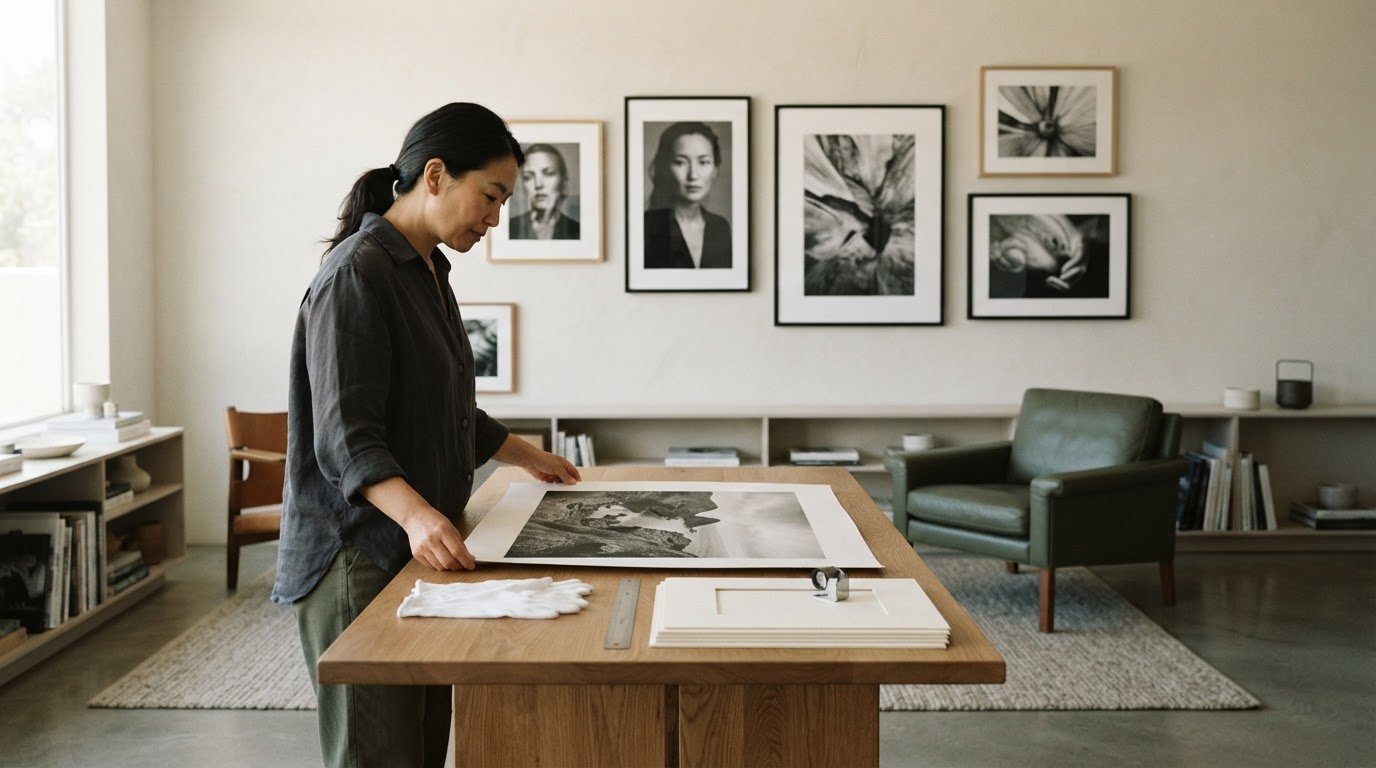
What if the best first print isn’t the rarest, but the one you’re still glad to see each day? Collecting limited edition prints can feel like a pursuit of insider knowledge or investment potential, especially when edition numbers, signatures and printing details seem to demand expert interpretation. But a collection can begin with a simpler question: does this image hold your attention, and does it mean something to you?
Edition details matter, but they’re there to deepen your understanding of a work, not replace your own response to it. With a few clear pointers, you can learn what limited editions mean in practice, compare the details that matter, and choose work that reflects your interests rather than market speculation.
This guide explores the language of editions, the qualities to consider when selecting a photographic print, and how to care for it. From a striking image to exhibition-quality printing and considered framing, collecting can be a lasting pleasure: a way to live with the photographs and stories that speak to you.
Key Takeaways
- Begin collecting limited edition prints with an image that continues to hold your attention, rather than choosing solely for perceived investment potential.
- Read edition numbers, signatures and provenance as details that add context. Their format and presence can vary from print to print.
- When comparing a print with an original, focus on what you’re choosing and what matters to you, not on which format seems more valuable.
- Use a simple checklist to consider the image, edition information, condition and how you’ll enjoy the work at home.
- Thoughtful display and general care can help you sustain a lasting relationship with a print.
Why Collecting Limited Edition Prints Begins with Personal Meaning
A photograph can become part of the rhythm of a home. You pass it in the morning, notice a detail in its composition at dusk, and find that its mood shifts with the light and your own changing perspective. That lasting pleasure is a compelling reason to begin collecting limited edition prints: the work isn’t simply something to acquire, but an image to return to.
A limited edition print belongs to a specified edition, meaning the edition has a stated limit rather than being offered as an unrestricted run. Practices can vary between artists and publishers, so the phrase alone doesn’t tell you every detail of how a print was made or presented. An open edition, by contrast, generally has no stated edition limit. For broader context on the term, see Understanding Limited Editions.
Personal resonance is a useful starting point because the image you connect with is the one you’ll want to keep looking at.
What does collecting limited edition prints mean?
In this guide, “prints” means physical photographic artworks, not original paintings or digital downloads. The edition describes the group to which a print belongs; the print itself is the object you choose to live with. Edition markings and related information offer context, but there isn’t one universal format that every edition follows.
That distinction makes the language easier to approach. You don’t need to begin with specialist terminology or a collecting strategy. Start by looking closely at the image, then use the edition details to understand more about the particular work.
Why a print can matter beyond its market value
An image may draw you in through its subject, its light, or a moment it preserves. A photograph of a familiar place might recall a journey; a portrait may hold your attention through gesture or expression; a cinematic scene may connect with a story you’ve loved for years. These associations are personal, and they can deepen as you encounter the work in everyday life.
That relationship is different from a prediction about resale demand or financial performance. The future market for a work is uncertain, so collecting is more rewarding when your decision doesn’t depend on a promised return. Treat market information as context, not as the measure of whether a print belongs in your home.
Think of the image as a conversation that can unfold over time. You may notice a new detail, remember why it first caught your eye, or find that it takes on a different meaning as your interests change. Choosing exhibition-quality photographic art for that continuing experience makes collecting less about tracking an asset and more about sustaining a connection with the work.
How Edition Numbers, Signatures, and Provenance Add Context
Once an image has caught your attention, its accompanying details can help you understand the particular print in front of you. An edition number, a signature, or a record of ownership each offers a different kind of context. None should be treated as a shortcut to judging the work’s artistic or financial worth.
Edition details help place a print in context; they don’t guarantee that scarcity will translate into value.
How to read an edition number and signature
A number such as 7/25 is commonly used to indicate a print’s position within an edition of 25. It’s an illustrative example, not a universal format: conventions and the information provided can differ between works. Read the marking alongside the print’s description, rather than assuming the same notation or practice applies to every edition.
A signature, when present, can add useful information about a print. Consider where it appears and how it relates to the description, but don’t treat a signature by itself as proof of authenticity. Some limited editions are signed; others aren’t. The absence of a signature doesn’t, on its own, explain the print’s status or quality.
What condition and provenance can tell a collector
Condition describes the print’s present state, while provenance refers to its documented history or chain of ownership, when that information exists. Both can help you build a clearer picture of a work, but they answer different questions: condition concerns what can be observed about the print, and provenance concerns its recorded history.
Keep documented facts separate from impressions. A print that looks old doesn’t necessarily have a known history, just as an attractive appearance doesn’t provide a complete account of its condition. Give greater weight to details explicitly stated in the work’s description, and avoid filling gaps with assumptions about age, handling, or ownership.
These details are most useful when read together. An edition marking can identify a print’s stated place in an edition; a signature may provide further information; and provenance, if documented, can add an account of its history. Each contributes context, but none alone tells the whole story. For a beginner, this is a measured way to approach collecting limited edition prints: notice what is stated, distinguish it from what you’re inferring, and let the image remain central.
Galerie Prints offers signed and limited editions across varied photographic movements and periods, with a focus on exhibition-quality prints. Explore signed and limited photographic prints to see how image, edition information, and presentation come together in individual works.
Limited Edition Prints and Originals: Compare the Work, Not Just the Format
A limited edition print and an original can offer different ways to encounter an image or artwork. The right choice depends less on a hierarchy of formats than on what you want to own, what draws you to the work, and how you hope to live with it. An editioned print is one of a specified group of prints; “original” can mean a unique work, though the term’s precise meaning depends on the medium and the description. Read the work’s details carefully.
What differs between a limited edition print and an original?
Both formats can carry artistic significance. With a limited edition print, you’re choosing a print and considering its place within the stated edition. With an original, you’re considering the work described as the original, which may be a singular object. Neither format is automatically more meaningful or more rewarding to collect.
Use this comparison to clarify what you’re choosing, rather than to rank the two:
| Format | What you’re choosing | Questions to consider |
|---|---|---|
| Limited edition print | A print belonging to a specified edition, with details described for that particular work. | What does the description say about the edition? Does the image and format suit your interest and intended display? |
| Original | A work identified as an original; its exact meaning depends on the medium and description. | What does “original” mean for this work? What qualities of the object matter most to you? |
For example, you might be drawn to a photograph’s composition and want a print to display, while another collector may be interested in a singular work and its particular physical presence. Those are different collecting aims, not evidence that one format is inherently better.
Does a limited edition print make a good investment?
Edition status alone doesn’t establish future performance or resale value. A stated limit describes the edition, but it doesn’t predict what a future buyer might want or what a work may be worth later. Treating “limited” as a promise of appreciation can turn a nuanced decision into a financial assumption.
Market considerations may be part of a collector’s research, but they’re uncertain. The more dependable outcome is the experience of owning a work you enjoy: its subject, composition, or connection to a photographic period may continue to reward your attention regardless of how the market changes.
Edition status alone cannot determine a work’s personal or financial significance. For anyone collecting limited edition prints, that distinction keeps the choice grounded: understand what the description says, then decide whether the work itself merits a place in your collection. An informed decision can consider format and edition details without mistaking either for a guarantee of value.
A Practical Checklist for Choosing a Limited Edition Print
A considered choice doesn’t require specialist knowledge. It does benefit from time with the image and a careful reading of the information provided. Use this four-step process to move from first impression to a print you can enjoy with confidence.
- Identify what draws you in. Look beyond the initial impact. Is it the subject, composition, atmosphere, or a detail you keep noticing? Write down what you respond to and why. That short note gives you a personal reference point if trends or other opinions begin to influence your decision.
- Review the edition details. Read the product description for information about the edition and note whether a signature is mentioned. Separate what’s explicitly stated from what you might assume. Let the description guide your understanding rather than relying on general expectations about how editions are marked.
- Assess the stated condition and history. Consider any condition information and provenance included in the description. These details can help you understand the print, but they aren’t interchangeable: condition concerns the work’s present state, while provenance concerns documented history. Don’t infer either from an image alone.
- Plan how you’ll enjoy it. Picture the work in the space where you’d like to live with it. Consider how its subject and scale might relate to the room, and whether you’d prefer to experience it as a focal point or as part of a wider arrangement. The aim is to imagine a genuine place for the image in your daily life.
Questions to ask before choosing a print
Pause before deciding and ask yourself: Does the image continue to interest me beyond a first glance? What edition, signature, condition, and provenance details are explicitly provided? Will the work suit the space and the way I want to experience it? These questions keep the decision personal and grounded in the information available.
Compare confirmed product descriptions when considering different prints. An image alone can’t reliably communicate every detail about an edition, its condition, or its history, so avoid filling in missing information by guesswork. A written description gives you a firmer basis for comparing works on like terms.
How to start a collection with intention
A collection can begin with a theme, subject, photographer, or visual quality that genuinely interests you. You might be drawn to portraits, a particular photographic period, or the way a certain kind of light shapes an image. There’s no fixed formula: a coherent collection can emerge gradually as you discover what consistently holds your attention.
For further inspiration on living with photographic art, explore fine art photography collecting and decorating. As you consider your next work, explore exhibition-quality photographic prints and let your own eye lead.
Enjoying and Caring for Your Limited Edition Print
A print’s place in a collection is shaped not only by the moment you choose it, but by the attention you give it afterwards. Display and care are part of sustaining a relationship with the image: making space for it in your home, returning to its details, and treating it thoughtfully as it becomes part of daily life.
Display a print so it remains part of everyday life
Choose a place where the work can be seen and appreciated, and where its subject and atmosphere feel at ease with the room. Think about the experience you want: a single image that draws the eye, or a work that sits in conversation with other objects and photographs. Give yourself time to live with the arrangement; a considered position can make the print feel naturally at home.
Professional framing is available with purchased prints to complete their presentation. Galerie Prints also offers bespoke services, including custom sizing, cropping, large-scale murals and wallpapers, and printing on any substrate, including aluminium, wood and glass. These options can help shape how a chosen work is presented while keeping the image itself at the centre. For broader ideas about integrating photographic art into a space, explore this guide to displaying and collecting fine art photography.
Care needn’t become complicated. Handle the print thoughtfully, keep track of any care guidance provided with it, and take care when moving or repositioning it. If you’re unsure how best to manage a particular work, seek advice suited to that print rather than relying on assumptions about every edition being alike.
Make the collecting experience personal and lasting
A simple record can preserve useful context. Note the artist and title, along with the edition information, signature, condition details, and provenance stated in the description. Keep your notes factual, separating what was provided from your own observations. This small habit makes it easier to revisit the story of the work as your collection grows.
Also record what first drew you to the image. Perhaps it was the stillness of a scene, a subject with personal meaning, or a detail in the composition. Looking back at that note later can reveal how your response has changed, or remind you of the original connection. That evolving attention is part of the pleasure of collecting limited edition prints, and it doesn’t depend on a prediction about future financial value.
Galerie Prints focuses on exhibition-quality photographic prints, including signed and limited editions from varied photographic movements and periods. If you’re ready to discover a work that speaks to your own interests, explore limited edition and signed photographic prints.
Let Your Collection Grow with Your Eye
Collecting limited edition prints can remain an open-ended pleasure, shaped by curiosity rather than a fixed plan. Give yourself permission to follow a subject, photographer, or visual quality that continues to hold your attention. As your collection develops, you may discover unexpected connections between works, or find that a single image becomes a touchstone for a particular time or place.
As you consider what to live with next, Galerie Prints describes its photographic works as exhibition-quality, with signed and limited editions spanning varied movements and periods. Bespoke framing and printing on any substrate offer ways to consider how a chosen print will be presented in your space. Let these possibilities serve the work and your experience of it, rather than dictate what belongs in your collection.
Take your time, trust the details that matter to you, and allow your collection to become a personal record of the images you value. Explore exhibition-quality photographic prints and discover a work that feels worth returning to. The most rewarding collection is one that continues to bring meaning and pleasure into everyday life.
Frequently Asked Questions
What is a limited edition print?
A limited edition print is one of a stated number of prints in an edition. The edition information helps describe the work’s place within that group, though formats and practices can vary. Read the specific description rather than assume every print follows the same conventions. The term refers to the print’s edition, not by itself to its subject, condition, or likely market performance.
Are limited edition prints signed?
Some limited edition prints are signed, but a signature isn’t a feature of every edition. Look for signature information in the work’s description and consider it alongside the other details provided. A signature can be useful context, but its presence alone doesn’t establish every fact about a print. When comparing two works, note whether each description mentions a signature rather than treating one format as the universal standard.
What does the number on a limited edition print mean?
An edition number commonly indicates a print’s position within its stated edition. For example, a notation such as 7/25 may signify the seventh print in an edition of 25. Numbering practices can differ, so use the accompanying description to interpret the marking for that particular work. Don’t assume the number indicates when the print was made, or that a lower number automatically means higher quality or value.
Are limited edition prints a good investment?
Not necessarily. A limited edition designation doesn’t establish what a print will be worth in the future or how easily it might resell. Market outcomes are uncertain, and edition status alone can’t predict them. If financial considerations matter to you, keep them separate from the reasons you enjoy the image. A print you value for its subject or artistic qualities can bring pleasure in your home without relying on a future return.
How should I choose a limited edition print?
Choose a work whose image interests you beyond its first impression, then read its description closely. Compare the stated edition information, signature details, condition, and any provenance provided, and consider how you’d like to display it. For collecting limited edition prints, keeping a brief note about what drew you to a particular image can help you make thoughtful choices and recognise when a passing trend, rather than your own taste, is leading the decision.
How can I care for a limited edition print?
Handle your print thoughtfully, keep any care information supplied with it, and take care when moving or repositioning it. Choose a display location where you can appreciate the work and where it suits its surroundings. Since individual works and presentation choices can differ, avoid assuming one specific care method applies to every print. A simple record of the work’s details can also help you keep track of it as your collection develops.
What is the difference between a limited edition print and an original?
A limited edition print belongs to a stated edition, while an original is described as the original work; the precise distinction depends on the medium and the work’s description. Collectors may be drawn to either for different reasons, including the object itself or the way they want to experience it. Read the wording for the individual work carefully, since neither label alone determines artistic importance, personal significance, or future value.