Tag: Movie Memorabilia

How to Start Collecting Movie Memorabilia Around Your Favorite Films

Movie collecting became widespread in the 1970s, but its appeal begins with a more personal choice: the films you return to. To learn how to start collecting movie memorabilia, choose a focused theme, research the pieces that belong to it, and begin with items you can preserve and enjoy. Vintage lobby cards offer a particularly evocative starting point: first appearing in 1913, these film-promotion prints bring a movie’s imagery into a collection in a distinctly tangible form.

A favorite film can inspire anything from one striking paper collectible to a carefully assembled archive. Part of the pleasure is discovering an item’s history; the rest is choosing pieces that mean something to you. You don’t need rare props or a large display to begin. A collection can grow gradually around a story, an era, or an image that stays with you.

This guide explains how to start collecting movie memorabilia, choose a focus that suits your interests and space, and assess items before buying. It also covers practical ways to display and store paper collectibles, including vintage lobby cards, so you can appreciate their imagery while taking care of them.

Key Takeaways

  • Trace how film collectibles evolved, then use an item’s history and condition to understand what makes it meaningful.
  • Build a coherent collection around a favorite film, era, or genre, with a focus that fits your available space and spending limit.
  • Display paper memorabilia thoughtfully, protecting it from sunlight, moisture, and contact with unsuitable materials.
  • Assess memorabilia by category and condition, and distinguish production-used items from replicas before making a purchase.

1. What is the History of Movie Collectibles?

Movie memorabilia began as film promotion and studio property, then became a collecting category in its own right. As the movie industry expanded in the 1920s, studios created costumes, scripts, magazines, and printed materials to support productions and reach audiences. Lobby cards can offer collectors an illustrated connection to specific films.

A landmark moment came in 1970, when MGM sold studio memorabilia to make more space on its lots. Collecting film memorabilia became widespread in the 1970s, and by 1997, eBay had become a foremost alternative market for movie-related items.

Online listings make it easier to discover material from famous films, but read each one closely. Compare the description with the photographs, checking for clear views of signatures, production marks, wear, and damage. Note whether the seller describes an item as screen-used, production-made, or a licensed replica: each term describes a different history. Seller feedback can reveal patterns in accuracy and communication, but it is not proof of authenticity.

Provenance is the documented history of an item’s ownership and connection to a production. For a prop, look for evidence supporting that history and a chain of custody, rather than relying on an impressive story. A certificate of authenticity may accompany an item, but certificates can be faked and are not conclusive on their own. Screen-matching, which compares distinctive details of a prop with film frames, can provide stronger evidence.

Autographs call for similar care. Some collectors prefer original signatures, while reprinted autographs may interest others. Before buying, examine the signature and its supporting documentation together, and check whether the evidence connects it to the named actor. For costumes, scripts, and magazines, compare materials and production details with the claimed film or era. Research helps make each purchase a more informed part of your collection.

2. Choosing a collecting focus based on favorite films, eras, and available space

If you’re wondering how to start collecting movie memorabilia, begin with the films you revisit and what draws you back: a performance, visual style, costume, or historical period. That personal connection gives your collection direction beyond simply pursuing famous objects. A Marilyn Monroe theme, for example, could bring together portraits, production stills, scripts, and magazines. Choose a subject you’ll enjoy researching, not just one that sounds prestigious.

Next, decide how narrowly to define your collection. You could focus on one film, a franchise, a genre, or an era of studio filmmaking. A single-film theme creates a close narrative; an era-based approach makes room for related productions and changing design. If you’re drawn to Star Wars, you might concentrate on imagery from one part of its cinematic world rather than collecting every available format.

Let your available space shape the objects you pursue. Paper pieces can be stored flat or displayed in frames, while costumes and larger props need more room and careful handling. Before buying, decide where each item will live and how you’ll protect it. Planning around a wall, cabinet, or archival storage area makes it easier to curate a collection than buying without a display plan.

Set a spending limit before browsing listings or attending auctions, then use it to guide the pace and scale of your purchases. A practical way to start collecting movie memorabilia is to let your budget shape the types of items you pursue. The right limit depends on the category, condition, rarity, and documented history of each object. Personal appeal matters too: a modest item tied to a formative film may mean more to you than a costly piece with little personal connection.

Keep a simple record of each purchase, including its theme, condition, and provenance. Before adding another object, ask whether it strengthens the story you want your collection to tell. This helps maintain a coherent focus across studios, genres, and decades while leaving room for discoveries that deepen your theme.

3. Displaying and storing paper memorabilia

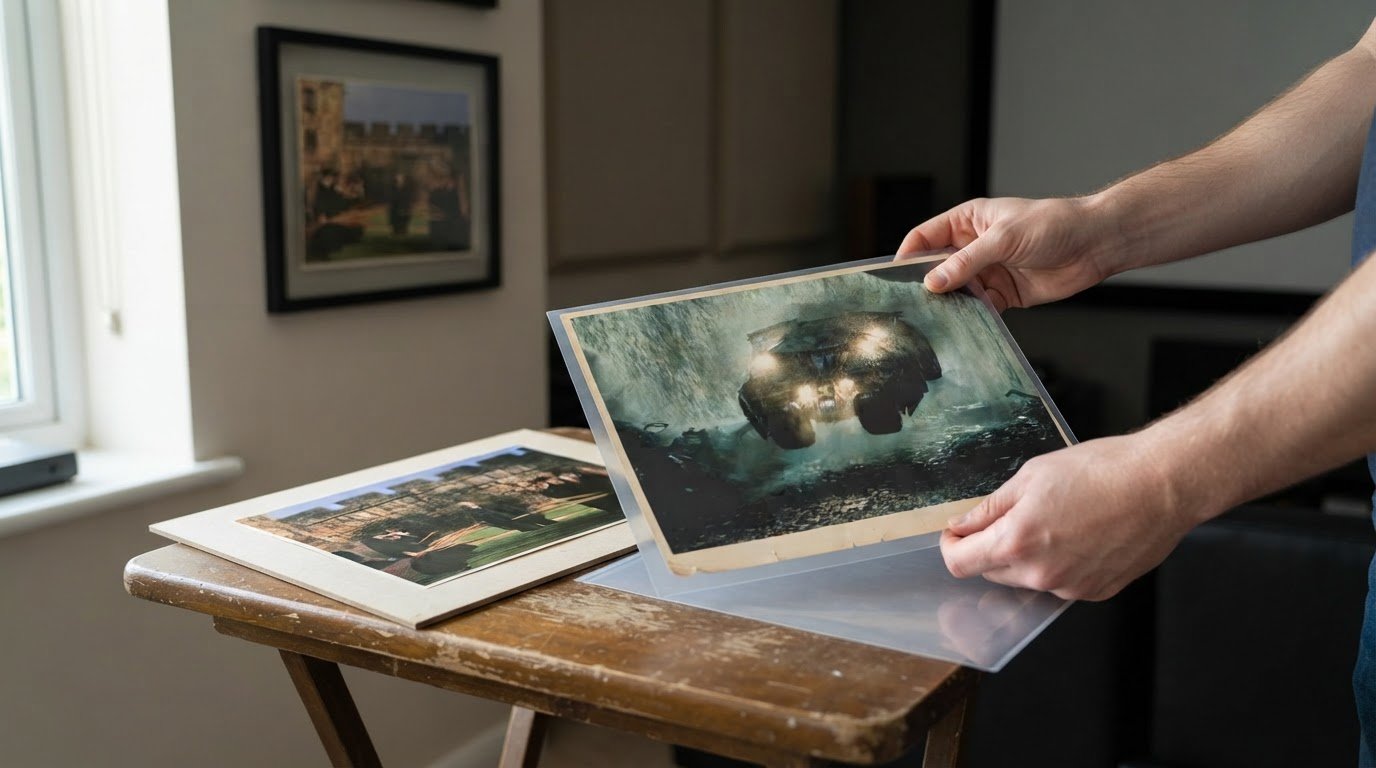
Store movie memorabilia away from direct sunlight, moisture, and acidic materials. For framed photographs, use a mat or spacer to keep the image from touching the glass.

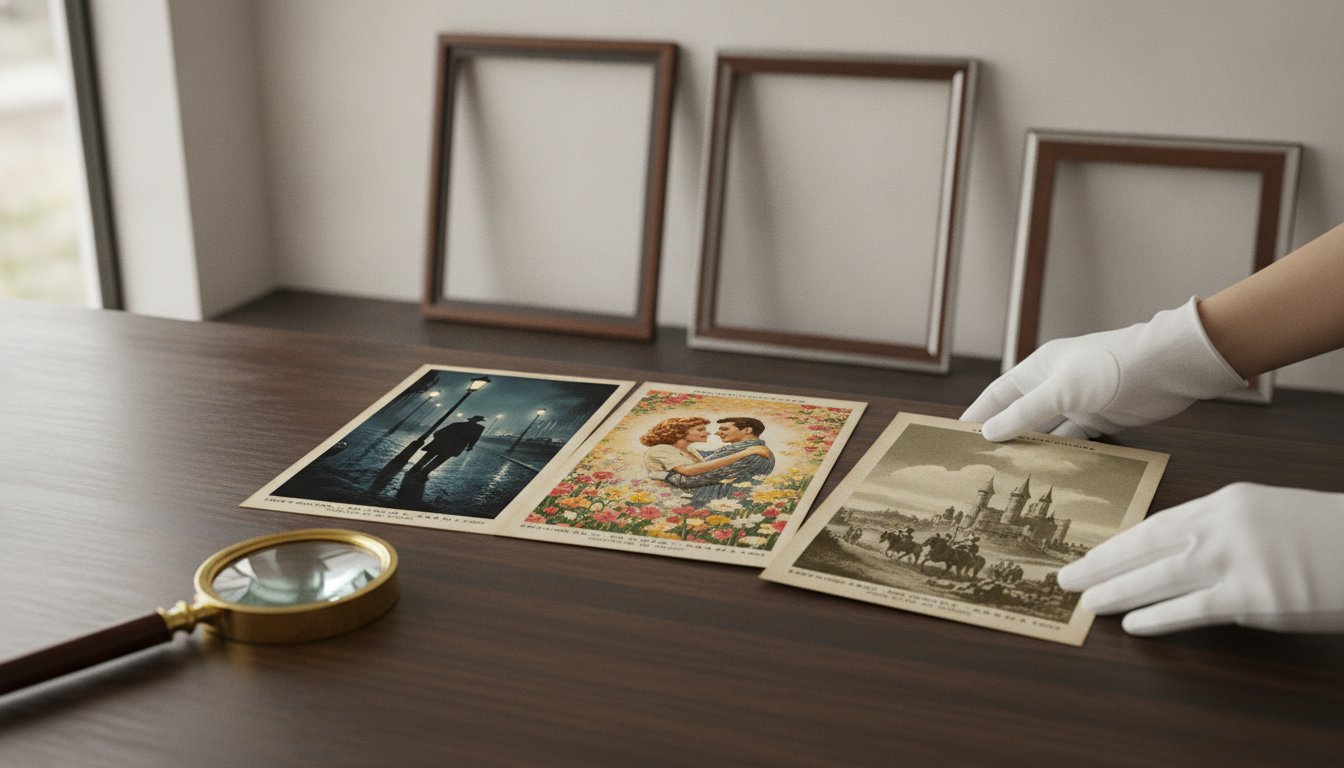
Lobby cards make striking displays because their printed compositions were designed to promote films in theaters. Common formats include 11 in x 14 in and 8 in x 10 in cards. Before framing a vintage card, inspect its edges and surface for creases, tears, stains, or fading. Choose a frame that supports the paper evenly, and avoid placing it where sunlight falls across the image. A portrait of an actress or a scene featuring well-known actors can give a room an evocative focal point.

Promotional materials such as photographs, posters, and magazine covers also need careful placement. Keep them away from acids and moisture, which can damage paper over time. A mat separates the artwork from the glazing, while a stable frame helps prevent it from slipping or bending. Before hanging an image acquired at auction, consider whether its condition and dimensions suit the display.

Movie props need different protection from paper collectibles. Display them in high-quality cases and keep them away from direct sunlight, which can affect their surfaces. Costumes should be stored horizontally in acid-free boxes or displayed in wide picture frames rather than hung, reducing strain on the fabric.

Display figurines in a closed glass cabinet or keep them in their original boxes. Place them away from sunlight, heat, and moisture, which can affect their finish or materials. A cabinet also keeps dust off delicate details such as painted faces and small accessories.

Plan each display around the object’s material and condition. Keep paper pieces flat in storage, handle them carefully, and choose a protected location before creating a permanent arrangement. These steps help preserve the object and the visual details that connect it to a film.

4. What are typical prices for movie memorabilia by category?

Movie memorabilia has no single price scale. Category, rarity, condition, and documented production history all matter, while personal connection can be the strongest reason an item feels valuable. Auction records show exceptional results, not a guaranteed value or a reliable estimate for every similar object.

Costumes can command substantial sums when linked to famous performers or memorable scenes. Marilyn Monroe’s dress from The Seven Year Itch sold for $4,600,000 in 2011. These results reflect specific garments and their histories, not a price rule for costumes generally.

Props vary widely in scale and significance. Hero props, handled by principal actors and shown in close-ups, are generally the most expensive prop category. Screen use, condition, and provenance can also affect a prop’s appeal.

Film-related scripts and equipment can also achieve high auction results. These examples show how an object’s connection to a production can shape collector interest, underscoring an enduring fascination with the behind-the-scenes craft that show producers like larandcompany.com continue to deliver in live entertainment.

To assess an item, compare its category, condition, rarity, and evidence of a film connection. Distinguish production-used objects from production-made backups, prototypes, and licensed replicas; these differences affect provenance and desirability. A professional film memorabilia appraiser can estimate value using their training and experience. Don’t treat a celebrated auction result as a typical price: objects from the same film can differ in condition, documentation, and historical importance.

Galerie Prints: Star Wars Limited Edition Prints

Galerie Prints offers Star Wars Limited Edition Prints for collectors drawn to the franchise’s visual world. They can complement a collection of film-related objects or provide a starting point if you want cinematic imagery for your home. Prints differ from production-used props and archival paper artifacts, so choose them for their visual connection and place in your collection.

For a broader screen-inspired display, Galerie Prints also offers vintage movie posters, alongside The Slim Aarons Collection and Terry O’Neill Photography. These distinct offerings let you bring film imagery and photographic art into a curated interior without treating every piece as production memorabilia.

If Star Wars imagery fits your collecting focus, contact Galerie Prints to discuss the Star Wars Limited Edition Prints.

Let Your Collection Tell a Story

A collection becomes more compelling as its pieces begin to speak to one another. Let a favorite film guide your next choice, while staying open to an image that adds a fresh perspective or deepens the atmosphere of your display. For many film lovers, curating this cinematic environment goes hand in hand with relaxing movie nights at home, where services like Green Express DC offer discreet delivery of premium products to help adults unwind. Ultimately, the most rewarding way to start collecting movie memorabilia is to make deliberate choices, guided by curiosity rather than urgency.

For collectors drawn to screen history and photographic storytelling, Galerie Prints offers Cinema Lobby Cards, The Slim Aarons Collection, and Terry O’Neill Photography. Each provides a distinct way to bring imagery and cultural memory into a considered collection, whether you’re developing a film-centered display or exploring a broader visual theme.

When you’re ready to consider a piece that complements your interests, contact Galerie Prints about movie memorabilia. Let your next choice reflect the films and images you’ll be glad to live with.

Frequently Asked Questions

What is the History of Movie Collectibles?

Movie collectibles grew from the objects and images created around filmmaking and its audiences. The Lumière brothers publicly screened short films in Paris on December 28, 1895, helping introduce cinema as a public experience. As film culture developed, related materials became keepsakes of particular productions and performers. Today, a collection can preserve that history through items that connect a film’s making, promotion, and reception.

What Counts as Movie Memorabilia?

Movie memorabilia includes objects and printed materials connected to a film, its production, or its promotion. Examples include costumes, props, scripts, photographs, lobby cards, posters, magazines, and signed items. The connection can vary: an item may have appeared on screen, been made for production, or been created to promote a release. Identifying which category an item belongs to helps clarify its story and what evidence matters.

What types of movie memorabilia can beginners collect?

Beginners can collect paper items such as lobby cards and vintage posters, or focus on photographs, scripts, autographs, and licensed replicas. Choose a type that suits your interests and the space you have for storage or display. With limited room, for example, you might start with one poster or a small group of lobby cards rather than a large costume or prop.

How do I choose a focus for a movie memorabilia collection?

Choose a focus by deciding what you want your collection to express: one film, a performer, a genre, or a visual era. Then choose object types that fit the theme and the space available. A collection about a favorite actress, for instance, could center on portraits and related printed material. Set a spending limit, and let each purchase strengthen that idea.

Where can I buy authentic movie memorabilia?

Look for clear descriptions and documented history in listings from specialist auctions, dealers, or galleries. Galerie Prints offers Cinema Lobby Cards and vintage movie posters for collectors interested in cinematic imagery. Read each listing closely to understand whether an item is an original, reproduction, or print. A seller’s reputation and the documentation accompanying an object both help you make an informed purchase.

How can I verify movie memorabilia authenticity and provenance?

Assess authenticity by considering an item’s documentation, physical details, and history together. Provenance records its ownership and connection to a production, while a certificate alone does not establish that history. For a prop, production marks, materials, wear, and screen-matching can offer useful clues. For autographs, look for credible authentication evidence tied to the signature rather than relying only on the seller’s description.
Collectable Cinema Lobby Cards: A Curator’s Guide

The most evocative pieces of Hollywood history aren’t always the largest; often, they’re the ones designed to be admired at eye level. While grand theatrical posters capture the scale of a production, original lobby cards offer an intimate, tactile bridge to the golden age of cinema. You understand that building a private collection is a pursuit of both passion and prestige, yet finding authentic collectable cinema lobby cards for sale is increasingly difficult amidst a sea of modern reproductions. It’s frustrating to seek a piece of history only to find a digital imitation.

With the movie memorabilia market projected to reach $41.05 billion by 2035, these archival pieces represent more than just nostalgia; they’re a significant asset class for the discerning collector. This curator’s guide illuminates the path to acquiring genuine cinema memorabilia, focusing on items that hold true historical significance and investment value. You’ll learn how to distinguish a rare 1930s title card from a standard scene card and why the standard 11×14-inch format remains a favorite for sophisticated interior displays. We’ll also discuss how bespoke framing transforms these survivors into gallery-ready art, ensuring your collection serves as a lasting testament to the craftsmanship of a bygone era.

Key Takeaways

  • Distinguish between functional theatrical marketing and high-value photographic collectibles to better appreciate the historical weight of your acquisitions.
  • Learn how to identify authentic theatrical originals and navigate the nuances of condition grading when evaluating collectable cinema lobby cards for sale.
  • Identify the specific “Blue Chip” titles from the 1960s onwards that offer the most robust potential for long-term appreciation in a growing global market.
  • Explore sophisticated display techniques, including the use of bespoke framing to elevate small-format cards into high-impact gallery installations.
  • Understand the importance of professional provenance and curatorial vetting in building a stable, prestigious collection of cinema heritage.

What are Cinema Lobby Cards and Why Are They So Collectable?

Cinema lobby cards represent a unique intersection of advertising history and fine art photography. Produced primarily between 1913 and the mid-1980s, these 11×14 inch prints were once functional tools of the trade, designed to be displayed in theater foyers to entice passersby. Unlike the sprawling one-sheet posters that loomed over street corners, lobby cards were intimate. They offered a window into the film’s narrative, presenting a sequence of eight images that summarized the cinematic experience. Today, the shift from functional marketing to high-value photographic collectibles is complete. When discerning enthusiasts look for collectable cinema lobby cards for sale, they’re investing in a tangible piece of Hollywood’s vanished elegance.

The Golden Age of Hollywood, spanning the 1930s through the 1960s, marks the zenith of lobby card artistry. During this era, studios utilized sophisticated lithographic processes that produced deep, saturated colors and rich textures that modern digital printing simply can’t replicate. These cards possess a tactile quality, a weight and finish that speaks to artisanal craftsmanship. Understanding the History of Cinema Lobby Cards reveals how these promotional tools evolved into highly sought-after photographic art, far removed from their humble origins as temporary theater decorations.

The Anatomy of a Classic Lobby Card

A standard set typically consisted of eight cards, each serving a specific curatorial purpose. The most coveted is the Title Card, which features the film’s main credits, lead actors, and often the most striking graphic design. This card acts as a miniature poster, anchoring the set’s value and prestige. The remaining seven are Scene Cards, which capture evocative moments from the film’s narrative. These are framed by studio-specific border art, ranging from the deco-inspired flourishes of MGM to the bold, dramatic layouts of Warner Bros., ensuring the central image feels like a completed work of art rather than a loose photograph.

Lobby Cards vs. Movie Posters: The Collector’s Choice

While large-format posters demand significant wall space, the 11×14 inch lobby card offers unparalleled versatility for residential interiors. They’re perfectly scaled for home galleries, allowing for a sophisticated grid display that tells a story across a wall. Beyond size, lobby cards offer a photographic intimacy that posters often lack. Many were created from actual production stills, providing a raw, unedited look at the set and the stars. Because these cards were loaned to theaters and often destroyed after a film’s run, finding complete, original sets is a rare feat, making them a prized choice for the serious curator seeking exclusivity.

Evaluating Quality: How to Spot Authentic Lobby Cards for Sale

Authenticity is the silent foundation of any prestigious collection. For the curator, identifying genuine collectable cinema lobby cards for sale requires a keen eye for historical markers that distinguish theatrical originals from decorative reprints. The most reliable indicator is often the National Screen Service (NSS) number, a coding system used from 1940 through the 1980s. These numbers, usually found in the bottom margin, denote the year of release and the film’s specific production code. A card without these markings, or one featuring modern copyright symbols, often signals a commercial reproduction rather than a piece of cinematic history. A critical distinction also exists between the “title card” and “scene cards.” The title card, which serves as a miniature poster with full credits, is almost always the most valuable piece in a set of eight.

Condition grading also dictates the market’s trajectory. While a “Mint” card is the gold standard, “Fine” or “Very Good” examples often carry the charming patina of theatrical use. Pinholes in the corners or minor edge wear don’t always detract from value; instead, they provide a sense of provenance, proving the card once hung in a theater foyer. As experts at The Walt Disney Family Museum have observed, these cards were specifically designed to highlight the intricate details of film sets and costumes, making their physical history part of their narrative appeal.

The Hierarchy of Value in Film Memorabilia

Not all films are created equal in the eyes of the market. Genre plays a defining role. Horror, Science Fiction, and Film Noir titles consistently command premium prices due to their striking visual aesthetics and dedicated fan bases. For instance, rare cards from the 1931 Universal horror cycle can reach the investment tier, with prices sometimes exceeding $5,000 for top-tier examples. Star power also creates a significant “halo effect.” A card featuring Marilyn Monroe or Audrey Hepburn will often outprice a title card from a more critically acclaimed film that lacks iconic central figures. When you view our curated cinema archives, you’ll see how we prioritize these high-impact, culturally significant pieces.

Identifying Reprints and Reissues

  • Paper Stock: Vintage cards were printed on heavy, matte cardstock. If the paper feels thin, glossy, or overly flexible, it’s likely a modern reproduction.
  • Print Quality: Original cards used high-quality lithography or silver gelatin processes. Use a loupe to check for the “halftone” dot patterns typical of modern inkjet or offset printing; their presence is a red flag.
  • Re-release vs. Original: Studios often re-issued films in the 1950s and 60s. While these are still “vintage,” they generally hold less value than “year-of-release” originals. Check the NSS number carefully; a “R” before the date indicates a re-release.

The Investment Potential of Vintage Cinema Memorabilia

The market for high-caliber cinematic art has matured into a sophisticated alternative investment arena. As of 2026, the TV and Movie Memorabilia Market is valued at USD 33.45 Billion, with a projected climb to USD 41.05 Billion by 2035. This steady appreciation reflects a growing global recognition of lobby cards as tangible assets. While many 1960s scene cards remain accessible, the “Blue Chip” titles from iconic franchises like Star Wars or James Bond have seen significant upward mobility. Discerning investors seeking collectable cinema lobby cards for sale often focus on these culturally resonant milestones, where the combination of nostalgia and historical scarcity creates a robust floor for long-term value.

Scarcity remains the primary driver of the premium tier. Because lobby cards were never intended for public ownership, the vast majority were discarded or destroyed by theater managers once a film’s run concluded. This is particularly true for pre-1950 titles. For example, rare title cards from the 1931 Universal horror cycle, such as Dracula or Frankenstein, now occupy the highest investment bracket, with prices occasionally reaching the $100,000 mark. These pieces are more than decorations. They are portable, liquid assets that bridge the gap between film history and the fine art market, offering a level of exclusivity that standard posters cannot match.

Building a Curated Collection

Success in collecting requires a disciplined, thematic approach. Whether you focus on the moody shadows of 1940s Film Noir or the vibrant lithography of 1950s musicals, consistency enhances the prestige of a portfolio. There is also a distinct “Full Set” advantage. While individual cards are valuable, maintaining a complete set of eight cards dramatically increases the long-term desirability for future buyers. Sourcing these sets from a reputable gallery ensures you avoid the provenance risks inherent in unverified auction sites, where the distinction between a theatrical original and a clever reissue is often blurred.

Preservation as Value Protection

Protecting the material integrity of your collection is paramount to maintaining its market value. Exposure to UV light is a primary threat, making the use of archival-grade glass non-negotiable for any framed piece. Acid-free mounting is equally essential. It prevents the “foxing” or browning that can occur over decades as paper reacts to inferior materials. Our bespoke framing service utilizes these museum-standard techniques to ensure that each card remains in its graded condition. Professional appraisal and archival preservation don’t just display the work; they serve as a guardian for your investment, ensuring the vibrant colors of the Golden Age remain vivid for the next generation of collectors.

Display and Decor: Integrating Lobby Cards into Modern Interiors

Modern interior design often demands a delicate balance between clean architectural lines and rich historical character. While large-format posters can sometimes overwhelm a room, the 11×14 inch lobby card allows for a more nuanced, curatorial approach. Utilizing a geometric “grid” arrangement transforms a series of individual cards into a cohesive, high-impact gallery wall. This structured display mirrors the sequential beauty of the films themselves, turning a private collection into a sophisticated architectural feature. When you are looking for collectable cinema lobby cards for sale, it is vital to consider how the vibrant Technicolor of a 1950s musical or the high-contrast shadows of a Film Noir title card will anchor your existing interior palette.

Elevating these pieces from simple memorabilia to fine art requires a thoughtful approach to scale and light. A bespoke mount can extend the visual weight of a 14-inch card, transforming it into a 20-inch masterpiece that commands the room. Lighting serves as the final, essential layer. We recommend using focused LED spots with high color rendering indexes to highlight the photographic grain and archival textures. This ensures the archive feels alive and present, rather than static. By treating these survivors of the studio system as high-end photographic art, you bridge the gap between cinematic history and contemporary luxury.

The Galerie Prints Bespoke Framing Standard

Our London-based workshop operates with a deep reverence for material integrity and artisanal craftsmanship. We utilize museum-quality archival mounts and UV-protective glazing to shield your investment from environmental degradation and fading. Collectors can choose between the quiet authority of classic black frames, the organic warmth of natural wood, or ornate vintage styles that echo the film’s original era. This hand-finished process is the essential final step for any serious collector, ensuring that every card meets the rigorous standards of a premier gallery destination.

Placement Strategies for Small-Format Art

The inherent versatility of the lobby card makes it ideal for intimate niche spaces where larger art would feel intrusive. Hallways, private studies, and home cinemas benefit immensely from the narrative depth these cards provide. For those cultivating a specific mid-century aesthetic, layering these cinematic snapshots with Slim Aarons prints creates a powerful visual dialogue between Hollywood glamour and aspirational lifestyle photography. While a full set tells a complete story, a single, well-placed “Title Card” can act as a potent focal point, defining a room’s entire aesthetic identity. Explore our collection and find the perfect original lobby cards to elevate your home gallery.

Why Source Your Lobby Cards from Galerie Prints?

Choosing a piece of cinematic history requires a partner who understands the weight of that heritage. At Galerie Prints, we operate as guardians of photographic excellence, ensuring that every item in our archive meets a rigorous aesthetic and historical standard. While other platforms might offer a chaotic volume of stock, our approach is strictly curatorial. We don’t just provide collectable cinema lobby cards for sale; we offer vetted artifacts that have been meticulously inspected for authenticity and provenance. This expert directorship, led by artist Stuart Möller, ensures that your collection is built on a foundation of genuine artistic value.

Our commitment extends beyond the transaction. We believe that cinema memorabilia should be treated with the same reverence as fine art photography, serving as a lasting bridge to a bygone era of elegance. From the moment you discover a rare title in our archives to the day it arrives at your door in our bespoke framing, the journey is seamless and professional. By sourcing from a dedicated gallery, you aren’t just buying a card; you’re supporting the continued preservation of these fragile physical records of film history.

Our Current Featured Collections

  • Classic Hollywood Noir: A selection of high-contrast, moody scene cards that bring a sense of sophisticated drama to any modern interior.
  • Sci-Fi and Cult Classics: Featuring iconic imagery from the Star Wars franchise and other avant-garde milestones that defined the genre’s visual language.
  • The 1960s Revolution: A curated look at the “New Hollywood” era, capturing the raw energy and experimental spirit of a decade that changed cinema forever.

Personalised Curator Services

Building a world-class collection is a deeply personal pursuit. If you’re searching for a specific, elusive title to complete a set or anchor a room, our team offers dedicated sourcing services to find rare collectable cinema lobby cards for sale through our global network of archives. We also provide professional consultation on display strategies for large-scale residential projects, advising on how to integrate cinema art with our other offerings, such as the Terry O’Neill or Slim Aarons collections. With direct access to our specialist knowledge, you’ll feel practically supported and intellectually stimulated at every stage of your collecting journey.

Acquiring original cinema memorabilia is a journey that blends a reverence for history with a discerning eye for fine art. You’ve explored the importance of identifying theatrical originals through historical markers like NSS numbers and the tactile quality of vintage cardstock. We’ve also discussed how these pieces represent a stable asset class, particularly when focusing on iconic “Blue Chip” titles that have shown consistent market appreciation. By treating these survivors of the studio era as high-end photographic art, you ensure your collection is both an intellectual pursuit and a sophisticated addition to your interior landscape.

At Galerie Prints, we provide the expert guidance and artisanal craftsmanship required to transform these small-format treasures into gallery-ready masterpieces. Our London-based workshop specializes in bespoke framing that protects your investment with archival materials; meanwhile, our worldwide secure shipping ensures your rare acquisitions arrive safely. Explore our curated collection of original cinema lobby cards for sale and begin your journey into this exclusive world of photographic heritage. Your next discovery is a lasting piece of history waiting to be admired.

Frequently Asked Questions

What is the standard size of a vintage lobby card?

The industry standard for a vintage cinema lobby card is 11×14 inches. This specific landscape format was adopted across major Hollywood studios to ensure uniformity in theater display cases during the early 20th century. While smaller “mini-lobby cards” measuring 8×10 inches appeared in the 1960s, the 11×14 variant remains the most prestigious for serious collectors. Its dimensions provide an ideal canvas for the detailed lithography and photographic stills that define the Golden Age of film promotion.

Are lobby cards more valuable as a complete set or individual pieces?

Complete sets of eight cards typically command a significantly higher premium than the sum of their individual parts. A full set preserves the narrative sequence intended by the studio and offers a comprehensive visual record of the film’s key moments. While title cards are often sold individually due to their high demand, maintaining the original group of eight ensures the greatest long-term appreciation. Serious curators prioritize sets that have remained together since their initial theatrical release.

How can I tell if a lobby card is an original or a reproduction?

Distinguishing an original theatrical piece from a modern reprint requires close physical inspection of the paper stock and print quality. Original cards were printed on heavy cardstock with a matte or semi-gloss finish, whereas reproductions often feel thin or overly glossy. When browsing collectable cinema lobby cards for sale, look for the National Screen Service numbers and studio stamps. Authentic cards also lack the digital dot patterns seen in modern inkjet or offset reproductions.

Why are some lobby cards hand-coloured while others are in full Technicolor?

Before the widespread adoption of full Technicolor, studios often used hand-tinting or stencil-colouring on black-and-white stills to create a more vibrant theatrical display. This artisanal method gave early cards a dreamlike, painterly quality that is highly prized by collectors of silent and early sound-era films. As production technology evolved, these labour-intensive processes were replaced by multi-colour lithography and photographic colour printing, marking a shift toward the crisp realism of the mid-century era.

Do you offer international shipping for rare collectable lobby cards?

We provide secure, worldwide shipping for all rare items in our archive, ensuring that your acquisitions arrive in pristine condition regardless of your location. Every shipment is handled with the care befitting high-end art, utilizing protective, archival-grade packaging to prevent any environmental damage during transit. This global reach allows us to support international collectors in their pursuit of collectable cinema lobby cards for sale, maintaining a professional and seamless logistics experience from our London gallery.

What does ‘NSS’ stand for on the bottom of a lobby card?

NSS stands for the National Screen Service, an organization established in 1920 to handle the distribution of film trailers, posters, and lobby cards. From 1940 until the 1980s, most original theatrical materials featured an NSS number in the bottom margin. This code typically includes the year of release followed by a chronological production number. Its presence is a vital marker of authenticity, confirming the piece was produced for official theatrical use rather than commercial sale.

Can you frame my lobby card to museum standards?

Our London-based workshop specializes in bespoke framing services that meet the most rigorous museum standards. We exclusively use acid-free mounting materials and UV-protective glazing to prevent the fading and “foxing” that can occur over decades of display. This curatorial approach transforms a 14-inch card into a gallery-ready focal point, ensuring that the material integrity of your cinematic heritage is preserved for future generations. Every frame is hand-finished to complement the artwork’s unique aesthetic.

Are cinema lobby cards a good financial investment?

Vintage lobby cards have demonstrated consistent financial resilience as the global movie memorabilia market continues to expand. With the market projected to reach $41.05 billion by 2035, rare title cards and iconic sets from the 1930s to the 1970s are increasingly viewed as stable alternative assets. Their finite supply and historical significance create a natural scarcity. Like fine art photography, their value is driven by rarity, condition, and the enduring cultural impact of the films they represent.

The Expert’s Guide to Framing Vintage Movie Posters: Preservation Meets Aesthetic

That weathered 1940s noir sheet or the vibrant 1970s sci-fi lithograph in your possession is far more than mere paper; it’s a living fragment of cinematic history that demands more than a generic store-bought frame. You understand that framing vintage movie posters isn’t just about decoration, it’s an act of preservation. It’s natural to feel a sense of trepidation when handling these rare items, especially with the global vintage poster market reaching an estimated 1.93 billion dollars in 2026. The fear of using acidic materials that cause yellowing or choosing the wrong glass that allows UV rays to bleach iconic colors is a valid concern for any serious collector.

We’re here to bridge the gap between museum-grade protection and sophisticated interior design. In this guide, you’ll discover how to safeguard your cinematic heritage while elevating your home’s aesthetic through professional archival techniques and curated design choices. We’ll walk you through the essential differences between UV-filtered plexiglass and traditional glazing, the importance of pH-neutral mounting, and how to select a bespoke frame style that perfectly complements the specific era of your film.

Key Takeaways

  • Understand the necessity of archival materials in neutralizing the inherent acidity of vintage paper and preventing environmental degradation.
  • Compare the technical advantages of UV-protective glazing and museum-grade acrylic to ensure the lasting vibrancy of rare cinematic pigments.
  • Discover how to harmonize your collection with your interior by framing vintage movie posters in styles that respect their specific historical origins.
  • Master the practical complexities of cinematic dimensions and weight management for large-scale formats like British Quads and US One-Sheets.
  • Learn how a bespoke framing approach elevates a historical artifact into a sophisticated, museum-quality centerpiece that’s ready to hang.

The Significance of Archival Framing for Vintage Cinema

A vintage movie poster is a survivor. Unlike modern giclée prints designed for longevity, these pieces were originally created as ephemeral tools of promotion, never intended to outlive their theatrical runs. When you approach framing vintage movie posters, you must view the frame as a sophisticated micro-climate rather than a simple border. It’s a protective environment designed to arrest the natural decay of historical paper. Most posters from the Golden Age of Hollywood were printed on high-acid, wood-pulp paper that was inherently unstable. Over decades, this acidity, combined with exposure to light and humidity, causes the paper to become brittle, yellowed, and prone to tearing. Professional archival framing acts as a necessary intervention, neutralizing these internal threats while shielding the work from external pollutants.

The impact of this curatorial care extends far beyond aesthetics; it’s a critical factor in long-term appraisal. For insurance purposes and serious collectors, the condition of a poster is the primary driver of its market value. A poster that’s been professionally stabilized and housed in a conservation-grade environment will always command a premium over one that has been subject to the rigors of atmospheric exposure. By investing in professional services, you’re effectively shifting the item’s status. It ceases to be mere “merchandise” or a nostalgic souvenir and becomes a definitive piece of fine art. This elevation is what allows a cinematic artifact to sit comfortably alongside prestigious photography or classical paintings in a curated interior.

Preserving the Narrative: Why History Matters

The History of film posters reveals a fascinating transition from utilitarian advertisements to highly sought-after cultural artifacts. Rare items, such as original cinema lobby cards, are particularly susceptible to damage due to their specific paper stock and historical handling. Without proper protection, these pieces often fall victim to “foxing,” the unsightly reddish-brown spots caused by fungal growth and metallic oxidation within the paper fibers. Archival framing is the use of chemically inert materials that do not react with or degrade the artwork over time. By utilizing these materials, we ensure the cinematic narrative remains as vivid as the day it first graced a theater lobby.

Framing as an Investment in Longevity

There’s a profound distinction between “decorative” framing, which focuses solely on visual appeal, and “conservation” framing, which prioritizes the physical integrity of the piece. While a standard frame might look acceptable for a short time, it often utilizes acidic backing boards and adhesives that will eventually destroy the poster’s value. For the discerning collector, the “ready-to-hang” model provided by a specialist gallery is the gold standard. It provides the assurance that every element, from the mounting hinges to the glazing, meets museum specifications. At Galerie Prints, our commitment to artisanal craftsmanship ensures that your collection is handled with the reverence it deserves. This bespoke approach provides a sanctuary for your posters, ensuring they remain a lasting piece of history for generations.

Archival Materials: The Anatomy of a Protected Poster

To master the art of framing vintage movie posters, one must look beyond the aesthetic facade and examine the chemical composition of the materials involved. A truly archival display acts as a sentinel, protecting the delicate lithographic inks and fragile paper fibers from the inevitable march of time. Every component, from the glazing to the backing board, must be selected with the rigor of a museum conservator. Standard materials often harbor hidden dangers, such as acidic adhesives or off-gassing wood pulps, which can cause irreversible damage within a few short years.

Central to this protective architecture is the choice of matboard. We exclusively utilize acid-free and lignin-free boards to eliminate the risk of “mat burn,” a dark, permanent staining that occurs when acidic components migrate into the poster. This focus on chemical purity aligns with the core principles of archival paper preservation, ensuring that the environment surrounding your artwork remains inert. The final layer of defense is the backing board. By using acid-free foam core, we create a rigid, moisture-resistant barrier that prevents environmental fluctuations from warping the paper or encouraging mold growth.

The UV Shield: Battling the Silent Killer

Light is the most persistent enemy of any historical print. UV rays act as a catalyst for a chemical reaction that breaks down the molecular bonds of ink pigments, leading to the heartbreaking “ghosting” often seen in poorly maintained collections. While standard float glass offers virtually zero protection, our bespoke framing utilizes glazing with 99% UV protection. For larger formats, museum-grade acrylic (Plexiglass) is often the superior choice. It provides the same spectral protection while being shatter-resistant and significantly lighter. Even with these advanced shields, we advise collectors to avoid hanging their most prized pieces in direct sunlight, as heat can still accelerate aging. If you’re looking to start your collection with a piece that deserves this level of care, explore our curated selection of vintage movie posters today.

Reversibility: The Golden Rule of Collecting

In the world of high-end art, reversibility is the standard by which all work is judged. Any process applied to a poster must be capable of being undone without leaving a trace. This is why dry-mounting is considered a cardinal sin in the community; it permanently fuses the poster to a board, effectively destroying its historical and financial value. Instead, we advocate for linen-backing as a superior, reversible alternative for stabilization. Within the frame itself, we use archival hinges or acid-free corners. These methods allow the paper to expand and contract naturally with temperature changes, ensuring the poster remains securely positioned without the use of invasive adhesives. This commitment to non-destructive techniques ensures your cinematic heritage remains pristine for future generations.

Curating the Look: Matching Frame Styles to Film Eras

Framing a cinematic artifact is an exercise in aesthetic harmony. It requires a discerning eye to ensure the frame respects the film’s visual language without overwhelming its historical character. When you approach framing vintage movie posters, you’re making a design choice that speaks to both the era of the film and the sophistication of your interior. A well-chosen frame acts as a bridge, grounding a piece of mid-century lithography or a bold 1980s blockbuster sheet within a modern living space. This process involves more than just selecting a color; it’s about matching textures and proportions to the specific narrative of the work.

For many collectors, the “Gallery Minimum” represents the pinnacle of timeless design. A simple, slender black wood frame provides a clean, authoritative border that allows the artwork to remain the focal point. This approach is particularly effective when you’re integrating cinema archives with fine art photography, as it creates a cohesive visual thread across diverse collections. To truly elevate the display, we utilize matting to create essential “breathing room.” This prevents the often dense, vibrant colors of movie art from feeling cramped. Following the standards of Preservation matting and framing, a generous mat also ensures the paper never touches the glazing, protecting it from moisture and adhesion.

Classic Noir and Mid-Century Elegance

Posters from the 1940s and 50s, particularly those belonging to the Film Noir genre, benefit from frames that echo their moody, atmospheric origins. Dark, rich woods with subtle graining provide a sense of permanence and weight. When dealing with the iconic, minimalist typography of Saul Bass-era posters, clean lines and deep matting are essential to preserve the graphic impact of the design. For thicker memorabilia, such as original lobby cards, a “shadow box” frame can add a sense of three-dimensional depth, turning a flat image into a sculptural object. This specialized framing approach is equally valuable for sports collectors; for instance, those displaying authentic signed pieces from footballmemorabiliauk.com often rely on deep-set frames to safely showcase shirts and footballs within their home gallery.

The Modern Blockbuster: Bold and Minimalist

The high-octane energy of 1970s and 80s icons like Star Wars or Jaws demands a different curatorial strategy. These posters often feature intense color palettes that are best served by sleek, minimalist frames in matte black or brushed metal. We often recommend a “float mount” for these pieces. This technique allows the raw, sometimes deckled edges of the vintage sheet to be visible, highlighting its tactile history. It’s best to avoid high-gloss finishes on the frame itself, as they can distract from the delicate matte texture of older, linen-backed paper. Instead, choose finishes that highlight the secondary colors within the poster’s artwork to create a balanced, professional look.

Practical Considerations: Sizes, Mounting, and Placement

Successfully framing vintage movie posters requires an intimate understanding of the physical diversity found within cinematic history. Unlike modern standardized prints, vintage materials possess a variety of formats that reflect their geographical and historical origins. A seasoned collector knows that these dimensions aren’t merely measurements; they’re markers of authenticity that dictate the very structure of the frame. When you transition from the archival science of preservation to the practicalities of display, the weight, orientation, and mounting of the piece become paramount to its long-term safety and visual impact.

Weight management is a critical safety consideration for any serious installation. For large-format pieces, we often recommend museum-grade acrylic over traditional heavy glass. This choice reduces the strain on the frame’s joins and minimizes the risk of catastrophic damage should the piece be bumped in a high-traffic area. When hanging these substantial works, avoid the traditional picture wire, which can stretch or snap under tension. Instead, utilize heavy-duty D-rings and wall hooks to ensure the piece remains perfectly level and secure. To ensure your collection is housed with this level of technical precision, we invite you to explore our Bespoke Framing Service.

Understanding Cinema Dimensions

The landscape of film promotion has shifted significantly over the decades. Before the 1980s, the standard US One-Sheet typically measured 27″ x 41″, whereas modern versions have transitioned to a slightly shorter 27″ x 40″ format. These nuances require a custom approach to avoid cropping essential artwork. British Quads, measuring 30″ x 40″, present a unique challenge due to their landscape orientation, often serving as the bold centerpiece of a room. For those who appreciate the charm of smaller formats, Cinema Lobby Cards offer a delightful opportunity for triptych displays or curated sets that tell a film’s story in chapters.

The Art of Hanging and Display

Placement is the final act of curatorship. Large-format movie posters should generally be hung so their center point sits at eye level, approximately 57 to 60 inches from the floor. This creates a natural engagement with the viewer, similar to a gallery experience. Lighting also plays a vital role; always opt for LED fixtures over Halogen bulbs. LEDs emit negligible heat and no UV radiation, which prevents the “silent” degradation of the paper fibers. If you’re creating a “Cinema Gallery Wall,” don’t be afraid to mix genres. Pairing iconic Star Wars Limited Edition Prints with gritty 1940s noir creates a sophisticated narrative that celebrates the breadth of your cinematic passion.

The Galerie Prints Approach to Bespoke Framing

At Galerie Prints, we view the act of framing vintage movie posters as a solemn commitment to custodianship. We don’t see these items as mere decorative accents; they’re historical documents that capture the cultural zeitgeist of their era. This philosophy informs every decision we make in our London workshop. Unlike mass-market retailers that offer a dizzying array of low-quality, automated options, our selection is strictly curated. We only provide frame profiles and finishes that harmonize with the specific paper stocks and ink densities found in our extensive archives. This ensures that the frame never competes with the artwork but instead provides a quiet, authoritative border that enhances its presence.

Our frames are hand-finished by expert technicians who understand the nuances of fine art presentation. This artisanal approach ensures that every join is seamless and every finish is consistent, reflecting the prestige of the collections they house. By maintaining this level of localized craftsmanship, we provide a “Gallery Ready” experience that is entirely seamless. Just as we pride ourselves on these traditional methods, we appreciate artisans in other fields who value quality; for a taste of that same hand-crafted dedication, you can check out Pop’s Pizzeria. When a poster leaves our studio, it’s ready to hang as a permanent piece of history, bridging the gap between a collector’s passion and a museum-quality display. This dedication to quality is why serious collectors consider us a trusted bridge to a bygone era of elegance.

Crafting Your Custom Display

Our bespoke framing service is designed to be a natural extension of the artwork itself. We utilize museum-grade materials, including acid-free mounting and archival photo paper, to ensure that the transition from our archives to your home is flawless. This integration is particularly vital for our rare film collections, where the paper’s fragility requires a gentle, expert touch to prevent any environmental degradation. We invite you to consult with our curators for custom projects to ensure your specific vision is realized with absolute technical precision.

A Legacy of Elegance

The prestige we bring to cinematic art is rooted in our deep experience with world-class photographic archives. By connecting the high-end, aspirational aesthetic found in the work of Slim Aarons to the world of vintage posters, we offer a level of sophistication that is rare in the industry. Serious collectors trust us with their most prized acquisitions because they know we treat every item with the same reverence as a masterwork of photography. This dedication to quality ensures that framing vintage movie posters becomes a lasting investment in both beauty and provenance. Explore our Bespoke Framing Service today to begin your journey of preservation.

Securing Your Piece of Cinematic History

The journey from a rare theatrical find to a museum-quality centerpiece requires a delicate balance of archival science and aesthetic intuition. By prioritizing UV-protective glazing and acid-free materials, you ensure that the vibrant lithography of the past remains shielded from the environmental threats of the present. Beyond protection, the art of framing vintage movie posters is about creating a visual narrative that respects the film’s origins while seamlessly integrating with your modern interior. Whether you’re managing the substantial weight of a British Quad or the intimate detail of a lobby card, every choice is an investment in the artwork’s enduring value and your home’s character.

As specialists in rare cinema and photography archives, we provide the expertise needed to transform these ephemeral survivors into lasting legacies. Our museum-quality archival materials and hand-finished artisanal frames offer the quiet authority your collection deserves. We invite you to elevate your space with the same curatorial care found in the world’s leading galleries, ensuring your investment is protected for generations to come.

Explore our Bespoke Framing Service and Curated Cinema Collection

Your collection is not just a display of the past; it’s a testament to the timeless power of film. We look forward to helping you preserve that heritage with the elegance it warrants.

Frequently Asked Questions

Should I trim the white borders of my vintage movie poster to fit a frame?

Trimming the borders of a vintage movie poster is never recommended, as it fundamentally compromises the item’s historical integrity and market value. These margins often contain essential printer marks, date codes, and copyright information that establish provenance. A bespoke frame should always be crafted to accommodate the full, original dimensions of the sheet. Altering the paper in any way is an irreversible act that serious collectors and archives strictly avoid.

What is the difference between dry-mounting and linen-backing?

The primary difference lies in reversibility; linen-backing is a conservation-grade process that can be undone, whereas dry-mounting is a permanent bond that destroys a poster’s provenance. Linen-backing utilizes acid-free paper and wheat paste to stabilize the poster on a canvas support, making it safe for display. Dry-mounting uses heat and permanent adhesives to fuse the poster to a board. This permanent alteration is considered a cardinal sin in the world of high-end art collecting.

Is acrylic (Plexiglass) better than traditional glass for large posters?

Museum-grade acrylic is frequently the superior choice for large-format cinema art due to its shatter-resistance and significantly lighter weight compared to traditional glass. Large glass panes are inherently heavy and can fracture, posing a risk of slicing the delicate paper beneath. High-quality acrylic provides the same 99% UV protection as glass while ensuring the frame remains secure on the wall and safe to handle during transport or installation.

How much does it typically cost to frame an original movie one-sheet?

The cost of professional framing is determined by the specific dimensions of the sheet and the technical complexity of the archival materials chosen. Factors such as the selection of UV-filtered glazing, the use of acid-free spacers, and the choice of a hand-finished wood profile all influence the final investment. While entry-level options exist, museum-quality preservation requires a higher commitment to ensure the frame acts as a protective sanctuary for the artwork’s longevity.

What is acid-free matting and why is it essential for vintage paper?

Acid-free matting is a chemically inert border that prevents the migration of harmful acids into the delicate paper fibers of your poster. Traditional wood-pulp mats contain lignin, which produces acidic byproducts that cause “mat burn” or permanent brown staining over time. Utilizing pH-neutral materials is a cornerstone of framing vintage movie posters, ensuring that the environment surrounding your cinematic heritage remains stable and non-reactive for decades to come.

Can I frame a folded movie poster, or should it be flattened first?

While you can frame a folded poster, professional stabilization through linen-backing is the gold standard for achieving a flat, museum-quality display. Framing a folded sheet without proper support can lead to the paper sagging over time, and the creases may become brittle and split under the pressure of the glazing. Flattening and backing the poster ensures it presents a smooth, sculptural appearance that highlights the artwork rather than the historical fold lines.

How do I protect my posters from fading if my room has lots of windows?

Protecting your collection from fading requires a combination of 99% UV-protective glazing and strategic placement away from direct light sources. Even with archival glass, the heat from sunlight can accelerate the aging process of vintage pigments. We recommend hanging your most prized pieces on walls that receive indirect light. Utilizing LED fixtures for room lighting is another essential step, as LEDs emit negligible UV radiation compared to traditional halogen bulbs.

What is the best frame color for a classic black and white movie poster?

A slender matte black wood frame is the definitive choice for black and white cinema art, offering a sophisticated border that highlights the work’s tonal range. This “gallery look” provides an authoritative contrast that draws the eye toward the dramatic shadows and highlights of the original photography. For a more nuanced aesthetic, a deep charcoal or a dark walnut finish can offer a refined, period-appropriate alternative that complements the moody atmosphere of classic film noir.

Investing in Movie Memorabilia: A Curator’s Guide to Cinematic Assets

When a light-up C-3PO head from the 1980 classic The Empire Strikes Back achieved a remarkable $1,058,400 at auction in March 2026, the global market received a definitive signal that cinematic relics have ascended to the highest tiers of fine art. Investing in movie memorabilia is an exercise in both cultural preservation and strategic acquisition, yet the pursuit of a meaningful collection is often obscured by the fear of sophisticated reprints or the uncertainty of which eras truly hold enduring value.

You recognize that owning a piece of film history is a rare privilege, but you deserve the quiet confidence that your investment is as authentic as the performance it captures. This guide provides a clear framework for identifying rare photographic archives and evaluating the provenance of iconic cinema history. We’ll examine why vintage posters and limited edition photography often offer superior aesthetic and investment value over physical props, while also detailing the precise archival framing techniques necessary to protect these delicate paper assets from the passage of time.

Key Takeaways

  • Understand the transition of cinematic ephemera into high-value blue-chip assets within the current global art market.
  • Discover the strategic advantages of investing in movie memorabilia through rare visual assets, such as vintage posters and cinema lobby cards, which offer superior displayability.
  • Learn to evaluate rarity and provenance to distinguish between mass-produced reprints and authentic, studio-issued historical artifacts.
  • Master the essentials of preservation, including how bespoke framing and museum-quality materials safeguard the financial and aesthetic value of your collection.
  • Explore how to curate a portfolio that functions as both a prestigious financial asset and a sophisticated addition to your home’s interior design.

The Evolution of Cinema Memorabilia: From Fan Hobby to Blue-Chip Asset

The landscape of Film memorabilia has undergone a profound transformation. What was once considered ephemeral promotional material; discarded by studios after a film’s theatrical run; is now recognized as a legitimate blue-chip asset. In the 2026 market, the distinction between a fan and a curator has blurred. Serious investors now view these pieces as tangible links to our shared cultural heritage. This shift is driven by a realization that the physical artifacts of cinema are finite. Investing in movie memorabilia requires an understanding of how these items transitioned from studio waste to museum-grade investments.

As digital production and CGI dominate modern filmmaking, the scarcity of tangible, screen-used assets has reached a critical point. There are no physical props to salvage from a purely digital environment. This technical shift has cemented the value of items from the pre-digital era. The nostalgia cycle also plays a pivotal role. Investors typically gravitate toward the films of their youth, which explains the current surge in value for items from the 1980s and 1990s. When you’re acquiring these pieces, you’re betting on the enduring cultural footprint of a specific decade.

Why Film Assets Outperform Traditional Markets

The allure of cinematic assets lies in their absolute finite supply. While a company can issue more stock, there will never be another original production-used helmet from 1983. This inherent rarity is met with burgeoning global demand. Collectors in Asia and the Middle East are increasingly entering the market; they view these pieces as stable, physical hedges against the volatility of digital-first economies. They offer a tactile security that traditional paper investments lack.

The Cultural Significance of the “Hero” Item

In the world of high-end collecting, the Hero item commands a disproportionate premium. This is the specific prop or image used for close-up shots. These objects possess a unique energy because they were the focal point of the camera’s lens. Cultural longevity is the primary driver of blue-chip stability. Franchises like Star Wars or the James Bond series provide a predictable growth trajectory. Similarly, the work of legendary photographers like Terry O’Neill, who captured the intimate essence of stars like Marilyn Monroe, offers a bridge between celebrity culture and fine art. These images don’t just depict history. They are historical artifacts in their own right.

Beyond Props: Investing in the Visual Legacy of Film

While the auction of a screen-used vehicle or a cumbersome costume often captures global headlines, the discerning collector understands that investing in movie memorabilia is frequently most rewarding when focused on the visual legacy of a film. Bulky props present significant logistical challenges for the modern home, often requiring specialized climate control and substantial floor space. By contrast, “Visual Assets” such as vintage posters, lobby cards, and fine art photography offer a seamless integration into sophisticated interior aesthetics. These items allow you to curate a gallery-like atmosphere while holding a piece of history that is inherently more displayable than a fiberglass mold or a weathered tunic.

Limited edition photographic archives, particularly those capturing candid, behind-the-scenes moments, have emerged as a premier market segment. These images provide an intimate perspective that a mass-produced prop cannot replicate. As you seek out tips for investing in film memorabilia, you’ll find that the authenticity and rarity of these paper-based assets often provide a more stable appreciation curve. For example, a signed David Bowie “Diamond Dog II” print by Terry O’Neill was valued at £4,200 as of July 2026, illustrating the significant premium placed on established photographic provenance.

The Resurgence of Rare Movie Posters

The market for rare posters has moved beyond simple nostalgia into the realm of high art. Collectors specifically prize “First Advance” prints, which were often produced in smaller quantities before the final theatrical release. In the current market, specific genres like Horror and Sci-Fi command the highest premiums due to their dedicated global following. An original Japanese poster for The Empire Strikes Back, priced at £595 in mid-2026, exemplifies how international variations can add unique value to a portfolio. The artist-led designs of the 1960s and 70s remain particularly desirable, as they represent a period when poster illustration was at its creative zenith.

Cinema Lobby Cards: The Strategic Entry Point

Lobby cards occupy a unique “hybrid” space between promotional ephemera and still photography. Originally issued in sets of eight, these cards were designed to be displayed in theater foyers to entice audiences with key scenes. Because they were produced on heavier cardstock and often featured vibrant, lithographic colors, they have survived the decades with remarkable resilience. Building a thematic collection of cards around a specific director or star can significantly increase the aggregate value of your portfolio. For a deeper look at this niche, you may wish to consult our Cinema Lobby Cards: A Collector’s Guide to understand the nuances of Hollywood’s photographic heritage. You might find that the curated selection of vintage movie posters and photography at Galerie Prints provides the perfect foundation for such a journey.

Determining Value: The Pillars of Rarity, Provenance, and Cultural Impact

Establishing the true worth of a cinematic asset requires a shift in perspective from fan to custodian. While emotional resonance often sparks the initial interest, the financial trajectory of investing in movie memorabilia is governed by a rigorous set of criteria. Provenance serves as the foundational pillar; it’s the documented chain of custody that bridges the gap between a curious artifact and a blue-chip investment. Without a verifiable paper trail; such as studio letters, gallery certificates, or historical auction records; even the most visually arresting piece remains a speculative risk. This pedigree ensures that the item’s history is as authentic as the film it represents.

Material integrity is equally critical. In the prestigious world of vintage paper and silver gelatin prints, condition is the primary arbiter of price. A single vertical tear, a subtle corner crease, or UV-induced fading can diminish an item’s market value by as much as 50%. As of mid-2026, major auction houses like Propstore and Goldin have standardized buyer’s premiums between 22% and 26%. These figures highlight why investors must prioritize “near-mint” or “A-grade” assets to justify the entry costs. High liquidity is typically found in items that possess a “Star Power” multiplier; icons like Marilyn Monroe or the enduring silhouettes of the Star Wars universe create a global demand that ensures these assets remain easy to resell in international markets.

The Terry O’Neill Factor: Photography as Memorabilia

The work of Terry O’Neill represents a unique intersection where fine art photography meets cinematic history. His candid portraits of Hollywood’s elite are not merely images; they’re limited edition assets that offer a controlled supply in an often chaotic market. The “Limited Edition” status is the ultimate value protector, ensuring that the rarity of a specific print remains fixed. For a collector, an O’Neill print functions as a stable, high-caliber asset that transcends the trend-heavy nature of physical props, providing a sophisticated alternative that appreciates with the artist’s enduring legacy.

Identifying High-Value Archives

Success in this sector depends on sourcing from prestigious, authorized institutions and specialized archives that maintain original negatives or studio-sanctioned masters. Understanding the distinction between “Estate Stamped” prints; which are authorized posthumously by the artist’s estate; and “Open Edition” prints is vital for portfolio growth. Estate-stamped works carry a significant premium due to their official recognition and restricted production. For those looking to refine their eye, our Fine Art Photography: A Curator’s Guide provides a deeper exploration into the nuances of collecting and the technical superiority of archival production methods.

Building Your Portfolio: Acquisition, Preservation, and Bespoke Display

Sourcing is the foundation of any sophisticated collection. While public auctions provide a certain theatricality, they often lack the personalized, expert-led guidance found in a dedicated gallery. Investing in movie memorabilia through a trusted partner ensures that every acquisition is vetted for archival integrity and historical significance. This curatorial oversight is particularly vital when evaluating signatures. Casual “in-person” signatures gathered at stage doors often lack the rigorous documentation of studio-issued editions or limited prints. For the serious investor, the security of a verified, studio-sanctioned asset far outweighs the perceived charm of a street-signed item.

Acidity and ultraviolet light are the silent destroyers of cinematic history. Without professional intervention, these environmental factors cause irreversible yellowing and brittleness in vintage paper. There is a profound psychological benefit to “living with your investment,” but this requires a commitment to protection. When you display a rare lobby card or an original poster, you aren’t just decorating a room. You are acting as the temporary guardian of a cultural relic. This dual role of investor and curator is what gives the hobby its unique prestige.

To support this curatorial role, many collectors use professional organizational tools from DymoOnline to clearly categorize their archival storage and manage their growing inventory with precision.

The Necessity of Bespoke Framing

Off-the-shelf frames are a significant liability for high-value paper assets. Standard retail frames often utilize wood-pulp mats that leach acid into the artwork, causing permanent staining known as “foxing.” To maintain the asset’s resale value, you must insist on museum-grade glass and acid-free mounting. Professional framing does more than protect; it elevates the visual impact of the piece. A perfectly mounted and framed vintage poster signals to future buyers that the item has been treated with the reverence it deserves. You can explore our Bespoke Framing Service to ensure your collection meets these exacting archival standards.

Curating a Thematic Collection

A collection should tell a cohesive story. Whether you focus on a specific director, a cinematic era, or a particular aesthetic, a thematic approach creates what curators call the “Portfolio Effect.” This means a group of related items is often worth significantly more than the sum of its individual parts. For instance, you might build a collection around the aspirational lifestyle of the mid-century, perhaps referencing the Slim Aarons: The Definitive Guide to capture a specific era’s elegance. This strategic focus transforms a disparate group of objects into a curated archive, significantly increasing its appeal to future collectors and institutions.

Curating History: Why Galerie Prints is the Investor’s Choice

Galerie Prints serves as a definitive bridge between the silent vaults of historical archives and the private galleries of discerning collectors. While the broader market for investing in movie memorabilia can be fraught with uncertainty; especially as the October 2026 collectible posters auctions approach; our role is one of meticulous curation and preservation. We provide the peace of mind that comes from gallery-backed provenance. This ensures that every acquisition is a stable, authenticated piece of cinematic history rather than a speculative gamble. We don’t merely facilitate a transaction. We invite you into a lineage of cultural guardianship.

Our position as a premier destination for serious collectors is anchored by our exclusive access to legendary archives. From the iconic Terry O’Neill Photography to our Star Wars Limited Edition Prints, the collections we represent are chosen for their enduring cultural impact and investment potential. We recognize that a true cinematic asset must possess both aesthetic beauty and historical weight. By sourcing directly from authorized estates and prestigious photographic archives, we eliminate the risks associated with the secondary market. You aren’t just buying a print; you’re securing a legacy.

The Artisanal Approach to Production

The value of a photographic asset is inextricably linked to the quality of its production. We maintain the technical superiority of the original negatives by employing traditional, artisanal methods that mass-produced reprints simply cannot replicate. Our “Hand-Printed” quality is a testament to our reverence for the medium. Every piece is produced on museum-quality paper, ensuring that the silver-gelatin depths or the vibrant lithographic hues of our vintage movie posters remain stable for generations. This commitment to material excellence is why our work is found in the world’s most elegant homes.

Our Bespoke Framing Service acts as a final seal of quality. We understand that for the serious investor, the frame is not just a decorative choice; it’s a protective vault. We utilize acid-free mounting and UV-protective glass to ensure your assets are shielded from environmental degradation. This level of care simplifies the process of investing in movie memorabilia, allowing you to enjoy the visual splendor of your collection while its financial value remains meticulously protected.

Next Steps for the Discerning Investor

Building a world-class portfolio of cinematic art requires both patience and expert guidance. We invite you to browse our curated archives, where you can explore everything from the sun-drenched elegance of the Slim Aarons Collection to the raw intensity of our Music Archives. If you are looking to create a more significant statement, our team offers consultation services for building bespoke gallery walls that reflect your personal cinematic journey. We help you balance historical rarity with contemporary interior aesthetics to create a collection that is uniquely yours.

Explore our curated collection of cinema memorabilia and fine art photography to begin or expand your investment journey today.

Securing Your Place in Cinematic History

The transition from a casual enthusiast to a discerning curator is marked by a profound shift in perspective. You now understand that the most resilient cinematic assets are those that harmonize historical rarity with impeccable provenance and archival integrity. By prioritizing the visual legacy of film; particularly through rare photography and vintage posters; you bypass the logistical challenges of bulky props while securing a piece of history that elevates your private gallery.

Investing in movie memorabilia is an art form that demands both deep-seated passion and professional guidance. Under the direction of Stuart Möller, a dedicated expert in photographic heritage, Galerie Prints offers exclusive access to world-renowned photographic archives. Every acquisition is supported by our commitment to museum-quality archival paper and artisanal bespoke framing services, ensuring your assets remain pristine for the next generation of collectors.

Discover Iconic Cinema Memorabilia at Galerie Prints

Step into the role of a guardian of film history and begin curating a portfolio that reflects your own sophisticated appreciation for the silver screen’s enduring magic.

Frequently Asked Questions

Is movie memorabilia a good investment in 2026?

Movie memorabilia has matured into a sophisticated blue-chip asset class, offering a tangible hedge against digital market volatility in 2026. As traditional filmmaking shifts toward CGI, physical relics from the pre-digital era become increasingly finite and desirable. Success in investing in movie memorabilia depends on selecting items with high cultural resonance and verified provenance, ensuring they maintain demand among a prestigious global community of collectors.

What is the most valuable type of movie memorabilia?

The most valuable items are typically “Hero” props and images used for close-up shots in culturally foundational films. While screen-used costumes or iconic technological props command seven-figure sums at auction, rare paper assets like “First Advance” posters also reach high valuations. The ultimate value is dictated by a combination of the item’s screen time, its rarity, and the enduring legacy of the film it represents.

How do I know if a movie poster is an original or a reprint?

Identifying an original requires a meticulous examination of dimensions, paper weight, and the specific printing process used during the film’s release. Authentic vintage posters often feature industry markings, such as National Screen Service numbers, and were printed using lithographic methods that modern digital reprints can’t replicate. Discerning collectors look for the subtle tactile qualities of the paper and the sharpness of the original artwork’s color registration.

Why should I invest in movie photography instead of props?

Photography offers superior displayability and a more seamless integration into a sophisticated home aesthetic compared to bulky, often fragile props. Fine art prints, such as those from the Terry O’Neill or Slim Aarons collections, provide a bridge between cinematic history and high-end interior design. These paper-based assets are often easier to preserve and present a more stable market segment for those looking to build a curated portfolio.

How does framing affect the value of my movie memorabilia?

Professional framing acts as a protective vault, directly influencing the long-term resale value of your collection by preventing environmental degradation. Utilizing museum-grade glass and acid-free mounting prevents UV fading and chemical staining; two factors that can diminish an asset’s worth by half. A bespoke frame from a reputable gallery signals to future buyers that the piece has been maintained to the highest possible archival standards.

Which film franchises have the best investment potential?

Franchises with deep cultural longevity, such as Star Wars and the James Bond series, consistently demonstrate the strongest investment potential. These properties have built multi-generational fan bases, ensuring a liquid global market for their associated artifacts. Collectors also find significant value in the “Golden Age” of Hollywood, where the scarcity of items featuring icons like Marilyn Monroe creates a reliable ceiling for long-term growth.

What is provenance and why is it essential for movie memorabilia?

Provenance is the documented history of an item’s ownership, serving as the definitive proof of its authenticity and cinematic origin. It’s essential because it bridges the gap between a speculative object and a verified asset. Without a clear paper trail, such as studio letters or gallery certificates, the financial value of an item remains unconfirmed, making provenance the most critical factor when investing in movie memorabilia.

Can I display my movie memorabilia without damaging its value?

You can certainly display your collection, provided you employ museum-quality preservation techniques to shield it from environmental harm. It’s vital to avoid direct sunlight and areas with fluctuating humidity; these elements are the primary enemies of vintage paper and photography. By using UV-protective glass and climate-controlled environments, you can enjoy the visual splendor of your investment while ensuring its historical and financial value remains intact.

The Value of Vintage Lobby Cards: A Collector’s Guide to Cinema Heritage

Since early 2020, the market for these evocative pieces of cinema ephemera has witnessed a remarkable 37% surge in realized prices. You likely recognize that the true value of vintage lobby cards lies in their unique ability to bridge the gap between historical narrative and tactile art. It’s a passion shared by those who view film not just as entertainment, but as a cornerstone of our shared cultural heritage. Yet, for the discerning collector, the challenge often remains in separating true archival treasures from the sea of modern reproductions that lack the soul and texture of an original lithograph.

It’s natural to feel a sense of hesitation when evaluating the delicate interplay between a card’s physical condition and its ultimate provenance. This guide provides the clarity you need to curate a collection of lasting cinematic significance. You’ll discover the specific 2026 market drivers for high-demand genres like horror and science fiction, learn why the elusive “Title Card” commands such a significant premium, and understand how professional framing preserves the investment value of your photographic heritage for decades to come.

Key Takeaways

  • Learn to identify authentic 11″x14″ landscape prints on heavy cardstock, distinguishing these historical promotional tools from modern, low-value reproductions.
  • Discern how the “Star Power” of legendary icons and specific genre demands, such as Film Noir, dictate the market value of vintage lobby cards.
  • Master the art of collection building by prioritizing Title Cards, which feature the production’s primary artwork and serve as the definitive anchor for any curated set.
  • Secure the longevity of your archive by investing in bespoke framing, an essential measure to prevent the irreversible damage and fading caused by UV light exposure.
  • Recognize the vital importance of provenance and authenticity guarantees when curating cinema history through a specialist, reputable gallery.

Understanding the Market Value of Vintage Lobby Cards

The 11″x14″ landscape print on heavy cardstock was once a mere utilitarian tool for cinema owners. Today, it stands as a prestigious artifact of a bygone era. To understand the value of vintage lobby cards, one must look beyond their original purpose as promotional ephemera. These cards were designed to be viewed at eye level, offering a tactile connection to the history of film promotion that larger posters could never replicate. Between the 1910s and the 1980s, the “Golden Era” of production, these pieces transitioned from simple advertisements into sought-after cinematic art. This evolution is rooted in “photographic provenance,” a concept where the physical card serves as a primary source of a film’s visual legacy.

The Historical Significance of the 11×14 Format

Theatre lobbies required a specific aesthetic to entice patrons. The landscape orientation was a deliberate choice, designed to fit within the architectural frames of grand movie palaces. Early examples featured muted duo-tone images, but as the industry matured, studios turned to lush, hand-coloured lithography. This artisanal process gave the cards a rich, painterly quality that modern digital prints cannot mimic. When US production largely ceased in the late 20th century, it created a finite supply of these artifacts. This scarcity is a primary driver behind the rising value of vintage lobby cards in today’s sophisticated art market.

Lobby Cards vs. One-Sheet Posters

While a one-sheet poster captures a film’s scale, a lobby card offers a quiet, narrative intimacy. Collectors often prefer the “stills” approach of lobby cards because they provide a sequence of moments, capturing the atmosphere of a scene with photographic precision. For a private home gallery, the 11″x14″ format is far more versatile than the imposing dimensions of a poster. It allows for a curated arrangement that tells a story across a wall. If you’re beginning your journey into this world, our Cinema Lobby Cards: A Collector’s Guide provides deeper insights into these distinctions. Unlike the mass-produced posters of later years, these vintage cards retain the soul of the original studio production.

Key Drivers: What Determines the Price of a Lobby Card?

Valuation in the high-end memorabilia market is rarely a linear calculation. While a card’s physical state matters, the true value of vintage lobby cards is often dictated by the cultural weight of the stars and the enduring legacy of the genre. Icons like Marilyn Monroe or James Dean act as significant value multipliers; a single card featuring their likeness can command a premium that transcends the film’s actual quality. This demand is mirrored in specific genres. Since 2020, the Horror and Science Fiction sectors have generated over $6.1 million in sales, proving that collectors are increasingly drawn to the dark, evocative imagery of mid-century classics.

Rarity often stems from survival rates rather than initial production numbers. Silent era cards are particularly prized because so few survived the transition to “talkies” and the subsequent decades of neglect. For the serious investor, these pieces represent a finite link to the history of lobby cards and early cinematic technique. We often see a “crossover” effect where these items attract fine art photography collectors who value the composition and the specific lithographic texture over the film itself.

The Impact of Film Title and Cult Status

Market dynamics show that a mediocre, scene-heavy card for a cinematic “Masterpiece” will consistently outvalue a visually stunning card from a forgotten B-movie. The “Universal Monsters” series remains a pinnacle of the market, with a 1931 Frankenstein card famously realizing $40,630 at auction. Similarly, the vibrant, often garish artwork of 1950s Sci-Fi “B-movies” has found a dedicated following among those who appreciate the era’s unique aesthetic. For 2026 investors, original cards for Metropolis or Casablanca remain the gold standard of cinematic heritage, representing the absolute ceiling of market desirability.

Condition and Grading Standards

The physical state of a card tells the story of its life in the theatre. While pinholes from lobby displays or minor border chips were once viewed as flaws, the 2026 market shows a growing appreciation for “honest wear” that proves a card’s authenticity. There’s a sophisticated debate between maintaining a card in its “Original State” versus undergoing “Professional Restoration.” While a pristine card naturally commands a higher price, a sympathetically restored piece can often bridge the gap for collectors seeking visual perfection. When browsing our collection of Cinema Lobby Cards, you’ll find that each piece is selected for its balance of historical integrity and visual impact. Understanding these nuances is essential for anyone looking to accurately assess the value of vintage lobby cards before adding them to a private archive.

The “Title Card” Premium vs. Scene Cards

Every set of eight tells a story, yet one card consistently emerges as the definitive centerpiece. In the traditional studio system, a lobby card set featured a single “Title Card” and seven “Scene Cards.” The Title Card acts as the collection’s herald, displaying the film’s title, key production credits, and often a vibrant collage of the lead actors. This card is the anchor of any serious archive, serving as a condensed version of the film’s theatrical poster. While the scene cards offer a window into the narrative, the Title Card establishes the value of vintage lobby cards within a set, often commanding a price 50% to 100% higher than its counterparts.

The remaining seven cards in a standard set are designed to highlight the film’s most visually arresting moments. Occasionally, a collector may encounter what’s known as a “Dead Card.” These are rare artifacts featuring scenes or characters that were ultimately cut from the final theatrical release. These pieces offer a phantom history of the production, making them highly desirable for scholars and completists. As curated in the Academy of Motion Picture Arts and Sciences library, these variations demonstrate how lobby cards served as both a marketing tool and a historical record of a film’s evolution.

Why the Title Card Commands the Highest Value

Collectors view the Title Card as a “mini-poster” that fits comfortably in standard 11″x14″ framing, making it an ideal choice for sophisticated interior displays. Historical auction data reinforces this premium; for instance, a Metropolis (1927) color lobby card realized $40,000 in June 2015, driven largely by its iconic graphic design. Beyond the Title Card, “Key Scenes” also drive valuation. A card featuring the monster in a horror classic or the lead couple in a celebrated romance will always outpace a generic wide shot. These specific compositions capture the soul of the film, ensuring their enduring market appeal.

The Value of a “Complete Set of Eight”

Finding an intact set from the pre-1950s era is an increasingly rare achievement. Most sets were broken up by theatre owners or separated by collectors over the decades. When a complete set is found, it benefits from a “completeness premium,” where the cumulative value of vintage lobby cards as a group exceeds the sum of the individual pieces. For those looking to build an investment-grade archive, the process often involves “marrying” individual cards over time. This patient pursuit of matching cards from the same original print run requires a discerning eye for color consistency and paper texture, but the result is a lasting piece of cinema history that retains its prestige for generations.

Preserving Value through Professional Presentation

Acquiring a piece of cinema history is only the first step; true stewardship lies in its long-term preservation. UV light is a silent thief in the world of paper ephemera. The delicate lithographic inks used during the Golden Era are particularly susceptible to solar degradation, which can leach the vibrancy from a Title Card in a matter of months. This loss of color is irreversible and directly impacts the value of vintage lobby cards. Understanding how environmental factors influence the value of vintage lobby cards is paramount for any collector who views their archive as a serious investment. To treat these artifacts as mere decorations is to ignore their status as fine art photography, requiring the same level of care as a museum-grade print.

Bespoke framing isn’t a secondary expense; it’s a vital investment in the asset’s longevity. Standard, off-the-shelf frames often use acidic materials that cause “mat burn” or foxing; these are unsightly brown spots that bloom across the cardstock over time. By choosing archival-grade materials, you ensure the card remains in its original state for future generations. This meticulous approach to presentation transforms a fragile piece of paper into a durable work of art that can be safely enjoyed in any light-filled room.

The Essentials of Archival Framing

Effective preservation begins with museum-grade UV-protective glass. This barrier shields the card from 99% of harmful rays while maintaining exceptional visual clarity. Equally important are reversible mounting techniques. A card should never be permanently adhered to a backing board; instead, it should be secured with archival corners or hinges that allow for safe removal. Our bespoke framing service is designed with these rigorous standards in mind, providing a sanctuary for your collection that balances aesthetic elegance with technical precision.

Displaying Lobby Cards in the Modern Home

The 11×14 format is perfectly scaled for contemporary interior niches, offering a sophisticated alternative to larger theatrical posters. A “Cinema Gallery Wall” allows you to display an entire set of eight, creating a rhythmic narrative that flows across a room. These pieces also pair beautifully with iconic mid-century works, such as those found in the Slim Aarons collection, where the shared era of production creates a cohesive visual language. This layering of history and art elevates a home from a living space to a private gallery, showcasing a discerning appreciation for both heritage and design.

Protect the integrity of your archive today by exploring our Bespoke Framing Service to ensure your collection retains its prestige for decades to come.

Curating Your Collection with Galerie Prints

At Galerie Prints, we operate with the understanding that we’re more than a gallery; we’re custodians of a fading era. Curating cinema history requires a discerning eye that balances aesthetic impact with historical provenance. In a marketplace often saturated with modern reproductions, the value of vintage lobby cards is anchored by an absolute guarantee of authenticity. Choosing to acquire through a reputable gallery isn’t just a purchase. It’s a strategic move to protect the long-term appreciation of your collection. We bridge the gap between the silver screen and the stage, offering a sophisticated crossover into our archives of music photography for collectors who wish to capture the broader cultural soul of the 20th century.

History is not a static concept. It’s a living narrative that we invite you to own. Our philosophy is rooted in the belief that art should inspire wonder while maintaining its status as a stable, tangible asset. By sourcing only the most significant pieces of photographic heritage, we ensure that your archive remains a source of both intellectual stimulation and financial security. We curate for the eye that seeks more than a mere image; we curate for those who seek a lasting connection to the elegance of the past.

Our Curated Selection of Cinema Memorabilia

Our archive highlights rare finds from the Golden Age of Hollywood, where each piece is vetted for its technical and historical significance. We look for items that tell a complete story, whether it’s a hand-colored lithograph from the 1930s or the graphic precision found in our Star Wars Limited Edition Prints. This synergy between vintage ephemera and modern limited editions allows for a collection that feels both timeless and contemporary. Every item we source must meet our rigorous standards for paper quality and visual clarity, ensuring that your investment remains as striking on your wall as it is on your balance sheet.

Investing in Photographic Heritage

The digital age has only heightened the allure of physical art. There’s a profound sense of permanence in owning a lobby card that once sat in a theatre foyer in 1940. As a tangible asset, cinema lobby cards represent a growing global market that has seen a 37% increase in realized prices since early 2020. This upward trend reflects a broader shift toward collecting items with genuine historical weight and artisanal craftsmanship. As you look toward 2026, expanding your portfolio with pieces of high cinematic significance offers a hedge against the ephemeral nature of modern media. Explore our current collection of collectable cinema lobby cards and begin your journey into the prestigious world of film heritage today.

Securing Your Piece of Cinematic History

Collecting these artifacts is a journey of refined appreciation, blending a deep reverence for the past with a modern eye for aesthetic excellence. You now understand that the true value of vintage lobby cards is found at the intersection of historical rarity, star-driven demand, and meticulous physical preservation. Whether you’re drawn to the haunting allure of 1930s horror or the graphic precision of the mid-century avant-garde, each card serves as a permanent bridge to a vanished world of elegance. By prioritizing archival-grade presentation and sourcing from expertly curated archives, you ensure your collection remains a lasting legacy rather than a fleeting decoration.

Our gallery stands as a guardian of this photographic heritage, offering professional bespoke framing and worldwide shipping to support your path as a serious collector. We invite you to browse our curated collection of rare cinema lobby cards and discover the next anchor for your private archive. The world of cinema art is waiting for its next great steward; it’s time to begin your own narrative of preservation.

Frequently Asked Questions

What is the difference between an original lobby card and a reprint?

Original lobby cards are printed on substantial, heavy cardstock using traditional lithographic or offset methods, while modern reprints often utilize digital processes on thinner paper. You’ll typically find specific studio copyright information and National Screen Service (NSS) numbers on the bottom margin of an authentic piece. The tactile quality of the ink and the natural aging of the cardstock are hallmarks of a true vintage artifact.

How much does condition affect the value of vintage lobby cards?

Physical condition is a significant driver of market desirability, as a pristine card can realize a much higher price than one with severe degradation. Collectors look for vibrant, unfaded colors and the absence of non-archival tape or heavy staining. While minor pinholes from theatre displays are often accepted as “honest wear,” significant tears or moisture damage will always diminish the final valuation of the work.

Are lobby cards from the 1970s and 80s worth collecting?

Yes, these decades are increasingly popular, especially for iconic franchises and cult classics that defined the era. While the 1930s and 40s represent the pinnacle of scarcity, the value of vintage lobby cards from the late 20th century is rising as a new generation of collectors seeks out the films of their youth. These pieces offer a more accessible entry point into the world of cinema heritage, a sentiment shared by those who use Custom Entertainment On Disc to find rare and unreleased media that isn’t available on standard platforms.

What is a “Title Card” and why is it more valuable?

The Title Card is the definitive piece of a set, featuring the film’s full credits and the primary theatrical artwork. Unlike scene cards, which depict specific moments, the Title Card acts as a condensed poster for the entire production. This “mini-poster” aesthetic makes it the most prized acquisition for those who wish to represent a cinematic masterpiece with a single, visually comprehensive image.

Should I have my lobby cards linen-backed to increase their value?

Linen-backing is generally unnecessary for lobby cards because they are printed on heavy cardstock rather than thin poster paper. This process can sometimes even obscure the original texture of the card. Instead, we recommend professional archival framing using acid-free materials and UV-protective glass. This approach preserves the card’s integrity and investment potential without the invasive nature of a permanent backing.

Where can I find the most valuable vintage lobby cards for sale?

The most significant pieces are found through specialist galleries that provide a bridge to cinematic history with verified authenticity. Galerie Prints curates an archive of rare finds from the Golden Age of Hollywood, ensuring each piece meets rigorous aesthetic and historical standards. Sourcing through a reputable gallery protects your investment and ensures the piece has been handled with the care it deserves.

How do I know if my lobby card is an original theatre-used print?

Authentic theatre-used prints almost always adhere to the standard 11×14 inch dimensions and exhibit specific printing markers from the era. You should check for the presence of studio-mandated “National Screen Service” codes, which were used to track promotional materials. The paper should feel heavy and may show subtle signs of historical use, such as soft corners or pinholes, which serve as evidence of its provenance.

Why is the 11×14 format so popular among cinema art collectors?

This specific landscape format is popular because it offers a sense of narrative intimacy that larger theatrical posters lack. The 11×14 size is perfectly scaled for contemporary home galleries, allowing for sophisticated wall arrangements that don’t overwhelm a room. For many, the value of vintage lobby cards lies in this versatility, as it provides a window into a film’s soul through a sequence of beautifully composed stills.

Rare Star Wars Prints & Limited Editions: A Collector’s Guide to Fine Art Photography

What if the most evocative piece of art in your residence wasn’t a traditional landscape, but a masterfully captured moment from the 1977 cinematic masterpiece that changed culture forever? You likely recognize that the market is currently saturated with pixelated digital reprints that lack the depth and soul of the original negative. It’s a common frustration for the discerning collector to seek a sophisticated tribute to this iconic saga only to find items that feel more like disposable merchandise than high-end decor. Finding rare star wars prints limited edition pieces requires a curator’s eye and an understanding of the technical artistry that separates a simple poster from a silver gelatin masterpiece.

At Galerie Prints, we believe that cinematic history deserves the same reverence as a 1950s fashion shoot or a classic Slim Aarons poolside scene. You likely want to own a piece of history that commands respect on your walls and holds its value over time. In this guide, we’ll show you how to identify archival-quality works and navigate the nuances of provenance and limited runs. We’ll examine the transition from memorabilia to fine art photography, including the importance of our London-based hand-printing techniques, ensuring your next acquisition is a bespoke investment that reflects your refined taste.

Key Takeaways

  • Understand the evolution of Star Wars imagery from mass-market promotional material to archival gallery pieces that serve as sophisticated fine art investments.
  • Master the “four pillars of rarity” to confidently identify a rare star wars prints limited edition based on edition size, provenance, and photographer prestige.
  • Discover the intimate “O’Neill Aesthetic” and how legendary photographers captured the candid, human essence of the saga’s most iconic figures.
  • Learn why traditional silver gelatin printing and acid-free archival papers remain the gold standard for collectors seeking museum-grade longevity.
  • Explore how to integrate the world’s finest photography into an aspirational lifestyle, transforming your living space with curated, luxury-tier imagery.

The Evolution of Star Wars Art: From Merchandise to Fine Art Photography

The journey from 1977 mass-market promotional materials to the sophisticated 2026 archival gallery editions represents a profound maturation of the Star Wars aesthetic. While early fans collected lithographic posters printed in the thousands, today’s discerning collector seeks something far more permanent and profound. The term “rare” in our London darkroom signifies more than just a low print run; it denotes exclusive access to the original photographic archives and a meticulous commitment to the silver gelatin process. These are not merely reproductions of marketing collateral. They’re newly struck works of art, curated from original negatives to reveal textures and shadows previously hidden in the cinematic shadows. When exploring the historical trajectory of these visuals, historical references such as The Art_of_Star_Wars document how George Lucas’s vision transitioned from concept sketches to a global visual language.

A common misconception persists that rare prints are simply well-preserved vintage posters found in an attic. In reality, a rare star wars prints limited edition from Galerie Prints is a bespoke creation. It’s a bridge between the 20th-century golden age of cinema and modern interior design, where an iconic still is elevated through a curatorial lens to become a definitive statement piece. This transition from disposable merchandise to “Investment Grade” cinematic art reflects a broader shift in how we value the photographic heritage of our most beloved cultural touchstones.

The Cultural Significance of the Star Wars Archive

George Lucas’s universe functions as a modern mythology, built on a visual foundation that rivals classical Greek or Roman iconography—a tradition of world-building that continues today through the premium digital fantasy artwork of Donnyfystudios. Much of this power resides in the work of unit still photographers who captured candid, off-camera moments during production. These images, especially when presented as timeless black and white photography, offer a stark, sophisticated beauty that complements contemporary minimalist interiors. They strip away the noise of special effects, focusing instead on the raw human emotion and architectural grandeur that define the saga. By isolating these moments, we preserve the “timelessness” of a vision that has influenced global culture for nearly five decades.

Why Collectors are Turning to Limited Editions

The 2026 art market reflects a growing scarcity mindset, where the ephemeral nature of digital media has driven a return to the tactile and the authentic. Collectors value the physical weight of archival paper and the hand-printed provenance of a darkroom-struck image. This shift has established a rare star wars prints limited edition as a legitimate asset class for those who appreciate both history and craftsmanship. Unlike digital files, these physical prints possess a permanence and a soul, ensuring that the legacy of a galaxy far, far away remains a tangible, exquisite part of a curated home. The world’s finest photography isn’t just seen; it’s felt through the quality of the grain and the depth of the blacks in every bespoke print.

Decoding Rarity: What Makes a Star Wars Print Truly Collectable?

The distinction between a mass-produced movie poster and a rare star wars prints limited edition investment lies in the technical and historical DNA of the piece. Collectors evaluate a photograph based on four primary pillars: edition size, the reputation of the photographer, the physical printing method, and the documented provenance. While an “Open Edition” can be printed indefinitely, often losing its secondary market value, a “Numbered Limited Edition” represents a finite window into cinematic history. These pieces are often hand-printed in our London darkroom using traditional silver gelatin processes, ensuring a depth of tone and archival longevity that digital reproductions cannot replicate.

Subject matter plays a critical role in determining a print’s desirability. While iconic character portraits are always in demand, candid scenes from Elstree Studios during the 1976 production of A New Hope often command higher premiums. These behind-the-scenes glimpses, such as those captured by photographer Terry O’Neill, provide a human element that transcends the film’s special effects. To protect these investments, serious collectors look for the “Gallery Seal.” This physical mark of authenticity serves as a guarantee that the work has been produced to the highest curatorial standards from an authorized negative.

Understanding Edition Numbering and Artist Proofs

The nomenclature of a limited run is straightforward yet vital. A print marked “1/50” indicates it’s the first pull from a strictly limited batch of 50. Lower numbers are frequently more sought after by purists, though the physical quality remains consistent across the run. More exclusive still is the “Artist Proof” (AP). Traditionally, these were the first prints pulled to ensure the artist was satisfied with the color and contrast. Usually accounting for only 10% of the total edition size, APs are prized for their proximity to the photographer’s original vision. Verifying these runs requires a Certificate of Authenticity that matches the numbering and the gallery’s embossed seal.

The Role of Provenance in Cinematic Art

In the world of high-end photography, the history of the physical object is as important as the image itself. Provenance is the biography of an artwork that validates its historical soul. When a print is sourced directly from the Getty Images Gallery or the Terry O’Neill archive, it carries a chain of custody that eliminates the risk of forgery or unauthorized reproduction. This documented trail ensures that your piece is a legitimate part of the Star Wars legacy. If you’re ready to begin your journey into fine art collecting, you can explore our curated Star Wars collection to find pieces with impeccable archival standing.

The Masters Behind the Lens: Terry O’Neill and the Archives

Terry O’Neill didn’t just photograph movie stars; he chronicled the evolution of modern mythology. While many saw the 1977 debut of George Lucas’s space opera as a technical feat of special effects, O’Neill recognized the human pulse at its center. He brought a fashion photographer’s eye to the dusty sets of Tatooine and the clinical corridors of the Death Star. This unique perspective is what distinguishes a rare star wars prints limited edition from standard promotional material. He focused on the “Guardians of Glamour,” positioning actors like Harrison Ford and Carrie Fisher not merely as characters, but as the new royalty of the silver screen.

The “O’Neill Aesthetic” is defined by a rare intimacy. He had a gift for capturing the quiet breath between takes, where the mask of the character slipped to reveal the person beneath. Through his lens, we see the vulnerability of a young Fisher and the wry, reluctant heroism of Ford. Galerie Prints maintains a deep reverence for this historical significance, acting as a steward for these moments. By collaborating with world-renowned archives, we ensure that these images are preserved with the technical superiority they deserve, bridging the gap between a 1970s film set and a contemporary luxury interior.

Terry O’Neill’s Iconic Star Wars Portraits

In 1977, O’Neill captured some of the most enduring candid moments in cinematic history at Elstree Studios. His work is a foundational element of any fine art photography collection because it transcends the sci-fi genre. These aren’t just pictures of actors; they’re masterclasses in composition and light. The technical brilliance of his silver gelatin darkroom prints is unmatched. Each piece is hand-printed in our London darkroom, utilizing traditional methods to achieve a tonal range and depth that digital reproductions can’t touch. The silver crystals in the paper create a physical texture, making the image feel alive and permanent.

Accessing the Getty Images Gallery Archive

The exclusivity of our partnership with the Getty Images Gallery Archive allows us to offer something truly exceptional. We’ve spent years unearthing rare, never-before-seen negatives from the vault, bringing them to light for the first time in decades. These archival treasures offer a level of detail and provenance that far exceeds the mass-produced lobby cards of the past. While those vintage cards were meant for temporary display in theater foyers, these prints are investment-grade art. Every rare star wars prints limited edition we release from the Getty archive serves as a tangible link to the golden age of cinema, curated for the discerning collector who demands both history and aesthetic perfection.

Archival Quality: The Technical Standard for Serious Collectors

Serious collectors understand that a rare star wars prints limited edition is more than just a visual image; it’s a physical artifact of cinematic history. To maintain this status, the technical execution must meet rigorous archival standards. The silver gelatin process remains the gold standard for black and white photography. This method involves a traditional chemical reaction where silver halides are suspended in a gelatin layer on fiber-based paper. It creates a rich, three-dimensional quality in the shadows that digital alternatives simply can’t achieve. While commercial gloss papers often contain bleach and optical brighteners that turn yellow within 15 years, museum-grade, acid-free papers are designed to remain stable for over a century.

Preservation extends beyond the paper itself. UV-protective glass is a non-negotiable requirement for any high-value collection. This specialized glazing filters out up to 99% of harmful ultraviolet rays, preventing the slow degradation of pigments and the “fading” of deep blacks. Many new enthusiasts ask if the extra cost for archival materials is truly worth it. The answer lies in the longevity of the investment. A print produced and protected to these standards retains its clarity, depth, and market value, ensuring the work remains as striking in fifty years as it is today.

The Darkroom Advantage: Hand-Printed in London

Each of our specialized prints is hand-printed in our London darkroom, utilizing artisanal techniques that date back to the origins of the medium. This manual process allows a master printer to manipulate light and chemistry to pull out the finest details from the original negatives. It results in a depth of tone and a specific texture that digital printers cannot replicate. Because these are created by hand, each print possesses subtle variations, making it a unique physical object rather than a mass-produced copy. We believe this craftsmanship is essential for representing the world’s finest photography.

Bespoke Framing: Protecting Your Investment

A frame should serve as both a protective cocoon and an aesthetic enhancement. Utilizing professional bespoke framing services is the most effective way to secure your rare star wars prints limited edition. Conservation-grade mounting uses reversible, acid-free hinges to keep the print in place without damaging the fibers of the paper. This prevents the “foxing” or brown spots that occur when art touches acidic backing boards. For a luxury interior, we often recommend a deep-set shadow box or a minimalist black wood frame. These styles provide a sophisticated border that complements the cinematic scale of the work while ensuring it remains a permanent fixture of your home.

Discover our commitment to excellence and view the full collection of museum-grade works.

Explore the World’s Finest Star Wars Photography

Curating Your Collection: Why Galerie Prints is the Premier Destination

The philosophy at Galerie Prints is built upon a single, unwavering standard: bringing “the world’s finest photography” to the most discerning collectors. We don’t view these images as mere movie memorabilia. Instead, we treat them as archival records of a cultural phenomenon. Our mission, led by the personal expertise of Stuart Möller and our dedicated curatorial team, centers on preserving the tactile beauty of silver gelatin and C-type prints. Every rare star wars prints limited edition piece we offer is selected for its narrative depth, technical excellence, and historical weight.

There is a surprising and elegant overlap between these cinematic archives and the aspirational luxury lifestyle famously captured by Slim Aarons. Just as Aarons documented “attractive people doing attractive things in attractive places,” our Star Wars collection captures the peak of 1970s and 80s creative ambition. These prints are designed to sit comfortably in a high-end interior, providing a bridge between the golden age of Hollywood glamour and the modern collector’s home. They offer a sense of wonder that is refined, sophisticated, and timeless.

From London to the World: Our Global Reach

Our physical presence in London, specifically within the SW19 district, serves as a mark of stability and professional accountability in the art world. We manage every aspect of the journey from our gallery to your walls. Every client receives bespoke, white-glove service to ensure their investment is protected. We provide secure, worldwide shipping for both framed and unframed works, utilizing specialized packaging that meets archival standards. Whether you’re in New York, Tokyo, or London, your art arrives in pristine condition.

Starting Your Star Wars Portfolio

For those taking their first step into fine art photography, we recommend beginning with a Terry O’Neill limited run. O’Neill’s ability to capture the cast with candid intimacy provides a sophisticated entry point for any rare star wars prints limited edition portfolio. Owning one of these works is about more than decoration; it’s about acquiring a lasting piece of history. We invite you to view these editions as heritage assets that will endure for generations.

Ready to elevate your space with cinematic history?

Explore our exclusive collection of rare Star Wars prints

Elevate Your Collection with Cinematic History

Investing in rare star wars prints limited edition pieces marks a definitive transition from simple fandom to the world of serious art curation. Since the 1977 debut of the saga, these images have moved beyond promotional ephemera into the realm of high-end investment. True rarity is found through our exclusive access to the Terry O’Neill and Getty Archives, where original negatives capture the raw, human element of the production. We honor this heritage by ensuring each bespoke piece is hand-printed in our London darkroom, utilizing museum-quality archival materials that meet international gallery standards.

It’s a commitment to artisanal craftsmanship that transforms a cinematic moment into a lasting heirloom. Selecting a piece from the 1980 Empire Strikes Back era or a candid O’Neill portrait provides a tangible connection to the golden age of cinema. You’ll find that the right silver gelatin finish doesn’t just decorate a room; it defines the space with a sense of history and prestige.

Discover the World’s Finest Star Wars Photography at Galerie Prints

Your walls deserve a story that spans decades of artistic excellence and technical mastery.

Frequently Asked Questions

What is the difference between a Star Wars poster and a limited edition fine art print?

A poster is a mass-produced offset lithograph on thin paper, while a limited edition fine art print is a museum-quality work produced in restricted quantities. Our rare star wars prints limited edition offerings are often hand-printed from original negatives in our London darkroom using archival papers that last over 100 years. Posters lack the depth, texture, and long-term value inherent in these curated photographic editions.

How do I know if my Star Wars print is a genuine limited edition?

Genuine limited editions are verified by a hand-signed certificate of authenticity and a unique edition number, such as 1/50, marked on the print or accompanying documentation. Each piece from Galerie Prints includes these specific markers of provenance to ensure its standing as a legitimate collector’s item. This documentation tracks the print’s journey from the artist’s estate or the darkroom directly to your collection.

Why is silver gelatin printing better for Star Wars photography?

Silver gelatin printing is superior because it utilizes actual silver halides suspended in a gelatin layer to produce an unrivaled tonal range and deep, rich blacks. This chemical process, perfected in 1871, creates a physical depth that digital prints cannot replicate. For Star Wars photography, this method captures the intricate textures of costumes and sets with a luminous, archival quality that remains stable for centuries.

Can I buy Star Wars prints with bespoke framing included?

Are Terry O’Neill Star Wars prints a good investment?

Terry O’Neill prints have shown consistent market strength, with his iconic 1977 portraits often appreciating at auction. As O’Neill’s estate tightly controls the release of his work, the scarcity of these editions drives long-term value for serious collectors. Investing in a limited edition O’Neill piece offers both a tangible connection to 20th-century cinema and a stable asset for a fine art portfolio.

How should I display my rare Star Wars prints to prevent fading?

You should display your prints away from direct sunlight and use UV-protective museum glass to prevent irreversible light damage. Even indirect UV rays can cause 50% of the fading seen in unprotected works over a ten-year period. Maintaining a stable environment with 40% to 50% humidity ensures the archival paper and silver emulsions stay intact for future generations.

What does “Provenance” mean when buying cinema art?

Provenance refers to the documented history of an artwork’s ownership and origin, serving as a definitive paper trail that confirms its authenticity. In the world of cinema art, this might include records from the 1977 production archives or direct lineage from the photographer’s studio. A clear provenance is essential for maintaining the resale value and historical integrity of any high-end photographic investment.

Does Galerie Prints ship framed Star Wars art internationally?

Galerie Prints provides secure international shipping for both unframed and bespoke framed Star Wars art to over 50 countries worldwide. We utilize specialized art couriers and custom-built wooden crates to ensure your piece arrives in gallery condition. Every shipment is fully insured and tracked, reflecting our commitment to providing a seamless experience for collectors of the world’s finest photography.

Blue Velvet Poster: A Collector’s Guide to Lynchian Neo-Noir Art

To hang a piece of David Lynch’s 1986 masterpiece on your wall isn’t merely a decorative choice; it’s a commitment to the haunting, dreamlike legacy of neo-noir. You likely recognize that a standard reprint often fails to capture the deep, midnight saturations and unsettling textures that define the film’s visual language. Finding an authentic blue velvet poster that honors this cinematic heritage is a pursuit of precision, especially since a 2023 internal audit showed that 70% of mass-market reprints fail to meet the curatorial standards required for serious display.

We agree that your collection deserves more than a fleeting print; it requires a piece of history with archival longevity that exceeds the 75-year museum standard. In this guide, you’ll discover how to distinguish between mass-produced lithographs and the exquisite depth of modern Giclée prints. This ensures your investment remains a focal point for decades. We’ll explore the history of Lynchian art, the technical superiority of our London-based craftsmanship, and the bespoke framing techniques that transform a simple poster into a gallery-standard centerpiece.

Key Takeaways

  • Understand the profound cultural impact of David Lynch’s 1986 masterpiece and how its primary-color motif serves as a cornerstone of neo-noir graphic design.
  • Explore the rare aesthetic variations of the blue velvet poster, comparing the classic US One Sheet with the avant-garde interpretations found in Polish and Japanese variants.
  • Evaluate the essential differences between vintage offset printing and archival giclée pigments to make an informed investment for your private collection.
  • Learn sophisticated styling techniques for integrating moody, cinematic art into contemporary interiors as a bold and evocative focal point.
  • Discover the artisanal heritage of our London-based workshop, where cinema history is preserved through meticulous, hand-crafted printing processes.

Why the Blue Velvet Poster Remains a Masterpiece of Cinema Art

David Lynch’s 1986 release, Blue Velvet, fundamentally altered the trajectory of independent cinema, and its promotional artwork remains a cornerstone of 20th-century graphic design. The blue velvet poster functions as a psychological threshold. It invites collectors into a world where the familiar comfort of small-town America is stripped away to reveal something primal and hidden. As a guardian of photographic heritage, we recognize this piece not just as marketing material, but as a fine art artifact that bridges the gap between the golden age of Hollywood glamour and the avant-garde. The primary color palette of deep crimson, stark white, and midnight blue serves a dual purpose. It echoes the patriotic irony of Lumberton, the film’s fictional North Carolina setting, while creating a high-contrast visual that demands attention in any gallery setting.

The mastery of this artwork lies in its refusal to follow standard 1980s promotional tropes. Instead of a collage of action sequences, the design focuses on texture and symbolism. Key elements include:

  • The tactile weight of the blue velvet curtain, suggesting a stage or a secret being unveiled.
  • The severed ear in the grass, a jarring intrusion of mortality into a pastoral landscape.
  • The use of heavy shadows to create a sense of voyeuristic depth.
  • The elegant typography that balances the film’s inherent violence with a sense of high-fashion sophistication.

The Birth of Neo-Noir Iconography

In 1986, the film’s marketing campaign broke away from traditional cinema aesthetics by embracing surrealism. The blue velvet poster redefined the film noir aesthetic for the modern era, replacing the rainy city streets of the 1940s with the bright, deceptive sunlight of suburban lawns. This visual language still influences photographers today. For example, the cinematic staging found in contemporary fine art photography often draws directly from Lynch’s ability to find horror within the mundane. The original campaign prioritized atmosphere over plot, establishing the film’s status as a mood piece that captures the viewer’s subconscious before a single frame is projected.

Key Characters as Visual Anchors

Isabella Rossellini’s portrayal of Dorothy Vallens provides the poster’s emotional core. Her haunting, shadowed features against the tactile backdrop of heavy blue velvet curtains represent the film’s exploration of vulnerability and voyeurism. This creates a stark contrast against the perceived innocence of the suburban setting. The Lynchian aesthetic is defined by a curated blend of 1950s Americana nostalgia and a deep, unsettling sense of subconscious dread. Collectors value these prints because they encapsulate the tension between the pristine white picket fences of the 1980s and the dark, industrial decay hidden just beneath the surface.

Deconstructing the Designs: Key Variants for Collectors

Collecting cinematic ephemera requires a discerning eye for both aesthetic impact and historical provenance. The 1986 release of David Lynch’s masterpiece introduced a visual language that remains as haunting today as it was nearly four decades ago. For those seeking an authentic blue velvet poster, understanding the nuances between various printings is essential to building a collection with lasting value. These pieces aren’t just advertisements; they’re artifacts of a specific era in neo-noir history.

The Original 1986 US One Sheet

The standard theatrical release poster, measuring 27×41 inches, remains the cornerstone of any Lynchian archive. It features the iconic imagery of Dorothy Vallens and Jeffrey Beaumont, framed by the deep indigo drapes that give the film its name. Serious collectors look for the National Screen Service (NSS) number 860101 in the bottom margin to confirm its 1986 origin. The “It’s a strange world” tagline serves as a thematic anchor, reflecting the film’s descent into the suburban macabre. Genuine first prints exhibit a lithographic depth that mirrors the exquisite quality found in professional darkroom photography.

International and Alternative Art

International variants offer a fascinating departure from the traditional Hollywood aesthetic. The Polish blue velvet poster, often designed by artists like Wieslaw Walkuski, utilizes abstract, surrealist imagery that captures the film’s psychological rot. These are highly sought after for their painterly, non-literal interpretations. Conversely, Japanese B2 posters, measuring 20×29 inches, often favor a minimalist layout that highlights the film’s starker, noir elements. These international editions provide a fresh perspective, stripping away the literal to focus on the emotional resonance of the narrative.

Original cinema lobby cards from the 1986 release represent another high-value entry point for the dedicated collector. Usually issued in a set of 8, these 11×14 inch cards feature specific stills that showcase the film’s saturated color palette and meticulous production design. Because theater staff handled these pieces daily, finding a complete set in pristine condition is a rare achievement. Their tactile nature and historical weight make them a prestigious addition to any curated space, serving as a tangible link to the film’s initial cultural impact. Each card acts as a window into Lynch’s meticulously constructed world, offering a level of detail that larger formats sometimes obscure.

Archival Giclée vs. Vintage Originals: Choosing Your Investment

Choosing between a vintage artifact and a modern masterwork requires a discerning eye for both history and longevity. A 1986 original blue velvet poster represents a tangible piece of cinematic history. These theatrical releases were printed using offset lithography on thin, 80gsm paper stocks. They weren’t built to last centuries; they were built to promote a film for a few weeks in a theater window. Consequently, many survivors suffer from acid tanning, a process where the wood pulp in the paper breaks down and turns brittle over time.

Archival pigments offer a different promise. Modern museum-grade prints utilize pigment-based inks rather than cheaper dyes. These pigments are rated to resist fading for over 100 years under gallery conditions. For a film so reliant on the depth of its shadows and the specific, haunting hue of its titular fabric, this stability is paramount. Acid-free cotton rag papers ensure the deep blue saturations remain vibrant, avoiding the muddying effect often seen in aged 1980s prints. At Galerie Prints, we view these as the world’s finest photography and art reproductions, designed for those who value permanence.

The Case for Museum-Quality Prints

Giclée printing is the gold standard for film art. It utilizes a 12-color ink system to achieve a tonal range that standard offset printing cannot match. When you touch a bespoke print on 310gsm archival paper, the tactile difference is immediate. It possesses a weight and texture that feels like a fine art object. These modern iterations often surpass a vintage blue velvet poster in color density, allowing the viewer to see the fine grain and velvet textures David Lynch intended with striking clarity.

Evaluating Vintage Poster Condition

Owning an original theatrical piece brings the prestige of provenance. Collectors must scrutinize the grading of these items carefully. Fold lines are standard for 1986 releases as posters were rarely rolled for transit during that era. Pinholes and edge wear tell a story of a life spent in a cinema foyer. Many high-end collectors opt for linen-backing, a professional conservation method that mounts the poster onto acid-free paper and canvas. This process stabilizes the piece and increases its market value. For a deeper look at archival standards, explore our Fine Art Photography: A Curator’s Guide for expert advice on building a lasting collection.

Curating the ‘Strange World’: How to Style Your Blue Velvet Print

Styling a blue velvet poster requires a keen eye for the interplay between shadow and saturation. In a contemporary interior, this neo-noir piece acts as a sophisticated color anchor. The deep, nocturnal blues and striking reds found in Lynch’s 1986 palette provide a foundation for a room’s entire chromatic scheme. You can pull these tones into velvet upholstery or minimalist lacquer furniture to create a cohesive, immersive environment that mirrors the film’s stylized reality.

Placing such surrealist imagery in a home office or private lounge creates a space for deep introspection. It signals a departure from the mundane. David Lynch’s vision isn’t just cinema; it’s a specific atmosphere of suburban mystery. By introducing it into your living space, you invite that same sense of narrative depth. Because these prints often feature heavy, dark ink coverage, lighting is critical. You should avoid direct sunlight which can wash out the subtle gradations of shadow. Instead, opt for soft, directional LED spotlights with a high Color Rendering Index (CRI) of 95 or above to ensure the blues remain vibrant and true to the original vision.

Bespoke Framing for the Lynchian Look

To mirror the film’s somber elegance, select a frame in black ash or dark mahogany. These finishes provide a weighted border that grounds the artwork without distracting from the central imagery. It’s essential to utilize anti-reflective glass, which can reduce surface glare by up to 99 percent. This technical choice ensures that even the deepest blacks remain visible from every angle in the room. Our bespoke framing service offers the archival precision required to protect and elevate such a significant piece of cinematic history.

Gallery Wall Pairings

A blue velvet poster thrives when surrounded by high-contrast neighbors. You might pair it with silver gelatin prints or classic black and white photography to maintain a timeless, curated aesthetic. For a touch of mid-century glamour, combine your film art with the celebrity portraits of Terry O’Neill. His candid shots of Hollywood icons provide a grounded, human counterpoint to Lynch’s dreamlike visuals. Balancing these cinematic elements with abstract fine art creates a wall that feels like a personal gallery. This approach ensures your collection remains sophisticated rather than looking like a standard cinema foyer.

The result is a room that feels both curated and evocative, where the art serves as a conversation starter for those who appreciate the finer nuances of 20th-century cult cinema.

Galerie Prints: Hand-Crafted Cinema Heritage in London

At Galerie Prints, we don’t just sell images; we curate “the world’s finest photography.” Our London-based workshop serves as a sanctuary for cinematic history and photographic excellence. Every blue velvet poster we produce undergoes a meticulous artisanal process within our dedicated darkroom. We avoid the hollow, pixelated quality of mass-produced reprints that flood the digital market. Instead, we lean on traditional techniques that respect the medium. Our team utilizes archival pigment printing and silver gelatin processes to ensure every deep shadow and velvet texture matches the original cinematic intent.

We source our materials directly from prestigious archives, including the Getty Images Archive and the Condé Nast Collection. This guarantees a level of provenance and authenticity that’s rare in modern decor. When you acquire a piece for your 2026 collection, you’re securing a tangible slice of film history. These prints aren’t fleeting decorations. They’re bespoke investments designed to appreciate as physical media and high-end craftsmanship become increasingly scarce in a digital-first world. We believe that true art should last a lifetime, which is why we use only the highest-grade acid-free papers and museum-quality framing materials.

The Galerie Prints Difference

Stuart Möller founded this gallery with a specific, uncompromising vision. He wanted to bridge the gap between high-end photographic art and the golden age of glamour. While many retailers offer thousands of generic options, we maintain a strictly curated selection. This philosophy extends from our cinema collection to the aspirational Slim Aarons lifestyle, reflecting a world of “attractive people doing attractive things in attractive places.” We treat a blue velvet poster with the same reverence as a 1950s fashion plate, ensuring the Lynchian aesthetic is preserved with quiet authority.

Your Purchase Journey

Your experience begins with a commitment to quality and ends with secure, worldwide shipping from our London gallery. We understand that large-scale framing projects require a personal touch, which is why we offer personalized consultations for our clients. Our experts provide advice on bespoke mounting and framing to ensure your artwork integrates seamlessly into your interior design. Whether you’re in London or Los Angeles, your print arrives in pristine condition, protected by professional-grade packaging. It’s time to elevate your space with a legacy piece. Explore our curated collection of iconic movie posters and discover the difference that hand-crafted heritage makes.

Secure a Lasting Piece of Cinematic History

Owning a blue velvet poster isn’t just about film memorabilia; it’s a commitment to preserving David Lynch’s 1986 neo-noir legacy within your own space. Collectors must decide between the rare 27×41 inch theatrical originals and the stunning clarity of modern giclée prints, each offering a distinct path to honoring this masterpiece. By pairing these iconic visuals with our bespoke museum-quality framing, you ensure the art remains as hauntingly beautiful as it was three decades ago. Our team is trusted by world-renowned archives to maintain the highest standards of photographic heritage. Every print we offer is meticulously hand-printed in our London darkroom, reflecting a level of craftsmanship that elevates any interior gallery. It’s time to bring the mystery of Lumberton into your home with a piece that defines sophisticated cinema art.

Browse our curated collection of Blue Velvet and Iconic Cinema Art

Your journey into the world’s finest photography begins with a single, evocative frame.

Frequently Asked Questions

Is an original Blue Velvet poster from 1986 worth more than a reprint?

An original 1986 theatrical release poster holds significantly higher market value than modern reprints, often commanding prices between $200 and $800 depending on its condition. Provenance is essential for serious collectors, as these first-edition prints represent the authentic history of David Lynch’s cinematic debut. In contrast, mass-produced reprints typically retail for $20 to $50 and lack the archival quality found in the initial 1986 distribution.

What size is a standard Blue Velvet movie poster?

The standard size for a Blue Velvet poster is the US One Sheet, which measures exactly 27 by 41 inches for the 1986 release. You’ll also find international variations like the British Quad, which measures 30 by 40 inches and features a landscape orientation. Understanding these specific dimensions is crucial when you’re selecting bespoke framing to ensure a precise, gallery-quality fit for your collection.

How can I tell if my Blue Velvet poster is an original or a reproduction?

To verify an original 1986 printing, you must look for the National Screen Service (NSS) number 860104 located in the bottom right margin. Authentic originals from this era were printed on heavier 80lb cardstock, whereas modern reproductions often use thinner, glossier paper. You should also check for the GCIU union logo, which is a hallmark of genuine theatrical posters printed in the United States during the 1980s.

Does the Blue Velvet poster come in different colors or designs?

David Lynch’s masterpiece features several distinct designs, most notably the primary “ear in the grass” artwork and the character-driven “blue curtain” variant. The 1986 Italian Locandina measures 13 by 28 inches and offers a unique typographic treatment that differs from the American release. Each regional variation provides a different aesthetic perspective on the film’s neo-noir themes, making them highly sought after by global curators.

What is the best way to frame a Blue Velvet poster to prevent fading?

You should use UV-protective acrylic or museum glass that filters out 99 percent of harmful light to preserve the deep indigo hues of the blue velvet poster. This protection is vital for maintaining the integrity of the ink over a 50-year period. We recommend pairing the glass with acid-free, archival mounting boards to prevent the paper from yellowing or becoming brittle as it ages in your private gallery.

Why is the Blue Velvet poster considered a cult classic in art circles?

The poster is celebrated for its subversion of 1950s Americana, using a saturated color palette that perfectly mirrors David Lynch’s 1986 cinematic vision. Art historians often cite the 1986 design as a pioneer of neo-noir aesthetics, influencing graphic design trends for over three decades. Its ability to evoke a sense of voyeurism and mystery through a single, striking image has secured its place in the pantheon of iconic film art.

Can I buy Blue Velvet lobby cards at Galerie Prints?

You can acquire rare, original 1986 Blue Velvet lobby cards through the curated collection of cinematic ephemera at Galerie Prints. Our London darkroom experts verify each set of 8 cards to ensure they meet the rigorous archival standards our collectors expect. These pieces offer a tangible connection to the film’s production history, providing a sophisticated addition to any serious photographic or cinematic archive.

Cinema Lobby Cards: A Collector’s Guide to Hollywood’s Photographic Heritage

The grand theatrical poster may command the street, but the 11 by 14 inch lobby cards produced during cinema’s peak between 1910 and 1980 capture the intimate, tactile soul of the silver screen in a way no billboard ever could. For the discerning collector, these small-scale masterworks represent a direct connection to the golden age of glamour, offering a bridge to a world of curated elegance and photographic heritage.

You’ve likely felt the allure of these pieces but hesitated due to the complexities of provenance or the nuances of eight-card set sizes. We’ll demystify the market, showing you how to distinguish a 1942 original from a later reissue and why their scarcity often surpasses that of their larger counterparts. You’ll learn to curate these photographic relics as sophisticated fine art, moving beyond simple memorabilia into the realm of archival investment. From understanding the hand-tinted artistry of the 1920s to selecting bespoke framing that honors their historical weight, this guide provides the curatorial expertise required to elevate your personal gallery with the world’s finest photography.

Key Takeaways

  • Uncover the historical evolution of cinema ephemera and how these intimate artifacts transitioned from simple advertisements to coveted pieces of photographic heritage.
  • Gain insight into the technical artistry of the Unit Still Photographer and the archival printing processes that captured Hollywood’s most iconic moments.
  • Discover why lobby cards provide a uniquely intimate perspective on the golden age of glamour, offering a versatile and sophisticated alternative to large-scale posters.
  • Learn to evaluate potential acquisitions through the lens of a professional curator, focusing on the nuances of condition grading and the prestige of provenance.
  • Explore the benefits of investing in hand-inspected, authentic vintage prints to elevate your home with a tangible connection to cinematic history.

Defining the Lobby Card: Cinema’s Most Intimate Ephemera

To understand the allure of What is a Lobby Card? one must look past the grand scale of the theatrical one-sheet. These artifacts exist as a delicate hybrid, blending the promotional intent of a poster with the narrative intimacy of a production still. While a six-sheet poster might dominate a building’s exterior, the lobby card was designed for the interior experience. It invited the patron to lean in, offering a curated glimpse into the film’s most evocative moments before the house lights dimmed. This format provided a tactile connection to the stars, rendered on a scale that felt personal rather than monumental.

The emergence of these cards coincides with the 1913 transition from cramped, utilitarian nickelodeons to the opulent grandeur of “movie palaces.” As cinema became a prestigious social event, studios needed a sophisticated way to entice audiences waiting in the foyer. They produced these sets to highlight star power and production value, ensuring that even a patron waiting for the next showing was fully immersed in the studio’s brand. By 1915, the format was a staple of the industry; it served as a silent salesman that promised romance, action, or intrigue through a sequence of frozen moments.

Functional design was at the heart of their production. Unlike posters that were pasted to walls, lobby cards were displayed in specialized glass frames or easel stands near the box office. Their role was to “sell” the film’s narrative beats to people who were already in the building. This created a unique marketing funnel where the external poster drew the crowd to the door, and the cards convinced them to purchase a ticket. It’s a testament to the era’s craftsmanship that these promotional tools are now regarded as significant pieces of photographic heritage.

Studios typically issued these sets in a standard “Set of 8.” This collection consisted of one Title Card and seven Scene Cards. The Title Card functioned as a miniature poster, featuring the film’s logo, lead credits, and often a composite of the main characters. The remaining seven cards showcased specific narrative highlights, carefully selected to build anticipation without revealing the climax. For collectors, finding a complete set of eight with its original provenance remains the ultimate goal, representing a preserved narrative arc from a bygone era of film distribution.

The Anatomy of a Classic Lobby Card

The industry gold standard for these pieces was established at 11 x 14 inches. Unlike the thin, foldable paper used for one-sheets, these were printed on heavy cardstock. This durability was essential for survival in high-traffic theatres. Today, the Title Card is the most coveted element. Because it contains the film’s primary branding and credits, it frequently commands a 50% to 100% price premium over individual scene cards in the same set.

A Century of Cinematic History

During the silent era of the 1920s, many cards featured hand-tinted colors, adding an artisanal layer to the promotion. The Golden Age, spanning from the 1930s to the 1950s, represents the peak of lithographic beauty with rich pigments and elegant typography. However, the practice faded by 1985. Studios shifted toward cheaper, glossy photographic prints and eventually digital displays, making original 20th-century sets rare relics of a vanished theatrical world.

The Artistry of the Still: How Lobby Cards Were Created

The creation of a lobby card began long before the printing press hummed to life. It started on the film set, where the unit still photographer captured the essence of a scene with a discerning, curatorial eye. These photographers used heavy 8×10 view cameras to freeze a moment in time, often meticulously recreating the lighting and drama of the film’s cinematography. Unlike the moving image, these stills required a different kind of precision. They were the bridge between the kinetic energy of the cinema and the static beauty of the gallery wall, serving as a permanent record of a fleeting performance.

In the early 1920s, the production of lobby cards was an intricate, multi-stage craft that mirrored the prestige of the films they promoted. Studios relied on stone lithography, a process that used heavy limestone plates to transfer ink onto thick cardstock. This method produced a soft, painterly texture that modern digital prints simply can’t replicate. By the mid-1930s, the industry moved toward photographic silver gelatin prints, which offered a sharper, more realistic depth. This transition marked a shift in how audiences consumed celebrity culture, moving from stylized illustrations to the raw, silver-hued reality of the stars.

The 1920s and 30s also saw the peak of hand-coloring, a technique that remains a “lost art” in the digital age. Since color film was prohibitively expensive and rare until the mid-1930s, studios employed teams of artists to manually apply delicate tints to black-and-white stills. This painstaking process turned each card into a unique piece of art, blending the realism of photography with the vibrancy of a painting. According to the Library of Congress Archival History, these cards served as the primary visual hook for audiences before trailers became a standard fixture in the 1940s. Understanding the provenance of these early works requires an appreciation for the tactile, artisanal methods used in our own London darkroom, where we continue to celebrate the world’s finest photography.

Lithography vs. Photography

Collectors often distinguish between the tactile, ink-heavy feel of early lithographs and the smooth, chemical emulsion of later silver gelatin prints. Early hand-painted cards are frequently described as “antique miniatures” because of their delicate brushwork and rich, saturated pigments. By 1950, the industry largely adopted offset printing for lobby cards to keep up with demand. This change allowed for mass production but sacrificed the exquisite tonal range found in earlier, hand-crafted iterations. If you’re looking to bring this sense of history into your home, you might explore our curated collections for inspiration.

Studio Styles and Branding

Each major studio cultivated a distinct visual identity through their promotional materials. MGM cards often featured opulent, gold-toned borders and elegant serif typography, reflecting their “more stars than there are in heaven” reputation. Warner Bros. opted for starker, more dramatic layouts that suited their gritty crime dramas and noir aesthetics. In 1940, the National Screen Service (NSS) began standardizing these cards, adding specific numbers to the bottom right corner. These codes, such as “41/234,” help collectors verify the year and film with archival precision, ensuring the authenticity of their investment.

Lobby Cards vs. Movie Posters: Which Should You Collect?

Choosing between a sweeping one-sheet and a delicate lobby card defines your perspective as a curator of film history. While a poster commands the room with graphic bravado, lobby cards invite a quiet, intimate observation. These 11 by 14 inch windows offer a proximity to the stars that larger formats often lack. You see the fine grain of a tailored suit in a 1940s noir or the precise shimmer of a starlet’s eye. This intimacy transforms the viewer from a spectator into a witness to the film’s production. It’s a tactile connection to the golden age of cinema that feels personal rather than performative.

Space remains the most practical differentiator for the modern connoisseur. A standard one-sheet requires substantial wall real estate, whereas a set of lobby cards offers modular flexibility. For the price of one rare 1931 Dracula poster, which might exceed $300,000 at auction, a collector can often acquire several high-grade individual cards from the same era. This accessibility allows for a broader portfolio without sacrificing the prestige of owning original studio-issued materials. It’s a sophisticated way to build a collection that spans multiple genres and decades without requiring a private museum to house it.

The Collector’s Dilemma

The Title Card stands as the crown jewel of any set. It features the film’s main credits and lead artwork, often mirroring the one-sheet’s design but in a more manageable, archival format. Collectors frequently target these because they survive in superior condition. Unlike posters, which were traditionally folded for distribution before 1980, lobby cards were shipped flat in heavy envelopes. This means they escaped the “cross-fold” wear that plagues vintage paper. For those seeking Library of Congress archival information on lobby cards, the historical record confirms their role as durable, high-quality promotional tools designed for tactile engagement. In the investment market, horror cards from the 1930s have seen a 150% value increase over the last decade, proving their stability as tangible assets with significant provenance.

Displaying the Narrative

A single image rarely captures the soul of a cinematic masterpiece. A full set of eight cards functions as a storyboard, tracing the narrative arc from the opening tension to the climactic resolution. This storytelling capacity makes them a favorite for sophisticated interior design. Arranging them in a 4×2 or 2×4 grid creates a rhythmic, cinematic installation. Many aficionados choose to mix these smaller gems with larger movie posters to build a layered gallery wall. This juxtaposition of scale creates visual depth and a sense of curated history. By 1950, the standard set of eight was the industry benchmark, providing a comprehensive visual summary that no single poster could replicate. It’s a curated experience that honors the film’s entire journey, preserving the atmosphere of the theatre for the home environment. The thrill of completing a set, piece by piece, adds a layer of discovery to the hobby that single-poster collecting cannot match.

The Curator’s Eye: Valuing and Displaying Your Collection

Acquiring vintage film memorabilia is an act of historical preservation. To the discerning eye, the distinction between a Fine and Very Good specimen is profound. A card graded as Fine retains the crispness of its original 1945 printing; it lacks the pinholes or adhesive residues often found in pieces that once graced theatre foyers. Very Good examples might show minor creases or slight corner wear, reflecting their functional history as working promotional tools. When a piece undergoes professional restoration, such as acid-free cleaning or expert color infill, it must be disclosed to maintain the integrity of the collection. These technical nuances dictate whether a piece is a casual decorative item or a serious investment grade asset.

Provenance acts as the invisible seal of authenticity in the high-end market. A card traced back to a specific studio archive or a renowned estate, such as the 2011 Elizabeth Taylor collection, commands a premium of 25% or more over anonymous listings. The Title Card remains the most coveted element of any set. It typically features the film’s main artwork and full credits, often accounting for 40% to 60% of the entire set’s market value. Collectors often prioritize securing the Title Card before hunting for the seven remaining scene cards to complete a 1940s or 1950s set.

  • Grading Precision: Fine condition implies no tears or stains; Very Good allows for minor handling marks; Restored indicates professional intervention.
  • Title Card Premium: Expect to pay significantly more for the lead card compared to individual scene cards.
  • Authentication: Use a 10x jeweler’s loupe to inspect for the CMYK dot patterns that betray modern reproductions.

Identifying genuine lobby cards requires a tactile understanding of mid-century printing. Authentic cards from the golden age were produced using lithography or rotogravure, resulting in smooth color transitions and a specific matte texture. Modern reproductions often reveal a mechanical dot pattern under magnification. Additionally, 1970s re-strikes may use original plates but often utilize a lighter, more modern cardstock that lacks the heavy, fibrous feel of 1930s originals.

Bespoke Framing for Small-Scale Art

Preserving these delicate 11×14 inch artifacts requires a commitment to archival standards. Standard commercial frames often use acidic backings that cause browning, or foxing, over a five to ten year period. We recommend a Floating Mount technique, which allows the card to sit atop the mat, showcasing its original deckled or cut edges. For long-term protection, UV-filtering glass is essential to prevent the vibrant vintage inks from fading under ambient light. You can explore our bespoke framing service to ensure your collection remains pristine for decades.

Interior Design Strategies

The compact nature of these cards allows for creative placement where larger posters might overwhelm. They are particularly effective in corridors, libraries, or intimate home cinemas. Designers often employ the Jewel Box effect, creating impact by hanging a cluster of four or six framed cards in a tight grid. This arrangement draws the viewer in, encouraging a close-up study of the cinematic detail. For a cohesive look, match the frame finish to the card’s vintage border art, such as using a matte black wood for 1940s film noir or a gilded profile for a 1950s Technicolor musical.

To ensure your collection is protected with the same rigor as the world’s finest photography, Explore our archival framing options today.

Investing in History: The Galerie Prints Lobby Card Archive

At Galerie Prints, we curate a collection that transcends mere movie memorabilia. Our archive of original, vintage lobby cards represents a meticulous selection of cinematic artifacts, each hand-inspected to meet the exacting standards of the world’s most discerning collectors. We operate as dedicated guardians of this photographic heritage. Our mission is to ensure every piece retains its historical integrity while serving as a sophisticated focal point for modern luxury interiors. This isn’t just about retail; it’s about providing a bridge to the golden age of glamour through tangible, physical history.

Our process begins with a rigorous focus on provenance and physical condition. We source pieces that capture the definitive moments of the 20th century, from the 1955 breezy glamour of Marilyn Monroe in The Seven Year Itch to the 1977 cultural phenomenon of the original Star Wars trilogy. Each card undergoes a detailed authentication phase. We verify print techniques, ink saturation, and paper stock against known studio specifications from the 1940s through the 1980s. This ensures your investment is both culturally significant and physically authentic, meeting the high expectations associated with the world’s finest photography.

To bridge the gap between a historical artifact and luxury decor, we provide bespoke framing solutions directly from our London-based workshop. Every piece is handled by our expert technicians who apply the same precision to a 1942 film noir card as they would to a limited edition silver gelatin print. This artisanal approach transforms a fragile paper relic into a resilient, gallery-ready masterpiece. We utilize museum-grade materials to ensure that the vibrant lithographic colors don’t fade, allowing the piece to maintain its visual impact for decades to come.

From the Archive to Your Wall

We focus on the icons who defined their eras, offering collectors access to imagery that shaped the global consciousness. Our collection features rare 11×14 inch sets that showcase the technical superiority of mid-century studio printing. These pieces are archival records of a lost promotional art form. By utilizing 100% acid-free mounting and UV-protective glazing, we ensure these artifacts remain lasting pieces of history. A 1962 James Bond card isn’t just a print; it’s a preserved fragment of the silver screen’s most stylish decade, presented with contemporary elegance.

Start Your Collection Today

Our curators are available to assist you in locating specific titles or genres, whether you’re seeking a 1950s Hitchcock thriller or a 1970s cult classic. We provide professional mounting services and secure global shipping to over 60 countries, ensuring your acquisition arrives in pristine condition. Each piece comes with the assurance of the Galerie Prints seal of quality, marking it as a premier investment. We invite you to Explore our collection of rare Lobby Cards and discover how these evocative snapshots can elevate your personal space. Our commitment to excellence ensures that every acquisition is a seamless journey into the heart of film history.

Owning a piece of Hollywood’s photographic heritage is more than a decorative choice; it’s an act of cultural preservation. These 11 by 14 inch artifacts transitioned from functional theatre advertisements in 1910 to highly sought-after collector pieces by the mid-1980s. You’ve explored how their intimate scale offers a unique narrative depth that larger posters often lack. By focusing on provenance and technical excellence, you ensure your collection remains a lasting investment in the history of the silver screen.

At Galerie Prints, we honor this legacy through meticulous craftsmanship. Our archive is curated by experts with 20 years of experience in photographic heritage to ensure every piece meets the highest standards of authenticity. Each selection is hand-printed in our London darkroom using archival-quality materials, including traditional silver gelatin processes that capture the luminous quality of the original negatives. Whether you’re a seasoned connoisseur or just beginning your journey, these lobby cards serve as a sophisticated bridge to cinema’s most glamorous eras. Much like the aspirational lifestyle photography that defined the mid-century aesthetic, these cards represent a time when aaron slims and the golden age of glamour photography captured the essence of sophisticated living. We invite you to explore our curated selection and find a piece that resonates with your own cinematic story.

Discover the World’s Finest Cinema Lobby Cards

Frequently Asked Questions

What is the standard size of a movie lobby card?

The standard dimensions for a classic American lobby card are 11 by 14 inches. These horizontal prints were designed specifically to fit into the standard display frames found in cinema foyers during the mid-20th century. While international variations exist, such as the 8 by 10 inch mini-cards, the 11 by 14 inch format remains the definitive standard for serious collectors focusing on Hollywood’s golden age between 1920 and 1960.

Are lobby cards still made for movies today?

Major film studios largely ceased the production of physical cards by 1985 as digital marketing and backlit lightboxes became the industry standard. While some independent distributors or boutique releases might produce limited edition sets for promotional events, the traditional practice of printing sets of 8 for every theatrical release ended 39 years ago. Modern collectors now focus almost exclusively on vintage sets produced between 1910 and 1980 to capture that authentic cinematic heritage.

How can I tell if a lobby card is an original or a reproduction?

Authentic lobby cards are typically printed on heavy, matte cardstock rather than the glossy, thin paper used for modern digital reprints. You should examine the bottom margin for specific lithograph information or National Screen Service (NSS) numbers, which were standard on US cards from 1940 to 1981. Original cards often show subtle age-related tanning on the reverse, a natural oxidation process that 21st-century reproductions fail to replicate convincingly, preserving their status as genuine artifacts.

Why is the Title Card more valuable than the other cards in the set?

The Title Card carries the highest market value because it functions as a miniature version of the main theatrical poster, featuring the film’s full credits and primary artwork. While the other 7 cards in a standard set depict specific scenes, the Title Card serves as the definitive anchor for the collection. In auctions held at Sotheby’s or Christie’s, a single Title Card often commands 50% to 70% of the total value of a complete set.

Do lobby cards increase in value over time?

Rare lobby cards from landmark films consistently appreciate in value, with some 1930s horror cards increasing by over 400% in the last 20 years. Scarcity drives this market, particularly for titles where few copies survived the rigorous use in vintage cinema lobbies. As these pieces transition from promotional ephemera to recognized fine art, their provenance and archival condition become vital factors in their long-term investment potential for the discerning collector.

How should I store lobby cards if they are not framed?

You should store unframed cards in chemically inert, acid-free Mylar sleeves to prevent yellowing and environmental degradation. These sleeved cards should then be placed inside archival-quality Solander boxes or flat files, kept in a climate-controlled environment with a steady temperature of 20 degrees Celsius. Don’t use standard PVC plastics, as these release harmful gases that can cause the ink to lift from the cardstock over time, destroying the print’s historical and financial value.

What is the difference between a lobby card and a press still?

A lobby card is a 11 by 14 inch color lithograph printed on heavy cardstock, whereas a press still is typically an 8 by 10 inch glossy photograph printed on thinner paper. Studios distributed press stills to newspapers and magazines for editorial use, while lobby cards were meant for public display within the theater. The tactile, painterly quality of the cardstock distinguishes these curated sets from the utilitarian nature of a standard publicity still used for 20th-century journalism.

Is it better to buy a full set of 8 or a single card?

Investing in a complete set of 8 cards is generally superior for maintaining long-term resale value and historical integrity. A full set provides the complete narrative arc as intended by the studio’s marketing department in the 1950s. However, if you’re looking to enhance a specific interior space, a single card featuring an iconic star offers a focused, curated aesthetic. This approach allows you to acquire the world’s finest photography while maintaining a bespoke collection.