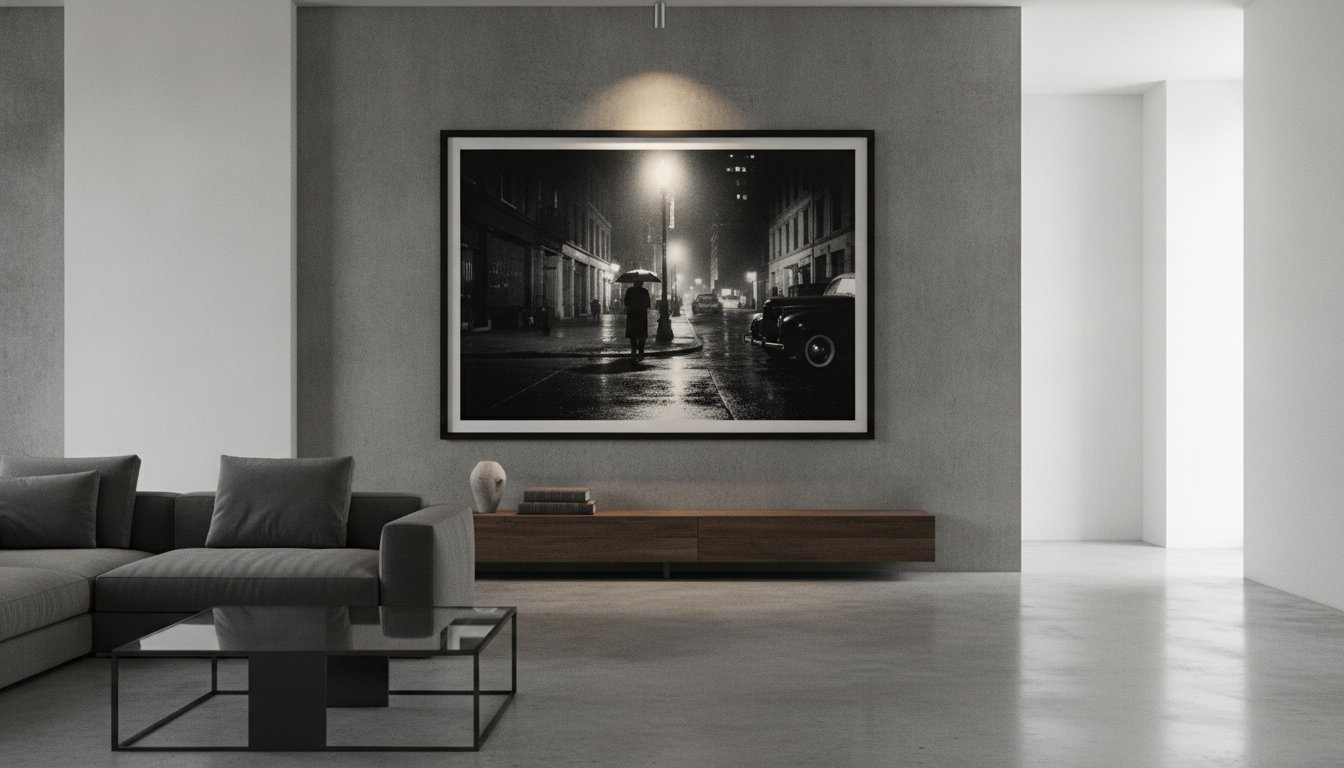
While most photographers of the 1940s sought beauty in the light, Arthur Fellig, the man known as Weegee, found his masterpiece in the flash-scorched shadows of a New York crime scene. He didn’t just document the city; he exposed its raw, unscripted theatre through a lens that felt both intrusive and deeply human. Today, the transition from the frantic pace of the daily tabloid to the quiet prestige of collectible photographic prints marks a profound shift in how we value these moments of urban history.
You likely recognize the grit and the high-contrast drama of his work, yet it’s often challenging to distinguish between mere sensationalism and the technical mastery required to capture the night. This article explores the cultural impact of Weegee’s nocturnal world, offering a deep understanding of why his work remains a cornerstone of photographic heritage. We’ll examine the artistry behind his most famous shots, provide inspiration for displaying these historic black and white prints in a modern space, and discuss the enduring investment value of an archive that continues to captivate the global art market in 2026.
Key Takeaways
- Uncover the myth of Arthur Fellig, the self-taught photographer whose uncanny ability to arrive first at crime scenes earned him the moniker “Weegee” and defined a new era of urban realism.
- Explore the “Naked City” aesthetic, a high-contrast noir style that elevated the grit of mid-century New York into a sophisticated and evocative form of visual storytelling.
- Gain insight into the technical precision of the 4×5 Speed Graphic camera and the innovative use of the flashbulb to create a stark, theatrical light in the dead of night.
- Discover the curatorial process of selecting Getty Images Gallery prints to ensure your collection reflects the authentic heritage of Weegee’s most iconic New York moments.
- Understand how museum-grade archival paper and bespoke framing serve as the essential bridge between historical tabloid imagery and contemporary fine art.
Who was Weegee? The Legend of Arthur Fellig
Arthur Fellig wasn’t just a photographer; he was a carefully constructed persona that blurred the line between newsman and artist. Born in 1899 in what is now Ukraine, he arrived in New York as a child, eventually finding his calling in the city’s frantic press rooms. By the 1930s, he had carved out a niche that no one else could touch. He was the only freelance press photographer granted permission to install a police radio in his car, essentially turning his Chevrolet into a mobile darkroom and office. This allowed him to arrive at fires, accidents, and crime scenes often before the authorities themselves, capturing the raw, bleeding edges of the city. He didn’t just witness the news; he lived within the heartbeat of the precinct, positioning himself as a guardian of the city’s most visceral moments.
The Origins of a Pseudonym
The name “Weegee” is inseparable from the myth he cultivated throughout his career. It’s widely believed to be a phonetic rendering of “Ouija,” a nod to his seemingly psychic ability to sense a story before it broke. While he leaned into this supernatural reputation, it was also a brilliant exercise in branding. In the cutthroat world of mid-century New York tabloids, he ensured his credit line was as recognizable as the imagery itself. A detailed look at Weegee’s life and career reveals a man who understood that in a city of millions, one had to become a legend to be remembered. His self-stamped “Weegee the Famous” on the back of his work wasn’t just arrogance; it was a declaration of his status as a master of the urban narrative.
The Lower East Side Context
While his crime shots brought him notoriety, his most enduring work often centered on the quiet, desperate humanity of the Lower East Side. The Bowery was his primary canvas. He captured the immigrant experience not with the detached eye of a social scientist, but with the lived empathy of someone who knew those streets intimately. He photographed families sleeping on fire escapes during heatwaves and the weary faces of late-night diners. These images, now available as prestigious Getty Images Gallery prints, serve as a bridge to a vanished era of New York history. They transform the gritty reality of 1940s poverty into a profound artistic statement that resonates with modern collectors. Today, those seeking to invest in photographic heritage often turn to Getty Images Gallery prints of his work to preserve that unpolished energy within a sophisticated, gallery-ready context. This shift from the sidewalk to the gallery wall recognized that Weegee had captured something essential about the human condition that transcended the morning edition.
The ‘Naked City’ Aesthetic: Grit as High Art
Weegee’s visual language was defined by a brutal, high-contrast clarity that transformed the mundane into the monumental. With the 1945 publication of his seminal book, Naked City, he shifted the cultural needle, proving that the flash-blasted reality of a midnight tenement fire could hold the same weight as a classical portrait. His work wasn’t merely reporting; it was a psychological excavation of urban life. By capturing the city in its most vulnerable states, he invited a voyeuristic gaze that forced viewers to confront the raw, unpolished truth of their own environment. This approach raised enduring questions about the ethics of the urban eye, yet it was this very intrusion that allowed him to document the soul of New York with such haunting precision.
The Cinematic Influence of Noir
The interplay of light and shadow in Weegee’s work directly informed the visual vocabulary of 1940s Hollywood. His signature style, characterized by stark white highlights against ink-black backgrounds, mirrored the burgeoning Film Noir genre. Directors and cinematographers looked to his images of wet pavements and rain-slicked alleys to find the authentic “noir” look. This wasn’t a coincidence; the heavy-duty flash bulbs he utilized created a theatrical artificiality that turned every street corner into a stage. Later in his career, he moved to Hollywood, serving as a consultant and even an actor, ensuring that the fictional grit of the silver screen matched the reality he had documented on the streets of New York. Collectors who acquire Getty Images Gallery prints of these works often find they possess a cinematic quality that anchors a room with dramatic, narrative weight.
Beyond the Crime Scene
While the sirens and strobe lights of the precinct were his primary focus, Weegee’s lens was equally fascinated by the “human menagerie” of the city’s private moments. He photographed lovers entwined in the back rows of movie theaters and crowds of thousands at Coney Island, treating each subject with a mixture of curiosity and profound empathy. These images capture the vulnerability of the sleeper and the uninhibited joy of the beachgoer, moving beyond the sensational to the sociological. By turning his camera away from the tragedy to face the onlookers, Weegee effectively immortalized the voyeuristic pulse of the city, documenting the spectator’s face as the true mirror of the event.
If you’re looking to bring this historic intensity into your own collection, exploring our curated selection of Getty Images Gallery prints offers a direct link to this era of unparalleled visual drama.
Technical Mastery: The Speed Graphic and the Flash
Weegee’s haunting aesthetic wasn’t merely a byproduct of chance; it was the result of a deliberate, heavy-duty technical setup that allowed him to conquer the night. His primary instrument was the 4×5 Speed Graphic, a formidable piece of engineering that became the standard for press photographers of the era. This camera was a box of wood and metal, built to withstand the chaotic energy of the New York streets. In the 1930s, capturing sharp motion in low-light conditions was an immense technical challenge, as film speeds were slow and lenses lacked the sophisticated coatings of modern optics. Weegee bypassed these limitations through a masterful, if brutal, use of the flashbulb, creating a signature look that defined an entire era of noir photography.
The ‘F/8 and Be There’ Philosophy
The stark, startling depth found in his work is a direct result of his technical discipline. Weegee famously adhered to the “f/8 and be there” mantra, setting his aperture to a mid-range f/8 and pre-focusing his lens to a fixed distance of ten feet. This approach removed the need for fine adjustments at a crime scene, allowing him to fire his shutter the moment he arrived. The powerful flashbulbs he used acted as a miniature sun, blasting the immediate foreground with light while the background dissolved into an inky, impenetrable black. This created a flat, theatrical perspective that made his subjects pop with an almost three-dimensional intensity, a quality that remains a hallmark of authentic Getty Images Gallery prints today.
The Artisanal Darkroom Process
Speed was Weegee’s primary currency, and to maintain his edge, he transformed the trunk of his Chevrolet into a mobile darkroom. This “trunk-lab” allowed him to develop negatives and produce wet prints while still on the scene, ensuring he was the first to deliver imagery to the tabloid editors. This rushed, artisanal process often introduced a specific chemical grit and texture to the negatives, a tactile history that is meticulously preserved in modern reproductions. When collectors invest in Getty Images Gallery prints, they aren’t just buying an image; they’re acquiring a piece of history that respects the original grain and the volatile conditions of its creation.
- The 4×5 Speed Graphic provided a large negative size, ensuring high resolution even in grainy conditions.
- Single-use flashbulbs were essential for freezing action in the dead of night.
- Mobile development allowed for an immediate bridge between the street and the printing press.
Modern museum-quality archival paper ensures that the raw, unpolished energy of his “trunk-lab” development is translated into a stable, lasting piece of art for the contemporary interior.
Iconic Works: From Tenement Fires to Coney Island
Weegee’s portfolio represents a relentless pursuit of the city’s many faces, moving far beyond the blood-stained sidewalks of the morning edition. His most celebrated work, The Critic (1943), serves as a masterclass in social juxtaposition. In this frame, two socialites, dripping in diamonds and fur, are confronted by a disheveled onlooker outside the Metropolitan Opera House. It’s a biting commentary on the chasm between New York’s elite and its marginalized citizens. Similarly, his 1940 photograph of Coney Island captures a literal sea of humanity, where nearly a million beachgoers merge into a single, pulsating organism of summer relief. These images are now preserved as high-fidelity Getty Images Gallery prints, allowing collectors to own a piece of this vanished social landscape.
Social Commentary through the Lens
Weegee possessed a rare ability to capture raw emotion during moments of extreme duress, particularly in his coverage of tenement fires. Rather than focusing on the flames, he turned his lens toward the faces of the displaced, recording a level of empathy that transcends mere sensationalism. His Opening Night at the Opera series further explored these class tensions, documenting the performative nature of wealth with a discerning, often cynical eye. This focus on the human condition is part of The Timeless Allure of Black and White Pictures, where the absence of color forces the viewer to engage directly with the narrative weight of the scene. He didn’t just take pictures; he curated the soul of the street.
The Architecture of the Night
In Weegee’s world, the city itself became a living character, a labyrinth of shadows and steel. He used his flash to isolate subjects against the vast urban dark, creating a sense of isolation even in a city of millions. Whether it was a lone drunkard on a Bowery stoop or the silhouette of a fire escape against a charcoal sky, his work provides a definitive historical record of mid-century New York. For those building serious Fine Art Photography collections, his architectural studies offer a bridge between street reportage and formalist composition. Every shadow tells a story of a city that was as brutal as it was beautiful.
The enduring power of these Getty Images Gallery prints lies in their ability to make the past feel startlingly present. You can explore our full archive and acquire your own museum-quality Weegee print to anchor your home with a piece of photographic history.
A Collector’s Guide: Displaying Weegee in a Modern Space
Weegee’s photography possesses a rare, raw magnetism that transforms a room. While his subjects were often found in the darkest corners of the city, the resulting Getty Images Gallery prints are now recognized as sophisticated additions to high-end residential and commercial spaces. The transition from a 1940s tabloid “press shot” to a contemporary focal point is achieved through a meticulous curatorial process. By utilizing museum-quality archival paper, these historic archives are elevated into permanent works of art that command attention without overwhelming a modern aesthetic. It’s a deliberate choice for the collector who values narrative depth alongside visual impact.
The Power of Black and White
The inherent versatility of monochrome art allows Weegee’s work to integrate seamlessly into a wide variety of contemporary color palettes. Whether placed within a minimalist setting or a warm mid-century modern environment, the high-contrast drama of his noir style provides a necessary visual anchor. A single, large-scale print can serve as a bold conversation piece, while a curated gallery wall of street photography creates a compelling narrative of urban history. A deep black frame effectively anchors the startlingly high-contrast whites of a Weegee print, providing a sophisticated bridge between the grit of the subject matter and the elegance of a curated interior. This balance ensures the work feels like a timeless heirloom rather than a historical relic.
Investing in Photographic Heritage
Investing in physical Getty Images Gallery prints offers a tactile connection to history that digital imagery simply cannot replicate. There is a palpable sense of permanence in the texture of a premium print, reminding the collector of the artisanal craftsmanship required to preserve these original source materials. As market activity in 2026 demonstrates a continued appreciation for Weegee’s critique of the “spectacle,” owning a piece of his archive is as much a cultural investment as it is an aesthetic one. Our bespoke framing service ensures that every piece is protected and presented with the quiet authority it deserves, bridging the gap between the sidewalk and the gallery. To find your next acquisition, explore our curated Fine Art Photography Gallery London for more iconic masters who defined the visual language of the 20th century.
Preserving the Pulse of the Naked City
Arthur Fellig’s journey from the frantic sidewalks of the Lower East Side to the hallowed walls of international galleries is a testament to the enduring power of raw, unscripted truth. By mastering the stark geometry of the night, he created a visual language that continues to influence the worlds of film and fine art. Today, acquiring Getty Images Gallery prints of his most iconic works allows you to bring that visceral energy into your own home, bridging the gap between historical grit and contemporary elegance. These images don’t just document the past; they invite you to experience the city’s soul in its most vulnerable state.
We invite you to Browse our curated collection of Iconic Fine Art Photography to find the perfect piece for your collection. Every acquisition features museum-quality archival giclée prints, supported by our hand-crafted bespoke framing in London. With worldwide shipping on all fine art photography, you can invest in a lasting piece of history that remains as provocative today as it was in the 1940s. Start your journey into the noir world of Weegee and let his legendary lens define your space.
Frequently Asked Questions
What camera did Weegee use for his famous night shots?
Weegee relied on the 4×5 Speed Graphic, a robust press camera that defined mid-century reportage. Its large negative format allowed for exceptional detail even when pushed in the darkroom. He paired this with a high-intensity flashbulb, creating the stark, high-contrast look that characterizes his archive. This combination was essential for freezing motion on the chaotic streets of New York, ensuring every face in the crowd was rendered with startling clarity.
Why is Weegee’s work considered fine art rather than just news?
While his work began as tabloid reportage, it’s considered fine art because of its profound psychological depth and masterful composition. He didn’t just capture events; he captured the human reaction to them. His use of light and shadow anticipated the Film Noir movement, elevating his imagery into a realm of deliberate artistic expression. Today, collectors value these works as masterpieces of the urban soul, transcending their original purpose as morning news.
Where can I buy authentic Getty Images Gallery prints by Weegee?
You can acquire authentic Weegee works through Galerie Prints, which provides direct access to the prestigious archive of Getty Images Gallery prints. We specialize in transforming these historic negatives into gallery-ready art using museum-quality archival paper. Each piece is treated as a lasting piece of history, ensuring that the raw energy of the original shot is preserved for a sophisticated modern interior. We provide global shipping and a bespoke framing service in London.
What does the name ‘Weegee’ actually mean?
The name’s a phonetic spelling of “Ouija,” referring to the popular board used for summoning spirits. It was a nickname given to him by fellow photographers who were amazed by his uncanny ability to arrive at crime scenes before the police. Arthur Fellig embraced this persona, often stamping his work “Weegee the Famous.” It became a powerful brand that suggested he possessed a supernatural sense for the city’s next big story.
Is Weegee’s photography still relevant to modern street photographers?
Modern street photographers continue to study his work for its unflinching narrative and bold technical execution. His pioneering use of off-camera flash to isolate subjects in the urban dark remains a cornerstone of the genre. He taught photographers that the story’s often found in the reaction of the crowd rather than the event itself. His influence is visible in any contemporary work that prioritizes raw, unscripted human emotion over polished perfection.
How should I frame a high-contrast black and white photography print?
High-contrast black and white photography is best served by a frame that anchors its dramatic tones without distraction. A slim, matte black wooden frame is a classic choice that complements the deep blacks of a Weegee print. We recommend using acid-free mounting and museum-quality archival paper to protect the image over time. Our bespoke framing service in London specializes in creating these elegant borders, ensuring your Getty Images Gallery prints are preserved in a gallery-ready format.
What is the ‘Naked City’ in the context of Weegee’s work?
The “Naked City” refers to the title of Weegee’s landmark 1945 book, which served as a definitive visual survey of New York’s nocturnal life. It stripped away the city’s polished facade to reveal the raw, unvarnished reality of its inhabitants. The term eventually became synonymous with the gritty, noir aesthetic he championed. It remains a vital cultural reference point, describing a city that’s exposed, vulnerable, and endlessly fascinating under the glare of a flashbulb.
Did Weegee really have a police radio in his car?
Yes, he was the first freelance photographer in New York to be granted a permit for a police radio. This allowed him to monitor emergency frequencies directly from his car, which he famously equipped as a mobile office and darkroom. By staying tuned to the city’s heartbeat, he could often beat the authorities to the scene. This technical advantage was the secret behind his prolific output and his reputation for being everywhere at once; today, that same spirit of constant vigilance is maintained through high-definition equipment from CCTVSecurityPros – Professional Security Cameras and Systems.