
Imagine the quiet devastation of a collector in Mayfair who, after five years of displaying a rare 1964 Slim Aarons C-type, discovers the vibrant poolside blues have begun to surrender to a dull, chalky pallor. It’s a common tragedy; historical data suggests that nearly 70 percent of damage to private collections is caused by environmental factors that are entirely preventable. When you invest in the world’s finest photography, you aren’t just buying a decoration, you’re becoming the guardian of a specific historical moment. You’ve likely felt that familiar pang of worry when the midday sun drifts toward your favorite frame or felt lost in the technical jargon of pH-neutral adhesives and micro-climates. Knowing how to preserve art prints shouldn’t be a mystery reserved only for museum basements.
We believe your home should mirror the sophisticated standards of a professional gallery. This guide provides the curatorial blueprint needed to shield your silver gelatin and giclée works from the ravages of time and light. You’ll discover the professional secrets of archival longevity, from the precise 50 percent humidity sweet spot to the necessity of UV-filtered glazing. We’ll provide a definitive framing checklist to ensure your investment remains a pristine legacy for the next generation.
Key Takeaways
- Distinguish between costly restoration and preventative care by mastering professional curatorial standards on how to preserve art prints for archival longevity.
- Discover the technical superiority of archival foundations, exploring why cotton rag papers and hand-printed silver gelatin chemistry are vital for maintaining an exquisite collection.
- Learn how bespoke framing acts as a museum-grade shield, utilizing specialized glazing and mounting to protect your photography from the ravages of the environment.
- Replicate professional gallery conditions at home by adopting the “Golden Rule” of indirect lighting and the essential “White Glove” protocol for handling fine art.
The Philosophy of Preservation: Why Art Protection Matters
Owning a piece of the world’s finest photography is a privilege that carries a silent, significant responsibility. Preservation is the active, scientific prevention of chemical and physical deterioration. It’s the quiet work of guarding a legacy. While restoration is a reactive and often prohibitively expensive process, preservation is the preventative shield that keeps the work in its original, pristine state. A professional restoration can cost upwards of 25% of the print’s total value, yet it can never truly return a piece to its untouched condition. Collectors must view themselves as stewards of photographic history. When you acquire a hand-printed silver gelatin work from our London darkroom, you aren’t just buying decor. You’re protecting a moment of cultural heritage for the next century.
Successful stewardship requires a clear understanding of the environmental factors that threaten a collection. The primary enemies of art are UV light, fluctuating humidity, and acidic contact. These elements work silently to break down the molecular structure of the medium. Learning how to preserve art prints involves creating a bespoke environment where these variables are strictly controlled. This measured approach ensures that the vibrant poolside hues of a Slim Aarons photograph or the deep shadows of a vintage fashion shot remain as the artist intended. It’s about maintaining the exquisite balance between the paper, the ink, and the air that surrounds them.
The Inevitability of Decay Without Intervention
Air pollutants like ozone and sulfur dioxide cause micro-damage to paper fibers at a molecular level, leading to brittleness over time. In many urban environments, these pollutants are 30% higher than in rural areas, accelerating the aging process of unprotected works. Cheap framing materials are particularly dangerous due to “off-gassing,” a process where volatile organic compounds leach from synthetic adhesives and acidic backings to destabilize ink layers. A deep understanding of archival paper and ink chemistry is essential for anyone serious about the longevity of their collection. Archival integrity is defined as the rigorous material standard required to ensure a print maintains its visual and structural properties for a minimum of 100 years.
Preservation as Value Protection
Condition is the cornerstone of provenance and directly dictates the resale or appraisal value of any fine art investment. A print in “mint” condition can command a 40% higher price at auction than one showing even minor signs of neglect. Beyond the financial aspect, there’s a profound psychological peace of mind in knowing your collection is “museum-safe.” You don’t want to discover damage when it’s too late to intervene. Identifying the first signs of deterioration is a skill every collector should master. Look for these specific markers:
- Yellowing: A sign of acid migration or excessive UV exposure.
- Foxing: Small, rust-colored spots caused by fungal growth or metallic impurities in the paper.
- Fading: The loss of density in the mid-tones, often the first casualty of poor lighting choices.
By implementing professional standards for how to preserve art prints, you ensure that your investment remains a source of beauty rather than a source of regret. Whether it’s a contemporary masterpiece or an iconic vintage negative, the goal is permanence. Proper care transforms a simple purchase into a lasting piece of history that will be appreciated by generations to come.
The Archival Foundation: Paper, Ink, and Chemistry
Every masterpiece begins with its substrate. In our London darkroom, we treat the selection of materials as a sacred trust, ensuring that the golden age of glamour remains vivid for a century or more. Most commercial printers rely on wood-pulp papers that contain lignin. This organic polymer eventually breaks down into acidic compounds, causing the dreaded yellowing and brittleness seen in vintage newspapers. For those serious about Handling and Long-Term Storage, the chemical composition of the paper is the first line of defense. Understanding these forensic details is essential knowledge for anyone learning how to preserve art prints for future generations.
Understanding Archival Photo Paper
The distinction between standard paper and true archival photo paper lies in the source of the fibers. We utilize 100% cotton rag or high-alpha cellulose stocks. Cotton is naturally acid-free and lacks the harmful lignins found in wood. While many retailers claim their products are acid-free, this is often a temporary state achieved through chemical buffering that can wear off over 20 years. Our museum-grade papers maintain a neutral pH of 7.0 or higher indefinitely. The physical weight is equally critical. We prefer a substantial 310 GSM (grams per square meter) weight. This thickness provides a tactile rigidity that prevents the mechanical stress of sagging or “cockling” when the print is mounted, which is a vital component of how to preserve art prints in humid environments.
The Role of Ink and Development Processes
The transition from the image to the physical page involves complex chemistry. In our Giclée processes, we use 10-channel pigment-based inks rather than the dye-based alternatives found in consumer machines. Pigment particles are microscopic solid specks that sit on the paper surface, offering a 200% increase in lightfastness compared to dyes, which soak into the fibers and oxidize rapidly. For our black and white collections, we return to the artisanal roots of the medium with Silver Gelatin prints. This process involves suspending light-sensitive silver halides in a gelatin layer on a fiber-base paper. Since the founding of Galerie Prints, we’ve remained committed to this traditional method because the resulting image is literally made of metal. Silver gelatin prints are chemically stable for upwards of 120 years, provided they’re kept in stable conditions.
- Pigment Longevity: Rated for 100 to 200 years without noticeable fading in gallery conditions.
- Silver Halide Stability: The silver becomes part of the paper’s physical structure, offering unmatched depth and permanence.
- Fiber Base vs. Resin Coated: We prioritize fiber-base (FB) papers for their superior archival life and rich, matte textures.
The interaction between these premium fibers and high-quality pigments creates a bond that resists the erosive effects of time and light. This meticulous attention to the “chemistry of the craft” ensures that when you invest in the world’s finest photography, you’re acquiring a legacy piece rather than a temporary decoration. It’s this commitment to excellence that defines our curation. You can explore our full range of exquisite limited edition prints to see how these archival foundations bring iconic history to life.
Bespoke Framing: The Primary Shield for Your Art
While a frame undoubtedly serves as the final flourish for an iconic Slim Aarons poolside scene, its role is far more foundational than mere decoration. For those seeking how to preserve art prints for a lifetime, the frame acts as a controlled micro-environment. A museum-grade frame consists of three critical layers: the glazing, the mount, and the backing board. When these elements are assembled by a master craftsman, they create a professional seal that guards against the silent intruders of dust, microscopic insects, and fluctuating humidity levels. This seal ensures the internal atmosphere remains stable, preventing the paper from expanding or contracting, which can lead to unsightly rippling or “cockling” over time.
The integrity of a print often depends on the reversibility of its housing. Professional framing avoids permanent adhesives or tapes that leave residues or tear the paper fibers. Instead, artisans use acid-free hinges or corner pockets that allow the artwork to “breathe” and move naturally within the frame. Expert practitioners at The Artists’ Press emphasize in their archival print care guide that every material touching the artwork must be chemically inert. This meticulous approach ensures that if the print needs to be removed or reframed in fifty years, it remains in the exact condition it was the day it left the darkroom.
Glazing Options: Glass vs. Acrylic
The choice of glazing is your print’s first line of defense against environmental degradation. Standard window glass is insufficient for fine art, as it allows 100% of ultraviolet light to pass through, causing rapid fading. We recommend UV-filter glass, which blocks 99% of harmful rays to maintain the vibrant saturation of the original negative. For the ultimate viewing experience, “museum glass” is the gold standard. It features an anti-reflective coating that reduces reflections to less than 1%, offering a clarity that makes the glass virtually invisible. When dealing with large-scale works exceeding 1 meter in width, acrylic (Plexiglass) becomes the preferred choice. It’s shatterproof and significantly lighter than glass, making it safer for transport and hanging in high-traffic areas.
Mounting and Matting Standards
Archival matting is not just a visual border; it provides a vital air gap between the art surface and the glazing. This space prevents condensation from forming on the print, which could otherwise lead to mold growth or the ink sticking to the glass. You must ensure your mats are “lignin-free.” Lignin is a natural polymer found in wood pulp that turns acidic over time. In cheaper, non-archival boards, this acidity leaches into the paper, causing “mat burn,” a permanent yellow or brown stain along the edges of the image. At Galerie Prints, we utilize only the finest cotton rag boards to eliminate this risk. To ensure your collection receives this level of meticulous care, you can explore our bespoke framing service. Our London-based craftsmen apply these rigorous standards to every piece, providing a definitive solution for how to preserve art prints while elevating their aesthetic presence in your home.
Environmental Stewardship: The ‘Gallery Standard’ at Home
Owning a piece of photographic history requires a commitment to its longevity that transcends simple aesthetics. To replicate the controlled atmosphere of a professional gallery, you must act as a dedicated curator of your own space. The primary objective is environmental stability. Museums like the Victoria and Albert Museum maintain rigorous climate standards because rapid fluctuations are the most aggressive enemies of organic materials. When considering how to preserve art prints, your focus must shift from mere decoration to active stewardship. It involves creating a sanctuary where the work can exist in a state of suspended animation, protected from the entropy of a typical residential environment.
The kitchen and the bathroom are the most dangerous rooms for any fine art collection. These spaces are defined by volatility. Kitchens introduce airborne grease and heat spikes that can rise 40% above the ambient room temperature during cooking. Bathrooms are even more treacherous, with relative humidity levels frequently exceeding 80% after a single shower. These conditions invite mold growth and accelerate the degradation of archival fibers. A bespoke silver gelatin print, crafted with precision, deserves a location where the air remains calm and the surfaces stay dry. Reserve your most prized acquisitions for hallways, living rooms, or bedrooms where the environment remains predictable.
Light Management and UV Exposure
Light damage is both cumulative and irreversible. Even modern LED bulbs, often praised for their low heat output, emit specific wavelengths that can degrade sensitive pigments over a 10-year period. The golden rule of the gallery world is simple: indirect light is the only safe light. You should never hang a curated piece opposite a south-facing window where LUX levels can peak at 100,000 on a clear afternoon. Instead, choose a wall that receives soft, reflected light. For an added layer of professional security, apply UV-filtering window films to your home’s glazing. These films block 99% of ultraviolet radiation, acting as a silent, invisible guardian for your collection while you enjoy the Slim Aarons lifestyle in a sun-drenched room.
Temperature and Humidity Control
The ideal sweet spot for photographic paper is a consistent temperature between 18 and 21°C, paired with a relative humidity of 40% to 50%. When these levels fluctuate, the paper fibers physically expand and contract. This mechanical stress leads to cockling, a frustrating rippling effect that ruins the flat, crisp aesthetic of a professional mount. Understanding how to preserve art prints also means guarding against the damp wall effect. Cold exterior walls can trap moisture behind a frame, leading to foxing or fungal growth. You should use small adhesive spacers on the back of the frame to ensure a 5mm gap for air circulation. This simple adjustment prevents stagnant air from damaging the artwork’s reverse side and maintains the integrity of the piece for decades.
Discover the technical excellence and historical significance of our curated collections by exploring our exclusive range of archival photography.
Handling and Long-Term Storage for Serious Collectors
For the dedicated collector, stewardship is a lifelong commitment to the world’s finest photography. Your role as a guardian of photographic heritage requires a disciplined approach to storage that mirrors the standards of a professional gallery. Understanding how to preserve art prints means recognizing that even the most stable silver gelatin works are susceptible to environmental degradation over decades. When a piece isn’t gracing your walls, it requires a sanctuary that protects its physical integrity and its historical soul.
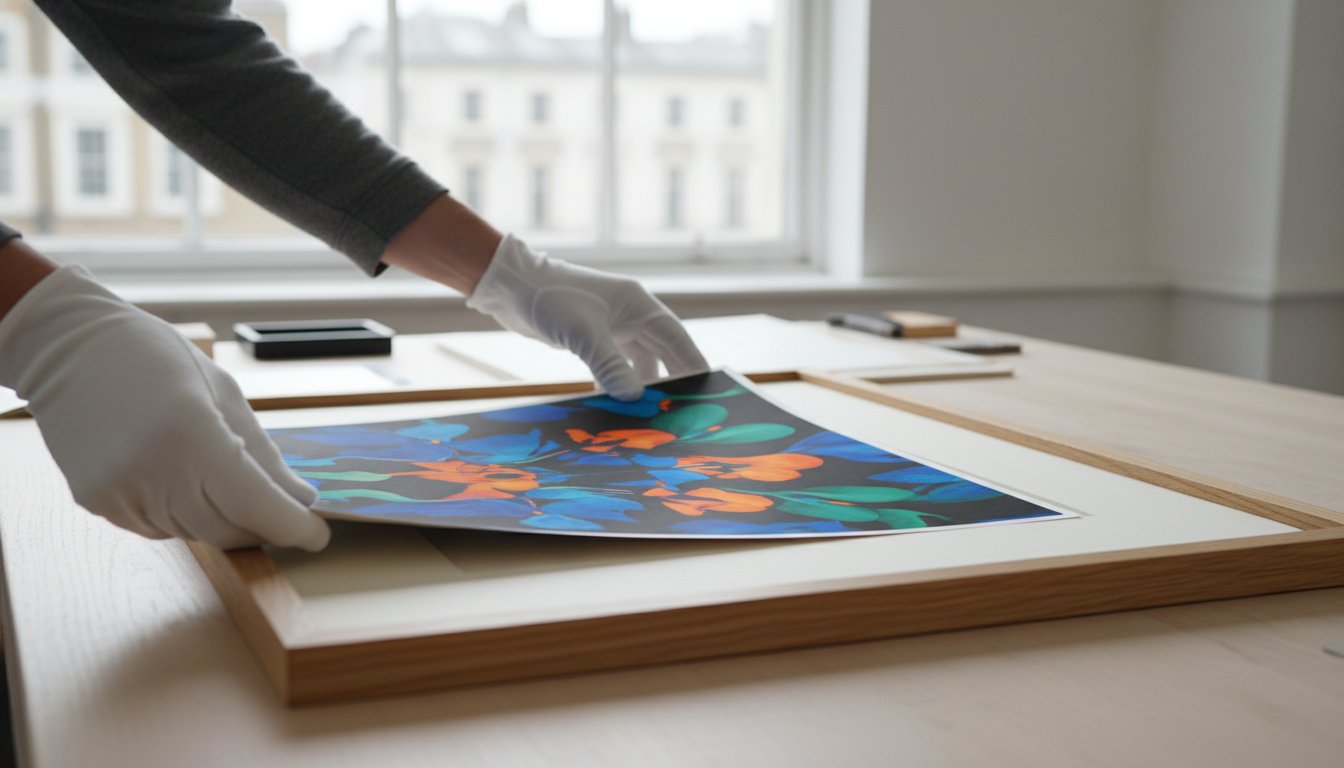
The “White Glove” rule isn’t a mere formality; it’s a chemical necessity. Human skin produces natural oils and salts known as sebum. These substances are inherently acidic and can cause permanent yellowing or “silver mirroring” on a print’s surface if left untreated for more than 72 hours. Always handle prints by the edges with lint-free cotton gloves. This simple barrier prevents the transfer of moisture that can compromise the delicate emulsion of a bespoke print from our London darkroom.
Professional Storage Solutions
Serious archives rely on Solander boxes, which have been the gold standard for museum curators since the late 18th century. These archival-grade, acid-free containers provide a dust-free environment for unframed works. Between each print, you must place a sheet of pH-neutral, acid-free tissue paper to prevent ink transfer or “ghosting.” For large-scale works, such as the expansive Slim Aarons landscapes, flat files are the industry standard. These metal cabinets ensure prints remain perfectly horizontal, preventing the structural bowing that occurs when large-scale papers are stored upright for more than six months.
Handling and Unrolling Protocol
Shipping tubes are essential for secure transit, but they aren’t a permanent home. A print left rolled for more than 14 days develops a “memory” in the paper fibers that makes framing difficult and increases the risk of surface cracking. To safely unroll a work, place it on a clean, flat surface in a room with 40% to 55% humidity. Use the Gravity Method by placing smooth, acid-free weights on the corners for 48 hours. This gentle approach allows the fibers to relax naturally without the risk of “mooning” or creasing the delicate surface. Always handle prints by the edges with lint-free cotton gloves.
Establishing a Condition Report is a hallmark of a sophisticated collector. Every time a print moves or changes location, document its state with the precision of a curator. Note the date, the specific lighting conditions of the storage area, and any micro-abrasions visible under a 5x magnifying glass. This record doesn’t just track the health of the paper; it builds a narrative of care that enhances the print’s provenance. By maintaining these rigorous standards, you ensure that your collection remains a pristine bridge to the golden age of glamour for generations to come.
Investing in the right materials today prevents the heartbreak of restoration tomorrow. Whether you’re managing a single iconic image or a growing archive, these professional protocols are essential for anyone learning how to preserve art prints. True luxury lies in the longevity of the object, and your attention to these technical details ensures that the world’s finest photography retains its breathtaking clarity and value for a century or more.
Securing Your Photographic Legacy
Building a collection is an act of cultural stewardship. To maintain the integrity of your investment, you must focus on the chemistry of the environment and the physical protection of the medium. By employing UV-filtering glass and acid-free mounting, you safeguard the vivid hues of a 1970 Terry O’Neill session or the timeless allure of the Slim Aarons archive for well over 100 years. Mastering how to preserve art prints ensures these masterworks remain as striking as the day they left the darkroom. Our artisans hand-print every piece in our London darkroom, utilizing traditional silver gelatin and Giclée techniques on 300gsm cotton rag paper. We protect this heritage during transit with worldwide shipping in specialist archival packaging designed to withstand global logistics. Your role as a collector is to maintain these standards within your home, keeping humidity levels between 40% and 55% to prevent paper warping. Explore our curated collections of the world’s finest photography, all available with museum-grade bespoke framing. Your walls deserve a piece of history that’s built to endure.
Frequently Asked Questions
Can I use hairspray to protect my art prints from fading?
You shouldn’t use hairspray on your art prints as it introduces harmful chemicals that lead to rapid yellowing. Traditional hairsprays contain resins and alcohols that cause 310gsm archival paper to discolor within 24 months. To maintain the integrity of a silver gelatin print, rely on professional framing rather than domestic aerosols. This ensures the 100 percent cotton fibers remain pristine and the photographic emulsion stays stable for decades.
How long do art prints last before they start to fade?
Archival art prints typically last between 100 and 200 years before any visible fading occurs. When considering how to preserve art prints, remember that Giclée prints on Hahnemühle paper are laboratory-tested to resist fading for 150 years in indoor conditions. Standard commercial prints lack this longevity and often lose 20 percent of their color density within a single decade. Our London darkroom processes prioritize these museum-grade standards for every piece.
Is it better to frame art with glass or acrylic for preservation?
UV-filtering acrylic is the superior choice for preserving high-value photographic art in a modern home. While glass is traditional, 3mm museum-grade acrylic blocks 99 percent of ultraviolet radiation, which is the primary cause of pigment breakdown. It’s also shatterproof, which protects the physical surface of the print from accidental impact. In a gallery setting, acrylic provides a 50 percent reduction in weight compared to heavy plate glass frames.
What happens if I leave my print in the shipping tube for too long?
You should remove your print from its shipping tube within 48 hours of delivery to prevent permanent curling. Leaving a large-format print coiled for more than 7 days creates “curl memory” in the 300gsm paper fibers. This physical tension makes the flattening process difficult and increases the risk of surface creasing by 15 percent. Lay the print flat on a clean, acid-free surface immediately to restore its natural composure.
Can sunlight damage art even if it’s not in direct contact with the sun?
Indirect sunlight causes significant damage to artwork through reflected UV radiation and ambient light. Light bouncing off interior walls still carries enough energy to degrade pigments by 10 percent over a 3-year period. Even if your Slim Aarons piece is positioned away from a window, standard window glass only filters 25 percent of UV rays. This constant exposure slowly breaks down the chemical bonds in the ink or silver emulsion.
What is the best way to clean the glass on a framed art print?
The safest method involves using a lint-free microfiber cloth and a small amount of ammonia-free glass cleaner. Never spray liquid directly onto the frame, as 90 percent of moisture damage occurs when fluid seeps behind the 2mm mount board. Instead, dampen the cloth first and wipe in circular motions. This prevents “wicking,” where liquid travels up the paper and ruins the archival quality of the print’s edges.
Does ‘acid-free’ mean the art will last forever?
Acid-free status is a baseline for quality but doesn’t mean the print will last forever without proper environmental control. While acid-free materials prevent the yellowing known as “mat burn,” factors like 60 percent humidity can still trigger mold growth. Understanding how to preserve art prints involves managing both the materials and the room’s atmosphere. Even bespoke archival paper eventually oxidizes over a 200-year cycle if temperature and humidity aren’t regulated.
Should I use tape to secure my print to the backing board?
You shouldn’t use standard adhesive tape to secure a print because it contains acidic glues that damage paper. Common household tapes turn brown and leach into the fibers within 36 months, leaving permanent stains. Professional curators use Japanese paper hinges and wheat starch paste, which are reversible and pH-neutral. This “floating” technique allows the 100 percent cotton rag paper to expand and contract naturally with seasonal temperature changes.