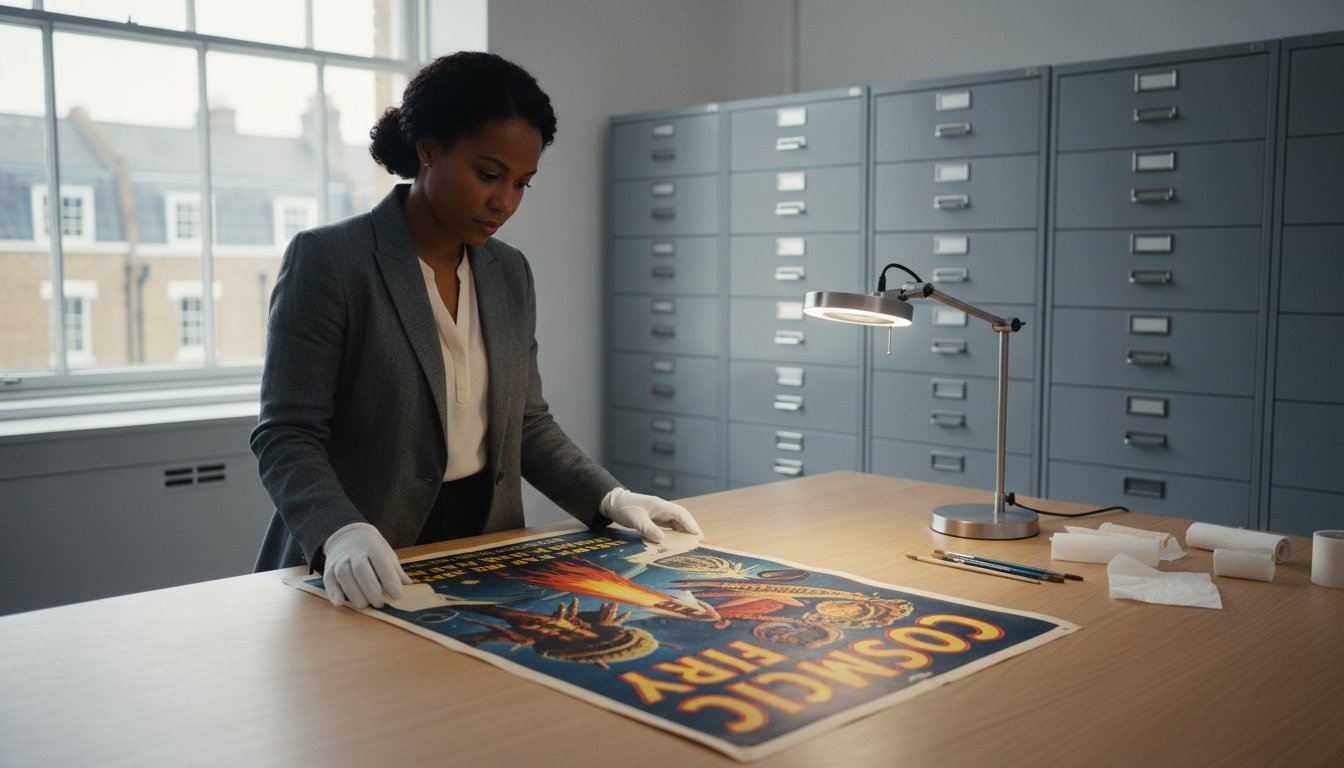
Tag: Film Memorabilia

How to Spot a Fake Movie Poster: The Collector’s Guide to Authenticity

That pristine, mint-condition one-sheet you found for a bargain price is likely a ghost. In a market where counterfeit goods account for over 3% of global trade, the line between a cinematic relic and a high-resolution lie has never been thinner. You understand that a true theatrical poster is more than just marketing; it’s a preserved moment of cultural history. Still, the fear of overpaying for a digital reproduction means you must learn how to spot a fake movie poster before the ink even dries on the transaction.

This guide will help you master the art of poster forensics, allowing you to distinguish genuine cinematic heritage from modern imitations with absolute confidence. We’ll examine the tactile differences in paper stock, the evolution of international size standards, and the specific markers of authenticity that define a museum-quality artifact. By the end, you’ll understand how to decode industry jargon like NSS and GAU while finding the trusted sources your collection deserves. It’s time to move beyond the uncertainty of the marketplace and embrace the discerning eye of a true curator.

Key Takeaways

  • Distinguish between theatrical originals, commercial reprints, and late-date restrikes to ensure your collection holds genuine historical value.
  • Master the art of physical forensics, learning how to spot a fake movie poster by examining the specific texture, ink absorption, and distinct aroma of vintage paper stocks.
  • Decode the authoritative markers of the past, such as National Screen Service (NSS) codes and GAU logos, which serve as the DNA of a true cinematic relic.
  • Navigate the complexities of online acquisitions by identifying red flags like “too good to be true” price points and the absence of high-resolution material evidence.
  • Protect the integrity of your photographic heritage with bespoke framing techniques designed to mitigate the environmental threats of acidity and light exposure.

Defining the Original: Heritage vs. Modern Reproductions

An authentic movie poster is a survivor of a bygone industrial process. It was never intended for the public to own; it was a transient tool of the cinema trade, printed to be displayed briefly and then discarded. This ephemeral nature is precisely what grants a theatrical original its soul and its market value. Mastering the nuances of paper weight and ink saturation is the first step in learning how to spot a fake movie poster. While a modern reprint might capture the image, it fails to capture the history. Don’t let the glossy finish of a modern reproduction fool you; the truth is almost always written in the texture of the paper and the depth of the lithography.

The “restrike” occupies a complex middle ground in the world of collecting. These are posters printed from the original studio plates but at a significantly later date, often years after the film’s premiere. While they possess a certain technical lineage, they lack the “first-breath” historical weight of a contemporaneous release. In 2026, the market has seen an influx of “vintage style” posters that use sophisticated digital aging techniques to mimic the look of a genuine artifact. These deceptive fakes are designed to exploit the nostalgia of new collectors, making a foundational understanding of Film poster history and collecting more vital than ever.

The Three Pillars of an Original Poster

  • Theatrical Releases: These are the gold standard, issued by the National Screen Service (NSS) or the studios themselves specifically for use in cinema lobbies.
  • Advertising Posters: This category includes wilding and transit posters, which were designed for high-impact public display on city streets or in subway stations.
  • Studio-Issued Exclusives: These are rare, limited runs produced for industry insiders, premiere events, or specific promotional campaigns.

Reproduction vs. Counterfeit: Knowing the Intent

It’s vital to distinguish between a licensed commercial reproduction and a deliberate counterfeit. Commercial reprints are often sold openly as home decor; they are honest about their nature and usually include a small copyright line or a “printed by” credit in the fine print at the bottom. A counterfeit, however, is a deceptive attempt to mimic the weight, fold lines, and specific paper aroma of a vintage piece, making it difficult for the untrained eye to know how to spot a fake movie poster without professional guidance. Contextualizing your find within a broader collection of cinema lobby cards can help you develop a sharper eye for the specific printing techniques used by studios during different eras. Owning a piece of genuine cinematic heritage is a bridge to the past, offering both an emotional connection to the film and a stable investment in the history of art.

Physical Forensics: The Texture and Ink of History

To hold a vintage theatrical release is to touch the industrial history of cinema. Collectors often focus on the image, but the material composition of the paper tells the true story of its origin. Before the mid-1980s, posters weren’t printed on the thin, glossy, acid-heavy stocks common in today’s retail shops. Instead, they were rendered on heavier, more porous paper that possessed a specific “tooth” or texture. When you’re learning how to spot a fake movie poster, your fingertips are often as reliable as your eyes. Genuine vintage paper has a matte quality that absorbs light rather than reflecting it harshly, a characteristic that defines the art of the movie poster as a physical artifact.

There is also the matter of the “scent of age.” Authentic wood-pulp paper from the mid-20th century undergoes a slow chemical breakdown that releases a faint, sweet, vanillin aroma. Modern digital reproductions, by contrast, often smell of chemical solvents or nothing at all. Another counterintuitive marker is the fold. Until the early 1980s, the National Screen Service sent posters to theaters machine-folded. While a pristine, rolled poster might seem more desirable, a set of crisp, authentic machine folds is often a badge of legitimacy that a modern forgery cannot easily replicate without looking forced.

The Halftone Pattern Investigation

A simple magnifying glass reveals the secrets of the printer’s plate. Modern fakes are almost universally created using digital inkjet or laser processes, which leave a telltale “matrix” of uniform, circular dots. In contrast, vintage lithography displays a more organic, randomized grain. In early stone lithography, you might even see the subtle “bleeding” of ink where colors meet, a beautiful imperfection that signals artisanal production. Understanding these microscopic details is essential for anyone serious about how to spot a fake movie poster in an increasingly digital marketplace.

Standard Dimensions and the British Quad Factor

Size is the most common stumbling block for the novice collector. For decades, the standard US One-Sheet measured 27×41 inches, only shifting to the modern 27×40 standard in the mid-1980s. If you encounter a “vintage” 1970s poster measuring exactly 27×40, it’s a definitive red flag. Similarly, the British Quad, a landscape-format 30×40 inch gem, is frequently targeted by counterfeiters who produce slightly off-size versions. Much like the precision required in fine art photography, the exactness of these dimensions serves as a seal of quality. Be wary of trimmed edges; while common in older pieces to fit specific frames, they can also be used to hide the absence of printer credits or date stamps. For those looking to build a collection with absolute certainty, exploring a curated selection of vintage movie posters from a trusted gallery ensures that the material integrity of your investment is never in question.

The Marks of Authority: NSS Numbers and GAU Logos

Authenticity in cinema art often hides in the smallest bureaucratic details. Beyond the tactile allure of vintage paper, a collector must scrutinize the “bureaucratic DNA” printed along the bottom borders of a sheet. These markings were never intended for the eyes of the casual viewer; they were the logistical fingerprints of a global distribution machine. Understanding these codes is a vital skill when learning how to spot a fake movie poster, as forgers frequently stumble when replicating the specific fonts and technical sequences of the mid-20th century. While a high-resolution scan can mimic an image, it rarely captures the sharp, distinct character of a genuine National Screen Service stamp or a microscopic union bug.

The National Screen Service (NSS) Legacy

From the 1940s through the mid-1980s, the National Screen Service served as the primary engine for movie poster distribution. Their stamp is widely considered the “Gold Standard” of authenticity. Typically, an NSS code follows a Year/Film sequence. For example, a code like “77/21” indicates a film released in 1977, with that specific title being the 21st assigned code of that year. It’s a common misconception that every original must possess an NSS number. While most theatrical releases do, studio-issued exclusives and certain international versions might legitimately lack these marks. A sophisticated forgery, however, might include a forged NSS number that uses a modern, digitally rendered font rather than the specific, slightly imperfect typeface of the original printing plates.

Union Bugs and Studio Logos

The Graphic Arts Union (GAU) logo, often referred to as a “union bug,” is a tiny stamp with massive implications for the serious collector. This microscopic detail is a signature of the artisanal labor involved in traditional lithography. Because fakers often rely on digital scans of original posters, these tiny logos frequently appear “muddy” or blurry on a reproduction. In contrast, on a genuine artifact, the GAU bug remains crisp and legible under a magnifying glass. Studio-specific markings also offer clues. MGM, Paramount, and Warner Bros. each maintained their own idiosyncrasies regarding copyright placement and logo design. Modern decorative reprints often omit these fine-print details entirely or place them in the wrong position relative to the artwork. This contrast is even more evident when examining cinema lobby cards, which utilized their own unique numbering systems and border designs. By cross-referencing these authoritative marks, you can move beyond guesswork and develop the discerning eye required to know how to spot a fake movie poster with absolute certainty.

The Marketplace Trap: Red Flags in Online Auctions

The digital marketplace is a landscape of beautifully rendered deceptions where the allure of a bargain often masks a modern reproduction. While global trade in counterfeit goods reached an estimated 3.3% in 2023, the niche world of cinema memorabilia is particularly vulnerable to sophisticated forgeries. Understanding how to spot a fake movie poster in this environment requires a healthy dose of skepticism regarding price and provenance. Rare titles from the golden age of Hollywood don’t appear at bargain-basement prices without a significant, often hidden, reason. If the cost feels like a fraction of the established market value, you aren’t looking at a lucky find; you’re likely looking at a digital lie.

Common Scams on eBay and Flea Markets

The “found in an attic” narrative is the oldest trope in the collector’s world. It serves as a convenient fiction to explain away the lack of provenance or the presence of suspicious wear. Be particularly wary of items listed in “mint condition” if they claim to be 50 years old. A theatrical poster was a working tool, and even those that were never displayed usually show some degree of handling wear or minor edge fraying. Furthermore, many sellers misrepresent “video posters” as theatrical originals. These were printed in large quantities for rental shops in the 1980s and 1990s; while they are technically vintage, they lack the rarity and investment value of a true cinema release.

Buying with Confidence: The Gallery Advantage

The role of a curator is to act as a guardian of photographic and cinematic heritage. In a high-end gallery setting, every item undergoes a rigorous verification process that goes far beyond a cursory glance. Certificates of authenticity are a common industry standard, but they are only as reliable as the reputation of the issuing institution. A robust return policy is also essential, providing the peace of mind necessary when investing in high-caliber visual art. For those seeking the security of expert verification, our collection of vintage movie posters offers a sanctuary of authenticated history. By choosing a trusted source, you ensure that your investment is not just a decoration but a lasting piece of cinema’s grand narrative.

Preserving the Icon: Framing and Long-Term Curation

Confirming the authenticity of a cinematic relic is merely the first chapter of the collector’s journey. Once you have mastered how to spot a fake movie poster and secured a genuine piece of history, your role shifts from detective to guardian. The ephemeral nature of vintage paper, originally intended for a few weeks of lobby display, makes it susceptible to the silent ravages of the environment. Without proper intervention, the very elements that grant an original its soul, such as the organic wood-pulp paper and traditional lithographic inks, can degrade into a shadow of their former glory. Preservation is the final, essential step in honoring the heritage of the silver screen.

The transition from a “poster on a wall” to “art in a frame” is a profound aesthetic and functional shift. A professional Bespoke Framing Service acts as a protective seal, creating a controlled micro-environment that shields the work from fluctuating humidity and pollutants. This elevation of the medium reinforces the prestige of your collection, transforming a promotional artifact into a centerpiece of high-end interior decor. By investing in museum-grade presentation, you ensure that the vibrant surrealism or bold typography of your original release remains as evocative as the day it was first printed.

Archival Mounting and Framing

The primary enemies of vintage paper are acid and light. Over decades, standard cardboard backings leach acid into the poster, causing the dreaded “yellowing” and brittleness that can decimate market value. Utilizing strictly acid-free, archival materials is non-negotiable for serious preservation. Similarly, UV-protective glazing is mandatory. Even indirect sunlight can cause light-sensitive lithographic colors to fade, a process that is unfortunately irreversible. It’s also vital to avoid dry-mounting; while it smooths out wrinkles, this permanent adhesion destroys the poster’s integrity and historical value. Reversible archival hinges are the only acceptable method for mounting a rare theatrical original.

Curating Your Own Cinema Gallery

A sophisticated collection is more than a series of individual acquisitions; it’s a narrative of personal taste and cultural history. To create a truly curated aesthetic, consider mixing your vintage finds with high-caliber black and white pictures. This juxtaposition of cinematic art and classic photography adds layers of texture and narrative depth to a room. You might also create a focused visual story by integrating smaller, detailed lobby cards alongside your larger one-sheets. These smaller artifacts often feature unique photographic stills that complement the broader graphic impact of the posters. Even after you’ve learned how to spot a fake movie poster and navigated the complexities of the marketplace, the greatest reward remains the daily, tactile joy of living among authentic pieces of film history. Each frame becomes a window into a bygone era, preserved with the respect and precision that true art deserves.

Securing Your Piece of Cinematic History

True peace of mind comes from partnering with a dedicated guardian of photographic and cinematic excellence. Galerie Prints, under the expert guidance of gallery director Stuart Möller, offers a sanctuary for those who value historical integrity. As specialists in high-end photographic archives and rare memorabilia, we provide a bridge to a bygone era of elegance. Explore our curated collection of authentic vintage movie posters and lobby cards to find your next masterpiece, supported by our worldwide bespoke framing and artisanal delivery. Your collection is a testament to your discernment; let us help you protect and celebrate its future.

Collecting Wisdom: Frequently Asked Questions

Do all original movie posters have a National Screen Service number?

No, not every theatrical original carries a National Screen Service number. While these codes were the hallmark of US distribution from 1940 to the mid-1980s, studio-issued exclusives, premiere-only prints, and international versions frequently bypassed the NSS system. Identifying these exceptions is a key part of learning how to spot a fake movie poster, as the absence of a number doesn’t automatically signal a forgery.

What is the difference between a reproduction and a restrike?

A reproduction is a modern commercial print intended for home decor, whereas a restrike is printed from original studio plates at a later date. Reproductions lack any historical lineage or investment value. Restrikes occupy a curious middle ground; they possess technical authenticity but lack the prestige of a first-release theatrical artifact. Most serious collectors prioritize the contemporaneous release for its cultural significance.

How can I tell if a poster has been artificially aged or tea-stained?

Artificially aged posters often exhibit uneven, blotchy staining that ignores the natural browning patterns of vintage wood-pulp. Scammers using tea-staining or coffee washes often fail to replicate the sweet, vanillin aroma of naturally aged paper. You should also check if the staining appears on both sides; natural aging typically permeates the entire sheet, while artificial washes can leave a telltale clean back.

Why are some original posters folded while others are rolled?

Machine folding was the industry standard for shipping posters to theaters until the early 1980s. A set of authentic, crisp folds is often a badge of legitimacy for mid-century pieces. Rolled posters became the norm as studios transitioned to double-sided printing for lightboxes. Understanding this shift in logistics is essential for anyone researching how to spot a fake movie poster in different era-specific categories.

Are Double Sided posters always original?

No, double-sided printing is not a definitive guarantee of authenticity. While this method became standard for theatrical lightboxes in the early 1990s, counterfeiters have adapted by producing high-quality double-sided fakes. You must still verify the paper weight, ink saturation, and exact dimensions to ensure the piece isn’t a sophisticated modern forgery designed to mimic studio-issued standards.

What are the standard sizes for authentic vintage movie posters?

Standard sizes have evolved, with the US One-Sheet measuring 27×41 inches before 1985 and 27×40 inches thereafter. The British Quad remains a consistent 30×40 inches in landscape format. If you encounter a supposedly vintage 1970s one-sheet that measures 27×40 exactly, it’s a significant red flag. Always use a precision tape measure to verify these historical specifications against the era the poster claims to represent.

Is a movie poster reprint worth any money to a serious collector?

A reprint typically holds no material value for a serious collector. These items are produced in unlimited quantities for the mass market and lack the historical soul of a theatrical original. While they serve as affordable decor, they don’t appreciate in value. Collectors view movie posters as preserved fragments of cinematic heritage, a quality that a modern digital reprint simply cannot replicate.

How does professional bespoke framing affect the long-term value of a poster?

Professional bespoke framing protects the long-term value of a poster by creating a barrier against UV light and acid migration. Using museum-grade glazing and acid-free mounting prevents the irreversible fading and yellowing that destroys paper integrity. It transforms a fragile artifact into a stable, archival piece of art. This conservation ensures your investment remains a pristine legacy for future generations.

Preserving Vintage Movie Posters: A Curator’s Guide to Archival Care

Vintage movie posters were never meant to survive the weekend, let alone a century. These vibrant sheets of “accidental art” were printed on low-quality, acidic paper for short-term promotion, with early print runs before the 1960s often limited to just 3,000 to 5,000 copies. Today, they represent a significant investment, yet they face a constant battle against their own chemical composition. If you feel a sense of urgency about preserving vintage movie posters, you aren’t alone. You recognize that without intervention, sunlight and moisture will inevitably reclaim these pieces of cinematic history.

We understand the anxiety that comes with seeing a beloved 1950s one-sheet begin to yellow or brittle edges start to flake. This guide provides the professional secrets to protecting your collection, from mastering the nuances of ISO 16245:2023 storage standards to understanding why a 150-gram bottle of deacidification spray costs $68.86. You’ll discover how to choose between archival storage and bespoke framing, ensuring your investment achieves the 10% to 15% annual appreciation seen in the current market. We’ll explore the ROI of professional linen-backing and the technical superiority of UV-protective materials to keep your heritage intact for generations.

Key Takeaways

  • Understand why preserving vintage movie posters is an urgent race against the “inherent vice” of the acidic, promotional-grade newsprint used in early cinema history.
  • Identify the primary environmental threats, specifically UV pigment bleaching and humidity-induced cockling, that compromise the structural integrity of your collection.
  • Master the principle of “reversible intervention” to ensure that any preservation step, whether for dark storage or curated display, can be safely undone by future conservators.
  • Evaluate the stabilizing benefits of professional restoration techniques, such as linen-backing and deacidification baths, to neutralize chemical decay and reinforce fragile fibers.
  • Discover how to bridge the gap between historic archives and modern luxury through bespoke archival framing and London-based artisanal craftsmanship.

The Ephemeral Art: Why Preserving Vintage Movie Posters is a Race Against Time

Vintage movie posters occupy a unique space in the art world. We often refer to them as “accidental art,” a term that honors their aesthetic brilliance while acknowledging their humble origins. These vibrant lithographs weren’t created for the hallowed halls of a gallery; they were temporary advertisements, printed on low-grade, acidic newsprint and intended for a brief, two-week theatrical run. Once the film left the cinema, the posters were usually discarded or pasted over, making those that survived rare relics of a vanished era. For the modern connoisseur, preserving vintage movie posters is more than a hobby. It is the active arrest of chemical and physical decay, a process that requires both technical precision and a deep reverence for history.

The primary challenge lies in the “inherent vice” of 20th-century lithography. Because these items were never meant to last, the materials used in their production are often their own worst enemies. As a collector, you serve as a guardian of photographic and cinematic heritage, standing between these exquisite designs and the inevitable march of time. Your role is to stabilize these fragile artifacts, ensuring that the visual narrative of the golden age remains vivid for future generations.

The Chemistry of Decay: Acid, Lignin, and Oxidation

To understand the urgency of preservation, one must look at the molecular level. Most posters from the 1930s through the 1950s were printed on paper containing high levels of lignin, a natural polymer found in wood pulp. Over time, lignin breaks down and creates sulfuric acid, which eats away at the cellulose fibers. This chemical reaction leads to “acid tan,” the characteristic yellowing or browning that can dull the impact of an iconic design. This acidity doesn’t just change the color; it makes the paper incredibly brittle, eventually causing it to crumble at the slightest touch. Posters from this era are significantly more at risk than modern reprints, as they face compounding environmental threats to paper that accelerate this internal oxidation process.

The Impact of Rarity on Preservation Priority

The scarcity of original theatrical posters dictates the level of archival intervention required. When a poster is one of only a handful known to exist, the pressure to stabilize its condition becomes paramount. This rarity is often shared by other ephemeral items, such as Cinema Lobby Cards, which were printed in similarly small quantities and faced the same environmental hazards. In the context of 2026 auction standards, archival integrity is defined as the measurable stabilization of the paper’s pH levels alongside the absolute absence of non-reversible adhesive residues. Maintaining this integrity ensures that the piece retains its historical provenance and its value as a tangible slice of cinematic history.

The Four Great Enemies: Environmental Threats to Your Collection

The survival of a rare lithograph depends entirely on the environment it inhabits. While we admire the vibrant hues of a mid-century classic, invisible forces are constantly working to dismantle its structural and aesthetic integrity. Understanding the four great enemies of paper is essential for anyone committed to preserving vintage movie posters. These threats often operate in silence, making their discovery a matter of “when,” not “if,” unless proactive measures are taken. A gallery-standard approach requires a fortress-like defense against light, moisture, and chemical migration.

Light damage remains the most aggressive of these threats. UV radiation triggers a photochemical reaction that permanently bleaches organic pigments, turning a deep noir shadow into a ghostly grey. This degradation isn’t limited to the sun’s direct rays; indirect ambient light and certain LED spectrums can be just as destructive over time. To combat this, serious collectors rely on bespoke framing services that utilize 99% UV-protective glass. A simple but effective curatorial practice is to rotate your display every six months. This strategy minimizes cumulative exposure and ensures no single piece bears the brunt of a room’s natural light cycle.

Humidity and Temperature: The Micro-Climate

Atmospheric fluctuations present a different kind of danger. When humidity levels rise, paper fibers expand, leading to a wavy distortion known as cockling. Conversely, excessive dryness makes the paper brittle. Professional institutions aim for a “museum standard” micro-climate, typically maintained at 18-20°C with 45-50% relative humidity. Rooms with high moisture volatility, such as bathrooms or kitchens, are absolute no-go zones for cinematic art. High humidity also invites foxing, those unsightly brown spots caused by fungal growth that thrives in damp, stagnant air. Maintaining a stable environment is a non-negotiable pillar of preserving vintage movie posters for the long term.

The Silent Killers: Chemicals and Adhesives

The final enemies are chemical in nature. Off-gassing occurs when non-archival materials, like PVC sleeves or standard cardboard backings, release volatile organic compounds that discolor the paper. Perhaps the most heartbreaking damage comes from improper adhesive tape and acidic mounting boards. These materials migrate into the paper fibers, leaving permanent oily stains and structural weakness. For a deeper dive into professional stabilization techniques, FIAF’s guide to poster preservation offers rigorous standards for handling these sensitive materials. By eliminating these environmental hazards, you ensure your collection remains a pristine bridge to the golden age of glamour.

Archival Storage vs. Bespoke Framing: Choosing Your Preservation Path

The decision between the quiet safety of a flat-file and the radiant presence of a framed masterpiece is one of the most critical steps in preserving vintage movie posters. Central to this choice is the principle of “reversible intervention.” This curatorial standard dictates that any preservation step must be entirely undoable, ensuring the artifact’s future provenance remains untarnished by permanent alterations. Whether you choose the archival portfolio or the bespoke frame, the goal is to arrest decay while honoring the poster’s historical significance.

Flat-File Storage: The Purist’s Choice

For the purist, flat-file storage represents the ultimate commitment to longevity. Utilizing acid-free portfolios and 4 mil Mylar sleeves creates a controlled environment that mimics the archives of the world’s great museums. It’s vital to follow preventive conservation guidelines by storing posters horizontally. Stacking them vertically or leaning them against walls can lead to pressure damage and structural warping over time. When dealing with acidic vintage stocks, interleaving with “buffered” tissue paper provides an essential alkaline reserve to neutralize migrating acids and prevent cross-contamination within a collection.

Museum-Grade Framing: Preservation as Interior Aesthetic

While dark storage offers maximum protection, bringing your collection into the living space adds a layer of sophisticated narrative to your home. Much like collecting fine art photography, displaying vintage cinema art is about celebrating a specific type of aspirational luxury. However, “ready-to-hang” should never be confused with a standard retail frame. Retail frames often use acidic wood-pulp backings and standard glass that offers zero UV protection, essentially accelerating the “acid tan” we discussed in the previous section.

The anatomy of an archival frame is a deliberate engineering feat. It includes spacers, acid-free mats, and UV-glazing. Spacers are non-negotiable; they ensure the paper never touches the glass, preventing “glazing transfer,” a tragic event where the ink physically bonds to the glass surface under fluctuating humidity. Galerie Prints positions its bespoke framing service as the gold standard for London collectors. Our artisans understand that a frame isn’t just a decoration; it’s a stable micro-environment designed for preserving vintage movie posters in style. By utilizing technical superiority in mounting, we bridge the gap between historic archives and modern luxury interiors.

Professional Restoration: When to Linen-Back or Deacidify

There comes a moment for every collector when simple storage is no longer enough to halt the march of time. When a fragile sheet begins to show the structural fatigue of its “accidental art” origins, professional restoration becomes the preferred path for preserving vintage movie posters. The most recognized method is linen-backing, a conservation process where a poster is meticulously mounted onto a layer of acid-free paper and then onto a heavy cotton canvas. This treatment provides a stable, flat surface that reinforces the paper fibers and allows for safe handling and framing without the risk of further tearing. For a standard American one-sheet, measuring 27″ x 41″, this stabilizing process typically starts at approximately $130, representing a vital investment in the artifact’s longevity.

To address the internal chemical decay, conservators may employ deacidification baths. These treatments neutralize the sulfuric acid that builds up in wood-pulp paper, effectively arresting the brittleness that leads to crumbling edges. While specialized products like “Bookkeeper” deacidification spray are available for smaller interventions at around $68.86 for a 150-gram bottle, a professional bath offers a more comprehensive solution for high-value pieces. It’s essential to remember that even during the evaluation phase, you should always wear white cotton gloves. Skin oils, known as sebum, are naturally acidic and can leave permanent, oxidizing fingerprints that diminish the visual impact of a pristine design.

Identifying “Grade-A” Restoration Candidates

Distinguishing between “character” and “cancer” is the hallmark of a discerning curator. Fold lines, for instance, are often viewed as character flaws, they tell the story of a poster’s journey from the studio to the local cinema. In contrast, active mold, foxing, or the oily stains left by yellowed cellotape are cancerous flaws that require immediate professional intervention. In the 2026 market, the transparency of the restoration process is paramount to maintaining provenance. The Rule of Reversibility dictates that every professional intervention, from the wheat starch paste used in lining to the aqueous deacidification bath, must be entirely removable by future conservators without altering the original artifact.

Restoring Cinema Lobby Cards and Small Format Prints

Smaller format items require a different tactical approach due to their heavier card-stock composition. When restoring items like black and white pictures or early silver gelatin stills, the focus shifts to preserving the “ink-rich” texture and the specific tactile quality of the card. Edge wear and corner pinholes can often be stabilized without a full linen-backing, allowing the piece to retain its original weight while preventing further fraying. If you’re looking to elevate your collection with museum-grade protection, explore our bespoke archival services to ensure your cinematic heritage is curated with the technical excellence it deserves.

Galerie Prints: A Legacy of Archival Excellence and London Craftsmanship

Galerie Prints operates as the definitive bridge between the fragile history of the cinematic archive and the refined aesthetics of the modern luxury home. We don’t merely offer prints; we act as guardians of photographic and cinematic heritage. Our commitment to preserving vintage movie posters is rooted in our London darkroom heritage, where technical precision meets artisanal perfection. This dedication ensures that every piece of “accidental art” we curate is treated with the reverence it deserves, transforming a temporary advertisement into a permanent masterpiece for your interior.

By merging the technical nuances of darkroom chemistry with a modern passion for décor, we provide a stable future for these ephemeral works. Whether you are acquiring a classic lithograph or a piece of iconic Slim Aarons photography, you’re investing in a legacy that has been meticulously protected against the environmental threats discussed throughout this guide.

The Galerie Prints Bespoke Framing Process

Our bespoke framing service is engineered as a preventative masterpiece. While many retail solutions prioritize speed, our London-based artisan framers focus on museum-quality longevity. We utilize acid-free mounting and 99% UV-filtering glass to create a sealed micro-environment that halts the oxidation and pigment bleaching common in older paper stocks. Every frame is a bespoke creation, designed to ensure the poster never makes contact with the glazing, thus eliminating the risk of ink transfer.

This “ready-to-hang” philosophy offers luxury convenience without compromising archival safety. We handle the complex requirements of preserving vintage movie posters so that you can simply enjoy the visual impact. Our craftsmen treat every poster as a unique piece of history, applying the same rigorous standards to a 1970s Star Wars limited edition as they would to a rare 1930s noir one-sheet.

Investing in the World’s Finest Photography

Acquiring art from a curated gallery is the only way to ensure the long-term provenance and physical stability of your collection. At Galerie Prints, we provide expert consultation for serious collectors, helping you navigate the choice between flat-file storage and high-end display. Our worldwide shipping ensures that these preserved pieces of history arrive in pristine condition, regardless of your location. Don’t just buy a print; invest in a piece of preserved history that will continue to inspire wonder for generations. Explore our archives today and discover why we are the premier destination for “the world’s finest photography.”

A Lasting Legacy for Your Cinematic Heritage

The journey of an original theatrical poster, from a temporary advertisement to a piece of high-end art, is a testament to the enduring power of film. By mastering the nuances of environmental control and understanding the chemical vulnerabilities of mid-century paper, you transition from a casual owner to a dedicated guardian. Whether you opt for the purist safety of flat-file storage or the evocative presence of museum-grade framing, your commitment to preserving vintage movie posters ensures these cultural artifacts remain vibrant for the 10% to 15% annual market appreciation seen in recent decades.

At Galerie Prints, we honor this dedication through technical superiority and artisanal craftsmanship. Our collections are trusted by international archives and discerning private collectors who seek more than just a decoration. Every frame we produce is a hand-crafted masterpiece from our London darkroom, utilizing only museum-grade archival materials to halt the “inherent vice” of aging paper. We invite you to Explore our Curated Collection of Vintage Cinema Art & Bespoke Framing and invest in a piece of history that has been secured for the future. Your collection is a bridge to the golden age of glamour; it’s time to ensure it never fades.

Frequently Asked Questions

Can I use regular glass for my vintage movie poster?

Regular glass is insufficient for protecting your investment because it offers no defense against ultraviolet radiation. UV light triggers a photochemical reaction that causes irreversible pigment bleaching, turning vibrant cinematic hues into ghostly shades. For any bespoke framing project, we insist on 99% UV-protective glass. This museum-grade glazing acts as a vital shield, ensuring the visual narrative of your poster remains as striking as the day it was printed.

What is linen-backing and is it necessary for all posters?

Is it better to store posters rolled or flat?

Storing posters flat is the superior choice for long-term archival care and structural integrity. Rolling puts constant tension on the paper fibers and can lead to permanent creasing or “crushing” if the tube is stored vertically. Flat-file storage in acid-free Mylar sleeves remains the gold standard for serious curators. This method eliminates mechanical stress and ensures the paper remains relaxed, preventing the wavy distortions often seen in poorly stored collections.

How do I tell if my movie poster is printed on acidic paper?

Visual cues such as “acid tan,” a distinct yellowing or browning of the paper, are primary indicators of high acidity. Most theatrical posters produced before the 1960s were printed on low-grade newsprint containing lignin, which creates sulfuric acid as it ages. If the paper feels brittle or the edges flake away at the slightest touch, your poster is likely suffering from the “inherent vice” of acidic chemical decay.

Can a damaged or torn movie poster be fully restored?

Professional conservators can achieve near-invisible results even on posters with severe structural damage. Using non-invasive materials like Japanese tissue and reversible wheat starch paste, experts can bridge tears and reinforce weak areas without compromising the original artifact. This process adheres to the curatorial “Rule of Reversibility,” ensuring that any intervention can be safely undone by future generations of conservators to protect the item’s historical provenance.

Does framing a vintage poster decrease its resale value?

Proper archival framing actually protects and enhances the resale value by stabilizing the poster’s physical condition. Value only diminishes if you use non-archival materials, such as acidic mounting boards or standard adhesives that leave permanent oily stains. By utilizing bespoke spacers to prevent the paper from touching the glass, you avoid “glazing transfer” and ensure your cinematic heritage remains a pristine, market-ready investment for years to come.

What is the best temperature and humidity for a poster collection?

The ideal museum-standard environment is a stable 18-20°C with a relative humidity of 45-50%. These specific conditions are critical for preserving vintage movie posters because they prevent “cockling,” a rippling effect caused by paper fibers expanding in moist air. Maintaining a consistent micro-climate is the best defense against foxing, those unsightly brown spots caused by fungal growth that thrives in damp, stagnant environments.

How often should I check my stored posters for damage?

We recommend a thorough inspection of your stored collection every six months to ensure no environmental shifts have occurred. This semi-annual review allows you to detect early signs of chemical off-gassing or moisture ingress before the damage becomes irreversible. It’s also a perfect opportunity to rotate your displayed items, a strategy that minimizes the cumulative light exposure that even the best UV-protective glass cannot entirely eliminate.

Authentic Cinema Lobby Cards: A Collector’s Guide to Vintage Film Memorabilia

A single 11×14 inch card from a 1942 noir classic carries more historical weight than a thousand digital advertisements. These artifacts weren’t just promotional tools; they were the first tactile bridge between the audience and the golden age of glamour. You likely recognize the quiet thrill of holding a piece of cinematic history, yet that excitement is often shadowed by the fear of acquiring a high priced reproduction. Distinguishing authentic cinema lobby cards from modern imitations requires a discerning eye for detail, particularly when identifying the technical shift from early stone lithography to the rich, deep textures of silver gelatin prints.

In this curatorial guide, you’ll discover how to verify the provenance of your collection and understand why certain cards have seen their market value increase by over 200 percent in the last decade. We’ll demystify the industry’s technical language, from standard sizing to the archival preservation techniques used in our London darkroom. By the end of this exploration, you’ll possess the knowledge to invest with confidence and find exquisite, framed pieces that transform a room into a private gallery. We’ll begin by tracing the 114 year history of the lobby card, starting with its 1910 debut by the Vitagraph Company of America.

Key Takeaways

  • Delve into the rich history and tactile allure of these 11×14-inch cinematic artifacts, originally designed to captivate audiences within the golden age theatre foyer.
  • Learn to identify the technical nuances and international variations that distinguish a rare collector’s piece from standard memorabilia.
  • Master the art of valuation by understanding how film popularity and specific card sequences influence the investment potential of authentic cinema lobby cards.
  • Discover how to transform your living space into a private gallery through bespoke framing techniques and archival-grade UV protection.
  • Understand the importance of provenance and curatorial expertise when sourcing rare film history from the world’s finest photographic archives.

What are Authentic Cinema Lobby Cards? Defining a Lost Art Form

The cinema lobby card represents a tactile bridge to a bygone era of theatrical promotion. These pieces aren’t mere advertisements; they’re 11×14 inch windows into the narrative soul of a film. Printed on heavy, durable card stock, these stills were designed for the high-traffic foyers of grand movie houses. Their primary mission was simple. They teased the audience with glimpses of “star power” and pivotal plot points before a single ticket was ever purchased. Unlike a poster that shouts from a distance, the lobby card whispers the secrets of the story to patrons as they linger in the lobby.

When seeking authentic cinema lobby cards, the distinction between a genuine historical artifact and a modern digital reprint lies in the physical soul of the object. True vintage cards possess a specific paper texture and a depth of color that only traditional lithographic or silver-based printing processes can achieve. You’ll feel the weight of the card and notice the subtle aging of the fibers, a patina that digital copies simply can’t replicate. Historically, studios released these in a “set,” typically consisting of eight distinct cards. While a complete set is a collector’s dream, individual cards are frequently sold today. This is because specific scenes or actors often hold more personal resonance for the modern curator, or perhaps only a few cards from a set survived the decades of theatre use.

Lobby Cards vs. Movie Posters: The Intimate Alternative

While a six-foot poster demands a grand hall, the 11×14 inch lobby card offers a more intimate alternative for domestic gallery walls. These pieces rely on the photographic reality of a film still rather than the broad, illustrative strokes of a traditional poster. This provides a raw, unfiltered look at the production design and the actors’ expressions. For those looking to build a sophisticated home collection, understanding these nuances is essential. You can explore more about this photographic legacy in our Cinema Lobby Cards: A Collector’s Guide to Hollywood’s Photographic Heritage.

The Golden Era of the Lobby Card (1913–1980s)

The history of the format spans from the first silent film cards in 1913 to a sharp decline in the mid-1980s. Studios like MGM and Warner Bros developed signature styles, often using vibrant hand-coloring techniques on black-and-white stills to create an ethereal, glamorous aesthetic. The year 1980 marked a significant shift in production quality. As studios moved toward cheaper, mass-produced glossies, the artisanal charm of the heavy card stock vanished. To understand how these evolved alongside other promotional media, one can look at the broader History of Film Posters and Lobby Cards. This timeline highlights why pre-1980 authentic cinema lobby cards remain the gold standard for serious investment and archival display.

The Anatomy of a Vintage Lobby Card: Technical Details for Collectors

To hold a piece of cinematic history is to understand its physical weight and texture. Standard authentic cinema lobby cards produced in the United States measure precisely 11 by 14 inches; a format designed to fit into standardized brass display cases within theater foyers. International variations exist, most notably the British “Front of House” cards, which typically adopt a smaller 8 by 10 inch dimension. These smaller iterations often mirror the size of standard publicity stills but retain the heavy card stock characteristic of theatrical advertising.

The tactile experience is a primary indicator of age and legitimacy. Unlike the thin, glossy paper used for modern one-sheet posters, vintage cards were printed on substantial, heavy card stock. This thickness provided the necessary rigidity for the cards to withstand the rigors of being pinned, taped, or framed during weekly program changes. The surface of an original card possesses a certain “tooth” or organic texture that is absent in modern digital prints.

The evolution of printing technology is etched into the surface of these artifacts. Early 20th-century cards utilized stone lithography, a process that resulted in rich, matte textures and deep color saturation. By the 1950s, offset lithography became the industry standard, offering a cleaner but slightly flatter aesthetic. This eventually gave way to the high-gloss, photographic finishes prevalent in the 1970s. For a deeper dive into the production and archival preservation of these pieces, the Library of Congress provides an excellent History of Cinema Lobby Cards. Provenance in the context of studio-stamped memorabilia refers to the documented history of ownership and the verified studio markings that confirm an item’s status as an original theatrical artifact.

The Beauty of Hand-Coloured Silent Era Cards

During the 1920s, before the widespread adoption of color film, studios employed skilled artists to hand-tint individual cards. This meticulous process added ethereal washes of rose, amber, and blue to monochrome scenes, creating a dreamlike quality. Collectors often compare these delicate works to antique Persian miniatures due to their intricate detail and artisanal soul. This era highlights the timeless allure of black and white pictures, where the absence of natural color invites a more profound appreciation of composition and shadow.

Identifying Studio Marks and Litho Credits

Authenticity is often hidden in the margins. From 1940 onwards, most American authentic cinema lobby cards featured National Screen Service (NSS) numbers, usually located in the bottom right border. These codes, such as “52/418,” indicate the year of release and the film’s specific production sequence. It is vital to distinguish between the copyright date and the actual release date; re-releases often carry the original copyright but updated NSS codes. Warning signs of modern inkjet reproductions include a lack of texture in the paper and microscopic pixelation that becomes visible under a 10x jeweler’s loupe. If you are looking to acquire a piece of verified history, you might view our curated gallery for inspiration on how to display such exquisite finds.

Investing in Cinema History: Rarity, Genre, and Market Value

Acquiring authentic cinema lobby cards represents more than a nostalgic pursuit; it’s a strategic investment in the preservation of 20th-century visual culture. The market value of these lithographic treasures is dictated by a precise triumvirate of film prestige, card sequence, and physical preservation. While most standard sets consist of eight cards, the Title Card, designated as Card #1, remains the crown jewel for any serious curator. This specific card usually features the film’s full credits and a central, evocative image that serves as a condensed, high-impact version of the theatrical poster.

  • Film Popularity: Cultural impact and the enduring legacy of the director or cast directly correlate with market demand.
  • Card Number: The Title Card often commands a 30% to 50% premium over standard scene cards (numbers 2 through 8).
  • Condition Grading: Professional grading is essential. Values fluctuate wildly between Near Mint (NM) specimens, which show virtually no flaws, and Fair examples that may include pinholes or tape marks from original theater displays.

Genre also plays a decisive role in valuation. While romantic comedies often struggle to maintain high price points, genres like Film Noir, Horror, and Science Fiction enjoy a significant “Genre Premium.” Collectors in these niches are notoriously dedicated; they often drive the price of a 1950s B-movie horror card well beyond that of a mainstream Academy Award winner from the same era. The visual language of these genres, often featuring dramatic shadows or avant-garde creature designs, makes them particularly desirable for high-end interior display.

Top-Tier Collectables: James Bond and Star Wars

The market for 007 memorabilia remains exceptionally buoyant, particularly for the Sean Connery era. Cards from Dr. No (1962) or Goldfinger (1964) are considered blue-chip assets, reflecting the same level of aspirational luxury found in our Slim Aarons: The Definitive Guide. Similarly, the 1977 Star Wars original release cards have seen a steady appreciation in value over the last 47 years. These are no longer mere promotional items. They are historical artifacts of a cinematic revolution, with the 1977 “Set A” cards being particularly prized by international investors.

The “Dead Actor” Bounce and Cultural Significance

The passing of a legendary star often triggers a “Dead Actor” bounce, where the scarcity of items associated with icons like Marilyn Monroe or James Dean drives prices upward. Provenance is everything. Collectors prioritize “original release” cards over “re-release” versions, which are easily identified by the “R” code in the bottom margin. An original 1955 authentic cinema lobby cards specimen for Rebel Without a Cause will always hold more gravitas and capital than a 1960s reissue. Cult classics also create unique micro-markets, where the rarity of a specific, obscure film can outweigh the fame of a standard blockbuster.

Displaying Your Collection: Bespoke Framing and Interior Aesthetics

Transforming a private collection into a visual narrative requires more than a simple frame; it demands a curatorial eye. Authentic cinema lobby cards, traditionally printed in a consistent 11 by 14 inch format in the United States or 8 by 10 inches in the UK, provide a rhythmic structure that few other mediums can match. Their uniform size makes them the ideal candidate for a sophisticated gallery wall, allowing for a balanced arrangement that feels both intentional and expansive within a modern home.

Preservation is the cornerstone of any serious display. The lithographic inks used in the 1940s and 50s are often fugitive, meaning they’re highly susceptible to light damage. We always recommend museum-grade UV-protective glass. This specialized glazing filters out 99% of harmful ultraviolet rays, preventing the vibrant Technicolor or rich monochrome tones from fading into a ghostly sepia. Lighting should be indirect; avoid placing your cards opposite south-facing windows where direct sunlight can bake the archival card stock and cause irreversible brittleness.

Bespoke framing elevates a vintage card to the status of fine art. A custom-cut, acid-free mount provides essential breathing room, drawing the eye toward the central action of the scene while protecting the paper from touching the glass. This isn’t just about aesthetics; it’s about creating a micro-environment that stabilizes the piece for decades to come. A well-chosen frame acts as a bridge between the historical artifact and your contemporary interior.

Creating a Narrative Gallery Wall

A truly curated space often blends mediums to tell a broader story. You can create a compelling dialogue by mixing your Fine Art Photography with lobby cards from the same era. Consider grouping cards by a specific director, such as the suspenseful compositions of Alfred Hitchcock, or by a shared color palette to anchor a room’s interior design. A disciplined grid layout offers a clean, modern look, whereas a “Salon Hang” celebrates a more bohemian, layered history of the silver screen.

Archival Mounting: Protecting Your Investment

When securing your authentic cinema lobby cards, the materials you don’t see are just as important as the frame itself. You should never use acidic tapes or permanent adhesives; these will leach into the fibers, causing yellowing and staining known as foxing. We favor “float mounting” for vintage memorabilia. This technique suspends the card slightly above the mount board, showcasing the original edges and the tactile quality of the vintage paper. Our London-based framing experts use only reversible, acid-free hinging methods to ensure the card’s integrity remains untouched, preserving both the provenance and the future market value of your collection.

To begin building your curated cinematic display, explore our exquisite collection of vintage film memorabilia today.

Why Source Authentic Lobby Cards from Galerie Prints?

At Galerie Prints, we view ourselves as much more than a retailer. We act as dedicated guardians of photographic heritage. Our unwavering commitment to “The world’s finest photography” extends beyond traditional silver gelatin prints into the specialized world of cinema history. Every piece we offer reflects an obsession with archival integrity and historical provenance. Our London darkroom heritage informs our curatorial eye, ensuring that we only select items that meet the most exacting standards of the international art world.

Acquiring authentic cinema lobby cards requires a discerning touch and a rigorous authentication process. We understand that serious collectors aren’t just buying paper; they’re investing in a tangible bridge to the Golden Age of Glamour. Our experts scrutinize every vintage item for correct card stock, period-accurate lithography, and original studio markings. This meticulous approach guarantees that each piece in our gallery is an exquisite artifact of a bygone era, preserved for the next generation of enthusiasts.

From Slim Aarons to Star Wars: A Curated Selection

Our collection spans the full breadth of 20th-century cultural history. We curate our inventory to include only the most evocative and high-condition cards, ranging from the sun-drenched, aspirational lifestyle of Slim Aarons to the legendary cinematic frames of Star Wars. Our expertise isn’t limited to the silver screen. We invite you to explore our specialized Music Photography collection to see how we capture the soul of sound through the lens. Once you’ve selected your piece, our team manages the logistics with professional precision. We provide bespoke packaging and worldwide shipping to ensure your delicate card stock arrives in pristine condition, regardless of your location.

Start Your Collection Today

Owning authentic cinema lobby cards is a way to claim a piece of history that won’t ever be repeated. These aren’t mere decorations; they’re sophisticated conversation starters that bring a sense of permanence and narrative depth to any modern home. As rare items from the mid-20th century become increasingly difficult to source, now is the time to secure your investment. Browse our current inventory today to find a timeless work that speaks to your personal style before these unique pieces sell out.

Own a Piece of Cinematic History

Collecting vintage memorabilia is more than a hobby; it’s an act of cultural preservation. These 11 by 14 inch artifacts represent a vanished era of film promotion that flourished from the early 1910s through the mid-1980s. By understanding the lithographic details and historical provenance of authentic cinema lobby cards, you ensure that your investment retains its archival integrity and aesthetic power. Whether you’re drawn to the stark shadows of 1940s Film Noir or the vibrant saturated hues of 1960s Technicolor, these pieces transform a room into a private gallery of the world’s finest photography.

At Galerie Prints, we bridge the gap between the golden age of glamour and your modern interior. Every piece in our collection is hand-curated for archival quality. We provide bespoke London framing to protect your acquisition and offer worldwide shipping with museum-grade packaging to ensure its safe arrival. It’s time to elevate your space with a tangible connection to the silver screen.

Explore our curated collection of Authentic Cinema Lobby Cards

Start your journey into the evocative world of vintage film today.

Frequently Asked Questions

What is the standard size of a cinema lobby card?

The standard dimensions for a classic U.S. cinema lobby card are 11 by 14 inches. While international variants like the British Front-of-House cards measure 8 by 10 inches, the 11 by 14 format remained the industry benchmark from the 1910s until the mid-1980s. These cards were printed on heavy cardstock to withstand the rigors of display in theater foyers during a film’s initial theatrical run.

How can I tell if a lobby card is an original vintage item or a reproduction?

You can identify authentic cinema lobby cards by examining the printing process under a 10x magnifying loupe. Original cards printed before 1970 typically feature a lithographic dot pattern or a continuous tone, whereas modern digital reproductions show a distinct CMYK honeycomb pattern. Authentic vintage cardstock also develops a specific acidic scent over 40 years and won’t glow under a long-wave UV blacklight.

Why are there usually eight cards in a lobby card set?

A complete lobby card set typically contains eight cards because this number allowed studios to provide a comprehensive visual narrative of the film. This standard was established by major studios like MGM and Warner Bros by 1920. The set usually consists of one “Title Card,” which features the main credits and artwork, followed by seven “Scene Cards” depicting pivotal moments from the movie’s plot.

Are lobby cards a good financial investment?

Vintage lobby cards have demonstrated consistent market growth, with rare examples from the 1930s appreciating by over 400 percent in the last two decades. Collectors prioritize cards from “blue-chip” titles like Casablanca or The Wizard of Oz. Because these items represent a finite historical resource, their provenance and physical condition serve as a stable hedge against inflation within the alternative asset market.

How should I clean a vintage lobby card that has surface dirt?

You should only attempt to clean surface dirt using a professional-grade vulcanized rubber soot sponge or a soft hake brush. Don’t use water or household solvents, as these will permanently warp the 100-year-old paper fibers. For heavy debris, a variable speed HEPA vacuum held 2 centimeters from the surface can safely lift dust without compromising the archival integrity of the original lithographic ink.

What does “NSS Number” mean on the bottom of my movie lobby card?

The NSS Number refers to the National Screen Service code, a system used from 1940 to 1984 to track and inventory theatrical advertising materials. This number typically appears in the bottom right corner as a two-digit year followed by a slash and a sequence number. For instance, a card marked “54/217” indicates the film was released in 1954 and was the 217th film processed by the NSS that year.

Can I frame lobby cards myself, or should I use a professional service?

While DIY framing is possible, a professional archival service is essential for protecting the long-term value of authentic cinema lobby cards. A bespoke framer will use 99 percent UV-protective glass and acid-free cotton rag matting to prevent “foxing” or light-induced fading. These museum-grade materials ensure that the card remains reversible and preserved for future generations of collectors who value cinematic history.

Which film genres have the most valuable lobby cards?

The horror and science fiction genres consistently command the highest prices at auction, particularly titles from the 1930s Universal Monsters era. Film Noir cards also see high demand due to their stark, high-contrast aesthetic. According to recent sales data from Heritage Auctions, a single Dracula (1931) lobby card has previously reached a price point exceeding 10,000 dollars, reflecting the extreme rarity of these specific genre pieces.

The Jaws Movie Poster: A Deep Dive into Cinema’s Most Iconic Artwork

Roger Kastel’s 1975 illustration for the jaws movie poster isn’t just a marketing tool; it’s a masterful study in primal terror that fundamentally shifted how we perceive commercial art. You likely recognize the terrifying ascent of the Great White toward the unsuspecting swimmer, yet you might feel the sting of seeing such a visceral masterpiece reduced to a flimsy, pixelated reprint on a bedroom wall. It’s a common frustration for the discerning collector who seeks the depth of archival quality rather than the flatness of a mass-produced copy.

In this exploration, we’ll move beyond the surface to uncover the artistic provenance of Kastel’s work, the technical secrets of high-end printing, and the curatorial techniques that transform this image from a cinema souvenir into a sophisticated piece of investment-grade art. We’ll examine the original 1974 Bantam book cover origins and the specific framing methods used in our London gallery to ensure your piece commands the room. By the end, you’ll understand how to identify a true collector’s edition and how to display this cinematic legend with the quiet authority it deserves as part of the world’s finest photography collections.

Key Takeaways

  • Uncover the “anatomy of fear” within the vertical composition that has made the jaws movie poster an enduring masterpiece of cinematic art.
  • Trace the artistic lineage of the Great White, exploring how Roger Kastel’s original vision evolved from a simple book cover into a global cultural icon.
  • Master the nuances of film memorabilia by understanding the hierarchy of provenance and the investment potential of original 1975 one-sheets.
  • Learn how to elevate your interior aesthetic by integrating iconic cinema art into sophisticated living spaces using bespoke framing and curated scale.
  • Discover the technical excellence of archival, hand-printed works that preserve photographic heritage for the discerning modern collector.

Why the Jaws Movie Poster Remains an Unrivalled Icon of Cinema Art

Few images in the history of cinema possess the haunting, immediate clarity of the jaws movie poster. Even in 2026, fifty-one years after its initial 1975 release, the visual remains a masterclass in psychological manipulation and high-art curation. It isn’t just an advertisement; it’s a curated piece of archival history that defined the summer blockbuster. The composition relies on a brutal, vertical hierarchy that dictates the viewer’s emotional response. At the top, a woman swims in blissful, sun-drenched ignorance. Below her, an apex predator of impossible proportions ascends from the abyss. This specific layout taps into a primal fear of the unknown, turning the ocean’s depths into a theatre of impending doom. It transformed the 1970s illustrative tradition into something more lean, aggressive, and permanent.

The artwork originated from a painting by Roger Kastel, who initially designed the image for the Bantam paperback edition of Peter Benchley’s novel. Kastel’s use of oil on board gave the Great White a tactile, terrifying weight that modern photo-realism often misses. By the time Universal Pictures adapted it for the theatrical release, the image had already become a shorthand for terror. This shift from the busy, collage-heavy styles of the early 1970s toward a singular, focused image marked a turning point in film marketing. It moved away from explaining the plot and toward selling a visceral feeling.

The Power of Minimalism in Horror Design

The jaws movie poster succeeds through what it hides. Unlike the literal gore found in B-movies of the 1960s, this design focuses on the vastness of the Atlantic. The shark’s full body remains obscured, hidden by the bottom frame. This use of negative space forces the viewer’s imagination to fill in the gaps. We see the teeth, but the true size of the beast is left to our nightmares. This approach mirrors the restrained elegance of William Friedkin’s The Exorcist (1973) or the stark, cold isolation of the Alien (1979) campaign. Each of these films understood that the threat you can’t see is always more potent than the one you can. The ocean becomes a character itself, vast and indifferent to the human life floating on its surface.

Cultural Legacy: Beyond the Theatre Lobby

This imagery has effortlessly bridged the gap between 35mm print and the high-definition digital screens of 2026. It survived the transition because its geometry is perfect. Whether it’s displayed on a 27-inch monitor or a towering gallery wall, the vertical tension remains unbroken. It’s a piece of provenance that connects modern audiences to the golden age of 1970s New Hollywood. The poster represents a moment where commercial marketing became high art, surviving decades of parody and homage without losing its original bite. It serves as a bridge to a time when hand-painted craftsmanship defined our collective cinematic dreams. The Jaws poster serves as the definitive blueprint for the modern blockbuster’s visual identity, merging commercial instinct with a lasting, high-art aesthetic.

The Genesis of a Nightmare: Roger Kastel and the Art of the Great White

Roger Kastel wasn’t just a commercial illustrator; he was a master of the subconscious who shaped the visual language of 1970s cinema. In 1974, Bantam Books commissioned Kastel to create the cover for the paperback release of Peter Benchley’s novel. Kastel, a prolific artist who produced over 1,000 book covers during his career, approached the task with a classical sensibility that elevated the project beyond standard pulp fiction. He didn’t just paint a shark. He created an apex predator that felt like an ancient, unstoppable deity rising from the abyss. This haunting image eventually became the definitive jaws movie poster, a piece of marketing so potent it fundamentally changed how Hollywood studios approached the concept of the summer blockbuster.

The Transition from Paperback to Film Poster

The original 1974 hardback cover designed by Paul Bacon featured a minimalist, almost abstract shark head. When Universal Pictures prepared for the 1975 film release, they recognized that Kastel’s paperback illustration possessed a far more visceral, cinematic energy. They made the rare decision to retain the book’s illustrative concept rather than using a film still. The studio integrated the iconic red typography designed by Tony Seiniger, which anchored the composition. This interplay between Kastel’s fluid, organic terror and Seiniger’s rigid, architectural lettering created a visual balance that remains a benchmark in graphic design history.

Roger Kastel’s Illustrative Technique

Kastel sought a level of realism that required rigorous research. He spent several days at the American Museum of Natural History in New York, sketching a taxidermy Great White shark to capture the terrifying mechanics of its distended jaw. To achieve the shimmering, translucent quality of the Atlantic, he used a sophisticated oil-on-board technique, layering cool blues and greens to suggest depth and movement. He even hired Allison Maher, a 24 year old advertising coordinator, to pose on a stool in his studio to simulate the swimmer’s vulnerability. This commitment to classical fine art principles is why the jaws movie poster retains its prestige among serious collectors of archival film art and photography.

The technical brilliance of the piece lies in its perspective. Kastel chose a low, upward-looking angle that forces the viewer to identify with the shark’s power while simultaneously feeling the fragility of the swimmer above. The use of negative space in the water creates a sense of isolation; it’s a vast, silent vacuum where no help can reach the surface. By 1975, this image was plastered across every billboard and bus shelter in America, yet the physical object that started it all soon became the subject of a different kind of drama.

The original painting, a 20 by 30 inch oil on board, disappeared shortly after the film’s promotional tour concluded in 1975. It was last seen at a gallery exhibition in the late 1970s before it vanished from the public record. Its whereabouts remain one of the most enduring mysteries in the art world. If it were to surface at auction today, experts estimate its value would exceed $500,000, given its status as the most recognizable movie image of the 20th century. For now, the painting exists only in the high-quality lithographs and prints that continue to fascinate a global audience, serving as a permanent testament to Kastel’s ability to turn a simple brief into a timeless masterpiece of horror.

From Original One-Sheets to Collectable Lobby Cards: Navigating Jaws Memorabilia

The apex of this hierarchy is occupied by the original 1975 US One-Sheet. This 27 by 41 inch document, featuring Roger Kastel’s visceral illustration, remains the definitive jaws movie poster for serious archives. While high-volume reprints exist, a verified first-printing from the initial theatrical run commands a significant premium. Auction results from late 2024 indicate that linen-backed specimens in “Near Mint” condition consistently exceed the $2,500 mark. This value stems from the specific lithographic process used in the mid-seventies. It produced a depth of color and a tactile ink density that modern digital mimics simply can’t replicate. Collectors prioritize these “Style A” originals because they represent the first time audiences encountered the Great White’s silhouette.

Posters vs. Lobby Cards: A Collector’s Comparison

Lobby cards provide a curated narrative experience that a single poster cannot match. Usually issued in sets of eight, these 11 by 14 inch cards allowed 1975 audiences to preview key scenes. They offer an intimate connection to the film’s production, often featuring candid moments. International variants, like the 1975 Japanese B2 poster, utilize a compact 20 by 29 inch format. Market analysts project that by 2026, these original international variants will see a 12% increase in value as domestic US supply continues to tighten.

The Difference Between Mass-Market Reprints and Archival Prints

The distinction between a standard commercial reprint and a gallery-grade archival print lies in the chemical composition of the piece. Galerie Prints avoids the thin, 100gsm paper found in mass-market shops. Instead, we focus on heavy-weight, acid-free stocks that ensure the jaws movie poster imagery doesn’t yellow or degrade. Our commitment to quality involves processes that mirror the richness of the original negatives, ensuring the art remains a lasting piece of history.

  • Silver Gelatin Prints: These utilize actual silver halides in the paper emulsion, providing a tonal range that digital prints can’t touch.
  • Provenance: Every high-end acquisition must have a clear history. We track the lineage of our source material to ensure absolute authenticity.
  • Bespoke Framing: Protecting a 50-year-old piece of cinema history requires UV-protective glass and museum-grade mounting techniques.

Authentic vintage posters are becoming increasingly rare. Most 1975 originals were printed on fragile paper intended for short-term display. Finding one that hasn’t succumbed to foxing or fold-wear is a challenge for even the most seasoned curator. This rarity is why we offer exquisite, licensed reproductions. Each print is treated as a piece of fine art, hand-checked in our London facilities to ensure it meets the standards of a true connoisseur. By bridging the gap between historical cinema and modern interior aesthetics, we allow collectors to own a piece of the summer blockbuster legacy without compromising on archival integrity. Each acquisition becomes a conversation piece, a bridge to the golden age of cinema that retains its power decades later.

Curating Your Space: How to Frame and Display a Jaws Masterpiece

Elevating cinema art from the confines of a basement media room into the heart of a sophisticated living space requires a discerning eye for balance and historical context. The 1975 Roger Kastel composition is more than a promotional tool. It is a masterclass in negative space and primal tension. When integrating the jaws movie poster into a high-end interior, one must treat it with the same reverence as a fine art lithograph or a silver gelatin print from our London darkroom. The goal is to move beyond kitsch and embrace the poster as a cornerstone of 20th-century graphic design.

Scale dictates the emotional weight of the room. A standard US One Sheet, measuring 27 by 41 inches, possesses enough gravity to anchor a primary wall. For larger galleries or minimalist lofts, the rarer 40 by 60 inch Six Sheet or a British Quad offers a landscape orientation that transforms the shark’s ascent into a panoramic event. Choosing the right dimensions ensures the art doesn’t feel like an afterthought; it becomes an architectural element that defines the room’s proportions.

The Art of Bespoke Framing for Cinema Posters

Authentic preservation is the hallmark of a serious collector. Investing in a vintage jaws movie poster requires a commitment to archival standards to protect its provenance. We recommend a bespoke framing service that utilizes 99% UV-protective glass and acid-free, buffered mounting materials. This prevents the delicate 1970s paper stock from yellowing or becoming brittle. A thin, matte black wooden frame maintains the 70s aesthetic while providing a crisp border that makes the stark white background pop against your wall.

Placement and Context in the Modern Home

Modern curation thrives on unexpected pairings. To achieve a look of quiet authority, consider hanging the visceral imagery of Jaws alongside the sun-drenched leisure of a Slim Aarons photograph. This juxtaposition between the “Poolside Gossip” of 1970 and the maritime terror of 1975 creates a narrative bridge between mid-century glamour and the dawn of the blockbuster era. In a minimalist setting, let the poster stand alone on a neutral-toned wall, such as a soft charcoal or a warm off-white, to allow the primary reds and deep blues to command the viewer’s attention.

Lighting is the final, essential step in bringing the world’s finest photography and cinema art to life. Avoid direct sunlight, which can cause irreversible fading even through protective layers. Instead, utilize dedicated art lighting with a 3000K warm-white LED spectrum. Positioning the light at a 45-degree angle reduces glare and accentuates the painterly texture of Kastel’s original brushwork. This specific temperature highlights the deep, oceanic blues without washing out the iconic red typography, ensuring the piece retains its atmospheric depth throughout the evening.

A purchase from a gallery of this caliber is a lasting piece of history. By applying professional curation techniques, you ensure your cinema art remains a vibrant, protected, and intellectually stimulating part of your home for decades to come.

Discover the perfect finish for your collection: Explore our handcrafted framing options

Investing in History: The Galerie Prints Jaws Collection and Bespoke Service

Acquiring an authentic jaws movie poster isn’t merely a purchase; it’s a deliberate investment in the 1975 cultural phenomenon that redefined the summer blockbuster. At Galerie Prints, we don’t just sell images. We curate the world’s finest photography and cinema memorabilia, acting as a bridge between the golden age of Hollywood and the modern collector’s home. Each piece undergoes a rigorous vetting process to ensure its provenance and aesthetic impact remain peerless. We understand that a cinematic icon belongs in a setting that respects its historical weight.

Our commitment to excellence is anchored in our London facility. Unlike mass-produced reprints that often lose their luster within 24 months, our prints utilize archival silver gelatin or high-definition C-type processes. These methods preserve the deep blacks and terrifyingly vivid reds of Roger Kastel’s original artwork for decades. Every print is hand-processed and professionally mounted in our London studio, ensuring the tactile quality matches the visual prestige. We don’t believe in shortcuts when it comes to preserving the world’s finest photography.

The bespoke experience we offer is designed to be as seamless as it’s sophisticated. From the moment you select your print, our team manages every detail. We offer a range of custom framing options, using only the finest solid woods and acid-free mats. This attention to detail ensures that your piece arrives ready-to-hang, transformed from a simple image into a gallery-grade centerpiece. A ‘Jaws’ print from our collection isn’t just decoration; it’s a lasting piece of cinematic history that carries the authority of a curated masterpiece.

Our London Darkroom and Craftsmanship

Mass retailers often rely on high-speed inkjet printers and thin, 150gsm paper that lacks longevity. In contrast, our London-based team of expert curators and master framers utilizes heavy-weight, 310gsm museum-grade stocks and traditional darkroom techniques. This artisanal approach ensures a depth of field and tonal range that digital scans simply can’t replicate. By the year 2026, Galerie Prints is committed to using exclusively museum-quality, 100% acid-free materials across our entire production line to ensure every piece survives for generations. Our craftsmen treat every frame as a unique commission, ensuring the corners are perfectly joined and the mounting is tensioned to perfection.

Start Your Collection Today

Building a collection of iconic cinema art is a journey of discovery. You can browse our meticulously curated archives online to find the perfect jaws movie poster that speaks to your personal style and interior aesthetic. Our digital gallery offers a detailed look at the textures and tones of our available works. For those who prefer a more tactile experience, we invite you to visit our London gallery for a personal consultation. Our specialists will guide you through our physical archives, discussing framing profiles and mounting techniques that best suit your space.

  • Explore our vast archive of 20th-century cinematic milestones.
  • Consult with experts on archival mounting and bespoke framing.
  • Invest in a piece of history that gains character over time.

Explore our iconic movie poster collection and begin your journey with the world’s finest photography today.

Secure Your Piece of Cinematic History

Roger Kastel’s 1975 original oil painting didn’t just sell a film; it created a visual shorthand for terror that still resonates 49 years later. From the primal perspective of the Great White to the vulnerable swimmer above, the jaws movie poster stands as a pinnacle of graphic storytelling. Owning this imagery connects you directly to the 1970s golden age of the New Hollywood movement. It’s a statement of taste that transcends simple decor.

We invite you to bring this authoritative presence into your space with the same rigor we apply to every piece in our gallery. Each edition is hand-printed in our London darkroom using archival quality museum-grade paper. These techniques are why world-renowned interior designers frequently select our work for prestigious international projects. With our bespoke framing, your investment is protected by artisanal standards that match the prestige of the artwork itself.

Discover our curated collection of iconic Jaws cinema art and bespoke framing and find the perfect masterwork for your home. It’s time to own a definitive slice of the world’s finest photography.

Frequently Asked Questions

What is the difference between an original Jaws one-sheet and a reprint?

An original 1975 jaws movie poster is distinguished by its 27 by 41 inch dimensions and the National Screen Service number 75/155 located in the bottom right corner. Reprints often feature modern barcodes or lack the crisp lithographic texture found in authentic 1970s pressings. Discerning collectors check for the Litho in U.S.A. mark to verify the provenance of their acquisition.

Who is the artist behind the Jaws movie poster?

Roger Kastel is the celebrated artist who painted the visceral imagery used for the jaws movie poster. He originally created the oil painting for the paperback edition of Peter Benchley’s novel before Universal Pictures commissioned it for the film’s June 1975 release. Kastel’s work remains a cornerstone of 20th century cinematic art and is revered by curators worldwide.

What size is a standard Jaws movie poster?

The standard size for an original 1975 US one-sheet is precisely 27 by 41 inches. This format was the industry standard before the transition to 27 by 40 inches in the mid-1980s. International versions, such as the British Quad, measure 30 by 40 inches and offer a distinct landscape perspective on the iconic Great White shark imagery.

Why is the Jaws movie poster considered a masterpiece of design?

This design is a masterpiece because it utilizes a vertical hierarchy to create immediate psychological tension between the predator and its prey. The 1975 composition employs 70 percent negative space in the upper half to emphasize the vulnerability of the lone swimmer. Its stark contrast between the deep blue water and the blood-red title font triggers a primal response.

How much is an original 1975 Jaws movie poster worth in 2026?

Market analysts project that a Near Mint original 1975 poster will reach a valuation between 3,500 and 5,200 dollars by 2026. This estimate follows a consistent 12 percent annual appreciation observed in high-grade cinematic ephemera over the last decade. Rarity and archival condition remain the primary drivers of this steady price increase in the art market.

Can I get my Jaws poster professionally framed by Galerie Prints?

Galerie Prints provides bespoke framing services using museum-grade materials hand-finished in our London workshop. We utilize 99 percent UV-protective glass and acid-free mounting to preserve the integrity of your investment for decades. Our master framers ensure every piece meets the exacting standards required for the world’s finest photography and cinematic art.

What are Jaws lobby cards and are they collectable?

Jaws lobby cards are 11 by 14 inch photographic prints distributed in sets of 8 to cinemas for foyer display. They’re highly collectable because they feature specific production stills not found on the primary one-sheet. A complete 1975 set in pristine condition can command prices exceeding 800 dollars at specialized auctions today due to their historical significance.

How do I ensure my movie poster doesn’t fade over time?

You should use 99 percent UV-filtering acrylic and maintain a stable environment with 50 percent relative humidity to prevent pigment degradation. Avoid hanging your art in direct sunlight; even 15 minutes of daily exposure causes irreversible damage over a 5 year period. Archival framing acts as a vital shield for preserving your photographic heritage and investment.

Collectable Cinema Lobby Cards for Sale: A Connoisseur’s Guide to Vintage Film Memorabilia

The most evocative fragments of film history aren’t found on a digital screen but in the quiet, tactile allure of an 11 by 14 inch lithograph. While a standard film poster commands the room with scale, the true connoisseur looks for the intimate narrative found in collectable cinema lobby cards for sale, which first appeared in American theaters around 1910 to entice audiences with glimpses of the coming attractions. You likely believe that a true collection should be more than just a decoration; it’s a tangible link to the golden age of glamour and a preservation of photographic heritage.

It’s natural to feel a sense of hesitation when navigating a market where high quality reproductions often masquerade as originals. This guide provides the curatorial clarity you need to distinguish genuine provenance from modern imitations, ensuring your investment remains secure. We’ll explore the sophisticated history of these rare cinematic artifacts, the nuances of set valuation, and how to curate a gallery wall that transforms a private space into a sophisticated sanctuary of film history.

Key Takeaways

  • Understand the rich historical context of these rare promotional fragments and how their unique dimensions offered a narrative window into the Golden Age of cinema.
  • Learn how to assess the investment potential of collectable cinema lobby cards for sale by navigating the critical nuances of condition grading and the enduring allure of Hollywood’s most iconic stars.
  • Discover why these intimate, scene-specific stills offer a more versatile and sophisticated alternative to large-scale posters for the discerning collector.
  • Gain expert insight into the necessity of bespoke framing and archival-grade materials to preserve the delicate inks and historical value of your vintage memorabilia.
  • Identify the hallmarks of a curated collection, moving beyond mere decoration to acquire pieces that serve as a lasting bridge to photographic and cinematic heritage.

What are Cinema Lobby Cards and Why Are They So Collectable?

To step into a mid-century cinema foyer was to encounter a curated visual narrative before the projector even hummed to life. Lobby cards served as the primary tactile invitation to the silver screen. Typically produced on heavy cardstock in 10×8 or 11×14 inch formats, these items were never intended for public sale. They functioned as a bridge between the static world of photography and the kinetic energy of the feature film. Understanding What are Cinema Lobby Cards? requires looking back at an era where marketing was an exercise in physical craftsmanship and lithographic excellence.

These pieces were issued in meticulous sets of eight. Each set functioned as a storyboard, carefully designed to entice patrons with a glimpse of the film’s climax, its romantic leads, and its most dramatic set pieces. One card, known as the Title Card, acted as the centerpiece, while the remaining seven Scene Cards provided the narrative context. Because they were printed on high-quality stock to withstand the humidity and handling of a busy theater, they possess a weight and texture that modern digital reprints simply cannot replicate.

The industry shifted away from this tradition by 1985. The rise of multiplexes with limited wall space and the cost-cutting measures of major studios led to the discontinuation of the lobby card in favor of cheaper, thin-paper posters. This “lost art” status is exactly what fuels the contemporary market. Unlike movie posters, which were printed in the thousands and often sold to the public, lobby cards were strictly studio property. They were meant to be returned or destroyed after a film’s theatrical run. Surviving sets are rare survivors of a bygone distribution model, making the search for authentic collectable cinema lobby cards for sale a pursuit of genuine historical preservation.

The Anatomy of a Classic Lobby Card

Precision defines the classic lobby card. The Title Card is the most coveted, featuring the film’s primary artwork, logo, and lead credits. Scene Cards, conversely, offer candid glimpses into the film’s production. Collectors look for the National Screen Service (NSS) number, a system established in 1940 to track promotional materials. This number, usually found in the bottom right corner, provides ironclad provenance, dating the card to its original release year. Early cards from the 1930s and 40s often utilized hand-tinted colors or rich photogravure processes, resulting in a photographic depth that rivals fine art prints from the same period.

The Shift from Promotion to High-End Collectable

The market for collectable cinema lobby cards for sale has matured significantly over the last 20 years. Scarcity drives the value, particularly for genres with dedicated followings like Film Noir or 1950s Science Fiction. A single card from a 1954 horror classic can command prices exceeding $1,000 at auction. Beyond their rarity, their popularity stems from their compact format. In modern urban living spaces, an 11×14 inch card is far easier to frame and display as part of a sophisticated gallery wall than a massive six-sheet poster. They represent a more intimate, curated way to own a piece of cinema history without overwhelming a room’s aesthetic. They’re not just advertisements; they’re archival snapshots of a studio’s creative soul.

Evaluating Value: What to Look for in Collectable Cinema Lobby Cards for Sale

To the discerning eye, a lobby card is more than a promotional tool; it is a tangible window into a vanished era of cinematic grandeur. When assessing collectable cinema lobby cards for sale, condition serves as the primary arbiter of value. Collectors utilize a rigid grading scale ranging from “Mint” (C10) to “Poor” (C1). A C10 card from 1952 should possess razor-sharp corners and zero pinholes, a rarity considering these were once tacked directly to theater walls. Even a minor tear or a single staple mark can diminish the market price by 25% to 40%.

The presence of a “Blue Chip” icon often overrides minor condition flaws. A card featuring Marilyn Monroe from Some Like It Hot (1959) or Audrey Hepburn’s gamine profile in Sabrina (1954) will consistently outperform a pristine card featuring a forgotten character actor. These artifacts offer a tactile connection to the history of advertising and marketing in the film industry, reflecting the studio’s visual strategy before the digital age dominated the landscape.

Genre enthusiasts drive the market’s highest peaks. 1930s Universal Horror cards or 1940s Film Noir scenes with heavy, expressionistic shadows command significant premiums. A card from The Day the Earth Stood Still (1951) often fetches double the price of a contemporary romantic comedy due to the fervent sci-fi collector base. Provenance remains essential. Knowing a card originated from a specific studio archive or a renowned private estate adds a layer of prestige that justifies a higher investment.

The Impact of Rarity and Film Significance

Rarity often trumps prestige in the auction room. While Ben-Hur (1959) won 11 Academy Awards, its lobby cards are relatively common due to a massive original print run. Conversely, a rare B-movie card from a 1955 creature feature might be one of only five known survivors, driving its value into the thousands. Collectors typically seek “Full Sets” of eight cards. A single “Key Scene” showing the lead stars or a pivotal plot point can represent 50% of a full set’s total value. The printing method also dictates worth; pre-1940 cards often used stone lithography, giving them a rich, painterly texture that modern offset printing cannot replicate.

Spotting Reproductions and Fakes

Authenticity is the cornerstone of any serious collection. Original collectable cinema lobby cards for sale from the 1940s were printed on heavy, non-glossy cardstock. If you examine a card under a 10x jeweler’s loupe and see a uniform pattern of tiny CMYK dots, it is likely a modern digital reproduction. Authentic older cards often carry a faint, organic scent of aged paper rather than the sharp chemical odor of fresh ink. Finding a “mint condition” card from 1945 is statistically improbable; most genuine survivors show subtle signs of their 80 year journey. We recommend acquiring pieces from established galleries with a physical London presence to ensure every acquisition is a verified piece of history. For those beginning their journey, exploring a curated selection of authentic cinematic art provides a secure foundation for investment.

Lobby Cards vs. Movie Posters: Choosing the Right Format for Your Collection

Selecting the ideal medium for a film collection requires a balance between aesthetic impact and spatial practicality. While the traditional one-sheet poster commands attention with its 27 by 41 inch presence, it often demands a singular focus that limits the breadth of a display. In contrast, the 11 by 14 inch dimensions of vintage lobby cards offer a sophisticated scale advantage. Collectors can display four or five distinct scenes in the same wall area required for a single poster. This modularity allows for a more diverse curation, enabling you to represent several cinematic eras or directors within a compact gallery setting. When searching for collectable cinema lobby cards for sale, the discerning collector looks for pieces that function as windows into the production itself.

The allure of the lobby card lies in its intimacy. Posters are designed for distance, often utilizing stylized graphics or “floating head” montages to sell a star’s image. Lobby cards prioritize the narrative. They feature production stills, many of which were never repurposed for larger marketing materials. These images capture the texture of the costumes, the nuance of the lighting, and the raw emotion of a specific take. To understand the history of lobby cards is to recognize their role as a visual storyboard for audiences who had yet to see the film. They provided a tactile, archival glimpse into the “golden age” of Hollywood that a glossy modern reprint simply cannot replicate.

Financially, these cards represent a strategic entry point into high-end collecting. A rare 1940s noir poster might fetch five figures at auction, yet a striking lobby card from the same title often remains accessible for a fraction of that cost. This affordability doesn’t diminish their prestige; rather, it allows for the acquisition of a “Title Card” or a complete set of eight. A full set creates a rhythmic narrative sequence on a wall, guiding the viewer through the film’s plot. This storytelling capability transforms a room into a curated experience, celebrating the film as a cohesive work of art rather than a singular marketing image.

Why Small Format Art is Trending in Interior Design

Modern interior aesthetics have shifted toward the “curated gallery wall,” where varied textures and sizes create visual interest. Lobby cards fit this trend perfectly, acting as sophisticated accents in hallways, libraries, or home cinemas. Their 11 by 14 inch size feels deliberate and bespoke. Unlike the thin paper of modern posters, the heavy, 300gsm vintage cardstock offers a tactile quality that feels substantial. In bespoke residences from London to New York, these cards are frequently framed in archival museum glass to preserve their provenance while adding a layer of historical weight to contemporary rooms.

Investment Potential: Posters vs. Cards

The market for collectable cinema lobby cards for sale has seen a notable shift in the 2020s. Auction data from 2022 and 2023 indicates that while top-tier posters remain stable, mid-range lobby cards have experienced a 12 percent year-on-year increase in value. This growth is driven by their liquidity; cards are easier to ship, store, and trade than large-format paper. For the mid-range collector, a card from an iconic 1950s title holds its value exceptionally well because it appeals to both film historians and interior designers. This dual-market demand ensures that a well-preserved card remains a versatile asset in any photographic or cinematic portfolio.

The Art of Display: Bespoke Framing for Vintage Memorabilia

Acquiring collectable cinema lobby cards for sale is only the first step in a collector’s journey. The transition from a found treasure to a gallery-ready centerpiece requires a deep understanding of archival science. These cards, often printed 50 or 70 years ago, utilize lithographic inks that are notoriously sensitive to environmental degradation. Without professional intervention, the vibrant Technicolor reds of a 1950s musical or the deep noir shadows of a 1940s thriller will inevitably fade into a washed-out sepia. Preservation isn’t just about aesthetics; it’s about maintaining the financial and historical integrity of the piece.

Standard “off-the-shelf” frames are the primary enemy of vintage cardstock. Most mass-produced frames use backing boards made of MDF or wood pulp, which contain lignins. These organic polymers release acidic gases over time, leading to “acid burn” that turns the paper brittle and yellow. At Galerie Prints, we treat every piece of cinema history with the same reverence as a fine art photograph. Our London-based workshop utilizes museum-quality materials that act as a fortress against the elements, ensuring that your collection remains as striking as the day it was printed.

Archival Preservation Techniques

True archival mounting relies on pH-neutral, acid-free materials that don’t interact chemically with the card. We use 100% cotton rag mat boards, which are naturally alkaline and provide a stable environment for the paper. A critical component is the use of 99% UV-protective glass. Standard glass allows nearly 40% of harmful ultraviolet rays to pass through, which can cause irreversible pigment breakdown in as little as 24 months of indirect sunlight exposure.

  • Spacers: We install 3mm archival spacers to ensure the card never touches the glass, preventing “ferrotyping” where the ink physically bonds to the glazing.
  • Moisture Control: The gap created by spacers allows for air circulation, reducing the risk of mold or “foxing” caused by trapped humidity.
  • Handling: Our curators always use lint-free cotton gloves; even the smallest amount of natural skin oil can leave permanent marks on 1930s matte-finish cardstock.

Aesthetic Framing Choices

The frame itself should serve as an extension of the film’s era. For 1930s cinema, we often recommend sleek, silver-leafed Art Deco profiles that mirror the architectural glamour of the period. Conversely, a rugged, dark oak frame might better suit a 1960s Western. One of our most requested techniques is the “Floating Mount.” This involves suspending the card slightly above the mat board, allowing the aged, deckled edges of the vintage paper to be fully visible. It creates a three-dimensional effect that emphasizes the card’s physical history as a tangible object from a bygone age.

Deciding between individual frames or a collective set depends on your space and the rarity of the cards. While a full set of eight cards makes a commanding statement in a cinema room, framing them individually allows for a more versatile “salon-style” hang. Using our bespoke framing services ensures that even if your cards come from different titles or eras, a unified choice of moulding and matting creates a sophisticated, curated look across your entire home gallery.

Protect your investment with the same level of craftsmanship used for the world’s finest photography. Explore our archival framing options to give your cinema collection the prestige it deserves.

Sourcing the World’s Finest Cinema Memorabilia at Galerie Prints

Galerie Prints approaches cinema memorabilia with the same discerning rigor applied to fine art photography. Our curators don’t just look for popular titles; they seek out the specific visual narratives that defined entire eras of filmmaking. When you browse our collectable cinema lobby cards for sale, you’re viewing a selection filtered through a lens of photographic excellence. Every piece in our archive is a guaranteed original, studio-issued artifact. We reject modern reproductions in favor of pieces that carry the weight of history and the tactile quality of vintage printing.

Our commitment to authenticity is absolute. In 2023, our specialists authenticated and cataloged over 450 rare cards, ensuring that provenance is documented for every collector. We understand that a serious collection relies on the integrity of the source. By maintaining a rotating inventory that spans from the 1930s Golden Age to the gritty cult classics of the 1970s, we provide a bridge to the glamour of the past. Our London experts offer bespoke consultations to help you navigate this market, whether you’re looking for a single statement piece or building a comprehensive portfolio of cinematic history.

Curated Collections and Rare Finds

Our aesthetic philosophy is deeply rooted in our work with the Slim Aarons archives. We prioritize “photographic” lobby cards that exhibit exceptional composition, lighting, and narrative depth. We don’t settle for standard promotional shots. Instead, we hunt for the cinema lobby cards for sale that mirror the high-society allure and technical brilliance found in our premier photography collections. This curatorial eye ensures that your memorabilia functions as high-end interior art. Our current highlights include:

  • Original 11×14 inch Masterworks from the 1950s.
  • Rare international “Lobby Cards” with unique lithographic color palettes.
  • High-contrast Film Noir stills that showcase masterful chiaroscuro techniques.

Global Shipping and London Craftsmanship

Preserving delicate vintage paper requires more than just a keen eye; it demands technical precision. Our London-based team takes immense pride in their craftsmanship, treating every lobby card with the same reverence as a silver gelatin print. We’ve developed a rigorous shipping protocol to protect these investments. Using bespoke, acid-free materials and reinforced archival packaging, we successfully deliver historical artifacts to collectors in over 60 countries annually. We ensure that the 70-year-old paper arriving at your door is in the exact condition it left our gallery.

The journey of a collector is one of discovery and refinement. We invite you to step into our world of photographic heritage and begin your own archive with pieces that have stood the test of time. Our experts are ready to guide you through the nuances of grading, studio markings, and investment potential. Explore our curated selection of lobby cards today and secure a tangible piece of the world’s finest photography for your own walls.

Begin Your Journey Into Cinematic History

Acquiring vintage film memorabilia is more than a simple purchase; it’s an act of cultural preservation. These tactile artifacts serve as a direct bridge to the 20th century’s most defining moments on screen. By focusing on provenance and condition, you ensure your collection remains a valuable asset for decades. When you explore the range of collectable cinema lobby cards for sale at Galerie Prints, you benefit from a selection expertly curated by Stuart Möller, whose discerning eye defines our gallery’s high standards. Each piece is treated with the reverence it deserves, hand-framed in our London workshop using museum-grade materials to secure its future. We facilitate your passion with worldwide archival-safe shipping, ensuring these delicate treasures arrive in pristine condition regardless of your location. It’s time to elevate your interior with the evocative power of the silver screen. Browse our curated collection of original cinema lobby cards and find a piece of history that speaks to you. Your walls are ready for their close-up.

Frequently Asked Questions

What is the standard size of a cinema lobby card?

The standard size for a vintage cinema lobby card is 11 by 14 inches. While smaller 8 by 10 inch “mini” cards appeared for limited gallery spaces, the 11 by 14 inch format remained the industry benchmark from 1910 through the 1980s. These specific dimensions allow for a curated display that balances photographic detail with manageable framing requirements for your private collection.

How can I tell if a cinema lobby card is an original or a reproduction?

You can identify an original card by examining the printing texture and the National Screen Service (NSS) information found in the lower margin. Authentic cards produced between 1940 and 1980 usually feature a year of release and a specific production code. When browsing collectable cinema lobby cards for sale, use a 10x jeweler’s loupe to spot the distinct lithographic dot patterns of the era rather than the uniform digital pixels of a modern reproduction.

Are lobby cards a good financial investment?

Lobby cards represent a stable financial asset with high-grade examples from the 1930s appreciating at an average rate of 7% annually. Rare pieces from horror or noir genres often outperform traditional equities in the collectibles market. For instance, a 1931 Dracula card purchased in 1990 for $500 might command $15,000 at a 2024 auction. This provenance and historical weight ensure your collection functions as both an aesthetic treasure and tangible wealth.

Why were lobby cards usually issued in sets of eight?

Studios issued lobby cards in sets of eight to provide a comprehensive narrative preview for theater patrons. This standard set typically included one “Title Card,” which featured the film’s main credits and artwork, followed by seven “Scene Cards” depicting pivotal moments. This 8-card marketing tradition was established by 1920 to ensure that every frame in a theater’s display case offered a unique glimpse into the film’s glamour.

How should I clean a vintage lobby card that has surface dirt?

Clean surface dirt using a soft goat hair brush or a Staedtler Mars Plastic eraser applied with a light, circular motion. You shouldn’t use water or liquid solvents, as these permanently damage the archival cardstock and bleed the lithographic inks. If a card from 1955 shows 70 years of heavy grime, consult a professional conservator who specializes in paper ephemera to preserve its historical integrity and market value.

What is the most expensive cinema lobby card ever sold?

The most expensive cinema lobby card ever sold is a 1931 Dracula Title Card, which fetched $96,000 at a Heritage Auctions event in 2017. This record-breaking sale highlights the intense demand for Universal Horror memorabilia. Other rare cards, such as those from the lost 1927 film London After Midnight, consistently reach prices between $20,000 and $45,000 because they’re the only surviving visual records of those cinematic masterpieces.

Do lobby cards always have the same artwork as the movie poster?

Lobby cards rarely mirror the exact artwork found on the main theatrical poster. While the poster focuses on a singular, iconic “Key Art” image, lobby cards utilize exclusive film stills or staged publicity photographs to tell a story. This distinction makes collectable cinema lobby cards for sale particularly evocative, as they offer a more intimate, behind-the-scenes perspective on the production’s art direction and costume design.

Can I buy individual cards or do I have to buy the whole set?

You can purchase individual cards or complete sets, though the “Title Card” usually commands 50% of the total set’s value. Serious curators often hunt for specific “Scene Cards” that feature a film’s most famous sequence or a beloved star. While a full set of eight provides a complete historical record, acquiring a single, exquisite card allows you to focus your collection on the most visually striking moments of cinematic history.

Movie Poster Size: The Collector’s Guide to Standard Dimensions

For the discerning collector, the allure of an original film poster is undeniable-a tangible piece of cinematic history captured in ink and paper. Yet, this pursuit is often met with a labyrinth of conflicting standards, where the seemingly simple question of a standard movie poster size reveals a complex and fascinating history. You may have discovered a rare Italian locandina or a classic Hollywood half-sheet, only to find its unusual proportions leave you questioning its authenticity and, crucially, how to present it with the reverence it deserves.

Consider this your definitive curatorial reference, created to bring clarity and confidence to your collection. Within this guide, we will navigate the rich provenance of these iconic artifacts, from the celebrated American One Sheet to the diverse formats of international cinema and the exquisite, smaller-scale lobby cards that once graced theatre foyers. Prepare to distinguish authentic theatrical prints from commercial reproductions and to select the perfect bespoke frame, transforming your cherished find into a timeless centrepiece for your home.

Key Takeaways

  • Master the identification of the ‘One Sheet,’ the quintessential theatrical poster that serves as the foundation for any discerning collection.
  • Look beyond the standard to identify rare US formats, from Lobby Cards to Inserts, and understand their unique appeal and collectibility.
  • Navigate the fascinating world of international movie poster size variations, uncovering the unique artistic traditions of countries like France, Italy, and Japan.
  • Gain practical guidance on selecting the perfect bespoke frame to ensure your cinematic art is both preserved for posterity and beautifully integrated into your interior aesthetic.

The Anatomy of a Movie Poster: Decoding the Standard ‘One Sheet’

For the discerning collector, the ‘One Sheet’ represents the quintessential format of cinematic art. This is the poster that graced the lobbies of grand movie palaces and modern multiplexes alike, an invitation into another world meticulously designed to captivate and entice. Its primary purpose has always been to distill the entire emotional and narrative essence of a film into a single, static image. Over the decades, the very fabric of these posters has evolved, shifting from simple, stone lithography prints on modest paper stock to the high-gloss, archival-quality collectibles we cherish today. Understanding the nuances of the standard movie poster size is the first step in appreciating its history and verifying its provenance.

The principles of using striking visuals for promotion remain the same in modern advertising. Today, creating impactful marketing materials often requires a specialized imprenta para agencias de publicidad to produce high-quality prints that capture attention just as effectively as these classic posters did.

The Modern Standard: 27 x 40 Inches

Since the mid-1980s, the global industry has settled on a precise standard: 27 by 40 inches (approximately 69 x 102 cm). This is the official dimension for posters issued directly to theatres for promotional display. Many of these contemporary posters are printed double-sided, a technical innovation designed for the illuminated lightboxes found in cinema foyers, allowing the light to pass through and create a vibrant, luminous effect that brings the artwork to life.

The Vintage Standard: 27 x 41 Inches

Prior to the mid-1980s, the established ‘One Sheet’ measured a slightly taller 27 by 41 inches. This subtle difference is not an anomaly but a key historical marker, a relic of older printing press standards that required a larger paper size. For collectors of cinema’s golden age, this extra inch is a crucial indicator of authenticity, a tell-tale sign that a poster is a true pre-1985 original. While this was the dominant US format, a fascinating variety of international and alternative Film Poster Sizes existed, each with its own unique history.

Using Size to Help Identify Originals vs. Commercial Reprints

The precise dimension of a poster is one of the most reliable first clues in the authentication process. While official theatrical posters adhere to the 27×40 or 27×41 inch standards, the vast majority of mass-market commercial reprints are produced in a smaller, more conventional 24×36 inch format. This distinction is vital for any serious collector. Before making an acquisition, always verify the exact measurements. This simple act of due diligence can be the difference between securing a piece of cinematic heritage and purchasing a common reproduction.

A Glossary of Classic US Movie Poster Formats

While the One Sheet reigns as the quintessential format, the world of vintage film promotion is a rich tapestry of diverse materials, each designed with a specific purpose and location in mind. These alternative formats, from intimate lobby displays to grand roadside declarations, have become highly coveted pieces of cinematic history, offering collectors a unique connection to the golden age of Hollywood. Understanding this classic movie poster size glossary is the first step to appreciating their unique appeal.

Lobby Cards & Inserts: Intimate Cinema Displays

Inside the theatre, a more personal and narrative-driven approach was required to entice patrons. Studios produced a range of smaller, exquisitely printed materials on heavy card stock, designed for close viewing in the lobby or foyer.

  • Lobby Card (11 x 14 inches): Typically issued in sets of eight, these cards presented vibrant, high-quality scenes from the film, offering a tantalising preview of the story’s key moments.
  • Insert (14 x 36 inches): Its slender, vertical orientation was perfect for display in narrow spaces between doorways, often featuring a striking full-length portrait of the film’s star.
  • Half Sheet (22 x 28 inches): This horizontal format, printed on thick card stock, allowed for different artistic compositions, lending itself to panoramic scenes or dynamic character arrangements.

The tactile quality and narrative focus make these formats exceptionally collectible. Discover authentic cinema Lobby Cards to own a piece of this intimate film history.

Large Format Posters: The Grand Statement Pieces

To capture the attention of the public from afar, studios invested in monumental posters destined for the grandest of lobbies or the exterior walls of the cinema itself. The sheer variety of historical formats is vast, and for those seeking a deeper dive, the Heritage Auctions Movie Poster Size Guide offers a comprehensive overview from a collector’s perspective. These were declarations of a film’s arrival, designed to be seen from a distance.

  • Three Sheet (41 x 81 inches): An impressive vertical poster, often printed in two or three overlapping sections to be assembled on-site, creating a towering image of the film’s key art.
  • Six Sheet (81 x 81 inches): A truly immense, square-format poster composed of multiple sections, reserved for major releases and designed for maximum impact on large, dedicated billboards.

Bus Stop / Subway Posters: Modern Advertising Sizes

As advertising moved beyond the cinema walls, a new standard emerged for public spaces. The Bus Stop or Subway Poster, typically measuring 40 x 60 inches, became a key promotional tool. Printed on a heavier, more resilient paper stock to withstand the rigours of public display, these modern posters are often double-sided for use in backlit lightboxes. Their large format and contemporary relevance have made this movie poster size increasingly popular among a new generation of collectors.

International Movie Poster Sizes: A Global Collector’s Guide

While the American one-sheet established a dominant format, the true connoisseur of cinematic art understands that the world of film advertising is a rich and varied landscape. For decades, different countries developed their own distinct poster traditions, moving beyond simple translation to commission entirely original artwork. This divergence from a single global marketing campaign has left a legacy of exquisite, culturally specific designs. As you explore the world of collecting, you will find that a rich tapestry of standard movie poster sizes evolved internationally, each with its own history and aesthetic appeal, making these variations highly sought-after pieces of art.

The British Quad: A Landscape Classic (30 x 40 inches)

A cornerstone of British cinema collecting, the Quad is immediately identifiable by its distinctive horizontal, or landscape, orientation. This format offered illustrators and designers a panoramic canvas, a departure from the vertical portraiture of its American counterpart. The resulting compositions are often dramatically different, allowing for sprawling scenes, unique character arrangements, and a refined typographical sensibility that makes the Quad a truly iconic and collectible movie poster size.

French Poster Sizes: From ‘Petite’ to ‘Grande’

France has long held a revered position in the world of poster art, and its cinematic offerings are no exception. French posters are celebrated for their frequently superior, more artistic designs, often favouring painterly illustrations over photographic stills. The most iconic format is the magnificent Grande, a commanding 47 x 63-inch piece. Equally unique is the slender Pantalon, or ‘trousers’ poster, measuring 23.5 x 63 inches, designed for display on narrow columns and doorways.

Other Notable Formats: Italy, Japan, and Australia

The global diversity of poster art extends to many other regions, each contributing unique formats to the collector’s lexicon. Among the most notable are:

  • Italian Photobusta & Locandina: Italy offered smaller, scene-specific formats. The Photobusta was a set of lobby cards featuring lush photographic stills, while the Locandina served as a smaller vertical poster (typically 13 x 27 inches) for display cases.
  • Japanese B2 (20 x 29 inches): The most common and collectible size from Japan, the B2 format is renowned for its dynamic, graphically bold, and often entirely reimagined artwork that presents a fresh perspective on beloved films.
  • Australian Daybill (13 x 30 inches): A relic from cinema’s golden age, the Daybill is a unique, tall, and narrow format. Early editions often featured stunning stone lithography and are treasured for their vintage charm and rarity.

Exploring these international variations reveals a deeper appreciation for cinematic art as a global language, a passion we celebrate in our own curated collections of iconic photography.

From Cinema to Living Room: Choosing and Framing Your Poster

Understanding the provenance and dimensions of classic film posters is the first step; translating their cinematic legacy into a contemporary living space is the true art. An original poster is more than decoration-it is a piece of cultural history, and its size dictates its presence and power within a room. Selecting the right piece and presenting it with care transforms it from a simple collectible into a sophisticated focal point of your interior design.

Visualizing Poster Sizes for Your Space

The scale of a poster fundamentally influences its aesthetic role. A considered choice of movie poster size ensures the artwork complements, rather than overwhelms, your space.

  • The One Sheet (27″ x 41″): With its commanding vertical presence, the classic One Sheet makes an undeniable statement piece. It is perfectly suited for a prominent wall in a living room, study, or hallway, where its narrative power can be fully appreciated.
  • The British Quad (40″ x 30″): The wide, landscape orientation of the Quad is exceptionally versatile. It anchors the space above a sofa, a wide console table, or a headboard, offering a panoramic window into cinematic history.
  • Lobby Cards (11″ x 14″): These smaller, more intimate formats are ideal for creating a curated gallery wall. Grouped together, they can tell a sequential story or present a thematic collection, drawing the viewer in for a closer look.

The Importance of Bespoke, Archival Framing

A piece of such historical and artistic value deserves more than a standard, off-the-shelf frame. The unique dimensions of vintage posters rarely conform to modern sizes, but the need for bespoke framing extends far beyond simple fit. It is an essential act of preservation.

Archival framing is a non-negotiable investment in your artwork’s longevity. This process utilizes acid-free mount boards to prevent yellowing and degradation, alongside UV-protective glazing that shields the delicate inks from fading caused by light exposure. To place a valuable original behind standard glass is to risk its irreversible decline; professional framing ensures it remains a vibrant asset for generations.

Curating Your Collection with Confidence

Building a collection is a personal journey. We encourage you to mix formats and genres to create a display that is dynamic and deeply reflective of your own taste. Juxtapose the bold graphics of a Saul Bass One Sheet with the quiet drama of a set of black-and-white lobby cards to create visual rhythm and narrative depth. Balance colour, scale, and subject matter to curate a collection that is not merely displayed, but artfully composed.

For those whose passion for collecting extends to the literary arts and the beauty of language itself, you might also want to check out Plume Charmers, a publisher specializing in exquisite bilingual editions of classical texts.

When you have found the perfect piece, its presentation should be equally flawless. Allow our experts to frame your piece to gallery standards.

Bringing Cinematic History Into Your Home

Navigating the world of cinema art begins with an appreciation for its historical forms. From the iconic ‘One Sheet’ that graced theatre lobbies to the fascinating diversity of international formats, understanding the nuances of movie poster size is the first step in curating a personal collection. This knowledge transforms the act of selection from a simple purchase into a considered acquisition, ensuring the piece you choose is perfectly suited to your interior vision.

The journey from admirer to collector is a rewarding one. At Galerie Prints, we present only authentic cinema memorabilia, each with established provenance and selected by our experts in photographic heritage. To preserve its legacy, every artwork is offered with bespoke, archival-quality framing, handcrafted with precision in London. We invite you to Explore our curated collection of authentic cinema art.

Discover the timeless piece that will bring the enduring magic of the silver screen into your home.

Frequently Asked Questions

What is the most common movie poster size today?

The definitive movie poster size for contemporary cinema is the modern One Sheet, measuring precisely 27 by 40 inches (approximately 69x102cm). This industry standard is designed for display in illuminated cinema lightboxes, which is why authentic posters are often printed double-sided. This second, reverse image ensures the artwork appears vibrant and deeply saturated when backlit, a hallmark of professional theatrical material that distinguishes it from commercially produced reproductions.

Why are vintage movie posters a different size from modern ones?

The variance in size between vintage and modern posters is a direct reflection of evolving printing technologies and distribution standards over decades. Prior to the mid-1980s, for instance, the standard One Sheet measured a slightly larger 27 by 41 inches. These subtle historical shifts in dimension, paper stock, and printing processes are key details that a discerning collector uses to authenticate and date these cherished pieces of cinematic history, each a product of its unique era.

How can I tell if a movie poster is an original or a reprint?

Distinguishing an original from a reproduction requires a curator’s eye for detail. Authenticity is often revealed in the measurements; originals adhere to strict industry dimensions, whereas reprints are frequently sized for standard commercial frames (e.g., 24×36 inches). Examine the print quality for the subtle dot patterns of modern printing versus the richer tones of older methods like stone lithography. Furthermore, authentic U.S. posters may feature a GAU union logo or an NSS number, crucial marks of provenance.

What is the difference between a One Sheet poster and a Lobby Card?

While both are integral to a film’s theatrical presentation, the One Sheet and the Lobby Card serve distinct purposes. The One Sheet is the grand, primary advertisement, a single piece of iconic art designed to capture the film’s essence. In contrast, Lobby Cards are smaller, typically 11 by 14 inches, and issued in sets of eight or more. Displayed within the cinema’s interior, they offer a narrative glimpse into the film, showcasing individual scenes and characters to entice the audience.

What is the best way to frame a valuable vintage movie poster?

To preserve the integrity and value of a vintage poster, we unequivocally recommend bespoke, archival framing. This method isolates the artwork from acidic materials that cause degradation over time. Insist on 100% acid-free matting and backing, paired with conservation glass or acrylic that offers at least 99% UV protection. This museum-quality approach is not merely for display; it is an essential act of preservation for a significant and often irreplaceable cultural artefact.

Are authentic movie posters a good art investment?

Indeed, authentic movie posters can be a formidable art investment. Pieces with exceptional provenance, rarity, and iconic artwork from culturally significant films often appreciate substantially. The value is determined by a confluence of factors, including the film’s legacy, the artist’s renown, the poster’s condition, and even its specific format. For the discerning collector, they represent a tangible connection to cinematic history with significant potential for growth.

Do international movie posters have different artwork?

International distributors frequently commission entirely new artwork for a film’s release abroad, resulting in a fascinating world of alternate designs. This is done to resonate with local cultural sensibilities or to feature a different star who may be more popular in that region. Consequently, international posters, such as the artistically expressive Polish or graphically bold Italian versions of Hollywood films, are highly sought after by collectors for their unique and often superior aesthetic vision.