
Tag: Acid-Free Matting

Acid-Free Matting for Pictures: Archival Framing Guide

The crisp paper border framing your favourite photograph might actually be destroying it from within. When standard mounting boards degrade over time, they release volatile acids that slowly scorch delicate paper fibres, leaving behind irreparable yellow burn lines and brittle edges. True acid free matting for pictures is never a mere decorative accent; it is an active chemical shield designed to protect photographic heritage. You shouldn’t have to watch an irreplaceable print deteriorate simply because off-the-shelf framing neglected basic preservation science.

If conflicting terminology like buffered cores, alpha-cellulose, and 100% cotton rag has left you uncertain, you aren’t alone. In this archival framing guide, you’ll discover how museum-grade matting shields fine art photography from irreversible degradation while elevating its visual presence on your wall. We’ll explore the chemistry of paper preservation, clarify how to match specific matting grades to different photographic mediums, and provide an essential checklist for commissioning bespoke framing that safeguards your collection for generations to come.

Key Takeaways

  • Understand why acid free matting for pictures functions as a vital chemical barrier, protecting fine art paper from the destructive yellow burn lines caused by off-gassing wood pulp.
  • Learn how to distinguish between decorative paper mats, purified alpha-cellulose conservation boards, and 100% cotton museum rag to choose the proper preservation tier for your collection.
  • Master the chemical difference between alkaline-buffered and unbuffered boards to prevent accidental damage to sensitive photographic emulsions and historic paper stocks.
  • Discover how curatorial choices, such as luxury 8-ply profiles and bespoke window margins, elevate presentation and introduce dramatic visual depth to your walls.
  • Acquire an indispensable checklist for complete archival framing, ensuring every component from reversible mounting hinges to protective backing guards your artwork indefinitely.

What Is Acid-Free Matting and Why Is It Vital for Framing?

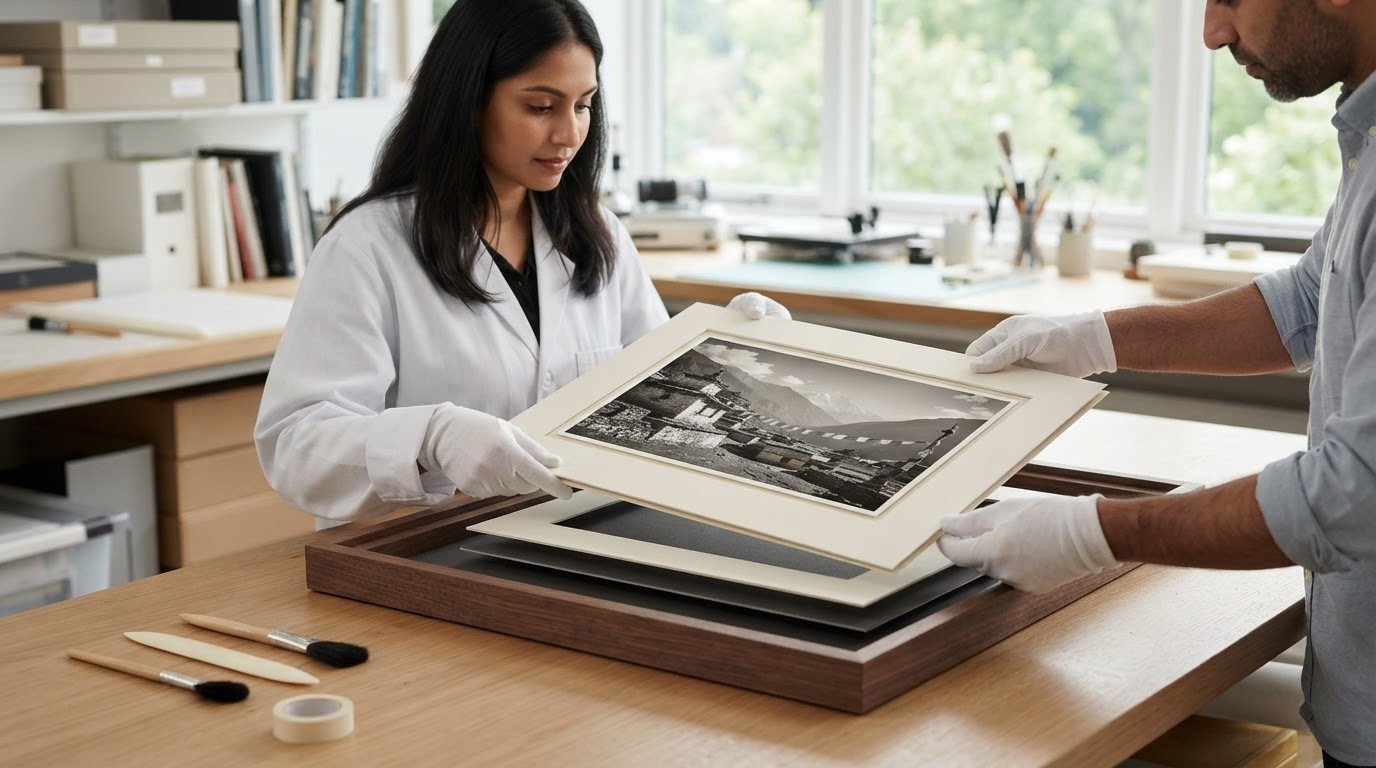
Fine art photography demands an environment where paper, pigments, and silver halides can exist in sustained chemical equilibrium. Acid-free matting consists of chemically neutral or alkaline-buffered board designed to encase and protect artwork within a sealed frame rebate. In gallery-grade preservation, a window mat (picture framing) provides both curatorial structure and a rigorous physical defence against atmospheric contaminants.

Standard retail mounts rely on unrefined wood pulp loaded with acidic compounds. Over time, these unstable boards break down, migrating directly into fragile paper substrates. The visual consequence is immediate and devastating: dark yellow rings, known as mat burns, etch themselves across the image margins alongside irreversible embrittlement. Incorporating true acid free matting for pictures prevents this chemical destruction, maintaining the tactile purity and market value of high-calibre editions.

The Chemistry of Mat Burn and Acid Migration

Wood pulp naturally contains lignin, the complex organic polymer that binds plant cells. When exposed to ambient indoor light, heat, and seasonal humidity, lignin degrades into acidic by-products like formic and acetic acids. These volatile compounds migrate across the interface where the board touches the art, hydrolysing the cellulose fibres of fine prints.

  • Chemical Scorch: Acid migration breaks molecular bonds, turning supple cotton or fibre-based photographic paper brittle and discoloured.
  • Environmental Acceleration: Domestic temperature swings and relative humidity spike the rate of acid transfer, accelerating decay within standard frames.
  • Permanent Degradation: Once cellulose chains sever, paper loses its structural integrity; the resulting discolouration cannot be reversed without costly conservation treatment.

Separating Art from Glass to Prevent Condensation Damage

Beyond chemical neutrality, acid free matting for pictures serves an indispensable mechanical purpose by creating breathing room beneath the glazing. Placing photographic emulsions directly against glass invites disaster. Daily shifts in indoor temperature trigger capillary condensation cycles, creating micro-droplets on the inner glass face.

Because traditional photographic gelatin swells when damp, direct contact can cause the image surface to fuse permanently to the pane. The precision-cut bevel of a conservation window mat establishes a stable microclimate, elevating the glazing away from the print to eliminate glazing adhesion and safeguard irreplaceable imagery.

The Matboard Hierarchy: Decorative vs Conservation vs Museum Rag Board

Selecting matboard requires balancing chemical longevity against the rarity of what sits inside the frame. The framing market divides these substrates into three distinct classifications: decorative paper mats, conservation-grade boards, and museum cotton rag. Understanding these divisions helps collectors choose appropriate acid free matting for pictures without falling victim to ambiguous labelling.

Mass-market retailers often label basic boards as acid-free simply because the paper was neutralised at the mill. True archival permanence, however, depends entirely on raw fibre origin. Matching the substrate to the intrinsic value of your print ensures your artwork survives decades of display without chemical interference.

Decorative Paper Mats: The Limitations of Buffered Wood Pulp

Decorative mats rely on ground wood pulp mechanically extracted from timber. While manufacturers introduce a calcium carbonate buffer to neutralise inherent acidity, this surface treatment is strictly temporary. As environmental humidity and warmth interact with residual lignin, that alkaline reserve gradually exhausts itself.

  • Core Breakdown: The untreated interior wood pulp turns acidic, slowly yellowing the exposed bevel edge.
  • Intended Application: Decorative boards belong exclusively on disposable graphics, open-edition commercial posters, or temporary corporate signage that won’t remain framed for long.

Conservation Board: Purified Alpha-Cellulose Excellence

Conservation matboard represents a substantial leap in chemical engineering. Fabricated from wood pulp stripped of lignin through rigorous chemical delignification, this substrate consists of 90% or higher pure alpha-cellulose fibres. The material remains chemically stable for 50 to 100 years, offering exceptional resistance to discolouration and deterioration.

Alpha-cellulose provides a reliable preservation standard for modern limited editions, collectible lithographs, and certified archival prints displayed in balanced residential interiors.

Museum Rag Board: 100% Cotton Fibre Permanence

Cotton fibres contain zero natural lignin, possessing centuries-long molecular stability without heavy chemical manipulation. Made from 100% cotton linters, museum rag board represents the gold standard defined by strict Library of Congress preservation guidelines. Its naturally pure pH shields the most delicate media from off-gassing and fibrous breakdown.

For collectors seeking to safeguard irreplaceable investments like fine art photography, cotton rag remains the uncompromising choice. When curating masterworks, paired with Galerie Prints’ bespoke framing service, 100% museum rag provides the definitive, heirloom-grade barrier your collection deserves.

Buffered vs Unbuffered Matting: Which Mediums Require Specific Chemistry?

Selecting acid free matting for pictures requires a nuanced understanding of internal chemistry. Most archival boards incorporate an alkaline reserve, typically a 2% to 3% addition of calcium carbonate. This alkaline buffer actively neutralises airborne pollutants, such as sulphur dioxide and nitrogen oxides, that seep through microscopic frame gaps over time. Without this chemical reserve, ambient environmental contaminants gradually turn the framing environment acidic.

Alkaline reserves aren’t universally beneficial. Certain historical photographic processes react poorly to alkaline environments, suffering from accelerated chemical fading or colour shifts. To prevent damage, conservators consult the Photographic Activity Test (ISO 18916). This rigorous international standard verifies that framing materials will not cause staining, silver image fading, or binder deterioration over long-term display.

When to Use Buffered Matting for Lasting Protection

Buffered matboards maintain an elevated pH between 7.5 and 9.5, establishing an impenetrable barrier against environmental acidity. This basic chemistry makes them ideal for plant-based, cellulose-heavy works on paper that thrive in slightly alkaline surroundings.

  • Modern Chromogenic Prints: Contemporary colour photography and digital pigment prints benefit immensely from the continuous protection of a buffered core.
  • Historic Ephemera: Vintage graphic pieces such as cinema lobby cards, printed on mass-produced cellulose stocks, rely on calcium carbonate reserves to halt internal acid generation.
  • Rare Manuscripts and Documents: Wood-based and rag papers carrying iron gall or modern carbon inks stay chemically stable within buffered mounts.

When Unbuffered Matting Is Essential for Sensitive Emulsions

Unbuffered boards maintain a strictly neutral pH around 7.0, completely free of added alkaline agents. They are designed for delicate mediums where excess alkalinity can strip colours or damage the underlying binder.

Cyanotypes represent the classic example: the Prussian blue pigment that forms the image chemically hydrolyses and bleaches away when exposed to high-pH environments. Similarly, nineteenth-century albumen prints, salted paper prints, and historic colour processes like dye transfer or chromogenic dye prints from early eras demand unbuffered materials.

Collectors displaying vintage black and white pictures or mixed-media works containing protein-based substrates, such as silk or vellum, should insist on unbuffered acid free matting for pictures. Matching the matboard’s pH to the chemical nature of the medium preserves your art’s original tone and tonal depth for generations.

Curatorial Styling: Choosing Bevels, Margins, and Colours for Fine Art

A bespoke frame does far more than isolate an image on a wall; it directs the gaze, balances composition, and dictates how a room experiences fine photography. Curating the presentation requires treating acid free matting for pictures as an architectural element. Through deliberate choices in caliper thickness, window proportions, and tonal balance, framing elevates a fine print into a commanding gallery centerpiece.

Selecting Matboard Thickness: 4-Ply vs 8-Ply Depth

Every traditional window mat features an interior aperture cut at a precise 45-degree angle. This bevel catches directional room lighting, gently guiding the viewer’s focus directly into the visual narrative. While standard 4-ply boards measure roughly 1.4 mm in thickness, luxury 8-ply boards offer a substantial 3.0 mm profile.

That extra depth delivers an unmistakable sculptural presence, casting a subtle shadow line that creates immediate separation between the glazing and the print surface. An 8-ply bevel provides the dramatic volume needed to complement expansive lifestyle imagery, such as large-scale prints from the Slim Aarons archive.

Mastering Border Proportions and the Optical Center

Mass-market frames often squeeze prints into stingy, two-inch borders that suffocate the composition. Gallery presentation requires generosity. Mat margins should consistently measure wider than the frame moulding itself, typically between 7 and 12 centimetres depending on image size.

  • The Gravity Illusion: The human eye naturally perceives the optical centre of an image slightly higher than its geometric midpoint. Equal borders on all four sides often make artwork look as if it is sliding down the frame.
  • Optical Weighting: Professional framers correct this perception by adding an extra half-inch or centimetre to the bottom border, anchoring the piece with quiet stability.

Harmonising Colour Tones with Photographic Paper Bases

Selecting board colour requires nuanced observation. Rather than reaching for generic fluorescent white, study the lightest highlights in the print. Crisp, bright white boards work beautifully with contemporary digital pigment editions, but they instantly flatten the warm, creamy base tones of vintage silver gelatin prints.

Warm ivory and soft natural whites harmonise seamlessly with historic paper fibres without competing for attention. In contrast, solid black or archival charcoal boards isolate high-contrast monochromatic imagery, generating a theatrical, cinematic mood. To find the ideal proportion and board tone for your acquisitions, explore Galerie Prints bespoke framing for curated, gallery-level framing solutions tailored directly to your artwork.

Complete Archival Assembly: Mounting Techniques, Glazing, and Backing

An archival window mount represents only the forward-facing shield of a true conservation enclosure. Securing fine photography requires treating the frame interior as an integrated, hermetically balanced capsule. Incorporating acid free matting for pictures without addressing what lies behind and around the paper leaves delicate prints exposed to unseen structural hazards. Every substrate, adhesive hinge, and barrier sheet must cooperate to neutralize environmental stress.

Archival Hinging vs Damaging Adhesive Tapes

Standard household adhesives are fatal to collectible prints. Pressure-sensitive masking tapes, duct tapes, and synthetic double-sided strips contain acidic, petroleum-based polymers that penetrate paper fibres, leaving irreversible oily brown stains within months. Fine art requires reversible mounting techniques that respect the paper’s organic nature.

  • Japanese Mulberry Paper and Wheat Starch: Traditional T-hinges crafted from feather-light kozo paper and purified, cooked wheat starch paste hold prints securely. If reframing is ever required, conservators can dissolve this adhesive cleanly with a drop of distilled water.
  • Suspended Freedom: Fastening the print exclusively along the top margin lets the sheet expand and contract with natural room humidity, preventing the rippling caused by rigid perimeter taping.
  • Archival Mounting Corners: Clear polyester corners or pure rag pockets cradle the sheet entirely through tension, ensuring zero adhesive touches the artwork.

UV Glazing and Sealed Protective Backing

Even the purest cotton board can’t stop ambient light decay. Pairing acid free matting for pictures with conservation-grade glazing that blocks 99% of ultraviolet light is essential to meet ISO 18902 photographic preservation standards. Without this protection, unfiltered daylight and fluorescent interior bulbs will irrevocably bleach pigments and embrittle paper binders.

Behind the artwork, the support assembly demands equal care. A secondary barrier sheet, such as acid-free conservation foamboard or inert archival fluted polypropylene, must separate the mount from the outside world. Never permit standard corrugated packaging cardboard near fine art; it off-gasses acidic lignin rapidly. Sealing the back of the frame with acid-free barrier paper and specialised rebate sealing tape halts dust mites, urban pollutants, and humidity fluctuations. Entrusting your collection to an artisanal bespoke framing service guarantees that every hidden layer, down to the final seal, upholds museum-calibre standards.

Preserve Your Photographic Collection for Generations

Investing in fine art is an act of cultural stewardship. Selecting true acid free matting for pictures is far more than an aesthetic decision; it’s an enduring commitment to chemical stability and visual longevity. Whether you specify 100% cotton museum rag to eliminate lignin degradation, tailor alkaline buffering to sensitive photographic chemistry, or introduce commanding 8-ply bevels for architectural presence, each curatorial choice shields your acquisition against time and ambient decay.

A remarkable print deserves uncompromised craftsmanship from the glazed facade through to the sealed conservation backing. Explore Bespoke Framing Services at Galerie Prints to protect your fine art acquisitions, including legendary prints from the Slim Aarons Collection, with handcrafted, museum-grade assemblies engineered for lifelong preservation. With the correct archival foundation in place, your collection will remain as luminous, crisp, and evocative decades from now as the afternoon it was first unveiled.

Frequently Asked Questions

How long does acid free matting last before losing its protective properties?

True museum-grade rag boards made from pure cotton will last several centuries without degrading or shifting in pH. Purified alpha-cellulose conservation boards provide dependable stability for 50 to 100 years in typical domestic environments. In contrast, chemically buffered decorative boards usually deplete their alkaline reserve within 5 to 15 years. Environmental factors like humidity, intense light exposure, and ambient atmospheric pollutants can speed up this exhaustion cycle considerably.

Can I tell if an old mat board is damaging my framed pictures?

Inspect the exposed 45-degree bevel cut around the image opening. If that crisp interior edge has turned yellow, tan, or dark brown, the board’s interior core has degraded into acid. You can also look for a faint, discoloured halo tracing the inner perimeter of the paper itself, known as mat burn. Once this browning appears, the mounting has begun actively scorching your print’s delicate cellulose fibres.

What is the difference between acid-neutral and 100% cotton rag matting?

Acid-neutral boards are typically manufactured from wood pulp that has undergone artificial buffering to raise its pH, but residual lignin remains an eventual breakdown hazard. In contrast, 100% cotton rag matting contains zero natural lignin from inception, relying on pure cellulose fibres rather than industrial additives. For collectors seeking the finest acid free matting for pictures, cotton rag provides uncompromising, heirloom-calibre longevity that never off-gasses or reverts to an acidic state over time.

Do black and white photographs require special unbuffered matboard?

Standard modern gelatin silver black and white prints thrive under alkaline-buffered boards, which neutralise atmospheric acid intrusion. However, historic nineteenth-century processes like albumen prints, cyanotypes, and early salted paper prints demand unbuffered, pH-neutral boards. The Prussian blue pigment in cyanotypes and the protein emulsions of vintage albumen prints react adversely to high alkaline levels, causing irreversible bleaching and chemical shifts if placed against standard buffered mounts.

Why do professional framers use an 8-ply mat instead of a standard 4-ply?

Professional framers prefer an 8-ply board because its commanding 3.0 mm profile introduces dramatic visual depth and an arresting sculptural bevel. Beyond its striking aesthetic presence, this thickness doubles the spatial separation between the glazing and the print surface. That generous clearance prevents fragile emulsions from sticking to condensation on the glass during humidity shifts, while giving expansive fine art photography an authoritative gallery presentation.

Is regular framing tape safe to attach artwork to an acid-free mat?

Standard framing tape, household masking tape, and double-sided adhesives are never safe for valuable art. Their synthetic adhesives degrade into acidic, oily resins that permanently stain paper fibres and cause structural warping. Pairing acid free matting for pictures with improper adhesive negates the mount’s protective qualities. You should only permit reversible Japanese kozo hinges adhered with pure wheat starch paste, or non-invasive museum mounting corners that grip without chemical contact.

Does acid-free matting prevent pictures from fading in sunlight?

Acid-free matting protects against chemical degradation, contact abrasion, and inner acid migration, but it can’t prevent solar fading. Fading and color loss result directly from exposure to ultraviolet radiation and visible light energy. Safeguarding your artwork against light damage requires pairing archival matting with conservation-grade glass or acrylic glazing that filters out at least 97% to 99% of UV rays, in compliance with photographic preservation standards.
Archival Framing for Fine Art Prints: The Collector’s Guide to Preservation

Is the frame protecting your collection, or is it a silent catalyst for its slow decay? You’ve spent years curating a collection that speaks to your soul, yet the fear of yellowed edges and muted pigments often lingers in the back of your mind. It’s a valid anxiety for any serious collector who appreciates the evocative power of a Slim Aarons or Terry O’Neill original. True archival framing for fine art prints isn’t merely a decorative accessory; it’s a bespoke chemical shield designed to halt the inevitable entropy of light and acid.

We understand that technical terms like “acid-free” and “museum-grade” can feel like a labyrinth of art world jargon. This guide illuminates the meticulous science and artisanal craft behind high-end preservation, giving you the confidence that your art is protected from environmental degradation. You’ll discover the vital role of 100% cotton rag mats and UV-filtering glazing, which blocks up to 99% of the radiation responsible for 40% of print fading. We’ll show you how to achieve an aesthetic result that complements a luxury interior while honoring the historical significance of your most cherished pieces.

Key Takeaways

  • Learn how museum-grade materials like UV-filtering glazing block 99% of harmful rays to ensure your photographic investments never lose their original vibrancy.
  • Discover why 100% cotton rag matting is the essential standard for archival framing for fine art prints, offering over a century of chemical stability compared to standard wood-pulp.
  • Understand how to harmonize historical aesthetics with modern protection, specifically tailored for iconic archives like the Slim Aarons or Terry O’Neill collections.
  • Experience the peace of mind that comes with a bespoke, ready-to-hang service where artisanal craftsmanship replaces industrial mass production.

Beyond Aesthetics: Why Archival Framing is Essential for Fine Art

To the casual observer, a frame is a border; to the serious collector, it’s a sanctuary. Archival framing for fine art prints represents a sophisticated system of pH-neutral materials engineered to arrest the natural process of chemical degradation. While a standard picture frame might provide structural support, it often harbors hidden dangers that compromise the integrity of paper and ink. The primary objective of archival housing is to create a micro-environment where environmental threats are neutralized before they reach the artwork.

The preservation process specifically targets three primary environmental threats that act as silent killers of visual heritage:

  • Ultraviolet Light: This radiation is responsible for approximately 40% of all fading in photographic works, breaking down pigments at a molecular level.
  • Fluctuating Humidity: Moisture causes paper fibers to expand and contract, which leads to permanent warping or “cockling” of the print surface.
  • Atmospheric Pollutants: Airborne acids and dust can penetrate porous paper fibers, causing unsightly yellowing and chemical foxing.

A critical distinction exists between “acid-free” and “archival” standards. Many commercial products are labeled acid-free because they’ve been treated with a calcium carbonate buffer to neutralize the acidity of wood pulp. This protection is often temporary. As the buffer depletes, the underlying lignin returns the material to an acidic state. True archival framing for fine art prints demands materials that are naturally pH-neutral and lignin-free from the outset, ensuring the housing remains chemically inert for centuries. Central to this philosophy is the concept of reversibility. Every hinge, mount, and adhesive must be fully removable, allowing the artwork to be extracted without a trace of damage.

The Chemistry of Fading and Yellowing

Standard wood-pulp papers contain lignin, a complex organic polymer that eventually breaks down into acidic compounds. This lead to “acid burn,” where the paper becomes brittle and discolored. For those investing in fine art photography, this degradation is a significant risk. Beyond chemical damage, UV radiation acts as a catalyst for destruction. Archival systems utilize specialized glazing to block up to 99% of these rays, protecting the delicate tonal range of the image.

Investment Protection for Collectors

Preserving a collection, such as the iconic works found in the Slim Aarons archive, requires a commitment to long-term stability. The resale value of a limited edition print is inextricably linked to its physical condition. Any sign of mounting damage or light-induced fading can diminish its market prestige. Museum-grade protection offers the psychological peace of mind that your investment is shielded from the common hazards of a home environment. The frame serves as the first and most vital line of defense in maintaining the work’s historical and financial value.

The Anatomy of Preservation: Key Components of an Archival Frame

A museum-grade frame is more than a decorative enclosure; it’s a meticulously engineered assembly of inert materials designed to work in concert. When considering archival framing for fine art prints, every layer must serve a dual purpose: aesthetic enhancement and chemical stability. This protective envelope ensures that the artwork remains isolated from the destructive influences of the outside world, creating a stable micro-environment that can last for generations. It’s a technical discipline that requires a deep understanding of material science and curatorial standards.

The foundation of this system begins with the mount board. Unlike standard matting, which often contains lignin-rich wood pulp, archival mounts utilize 100% cotton rag or highly purified alpha-cellulose. These materials are naturally pH-neutral and lignin-free, preventing the acid burn that leads to brittle paper and yellowed edges. Behind the artwork, a rigid backing board provides an essential barrier. This layer must be equally inert, shielding the print from moisture and the latent acidity often found in common wall surfaces. This structural integrity is vital for maintaining the flat, pristine surface of high-value photography.

Securing the print within this assembly requires specialized adhesives that prioritize the long-term health of the paper. Traditional tapes and glues are strictly avoided in professional workshops because they leave permanent residues. Instead, specialists utilize pH-neutral, water-reversible hinging methods. This technique ensures that the artwork is held securely but can be removed at any time without leaving a trace of its housing. For those seeking the ultimate in protection, our bespoke framing service employs these precise artisanal methods to safeguard every acquisition, ensuring a seamless transition from our archive to your collection.

Glazing Options: Glass vs. Acrylic

The choice of glazing is often a balance between clarity and safety. UV-filtering glass, which typically blocks up to 99% of harmful radiation, meets the rigorous ISO 18902 standard for conservation. It offers exceptional scratch resistance and is the preferred choice for residential displays where lighting is controlled. For large-format works, museum-grade acrylic is often superior. It is lightweight and shatter-proof, making it significantly safer for shipping and handling. Modern anti-reflective coatings can make the glazing virtually disappear, allowing the viewer to engage with the rich textures of the print without the distraction of glare.

The Importance of the Air Gap

Direct contact between a print and its glazing is a recipe for disaster. Moisture can become trapped against the surface, leading to condensation, mold growth, or the physical sticking of the emulsion to the glass. Archival framing for fine art prints solves this by creating a deliberate air gap. This is achieved through deep-bevel mats or discrete spacers hidden beneath the frame lip. This small pocket of air acts as a thermal buffer, regulating the micro-climate inside the frame and ensuring the delicate paper fibers can breathe. This meticulous attention to detail culminates in a ready-to-hang experience that bridges the gap between a world-class archive and your private gallery wall.

Archival vs. Standard Framing: Understanding the Long-Term Investment

The choice between standard and archival framing for fine art prints is rarely about the immediate visual appeal. It’s a decision about the future. While a standard frame might look adequate on day one, it functions as a chemical ticking clock. Standard wood-pulp matting contains lignin, a natural polymer that eventually breaks down into acid. This acidity migrates into the print, causing permanent structural damage. In contrast, 100% cotton-rag matting is naturally pH-neutral and remains stable for well over a century, ensuring that the paper fibers of your investment don’t become brittle or discolored.

The visual disparity becomes evident within just a few years. When you look at a cheap mat, the beveled edge often takes on a tell-tale orange or brown hue. This is the physical manifestation of acid buildup. Archival mats maintain a crisp, clean white bevel that continues to complement the art rather than distracting from it. From a financial perspective, the initial premium for museum-grade materials is a minor fraction of the potential restoration costs. Professional restoration for a print damaged by non-archival materials can range from $150 to $500 per piece, making the decision to invest in professional archival framing for fine art prints the only logical economic choice.

Identifying ‘Fake’ Archival Claims

The term “acid-free” is frequently used as a marketing shield, but it can be misleading for the uninitiated collector. Many manufacturers treat wood-pulp paper with a calcium carbonate buffer to neutralize its natural acidity. While this works initially, the buffer eventually depletes, and the mat returns to an acidic state. When selecting a framer, look for materials that meet the ISO 18902 standard. Conservation grade is suitable for many high-quality works, but museum grade, utilizing 100% cotton rag, is the gold standard for historical archives and high-value photography.

The Long-Term Visual Cost of Standard Framing

Standard framing often results in “mat burn,” a dark, permanent stain that follows the window of the matting and ruins the print’s margins. Beyond the paper, the image itself is at risk. Standard glass lacks the sophisticated UV-filtering technology needed to prevent pigments from losing their vibrancy, sometimes within months of display. Another hidden threat is outgassing. Outgassing refers to the release of volatile organic compounds from non-archival glues and plastics, which creates a hazy, chemical film on the surface of photographic emulsions. These invisible threats highlight why a bespoke, artisanal approach to archival framing for fine art prints is the only way to truly honor a significant collection.

Curating Your Display: Selecting Materials for Different Print Collections

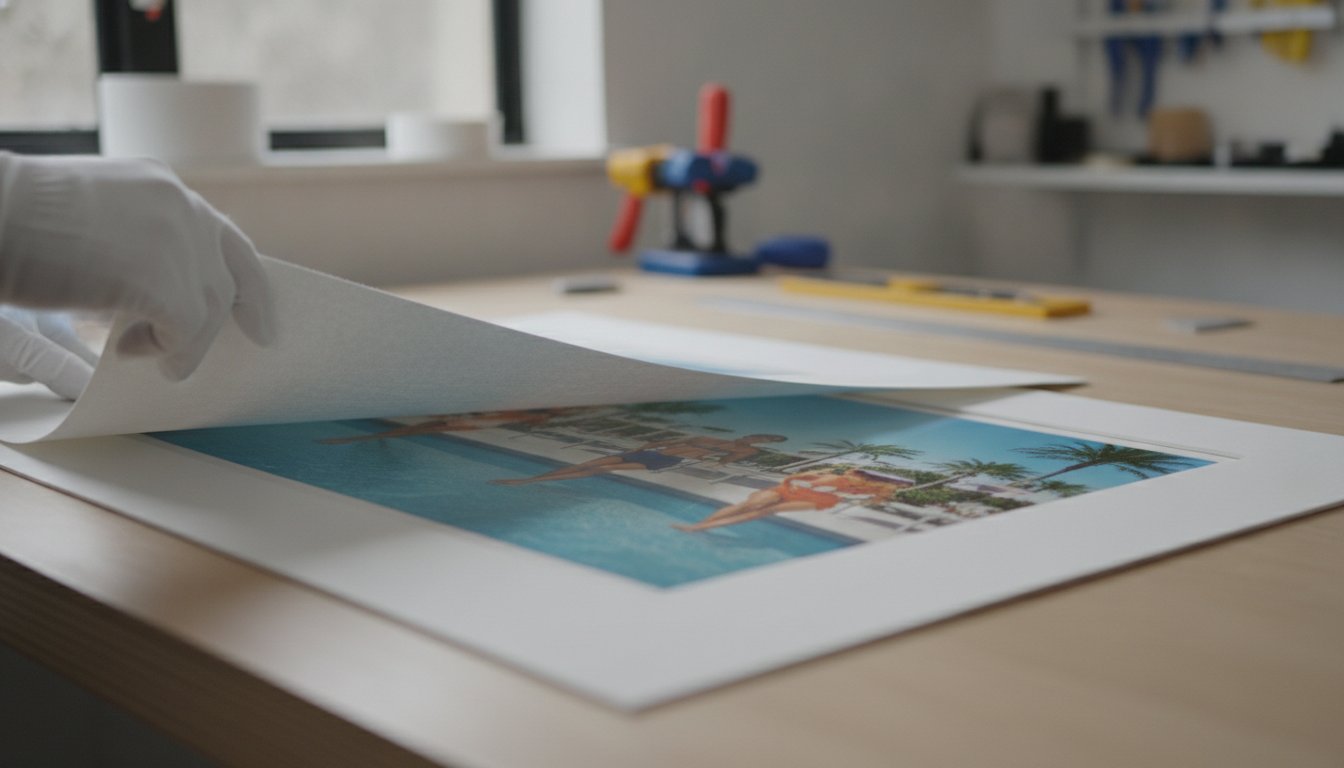
Curating a private gallery is a delicate balance of period-accurate design and invisible engineering. When selecting archival framing for fine art prints, one must consider the era and medium of the work to ensure the housing respects the artist’s original vision. A collection like the Slim Aarons archive requires a specific, nuanced touch. These 1960s masterpieces, celebrated for their vibrant saturated hues and aspirational settings, demand frames that echo mid-century elegance while providing 99% UV protection to keep those iconic poolside blues from losing their luster over time.

Black and white photography presents a different set of aesthetic challenges. The “white-point” of your matboard can fundamentally alter the viewer’s perception of the image’s tonal range. A cool-toned silver gelatin print might look muddy against a cream mat, while a warm-toned portrait requires a softer, off-white board to maintain its depth and luminosity. For oversized prints, structural integrity becomes the priority. Large-scale works often require museum-grade acrylic rather than glass to reduce weight and prevent the risk of shattering, which would be catastrophic for the print surface. Our Bespoke Framing Service specializes in these nuanced requirements, ensuring each piece is housed in a manner that respects both its history and its future.

Cinema memorabilia, such as vintage lobby cards or posters, often arrives on fragile, acidic paper stocks from the studio era. These items require a “preservation-first” approach where the material is neutralized or carefully encapsulated before being framed. Limited edition Star Wars prints, often produced on modern high-gloss papers, are particularly sensitive to light and heat. These require a deep air gap to prevent the emulsion from bonding to the glazing, a common disaster in standard retail framing. Selecting the correct archival housing is the only way to ensure these cultural artifacts remain pristine for the next generation of collectors.

Matching Frame Style to Artistic Era

Contemporary music archives often benefit from sleek, minimalist metal or black-stained wood frames that don’t compete with the raw energy of the subject matter. In contrast, mid-century icons are best served by classic walnut or oak mouldings that provide a sense of warmth and permanence. The color of the frame should act as an extension of the print’s tonal range, grounding the work within its architectural surroundings without overpowering the artist’s intent. This thoughtful selection ensures that the frame enhances the art while the archival materials provide a silent, permanent shield.

Preserving Rare Collectibles

Original cinema lobby cards are historical artifacts that demand more than just a standard mount. Archival techniques like encapsulation allow these fragile items to be viewed and displayed without being permanently adhered to a backing board, preserving their future trade value. For high-value collectibles like Star Wars limited editions, maximum UV shielding is non-negotiable. Using archival framing for fine art prints ensures these modern relics remain as vivid as the day they were struck, protecting the pigments from the subtle but relentless bleaching effect of indoor lighting and environmental pollutants.

The Galerie Prints Standard: Bespoke Framing for Iconic Photography

At Galerie Prints, we view our role as a bridge between the historical archive and your private sanctuary. Our ready-to-hang philosophy ensures that the transition from our collection to your wall occurs with zero friction. We don’t merely sell photography; we provide a complete curatorial solution that honors the prestige of the artists we represent. By integrating archival framing for fine art prints into our core offering, we ensure that every Terry O’Neill or Slim Aarons print is protected by the same museum-grade standards used by major institutions. This synergy between our premium paper stocks and conservation-grade housing guarantees that the visual impact of the work remains untarnished for generations.

Our frames are the result of localized, artisanal craftsmanship. While industrial workshops often rely on automated machinery, our specialists build each frame by hand, ensuring that every corner joint is seamless and every mount is perfectly centered. This human touch is essential for handling the delicate photographic emulsions found in our music archives and cinema lobby cards. When your framed masterpiece arrives, it’s a testament to a bygone era of elegance and technical excellence. We handle global shipping with the same precision, using professional-grade packaging to ensure your investment arrives in pristine condition, regardless of its destination.

A Curated Selection of Styles

Our signature finishes are designed to complement an aspirational lifestyle. Whether you select the stark sophistication of our gallery black, the ethereal clarity of our satin white, or the organic warmth of our natural wood mouldings, you’re choosing a frame that has been vetted for its aesthetic and protective qualities. Our mounting process is a study in precision, utilizing the pH-neutral hinging and deep-bevel mats to create the protective micro-climate your collection deserves. For serious collectors, we offer customization options that allow the frame to reflect the unique character of their private space while maintaining the highest standards of preservation.

The Seamless Purchase Journey

Adding museum-grade protection to your collection shouldn’t be a complex technical chore. We’ve refined the experience so you can select our bespoke framing service with a single click during the acquisition process. This convenience is backed by our direct, authoritative relationship with world-class archives, including Getty Images and the Terry O’Neill estate. By choosing our integrated service, you ensure that your art is handled only by specialists who understand the historical significance of the work. It’s the final, essential step in securing a piece of history for your home. Explore our bespoke framing service to find the perfect sanctuary for your next acquisition.

Securing Your Photographic Legacy

Your collection is a narrative of history and beauty, a window into the aspirational worlds captured by the masters of the lens. By understanding the meticulous science of pH-neutral materials and the necessity of UV-filtering barriers, you transition from a simple owner to a true guardian of artistic heritage. Investing in archival framing for fine art prints is the ultimate act of stewardship for any serious collector; it ensures that the vibrancy of a Slim Aarons poolside or the raw intensity of a Terry O’Neill portrait remains unchanged by the passage of time.

As specialist curators of the Slim Aarons archive, we recognize that a frame must be as exceptional as the work it protects. Our hand-finished artisanal frames provide museum-grade UV protection as standard, creating a permanent sanctuary for your acquisitions. This commitment to quality ensures that your gallery wall remains a source of wonder for generations to come. We invite you to elevate your collection with the protection it deserves.

Protect your investment with Galerie Prints’ Bespoke Framing Service and experience the peace of mind that only true craftsmanship can provide. Your art deserves a legacy as enduring as its beauty.

Frequently Asked Questions

What is the difference between acid-free and archival framing?

Acid-free materials are typically wood-based products chemically treated to neutralize acidity, a state that can revert as the buffer depletes over time. Archival framing for fine art prints utilizes materials like 100% cotton rag that are naturally pH-neutral and lignin-free. This ensures permanent chemical stability. While acid-free options offer a temporary shield, archival standards provide a lasting sanctuary for your collection without the risk of the protection fading away.

Does UV-filtering glass really prevent all fading?

UV-filtering glass blocks up to 99% of harmful ultraviolet rays, but it doesn’t stop all fading. Visible light and heat contribute to the remaining 60% of pigment degradation. Even with museum-grade glazing, you should avoid hanging your collection in direct sunlight. High-quality protection significantly slows the process, preserving the depth of photographic pigments for several decades longer than standard glass ever could.

Can I upgrade my current frames to archival standards?

You can certainly upgrade existing frames by replacing the internal components with conservation-grade materials. A specialist can swap out acidic matting and standard glass for 100% cotton rag boards and UV-filtering glazing. This process, known as refitting, is a cost-effective way to bring an older display up to modern archival framing for fine art prints standards without losing the aesthetic of the original moulding.

Is it worth framing a poster archivally if it’s not a limited edition?

Archival protection is highly recommended for vintage movie posters or items with high sentimental value. Many mass-produced posters are printed on acidic paper that degrades rapidly in a standard frame. By using museum-grade materials, you arrest this decay and ensure the piece doesn’t become brittle or stained. It’s a choice based on the emotional or historical significance you place on the work rather than its market price.

How do I know if my current frames are damaging my art?

Look for a tell-tale orange or brown tint on the beveled edge of the mat board, which indicates acid buildup. If you notice dark lines following the edge of the mat on the print itself, your artwork is suffering from mat burn. Other signs include foxing or small brown spots on the paper. These visual cues suggest that the internal micro-climate has become compromised and requires immediate professional attention.

What is the best way to clean archival glass or acrylic?

The safest method involves using a clean microfiber cloth and a specialized, ammonia-free cleaner designed for museum glazing. You should never spray the cleaner directly onto the frame, as liquid can seep under the lip and damage the print surface. Instead, dampen the cloth and wipe in a gentle, circular motion. Avoid paper towels, which can leave microscopic scratches on the surface of sensitive archival acrylic.

Why do archival mats have a different ‘white’ than standard mats?

Archival mats lack the artificial optical brighteners found in standard commercial boards. These chemicals create a bright white that eventually yellows as the additives break down. Museum-grade mats reflect the natural color of highly purified alpha-cellulose or cotton fibers. This results in a stable, sophisticated white-point that won’t shift over time, ensuring the tonal integrity of your black and white photography remains perfectly balanced for decades.

How should I hang my framed prints to maximize their lifespan?

You should position your framed work on an interior wall away from direct sunlight and heat sources like radiators or fireplaces. Avoid hanging art on damp exterior walls where temperature fluctuations can cause condensation inside the frame. Maintaining a stable environment with controlled humidity is the final step in the preservation journey. This careful placement complements the internal protection of the archival materials, maximizing the lifespan of your investment.

What is Archival Mounting? A Curator’s Guide to Preserving Fine Art

A masterpiece is more than just pigment on paper; it’s a silent witness to history that begins its slow journey of decay the moment it meets the air. For the discerning collector, the central question isn’t just how to display a work, but what is archival mounting and why is it the only acceptable standard for a serious gallery? You understand that a rare Terry O’Neill photograph or a limited edition Star Wars print represents a significant cultural investment. It’s only natural to feel a sense of trepidation when choosing how to house such pieces. You want to ensure that the vibrant soul of the artwork isn’t lost to the creeping shadows of acidity or environmental degradation.

We share your reverence for these visual treasures and recognize that technical terms like buffered matting or lignin-free backing can feel unnecessarily opaque. This guide clarifies those complexities, promising to show you how professional preservation techniques protect your art from the inside out. You’ll discover the meticulous standards established by the Fine Art Trade Guild, ranging from Museum Level protection to the artisanal use of Japanese tissue hinges. By the end of this exploration, you’ll possess the confidence to select framing services that don’t just decorate a room, but safeguard a legacy for generations to come.

Key Takeaways

  • Learn why removing lignin and utilizing alpha-cellulose mat boards are critical steps to prevent the acidic degradation that often yellows and destroys paper-based art.
  • Understand the technical nuances between traditional Japanese paper hinging for delicate works and dry mounting for achieving a flawlessly flat, contemporary aesthetic.
  • Gain a clear definition of what is archival mounting by exploring how specialized techniques safeguard the vibrant palettes of a Slim Aarons print or the structural integrity of vintage Cinema Lobby Cards.
  • Discover how bespoke, museum-grade framing transforms a simple acquisition into a protected piece of photographic heritage designed to last for generations.

Defining Archival Mounting: More Than Just a Backing

A common misconception involves the term “acid-free.” While many retail frames claim this status, it’s often a temporary state achieved through chemical buffers that eventually exhaust themselves. True archival framing materials go further by utilizing naturally inert substances that won’t degrade into acidic compounds. Without these standards, art often falls victim to “foxing,” those unsightly brown spots caused by oxidation, or becomes so brittle that the slightest movement causes irreparable cracks. By understanding what is archival mounting, you’re choosing to defend your investment against these silent, atmospheric threats.

The Core Philosophy: Conservation vs. Decoration

Choosing a mount is a decision between a fleeting decorative choice and a commitment to a legacy. A decorative mount might look striking today, but it offers no protection against the silent threats of atmospheric pollutants or humidity. Conservation-grade mounting acts as a sacrificial barrier, absorbing environmental stresses before they reach the delicate surface of the artwork. It provides the necessary structural support for fragile paper, preventing the sagging or “cockling” that occurs when art isn’t properly supported within its housing. This structural integrity is vital for maintaining the pristine, gallery-quality appearance of your collection over decades.

The Danger of Non-Archival Materials

The primary antagonist in the story of art degradation is lignin, the organic polymer that binds wood fibers together. In inexpensive boards, lignin eventually breaks down, releasing acidic gases that literally “burn” the paper. This chemical transfer results in a distinct yellowing of the art, most visible along the edges where the board meets the print. While traditional film photography is sensitive, modern digital prints often utilize complex ink sets that require even more stringent mounting standards. These contemporary works are highly reactive to outgassing from cheap wood pulp boards, making the curator’s choice of alpha-cellulose or cotton rag boards an absolute necessity for any serious collector who values the heritage of their work.

The Chemistry of Preservation: Lignin, Acids, and Buffers

To master the art of preservation, one must first master the science of the substrate. While we’ve established the general purpose of these methods, a deeper look into the chemistry reveals why certain materials are non-negotiable for serious collectors. Understanding the molecular composition of these materials is the key to answering what is archival mounting in a professional context. At its core, the process aims to eliminate lignin, the complex organic polymer that provides wood with its rigidity but acts as a ticking time bomb for paper. As lignin oxidizes, it produces acidic byproducts that migrate into your art, causing the telltale yellowing and structural decay that ruins a print’s heritage.

Purified alpha-cellulose represents the gold standard for high-end mounting. This material is wood pulp that has been chemically stripped of all harmful impurities, leaving only the stable plant fibers behind. However, for those seeking the pinnacle of museum-grade protection, 100% cotton rag remains the ultimate choice. Naturally lignin-free and incredibly durable, cotton fibers have been the foundation of the world’s most enduring documents for centuries. Utilizing these materials in a bespoke framing service ensures that the physical foundation of your display is as prestigious as the image it supports.

Buffered vs. Non-Buffered Boards

Most archival boards contain a “buffer” of calcium carbonate, which acts like an antacid to neutralize airborne pollutants. This alkaline reserve is essential for protecting most photographic prints from environmental acidity. Yet, curatorial precision requires nuance. Certain historical processes, such as cyanotypes or protein-based textiles, can react poorly to alkalinity. In these rare instances, we utilize unbuffered, pH-neutral materials to ensure the specific chemistry of the artwork remains undisturbed by its housing.

The Importance of pH Neutrality

In paper science, pH neutrality isn’t a static achievement but a long-term commitment. A board that tests neutral today may become acidic tomorrow if it lacks the proper molecular stability. Galerie Prints meticulously selects materials that maintain a stable, slightly alkaline pH between 7.5 and 9.5. This range provides a safety net, actively counteracting the acidic gases found in modern homes and urban environments. It’s this level of chemical foresight that defines what is archival mounting at the highest level, distinguishing a simple frame from a true archival vessel.

Professional Mounting Techniques: Hinging vs. Dry Mounting

The physical application of art to its substrate is where chemical science meets artisanal grace. When considering what is archival mounting, one must evaluate the delicate balance between structural permanence and the cardinal rule of conservation: reversibility. Every technique employed by a master framer should be inherently undoable, ensuring the artwork can be returned to its original, unmounted state without the slightest whisper of damage. This philosophy dictates the choice between traditional hinging and modern dry mounting, two distinct paths that define the final character of your display. While one method celebrates the natural movement of paper, the other seeks a flawless, architectural precision often required for contemporary spaces.

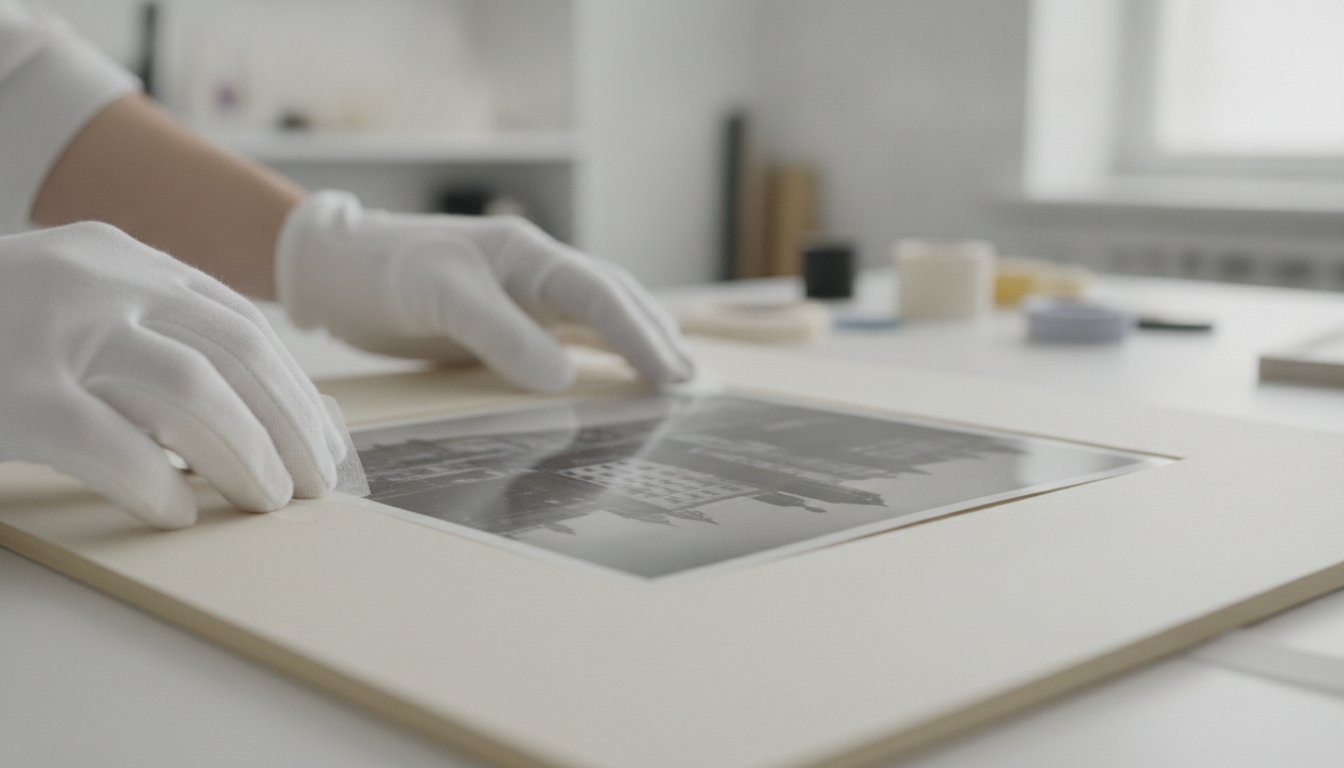
The aesthetic impact of these choices is profound. A collector must decide if they prefer the classic window mount or the sophisticated “float mount,” which leaves the raw, deckled edges of the paper exposed within the frame. This latter style requires impeccable hinging techniques to create the illusion of the art levitating against the backing board. Understanding what is archival mounting at this level allows you to tailor the presentation to the specific narrative of your collection, whether you’re housing a vintage lobby card or a modern masterpiece.

The Art of the Reversible Hinge

Hinging remains the traditional museum standard, utilizing strips of acid-free Japanese paper and refined wheat or rice starch paste. This centuries-old secret is favored because the paste is strong yet easily water-soluble, allowing for safe removal decades later. These hinges, often applied in a “T” or “folded” configuration, are designed to be intentionally weaker than the art paper itself. This ensures that if the frame is dropped or mishandled, the hinge will tear rather than the artwork. Furthermore, this method allows the paper to “breathe” and expand naturally with changes in humidity, preventing the tension that leads to long-term warping.

When to Choose Archival Dry Mounting

While hinging is poetic, large-scale fine art photography often demands a different approach to combat “cockling,” the subtle rippling that can occur in oversized prints. Archival dry mounting solves this by using heat-activated, acid-free tissues to bond the print entirely to a rigid, pH-neutral substrate. This results in a perfectly flat finish that complements sleek, modern interiors where light might otherwise catch the imperfections of a loose-hung print. Although it’s a more permanent bond, the use of specialized archival tissues ensures the process remains safe for high-value investments, providing the structural integrity required for the expansive vistas found in the Slim Aarons or Terry O’Neill archives.

Selection Guide: Matching Mounting to Your Collection

For those looking to safeguard their investments, our bespoke framing service provides the technical expertise required to match these museum-grade materials to your specific acquisition. Whether you’re housing a rare archive find or a modern limited edition, the mounting choice remains the most critical decision in the preservation journey.

Mounting for Modern Colour Photography

Modern colour works, such as those found in the Slim Aarons collection, require a mounting strategy that respects the delicate balance of contemporary C-type and Giclée pigments. In our current climate, these prints are susceptible to UV-induced shifts and atmospheric oxidation. When mounting large-format Terry O’Neill pieces, the goal is to provide absolute flatness without compromising the print’s ability to remain stable over decades. We utilize high-grade UV-opaque glazing in tandem with alpha-cellulose boards to create a light-stable environment that keeps those iconic poolside hues as vibrant as the day they were captured.

Archival Needs for Vintage Memorabilia

Vintage ephemera presents a more complex challenge. Objects like mid-century Cinema Lobby Cards were often printed on high-acid paper stocks never intended for longevity. These pieces require extra structural support to prevent the fragile fibers from shattering. A professional mounting strategy for these items often involves creating a “micro-environment” within the frame. This might include using de-acidification barriers or protective archival sleeves that arrest the decay of the original paper. For black and white archives, this controlled environment is also essential for preventing silver mirroring, a common phenomenon where silver ions migrate to the surface and create a distracting metallic sheen on the shadows of the image. By isolating the art from external pollutants, we ensure that Hollywood’s photographic heritage remains a tangible part of your home’s narrative.

The Galerie Prints Standard: Bespoke Framing as Heritage Protection

A collection truly matures when it transitions from a series of acquisitions into a curated legacy. We’ve explored the chemical nuances and technical methods, but the final execution requires a partner who views art preservation as a sacred duty. At Galerie Prints, our bespoke framing service is more than a logistical necessity; it’s a commitment to the enduring soul of the image. By integrating everything we’ve discussed about what is archival mounting, we provide a seamless bridge between the artist’s original vision and the sanctuary of your home. This process ensures that your investment remains as pristine as the day it left the darkroom or the studio.

Our curators apply these rigorous standards to every piece, regardless of its era. For instance, we insist on meticulous archival mounting for every Star Wars limited edition print that passes through our hands. These works are modern icons of cinematic history. They possess a value that will only grow as the decades pass. Using anything less than museum-grade materials would be a disservice to the collector and the heritage of the franchise. When you receive a piece from us, it arrives ready to hang. It offers the profound peace of mind that only professional, hand-finished craftsmanship can provide.

Artisanal Craftsmanship in 2026

Our London-based workshop serves as the heart of our operations. It’s a space where traditional methods meet the exacting precision of 2026 technology. Each frame is a testament to localized, artisanal skill. We don’t just select a board; we curate an environment. Our experts hand-select premium frames and archival mount boards that complement the specific tonal range and paper weight of your art. Investing in a Galerie Prints frame is a lifetime commitment. It’s an investment in a vessel designed to withstand the tests of time and environment while maintaining its quiet, sophisticated authority on your wall.

Your Next Steps as a Collector

The journey of a serious collector is one of constant learning and refined choices. A holistic understanding of what is archival mounting allows you to move forward with the certainty that your art is protected. Your next step is to ensure your current collection is properly housed. Our experts are available to consult on the best mounting strategies for your specific acquisitions, helping you choose between hinging and dry mounting with confidence. This is how you transform a living space into a gallery of personal history. We invite you to Explore our Bespoke Framing Options and discover how we can help you safeguard the heritage of your visual treasures with style.

Securing the Future of Your Photographic Heritage

A fine art collection is an evolving narrative of history and personal taste, but its survival depends on the invisible choices made within the frame. We have explored how the rigorous elimination of lignin and the strategic use of pH-neutral buffers create a sanctuary for delicate paper. By mastering what is archival mounting, you transition from a casual observer to a true steward of photographic history. Whether you are preserving the cinematic grandeur of a rare lobby card or the vibrant poolside leisure of a Slim Aarons print, the method of display is the deciding factor in its longevity.

Our London-based workshop remains dedicated to these museum-grade standards, utilizing exclusively acid-free materials and traditional hand-craftsmanship. Trusted by major archives including Getty Images, our expert framers ensure that every piece is treated with the reverence it deserves. We invite you to Preserve your collection with our Bespoke Framing Service and experience the confidence that comes with gallery-quality protection. Your collection is a legacy; let us help you ensure it remains as breathtaking for future generations as it is today.

Frequently Asked Questions

Is archival mounting the same as acid-free mounting?

No, archival mounting represents a more rigorous and permanent standard than simple acid-free labeling. While many retail boards are marketed as acid-free, they often consist of wood pulp that has been chemically treated to be neutral, a state that can revert over time as the buffers are exhausted. True archival standards require naturally inert materials, such as 100% cotton rag, which remain stable for centuries without the need for temporary chemical additives.

Can archival mounting be reversed if I want to change the frame later?

Absolute reversibility is the fundamental principle of professional preservation. Techniques like Japanese tissue hinging with water-soluble starch paste ensure that the artwork can be removed from its mount at any time without leaving a trace or damaging the paper fibers. This allows you to update your display or move the piece between collections while maintaining its original, untouched condition and market value.

How long will an archival mount protect my print?

When executed to the highest industry standards, archival mounting offers substantial longevity for your collection. The Fine Art Trade Guild defines Level 1 Museum framing as providing protection for up to 35 years in normal conditions, while Level 2 Conservation framing protects for up to 20 years. These benchmarks ensure that your investment survives the typical environmental stresses of a residential setting while maintaining its gallery-quality appearance.

Do I need archival mounting for digital Giclée prints?

Yes, digital Giclée prints require archival mounting because their complex ink sets and specialized coatings are often more reactive to atmospheric pollutants than traditional silver gelatin. High-quality digital papers are designed to be pH neutral, but they’ll quickly absorb acidity from inferior mounting boards. Protecting these modern works requires the same curatorial oversight and inert materials as a vintage masterpiece to prevent premature yellowing.

What is the difference between museum board and conservation board?

The primary difference lies in the base fiber used for the board’s construction. Museum board is crafted from 100% cotton rag, which is naturally free of harmful lignin and represents the ultimate standard in the art world. Conservation board is typically made from alpha-cellulose, which is wood pulp that’s been chemically purified to remove impurities. Both meet high standards, though cotton rag remains the prestigious choice for high-value archives.

Will archival mounting prevent my art from fading in the sun?

Mounting primarily protects against chemical decay and structural warping rather than light damage. While it’s a vital component of the preservation puzzle, you must pair it with UV-opaque glazing to prevent the pigments from fading. A complete archival housing addresses both the internal chemical environment through the mount and the external impact of light through specialized glass or acrylic.

Can I do archival mounting myself at home?

Attempting preservation at home is possible with specialist kits, but it’s rarely recommended for high-value investments. Professional framers operate in dust-controlled environments and possess the artisanal dexterity required for delicate Japanese tissue hinging. Given the technical nuances of what is archival mounting, entrusting your work to a seasoned expert ensures a flawless, risk-free result that preserves the physical heritage of the piece.

Why is archival mounting more expensive than standard framing?

The premium cost reflects both the rarity of the materials and the intensive artisanal labor involved. Standard framing often uses mass-produced adhesives and wood-pulp boards, whereas what is archival mounting requires hand-applied hinges and expensive cotton rag substrates. You’re paying for specialized expertise and materials that transform a simple decorative frame into a permanent heritage vessel designed to last for generations.