
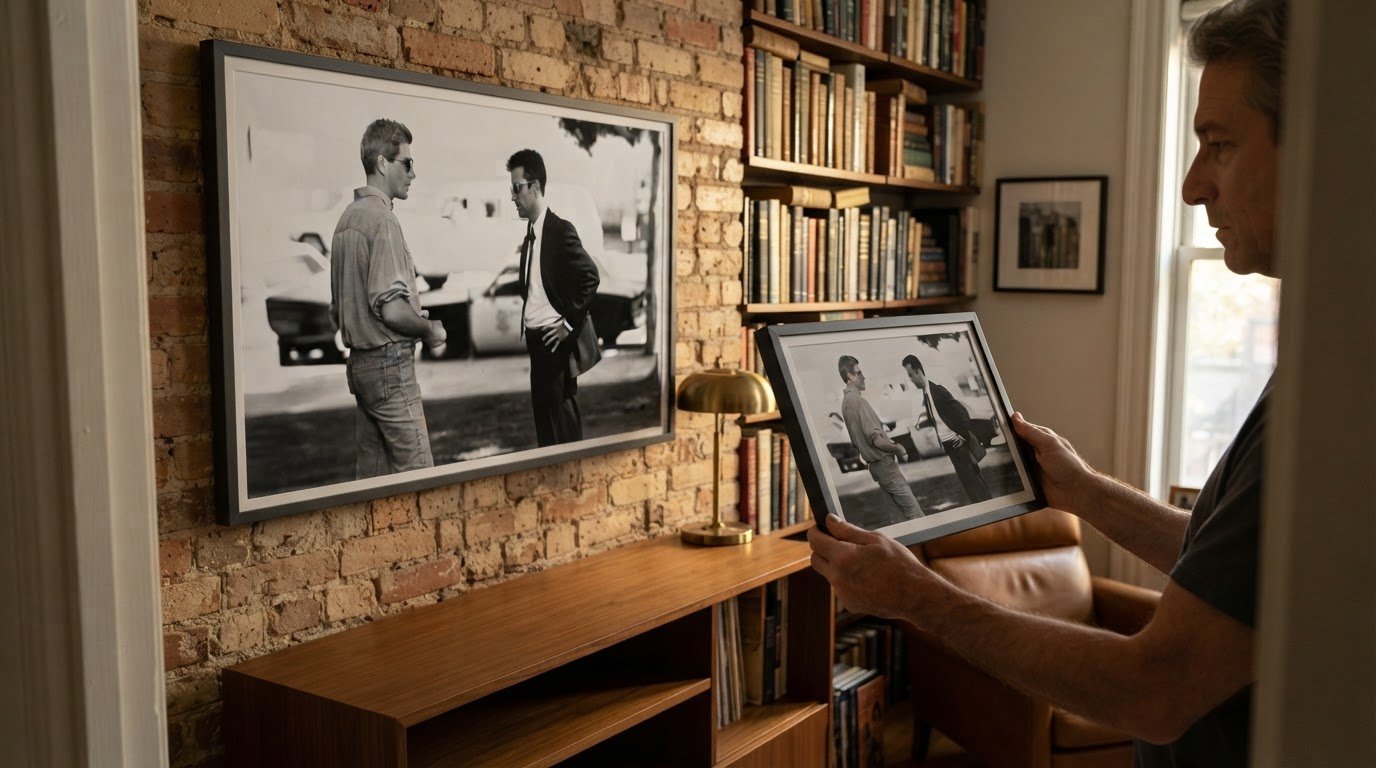
The most compelling classic car photography print isn’t necessarily the one with the most dramatic subject. It’s the image, format and scale that work together. Begin with the mood you want, from the quiet character of a black-and-white portrait to the movement of a car in motion. Then consider how the print’s proportions will sit on your wall. The best choice balances what draws you to the photograph with the space you have in mind.
A classic car can bring more than visual appeal to a room: its lines, setting and era can create a particular atmosphere. Choosing a print is both an appreciation of the image and a decision about how it will look on display. This guide explores photographic styles, print formats and practical ways to judge size and placement, helping you choose a piece that feels considered rather than simply decorative.
Key Takeaways
- Choose an image for its atmosphere as well as its car: composition, setting and tonal treatment all shape how it feels in a room.
- Match the print format to the photograph’s proportions so the subject remains balanced and clear.
- Judge scale in relation to the wall and nearby furnishings; a print should feel intentional in its setting, not crowded or lost.
- Explore Terry O’Neill Photography for a distinct archival perspective when considering photographic art for your display.
Classic car photography prints
Classic car photography prints can capture more than a vehicle’s shape. An image might emphasize a polished body, a racing moment or the period atmosphere around the car. Start by identifying what draws you to a photograph: its subject, composition, historical mood or tonal treatment. That preference helps narrow your options before you consider size and placement.
Black-and-white imagery often brings attention to contrast, reflections, and sculptural lines. A vintage Porsche 911 photographed in monochrome, for example, may read differently from the same model shown in colour. Colour can make paintwork and surroundings more prominent, while monochrome can simplify the palette. Neither approach is inherently better; choose according to the detail and mood you want the artwork to hold.
The scene matters as much as the marque. A stationary car against a plain background puts the vehicle first. A car on a road, track or city street adds context and movement. A photograph pairing a car with another subject, such as horses, tells a different story. Look at the whole frame, including its background, rather than focusing on the vehicle alone.
Use these visual cues to compare photographs with distinct characters:
- Portrait: A close view makes grille, badge, and bodywork central.
- Action: A racing scene conveys motion through the car’s position and setting.
- Street scene: Buildings and pavement place the vehicle within a particular environment.
- Monochrome: Tonal contrast emphasizes shape, shadow, and reflective surfaces.
Next, consider the print’s proportions. A landscape image can suit a wide wall, while a portrait composition may work beside a doorway or bookcase. Product listings show how sizes can vary: examples include 12 × 16 inches and 20 × 28 inches, with one listing offering a maximum size of 20 × 28 inches. These are examples from individual listings, not standard dimensions for every print.
Compare the print dimensions with the photograph’s original frame. Cropping changes what remains visible, especially when the subject sits near an edge. If the car’s front bumper, wheels or surrounding landscape are close to the frame, a different aspect ratio could cut off important details. Check the displayed image and its listed orientation, then consider whether the composition still feels balanced at the chosen size.
Measure the available wall area and account for nearby furniture. A print above a console should relate visually to the furniture’s width; a smaller piece may feel more deliberate in a narrow space. Outline the print dimensions with paper, then view the marked area from the room’s main entrance. This gives you a clearer sense of scale than imagining the size from a screen.
Framing changes the artwork’s overall presence. A slim frame can keep attention on the photograph’s edges, while a broader mount creates more visual space around it. Choose a finish that complements the room’s materials without competing with the car’s colour or the image’s contrast. For a black-and-white photograph, a restrained frame can preserve its tonal simplicity.
Finally, assess how the print will sit within the room’s light and existing art. Reflections from windows or strong lamps can make a glossy surface harder to view, while a busy gallery wall may compete with fine details in the photograph. A carefully chosen image, proportion, and position lets the vehicle’s character remain the focus, whether the scene captures a racing Porsche 911 or a quietly composed vintage touring car.
When judging the finished look, check whether a listing describes a physical print or a digital download; the format should suit your expectations for display.
Treat these as individual listing examples, not a price guide: the subjects and formats vary. Before choosing, consider what the listing includes and whether the image and its presentation suit your space.
Galerie Prints: Terry O’Neill Photography
Galerie Prints offers Terry O’Neill Photography, a natural next step if your interest in classic cars has broadened into an appreciation of photographic art. Explore the collection if you’re drawn to a photographer’s distinctive work as much as to a particular vehicle or era. The Slim Aarons Collection, Cinema Lobby Cards and Star Wars Limited Edition Prints offer other directions across the gallery’s selection, each with a distinct subject for display.
If you’ve chosen a photograph and want its presentation to feel considered, Galerie Prints’ Bespoke Framing Service can help bring the artwork and its setting together. Contact Galerie Prints to discuss your choice and framing needs.
Choose a Print That Feels Personal
A photograph earns its place on a wall through the connection it continues to invite. Choose an image that reflects what you value most, whether that is a particular era, the elegance of a design or the atmosphere surrounding a car. Your choice can be the starting point for a wider collection, bringing together automotive imagery and photographs with a related sense of history or style.
Galerie Prints offers The Slim Aarons Collection, Terry O’Neill Photography and Cinema Lobby Cards, each with a distinct visual perspective. These selections can help you build a considered display around more than one subject while keeping a clear curatorial thread. Explore the image that best expresses your taste and consider how you want to live with it.
Contact Galerie Prints about classic car prints and take the next step toward a display that feels distinctly yours.