
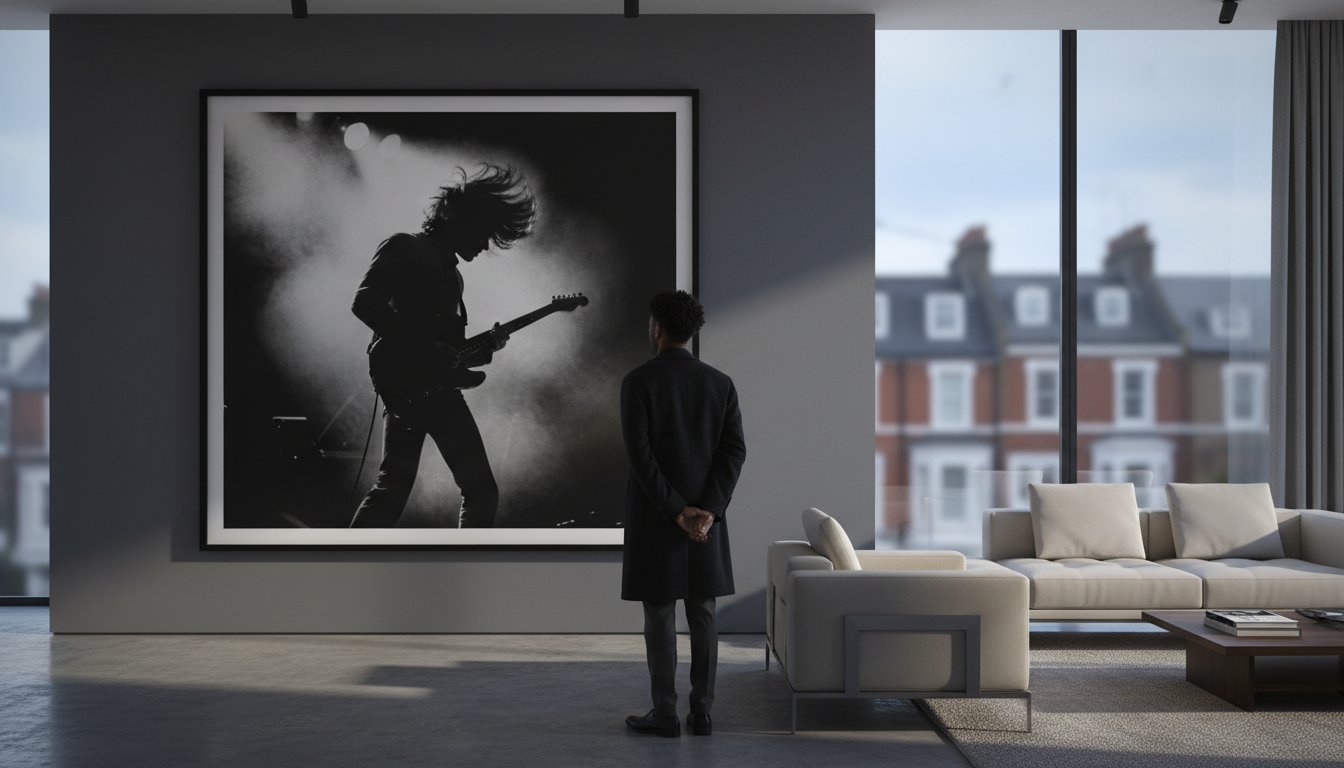
A single frame captured by Terry O’Neill or Gered Mankowitz does more than record a performance; it freezes the exact second a subculture became a global revolution. You recognize that the visceral energy of the 1960s and 70s deserves a tribute more enduring than a flimsy, mass-produced poster. To truly honor this legacy, one must look to the rock and roll photography legends who stood in the eye of the cultural hurricane, documenting the sweat on a headliner’s brow and the quiet, cigarette-smoke-filled moments backstage. These images aren’t just memories. They’re historical documents that, when produced with the precision of a master artisan, transform a living space into a private gallery of rebellion and grace.
In this article, you’ll discover the essential photographers whose work forms the foundation of any serious collection, from the 1963 portraits of The Beatles to the 1972 grit of The Rolling Stones. We’ll explain why the technical superiority of a hand-printed silver gelatin work is the only way to truly experience these moments. You’ll also gain curatorial inspiration for displaying large-scale, archival photography to create a sophisticated focal point in your home. We’re here to help you move beyond the ephemeral and invest in the world’s finest photography, ensuring these iconic stories remain preserved for a lifetime.
Key Takeaways
- Trace the transition of music photography from promotional ephemera to high-value fine art, preserving the irreplaceable spirit of the “Golden Age of Access.”
- Discover the master photographers and rock and roll photography legends whose fly-on-the-wall perspectives defined the visual identity of music’s greatest icons.
- Master the technical nuances of art investment, focusing on the provenance and superior craftsmanship of hand-printed silver gelatin archives.
- Learn how to curate a sophisticated music archive at home, elegantly pairing monochrome rock heritage with the sun-drenched luxury of Slim Aarons.
The Architects of the Rock Aesthetic: Why Photography Legends Matter
The transformation of music photography from a disposable promotional tool into a high-value fine art form marks a significant evolution in the global art market. During the 1960s and 1970s, a select group of visionaries did more than document performances; they built the visual mythology of modern rebellion. These rock and roll photography legends acted as silent partners in the creative process, translating the sonic energy of the stage into enduring silver gelatin prints. Today, these works aren’t merely nostalgia. They are blue-chip investments, curated with the same reverence as classical portraiture and sought after by collectors for their historical provenance and technical excellence.
This “Golden Age of Access” provided a level of intimacy that’s impossible to replicate in the modern era of controlled PR and digital immediacy. Photographers like Terry O’Neill or Gered Mankowitz weren’t just observers; they were part of the inner circle. They captured the quiet, vulnerable moments between the stadium anthems, defining the visual identity of icons like David Bowie and Mick Jagger. By crafting these personas, they ensured that the “Rock God” became a permanent fixture of our collective consciousness. The archives resulting from this era are irreplaceable, representing a unique intersection of cultural revolution and artisanal craftsmanship.
The Cultural Shift: From Magazines to Museum Walls
The 1960s created a unique vacuum for intimate celebrity documentation, where photographers enjoyed unrestricted backstage passes and shared hotel suites with the world’s biggest stars. This proximity allowed for the creation of raw, unvarnished imagery that originally lived on ephemeral newsprint like NME or Rolling Stone. However, the narrative shifted significantly as these images moved into the gallery space. A landmark exhibition on rock and roll photography at the Brooklyn Museum in 2009 served as a catalyst, proving that these works possessed the narrative depth required for permanent museum installations. In modern interior design, the raw, monochromatic aesthetic of these prints offers a sophisticated counterpoint to minimalist decor, providing a sense of history and edge that contemporary digital art often lacks.
Recognising a Legend: The Hallmarks of Iconic Music Photography
Discerning collectors look for specific hallmarks when identifying the work of true rock and roll photography legends. It’s a balance between narrative depth and stylistic artifice; the ability to tell a story while maintaining a high level of aesthetic polish. The concept of the “decisive moment” is vital here, especially in the high-energy, unpredictable environment of a live concert where lighting and movement are in constant flux. True “legend” status is defined as a rare combination of unfettered access, impeccable timing, and a technical mastery of the medium. These photographers understood how to use grain, shadow, and composition to elevate a musician into a symbol. Whether it’s a hand-printed shot from a London darkroom or an original negative from a tour bus, these works represent the pinnacle of 20th-century photographic heritage.
Terry O’Neill: The Man Who Defined the Sixties and Beyond
Terry O’Neill didn’t just photograph the 1960s; he lived them from the inner circle. His career began by chance at an airport in 1958, but he quickly became the premier chronicler of London’s cultural explosion. As a pioneer among rock and roll photography legends, O’Neill’s work is defined by a calculated invisibility that allowed his subjects to remain entirely themselves. He was present when The Beatles gathered for their first professional photo session in 1963, and he remained a trusted confidant to David Bowie during the experimental Diamond Dogs era in 1974. This level of access was unprecedented, transforming the photographer from a mere observer into a vital participant in the myth-making process.
Perhaps his most enduring masterpiece is the 1977 portrait of Faye Dunaway at the Beverly Hills Hotel. Captured at 6:30 AM the morning after she won the Academy Award for Network, the image serves as a pinnacle of the genre. It captures the exhaustion and surreal isolation of stardom. The composition, featuring newspapers scattered around a pool and the Oscar statuette sitting precariously on a breakfast table, tells a complete narrative of success and its subsequent comedown. This shot, along with his candid captures of iconic moments in rock and roll photography, ensures O’Neill’s place as a cornerstone of any serious music photography collection.
The O’Neill Method: Intimacy Through Trust
O’Neill’s technique relied on a quiet Leica camera and a refusal to use intrusive flash bulbs. This allowed him to blend into the background of dressing rooms and private estates. His 40 year collaboration with Elton John resulted in some of the most candid glimpses of the performer, including the legendary 1975 Dodger Stadium performances. His black and white portraits utilize a masterful balance of negative space and silver gelatin depth, capturing the vulnerability of superstars who usually lived behind a mask of public persona.
Collecting Terry O’Neill: Rarity and Provenance
The market for O’Neill’s work remains exceptionally strong, particularly for estate-stamped and signed limited editions. His archive continues to dictate the visual language of modern fashion editorials, with contemporary artists frequently referencing his 1960s aesthetics. In terms of investment value, O’Neill’s prints have seen consistent appreciation. For instance, a large-scale print of “Faye Dunaway, Hollywood” achieved a sale price of £47,500 at a Phillips auction in 2017, underscoring the enduring prestige of his work. Collectors looking to acquire such pieces can explore the curated Terry O’Neill collection to find works hand-printed with archival precision in our London darkroom.
Beyond the Stage: Candid Moments and Backstage Lore
The true legacy of the era’s most significant rock and roll photography legends isn’t found solely in the center-stage spotlight. It lives in the unscripted, quiet intervals between sets. These photographers didn’t just stand in the press pit; they lived the lifestyle alongside their subjects, earning a level of trust that allowed them to witness the human reality behind the rock-and-roll myth. These candid images hold a profound archival value, often surpassing performance shots because they strip away the performance mask to reveal the person beneath.
- Access: Being part of the inner circle allowed for a narrative depth that outsiders couldn’t achieve.
- Authenticity: Backstage shots capture the exhaustion and camaraderie that define the touring life.
- Technicality: Mastering low-light environments without the aid of modern digital sensors required immense skill and intuition.
The allure of the candid shot lies in its honesty. While a stage performance is a curated spectacle designed for the masses, a photograph taken in a dressing room or on a tour bus captures the vulnerability of the artist. This transition from the polished to the raw became particularly evident as the 1960s gave way to the 1970s, as photographers began to document the grit and rebellion that would eventually pave the way for the punk movement.
Mick Rock: The Man Who Shot the 70s
Mick Rock didn’t just document the 1970s; he defined its visual language through a lens of glamor and decadence. His 1972 work with David Bowie during the rise of Ziggy Stardust remains a cornerstone of photographic history. By utilizing a palette of high-contrast shadows and saturated, psychedelic colors, he mirrored the glam rock revolution’s intensity. His portraits of Lou Reed and Iggy Pop are more than just pictures; they’re a Music Photography: The Curated Art of Capturing Sound and Soul that bridges the gap between music and fine art, often hand-printed to ensure the highest archival quality.
Gered Mankowitz and the Early Stones
Gered Mankowitz captured the raw, unpolished energy of the 1960s London scene with a discerning eye for detail. Starting his work with The Rolling Stones in 1965, he documented their transition into global icons with an intimacy that felt both immediate and timeless. Shooting in high-smoke, low-light backstage environments required a mastery of silver gelatin printing and precise exposure. His work represents the British Invasion aesthetic perfectly, offering a gritty contrast to the era’s more commercial pop photography. These images, often sourced from original negatives, preserve a sense of permanence and historical provenance that serious collectors value.
The Collector’s Eye: Investing in Rock and Roll Heritage
To own a work by one of the rock and roll photography legends is to hold a physical fragment of cultural history. For the discerning collector, the journey begins with understanding the distinction between open editions and limited edition archival prints. While open editions offer accessibility, limited editions are restricted to a specific number of impressions, such as a run of 25 or 50. This scarcity is a primary driver of long-term value. Authenticity is anchored in provenance; every acquisition must be accompanied by a signed certificate of authenticity or a blind stamp from the photographer’s estate to verify its origin.
Preservation is just as critical as the acquisition itself. Investing in bespoke, archival framing is the only way to protect these assets from environmental degradation. Standard glass and acidic mounting boards can cause “foxing” or irreversible fading within fewer than 10 years. Utilizing acid-free mats and UV-protective museum glass ensures the image remains as vivid as the day it left the darkroom. These technical safeguards transform a simple photograph into a lasting legacy.
The Artisanal Process: Hand-Printed in the London Darkroom
The technical superiority of a silver gelatin print lies in its chemistry. Unlike modern digital inkjet reproductions, which sit on the surface of the paper, silver gelatin prints involve a light-sensitive emulsion of silver halides suspended in gelatin. When exposed to a negative and developed, the image becomes part of the paper fibers. This creates a depth of tone and a tactile, pearlescent quality that is impossible to replicate digitally. Galerie Prints maintains these traditional darkroom standards, ensuring each piece is a masterpiece of chemical craftsmanship. Hand-printing on heavy, archival fiber-based paper provides the structural integrity required for a print to last well over a century.
Building a Cohesive Music Archive
A sophisticated collection requires a narrative thread. Rather than simply gathering isolated images, a true curator looks for pieces that create a dialogue across different eras. You might pair a high-contrast, gritty stage shot from the 1970s with a rare, candid 1960s portrait to show the evolution of a performer’s persona. Balancing world-famous “hits” with lesser-known, intimate moments adds layers of intellectual interest to your walls. For those seeking to refine their aesthetic, this Fine Art Photography: A Curator’s Guide provides a framework for selecting works by rock and roll photography legends that complement a modern interior.
Discover the world’s finest photography and start your collection today.
Curating Your Own Music Archive at Home
Transforming a private residence into a sanctuary of musical history requires a transition from fan to curator. Large-scale prints of rock and roll photography legends act as more than mere decoration; they serve as the soul of a room. When you display a 1.5-meter wide silver gelatin print of David Bowie or Jimi Hendrix, you aren’t just filling wall space. You’re establishing a focal point that dictates the room’s entire aesthetic. To build a narrative gallery wall, arrange your collection chronologically or by movement, perhaps starting with the raw 1950s rockabilly era and transitioning into the psychedelic 1960s. This creates a visual biography of your personal taste.
A sophisticated interior often thrives on contrast. Don’t hesitate to pair the visceral, sweat-soaked energy of a backstage concert shot with the serene, aspirational luxury of a Slim Aarons poolside scene. This juxtaposition of “the grit and the glamour” creates a compelling dialogue between different facets of 20th-century culture. To protect your investment, consider these technical requirements for your home gallery:
- UV Protection: Always utilize museum-grade acrylic or glass that filters out 99% of ultraviolet rays to prevent fading.
- Lighting: Use dedicated LED art lighting with a high Color Rendering Index (CRI) of 95 or above to ensure colors and shadows appear exactly as the photographer intended.
- Placement: Avoid hanging archival prints directly opposite large south-facing windows, even with UV glass.
The Monochrome Edge: Black and White in Modern Interiors
Black and white photography remains the definitive choice for the serious collector. Its ability to strip away the distractions of color allows the raw emotion and composition of rock and roll photography legends to take center stage. High-contrast monochrome prints provide a sharp, architectural quality that complements minimalist furniture and neutral color palettes. You can learn more about why these images hold such enduring power in our guide on The Timeless Allure of Black and White Pictures. It’s a medium that suggests permanence and historical weight.
Bespoke Framing: The Final Touch
The frame is the bridge between the artwork and the architecture of your home. While a classic black gallery frame offers a sleek, industrial look, bespoke hand-finished wood frames can add warmth and texture. The choice of mount, or matting, is equally vital. A wide, acid-free museum mount provides the photograph with “breathing room,” elevating a simple print into a masterpiece of archival presentation. We invite you to explore the curated music archives at Galerie Prints to find the next cornerstone of your home collection.
Preserving the Visual Rhythm of Music History
The architects of the rock aesthetic, led by visionaries like Terry O’Neill, didn’t just document the music; they defined the very spirit of the 1960s and 70s. These rock and roll photography legends captured the raw, unscripted energy of a revolution, transforming backstage whispers and stadium roars into timeless art. Owning these works means preserving a piece of the 20th century’s most vital cultural shift, ensuring that the rebellion and glamour of the era remain vivid for generations. At Galerie Prints, we act as guardians of this heritage. Each piece is hand-printed in our London darkroom using traditional techniques that respect the original negative’s integrity. By sourcing from the official archives of Terry O’Neill and Getty Images, we provide collectors with museum-quality archival paper and bespoke framing that meets the highest gallery standards. It’s more than a decorative choice; it’s an investment in the world’s finest photography and a bridge to a golden age. We invite you to find the image that speaks to your own musical soul.
Explore our curated archive of Rock and Roll Photography Legends
Frequently Asked Questions
What makes a rock and roll photographer a legend in the art world?
A photographer achieves legendary status through their unique access to cultural icons and their ability to define a generation’s visual identity. Figures like Mick Rock, often called the man who shot the seventies, earned this title by capturing over 100 album covers including David Bowie’s Pin Ups. These rock and roll photography legends don’t just document events; they create the definitive imagery that survives for decades in the public consciousness.
Is rock photography a good financial investment compared to other art forms?
Fine art photography has shown substantial market resilience, with vintage music prints often appreciating as historical artifacts. According to Artnet’s 2023 reports, photography sales at major auction houses have maintained a steady trajectory over the last 10 years. Collectors view these pieces as blue-chip assets. A rare print from a 1960s session isn’t just decor; it’s a tangible piece of cultural history that often outpaces traditional equity markets in long-term value.
What is the difference between a silver gelatin print and a C-type print?
Silver gelatin prints are black and white images created using light-sensitive silver salts, while C-type prints are professional color photographs made from negatives or digital files. Our London darkroom produces silver gelatin prints by hand, a method used since the 1870s for its archival depth and exquisite tonal range. C-type prints utilize a chromogenic process, offering the rich, saturated tones seen in 1970s rock imagery. Both methods ensure museum-grade longevity for serious collectors.
How do I know if a music photography print is authentic?
Authenticity is confirmed via a signed Certificate of Authenticity and, frequently, the photographer’s own signature or an estate stamp. At Galerie Prints, we trace every piece back to the original negative or the artist’s personal archive to ensure perfect provenance. Genuine prints will often feature specific edition numbers, such as 1/50, embossed directly onto the paper. This rigorous verification process ensures your investment is a legitimate work of art rather than a mass-produced reproduction.
Why should I choose a limited edition print over an open edition?
Limited edition prints offer guaranteed exclusivity because only a fixed number, such as 25 or 50, will ever be produced. This scarcity is a primary driver of value in the global art market. While open editions are produced indefinitely, limited runs of rock and roll photography legends preserve the artist’s intent and the work’s rarity. Once an edition sells out, the secondary market value typically increases, which directly benefits the early collector.
Can I hang rock and roll photography in a formal dining or living room?
Rock photography serves as a striking focal point in formal spaces, blending raw energy with refined interior aesthetics. Large-scale black and white portraits provide a timeless, cinematic quality that complements mid-century modern or contemporary furniture. Designers often use these images to break the rigidity of traditional rooms. A curated 40×60 inch print creates an immediate conversation piece, bridging the gap between high-end glamour and rebellious history.
Who are the best photographers for David Bowie and The Rolling Stones?
Mick Rock is the preeminent chronicler of David Bowie, having captured the Ziggy Stardust era with unparalleled intimacy. For The Rolling Stones, Terry O’Neill and Gered Mankowitz provided the most iconic imagery. Mankowitz shot the famous Between the Buttons cover in 1966; meanwhile, O’Neill documented the band’s rise throughout the 1960s and 70s. Their archives represent the gold standard for collectors seeking to own a piece of these bands’ visual legacies.
How does Galerie Prints ensure the quality of their music archives?
We maintain the highest standards by hand-printing our collections in our London darkroom using traditional, time-honored methods. Every print undergoes a meticulous inspection to ensure it meets our world’s finest photography benchmark. We use heavy-weight archival papers and chemical processes designed to last over 100 years without fading. This commitment to craftsmanship ensures that the historical significance of the original negative is perfectly preserved for future generations.