
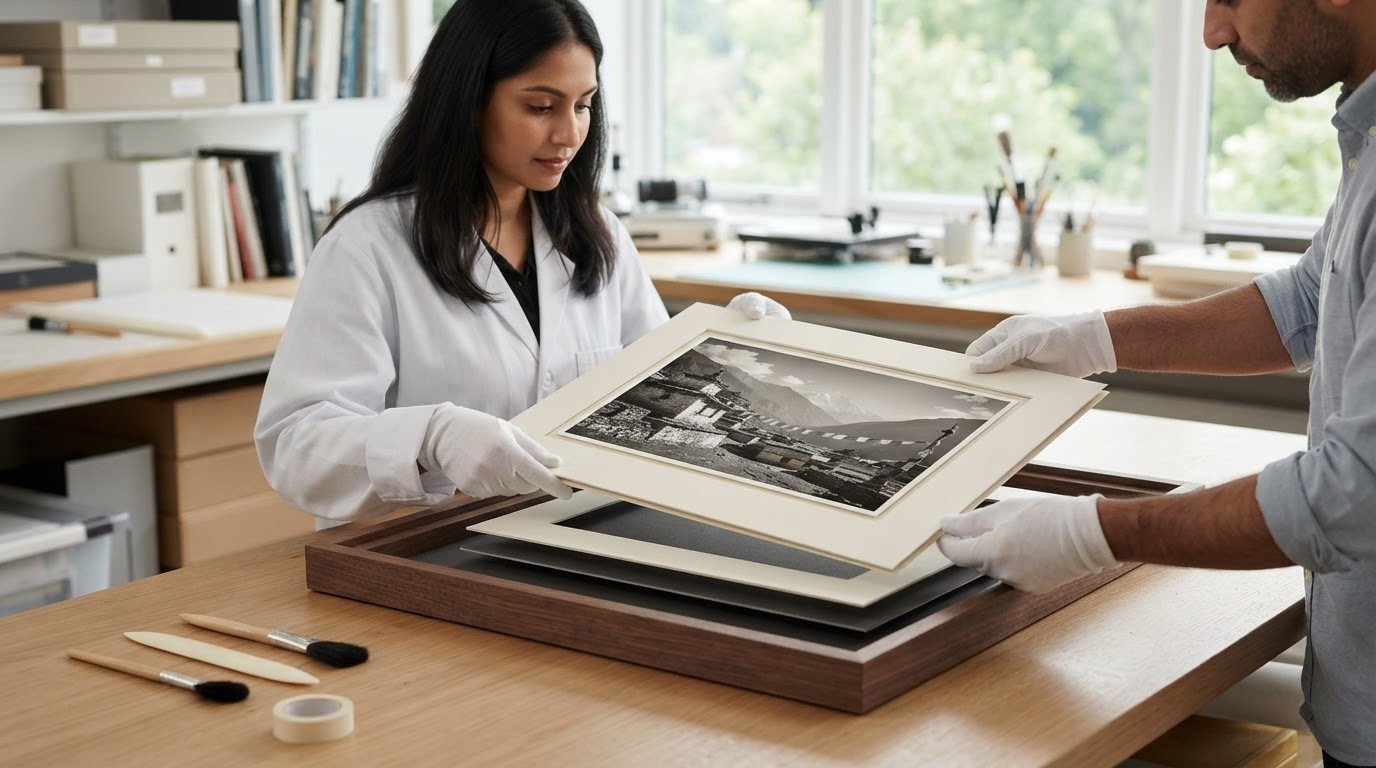
The crisp paper border framing your favourite photograph might actually be destroying it from within. When standard mounting boards degrade over time, they release volatile acids that slowly scorch delicate paper fibres, leaving behind irreparable yellow burn lines and brittle edges. True acid free matting for pictures is never a mere decorative accent; it is an active chemical shield designed to protect photographic heritage. You shouldn’t have to watch an irreplaceable print deteriorate simply because off-the-shelf framing neglected basic preservation science.
If conflicting terminology like buffered cores, alpha-cellulose, and 100% cotton rag has left you uncertain, you aren’t alone. In this archival framing guide, you’ll discover how museum-grade matting shields fine art photography from irreversible degradation while elevating its visual presence on your wall. We’ll explore the chemistry of paper preservation, clarify how to match specific matting grades to different photographic mediums, and provide an essential checklist for commissioning bespoke framing that safeguards your collection for generations to come.
Key Takeaways
- Understand why acid free matting for pictures functions as a vital chemical barrier, protecting fine art paper from the destructive yellow burn lines caused by off-gassing wood pulp.
- Learn how to distinguish between decorative paper mats, purified alpha-cellulose conservation boards, and 100% cotton museum rag to choose the proper preservation tier for your collection.
- Master the chemical difference between alkaline-buffered and unbuffered boards to prevent accidental damage to sensitive photographic emulsions and historic paper stocks.
- Discover how curatorial choices, such as luxury 8-ply profiles and bespoke window margins, elevate presentation and introduce dramatic visual depth to your walls.
- Acquire an indispensable checklist for complete archival framing, ensuring every component from reversible mounting hinges to protective backing guards your artwork indefinitely.
What Is Acid-Free Matting and Why Is It Vital for Framing?
Fine art photography demands an environment where paper, pigments, and silver halides can exist in sustained chemical equilibrium. Acid-free matting consists of chemically neutral or alkaline-buffered board designed to encase and protect artwork within a sealed frame rebate. In gallery-grade preservation, a window mat (picture framing) provides both curatorial structure and a rigorous physical defence against atmospheric contaminants.
Standard retail mounts rely on unrefined wood pulp loaded with acidic compounds. Over time, these unstable boards break down, migrating directly into fragile paper substrates. The visual consequence is immediate and devastating: dark yellow rings, known as mat burns, etch themselves across the image margins alongside irreversible embrittlement. Incorporating true acid free matting for pictures prevents this chemical destruction, maintaining the tactile purity and market value of high-calibre editions.
The Chemistry of Mat Burn and Acid Migration
Wood pulp naturally contains lignin, the complex organic polymer that binds plant cells. When exposed to ambient indoor light, heat, and seasonal humidity, lignin degrades into acidic by-products like formic and acetic acids. These volatile compounds migrate across the interface where the board touches the art, hydrolysing the cellulose fibres of fine prints.
- Chemical Scorch: Acid migration breaks molecular bonds, turning supple cotton or fibre-based photographic paper brittle and discoloured.
- Environmental Acceleration: Domestic temperature swings and relative humidity spike the rate of acid transfer, accelerating decay within standard frames.
- Permanent Degradation: Once cellulose chains sever, paper loses its structural integrity; the resulting discolouration cannot be reversed without costly conservation treatment.
Separating Art from Glass to Prevent Condensation Damage
Beyond chemical neutrality, acid free matting for pictures serves an indispensable mechanical purpose by creating breathing room beneath the glazing. Placing photographic emulsions directly against glass invites disaster. Daily shifts in indoor temperature trigger capillary condensation cycles, creating micro-droplets on the inner glass face.
Because traditional photographic gelatin swells when damp, direct contact can cause the image surface to fuse permanently to the pane. The precision-cut bevel of a conservation window mat establishes a stable microclimate, elevating the glazing away from the print to eliminate glazing adhesion and safeguard irreplaceable imagery.
The Matboard Hierarchy: Decorative vs Conservation vs Museum Rag Board
Selecting matboard requires balancing chemical longevity against the rarity of what sits inside the frame. The framing market divides these substrates into three distinct classifications: decorative paper mats, conservation-grade boards, and museum cotton rag. Understanding these divisions helps collectors choose appropriate acid free matting for pictures without falling victim to ambiguous labelling.
Mass-market retailers often label basic boards as acid-free simply because the paper was neutralised at the mill. True archival permanence, however, depends entirely on raw fibre origin. Matching the substrate to the intrinsic value of your print ensures your artwork survives decades of display without chemical interference.
Decorative Paper Mats: The Limitations of Buffered Wood Pulp
Decorative mats rely on ground wood pulp mechanically extracted from timber. While manufacturers introduce a calcium carbonate buffer to neutralise inherent acidity, this surface treatment is strictly temporary. As environmental humidity and warmth interact with residual lignin, that alkaline reserve gradually exhausts itself.
- Core Breakdown: The untreated interior wood pulp turns acidic, slowly yellowing the exposed bevel edge.
- Intended Application: Decorative boards belong exclusively on disposable graphics, open-edition commercial posters, or temporary corporate signage that won’t remain framed for long.
Conservation Board: Purified Alpha-Cellulose Excellence
Conservation matboard represents a substantial leap in chemical engineering. Fabricated from wood pulp stripped of lignin through rigorous chemical delignification, this substrate consists of 90% or higher pure alpha-cellulose fibres. The material remains chemically stable for 50 to 100 years, offering exceptional resistance to discolouration and deterioration.
Alpha-cellulose provides a reliable preservation standard for modern limited editions, collectible lithographs, and certified archival prints displayed in balanced residential interiors.
Museum Rag Board: 100% Cotton Fibre Permanence
Cotton fibres contain zero natural lignin, possessing centuries-long molecular stability without heavy chemical manipulation. Made from 100% cotton linters, museum rag board represents the gold standard defined by strict Library of Congress preservation guidelines. Its naturally pure pH shields the most delicate media from off-gassing and fibrous breakdown.
For collectors seeking to safeguard irreplaceable investments like fine art photography, cotton rag remains the uncompromising choice. When curating masterworks, paired with Galerie Prints’ bespoke framing service, 100% museum rag provides the definitive, heirloom-grade barrier your collection deserves.
Buffered vs Unbuffered Matting: Which Mediums Require Specific Chemistry?
Selecting acid free matting for pictures requires a nuanced understanding of internal chemistry. Most archival boards incorporate an alkaline reserve, typically a 2% to 3% addition of calcium carbonate. This alkaline buffer actively neutralises airborne pollutants, such as sulphur dioxide and nitrogen oxides, that seep through microscopic frame gaps over time. Without this chemical reserve, ambient environmental contaminants gradually turn the framing environment acidic.
Alkaline reserves aren’t universally beneficial. Certain historical photographic processes react poorly to alkaline environments, suffering from accelerated chemical fading or colour shifts. To prevent damage, conservators consult the Photographic Activity Test (ISO 18916). This rigorous international standard verifies that framing materials will not cause staining, silver image fading, or binder deterioration over long-term display.
When to Use Buffered Matting for Lasting Protection
Buffered matboards maintain an elevated pH between 7.5 and 9.5, establishing an impenetrable barrier against environmental acidity. This basic chemistry makes them ideal for plant-based, cellulose-heavy works on paper that thrive in slightly alkaline surroundings.
- Modern Chromogenic Prints: Contemporary colour photography and digital pigment prints benefit immensely from the continuous protection of a buffered core.
- Historic Ephemera: Vintage graphic pieces such as cinema lobby cards, printed on mass-produced cellulose stocks, rely on calcium carbonate reserves to halt internal acid generation.
- Rare Manuscripts and Documents: Wood-based and rag papers carrying iron gall or modern carbon inks stay chemically stable within buffered mounts.
When Unbuffered Matting Is Essential for Sensitive Emulsions
Unbuffered boards maintain a strictly neutral pH around 7.0, completely free of added alkaline agents. They are designed for delicate mediums where excess alkalinity can strip colours or damage the underlying binder.
Cyanotypes represent the classic example: the Prussian blue pigment that forms the image chemically hydrolyses and bleaches away when exposed to high-pH environments. Similarly, nineteenth-century albumen prints, salted paper prints, and historic colour processes like dye transfer or chromogenic dye prints from early eras demand unbuffered materials.
Collectors displaying vintage black and white pictures or mixed-media works containing protein-based substrates, such as silk or vellum, should insist on unbuffered acid free matting for pictures. Matching the matboard’s pH to the chemical nature of the medium preserves your art’s original tone and tonal depth for generations.
Curatorial Styling: Choosing Bevels, Margins, and Colours for Fine Art
A bespoke frame does far more than isolate an image on a wall; it directs the gaze, balances composition, and dictates how a room experiences fine photography. Curating the presentation requires treating acid free matting for pictures as an architectural element. Through deliberate choices in caliper thickness, window proportions, and tonal balance, framing elevates a fine print into a commanding gallery centerpiece.
Selecting Matboard Thickness: 4-Ply vs 8-Ply Depth
Every traditional window mat features an interior aperture cut at a precise 45-degree angle. This bevel catches directional room lighting, gently guiding the viewer’s focus directly into the visual narrative. While standard 4-ply boards measure roughly 1.4 mm in thickness, luxury 8-ply boards offer a substantial 3.0 mm profile.
That extra depth delivers an unmistakable sculptural presence, casting a subtle shadow line that creates immediate separation between the glazing and the print surface. An 8-ply bevel provides the dramatic volume needed to complement expansive lifestyle imagery, such as large-scale prints from the Slim Aarons archive.
Mastering Border Proportions and the Optical Center
Mass-market frames often squeeze prints into stingy, two-inch borders that suffocate the composition. Gallery presentation requires generosity. Mat margins should consistently measure wider than the frame moulding itself, typically between 7 and 12 centimetres depending on image size.
- The Gravity Illusion: The human eye naturally perceives the optical centre of an image slightly higher than its geometric midpoint. Equal borders on all four sides often make artwork look as if it is sliding down the frame.
- Optical Weighting: Professional framers correct this perception by adding an extra half-inch or centimetre to the bottom border, anchoring the piece with quiet stability.
Harmonising Colour Tones with Photographic Paper Bases
Selecting board colour requires nuanced observation. Rather than reaching for generic fluorescent white, study the lightest highlights in the print. Crisp, bright white boards work beautifully with contemporary digital pigment editions, but they instantly flatten the warm, creamy base tones of vintage silver gelatin prints.
Warm ivory and soft natural whites harmonise seamlessly with historic paper fibres without competing for attention. In contrast, solid black or archival charcoal boards isolate high-contrast monochromatic imagery, generating a theatrical, cinematic mood. To find the ideal proportion and board tone for your acquisitions, explore Galerie Prints bespoke framing for curated, gallery-level framing solutions tailored directly to your artwork.
Complete Archival Assembly: Mounting Techniques, Glazing, and Backing
An archival window mount represents only the forward-facing shield of a true conservation enclosure. Securing fine photography requires treating the frame interior as an integrated, hermetically balanced capsule. Incorporating acid free matting for pictures without addressing what lies behind and around the paper leaves delicate prints exposed to unseen structural hazards. Every substrate, adhesive hinge, and barrier sheet must cooperate to neutralize environmental stress.
Archival Hinging vs Damaging Adhesive Tapes
Standard household adhesives are fatal to collectible prints. Pressure-sensitive masking tapes, duct tapes, and synthetic double-sided strips contain acidic, petroleum-based polymers that penetrate paper fibres, leaving irreversible oily brown stains within months. Fine art requires reversible mounting techniques that respect the paper’s organic nature.
- Japanese Mulberry Paper and Wheat Starch: Traditional T-hinges crafted from feather-light kozo paper and purified, cooked wheat starch paste hold prints securely. If reframing is ever required, conservators can dissolve this adhesive cleanly with a drop of distilled water.
- Suspended Freedom: Fastening the print exclusively along the top margin lets the sheet expand and contract with natural room humidity, preventing the rippling caused by rigid perimeter taping.
- Archival Mounting Corners: Clear polyester corners or pure rag pockets cradle the sheet entirely through tension, ensuring zero adhesive touches the artwork.
UV Glazing and Sealed Protective Backing
Even the purest cotton board can’t stop ambient light decay. Pairing acid free matting for pictures with conservation-grade glazing that blocks 99% of ultraviolet light is essential to meet ISO 18902 photographic preservation standards. Without this protection, unfiltered daylight and fluorescent interior bulbs will irrevocably bleach pigments and embrittle paper binders.
Behind the artwork, the support assembly demands equal care. A secondary barrier sheet, such as acid-free conservation foamboard or inert archival fluted polypropylene, must separate the mount from the outside world. Never permit standard corrugated packaging cardboard near fine art; it off-gasses acidic lignin rapidly. Sealing the back of the frame with acid-free barrier paper and specialised rebate sealing tape halts dust mites, urban pollutants, and humidity fluctuations. Entrusting your collection to an artisanal bespoke framing service guarantees that every hidden layer, down to the final seal, upholds museum-calibre standards.
Preserve Your Photographic Collection for Generations
Investing in fine art is an act of cultural stewardship. Selecting true acid free matting for pictures is far more than an aesthetic decision; it’s an enduring commitment to chemical stability and visual longevity. Whether you specify 100% cotton museum rag to eliminate lignin degradation, tailor alkaline buffering to sensitive photographic chemistry, or introduce commanding 8-ply bevels for architectural presence, each curatorial choice shields your acquisition against time and ambient decay.
A remarkable print deserves uncompromised craftsmanship from the glazed facade through to the sealed conservation backing. Explore Bespoke Framing Services at Galerie Prints to protect your fine art acquisitions, including legendary prints from the Slim Aarons Collection, with handcrafted, museum-grade assemblies engineered for lifelong preservation. With the correct archival foundation in place, your collection will remain as luminous, crisp, and evocative decades from now as the afternoon it was first unveiled.
Frequently Asked Questions
How long does acid free matting last before losing its protective properties?
True museum-grade rag boards made from pure cotton will last several centuries without degrading or shifting in pH. Purified alpha-cellulose conservation boards provide dependable stability for 50 to 100 years in typical domestic environments. In contrast, chemically buffered decorative boards usually deplete their alkaline reserve within 5 to 15 years. Environmental factors like humidity, intense light exposure, and ambient atmospheric pollutants can speed up this exhaustion cycle considerably.
Can I tell if an old mat board is damaging my framed pictures?
Inspect the exposed 45-degree bevel cut around the image opening. If that crisp interior edge has turned yellow, tan, or dark brown, the board’s interior core has degraded into acid. You can also look for a faint, discoloured halo tracing the inner perimeter of the paper itself, known as mat burn. Once this browning appears, the mounting has begun actively scorching your print’s delicate cellulose fibres.
What is the difference between acid-neutral and 100% cotton rag matting?
Acid-neutral boards are typically manufactured from wood pulp that has undergone artificial buffering to raise its pH, but residual lignin remains an eventual breakdown hazard. In contrast, 100% cotton rag matting contains zero natural lignin from inception, relying on pure cellulose fibres rather than industrial additives. For collectors seeking the finest acid free matting for pictures, cotton rag provides uncompromising, heirloom-calibre longevity that never off-gasses or reverts to an acidic state over time.
Do black and white photographs require special unbuffered matboard?
Standard modern gelatin silver black and white prints thrive under alkaline-buffered boards, which neutralise atmospheric acid intrusion. However, historic nineteenth-century processes like albumen prints, cyanotypes, and early salted paper prints demand unbuffered, pH-neutral boards. The Prussian blue pigment in cyanotypes and the protein emulsions of vintage albumen prints react adversely to high alkaline levels, causing irreversible bleaching and chemical shifts if placed against standard buffered mounts.
Why do professional framers use an 8-ply mat instead of a standard 4-ply?
Professional framers prefer an 8-ply board because its commanding 3.0 mm profile introduces dramatic visual depth and an arresting sculptural bevel. Beyond its striking aesthetic presence, this thickness doubles the spatial separation between the glazing and the print surface. That generous clearance prevents fragile emulsions from sticking to condensation on the glass during humidity shifts, while giving expansive fine art photography an authoritative gallery presentation.
Is regular framing tape safe to attach artwork to an acid-free mat?
Standard framing tape, household masking tape, and double-sided adhesives are never safe for valuable art. Their synthetic adhesives degrade into acidic, oily resins that permanently stain paper fibres and cause structural warping. Pairing acid free matting for pictures with improper adhesive negates the mount’s protective qualities. You should only permit reversible Japanese kozo hinges adhered with pure wheat starch paste, or non-invasive museum mounting corners that grip without chemical contact.
Does acid-free matting prevent pictures from fading in sunlight?
Acid-free matting protects against chemical degradation, contact abrasion, and inner acid migration, but it can’t prevent solar fading. Fading and color loss result directly from exposure to ultraviolet radiation and visible light energy. Safeguarding your artwork against light damage requires pairing archival matting with conservation-grade glass or acrylic glazing that filters out at least 97% to 99% of UV rays, in compliance with photographic preservation standards.