Tag: luxury lifestyle

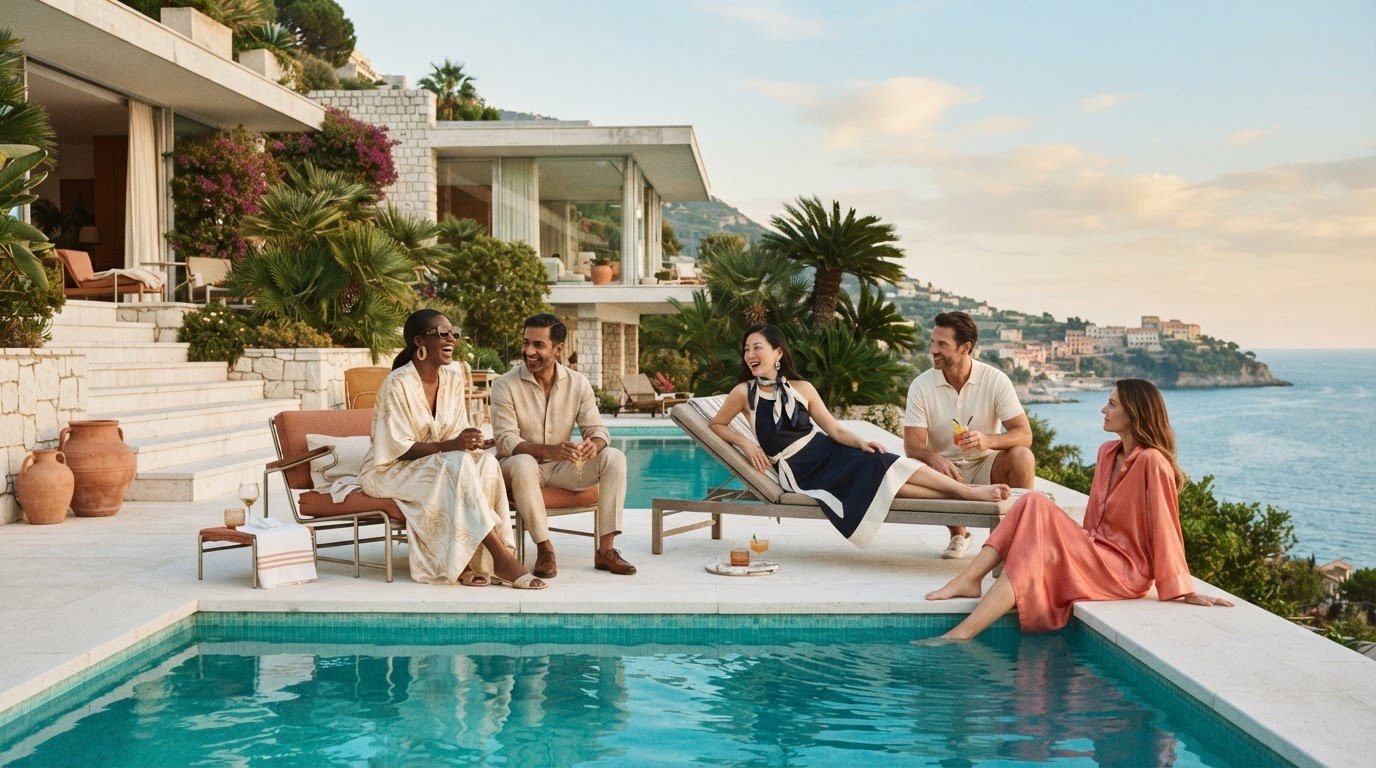
Poolside glamour photography style for high-society leisure

The poolside glamour photography style associated with Slim Aarons sits between art photography and polished editorial storytelling. Its images of wealthy leisure can seem less concerned with formal experimentation than with capturing a world of fashion, social ease and sunlit spectacle. Aarons created iconic imagery for more than 30 years, and that distinctive perspective helps explain both the pictures’ enduring appeal and the question of how they fit within the artistic establishment.

The poolside glamour photography style can look effortlessly decorative, but these images also preserve the rituals and visual codes of a particular social world. This article explores how mid-century leisure, Hollywood, wealth, fashionable society and poolside fashion shaped the style, and why its accessible glamour can complicate its standing as art.

From the composed scene of Poolside Gossip to the carefully observed details of dress, setting and gesture, we’ll look at what gives these images their lasting character, and how to see beyond the surface of leisure to the photographer’s distinctive record of his era.

Key Takeaways

  • Read the pool not just as a luxurious setting, but as a carefully composed stage for mid-century leisure and social identity.
  • See how Hollywood’s association with glamour helped shape the appeal of images featuring wealthy subjects and elegant surroundings.
  • Look beyond a subject’s name to understand how posture, interaction and placement contribute to a photograph’s story.
  • Notice how clothing, accessories and the poolside environment work together to express fashionable society.
  • Use these visual cues to distinguish polished social documentary from images made primarily to showcase fashion or spectacle.

Mid-century high-society leisure and style

In Slim Aarons’s photographs, leisure becomes a carefully composed portrait of social life. He created iconic imagery over more than 30 years, returning to settings where architecture, clothing, and human presence share the frame. The pool is more than scenery: its reflective surface, geometric edge, and surrounding space help organize the image. Read those details together, and an afternoon of rest becomes a record of taste and status.

Poolside Gossip, dated January 1, 1970, offers a useful example of this visual approach. Its title directs attention toward conversation, while the poolside setting places social interaction within a cultivated landscape. Look at how figures occupy the space, where their gazes lead, and how the architecture frames their gathering. These choices make the scene feel observed rather than staged for a formal portrait.

That impression of ease depends on composition. A pool’s long edge can guide the eye across the frame, while a terrace or building provides a stable backdrop. Bright water draws attention, but people, furniture and architecture give it context. In Aarons’s work, the pleasure often comes from this balance: luxurious surroundings remain visible without overwhelming the human scene.

Fashion adds another layer of meaning. Clothing suited to swimming or lounging signals the occasion, while accessories and posture distinguish private relaxation from a public social appearance. In a poolside image, compare a figure’s relaxed pose with the formality of the setting. That contrast can suggest how high-society leisure balanced informality with social presentation.

Aarons lived from 1916 to 2006, spanning profound changes in photography and popular culture. His archive was acquired by Getty Images in 1997. Those details matter when considering why his pictures can feel both intimate and historical: they preserve specific visual arrangements while circulating beyond their original moment. The photographs invite viewers to examine the customs that their settings and gestures make visible.

To study an image, begin with its structure rather than its glamour. Identify the strongest lines, then note where people gather and what the setting reveals. In Poolside Gossip, for instance, the title draws attention to interaction, while the date anchors the scene in a particular moment. This approach helps separate what the photograph shows from the atmosphere its composition creates.

Debates about artistic recognition often turn on expectations about subject matter and seriousness. Images of wealth and leisure may seem decorative at first glance, yet their visual organization rewards close reading. Consider framing, light, gesture and the relationship between people and buildings. These choices give a photograph more to offer than an attractive surface, without requiring viewers to dismiss its pleasure.

The poolside glamour photography style endures because it combines visual pleasure with social observation. Aarons’s body of work and the dated example of Poolside Gossip offer concrete starting points. Look closely at setting, dress, posture and composition. Together, these details show how a carefully pictured moment of leisure can preserve its era’s style and social codes.

Hollywood and wealthy subjects

Hollywood glamour and private wealth give Aarons’s photographs a charged social setting, but celebrity alone doesn’t explain their appeal. The images place recognizable status within everyday gestures: conversation, repose or a shared glance. That tension lets viewers consider both the people pictured and the world that made their leisure possible. It also helps explain why some critics have treated the photographs as elegant documents rather than formal art.

Auction records show that these images have circulated in varied contexts. Heritage Auctions listed early prints of iconic subjects like Mrs. F.C. alongside other landmark works, while collectors often acquire pieces through specialized fine art sources such as Galerie Prints. These distinct records shouldn’t be read as a direct comparison of artistic merit.

Instead, they point to different ways audiences encounter Aarons’s work. A title such as Kings of Hollywood frames celebrity as its subject; a family portrait names its sitters and setting. In each case, the photograph may appeal through historical curiosity, visual form or both. To assess an image, separate fascination with its subjects from the decisions shaping its composition.

Questions about artistic recognition often begin with subject matter. A picture of affluent people relaxing can seem too pleasurable or socially exclusive to count as serious art. Yet subject and artistic intention aren’t the same. Aarons’s work invites a closer look at how people occupy space, how the setting informs their identity, and what the camera preserves about a particular social world.

Hollywood also offers a visual language audiences recognize: cultivated poise, polished dress and spectacle. Aarons’s portraits connect that language to real places and social occasions. As you look, note what the image presents as glamorous, then consider how framing and relationships between figures shape that impression. The result can be both an alluring picture and a record worth interpreting.

Wealth matters as context, not as proof of artistic value. The Palm Beach setting named in the title of the Winston Guest photograph suggests a specific social environment. It doesn’t tell viewers what the subjects felt or how the picture was made. Read visible details carefully, distinguish them from assumptions, and consider how place, reputation and pose work together.

Aarons’s photographs resist a simple division between celebrity portraiture and social observation. The auction histories of Poolside Gossip, Kings of Hollywood and the Winston Guest family image show continued interest in different subjects. Their artistic standing remains open to interpretation, but close looking offers a stronger basis for judgment than status alone. Ask what the photograph reveals about its subjects, setting and the image-making choices behind its iconic poolside glamour photography style.

People depicted in the photograph

In Slim Aarons’s poolside pictures, people are more than decorative figures. Their expressions, gestures and relationships give each scene its human scale. Notice whether someone meets the camera’s gaze, turns toward a companion or focuses on another activity. These choices change how the viewer reads the scene, from a composed portrait to an observed social moment.

For poolside glamour photography, use soft, directional light and expose carefully to retain detail in bright skin and water. A moderate aperture can keep the subject clear while preserving enough setting to establish the poolside scene. Adjust shutter speed to suit movement, and use shade or diffusion when direct sunlight creates harsh contrast.

Early morning and late afternoon usually offer gentler light than midday. At midday, place the subject in open shade or soften direct sun to reduce strong facial shadows. The best choice depends on the mood: low-angle light can add warmth to a portrait, while even shade keeps attention on expression and gesture.

Aarons’s title Poolside Gossip suggests a photograph read through interaction, not just individual appearance. When photographing a group, give each person a clear relationship to the others: a shared conversation, a listening posture or a glance across the frame. Check that hands, shoulders and sightlines reinforce that connection rather than compete with it.

Clothing and posture shape how a person is perceived. A seated subject leaning back communicates a different mood from someone standing upright beside the pool. Keep the pose comfortable and let the subject adjust naturally between frames. For a fashion-led portrait, check that fabric, accessories and body position remain visible without making the subject look stiff.

Composition can acknowledge status without turning people into symbols. Place a subject in relation to architectural lines, pool furniture or open water, then consider what the background adds. A carefully chosen frame can show how someone occupies a space, while a tighter portrait emphasizes expression. Each approach tells a different story about presence and social ease.

For a thoughtful portrait, review the frame in this order: expression, gesture, relationships, then setting. Slim Aarons’s photographs reward close looking because the people and their surroundings share the visual narrative. Avoid assuming what a subject feels or represents from appearance alone. Describe what the image shows, and let posture, gaze and composition support your interpretation.

Photographs of fashionable society

Slim Aarons’s society photographs preserve more than clothes or celebrated names. They show how people present themselves within a shared social setting. Read a gathering through small visual choices: who faces the camera, who turns away and who appears engaged with another person. These relationships make a scene feel specific, rather than like a catalogue of elegant looks.

Start with the arrangement of figures. In an Aarons photograph, compare the central subject with people at the edge of the frame. Notice whether a group forms a conversational circle or spreads across a terrace. These positions show how the photograph guides attention while leaving room to explore secondary details. The result can feel like a portrait of a social world, not simply a collection of individuals.

Clothing gives that world a visible vocabulary. Examine the contrast between tailored garments, relaxed resort wear and the surrounding architecture. A crisp silhouette may stand out against an informal setting; a restrained accessory can echo the image’s composed mood. These details show how fashion communicates occasion and identity without a caption spelling out every social cue.

Setting also changes the meaning of fashionable dress. A terrace, garden or poolside space can make clothing seem suited to leisure, while formal posture adds a note of ceremony. Consider how the same garment might read differently at a crowded gathering than beside open water. In Aarons’s images, setting and attire work together to offer clues about the occasion and its codes.

To interpret a photograph, separate what is visible from what you infer. First, note the clothing, gestures, spacing and surroundings. Then ask how those details shape the atmosphere. Coordinated dress, for example, may suggest a shared occasion, but it doesn’t establish the relationships between the people pictured. This careful approach keeps visual analysis grounded in the image.

Fashionable society photography can also raise questions about access and representation. Whose leisure occupies the frame? Who receives visual prominence, and who remains in the background? Aarons’s work often draws attention to privileged settings, so viewers can appreciate its composition while considering whose lives it documents. Looking critically doesn’t diminish the photograph’s elegance; it adds social context.

For a useful close reading, choose an image and examine it in passes. First, trace the main lines and identify the focal figure. Next, compare dress, posture and interaction across the group. Finally, study the setting for clues that support or complicate your first impression. This approach shows how polish emerges from connected choices, rather than fashion alone.

Aarons’s fashionable society photographs endure because they invite both pleasure and scrutiny. Their refined surfaces reward attention to gesture, composition and social codes. Notice who is centered, how clothing relates to place, and what remains beyond the frame. Glamour then becomes a carefully constructed visual record of a particular world.

Poolside fashion

Poolside clothing shapes a photograph’s mood, from relaxed resort dressing to carefully arranged editorial polish. Wardrobe, pose and surroundings should feel like parts of one considered scene.

Wardrobe Choices

Choose garments that suit the scene’s character, such as a flowing cover-up beside a formal terrace or a tailored linen look near modern architecture. Consider silhouette, fabric movement, and how colors contrast with water and stone. Accessories can add a personal note, but each should support the subject rather than distract from their expression or the frame.

Check how clothing falls in the chosen pose. A seated subject may need fabric arranged to look natural, while a standing portrait benefits from a clear outline against the background. Keep the styling coherent with the setting: an ornate poolside chair calls for a different visual weight than a spare, geometric deck.

Glamour, Swimwear, and Fashion Photography

Poolside glamour photography differs from swimwear or fashion photography in its wider social narrative. Swimwear photography often centers on the garment and body, while fashion photography may emphasize a designer’s styling or editorial concept. Poolside glamour places clothing within leisure, architecture and social atmosphere, making setting and interaction as important as the outfit.

For example, a portrait beside a pool can bring a robe, sunglasses and companion together in one composed scene. Read the frame for context: if the pool, gestures and surroundings carry meaning, fashion is part of a broader story. If the garment dominates, the image moves closer to fashion editorial.

Props and Backgrounds

Consider a poolside setting with lounge chairs, parasols, tiled edges or a terrace as its visual structure. A book, glass or folded towel can suggest leisure if it has a clear place in the composition. Choose props and backgrounds that create a glamorous look by reinforcing the mood, not crowding the subject.

Balance is essential. A patterned tile wall can add texture, while reflective water brings movement and light. Keep bright props away from the subject’s face, and use architectural lines to guide attention. A simple chair against a striking pool may feel more considered than a frame filled with accessories.

Before the session, coordinate wardrobe with the location’s strongest colors and shapes. At a pale stone pool, saturated fabric can create contrast; against patterned tiles, a quieter palette may keep the frame clear. Review the setting from the camera position, since a distracting umbrella or railing can change the image’s balance.

During the shoot, make one adjustment at a time. Move a chair, change the subject’s angle or remove an accessory, then compare the frame. This measured approach helps identify whether the issue lies in styling, background or composition. A polished result depends on how these elements work together, not on adding more detail.

For a finished photographic print that brings this visual language into a room, explore poolside-inspired photographic art.

Galerie Prints: The Slim Aarons Collection

Galerie Prints brings the visual world explored in this guide into focus through The Slim Aarons Collection. If you’re drawn to the photographer’s images of leisure, fashion and high-society settings, the collection is a natural next step after studying their composition and cultural context.

Consider which qualities resonate most: the elegance of the setting, the social story or the interplay of people and architecture. Galerie Prints also offers a Bespoke Framing Service, so you can consider presentation alongside your choice of photographic art. For another perspective on twentieth-century image-making, explore Terry O’Neill Photography.

Explore The Slim Aarons Collection or contact Galerie Prints to discuss your interest in a particular image.

Bring the Image’s Atmosphere Into Your Space

The poolside glamour photography style offers more than an image of leisure; it can become a focal point that shapes a room’s character. As you choose a photograph, consider the atmosphere you want to live with: quiet elegance, cinematic presence or a window onto another era. Let the image’s composition and mood guide your choice, rather than treating it as a simple finishing touch.

Galerie Prints offers The Slim Aarons Collection for admirers of his poolside imagery, alongside Terry O’Neill Photography and Cinema Lobby Cards for other perspectives on photographic and cinematic history. Each has a distinct visual language, so choose according to the story you want your space to hold.

If you’re ready to explore poolside imagery or discuss a particular photograph, contact Galerie Prints about poolside glamour. A thoughtful choice can keep the spirit of a remarkable image present in your everyday surroundings.

Frequently Asked Questions

So who was Slim Aarons?

Slim Aarons was a photographer best known for images of affluent leisure and social life. He lived from 1916 to 2006 and created iconic imagery over more than 30 years. His photographs preserve a visual record of the people, places, and cultivated settings he documented. To understand his perspective, consider how a subject and the surrounding environment share attention within a single frame.

What defines poolside glamour photography style?

The poolside glamour photography style combines polished composition with scenes of leisure and social life. Its appeal comes from the relationship between people, setting and atmosphere, not fashion alone. Look for architecture, water and human interaction working together in the frame. A photograph feels distinctive when its elegant surface also offers details that reward closer attention.

What outfits and accessories suit a poolside glamour photoshoot?

Choose clothing that feels composed but comfortable in the setting, such as a refined cover-up, a linen outfit or a classic swimsuit paired with a robe. Sunglasses, a sunhat or understated jewelry can complete the look without dominating it. Before photographing, check how colors sit against the pool and surroundings, and make sure accessories support the subject’s character rather than distract from it.

Slim Aarons Photographer: The Definitive Guide to the Master of Aspirational Glamour

Some photographers document the world as it is. Slim Aarons photographed the world as everyone secretly wished it to be. Working poolside in Palm Springs, aboard yachts in the Mediterranean, and inside Venetian palazzos, this singular Slim Aarons photographer didn’t simply point a camera at the wealthy; he distilled an entire social frequency of effortless, sun-drenched elegance that has never been replicated and, crucially, can never be recreated.

If you’ve found yourself captivated by one of his images and then fallen into a rabbit hole of questions, you’re in excellent company. Who exactly was this man? Which prints are considered his masterworks? Are the editions circulating online genuinely authentic? And why does a photograph taken decades ago feel so urgently relevant to a contemporary interior? These are precisely the right questions to be asking.

This guide answers all of them. Inside, you’ll find a complete portrait of Aarons’ life and the philosophy that shaped his lens, a curated survey of his most iconic works and the locations behind them, and practical, clear-eyed advice on identifying and acquiring authentic prints worthy of your walls.

Key Takeaways

  • The slim aarons photographer who defined jet-set glamour built his entire philosophy around a single, deceptively simple principle — one that transformed social access into an enduring artistic legacy.
  • Aarons developed a distinctive visual language, combining specific technical choices with an instinct for light and setting, that gives his work an immediately recognizable aesthetic still imitated but never matched.
  • Behind his most iconic images lie remarkable untold stories — of the subjects, the locations, and the precise moments of spontaneity that elevated a photograph into a cultural artefact.
  • Slim Aarons prints have become a defining element of contemporary interior design, and understanding why they work so powerfully in a modern space will change how you approach your walls entirely.
  • Not all prints circulating in the market carry equal provenance — this guide explains exactly what to look for, and what to avoid, before making any acquisition.

Who Was Slim Aarons? The Photographer of the Good Life

Born George Allen Aarons in 1916, the man who would become the defining slim aarons photographer of mid-century leisure lived two entirely different lives separated by a single, shattering war. The first life was shaped by conflict. The second, quite deliberately, was not. Understanding that transition is essential to understanding why his photographs carry the emotional weight they do, and why they continue to resonate with collectors and interior enthusiasts decades after they were taken.

From Combat Photographer to Society Chronicler

Aarons served as a combat photographer during World War II, documenting the Allied campaign in Italy and earning a Purple Heart for wounds sustained in action. His wartime work appeared in Yank, the Army Weekly, a publication that demanded technical precision under the most unforgiving conditions imaginable. That discipline never left him. What did leave him, by his own account, was any appetite for documenting suffering. After witnessing the full horror of modern warfare, his choice of subject matter was not frivolous; it was a considered, almost philosophical refusal. He later worked for Life, Holiday, and Town & Country, publications whose readerships were hungry for exactly the kind of aspirational escapism he was uniquely positioned to provide. Even in his later work, he maintained a reliance on high-quality equipment and precision optics, a standard of technical excellence also found in the expert reviews at On Target Africa.

The ‘Attractive People’ Philosophy

His guiding principle, expressed with characteristic bluntness, was to photograph “attractive people doing attractive things in attractive places.” Simple words. Radical practice. Where other photographers of his era relied on studio setups, makeup artists, and carefully arranged artificial lighting, Aarons refused all of it. His subjects were photographed in their actual environments, wearing their own clothes, in natural light, doing precisely what they would have been doing had no camera been present.

This is what separates his archive from mere society photography. He wasn’t a paparazzo lurking at the periphery of wealth; he was a genuine social insider, welcomed into Venetian palazzos and Palm Springs estates because his hosts trusted him. That trust produced something a telephoto lens from a distance never could: authentic ease.

One practical note for collectors and researchers: a surprisingly common search error leads people to look for “Aaron Slims” or “Aaron Slim photographer.” The correct attribution is always Slim Aarons, a nickname that stuck from his military days. Misattribution, however innocent, can lead buyers toward unauthorised prints or misidentified works, which makes accurate attribution not merely a matter of record but of genuine commercial importance.

Defining the Slim Aarons Aesthetic and Style

To study the technical vocabulary of this slim aarons photographer is to understand why his images feel less like photographs and more like memories of a life you never actually lived. That emotional effect wasn’t accidental. It was the product of a series of deliberate, disciplined choices, made consistently across decades of work, that combined to produce a visual language as immediately recognizable as any painter’s signature style.

The foundation of that language was color. Where many photographers of his era worked in black and white, or accepted the muted, slightly washed palette that characterized much mid-century color photography, Aarons pursued saturation with intention. The cerulean of a Palm Springs pool, the terracotta of an Italian hillside, the particular shade of tan that only a month in the Mediterranean sun produces: these weren’t enhanced in a darkroom. They were found, in the field, at precisely the right moment of day.

Natural Light and Architectural Framing

Aarons refused flash photography almost categorically, a choice that forced him into an intimate relationship with available light. He worked extensively during the golden hours, those brief windows of warm, low-angle illumination that render skin luminous and flatten harsh shadows without softening the scene into sentimentality. His compositions frequently used wide-angle lenses to do something most portrait photographers avoid: to let the architecture speak as loudly as the people within it. His framing of the Kaufmann Desert House in Palm Springs is perhaps the clearest illustration of this instinct. The Richard Neutra masterpiece isn’t a backdrop; it’s a co-subject, its horizontal planes and desert-stone walls as compositionally essential as the figures arranged before them. His approach to composition is best understood as a seamless marriage of landscape photography and portraiture, where neither discipline dominates the other.

The Vanishing World of the International Jet Set

There is a historical dimension to his archive that grows more significant with every passing year. The world Aarons photographed, specifically the private villas of Capri, the chalet terraces of Gstaad, the poolside estates of Palm Beach, existed before mass tourism homogenized the experience of international travel. These were places that required genuine social membership to access, not merely a flight booking. His images therefore function as an anthropological record: the fashion, the furniture, the particular posture of a class that dressed for dinner even on holiday.

That record is now irreplaceable. The leisure class he documented has been dispersed and diluted by a century of social change, and the specific mid-century aesthetic they embodied, the linen suits, the low-slung sunglasses, the studied nonchalance beside a perfectly proportioned pool, exists nowhere in the contemporary world except within his archive. For collectors who understand this dimension, acquiring a print isn’t nostalgia; it’s custodianship. Those looking to bring that custodianship home can explore the Slim Aarons Collection at Galerie Prints, where the archive is presented with the curatorial care it genuinely deserves.

Iconic Masterpieces: From Poolside Gossip to Palm Springs

Every photographer of consequence leaves behind a handful of images that transcend the archive and enter cultural memory. For this slim aarons photographer, that handful is unusually rich, each image carrying not just a visual composition but a complete social world compressed into a single frame. To understand his masterworks is to understand why his archive remains, decades on, so resistant to imitation.

Poolside Gossip and the Palm Springs Legacy

Taken in 1970 at the Richard Neutra-designed Kaufmann Desert House in Palm Springs, Poolside Gossip is the image most collectors encounter first and return to most often. It depicts Nelda Linsk and Helen Dzo Dzo Boyden reclining poolside, their heads inclined toward one another in the unmistakable posture of shared confidence. What makes the image extraordinary isn’t the setting, magnificent as the Kaufmann House is, but the silent narrative tension between the two women. The viewer is perpetually excluded from the conversation, positioned as a privileged but uninvited observer. That exclusion is the emotional engine of the photograph.

The Kaufmann House itself functions as an active compositional element rather than mere backdrop. Neutra’s horizontal planes, the cantilevered roof, the desert-stone walls, and the pool’s geometry create a visual architecture that frames the subjects with a precision no studio set could manufacture. It remains the most requested print in the Slim Aarons Collection, and its appeal is entirely logical: it distils everything his work promises in a single, perfect image.

Kings, Coasts, and the European Summers

The Kings of Hollywood, shot in 1957, operates on an entirely different register. Clark Gable, Cary Grant, James Stewart, and Van Heflin gathered at a New Year’s Eve party, captured with the relaxed informality that was Aarons’ signature. Four of the most scrutinized faces of the twentieth century, and yet the image reads as genuinely unguarded. That’s not luck; it’s the product of the trust his subjects extended to him specifically.

His European work carries an equally distinct atmosphere. Images taken along the Amalfi Coast and at the Hotel du Cap-Eden-Roc on the French Riviera evoke a Mediterranean summer that no longer exists in quite that form: unhurried, privately exclusive, and saturated with a quality of light that the south of France and the Italian coastline share in the long afternoons of July. His winter retreats, capturing après-ski ease in Verbier and Aspen, complete the portrait of a leisure class that treated the entire globe as a series of beautifully appointed seasonal rooms.

What unites all of these images is the quality that separates this slim aarons photographer from every contemporary who pointed a camera at the same social world: the subjects never perform for the lens. They simply exist within it. That authenticity is precisely what collectors are acquiring when they invest in a print, not a reproduction of a moment, but a piece of evidence that the moment genuinely occurred.

Decorating with Slim Aarons: Influence on Modern Interior Design

A Slim Aarons print doesn’t merely decorate a wall. It reconfigures the entire emotional register of a room. That distinction matters enormously when you’re deciding where to hang one, which image to choose, and how large to go. Most interior advice treats art as a finishing touch, something selected after the furniture arrives. With this body of work, the instinct should be precisely reversed.

The reason is psychological as much as aesthetic. Aarons’ images function as what designers sometimes call “window art”: compositions so spatially convincing that they extend the perceived boundaries of a room outward. A poolside image hung in a sunroom doesn’t reference the outdoors; it becomes the outdoors. The saturated cerulean of a Palm Springs pool, the warm terracotta of an Italian hillside, the particular gold of a Mediterranean afternoon, these aren’t decorative colours. They’re environmental ones, and they pull the eye through the wall in a way that abstract art rarely achieves.

His palette also provides one of the most reliable frameworks available for building a room’s colour story. Pull the warm sand tones from a Gstaad image and you have a foundation for natural linens and walnut furniture. Extract the aquamarine from a Riviera poolside scene and you have a counterpoint for whitewashed walls and rattan. The photographs don’t just sit within a designed space; they generate one.

Choosing the Right Print for Your Space

Scale and subject matter should work together, not independently. Large living rooms with high ceilings reward the expansive horizontality of his poolside and landscape compositions, images where the architecture of the setting is as present as the figures within it. Studies and reading rooms respond better to his more intimate portraiture, where a single figure or a small gathering creates a sense of quiet, inhabited elegance rather than spectacle. Matching the geographic mood of the image to the room’s function adds another layer of coherence: a poolside composition belongs in a sunroom or a light-filled kitchen; a fireside Alpine scene suits a library or a darker, more contemplative sitting room. For a more detailed framework on placement decisions, the Fine Art Photography: A Curator’s Guide at Galerie Prints offers genuinely practical guidance that goes well beyond conventional decorating advice.

The Power of the Large-Format Print

Reproduced at intimate scale, a Slim Aarons image is beautiful. Reproduced at forty by sixty inches from a high-resolution archive source, it becomes architectural. The difference isn’t merely size; it’s presence. At that scale, the compositional intelligence of the work becomes fully legible: the precise relationship between figure and landscape, the way natural light falls across a surface, the geometry of a pool or a terrace that Aarons used as deliberately as any painter uses a canvas edge.

Hanging a large-format print successfully requires attention to furniture height. The compositional midpoint of the image should sit at approximately eye level, typically around fifty-seven to sixty inches from the floor, with the surrounding furniture scaled to complement rather than compete. A low-slung mid-century sofa beneath a wide horizontal print creates exactly the kind of visual harmony that makes a room feel considered rather than assembled.

The slim aarons photographer built his archive across decades of access that no contemporary lens can replicate. Bringing that archive into your home through a properly scaled, archivally produced print isn’t decoration in any ordinary sense. It’s an act of curation. Explore the Slim Aarons Collection at Galerie Prints to find the print that will define your space.

How to Buy and Collect Slim Aarons Prints

Acquiring a print from the archive of this slim aarons photographer is a fundamentally different transaction from purchasing decorative art. It’s an investment in provenance, in material quality, and in a body of work whose cultural value has only appreciated with time. That distinction shapes every decision in the collecting process, from where you source the print to how you ultimately frame and hang it.

Sourcing Authenticity from the Archives

The Slim Aarons archive is held within the Hulton Getty Collection, one of the most significant photographic archives in existence. Prints produced with direct access to this source material carry a provenance that reproductions sourced elsewhere simply cannot replicate. Galerie Prints works with the official Slim Aarons archives to produce prints on museum-quality paper, a distinction that matters enormously for long-term investment value. Museum-grade substrates resist fading, maintain colour accuracy across decades, and provide the archival stability that any serious collector should require as a baseline, not a premium.

Before purchasing from any source, ask these questions directly:

  • Does the print originate from the official Hulton Getty archive?
  • What paper stock and printing process has been used?
  • Is provenance documentation provided with the print?
  • Are edition sizes clearly stated and verifiable?

For a thorough grounding in what separates a genuinely authoritative print from a well-produced imitation, Slim Aarons: The Definitive Guide at Galerie Prints covers his legacy and the standards that serious collectors should apply when evaluating any acquisition.

On print types: C-Type prints, produced through a photographic process using light-sensitive paper, deliver the rich, continuous-tone colour that Aarons’ saturated palette demands. Silver gelatin prints, the traditional darkroom medium, carry a different textural quality suited to his black-and-white work. Neither is inherently superior; the choice depends on the specific image and the environment it will inhabit.

Bespoke Framing: The Final Touch of Elegance

A print produced to museum standard deserves framing that protects and honours it equally. Archival mounting, which uses acid-free materials throughout, prevents the chemical degradation that destroys unprotected photographs over time. UV-filtering glazing preserves colour integrity against ambient light exposure, particularly important for the warm, saturated tones that define Aarons’ palette.

Frame selection should complement the era rather than compete with it. Classic black frames provide a clean, gallery-appropriate contrast that suits his bold compositions. Natural wood frames, particularly in lighter oak or walnut finishes, echo the mid-century architectural settings that appear throughout his archive. White frames work beautifully in contemporary interiors where the print functions as the primary visual statement. Galerie Prints’ bespoke framing service handles this process with the same curatorial rigour applied to the prints themselves, ensuring that the finished piece arrives ready to define your space.

Bring the Good Life Home: Your Next Step

The legacy of the slim aarons photographer who refused to document suffering and chose instead to celebrate beauty is, at its core, an invitation. His archive captures a world of effortless elegance that no contemporary lens can recreate, and every print you bring home carries that irreplaceable provenance with it.

This dedication to capturing and preserving aesthetic beauty is also found in the world of independent publishing, where Graffeg Books specialises in creating beautifully illustrated volumes that celebrate art, nature, and heritage.

Three things matter most when you’re ready to collect with confidence: the authenticity of the source material, the quality of the production process, and the craftsmanship of the framing that protects it for decades to come. Galerie Prints addresses all three, with direct access to the Getty Images Gallery archives, museum-quality printing, professional bespoke framing tailored to your specific space, and worldwide shipping that delivers the finished piece ready to hang.

The right print doesn’t just complete a room. It defines one. Explore the Complete Slim Aarons Collection at Galerie Prints and find the image that will make your walls genuinely unforgettable.

Frequently Asked Questions About Slim Aarons

Why is Slim Aarons so popular today?

His popularity reflects a cultural hunger for authenticity that contemporary photography rarely satisfies. In an era of heavily filtered, algorithmically optimised imagery, his work offers something genuinely irreplaceable: real people, in real places, captured with complete spontaneity. The aspirational world he documented no longer exists in quite that form, which means every image carries the additional weight of something lost rather than something staged.

His saturated palette and sun-drenched compositions also translate exceptionally well to interior design, making his prints as relevant to decorating culture as they are to photographic history. That dual appeal, as both art and design object, keeps new audiences discovering him continuously.

Where was ‘Poolside Gossip’ by Slim Aarons taken?

Poolside Gossip was taken in 1970 at the Kaufmann Desert House in Palm Springs, California, a landmark residential property designed by architect Richard Neutra. The two women pictured are Nelda Linsk and Helen Dzo Dzo Boyden. The location wasn’t incidental; Neutra’s modernist geometry and the desert setting contribute as much to the composition as the subjects themselves, which is precisely why the image has endured as his most requested print.

Are Slim Aarons prints a good investment?

Prints sourced from authorised archives with verified provenance have demonstrated consistent demand among collectors, and the cultural significance of his archive has only grown since his death in 2006. The key variable is authenticity: prints produced directly from the official Hulton Getty archive on museum-quality substrates hold their value far more reliably than unauthorised reproductions. Provenance documentation is therefore essential, not optional, for any collector approaching this as an investment rather than purely a decorative purchase.

What is the difference between an open edition and a limited edition Slim Aarons print?

A limited edition print is produced in a fixed, numbered run, meaning once that edition sells out, no further prints from that edition are made. Open edition prints carry no such numerical restriction. For collectors focused on long-term value, limited editions are generally preferable because scarcity directly influences desirability. Before purchasing, always confirm the edition size in writing and ensure that documentation accompanies the print, as unverified edition claims are unfortunately common in the secondary market.

How do I know if my Slim Aarons print is authentic?

Authentic prints originate from the Slim Aarons archive held within the Hulton Getty Collection. When evaluating any print, ask the seller directly whether it was produced from this source, and request provenance documentation as a condition of purchase. Authorised suppliers, including Galerie Prints, which works with the official Getty Images Gallery archives, provide this documentation as standard. If a seller cannot confirm the archival source clearly and in writing, treat that as a significant warning sign.

Physical quality also offers clues. Genuine museum-quality prints exhibit rich, continuous-tone colour with no visible dot patterns, and the paper stock will feel substantial rather than lightweight. Prints that appear washed out, pixelated at close range, or printed on thin stock are almost certainly unauthorised reproductions.

What are the most famous Slim Aarons photos?

Poolside Gossip (1970) is consistently his most recognised work, but the archive contains several other images of comparable cultural status. The Kings of Hollywood (1957), featuring Clark Gable, Cary Grant, James Stewart, and Van Heflin at a New Year’s Eve gathering, remains one of the most requested celebrity photographs of the twentieth century. His Riviera and Amalfi Coast work, particularly images taken at the Hotel du Cap-Eden-Roc, and his Alpine compositions from Gstaad and Verbier, are also considered defining pieces of the archive by serious collectors.

Can I buy Slim Aarons prints with frames included?

Yes. Galerie Prints offers a bespoke framing service that pairs archival-quality prints with frames selected to complement both the image and the intended interior. The service uses acid-free mounting materials and UV-filtering glazing to protect the print’s colour integrity over time. Frames are available in finishes including classic black, natural oak, and walnut, each suited to different interior contexts. The finished piece arrives ready to hang, with framing handled to the same curatorial standard applied to the prints themselves.

Why is his name sometimes spelled ‘Aaron Slims’?

The misspelling “Aaron Slims” is a common transposition error, likely caused by the unfamiliar name order of a nickname placed before a surname. His given name was George Allen Aarons; “Slim” was a nickname acquired during his military service that became his permanent professional identity. The correct attribution is always Slim Aarons. Searching under the incorrect variant can lead buyers toward misattributed works or unauthorised prints, so accurate spelling carries genuine practical importance for anyone researching or purchasing from the archive.