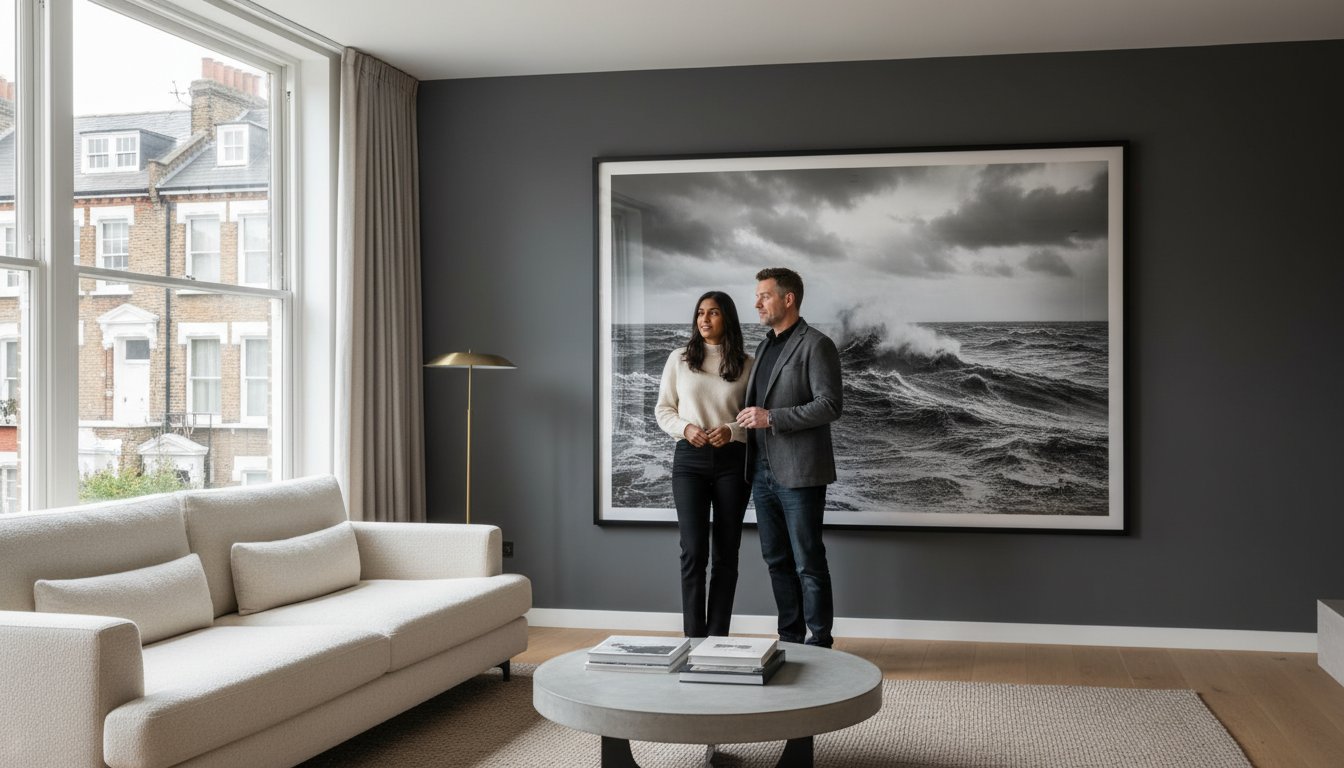

What if the most evocative Slim Aarons photograph loses its narrative power simply because it’s dwarfed by the furniture it was meant to crown? It’s a common frustration for collectors who find themselves questioning exactly what size art for above sofa installations will yield that elusive, gallery-standard balance. You’ve likely felt that unsettling realization when a piece you love feels lost against a sprawling wall, or perhaps you’re hesitant to commit to a large-scale Terry O’Neill print for fear of overwhelming the room’s silhouette.
We understand that selecting art is an investment in heritage and atmosphere, not just a search for decor. This curatorial guide will teach you to master the art of scale, moving beyond guesswork to apply the precise proportions used by professional designers. You’ll learn the essential two-thirds rule, how to account for the added dimensions of bespoke framing, and why pieces 40 inches or wider are defining the most sophisticated interiors of 2026. By the end, you’ll have the confidence to transform your living space into a balanced, luxurious sanctuary that honors the prestige of your collection.
Key Takeaways
- Discover why your sofa serves as the room’s primary anchor and how to select art that acts as a commanding, proportional visual crown.
- Master the definitive 2/3 to 3/4 ratio to determine exactly what size art for above sofa installations will create a perfectly balanced, gallery-standard silhouette.
- Learn to calculate the critical difference between raw print dimensions and final wall size by accounting for the prestige of bespoke framing and mounting.
- Evaluate the compositional power of a single, large-scale statement piece versus the narrative rhythm and visual flow of diptychs or triptychs.
- Align the aspirational scale of your chosen subject matter, from Slim Aarons’ sun-drenched vistas to iconic music archives, with your room’s unique architectural proportions.
The Significance of Scale: Why Art Proportions Above Your Sofa Matter
In the world of high-end interior design, the sofa acts as the foundational anchor of the living space. It defines the room’s orientation and dictates the flow of conversation. However, a sofa without the right accompaniment remains a silhouette in search of a story. When you consider what size art for above sofa placement, you’re looking for the “visual crown.” This piece completes the architectural narrative. If the proportions are off, the entire room feels unsettled. A piece that is too small creates a “floating” effect, where the art seems to drift aimlessly on the wall. This disconnect makes even the most prestigious print appear like an afterthought, instantly diminishing the perceived value and sophistication of the space.
Achieving the “Curatorial Proportion” requires a sophisticated balance. It’s not merely about the physical frame. You must consider the intricate relationship between your ceiling height, the sofa’s total length, and the “breathable” white space surrounding the work. According to 2026 market trends, there is a distinct move toward oversized statement pieces. Collectors are increasingly favoring works 40 inches or wider to create a bold focal point. This approach ensures the art commands the room rather than merely occupying it, allowing the viewer to appreciate the technical superiority and historical significance of the work without visual clutter.
To find inspiration for these statement pieces, you can learn more about On The Edge Gallery and explore their collection of contemporary works designed to make a lasting impact.
The Psychology of Large-Scale Photography
Large-scale photography does more than fill a void; it creates an immersive window. An expansive Slim Aarons vista or a life-sized Terry O’Neill portrait invites the viewer into another world. This is the primary distinction between a mere decoration and a true statement piece. Visual weight also plays a crucial role in how we perceive scale. Darker, high-contrast photography often feels heavier and more substantial. Consequently, a moody, dark-toned image might require slightly more “breathable” wall space to avoid feeling cramped, whereas a lighter, more ethereal print can occupy a larger percentage of the wall without overwhelming the senses.
Common Sizing Pitfalls to Avoid
The most frequent error in luxury homes is the “Postage Stamp” mistake. This occurs when a small, solitary print is placed on a vast wall, leaving it looking disconnected. Conversely, art that is significantly wider than the sofa itself creates a top-heavy arrangement that feels oppressive and unstable. The ideal visual horizon ensures the eye travels naturally from the sofa’s silhouette back to the art. To maintain this connection, the bottom of the frame should typically sit 6 to 10 inches above the sofa back. Determining what size art for above sofa displays best usually involves the “Two-Thirds Rule,” ensuring the art spans approximately 60% to 75% of the sofa’s width for a balanced, gallery-standard result.
The Golden Ratios: Calculating the Perfect Art Size for Your Sofa
Precision is the hallmark of a well-curated home. When you’re deciding what size art for above sofa placement, the most reliable guideline is the 2/3 to 3/4 rule. This formula ensures your chosen work spans a significant portion of the sofa’s width without extending beyond its physical boundaries. If the art is too narrow, it looks like a lonely island. If it’s too wide, it creates a top-heavy imbalance that makes the furniture feel fragile. By adhering to this ratio, you anchor the seating area and create a cohesive focal point that feels intentional and luxurious.
While your eye for aesthetics is vital, the mathematics of the room provide the necessary boundaries for that beauty to thrive. For a standard sofa, the art should ideally cover roughly 60% to 75% of the space above the back cushions. This creates a visual “sweet spot” where the artwork feels like a natural extension of the furniture rather than a separate, disconnected element. Our bespoke framing service ensures these final dimensions are calculated with millimetre precision, accounting for the mount and frame profile to reach these ideal ratios.
Sizing Math for Standard Sofa Widths
Standard sofa dimensions provide a helpful baseline for your curatorial calculations. Consider these common configurations:
- The Loveseat (approx. 150cm): Aim for an art width between 100cm and 115cm. This scale provides enough presence to command the wall while respecting the compact nature of the seating.
- The Three-Seater (approx. 210cm): This common size requires a more substantial piece, ideally between 140cm and 160cm wide. A single, large-scale Terry O’Neill print is often the perfect candidate for this silhouette.
- The Grand Sofa or Sectional (230cm+): For these expansive silhouettes, you’ll need art that measures 180cm or wider. If a single print of that magnitude isn’t feasible, consider a triptych or a multi-panel set to bridge the gap across the wall.
The Height Factor: How High to Hang?
Height is the final piece of the puzzle in determining what size art for above sofa installations. The “Golden Gap”—the distance between the top of the sofa and the bottom of the frame—should ideally be 15cm to 20cm (6-8 inches). This keeps the art connected to the furniture rather than floating in isolation. For those with high ceilings, you might feel tempted to hang the art higher to fill the vertical void. Don’t. Instead, prioritize vertical height within the piece itself by choosing a portrait orientation. This draws the eye upward while maintaining the 57-inch rule, which suggests that the center of the artwork should sit at the average human eye level for a true gallery experience.
Compositional Strategies: Single Statement vs. Gallery Wall
While the mathematical ratios discussed previously provide the necessary architectural stability, the choice of composition determines the emotional resonance of the room. A single, commanding fine art photography print offers a sense of serene confidence, acting as a singular window into a specific moment of heritage or beauty. This approach is particularly effective when the subject matter is complex or deeply evocative, allowing the viewer’s eye to linger without distraction. Conversely, diptychs and triptychs allow for a narrative arc, where a story unfolds across multiple frames, creating a rhythmic visual cadence that spans the length of the sofa.
For those who prefer a structured, museum-like environment, a grid layout of black and white pictures provides an air of quiet authority. This arrangement relies on absolute precision, where uniform framing and identical spacing create a cohesive unit. It is an excellent strategy for displaying archival collections or music photography, where the collective impact of the series outweighs the individual power of a single shot. The salon-style gallery wall offers a more personal, eclectic alternative, mixing various sizes while maintaining a strict “outer” boundary to ensure the display feels like a curated collection rather than a random assortment.
The Triptych Advantage for Extra-Long Sofas
Extra-long sofas often present a unique challenge when determining what size art for above sofa displays. A single frame measuring over 180cm can be difficult to manage logistically, particularly when navigating narrow hallways or historic staircases. Triptychs offer an elegant solution. By splitting a single panoramic vista or grouping three related works, you achieve the necessary scale with greater ease. To ensure they read as a single, unified entity, maintain a consistent spacing of 5cm to 10cm between frames. This “breath” between pieces adds a modern, architectural layer to the installation while honoring the primary subject matter.
Mastering the Gallery Wall Above a Sofa
Creating a gallery wall requires a delicate balance of variety and restraint. The most successful arrangements begin with a “hero” piece, a larger work that anchors the collection and draws the eye first. From this anchor, you can build outward using the “Invisible Box” technique. This involves keeping the outer edges of the entire arrangement within a defined rectangular boundary that adheres to the 2/3 width rule. This ensures the total arrangement respects the previously established guidelines for what size art for above sofa installations. For a more detailed walkthrough on arranging these complex displays, see our guide on how to create a gallery wall.
The Bespoke Factor: How Framing and Mounting Affect Final Dimensions
A common oversight when determining what size art for above sofa displays is the distinction between the image itself and its final footprint. While you might purchase a specific print size, the “Final Wall Size” is the only metric that truly matters for your room’s proportions. In the world of high-end galleries, a print is rarely hung in isolation. It’s cradled by a mount and secured within a frame, both of which add significant physical inches and visual weight to the installation. Failing to account for these additions often leads to a piece that feels unexpectedly crowded or, conversely, perfectly sized despite a smaller initial print dimension.
The mount, or mat, serves as a silent curator, providing the necessary “breath” for a piece to be fully appreciated. For the sun-drenched vistas found in the Slim Aarons collection, a generous mount adds a layer of prestige and historical distance. It elevates the work from a simple photograph to a preserved artifact. Beyond aesthetics, the frame itself adds substantial width. A standard 2-inch timber frame, when applied to both sides, adds 4 to 5 inches to the total horizontal span. For those seeking a more contemporary, avant-garde silhouette, the “Floating” mount offers an alternative that allows the paper’s edge to be seen, providing a sense of raw, artisanal authenticity.
Calculating the Frame’s Footprint
To achieve a gallery-standard finish, you must incorporate the mount and frame into your initial 2/3 width calculation. Standard mount widths typically range from 5cm for smaller works to 10cm or more for large-scale statement pieces. If you’re working with a three-seater sofa, a 10cm border on each side of the print adds a total of 20cm to the width before the frame is even considered. This “luxury of space” is a hallmark of premium interiors, as wider mounts are currently trending in elite design circles to emphasize the exclusivity of the work. You can explore these archival options through our bespoke framing service to ensure your final piece meets these exacting standards.
Selecting the Right Frame Style for Your Sofa’s Aesthetic
The frame’s profile should mirror the architectural language of your seating. Minimalist, low-profile sofas pair beautifully with slim, modern aluminium frames that disappear into the background, allowing the photography to take center stage. For more traditional or mid-century modern silhouettes, classic timber frames in oak or walnut provide a sense of permanence and warmth. Consider the room’s existing hardware or the sofa’s legs when selecting a frame color. A black frame might ground a light-colored sofa, while a natural wood finish can soften a high-energy room. This cohesion ensures the art feels like an integral part of the home’s heritage rather than a fleeting addition.
Curating the Collection: Choosing Art that Fits Your Space and Soul
While the mathematical precision of ratios provides a structural foundation, the final selection must resonate with the room’s soul. The subject matter should mirror the energy of your seating area. A relaxed, linen-clad sofa in a coastal residence finds its partner in the sun-drenched, serene vistas of the Mediterranean. In contrast, a velvet-tufted mid-century piece might demand the raw, high-energy grit found in our music photography archives. This alignment of vibe and volume ensures the art doesn’t just sit on the wall; it lives within the space.
Determining what size art for above sofa displays requires an understanding of “aspirational scale.” Certain photographers demand larger formats to be fully appreciated. To view a work of significant historical provenance at a small size is to lose the nuances of the artist’s technique and the technical superiority of the production. Before committing, we recommend the “Tape-it-Out” method. Use low-tack painter’s tape to outline the proposed frame dimensions on your wall. This allows you to visualize the piece throughout the day, seeing how the light hits the space and ensuring the proportions feel commanding rather than crowded. Investing in archival quality means this focal point will remain a lasting piece of history, preserving original source materials for generations.
The Slim Aarons Effect: Wide-Angle Luxury
The legendary “Poolside” series by Slim Aarons is the quintessential example of photography that thrives on an oversized landscape format. These works often feature a strong horizon line that can visually “widen” a narrow room, creating an illusion of architectural depth. To capture the full aspirational lifestyle of the era, these prints should be hung with enough presence to act as a secondary window. Explore our curated Slim Aarons collection to find the iconic vista that matches your sofa’s silhouette.
Cinematic Scale with Lobby Cards and Posters
For collectors with a passion for the silver screen, cinema lobby cards offer a sophisticated alternative to single large prints. When arranged in a precise grid of 4 or 6, they create a rhythmic, collectable look that bridges the gap between art and history. If your living room serves as a media-centric sanctuary, a diptych of vintage movie posters can provide the necessary cinematic scale without feeling cluttered. When deciding what size art for above sofa placement, remember the four pillars of a perfect purchase:
- Width: Does it respect the 2/3 rule while allowing for frame thickness?
- Height: Is the center at eye level, approximately 57 inches from the floor?
- Frame: Does the timber or aluminium finish complement the room’s hardware?
- Soul: Does the subject matter evoke the wonder and nostalgia your home deserves?
Transforming Your Interior with Curatorial Precision
You now possess the discerning insight required to move beyond mere decoration and toward true architectural harmony. By mastering the golden ratios and accounting for the substantial footprint of bespoke framing, the question of what size art for above sofa installations becomes a matter of precise calculation rather than hesitant guesswork. You understand that a piece must not only occupy a void but must crown the room’s primary anchor with the appropriate visual weight and historical resonance.
Selecting a focal point is an act of stewardship for your home’s legacy. Our museum-quality prints are sourced from prestigious authorized archives, including Getty Images and the Terry O’Neill collection, ensuring every investment carries genuine provenance. With worldwide shipping and bespoke framing executed by master craftsmen, your journey from selection to installation is supported by technical excellence at every stage.
Explore our curated collections of Fine Art Photography and find your perfect statement piece. It’s time to let your walls tell a story of elegance and heritage that will endure for generations.
Frequently Asked Questions
What is the 2/3 rule for art above a sofa?
The 2/3 rule is a foundational principle of interior curation. It suggests that the total width of your artwork, including the frame and any mounting, should span between 60% and 75% of the sofa’s total width. This ratio ensures the art acts as a commanding visual anchor without overwhelming the furniture’s silhouette. It prevents the common error of choosing a piece that appears dwarfed by the seating below.
How high should art be hung above a couch?
Ideally, the bottom edge of your frame should sit 6 to 10 inches (15cm to 25cm) above the top of the sofa back. This distance, often called the “Golden Gap,” creates a cohesive connection between the furniture and the art. Hanging the piece any higher risks a “floating” effect, where the artwork feels disconnected from the room’s primary anchor and loses its narrative power.
Can I hang art that is wider than my sofa?
Hanging art wider than the sofa is generally discouraged in high-end design. Such an arrangement creates a top-heavy imbalance that makes the seating area feel fragile and unsettled. If you have an exceptionally large wall, it’s better to select a piece that adheres to the 75% width limit and then balance the surrounding space with architectural elements like floor lamps or sculptural greenery.
Should I choose one large piece or a gallery wall for my living room?
The decision depends on the emotional resonance you wish to create. A single, large-scale print offers a serene, museum-like focal point that emphasizes the prestige of the artist. A gallery wall allows for a more personal, narrative approach. Both strategies are successful provided the total arrangement respects the guidelines for what size art for above sofa installations to maintain a balanced silhouette.
How do I choose the right frame size for my art print?
When selecting a frame, you must calculate the “Final Wall Size” rather than just the print dimensions. A bespoke framing service will often include a 5cm to 10cm mount, which adds significant “breath” and prestige to the work. A substantial timber frame can add another 4 to 5 inches to the total horizontal span. Always use these final, outer dimensions for your proportional calculations.
What if my sofa is placed against a very large, high-ceilinged wall?
In rooms with soaring ceilings, prioritize vertical height within the artwork itself rather than hanging a smaller piece higher up. Choosing a portrait orientation or a tall triptych draws the eye upward while keeping the bottom of the frame near the sofa. This fills the vertical void while respecting the 57-inch eye-level rule, ensuring the collection remains accessible and impactful for the viewer.
Is it okay to lean art on the sofa back instead of hanging it?
Leaning art is a casual styling choice that lacks the permanence and quiet authority of a gallery-standard installation. For high-caliber photography, secure hanging is essential to protect the frame and the archival materials from accidental damage. A properly mounted piece conveys a sense of stability and historical significance, suggesting the work is a lasting piece of heritage rather than a temporary decoration.
How do I handle art placement if my sofa isn’t centred on the wall?
If your sofa is offset, you should center the artwork over the sofa rather than the wall. This maintains the critical visual relationship between the furniture and the art. When determining what size art for above sofa displays in asymmetrical rooms, use the sofa’s width as your primary guide. You can then balance the remaining wall space with secondary elements like a tall floor lamp or a curated pedestal.