
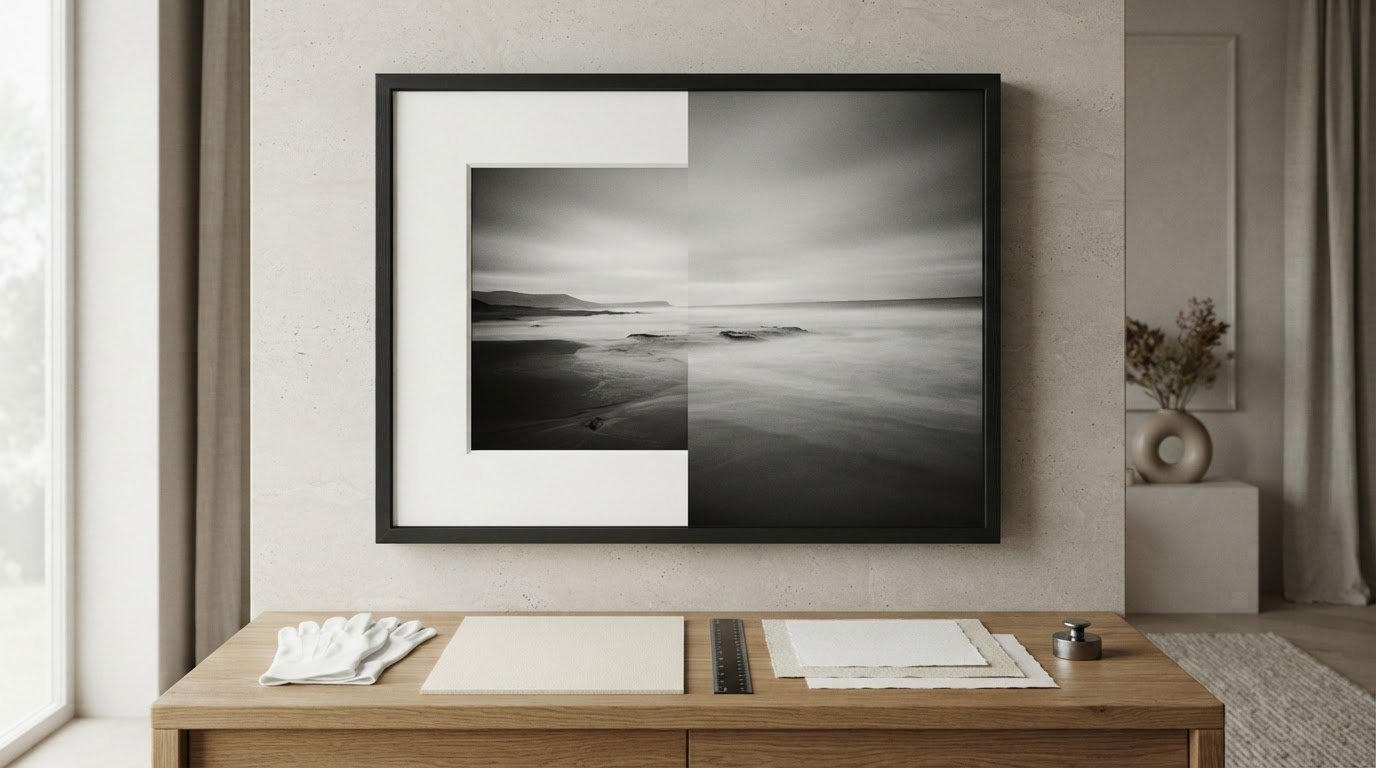
The cleanest, most minimalist framing choice in contemporary design can quietly become the most destructive decision for an art collection. When standing before a prized piece and asking, should I frame a print with or without a mat, the dilemma reaches far beyond simple styling; it is fundamentally archival. Resting bare photographic paper directly against glazing risks trapped humidity, which can fuse delicate emulsions to glass and cause irreversible damage.
It is natural to feel caught between the crisp immediacy of full-bleed presentation and the quiet reverence of a traditional mount. You want your living space to feel refined rather than dated, yet uncertainty around margin ratios, tonal balance, and print protection can stall any installation. You will discover whether matting or full-bleed framing best elevates and preserves your fine art photography. Ahead, we share a definitive curatorial framework to safeguard your valued prints, balance negative space, and achieve a timeless presentation that enriches your interior architecture.
Key Takeaways
- Master the curatorial criteria for deciding whether you should frame a print with or without a mat based on artwork rarity, scale, and paper surface.
- Understand how archival cotton rag matting physically separates print emulsions from glass, eliminating condensation risks and long-term degradation.
- Discover when full-bleed presentation creates dramatic visual impact, particularly for expansive landscape photography and bold mid-century compositions.
- Learn why standard wood pulp mats inflict irreversible mat burn and how conservation-grade mounting preserves collector value across decades.
- Identify the spatial proportions and frame depths needed to achieve architectural harmony within sophisticated residential interiors.
Framing With or Without a Mat: The Essential Curatorial Difference
Every framing decision is fundamentally a dialogue between preservation and spatial perception. When resolving whether you should frame a print with or without a mat, you are choosing how the eye transitions from the active architecture of a room into the frozen narrative of a photograph. Historically, fine art institutions positioned mat boards as essential isolation chambers, focusing contemplation squarely upon delicate tonal gradations. Modern residential design, by contrast, frequently embraces the immediate clarity of full-bleed presentation. Both approaches carry distinct physical consequences for fine art paper and create entirely different sensory experiences within an interior.
The Anatomy and Purpose of a Picture Mat
A window mount is far more than a decorative paper border. In traditional gallery presentation, a conservation-grade 4-ply or substantial 8-ply beveled mount acts as an architectural relief. The precision 45-degree bevel cut produces a crisp, recessed shadow line, gently drawing the eye inward toward the print while visually isolating the subject from patterned wall coverings or competing decor. More crucially, as detailed in the archival overview of Mat (picture framing), the board establishes an indispensable physical barrier. This spatial depth prevents the photographic emulsion from resting directly against the framing glass, eliminating the micro-climate where condensation gathers and permanently destroys gelatin or pigment surfaces.
The Aesthetic Intent of Matless Full-Bleed Framing
Borderless presentation strips away ornamental ceremony to celebrate raw graphic impact. By running a photograph directly to the inner rebate of the moulding, full-bleed framing creates an uninterrupted window into the image:
- Visual immediacy: The frame functions as an architectural portal, pulling the viewer directly into the composition without decorative buffering.
- Modern spatial balance: Expansive horizontal vistas and bold mid-century works gain dramatic presence, complementing the clean lines of contemporary residential joinery.
- Maximized scale: Artworks command wall space through imagery alone, an ideal treatment when oversized dimensions leave little room for perimeter margins.
Deciding if you should frame a print with or without a mat ultimately hinges on whether your space calls for the contemplative reverence of a layered reveal or the kinetic, contemporary drama of an unbordered horizon.
When You Should Frame a Print With a Mat: Protection and Prestige
Preservation is an invisible art. While aesthetic preferences shift across eras, the physical vulnerabilities of fine art paper remain constant. When asking yourself if you should frame a print with or without a mat, remember that rare photographic editions demand physical separation from ambient room environments. Incorporating an archival window mount provides an essential buffer against degradation, ensuring collector-grade imagery maintains its pristine physical state across generations.
Preventing Glazing Damage and Moisture Traps
Every home experiences diurnal temperature fluctuations. As warm air cools against framing glass or acrylic, microscopic condensation forms along the interior glazing surface. Without a separating window border, the delicate emulsion of a photographic print touches that glass directly. Over months or years, the gelatin or pigment layer rehydrates, softens, and permanently adheres to the glass face. Lifting the glass tears the artwork away, resulting in catastrophic loss. Adhering to professional conservation framing practices ensures paper fibers have adequate clearance to expand and contract naturally as seasonal relative humidity shifts.
Elevating Historic and Fine Art Photographic Archives
Archival collections possess a visual gravity that responds exquisitely to intentional border treatments. Intimate mid-century portraits and classic black and white pictures require quiet visual isolation so the eye can savor subtle silver tonal transitions. A pristine white, warm white, or soft neutral museum mount establishes a zone of visual silence. This perimeter blocks competing wall tones, allowing deep velvety blacks and crisp architectural highlights to resonate with authentic gallery prestige.
Balancing Print Scale on Expansive Wall Spaces
Interior architecture frequently demands substantial visual weight. An intimate 8×10 or 11×14 inch archival print can easily feel lost upon a double-height wall or above a substantial credenza. A generous mat solves this spatial tension through proportion:
- Substantial margins: Applying a four- to five-inch border expands the overall frame footprint, allowing smaller historical pieces to hold significant architectural space.
- Curatorial focus: Wide margins create dramatic negative space, drawing the viewer closer to study fine grain, facial expressions, and nuanced period details.
- Collector presence: The deliberate use of negative space signals that the image inside is an authentic artifact deserving focused contemplation.
If you are considering whether you should frame a print with or without a mat to safeguard rare family heirlooms or archive acquisitions, partnering with an artisanal studio for a bespoke framing service guarantees your pieces receive tailored, conservation-grade protection that honors their historical weight.
When to Frame Without a Mat: Modern Scale and Immersive Art
Borderless framing strips away visual boundary lines to pull the observer directly into the frame. While intimate, historical works often benefit from the formal reverence of a window border, contemporary residences frequently call for an immediate, architectural punch. When asking whether you should frame a print with or without a mat, scale and pictorial composition serve as your clearest aesthetic guides. Removing the perimeter creates an immersive threshold, allowing sweeping horizons and saturated palettes to interact seamlessly with clean interior millwork.
Maximizing the Visual Impact of Large-Format Works
Large-format lifestyle works thrive on uninhibited space. Iconic resort scenes, such as those captured by slim aarons, celebrate sunlight, saturated azure pools, and sprawling mid-century villas. Encasing a substantial 30×40 inch or 40×60 inch photograph within an additional four-inch mat border can easily produce an overwhelming, cumbersome profile that swallows residential wall space. Extending the photograph straight to a slender walnut, natural oak, or satin black moulding produces modern immediacy. The image reads as a panoramic architectural window rather than a framed paper artifact.
Protecting Art Without a Mat: The Role of Framers Spacers
Dispensing with a mat must never mean sacrificing conservation standards. Contrary to common belief, custom framing without a mat does not require pressing fine art paper flat against glazing. Seasoned framing studios deploy framers spacers to achieve safety:
- Concealed depth: Framers secure inert acrylic or wood fillet spacers inside the frame rebate, hidden entirely behind the lip of the moulding.
- Air circulation: These slender profiles lift the glass a crucial 1/8 to 1/4 inch away from the print, establishing identical environmental airflow to a traditional 8-ply mat.
- Structural flat support: Archival backing boards and reversible hinge mounts ensure broad sheets remain perfectly flat without bowing or touching the glazing across seasonal temperature shifts.
Highlighting Deckled Edges and Exposed Paper Character
Certain fine art papers possess rich, tactile personalities that should be celebrated rather than tucked behind a beveled mat opening. Heavyweight cotton rag papers featuring hand-torn or deckled edges gain captivating presence through shadowbox float mounting. In this treatment, the print is gently anchored atop an archival 8-ply conservation board with a generous margin surrounding it, leaving the irregular, feathered paper edges entirely exposed. Adding internal frame spacers sets the glazing forward, casting natural, atmospheric drop shadows around the paper edges and accentuating the physical craftsmanship of the print itself.
Deciding if you should frame a print with or without a mat comes down to artistic intent: choose a mat for quiet focus, or embrace spacer-based full-bleed methods when your artwork demands architectural scale and visceral immersion.
Curator Decision Framework: Choosing the Right Framing Approach
Every considered acquisition requires a deliberate framing strategy that synthesizes physical preservation with spatial harmony. Determining whether you should frame a print with or without a mat ceases to be guesswork when evaluating two core pillars: the material nature of the photographic medium and the architectural atmosphere of the installation space. A curated interior relies on this balance to ensure artwork looks intentional rather than accidentally assembled.
Print Characteristics: Medium, Rarity, and Paper Finish
The substrate of your artwork dictates the minimum level of physical isolation required inside the frame moulding:
- Chromogenic and gelatin silver prints: Glossy, resin-coated, or darkroom C-type papers possess delicate chemical layers that permanently fuse to acrylic or glass if subjected to direct contact; they demand the physical offset of a 4-ply mat or concealed archival spacers.
- Heavy cotton rag fine art papers: Textured, ultra-matte baryta surfaces absorb ambient light with minimal surface glare. While they offer greater aesthetic flexibility for edge-to-edge presentation, their thick fibrous edges still require non-invasive corner hinges rather than destructive adhesive mounts.
- Limited-edition archival rarity: High-value historical acquisitions necessitate museum-standard reversible mounting techniques, ensuring the print remains entirely untouched by permanent adhesives, masking tapes, or non-archival backing boards.
Interior Architecture, Room Mood, and Display Density
The proportions and lighting of your domestic environment fundamentally shape how a framed composition behaves on the wall. A generous, off-white window border introduces a pocket of calm, making it ideal for period architecture with detailed plasterwork, patterned wallpapers, or rooms with active joinery. In contrast, modern spaces characterized by polished concrete floors, steel-framed glass doors, and restrained furnishings often benefit from full-bleed framing within slender metal or dark hardwood mouldings, allowing the photograph to function as an uncluttered graphic anchor.
Arrangement density matters just as profoundly. For a tight, grid-aligned salon wall featuring multiple images, unifying pieces with identical three-inch archival mats produces rhythmic order and prevents visual exhaustion. For a solitary statement piece over a wide low sideboard, full-bleed presentation can create an immediate, arresting presence that grounds the room.
Whether you need custom cotton window borders for rare archival portraits or precision spacer installations for expansive statement works, explore our artisanal bespoke framing service to pair your collection with flawless, hand-finished museum standards.
Resolving whether you should frame a print with or without a mat comes down to aligning the tactile vulnerabilities of your photographic print with the volume, light, and architectural voice of your living space.
Executing the Presentation: Archival Materials and Custom Framing
Execution transforms an aesthetic concept into an enduring legacy. Even after deciding whether you should frame a print with or without a mat, the longevity of your investment relies entirely on the chemical integrity of the materials resting inside the moulding. Substandard mounts inflict slow, irreversible damage on fine art paper, while true conservation components guarantee your collection remains as luminous decades from now as the day it was printed.
Selecting True Archival Mat Boards: Avoiding Mat Burn
Standard decorative mat boards are manufactured from unrefined wood pulp laden with lignin. Over time, environmental heat and light break down this compound, off-gassing hydrochloric and sulfuric acids that leach directly into fine art paper fibers. The consequence is unsightly “mat burn,” a permanent sepia discoloration etched along the beveled border of the print. Authentic preservation demands 100% cotton rag museum boards or virgin alpha-cellulose boards that are completely acid-free and lignin-free. Hand-applied Japanese mulberry paper hinges and water-reversible wheat starch paste ensure the print hangs naturally without chemical degradation.
Determining Proportions and Harmonious Tones
Precision proportions prevent a finished frame from appearing visually unstable. Curators rely on proven visual rules to establish balance:
- The scale differential: Mat borders should measure at least double the face width of your frame moulding, preventing the frame and mount from competing for optical dominance.
- The curatorial bottom weight: Adding a subtle quarter- to half-inch of additional width to the lower mat margin compensates for an optical drop illusion, keeping the artwork grounded squarely in the center of the aperture.
- Tonal matching: Stark, bleached optical whites clash harshly with traditional silver gelatin tones; select warm ivory, natural linen, or soft charcoal boards that pull their hue from the palest highlights within the image itself.
The Galerie Prints Approach to Bespoke Presentation
Acquiring curated fine art photography is an investment in cultural heritage. Our master craftsmen hand-finish every piece through a dedicated bespoke framing service, ensuring each print is cradled within genuine museum-grade conservation materials. From hand-cut 8-ply cotton boards to precision hidden-spacer installations for full-bleed works, each finished frame arrives ready to hang, elevating your residence with timeless gallery authority.
When asking whether you should frame a print with or without a mat, remember that material execution matters as much as border styling. Choosing artisanal craftsmanship safeguards photographic history while creating an exquisite visual presence in your home.
Elevating Your Art Collection for Generations to Come
Selecting the ideal presentation for fine artwork isn’t merely an interior styling choice; it’s an enduring act of stewardship. When asking yourself, should I frame a print with or without a mat, your decision ultimately harmonizes room architecture with conservation physics. A generous cotton rag mount introduces contemplative negative space while isolating delicate photographic surfaces from glazing. Conversely, an expertly spaced full-bleed presentation delivers immediate, cinematic immersion across modern interiors.
As a trusted worldwide specialist in iconic 20th-century photography archives, Galerie Prints honors the balance between historical resonance and contemporary design. Our curator-selected archives are printed on premium archival photographic papers and paired with bespoke hand-crafted framing providing museum-standard protection against environmental shifts. Explore Bespoke Framing for Your Fine Art Prints to present your photography with the quiet authority, elegance, and protection your living space deserves.
Frequently Asked Questions
Does framing a print without a mat damage the artwork over time?
Framing without a mat can cause irreversible damage if the print rests directly against the glazing. Daily interior temperature shifts cause microscopic condensation to form on the inside of framing glass. When photographic emulsions touch this moisture, they soften and permanently fuse to the glass. To frame safely without a window border, always ensure your framer installs concealed archival spacers beneath the frame rebate to maintain an air gap.
Can I frame an oversized art print with a mat without it looking too bulky?
You can mat an oversized piece successfully by using a narrow, tailored border paired with a slender moulding profile. For expansive works spanning 30×40 inches or larger, standard wide mats often create excessive visual bulk that overwhelms domestic wall space. Limiting the mount to two or two and a half inches provides the necessary air buffer without dominating the room. Alternatively, full-bleed presentation offers a sleek architectural look.
What is the standard mat board width for fine art photography?
Fine art photography typically looks best with a mat width between two and a half and four inches, depending on the print dimensions. A reliable curatorial guideline requires the mat to measure at least twice the width of the frame moulding. This proportional difference ensures the frame and mount don’t compete for optical dominance while drawing the viewer’s gaze into the delicate mid-tones of the photograph.
What is mat burn and how do I prevent it on valuable prints?
Mat burn is a permanent, yellowish-brown line of chemical discoloration that appears along the inner beveled edge of an artwork. It occurs when low-grade, wood-pulp boards break down and release acidic lignin directly into the print paper. You can prevent this damage entirely by using only 100% cotton rag museum boards or alpha-cellulose conservation boards that are certified acid-free and lignin-free.
Is it better to match the mat color to the print or to the wall color?
Curators always match the mat color to the highlights within the artwork rather than the wall paint. Selecting a stark white board can make vintage black-and-white prints appear dingy or yellowed by comparison. Instead, choose warm ivory, soft cream, or natural off-white tones that pull directly from the lightest values in the photographic paper, creating a seamless tonal transition that enriches the imagery.
How do framers protect full-bleed prints if no mat is used?
Professional framers install inert acrylic or wood fillet spacers inside the frame rebate, concealed completely beneath the moulding lip. These slim spacers elevate the glazing roughly 1/8 to 1/4 inch away from the artwork surface. This structure provides the same continuous airflow and moisture protection as a traditional window mount, allowing you to showcase full-bleed photography without risking glaze contact.
Are movie posters and lobby cards better displayed with or without a mat?
When deciding if you should frame a print with or without a mat for cinema archives, piece size dictates the best approach. Small, rare artifacts like vintage cinema lobby cards benefit immensely from wide archival mats, which elevate their modest footprint to command attention on the wall. Conversely, large vintage movie posters possess bold graphic lettering and vibrant borders designed to extend edge-to-edge within a spacer-fitted frame.