
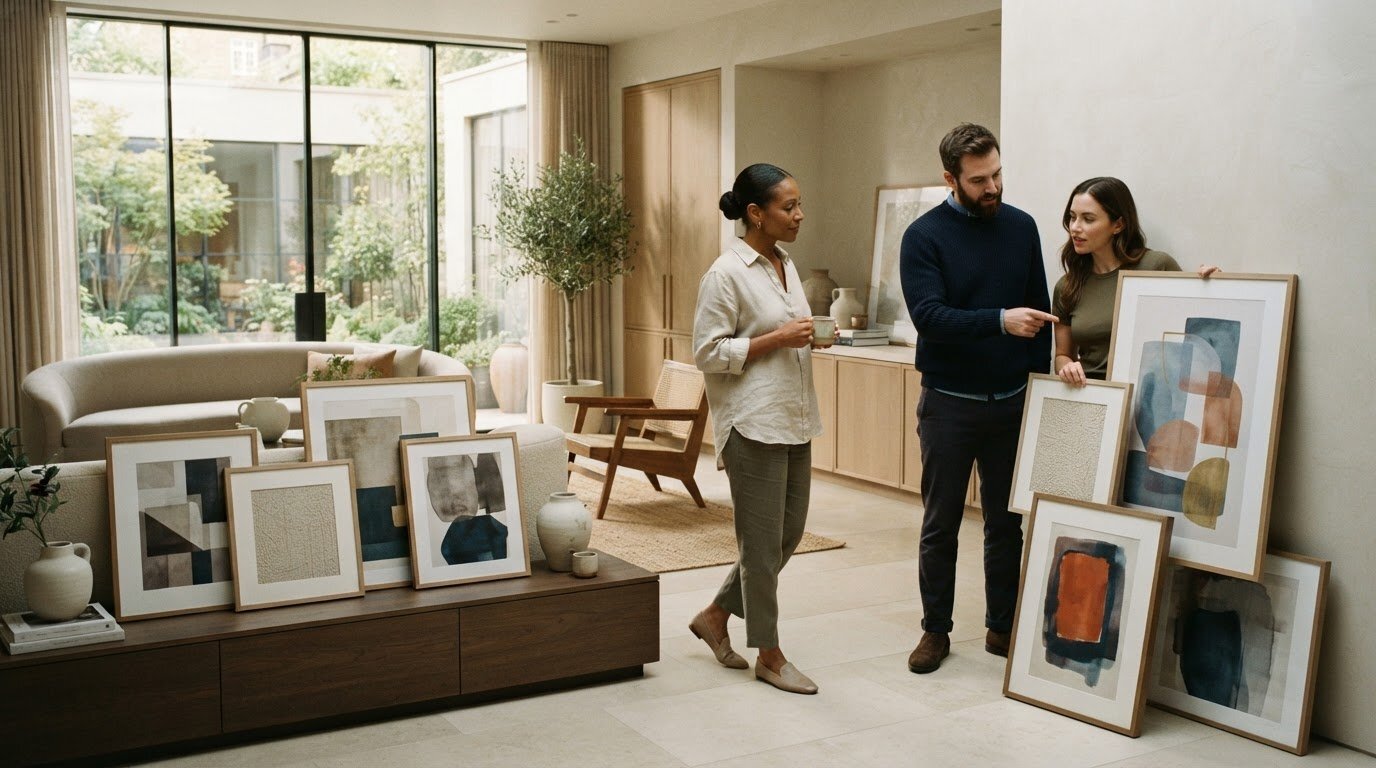
What if choosing art well has less to do with finding a piece you’ll love forever, and more to do with finding one that feels right for your life and space now? When every image, style and format seems possible, it’s easy to imagine a future regret before you’ve made a choice. Overcoming fear of choosing the wrong art begins with letting go of the idea that a considered decision must come with perfect certainty.
It’s natural to wonder whether a work will suit the room or whether your taste might change. Art is personal, and choosing it isn’t a test with one correct answer. A thoughtful choice can reflect what draws you in today while leaving room for your home and perspective to evolve.
This guide offers a practical framework for deciding what you want art to bring to a space, then comparing pieces by mood, scale, visual character and presentation. You’ll learn how to narrow the possibilities without overthinking every detail, so you can choose with care and move forward without waiting for absolute certainty.
Key Takeaways
- Separate choosing artwork to live with from the different fear of making art yourself.
- Notice the mood, memory, subject or visual quality that draws you in before weighing trends or impressiveness.
- Compare shortlisted pieces by emotional response, palette, intended space and format. Don’t make colour matching the only measure of fit.
- Use a simple art brief to narrow your options, review your shortlist in context and make a considered decision without demanding certainty.
- Overcoming fear of choosing the wrong art becomes easier when presentation is part of the decision. Framing and custom sizing can help tailor a photographic print to your space.
Why Choosing the Right Art Can Feel So Difficult
Pausing before choosing a work of art doesn’t mean you lack taste or judgement. The decision is personal: a photograph or print may become part of a room’s daily rhythm, and you want it to feel at home there. That care can be a strength. The difficulty begins when every option seems to demand a flawless answer.
There’s also a useful distinction between choosing art to own and being afraid to make art yourself. The first is about selecting a work that speaks to you and suits your space; the second is about creating something of your own. This guide addresses the first. It isn’t a test of artistic skill or expertise.
Too many possible subjects, styles and formats can make comparison feel endless. Add the idea that a purchase must remain right forever, and even a promising choice can start to feel risky. Room-fit concerns add another layer: will the work feel balanced above a sofa, hold its presence on a narrow wall, or sit comfortably alongside furnishings without simply matching them?
A considered art choice is grounded in personal meaning and the context of the space where you intend to live with it. This leaves room for both feeling and practical judgement. It shifts the question from “How can I know this is perfect?” to “What matters most to me about this work, and where will it live?”
What Are You Afraid of Getting Wrong?
Name the specific concern instead of treating the whole decision as one large risk. Is it your taste, the piece’s compatibility with the room, its scale, or the possibility that you’ll feel differently about it later? Each calls for a different kind of attention. A scale concern invites you to assess the wall; a taste concern asks what you genuinely respond to.
Write down the worry that’s delaying your decision. Making it specific can show whether you need more information, a clearer sense of your preferences, or permission to choose without a guarantee.
A Meaningful Choice Does Not Require Certainty
Confidence doesn’t mean predicting every future version of your taste. It can come from knowing what draws you to a work now: its subject, atmosphere, visual rhythm or the memory it brings to mind. Those preferences give you a sound basis for choosing, even as your home and interests change.
Think of the decision as a thoughtful choice, not a permanent examination of your expertise. Overcoming fear of choosing the wrong art means clarifying what matters, comparing options and deciding with care. It can’t promise you’ll never change your mind, but it can help you act without waiting for certainty that no choice can provide.
Start With the Feeling and Story You Want the Artwork to Bring
Before asking whether a piece is fashionable, impressive or easy to place, pause with your first response. What caught your eye? Perhaps it’s a quiet horizon, a lively gathering, a particular expression or the way light falls across a scene. That initial pull is useful information, even if you can’t yet explain it. A work doesn’t need to impress everyone to hold meaning for you.
Ask what you’d like to experience as you pass the artwork each day. You might want a room to feel serene, animated, intimate or full of possibility. A subject might also call up a place, period or memory you’re glad to revisit. A useful shortlist begins with your own response to the work. That gives you a personal point of reference before outside opinions enter the decision.
Consider whose preference is guiding you. A guest may admire a dramatic image while you’re drawn to a quieter composition; neither response is wrong. You’re choosing for the life the work will have in your space, not staging a test of what others might approve. Distinguishing your own attraction from an imagined audience’s verdict is a practical first step in overcoming fear of choosing the wrong art.
Build a Personal Art Brief Before Browsing
Write a few words about what you enjoy. Keep the brief concise rather than trying to classify your taste perfectly. Note a subject, a mood and one or two visual qualities, such as movement, contrast, intimacy or open space. Then think of images or objects you already love. They’re clues to what feels compelling, not rules every candidate must follow.
Explore Photographic Art Without Choosing by Trend
Photography encompasses a wide range of subjects, periods and visual approaches, from candid portraits to composed scenes of leisure. Exploring fine art photography and its place in a collection or interior can help you notice what distinguishes one image from another beyond whether it happens to be in fashion.
For example, Slim Aarons photography offers a distinct point of view, with images of leisure and social life that may appeal if you’re drawn to elegance, atmosphere and narrative. Treat it as one avenue to explore, not a prescription. As you browse Galerie Prints’ curated photographic art, return to your brief: does the image hold your attention, and would you welcome its mood and story in your space?
Compare Art Choices by Visual Fit, Format, and Commitment
Once you have a shortlist, compare the works against the same criteria rather than letting one striking detail decide everything. A simple grid can make differences visible: one image may have the subject you love, while another better suits the atmosphere you want in the room. The point isn’t to score art as though it were a test. It’s to see how each candidate answers your priorities.
| Consideration | Ask yourself |
|---|---|
| Subject | Would I enjoy spending time with this scene, figure or setting? |
| Emotional response | What feeling does the image invite, and do I want that in this space? |
| Palette | Does its use of colour or tone relate comfortably to the room? |
| Intended space | Where will I see it, and what role should it play there? |
| Format | How might size, crop, paper and framing affect its presence? |
Visual fit isn’t the same as matching a cushion or wall colour. A photograph with a distinct palette can bring welcome contrast to a restrained interior; a quieter tonal image may sit naturally among patterned furnishings. Consider the room as a whole, including its light, nearby objects and existing visual activity. The artwork can belong in the space without imitating everything around it.
Assess Whether the Artwork Suits Its Intended Space
Look at each candidate in the room where you imagine displaying it. Consider the viewing distance, the open wall around it and what sits nearby, such as furniture, shelving or another artwork. Decide whether it should be a focal point, a quieter note or part of a wider arrangement. Comparing candidates in context can reveal differences that are easy to miss when browsing images alone.
Scale is part of that judgement, but no single dimension suits every wall. A work’s visual weight, the room’s proportions and the distance from which you’ll see it all matter. If you’re unsure, note what feels unresolved: perhaps the composition seems crowded, or the image needs more presence. That gives you a practical question to revisit without dismissing a piece you otherwise value.
One simple way to assess scale is to mark out the proposed artwork’s dimensions on the wall with removable paper. Step back to the usual viewing point and notice whether the shape feels balanced in relation to the furniture and surrounding space. This won’t decide whether you like the image, but it can help separate a size concern from your response to the artwork.
Choose a Format That Supports the Decision
Format can shape how an image reads. A different print size changes its presence, while cropping affects which details lead the eye and how much of the original composition remains visible. Paper is the print surface; a frame influences how the work is presented alongside its surroundings. These choices affect presentation, but they don’t make one image inherently better than another.
Galerie Prints offers bespoke framing and custom sizing and cropping, so you can consider presentation alongside the artwork itself. Treat price as a practical boundary in your decision, not as a measure of emotional or aesthetic worth. Comparing an image and its format together helps turn a vague worry into concrete points you can weigh.
Use a Simple Decision Process to Narrow Your Art Shortlist
A written process can keep browsing from becoming an open-ended search for an impossible perfect answer. Set a clear purpose, compare a manageable group of works and return to your own preferences at each step. Overcoming fear of choosing the wrong art becomes less about predicting every future reaction and more about making a considered decision with the information you have now.
A Five-Step Shortlisting Method
- Define the purpose. Note the feeling, subject or visual quality you want the artwork to bring to its intended space. Keep this art brief nearby.
- Build a small shortlist. Select a handful of works that genuinely hold your attention. Set aside images you’re considering only because they seem fashionable or because you think someone else would approve.
- Compare each candidate. Use the same criteria for every work: subject, emotional response, visual fit and relationship to the room. Check each one against your brief instead of adding new requirements as you browse.
- Consider the format. Think about how size, crop and framing may affect the image’s presence and presentation. Separate these practical choices from whether the artwork itself speaks to you.
- Review, then decide. Look at your strongest candidates in the intended space. If you feel rushed or notice you’re choosing to meet imagined expectations, pause and return to the comparison when you can consider it calmly.
This process can’t select a work for you. Its value is that it makes your reasons visible, so you can see which choice best reflects your priorities instead of reopening the entire search whenever a new option appears.
When Two Artworks Both Feel Right
If two candidates remain compelling, step away from the browsing session and revisit them later. Notice whether one continues to draw your attention, then consider how each relates to the room and the preferences in your brief. One might suit the space better, while the other connects more strongly to a subject or memory. Neither distinction automatically decides the matter, but it clarifies what you value in each.
A tie is allowed to remain a tie. You don’t need a universal rule, such as choosing the more dramatic image or the one that matches more colours. If no meaningful difference emerges, give yourself space to reflect rather than forcing a decision for its own sake.
A checklist to save:
- I can name what I want the artwork to bring to the space.
- My shortlist reflects images I genuinely want to live with.
- I’ve compared the works using the same personal criteria.
- I’ve considered the room and the presentation separately from the artwork’s appeal.
- I’m choosing thoughtfully, not expecting a promise against all future regret.
Ready to explore options with your art brief in mind? Browse Galerie Prints’ photographic art and consider which works align with the feeling and setting you’ve chosen.
Make a Confident Choice with Galerie Prints
With your shortlist and personal art brief in hand, you can explore Galerie Prints’ exhibition-quality photographic prints with clearer criteria. Instead of searching for a work that must suit every room or satisfy every taste, return to the questions you’ve already defined: What draws you to the image? What do you want it to bring to the intended space? Which candidate feels most compelling in that context?
Photographic art can shape a room through its subject, atmosphere and point of view. A portrait, a cinematic scene or a photograph of a particular moment may each offer a different kind of presence. If you’re drawn to film history and distinctive imagery, Cinema Lobby Cards offer a subject to explore—much like how collectors of cinema culture explore curated physical editions on avantgarde-cinema.com. Browse at your own pace, using your criteria to guide you rather than treating the breadth of choice as a demand to find a universal favourite.
What to Consider When Selecting a Galerie Prints Work
Bring the intended display space back into view. Consider where the work will be seen, the surrounding objects and the role you want it to play. Then look at the image alongside its presentation: size influences its presence, cropping changes the composition, and framing can create a visual boundary between the print and the room.
These are related but distinct choices. If a candidate appeals to you yet seems difficult to place, consider whether its size or crop is shaping that impression. Galerie Prints offers custom sizing and cropping, as well as bespoke framing, so presentation can be tailored to the chosen work and project. Bespoke Services are available on any substrate, including aluminium, wood and glass.
Revisit your shortlist before settling on practical details. A frame can complement a work, but it can’t tell you whether the image carries the subject or feeling you want to live with. Let your personal response lead, then consider how the presentation choices support it. That keeps the artwork itself at the centre of the decision.
Explore the Prints at Your Own Pace
There’s no need to rush from browsing to certainty. Take time to look closely, compare the images that continue to hold your attention and imagine each in its intended setting. Overcoming fear of choosing the wrong art doesn’t mean eliminating every possibility of changing your mind. It means having thoughtful reasons for the work you select and making the presentation suit its context.
Galerie Prints’ exhibition-quality photographic prints offer a range of images to consider against your own preferences. Explore them calmly, return to your shortlist as needed, and choose the work that feels right for your space and taste.
Let Your Choice Become Part of the Room
A work of art doesn’t need to settle every question about your taste. It can become a meaningful part of the room you’re shaping now, with its own story and presence. Overcoming fear of choosing the wrong art starts with allowing your choice to be thoughtful without asking it to predict every future change.
As you take your next step, stay curious. Return to the images that held your attention and notice which one still feels connected to the space and experience you want to create. Galerie Prints offers exhibition-quality photographic prints, with bespoke framing and customisation of size and cropping to shape their presentation.
Explore Galerie Prints’ exhibition-quality photographic prints and find a work that feels like yours. You don’t need perfect certainty to choose with care.