
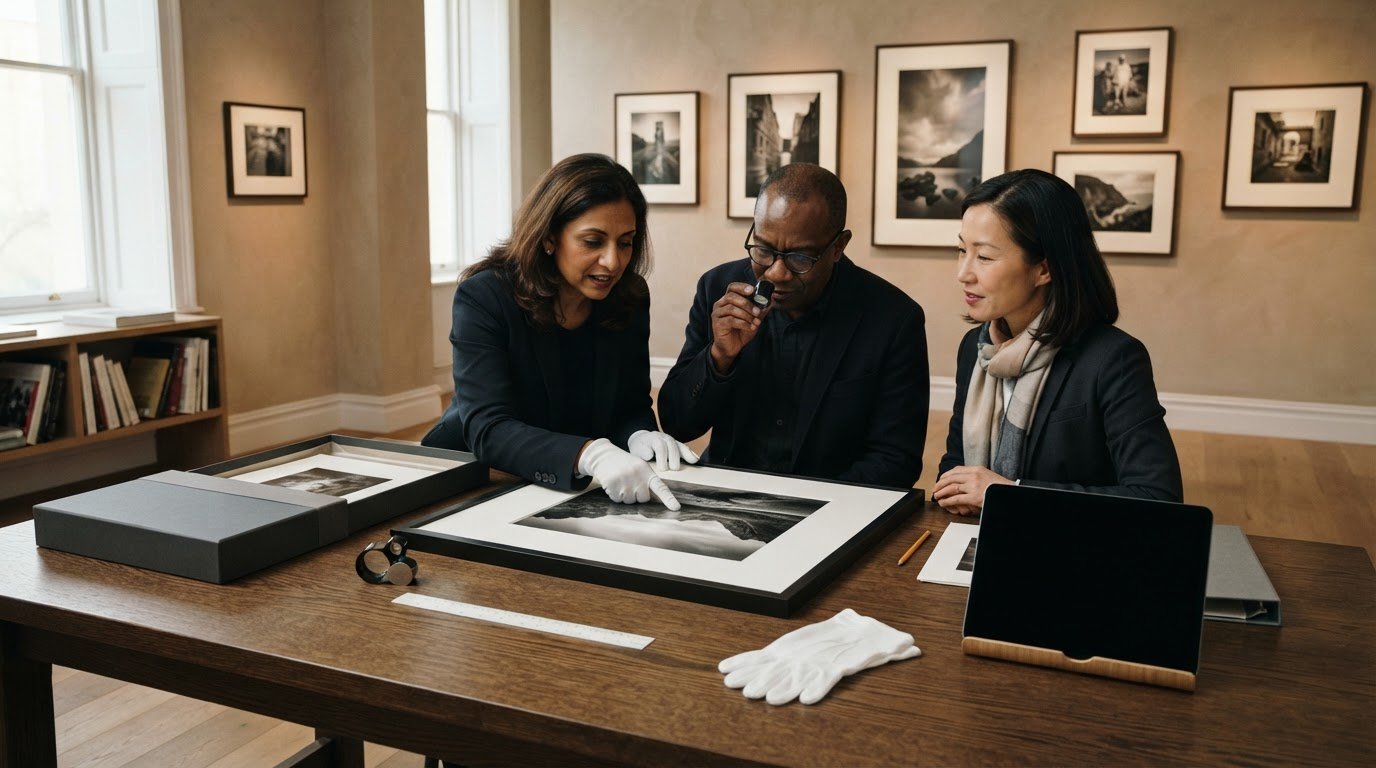
What if the most useful appraisal of a photograph isn’t a forecast of what it will earn, but a clearer understanding of what you own? Investing in fine art photography can be compelling for its market possibilities, yet a photograph’s significance also lies in its maker, history and place within a collection.
If editions, provenance and condition records feel difficult to interpret, or online asking prices seem to tell only part of the story, look for stronger evidence. Asking prices aren’t the same as realised values, and a valuation captures a particular market context, not a promise of future returns.
This guide shows you how to create a clear inventory, assess the details that shape a photograph’s collectibility and interpret its current market context with care. You’ll learn what to record about editions, ownership history and condition, and how to distinguish useful pricing evidence from speculation.
Whether your collection includes works from archives such as Slim Aarons or Terry O’Neill Photography, the aim is considered stewardship: understand the images you live with, make informed collecting decisions and appreciate photographic heritage without treating art as a guaranteed financial asset.
Key Takeaways
- Start with a structured inventory of each photograph, recording identifying details and the documentation that accompanies it.
- Assess authorship, edition, provenance, condition and production together to build a more complete picture of a work’s collectibility.
- When researching comparables, distinguish completed sales from asking prices and note the date, source and relevance of each example.
- Approach investing in fine art photography as a considered collecting decision, not a guarantee of future appreciation or an easy-to-sell asset.
- Group works by artist, subject or collecting purpose, then record any supported value range alongside its evidence and confidence level.
What Does Investing in Fine Art Photography Actually Mean?
To appraise a photography collection is to assemble and interpret evidence about the works, then state an opinion of value for a particular purpose and point in time. It is not a guarantee of a future sale price or a prediction that a photograph will appreciate. The distinction matters: a collection can hold deep personal and historical significance even when its future market value is uncertain.
For some collectors, a photograph earns its place through memory, atmosphere or an enduring connection to the artist. Others also consider resale prospects. These aims can coexist, but they are not interchangeable. An appraisal is a time-specific estimate based on available evidence, not a forecast of investment returns. Responsible investing in fine art photography means weighing a work’s cultural and artistic importance alongside the facts that may shape its current market context.
What makes a photograph a fine art collectible?
Fine art photography is distinguished by artistic intention: the photograph is made or presented as an artwork, rather than solely as a record or illustration. Authorship, historical context and the image’s place within an artist’s wider practice help explain its significance. For an introduction to fine art photography’s history and defining ideas, consider how the medium developed as an expressive art form.
A collectible photograph also needs to be understood as a specific object. The image, the individual print, its production details and its accompanying documentation all matter. An authorised art print is not automatically rare, and a familiar image is not necessarily collectible simply because it is visually striking. Galerie Prints’ curated archives, including the Slim Aarons Collection and Terry O’Neill Photography, let collectors explore works through their photographers, images and historical contexts. The prints within a collection may still differ in edition status and market profile.
Appraisal, asking price and investment value are not the same
An appraisal expresses an opinion of value for a stated purpose, such as reviewing a collection or considering a sale. Its usefulness depends on evidence about the particular photograph: authorship, edition information, provenance, condition, print characteristics and relevant market comparisons. If key details are missing, record that uncertainty rather than disguising it with a precise-looking figure.
An asking price shows what a seller hopes to receive; it does not prove a buyer paid that amount. Completed sales can offer stronger context, but still need to be compared carefully with the work in question. Resale demand and future prices remain uncertain, even for established photographers. Treat a valuation as a reasoned snapshot, then make collecting decisions with both market evidence and your own relationship to the image in view.
How to Appraise a Photography Collection Step by Step
A reliable appraisal begins with a consistent record, not a guess at what each photograph might sell for. Work through the collection one piece at a time, keeping observed details distinct from information supplied by documents or inferred from research. For formal valuation contexts, the IRS guidance on art appraisal services offers a useful reference point.
- Step 1: Identify each work. Record the artist, title or descriptive identification, image details and any known image or print date. If a detail is uncertain, mark it as such instead of filling the gap with an assumption.
- Step 2: Create the inventory record. Note dimensions, medium, documented edition details, and how and when you acquired the work. Attach purchase records and related correspondence.
- Step 3: Assess visible condition. Describe what you can observe, such as fading, creases, handling marks, mounting or frame condition. Don’t clean, unmount or otherwise alter the photograph to inspect it.
- Step 4: Research relevant comparisons. Look for completed sales of sufficiently similar works, and distinguish them from unsold listings and asking prices.
- Step 5: Record uncertainty. Label each entry as directly observed, documented by a source, estimated or still requiring verification. Note the source and date for research findings.
A useful inventory records each photograph’s artist, title or description, image details, dimensions, medium and acquisition documentation.
Build a reliable record for every photograph
Photograph the front and reverse, along with any visible signature, label or accompanying paperwork, and store these reference images with the inventory entry. Record the image date and print date separately if both are known; they describe different points in a work’s history. Keep invoices, certificates and correspondence together, but assess each as evidence rather than treating any single item as conclusive proof.
Assess condition, edition details and provenance
Use precise, neutral descriptions: “crease visible near lower edge” is more useful than “poor condition.” Record an edition number, edition size, signature or print process only when it’s legible or supported by documentation. For provenance, trace ownership or exhibition history through available records, noting gaps clearly. Don’t infer a complete history from a single document.
Once the records are assembled, they can help you compare works consistently and identify where more information is needed. To explore photographs to live with and appreciate, browse curated fine art photography prints with their artistic and historical context in mind. Print dimensions, paper options and framing can shape how a work is displayed and enjoyed, but they don’t establish its investment return.
Which Evidence Matters Most When Assessing Photography’s Value?
Not all evidence carries equal weight. A documented detail about the specific print usually tells you more than a broad claim about an artist’s popularity, and an unsold listing is not proof of what a buyer will pay. For a balanced view, examine the work’s history and physical qualities alongside relevant completed sales.
| Evidence | What it can show | How to weigh it |
|---|---|---|
| Authorship | Who made the image and how it relates to their wider practice. | Give more weight to reliable, work-specific documentation than general claims of recognition. |
| Edition | Edition number, size and any documented distinctions between printings. | Use confirmed details as context, not as a direct measure of demand. |
| Provenance | Recorded ownership, exhibition or other history of the individual print. | Separate traceable records from stories that lack supporting evidence. |
| Condition | The print’s visible state, including fading, creases or handling marks. | Assess the specific object; avoid assuming that similar images have similar condition. |
| Production | Documented print process, materials and other physical characteristics. | Rely on records or observable features, not unsupported descriptions. |
| Completed sales | Evidence of transactions involving comparable works. | Compare closely related works and distinguish sale results from estimates and asking prices. |
How artist, edition and provenance affect the assessment
An artist’s established practice and historical significance may shape collector interest, but reputation alone cannot establish the value of a particular print. Edition size is one factor in an appraisal, not a stand-alone measure of value or demand. Edition and print details can differ between works, so confirm what applies to the photograph being assessed. Provenance can enrich its story when supported by records; label an unverified account clearly. Christie’s guide to collecting photography offers further context for collectors.
How condition and comparable sales shape the estimate
A useful comparison is specific: look for the same artist and image, with a meaningfully similar print type, dimensions, edition context and condition. Differences in any of these details may limit how closely one sale can inform another. Record the sale date and source, and identify whether the figure reflects a completed transaction, an auction estimate, a gallery listing or an asking price. These are different kinds of evidence, not interchangeable values.
For anyone investing in fine art photography, documented, work-specific evidence should lead the assessment. Market narratives can provide context, but they cannot promise future returns.
How to Turn Your Appraisal Research into a Useful Collection Review
Research becomes more useful when it is organised around the questions you want to answer. Group photographs by artist, subject, period, completeness of documentation or collecting purpose. This can reveal patterns across a collection: perhaps several works share a subject, while others have gaps in their ownership records or condition notes.
Keep a consistent register for every work, then add review fields such as evidence source, date checked, confidence level and next step. If the available comparisons support a value range, record it with its source and date rather than presenting a single figure as exact. If evidence is thin or not closely comparable, leave the value open and explain why. A review is useful even when it identifies uncertainty rather than resolving it.
Create a collection register and prioritise missing information
Use the same fields throughout so you can compare records without suggesting greater precision than the evidence allows. Flag missing edition, provenance or condition details for further research. Prioritise works that are fragile, poorly documented or especially significant to you, and keep their records and reference photographs carefully organised. Revisit the register periodically to add new documentation or note a change in observed condition. This helps maintain an accurate record, but doesn’t predict market movements.
Keep the purpose of each review clear. An insurance question may focus on replacement considerations, while estate, tax or resale planning may call for different evidence and a different valuation basis. A personal collection review, by contrast, can help you understand what you own, what matters to you and where your records need attention. These purposes shouldn’t be treated as interchangeable.
When a collection may need a formal appraisal
If you need a formal opinion for insurance, estate, tax or sale purposes, the appropriate appraisal approach depends on that specific use. A formal appraisal is a purpose-specific opinion based on the required valuation basis and the evidence available; photography expertise is relevant to assessing the work. An online estimate, gallery asking price or personal spreadsheet can help organise research, but shouldn’t be presented as a formal valuation.
For collectors investing in fine art photography, a thoughtful review joins market research with the quieter reasons a work belongs in the collection: its image, history and connection to the artist. Explore photographs through curated archives and their historical context at Galerie Prints. Print dimensions, paper choices and framing can shape how a work is displayed and enjoyed, while remaining separate from evidence of financial return.
Collect Fine Art Photography with Knowledge, Context and Care
A thoughtful collection review brings together what the records can establish and what draws you to each image. Market evidence helps clarify a work’s present context, but it cannot guarantee a future result. Collect for considered reasons: the artist’s practice, the image’s history and the place it holds in your collection can matter alongside any financial questions.
Explore photographic work through its artist and archive
Looking at a photograph within an artist’s wider practice can deepen your understanding of its subject and historical setting. Galerie Prints’ The Slim Aarons Collection and Terry O’Neill Photography offer two distinct archives to explore, each inviting attention to the images and the stories associated with their makers. An archive is a starting point for research and appreciation, not evidence that every print is rare or will rise in value.
Choose a print to live with, then document the decision
Once an image resonates, consider how its scale, paper and intended display setting will shape your experience of it. Record the details of the print you select and keep its acquisition documentation with your collection register. Galerie Prints’ bespoke framing service offers a considered way to present a work, but the choice of frame is not evidence of investment value.
Investing in fine art photography calls for clear-eyed research and a personal sense of purpose. Appraise the evidence carefully, acknowledge what remains uncertain, and leave room for the pleasure of living with the image. Explore fine art photography at Galerie Prints.
Build a Collection with Clarity and Confidence
A considered appraisal begins with a reliable record and gives each photograph its own context. Document what you can verify, distinguish completed sales from asking prices, and treat any valuation as a snapshot rather than a promise of future returns. This approach lets you make informed decisions while preserving space for the personal meaning that first drew you to the image.
For those investing in fine art photography, strong collection decisions balance evidence with an understanding of the artist, the work’s history and your reasons for living with it. Galerie Prints brings together curated photographic archives, including the Slim Aarons Collection and iconic works by Terry O’Neill. Print dimensions, paper options and bespoke framing help shape how a selected work is presented, not its guaranteed financial outcome.
Explore these images through their artistic and historical context, and let careful research guide your next step. Explore Galerie Prints’ curated fine art photography, and continue building a collection with knowledge, care and lasting personal resonance.
Frequently Asked Questions
How do you appraise a photography collection?
Appraise a photography collection by documenting each work and assessing its evidence individually. Record the artist, title or image description, dimensions, medium, edition details, provenance and condition, noting which details are documented and which remain uncertain. Then research relevant completed sales, comparing works with similar characteristics rather than relying on broad popularity claims or asking prices. If you record a value range, include its date, sources and confidence level.
What makes a fine art photograph valuable?
A fine art photograph’s value can reflect its authorship, artistic and historical context, edition details, provenance, condition, production and relevant market evidence. These factors apply to the specific print, not just the image or the photographer’s reputation. A documented history or strong condition may help inform an assessment, but neither guarantees a particular price. Collectibility also depends on whether buyers want that work in the market at the time of sale.
Do limited-edition photographs increase in value?
A limited edition doesn’t automatically increase in value. A documented edition can help establish how a print relates to other versions of the image, but edition size alone doesn’t show whether collectors will want it or what they may pay. Consider authorship, print details, provenance, condition and comparable completed sales together. Treat claims about future appreciation cautiously, even when a photograph is signed or belongs to a small edition.
Is fine art photography a good investment?
Fine art photography may interest collectors for both its artistic meaning and its possible market value, but it isn’t a guaranteed investment. Resale demand and future prices are uncertain, and selling a work at a desired price may take time. Before investing in fine art photography, consider your collecting purpose, the evidence for the specific print and whether you can hold it without relying on a quick sale. Personal connection can remain central.
How can I tell whether a photograph is an original print?
Start with records that identify the specific print, such as acquisition paperwork, edition information, certificates or other documentation from a relevant source. Compare those details with reliable information about the artist’s work and the print’s production. A signature or label can be useful evidence, but shouldn’t be treated as conclusive proof on its own. If authenticity remains uncertain, record the unanswered questions and avoid assigning a value that assumes the details are settled.
Does provenance affect the value of a photograph?
Provenance can inform a photograph’s assessment by documenting its ownership or exhibition history and connecting the print to its past. Its strength depends on the quality and continuity of the records. Keep invoices, correspondence, labels and certificates together, and distinguish documented facts from an unverified story. Missing links don’t automatically determine a work’s value, but they should be noted as uncertainty rather than filled in with assumptions.
When should I get a professional appraisal for photography?
A formal appraisal may be appropriate when you need an opinion for a specific purpose, such as insurance, estate planning, tax matters or a sale. Requirements can differ, so the intended use should be clear, and relevant photography expertise matters. A personal inventory, online estimate or gallery asking price can help with research, but it isn’t automatically a formal valuation. Keep the appraisal’s purpose, date and supporting evidence with your records.