
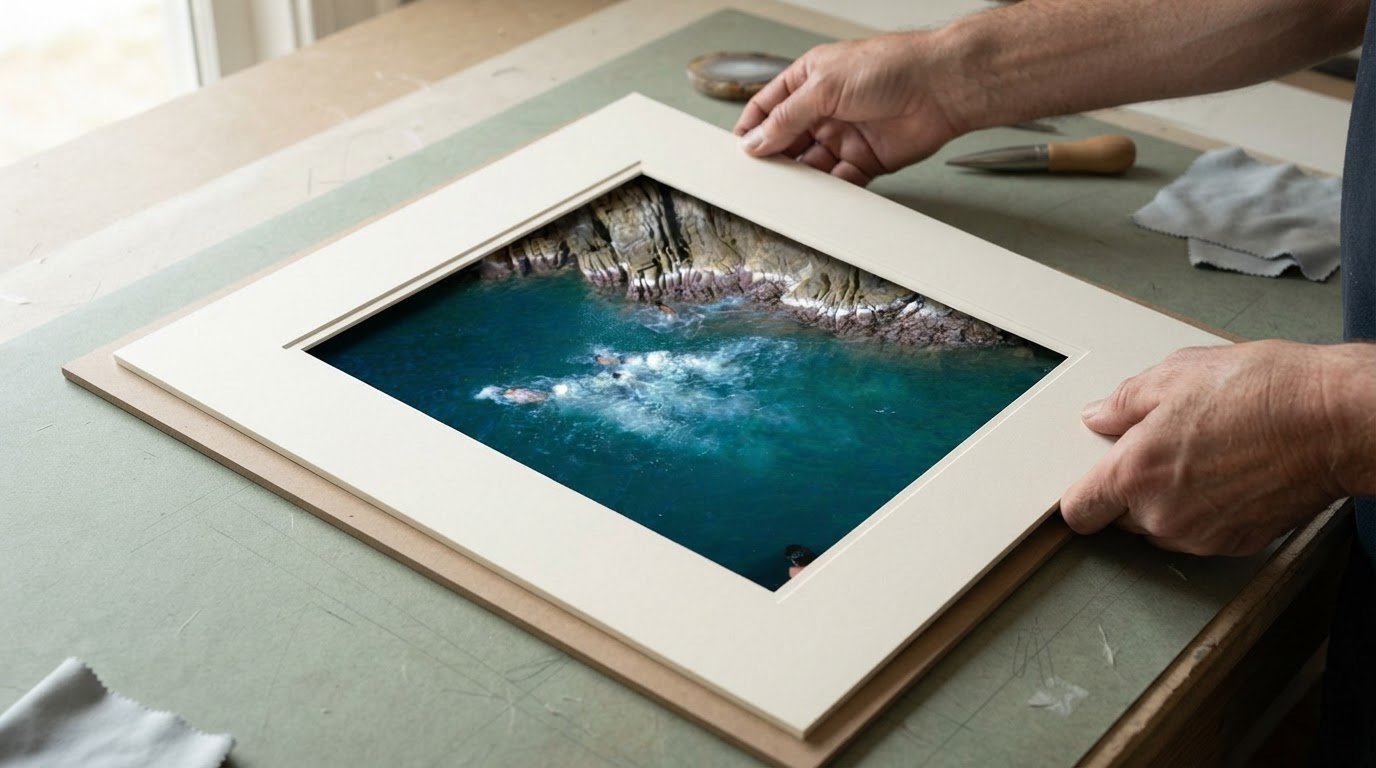
The aperture, not the frame’s outer dimensions, determines how a mounted print sits. Choosing the right mount for a print means selecting an opening slightly smaller than the image, so the mount overlaps the edges and holds the print in place. The exact overlap depends on the mount and the look you want.
It’s easy to focus on the frame and overlook the opening that shapes the image. A well-proportioned aperture gives a photograph breathing room, creates a quiet border, and keeps the composition balanced rather than crowded.
This guide explains how to match print dimensions to the aperture, choose a mount for the display, and understand the differences between mat board, foamcore, and other mounting methods. It also covers archival materials and conservation framing, helping you make choices that suit the image and its future.
Key Takeaways
- Choose a mounting approach to suit where and how the print will be displayed, from a framed presentation to a clean, frameless look.
- Use the print’s dimensions and the visible opening to plan a balanced aperture and avoid obscuring important details.
- For conservation framing, consider archival backing and matting, non-invasive mounting, and suitable separation from the glazing.
- Learn how mat board, foamcore, and dry mounting differ so you can select a support that complements the print and its presentation.
Choosing a mount for the intended display or use
Choosing the right mount for a print starts with where and how it will be displayed: in a glazed frame, frameless on a wall, or another setting. Match the support, thickness, and finish to the print and its intended display.
Mount Types for Prints
Mat board, foamcore, and dry mounting support prints in different ways, shaping both presentation and handling. Mat board creates a border inside a frame, while foamcore provides a firm backing for posters and frameless displays. Dry mounting bonds a print to a support with adhesive. It can suit a display where a flat finish matters more than removing the print later.
Mount Size and Thickness
Mount size refers to the board’s overall dimensions, while thickness describes its depth. For a framed print, choose board that fits the frame and leaves the image’s edges secure beneath the mat. Mat board used for mounting is usually around 1/16 inches thick. Foamcore is available in 3/16-inch and 1/2-inch thicknesses, offering options for different presentation needs.
Consider the frame’s depth before choosing a thicker support. Substantial foamcore can give a frameless print more presence, while a slim mat suits a close-fitting frame. The display matters, too: canvas needs structural support but not glazing. A canvas floating frame can preserve clean, modern lines and create a gallery-style effect.
If a print is intended to sit directly in an existing frame or mounting hardware, a no-mount presentation may be suitable. It can also work for creative applications, such as a kitchen backsplash, where a traditional mat would not serve the purpose. Consider exposure and handling before choosing this approach.
Glazing affects the material choice. Glass offers a crisp view and resists scratches; acrylic is lighter and less breakable, making it suitable for large prints or public installations. Choose the mount and glazing together so the support, frame depth, and display setting work as one considered presentation.
Choosing print size to match a mount aperture
The aperture is the visible opening in a mount, so match it to the image area you want to show. For a secure, balanced presentation, the opening usually overlaps the print’s edges slightly. Measure the image itself, not the frame’s outside dimensions, and allow for any border or signature you want to keep visible.
Mounting costs in the United States depend on print size, materials, and the work involved. A simple support differs from a framed, glazed presentation, so the choices that shape the finished look also affect the cost.
For home mounting, prepare a clean, flat work surface, the print, a backing board, and suitable mounting materials. Handle the print with clean, dry hands, then centre it before securing it. If you want a non-invasive approach, avoid putting adhesive on the image.
- Measure the print’s image area and note any margins you want to preserve.
- Choose an aperture that reveals the intended composition while overlapping the edges enough to hold the print.
- Position the print on the backing, keeping the margins even and the image straight.
- Secure it with the chosen mounting method, then place it in the frame and check alignment.
Standard sizes can help you plan, but listed print-only frame dimensions vary by format: A5 is 244 x 182 mm, A4 is 331 x 244 mm, A3 is 456 x 333 mm, and A2 is 628 x 454 mm. The listed A1 print-only frame size is 638 x 885 mm. Treat these as frame dimensions, then match the aperture to the actual print and composition. If the image has an important border, allow it to remain visible rather than letting the mount conceal it. That balance is central to choosing the right mount for a print.
For a considered finish, explore this print presentation alongside the aperture and frame proportions.
Conservation framing and archival materials
Conservation framing combines supportive materials with methods designed to limit direct contact with the print. For photographs and paper posters, flat support, careful handling, and separation from glazing help protect the image.
Reversible Mounting Options
Reversible mounting secures a print without applying adhesive directly to its surface. Hinged corners can hold it in place while allowing later removal, which is useful if you want to examine or reframe the work. Keep the support flat and smooth, and avoid methods that bond the print permanently to a board. Clean, dry hands or gloves help reduce handling marks.
Effects on Appearance, Framing, and Protection
Mounting affects how a print sits in its frame, how much of its edges remain visible, and whether it touches the glazing. Acid-free matting and backing provide archival support, while a mat can separate the image from glass or acrylic. If glazing could touch the print, use spacers. UV-protective glazing can reduce fading and help preserve print colours.
For a photograph or paper poster, a flat, smooth backing supports an even presentation. Matting can separate the image visually from the frame, while the aperture determines which parts of the print remain visible. These choices shape both the composition and the physical arrangement of the framed work.
Risks of Heat Mounting and Pressure-Sensitive Adhesives
Heat mounting and pressure-sensitive adhesives attach a print to its support, making later removal more difficult than using hinged corners. Adhesive can remain on the paper or affect its surface during removal, so consider carefully before making a permanent attachment. For a print intended for conservation, avoid applying adhesive directly to the image and use a non-invasive mounting method instead.
Acid-free backing and matting support long-term storage or display, but materials alone don’t protect every part of a framed print. Clean handling, suitable support, and thoughtful spacing all contribute. Together, these decisions help preserve the work’s appearance and keep the framing approach appropriate to the print.
What are the different types of mounts for prints, such as mats, foam board, and dry mounting?
Mounting materials support a print and shape how it looks in a frame or on a wall. The main options include mat board, foamcore, dry mounting, and edge mounting.
Mat board surrounds a print with a visible border inside a frame. It can create contrast, draw attention toward the image, and keep the print separated from glazing. Galleries and retail displays commonly use mat board for framed prints behind glass. A pale mat, for example, can give a dark photograph room to breathe, while a darker border can echo tones within the image.
Foamcore is a lightweight, rigid support used for posters, larger prints, and frameless presentations. Its clean edges suit a simple display without a traditional mat and frame. Select a board size that supports the print without bending, and consider how you’ll hang the finished piece. Foamcore provides structure, but it doesn’t create the decorative border of a mat.
Dry mounting attaches a print to a backing board with adhesive, creating a flat, secured presentation. It can suit a print intended for stable display, but differs from hinged or corner mounting because the print is bonded to its support. This matters if you may want to remove or reframe the image later.
Edge mounting offers another frameless look. A mount wraps around the print’s edges and sits flush against the wall, giving the image a neat, finished outline. A no-mount display, by contrast, can work when the print will use existing mounting hardware or serve a creative purpose, such as a kitchen backsplash.
Choose by balancing appearance, support, and future handling. A framed photograph may benefit from a mat; a poster can use foamcore; and a print intended for permanent display may suit dry mounting. For a frameless finish, compare edge mounting with a simple backing before choosing the presentation.
Explore prints to frame and consider which mounting style best complements the image.
Galerie Prints
Galerie Prints brings together photographic and archival imagery with a Bespoke Framing Service, making it a natural next step when you’ve chosen a print and want to consider its presentation as a whole. The Slim Aarons Collection, Terry O’Neill Photography, Cinema Lobby Cards, and Star Wars Limited Edition Prints offer distinct imagery to pair with a thoughtfully selected mount and frame.
Consider the print’s dimensions, the aperture you want, and whether archival materials matter for its long-term display. These decisions help shape a frame that complements the image rather than competing with it. Bespoke framing is especially useful when standard proportions don’t suit the print or the look you have in mind.
Contact Galerie Prints to discuss framing your chosen print.
Let the image find its place
A print’s presence comes from more than its subject. The space around the image, the character of the room, and the way light meets the finished frame all shape how it’s experienced. Choosing the right mount for a print is part of deciding how the image will live with you, whether it becomes a quiet accent or the centre of a room.
Take a moment to consider how you want the finished piece to feel. A restrained border can let the photograph speak; a more pronounced mount can give it a formal, collected quality. For an image with personal or historical significance, thoughtful framing can help it remain part of your space as your interiors evolve.
If you’re ready to explore a considered presentation for your print, ask Galerie Prints about print mounts. Your chosen image deserves a setting that feels distinctly its own.
Frequently Asked Questions
What Print Size Do I Need If I’m Using a Mount?
Choose a print that fits behind the mount while leaving the intended image area visible through its aperture. Measure the printed image, not just the paper, especially if the sheet has a wide white border. For example, a signature near an edge may need to remain visible, so make sure the opening doesn’t cover it. Check the frame’s inner dimensions separately.
What materials are safe for archival mounting and will not damage a print?
Acid-free backing and matting are suitable for archival presentation, particularly for photographs intended for long-term storage. Pair them with non-invasive mounting, such as hinged corners, rather than applying adhesive to the print. Clean, dry hands or gloves help limit handling marks. If glazing sits close to the image, spacers keep it from touching the print.
When should I use a window mat versus full-bleed or float mounting?
Choose a window mat when you want a defined border around the image or separation between the print and glazing. A full-bleed presentation suits artwork intended to fill the visible frame area without a mat border. Float mounting can suit a canvas when you want its edges visible and a clean, gallery-style effect. Let the artwork’s composition guide your choice.
What mounting method is best for photographs, posters, and fine art prints?
For photographs and fine art prints you want to preserve, use a flat support and non-invasive mounting, such as hinged corners. A framed photograph can sit behind a mat, while foamcore is commonly used for posters, larger prints, or frameless displays. The right method depends on the paper, the presentation, and whether future removal matters.