
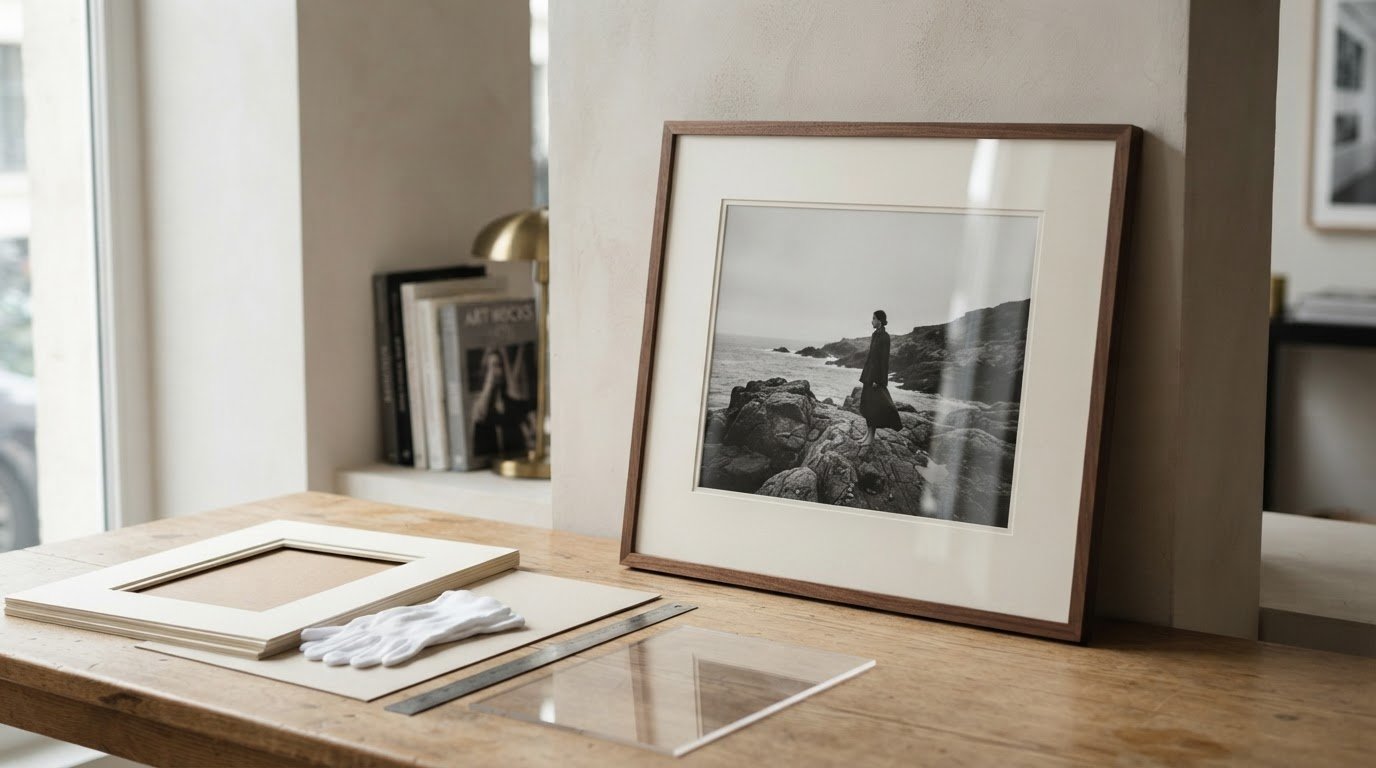
An exquisite photograph is a captured moment of history, yet without the right protection, that history begins to fade the second it meets the air. Choosing the correct approach to framing fine art photography is the definitive line between a simple wall decoration and a lasting investment that commands a room. You’ve likely spent hours selecting a Slim Aarons poolside scene or a Terry O’Neill portrait, only to feel a sudden hesitation when faced with the technicalities of archival mounting. It’s a common anxiety for collectors who fear that acidic backings or harsh glares might obscure the very soul of the work they admire.
We understand that your home is your personal gallery, and every piece should reflect that prestige. This guide, a definitive resource for the discerning collector, will show you how professional framing preserves photographic heritage while transforming a standard print into a museum-quality masterpiece. We’ll explore the science of UV-filtering glass, the necessity of pH-neutral materials, and the art of matching frame profiles to the specific era of your collection. From the sleek minimalism of modern archives to the warm wood tones favored in mid-century aesthetics, you’ll gain the confidence to curate a space that feels both timeless and protected for decades to come.
Key Takeaways
- Identify the essential archival materials required to safeguard your investment against acidity and environmental aging over the coming decades.
- Learn how to harmonize frame styles with the soul of the photograph, ensuring the aesthetic mirrors the specific historical era of the work.
- Master the precision of the golden ratio to calculate mount proportions that lend a prestigious, gallery-standard presence to any sized print.
- Understand how professional framing fine art photography acts as a final curatorial act, elevating a simple image into a definitive piece of heritage.
- Discover the long-term value of bespoke, hand-finished framing compared to mass-produced options for maintaining the integrity of limited edition prints.
The Curatorial Role of Framing Fine Art Photography
For the serious collector, the acquisition of a physical print is only the beginning of the narrative journey. The process of framing fine art photography represents the final curatorial act, a deliberate choice that bridges the gap between a captured moment of history and the contemporary environment it will inhabit. While casual decorating often treats a frame as a mere accessory to match a sofa or a wall color, true collecting views the frame as a protective sanctuary and a psychological boundary. It signals to the viewer that the work inside is not a disposable image, but a piece of heritage deserving of genuine reverence. It’s the difference between merely filling a space and building a legacy.
This presentation style dictates how we perceive photographic history. A well-chosen frame creates a sense of permanence; it isolates the artist’s vision from the distractions of the room, allowing the viewer to step into the world of the image. As you explore the evolution of photography framing, you’ll see that iconic works, from the sun-drenched Slim Aarons scenes to the intimate Terry O’Neill portraits, rely on this boundary to maintain their narrative power. The frame acts as a portal, inviting a sense of wonder while maintaining a professional, polished distance that befits a luxury gallery.
Preservation as a Primary Objective
Beyond the visual impact, the frame serves a vital functional role as a guardian. Fine art photography demands significantly higher standards than standard commercial posters because the materials are inherently more sensitive to environmental shifts. Without professional intervention, prints are susceptible to irreversible damage. Foxing, the unsightly brown spots caused by fungal growth or metallic impurities, and waving, caused by humidity fluctuations, can ruin a masterpiece in just a few years. A Bespoke Framing Service ensures that every component, from the backing to the glazing, creates a stable micro-environment that protects the print’s physical integrity for decades.
Enhancing the Visual Narrative
A frame should never compete with the art; instead, it should focus the eye and provide a sense of depth that draws the viewer into the scene. Mastering the nuances of framing fine art photography allows you to achieve the coveted ‘Gallery Look’, which requires a balance of quiet authority and technical precision. By choosing a profile that complements the subject matter, you provide the work with a stage. This is particularly important for high-caliber archives where the goal is to mirror the prestige of a luxury gallery. Whether it’s a minimalist black wood or a warm, hand-finished oak, the right choice ensures the photograph remains the protagonist of the story.
Archival Excellence: Materials That Protect Your Investment
Archival framing is the science of preservation. It involves using chemically stable, inert materials that prevent the slow, silent deterioration of a print over time. When we discuss framing fine art photography, we’re referring to a system where every component, from the backing to the hinges, is designed to be reversible and non-reactive. For collectors of rare archives, museum-quality standards aren’t a luxury; they’re the only way to ensure the longevity of the work. Standard framing materials often contain lignin, a natural substance in wood pulp that turns acidic as it ages, causing the “burning” or yellowing of the paper. By contrast, professional-grade materials act as a barrier, maintaining the print’s original brilliance for generations.
Museum-Quality Mounting and Matting
The mount, or mat, serves a dual purpose: aesthetic elevation and physical protection. Its primary function is to create a necessary air gap between the photograph and the glazing, preventing the print from adhering to the glass due to condensation. Industry standards dictate the use of 100% cotton rag or high-grade alpha-cellulose boards, which are naturally pH neutral. To achieve that definitive gallery feel, many curators utilize a weighted bottom mount, where the lower border is slightly wider than the top and sides, providing a visual anchor for the piece. Implementing these conservation framing techniques ensures that the artwork remains suspended in a safe, acid-free environment.
Understanding UV-Protective and Anti-Reflective Glass
Environmental light is a constant threat to photographic pigments. Research indicates that UV radiation is responsible for approximately 40% of the fading seen in art prints. To combat this, collectors must choose glazing that offers significant UV protection. While standard glass provides a basic barrier, museum-grade glazing blocks up to 99% of harmful rays while virtually eliminating reflections. This balance of protection and clarity is essential; you want to see the texture of the paper and the depth of the shadows without the distraction of a mirror-like glare. For larger pieces, high-quality acrylic is often preferred for its shatter resistance and lighter weight, provided it maintains those critical archival standards. If you’re looking to elevate a recent acquisition, exploring a bespoke framing service is the most reliable way to secure these premium materials.
Aesthetic Styles: Matching the Frame to the Photographic Era
The frame is far more than a simple border; it’s a stylistic extension of the image’s era and intent. A photograph captured in the 1960s carries a distinct energy that differs vastly from a contemporary Star Wars Limited Edition Print or a monochrome scene from our Music Archives. To master the art of framing fine art photography, one must align their choices with the principles outlined in our Fine Art Photography: A Curator’s Guide. This alignment ensures the frame honors the soul of the work rather than merely serving as a decorative afterthought. The choice of color is the first step in this curatorial journey. Stark black frames provide a definitive, modern edge that anchors an image, while gallery white offers a seamless, airy transition that suits minimalist interiors. Warm wood tones, such as hand-finished oak or walnut, evoke a sense of heritage and artisanal craftsmanship that complements historical subjects.
Materiality plays a significant role in the tactile experience of the art. While mass-produced composite frames often feel hollow and fragile, solid timber mouldings offer a weight and texture that signals prestige. This physical presence is essential for serious collectors who view their acquisitions as permanent fixtures. Selecting high-quality, sustainable wood ensures that the frame ages as gracefully as the photograph it protects. By employing sophisticated archival framing techniques, you ensure that these aesthetic choices are supported by the structural integrity required to preserve the work for decades.
The Slim Aarons Aesthetic: Mid-Century Elegance
For the vibrant, sun-drenched works found in the Slim Aarons collection, the framing must mirror the “aspirational” mood of the subject matter. Clean, minimalist frames in white or light, natural woods work best to preserve the sense of leisure and light. A wide, bright white mount is often the secret to success here; it acts as a visual buffer that allows the saturated turquoises of a poolside scene to pop. The goal is to make the piece feel as effortless and elegant as the high-society lifestyle Aarons famously documented.
Classic vs. Contemporary Framing Approaches
Monochrome archives, such as the iconic Terry O’Neill Photography, often demand the timeless ‘Black Box’ frame. This deep-profile style adds a three-dimensional quality, creating a shadowbox effect that draws the viewer into the celebrity’s gaze. Conversely, for vintage movie posters or Cinema Lobby Cards, a slightly more traditional moulding can echo the golden age of the silver screen. Modern collectors may also consider float-framing, a technique where the print appears to hover within the frame. This method is particularly effective for prints with deckled edges, as it highlights the physical nature of the paper itself, creating a sophisticated, gallery-standard display.
Proportions and Precision: The Art of Mounting and Sizing
Precision in measurement is the silent language of the gallery. When framing fine art photography, the relationship between the image and its border determines the piece’s perceived value. Many collectors make the mistake of choosing a frame that matches the print size too closely; this creates a claustrophobic effect that stifles the artwork’s narrative. Instead, professional curators often employ the golden ratio to calculate mount widths that provide perfect visual balance. By intentionally oversizing a mount, even a modest print gains a sense of immense prestige. It signals that the work is significant enough to command its own dedicated territory on the wall.
Large-format pieces present a different set of technical challenges. As the scale increases, the structural integrity of the frame becomes paramount. The weight of museum-grade glazing requires robust joinery to prevent bowing, which could otherwise cause the glass to touch the print. Achieving this level of precision requires artisanal expertise that mass-produced options simply can’t provide. When framing fine art photography at a significant scale, the frame must act as a rigid exoskeleton, protecting the print from the physical stresses of its own size.
The Impact of Border Width and Window Mounts
Wide borders are essential for creating ‘breathing room,’ allowing the viewer’s eye to settle on the subject without distraction. The ‘Museum Mount’, characterized by a significantly larger frame for a smaller print, remains a hallmark of luxury in the art world. It suggests a level of care and expense that elevates the entire room. A window mount is a protective and aesthetic buffer cut from archival board that sits over the print to provide depth and prevent glass contact. This technique ensures the print remains flat and secure, avoiding the unsightly waving that occurs when paper is pressed directly against a hard surface.
Achieving the Gallery Look in Residential Spaces
Scaling art to the dimensions of your room is vital for a harmonious interior. A large Star Wars Limited Edition Print might dominate a small study, while a series of smaller Cinema Lobby Cards requires consistent spacing to feel like a cohesive collection. Always aim for eye-level hanging, typically centering the work roughly 145cm from the floor to mirror professional standards. Lighting is the final touch; use directional LEDs to avoid hotspots on the glass that can obscure fine details. To ensure your collection is presented with this level of curatorial precision, you can select a bespoke framing option that is tailored to your specific space.
Bespoke Framing: The Galerie Prints Signature Approach
The final stage of acquisition shouldn’t be a logistical burden. While many collectors find the process of sourcing a frame after the print arrives to be a point of friction, our signature approach to framing fine art photography integrates the curatorial and technical processes into one seamless experience. We don’t view the frame as an add-on; it’s the final layer of the artist’s presentation. By utilizing a Bespoke Framing Service that operates in direct concert with our archives, we ensure that every physical print is delivered as a completed masterpiece. This artisanal, localized production stands in stark contrast to mass-produced mail-in services that often prioritize volume over the delicate technical needs of high-caliber art.
Hand-finished frames offer a level of durability that composite materials can’t match. Every corner is joined with precision, and every finish is applied by hand to ensure a depth of color and texture that complements the specific photographic era. This commitment to craftsmanship ensures that your investment is ready to hang the moment it arrives at your door, regardless of whether you’re in London, New York, or Sydney. Large-scale framed works require specialized handling during global transit, and our logistics team ensures that even the most substantial pieces are crated and shipped with the same level of care used by international galleries. It’s about providing peace of mind alongside prestigious art.
From Archive to Wall: A Seamless Journey
There’s a distinct advantage in having a curator oversee the final presentation of your collection. When you select a piece from our Star Wars Limited Edition Prints or our extensive Music Archives, our team understands the historical context and visual requirements of that specific work. We maintain a rigorous consistency across large-scale collections, ensuring that if you hang multiple works in a single space, the profiles and mounts match perfectly. This eliminates the guesswork for the collector and guarantees a professional result every time. We invite you to explore our bespoke framing service for your next acquisition to experience this integrated excellence firsthand.
Investment Value and Heritage
A professionally framed print is more than a decoration; it’s a legacy. While the initial print holds significant value, the meticulous process of framing fine art photography ensures the work retains its market appeal and physical integrity far better over time. The frame acts as a primary line of defense, protecting the photographic heritage for future generations. Our commitment to localized production and premium materials ensures that every piece we deliver is a lasting piece of history. By choosing artisanal craftsmanship over mass-market convenience, you’re investing in a heritage that will remain as evocative and prestigious decades from now as it is today.
Elevating Your Collection for the Next Generation
The final act of curation is a commitment to the future. By prioritizing archival materials and precise proportions, you ensure that your investment remains a vibrant window into the past rather than a fading memory. We’ve discussed how the right glazing and acid-free mounting create a sanctuary for your prints, while thoughtful aesthetic choices bridge the gap between historical heritage and modern design. Mastering the nuances of framing fine art photography is what transforms a personal residence into a private gallery of enduring significance.
Our Bespoke Framing Service removes the logistical friction from this journey, offering pieces that are hand-crafted by specialist artisans and delivered ready to hang. With professional mounting included with all bespoke frames and global secure shipping for framed artwork, your collection is protected from the moment it leaves our archive until it reaches your wall. It’s an invitation to give your acquisitions the prestigious stage they deserve. Discover our Bespoke Framing Service and complete your collection to begin building a legacy of beauty that will inspire for decades to come.
Frequently Asked Questions
What is the difference between standard and archival framing for photography?
Archival framing focuses on long-term preservation by utilizing chemically inert materials like 100% cotton rag matboard and pH-neutral adhesives. Standard options often contain lignin, which turns acidic and causes yellowing or “burning” of the paper over time. By contrast, museum-quality framing fine art photography creates a stable micro-environment. This ensures the physical integrity of the print remains untouched, protecting your investment from environmental degradation for many decades to come.
Does framing a photograph increase its value as a collectable?
A professionally framed piece often holds its value better because the frame acts as a primary guardian of the print’s condition. Collectors prioritize works that haven’t suffered from light damage or moisture. When you choose a bespoke service, you’re signaling that the work is a significant piece of heritage. This curatorial care transforms a simple print into a prestigious, gallery-standard asset that commands respect in the secondary art market.
What kind of glass is best for displaying fine art photography in a bright room?
For spaces with high natural light, museum-grade glass is the gold standard. It features an anti-reflective coating that virtually eliminates glare, allowing you to see the deep shadows and fine details without a mirror-like reflection. Crucially, it blocks up to 99% of UV radiation. Research shows UV rays cause 40% of fading in art prints, so this specialized glazing is essential for maintaining the vibrant colors of poolside scenes or historical portraits.
Why is a mount (mat) necessary for framed photography?
The mount, or mat, provides a vital physical barrier by creating a necessary air gap between the photograph and the glass. Without this space, condensation can cause the print to adhere to the glazing, leading to irreversible surface damage. Aesthetically, it offers “breathing room” that draws the eye toward the subject. Using wide, weighted mounts is a hallmark of luxury, giving even smaller prints a sense of immense prestige and quiet authority.
How do I choose the right frame color for a black and white photograph?
Monochrome archives, such as Terry O’Neill Photography, typically look best in a classic ‘Black Box’ frame. This deep-profile style adds a three-dimensional quality that anchors the image. If you prefer a more contemporary aesthetic, a crisp white frame offers a seamless transition to the wall. For historical pieces like Cinema Lobby Cards, warm, hand-finished wood tones like walnut can echo the era of the production, providing a sense of nostalgic elegance and artisanal craftsmanship.
Can I buy a frame separately for a print I already own?
Galerie Prints offers a Bespoke Framing Service as a dedicated add-on for our curated collections, including the Slim Aarons Collection. While we specialize in providing ready-to-hang physical prints from our own archives, serious collectors should always seek artisanal, localized production for any work they own. It’s vital to ensure that any separate frame you acquire meets museum-quality standards, as mass-produced options often lack the technical precision required for high-caliber visual art.
What are the risks of using a cheap, non-archival frame for high-end prints?
Cheap frames often use wood-pulp backing boards that release harmful gases as they age, leading to unsightly brown spots known as foxing. Non-archival adhesives can also cause permanent staining or waving of the paper. When framing fine art photography, cutting corners on materials invites environmental light and humidity to destroy the work’s soul. These risks aren’t just aesthetic; they can lead to restoration costs that far exceed the initial price of a professional frame.
How does Galerie Prints ensure the safety of framed art during shipping?
We treat every framed work as a piece of history. Our team uses specialized crating and secure global shipping to protect against the physical stresses of transit. Large-format framed works are packed with museum-quality materials to prevent glass breakage or frame bowing. This ensures that your acquisition arrives in perfect condition, ready for immediate display. We handle the technical logistics so you can focus on the wonder of your new gallery-standard masterpiece.