
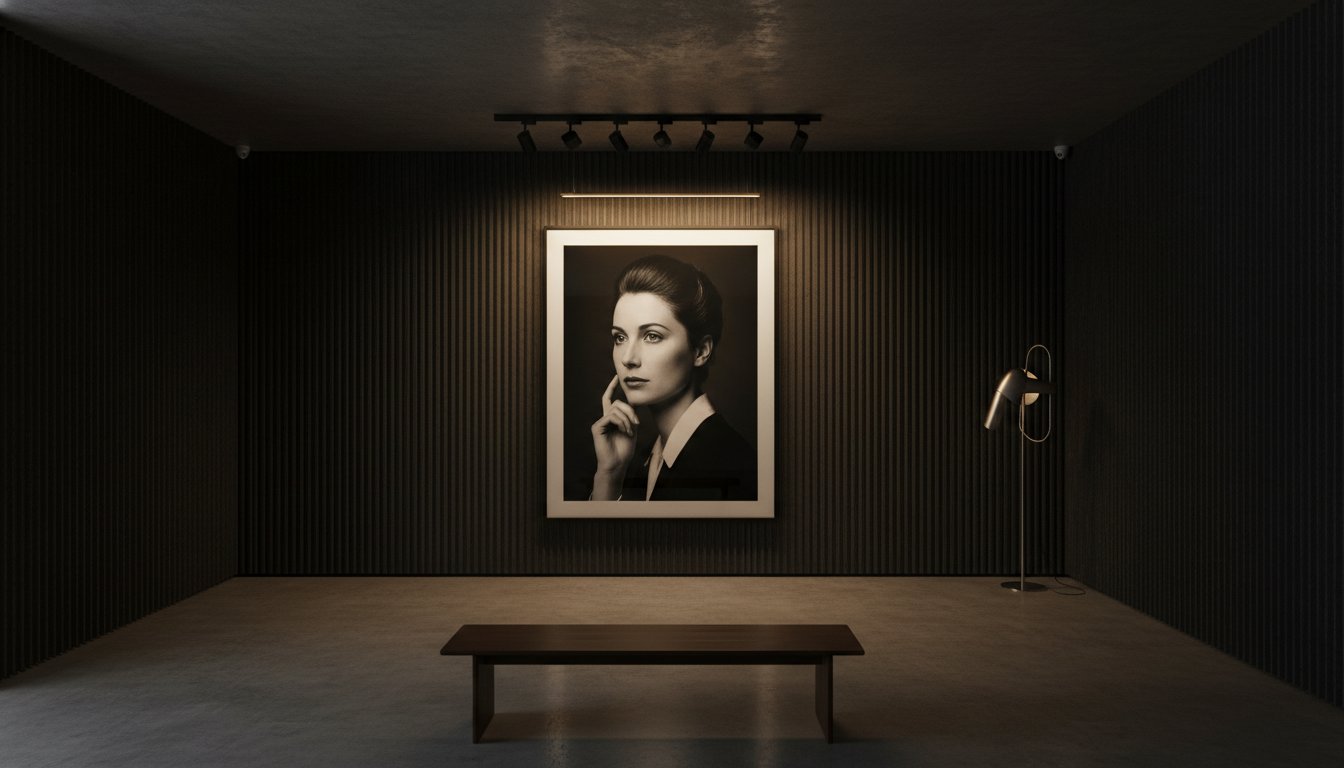
What if the most transformative element of your private collection isn’t the artist’s signature, but the invisible spectrum of light that brings it to life? Selecting the best lighting for artwork at home is the final act of curation, a decisive moment where technical precision meets aesthetic wonder. You likely understand the frustration of seeing a masterwork, perhaps a Terry O’Neill portrait, obscured by an aggressive glare, or the quiet anxiety that ultraviolet rays might slowly leach the soul from a vintage movie poster. It’s a delicate challenge to illuminate your space while acting as a guardian of your photographic heritage and a bridge to a bygone era of elegance.
This guide promises to demystify the science of the gallery glow, helping you achieve a warm, evocative atmosphere that preserves the value of every print. You’ll learn why a Color Rendering Index of 95 or higher is non-negotiable for true color accuracy and how the 2026 Matter smart home standard simplifies your setup. We’ll explore everything from the archival safety of 50-lux limits to the effortless elegance of wireless fixtures, giving you the confidence to light your collection like a professional curator.
Key Takeaways
- Master the “Golden Ratio” of color temperature, ensuring your lighting falls between 2700K and 3000K to mirror the warmth of a professional gallery.
- Understand why a Color Rendering Index (CRI) of 95 or higher is the essential metric for revealing the true depth and historical authenticity of your photographic prints.
- Learn to apply the 30-degree rule to eliminate distracting glare, allowing you to achieve the best lighting for artwork at home while maintaining visual clarity.
- Compare the traditional elegance of architectural picture lights with the versatile precision of modern track systems for larger curated collections.
- Discover how modern LED technology serves as a guardian for your collection, effectively neutralizing the invisible enemies of UV radiation and heat.
The Curatorial Importance of Lighting for Fine Art Photography
Lighting serves as the silent interlocutor between a physical print and the observer’s emotional landscape. It’s the medium through which a static image transforms into a living narrative, inviting the viewer to step into a captured moment. When you seek the best lighting for artwork at home, you aren’t merely shopping for utilitarian fixtures; you’re designing an immersive experience. Standard overhead lighting, which is often indiscriminate and harsh, fails to respect the intricate layers of fine art photography. It flattens the work, stripping away the intentional depth and emotional resonance the artist labored to capture.
Consider the evocative poolside scenes of Slim Aarons. His work thrives on a specific, aspirational texture that requires precise illumination to truly sing. Without a curated light source, the sun-drenched vibrancy of a mid-century Italian villa can appear muted and lifeless. Effective lighting acts as a guardian of this aesthetic, ensuring that the shadows remain rich and the highlights remain crisp. This approach mirrors the rigorous standards found in the archival preservation of paintings, where light is treated as both a revelatory tool and a potential risk to the integrity of the medium.
Beyond Visibility: Creating a Narrative
The eye doesn’t naturally know where to linger in a complex photographic composition. Curatorial lighting guides the viewer through the frame, highlighting the primary subject while allowing the background to recede into a soft, atmospheric glow. While “flood” lighting provides a broad, utilitarian wash that often results in a sterile environment, “spot” lighting creates the focused intensity required for a true home gallery. This distinction is vital for vintage archives. The right beam can deepen color saturation and restore the luster of aged silver-gelatin prints, making the history they represent feel immediate and vital.
The Aesthetic Impact of Shadow and Highlight
Shadows are as essential as light itself, particularly when displaying black and white pictures. Directional light creates a sense of three-dimensional depth, preventing the flat appearance common with recessed ceiling lights. It also emphasizes the tactile, artisanal texture of premium archival papers. By angling the light correctly, you reveal the subtle grain and heavy weight of the paper, reminding the viewer that they’re looking at a lasting piece of history. Achieving the best lighting for artwork at home means honoring these tactile details through a measured, luxurious glow that establishes a museum-quality focal point in any room.
Technical Foundations: Understanding CRI, Kelvins, and Lux
To achieve the best lighting for artwork at home, one must move beyond the purely aesthetic and embrace the rigorous physics of illumination. While the emotional impact of a piece is subjective, the technical metrics that reveal its true character are absolute. For the discerning collector, three specific variables dictate whether a photograph remains a vibrant window into the past or becomes a dull, distorted shadow of itself: CRI, Kelvins, and Lux. This scientific approach ensures that your home gallery functions with the same quiet authority as a professional institution.
Mastering the Color Rendering Index (CRI)
The Color Rendering Index, or CRI, measures a light source’s ability to reveal the true colors of an object compared to natural sunlight. For those displaying high-caliber visual art, a CRI below 95 is unacceptable. A lower index muddies the spectrum; it can turn the crystalline turquoise of a Slim Aarons poolside scene into a murky, indistinct teal. In celebrity portraiture, such as the storied archives of Terry O’Neill, a high CRI is essential to preserve the subtle warmth of skin tones and the intricate textures of mid-century couture. Without this spectral precision, the historical authenticity of the work is compromised.
Kelvins and Color Temperature
Color temperature, measured in Kelvins (K), defines the mood and clarity of the light. The industry standard for residential galleries is the Golden Ratio of 2700K to 3000K. While 2700K offers a traditional, incandescent warmth, 3000K provides a sophisticated balance of clarity and invitation. It ensures that the whites in a Star Wars limited edition print remain crisp without feeling clinical. This warm light has a profound psychological effect, creating a sense of permanence and prestige that invites guests to linger on the page of history you’ve hung on your wall.
Intensity is the final pillar of a successful installation. Following established conservation guidelines for light exposure, sensitive materials like photographic emulsions should be kept at a maximum of 50 lux. For moderately sensitive works, such as certain cinema lobby cards, 250 lux is the upper limit. Modern museum-grade LEDs have replaced halogens as the gold standard because they offer up to 80% more energy efficiency and produce negligible heat. This transition ensures that the best lighting for artwork at home is also the safest for your long-term investment. When your lighting matches the caliber of your collection, the results are breathtaking. If you’re ready to start your journey with a masterpiece, consult our curator’s guide to collecting to find your next focal point.
Picture Lights vs. Track Lighting: Choosing Your Architecture
Selecting the structural framework for your illumination is a decision that defines the architectural soul of your home gallery. While the technical metrics discussed previously ensure color fidelity, the hardware you choose dictates the emotional intimacy of the viewing experience. For those curating a sophisticated space, the best lighting for artwork at home often comes down to a choice between the traditional prestige of the picture light and the versatile precision of track systems. Each offers a distinct narrative path for your collection, whether you’re highlighting a solitary masterwork or a sprawling gallery wall.
The Case for the Classic Picture Light
The over-the-frame picture light remains the gold standard for creating an intimate, self-contained glow. This method is particularly effective for smaller, historically significant pieces like cinema lobby cards, where the light creates a private world within the frame. When choosing a fixture, the finish should act as an extension of your bespoke framing; hand-rubbed brass or deep bronze adds a layer of historical authenticity that complements vintage aesthetics. In 2026, high-end wireless LED picture lights have become a premier choice for collectors. These rechargeable units offer the clean, wire-free look of a hardwired installation without the invasive electrical work, providing a professional finish with minimal disruption to your interior design.
Track Lighting for the Serious Collector
For those with large-scale prints or evolving gallery walls, track lighting offers unparalleled flexibility. It allows you to adjust beam angles and intensities for varying print sizes on a single wall, ensuring that a large-format Star Wars limited edition print receives the same curatorial attention as a smaller portrait. Modern tracks have evolved into slim, low-profile designs that virtually disappear into the ceiling architecture, supporting the 2026 trend of “seeing the light, not the fixture.” This system excels at layering light; you can use narrow spot beams for the artwork while allowing wider flood lamps to provide soft, ambient room lighting. This multi-layered approach prevents the “flat” look often associated with standard residential setups.
Minimalist collectors may prefer recessed wall washers, which provide a seamless wash of light across an entire surface. This approach is ideal for modern architectural spaces where the goal is a clean, unobstructed aesthetic. Regardless of the architecture you choose, the power dilemma is now easily solved. While hardwired solutions offer permanent stability, the advancements in high-end battery technology mean that even the best lighting for artwork at home can now be achieved with portable, high-CRI fixtures that honor the prestige of your collection without the need for complex wiring.
Step-by-Step Guide to Positioning and Installation
Achieving the best lighting for artwork at home requires more than an eye for beauty; it demands a curator’s precision in geometry. The most exquisite Star Wars limited edition print or Terry O’Neill portrait can be diminished by a single misplaced beam. Precision in placement is the hallmark of a true connoisseur, ensuring that every detail is revealed without the interference of distracting glares or heavy shadows. By mastering the physical relationship between the light source and the frame, you transform a simple wall into a prestigious gallery space.
Calculating the Perfect Angle
The gold standard of art illumination is the 30-degree rule, a calculation designed to eliminate the “veiling reflection” that often obscures high-gloss photography or glass-fronted frames. When the light is positioned at a 30-degree angle from the vertical, the reflected light is directed toward the floor rather than into the viewer’s eyes. If your collection features deep, artisanal frames, you may need to increase this angle slightly to avoid casting a shadow on the top of the print. A practical method to test this before installation is the flashlight test. Simply hold a light at the intended mounting point and observe the reflections on the glass. This simple step ensures that the final result is as polished as a professional exhibition.
Sizing Your Fixture
Proportion is essential for maintaining the visual balance of your display. As a general rule, a picture light should measure between one-half and two-thirds the width of the framed artwork. This ensures a broad, even wash of light across the entire image. However, exceptions exist for oversized landscape photography or wide-format Slim Aarons prints, where a longer fixture or multiple smaller lights may be necessary to prevent “fall-off” at the edges. Centering the fixture with absolute symmetry is non-negotiable for a formal gallery setting, as even a minor misalignment can disrupt the measured, luxurious rhythm of the room.
Height is the final variable in this curatorial equation. Artwork should generally be hung so the center of the piece is at the average eye level, which is approximately 145 to 152 centimeters from the floor. Once the art is positioned, the light must be adjusted to ensure the beam is centered on the focal point of the composition. To achieve the most sophisticated result, your hardware must be as high-quality as the art it illuminates. Our bespoke framing service provides the ideal foundation for this technical mastery, utilizing premium materials and glazing that work in harmony with your lighting design to preserve the soul of every image.
Preserving Your Collection: Lighting for Archival Longevity
As a dedicated guardian of photographic heritage, your responsibility extends beyond the initial acquisition; it encompasses the lifelong protection of the image’s soul. The “Invisible Enemy”—the combined forces of ultraviolet radiation and infrared heat—works silently to degrade the physical integrity of your collection. Achieving the best lighting for artwork at home is therefore a dual pursuit of aesthetic brilliance and rigorous archival defense. By controlling the environment, you ensure that the vibrant narratives within your frames remain as potent for future generations as they are today.
Mitigating UV and Infrared Damage
The science of photo-oxidation is the primary concern for any serious collector. This process occurs when high-energy light photons strike the surface of a print, breaking down the molecular bonds of pigments and organic paper fibers. The result is irreversible: colors shift, blacks lose their depth, and the paper itself becomes brittle. In 2026, museum-grade LED technology has become the undisputed champion of preservation. Unlike legacy halogen or incandescent bulbs, high-quality LEDs emit negligible ultraviolet radiation. Verified conservation standards suggest that UV content should never exceed 75 microwatts per lumen, with a strong preference for levels below 30 microwatts per lumen to ensure total safety.
Heat is the second component of this destructive duo. Excessive warmth accelerates chemical decay, particularly in the delicate emulsions of vintage archives or limited edition prints. A simple, tactile test remains remarkably effective: your hand should never feel even a hint of warmth on the surface of the artwork or the glazing. Because LEDs are up to 80% more energy-efficient than traditional bulbs, they produce significantly less heat, making them the superior choice for maintaining the “museum-quality” focal points you’ve worked to create.
The Role of Bespoke Framing in Light Management
True archival longevity is achieved through a synergy between illumination and protection. Galerie Prints recommends pairing professional lighting with museum-grade glazing. Our bespoke framing service utilizes specialized art glass that filters out up to 99% of harmful UV rays, acting as a secondary shield against environmental degradation. This non-reflective glass also enhances the effectiveness of your lighting design; it allows the light to pass through to the image without creating the “veiling reflections” that obscure fine details. When choosing your frames, consider deeper profiles that can elegantly accommodate modern, low-profile picture light brackets without compromising the structural integrity of the piece.
Finally, consider the duration of exposure. Even the best lighting for artwork at home should be managed with a measured approach. By utilizing the 2026 Matter smart home standard, you can establish a lighting schedule that illuminates your collection only when the room is occupied. This simple act of curation significantly reduces the cumulative light load on your prints. By combining technical precision with high-quality materials, you transform your home into a stable sanctuary for visual history, ensuring your investment remains a lasting piece of history for decades to come.
Elevating Your Collection into a Lasting Legacy
Mastering the interplay between light and shadow is more than a technical exercise; it’s a profound expression of reverence for the art you’ve chosen to live with. By prioritizing a high Color Rendering Index and adhering to the geometric discipline of the 30-degree rule, you ensure your collection is seen exactly as the artist intended. Implementing the best lighting for artwork at home is the final, essential layer in your journey as a collector, transforming a simple residence into a sophisticated sanctuary of visual history.
As an official partner of the Slim Aarons Archive, we provide access to museum-quality archival prints that deserve nothing less than curatorial excellence. Our handcrafted bespoke framing, produced with artisanal precision in London, serves as the perfect foundation for your lighting design. Whether you’re showcasing iconic music archives or limited edition cinema posters, the right illumination acts as a guardian of your investment. It’s time to bring your walls to life with the prestige they deserve. Explore our Curated Collections and Bespoke Framing Services to begin the next chapter of your home’s narrative. Your collection is a piece of history; let it shine with enduring brilliance.
Frequently Asked Questions
Can LED lights damage my photographic prints over time?
Modern LEDs are the safest choice for illuminating sensitive collections because they emit negligible heat and ultraviolet radiation. Unlike legacy halogen bulbs, high-quality LEDs don’t cause the photo-oxidation that leads to fading or brittle paper fibers. To ensure maximum protection, select fixtures with a UV output below 75 microwatts per lumen. This technical precision acts as a guardian for your photographic heritage.
What is the best color temperature (Kelvins) for lighting fine art photography?
The industry standard for fine art photography falls between 2700K and 3000K. This range provides a sophisticated, warm glow that mirrors the atmosphere of an elite gallery. While 2700K offers a traditional, incandescent warmth, 3000K is often preferred for contemporary prints. It provides a crisp clarity that reveals the true depth of the artist’s work without feeling clinical or cold.
How do I avoid glare on the glass of my framed artwork?
You can effectively eliminate distracting reflections by positioning your light source at a 30-degree angle from the vertical. This specific geometry ensures that any light bouncing off the glass is directed toward the floor rather than into the viewer’s eyes. Pairing this technique with museum-grade, non-reflective glass in your bespoke framing will result in a perfectly clear, unobstructed viewing experience.
How wide should my picture light be compared to my frame?
A picture light should ideally measure between one-half and two-thirds the width of the framed artwork. This proportion ensures an even, luxurious wash of light across the entire composition without dark fall-off at the edges. For oversized landscape photography or panoramic prints, you may need to select a longer fixture to maintain perfect visual balance and symmetry across the wall.
Do I need a hardwired light or are battery-powered picture lights good enough?
While hardwired solutions offer permanent stability, high-end battery-powered lights are now a prestigious alternative for achieving the best lighting for artwork at home. Modern rechargeable units in 2026 provide the same high CRI and color temperature as traditional installations. They are an excellent solution for historic homes where you wish to avoid invasive electrical work while maintaining a professional aesthetic.
What is the 30-degree rule in art lighting and why does it matter?
The 30-degree rule is a curatorial standard used to calculate the optimal mounting distance to prevent glare and frame shadows. By angling the light 30 degrees from the vertical, you ensure the beam hits the focal point of the print with precision. This technique is essential for highlighting the artisanal texture of the paper while keeping the frame from casting a shadow over the image.
Can I use smart bulbs or dimmers for my art lighting?
Smart bulbs and dimmers are highly recommended for creating a measured, luxurious atmosphere in your home gallery. Utilizing the Matter smart home standard allows you to integrate your art lighting into a cohesive system that adjusts throughout the day. Dimmers are particularly valuable for conservation; they allow you to reduce light intensity and exposure time, which helps preserve the value of your collection.
Is it better to light a gallery wall with individual lights or one track?
Track lighting is generally the superior choice for a gallery wall because it offers unparalleled flexibility for evolving collections. It allows you to adjust individual beam angles and positions for varying print sizes on a single surface. Individual picture lights are better reserved for solitary, iconic pieces where you want to create a self-contained, intimate glow that emphasizes the work’s historical significance.