
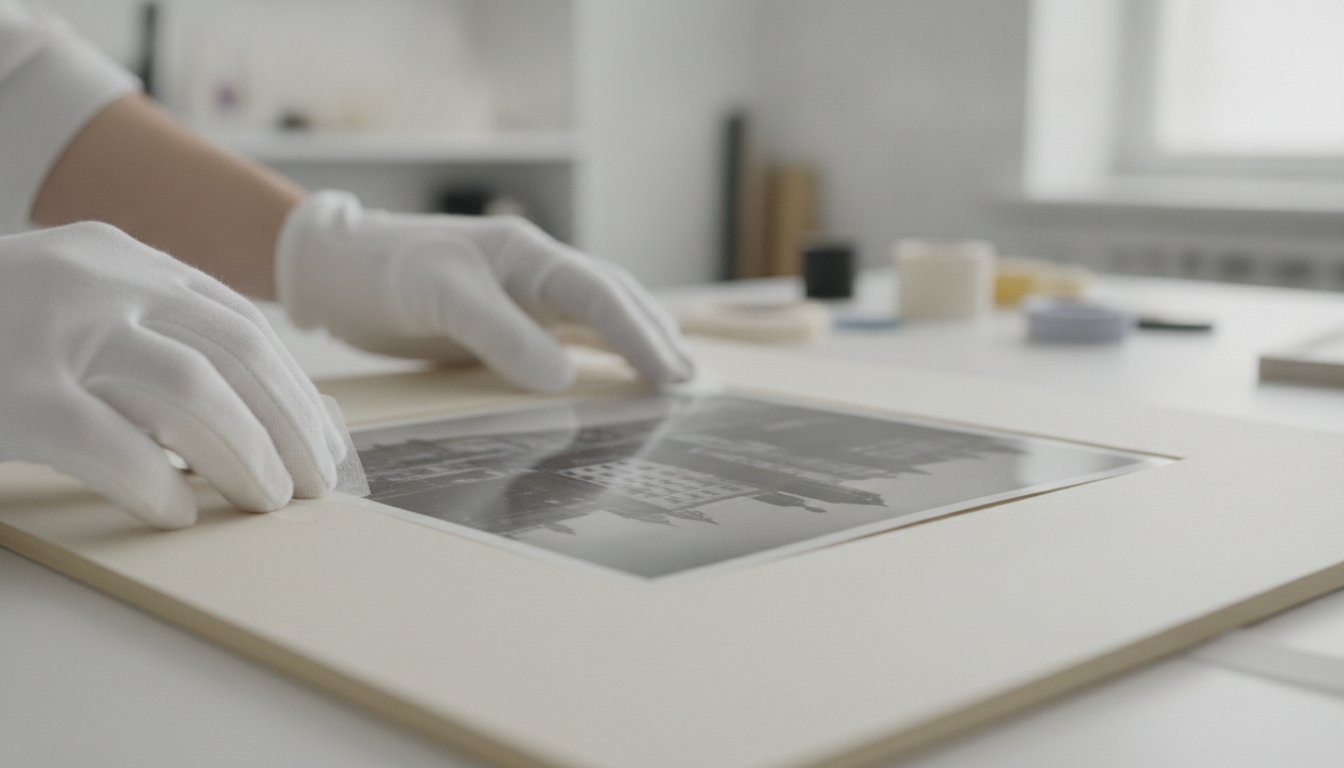
A masterpiece is more than just pigment on paper; it’s a silent witness to history that begins its slow journey of decay the moment it meets the air. For the discerning collector, the central question isn’t just how to display a work, but what is archival mounting and why is it the only acceptable standard for a serious gallery? You understand that a rare Terry O’Neill photograph or a limited edition Star Wars print represents a significant cultural investment. It’s only natural to feel a sense of trepidation when choosing how to house such pieces. You want to ensure that the vibrant soul of the artwork isn’t lost to the creeping shadows of acidity or environmental degradation.
We share your reverence for these visual treasures and recognize that technical terms like buffered matting or lignin-free backing can feel unnecessarily opaque. This guide clarifies those complexities, promising to show you how professional preservation techniques protect your art from the inside out. You’ll discover the meticulous standards established by the Fine Art Trade Guild, ranging from Museum Level protection to the artisanal use of Japanese tissue hinges. By the end of this exploration, you’ll possess the confidence to select framing services that don’t just decorate a room, but safeguard a legacy for generations to come.
Key Takeaways
- Learn why removing lignin and utilizing alpha-cellulose mat boards are critical steps to prevent the acidic degradation that often yellows and destroys paper-based art.
- Understand the technical nuances between traditional Japanese paper hinging for delicate works and dry mounting for achieving a flawlessly flat, contemporary aesthetic.
- Gain a clear definition of what is archival mounting by exploring how specialized techniques safeguard the vibrant palettes of a Slim Aarons print or the structural integrity of vintage Cinema Lobby Cards.
- Discover how bespoke, museum-grade framing transforms a simple acquisition into a protected piece of photographic heritage designed to last for generations.
Defining Archival Mounting: More Than Just a Backing
A common misconception involves the term “acid-free.” While many retail frames claim this status, it’s often a temporary state achieved through chemical buffers that eventually exhaust themselves. True archival framing materials go further by utilizing naturally inert substances that won’t degrade into acidic compounds. Without these standards, art often falls victim to “foxing,” those unsightly brown spots caused by oxidation, or becomes so brittle that the slightest movement causes irreparable cracks. By understanding what is archival mounting, you’re choosing to defend your investment against these silent, atmospheric threats.
The Core Philosophy: Conservation vs. Decoration
Choosing a mount is a decision between a fleeting decorative choice and a commitment to a legacy. A decorative mount might look striking today, but it offers no protection against the silent threats of atmospheric pollutants or humidity. Conservation-grade mounting acts as a sacrificial barrier, absorbing environmental stresses before they reach the delicate surface of the artwork. It provides the necessary structural support for fragile paper, preventing the sagging or “cockling” that occurs when art isn’t properly supported within its housing. This structural integrity is vital for maintaining the pristine, gallery-quality appearance of your collection over decades.
The Danger of Non-Archival Materials
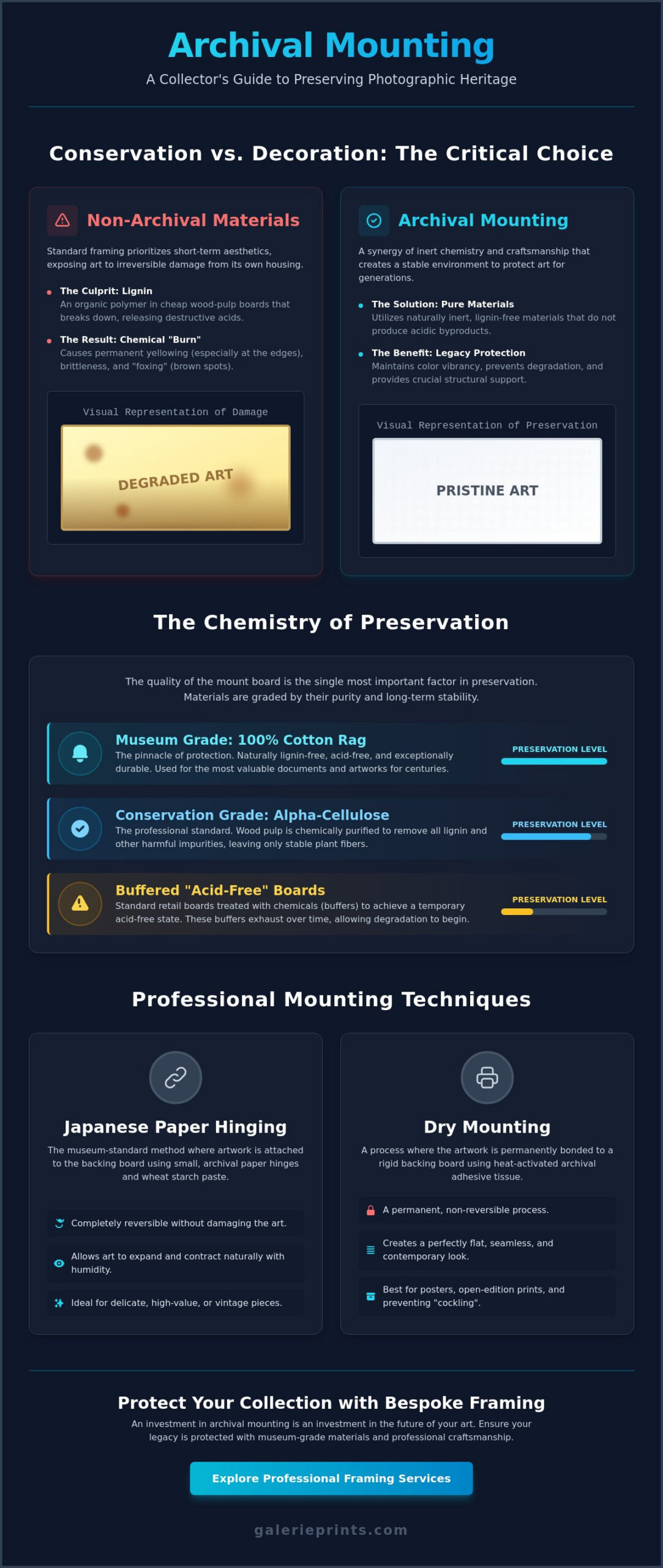
The primary antagonist in the story of art degradation is lignin, the organic polymer that binds wood fibers together. In inexpensive boards, lignin eventually breaks down, releasing acidic gases that literally “burn” the paper. This chemical transfer results in a distinct yellowing of the art, most visible along the edges where the board meets the print. While traditional film photography is sensitive, modern digital prints often utilize complex ink sets that require even more stringent mounting standards. These contemporary works are highly reactive to outgassing from cheap wood pulp boards, making the curator’s choice of alpha-cellulose or cotton rag boards an absolute necessity for any serious collector who values the heritage of their work.
The Chemistry of Preservation: Lignin, Acids, and Buffers
To master the art of preservation, one must first master the science of the substrate. While we’ve established the general purpose of these methods, a deeper look into the chemistry reveals why certain materials are non-negotiable for serious collectors. Understanding the molecular composition of these materials is the key to answering what is archival mounting in a professional context. At its core, the process aims to eliminate lignin, the complex organic polymer that provides wood with its rigidity but acts as a ticking time bomb for paper. As lignin oxidizes, it produces acidic byproducts that migrate into your art, causing the telltale yellowing and structural decay that ruins a print’s heritage.
Purified alpha-cellulose represents the gold standard for high-end mounting. This material is wood pulp that has been chemically stripped of all harmful impurities, leaving only the stable plant fibers behind. However, for those seeking the pinnacle of museum-grade protection, 100% cotton rag remains the ultimate choice. Naturally lignin-free and incredibly durable, cotton fibers have been the foundation of the world’s most enduring documents for centuries. Utilizing these materials in a bespoke framing service ensures that the physical foundation of your display is as prestigious as the image it supports.
Buffered vs. Non-Buffered Boards
Most archival boards contain a “buffer” of calcium carbonate, which acts like an antacid to neutralize airborne pollutants. This alkaline reserve is essential for protecting most photographic prints from environmental acidity. Yet, curatorial precision requires nuance. Certain historical processes, such as cyanotypes or protein-based textiles, can react poorly to alkalinity. In these rare instances, we utilize unbuffered, pH-neutral materials to ensure the specific chemistry of the artwork remains undisturbed by its housing.
The Importance of pH Neutrality
In paper science, pH neutrality isn’t a static achievement but a long-term commitment. A board that tests neutral today may become acidic tomorrow if it lacks the proper molecular stability. Galerie Prints meticulously selects materials that maintain a stable, slightly alkaline pH between 7.5 and 9.5. This range provides a safety net, actively counteracting the acidic gases found in modern homes and urban environments. It’s this level of chemical foresight that defines what is archival mounting at the highest level, distinguishing a simple frame from a true archival vessel.
Professional Mounting Techniques: Hinging vs. Dry Mounting
The physical application of art to its substrate is where chemical science meets artisanal grace. When considering what is archival mounting, one must evaluate the delicate balance between structural permanence and the cardinal rule of conservation: reversibility. Every technique employed by a master framer should be inherently undoable, ensuring the artwork can be returned to its original, unmounted state without the slightest whisper of damage. This philosophy dictates the choice between traditional hinging and modern dry mounting, two distinct paths that define the final character of your display. While one method celebrates the natural movement of paper, the other seeks a flawless, architectural precision often required for contemporary spaces.
The aesthetic impact of these choices is profound. A collector must decide if they prefer the classic window mount or the sophisticated “float mount,” which leaves the raw, deckled edges of the paper exposed within the frame. This latter style requires impeccable hinging techniques to create the illusion of the art levitating against the backing board. Understanding what is archival mounting at this level allows you to tailor the presentation to the specific narrative of your collection, whether you’re housing a vintage lobby card or a modern masterpiece.
The Art of the Reversible Hinge
Hinging remains the traditional museum standard, utilizing strips of acid-free Japanese paper and refined wheat or rice starch paste. This centuries-old secret is favored because the paste is strong yet easily water-soluble, allowing for safe removal decades later. These hinges, often applied in a “T” or “folded” configuration, are designed to be intentionally weaker than the art paper itself. This ensures that if the frame is dropped or mishandled, the hinge will tear rather than the artwork. Furthermore, this method allows the paper to “breathe” and expand naturally with changes in humidity, preventing the tension that leads to long-term warping.
When to Choose Archival Dry Mounting
While hinging is poetic, large-scale fine art photography often demands a different approach to combat “cockling,” the subtle rippling that can occur in oversized prints. Archival dry mounting solves this by using heat-activated, acid-free tissues to bond the print entirely to a rigid, pH-neutral substrate. This results in a perfectly flat finish that complements sleek, modern interiors where light might otherwise catch the imperfections of a loose-hung print. Although it’s a more permanent bond, the use of specialized archival tissues ensures the process remains safe for high-value investments, providing the structural integrity required for the expansive vistas found in the Slim Aarons or Terry O’Neill archives.
Selection Guide: Matching Mounting to Your Collection
For those looking to safeguard their investments, our bespoke framing service provides the technical expertise required to match these museum-grade materials to your specific acquisition. Whether you’re housing a rare archive find or a modern limited edition, the mounting choice remains the most critical decision in the preservation journey.
Mounting for Modern Colour Photography
Modern colour works, such as those found in the Slim Aarons collection, require a mounting strategy that respects the delicate balance of contemporary C-type and Giclée pigments. In our current climate, these prints are susceptible to UV-induced shifts and atmospheric oxidation. When mounting large-format Terry O’Neill pieces, the goal is to provide absolute flatness without compromising the print’s ability to remain stable over decades. We utilize high-grade UV-opaque glazing in tandem with alpha-cellulose boards to create a light-stable environment that keeps those iconic poolside hues as vibrant as the day they were captured.
Archival Needs for Vintage Memorabilia
Vintage ephemera presents a more complex challenge. Objects like mid-century Cinema Lobby Cards were often printed on high-acid paper stocks never intended for longevity. These pieces require extra structural support to prevent the fragile fibers from shattering. A professional mounting strategy for these items often involves creating a “micro-environment” within the frame. This might include using de-acidification barriers or protective archival sleeves that arrest the decay of the original paper. For black and white archives, this controlled environment is also essential for preventing silver mirroring, a common phenomenon where silver ions migrate to the surface and create a distracting metallic sheen on the shadows of the image. By isolating the art from external pollutants, we ensure that Hollywood’s photographic heritage remains a tangible part of your home’s narrative.
The Galerie Prints Standard: Bespoke Framing as Heritage Protection
A collection truly matures when it transitions from a series of acquisitions into a curated legacy. We’ve explored the chemical nuances and technical methods, but the final execution requires a partner who views art preservation as a sacred duty. At Galerie Prints, our bespoke framing service is more than a logistical necessity; it’s a commitment to the enduring soul of the image. By integrating everything we’ve discussed about what is archival mounting, we provide a seamless bridge between the artist’s original vision and the sanctuary of your home. This process ensures that your investment remains as pristine as the day it left the darkroom or the studio.
Our curators apply these rigorous standards to every piece, regardless of its era. For instance, we insist on meticulous archival mounting for every Star Wars limited edition print that passes through our hands. These works are modern icons of cinematic history. They possess a value that will only grow as the decades pass. Using anything less than museum-grade materials would be a disservice to the collector and the heritage of the franchise. When you receive a piece from us, it arrives ready to hang. It offers the profound peace of mind that only professional, hand-finished craftsmanship can provide.
Artisanal Craftsmanship in 2026
Our London-based workshop serves as the heart of our operations. It’s a space where traditional methods meet the exacting precision of 2026 technology. Each frame is a testament to localized, artisanal skill. We don’t just select a board; we curate an environment. Our experts hand-select premium frames and archival mount boards that complement the specific tonal range and paper weight of your art. Investing in a Galerie Prints frame is a lifetime commitment. It’s an investment in a vessel designed to withstand the tests of time and environment while maintaining its quiet, sophisticated authority on your wall.
Your Next Steps as a Collector
The journey of a serious collector is one of constant learning and refined choices. A holistic understanding of what is archival mounting allows you to move forward with the certainty that your art is protected. Your next step is to ensure your current collection is properly housed. Our experts are available to consult on the best mounting strategies for your specific acquisitions, helping you choose between hinging and dry mounting with confidence. This is how you transform a living space into a gallery of personal history. We invite you to Explore our Bespoke Framing Options and discover how we can help you safeguard the heritage of your visual treasures with style.
Securing the Future of Your Photographic Heritage
A fine art collection is an evolving narrative of history and personal taste, but its survival depends on the invisible choices made within the frame. We have explored how the rigorous elimination of lignin and the strategic use of pH-neutral buffers create a sanctuary for delicate paper. By mastering what is archival mounting, you transition from a casual observer to a true steward of photographic history. Whether you are preserving the cinematic grandeur of a rare lobby card or the vibrant poolside leisure of a Slim Aarons print, the method of display is the deciding factor in its longevity.
Our London-based workshop remains dedicated to these museum-grade standards, utilizing exclusively acid-free materials and traditional hand-craftsmanship. Trusted by major archives including Getty Images, our expert framers ensure that every piece is treated with the reverence it deserves. We invite you to Preserve your collection with our Bespoke Framing Service and experience the confidence that comes with gallery-quality protection. Your collection is a legacy; let us help you ensure it remains as breathtaking for future generations as it is today.
Frequently Asked Questions
Is archival mounting the same as acid-free mounting?
No, archival mounting represents a more rigorous and permanent standard than simple acid-free labeling. While many retail boards are marketed as acid-free, they often consist of wood pulp that has been chemically treated to be neutral, a state that can revert over time as the buffers are exhausted. True archival standards require naturally inert materials, such as 100% cotton rag, which remain stable for centuries without the need for temporary chemical additives.
Can archival mounting be reversed if I want to change the frame later?
Absolute reversibility is the fundamental principle of professional preservation. Techniques like Japanese tissue hinging with water-soluble starch paste ensure that the artwork can be removed from its mount at any time without leaving a trace or damaging the paper fibers. This allows you to update your display or move the piece between collections while maintaining its original, untouched condition and market value.
How long will an archival mount protect my print?
When executed to the highest industry standards, archival mounting offers substantial longevity for your collection. The Fine Art Trade Guild defines Level 1 Museum framing as providing protection for up to 35 years in normal conditions, while Level 2 Conservation framing protects for up to 20 years. These benchmarks ensure that your investment survives the typical environmental stresses of a residential setting while maintaining its gallery-quality appearance.
Do I need archival mounting for digital Giclée prints?
Yes, digital Giclée prints require archival mounting because their complex ink sets and specialized coatings are often more reactive to atmospheric pollutants than traditional silver gelatin. High-quality digital papers are designed to be pH neutral, but they’ll quickly absorb acidity from inferior mounting boards. Protecting these modern works requires the same curatorial oversight and inert materials as a vintage masterpiece to prevent premature yellowing.
What is the difference between museum board and conservation board?
The primary difference lies in the base fiber used for the board’s construction. Museum board is crafted from 100% cotton rag, which is naturally free of harmful lignin and represents the ultimate standard in the art world. Conservation board is typically made from alpha-cellulose, which is wood pulp that’s been chemically purified to remove impurities. Both meet high standards, though cotton rag remains the prestigious choice for high-value archives.
Will archival mounting prevent my art from fading in the sun?
Mounting primarily protects against chemical decay and structural warping rather than light damage. While it’s a vital component of the preservation puzzle, you must pair it with UV-opaque glazing to prevent the pigments from fading. A complete archival housing addresses both the internal chemical environment through the mount and the external impact of light through specialized glass or acrylic.
Can I do archival mounting myself at home?
Attempting preservation at home is possible with specialist kits, but it’s rarely recommended for high-value investments. Professional framers operate in dust-controlled environments and possess the artisanal dexterity required for delicate Japanese tissue hinging. Given the technical nuances of what is archival mounting, entrusting your work to a seasoned expert ensures a flawless, risk-free result that preserves the physical heritage of the piece.
Why is archival mounting more expensive than standard framing?
The premium cost reflects both the rarity of the materials and the intensive artisanal labor involved. Standard framing often uses mass-produced adhesives and wood-pulp boards, whereas what is archival mounting requires hand-applied hinges and expensive cotton rag substrates. You’re paying for specialized expertise and materials that transform a simple decorative frame into a permanent heritage vessel designed to last for generations.