
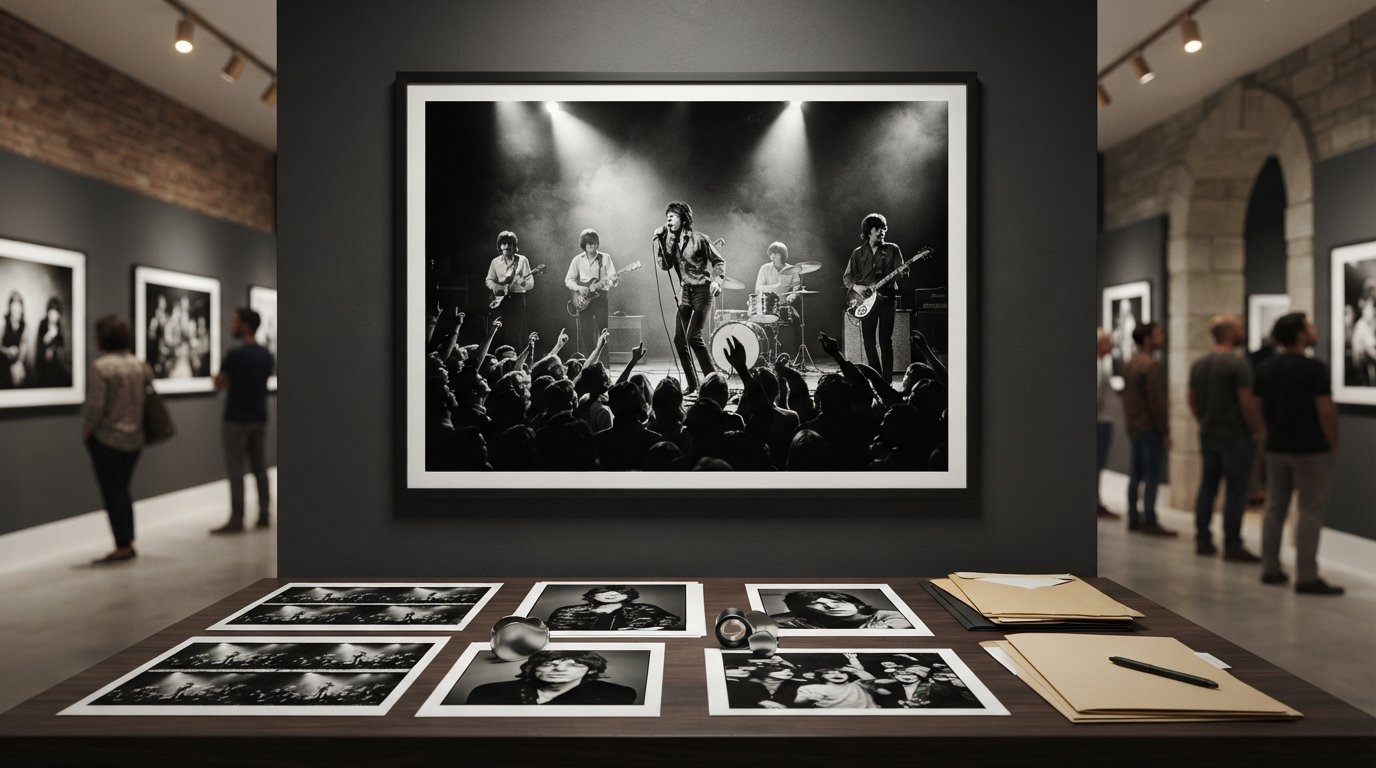
The best places to look for Rolling Stones photographs are specialist photography galleries and curated music-image collections. If you’re deciding where to buy Rolling Stones photos, begin with the image’s photographer, date and context: Art Kane photographed the band in 1966, while Roger Jackson’s “Park Stones” captures them walking through Green Park in 1967.
A great Rolling Stones photograph offers more than a familiar face: it can capture the atmosphere of a performance, a moment between shows or the band in another era. Understanding the image’s context can help you find a photograph that resonates with your connection to the music.
This guide explores historic performance images, candid photographs and portraits of band members and their collaborators. You’ll also learn how to compare image subjects and provenance, and what to consider when choosing a print for a collection or a place in your home.
Key Takeaways
- Trace a photograph through its photographer, date, setting and edition details to understand the story behind the image.
- Compare live-performance scenes, candid moments and portraits to find the kind of Rolling Stones image that suits your collection.
- Look beyond the band itself: photographs of members with fellow musicians can capture a wider chapter of music history.
- Before purchasing, distinguish ownership of a physical print from permission to reproduce or use the photograph.
- Explore how image format, presentation and the photograph’s historical context shape its appeal as a collectible or display piece.
Historic Rolling Stones images and performances
Historic Rolling Stones photographs can preserve more than a performance: they record a place, a moment and the way the band appeared to the camera. Start by reading the caption alongside the image. A named photographer, location and date can help distinguish a concert scene from a portrait or an informal moment away from the stage. Those details also give you a clearer way to compare photographs with different moods.
One example is Dominic Lamblin’s photograph “Rolling Stones in Montreux, Switzerland 1972.” It is signed and numbered in an edition of 50. The Montreux setting and date give the image a specific historical frame, while the edition information identifies it as part of a defined print run. For collectors, those details can make a photograph easier to place and discuss than an image with only a band name attached.
Performance photographs and candid images offer distinct perspectives on the band’s history. A live image centres on gesture, movement and the relationship between musicians and audience. A photograph taken away from the stage may draw attention to expression, clothing or setting. Decide which kind of moment you want to live with to narrow a broad search to images that feel personal.
Captions deserve close attention. Compare the photographer’s name, the stated place and the date, then note whether the title describes a performance, a location or the people pictured. For example, “Rolling Stones in Montreux, Switzerland 1972” provides a place and year, not simply a general band identification. Keep those details together when considering several photographs, so images from different moments don’t blur into one undifferentiated collection.
Edition information adds another layer to a historic print. In Lamblin’s Montreux photograph, the signed, numbered edition of 50 gives the print a defined place within its edition. Treat the signature, numbering and title as separate details when reading an artwork description. Together, they help you understand what is being offered and why the photograph belongs to a particular historical and photographic context.
- Choose a subject: live performance, portrait or candid scene.
- Read the caption for photographer, place and date.
- Note edition details, including a signature and numbering.
These steps make it easier to compare historic Stones images by visual character and documented context. Lamblin’s Montreux image, for example, may appeal to someone drawn to a specific place and year, while another collector may prefer the energy of a stage scene. Let the setting, caption and edition details guide your selection, rather than relying on the band’s name alone.
Photo collections and image providers
Rolling Stones photographs appear in different kinds of collections, each offering a distinct way to search. A photographer-led archive groups work around an individual perspective, while a music collection brings together artists, eras and performance settings. A gallery collection may be arranged by signed prints, limited editions or subject matter. Start with the kind of image you want, then narrow your search by photographer, date or place.
Photographer names can make a broad search more precise. Terry O’Neill’s work, for instance, includes portraits and images of musicians, while Gered Mankowitz’s Stones photographs offer another path into the band’s visual history. Search the photographer’s full name alongside “Rolling Stones,” then compare captions and image details rather than relying on a thumbnail alone.
Collection structure also affects what you discover. A music archive may include portraits, backstage moments and images of musicians together; a concert-focused collection may foreground stage action. If you’re drawn to a particular period, pair “Rolling Stones” with a place or year. A location-based search can uncover photographs that a general band-name search misses.
Compare listings by the information attached to each photograph. Look for the photographer, image title, setting, date and print details. A caption naming a studio or city, for example, gives you a more specific starting point than a description that identifies only the band. Record these details as you browse to compare images accurately across collections and avoid confusing similar scenes.
Use this short search sequence to keep your search focused:
- Choose a subject, such as a live performance or band portrait.
- Search the subject with a photographer’s name, such as Terry O’Neill.
- Add a place, year or venue when you have one in mind.
- Compare captions, edition descriptions and presentation details.
This sequence helps distinguish a broad image search from a purposeful collection search. “Rolling Stones” plus “Terry O’Neill,” for example, narrows the photographer; adding a studio or year can help identify a particular image. Keep a shortlist with each photograph’s caption and collection context. You can then compare the images’ historical focus rather than choosing solely by first impression.
Collectors interested in music photography can also explore adjacent subjects, such as portraits of fellow performers or collaborators. Keep the Stones as your anchor, then broaden the search with a musician’s name when the image’s wider musical context matters. To explore a wider selection of photographic art, browse curated photographic collections.
Photographs of band members and collaborators
Images of Rolling Stones members with other musicians reveal connections beyond the band’s performances. A photograph can place Mick Jagger or Keith Richards within a wider musical circle, making the collaborator, setting and date part of its appeal. These works suit collectors interested in shared histories, not only group portraits. Caption names help identify those relationships and compare images with different subjects.
Eddie Kramer’s photograph of Jimi Hendrix and Mick Jagger at Madison Square Garden, New York City, in 1969, brings two influential musicians into one frame. Its title identifies both performers, the venue and the year, giving the image a clear historical setting. Consider whether you’re drawn to the meeting of artists, the specific New York location or the period represented. Each detail offers a different reason to choose the photograph.
Other images place Stones members alongside celebrated collaborators. Bob Gruen’s photograph of Keith Richards with Tina Turner and David Bowie in New York City in 1983, for example, centres a trio of major musical figures. Ken Regan’s 1972 New York City image brings Richards and Jagger together with Bob Dylan. These captions help distinguish a photograph’s significance from a general band portrait.
Peter Simon’s photograph of Keith Richards, Mick Jagger and Peter Tosh, dated 1978, offers another route into the Stones’ musical relationships. Compare its named subjects with the New York scenes by Gruen and Regan. The collaborators, dates and locations create different historical associations, even when a photograph features the same Stones members. A caption can therefore guide both research and personal selection.
For a different perspective, David Yarrow’s photograph The Rolling Stones depicts a scene in Wells, Nevada, dated 2023. Its contemporary date and named setting distinguish it from images documenting earlier decades. Consider whether you want a photograph tied to a particular musical encounter or one focused on the band in a specific place. That choice will shape the kinds of images worth comparing.
Use these details to assess a photograph’s subject and context:
- Identify each named musician in the caption.
- Compare the stated date and location with your interests.
- Decide whether the collaboration or the Stones themselves anchor the image.
- Keep the full title beside each shortlisted photograph.
These examples suggest useful search combinations: a band member’s name with a collaborator, place or year. Pairing “Keith Richards” with “Bob Dylan” or “Peter Tosh,” for instance, can narrow the search to a specific musical encounter. If the setting matters, add New York City or Madison Square Garden. Your shortlist can then reflect the story you want the photograph to preserve.
Photographs of the Rolling Stones for sale
For a more focused search, compare photographs by scene, photographer and listed price. A classic 1972 tour photograph is listed from $490. The contrast shows how image, context and the specific print can shape the range of available offers.
Other examples capture different moments in the band’s history, such as intimate studio sessions and energetic backstage moments.
These listings provide comparison points, not a universal valuation. The market snapshot for Rolling Stones and band-member photographic prints places typical offers between $151 and $2,000, with a median of about $490. It draws on 31 price samples from 3 sources, collected October 24, 2026, and is valid until November 23, 2026. Individual photographs can sit outside that range.
Consider the named image before comparing figures. Different titles, settings and listed formats make direct comparisons more complex than looking at price alone.
Use listing details to create a shortlist. Record the photographer, image title, date or place, and whether the figure is a starting price or displayed range. For example, compare the starting price for Russell’s 1972 tour photograph with the displayed range for Szabo’s 1978 image. This keeps unlike listing formats distinct and helps you identify which photographs best fit your interests.
- Compare the full image title and photographer, not just the band name.
- Distinguish a starting price from a displayed price range.
- Keep the market snapshot’s date alongside its figures.
When searching for where to buy rolling stones photos through trusted platforms like Galerie Prints, international customers outside the United States are responsible for paying any duties or taxes imposed by their country before delivery. Include this in your purchase considerations. Comparing the photograph, its listing details and applicable charges in the destination country helps you assess the full transaction, rather than focusing on the displayed figure alone.
What copyright and licensing rules apply to buying Rolling Stones photos?
Buying a Rolling Stones photograph and receiving permission to reproduce it are different matters. Treat a print purchase as acquiring the physical artwork unless its written terms explicitly grant additional uses. Displaying a framed photograph at home, for example, differs from reproducing it on a website, album cover or advertisement. The photographer, rights holder and seller’s terms all matter.
Before purchasing a print, identify how you intend to use it. A collector seeking a photograph for private display has a different purpose from a publisher planning a book cover. An image for a business campaign or merchandise may require permissions beyond owning a print. Read the product description and any accompanying terms for details about permitted use.
Pay particular attention to terms such as “personal use,” “reproduction” and “commercial use.” A listing for a signed or numbered print describes the physical artwork; those details alone don’t explain whether you may reproduce the image. An edition statement, for instance, may identify a print’s place in a series without addressing online publication or promotional use.
Use this checklist before completing a purchase:
- Write down your intended use, such as home display or editorial publication.
- Read the listing and transaction terms for permitted uses and restrictions.
- Separate ownership of the print from permission to copy or publish its image.
- Keep the receipt and any written license with the photograph’s title and photographer.
Written terms are especially important when an image will appear beyond a private interior. Posting a photograph online, including it in a publication or using it to promote a product can involve distinct permissions. Don’t assume permission for one purpose extends to another. For example, a license describing editorial use shouldn’t automatically be read as permission for advertising.
Captions can help identify a photograph, but they don’t replace licensing terms. A title naming Mick Jagger, a photographer and a concert setting describes the subject and context. It doesn’t explain by itself whether copying or publication is authorized. Keep the caption with the seller’s written terms so the image and its permitted use remain clearly associated.
If your intended use changes after purchase, revisit the written terms before reproducing the image. A print bought for a living room may later attract interest from a magazine or business. That new purpose calls for a separate review of the applicable permissions. Careful recordkeeping preserves the distinction between owning a photographic artwork and having the right to use its image elsewhere.
Galerie Prints: The Slim Aarons Collection
Galerie Prints offers Terry O’Neill Photography for readers drawn to the atmosphere and artistry of classic music photography. If you’re looking beyond Rolling Stones images, this collection offers a way to explore photography from another era. The Slim Aarons Collection presents a different photographic perspective, while Cinema Lobby Cards and Star Wars Limited Edition Prints extend the selection into film and popular culture.
These collections suit readers choosing photographic art for its subject, historical character or place within a wider visual collection. Explore Terry O’Neill Photography when the photographer’s perspective matters as much as the musical subject, or consider The Slim Aarons Collection for a contrasting photographic style.
Visit Galerie Prints to explore its collections.
Choose the image that keeps its story alive
A photograph can be more than a record of a performance: it can shape a room’s atmosphere and keep a musical era close. As you decide where to buy Rolling Stones photos, consider which image you’ll want to return to and how its story will sit alongside the art you already value.
Galerie Prints offers Terry O’Neill Photography, The Slim Aarons Collection and Cinema Lobby Cards, each presenting a distinct perspective on photography and popular culture. Explore these collections as you consider what kind of visual history belongs in your space.
For a next step, contact Galerie Prints about Rolling Stones photos. Let your interest in a particular image, photographer or moment guide the conversation, and continue your search with a clearer sense of the photograph you hope to live with.
Frequently Asked Questions
Where can I buy authentic Rolling Stones photos online?
Look for galleries and music-photo archives whose listings identify the photographer and specific image. To decide where to buy Rolling Stones photos, compare the title, edition details and description of the physical print rather than relying on the band’s name alone. Galerie Prints offers a Music Archives category for music photography. Keep the listing details with your purchase record so you can identify the artwork later.
Which reputable photo agencies sell Rolling Stones concert photographs?
Specialist music-photo archives and fine-art photography galleries are relevant places to search for concert imagery. Compare each listing’s photographer credit, image title and event context to distinguish a performance photograph from a portrait. Galerie Prints offers Music Archives and Terry O’Neill Photography, collections for exploring music-related photographic art. Search by an artist or event as well as the band, then assess each listing on its own details.
Where can I buy vintage Rolling Stones prints and original photographs?
Search gallery and photographic archive listings, distinguishing a vintage print from a photograph described as an original. Those terms refer to different qualities, so read the item description carefully. Note the photographer, image title, print details and any condition information provided. If age matters to your collection, prioritize listings that clearly describe the specific object rather than relying on a general “vintage” label.
How much do Rolling Stones photos and prints typically cost?
Market offers for Rolling Stones and band-member photographic prints typically range from $151 to $2,000, with a median of about $490. This market snapshot is based on 31 price samples from 3 sources, collected October 24, 2026, and valid until November 23, 2026. Treat the range as a broad comparison, not a quote for a particular image. Photographer, rarity and print dimensions affect individual listings.
Where can I buy Rolling Stones photos in the United States?
US buyers can search online gallery collections and music-photography archives, comparing listings by image and photographer. Galerie Prints offers a Music Archives category and worldwide coverage. For a practical shortlist, record each candidate’s title, edition information and listed format. When comparing options across locations, also account for any duties or taxes imposed by your country before delivery.
Are Rolling Stones photos available as licensed fine-art prints?
Some photographs are offered as fine-art prints, but the purchase terms determine what uses are permitted. A print listing and image-use permissions are separate details. Before buying, decide whether you want the artwork for display or intend to reproduce the image elsewhere. Read the specific terms and keep them with your purchase record, especially if a publication or commercial project is involved.
How do Rolling Stones photo prints compare across sellers, sizes, and formats?
Compare like with like: the same photograph, photographer, edition status and physical format. Then consider the stated dimensions and whether the listing describes a print alone or a framed presentation. A lower figure may reflect a different size or format, so price alone doesn’t establish which option is the closer match. Keep each listing’s specifications together before choosing the version that suits your collection or display.