
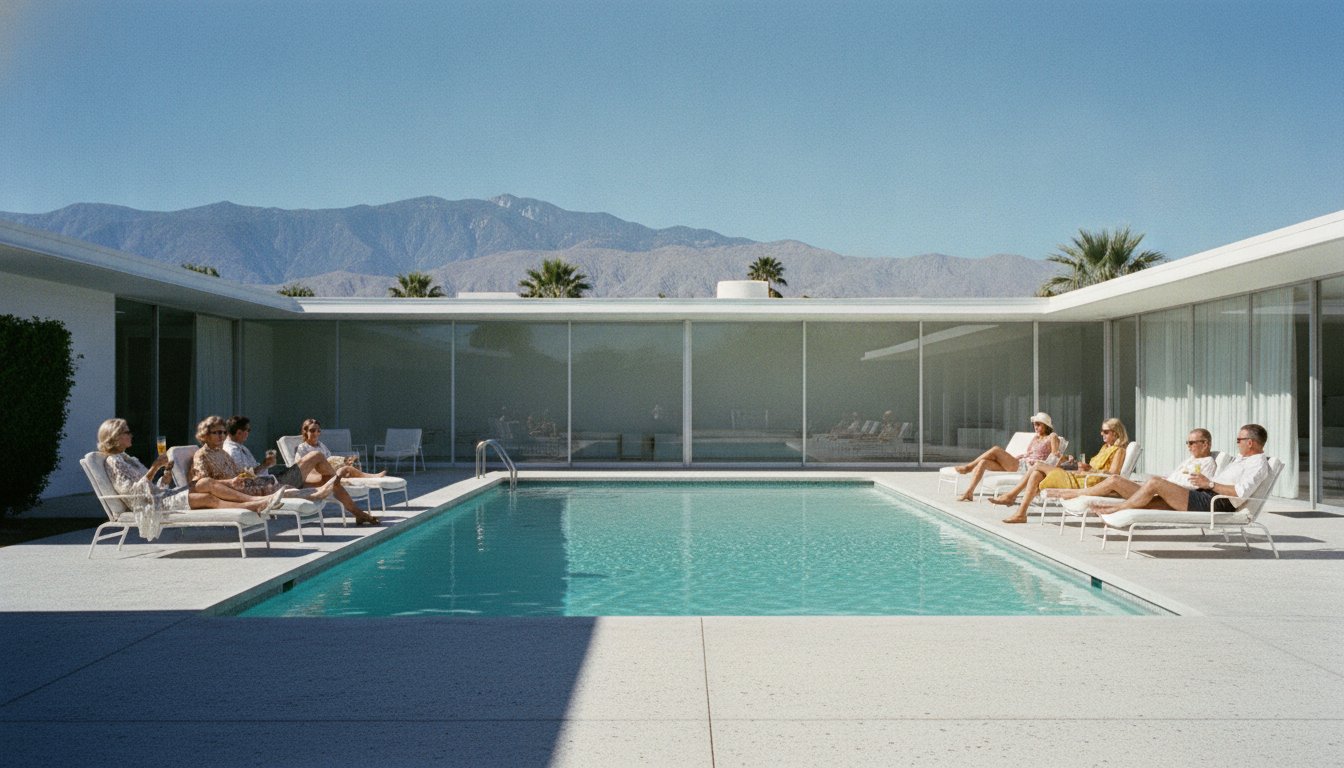
Tag: Desert Modernism

Slim Aarons Palm Springs: The Definitive Guide to Desert Modernism

The record auction price of $63,000 for a single photograph confirms that Slim Aarons didn’t just capture moments; he minted the visual currency of the American Dream. His work, particularly the sun-drenched frames of slim aarons palm springs, represents more than mere photography. It’s a preserved portal to a bygone era of elegance where architecture and leisure merged into a singular, aspirational art form. You likely recognize the crystalline blues and the effortless poise of his subjects, yet bringing such a piece into your collection requires a deeper understanding of its historical provenance and the technical excellence of archival production.

In this definitive guide, we’ll reveal the stories behind the iconic Kaufmann Desert House and the architectural legacy of Richard Neutra that defines the desert modern aesthetic. You’ll learn how to distinguish authentic archival prints from mass-market imitations and how to select the perfect scale for these expansive landscapes. We’ll explore the cultural significance of his most famous works and provide a curated roadmap for integrating this high-end mid-century modern style into your own home through meticulous, artisanal framing that honors the artist’s original vision.

Key Takeaways

  • Explore the philosophy of “attractive people doing attractive things” and why mid-century Palm Springs became the ultimate epicentre of aspirational living.
  • Uncover the narrative details within Poolside Gossip while identifying the key socialites who defined the iconic slim aarons palm springs aesthetic.
  • Understand the architectural mastery of Richard Neutra’s Kaufmann Desert House and how its pioneering design served as the perfect stage for Aarons’ work.
  • Master the art of scaling and placement to ensure a large-format desert landscape achieves a high-end mid-century modern look in your home.
  • Discover why investing in archival gallery prints is essential for preserving the tactile quality and historical authenticity of these photographic treasures.

The Allure of Palm Springs Through Slim Aarons’ Lens

In the 1970s, Palm Springs emerged as the geographic heart of the American leisure class. It wasn’t just a vacation spot; it was a curated exhibition of post-war success. Slim Aarons arrived not as a stranger, but as a peer with a camera. After the harrowing realities of WWII, his career pivot was entirely intentional. According to Slim Aarons’ biography, he served as a combat photographer before making the conscious decision to only document “attractive people doing attractive things in attractive places.” This philosophy transformed the arid California landscape into a vibrant, high-contrast dreamscape. The specific quality of slim aarons palm springs photography relies on the relentless, unfiltered desert sun. This natural light provided the intense saturation required for his signature Kodachrome palette, making the blues deeper and the architecture sharper.

The Desert Oasis as a Social Stage

Aarons didn’t just find scenes; he understood the social architecture of the desert. He sought out the “leisure elite,” a mix of socialites and Hollywood royalty who treated the Coachella Valley as a private sanctuary. The post-war era saw a cultural shift toward this “Desert Modern” lifestyle, where the harsh environment was tamed by glass walls and turquoise water. Palm Springs offered the ultimate stage for this narrative. It provided a sense of isolation that felt exclusive yet entirely visible through his lens. His subjects weren’t just posing. They were performing the ultimate version of the American Dream, surrounded by mid-century masterpieces that blurred the lines between indoor comfort and the wild desert landscape.

Capturing the Aspirational Aesthetic

The visual language of these works is defined by an almost casual decadence. We see a world of crisp linen, perfectly chilled martinis, and the architectural geometry of poolside lounging. There’s a stillness in his desert works that suggests time has stopped at the height of a mid-afternoon cocktail party. This “effortless elegance” was never accidental. It was a meticulous capture of a specific social rhythm that prioritized aesthetic beauty above all else. He managed to make the elite feel accessible while maintaining their untouchable prestige. The “Aarons Aesthetic” is a masterful blend of candid observation and staged perfection, where every shadow and socialite serves the greater narrative of a sun-drenched utopia.

Decoding the Masterpiece: ‘Poolside Gossip’ and Beyond

While the broad strokes of the desert lifestyle are evocative, specific compositions have elevated the slim aarons palm springs portfolio to the status of high art. Among these, ‘Poolside Gossip’ reigns supreme. This 1970 masterwork isn’t merely a photograph; it’s a meticulously balanced tableau that captures the very soul of mid-century aspirations. Its enduring power lies in a “frozen in time” quality that makes the viewer feel like an invited guest to a conversation that never ends. It’s a testament to Aarons’ ability to document a social hierarchy while simultaneously creating a piece of timeless interior decor.

The Story Behind ‘Poolside Gossip’

The scene features socialite Nelda Linsk, dressed in a striking yellow lace outfit, and Helen Dzo Dzo Kaptur lounging by the crystalline waters of a private pool. The intentional coordination of Linsk’s attire with the surrounding decor demonstrates Aarons’ sharp eye for editorial perfection. To truly understand the gravity of this image, one must consider the history of the Kaufmann Desert House, which served as the architectural anchor for the shoot. This residence, a pinnacle of modernism, provided the clean lines and glass expanses that allowed Aarons to frame his subjects within a geometric paradise. It’s frequently described as the “Mona Lisa” of the movement, representing a peak of cultural and aesthetic harmony that continues to influence designers today.

Other Notable Desert Works in the Collection

Beyond this singular masterpiece, the collection includes vibrant social chronicles like ‘Palm Springs Party’ and ‘Desert House Party’. These works shift the focus from intimate conversation to the broader social energy of the era. Aarons frequently employed wide-angle lenses to capture the sheer scale of these desert estates, ensuring the dramatic mountain backdrops and sprawling lawns were as much a part of the story as the guests themselves. This technical choice emphasizes the “indoor-outdoor” flow that defines the region’s architecture. The resulting images are not just portraits but environmental studies of luxury.

These archival prints are prized by collectors for their historical weight and visual brilliance. Because they document a specific, unrepeatable moment in social history, they carry a rarity that mass-produced alternatives simply cannot match. For those looking to anchor a room with a definitive piece of history, you might explore the Slim Aarons Collection to find a work that resonates with your personal aesthetic. Each print serves as a bridge to an era where elegance was the primary pursuit of the afternoon, rendered with the technical precision that only an archival gallery print can provide.

Architecture as the Co-Star: The Kaufmann Desert House

In the visual lexicon of slim aarons palm springs, the architecture is never a passive observer. It functions as a primary protagonist, dictating the rhythm of the social interactions it houses. Richard Neutra’s 1946 masterpiece, the Kaufmann Desert House, stands as the definitive stage for these social chronicles. Built for department store tycoon Edgar J. Kaufmann, the residence was designed to be a “machine in the desert,” a sophisticated structure of steel, glass, and stone that balanced industrial precision with the raw beauty of the Coachella Valley. For Aarons, this wasn’t just a setting; it was a co-star that provided the geometric rigour necessary to elevate a lifestyle photograph into a work of high-modernist art.

Richard Neutra’s Architectural Canvas

The Kaufmann House is often cited as the “holy grail” of mid-century modernism. Its significance lies in its pioneering use of glass walls and cantilevered steel, which effectively dissolved the boundaries between the interior sanctuary and the arid landscape. This specific architectural language facilitated the “indoor-outdoor” flow that became the hallmark of the era. When Aarons framed his subjects against these silver-grey stone walls or beneath the slatted pergolas, he was capturing a revolutionary way of living. The house offered a sense of transparency and lightness that mirrored the carefree, sun-drenched existence of the post-war elite. It remains a featured stop on modern architecture tours today, though its interior remains a private, untouchable sanctuary.

The Synergy of Light and Structure

The desert sun, notorious for its harshness, becomes a tool of refinement when interacting with Neutra’s reflective surfaces. Aarons possessed a singular ability to harness this light, using it to highlight the crisp, horizontal planes of the house. He understood that the transparency of modern architecture allowed for a unique layering of subjects, where people, furniture, and the distant San Jacinto Mountains could all exist within a single, coherent frame. This mastery of composition is explored further in our Slim Aarons: The Definitive Guide, which examines how the artist’s technical choices solidified his legacy. By capturing the interplay of shadow and structure, Aarons ensured that the Kaufmann House would remain an eternal symbol of luxury, perfectly preserved in a state of architectural grace.

Bringing the Desert Home: Styling Palm Springs Photography

Integrating a masterpiece from the slim aarons palm springs collection into a contemporary home requires a curatorial eye that respects both the artist’s vision and the room’s architectural rhythm. These works aren’t merely decorations; they function as windows into an era of unparalleled poise. To achieve a high-end aesthetic, one must consider the sheer scale of the desert landscape. The vast horizons and sprawling poolside vistas captured by Aarons often demand large-format prints. A small frame can’t fully convey the expansive luxury of the Coachella Valley. When a piece is sized correctly, it becomes a chromatic anchor, pulling the room together through its dominant turquoise and sun-drenched yellow hues.

Integrating ‘Desert Chic’ into Modern Interiors

The most successful placements often pair these prints with furniture that shares their mid-century provenance. An Eames lounge chair or a Saarinen tulip table provides the perfect structural dialogue for a work like ‘Poolside Gossip’. In a minimalist living room, a large-scale Aarons piece acts as the primary focal point, injecting warmth and narrative into an otherwise spare environment. Beyond the main living areas, these photographs excel in transitional spaces. A hallway or dining room can be instantly transformed into a curated gallery, evoking a permanent “vacation mood” that invites guests to linger. The goal is to create a space where the photography feels like an extension of the home’s own architecture.

Choosing the Right Frame and Size

Preserving the vivid Kodachrome saturation of these archival works is a technical necessity. At Galerie Prints, we utilize premium archival photo paper that ensures the deep blues of the water and the crisp whites of the architecture remain vibrant for decades. Our Bespoke Framing Service provides the artisanal craftsmanship required to protect such significant pieces of history. For Aarons’ lush compositions, a slim, elegant frame in matte black or natural wood often works best. This minimalist approach allows the complexity of the image to breathe without being overwhelmed by heavy molding. It’s a balance of protection and presentation that befits a luxury gallery offering.

When selecting your size, consider the impact of a “statement” piece. A large-scale desert landscape creates an immediate conversation starter, drawing the viewer into the social nuances of the 1970s. It’s an investment in a specific aspirational lifestyle that transcends temporary trends. By focusing on material quality and historical authenticity, you ensure that your piece of the slim aarons palm springs legacy remains as timeless as the desert itself.

Investing in History: Collecting Slim Aarons Prints

Owning a piece from the slim aarons palm springs collection is an act of cultural stewardship. It represents a definitive shift from the world of ephemeral digital imagery to the realm of physical legacy. While the market is flooded with low-quality digital reproductions and mass-produced posters, the discerning collector understands that true value lies in the tactile authenticity of an archival print. These works are not merely decorative objects; they are tangible links to a mid-century utopia that no longer exists. Investing in these images means securing a lasting piece of history that retains its visual and cultural potency for generations.

The Value of Archival Quality Prints

The distinction between a standard reproduction and a gallery-grade print is found in the meticulous production process. We utilize traditional methods that honour the artist’s original vision, working with premium archival paper types that are designed to resist the fading effects of time. This technical excellence is only possible through direct access to the original source materials from the Getty Images Gallery. By preserving the fine grain and specific colour balance of the 1970s Kodachrome negatives, we ensure that each work remains a heritage piece. With a record auction price of $63,000 for “Poolside Glamour” in 2024, the market for Aarons’ work continues to demonstrate robust stability. This growth reflects a global appreciation for the material quality and historical weight of physical, high-grade photography.

Why Galerie Prints is the Collector’s Choice

Galerie Prints operates with an air of quiet authority, positioning itself as a bridge to a bygone era of elegance. Under the curatorial expertise of Stuart Möller, the gallery provides a sophisticated environment for serious collectors to navigate the nuances of photographic art. Each order is handled with the precision one would expect from a luxury institution. Our London-based framing studio utilizes localized, artisanal craftsmanship to mount and frame every piece. This bespoke service ensures that the final presentation is as refined as the subject matter itself. We don’t just sell photography; we facilitate an investment in a specific, aspirational lifestyle that has become a cornerstone of high-end interior design.

Choosing a print is the first step in a journey toward creating a home that feels both intellectually stimulated and aesthetically complete. Whether you are a seasoned collector or a first-time buyer, the quality of the production justifies the premium positioning of these works. To begin your own archive, Explore the full Slim Aarons Palm Springs Collection at Galerie Prints and discover a work that speaks to your own sense of history and style.

Preserving the Legacy of Desert Modernism

The sun-drenched poolscapes of slim aarons palm springs continue to serve as the ultimate visual shorthand for mid-century luxury. By exploring the architectural brilliance of the Kaufmann House and the social narratives of the 1970s, we understand why these images remain the cornerstone of high-end interior design. Authenticity is the bridge between a mere decoration and a lasting investment. Selecting an archival print ensures that the vivid Kodachrome saturation and historical nuance of Aarons’ work are preserved for the next generation of collectors.

Every piece we offer is sourced directly from the official Getty Images Gallery archive and produced on museum-quality archival paper. To ensure the highest standard of presentation, each work is meticulously hand-framed in our London studio. Acquire an Iconic Piece of History: Shop the Slim Aarons Palm Springs Collection and transform your living space into a gallery of timeless elegance. We invite you to bring this era of unparalleled poise into your home and experience the enduring allure of the desert.

Frequently Asked Questions

Where was Slim Aarons’ Poolside Gossip taken?

Poolside Gossip was captured at the Kaufmann Desert House, a landmark of mid-century architecture located at 470 West Vista Chino in Palm Springs. Designed by Richard Neutra in 1946, the residence provided the geometric backdrop and glass walls that defined Slim Aarons’ most famous composition. The house remains one of the world’s most significant examples of Desert Modernism, serving as a private sanctuary for the elite subjects featured in his work.

Who are the women in Slim Aarons’ Palm Springs photos?

The primary figures in the iconic 1970 slim aarons palm springs photograph are socialites Nelda Linsk and Helen Dzo Dzo Kaptur. Linsk, the owner of the Kaufmann House at the time, is famously depicted in a vibrant yellow lace outfit, while Kaptur lounges nearby. These women were not models but members of the high-society leisure class that Aarons dedicated his career to documenting in their natural, sophisticated environments.

Is the Kaufmann Desert House open to the public?

The Kaufmann Desert House is a private residence and is not currently open to the public for interior tours. Enthusiasts can view the exterior from the street at 470 West Vista Chino or participate in guided mini-coach tours during Modernism Week. Occasionally, limited tickets are released for landscape tours, which sold out in three minutes in early 2026, highlighting the enduring public fascination with this architectural masterpiece.

What is the best size for a Slim Aarons Palm Springs print?

Large-format prints are generally recommended for desert landscapes to capture the expansive sense of luxury and architectural detail. Given the wide horizons and intricate poolside scenes, a larger scale allows the viewer to appreciate the social nuances and the dramatic mountain backdrops. We suggest measuring your wall space carefully, as these pieces often function as the primary chromatic anchor and focal point in a high-end mid-century modern interior.

Are these prints authentic Slim Aarons works?

Every slim aarons palm springs print we offer is an authentic archival work sourced directly from the official Getty Images Gallery archive. These are physical gallery prints produced using original source materials to ensure historical accuracy and technical excellence. We operate as a guardian of photographic heritage, providing collectors with access to high-caliber visual art that maintains its cultural significance and material quality over decades of display.

How should I frame a Slim Aarons print to preserve its value?

To preserve the long-term value and colour saturation of your print, we recommend professional bespoke framing using museum-quality archival materials. Our London-based studio utilizes artisanal craftsmanship to mount prints securely, often opting for slim, elegant frames that don’t distract from the lush compositions. Using UV-protective glass and acid-free mounts prevents deterioration, ensuring your investment remains a heritage piece that reflects the prestige of the original artist.

What is the difference between a C-type print and a standard poster?

A C-type print is a professional photographic reproduction made on light-sensitive archival paper, offering superior depth, tonal range, and longevity. In contrast, a standard poster is a mass-produced ink-on-paper product that lacks the tactile quality and historical authenticity of a gallery print. Choosing a C-type work ensures that the vivid Kodachrome colours of the 1970s are rendered with the technical precision required for serious art collections.

Does Galerie Prints ship Slim Aarons photography internationally?

We provide worldwide shipping for our entire collection, including all framed and unframed Slim Aarons works. Each piece is meticulously packed to ensure it arrives in pristine condition, regardless of the destination. Our logistics are handled with the same professional distance and care that befits a luxury gallery, ensuring that collectors globally can acquire these lasting pieces of history for their personal archives and private residences.

The Slim Aarons Palm Springs Collection: A Curated Guide to Desert Modernism

A Slim Aarons photograph is not merely a piece of decor; it is a meticulously preserved portal to a golden age of leisure that can never be recreated. You likely recognize the shimmering turquoise waters and the sharp, geometric shadows of the Kaufmann House, yet building a personal gallery from the slim aarons palm springs collection requires more than just an eye for beauty. It’s natural to feel a sense of hesitation when choosing between sizes or wondering how a specific frame might alter the soul of a desert modern interior.

This curated guide will illuminate the architectural significance of these legendary locations and provide the technical insight needed to distinguish a true archival treasure from a common reproduction. We’ll explore the elite social circles captured by Aarons’ lens and share the essential secrets for investing in a print that retains its prestige and value for decades to come. By the end of this journey, you’ll possess the knowledge to select a piece of photographic history that transforms your home into a sophisticated sanctuary of mid-century elegance.

Article Highlights

  • Explore the 1970s time capsule of high society within the slim aarons palm springs collection, where the Coachella Valley serves as a sun-drenched playground for the world’s most glamorous figures.
  • Understand the architectural genius of Richard Neutra and how the Kaufmann Desert House, a masterpiece that once commanded a $19.1 million auction price, acted as the definitive stage for Aarons’ most celebrated compositions.
  • Discover how the vibrant turquoise hues and clean lines of desert modernism provide a transformative pop of color, making these prints essential for a sophisticated contemporary interior.
  • Learn the essential distinctions between open editions and limited archival releases to ensure your art investment carries the weight of true historical heritage.
  • Gain insight into the meticulous curation process and our partnership with the Getty Images Archive, which holds over 80 million images, guaranteeing the absolute authenticity of every archival print.

Beyond ‘Poolside Gossip’: The Essence of the Slim Aarons Palm Springs Collection

While “Poolside Gossip” remains the most recognizable entry point into the slim aarons palm springs collection, it represents only a single frame in a sprawling, sun-drenched narrative. To understand the true essence of this archive, one must view it as a meticulous 1970s time capsule. Aarons famously described his work as capturing “attractive people doing attractive things,” a philosophy that found its ultimate expression in the Coachella Valley. This desert oasis offered a unique geographical allure, providing a secluded stage where high society could indulge in a life of unhurried elegance, far from the prying eyes of the urban press. The resulting imagery is more than a social record; it is an enduring testament to a specific, unrepeatable moment in American leisure.

The shift in Aarons’ perspective was profound. Before he became the premier chronicler of the jet set, he served as a combat photographer during World War II, witnessing the visceral realities of the front lines. This experience fundamentally altered his creative drive. He made a conscious decision to dedicate his lens to the pursuit of beauty and tranquility, effectively turning his back on the darkness of conflict. You can explore the details of Slim Aarons’s life and career to see how this dramatic pivot shaped his artistic identity. In Palm Springs, this pursuit culminated in the “Desert House” series, a cornerstone of the collection that treats mid-century architecture and human presence as equal partners in a grand visual symphony.

The Social Landscape of 1970s Palm Springs

Aarons didn’t merely observe the desert elite; he was an invited guest in their world. This insider status allowed him to document a “desert jet set” culture that was otherwise inaccessible to the public. Figures like Nelda Linsk and Helen Dzo Dzo Kaptur weren’t just subjects; they were his friends and hosts. Because of this trust, his portrayals possess a rare quality. They are candid yet impeccably polished, capturing the authentic rhythms of a social circle that viewed leisure as a serious pursuit. He wasn’t a voyeur, but a curator of his friends’ most elegant moments.

Defining the ‘Aspirational’ Aesthetic

The visual language of the slim aarons palm springs collection essentially pioneered the concept of modern aspirational photography. His work relies on a specific, high-key lighting that emphasizes the vibrant turquoise of swimming pools against the muted ochre of the desert mountains and the crisp whites of the architecture. These color palettes, combined with sharp, geometric shadows, create a sense of order and serenity that feels both vintage and remarkably contemporary. Through his lens, Aarons successfully redefined leisure as an art form, creating a template for luxury that continues to influence modern interior design and marketing.

The Architectural Muse: Richard Neutra and the Kaufmann Desert House

The architectural silhouette of the Kaufmann Desert House serves as the definitive spine of the slim aarons palm springs collection. Designed by Richard Neutra in 1946, this structure was never merely a background; it was a carefully constructed stage that dictated the movement and mood of Aarons’ subjects. The house itself is a masterpiece of modernism, once commanding a $19.1 million price at a Christie’s auction. Its cultural gravity is so immense that when garden tours were briefly offered in early 2026, tickets vanished in a mere three minutes. This level of prestige is precisely what Aarons captured, translating Neutra’s physical steel and glass into a permanent visual legacy.

Desert Modernism: A Photographic Backdrop

Mid-century architecture provides the perfect aesthetic foil for the vibrant socialites Aarons documented. The floor-to-ceiling glass walls characteristic of the era allowed Aarons to play with reflections and transparency, often blurring the line between interior luxury and the rugged Coachella Valley. When you’re selecting a print, look for these strong architectural lines. A composition that emphasizes the geometric precision of a Neutra or Lautner design often serves as a grounding element in a contemporary room, providing a structured contrast to softer furnishings. This harmony between structure and environment is a hallmark of great landscape architecture; you can learn more about idg to see how these principles of masterplanning continue to shape luxury spaces today.

The Kaufmann House Series: A Collector’s Dream

While many are drawn to the pool, seasoned collectors look for the deeper narrative found in the 1970 “Wonderful Time” session. This specific shoot produced some of the most enduring images in the slim aarons palm springs collection, characterized by a mature, saturated color palette that feels incredibly rich on archival paper. These prints are considered blue-chip investments, as they represent the pinnacle of Aarons’ career and the height of Palm Springs’ social relevance. For those looking to bring this architectural heritage into their own spaces, exploring the full Slim Aarons Collection reveals the breadth of Neutra’s influence.

The collection also ventures beyond the Kaufmann gates to other landmarks like John Lautner’s Elrod House, famous for its massive concrete dome, and the natural majesty of Andreas Canyon. Each location was chosen for its ability to frame the “attractive people” in a way that felt both effortless and deeply intentional. These sites remain the pillars of the desert modern aesthetic, ensuring that every print remains a timeless piece of history rather than a fleeting trend.

Why Palm Springs Photography Defines the Modern Interior

The enduring appeal of the slim aarons palm springs collection in contemporary design lies in its ability to serve as a sophisticated visual bridge between historical prestige and modern minimalism. These photographs don’t merely sit on a wall; they function as expansive windows into a world defined by unhurried elegance and architectural purity. In a high-end interior, where clean lines can sometimes feel clinical, an Aarons print introduces a necessary layer of human narrative and aspirational warmth. The emotional resonance of nostalgia acts as a powerful anchor, grounding a modern room in a legacy of timeless style that feels both lived-in and impeccably curated.

The vibrant turquoise of the swimming pools and the deep, shifting gradients of the desert skies provide a transformative “pop of color” that few other photographic archives can match. This isn’t just about brightness; it’s about the specific, saturated quality of mid-century film that feels organic and luxurious. By introducing these specific hues, a designer can instantly shift the energy of a space from purely functional to evocative and relaxed. It’s a visual shorthand for a lifestyle where leisure is treated with the same reverence as art, making these prints a favorite for those who wish to cultivate an atmosphere of quiet, confident success.

The Palette of the Desert

The core colors of the Palm Springs works—Aqua, Gold, and Bone—create a versatile foundation for any curated space. These tones harmonize beautifully with natural materials, allowing a print to feel integrated into the room’s architecture rather than imposed upon it. For instance, the gold of the desert sand complements rich teak furniture or brushed brass accents, while the bone-white architectural elements echo the cool surfaces of honed travertine or light leather upholstery. Understanding the timeless allure of photography helps in recognizing how these specific palettes can unify a room’s disparate textures into a single, cohesive statement of elegance.

Creating a Focal Point with Scale

Because these compositions were designed with such geometric precision and vast environmental context, they often demand a significant physical presence to be fully appreciated. A large-scale 40×60 inch print can act as the primary architectural anchor in a minimalist room, commanding the viewer’s attention and setting the tone for the entire floor plan. Smaller prints, however, find their strength when organized within a curated gallery wall. When using the slim aarons palm springs collection in this manner, it’s best to maintain a consistent, high-end framing style to ensure the collective impact remains as polished and prestigious as the subject matter itself.

Collector’s Guide: Selecting and Framing Your Palm Springs Prints

Acquiring a piece from the slim aarons palm springs collection is a gesture of preservation as much as it is an aesthetic choice. To ensure you’re investing in a genuine artifact of photographic history, you must verify the print’s provenance. Authentic prints are produced from the original negatives housed in the Getty Images Archive, which contains over 80 million images, and should be accompanied by a formal certificate of authenticity. While open editions provide a stunning entry point for interior decoration, serious collectors often seek out limited archival releases that possess a higher degree of scarcity. Regardless of the edition, the tactile quality of the paper and the precision of the color reproduction are the true hallmarks of a gallery-standard piece.

The C-Type Print: Why Quality Matters

The specific visual allure of Aarons’ work, often referred to as the “Aarons’ glow,” is a direct result of the C-Type (chromogenic) printing process. Unlike standard digital inkjet prints, C-Type prints involve a traditional chemical development of light-sensitive paper, resulting in extraordinary color depth and a seamless tonal range. This process captures the nuanced turquoise of a 1970s pool with a richness that modern alternatives simply cannot replicate. Galerie Prints utilizes original negatives for maximum clarity, ensuring that every architectural detail and socialite’s expression is rendered with the same precision Aarons saw through his viewfinder.

Bespoke Framing Styles for Palm Springs Art

A high-caliber print requires a presentation that honors its heritage. For the classic desert modern look, we recommend “Slim White” or “Natural Oak” frame styles. These finishes mirror the architectural materials found in the Coachella Valley, allowing the photograph to feel like an extension of the room’s design rather than a separate addition. For a more contemporary, high-end gallery feel, a “Shadow Box” mount provides a sense of three-dimensional depth, making the image appear as if it’s floating within the frame. It’s essential to utilize a wide mount, or mat, to give the photography “room to breathe,” which prevents the composition from feeling cramped and draws the eye directly into the narrative.

Considering that Palm Springs imagery is often destined for sun-drenched rooms, the choice of glass is a critical technical decision. Standard glass can obscure the finer details with glare and allow UV rays to fade the delicate chromogenic dyes over time. We advise using UV-protective, non-reflective glass to maintain the print’s integrity and long-term value. Protecting your investment starts with professional care, which is why we offer a comprehensive Bespoke Framing Service to ensure your piece arrives ready for a lifetime of display in any lighting condition.

Investing in History: The Galerie Prints Curation of Slim Aarons

Galerie Prints occupies a distinctive position as a premier destination for those seeking the authentic slim aarons palm springs collection. Our authority is rooted in a profound partnership with the Getty Images Gallery, which grants us access to the world’s largest commercial photography archive. By sourcing directly from these historic vaults, which house over 80 million images, we ensure that every piece we offer is a faithful continuation of Aarons’ original artistic intent. Owning one of these prints is not merely a decorative choice; it is the acquisition of a lasting piece of history and a physical connection to the mid-century socialites and architectural pioneers who defined the Coachella Valley’s golden age.

Operating as a bridge to a bygone era of elegance, we provide an air of quiet authority that befits a luxury gallery. We don’t simply sell photographs; we act as guardians of a photographic heritage that captures a rare intersection of celebrity, leisure, and design. Our curators are seasoned experts, comfortable discussing the technical nuances of historical movements and advising on how these prestigious works can anchor a contemporary home. This deliberate, layers-of-value approach ensures that you feel intellectually stimulated by the art and practically supported throughout your purchase journey.

From Archive to Wall: The Journey of a Print

The transition from a scanned negative to a gallery-ready masterpiece involves a series of highly technical, artisanal steps that prioritize historical authenticity. We begin with the high-resolution digitization of the original source materials, preserving the subtle grain and atmospheric light of the 1970s film. This is followed by the technical precision of our bespoke framing service, where each frame is hand-crafted to the exacting standards of the art world. This artisanal marker acts as a seal of quality, justifying the premium nature of the work and ensuring that the final product possesses the permanence and stability required for a serious collection.

Start Your Collection Today

Our worldly expertise guides you through every step of the selection process, from choosing the correct size for your wall to managing the complexities of global shipping. We understand that every interior is unique, and our team is dedicated to providing the precise technical and aesthetic advice needed to achieve the perfect desert modern look. Beyond the most celebrated compositions, our archives contain rare and less-seen images from the desert social scene, offering a fresh perspective for the discerning collector. We invite you to linger over these works and discover the piece that speaks to your personal sense of style. Explore the Slim Aarons Palm Springs Collection at Galerie Prints and begin your journey into the elite world of aspirational photography today.

Preserving the Legacy of Desert Modernism

The slim aarons palm springs collection represents a rare intersection where architectural genius and social grace were captured in a single, unrepeatable era. By understanding the biorealism of Richard Neutra and the meticulous technical standards of C-Type printing, you’re no longer just a decorator; you’re a steward of photographic heritage. These images do more than introduce a vibrant pop of turquoise to a room. They anchor a contemporary space in a permanent narrative of leisure and sophistication that continues to define high-end design.

Galerie Prints provides direct access to the Getty Images Gallery archives, ensuring your print is produced from original source materials for unparalleled clarity. Every piece is hand-crafted with our bespoke framing service in London and delivered via worldwide white-glove shipping to preserve its prestige. We invite you to acquire a piece of the Slim Aarons Palm Springs Collection and bring a lasting fragment of history into your private sanctuary. Your journey into the sun-drenched world of the desert elite is just beginning.

Frequently Asked Questions

What is the most famous Slim Aarons Palm Springs photo?

“Poolside Gossip” is the undisputed centerpiece of the slim aarons palm springs collection. Taken in January 1970, it captures the quintessence of desert modernism through its perfect geometric composition and saturated turquoise palette. This single frame has become a global shorthand for mid-century luxury and remains the most sought-after work for contemporary collectors looking to anchor a room with iconic imagery.

Where exactly was the ‘Poolside Gossip’ photograph taken?

The iconic “Poolside Gossip” was staged at the Kaufmann Desert House, located at 445 West Via Preciosa in Palm Springs. Designed by Richard Neutra in 1946 for Edgar J. Kaufmann, the residence is a masterclass in modern architecture. It served as the perfect structural foil for Aarons’ socialite subjects, offering clean lines and expansive glass walls that blurred the boundary between the living room and the rugged desert landscape.

Are Slim Aarons prints a good investment for collectors?

Archival prints from the slim aarons palm springs collection are considered blue-chip investments in the world of photographic art. Because these pieces are sourced from the Getty Images Archive and carry verified certificates of authenticity, they tend to retain or increase in value over time. As the cultural significance of desert modernism grows, owning a true archival print is seen as a stable acquisition for a serious fine art portfolio.

What is the difference between an archival print and a poster?

An archival print is a high-fidelity C-Type photograph developed using traditional chemical processes on light-sensitive paper, whereas a poster is a mass-produced offset lithograph. Archival prints offer a depth of color and a physical longevity that can last for over a century without fading. Posters lack the material quality and the official provenance required to be considered a piece of fine art or a lasting investment.

Who are the women in the Slim Aarons Palm Springs photos?

The two central figures in the “Poolside Gossip” photograph are Nelda Linsk, the homeowner’s wife dressed in yellow, and her friend Helen Dzo Dzo Kaptur, seen in white. These women weren’t professional models but actual members of the desert jet set that Aarons documented. Their presence adds a layer of authentic social history to the image, reflecting the genuine “attractive people” lifestyle Aarons famously pursued throughout his career.

How do I know if my Slim Aarons print is authentic?

Verification of a Slim Aarons print relies on the presence of an official stamp from the Getty Images Archive or an accompanying Certificate of Authenticity from an authorized gallery. Every authentic work is produced from the original negatives, ensuring the clarity and tonal range meet the artist’s standards. Buyers should always confirm the source of their print to avoid low-quality digital reproductions that lack historical and market value.

What is the best frame for a Slim Aarons Palm Springs print?

A slim white or natural oak frame is the most evocative choice for a Palm Springs print, as these styles mirror the architectural materials of the desert modern era. Utilizing a shadow box mount with a wide mat allows the photography room to breathe and creates a sophisticated gallery feel. This presentation ensures the focus remains on the vibrant turquoise hues and the sharp geometric lines of the composition without distraction.

Can I order a custom size for a Slim Aarons print?

We offer a range of traditional and contemporary sizes to suit various interior requirements, and custom dimensions can often be accommodated through our bespoke services. Whether you require a modest piece for a curated gallery wall or a large-scale 40×60 inch focal point, our team provides guidance on the best proportions for your space. This ensures the visual impact of the photograph is maintained regardless of the physical scale of the room.