
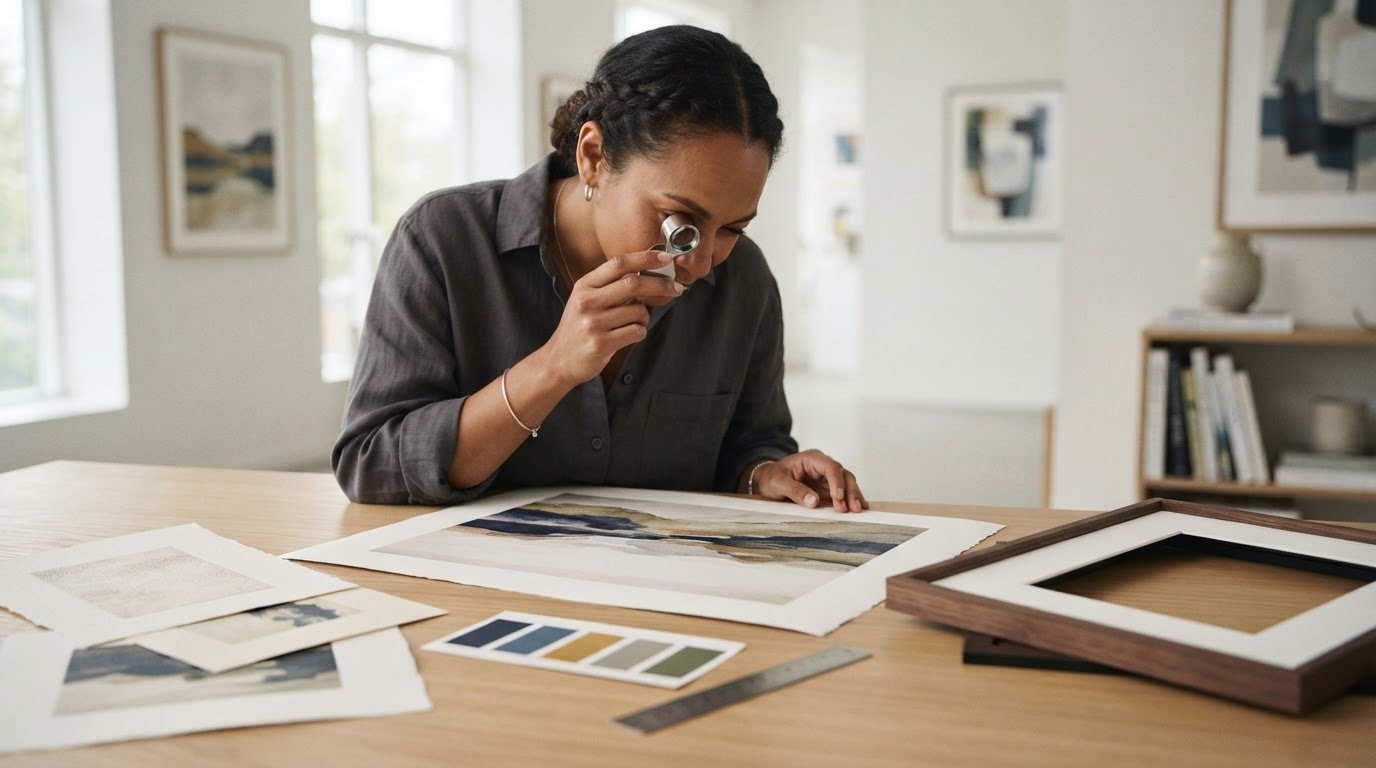
The lowest-priced art print can become the costliest choice if a soft image, inaccurate colour or fragile paper leaves you disappointed. The risk of buying cheap art prints isn’t the price itself. It’s paying without enough information to judge what will arrive, how the image may age or whether it has been reproduced with appropriate rights. A low price can still represent good value when the details stand up to scrutiny.
It’s understandable to want an affordable way to bring a photograph or artwork into your home. Before deciding, look for clear information about image sharpness, colour, paper type and printing method, along with details about the image’s source and permitted use. This guide explains how to assess those details, what “archival” claims do and don’t tell you, and how display conditions and framing can affect a print over time. You’ll be better equipped to compare listings on their merits and choose a work that suits your space and expectations, rather than relying on price alone.
Key Takeaways
- The risk of buying cheap art prints depends on what the listing leaves unclear, not simply on its low price.
- Check image detail, exact dimensions, paper type, finish and production information before comparing prints.
- Labels such as “archival” or “museum-quality” are more useful when supported by specific material details.
- Verify the artist or source, image rights and seller contact information, and read carefully how the listing describes the print.
- A specialist gallery may make artwork and format details easier to assess, but check the specifications and policies for the individual listing.
What is the real risk of buying cheap art prints?
The risk of buying cheap art prints lies in uncertainty, not in the price tag. A low price doesn’t prove that an image is poor, unlicensed or carelessly made. It does make the listing’s details especially important. Can you identify the image’s source, understand how it was reproduced and find clear seller information in case you have a question or problem?
It also helps to distinguish the format. A mass-produced poster is generally made for decorative display and distributed in quantity. An art reproduction is a copy of an existing artwork or photograph, made using a printing process. An editioned print may be numbered or limited, but the word “print” alone doesn’t establish that it was made using an artist’s original, hands-on process. For context on traditional printmaking techniques, including processes such as etching and lithography, check how the seller uses terms such as “edition” and “reproduction.”
The listing’s evidence matters more than the price alone. Clear information lets you judge what you’re buying, while a bargain without specifics leaves too much to guess.
When is a low-priced print a reasonable choice?
A budget print may suit a temporary display, a secondary room or a decorative purpose where collectability and long-term preservation aren’t priorities. The important distinction is between an affordable print described plainly and a listing that leaves essential facts unanswered. A seller who states the format, dimensions and materials gives you a basis for deciding whether it meets your needs. A higher price, by itself, proves neither superior materials nor stronger provenance.
What risks should buyers actually look for?
Look beyond the thumbnail. A soft or pixelated image may be more noticeable at the size you plan to display, and unclear dimensions can lead to an unexpected fit. Vague material descriptions make it difficult to anticipate the print’s feel or care needs. Missing seller contact information can also leave you unsure where to turn with a question or problem.
Colour on screen is only a preview. Your device’s display settings and viewing conditions can make hues look different from those on the physical print, so treat product images as references rather than exact colour proofs. Longevity depends on more than price: paper and inks, exposure to light, handling and display conditions can all affect fading or damage. If the listing claims fade resistance or archival quality, look for product-specific details before relying on those claims.
How can you assess an art print’s image, paper, and production?
A useful listing gives you more than an attractive preview. Check the image, the physical print you’ll receive and the process used to make it. If a key detail is missing, ask the seller before ordering rather than relying on a broad quality label.
- Image clarity: Look for enlarged product views that show fine detail. A small thumbnail can conceal softness or pixelation.
- Crop and dimensions: Check whether the composition is cropped and confirm the finished print’s width and height, not just the image file or frame size.
- Paper and finish: Look for a named paper type and a description of its surface, such as matte or glossy. Don’t assume a finish or substrate that isn’t stated.
- Production: See whether the listing identifies the printing process and explains what is being reproduced.
Close-up photographs can help you inspect detail and surface, though they can’t fully convey how a print feels in person. For an introduction to how to analyze art, PBS describes techniques for examining physical works. Apply the same attentive eye online, while remembering that a listing image isn’t a substitute for inspecting the print itself.
How can you judge image resolution and colour online?
Enlarged views should remain reasonably clear rather than breaking into visible blocks or blur. Compare the preview with the stated finished dimensions, and check whether the image is shown edge to edge or with a border. Screen settings affect appearance, so an online image can’t promise an exact colour match. If faithful tonal rendering matters to you, ask the seller how colour variation is handled.
What should a paper or printing description tell you?
Compare paper type, surface finish and print process where the listing provides those details. “Inkjet” describes a method of printing, not a complete guarantee of image quality or longevity. Those depend on the specific materials and production information. Likewise, “archival” and “museum-quality” need substance behind them.
If a listing calls a print archival, check the specific paper, ink or other materials, and look for evidence supporting the claim for that particular print. The word alone doesn’t tell you how the work was made or how it may perform over time. For broader context on choosing and displaying photographic work, consult Fine Art Photography: A Curator’s Guide to Collecting and Decorating.
Print size and paper choices can shape both the presentation and the finished work. Galerie Prints offers options across its photographic prints, but check each listing for its own specifications. Explore photographic prints to compare formats before you decide.
How do cheap posters, art reproductions, and collectable prints differ?
These labels describe different things, but sellers don’t always use them consistently. A poster is usually a format intended for display; an art reproduction describes an image copied from an existing work; and a collectable print may carry additional significance because of its subject, history or documented edition. None of these labels alone tells you the print’s quality or value. Read the listing for specifics.
| Format | Typical purpose | Information to verify | Questions to ask |
|---|---|---|---|
| Poster | Decorative display or promotion | Dimensions, paper, finish, image source | Is this a reproduction, promotional item or another format? |
| Art reproduction | Display of an existing artwork or photograph | Creator, image attribution, reproduction method, materials | What original image is reproduced, and who authorized it? |
| Collectable or editioned print | Display and, in some cases, collecting | Edition size, number, signature status, issuer and provenance | What supports the edition or collectable claim? |
For historic printed objects such as cinema lobby cards, the format itself can carry cultural and visual interest beyond its decorative use. Galerie Prints offers cinema memorabilia, including Cinema Lobby Cards. Its guide, Cinema Lobby Cards: A Collector’s Guide to Hollywood’s Photographic Heritage, explores this category of collectable object. As with any listing, check what is being sold and how its history or edition status is described.
What is the difference between a poster and an art reproduction?
A poster is best understood as a display format, not automatically as a low-grade product. Paper, printing and image quality can vary. A reproduction, by contrast, tells you that an existing image has been copied, but the term doesn’t specify how well or on what materials. For either format, confirm the creator or image attribution, exact dimensions, paper and finish. If the listing doesn’t name the source, ask.
What does limited edition mean on a print listing?
Scarcity language needs evidence. Look for the edition size, whether the print is numbered or signed, and who issued the edition. Ask whether the stated edition refers to this format or to all reproductions of the image. A claim of rarity is not the same as documented edition information, and neither collectability nor future resale value should be assumed without evidence specific to the work.
Clear distinctions matter: the risk of buying cheap art prints rises when a category label stands in for facts about the object. Compare the description with the actual format and ask for clarification if the wording is ambiguous.
What should you check before ordering an inexpensive art print?
A quick review before checkout can reveal whether a listing gives you enough information to make a considered choice. The risk of buying cheap art prints often comes down to details that are easy to overlook when a compelling image and low price take centre stage. Use this checklist:
- Confirm the artwork attribution. Is the artist, photographer or other creator named clearly?
- Check the image source and rights information. Does the seller explain where the image comes from and how it is authorized for reproduction?
- Verify the finished dimensions. Compare the print size with your intended wall space and frame, and check whether the dimensions include a border.
- Read the material and production details. Look for the stated paper, finish and printing process. If the listing makes claims about longevity, look for product-specific information to support them.
- Find the seller’s contact details. Make sure you know how to ask questions or report a problem after ordering.
- Review delivery and display terms. Check how the print is protected in transit, what to do if it arrives damaged, the current return policy and whether made-to-order conditions apply.
- Clarify framing. Confirm whether a frame is included, optional or unavailable for the chosen format, and review any framing terms before purchase.
A specialist gallery may present artwork, archive and format information together, but details can differ from one listing to another. Galerie Prints offers choices in print size, paper type and bespoke framing. Review the specific artwork listing rather than assuming every option applies to every print. Explore photographic prints and framing options as you compare what each purchase includes.
Which questions should you ask the seller?
If anything important is unclear, ask directly: who created or licensed the image, and how is this print described? Request the exact paper type, print process and finished size if they aren’t stated. Before choosing a frame, ask whether it’s included or optional for that format. Clear answers help you compare the product with your expectations before placing an order.
How do shipping, returns, and display affect the decision?
Packaging matters. Find out how the print is protected and what steps to take if it arrives bent, marked or otherwise damaged. Read the seller’s current return policy before checkout, paying attention to any conditions for made-to-order items. Once displayed, the surroundings matter too. Consider direct light, humidity and handling, and choose framing with the room and your care expectations in mind.
How can a specialist gallery help you buy an art print with confidence?
A specialist gallery can provide useful context for a purchase: who made the image, where it comes from, and which formats or framing choices are available. That context helps you assess a print as more than a pleasing image on a screen. It may also be easier to compare options when listings explain their specifications and the seller makes its policies accessible.
Curation is a starting point, not a substitute for checking the individual work. Image rights, edition status, paper, production method and framing details can vary between listings, even within the same gallery. If a point matters to your decision and isn’t clear, ask the seller or look for item-specific information before ordering.
What can a curated gallery offer beyond the image?
Collection and photographer context can make a work more meaningful by helping you understand its place within a broader archive or body of photography. Galerie Prints presents selections that include the Slim Aarons Collection and Terry O’Neill Photography, alongside posters and collectable cinema memorabilia. For readers interested in the background to Aarons’ work, Slim Aarons: The Definitive Guide to the Master of Aspirational Photography offers additional archive context. Use that history to learn about the image, while checking the specifications of the particular print you’re considering.
Format choices matter, too. Galerie Prints offers print sizes, paper types and a bespoke framing service. These options can help you plan the presentation, but don’t assume every format or framing choice applies to every listing. Confirm what’s available for the specific work and review the relevant terms.
How should you make the final decision?
Compare like with like: the same finished dimensions, stated paper details, framing status and level of seller information. Then weigh those facts against your budget, where the print will hang and how long you expect to display it. If collectability matters, look for evidence such as clear edition details rather than relying on claims of rarity alone.
The risk of buying cheap art prints is easier to judge when you compare a listing’s claims with your own expectations. A specialist gallery can make that evaluation more informed, but your decision should rest on details you can verify for the specific piece. Take a considered look through curated photography prints and framing options, and assess each listing on its own specifications.
Choose a print with confidence and care
The risk of buying cheap art prints isn’t defined by price alone. It comes from unclear information about the image, materials, edition or seller. Before you decide, look for specific listing details, compare like with like, and consider how the print’s dimensions and materials suit your space and expectations. A poster, reproduction and collectable print aren’t interchangeable terms, so check what the seller means for the particular work.
A well-chosen print can bring character and history into a room, whether you’re drawn to a striking photograph or a piece of cinema heritage. Galerie Prints presents curated selections including the Slim Aarons Collection and Terry O’Neill Photography, with choices of print sizes, paper types and bespoke framing. Specifications and options can vary by listing, so review the details for the artwork that catches your eye.
Let the image inspire you, then let clear information guide your decision. Explore curated photography prints and bespoke framing to find a work that suits your home and expectations.
Frequently Asked Questions
Is it always risky to buy cheap art prints?
No. A low price alone doesn’t show that a print is poorly made or that its image rights are questionable. The risk of buying cheap art prints comes from uncertainty: missing information about the image, materials, dimensions or seller can make it hard to know what you’ll receive. A clearly described print may suit a decorative purpose or shorter display period. Compare its stated qualities with your expectations, rather than assuming price determines quality.
Can cheap art prints fade quickly?
They can fade, but price alone doesn’t predict how quickly. Fading depends on the print’s materials and production as well as its display conditions, including exposure to light. Handling and framing can also affect its condition. Look for specific information about the paper and inks, and treat claims such as “fade-resistant” or “archival” as claims to verify against the particular print. For longer display, consider reducing direct light exposure.
How can you tell whether an art print is good quality online?
Look for enlarged product views that remain clear, then check the stated finished dimensions, crop, paper type, surface finish and printing process. The listing should identify the artist or image source and give enough detail to understand what’s being sold. Screen images can’t guarantee an exact colour match, so ask about colour variation if accurate tones matter. Clear seller contact information and straightforward product descriptions add useful reassurance.
What happens if an art print listing does not name the paper?
An unnamed paper doesn’t automatically mean the print is poor, but it leaves you without an important point of comparison. Ask the seller for the paper type and surface finish, and whether the listing provides information about the production process. If you can’t get details that matter to your decision, consider whether the uncertainty fits your budget and intended use. Check the return policy before ordering, too.
Are limited-edition prints worth more than open-edition prints?
Not necessarily. “Limited edition” describes a claimed restriction on the number of prints, but it doesn’t by itself establish desirability or future resale value. Check the edition size, numbering, signature status, who issued the edition, and whether those details apply to the specific format. Compare the documentation with the seller’s description. An open-edition print may still be the right choice if you value the image for display rather than collectability.
Should I buy an art print framed or unframed?
Choose based on your space, presentation preferences and plans for display. An unframed print gives you flexibility to select a frame later, while a framed option may offer a more finished presentation. Before ordering, confirm whether framing is included or optional for that particular print, and check the dimensions and framing terms. Galerie Prints offers a bespoke framing service, but available choices should be confirmed for the individual listing.
What should I check before buying a photographic art print?
Confirm the photographer or image attribution and look for information about the image’s source and reproduction rights. Check the finished dimensions, crop, paper, finish and printing process, then review the seller’s contact details, delivery protection and return policy. The risk of buying cheap art prints is easier to judge when those facts are clear. Finally, consider where the photograph will hang and how light, handling and framing may affect its condition over time.