
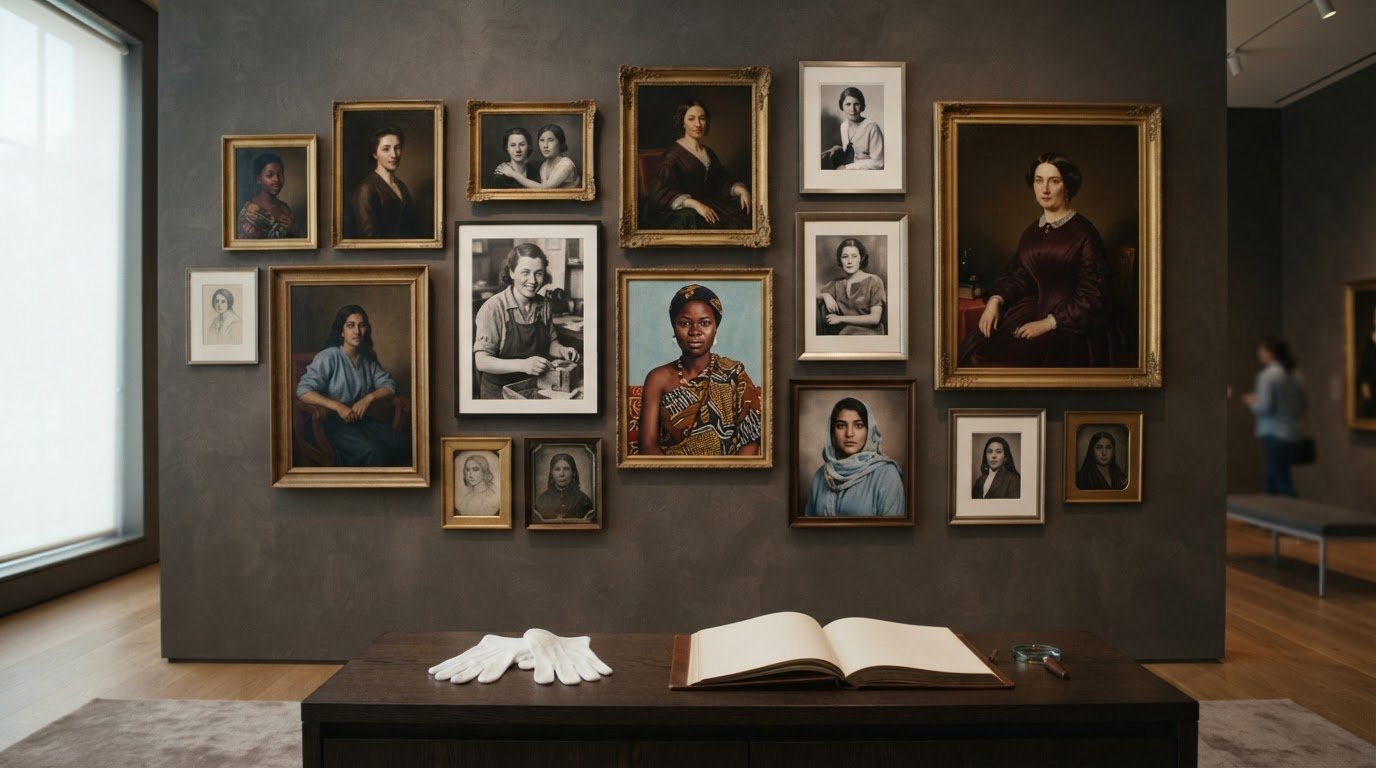
What makes a portrait famous: the face it shows, the hand that shaped it, or the story that gathers around it? The most memorable famous portraits of women hold all three in tension. A sitter’s likeness may be instantly recognisable, yet an image’s lasting power often lies in the artist’s choices and the cultural moment that shaped how we see her.
It’s easy to know a celebrated face without knowing the history behind it. This guide looks beyond recognition to explore how pose, light, setting and medium influence a portrait’s meaning, and where the artist’s interpretation diverges from the sitter’s public image.
Across 12 portraits in painting and photography, you’ll find the stories behind each image and the visual details that help it endure. You’ll also find a practical way to consider photographic portraits at home, where a print can bring historical and artistic depth to an interior. From intimate studies to images that helped create public icons, these works reward a slower look.
Key Takeaways
- Discover how artistic innovation, cultural history and a sitter’s public image can each contribute to a portrait’s enduring fame.
- Explore famous portraits of women across painting and photography, with context that goes beyond familiar faces.
- Use pose, gaze, setting and point of view to compare how artists and photographers shape a portrait’s meaning.
- Look for photographer attribution and archival context to appreciate photographic portraits as historical works as well as compelling images.
- Consider how print size, paper and bespoke framing can help a photographic portrait find a thoughtful place in your home.
Why Famous Portraits of Women Stay in the Public Imagination
An iconic portrait remains recognisable, influential and open to interpretation long after it was made. Its fame may begin with artistic invention, a compelling likeness or the sitter’s public standing, but endurance depends on more than a familiar face. Viewers return because the image continues to offer something to notice, question or reconsider.
There’s no single measure of importance. Artistic merit describes qualities such as composition, technique and originality; popularity reflects how widely an image is known and circulated. The two can overlap, but neither automatically proves the other. A portrait may be celebrated for formal innovation, while another becomes a cultural touchstone because it captures a person or period that generations recognise.
What makes a portrait of a woman iconic?
Recognition is only the beginning. A portrait’s influence can be traced through the images it inspires, the expectations of representation it changes, or the conversations it prompts about identity, power and beauty. Its reach may grow through museum exhibitions and printed reproductions, then travel further through film, fashion or popular culture. As an image moves between settings, its meaning can shift. A work first encountered as art may become a symbol, while familiarity can make viewers curious about its history.
The Mona Lisa offers a familiar example. Leonardo da Vinci’s portrait is among the best-known works in the history of painting, yet its enduring appeal rests on more than recognition: its composition and enigmatic expression invite repeated looking. A broader reference to paintings by Leonardo da Vinci places it within the artist’s wider body of work, rather than treating it as an image without context.
The subject is the person shown; the story is what viewers, artists and history come to associate with her. That distinction matters, especially when a sitter’s public image threatens to overshadow the choices made in creating the portrait. Ask who shaped the image, for whom and under what circumstances to look more attentively.
From painted likeness to photographic image
For centuries, painted portraits were often commissioned likenesses, shaped by the expectations of sitters and patrons as well as the artist’s vision. Photography introduced another way to make and circulate portraits. A camera could record a particular encounter, but framing, lighting, timing and selection still guided what the viewer saw. Neither medium is a neutral window onto its subject.
Look closely at both. A composed pose may suggest authority or intimacy; clothing and setting can signal status, character or a particular historical moment. A direct gaze can feel candid in a photograph and carefully staged in a painting, while an averted one may invite speculation in either. The medium changes how an image is made, not the importance of its visual decisions.
This article brings together famous portraits of women across painting and photography as a considered selection, not an objective ranking. Rather than deciding which sitter matters most, it asks how each image works: what the maker reveals, what remains outside the frame, and how its audience has shaped its afterlife. This approach makes the portraits’ differences, as well as their lasting power, easier to see.
Famous Painted Portraits of Women: Five Images and Their Stories
These five paintings show how a portrait can communicate far more than likeness. Across centuries, artists have used a turn of the head, a carefully chosen garment or a spare setting to shape how a woman is seen. The works aren’t a ranking; each offers a distinct relationship between artist, sitter and viewer.
The Mona Lisa and Girl with a Pearl Earring: portraits that invite interpretation
Leonardo da Vinci’s Mona Lisa, painted around 1503-1519, is traditionally identified as Lisa Gherardini, the Florentine wife of merchant Francesco del Giocondo. The poised, three-quarter presentation gives her presence without explaining it. Her composed expression and the softly receding landscape keep the viewer moving between her face and the space behind her. The result feels intimate, yet never entirely familiar.
Johannes Vermeer’s Girl with a Pearl Earring, usually dated around 1665, offers a different kind of encounter. The sitter is unidentified, and the work is often understood as a tronie, a study of a character or expression rather than a commissioned portrait of a named person. Her turned head, parted lips and glance over the shoulder create a fleeting impression of contact. The pearl and dark background draw attention to her face, but don’t settle who she is.
A portrait’s pose can make a sitter seem composed, approachable or elusive before a viewer knows a single fact about her. In both paintings, restraint creates interpretive possibility; it isn’t a blankness to be filled with certainty.
Madame X, Whistler’s Mother, and Frida Kahlo’s self-portraits
John Singer Sargent’s Madame X (1883-1884) depicts Virginie Amélie Avegno Gautreau, a prominent Parisian socialite, in a black evening gown against a dark ground. The elongated silhouette and sharply defined profile present her as a striking social presence, rather than a conventional, softened likeness. First shown in Paris in 1884, the portrait provoked controversy over its daring presentation. Sargent later repainted the gown’s slipping strap, showing how a small compositional detail could alter the work’s reception.
James McNeill Whistler’s Arrangement in Grey and Black No. 1 (1871), commonly called Whistler’s Mother, portrays Anna McNeill Whistler seated in profile. The plain interior and restrained palette direct attention to the measured arrangement of forms. Its domestic setting matters, but Whistler’s formal title also asks us to see a carefully composed painting, not only a familiar image of motherhood.
Frida Kahlo’s Self-Portrait with Cropped Hair (1940) turns the artist herself into both maker and subject. Kahlo sits in an oversized suit, scissors in hand, amid locks of cut hair. The clothing and direct pose unsettle conventional expectations of feminine appearance, while the song lyric painted above her adds another layer. Rather than reducing the portrait to a single biographical clue, look at how Kahlo controls her own presentation.
Together, these works make clear that a painted likeness is never simply a record of appearance. For a different medium and a new set of image-making choices, explore curated photographic archives at Galerie Prints.
Famous Photographic Portraits of Women and the Stories They Preserve
A photograph can preserve a particular instant, but it also helps determine how that instant is remembered. The photographer chooses where to stand, what to include and when to release the shutter; later, editors, publishers and audiences give the image new meanings. The famous portraits of women below span celebrity, documentary and fashion photography. These forms may overlap, but they don’t ask us to look in quite the same way.
Celebrity portraiture: Audrey Hepburn through Terry O’Neill’s lens
Terry O’Neill photographed Audrey Hepburn in Paris during the 1960s, including on the set of How to Steal a Million in 1966. In these images, the camera meets a performer at work, where a composed presence can sit alongside the movement and surroundings of a film production. O’Neill’s framing matters: a close view may draw attention to Hepburn’s expression, while a wider frame places her within cinema’s crafted world. The photograph records a public figure, but its particular angle can suggest a character beyond the familiar screen persona.
To look closely, notice the relationship between Hepburn and the frame. Does the image feel like a formal sitting, a moment between takes or a fashion-led composition? The categories aren’t always distinct. Celebrity photographs can be carefully arranged while retaining the impression of spontaneity, and their enduring appeal often rests on that balance. O’Neill’s archive invites viewers to consider how an individual photographer’s eye shaped the visual memory of a star.
Documentary and editorial portraits: context changes what we see
Dorothea Lange made Migrant Mother in 1936 while documenting conditions for the United States Resettlement Administration, later part of the Farm Security Administration. The sitter was Florence Owens Thompson, photographed with her children at a pea-pickers’ camp near Nipomo, California. Thompson’s steady, distant gaze and the children turned toward her make the frame feel intimate, but the photograph also belongs to a government documentary project about poverty and displacement during the Great Depression. Its public circulation helped make one encounter stand for a wider crisis, even as Thompson remained a person with her own story.
A different kind of image-making appears in Richard Avedon’s fashion photograph Dovima with Elephants, made at the Cirque d’Hiver in Paris in 1955. Model Dovima, wearing an evening gown by Christian Dior, is posed among circus elephants. The contrast between the gown’s refinement, the animals’ scale and Dovima’s controlled gesture turns fashion into visual theatre. The image isn’t a documentary record of ordinary life; its artifice is central to its effect.
Gordon Parks’s American Gothic, Washington, D.C. (1942) offers another deliberate portrait. Made for the Farm Security Administration, it depicts Ella Watson, a government charwoman, standing with a broom and mop before an American flag. The arrangement draws attention to work, race and national symbolism without making Watson merely a symbol.
A famous photograph preserves a moment, then frames the terms on which audiences remember its subject. Identifying the photographer, circumstances and intended purpose helps separate what the image shows from the meanings later attached to it. Those layers are part of what makes photographic portraits enduring works of visual and historical interest.
How to Read a Famous Portrait: Compare Pose, Setting, and Point of View
A close reading begins with what’s visible, then asks what the image’s circumstances add. Compare a painted likeness with a photograph, or two photographs made for different purposes. The same direct gaze might feel inviting in one image and challenging in another; its meaning depends on the sitter, maker, audience and moment. This simple framework helps you look beyond recognition in famous portraits of women.
What pose, gaze, and setting reveal
Start with the body and eyes. Is the sitter turned toward the viewer, shown in profile, caught mid-gesture or held in a carefully arranged pose? A direct gaze can establish contact, but it doesn’t always signal confidence or defiance. Consider the rest of the image before deciding what it suggests. An averted gaze may convey reflection, follow a period convention or simply direct attention elsewhere.
Setting offers another clue. A controlled studio or dark, neutral background can isolate a face, while a domestic room, outdoor landscape or workplace ties the sitter to a particular environment. Clothing and props can point to profession, status, fashion or the circumstances of the portrait, but avoid treating them as a fixed code. Ask what the image actually shows and what you’re bringing to it.
| Portrait | Medium and pose | Gaze and setting | Likely audience or purpose |
|---|---|---|---|
| Mona Lisa | Painting; seated, turned toward the viewer | Calm gaze; landscape backdrop | Made within the tradition of elite portraiture |
| Madame X | Painting; standing in profile | Eyes turned aside; dark, spare background | Exhibited publicly as a portrait of a Parisian socialite |
| Migrant Mother | Documentary photograph; close grouping with children | Gaze directed away; pea-pickers’ camp | Made for a government documentary project |
| Dovima with Elephants | Fashion photograph; deliberate, extended pose | Controlled gesture; circus setting | Fashion imagery for a magazine audience |
The table shows why a visual feature can’t be interpreted in isolation. A formal pose may be expected in a painted social portrait, while an apparently unguarded photographic moment may still be carefully composed. An outdoor or workaday setting can serve documentary aims, while a constructed setting can make fashion imagery more theatrical. Medium shapes the encounter, but doesn’t explain it entirely.
How context and authorship shape the viewer’s reading
Next, ask three questions: who made the image, for whom and under what circumstances? A painter may interpret a sitter through composition and brushwork; a photographer makes choices about framing, timing and selection. The woman pictured has her own identity, which may not be fully captured by the artist’s or audience’s interpretation. Knowing a portrait’s original purpose can help distinguish a commissioned likeness from an editorial or documentary image.
A portrait’s meaning lives in the meeting between what the image shows and the context that teaches us how to see it. Revisit the frame after learning its authorship and circumstances; details that first seemed incidental may take on new significance. To continue looking closely, explore fine art photography prints and consider how attribution and archival context deepen appreciation.
Explore Famous Women’s Portraits as Photographic Art
After considering how a portrait was made and what it has come to mean, bring that attention to photographic art. A print offers more than a familiar face: it preserves a photographer’s decisions and connects a moment to its wider historical setting. Knowing who made the image, when it was created and where it first appeared can deepen your appreciation before you decide how it might live in your home.
Attribution is a useful starting point. A photographer’s name gives you a way into their wider body of work, while archive information can clarify a photograph’s date, subject and original context. These details help distinguish a carefully staged celebrity portrait from an editorial image made for publication, or a candid moment preserved in a documentary record. The picture may feel immediate, but its history gives that first impression depth.
Choosing a photographic portrait for a considered interior
Begin with the image itself. Consider the subject and mood, then notice how they relate to the room’s existing character. A lively, glamorous portrait may bring energy to a quiet space; a more contemplative image can create a pause among bolder colours and forms. Think about viewing distance, too. The print should feel at ease with the wall and furnishings around it, rather than competing with them.
Print size, paper type and framing all influence how a photograph is experienced. A larger format gives expression and detail greater presence, while a smaller print may reward a closer look. Paper affects the image’s surface and overall impression; bespoke framing can help connect it to the room’s materials and proportions. For an atmosphere of leisure and aspiration, Slim Aarons’ photography offers another way to consider how people, setting and style come together in an image.
Explore curated photographic archives
An archive encourages discovery beyond a single celebrated frame. It lets you follow a photographer’s eye across subjects and moments, compare images made in different circumstances, and place individual portraits within a broader visual record. Galerie Prints brings together curated photographic archives including Terry O’Neill Photography. Explore these portraits as works shaped by artistic choices and historical associations, not simply as decoration.
As you explore famous portraits of women, take time to read the photographer credit and any context accompanying a print. Ask what drew your attention first, then notice how authorship and history refine that response. A considered choice may be an image you already know, or one that becomes compelling through a small detail, a distinctive point of view or the story around it. Explore Galerie Prints’ photographic archives to discover portraits that reward close looking and deserve a lasting place in your interior.
Let a Portrait Find Its Place
The next time an image holds your attention, pause before settling on what it means. Notice what the frame reveals, what it leaves unsaid, and how your response changes as you learn more about its maker and moment. That habit of looking can turn a familiar face into a fresh encounter, and make choosing art feel more personal than simply selecting a well-known image.
The lasting appeal of famous portraits of women lies partly in this openness: each image carries a history, yet invites you to bring your own perspective to it. A photographic print can keep that conversation present in a room, offering a detail to return to and a story that unfolds with time.
Explore a curated selection of photographic art and choose an image that speaks to your eye and your space. Explore fine art photography prints at Galerie Prints, and discover a portrait you’ll be glad to live with.
Frequently Asked Questions
What is the most famous portrait of a woman?
Leonardo da Vinci’s Mona Lisa is often considered the most famous portrait of a woman, though there’s no formal measure of fame. Its exceptional visibility comes partly from its place in the Louvre and its repeated appearance in books, exhibitions and popular culture. If you’re comparing candidates, consider not only how widely recognised an image is, but also whether its artistic history and cultural influence make it meaningful to you.
Who painted the most famous portraits of women?
No single painter owns that distinction. Leonardo da Vinci, Johannes Vermeer, John Singer Sargent, James McNeill Whistler and Frida Kahlo each made celebrated portraits of women, using markedly different approaches. To explore beyond the most familiar names, look at museum catalogues for artists such as Élisabeth Vigée Le Brun or Artemisia Gentileschi. Their works offer another perspective on who was represented, who did the representing and how women shaped art history.
Is the Mona Lisa considered a portrait of a woman?
Yes. The Mona Lisa depicts a woman traditionally identified as Lisa Gherardini, a Florentine associated with the painting’s commission. Art historians generally describe it as a portrait, although questions about its precise commission history and intended purpose remain part of its scholarly discussion. For a useful first comparison, notice how Leonardo presents her in a three-quarter view rather than in strict profile, a choice that gives the sitter a strong sense of presence.
What makes a woman’s portrait iconic?
A woman’s portrait becomes iconic when its visual qualities and cultural life keep attracting attention. Recognition helps, but an image may also endure because it influenced later artists, became associated with a historical event or continues to prompt debate. Try asking what people remember first: the sitter’s name, the composition or a story linked to the image. The answer can reveal whether its fame rests chiefly on artistic innovation, cultural history or public recognition.
Can a photograph be considered a fine art portrait?
Yes. A photograph can be a fine art portrait when the image reflects deliberate artistic choices, such as composition, lighting, timing and the relationship between subject and photographer. Documentary or commissioned origins don’t automatically prevent a photograph from being valued as art. To judge a print, consider the photographer’s intention, the quality of the image and its place within a body of work, rather than assuming a photograph is only a record.
How do I identify the photographer behind a famous portrait?
Start with the image caption or publication where you encountered it, then compare the credit with a museum, archive or photographer’s catalogue. Check the exact title, date and version: similar portraits may have been made during the same sitting, and reproductions can circulate without complete captions. If the credit is unclear, search the institution that holds or publishes the photograph. A reliable attribution should connect the photographer to the specific image, not just its subject.
What is the difference between a portrait and a self-portrait?
A portrait depicts a person; a self-portrait depicts the artist who makes it. In painting, the artist might work from a mirror or other reference, while a photographer may use a remote shutter, timer or reflected image. The distinction concerns the artist’s identity as both maker and subject, not whether the image feels candid or formal. A self-portrait can be carefully staged, and a portrait made by someone else can feel deeply personal.
