

The most profound connection to a musical icon isn’t found on a glowing screen, but within the rich grain of a silver gelatin print. As we witness a global shift toward the tangibility of physical assets, discerning collectors are increasingly turning to collectable music photography to anchor their personal spaces with a sense of permanent history. You understand that a mass-produced reproduction can never replicate the aura of a moment captured by a master like Terry O’Neill or Mick Rock. However, the path to building a serious collection is often obscured by technical jargon, confusing estate stamps, and the legitimate fear of purchasing a piece that lacks true archival integrity.
This guide serves as your curatorial compass, helping you navigate the complexities of the art market to secure museum-quality pieces that elevate your interior aesthetic. You’ll learn to verify provenance with absolute certainty and master the nuances of limited editions to ensure your acquisitions hold their value. We will also examine the latest 2026 international standards for print stability, providing you with the technical knowledge required to protect your investment from the elements. From the heritage of the darkroom to the precision of bespoke framing, we invite you to bridge the gap between historical reverence and modern luxury.
Key Takeaways
- Learn to distinguish between a fleeting record and a fine art investment by evaluating the photographer’s legacy and the rarity of the subject matter.
- Identify the non-negotiable technical standards, including pigment-based inks and archival-grade materials, that ensure your collection remains vibrant for generations.
- Secure the longevity of your collectable music photography by utilizing bespoke framing and UV-protective glass to shield rare prints from light damage.
- Master the nuances of provenance, from edition numbering to estate stamps, to ensure every piece in your gallery is an authentic cultural artifact.
- Discover how to curate a sophisticated interior that serves as both a personal sanctuary and a guardian of musical heritage.
Defining the Allure of Collectable Music Photography
The transition of music photography from the ephemeral pages of music tabloids to the curated walls of prestigious galleries marks a significant shift in cultural valuation. What was once a fast-paced exercise in Concert Photography, capturing a frantic moment for a morning edition, has matured into a sophisticated category of fine art. This evolution is driven by a collective desire to preserve the “soul” of an era, a palpable nostalgia for the raw, unscripted energy of the 1960s and 70s. For the discerning collector, acquiring collectable music photography is an act of guardianship, securing a tangible link to a bygone age of elegance and rebellion.
The psychology behind this pursuit is deeply personal. Collectors aren’t merely buying an image; they’re acquiring the atmosphere of a candid backstage whisper or the electric tension of a sold-out stadium. This emotional resonance is what differentiates a standard print from a museum-quality artifact. While an open edition may offer visual pleasure, it lacks the inherent scarcity that defines a true investment. Finite availability is the cornerstone of the art market, ensuring that the piece you hang in your home remains as exclusive as the performance it depicts. It’s a bridge to the heady days of rock and jazz, rendered in the permanent language of light and shadow.
The Significance of Limited Edition Numbering
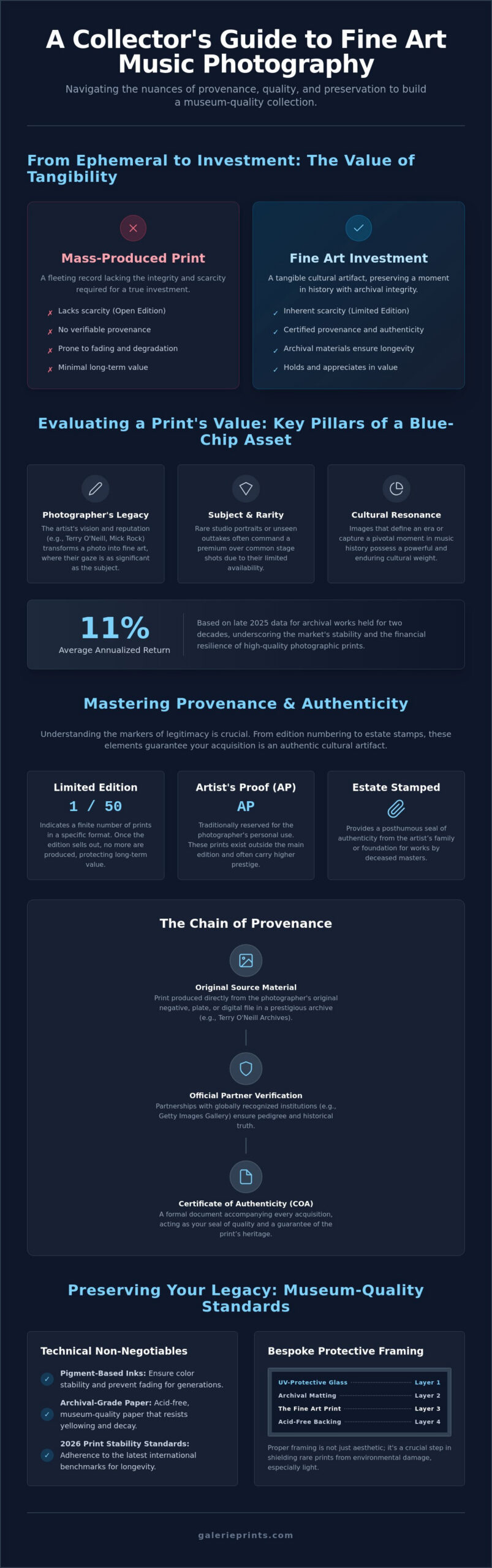
The value of a print is inextricably tied to its rarity, often denoted by a fraction like “1/50” in the lower margin. This numbering indicates that only fifty such prints will ever exist in that specific format, protecting the long-term value of your acquisition. Within our Music Archives, you may also encounter Artist Proofs (AP), which are traditionally reserved for the photographer’s personal use and often carry a higher prestige. For works by deceased masters, Estate Stamped prints provide a posthumous seal of authenticity from the artist’s family or foundation. To maintain this scarcity, original digital files or physical plates are often retired, ensuring that the edition can never be replicated.
Provenance and the Role of Prestigious Archives
Provenance is the documented history of an artwork’s ownership and origin, serving as the ultimate proof of its legitimacy. In the world of high-end collectable music photography, this pedigree is often established through official partnerships with globally recognized institutions. Galerie Prints operates as an official partner of the Getty Images Gallery, providing direct access to the definitive Terry O’Neill archives. This connection ensures that every print is produced from the original source material, maintaining the technical superiority and historical truth of the image. Every acquisition is accompanied by a Certificate of Authenticity (COA), a formal document that acts as your seal of quality and a guarantee of the print’s heritage.
Evaluating Value: Artists, Eras, and Cultural Resonance
The valuation of collectable music photography is a nuanced calculation where the historical weight of the subject meets the artistic pedigree of the photographer. While a candid snapshot of a legendary performer holds sentimental value, it’s the “Photographer’s Legacy” that transforms a print into a blue-chip asset. Icons like Terry O’Neill didn’t merely document fame; they interpreted it through a lens of quiet intimacy. This distinction is vital for those looking to integrate music imagery into a broader fine art photography collection, where the gaze of the artist is as significant as the person in the frame.
Market trends in 2026 reflect a clear “flight to quality,” with collectors increasingly prioritizing rarity and physical integrity over ubiquity. While stage shots capture the kinetic energy of a performance, rare studio portraits or unseen outtakes often command a premium due to their scarcity. Data from late 2025 suggests that archival works held for two decades have shown an average annualized return of 11%, underscoring the stability of this market. This financial resilience is bolstered by rigorous standards in the preservation and archival of photographic prints, ensuring that the physical object remains as pristine as the day it was developed. You can explore these high-caliber works within the Galerie Prints music archives.
The Terry O’Neill Influence
Terry O’Neill’s work represents the gold standard for the genre. His unique ability to capture the quiet humanity of stars like David Bowie and Elton John elevated his output from mere press photography to high-end gallery art. By blending a reporter’s instinct with a curator’s eye, O’Neill created images that resonate with a timeless, sophisticated aesthetic. His archives are a cornerstone of our collection, offering a rare glimpse into the private worlds of the 20th century’s greatest musical minds.
Beyond the Stage: Rare Cinema and Music Crossover
The allure of musical history often intersects with the golden age of film. Collectors frequently diversify their portfolios by including rare cinema lobby cards or Star Wars limited edition prints. These artifacts offer a different tactile experience, serving as historical touchstones that appreciate alongside traditional photography. Whether it’s a vintage movie poster or a candid film set portrait, these pieces add narrative depth to a sophisticated interior, ensuring your collection is as diverse as it is prestigious.
Technical Superiority: Museum-Quality Standards in Music Prints
While the charisma of the performer captures the eye, it’s the material integrity of the print that secures the investment. For serious enthusiasts of collectable music photography, the choice of paper and ink is a non-negotiable standard. Unlike standard commercial prints that use dye-based inks prone to shifting and fading, museum-quality works utilize pigment-based inks. These microscopic particles of color sit on the surface of the paper rather than soaking in, providing a level of lightfastness that preserves the deep blacks and subtle highlights of a classic portrait for decades. This technical rigor is one of the primary ways experts determine the value of collectible photographs, as physical degradation is the greatest enemy of any art portfolio.
The tactile experience of a print is defined by its substrate. High-end music photography demands acid-free, 100% cotton rag papers from heritage mills like Hahnemühle. These materials offer a specific weight and texture that mass-produced alternatives simply cannot replicate. This commitment to quality isn’t just about aesthetics; it’s about permanence. At Galerie Prints, our localized production in London ensures that every piece is handled with the artisanal care required to meet the exacting standards of a luxury gallery.
Archival Papers and Giclée Excellence
Giclée printing is a sophisticated, high-resolution ink-jet process that uses archival pigment inks to produce fine art prints with a life expectancy often exceeding 100 years. This method has become the industry standard for fine art because it allows for a level of detail and color accuracy that mirrors the photographer’s original vision. The chemistry of museum-grade papers ensures they remain acid-free, preventing the yellowing or brittleness that plagues lesser reproductions. By prioritizing these technical specifications, we protect the full tonal range of black and white imagery, ensuring the shadows remain deep and the highlights stay crisp under gallery-grade lighting.
Traditional Darkroom vs. Modern Digital Production
There is an enduring prestige associated with silver gelatin prints, a traditional darkroom method where the image is formed by metallic silver suspended in a gelatin layer. This process is often viewed as the pinnacle of the craft, offering a depth and “glow” that is highly sought after in the music archives. However, modern digital C-type prints have evolved to replicate this sophistication with remarkable precision. By exposing light-sensitive photographic paper to a digital laser before traditional chemical processing, we achieve a bridge between historical soul and contemporary clarity. This hybrid approach allows us to maintain the texture and emotional weight of the original negative while utilizing the precision of modern technology.
Bespoke Framing: The Final Step in Preservation and Aesthetics
Acquiring a masterpiece is only the beginning of the journey. To truly honor a piece of collectable music photography, you must view the frame as the sentinel of its legacy. A bespoke frame serves a dual purpose, acting as a sophisticated extension of your interior aesthetic while providing a structural shield against the passage of time. Professional mounting is essential to ensure long-term flatness, preventing the unsightly rippling that often occurs with lesser, off-the-shelf solutions. This “ready-to-hang” philosophy is a hallmark of a premier gallery, allowing you to transition an archive piece directly from our London workshop to your wall without hesitation.
The most critical technical component of any frame is the glass. With the release of the ISO 18937-3:2026 standard, we now have clearer international benchmarks for how photographic prints react to modern LED lighting in indoor environments. Utilizing museum-grade, UV-protective glass is non-negotiable for rare acquisitions. It filters out the harmful wavelengths that cause irreversible light-induced degradation, ensuring the tonal depth we discussed in the previous section remains intact for a century. Our Bespoke Framing Service utilizes these exact materials to protect your investment with precision.
Choosing the Perfect Frame for Music Art
The era of the photograph often dictates the language of the frame. The raw, high-contrast energy of 70s rock photography thrives in sleek, minimalist black wood that doesn’t compete with the subject’s intensity. Mounts, or mats, are equally vital, providing the visual breathing room necessary to focus the eye while ensuring the print never physically touches the glass. For more nuanced layout strategies, you can explore our guide on how to display photography.
Designing a Musical Gallery Wall
A well-curated gallery wall is a narrative of cultural history. Balance is achieved by mixing high-octane stage portraits with the soft, candid intimacy of backstage moments. You can even create a thematic thread by linking your music archives with the sun-drenched, aspirational Slim Aarons aesthetic, bridging the world of rock stardom with the pinnacle of mid-century luxury. Proper lighting, ideally using dimmable LEDs that comply with the latest 2026 stability standards, will highlight the archival depth of each piece without compromising its physical integrity.
Curating Your Legacy with Galerie Prints
Selecting a piece for your home is a deeply personal endeavor. It requires a partner who understands that collectable music photography is not merely a product, but a vessel for cultural memory. Galerie Prints operates with the quiet authority of a seasoned curator, offering you a direct bridge to a bygone era of elegance. Through our unique access to the Getty Images Gallery and the definitive Terry O’Neill Photography archives, we provide more than just imagery; we offer a verified connection to the icons who shaped the modern world. Every acquisition is an investment in a legacy of beauty, craftsmanship, and culture.
Our commitment to quality is anchored in our localized, artisanal production. By maintaining our workshop in London, we ensure that every print meets the rigorous standards of a luxury gallery before it ever reaches your door. This hands-on approach is our seal of quality, justifying the prestige of our offerings and the permanence of your investment. You aren’t just buying a decoration. You’re securing a lasting piece of history that has been handled with the same reverence a museum would accord a national treasure. This dedication ensures your collection remains as striking in twenty years as it’s today.
The Aspirational Connection: From Music to Slim Aarons
The raw energy of a rock archive often finds its perfect counterpoint in the “luxury of leisure” captured in Aaron Slims prints. This high-end aesthetic resonates across genres, creating a cohesive narrative of sophistication within your interior. Whether you’re drawn to the grit of a backstage moment or the polished allure of the jet-set lifestyle, our collections invite you into an elite world of visual wonder and historical significance. By blending these different photographic genres, you create a space that feels both worldly and deeply personal, reflecting a life well-lived and a taste well-honed.
A World-Class Curatorial Experience
The archives at Galerie Prints are shaped by the artistic vision of our director, Stuart Möller, whose discerning eye ensures that only the most evocative and historically significant works are featured. We don’t just sell prints; we guide you through the nuances of collectable music photography to help you build a collection that resonates with your personal history. From your initial selection to the final global delivery, our service is designed to be as polished and professional as the art itself. Galerie Prints operates as a dedicated guardian of photographic heritage, ensuring that the soul of every moment is preserved for future generations.
Securing Your Piece of Musical Heritage
Building a collection of collectable music photography is an investment in both cultural legacy and visual excellence. You’ve navigated the complexities of edition numbering, provenance, and the rigorous international standards that define long-term stability. By prioritizing museum-quality archival materials and verifying the artist’s legacy, you ensure that the soul of a performance remains vibrant for a lifetime. These pieces don’t just decorate a room; they anchor it with the weight of history and the precision of fine art.
As an official Getty Images Gallery partner, Galerie Prints provides the definitive bridge to these iconic moments. Every acquisition is treated with artisanal reverence, featuring bespoke hand-crafted framing produced in our London workshop to meet the highest gallery specifications. We invite you to Explore the Curated Music Photography Collection at Galerie Prints and discover a work that resonates with your personal narrative. Your walls are the final sanctuary for these storied histories; let them reflect the elegance and raw energy of the legends who defined an era.
Frequently Asked Questions
What makes a music photograph “collectable” rather than just a print?
A photograph becomes collectable music photography when it possesses documented provenance, inherent scarcity through limited editions, and museum-grade archival quality. Unlike mass-produced reproductions, these pieces are produced from original negatives or digital files under strict gallery supervision. The value resides in the photographer’s unique gaze and the finite nature of the print run, ensuring the work remains a rare cultural artifact rather than a common commodity.
Are limited edition music prints a good financial investment?
Limited edition prints often serve as robust financial assets within a diversified portfolio. Data from late 2025 indicates that archival photographic works held for two decades have yielded an average annualized return of 11%. While the market is selective, pieces featuring iconic subjects by blue-chip photographers consistently command premium value. This growth is driven by the “Nostalgia Economy” and a global flight toward tangible, high-quality physical assets.
What is the difference between a signed print and an estate-stamped print?
A signed print features the artist’s original autograph, while an estate-stamped print is authorized posthumously by the artist’s foundation or family. Signed works often carry a higher initial prestige because of the direct connection to the creator. However, estate-stamped prints from prestigious archives remain highly sought after by collectors. They represent the official, final word on the artist’s legacy and are produced to the same exacting archival standards as lifetime editions.
How do I verify the authenticity of a music photograph?
Verification requires a combination of a formal Certificate of Authenticity and a clear chain of custody. You should prioritize acquisitions from galleries that maintain official partnerships with major archives, such as the Getty Images Gallery. These institutions provide a “seal of quality” that guarantees the print’s origin. Always check for physical markers like edition numbering or embossed gallery stamps, which serve as primary evidence of a print’s legitimacy.
Does the edition number (e.g., 1/100) significantly affect the print’s value?
The total size of the edition is the primary driver of value, although lower numbers or specific Artist Proofs are often favored by seasoned collectors. While “1/100” isn’t inherently superior to “90/100” in technical terms, the psychological appeal of an early number can influence resale demand. The most important factor is the hard limit on production; once an edition is sold out, no further prints of that specific format will ever be produced.
How should I care for my music photography to prevent fading over time?
Longevity is ensured through the use of UV-protective glass and acid-free mounting materials that prevent chemical degradation. It’s essential to display your collection away from direct sunlight and utilize LED lighting that complies with the March 2026 ISO 18937-3 standards for print stability. These precautions, combined with professional bespoke framing, shield the delicate tonal range of your collectable music photography from environmental damage and ensure the work remains pristine for generations.
What is Giclée printing, and why is it used for fine art music photography?
Giclée is a sophisticated, high-resolution printing process that utilizes archival pigment-based inks and acid-free cotton rag paper. It’s the industry standard for fine art because it offers a life expectancy often exceeding 100 years. This method allows for incredible depth and color accuracy, capturing the nuances of the original performance with a level of detail that standard dye-based prints simply cannot match, making it ideal for high-end collections.
Can I choose a bespoke frame for any music print in the collection?
You can certainly select a tailored finish through our Bespoke Framing Service for any piece in the archive. We provide a range of museum-grade options, from minimalist black wood to hand-stained finishes, all designed to complement the specific era of the photograph. Every frame is hand-crafted in our London workshop to ensure a “ready-to-hang” convenience that meets the aesthetic and protective requirements of a serious art collection.