
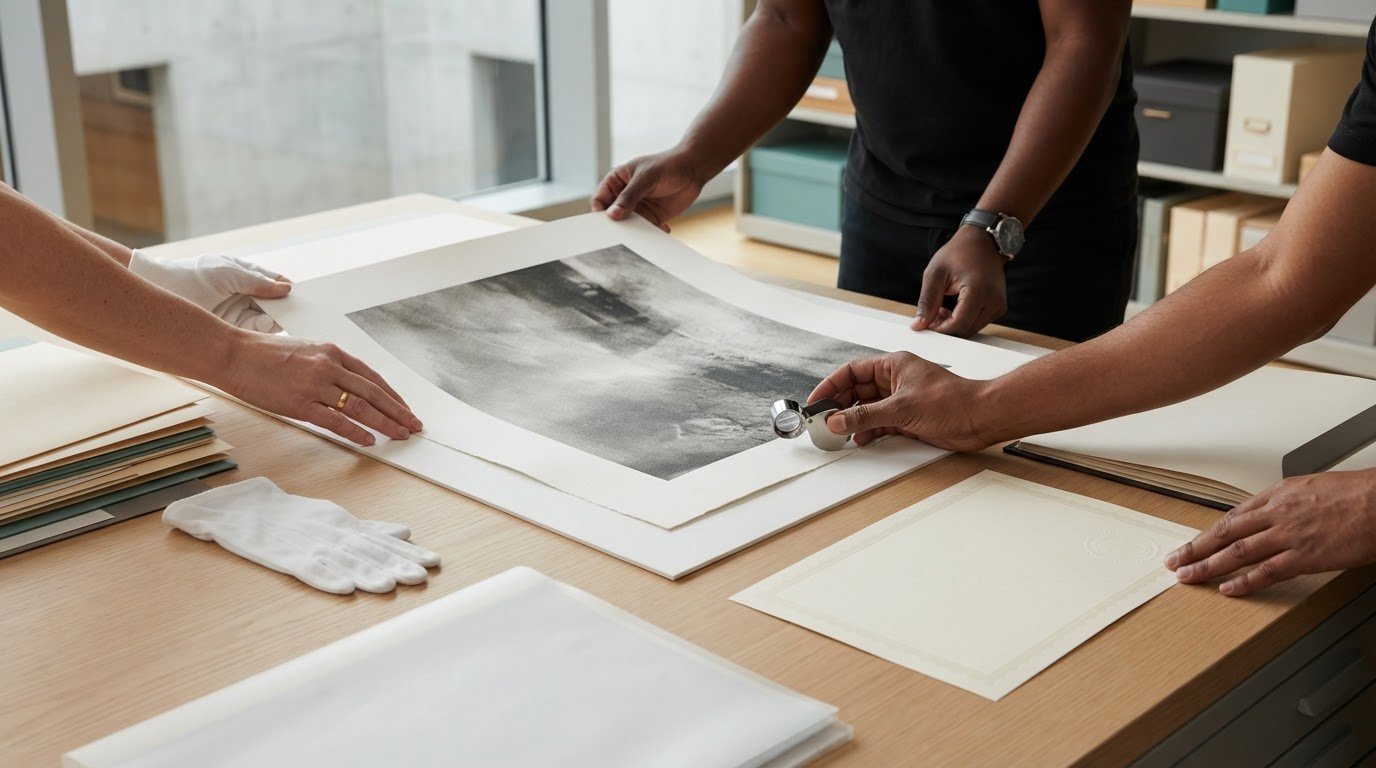
A print marked 1/100 isn’t automatically more valuable or better made than one numbered 40/100. Understanding print edition numbers starts with seeing them as a record of a work’s place within a stated run, not a verdict on its quality. The numerator identifies the individual impression; the denominator indicates the edition’s total size. But that fraction alone can’t reveal when the print was made, how it was produced, or how it has been cared for.
It’s natural to wonder whether a low number, a limited-edition label, or an artist’s proof signals greater rarity and value. The details matter, but they need context. This guide explains how to read edition markings, distinguish limited and open editions from proofs, and understand what the numbers can and can’t tell you. You’ll also learn how to weigh edition information alongside condition, provenance, and presentation when comparing photographic prints and other works on paper.
Key Takeaways
- Understanding print edition numbers starts with reading the fraction correctly: the top number identifies the impression, while the bottom gives the edition size.
- Compare limited and open editions by whether the print run is capped, not by assuming one reflects greater artistic merit.
- Recognize artist’s proofs as a distinct marking, while remembering that their use and quantity can vary.
- Assess a print beyond its number by considering attribution, publisher, provenance, medium, condition, and accompanying documentation.
- Use edition details alongside the image, materials, size, and intended display to compare prints with greater confidence.
What Do Print Edition Numbers Mean? Read the Marking Correctly
Print edition numbers identify an individual impression within a stated edition. The top number indicates that impression, and the bottom number shows the edition’s total size. This fraction is a useful starting point, but it doesn’t tell the whole story of a print’s creation or significance.
Understanding print edition numbers means reading the notation alongside information about the artist, publisher, and print process. Conventions differ: some works use a fraction, while others may have a lettered marking or another form of documentation. Treat the number as one detail in the print’s record, not a complete account of its quality, history, or value.
What does a marking such as 12/100 mean?
In the common fraction format, 12/100 means the print is identified as number 12 in an edition of 100. The denominator describes the declared size of that edition; the numerator distinguishes this impression from the others in it.
The “12” isn’t a quality grade. It doesn’t mean this impression is sharper, more carefully made, or more desirable than number 40. Nor does the fraction alone establish how the print was produced or how it was documented. Interpret the marking in context, taking account of the edition information and any supporting details provided for the work.
Is the edition number the same as the print number?
In everyday collecting, people may call the numerator the print number. More precisely, it identifies an individual impression within the edition, while the denominator states the total declared edition size. So in 12/100, “12” identifies the impression and “100” describes the edition.
The numerator doesn’t necessarily record the order in which prints were made, inspected, or released. A print numbered 12 may not have been produced before one numbered 40. A lower number therefore isn’t inherently more desirable. Consider the work’s documentation and condition rather than treating the numerator as a ranking.
Other markings may appear alongside edition fractions. For example, “A/P” can indicate an Artist’s Proof, a related proof designation with a different meaning from a standard numbered impression. Interpret the marking according to the conventions used for that particular work rather than assuming it follows the same numbering system.
A careful reading begins with two questions: what does each part of the marking designate, and what context explains the convention? These questions help separate useful edition information from assumptions the numbers alone can’t support.
How Are Limited-Edition Prints Numbered and Produced?
A limited-edition print has a declared boundary: the artist or publisher sets the intended number of impressions for that edition. Prints are produced using the chosen process, and individual impressions may be numbered, signed, or recorded in accompanying documentation. The sequence and details vary, so read a fraction alongside information about the work and its production.
In a fraction, the denominator communicates the stated total size of that edition, not how many prints remain available. For example, the “30” in 5/30 indicates an edition declared to contain 30 impressions. It doesn’t tell you how many have been sold, retained, or released at a particular moment.
What does the denominator tell a collector?
The denominator records the edition size for the specific work and edition being described. Availability is a separate matter: some impressions may already be with collectors, while others may be held back or released later. The notation alone doesn’t show when each print entered circulation or whether the entire edition was offered at the same time.
This distinction is central to understanding print edition numbers. A declared edition size describes the intended scope of a run; a seller’s current stock describes only what is available now. Christie’s guide to the original print provides further context on prints and multiples, including how edition notation functions.
Can the same image appear in different editions or formats?
Yes. An image may be printed in different sizes, on different materials, or through distinct processes, and those versions may be treated as separate editions. The artist or publisher’s terms determine how each edition is defined; there isn’t one universal convention that automatically groups every version of an image together.
Read the documentation for the particular print rather than assuming that a number applies to every reproduction of the image. Look for details that identify its format, medium, edition size, and publisher. These particulars help distinguish one defined run from another, especially when the same image appears in more than one presentation.
An edition reflects decisions about both scope and production. Methods can range from traditional printmaking to photographic printing, and the process may influence how impressions are made and documented. For a broader introduction to collecting photographic prints and memorabilia, explore curated print collections.
Limited Edition, Open Edition, or Artist’s Proof: What Is the Difference?
These labels describe different relationships to a print run, not a simple scale of artistic merit. A limited edition has a stated production cap; an open edition has no fixed limit declared in its terms; and an artist’s proof is a related proof marking whose meaning and use depend on the artist or publisher. None of these labels, on its own, establishes a print’s authenticity, condition, or market value.
Understanding print edition numbers means looking beyond the label to the documentation for the specific work. Christie’s guide to collecting prints offers further context on printmaking and the role edition information plays in collecting.
- Limited edition: A declared, bounded run, often represented by a fraction such as 12/100. Check which work or format the stated edition size applies to.
- Open edition: A print offered without a stated fixed edition limit. Review the description for details about its medium, publisher, and production.
- Artist’s proof: Often marked AP or A/P, this is a proof associated with an edition and may be marked separately from its numbered impressions. Its meaning depends on how the term is used for that particular print.
How does a limited edition differ from an open edition?
A limited edition is defined by a stated cap on the number of impressions in that edition. An open edition has no such fixed limit in its terms. This distinction concerns the scope of production, not whether a print is more beautifully made, more significant, or better suited to a collection. Both formats can appeal for different reasons, depending on the work and the collector’s interests.
What is an artist’s proof, or AP?
AP commonly stands for artist’s proof, a marking associated with a print edition and sometimes shown outside its main numbered run. Proof practices and quantities vary by artist and publisher, so the letters alone don’t establish rarity, quality, or value. Read the accompanying description or documentation to understand how the proof relates to the edition.
Edition terminology can be informative, but it isn’t a substitute for a fuller assessment. A limited-edition label doesn’t independently prove that a print is authentic, and an AP marking doesn’t automatically make one more desirable. Consider the artist attribution, publisher, provenance, condition, and documentation together. This keeps the focus on the print itself and the evidence that accompanies it.
How Should You Assess a Print Beyond Its Edition Number?
An edition marking is one clue in a print’s story, not a complete assessment. Edition size alone cannot establish a print’s authenticity, market value, demand, or future appreciation. A small declared run may be relevant, but it doesn’t replace attention to who made or published the work, what it’s printed on, and how it has been preserved.
Use this checklist to build a fuller picture:
- Artist attribution: Does the stated artist match the work’s accompanying description?
- Publisher and production details: Are the publisher and medium identified, and do they correspond with the print’s documentation?
- Provenance: Is there information about the work’s ownership or history?
- Condition: Examine the print for visible wear, damage, or changes that could affect its appearance.
- Documentation: Compare certificates, labels, and other records with the edition marking and description.
What evidence helps establish a print’s identity and provenance?
Attribution connects a work to its stated artist, while provenance provides a record of its history and ownership. A certificate or other documentation can support that account, especially when details such as title, medium, publisher, and edition information are consistent. Treat documents as useful evidence, not automatic proof in isolation. Compare their details with the print and its accompanying description.
Does a lower edition number make a print more valuable?
No. A lower numerator alone doesn’t reliably establish greater value. It identifies an impression within an edition, but not its quality or place in a hierarchy. The artist, image, edition terms, condition, provenance, and collector demand all provide context. A small edition also doesn’t guarantee authenticity or future appreciation. Assess the work as a whole rather than allowing one number to stand in for evidence.
For photographic prints and collectable works, the image matters alongside its physical presentation and history. Condition affects how a print looks and feels in a space, while framing can help present it thoughtfully. Galerie Prints brings together photography and collectable print categories from curated archives, with framing options for purchased prints. Explore curated photographic prints with these considerations in mind.
Using Edition Knowledge to Choose a Collectable Print
Edition details are most useful when considered alongside the image and how you want to live with it. A number can clarify a print’s stated place in a run, but your choice should also reflect the photograph’s subject, its materials, and how it will sit within your space. For broader collecting and display ideas, read Fine Art Photography: A Curator’s Guide to Collecting and Decorating.
What should you look for in a print listing?
Read each description carefully, separating stated details from assumptions. A limited-edition label, for example, tells you about the edition terms as described, but it doesn’t establish quality or value by itself. As you compare prints, consider:
- Edition information: Note the stated size and any numbering or proof marks. Treat the listing’s wording as the starting point, not a reason to infer details it doesn’t provide.
- Image and context: Consider the subject, the photographer’s perspective, and the story or period the image evokes. A print’s appeal can be personal as well as historical.
- Materials and format: Compare the available size and paper choices with the scale and character you want in the room.
- Presentation: Think about where the work will hang and whether framing suits the setting. A considered frame can help integrate a print into its surroundings.
This is where understanding print edition numbers becomes practical: the marking helps you read the edition statement, while the image, materials, and intended display help you decide whether the work is right for you. A striking photograph with edition terms that meet your preferences may be more satisfying than one selected simply for a smaller numerator. Beyond traditional gallery prints, that same appreciation for tangible presentation extends to custom memorabilia from Custom Sports Products, where personalized trading cards and photo plaques turn meaningful sporting moments into display-worthy keepsakes.
How can a curated gallery support a considered choice?
A curated gallery offers a starting point for discovering photography and collectable print categories, bringing works together through their subjects, creators, and visual character. Galerie Prints presents photography from archives including the Slim Aarons Collection and works by Terry O’Neill, alongside collectable cinema memorabilia. Compare each work’s description and edition details, then consider how its scale and materials will complement your space.
Once you’ve chosen a print, Galerie Prints’ bespoke framing service offers a way to prepare it for display. Weigh the image, edition terms, materials, and presentation together. Explore the Galerie Prints collections to discover works for your collection and home.
Collect with Clarity and Confidence
Understanding print edition numbers helps you read a marking accurately, but the fraction is only one part of a print’s story. The denominator describes the stated edition size, while the numerator identifies an impression. Neither a low number nor a limited-edition label, by itself, establishes authenticity, quality, or value.
A considered choice brings edition terms together with the artist, publisher, provenance, medium, condition, and documentation. Then look beyond the paperwork: the image’s subject, its materials, and the way it will live in your space all shape the pleasure of collecting.
Galerie Prints presents curated works from the Slim Aarons Collection, alongside photography by Terry O’Neill. Once you’ve found a print that speaks to you, professional bespoke framing is available for purchased prints, helping prepare the work for display.
Explore the curated print collections and discover a work that feels meaningful to collect and rewarding to display.
Frequently Asked Questions
What does 1/50 mean on a print?
On a print using the common fraction format, 1/50 usually identifies impression number 1 in a stated edition of 50. The denominator describes the edition size, while the numerator distinguishes that impression within the run. The “1” doesn’t necessarily mean it was printed first, and the notation doesn’t grade its quality. Read it alongside the work’s description and documentation to understand the edition terms being used.
Is a lower print edition number more valuable?
No. A lower numerator alone doesn’t reliably make a print more valuable or desirable. It identifies an impression within the edition, but doesn’t indicate superior quality, production order, or greater demand. Collectors also consider the artist, image, edition terms, provenance, documentation, and condition. A number can help describe a print, but it shouldn’t be treated as a ranking or a prediction of future appreciation.
What does AP mean on a limited-edition print?
AP commonly stands for “Artist’s Proof,” a marking associated with an edition and sometimes used for impressions marked separately from the numbered run. The meaning, quantity, and handling of proofs can vary between artists and publishers. An AP marking alone doesn’t establish that a print is rarer, more valuable, or identical to every other impression. Read the work’s accompanying description and documentation for its specific context.
Are limited-edition prints more valuable than open-edition prints?
Not automatically. A limited edition has a stated production cap, while an open edition has no fixed limit stated in its terms. That distinction describes production, not artistic merit or guaranteed market value. A print’s appeal depends on factors such as the artist, image, condition, provenance, and collector demand, as well as its edition details. Consider the particular work and its documentation rather than relying on the label alone.
Can the same photograph have more than one edition?
Yes. The same image may be produced in different sizes, media, or formats, with each version described under separate edition terms. The artist or publisher determines how a particular run is defined, so don’t assume one edition statement applies to every version of the photograph. Compare the description and documentation for the specific print, paying attention to the stated format, medium, publisher, and edition size.
Does a numbered print prove it is authentic?
No. A number is useful identifying information, but it doesn’t prove authenticity on its own. Consider it alongside artist attribution, publisher details, provenance, the print’s condition, and any accompanying documentation. Check that the details are consistent with one another and with the description of the work. Understanding print edition numbers helps you interpret the marking, while the broader evidence provides a more complete basis for assessing the print’s identity.
What is the difference between a print number and an edition size?
In a fraction such as 12/100, the print number is generally the numerator, “12,” which identifies the individual impression within the edition. The edition size is the denominator, “100,” which states the total size of that edition. The number doesn’t necessarily indicate when the print was made or inspected. Conventions can vary, so interpret the marking with the work’s own description and documentation.