
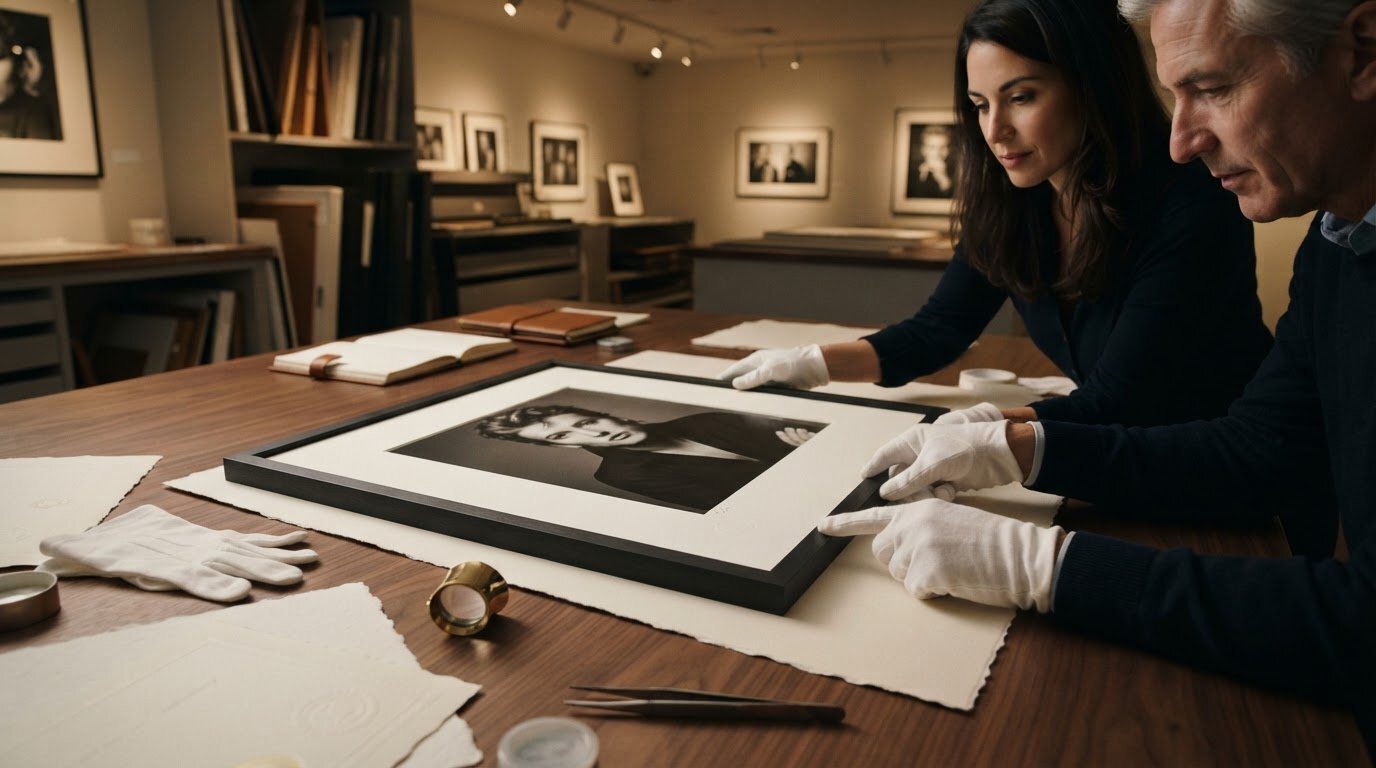
A small edition doesn’t, by itself, prove a celebrity photograph is authentic. When collecting celebrity photography prints, look at the edition record: fine-art editions usually contain 5-50 prints, while large or premium editions often contain 5-10; artist proofs typically number 1-2 per edition. A notation such as 3/25 means the third print in an edition of 25.
The image may be the first thing that draws you in, but edition details, provenance, estate stamps and physical materials reveal more about its story. Understanding these clues helps you assess what a print represents and how it was made. This guide explains edition numbering and artist proofs, what authenticity markers can and cannot establish, and why archival materials matter when choosing and caring for a photograph. Together, these details bring the work’s history into focus, beyond the celebrity in the frame.
Key Takeaways
- Read edition markings alongside the print’s documentation to understand what the numbering does, and doesn’t, tell you.
- Treat an estate stamp as one clue in an authenticity assessment, and consider how it relates to the photograph’s provenance.
- Learn which material and production details can inform your assessment of a print’s archival quality and long-term care.
- Consider the photographer, subject, and image history together when deciding what makes a celebrity photograph meaningful to collect.
- Explore Galerie Prints’ The Slim Aarons Collection and other photography offerings when you’re ready to find a work with a story that resonates.
Edition sizes, numbering, and artist proofs
An edition describes the number of prints produced from a photograph under a defined release. Standard fine-art photography editions usually contain 5-50 prints. Large or premium editions often contain 5-10 prints, though these market descriptions aren’t universal rules. Read the stated edition size as a limit for that particular release, not a guarantee of value. The photographer, image, print history, condition, and documentation all contribute to a work’s significance.
Numbering records a print’s place within its edition. In the notation 3/25, the first number identifies the individual print, while the second gives the total edition size. It means the third print in an edition of 25. The fraction doesn’t mean the print is a third of the edition, nor does it alone establish authenticity. Compare the number on the print with its accompanying certificate or other edition documentation. The details should refer to the same photograph and edition.
A 1 of 1 photography print means a single print ever made, including the Artist Proof. That specific definition matters: don’t assume the label means one numbered print plus a separate artist proof. Artist proofs are typically limited to 1-2 proofs per edition. They’re associated with an edition, but their notation may differ from the numbered sequence. A proof can be desirable to collectors, but its label alone doesn’t establish superior quality, rarity, or resale value. Consider its documentation and relationship to the edition.
To assess a print’s condition, inspect its surface, edges and paper for visible damage, fading, stains or creases. Compare the edition number with its documentation. Resale value depends on condition, edition scarcity, provenance and interest in the photographer or image, so a low edition number alone is not enough to determine it.
Use these practical checks when reviewing an edition:
- Match the notation. Compare a mark such as 3/25 with the certificate or edition record, including the image and edition size.
- Understand the category. Distinguish a numbered print from an Artist Proof, and read 1 of 1 according to its stated meaning.
- Record the condition. Note visible flaws and keep documentation with the print, so its physical state and edition history remain clear.
For example, a 3/25 print and an Artist Proof from the same edition are different designations. Neither label, on its own, reveals which has stronger provenance or market appeal. In collecting celebrity photography prints, edition details are most useful when read alongside condition and records. Together, those clues give a more considered basis for understanding the photograph, rather than treating a small edition number as a verdict.
Photographic print authenticity and estate stamps
Authenticity rests on more than a signature or stamp. For a celebrity photograph, assess the image’s history, how the print was produced and the records that connect them. An estate stamp may indicate approval or association with an artist’s estate, but its meaning depends on who applied it and when. Treat it as one piece of evidence, not as a standalone certificate of authenticity.
What do celebrity photography prints typically cost by photographer, subject, size and edition? Prices vary with the photographer’s market, the image’s cultural significance, print size, edition scarcity, condition and provenance. Weigh these factors together: no single stamp or celebrity name determines a print’s market value.
Look for documentation identifying the photographer, image, printing details and ownership history. A certificate is more useful when its information matches the print and comes from a traceable source. For an estate-stamped work, note the stamp’s wording and location, then compare it with the accompanying paperwork. Without supporting context, a stamp may leave important questions about the print’s history unanswered.
What are the risks of buying celebrity photo prints online or at auction? A listing may provide incomplete provenance or unclear edition details, and its photographs may not show condition problems. Compare the description with the print’s actual markings and records, and review the stated condition, return terms and shipping arrangements before buying or bidding.
Use this practical review before purchase:
- Match the image. Check that the title, subject, and photographer in the paperwork correspond to the photograph offered.
- Read the stamp closely. Record its wording, placement, and relationship to any signature or edition notation.
- Trace the ownership history. Look for a clear account of how the print moved from its maker or estate to its current seller.
- Inspect the physical print. Review the surface, edges, and reverse for marks or damage, using detailed images when viewing remotely.
- Keep records together. Preserve certificates, invoices, and condition notes with the print’s identifying details.
At auction, treat the catalogue description as a claim to evaluate, not a substitute for documentation. An online image can conceal fading, retouching or handling marks, or show a different print from the one delivered. If an estate stamp appears alongside a signature, consider whether both fit the documented history. When collecting celebrity photography prints, a careful paper trail helps distinguish an evocative image from a well-supported collectible. A sound assessment brings together the physical photograph, its markings and a coherent provenance record.
Print materials and archival quality
A photograph’s paper and printing process affect its surface, appearance and care. A glossy finish can make contrast feel more pronounced, while a matte finish softens reflections. These are visual qualities, not proof of archival performance. To assess a print, look for details about its materials and process in the documentation, then consider how you will frame, display and store it.
Paper matters because its composition and treatment influence how it responds to light, moisture and handling. Cotton and other durable fine-art papers are often used for photographic printing, while coated papers can create a distinct finish. Don’t judge longevity by appearance alone. Find out what the print is made on, how it was produced and whether those details accompany its edition information.
Ink or photographic chemistry also contributes to the finished image. Pigment printing and traditional photographic processes produce different surfaces and tonal qualities, but neither description alone tells you how a particular print will age. The process, paper, display conditions and care all matter. For example, compare a richly detailed black-and-white portrait with its stated process and paper instead of relying only on deep shadows or smooth highlights.
Framing can help limit avoidable wear. Keep the print from touching the glazing, and use suitable mounting materials that won’t transfer discoloration. A qualified framer can select an appropriate mount and backing for the print’s format. For storage, keep photographs flat when their construction allows, using protective interleaving and stable conditions. Avoid folding, rolling or repeatedly touching the image surface.
Display conditions are equally important. Morrison Hotel Gallery recommends displaying photographic prints away from direct sunlight to help maintain their quality. A wall beside a bright window may expose a photograph to stronger light than a shaded interior wall. Choose a position away from direct sun, and avoid placing framed work where moisture or heat can fluctuate sharply, such as near a bathroom or radiator.
- Read the specifications. Record the paper, surface, and printing process stated for the individual work.
- Inspect the image. Look for fading, scratches, creases, or discoloration across the print and its edges.
- Plan the frame. Use suitable mounting materials and prevent the photograph from touching the glazing.
- Choose its setting. Keep the print away from direct sunlight, excess heat, and damp conditions.
Material quality is part of a photograph’s story, not just a technical footnote. Collecting celebrity photography prints means considering how a print will live in your space as well as what it depicts. Start with the paper and process, then choose care practices suited to the image’s surface and tonal character. Keep material notes and care instructions with the provenance documents. This attention to preservation helps future owners understand how the photograph was made and how to care for it.
Celebrity photographs
A celebrity portrait can preserve more than a recognizable face; it can hold a moment in cultural history. Steve McQueen was photographed at 20th Century Fox Studio in Los Angeles in 1966. Jay Dickman photographed Willie Nelson drinking a Lone Star beer in 1978. These images invite collectors to consider the photographer’s choices, the setting, and the story behind the frame.
What rights or licences are needed to buy, display or reproduce celebrity photographs? Buying a print generally gives you ownership of that physical object, not the right to reproduce its image. The sale terms identify any additional permissions; reproduction for publication, merchandise or promotion requires authorisation from the relevant rights holder.
Where can collectors find celebrity photography galleries, fairs and auctions in the United States? Look for specialist photography galleries, photography sections at art fairs and auction catalogues featuring photographic works. Search by photographer, subject or image title, then review the catalogue description, provenance, condition and sale terms before deciding.
The circumstances around a photograph can deepen its significance. A 1984 Steve Jobs portrait was made in Woodside, California, while a photograph of Snoop Dogg, Wiz Khalifa, and Seth Rogen dates to Los Angeles in 2016. Those places and dates give collectors a starting point for researching the image’s context. They also help distinguish a carefully identified photograph from a generic celebrity depiction.
Subject matter can carry its own historical texture. In a Steve McQueen photograph, the custom Metisse motorcycle featured a 650cc Triumph engine. Commemorative photographs of Victory in Europe Day relate to 8 May 1945. Such details connect the image to an era, an event, or an aspect of a subject’s life. A caption, catalogue record, or photographer’s account can help clarify that connection.
- Identify the maker. Record the photographer’s name and compare it with the print’s documentation.
- Place the image. Note the subject, setting, date, and any event associated with the photograph.
- Separate ownership from image rights. Read the sale terms and distinguish owning the print from reproducing it.
- Explore the market thoughtfully. Compare gallery listings, fair exhibitors, and auction descriptions for the same photographer or image.
A portrait’s appeal may begin with a familiar face, but collecting gains depth through context. Compare the 1966 McQueen image with later portraits, considering how the photographer’s approach and setting shape its character. For collecting celebrity photography prints, provenance, historical context, and the intended use of the image each inform a considered choice. A photograph can then be appreciated both as an artwork and as a record of a person’s place in public life.
Where can you buy authentic celebrity photography prints?
Collectors can find celebrity photographs through specialist galleries, art fairs, auction catalogues and online art retailers. Each setting presents the work differently: a gallery may offer curatorial context, while an auction catalogue focuses on the lot. Compare the photograph, documentation, condition and edition details before deciding where to buy.
A specialist gallery can connect an image with its photographer, subject and historical setting. For example, consider a Terry O’Neill portrait alongside information identifying the image and print, not just the celebrity’s name. Read the item description carefully and make sure the physical print’s details match its accompanying records.
At an art fair, examine the work in person where possible. View the surface under the venue’s lighting, check the edges and reverse, and compare the print with its description. If it is framed, review any available documentation separately. A frame can enhance presentation, but it does not establish the photograph’s edition or history.
Auction catalogues offer another route, particularly for works associated with a specific photographer or period. Read the entry for the image title, print details, condition and provenance. Compare these details with the marks visible in the lot photographs. The catalogue should describe the specific print on offer, not rely solely on the celebrity’s fame.
Online listings call for a different kind of attention. A screen can make texture, fading and small marks difficult to judge, so inspect every available view. Check whether the listing describes the actual print or uses a representative image. Before buying, review the sale and return terms, shipping method and packaging details.
Use this short checklist across galleries, fairs, auctions and online listings:
- Identify the work. Match the photographer, subject, image title, and print details across the listing and its documentation.
- Assess condition. Look for fading, creases, scratches, stains, and edge damage in the print itself.
- Review provenance. Read the ownership history and compare it with any certificate or estate marking.
- Understand the transaction. Check sale terms, shipping arrangements, and how the work will be protected in transit.
The right buying channel depends on what matters most: in-person inspection, detailed catalogue information, or access to a particular photographer’s work. A collector considering Star Wars Limited Edition Prints, for example, should read the edition description and documentation for the specific print, rather than treating the subject alone as evidence of authenticity. For a more focused search, explore celebrity photography prints and compare each work’s identifying details before choosing.
Galerie Prints: The Slim Aarons Collection
Galerie Prints offers The Slim Aarons Collection for collectors drawn to photographs that capture a particular moment and atmosphere. The collection also includes Terry O’Neill Photography, Cinema Lobby Cards and Star Wars Limited Edition Prints, offering distinct ways to explore celebrity and screen history through images.
Use edition details, provenance and materials to guide your selection: choose a photographer or subject that resonates, then review the individual print’s description and presentation. Galerie Prints’ Bespoke Framing Service offers a practical next step when you’re deciding how to display a work.
Explore Galerie Prints online to discover the collection and find a photograph that speaks to your interests.
Let the image guide your next choice
A collected photograph can become a lasting point of connection, carrying personal meaning beyond the moment it records. As you continue collecting celebrity photography prints, consider which stories you want your collection to hold: a distinctive portrait, a glimpse of a particular era or the atmosphere of a celebrated screen moment.
Galerie Prints brings these possibilities together through The Slim Aarons Collection, Terry O’Neill Photography and Cinema Lobby Cards. Each offers a different way to engage with photographic and cinematic history, whether your interest begins with a photographer’s vision or an image that has stayed with you.
Let curiosity lead. Explore the works, take time with the images, and choose the one that feels meaningful in your own space. Contact Galerie Prints about collecting and continue discovering the photographs that speak to you.
Frequently Asked Questions
What types of celebrity photography prints can collectors buy?
Collectors can choose portraits, candid moments, performance photographs and images connected to film or music. Galerie Prints offers Terry O’Neill Photography, alongside Cinema Lobby Cards and Star Wars Limited Edition Prints, which are screen-history collectibles rather than necessarily photographic prints. The right fit depends on whether you’re drawn to a particular photographer, performer, cultural moment or visual style. Decide what story you want the work to bring to your collection.
How can you verify the authenticity and provenance of a celebrity photo print?
Compare the print’s identifying details with its documentation and keep a record for the individual work. Note the photographer, image title, process and any annotations, then store the purchase record with the provenance papers. If the print has been reframed, retain any earlier labels or paperwork. A consistent record helps you understand the object’s history and distinguish its documentation from information about other prints of the same image.
How do limited editions, open editions, and artist proofs affect value?
A limited edition has a defined production total, while an open edition has no fixed cap. An artist’s proof is identified separately from the regular numbered sequence, so compare its documentation with the edition record. These categories describe scarcity but do not determine value by themselves. Condition, provenance, image appeal and interest in the photographer also shape how collectors assess a print.
Which photographers and celebrity photo prints are most collectible?
Collectibility often reflects the strength of a photographer’s body of work and the cultural resonance of a particular image. Terry O’Neill and Slim Aarons are represented in Galerie Prints’ offerings; Jay Dickman and Timothy White are also associated with celebrity images discussed in this guide. Rather than relying on fame alone, consider whether the photograph has a compelling story, a clearly identified maker and lasting personal appeal.
How should you store, frame, and preserve photographic prints?
Handle a print by its edges and avoid touching the image surface, particularly when unpacking or reframing it. Choose a frame and mount that hold the photograph securely without adhesives contacting the print. For unframed works, use protective enclosures and store them flat where practical. Keep photographs away from direct sunlight, damp areas and heat sources, and preserve their labels and paperwork with the storage record.