
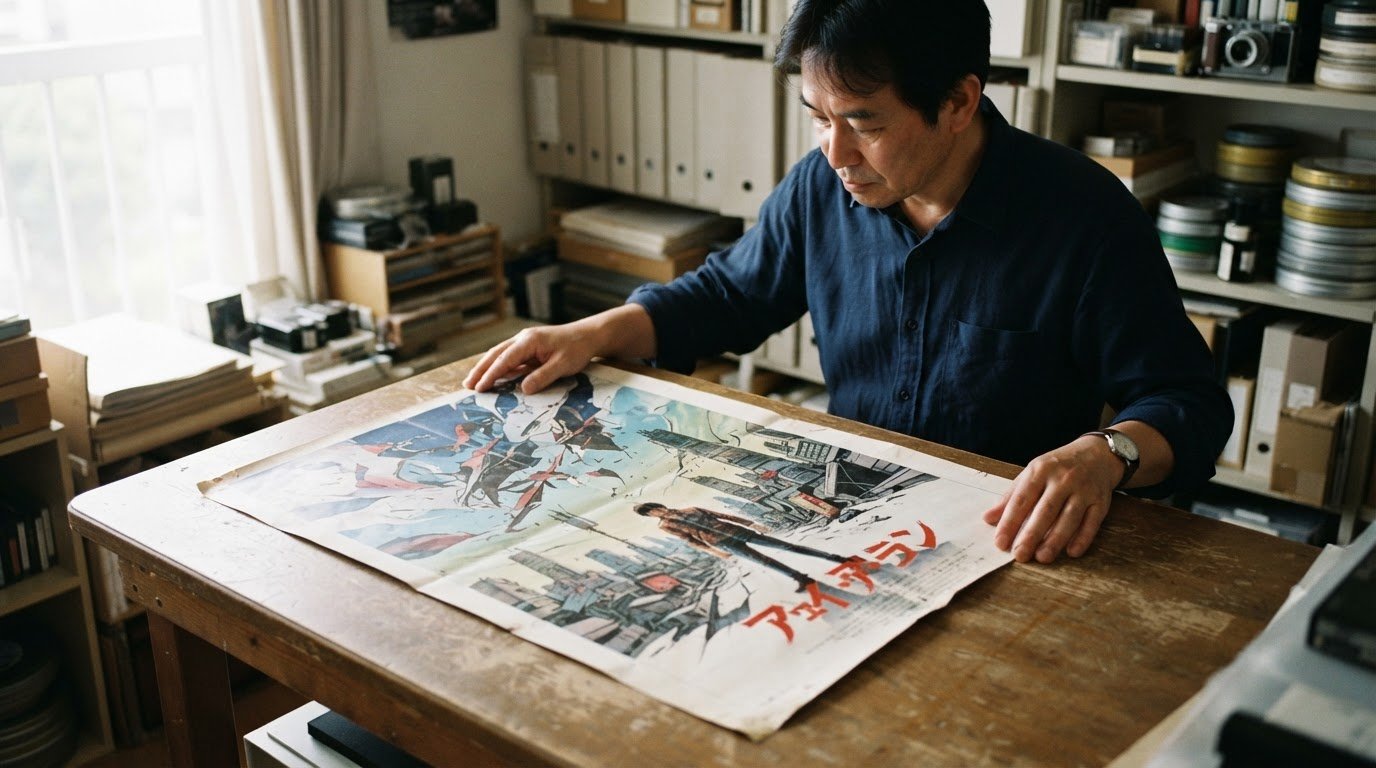
The Japanese B2 format has traditionally been used for cinema posters in Japan, measuring approximately 20 inches wide by 29 inches tall. For collectors, that scale is only part of the appeal: Japanese release artwork can offer a strikingly different interpretation of a familiar film. Collecting Japanese B2 movie posters means considering the image alongside its release history, rarity and condition.
A poster’s design can feel like a small piece of cinema history, shaped for its original audience and made to command attention on a theatre wall. It’s natural to look beyond the title itself: the artwork, printing format and evidence of an original release can all influence a poster’s significance and how collectors value it.
This guide explores what distinguishes Japanese B2 posters, why the format matters, and how rarity and auction prices shape interest in iconic film artwork. It also turns to posters for beloved Japanese films, where the visual language of the release can become as memorable as the film itself.
Key Takeaways
- Learn how to distinguish Japanese release artwork and recognize details that give a poster its historical character.
- Use the B2 format as a practical reference when identifying and displaying Japanese theatrical posters.
- Understand why rarity, release history and condition can shape collector interest and auction values.
- Explore how posters for iconic Japanese films bring together memorable imagery and cinema heritage.
Distinctive Japanese release artwork
Japanese film posters can give familiar titles a distinct visual identity. Tadanori Yokoo produced well over 800 designs across a career spanning more than six decades, a body of work that places poster art within a wider creative practice. Noriyoshi Ohrai created Japanese artwork for The Empire Strikes Back, released in 1980. These examples show why a collector may value the artist’s approach as much as the film title: composition, imagery and typography shape the poster’s character.
Some releases also appear in named design variations. For Escape from New York, Japanese B2 examples dated 1981 include both Liberty Style and Plissken Style posters. First Blood has a Bike Style Japanese B2 poster dated 1982, while A Nightmare on Elm Street has a Montage Style B2 poster dated 1984. These labels help distinguish different visual treatments of the same film. When cataloguing a poster, record its exact style designation alongside the title and date; that detail makes comparisons between related designs clearer.
Release descriptions matter, too. Japanese B2 examples for Dawn of the Dead distinguish the 1978 film from a poster identified as its 1979 first release, and a separate 1978 poster carries the re-release label R1994. A date associated with a film is therefore not always the same as the poster’s release context. Friday the 13th and The Fog each have Japanese final posters dated 1980, illustrating another useful cataloguing distinction: final artwork is not interchangeable with every promotional design.
For a collection record, note the title, artwork designation, date and release wording exactly as presented. Then compare these details before treating two posters as variants or editions. A special STB poster for Akira Kurosawa’s Kagemusha was released in 1980, offering a further example of how format can add context to a film poster. Taken together, artist attribution, design variation and release terminology give collectors a more precise account of each object, beyond the film name printed on its face.
Japanese B2 posters as a standard theatrical format in Japan
Japan’s standard cinema poster has traditionally been B2, measuring approximately 20 inches wide and 29 inches tall. Japanese B2 listings also give a metric size of 51 × 73 cm. Compare those dimensions with B3 posters, often used for regional distribution. The difference is more than a catalogue label: format affects how the artwork occupies a wall and what display space it needs.
Format can also preserve clues about a poster’s intended use. In the late 1940s, Japanese posters were sometimes produced in B3 because post-war paper scarcity constrained printing. The regional B3 variant of the 1954 Seven Samurai poster measures 36 × 51 cm. Record the dimensions alongside the title and release details; this helps distinguish a smaller regional poster from a B2 example of the same film.
For buyers in the United States, import duties depend on the shipment’s customs classification and declared value. Shipping charges depend on package dimensions, service and destination. Factor them in separately when estimating the total cost, since no single duty or shipping figure applies to every poster.
To assess whether a Japanese B2 poster is an original or reprint, compare its release wording, credits and printer marks with reliable records for that specific title. Examine the paper and printing closely, and consider provenance; no single visual detail establishes originality for every poster.
For international shipping, keep the poster protected from moisture and movement, and use a rigid package that prevents bending. Ask for tracking and suitable transit protection for the shipment. At home, store the poster flat or carefully rolled in a protective sleeve, away from direct sunlight and damp conditions. For display, choose a frame that fits its 51 × 73 cm dimensions without forcing or trimming the paper. A well-sized frame lets the original composition remain intact.
Japanese movie poster display cases typically accommodate both standard B2 posters and STB two-panel posters, which also appeared beside ticket booths and as theater door panels.
Poster rarity and auction prices
Japanese B2 poster values vary with scarcity, release history, condition and collector demand. An anonymous market aggregate places typical offers between 110 and 365 USD, with a median about 157, based on 46 price samples from 3 sources. Treat that range as a market snapshot, not a fixed valuation: a scarce first release can attract different interest from a later issue of the same film.
Auction results can show exceptional examples selling well beyond ordinary offers, but each result relates to a specific item, not every poster for either film. Condition, rarity and the precise release or format can explain why one result differs sharply from broader market offers.
Collectors can buy authentic Japanese B2 posters through specialist vintage-poster dealers, auction houses and established Japanese collectibles marketplaces. These channels provide different ways to encounter original theatrical material, from curated listings to competitive bidding. Compare the poster’s title, release details, dimensions and condition description before judging whether a listing matches your collecting focus.
For Japanese marketplaces and auction sites, there isn’t one universally best venue for every B2 poster. A specialist dealer may offer a focused catalogue, while an auction gives a particular piece a time-limited bidding process. Japanese collectibles marketplaces can surface titles less visible in general poster listings. Choose by the strength of the object description, available photographs and clarity around release context, rather than platform name alone.
Build a record for each candidate before bidding or buying: note its film title, stated release, format, condition and any provenance. Then compare like with like. A first-release Princess Mononoke poster and a later promotional design are not equivalent simply because both feature the same film. For collecting Japanese B2 movie posters, that distinction makes rarity meaningful and helps put auction results in context.
Collectible posters for iconic Japanese films
Japanese film posters let collectors approach landmark cinema through artwork made for theatrical release. Akira and My Neighbor Totoro, both released in 1988, represent very different visual worlds, while Spirited Away, released in 2001, offers another point of connection with Studio Ghibli’s celebrated storytelling. Their posters can anchor a collection around a director, studio, genre or moment in Japanese film history.
Consider how an image expresses a film’s atmosphere, not only its title. The Japanese B2 poster for Princess Mononoke depicts San in a misty forest, turning the setting into a defining part of the composition. That artwork invites comparison with posters for Akira or My Neighbor Totoro: each title suggests a distinct aesthetic, giving collectors a way to build visual contrast across a wall or archive.
Condition matters alongside the film and design. Compare the seller’s stated grade with clear images, then inspect corners, edges and the printed surface for creases, tears, stains, fading, pinholes or tape repairs. Ask how visible each defect is and whether it crosses important artwork; a small flaw in a quiet margin affects the image differently from damage across a character or title.
Choose a theme before acquiring individual posters to give your collection direction. A Studio Ghibli grouping might connect My Neighbor Totoro and Spirited Away through their studio heritage. A broader Japanese cinema collection could bring animation together with live-action classics. Record each poster’s title, release date, format, design and condition. This makes it easier to understand each piece’s historical context as well as its decorative appeal.
Collectors drawn to the enduring visual language of cinema can explore vintage movie posters as another way to bring film history into a collection. The strongest display begins with a clear curatorial idea, whether it follows a single film, a studio or the evolution of Japanese screen art.
Galerie Prints: Vintage movie posters
Galerie Prints offers vintage movie posters for collectors drawn to the visual history of cinema. If your collection of Japanese B2 artwork sits within a wider interest in film imagery, Cinema Lobby Cards provide another format to explore, while Star Wars Limited Edition Prints offer a distinct connection to a celebrated screen universe. These offerings let you shape a broader cinema-focused display without losing sight of the original posters’ individual release histories.
Choose complementary pieces by considering how each work relates to your collection’s themes, from film and genre to composition and display. For collectors who want a considered presentation, Galerie Prints also offers a Bespoke Framing Service. Contact Galerie Prints to discuss which pieces best suit your collection.
Shape the next chapter of your collection
A considered collection grows through choices that reflect your own eye, not simply a list of celebrated titles. As you continue collecting Japanese B2 movie posters, let each new piece strengthen a personal thread, whether that means a director, a visual mood or the cinematic memories you want to keep close. Over time, those choices can make a display feel less like an assortment and more like a thoughtful portrait of your interests.
To broaden a collection centred on film and photography, explore Galerie Prints’ The Slim Aarons Collection, Terry O’Neill Photography and Cinema Lobby Cards. Each offers a distinct subject and atmosphere to complement an interest in visual culture.
Contact Galerie Prints about collecting to continue the conversation. Let your next choice be one that makes your collection feel unmistakably your own.
Frequently Asked Questions
What are Japanese B2 movie posters and what are their dimensions?
Japanese B2 movie posters are theatrical posters printed in Japan’s traditional standard cinema format, measuring 51 × 73 cm, or approximately 20 × 29 inches. Their portrait proportions make them suitable for a prominent wall display, but the exact frame should accommodate the poster without trimming its edges. Check dimensions before choosing a frame, especially when comparing B2 posters with smaller regional formats.
How much do Japanese B2 movie posters typically cost?
Typical market offers for original Japanese B2 movie posters range from 110 to 365 USD, with a median about 157, based on an anonymous aggregate of 46 price samples from 3 sources collected on November 4, 2026. Individual asking prices and auction results can differ. A poster’s condition, release history, rarity and demand for its film all influence how it compares with that market snapshot.
Are Japanese B2 posters valuable, and which titles are most collectible?
Some Japanese B2 posters are valuable, particularly scarce originals in strong condition. First-run Princess Mononoke posters in excellent condition regularly sell for hundreds of dollars on the secondary market, while original Japanese Breakfast at Tiffany’s posters regularly sell for thousands. These examples illustrate how title, edition and preservation affect collector demand.