
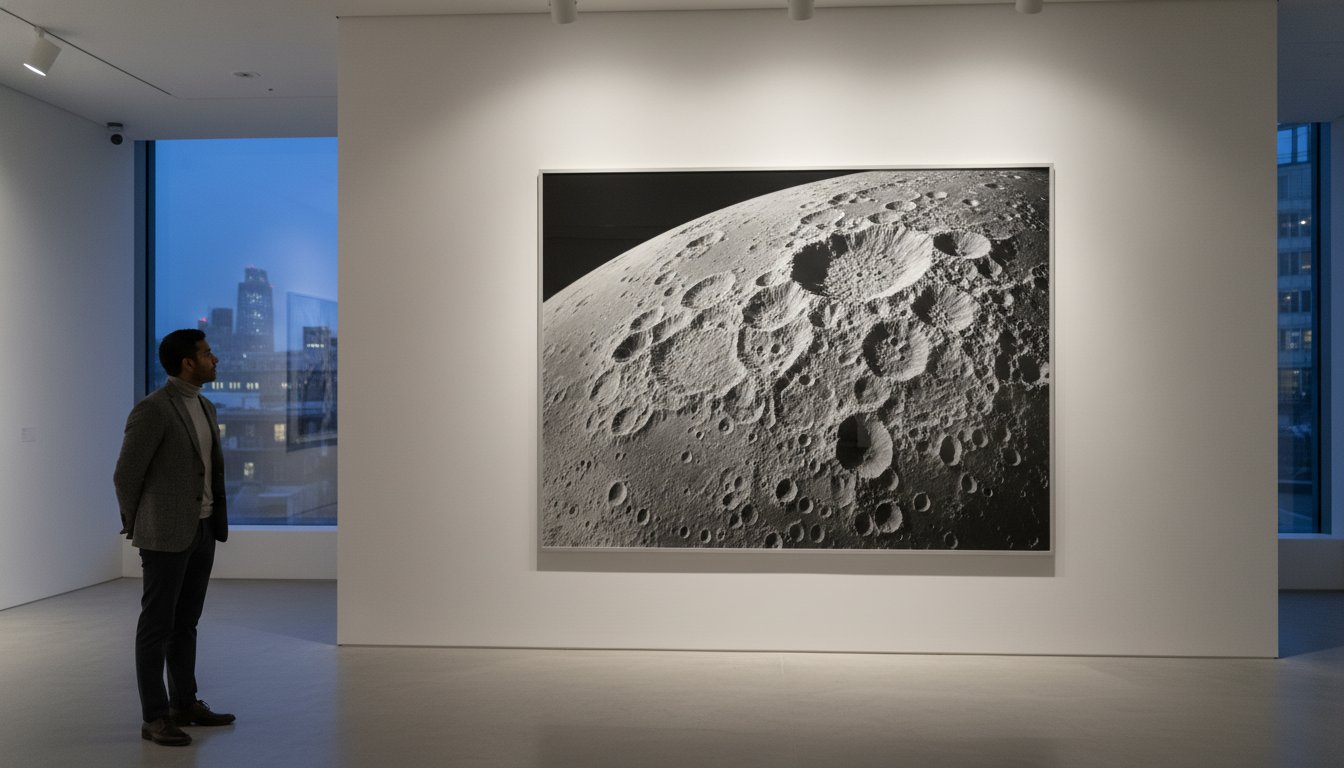
Tag: Astronomy

Hyperion Moon: The Surreal Art of Saturn’s Most Mysterious Satellite

Nature’s most avant-garde sculpture isn’t housed in the Tate or the MoMA; it orbits 1.4 billion kilometers away in the frozen reaches of the Saturnian system. As you gaze upon the hyperion moon, it’s clear that traditional astronomical imagery often lacks the soul and texture required for a sophisticated home, frequently trapped in the dry, clinical world of scientific journals. We understand that a discerning eye seeks more than just a map of the stars. It seeks a piece of history that resonates with the same prestige as a silver gelatin print from a mid-century fashion archive.

In this exploration, you’ll discover this celestial marvel through a lens of refined appreciation, moving beyond the 2005 Cassini mission data to witness its porous, sponge-like surface as a curated work of art. We’ll guide you through the moon’s chaotic physics and sculptural beauty, ultimately revealing how to bring the world’s finest photography into your own collection. From the technical excellence of our London darkroom to the timeless allure of the cosmos, you’re about to see the heavens in an entirely new light.

Key Takeaways

  • Uncover the mysterious history and unique composition of Saturn’s “sponge moon,” a celestial enigma that has fascinated explorers since its 1848 discovery.
  • Explore the sculptural aesthetic of the hyperion moon, examining how its pock-marked surface and high-contrast craters serve as a masterclass in natural abstraction.
  • Gain insight into the “mechanical photography” of the Cassini-Huygens mission and how these archival records are curated as exquisite works of fine art.
  • Learn how to integrate the timeless texture of celestial photography into modern interiors to achieve a sophisticated sense of perspective and prestige.

What is the Hyperion Moon? Saturn’s ‘Sponge’ Satellite Explained

The hyperion moon represents a striking departure from the celestial symmetry we expect from the heavens. It is a celestial curiosity that resembles a weathered piece of pumice or an ancient, deep-sea sponge drifting through the vacuum of the outer solar system. As Saturn’s largest irregular satellite, its pock-marked surface creates a visual texture so unique it feels like a curated piece of abstract sculpture. This moon doesn’t possess the smooth, icy surfaces of its neighbors; instead, it offers a jagged, porous facade that has captivated astronomers and artists alike since its identification in the mid-19th century.

Unlike the majestic spheres of Titan or Rhea, Hyperion is distinctly potato-shaped. This irregular geometry isn’t an accident of birth but a testament to a violent history. Scientists believe the moon is a remnant of a much larger body that was destroyed by a cataclysmic impact during the early, chaotic years of our solar system’s formation. This history gives the moon a sense of archival importance, acting as a frozen record of ancient cosmic transitions.

The Discovery and Naming of a Titan

On September 16, 1848, a trio of astronomers changed our understanding of the Saturnian system forever. William Lassell in Liverpool and the father-son duo of William and George Bond in Massachusetts independently discovered the moon within days of each other. This discovery occurred during a golden age of observational astronomy, a period defined by a rigorous race to map the intricate architecture of Saturn’s rings and satellites.

The naming follows the tradition of the Greek Titans, specifically the Titan of watchfulness and observation. This choice is particularly apt given the moon’s strange, chaotic rotation. Saturn’s moon Hyperion forced astronomers to reconsider the definition of a satellite. It proved that moons could be irregular, battered, and fundamentally unpredictable, shifting the focus from perfect spheres to the beauty found in celestial imperfection.

A Rubble Pile in Space: Composition and Density

The physical makeup of the hyperion moon is perhaps its most enigmatic quality. It is often described as a “rubble pile” because it’s held together by exceptionally weak gravity. Its density is remarkably low, measured at approximately 0.54 grams per cubic centimeter. This is roughly half the density of water, suggesting the moon isn’t a solid mass but a complex labyrinth of internal voids.

  • Porosity: Scientific models indicate that over 40 percent of the moon’s volume consists of empty space.
  • Materiality: It’s composed primarily of water ice, though it contains traces of frozen methane and carbon dioxide.
  • Surface Depth: The dark material lining the bottom of its deep craters remains a subject of intense study, providing a stark contrast to the brilliant white of its icy ridges.

This high porosity explains its “sponge” appearance. When objects strike Hyperion, they don’t cause traditional explosive craters. Instead, they compress the porous surface, leaving deep, well-defined pits that haven’t been smoothed over by geological activity. It’s a pristine, frozen record of impact history, preserved with the same care one might find in a London darkroom’s most valued negative.

The Extraordinary Visual Aesthetic of Hyperion’s Surface

The surface of the Hyperion moon presents a masterclass in natural abstraction. It defies the typical spherical expectations of lunar bodies, instead appearing as a porous, weathered bone or a deep-sea sponge suspended in the void. This startling morphology arises from a density approximately 54 percent that of liquid water. According to NASA’s profile on Hyperion, this extreme porosity allows impactors to compress the surface rather than excavating it, which preserves the sharp, deep edges of its craters. The result is a high-contrast visual profile where dark, reddish material collects at the bottom of these pits, creating a chiaroscuro effect that feels intentionally composed by a master artist.

The ‘Sponge’ Effect: Why Hyperion Looks Different

This organic texture stems from the physics of ‘sun-scalded’ ice. Because the moon lacks the internal heat or geological activity to soften its features, the craters remain jagged and pristine for eons. The visual result mirrors the intricate, chaotic patterns found in terrestrial nature, from bleached coral reefs to ancient skeletal remains. It’s this raw, evocative quality that makes the moon a frequent reference for those exploring fine art photography, as its surface demands the same level of close, appreciative study as a curated silver gelatin print. The false-color views captured by the Cassini spacecraft during its 2005 flyby reveal a complex palette of subtle reds, icy blues, and deep greys, transforming a distant rock into a piece of avant-garde art that rivals modern museum installations.

Static Charge and the Tumble of Chaos

Hyperion’s rotation is famously chaotic, a rare trait discovered by the Voyager 2 mission in 1981. It doesn’t have a fixed pole or a predictable day-night cycle; it tumbles through its orbit, influenced by the heavy gravitational tug of Titan. This erratic motion ensures that lighting is never consistent, casting ever-changing, dramatic shadows across its deep pores. Scientists have also observed that the moon carries a significant static charge. This electricity may physically move fine dust particles across the surface, constantly shifting the dark hydrocarbons that line the crater floors. For collectors who appreciate the timeless allure of archival imagery, these shifting shadows and textures provide a sense of movement and depth that is rarely found elsewhere in the solar system.

  • Porosity: Over 40 percent of the moon’s interior is estimated to be empty space.
  • Visual Contrast: The bright water ice walls contrast sharply with the dark material, likely hydrocarbons, found at the crater depths.
  • Scale: Craters like the one named Helios reach depths of 10 kilometers, maintaining their sharp definition without the softening of erosion.

The interplay of light and shadow on such a jagged landscape creates a visual rhythm that is both unsettling and beautiful. It’s a reminder that nature, even in the cold vacuum of space, often mimics the most delicate organic structures found on Earth.

Capturing the Cosmos: The Photography of the Cassini-Huygens Mission

The Cassini-Huygens mission represents the pinnacle of celestial documentation, functioning as a sophisticated mechanical explorer that traversed 1.4 billion kilometers to reach the Saturnian system. These probes aren’t merely instruments of measurement; they’re the spiritual successors to great archival photographers who documented the terrestrial frontiers of the 19th century. They capture the raw, desolate beauty of the cosmic wilderness with a precision that borders on the poetic. The hyperion moon presents a unique challenge for any lens. It’s a tumbling, chaotic body with an unpredictable rotation, making it one of the most difficult subjects in the solar system to track.

Capturing clear imagery at a resolution of 13 kilometers per pixel required extraordinary technical coordination from the spacecraft’s imaging team. The process of translating digital data into fine art is a meticulous journey. Millions of miles away, the probe records light values as binary code. This data is beamed back to Earth, where it’s curated and processed into the exquisite visual imagery that graces the walls of high-end galleries. The result is a bridge between cold, hard science and the evocative world of luxury photography.

The 2005 Flyby: A Landmark in Astronomical Imaging

On September 26, 2005, Cassini performed its most significant encounter with this strange satellite. The narrow-angle camera was deployed to capture the hyperion moon in startling detail, revealing a surface that appears more like organic sponge or ancient coral than solid rock. These Cassini-Huygens mission observations provided the first high-resolution look at the moon’s “pock-marked” aesthetic. By utilizing specific filters, the imaging team highlighted the sculptural depth of the craters, some of which are over 10 kilometers deep. This transition from raw, grainy data to the curated, high-contrast images we see today is a testament to the artistry involved in space exploration.

Archival Preservation of Space Imagery

At Galerie Prints, we view these images as a vital part of our global photographic heritage. They aren’t just scientific records; they’re timeless works of art that demand the highest standards of preservation. To honor the depth of the vacuum, we prioritize specific technical elements:

  • Museum-Quality Archival Paper: We use heavy-weight stocks that can hold the rich, deep blacks of space without losing detail.
  • Technical Superiority: Our printing process ensures that the subtle gradations of light on the crater walls are rendered with absolute clarity.
  • Artisanal Craftsmanship: Each piece is treated with the same reverence as a silver gelatin print produced in our London darkroom.

This commitment to quality ensures that a purchase isn’t just a decoration but a lasting piece of history. By applying bespoke gallery standards to celestial photography, we invite collectors into a world where science and glamour converge.

The Ethereal Appeal of Space Photography in Modern Interior Design

Celestial photography transcends mere decoration. It introduces a profound sense of perspective into a living space that few other subjects can replicate. While a traditional portrait captures a fleeting moment in human history, a high-resolution image of the hyperion moon captures an epoch. Its chaotic, sponge-like surface offers an organic complexity that anchors a room, providing a visual weight that’s both grounding and intellectually stimulating. This aesthetic particularly suits minimalist and mid-century modern interiors. In these spaces, the raw, unpolished textures of the cosmos provide a necessary counterpoint to sleek, manufactured lines.

Psychologists, including Frank White who coined the term in his 1987 study, describe the “overview effect” as a cognitive shift in awareness reported by astronauts. Bringing this sensation into the home through large-scale prints fosters a meditative atmosphere. It’s a reminder of our place in the universe, turning a simple hallway or study into a place of reflection. For collectors, pairing these astronomical marvels with cinema lobby cards creates a fascinating dialogue between the scientific reality of space exploration and the golden age of Hollywood’s science fiction imagination.

Curating a Gallery Wall with a Universal Theme

A sophisticated gallery wall thrives on contrast. You might mix stark, black and white lunar photography with the high-contrast, deep-shadowed images of the Saturnian system. We treat these celestial bodies as the “Slim Aarons” of the stars; they represent a different kind of aspirational luxury, one defined by the vastness of the frontier rather than the poolside. Bespoke framing is essential here. A deep-set shadow box frame elevates a space print from a scientific record to a prestigious piece of fine art, ensuring it commands the attention it deserves.

Lighting and Placement for Maximum Impact

To truly honor the hyperion moon, lighting must be intentional. Use directional spotlights at a 45-degree angle to mimic the way the sun hits the moon’s irregular craters. This creates a three-dimensional depth that draws the eye into the photograph’s valleys. Scale is equally vital. A monumental 40×60 inch print captures the true gravity of the cosmos. Finally, we always recommend archival photo paper. It’s a technical necessity that prevents glare in high-light environments, ensuring the deep blacks of the vacuum remain velvety and immersive.

Curating Your Own Universe: Fine Art Prints at Galerie Prints

Bringing the haunting, sponge-like textures of the Hyperion moon into your personal environment requires more than a digital screen. It demands a physical object that carries the weight of the cosmos and the history of its discovery. At Galerie Prints, we act as a sophisticated bridge between the golden age of exploration and the discerning modern collector. Our mission is to provide access to the world’s finest photography, spanning from the iconic movie stills of the 20th century to the surreal wonders of the Saturnian system. Every print we produce is handled with the quiet authority and reverence typically reserved for rare historical artifacts.

Our London-based craftsmanship ensures that your journey into the stars is anchored by tangible quality. We understand that a photograph of a distant celestial body is a window into the unknown. By combining high-end interior aesthetics with a passion for scientific wonder, we help you transform your space into a curated gallery of the extraordinary. Experience the luxury of museum-grade mounting and bespoke framing that turns a simple image into a definitive statement piece for your home or office.

The Galerie Prints Difference: Quality and Provenance

The distinction of a Galerie Prints piece lies in its physical creation. We don’t rely on mass-produced methods. Instead, each work is hand-printed in our London darkroom using the finest archival materials available. This dedication to craftsmanship means that the intricate craters and chaotic rotation of the hyperion moon are rendered with exquisite clarity. We take our role as guardians of photographic heritage seriously, managing a collection that includes everything from the legendary works of Terry O’Neill to the vast archives of Getty Images.

Choosing a print from our collection is an investment in a piece of history. We use traditional silver gelatin processes and premium papers to ensure that your artwork remains as vivid in fifty years as it is today. This focus on provenance and technical excellence justifies the exclusivity of our offerings. When you acquire a piece from us, you’re securing a legacy of beauty that transcends the fleeting nature of modern digital media.

Customizing Your Celestial Masterpiece

Personal style should never be a compromise when collecting fine art. We offer a comprehensive range of bespoke framing options tailored to match your specific interior aesthetic. Whether you prefer the clean lines of a contemporary gallery frame or the weight of a more traditional mount, our artisans ensure a perfect fit. Each frame is constructed to protect the integrity of the print while elevating its visual impact within your room.

For serious collectors aiming to curate a themed archive of planetary exploration, we provide personalized consultations to help build a cohesive narrative. Our experts are as comfortable discussing the technical nuances of a 1950s fashion shoot as they are advising on the best way to display a hyperion moon landscape. If you’re ready to select a definitive work for your collection, Contact our London gallery to find the perfect piece that resonates with your vision of the universe.

Inviting the Infinite Into Your Curated Space

The 1997 launch of the Cassini-Huygens mission forever altered our visual relationship with the solar system. By documenting the hyperion moon through high-resolution imaging, the spacecraft revealed a porous, sponge-like texture that defies traditional planetary expectations. These 2004 arrival images represent more than mere scientific data; they’re profound works of art that capture the chaotic rotation and ancient history of Saturn’s system. Integrating such celestial photography into a modern interior transforms a room into a gateway for contemplation and sophisticated wonder.

Acquiring a piece of this astronomical legacy requires a commitment to technical excellence. Every print in our collection is hand-printed in our London darkroom on museum-quality archival paper. Under the expert eye of curator Stuart Möller, we ensure each image maintains the depth and clarity intended by the original mission photographers. Our bespoke framing options provide the final touch of permanence for these iconic views of the universe. We invite you to Explore the World’s Finest Photography and Celestial Prints and find a timeless piece that resonates with your own sense of discovery. Your journey toward a more inspired home begins with a single, extraordinary image.

Frequently Asked Questions

Why does Hyperion look like a sponge?

Hyperion possesses a porous, sponge-like appearance because its density is approximately 0.54 grams per cubic centimeter, which is about half the density of water. This low density suggests the moon is a rubble pile of water ice with vast internal voids. Craters don’t fill with debris as they do on denser bodies; instead, impacts compress the surface material. This process preserves deep, sharp-edged pits that give the hyperion moon its unique, honeycomb texture.

Who discovered the Hyperion moon and when?

Three astronomers discovered Hyperion on September 16, 1848, during a period of intense celestial observation. William Cranch Bond and his son George Phillips Bond identified it from the Harvard College Observatory, while William Lassell independently spotted it two days later in Liverpool. This discovery marked a significant milestone as it was the first non-round moon found in the solar system. It revealed early clues about the diverse nature of the celestial bodies orbiting Saturn.

Is Hyperion the largest irregular moon in the solar system?

Hyperion ranks as the largest non-spherical moon in the solar system, measuring approximately 360 by 266 by 205 kilometers. While other moons like Phoebe possess a greater total volume, they maintain a more rounded, hydrostatic shape. Hyperion’s jagged, potato-like form distinguishes it as a premier example of an irregular satellite. Its impressive dimensions ensure it remains a fascinating subject for those collecting the world’s finest photography of our cosmic neighborhood.

What is the ‘chaotic rotation’ of Hyperion?

The chaotic rotation of the hyperion moon refers to its unpredictable spinning motion, which lacks a fixed axis or a constant period. Gravitational interactions with Saturn and the massive moon Titan cause this instability. Unlike Earth’s moon, which always shows the same face to its planet, Hyperion tumbles through space in a manner that makes its orientation impossible to forecast. This 1984 discovery by researcher Jack Wisdom changed our understanding of celestial mechanics.

Can I buy high-quality prints of Saturn’s moons?

You can acquire exquisite, high-quality prints of Saturn’s moons through our curated collections at Galerie Prints. We specialize in archival imagery that captures the ethereal beauty of the cosmos. Each piece undergoes a meticulous production process to ensure it meets our standards of excellence. Our London-based craftsmanship guarantees that every print serves as a timeless investment for your private gallery or interior space, reflecting a true passion for photographic heritage.

What makes the Cassini-Huygens photography of Hyperion so special?

The Cassini-Huygens mission provided the first high-resolution views of Hyperion during a close flyby on September 26, 2005. These images revealed the moon’s strange, cup-like craters and complex surface features with a clarity of 1 kilometer per pixel. This technical superiority allows us to appreciate the tactile, almost sculptural quality of the moon. Such provenance ensures these photographs are regarded as iconic records of human exploration and scientific achievement.

How do I choose the right frame for a space photography print?

Selecting the right frame involves balancing the print’s aesthetic with the room’s interior design. We recommend bespoke wooden frames in matte black or dark walnut to emphasize the deep blacks of deep space. These choices provide a sophisticated border that doesn’t distract from the celestial subject. Our team ensures that all framing uses archival materials to protect the longevity and integrity of your investment, preserving the world’s finest photography for generations.

Is Hyperion moon photography available in black and white?

We offer a selection of space imagery in striking black and white, often hand-printed in our London darkroom to achieve a deep tonal range. The stark contrast of a silver gelatin print perfectly highlights the dramatic shadows and porous textures of the lunar surface. This monochromatic approach lends a sense of timeless elegance to the work. It transforms a scientific observation into a piece of evocative, fine art photography that suits any luxury interior.

Saturn Hex: The Celestial Geometry of the Solar System’s Most Mysterious Masterpiece

What if the most mathematically perfect composition in existence isn’t housed in a museum, but is currently spinning 1.2 billion kilometers away? Nature rarely draws in straight lines, yet at the north pole of our solar system’s jewel, a geometric anomaly defies every terrestrial rule of fluid dynamics. The saturn hex isn’t merely a meteorological event; it’s a permanent, six-sided storm spanning 30,000 kilometers in width, large enough to swallow two Earths whole. First glimpsed by the Voyager 1 mission in 1980, this atmospheric marvel has challenged our understanding of planetary physics for over 44 years. It stands as a testament to the fact that the universe is a gallery of the sublime, where physics and fine art converge in a display of silent, spinning symmetry.

You likely feel that the sheer scale of the cosmos is often lost in dry, academic descriptions that strip away its inherent beauty. We’ll bridge that gap by exploring the captivating story, scientific wonder, and aesthetic allure of this celestial masterpiece. From the grainy 1981 flybys to the high-resolution infrared captures of the Cassini orbiter in 2017, we invite you to trace the evolution of this icon and discover how its haunting geometry can inspire a sophisticated interior aesthetic.

Key Takeaways

  • Marvel at the staggering scale of this polar phenomenon, where a six-sided symmetry wider than two Earths blurs the line between planetary science and fine art.
  • Trace the visual evolution of the saturn hex from its grainy 1980s discovery to the breathtaking, high-definition archives that define modern celestial photography.
  • Understand why the minimalist perfection of celestial geometry serves as a powerful focal point in contemporary luxury interior design and curated spaces.
  • Gain expert insight into curating a collection of space art that honors the technical excellence and archival provenance of the world’s finest photography.

The Saturn Hex: A North Polar Geometric Masterpiece

Standing as the solar system’s most enigmatic architectural feat, the saturn hex is a permanent, six-sided cloud pattern that crowns the gas giant’s north pole at 78°N. It represents a rare intersection of fluid dynamics and pure geometry, possessing a visual precision that feels more like a curated work of art than a product of atmospheric chaos. The scale is staggering. Each of the six sides stretches approximately 14,500 km, a distance that ensures the entire structure is wider than two Earths placed side by side.

While terrestrial hurricanes are ephemeral things that dissipate within days of meeting land, this jet stream possesses a haunting stability. It’s a storm of centuries. This persistent arrangement challenges our fundamental understanding of planetary weather, maintaining its perfect symmetry despite the turbulent gases that surround it. The allure of the structure lies in this impossible balance; it’s a massive, rotating masterpiece that remains fixed in place while the rest of the planet’s atmosphere churns in a state of constant flux.

  • Location: Fixed at the northern celestial pole (78°N).
  • Dimensions: 30,000 km in total diameter.
  • Longevity: Observed consistently for over 40 years.

The Discovery: Voyager’s Tantalising Glimpse

The provenance of our knowledge regarding the saturn hex began with the Voyager 1 and 2 missions in 1980 and 1981. These early flybys provided the first grainy, monochrome glimpses of a shape that defied logic. Initial skepticism was rampant among the scientific community. Many researchers questioned if the perfect geometry was merely an optical illusion or a temporary fluke of the light. Following these missions, a 20-year period of shadow fell over the pole as Saturn’s long orbit tilted the feature away from the sun, keeping the secret hidden until the arrival of the Cassini spacecraft in the new millennium.

The Anatomy of a Celestial Vortex

At the exact geometric centre of this masterpiece sits a massive, hurricane-like vortex, acting as a central eye that anchors the surrounding composition. The winds within this polar jet stream reach staggering speeds of 320 km/h, carving out a structure that isn’t merely a surface-level phenomenon. Research indicates the hexagonal walls extend at least 300 km vertically into the planet’s dense atmosphere. This depth adds a layer of physical presence to the mystery, suggesting that the forces shaping this iconic silhouette are rooted deep within the planet’s interior, far below the visible clouds.

The Dimensions of a Giant: Understanding the Scale of the Saturn Hex

To grasp the sheer magnitude of the saturn hex, one must look past the grainy telescope observations of the 20th century and into the high-definition reality captured by the Cassini-Huygens mission. Spanning approximately 29,000 kilometres in width, this six-sided marvel could comfortably house two entire Earths within its borders. It’s a vast, atmospheric sculpture of staggering proportions. Unlike the ephemeral hurricanes we witness on our own planet, which drift across oceans and dissipate over land, this geometric crown remains fixed. It’s anchored at the north pole, rotating with a rhythmic precision of 10 hours and 39 minutes. This specific timing is significant; it aligns perfectly with Saturn’s internal radio emissions, suggesting the hexagon is deeply tethered to the planet’s deep interior rather than being a mere surface-level disturbance.

Curiously, this symmetry is a solitary masterpiece. While the south pole features a massive, swirling vortex, it lacks the rigid hexagonal architecture found in the north. This planetary asymmetry remains one of the solar system’s most enduring enigmas, challenging our understanding of how gas giants distribute energy. The absence of a southern twin suggests that the specific interplay of heat flow and rotation required to forge such a shape is unique to the northern latitudes.

A Comparison of Earthly and Saturnian Storms

On Earth, storms are chaotic, turbulent, and fundamentally unstable, governed by the friction of continents and the varying temperatures of the sea. Saturn’s atmosphere, a rich tapestry of hydrogen and helium, lacks these terrestrial interruptions. The result is a jet stream of incredible purity and speed, with winds exceeding 320 kilometres per hour. The hexagon is a stationary wave that creates the illusion of a solid structure. This permanence evokes the same sense of timelessness found in the exquisite archival prints that document our own history, where a single moment is preserved with absolute clarity against the passage of time.

The Geometric Precision of Fluid Dynamics

Scientists at Oxford University demonstrated in 2010 that this celestial shape isn’t magic, but mathematics. By spinning liquids at varying speeds within a laboratory tank, they successfully recreated hexagonal patterns in a controlled environment. These vertices emerge where different wind speeds collide, creating a delicate balance of pressure and flow. The saturn hex is a natural manifestation of complex physics, a curated display of order within the gas giant’s immense pressure. This geometric perfection mirrors the sophisticated aesthetic logic found in the finest architectural designs, proving that nature is the ultimate master of form and function.

From Voyager to Cassini: A Visual Evolution of the Hexagon

The visual narrative of the saturn hex began with the grainy, pixelated data art of the Voyager 1 and 2 flybys in 1980 and 1981. These early transmissions offered a mere glimpse of the geometric anomaly, captured in low-resolution frames that required significant digital reconstruction to be understood by the public. It wasn’t until the Cassini-Huygens mission arrived in 2004 that we transitioned from grain to glory. This sophisticated orbiter, a pinnacle of late-twentieth-century engineering, provided the first “living colour” archives of the north pole. It revealed the structure not as a mathematical abstraction but as a physical, churning masterpiece of fluid dynamics, preserved now in high-resolution galleries as a testament to human curiosity.

The Blue Period: Winter at the North Pole

During the initial phase of the Cassini mission, the pole was shrouded in the deep shadows of a long Saturnian winter. The resulting imagery revealed a moody, sapphire-toned landscape that felt more like a curated piece of noir than a scientific record. This aesthetic was a direct product of Rayleigh scattering, where shorter blue wavelengths of light are dispersed by the atmosphere in the absence of direct sunlight. These evocative captures possess the same timeless quality found in fine art photography, where the interplay of shadow and light creates a sense of profound, quiet mystery. The saturn hex appeared as a ghostly, cerulean silhouette against the dark, frozen void of the polar night, a vision of archival elegance that defined the mission’s early years.

The Golden Age: Summer and Haze

Between 2012 and 2016, the visual narrative shifted dramatically as the north pole tilted toward the sun for its summer solstice. This seasonal transition triggered an exquisite chemical transformation within the atmosphere. Increased ultraviolet light produced thick photochemical hazes, turning the once-moody blue into a radiant golden hue. Cassini’s wide-angle camera was technically superior for this task, capturing the entire 30,000-kilometre-wide structure in a single, breathtaking frame. The technical details of this shift include:

  • The transition from a clear atmosphere to one heavy with aerosols.
  • A marked increase in the density of the polar haze layer.
  • The shifting of the hex’s appearance from a “moody” blue to a “radiant” gold.

NASA scientists, captivated by the brilliance of the 2013 natural-colour view, famously described the feature as a “holiday ornament” perched atop the planet. This period represents the golden age of Saturnian observation, where the hexagon evolved from a cold secret into a brilliant, sun-drenched crown of gold, providing a visual legacy that remains unparalleled in planetary photography.

The Aesthetic of the Cosmos: Bringing Celestial Geometry into the Home

Space art has transitioned from the pages of scientific journals into the hushed corridors of high-end interior design and luxury galleries. Collectors are increasingly drawn to the saturn hex because it represents the ultimate intersection of natural chaos and mathematical perfection. This atmospheric phenomenon, a vortex spanning approximately 30,000 kilometers, offers a sense of scale that is both humbling and deeply grounding. Its six-sided symmetry provides a focal point for minimalist spaces, offering a structural anchor that feels intentional. To create a truly sophisticated interior, designers often pair these cosmic wonders with black and white pictures. This juxtaposition bridges the gap between the infinite reach of the stars and the intimate, monochromatic history of Earthly life.

Curating a Celestial Gallery Wall

Creating a narrative on your walls requires a careful balance of subjects. You might juxtapose the cold, geometric beauty of the saturn hex against the raw, visceral energy of iconic music photography. This contrast highlights the rhythm found in both the heavens and the arts. Size is a critical factor in this curation. Large-scale prints, often measuring 40×60 inches or larger, are essential to convey the majesty of a storm that could swallow our home planet twice over. We utilize museum-quality archival paper to ensure that every cloud filament and shadow within the hexagon is rendered with absolute clarity, preserving the intricate details for generations.

Bespoke Framing for Out-of-This-World Art

The golden and deep azure hues of Saturnian imagery require a presentation that respects their rarity. A bespoke framing service is vital for protecting these high-end archival works from environmental degradation. Beyond protection, the right frame adds a tactile dimension to the digital data captured by the Cassini spacecraft in 2013. Our works are often hand-printed in our London darkroom, transforming a scientific observation into a physical heirloom. This process elevates the digital image into a piece of fine art that demands a second look. The choice of mounting and glass can drastically change the viewer’s emotional response, turning a simple photograph into a window into the deep solar system.

Discover the world’s finest photography and start your collection today by exploring our archival space collection.

Curating the Universe: Fine Art Prints of the Saturnian Hexagon

At Galerie Prints, our commitment to “the world’s finest photography” extends far beyond the terrestrial. We believe the most profound art often exists at the edge of human perception. The saturn hex represents a pinnacle of this belief. It’s a geometric anomaly that challenges our understanding of fluid dynamics and celestial beauty. By curating these images, we offer more than a visual record; we provide a bridge to the deep reaches of the solar system. Our collection moves from the traditional darkroom to the cold vacuum of space, ensuring every piece carries the weight of its incredible provenance.

Choosing a piece from our archive is an investment in a lasting fragment of history. Whether you’re drawn to the sun-drenched poolside glamour of Slim Aarons or the haunting symmetry of a distant gas giant, each print serves as a testament to natural art. These aren’t mere posters. They’re archival-quality treasures that capture a specific moment in our species’ journey of discovery. Since the Cassini mission concluded its 13-year tenure in 2017, these images have transitioned from scientific data to iconic artifacts of the 21st century.

Hand-Printed Excellence in London

Every celestial print begins as raw NASA data, often transmitted across 1.2 billion kilometers of void. Our role as guardians of photographic heritage is to translate those digital signals into tangible masterpieces. In our London-based studio, we employ meticulous craftsmanship to produce exquisite silver gelatin or Giclée prints. This technical process ensures the subtle gradients of Saturn’s atmosphere are preserved with the same reverence we afford to cinematic icons. We treat the saturn hex with the same artisanal care as a mid-century negative, maintaining a standard of excellence that defines our brand.

Find Your Perfect Piece of the Stars

Finding an iconic piece of space imagery shouldn’t feel like a daunting expedition. Our online gallery is designed for the discerning collector, offering a seamless path from discovery to acquisition. We provide a professional, polished service that guarantees your artwork arrives in pristine condition, ready to transform your interior space. Our team handles every detail with the precision expected of a luxury gallery. Discover the world’s finest photography at Galerie Prints and bring the majesty of the cosmos into your home.

The discovery of the saturn hex by Voyager 1 in 1981 fundamentally shifted our understanding of planetary fluid dynamics. This 30,000-kilometer wide atmospheric marvel remains a peak of celestial geometry, featuring a storm system that’s twice the diameter of Earth. The 13-year Cassini mission later provided the high-resolution perspectives needed to appreciate this six-sided symmetry as a work of natural art. These images are no longer just scientific records; they’re iconic documents of our place in the universe. At Galerie Prints, we bridge the gap between deep space exploration and sophisticated interior design. We source from the world’s finest photography archives to curate images that possess both historical weight and aesthetic brilliance. Each piece is hand-printed in our London darkroom to maintain the highest archival standards. We offer bespoke framing for museum-quality display, ensuring your selection arrives as a finished masterpiece. Explore our curated collection of fine art photography and celestial prints to select a timeless addition to your home. It’s a rare chance to live alongside the most exquisite mysteries of our solar system.

Frequently Asked Questions

What exactly is the Saturn Hex?

The Saturn Hex is a persistent, six-sided jet stream located at the planet’s north pole, measuring approximately 32,000 kilometres in width. This geometric marvel consists of atmospheric gases moving at speeds reaching 320 kilometres per hour. It represents a rare intersection of fluid dynamics and celestial architecture, remaining one of the most enigmatic features in our solar system’s visual archive.

How was the Saturn hexagon discovered?

NASA’s Voyager 1 mission first revealed this geometric structure in 1980, with Voyager 2 providing further confirmation during its 1981 flyby. Scientists initially struggled to comprehend the rigid, six-sided symmetry of the clouds. It wasn’t until the Cassini spacecraft arrived in 2004 that we gained the high-resolution, archival-quality imagery needed to study its complex movements in detail.

Why does the Saturn Hex change colour?

The saturn hex shifts its hue due to the changing concentrations of photochemical hazes as the planet moves through its 29-year orbit. Observations from the Cassini mission showed a transition from a deep azure blue in 2012 to a rich, golden ochre by 2016. This transformation occurs as increased sunlight during the seven-year polar summer triggers the production of suspended particles within the atmosphere.

How large is the hexagon on Saturn compared to Earth?

Saturn’s northern hexagon spans roughly 32,000 kilometres across, a distance that could comfortably contain two Earths side-by-side. While Earth has a diameter of 12,742 kilometres, this single storm system dwarfs our entire planet. The sheer scale of this atmospheric masterpiece challenges our terrestrial perceptions of order and proportion, standing as a testament to the grand design of the cosmos.

Is the Saturn Hexagon a real photograph or a computer-generated image?

These are authentic photographs captured by the Cassini spacecraft’s imaging science subsystem between 2004 and 2017. While some images use false colour to highlight thermal differences, the geometric structure itself is a physical reality of Saturn’s atmosphere. These frames represent the world’s finest photography of deep space, preserved as a digital provenance of our first close encounters with the ringed giant.

Can you see the Saturn Hex with a home telescope?

You can’t see the hexagon through a standard home telescope, as its position at the north pole requires a specific viewing angle and extreme magnification. Even with high-end amateur equipment, the 1.4 billion kilometres separating Earth and Saturn make resolving such specific atmospheric detail nearly impossible. To appreciate this celestial geometry, one must rely on the exquisite, high-resolution data provided by multi-billion dollar space agencies.

Why is there no hexagon on Saturn’s south pole?

Saturn’s south pole features a massive, circular hurricane-like vortex rather than a hexagon because the atmospheric conditions and jet stream boundaries differ between the two hemispheres. The southern vortex measures approximately 8,000 kilometres in diameter, yet it lacks the specific standing wave patterns that create the northern geometry. This asymmetry reminds us that even within a single planet, the laws of fluid dynamics produce varied and bespoke results.

How long has the Saturn Hexagon been spinning?

The saturn hex has been spinning for at least 44 years, based on the earliest records from the 1980 Voyager mission. Researchers believe this atmospheric feature is a permanent or semi-permanent fixture that may have existed for centuries before its discovery. Its stability is remarkable, maintaining its precise six-sided form despite the turbulent, high-velocity winds that define the planet’s upper atmosphere.

The Saturn Hexagon: Nature’s Most Perplexing Geometric Masterpiece

What if the most precise geometric masterpiece in our solar system wasn’t carved by a master sculptor, but birthed from a tempest that has spanned at least 44 years? Since its initial discovery by the Voyager mission in 1980, the saturn hexagon has remained a hauntingly beautiful enigma, a 32,000 kilometer wide storm that defies the chaotic expectations of planetary fluid dynamics.

You likely feel that while the science of the cosmos is fascinating, the low quality digital renders and dense technical jargon often strip away the soul of these celestial wonders. We believe that the staggering symmetry of this polar vortex is more than a meteorological anomaly; it’s a piece of natural art that deserves a place among the world’s finest photography. Discover the intersection of celestial science and fine art as we explore the enduring mystery and haunting beauty of Saturn’s northern polar storm. We’ll examine the Cassini mission’s definitive 2004 data, the physics behind the shape, and how these archival captures can be displayed as exquisite, timeless works of art in your own curated space.

Key Takeaways

  • Uncover the staggering scale of the saturn hexagon, a persistent geometric storm spanning 30,000 kilometres that challenges our understanding of celestial fluid dynamics.
  • Revisit the legacy of the Cassini-Huygens mission, the definitive curator of high-definition imagery that brought the secrets of the outer solar system into sharp focus.
  • Explore the intersection of sacred geometry and abstract minimalism by analyzing the planet’s natural mathematical perfection as a form of celestial fine art.
  • Learn how to integrate the golden and ochre hues of Saturnian photography into sophisticated modern interiors to create a compelling, archival-quality focal point.
  • Discover the artisanal process behind hand-printing these iconic cosmic moments in our London darkroom, ensuring a lasting piece of photographic history for your collection.

What is the Saturn Hexagon? A Celestial Mystery Defined

Saturn’s north pole hosts a feature so geometrically precise it appears almost architectural. This is the Saturn’s hexagon, a persistent cloud pattern that spans roughly 30,000 kilometres in diameter. To visualize its staggering scale, one must imagine two Earth-sized spheres nestled side by side within its borders. It isn’t a fleeting storm but a perpetual masterpiece of fluid dynamics, remaining essentially unchanged since its initial documentation over forty years ago. This six-sided structure represents a rare, exquisite intersection of chaotic weather and perfect symmetry, acting as a permanent crown for the ringed planet.

The Discovery: From Voyager to Cassini

NASA’s Voyager 1 mission provided the first glimpse of this anomaly in 1980, followed by Voyager 2 in 1981. These early captures were grainy and low-resolution, yet they baffled scientists who found it difficult to explain such rigid geometry in a fluid atmosphere. Because Saturn’s orbit is so vast, researchers waited over twenty years for the northern spring to bring the pole back into the full light of the sun. By the time the Cassini spacecraft began capturing its high-definition portraits, the 1980s silhouettes were replaced by the crisp, detailed imagery of the modern era, revealing the saturn hexagon in its true, complex glory.

The Anatomy of a Six-Sided Storm

The saturn hexagon is powered by a jet stream of staggering intensity, with winds moving at 320 kilometres per hour. This atmospheric ribbon maintains the six-sided boundary, encircling a massive polar vortex that functions like a central eye. The structure is characterized by specific layers:

  • The Jet Stream: An atmospheric current that creates the hexagonal walls through intense fluid displacement.
  • The Central Vortex: A massive hurricane-like system situated at the dead center of the pole.
  • The Golden Hue: A distinct palette created by a hazy shade of aerosols in the upper atmosphere reacting with sunlight.

This golden palette gives the storm a timeless, archival quality. It’s a reminder that even the most distant corners of our solar system possess a curated beauty that rivals the finest terrestrial art. The precision of the 320 kilometre per hour winds ensures the shape remains stable, providing a sense of permanence in an otherwise turbulent gas giant.

The Cassini Legacy: Capturing the Infinite in High Definition

The Cassini-Huygens mission served as the ultimate curator for Saturn’s atmospheric wonders, operating with a level of precision that transformed our understanding of the outer solar system. From its arrival in July 2004 until its deliberate, poetic plunge into the planet’s atmosphere on September 15, 2017, the spacecraft spent 13 years providing an unprecedented archive of the planet’s secrets. It didn’t just observe the saturn hexagon; it dissected it. By utilizing specialized filters across the infrared and ultraviolet spectrums, Cassini peeled back the opaque layers of the storm to reveal a complex, multi-tiered structure that remains unmatched in its geometric perfection. The mission’s ‘Grand Finale’ in 2017 provided the most intimate portraits yet, capturing the swirling cloud tops with a clarity that feels almost tactile, as if one could reach out and touch the velvet textures of the gas giant.

The Art of Space Photography

The Imaging Science Subsystem (ISS) on board Cassini functioned as a sophisticated digital darkroom, translating streams of raw binary data into the breathtaking natural-color compositions that define our modern understanding of the cosmos. This process requires a meticulous touch to ensure the final image maintains its scientific provenance while achieving an aesthetic grace. Scientists carefully calibrated the light intensities to replicate what the human eye would see if standing on the spacecraft’s deck. Astrophotography is the bridge between empirical data and visual wonder. This dedication to visual excellence mirrors the standard required when selecting the world’s finest photography for a discerning private collection.

Seasons in the Sun: Changing Hues

During its tenure, Cassini witnessed a dramatic shift in the hexagon’s palette, observing a transition from a serene, icy blue in 2012 to a deep, golden ochre by late 2016. This transformation wasn’t a trick of the lens but a result of Saturn’s seven-year seasons. As the north pole tilted toward the sun, increased ultraviolet light triggered the production of photochemical hazes within the saturn hexagon, acting like a celestial filter. This shift in hue alters the entire mood of the planetary landscape. It’s reminiscent of a curated film set where the lighting is adjusted to dictate the emotional resonance of the scene, proving that even on a planetary scale, color is the primary storyteller of time and temperature.

The Aesthetic of the Infinite: Natural Geometry as Fine Art

The saturn hexagon represents a profound intersection of fluid dynamics and what scholars often term sacred geometry. Its six-sided perfection, spanning roughly 32,000 kilometers in diameter, mirrors the mathematical precision found in the works of 20th-century abstract minimalists like Frank Stella or Sol LeWitt. To the human eye, this shape acts as a rare anchor of stability. It’s a found object of staggering proportions, curated by the laws of physics and displayed within the dark, archival depths of the outer solar system. This geometric phenomenon invites us to view the cosmos not just as a vacuum of data, but as a curated gallery of exquisite forms that challenge our understanding of natural design.

This perspective aligns with the ethos of many modern art spaces; for those inspired by such natural precision, you can learn more about Aleph Contemporary and its own collection of original works.

Symmetry and the Sublime

The concept of the Sublime, explored by philosopher Edmund Burke in 1757, finds its ultimate expression in this polar vortex. While the surrounding atmosphere is a churn of turbulent gases moving at 320 kilometers per hour, the hexagon remains eerily static. This rigid order amidst perceived chaos creates a visual tension that draws the viewer in. It’s a masterclass in cosmic composition where symmetry provides a sense of safety against the infinite scale of the void. The hexagon’s sharp lines contrast beautifully with the soft, ethereal rings below, creating a balance that feels intentional, almost bespoke, in its execution.

The Golden Age of Space Exploration Aesthetic

Imagery captured by the Cassini spacecraft since its 2004 arrival evokes a distinct nostalgia for the 1960s Space Age design movement. This era, championed by visionaries like Eero Aarnio and Verner Panton, was defined by bold geometric shapes and a relentless optimism for the future. Much like the Mona Lisa serves as a cornerstone of the Renaissance, the saturn hexagon positions itself as the definitive portrait of the gas giant. It bridges the gap between scientific data and fine art, echoing the sleek motifs of 1970s futurism that still influence contemporary interior aesthetics. These images remind us of a time when the stars were the ultimate frontier of both science and style.

Curating the Cosmos: Integrating Space Imagery into Modern Interiors

Integrating celestial phenomena into a curated home requires more than a casual interest in science; it demands an eye for geometric harmony. The saturn hexagon, with its rigid six-sided symmetry and swirling golden hues, acts as a bridge between the organic and the mathematical. When placed in a sophisticated living space, these prints serve as a grounding focal point that sparks intellectual curiosity. The ochre and amber tones captured by the Cassini spacecraft during its mission from 2004 to 2017 offer a surprisingly versatile palette. These warm, metallic shades pair exceptionally well with the rich teaks of mid-century modern furniture or the stark, monochrome lines of a minimalist interior.

Scale is the most critical factor when showcasing this atmospheric marvel. A small print fails to capture the intricate cloud bands that define the polar storm. To truly appreciate the 20,000-mile wide vortex, a large-format print of at least 100cm is necessary. This expansive size ensures the geometry dominates the wall, commanding the same respect as a piece of high-end abstract expressionist art. It transforms a simple wall into a window onto the outer solar system.

Choosing the Right Medium

Modern archival inkjet processes provide a wide color gamut for those golden Saturnian highlights. However, for the deep, light-absorbing void of space, our London-based darkroom experts often recommend heavy-weight matte papers. These surfaces eliminate 85% of the glare found on standard gloss finishes. This allows the viewer to peer into the dark gradients of the storm without the distraction of room reflections. Premium archival paper ensures the print remains a lasting piece of history, resisting the yellowing that affects lesser materials.

The Role of Bespoke Framing

A bespoke frame provides the final layer of prestige for such an iconic image. We suggest a simple, elegant frame, such as a thin black wood, to allow the planet’s geometry to lead the eye. Using museum-quality glass with 99% UV protection is essential to preserve the delicate gradients of the gas giant for decades. Consider float mounting the print. This technique creates a subtle shadow gap that gives the impression of the planet being suspended in a dark, infinite void, mirroring the isolation of Saturn in the vacuum of space.

Explore our curated collection of the world’s finest photography to find a cosmic masterpiece for your collection.

From the Darkroom to Your Wall: The Galerie Prints Approach

The cosmic mystery of the saturn hexagon deserves a presentation that matches its celestial complexity. At Galerie Prints, we bridge the gap between historic astronomical discovery and high-end interior aesthetics. We aren’t just a retailer; we’re guardians of a photographic heritage that spans over 100 years of human achievement. Every image we curate, from the sun-drenched pools of a Slim Aarons estate to the icy geometric storms of the outer solar system, undergoes a rigorous selection process. Our London-based team utilizes traditional darkroom techniques and state-of-the-art archival processes to ensure that the depth of the cosmos is captured with absolute clarity. We believe that a photograph should be more than a digital file; it should be a tactile, evocative experience.

Our Commitment to Provenance

Authenticity defines every piece we produce. We source our imagery from prestigious, official archives including the Getty Images Archive and NASA-affiliated collections. This direct lineage ensures that your print isn’t a mere reproduction but a genuine, lasting piece of history. Whether it’s a silver gelatin print or a modern archival pigment work, our craftsmen in London hand-finish every order. We provide a bespoke service that includes custom framing options, meaning your chosen piece arrives ready-to-hang. This meticulous attention to detail has made us a trusted partner for collectors in over 50 countries who value the technical superiority of our work.

Creating Your Own Gallery of Wonder

A home should reflect the breadth of one’s curiosity. We encourage our clients to embrace a curated life by blending diverse photographic genres. Imagine the stark, monochromatic precision of the saturn hexagon hanging alongside the vibrant, mid-century glamour of 1960s cinema or the timeless elegance of Italian lifestyle shots. This juxtaposition creates a sophisticated narrative within your space; it transforms a simple wall into a sanctuary of inspiration. Surrounding yourself with beauty that inspires wonder is a fundamental part of the Galerie Prints philosophy. You can Explore the World’s Finest Photography at Galerie Prints to find the perfect anchor for your personal collection. Our commitment to excellence ensures that every gaze at your wall reveals something new and profound.

Elevating Your Space With Celestial Artistry

The 30,000-kilometer-wide atmospheric phenomenon at Saturn’s north pole remains a singular marvel of the known universe. Since its initial discovery by the Voyager 1 mission in 1981, the saturn hexagon has captivated scientists and aesthetes alike with its six-sided symmetry. It’s a rare instance where fluid dynamics and geometric perfection collide; this provides a visual narrative that transcends traditional landscape photography. The Cassini spacecraft’s 13-year odyssey provided the high-definition data necessary to view this storm not just as a scientific data point, but as a masterpiece of natural design suitable for the most discerning modern interiors.

Bringing such immense beauty into your home requires a commitment to technical excellence. Every piece in our collection is hand-printed in our London darkroom on archival museum-quality paper to ensure the depth and clarity of the original negatives are preserved for generations. We provide bespoke framing tailored to your specific aesthetic, a standard of care that’s made us a destination trusted by serious collectors worldwide. Your walls deserve the permanence of history captured through the world’s finest photography.

Discover our curated collection of iconic fine art photography and invite the infinite beauty of the cosmos into your daily life.

Frequently Asked Questions

Is the Saturn Hexagon a real photograph or CGI?

The Saturn Hexagon is a genuine celestial phenomenon, captured in exquisite detail by the Voyager 1 mission in 1981 and later by the Cassini spacecraft. While the striking geometric precision might appear as if it were a digital rendering, these images are authentic visual records. The Cassini mission provided over 450,000 images during its 13 year orbit, documenting this six sided jet stream with archival accuracy.

How did the Saturn Hexagon form?

Scientists believe the saturn hexagon formed through a massive, permanent atmospheric jet stream that flows at speeds reaching 320 kilometres per hour. Laboratory experiments at Oxford University in 2010 demonstrated that when fluids rotate at different speeds, they naturally create polygonal shapes. This specific six sided structure remains stable because of the unique fluid dynamics within the gas giant’s northern latitudes, where the wind shear creates this enduring geometric masterpiece.

Does the Saturn Hexagon change shape over time?

The hexagon’s fundamental geometric shape remains remarkably stable, though its aesthetic appearance evolves with the planet’s 29 year seasonal cycle. Observations between 2012 and 2016 revealed a dramatic transition in hue as the north pole tilted toward the sun. This stability is a testament to the immense scale of the storm, which has persisted since its initial discovery by the Voyager mission over 40 years ago.

What colour is the Saturn Hexagon in person?

The saturn hexagon shifts from a deep, somber azure during the polar winter to a rich, golden ochre during the summer months. This transformation occurs because increased sunlight triggers photochemical reactions in the atmosphere, creating a thick haze of aerosols. When the Cassini spacecraft arrived in 2004, the pole appeared blue, but by the mission’s conclusion in 2017, the region had transitioned into a vibrant, sunlit gold.

Can you see the Saturn Hexagon with a home telescope?

You cannot see the hexagon through a standard home telescope, as it requires a resolution far beyond the capabilities of consumer optics. Even with a high quality 200mm aperture telescope, Saturn appears as a luminous disc with distinct rings, but the polar details remain obscured. Capturing this level of intricate geometry requires the proximity of a deep space probe or the advanced imaging power of the Hubble Space Telescope.

Why is the hexagon only at Saturn’s north pole and not the south?

Saturn’s south pole features a massive hurricane rather than a hexagon, likely due to differences in wind speeds and atmospheric pressure between the two hemispheres. Data from the Cassini mission indicated that the southern vortex is roughly 8,000 kilometres wide, yet it lacks the specific jet stream boundaries required to form a polygon. This hemispheric asymmetry remains one of the most intriguing puzzles for planetary scientists studying the gas giant’s complex weather systems.

How big is the storm in the centre of the hexagon?

The central vortex at the heart of the hexagon is approximately 2,000 kilometres in diameter, making it 50 times larger than a typical terrestrial hurricane. Winds within this central eye reach speeds of 150 metres per second, creating a powerful focal point for the surrounding 30,000 kilometre wide geometric structure. It’s an immense, churning engine of atmospheric energy that anchors the entire northern polar region.

What did the Cassini mission reveal about the hexagon’s depth?

The Cassini mission revealed that the hexagon isn’t merely a surface cloud formation but a deep atmospheric structure extending 300 kilometres into the planet’s interior. Using its Composite Infrared Spectrometer, the spacecraft mapped the heat signatures of the storm, proving it penetrates far below the visible cloud tops. This depth explains why the structure remains so resilient, resisting the turbulent forces that would dissipate smaller, shallower weather patterns.