
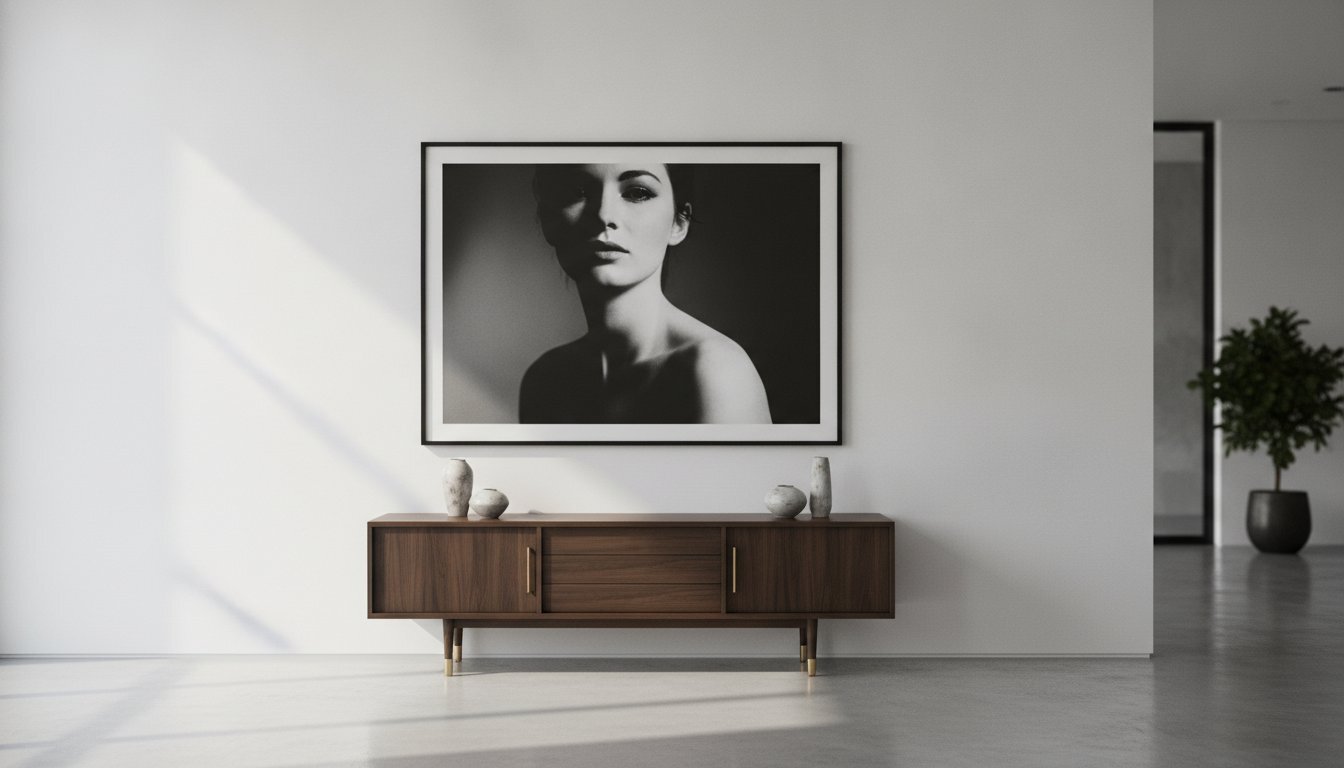
To capture the soul of the 1960s, one didn’t just photograph a celebrity; one had to seduce the lens until the persona dissolved into something raw and permanent. Bert Stern didn’t merely document the ‘Mad Men’ era; he sculpted its mythology through a lens of high-contrast light and intimate dialogue. You likely recognize the ethereal, tragic glow of Marilyn Monroe in his legendary ‘Last Sitting’, a series that remains the gold standard for celebrity portraiture even as it draws crowds to the National Portrait Gallery through September 2026.
It’s natural to feel a deep reverence for these images, yet navigating the transition from admirer to collector can be daunting when mass-produced posters often mask the true brilliance of archival work. This article explores the provocative legacy of a man who redefined the visual landscape of the twentieth century. You’ll gain a sophisticated understanding of his technical style beyond the famous Monroe sessions, learn how his monochrome masterpieces can anchor a curated home gallery, and find the confidence to invest in the enduring value of an archival print. We invite you to step into the studio of a master who turned the flashbulb into a tool of high art.
Key Takeaways
- Understand how Bert Stern evolved from a Madison Avenue advertising visionary into a pioneer of psychological celebrity portraiture.
- Explore the technical and emotional depth of ‘The Last Sitting’, the definitive 1962 Marilyn Monroe collection that remains a pinnacle of photographic art.
- Learn to contrast the raw, high-contrast intimacy of Stern’s work with the aspirational glamour of contemporaries like Slim Aarons to build a balanced fine art collection.
- Discover how to distinguish between mass-market reproductions and museum-quality archival prints by focusing on paper weight and historical authenticity.
- Gain insight into how bespoke framing and white-glove delivery preserve the prestige of iconic photography in a modern luxury home.
Who Was Bert Stern? The Enfant Terrible of Madison Avenue
Bert Stern was the self-taught visionary who essentially drafted the blueprint for the modern creative director. Long before the term became a corporate staple, he was the quintessential “Mad Men” archetype, a man who understood that post-war America didn’t want products; it wanted a mood. His Smirnoff campaign in the 1950s, famously featuring a martini glass reflected against the Egyptian desert, signaled the definitive end of literal advertising. He brought a high-art sensibility to commercial brands, proving that a bottle of vodka could be as evocative as a gallery masterpiece.
According to Bert Stern’s biography, his rise was meteoric, positioning him as a peer to giants like Richard Avedon during the legendary Golden Age of Madison Avenue. While the early 1950s were often defined by a stiff, choreographed formality, the work of bert stern acted as the bridge to the raw, psychological intimacy that would soon define the 1960s. He possessed an uncanny ability to strip away the artifice of celebrity, replacing it with a sense of urgent, tactile reality that felt dangerously new. He didn’t just take pictures. He built worlds.
From Madison Avenue to the Silver Screen
The transition from commercial dominance to cinematic iconography was seamless for a photographer with such a narrative eye. His 1962 poster for Stanley Kubrick’s Lolita, featuring Sue Lyon peering over heart-shaped sunglasses, remains one of the most enduring images in cinema history. This wasn’t merely promotional material; it was a cultural flashpoint that proved Stern could distill an entire film’s tension into a single frame. He used the immense financial rewards of his commercial success to fund his personal obsessions with pure fine art, ensuring he never had to compromise his aesthetic integrity. He earned his reputation as an enfant terrible by treating the rigid protocols of the traditional photography studio as obstacles to be dismantled rather than rules to be followed.
The Californian Light and Modern Sensibility
His approach to light was almost architectural, a technique that set him apart from his contemporaries. He could manipulate the harsh Californian sun or the sterile glow of a studio to create a sculptural feel that gave his subjects a three-dimensional weight. In his high-fashion Vogue editorials, the camera wasn’t a passive observer. Instead, his portraits feel like a collaborative performance, a shared secret between the artist and the muse that transcends the static nature of a pose. This modern sensibility is why his work remains a cornerstone of 20th-century art, offering a level of sophistication that continues to inspire serious collectors today.
The Last Sitting: The Intimacy of Marilyn Monroe
In late June 1962, bert stern checked into the Bel-Air Hotel for a three-day marathon that would produce 2,571 images and a legend that would outlive both the photographer and his subject. This Vogue commission, originally intended as a standard fashion editorial, quickly transformed into a profound psychological study. The resulting collection, known as ‘The Last Sitting’, captured Monroe just weeks before her death, documenting a spectrum of emotion from playful exuberance to haunting melancholy. It remains the definitive portrait of the actress precisely because it refuses to look away from her raw vulnerability.
The sheer volume of work, spanning from the starkly beautiful ‘Nudes’ to the somber ‘Black Veils’, offers a rare look at a woman who was otherwise the most mediated figure on earth. Perhaps the most striking element of this archive is the presence of the ‘X’ marks. Monroe used a hairpin or orange marker to cross out the transparencies she disliked, physically scarring the film. Rather than discarding these, Stern eventually recognized them as a collaborative act of creative defiance, elevating the rejected frames into powerful statements on the nature of fame and self-image. These marked frames have since become some of the most iconic pieces in the collection.
Vogue 1962: A Shift in Celebrity Portraiture
Stern stripped away the heavy Hollywood artifice that had characterized Monroe’s studio career for over a decade. He replaced elaborate sets with simple props; a sheer scarf, a single rose, or a glass of champagne served as the only distractions from the human form. By focusing on the woman beneath the icon, these images redefined the celebrity portrait for the modern era, moving away from idealized perfection toward an honest, often fractured reality. It’s this transition from starlet to human that gives the series its enduring power.
The Sculptural Quality of Monochrome
While the color transparencies offer a vivid warmth, the black and white pictures from this series are frequently the most sought-after by serious collectors. There is a tactile, three-dimensional quality to the monochrome work where the interplay of deep shadow and luminous skin feels almost carved from stone. Stern’s masterful lighting techniques, which emphasized texture over flat beauty, created a sculptural depth that would influence generations of fashion photographers. This enduring aesthetic makes his work a cornerstone for those looking to build a prestigious photography collection that balances historical weight with modern interior appeal.
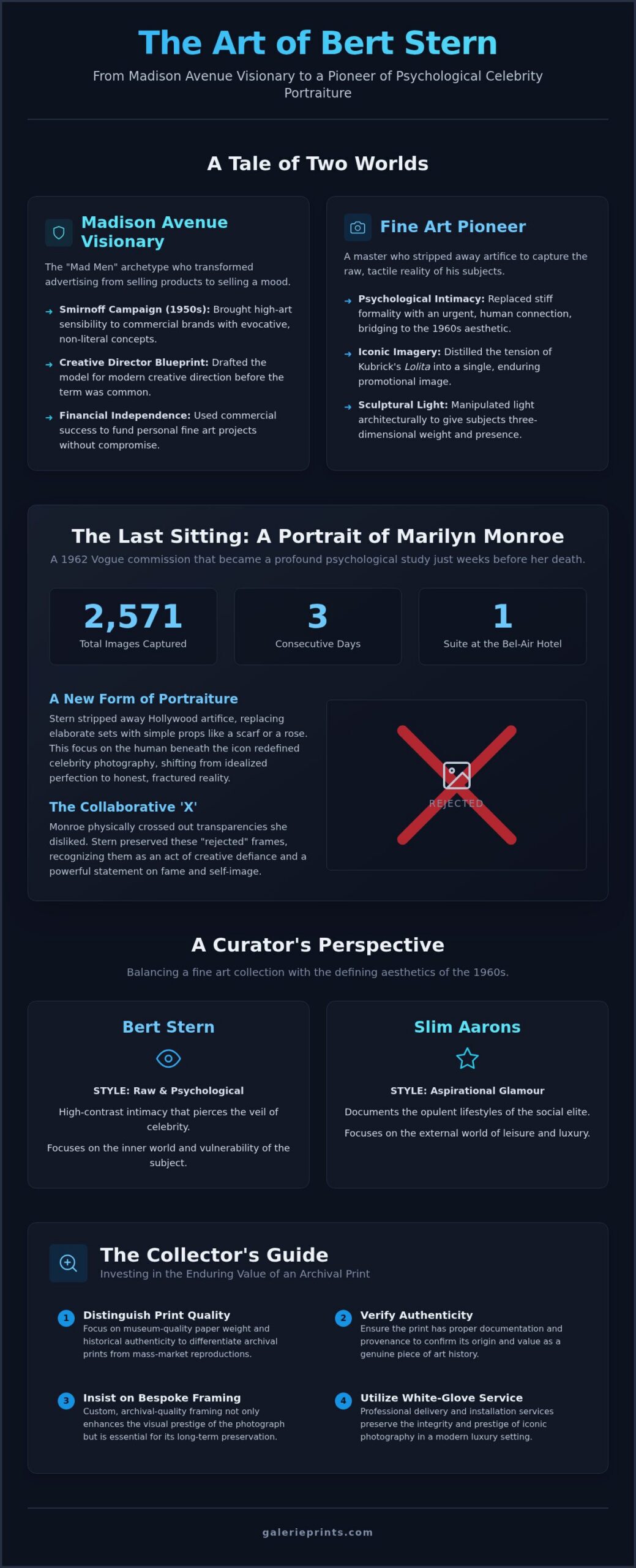
A Curator’s Perspective: Stern, Aarons, and the 60s Aesthetic
Viewing the 1960s through a curatorial lens requires an appreciation for the era’s dual nature. On one hand, we have the “Aspirational Glamour” of Slim Aarons, whose sun-drenched poolside scenes defined a world of leisure and social grace. On the other, we find the “Psychological Intimacy” of bert stern. While Aarons famously photographed “attractive people doing attractive things in attractive places,” Stern went much deeper, seeking the unvarnished truth behind the fame. This tension between grit and polish creates a complete picture of the mid-century dream, making both artists essential pillars of the fine art photography landscape.
The grit of Stern’s close-up work and the polish of Aarons’ wide-angle vistas represent two essential sides of the same coin. Both men were masters of their craft, yet they occupied different emotional territories. Stern’s work often feels like a secret shared in a dimly lit room, while Aarons’ work feels like an invitation to a garden party. For the serious collector, possessing works from both archives allows for a sophisticated dialogue on the walls of a contemporary home, blending the raw humanity of the 1960s with its most polished, aspirational ideals.
The Celebrity as Icon: Stern’s Hall of Fame
Stern’s portfolio extends far beyond his famous hotel room sessions. He was a primary architect of the “youthquake” that shook London and New York, capturing the sharp, gamine features of Twiggy and the timeless elegance of Audrey Hepburn with equal dexterity. In his 1963 portraits of Elizabeth Taylor during the filming of Cleopatra, he managed to find a quiet, regal stillness amidst what was then the most expensive production in cinema history. Before the era of digital saturation, the photographer acted as a star-maker; bert stern didn’t just document fame, he distilled it into a visual language that defined the decade’s iconography.
Building a Cohesive Gallery Wall
The Collector’s Guide: Investing in Bert Stern Prints
Investing in the work of bert stern requires a discerning eye for technical excellence and an understanding of the artist’s enduring market stability. In the two years leading up to May 2026, a remarkable 93% of Stern’s works sold at auction exceeded their low estimates, signaling a robust and active demand among serious collectors. Whether you are drawn to the high-contrast allure of ‘The Last Sitting’ or his revolutionary commercial fashion work, the value of a print is inextricably linked to its production quality. Distinguishing between a digital reproduction and a museum-quality archival print is the first step toward building a collection with lasting financial and aesthetic weight.
Material integrity is non-negotiable for the preservation of photographic heritage. Authentic fine art prints utilize heavy-weight, acid-free archival paper that prevents yellowing and degradation over decades. This substrate allows for the deep, velvety blacks and luminous highlights that define Stern’s sculptural style. Recent market activity reinforces this value; for instance, the print “Arabian Marilyn” (1962) sold for $28,500 at a Christie’s auction in February 2026, more than 23 times its low estimate. Such results underscore why limited editions and authorized posthumous releases from the Bert Stern Trust remain a stable sector for aesthetic investment.
Archival Standards: The Galerie Prints Difference
Our commitment to excellence mirrors the high-end nature of the archives we represent. We utilize traditional production methods and artisanal craftsmanship to ensure every print captures the rich tonal range originally intended by bert stern. By focusing on localized, London-based framing and meticulous mounting, we provide a product that is not merely a decoration but a permanent piece of history. This dedication to material quality ensures that the intimacy and grit of a 1960s session are preserved for future generations. You may find your next centerpiece by browsing our fine art photography collection.
Choosing the Right Scale for Your Space
Large-format portraits possess a unique psychological gravity that can anchor the design scheme of an entire room. In a minimalist setting, a high-impact monochrome print provides a sophisticated focal point, while in a maximalist interior, it offers a moment of structured clarity. The scale of the work should respect the architecture of the space, allowing the subject to command attention without overwhelming the viewer. To maintain the intimate dialogue intended by the photographer, hang high-impact monochrome art so that the vertical center of the print sits at a standard eye level of 57 to 60 inches from the floor.
The Final Touch: Bespoke Framing for Iconic Art
An archival print of this caliber demands more than a standard border; it requires a guardian. Choosing a bespoke framing service is the final, essential step in transforming a photograph into a permanent fixture of your heritage. At Galerie Prints, we treat the framing process as an extension of the curatorial journey, ensuring the physical presentation matches the artistic prestige of the work. Our approach delivers ready-to-hang luxury directly to your door, supported by global white-glove shipping that guarantees the safety of your acquisition. The right frame does more than hold the paper; it acts as a sculptural window that enhances the profound depth of bert stern and his high-contrast monochrome studies.
Protecting your investment is a matter of technical precision. Because Stern’s work often features delicate tonal transitions and deep, velvety blacks, the use of UV-protective glass is non-negotiable to prevent fading from ambient light. We pair this with acid-free mounting and museum-grade materials to ensure the print remains in pristine condition for decades. This meticulous attention to detail preserves the tactile quality of the heavy-weight paper discussed earlier. It provides you with the peace of mind that your piece of history is chemically and physically secure, maintaining its value as a stable aesthetic investment.
Frame Styles for the Modern Curator
Selecting the right profile is a deeply personal part of the collecting process that influences how the art interacts with your space. Minimalist black wood frames are the classic choice for Stern’s sculptural work. They echo the sharp lines and high-contrast shadows of the 1960s aesthetic without competing for attention. Consider these presentation options for your collection:
- Traditional Window Mounting: This method provides a classic, elevated look that signals museum-level prestige and offers a clean border for the eye to rest.
- Oversized Matting: Using a larger mat creates a sense of monumental importance, allowing even a mid-sized print to command the attention of a large room.
- The Gallery Wrap: A more contemporary choice that focuses entirely on the raw, unadulterated impact of the photograph itself.
Creating Your Own Home Gallery
Starting a collection doesn’t require a full gallery wall from day one. You can begin with a single, powerful statement piece from the Monroe series to anchor your space, gradually adding contemporaries like Terry O’Neill or Slim Aarons to build a narrative of 20th-century glamour. Our online customization tool allows you to experiment with different bespoke finishes, ensuring the final product perfectly complements your specific interior decor. This seamless blend of digital convenience and artisanal craftsmanship makes the transition from admirer to collector effortless. Explore our curated collections and begin your journey as a collector today.
Curating a Legacy of 1960s Iconography
The legacy of bert stern represents a definitive visual rebellion, a narrative that transitioned from the polished artifice of Madison Avenue to the profound psychological depth of ‘The Last Sitting’. He didn’t just document the icons of his era; he sculpted their humanity into permanent, high-contrast mythology. This journey into the raw soul of the 1960s offers more than mere nostalgia; it provides a foundational anchor for any sophisticated home gallery.
Securing such a piece isn’t simply an act of decoration but an investment in photographic heritage. We offer museum-quality archival prints that ensure the longevity of Stern’s vision, paired with bespoke framing by artisanal craftsmen to meet the highest gallery standards. Our worldwide shipping provides ready-to-hang art delivered with the precision and care your collection demands. This balance of technical excellence and historical significance ensures your acquisition remains a stable and evocative centerpiece for years to come.
Discover Iconic Bert Stern Fine Art Photography and Bespoke Framing at Galerie Prints and begin your own journey into the evocative world of mid-century iconography. Embrace the opportunity to own a fragment of history and let these powerful images redefine your interior landscape.
Frequently Asked Questions
Who was Bert Stern and why is he famous?
Bert Stern was a self-taught American commercial and fashion photographer who revolutionized the visual language of Madison Avenue during the 1950s and 60s. He is most famous for bridging the gap between stiff, formal portraiture and a new era of raw, psychological intimacy. His ability to distill a subject’s soul into a single, high-contrast frame made him a primary architect of 20th-century celebrity iconography.
What is ‘The Last Sitting’ with Marilyn Monroe?
‘The Last Sitting’ is a legendary archive of 2,571 photographs taken over a three-day period at the Bel-Air Hotel in June 1962. Originally a Vogue commission, these images captured Monroe in a state of unprecedented vulnerability just six weeks before her death. The collection includes everything from playful nudes to somber portraits, remaining the most sought-after and definitive series in photographic history.
Are Bert Stern prints a good investment for art collectors?
Yes, bert stern prints have demonstrated exceptional market resilience, with 93% of his works sold at auction exceeding their low estimates in the two years leading up to May 2026. The enduring cultural significance of his Marilyn Monroe series, combined with strong sell-through rates at major auction houses, makes his archival work a stable and prestigious choice for serious aesthetic investment.
Why did Bert Stern shoot almost exclusively in black and white for his fine art?
He utilized monochrome to emphasize the sculptural and tactile qualities of his subjects, stripping away the distraction of color to focus on the interplay of light and shadow. While he produced vibrant color work for commercial editorials, his black and white photography is prized by collectors for its timeless depth. This high-contrast approach gives the images a carved, three-dimensional quality that color simply cannot replicate.
How can I tell if a Bert Stern print is archival quality?
Archival quality is determined by the use of heavy-weight, acid-free paper and specialized production methods that ensure the longevity of the image. Museum-grade prints resist the yellowing and fading common in mass-market reproductions. When you invest in an archival print, you’re purchasing a piece of history that has been crafted to maintain its tonal richness and material integrity for decades.
What is the best way to frame a black and white photography print?
The most sophisticated presentation involves a minimalist black wood frame paired with acid-free, oversized matting to create a sense of museum-level prestige. It’s essential to use UV-protective glass to shield the delicate blacks and luminous whites from light damage. This bespoke approach ensures the frame acts as a window that enhances the depth of the work rather than a distraction from it.
What influenced Bert Stern’s sculptural photography style?
His style was heavily influenced by his early background in graphic design and the creative rebellion of the Golden Age of Madison Avenue. bert stern rejected traditional studio rules, opting instead to manipulate natural light to create a sense of physical weight and three-dimensional form. This architectural approach to the human face transformed his portraits into collaborative performances that felt dangerously modern for their time.
Can I buy ready-to-hang Bert Stern prints at Galerie Prints?
Yes, we offer a curated selection of fine art photography prints that can be paired with our bespoke framing service for a complete, luxury presentation. Every piece is handled by artisanal craftsmen and delivered with global white-glove shipping. This ensures your acquisition arrives in pristine condition and is ready to be displayed as a centerpiece in your curated home gallery immediately upon arrival.