

Investing in limited edition prints is about more than acquiring a restricted run of paper; it’s about securing a tangible bridge to a specific historical moment, preserved through the meticulous lens of artisanal craftsmanship. You likely appreciate the quiet prestige that a Slim Aarons or Terry O’Neill piece brings to a room, yet the fear of accidentally purchasing a low-quality reproduction can be paralyzing. It’s natural to feel a sense of hesitation when faced with technical art world terminology like Silver Gelatin or Artist’s Proofs. You want your collection to reflect a sophisticated lifestyle, not a lack of discernment.
This guide will empower you to navigate the nuances of fine art photography with the confidence of a seasoned curator. We’ll explore how to identify authentic photographic heritage, understand the critical importance of archival quality, and master the art of preserving your collection through bespoke framing. You’ll learn to distinguish between a simple image and a lasting piece of history, ensuring your home interior remains as authentic as the stories captured within each frame.
Key Takeaways
- Master the nuanced terminology of the art world, including the distinction between numbered runs and Artist’s Proofs, to understand the true scarcity of your acquisition.
- Identify collector-grade materials like silver gelatin and museum-quality paper that ensure your limited edition prints maintain their historical integrity and visual depth.
- Evaluate the enduring market appeal of world-renowned archives, such as the Slim Aarons Collection, to differentiate between simple decoration and long-term photographic heritage.
- Discover how bespoke framing and professional environmental management protect your investment from degradation while elevating the print to a gallery-standard centerpiece.
- Connect with a curated legacy of photographic excellence, ranging from Terry O’Neill’s portraits to rare music archives, through the lens of expert curatorial guidance.
The Allure of Scarcity: What Defines Limited Edition Prints?
A limited edition print is far more than a mere reproduction. It represents a definitive, curatorial choice to restrict the number of impressions produced from a single image, ensuring that each piece remains a rare artifact. This scarcity isn’t just a marketing tactic; it’s a foundational principle of the art market that preserves both the financial value and the emotional weight of the work. By transitioning from a historical negative, often housed in renowned historical archives, to a finished print, Galerie Prints transforms a fleeting moment into a tangible piece of history.
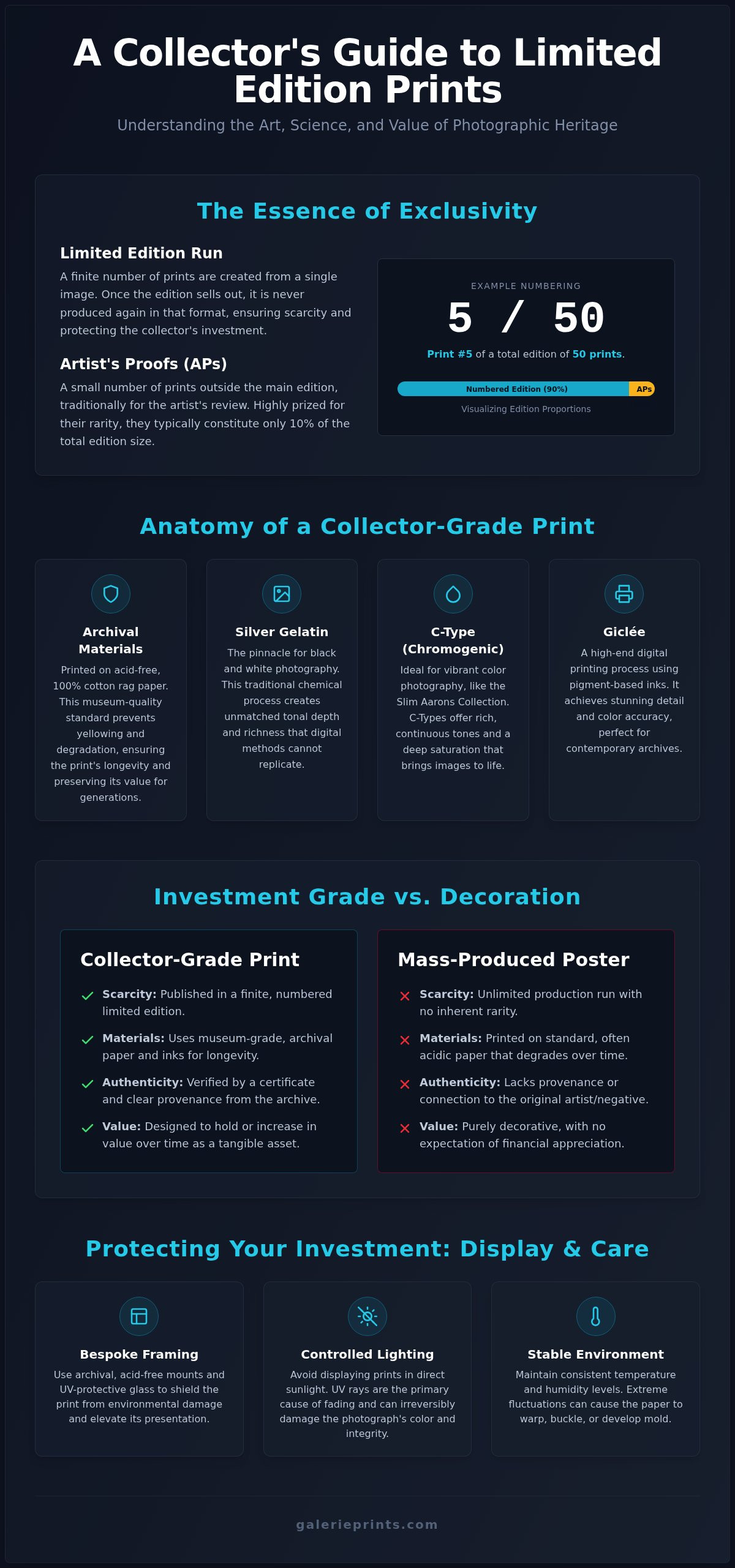
Traditional editions also include “Artist Proofs”, or APs. These prints sit outside the regular numbered sequence. Historically, they were the first impressions pulled from the negative, reserved for the artist to inspect the technical quality. Today, they remain highly sought after by serious collectors because of their proximity to the creator’s original vision and their even greater rarity, usually comprising only 10% of the total edition size.
Understanding the Numbering System
When you examine the margin of one of our limited edition prints, you’ll find a fraction, such as 5/50. The first number identifies the specific print in the sequence; the second indicates the total size of the edition. While modern production ensures that the 50th print is as technically perfect as the first, lower numbers often command a higher level of prestige among seasoned aficionados. The most critical aspect of this system is its finality. Once an edition sells out, Galerie Prints will never produce that image in that format again. This closure protects your investment, ensuring the market isn’t flooded with subsequent copies that would dilute the work’s exclusivity.
The Emotional Value of Photographic Heritage
Owning a curated gallery print allows you to possess a physical link to a bygone era of elegance. Unlike a mass-produced poster, which lacks depth and historical soul, these works are produced using archival methods that honor the original source material. Whether it’s the sun-drenched poolside scenes of the Slim Aarons Collection or the intimate celebrity portraits by Terry O’Neill, these images evoke a sense of nostalgia that transforms a home interior.
Authenticity is anchored by the concept of provenance. In the context of photographic archives, provenance is the documented history of a print’s origin and ownership, providing an unbroken chain of custody that verifies its status as a genuine piece of art. This transparency is what gives a collector the confidence to build a legacy, knowing they’re a guardian of a specific moment in time.
The Anatomy of a Collector-Grade Print: Quality and Authenticity
A collector-grade print is a sophisticated marriage of historical narrative and material excellence. While the concept of scarcity defines the market value, the physical reality of limited edition prints is anchored in the technical precision of their production. At Galerie Prints, we treat the transition from original negative to paper with the reverence it deserves, ensuring that the tactile quality of the work matches its visual prestige. Each piece isn’t just an image; it’s a physical artifact built to withstand time through the use of museum-grade materials.
Understanding the medium is essential for any discerning collector. Silver Gelatin prints remain the zenith for black and white photography, utilizing a traditional chemical process where silver salts are suspended in a gelatin layer to create unmatched tonal depth. For the vibrant, sun-drenched hues often found in the Slim Aarons Collection, C-Type (Chromogenic) prints offer a rich, continuous tone that digital alternatives struggle to replicate. Giclée prints, meanwhile, utilize high-end pigment inks to achieve a level of detail and color accuracy that brings contemporary music archives to life with stunning clarity.
Archival Standards and Longevity
Acid-free, 100% cotton rag paper is a non-negotiable requirement for serious collectors. Without this standard, the paper’s internal chemistry will eventually cause yellowing and degradation, destroying the work’s long-term value. You can often identify museum-quality production by the sheer weight and fiber-rich texture of the paper, which provides a physical presence far removed from the thin, glossy surfaces of commercial posters. Modern pigment inks also prevent “bronzing,” a common defect in lower-quality reproductions where ink pools on the surface to create a distracting metallic sheen. You can explore our commitment to these standards by browsing the Terry O’Neill Photography archive.
Verification: The Certificate of Authenticity
Authenticity is the cornerstone of any serious collection. Every piece must be accompanied by a Certificate of Authenticity (COA) that details the edition number, the specific production method, and the archive of origin. For legendary figures such as Terry O’Neill or Slim Aarons, the presence of an estate signature or an embossed stamp acts as an ironclad guarantee of heritage. An estate stamp serves as a definitive seal of approval from the artist’s representatives, confirming that the work meets the rigorous standards established during the creator’s lifetime. This layer of verification ensures that your acquisition is not just a beautiful object, but a legitimate piece of photographic history that will retain its significance for generations.
Investment vs. Decoration: Navigating the Fine Art Market
Distinguishing between a temporary trend and a lasting asset is the hallmark of a discerning collector. While open editions offer an accessible entry point into the visual arts, they lack the finite supply that anchors the long-term value of a true collection. In contrast, limited edition prints represent a strategic commitment to rarity, ensuring that the work you acquire doesn’t become a ubiquitous commodity. This distinction is why heritage photography continues to command such respect in high-end circles; these pieces aren’t just images, but restricted artifacts of a cultural legacy that grows more significant as the physical negatives age.
The “lifestyle” factor plays a critical role in how aspirational photography influences interior value. It’s about more than just matching a color palette; it’s about the psychological weight a piece carries within a room. When you choose a work that evokes a specific era of prestige, you aren’t just decorating a wall. You’re installing a silent ambassador of your own aesthetic standards. This intersection of personal taste and market stability is what separates a curated home from one that simply follows the latest retail trends.
The Slim Aarons Phenomenon
Few photographers have captured the essence of high society with the same effortless grace as Slim Aarons. His philosophy of photographing “attractive people doing attractive things in attractive places” has become the definitive gold standard of aspirational decor. These images serve as a curated window into a golden era of leisure, offering a sense of nostalgia that is both evocative and deeply stylish. Because we maintain official access to world-renowned photographic archives, our collection offers authorized prints that preserve the integrity of the original vision. For a deeper look into why his work remains a cornerstone of the modern gallery, explore our Slim Aarons: The Definitive Guide.
Collecting Niche Icons: Cinema and Music
Beyond the sun-soaked poolsides of the Mediterranean, niche icons offer another compelling avenue for those looking to build a multi-layered collection. Star Wars Limited Edition Prints, for instance, bridge the gap between cinematic history and fine art, appealing to those who value the intersection of pop culture and prestige. Similarly, our Music Archives and the iconic work of Terry O’Neill capture the raw energy of cultural shifts, from the birth of rock and roll to the height of Hollywood’s glamour. These works are essential because they resonate with personal passions while maintaining their status as high-caliber visual art. For those drawn to the stark elegance of monochrome, The Timeless Allure of Black and White Pictures offers further guidance on building a cohesive and evocative collection.
Curating Your Space: A Guide to Displaying Limited Editions
Once you’ve secured a piece of photographic heritage, the challenge shifts from selection to presentation. A limited edition print requires a setting that respects its provenance and ensures its longevity. It’s a delicate balance between visual impact and physical preservation. Improper placement can turn a prized asset into a fading memory; therefore, understanding the environment of your home is just as vital as understanding the art itself. Lighting remains the most critical factor. While it’s tempting to place a vibrant Slim Aarons poolside scene in a sun-drenched lounge, direct UV exposure leads to pigment degradation. We recommend using museum-grade glass to filter out harmful rays. Humidity also matters. Avoid hanging your collection on external walls or near heat sources where fluctuating temperatures can cause the paper to ripple or cockle.
The Importance of Bespoke Framing
Professional framing is far more than a finishing touch; it’s an investment in the print’s future. Off-the-shelf frames often utilize acidic backing boards that slowly burn the paper over time. Our Bespoke Framing Service utilizes acid-free mounts and specialized spacers that prevent the print from touching the glass, allowing the paper to breathe. This artisanal approach, handled by our London-based experts, ensures your artwork arrives in a ready-to-hang state. It provides a polished, gallery-standard finish that commands authority in any room while protecting the material integrity of your limited edition prints.
Designing with Intent: The Gallery Wall
A successful gallery wall tells a cohesive story. You might mix the stark, monochromatic intensity of Terry O’Neill’s portraits with the lush, saturated colors of the Slim Aarons Collection. To maintain a sophisticated narrative, use consistent frame materials or mount colors across the display. Scale is equally important. A single, large-format print often makes a stronger statement than several smaller pieces. Don’t be afraid to integrate rare cinema lobby cards into the mix. Their smaller size and unique graphics add a layer of texture and historical intrigue to a contemporary arrangement.
Planning a layout requires precision to avoid damaging your walls. Follow these steps for a flawless installation:
- Measure your wall space and mark the boundaries on the floor using masking tape.
- Arrange your framed prints within this floor boundary until the composition feels balanced.
- Trace each frame onto brown craft paper and cut out the templates.
- Tape these templates to the wall to visualize the final layout.
- Once satisfied, hammer your picture hooks directly through the paper templates for perfect placement.
The Galerie Prints Collection: A Legacy in Ink
Galerie Prints operates with a singular mission: to serve as a bridge between the modern collector and the effortless elegance of the past. We don’t merely sell photography; we curate a legacy in ink. By positioning ourselves as guardians of photographic heritage, we offer more than just wall decor. We provide an entry point into a world of cultural significance. Our curated archives span the breadth of twentieth-century glamour, from the definitive Terry O’Neill Photography collection to our extensive Music Archives. This curatorial authority ensures that every piece selected for our gallery meets the highest standards of historical and technical excellence.
From Hollywood to London: Global Reach, Artisanal Touch
The journey of a print begins in world-renowned archives but finds its physical form in our artisanal London workshop. Here, every image is meticulously handled by experts who understand the nuances of traditional production methods. We take immense pride in our localized, high-end craftsmanship, which serves as a seal of quality for every acquisition. This dedication extends to our sourcing of unique historical items, such as original Cinema Lobby Cards, which offer a tactile connection to the golden age of film. We’ve designed the experience to be seamless, guiding you from the initial online selection through to the delivery of a bespoke framed masterpiece. It’s a professional, polished process that ensures you feel practically supported while remaining intellectually stimulated by the art itself.
Building Your Collection with Galerie Prints
Starting a collection can feel daunting, but we’re here to act as your trusted guide. Whether you’re a first-time buyer or a seasoned aficionado, we provide personalized advice to help you select pieces that resonate with your personal narrative. We believe that a purchase from our gallery shouldn’t be a fleeting decoration. Instead, it should be a lasting piece of history that brings a sense of permanence and stability to your home. By investing in limited edition prints, you’re securing a work that will retain its cultural weight for generations. Each print we produce is a testament to our commitment to material quality and historical authenticity, ensuring your collection reflects a sophisticated, aspirational lifestyle.
Ready to begin your journey into the world of fine art photography? Explore our full collection of Limited Edition Prints and discover the piece that will anchor your home’s aesthetic.
Building Your Legacy in Fine Art
Securing a sophisticated home interior requires a discerning eye for quality and a deep respect for photographic heritage, a principle that ensures every acquisition transcends simple decoration. By mastering the nuances of archival standards and the significance of official provenance, you ensure your collection remains a source of enduring prestige for years to come. It’s about more than just filling wall space; it’s about acting as a guardian for a specific historical moment, preserved through artisanal care. Galerie Prints supports this journey by offering official archive-sourced photography that’s meticulously hand-finished in our London workshop, utilizing only museum-quality archival materials to guarantee that every piece retains its brilliance for generations.
Investing in limited edition prints allows you to own a tangible piece of history that reflects your commitment to technical excellence and timeless elegance. Whether you’re drawn to the sun-soaked poolsides of mid-century leisure or the raw energy of legendary music archives, each acquisition is a step toward a more cultured, aspirational lifestyle. We invite you to discover the perfect anchor for your collection and begin your own curatorial journey today.
Browse our curated collection of Limited Edition Prints
Frequently Asked Questions
What is the difference between a limited edition and an open edition print?
A limited edition print is produced in a strictly fixed quantity, while an open edition can be reproduced indefinitely. This restriction creates a ceiling on supply that directly supports the work’s long-term value. Open editions are typically treated as decorative items rather than collectible assets. By choosing a limited run, you’re investing in a piece of art that maintains its exclusivity and historical integrity within the fine art market.
How do I know if a limited edition print is authentic?
Authenticity is verified through a combination of physical markers and documentation. Look for hand-numbering in the margin, embossed estate stamps, or the artist’s signature. Every piece we offer is sourced directly from official archives, such as the Slim Aarons or Terry O’Neill collections. These physical cues, paired with a formal Certificate of Authenticity, provide the necessary provenance to confirm the print’s status as a genuine gallery-grade artifact.
Why are some limited edition prints more expensive than others?
Several factors influence the pricing of a print, including the artist’s prestige, the size of the edition, and the complexity of the production process. A smaller edition run of 25 will always carry a higher premium than a run of 150. Technical mediums also matter. Traditional silver gelatin prints require more artisanal labor and specialized chemistry than modern digital methods, reflecting the technical superiority and tactile depth that serious collectors demand.
Can a limited edition print be reprinted once it sells out?
No, a true limited edition cannot be reprinted once the numbered set is exhausted. This finality is a core principle of the art world that protects your acquisition. The gallery makes a legal and ethical commitment to never produce that image in that specific format again. This ensures that limited edition prints remain rare assets rather than becoming common, mass-produced commodities over time.
What does “Artist Proof” (AP) mean on a limited edition print?
The “Artist Proof” is a print produced outside the regular numbered sequence, historically reserved for the creator’s personal use or quality inspection. These pieces are often more valuable because they’re even rarer than the standard edition, typically representing only 10% of the total run. Collectors prize APs for their proximity to the artist’s original vision and their status as a unique subset of the photographic heritage.
How should I clean and maintain my limited edition prints?
Maintenance should be minimal and non-invasive. Never apply water or cleaning chemicals directly to the print or the frame. If the glass requires cleaning, use a small amount of specialized glass cleaner on a microfiber cloth, ensuring no liquid seeps under the frame edges. It’s best to keep the work in a climate-controlled room away from extreme humidity or direct UV light to preserve the archival inks.
Does Galerie Prints provide a Certificate of Authenticity?
Every acquisition from Galerie Prints is accompanied by a formal Certificate of Authenticity. This document acts as an essential trust signal, detailing the print’s origin, the edition number, and the specific production technique used. It provides an unbroken chain of provenance that is vital for insurance purposes and future valuations. We take our role as guardians of photographic heritage seriously, ensuring your investment is fully documented.
Is bespoke framing necessary for limited edition photography?
Bespoke framing is vital if you want to protect the material integrity of your investment. Standard, off-the-shelf frames often contain acidic components that lead to yellowing or “burning” of the paper over time. Our bespoke service utilizes museum-grade, acid-free materials and specialized spacers that prevent the print from touching the glass. This artisanal approach ensures your limited edition prints are preserved in a stable, archival environment that prevents degradation for decades.