
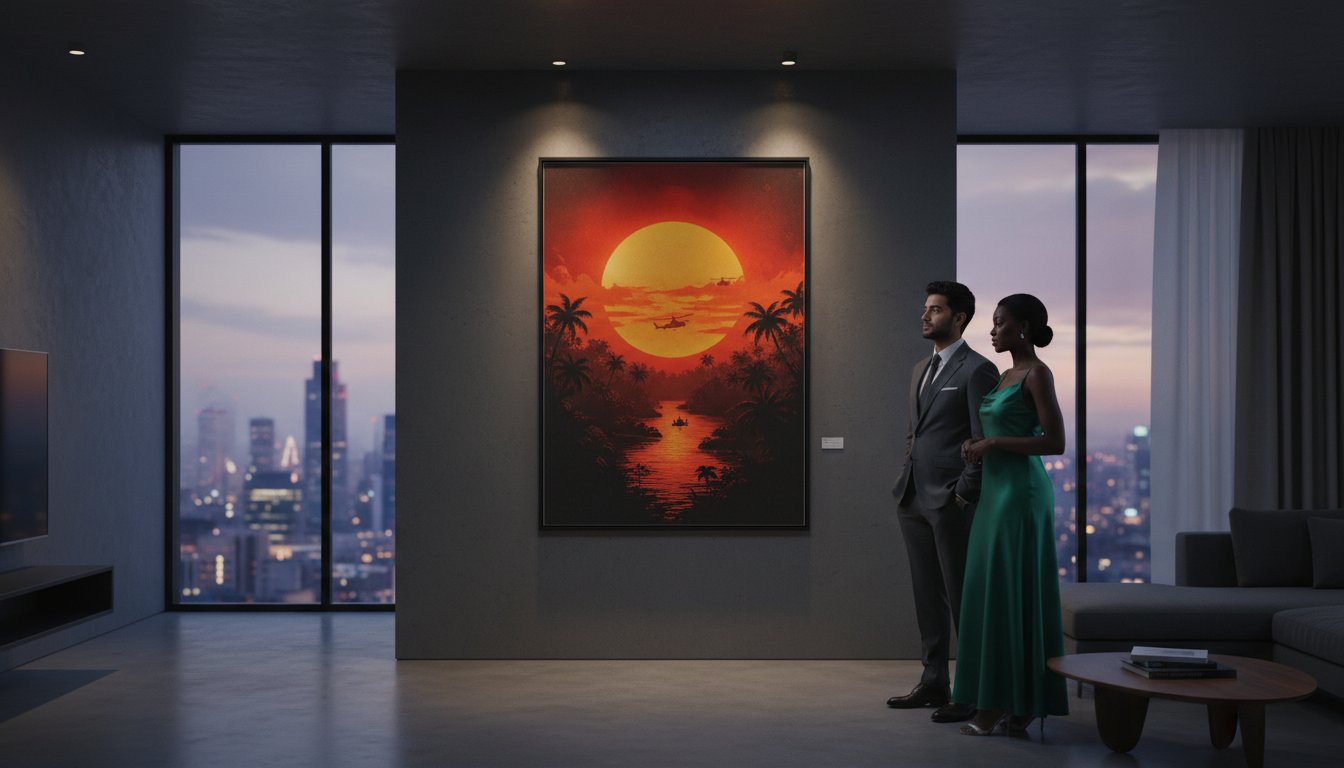
To look at the original apocalypse now poster is to feel the humid heat of the jungle and the psychological weight of madness before a single frame of Francis Ford Coppola’s 1979 epic even flickers to life. You’ve likely felt the frustration of seeing this visceral imagery reduced to grainy, low-resolution reprints that fail to honor the artist’s intent. As a discerning collector, you recognize that a masterpiece of this caliber demands a display that mirrors its prestige; not a mass-produced afterthought from a high-street retailer.
In this guide, we’ll delve into the legendary illustrations of Bob Peak, the man who defined 20th-century film promotion, to understand how his 1979 compositions became the definitive visual shorthand for the Vietnam War. You’ll discover the essential criteria for selecting an archival-quality print, ensuring the provenance and technical excellence of your acquisition. We’re exploring the intersection of cinematic history and interior aesthetics, providing the insight you need to secure a bespoke, gallery-grade piece that transforms your home office or media room into a curated space of historical significance.
Key Takeaways
- Understand how the operatic scale of Francis Ford Coppola’s production influenced the creation of cinema’s most enduring and evocative war imagery.
- Explore the technical mastery of Bob Peak and the symbolic depth behind the legendary apocalypse now poster “River and Sun” design.
- Learn why archival-quality materials and premium textures are essential for preserving the historical provenance and visual impact of your fine art investment.
- Discover expert techniques for framing and positioning your print to transform a home office or media room into a sophisticated private gallery.
- Gain insight into the meticulous hand-printing processes used by master curators to create museum-grade tributes to cinematic history.
The Visual Legacy of Francis Ford Coppola’s War Epic
Francis Ford Coppola’s 1979 masterpiece didn’t just redefine the war genre; it shattered the existing visual vocabulary of cinema. The production, famously plagued by typhoons and a budget that ballooned to $31 million, demanded a marketing presence that could match its operatic intensity. The apocalypse now poster emerged not as a simple advertisement, but as a gateway into a hallucinatory fever dream. It moved away from the gritty, documentary style of earlier 1970s combat films, opting instead for a curated, surrealist aesthetic that captured the film’s descent into madness. This imagery helped establish a visual shorthand for the Vietnam War that persists in our cultural consciousness today.
Beyond the Battlefield: The Surrealism of 1979
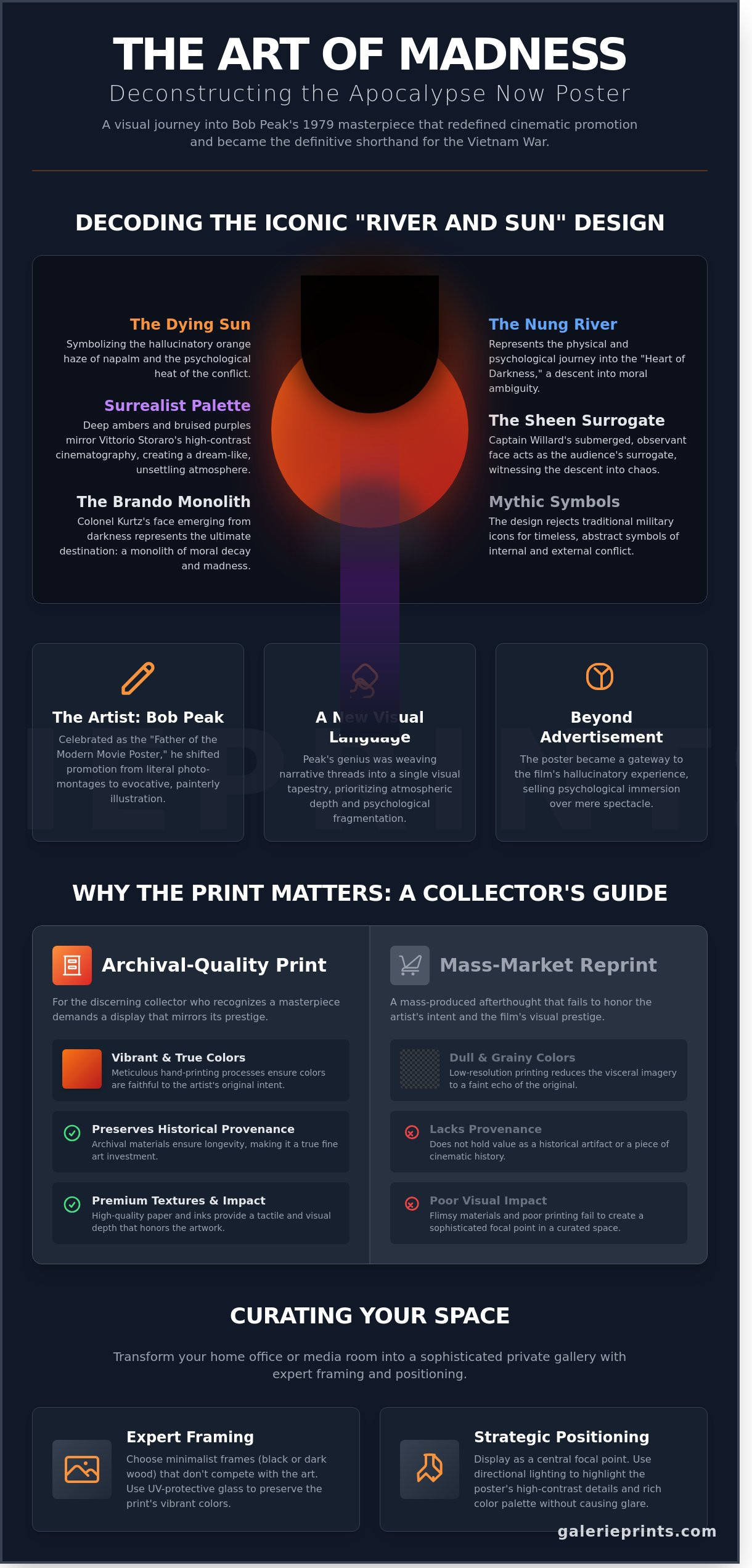
Vittorio Storaro’s cinematography, characterized by high-contrast chiaroscuro and a palette of deep ambers and bruised purples, dictated the film’s marketing language. The original campaign, much of which is detailed on Apocalypse Now on Wikipedia, rejected standard action shots of soldiers in favor of evocative, painterly compositions. Instead, the artwork focused on atmospheric motifs: the thick, orange haze of napalm, the reflective stillness of the Nung River, and the silhouettes of helicopters against a dying sun. These choices elevated the film from a historical account to a timeless piece of visual art. The marketing avoided the loud tropes of the era, choosing to sell an experience of psychological immersion rather than mere spectacle.
The Enduring Power of the Brando/Sheen Contrast
The primary apocalypse now poster designs rely on a profound psychological weight, anchored by the juxtaposed faces of Marlon Brando and Martin Sheen. Brando’s shaved head, emerging from the shadows as Colonel Kurtz, represents the ultimate end of the river journey. It acts as a monolith of moral decay. In contrast, Sheen’s Willard, often depicted submerged or in a state of intense observation, serves as our surrogate in this descent. This specific use of portraiture bridges the gap between commercial graphic design and the world of Fine Art Photography, where the human face becomes a landscape of its own, rich with unspoken narrative.
The legacy of these images is found in their ability to evoke a sense of dread and wonder simultaneously. By 1979, the American public was exhausted by newsreel footage of the war. Coppola and artist Bob Peak realized that to capture the “heart of darkness,” they needed something more abstract. They created a look that combined several key elements:
- Vibrant, unnatural color palettes that suggested a drug-induced haze.
- Symbolic layering of faces and landscapes to represent internal conflict.
- A rejection of traditional military iconography in favor of mythic, timeless symbols.
This approach ensured the film’s place in the history of archival excellence, turning a chaotic production into an enduring icon of prestige cinema. It remains a masterclass in how to translate complex, operatic themes into a single, static image that commands attention decades later.
Decoding the Artistry: The Iconic Bob Peak Designs
Widely celebrated as the “Father of the Modern Movie Poster,” Bob Peak fundamentally transformed how audiences perceived cinematic promotion during the late 1970s. His work on the apocalypse now poster represents a pinnacle of this evolution, moving away from the literal photo-montage styles of the 1960s toward a more evocative, illustrative approach. By exploring The Art of Bob Peak, one discovers a creator who prioritized atmospheric depth over simple character placement. His “painterly” style defined a new era of film art, utilizing expressive brushwork and light to create a sense of movement that static photography often lacked.
Peak’s genius lay in his ability to weave disparate narrative threads into a single, cohesive visual tapestry. In the 1979 campaign, he used vibrant, almost hallucinatory oranges and deep ochres to mirror the film’s descent into psychological fragmentation. These unnatural hues don’t just decorate the page; they signal the madness of the Vietnam conflict through a lens of high-art abstraction. Collectors often seek these original prints for their historical provenance, recognizing them as essential artifacts of 20th-century graphic design that bridge the gap between commercial art and fine gallery pieces.
The “Sun and River” Motif
The central verticality of the Nung River serves as the composition’s spine, drawing the eye upward into a journey toward the soul’s darker recesses. At the apex, the setting sun acts as a terrifying halo for Colonel Kurtz, stripping away his humanity to reveal a deity of war. Peak’s technique of layering faces like Captain Willard into the river’s reflection creates a dreamlike state that captures the film’s surrealist pacing. It’s a departure from the grit of 1960s realism, opting instead for a lush, archival quality that feels timeless.
Variant Designs: From “Redux” to International Releases
While the original 1979 US one-sheet remains the standard, the 2001 Redux version and international variants offer fascinating departures. The Polish and Japanese posters, for instance, lean into more abstract interpretations of horror, often stripping away the Hollywood sheen for something more visceral and unsettling. These rare variants are now highly sought-after cinema lobby cards and posters. For those looking to build a serious collection, exploring curated cinema archives provides a gateway to these rare historical moments. The technical superiority of these early printings, often involving complex lithographic processes, ensures their lasting value in the art market.
- 1979 Original: Defined by Peak’s warm, golden palette and the iconic “River and Sun” layout.
- 2001 Redux: Features a more high-contrast, modern aesthetic while maintaining the core Peak elements.
- Polish Variant: Known for its stark, avant-garde imagery that emphasizes the psychological toll of war.
Archival Quality vs. Mass Market: Why the Print Matters
When acquiring a piece of cinematic history, the distinction between a mass-produced reprint and an archival-grade work is profound. A standard, thin-gloss apocalypse now poster often loses the soul of the original work, failing to capture the visceral intensity of the 1979 masterpiece. True collectors understand that the investment lies in the medium itself. Premium, heavy-weight paper offers a tactile depth that avoids the distracting glare of cheap plastic coatings. It’s the difference between a fleeting image and a permanent fixture of a refined interior. The weight of the paper alone, often exceeding 300gsm, provides a structural integrity that prevents the unsightly rippling common in lower-tier products.
Precision in color accuracy is where the archival difference becomes most visible. Bob Peak’s legendary design relies on a specific, brooding palette of scorched oranges and deep, blood-reds that represent the film’s descent into madness. By exploring Artist Bob Peak’s Art, Career & Background, one appreciates how his painterly style demands high-fidelity reproduction. Pigment-based inks ensure these hues remain vibrant for decades. In contrast, dye-based alternatives found in mass-market prints often begin to shift or fade within 24 months of light exposure. An apocalypse now poster from a curated source isn’t just a decoration; it’s a testament to the artist’s original intent.
The Science of Archival Giclée Printing
Giclée printing is the gold standard for reproducing fine art with a level of detail that traditional lithography cannot match. This process uses a minimum of 12 distinct pigment colors to create smooth gradients and rich blacks. At Galerie Prints, we utilize acid-free, museum-grade materials to prevent the yellowing that plagues cheap paper over time. Our London-based craftsmanship ensures that every print meets the rigorous standards of a cinematic archive. This technical excellence guarantees a lifespan of over 100 years in typical indoor conditions.
Avoiding the “Dorm Room” Aesthetic
Transforming a space requires moving beyond the “tacked-up” look associated with temporary dwellings. A mounted gallery piece commands a room with its structural presence and sophisticated finish. Large-format prints act as focal points in luxury settings, providing a sense of permanence and authority. For those who appreciate a more minimalist or classic approach, the Timeless Allure of Black and White Pictures offers insight into how monochromatic variants can provide a similarly powerful impact.
- Longevity: Pigment inks resist UV degradation for a century.
- Tactility: Textured, heavy-weight paper adds physical depth.
- Integrity: Acid-free fibers prevent chemical breakdown and discoloration.
Curating Your Space: How to Frame and Display the Epic
To own an original apocalypse now poster is to possess a fragment of cinematic history. It demands a presentation that respects its 1979 origins while ensuring its longevity for the next 50 years. We recommend placing this large-scale work in a dedicated media room or a quiet home office. These spaces act as a private theatre where the poster’s heavy, atmospheric tension can breathe without competing with domestic clutter. A 5cm acid-free mount provides the necessary “breathing room,” preventing the ink from touching the glass and creating a visual buffer that draws the eye into the sunset-drenched horizon of the Mekong Delta.
Lighting is the final, critical step in your curation. Because the apocalypse now poster relies on deep blacks and subtle shadow detail, overhead glare can ruin the immersion. Position your lighting at a 45-degree angle to the print or use dedicated museum-grade spotlights. We suggest bulbs with a 3000K color temperature to enhance the warmth of the orange and red hues without washing out the darker gradients of the jungle canopy.
Bespoke Framing: The Galerie Prints Standard
Our London darkroom heritage informs every framing choice we make. For this specific film, we recommend hand-stained black ash or dark walnut wood frames. These materials echo the organic, rugged textures of the 1970s aesthetic. We exclusively use glass with 99% UV protection. This is vital for preserving the volatile red pigments that define the film’s visual identity, ensuring they don’t fade into a pale pink over time.
Interior Design Styles that Suit War Cinema
This artwork thrives within Industrial or Brutalist interiors where raw concrete and exposed steel mirror the film’s gritty realism. It also pairs beautifully with Mid-Century Modern furniture, particularly Eames-style leather loungers and dark teak sideboards. If you’re building a “Cinema Wall,” combine the main poster with original 8×10 inch lobby cards to create a narrative flow that captures the scale of Coppola’s vision.
Ready to elevate your collection with archival-grade presentation? Explore our bespoke framing services to find the perfect match for your cinematic investment.
The Galerie Prints Collection: A Curated Tribute to History
At Galerie Prints, we don’t merely sell images; we curate a legacy. Our archive represents a meticulously selected assembly of the world’s finest photography and cinematic art. When you acquire an apocalypse now poster from our collection, you’re securing a piece of cultural provenance that has been vetted for its historical significance and visual impact. We act as a bridge between the golden age of cinema and the modern collector’s home; we ensure every piece resonates with the same intensity today as it did during its original release in 1979.
The journey from our gallery to your wall is one of dedicated craftsmanship. Once you select your artwork, our team in the London workshop begins the bespoke framing process. We offer a variety of hand-finished frames, specifically chosen to complement the atmospheric weight of cinematic art. This isn’t a mass-produced product. It’s a tailored experience where your artwork is handled with the precision of a museum artifact, ensuring it arrives ready to serve as a focal point in your interior.
Hand-Printed Excellence in London
Every print we produce is a testament to artisanal precision. We utilize a hand-printed archival process in our London darkroom that elevates a standard reproduction into a gallery-grade investment. This Galerie Prints seal of quality guarantees that the tonal depth and contrast of your apocalypse now poster remain preserved for decades. Under the curatorial vision of Stuart Möller, who has spent over 22 years refining our film and photography archives, each piece undergoes a rigorous selection process. We invite you to explore our broader cultural offerings, including our curated collection of Music Photography, to find pieces that capture the same raw soul and energy found in cinema’s greatest masterpieces.
Owning a piece from this collection offers more than aesthetic pleasure; it’s an emotional connection to a moment in time when filmmaking reached its zenith. These prints aren’t just decorations. They’re lasting pieces of history that hold their value through technical excellence and timeless appeal. Investing in our archival prints means you’re preserving a narrative that will continue to inspire wonder and nostalgia for generations. We take pride in being the guardians of these moments, providing you with an elite window into the world’s finest photography and the enduring power of the silver screen.
Elevate Your Collection with a Masterpiece of Modern Cinema
The enduring power of Bob Peak’s 1979 design proves that a truly great film requires an equally profound visual identity. Owning an apocalypse now poster is an opportunity to anchor your interior with a piece of cultural history that resonates with the raw intensity of Francis Ford Coppola’s vision. We’ve examined the critical differences between fleeting mass-market reproductions and the lasting value of archival-quality prints. Every detail matters, from the chemical precision of the development process to the final placement on your wall. At Galerie Prints, we honor this heritage by ensuring every piece is hand-printed in our London darkroom, utilizing techniques that preserve the rich, dark tones of the original negative. Our commitment to excellence includes bespoke framing and museum-grade UV protection, ensuring your artwork remains a focal point for decades. It’s more than a purchase; it’s a stewardship of the world’s finest photography and cinematic art. We invite you to find the perfect statement piece for your home today.
Explore our curated collection of Apocalypse Now and iconic film posters
Frequently Asked Questions
Who designed the original Apocalypse Now movie poster?
The legendary American illustrator Bob Peak designed the original 1979 Apocalypse Now poster. Peak, often called the father of the modern movie poster, created a visual language that balanced the haunting silhouette of Marlon Brando with the chaotic orange hues of the Vietnam War. His 1979 composition remains one of the most sought-after pieces of cinematic art, representing a pivotal moment in 20th-century graphic design.
What is the difference between an original lithograph and a fine art print?
Original lithographs were commercial 4-color offset prints produced for 1979 cinema lobbies. In contrast, our fine art prints utilize 12-color pigment processes or traditional silver gelatin techniques. These bespoke editions offer a depth of color and 100-year longevity that commercial lithographs can’t match. Every piece is curated to meet the exacting standards of the world’s finest photography, ensuring a museum-grade finish for your home.
What size is a standard Apocalypse Now movie poster?
The standard US One Sheet for the 1979 release measures exactly 27 by 41 inches. While modern posters shifted to 27 by 40 inches in 1985, collectors often seek the original larger dimensions for their historical provenance. We offer bespoke sizing options at Galerie Prints to ensure your apocalypse now poster fits perfectly within your private collection, providing a grand statement for any interior space.
How should I frame my movie poster to prevent it from fading?
You should use 99 percent UV-protective museum glass and acid-free mounting materials to prevent irreversible solar damage. Light exposure can cause 30 percent of pigment loss within a single decade if left unprotected. Our London-based craftsmen use archival-grade materials that shield the artwork, ensuring the vibrant oranges and deep blacks of your print remain preserved for future generations. This professional framing is essential for maintaining provenance.
Why is the Apocalypse Now poster considered a masterpiece of design?
Bob Peak’s design is a masterpiece because it utilizes a 1970s psychedelic color palette to convey the psychological descent into madness. The juxtaposition of Colonel Kurtz’s face against the rising sun creates a visceral tension that defined 20th-century film marketing. It’s a timeless example of how graphic design can mirror the narrative complexity of a 153-minute cinematic epic, blending fine art with commercial necessity.
Can I buy the Apocalypse Now Redux poster at Galerie Prints?
Yes, we offer the 2001 Apocalypse Now Redux imagery as part of our curated cinematic collection. This version features the updated 49-minute extended cut aesthetic, captured through high-definition archival printing. Whether you prefer the 1979 original or the 2001 reimagining, each print is hand-prepared in our London darkroom to ensure it meets our reputation for excellence. We pride ourselves on offering only the world’s finest photography.
What does “archival quality” mean for a film poster?
Archival quality refers to materials that are chemically stable and PH neutral, guaranteeing a lifespan of over 100 years without yellowing. This involves using 300gsm cotton rag papers and pigment-based inks rather than standard dye-based alternatives. Investing in an archival apocalypse now poster means you’re acquiring a lasting piece of history that retains its financial and aesthetic value, hand-printed to the highest professional standards.
Does Galerie Prints ship framed posters internationally?
We provide secure international shipping for all our framed and unframed works to over 50 countries. Each framed piece is encased in bespoke, reinforced timber crates to ensure it arrives in pristine condition. Our logistics team handles every detail with the precision expected of a premier destination for the world’s finest photography, managing the journey from our London workshop to your door with absolute care.