
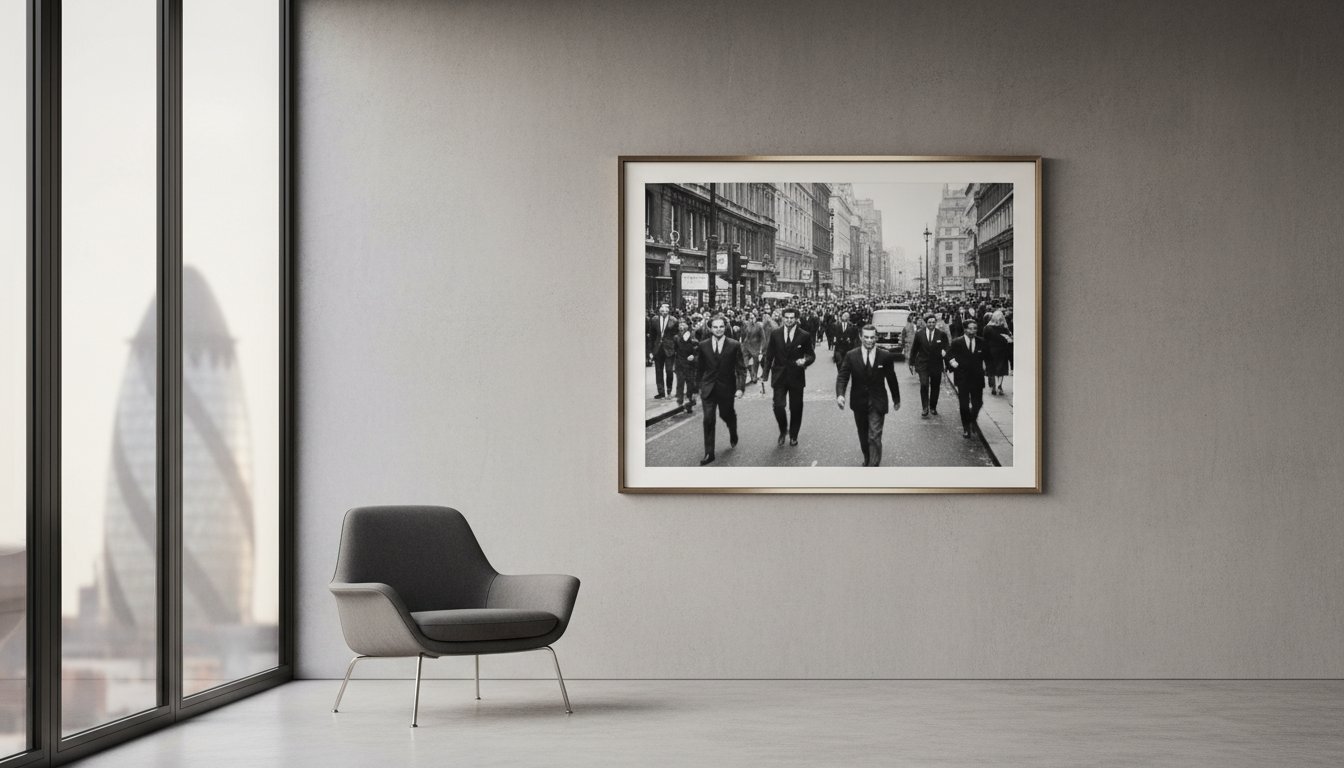
A single photograph taken in london street during the summer of 1963 holds more cultural weight than the 1.8 billion digital images uploaded to global servers every single day. You likely feel that a generic, mass-produced poster from a high-street retailer fails to capture the grit and glamour of a city that has inspired artists for centuries. It’s exhausting to search for authentic art only to find low-resolution reproductions that lack the depth of a true archival print.
At Galerie Prints, we serve as guardians of this photographic heritage. We’ll show you how the world’s finest photographers captured the raw essence of the capital and how you can bring that timeless urban aesthetic into your own living space. You’ll learn the stories behind these curated moments and see how our bespoke, hand-printed silver gelatin pieces provide a sense of permanence that digital files never can. This guide explores the provenance of our most iconic shots and explains how to select a piece of history that arrives ready to hang in your luxury interior.
Key Takeaways
- Understand the evolution of life in london street photography, tracing its journey from raw documentary moments to the sophisticated fine art that captures the city’s enduring soul.
- Identify the iconic thoroughfares that shaped global cultural movements and learn how location serves as a pivotal element in legendary fashion and celebrity imagery.
- Discover the critical distinctions between mass-produced posters and archival-quality prints, emphasizing the importance of provenance in building a prestigious art collection.
- Master the art of curating an urban aesthetic within your home, using narrative-driven gallery walls to create a sense of timeless nostalgia and modern elegance.
- Explore how bespoke craftsmanship and hand-printing techniques ensure each piece remains a lasting investment in the world’s finest photography.
The Enduring Allure of Life in a London Street
The London street has remained the primary muse for urban photographers for over 120 years, acting as a living gallery that documents the pulse of the metropolis. What began in the late 19th century as a grit-laden documentary effort to record the lives of the working class has matured into a sophisticated genre of fine art. This transition reflects a shift in how we perceive the city; we no longer look at these images merely as historical records but as curated masterpieces that belong in a private collection or a high-end gallery. A single, well-timed photograph from 1966 can encapsulate the entire spirit of a decade, freezing the cultural revolution of the Swinging Sixties in a single frame of movement and style. The light is everything.
Defining the London aesthetic requires an appreciation for the city’s inherent contradictions. It’s a blend of architectural heritage, from the soot-stained bricks of the East End to the white stucco of Belgravia, paired with the fleeting glamour of its inhabitants. Capturing a candid moment in london street photography requires an eye for this drama, where the permanence of the stone meets the ephemeral nature of the crowd. These photographs offer a sense of stability, suggesting that while the people change, the city’s soul remains constant.
Beyond the Pavement: London as a Photographic Subject
The role of natural light is paramount in London’s photographic history. The city’s famous “pea-souper” fogs of the early 1950s and the soft, diffused grey skies provide a unique atmosphere that softens edges and adds a layer of mystery to every shot. The city’s layout, characterized by its labyrinthine alleys and grand, sweeping avenues, creates natural frames that guide the viewer’s eye toward the heart of the composition. The London street aesthetic represents a fusion of historical permanence and fleeting human moments.
The Nostalgia Factor in Urban Art
Modern collectors are increasingly drawn to the tactile and emotional depth of monochrome scenes. There’s a specific yearning for the “lost” London of the mid-20th century, a time when the city was rebuilding and reinventing itself. This fascination is built upon the timeless allure of black and white pictures which serves as a foundation for any serious street photography collection. The way light falls on a wet pavement in london street scenes creates a cinematic quality that color often obscures. By focusing on contrast and form, these silver gelatin prints offer a sense of provenance and archival prestige that resonates with those who appreciate the world’s finest photography.
Mapping the Icons: From Carnaby Street to Abbey Road
The narratives captured in london street photography during the mid-20th century transformed simple thoroughfares into global icons. London’s geography isn’t merely a collection of coordinates; it’s an archival record of human expression. These locations served as the stage where the rigid social structures of the post-war era collided with a radical new youth energy. While the physical facades of these buildings have shifted over the decades, the curated prints in our collection preserve the soul of these moments with a clarity that digital media cannot replicate. The significance of location in these works lies in the tension between the timeless, grey London architecture and the fleeting, vibrant movements of the people within the frame.
The Swinging Sixties: Carnaby Street and King’s Road
By the time Time magazine declared London the “Swinging City” on April 15, 1966, Carnaby Street had already become the epicentre of a fashion revolution. Photographers like Terry O’Neill played a vital role in documenting this explosion of youth culture in Soho. He captured the transition from the austerity of the 1950s to the peacock brilliance of the 1960s. These streets weren’t just places to shop; they were laboratories for identity. The contrast was stark. Traditional Victorian brickwork served as the backdrop for Mary Quant’s miniskirts and the bold, geometric patterns of mod culture. This juxtaposition created a visual language that defined an entire generation, turning a narrow West End street into a symbol of global liberation.
Music and the City: The Streets that Defined an Era
Few locations illustrate the power of the lens better than the zebra crossing at Abbey Road. On August 8, 1969, at approximately 11:35 AM, a simple ten-minute photoshoot created what is perhaps the most famous street image in history. Through the lens of music photography, ordinary crossings were elevated to the status of shrines. This transformation continued into the 1970s and 80s, as the raw energy of London’s backstreets and club scenes began to dominate the frame. The grit of a Soho alleyway or the industrial shadows of the East End provided the perfect texture for the burgeoning punk and New Romantic movements.
- Carnaby Street: The birthplace of the Mod aesthetic and 1960s youth rebellion.
- King’s Road: The sophisticated heart of Chelsea’s fashion and punk scenes.
- Abbey Road: A testament to how a single image can turn a suburban road into a site of pilgrimage.
- Soho Backstreets: The gritty, authentic core of London’s nightlife and subcultural history.
The energy found in london street life remains immortalized in our archival collections, where each piece is a bridge to the golden age of glamour. These images offer more than just nostalgia; they provide a definitive record of a city in constant flux. To own one of these prints is to possess a tangible piece of this heritage, meticulously preserved. You might consider exploring our exclusive collections to find a piece that resonates with your own sense of history. We take pride in the fact that many of our works are hand-printed in our London darkroom, ensuring that the world’s finest photography is presented with the technical superiority it deserves.
Archival Quality: Why Fine Art Prints Surpass Modern Snapshots
A mass-produced poster is a fleeting decoration, but an archival-grade print is a legacy. The distinction lies in the soul of the production. While digital snapshots often live and die on glowing screens, serious collectors understand that the true essence of a moment is only preserved through meticulous craftsmanship. Hand-printed works from original negatives possess a physical presence that digital reproductions lack. This depth is born in the darkroom, where chemistry and light converge to create a tangible piece of history. A candid moment captured in london street life during the 1960s gains a profound, sculptural quality when rendered through traditional methods.
The value of a photographic collection isn’t just in the image itself, but in its physical integrity and its journey from the camera to the wall. Premium street photography requires a medium that can handle the grit of the pavement and the soft glow of a Victorian streetlamp with equal precision. By choosing archival quality, you aren’t just buying a picture; you’re investing in a curated artifact that maintains its brilliance for generations.
The Technical Superiority of Silver Gelatin
The silver gelatin process remains the gold standard for black and white photography. It uses light-sensitive silver salts suspended in a gelatin layer, a method that creates an unmatched tonal range from the deepest obsidian blacks to the most luminous, ethereal whites. This chemical bond produces a three-dimensional “pop” that flat digital ink cannot replicate. Every print is a unique labor of love, hand-crafted in our London darkroom to ensure the artist’s original vision is honored.
- Tonal Complexity: Silver gelatin captures subtle gradations in shadow that are essential for the moody atmosphere of London’s alleyways.
- Fiber-Based Paper: We use heavy-weight archival photo paper that offers a rich, tactile texture and prevents the curling common in cheaper alternatives.
- Artisanal Precision: Hand-printing allows for “dodging and burning,” a technique where the printer manually adjusts light levels to highlight specific details in complex street scenes.
Provenance and the Value of Historic Archives
Authenticity is the cornerstone of any serious art collection. Galerie Prints serves as a guardian of photographic heritage by working directly with prestigious institutions like the Getty Images Gallery and the Terry O’Neill archives. These partnerships ensure that every piece is sourced from original material, providing a direct link to the golden age of photography. Collectors receive official gallery certification and authenticity stamps, which are vital for establishing the long-term value and provenance of the work.
When properly mounted and framed using museum-grade, acid-free materials, archival silver gelatin prints can last over 100 years without significant degradation or loss of detail. This permanence ensures that a fleeting moment captured in london street environments becomes a lasting piece of history. Whether you’re drawn to the high-fashion energy of the West End or the raw textures of the East End, these prints offer a sense of stability and prestige that defines the world’s finest photography.
Curating the Urban Aesthetic: Decorating with London Photography
Bringing the kinetic energy of a moment captured in london street life into a private residence requires a discerning eye for composition and scale. High-end urban photography serves as a window, offering a permanent connection to the city’s shifting narrative. When you integrate large-scale prints into contemporary interiors, the photograph becomes an architectural element. It anchors the room, providing a sense of depth that expands the physical boundaries of the space. In minimalist settings, the intricate detail of a bustling London thoroughfare provides a necessary counterpoint to clean lines and neutral palettes, preventing the decor from feeling sterile.
Creating a gallery wall allows for a more complex storytelling approach. By mixing candid snapshots of 1960s Soho with architectural studies of the City, you build a visual history that spans decades. This curated layering reflects the multifaceted nature of the metropolis itself. In professional environments, the impact is equally profound. A 2010 study by the University of Exeter’s Dr. Craig Knight revealed that employees working in “enriched” spaces decorated with art were 17% more productive than those in lean, functional offices. A well-placed street scene provides a cognitive break, inviting the viewer to step out of their immediate tasks and into a different world.
Choosing the Right Scale for Street Scenes
The dimensions of your print dictate the room’s emotional volume. An oversized statement piece, perhaps a wide-angle view of Westminster at dusk, commands the entire wall and sets a tone of grandeur. Conversely, a series of smaller, intimate close-ups of architectural details or fleeting human interactions invites the viewer to step closer. It’s vital to match the mood to the room’s function. A high-energy scene of a rainy night in london street history, filled with neon reflections, suits a vibrant dining area, while the quiet, rhythmic shadows of a residential mews are better suited for a study or bedroom.
Framing the City: Bespoke Mounting for Urban Art
Acquiring fine art photography is only the first step; the presentation must match the caliber of the print. At Galerie Prints, we believe that bespoke framing is non-negotiable for preserving the archival integrity of the work. For classic black and white street photography, a slim black wooden frame with a generous white mount remains the gold standard, as it focuses the eye entirely on the silver gelatin tones. Colour photography often benefits from more neutral, natural wood tones that don’t compete with the palette of the image.
- Anti-Reflective Glass: We utilize museum-grade glass to ensure the city’s finest details aren’t obscured by glare.
- Archival Mounting: Using acid-free materials prevents yellowing, ensuring the print remains as crisp as the day it was hand-printed in our London darkroom.
- Proportional Weight: The width of the frame should complement, not overwhelm, the delicate grain of the film.
The world’s finest photography deserves a finish that reflects its provenance and the skill of the artist behind the lens. By choosing professional mounting, you secure the photograph’s future as a lasting piece of history within your home.
Discover the perfect centerpiece for your interior by exploring our exclusive collection of iconic London street photography today.
Discover the World’s Finest London Street Photography at Galerie Prints
Galerie Prints serves as a dedicated guardian for the world’s most evocative imagery. We don’t just sell prints; we preserve the delicate provenance of photographic history. Based in the heart of the UK, our gallery bridges the gap between local artisanal excellence and a global audience of discerning collectors. Every piece in our collection represents a deliberate investment in cultural history, capturing moments that defined the 20th century. Whether you are looking for a candid moment captured in london street scenes or an iconic fashion study, our bespoke journey ensures your selection is treated with the reverence it deserves. From the initial curation to the final professional framing, we maintain a standard of quality that satisfies the most rigorous archival requirements.
Hand-Printed in Our London Darkroom
The soul of a photograph lives in its physical form. At Galerie Prints, we champion the rare art of traditional craftsmanship. Every silver gelatin print is hand-printed in our London darkroom, utilizing techniques that have remained unchanged for decades. This commitment to local production ensures that the final work possesses a depth and tonality that digital processes simply cannot replicate. Our curators meticulously select images that do more than just document a location; they tell a story of the city’s evolving identity. We lean heavily into the “Slim Aarons” lifestyle, emphasizing a world of luxury, aspirational beauty, and timeless style. By choosing a print from our darkroom, you are acquiring a piece of art that embodies the same prestige as the original negatives from which they were born.
Start Your Collection with a Piece of History
Building a personal gallery should be an inspiring and seamless experience. Our online platform allows collectors from New York to Tokyo to browse through thousands of curated images spanning film, music, and classic street photography. You can find a striking visual captured in london street history and have it delivered to your door with world-class shipping protection. For those who prefer a more tactile consultation, our Wimbledon gallery offers a private space to explore the collection in person. Since our founding, we have focused on making “The world’s finest photography” accessible to those who value authenticity. Each purchase includes detailed information on the print’s origin, ensuring you understand the historical weight of the art you own. Visit us in Wimbledon or explore our digital archives to find the piece that speaks to your unique aesthetic.
- Archival Quality: We use museum-grade materials to ensure your investment lasts for generations.
- Global Reach: Our logistics team handles international shipping with specialized crating for delicate frames.
- Curatorial Expertise: Our staff provides insights into the photographers’ lives and the technical nuances of each shot.
- Bespoke Framing: Choose from a variety of hand-finished frames to complement your interior design.
Preserve the Narrative of the Urban Landscape
Owning a piece of London’s history is more than a decorative choice; it’s a commitment to preserving a specific moment in time. Whether you’re drawn to the 1960s energy of Carnaby Street or the quiet, atmospheric scenes found in london street life, these images represent the pinnacle of urban art. Our official partnerships with the Terry O’Neill and Getty Images archives ensure that every print carries the weight of authentic provenance and historical significance. We don’t just offer images; we provide a bridge to the golden age of photography. Each piece is meticulously hand-printed in our London darkroom, utilizing artisanal processes that offer a depth and texture modern digital snapshots can’t replicate. By choosing our bespoke framing service with museum-quality materials, you’re investing in a legacy that will endure for generations. It’s time to transform your walls into a gallery that celebrates the world’s finest photography.
Explore our curated collection of iconic London street photography and bring the city home.
Start your journey today and find the perfect window into the soul of the city.
Frequently Asked Questions
What is the best type of print for a black and white London street scene?
A silver gelatin print is the gold standard for a black and white scene captured in london street photography. These prints, often hand-produced in our London darkroom, utilize light-sensitive paper and silver salts to create deep, velvety blacks and a rich tonal range that digital processes can’t replicate. This traditional method ensures your artwork remains a timeless heirloom for over 100 years.
Are the prints at Galerie Prints original or reproductions?
Galerie Prints offers authentic, archival-grade prints produced directly from original negatives or transparencies held in prestigious archives like the Getty Images Gallery. We don’t sell mass-produced posters; every piece is a bespoke creation authorized by the estate or photographer. Each print comes with a certificate of authenticity to verify its provenance and status as a genuine piece of photographic history.
How do I choose the right size print for my living room wall?
You should select a print size that occupies approximately 60% to 75% of the available wall space above your sofa or sideboard. For a standard 2.5-meter sofa, a large format 30×40 inch print provides a balanced, gallery-style focal point. If you’re creating a triptych, ensure at least 5 centimeters of space between frames to maintain a cohesive yet breathable visual arrangement.
What makes Terry O’Neill’s London photography so collectable?
Terry O’Neill’s work is highly collectable because he captured the 1960s “Swinging London” era with unparalleled intimacy and access. His 50-year career included iconic portraits of The Beatles and The Rolling Stones that defined British youth culture. Since his passing in 2019, the finite nature of his signed editions has led to a steady increase in demand among serious art investors.
Do you offer international shipping for framed photography prints?
We provide secure international shipping for all framed photography prints to over 50 countries across the globe. Our team utilizes bespoke wooden crates and shock-absorbent materials to ensure your artwork arrives in pristine condition. We partner with specialized art couriers like DHL and FedEx to provide end-to-end tracking for every shipment leaving our London gallery, ensuring total peace of mind.
Can I find Slim Aarons prints that feature London locations?
You can find several exquisite Slim Aarons photographs featuring London’s elite locations, such as his 1950s shots of Claridge’s or private residences in Belgravia. While he’s famous for poolside glamour, Aarons documented the “attractive people doing attractive things” philosophy in london street settings as well. These prints offer a rare glimpse into the mid-century British aristocracy through his signature lens.
What is the difference between a silver gelatin print and a C-type print?
The primary difference lies in the chemistry, as silver gelatin prints use silver halides for black and white imagery, while C-type prints are a chromogenic process for color photography. Silver gelatin prints are hand-processed in a darkroom to achieve a specific tactile quality and archival permanence. C-type prints utilize light-sensitive paper exposed to digital or analog light sources to produce vibrant, true-to-life colors.
How should I care for my archival photography print to prevent fading?
To prevent fading, you must frame your print using 99% UV-protective glass or acrylic and avoid hanging it in direct sunlight. Maintaining a stable environment with humidity levels between 30% and 50% protects the paper fibers from warping or mold growth. These museum-grade standards ensure the pigments and emulsions remain vibrant for several generations without the need for any professional restoration.